Articles
National and Natural Parks in Portugal. A brief history to understand the appropriation by the state of humanized territories
National and Natural Parks in Portugal. A brief history to understand the appropriation by the state of humanized territories
Investigaciones Regionales - Journal of Regional Research, núm. 55, Esp., pp. 93-111, 2023
Asociación Española de Ciencia Regional

Esta obra está bajo una Licencia Creative Commons Atribución-NoComercial 4.0 Internacional.
Recepción: 31 Mayo 2022
Aprobación: 16 Septiembre 2022
Resumen: The text examines legal frameworks in Portugal to discuss how nature conservation has been managed from a state perspective. Natural Protected Areas correspond to a desire of the political sphere to match an international environmental agenda. However, they have been implemented mainly in private properties or in baldios (communal, though not public lands). Therefore, in practical terms, a tension has been always present between the state and the communities and/or private owners since the beginning of the 20th Century with the creation of ‘forest perimeters’. The article flies over the critical turning points in Portuguese conservation policies from the seventies of the 20th Century to present-day with the recently created diploma of co-management for Protected Areas.
Keywords: Portugal, state, protected areas, conservation, legal diplomas
National and Natural Parks in Portugal. A brief history to understand the appropriation by the state of humanized territories
1. Preamble
With this text we want to systematize a set of normative tools that frame the emergence of Natural Parks in Portugal, keeping the evolution of nature conservation policies in the Spanish State as reference, though it is not our intention to deeply analyze the latter. One first and important fact points to a late process as concerns the creation of Protected Areas (PAs) and specifically Natural Parks (NPs) in Portugal; in this sense, when comparing with the history of PAs in the Spanish State, more than 50 years separates the two countries. Only in 1971 Portugal established its first protected area, the National Park Peneda-Gerês (PNPG), up in the northern and mountainous part of the country - also a rural and humanized landscape. Our aim, considering Goberpark project[1] scope and its objectives, is to set a comparative scenario to think with and through different approaches to nature conservation. Actually, despite the territorial contiguity of some PAs of the two Iberian States, which have allowed recent joint collaborations concerning nature conservation policies (e.g. Reserva da Biosfera Tranfronteiriça Gerês-Xurês[2] and Reserva da Biosfera Transfronteiriça Meseta Ibérica[3]), we can identify a different history in each state that relates not only to different geopolitical histories, but also to more specific nature conservation concerns and policies. Especially, the fact that Portugal is administratively a ‘homogenous’ state contrasts with the historical and political heterogeneity of Spain and its Autonomies (cf. for instance, as concerns the management of transboundary Biosphere Reserves, Trillo & Paúl, 2018 and 2016). As we will see, the fact that Portugal as a whole is a smaller country - territorially speaking - with higher population densities also contributes to different approaches to nature conservation and options in terms of nature heritagization. For instance, Portugal only has one National Park, contrasting with sixteen in Spain. In this sense it is also important to look at the recent socio-economic history of the two countries, considering development models in which tourism must also be included as well as the transformative dynamics of the rural world (Figueiredo, 2008a; Frazão-Moreira, Carvalho & Martins, 2009; Pereira da Silva, 2000; Silva, 2008). Nature conservation and heritagization processes in Portugal cannot be dissociated from the structural transformation of its rural world in all its dimensions - demographic, ideological, social, political and cultural (idem, ibidem).
In fact, 1971 indicates a relatively recent nature conservation history in the Portuguese State, but we may trace back to the end of the 19th Century and the beginning of the 20th Century a kind of pre-history of nature conservation in Portugal with the creation of the perímetros florestais (forest perimeters)[4]. By reading the legal diploma that establishes these areas in the scope of the Forest Regime (1901 - part IV, article 25.º, Decree, 24 December 1901, in Estêvão, 1983), we identify concerns with the conservation of natural values and their functions and benefits in many ‘environmental’ realms. In the text is referred that “the forest cover of land whose afforestation is of public utility, and convenient or necessary for the good regime of the waters and defence of the floodplains, for the valorisation of the arid plains and benefit of the climate, or for the fixation and conservation of the soil, in the mountains, and the sands, on the sea coast” (our translation). In fact, two of these forest areas (which included communal, municipal and private lands occupied by State forest services), created in the late 19th Century, correspond to two of the biggest and most important, in terms of natural values, PAs in Portugal – PNPG and Natural Park of Serra da Estrela (PNSE).
The excerpt of this old legal diploma suggests a notion of conservation in a latus sense; in a certain way one can identify some principles of an ecosystem service perspective – an integrative approach that refers to the benefits and provided services of creating and keeping a good forest. Obviously, it does not explain conceptually a conservation nor an environmental policy in the sense of what 70 years after framed the creation of the first protected area in Portugal or, for instance, the National Parks in the Spanish State back in the second decade of the 20th century (Parque Nacional da La Montaña de Covadonga in 1918 [actually Parque Nacional de Picos de Europa] and Parque Nacional de Ordesa in 1919). But, as we said before, there were purposes in that forest policy which did go beyond forest production assumptions in strictum sense. In fact, forest engineers “were the main actors in the creation of the nature protectionist movement in Portugal during the first half of the 1900s” (Pinto & Partidário, 2012, p. 792).
Notwithstanding, and this is the critical question here, this approach by the national government was a turning point considering the contemporary history of relations between local communities and the central state as concerns the creation of PAs. The creation of forest areas depended on land occupation in terms of uses; lands that were previously used by local communities for grazing cattle and for manure (cattle bed) became areas of forest production – following principles of resource rationalization and territorial management according to, at the time, advances in forest science knowledge (Devy-Vareta, 2003). More than simply planting trees, that was a time when the state services and representatives planted the seeds of distrust and conflict that lasts until today, concerning not specifically nature conservation as a whole but mainly conservation promoted by the national government (cf. Estêvão, 1983) and anything that is seen as ‘coming’ from the state; a representation that perdures until today and defines much of the conservation attitudes in Portugal (Iannuzzi, Santos & Mourato, 2020). That was a time when the appropriation by the state of humanized territories in rural areas, especially in the Northern regions of the Country, began. Nevertheless, the role of an environmental NGO, such as LPN[5] (Liga para a Protecção da Natureza) in the implementation of the first PAs in Portugal, PNPG, and Natural Park of Arrábida (PNA) was decisive. Per se, the Portuguese State, especially under a dictatorial regime (until 1974) and with no particular and clear idea for nature conservation, would not have been able to implement PAs in the country. Such actors as LPN were crucial to translate international demands into practical terms (Pinto & Partidário, 2012). However, a centralized approach based on a territorial appropriation ideology by the national government with little space for effective participation of other actors still prevails until today and despite legal evolutions towards participatory models, concerning implementation and management of PAs (Iannuzzi, Santos & Mourato, 2020).
2. Introduction
We now need to fast-forward this proto-history to set up our timeline in the 1970s and to analyze the most significant legislation within the scope of what we would call the process of social and political construction of nature in contemporary Portugal (Iannuzzi, Santos & Mourato, 2020; Martins, 2018; Pinto and Partidário, 2012). We believe that a diachronic analysis of the normative frameworks defined by the Portuguese State helps us to conceptually understand several aspects that are relevant in studies on PAs, and in particular within the field of anthropology (e.g. Brockington, Duffy & Igoe, 2008; Beltran & Vaccaro, 2008; Córtes Vázquez & Beltran, 2019; Martins, 2018; Santamarina, 2019 and 2009) and address some critical questions: (i) what is nature?; (ii) what is nature conservation/protection?; (iii) what is a protected area?; (iv) what can be the place of humans in protected areas and what are the limits of their action?; (v) what are the hegemonic political ideologies concerning nature conservation?; (vi) what are the main management paradigms?; (vii) what forms of nature appropriation are emergent at a certain moment in history?; and finally (vii) identify participatory possibilities beyond those framed by and for state services. Actually, the objectives of Goberpark are quite clear as concerns these matters, when assuming the need to trace the genealogies of Natural Parks as crucial to understand not only what they are but what they can be[6] - the diversity of PAs experiences in terms of public acceptance/social representations, consensual interests, state-local communities’ relations, impacts, is also undeniably related to a particular history of implementation, definition of restrictions and management (Iannuzzi, Santos, & Mourato, 2020; West, Igoe & Brockington, 2006). In this sense, one of the research lines of the project is related to conservation policies, natural heritage and forms of governance, considering that the state has been the key actor in the nature conservation history of the two countries, though now facing challenges by the so-called green capitalism through the financialization of nature (Brockington and Duffy 2010; Sullivan 2012)[7].
Therefore, the specific objective of this article is to address the legislation concerning the creation and management of parks in Portugal, which are analyzed bearing in mind the turning points of conservation policies and the role of local communities. A documental methodology and a qualitative text analysis (Bernard, 1995; Wutich et al 2015) of the legislation concerning Portuguese parks, published from 1971 until now, was followed.
Normative diplomas, as texts of law, shape and are shaped by social representations that are relatively hegemonic or imposed in a society, in a specific time. They are inscribed in a cultural narrative that is also worthy of scrutiny. Specifically, the legislative texts on nature conservation, PAs, the environment and the creation of natural parks in these two countries show that they cannot be dissociated from ideological frameworks that are more or less hegemonic in the Western World (Apostolopoulou & Cortés Vazquez, 2019; Iannuzzi, Santos & Mourato, 2020; Martins 2018; Pinto & Partidário 2012). Something reinforced in the cases of Portugal and Spain with their admission in the European Union back in 1986 (Figueiredo, 2008b; Iannuzzi, Santos & Mourato, 2020; Pinto & Partidário, 2012). A very recent example may be found in the post-crisis neoliberal policies and their impacts on PAs management models (Apostolopoulou & Cortés Vazquez, 2019; Brockington & Duffy, 2010; Sullivan, 2012). They show that recent evolutions in nature conservation governance models have been affected by a managerialism philosophy that points to a capitalistic appropriation of PAs with the competence transference from the state to economic-driven actors. Another significant example of this may be located in a new trend of governance based on co-management principles (Petursson & Kristofersson, 2021) - a subject to which we will return in the last section of this article. Therefore, a scrutiny of nature conservation policies and the creation of PAs will always constitute a gateway to broader themes that are critical to grasp nature conservation models and improve PAs governance possibilities and, in particular, of Natural Parks (NPs). These are assumed and proposed objectives of the Goberpark project. In the Foucauldian wake, we understand that public policies, as discourses that are produced about reality, define that same reality and the spectrum of possibilities for action and perception of it (in this case, protected areas).
Having said that, another critical assumption is due: the creation of PAs, and of NPs in particular, do not correspond to undisputed processes devoid of contradictory and provisional views (Brockington, Duffy & Igoe, 2008; Martins, 2018, West, Igoe & Brockington, 2006). Quite the opposite. The analysis of these texts reveals a conceptual evolution that also reflects renewed frameworks about what nature is, its conservation, the place of humans on it, the economy, politics and the world (Apostolopoulou & Cortés Vazquez, 2019; Carvalho & Fernandes, 2002; Pinto & Partidário, 2012) and governance systems (Iannuzzi, Santos & Mourato, 2020; Petursson & Kristofersson, 2021), considering that effectively PAs demand more than objectives related to conservation only. More specifically, in this text, based on an exploratory study of a documentary nature, we examine the national/state network of protected areas, with a focus on NPs, in Portugal, through the analysis of the legislative texts that frame the creation and management of Natural Parks and, in a comparative perspective, through the identification of the most significant numeric differences between the networks of Spain and Portugal. Development goals, public participation, subsidiarity, leisure, cultural heritage, resource management, infrastructure construction, ecosystem services, forest, among others, set the complexity and multidimensionality reflected on these diplomas that go far beyond purely nature conservation.
3. Brief Characterization of Protected Areas in Portugal
Portugal has a total area of 92,212 Km2 (89,089 on the mainland, 2322 Km2 in the Azores and 801 Km2 in Madeira), with 22% of the land area included in the Natura 2000 Network and 16% of protected marine waters (ICNF, 2017). The conservation of nature and biodiversity and the creation of protected areas in the continental area is responsibility and competence of the Portuguese State, through its national authority, Instituto de Conservação da Natureza e Florestas (ICNF)[8]. In the Autonomous Regions of the Azores and Madeira islands, it is the responsibility and competence of the regional Governments. The legal framework of nature and biodiversity conservation areas (National System of Classified Areas - SNAC; Decree-Law 242/2015) comprises: i) the National Network of Protected Areas (RNAP); ii) the national sites and special protection areas integrated in the Natura 2000 Network (European commission's biodiversity conservation network); iii) other classified areas under international commitments assumed by the Portuguese State. It is within this framework of the SNAC that all categories and typologies of protected areas are defined, including the one of the Natural Park included in the RNAP.
Regarding the different PA regimes in Portugal, they can be national, regional, local, international (in territories adjacent to Spain) or private (Table 1, Figure 1). Regarding the autonomous regions, there is a natural park in Madeira and another one in the Azores, in this case encompassing the existing protected areas on each of the nine islands. Three marine parks were also created adjacent to three of the terrestrial natural parks: Luís Saldanha Park adjacent to the Arrábida NP, Cabo Girão in Madeira, and the marine area of the Azores NP. The area occupied by NPs thus corresponds to 8% of the total area of mainland Portugal and to two thirds of the territory of Madeira. In relation to the Azores archipelago, due to the diversity and multiplicity of protection figures, there is no data available to fully stipulate this value.
Table 1.
National Network of Protected Areas (RNAP) on the Continent - Portugal
| Nº | Total Area (ha) | Land Area (ha) | Sea Area (ha) | |
| National Scope | 32 | 743,100.57 | 689,479 | 53,621 |
| Regional Scope | 8 | 52,221.66 | 52,221.66 | 0,00 |
| Local Scope | 7 | 3,523.4 | 3,523 | 0,00 |
| Private Scope | 1 | 214.65 | 214 | 0,00 |
In brief, Portugal has 16 Natural Parks, 14 of them continental (13 of national scope and 1 regional -the last one to be created- Vale do Tua Natural Park managed by the Vale do Tua Regional Development Agency, currently comprising the municipalities of Alijó, Carrazeda de Ansiães, Mirandela, Murça, Vila Flor and EDP - the strongest Energy Company in Portugal).
Figure 1.
Location of Protected Areas in Mainland Portugal. 2020
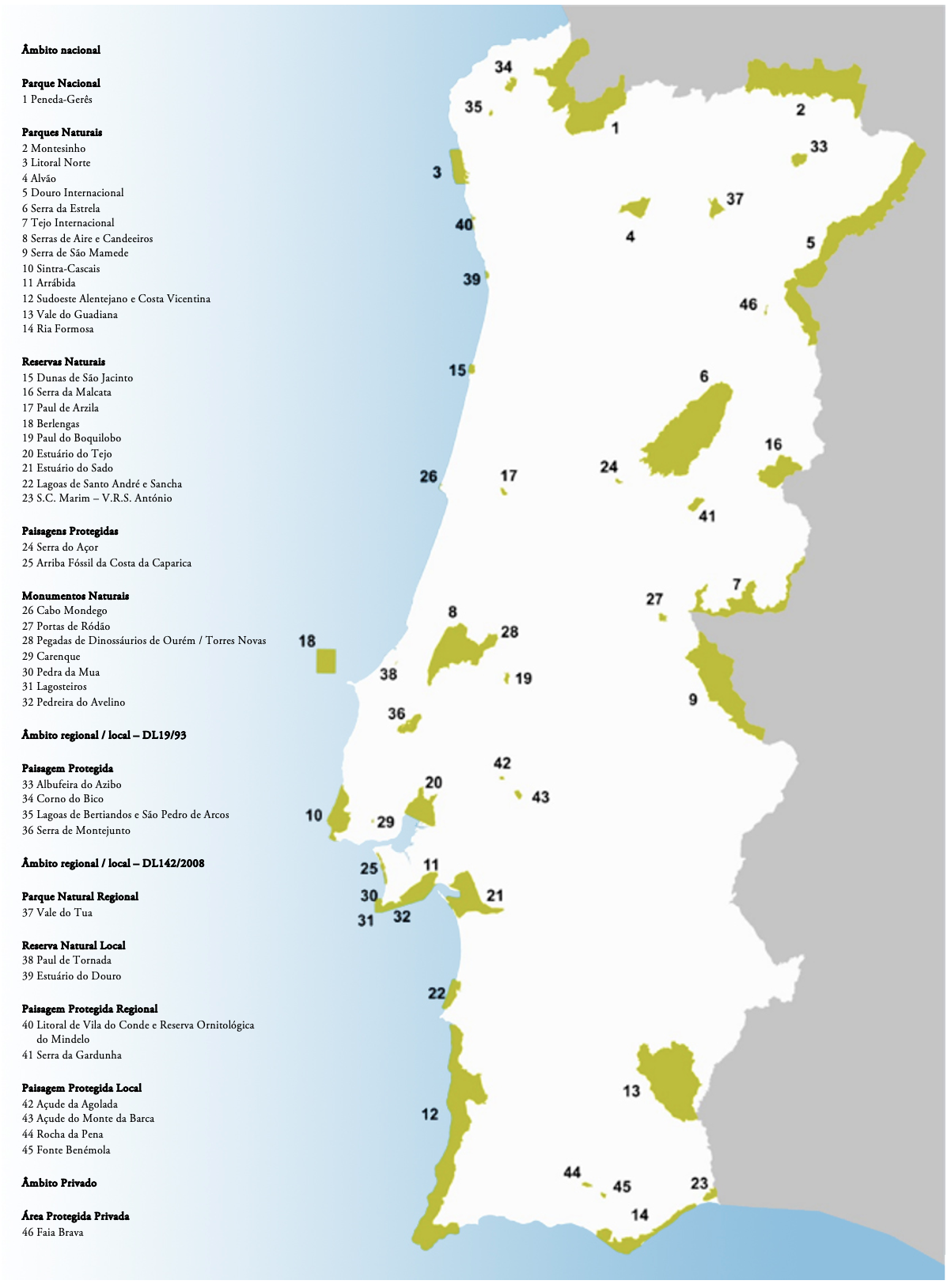
Source: ICNF
4. The 14 Natural Parks in continental Portugal
Three NPs are located in the sea coastaline (North Coast, Southwest Alentejo and Costa Vicentina, Ria Formosa); four NPs are related to rivers / hydrographic basins (Douro International, Vale do Tua, Tejo International and the Guadiana Basin); four NPs in the inner mountain (Alvão, Montesinho, Serra da Estrela, Serra de São Mamede) and three in the littoral mountain range (Serra de Aire, Sintra-Cascais and Arrábida). Some of them are in areas of strong tourist attraction, namely the first two to be created, in 1976, Arrábida and Serra da Estrela (where the highest peak of mainland Portugal is located – Torre 1993m and the only Portuguese spot with some snow tourism); these two have been subject to strong human pressure from visitation. The rest correspond to depopulation areas and emptying of agricultural activity (Carvalho & Frazão-Moreira 2011; Figueiredo 2008a), namely Alvão, Montesinho and Douro Internacional. As concerns the area of the NPs, the largest is the Sudoeste Alentejano NP with 89,571.90 ha, followed very closely by Serra da Estrela (Central Inner Region), and the smallest, the Alvão NP (Interior North) with 7,202.70 ha. Most NPs, and also the only National Park in Portugal, are located in areas of low population density (except Arrábida Natural Park and Sintra-Cascais Natural Park - both in what can be designated the Greater Lisbon/Lisbon Metropolitan Area and subject to strong tourist pressure, real estate speculation for the construction of first and/or second homes and even until the 1990s, threats from industries). Some examples, such as Montesinho NP (population density in 2011 and 2001 of municipalities of Bragança - 28.6/29.6, and Vinhais -11.2/15.2) or Guadiana Valley NP (Mértola - 4.8/6.7, and Serpa - 13/15.1) – compares negatively with the density for the whole country (114.5/112.4[10]). Obviously, this is a non-absolute figure due to the size of each municipality, but it is a fact that NPs are mostly located in low-density areas (Figueiredo, 2008b).
Therefore, it is not surprising that the most recent development plans and framework documents define local development and the valorization of endonegous resources as main achievements to fulfill and as a declared intention for the territories – both on economic and social levels (Figueiredo, 2008b; Iannuzzi, Santos & Mourato, 2020; Pereira da Silva 2000). In this sense, the issue of fixing people and the importance that they may have simultaneously as caregivers and cultivators (guardians and gardeners) of the landscape and nature, becomes present in the current policies and management instruments of protected areas. Once again this is a trend aligned with international debates (Iannuzzi, Santos & Mourato, 2020; Martins, 2018). The role of humans in PAs and the importance of assuring active forms of local management that implicate indigenous communities and their cultural perspectives and knowledge on nature and on their dwelled territories is thus present in conservation narratives.[11] In the marginal areas of Europe (such as Portugal) the issue is related to the invention of a new rural where agropastoral activities and identities lose their space in favor of tourism and recreational activities, gentrification (Figueiredo, 2008b) and even to capitalistic modes of production associated to environmental protection (Brockington & Duffy, 2010; Sullivan, 2012). This last feature, however, so far does not seem to be the focus in Portugal.
We will look now to the Spanish State, in a quick glimpse, only to provide a comparative framework[12]. Spain has a territory of 505,990 km2. The competences regarding the protected areas belong to the autonomies (regarding the three autonomies approached by Goberpark project, in Catalunya since 1980, in Andalusia since 1984 and in Valencian Community since 1985). 27% of the terrestrial territory is protected and included in the Natura 2000 Network and 13% of marine waters are protected (Europarc 2018; Table 2). Protected areas can have a regional, autonomic or international status. So far, 152 NPs have been created in Spain. Considering the three Autonomic Communities (Regions), envisioned as analysis units by Goberpark, Andalusia has 24 NPs, Valencian Community has 22 NPs and Catalonia has 14. In terms of population, in 2020, Spain had 47 million residents, which meant a density of 94 inhabitants/Km2 considering an area of 505,990 km2. Portugal in 2021 had 10,101,363 inhabitants, which meant a population density of 112, 2/km2, considering its 92,212 Km2.
Table 2.
Surface area and number of protected natural spaces under the figures established in the State Law (42/2007) - Spain
| Categories | Nº | Area Total (ha) | Land Area (ha) | Sea Area (ha) |
| National park | 16 | 488,678 | 391,911 | 96,767 |
| Natural park | 152 | 4.075,116 | 3.984,061 | 91,054 |
| Natural reserve | 291 | 169,165 | 158,650 | 10,516 |
| Natural monument | 359 | 89,505 | 89,387 | 118 |
| Protected landscape | 61 | 160,762 | 156,776 | 3,986 |
| Protected marine area | 2 | 4.896,316 | 4.896,316 |
5. Chronology of the legislative process for the creation of PAs in Portugal with a special focus on Natural Parks
In chronological terms, as previously mentioned, a fact to consider is related to the late creation of protected areas in Portugal (compared to other countries, in particular Spain). In 1971, the Peneda-Gerês National Park and a first Natural Reserve (Arrábida) were created, later reclassified as a Natural Park (1976), both on the initiative of an NGO, the LPN. It is, in fact, in the last 50 years that we can speak of a true environmental policy of nature conservation and protected areas, following an international trend (Brockington, Duffy & Igoe, 2008; Iannuzzi, Santos & Mourato, 2020). Until then, and since the end of the 19th century, a forest-centered approach prevailed; albeit with concerns already raised regarding landscape and leisure/contemplation/human enjoyment dimensions. After 1974, with the end of the dictatorial regime, the democratic transition and, in the 1980s, the entry into the European Economic Community together with Spain, legislative production on environmental issues, nature conservation and biodiversity gained decisive momentum. From then, legislation reflects what has been established internationally, mainly the common principles of the European Union (EU). According to Pinto and Partidário (2012), the democratic transition in Portugal, in 1974, signaled a critical shift - from what the authors call the ‘original’ to the ‘new’ paradigm. The original paradigm, advocated by forest engineers and inspired by the wilderness model (based on the Yellowstone paradigm), aimed at the reduction of traditional human activities and the valorization of wilderness. Differently, and especially embraced by landscape architects, the new paradigm, that actually prevailed after 1974, assumed that “PAs had the main purpose of conserving the landscapes resultant from traditional agro-pastoral activities and other associated cultural values” (Pinto & Partidário, 2012, p. 793). In fact, the new paradigm, by assuming the historical and cultural role of local communities not only in the past, but as the continuous landscape gatekeepers, guardians and gardeners, was more faithful to the specificity of the Portuguese social and territorial reality - a highly humanized and rural territory (Carvalho & Frazão-Moreira, 2011; Martins, 2018), which was already facing strong depopulation processes and the abandonment of traditional activities related to a subsistence and family-based agriculture (Figueiredo, 2008b). This new paradigm, despite an evolution from a landscape model (1975 - late 90s) to what Pinto and Partidário (2012) call the biodiversity conservation model, that prevails nowadays, acknowledges that human activities (traditional, such as agro-pastoral, and new, such as tourism) are not incompatible with nature conservation.
It is, in this sense, that we can and must frame the main legislation landmarks considering the PA, and, in particular, the NP (Queirós, 2012; Schmidt et al. 2017). In 1975, the National Service of Parks, Reserves and Landscape Heritage was created (predecessor of the current ICNF), that is, the national entity with maximum competence as concerns biodiversity and nature conservation. In 1976 occurs an amplification of classified area types with the creation of a new Nature Protection Regime (Decree-Law 613/76). With the creation of the Basic Environmental Law (11/87 – revoked in 2014), the scope of the classification is extended again, and the figures of regional and local protection are recognized. Then, in 1993, the RNAP was defined, as well as the regulations relating to the classification processes. In 1999, the Decree-Law 140/99 transposes the European Habitats Directive, which defines the preservation of natural habitats and the conservation of wild fauna and flora. In 2001, the National Strategy for Nature Conservation and Biodiversity was approved, which aims, among other things, at valuing the PAs and their natural, cultural and social heritage elements. 2007 marks an important new stage in terms of PAs governance model. By then the directive commissions of all PAs were extinct, so did the position of NPs director. PAs were grouped into 5 management departments for classified areas according to Nature 2000 network (respecting bio-territorial criteria), each one having a director. In practical terms, NPs lost a ‘human face’, a sort of proximity management approach that for local communities was a valuable aspect. Changes in governance policies are indeed one of the most relevant topics in this history of nature conservation in Portugal. As Pinto and Partidário (2012) sharply refer, governance models in Portugal have changed rapidly in the last 40 years. This raises an important issue, concerning the stability in terms of nature conservation policy and all it implies - expectations, representations and potential for action. The whole idea of processes defined by top-down decisions, of a macro-politics from which local actors are withdrawn without expressing their views, is a structural element in this conflictual history (cf. Iannuzzi, Santos & Mourato, 2020).
Regarding the legislation for the creation of NPs, we summarize it on Table 3. Six NPs were created between 1976 and 1983 - by direct initiative of the national government - five are mountain/mountain areas and one in the South (Algarve - PNT Ria Formosa). 1975 - 1990 was the period of NPs greatest expansion in terms of figures and corresponded to: (i) a structural political change (transition to democracy after 46 years of political dictatorship); (ii) Portugal's entry into the EEC (EC and now EU), with new and simultaneously broader and more specific frameworks (e.g. Natura 2000 Network) and international commitments in terms of environmental policies and (iii) a new environmental awareness at a global level with political impacts on the territory management. In fact, the increase in Portugal in this period corresponds to global trends (cf. Brockington, Duffy & Igoe, 2008). Between 1995 and 2000, three NPs were created within the framework of the three major Portuguese rivers / hydrographic basins, which are, in fact, transnational (Vale do Guadiana – 1995, Douro International - 1998 and Tejo International - 2000).
Table 3.
National Network of Natural Parks (Portugal)[13]
(North to South Order + Autonomous Regions and Marine Parks)
| National Scope | Creation | Area (ha) | ||
| 1. Parque Natural de Montesinho | Decreto-Lei 355/79, 30 agosto. | Reclassificação: Decreto Regulamentar nº 5- A/97, 4 abril. | 74,229.38 | |
| 2. Parque Natural do Litoral Norte | Decreto Regulamentar 6/2005, 21 julho. (Decreto–Lei 357/87, 17 novembro = [Área de] Paisagem Protegida do Litoral de Esposende) | Reclassificação: Decreto Regulamentar nº 6/2005, 21 julho, com alteração de limites | 8,762.70 | |
| 3. Parque Natural do Alvão | Decreto-Lei 237/83, 8 junho. | 7,202.70 | ||
| 4. Parque Natural do Douro Internacional | Decreto-Lei 8/98, 11 maio. | 87,011.30 | ||
| 5. Parque Natural da Serra da Estrela | Decreto-Lei 557/76, 16 julho. Alteração limites: Decreto Regulamentar. 83/2007, 10 outubro. | Reclassificação: Decreto Regulamentar 50/97, 20 novembro, com redefinição dos limites. | 89,136.50 | |
| 6. Parque Natural do Tejo Internacional | Decreto Regulamentar 9/2000, 18 agosto, alterado pelo Decreto Regulamentar 3/2004, 12 fevereiro, que inclui alteração de limites, fixados pelo Decreto Regulamentar 21/2006, 27 dezembro. | 26,491-10 | ||
| 7. Parque Natural das Serras de Aire e Candeeiros | Decreto-Lei118/79, 4 de maio. | 38,392.50 | ||
| 8. Parque Natural da Serra de São Mamede | Decreto-Lei 121/89, 14 abril. | Reclassificação: Decreto Regulamentar nº 20/2004, 20 maio, com alteração dos limites. | 56,058.90 | |
| 9. Parque Natural de Sintra-Cascais | Decreto Regulamentar 8/94, 11 março. (Decreto-Lei 292/81, 15 outubro = [Área de] Paisagem Protegida de Sintra-Cascais) | 14,450.80 | ||
| 10. Parque Natural da Arrábida | Decreto-Lei 622/76, 28 julho. | Reclassificação: Decreto Regulamentar 23/98, 14 outubro, com alteração dos limites. | 17,653.10 | |
| 11. Parque Natural do Sudoeste Alentejano e Costa Vicentina | Decreto Regulamentar 26/95, 21 setembro. (Decreto-Lei 241/88,7 junho = [Área de] Paisagem Protegida do Sudoeste Alentejano e Costa Vicentina) | 89,571.90 | ||
| 12. Parque Natural do Vale do Guadiana | Decreto Regulamentar 28/95, 18 novembro. | 69,669.30 | ||
| 13. Parque Natural da Ria Formosa | Decreto-Lei 373/87, 9 dezembro. (Decreto 45/78, 2 maio = Reserva Natural da Ria Formosa) | 17,900.90 | ||
| REGIONAL / LOCAL SCOPE – (CREATED UNDER DECREE-LAW 142/2008, 24 JULY) | ||||
| 14. Parque Natural Regional do Vale do Tua | Deliberação das Assembleias Intermunicipais das Associações de Municípios do Vale do Douro Norte e da Terra Quente Transmontana (Regulamento 364-A/2013, 24 setembro, D.R. 2.ª série, suplemento + Declaração de retificação 28/2014, 13 janeiro, D.R.2.ªsérie) | Integração na RNAP: Of. n.º 7885/2014, 21 fevereiro 2014. | 24,769.07 | |
| REGIONAL SCOPE – AUTONOMIC REGIONS - ISLANDS | ||||
| 15. Parque Natural da Madeira | Decreto Regional 14/82/M | 67% Territory | ||
| 16. Parque Natural dos Açores | Corvo: Decreto Legislativo Regional 56/2006/A Vários – classificação em 2008 e 2011 | Corvo requalificado – Regional a Natural Parque Natural Decreto Legislativo Regional 44/2008/A | 9 Islands Corvo São Miguel Pico Graciosa Faial Santa Maria Flores São Jorge Terceira | |
| MARINE NATURAL PARKS | ||||
| 1. Parque Marinho Professor Luís Saldanha | Decreto Regulamentar 23/98, 14 outubro | |||
| 2. Parque Natural Marinho do Cabo Girão | Decreto Legislativo Regional 4/2017/M | |||
| 3. Parque Marinho dos Açores | Decreto Legislativo Regional 28/2011/A | Reclassificação 2016 Decreto Legislativo Regional 13/2016/A | ||
6. The evolution of the definition of Natural Park and the concept of conservation
According to Pinto & Partidário (2012), four predominant paradigms in terms of PA management and philosophy in Portugal can be identified: 1971-74, the wilderness model; 1975-1985 – the landscape model; 1985-1999 – the nature conservation model; and since 2000 – the biodiversity conservation model. Without delving into the designations, it is important to mention that we are facing an evolution that reflects the incorporation and recognition of new values defined within the scope of an increasingly international scientific and legislative production, on the one hand, while recognizing the social, economic and cultural transformation of the Portuguese rural world (where most of Portugal's PAs are located) with the loss of importance of agro-pastoralism and forestry in favor of tourism, education and conservation. As referred previously, this evolution reflects a changing kind of human presence in the territory - less of those who work and live off the land and more of those who contemplate and visit the land - regardless of their intentions and objectives (Figueiredo, 2008a). In fact, a movement facilitated by the classification of the areas - one of the important (and non-innocuous) impacts of the creation of PAs, the symbolic readings produced over places (Martins, 2018).
If we look at a comparison of the definitions of the concepts of NP, these changes are clear. In 1979, NPs were considered “areas of territory, properly ordered, aiming at recreation, nature conservation, landscape protection and the promotion of rural populations, which may affect public or private property and where zoning establishes the makings and uses of the different plots of land (Decree-Law 613/1976. Article 2, no. 6)17. In the 2008 legislation (Decree-Law 142/2008. Article 17), in turn, it is stated:
1. A «natural park» is understood to be an area that predominantly contains natural or semi-natural ecosystems, where the long-term preservation of biodiversity may depend on human activity, ensuring a sustainable flow of natural products and services.
2. The classification of a natural park aims at protecting existing natural values, contributing to regional and national development, and adopting measures compatible with the objectives of its classification, namely:
a) The promotion of management practices that ensure the conservation of elements of biodiversity;
b) The creation of opportunities for the promotion of recreational and leisure activities, which in their character and magnitude are in line with the maintenance of the attributes and qualities of the area;
c) The promotion of activities that constitute alternative ways of sustainable local development.
In other words, in terms of the philosophy/ideology of the NPs framework in Portugal, we can consider that they are, above all, territories of cultural landscape and nature conservation with the theme of development becoming present since the late 90s. It becomes also regular the reference to sustainable development and well-being of (human) populations – natural, heritage and resource values. For example, in the decree that creates the Arrábida NP in 1976, it is referred the protection against degradation - demographic, urban and industrial pressure - aiming at the “full use of all its resources and potential” and “of a scientific, cultural, historical, landscape”. And there are also references to culture and recreation, announcing the creation of the Marine Park due to the threats already suffered at that time by sea tourism.
In 1993, the law establishes PA classification following more closely the international typology. NP philosophy in 2008 is no longer dominated by the landscape paradigm; biodiversity conservation and ecosystem services paradigms became prevalent, as well as the contribution to regional and national development and sustainable local development, namely through activities of recreation and leisure. The legislation not only enshrines the national interest but also admits the regional and local interest. The concept of development appears reflected in the shift from an eminently 'ecologist/biologist' vision, linked in the past (1976) to the recognition of the importance of traditional activities (agro-pastoralism, in many cases), to a socio-eco-economist approach, in which the place of the human is not only that of a conservative/protector, but also where the possibility of (sustained) transformation by humans – interested parties – is admitted.
7. On the issue of Regions in Portugal
It is from 1987 on that the initiative to create some parks of national scope is allowed to municipalities. However, the creation of regional areas only appears in the 1993 law, but still in the figure of Protected Landscape. It will be the 2008 law that stipulates the existence of regional NPs. The first, and so far, the only regional NP, was created in 2013, Vale do Tua NP18. The content of the legislation regarding its creation (Regulation no 364-A/2013) emphasizes tourism associated with local development - something that is reflected in the political option of delegating the park’s management to a local development association that includes a private company - the most important energy company in Portugal. Actually, the creation of this NP reflects an attempt to compensate significant infrastructural impacts in the area with the construction of the Tua river dam. Notwithstanding the creation of the park was not decided by the central government, and apparently resulting from a bottom-up process, the fact is that the implementation of the Vale do Tua NP is seen by environmentalists, such as the Green Party, as a ‘cosmetic’ solution architected by the central state, conjointly with a powerful company that, by the time, wanted to expand its energy production business19. The creation of this NP does not erase the fact that an important landscape related with natural and cultural values was destroyed by the construction of a dam.
Finally, at this point, a reference to the Autonomous Regions of Madeira and the Azores. In Madeira, the NP dates from 1982. In the Azores, the existence of a first regional park, in Corvo, its smallest island, created in 2006, later gave rise to the creation of 9 Natural Parks, one in each of the Islands, in 2008 and 2011. In each of the archipelagos a Marine Natural Park was also created. Concerning the Autonomous Regions, it is important to recover Decree-Law 142/2008, which establishes the legal regime for the conservation of nature and biodiversity for the entire country and which, in its Article 54 (on Autonomous Regions), states the importance of meeting “the specificities arising from the location of these Regions in the oceanic environment and in a restricted and unique biogeographical region, Macaronesia”.
8. Where are we now? Co-management as the solution to bring together the State and the communities?
The possibility of creating a Private Statute PA with Ordinance 1181/2009 is allowed. There is only one in Portugal, the Faia Brava Private Protected Area created in 2010 with 214.67 ha, in central-north mainland Portugal. This Private Protected Area follows an ecological restoration model and is integrated in the Rewilding Europe network (DeSilvey & Bartolini 2019; Sá, 2014). However, in this last section we would like to focus in an important (but yet to be fully and critically assessed) evolution in the Portuguese law considering governance models of protected areas: The implementation of a co-management system in the Portuguese network of protected areas. As we said, it was our intention with this article to trace in recent Portuguese conservation history what has been the role of the state, considering that it is the main actor, of this quite recent process in the country. Therefore, our approach to this subject, co-management, is needed because it constitutes the last (significant) output of this appropriation process of the territory by the state, through mechanisms of public policies related to nature conservation and governance.
In 2019 the model of co-management of protected areas was established (Decree-Law 116/2019) as the intention of transferring management competences of protected areas to Municipalities, also involving other entities such as universities, non-governmental organizations and public entities. This policy arises in the framework of a national policy of transferring competences to local authorities in different areas of action from the central state, for example, education, social action, health, civil protection, culture, heritage, habitation to forest and protected areas management (Law 50/2018). The policy of co-management of protected areas is ranged with the National Strategy for Nature Conservation and Biodiversity 2030 (published in 2018; Council of Ministers Resolution 55/2018) and is established as a model of "participatory and collaborative management" with which a dynamic of "proximity management" is intended. However, everything indicates that this change in the management policy of protected areas results mainly from a broad national policy of subsidiarity, decentralization and regionalization and not so much an option for a new community-based management model (e.g., Brosius, Tsing & Zerner, 1998) in which greater involvement of local populations in the destinies of their territory is sought. As Iannuzzi, Santos & Mourato (2020) fully states in their article, despite all the good intentions inscribed in law, the central state does not abdicate to “retain control and institutional fit while adapting to a dynamic multilevel governance and bottom-up requests” (p.1691). The authors call for a “cultural and organizational” transformation in a wider sense.
The legislation concerning the co-management of protected areas highlights the following key assumptions:
· The humanized character of the entire national territory and also of the protected areas, in which a harmonious balance has been built between human activities and nature that sustain ecosystems and therefore require the presence of people and their activities.
· The increase in demand for protected areas for use and enjoyment, with this call being more demanding and respectful of the distinctive and genuine values that these areas can offer.
· The PAs are target of a growing demand by different interest groups, not only tourism (e.g., extractivism, energy…).
· The fact that, especially in inland regions, protected areas are increasingly becoming poles of attraction, inducing the mobilization of local resources and helping to promote local economic and social development.
Furthermore, it is recognized that each protected area "has its own specificities arising from its natural values, in the political, territorial, cultural, social and economic dimensions of its sustainability, for which the entities that are in the territory have, admittedly, a capacity for mobilization and interaction that proximity and knowledge of the territory gives them".
Co-management is made effective through the Co-management Committee, chaired by the mayor of one of the municipalities affected by the protected area, a representative of the ICNF (national entity), and representatives of entities relevant to the sustainable development of the territories affected by the protected area: one representative of a higher education institution, one representative of environmental and similar non-governmental organization and up to three representatives of other entities. Strategic Councils are also created for each protected area, a consultative body supporting planning and management with national, regional and local political, administrative and scientific representation (Decree-Law 43/2019).
The Co-management Commission establishes an annual Co-management Plan which must be subject to public consultation. The guiding principles of the co-management commission, which must be put into practice in the activities presented in the Plan, are related to: the enhancement of the protected area, based on its sustainability in the political, social, economic, ecological, territorial and cultural dimensions and focusing specifically on the areas of promotion, awareness and communication; the safeguarding of natural values and the response to society's requests, through greater articulation and efficiency of interactions between ICNF, municipalities and other competent public entities; the creation of a closer relationship with citizens and relevant entities for the promotion of the sustainable development of the protected area.
The axes of co-management are thus, using the concepts present in the legislation, "sustainable development" and "protection and valorization of the natural capital". Among the various preferential actions planned for the co-management plans, we highlight the following: promotion of economic activities developed in the protected area that are compatible with the protection of natural values and resources; establishment of partnerships with companies and public entities to implement actions to sustainably valorize the territory, particularly actions associated with agro-silvo-pastoralism, hunting, fishing, culture and nature tourism; promotion of technological, economic and social innovation in practices applied to the maintenance of traditional activities and products, and promotion of the "Natural.pt" trademark. The Natural.pt brand is an initiative for economic development that aims at the integrated promotion of the territory, products and services existing in the RNAP, advocating principles of sustainability and valorization of nature and endogenous resources.
It seems that the vision of co-management, as proposed in the legislation and public guidelines presented by the ICNF, is focused on a developmentalist perspective based on the commodification of nature (Brockington & Duffy, 2010; Sullivan, 2012). The communities living in the territories of the PAs may or may not have a voice in the co-management bodies insofar as the entities that represent them are in their constitution. By February 2022 (INCF website data. see Figure 2), not only the Peneda-Gerês National Park (PNPG), but also eight of the fourteen NPs in mainland Portugal had constituted their co-management commissions. What kind of institutions were chosen for these commissions besides the ones required by law - the municipality, the ICNF, a higher education institution and an Environmental NGO? And who appoints them? The proposal to include these entities in the co-management committee is made by the municipalities and depends on the prior approval of the Strategic Council of the protected area and the ICNF, and their representatives are appointed by dispatch of the members of the Government responsible for the areas of nature conservation and higher education.
We can take three protected areas as examples. In PNPG, the three institutions are the Associação de Desenvolvimento das Regiões do Parque Nacional da Peneda-Gerês (Association for the Development of the Regions of the Peneda-Gerês National Park), the Associação Florestal Atlântica (Atlantic Forest Association) and the Direção Regional de Agricultura e Pescas do Norte (Regional Direction for Agriculture and Fisheries of the North). In the case of the Montesinho NP the entities are AZIMUTE - Associação de Desporto de Aventura, Juventude e Ambiente (Adventure Sports, Youth and Environment Association), ARBOREA – Associação Agroflorestal e Ambiental da Terra Fria Transmontana (Agroforestry and Environmental Association of Terra Fria Transmontana) and the Direção Regional de Agricultura e Pescas do Norte (Regional Direction of Agriculture and Fisheries of the North). Finally, in the case of the Guadiana Natural Park the entities are Rota do Guadiana - Associação de Desenvolvimento Integrado (Guadiana Route - Association for Integrated Development), the Escola Profissional ALSUD (Professional School) and the Cooperativa Agrícola de Mértola (Mértola Agricultural Cooperative). In these examples, institutions linked to sports, development, forestry and agriculture are present in the co-management committees. As far as agriculture is concerned, two of the parks have the Regional Direction of Agriculture and Fisheries of the North as a member of the commission, which is a regional entity under the auspices of the Ministry of Agriculture (Ministério da Agricultura e Alimentação). It will be interesting to understand in depth, in an ethnographic view, on the one hand, the processes and negotiations that lead to the appointment of the entities that are actors in co-management and, on the other hand, whether local communities recognize themselves as represented and as partners in this co-management new governance model.
Figure 2.
Co-management constitution processes. February 2022
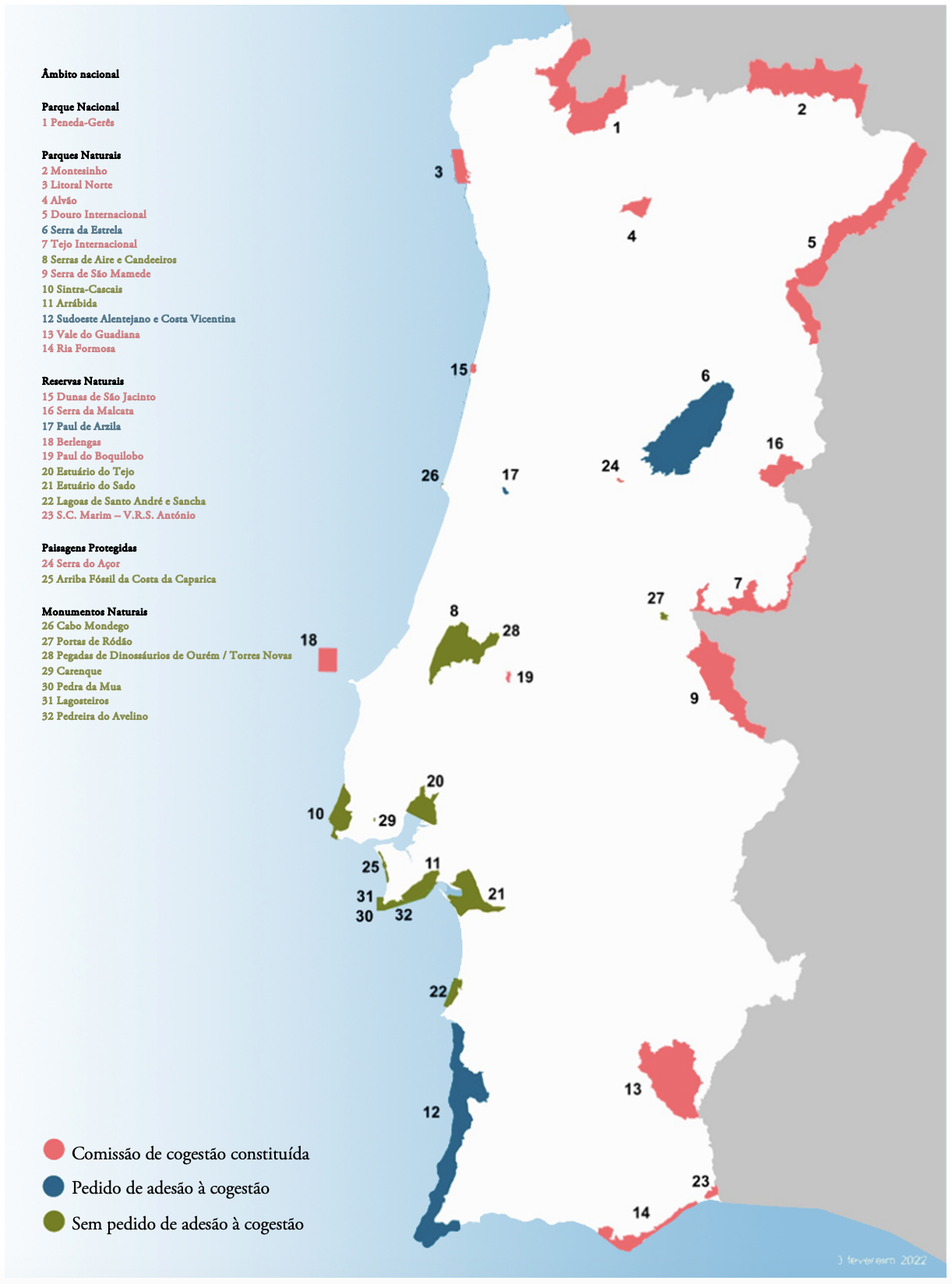
ICNF
9. Final Quick Remarks: Where the fields have (no) name
By glossing this title of a well-known song by the Irish rock band U2, we want to stress the fact that NPs in Portugal have been implement by the state in areas and properties whose owner is not the state. This has led to conflicts - mainly in governance models. Who can do what, where and when? This is not a rhetorical or philosophical question, but a fair inquiry by those who have been affected[15]. And this is the right word - affected. Much has been said in anthropological literature about the conflictual (on non-consensual) character of conservation ideologies (e.g. Brosius, Tsing & Zerner, 1998; Martins, 2018). And we know that PAs are living and transformative places where different interests from different actors are projected - even more recent neoliberal desires (Apostolopoulou & Cortés Vazquez, 2019). Portugal has its own nature conservation history as well as a political history defined until quite recently by an absence of a specific and directed policy on PAs. The evolution in the Portugal law has reflected the evolution in the international law, in particular and such as in many more realms of national policies, after the adhesion of Portugal to the European Union, back in 1986. The fact is that Portugal is a highly humanized territory - there are no wilderness areas. Despite perceptions of wild and untouched environments, every inch of the territory has been already transformed and, by assuming this, any approach to nature conservation in Portugal needs the effective participation of local communities, and especially of private owners and the commons commissions (comissões de baldios). We are now on the expectation to realize what this new solution based on co-management may represent effectively for the local communities. As stated by Petursson and Kristofersson (2021) for Vatnajökull National Park in Iceland, co-management cannot be seen a “one-size-fits-all” solution. They claim for “diverse approaches for governance which are cognizant of the context and site-specific conditions that they operate within” (ibidem, p.16). The questions of legitimacy and distribution of power as well as the clarification of the key-actors’ roles are crucial. In fact, and once again, notwithstanding different starting points between the Icelandic example and Portugal (for instance, as concerns property structure) the point is consent - a question of the state clearly ‘asking permission’ to legitimate owners and simply do not mistreat them.
However, we want to finish this text by recalling an evolution in PAs policy in Portugal. Presently it does not consecrate only the national interest (as an abstract notion), but it also admits regional and local interests - recognition of the concept of (local) development. It means a transition from an eminently ecologist/biologist vision to a socio-eco-economist perspective, in which humans’ place is not just one of a keeper-protector, but one in which the possibility of (sustained) agencialities/transformations/appropriations by humans - as stakeholders - is recognized.
References
Apostolopoulou, E., & Cortés Vázquez, J. C. (2019). Neoliberalism and environmental movements around the World after the 2008 financial crash: Defending the right to nature. In E. Apostolopoulou & J. Cortes Vázques (Eds.), The Right to Nature: Social Movements, Environmental Justice and Neoliberal Natures (pp. 1-13). Routledge.
Beltran Costa, O., & Santamarina Campos, B. (2016). Antropología de la Conservación en España. Balance y perspectivas. Revista de Antropología Social, 25(1), 85-109.
Beltran, O, Fernández, J., & Vaccaro, I. (2008) Espacios naturales protegidos, política y cultura. In O. Beltran, J. Fernández & I. Vaccaro (Eds.), Patrimonialización de la naturaleza, el marco social de las políticas ambientales (pp. 11-26). Ankulegi.
Bernard, H. R. (1995). Research Methods in Anthropology: Qualitative and Quantitative Approaches. Altamira Press.
Brockington, D., & Duffy, R. (2010) Capitalism and conservation: The production and reproduction of biodiversity conservation. Antipode 42(3), 469–484.
Brockington, D., Duffy, R., & Igoe, J. (2008). Nature unbound: conservation. Capitalism and the future of protected areas. Earthscan.
Brosius, P., Tsing, A., & Zerner, C. (1998). Representing communities: Histories and politics of community‐based natural resource management. Society & Natural Resources: An International Journal, 11(2), 157-168.
Cardeira da Silva, M., & Frazão-Moreira, A. (2013). Colecionistas, turistas, caçadores e outros supostos predadores. In M. Cardeira da Silva & M. C. Saraiva (Eds.), As Lições de Jill Dias. Antropologia, História, África, Academia (pp. 112-133). CRIA.
Carvalho, A., & Frazão-Moreira, A. (2011). Importance of local knowledge in plant resources management and conservation in two protected areas from Trás-os-Montes, Portugal. Journal of Ethnobiology and Ethnomedicine, 7 (36). https://doi.org/10.1186/1746-4269-7-36
Carvalho, P., & Fernandes, J.L. (2002). Paisagem e apropriação dos territórios. Reflexão em torno de dois exemplos comparativos: a Serra da Lousã e o Parque Natural das Serras de Aire e Candeeiros. In C. Lucilia (Ed.), Território, innovação e trajectórias de desenvolvimento (pp. 275-320). Centro de Estudos Geográficos. Faculdade de Letras da Universidade de Coimbra.
Cortés Vázquez, J., & Beltrán, O. (2019). Introducción. Nuevos modelos de conservación, ¿nuevos momentos patrimoniales? In J. Cortes Vázquez & O. Beltran (Eds.), Repensar la conservación: Naturaleza, mercado y sociedad civil (pp.9-26). Universitat de Barcelona.
DeSilvey, C., & Bartolini, N. (2019). Where horses run free? Autonomy, temporality and rewilding in the Côa Valley, Portugal. Transactions of the Institute of British Geographers, 44(1), 94-109.
Devy-Vareta, N. (2003). O Regime florestal em Portugal através do Século XX (1903-2003). Revista da Faculdade de Letras-Geografia, 19, 447-455.
Estêvão, J. (1983). A florestação dos baldios. Análise Social, 19(77-78-79), 1157-1260.
EUROPAC-España (2021). Anuario 2020 del estado de las áreas protegidas en España. Ed. Fundación Fernando González Bernáldez.
Figueiredo, E. (2008ab). ¿Cómo proteger a las personas en las áreas protegidas? El medio ambiente como vulnerabilidad en dos áreas protegidas portuguesas. Revista Española de Estudios Agrosociales y Pesqueros, 220, 45-69.
Figueiredo, E. (2008b): Imagine there´s no Rural - the transformation of rural spaces into places of nature conservation in Portugal. European Urban and Regional Studies, 15(2), 159-171.
Frazão-Moreira, A., Carvalho, A., & Martins, M. E. (2009). Local knowledge also ‘comes from books’: cultural change, landscape transformation and conservation of biodiversity in two protected areas in Portugal. Anthropological Notebooks, 15(1), 27-36.
Iannuzzi, G., Santos, R., & Mourato, J. (2020). The involvement of non-state actors in the creation and management of protected areas: insights from the Portuguese case. Journal of Environmental Planning and Management, 63(9), 1674-1694.
ICNF (2017). Estratégia nacional de conservação da natureza e biodiversidade - ENCNB 2025. Ministério do Ambiente.
MacKenzie, J. M. (2017). The empire of nature: Hunting, conservation and British imperialism. Manchester University Press.
Martins, H. (2018). Humanos e não-humanos em ambientes partilhados. Notas introdutórias a uma antropologia das áreas protegidas. Análise Social, 53(226), 28-56.
Mullero Mendigorri, R. (2017). Territorio y áreas protegidas en España y Portugal: dos modelos de intervención en una geografía compartida. Boletín de la Asociación de Geógrafos Españoles, 74, 205-227.
Pereira da Silva, C. (2000). Áreas Protegidas em Portugal: Que papel? Conservação versus desenvolvimento. GeoINova, 2, 27-44.
Petursson, J., & Kristofersson, D. (2021). Co-management of protected areas: A governance system analysis of Vatnajökull National Park, Iceland. Land, 10(7), 681. https://doi.org/10.3390/land10070681
Pinto, B., & Partidário, M. (2012). The history of the establishment and management philosophies of the portuguese protected areas: Combining written records and oral history. Environmental Management, 49(4), 788–801.
Queirós, M. (2012). Natural Parks in Portugal: a way to become more ecologically responsible? Environment and History, 18(4), 585-611.
REA (2021). Relatório de Estado do Ambiente. Portugal. 2020/21. Agência Portuguesa do Ambiente.
Sá, G. (2017). The return of what never left: animals present in future natures. Vibrant. Virtual Brazilian Anthropology, 14(2).
Santamarina Campos, B. (2009). De parques y naturalezas. Enunciados, cimientos y dispositivos. Revista Dialectología y tradiciones populares, 64(1), 237-267.
Santamarina Campos, B. (2019). El inicio de la protección de la naturaleza en España. Orígenes y balance de la conservación». Revista Española de Investigaciones Sociológicas, 168, 55-72. http://dx.doi.org/10.5477/cis/reis.168.55
Schmidt, L., Mourato, J., Travassos, D., & Calvário, R. (2017). Áreas Protegidas: que modelo de gestão?. ICS.
Silva, L. (2008). Contributo para o estudo da pós-ruralidade em Portugal. Arquivos da Memória, 4, 6-25.
Sullivan, S. (2012). Banking Nature? The Spectacular Financialisation of Environmental Conservation. Antipode 45(1), 198–217.
Trillo, J. M., & Paúl, V. (2018). La Reserva de la Biosfera Meseta Ibérica como espacio natural protegido transfronterizo: ¿herramienta de conservación o marca promocional?Documents d’Anàlisi Geogràfica, 64(3), 493-508.
Trillo, J. M., & Paúl, V. (2016). Transboundary Protected Areas as Ideal Tools? Analyzing the Gerês-Xurés Transboundary Biosphere Reserve. Land Use Policy, 52, 454-463.
Urbano, P. (2020). Tapadas e Caçadas Reais nos finais da monarquia constitucional portuguesa. In Maria Cristina Dias Joanaz de Melo (ed.) Como a Fénix Renascida – Matas, Bosques e Arvoredos (Séculos XVI-XX): Representações, Gestão, Fruição, (pp.131-162). Colibri.
West, P., Igoe, J., & Brockington, D. (2006). Parks and peoples: the social impact of protected areas. Annual Review of Anthropology, 35, 251-277.
Wutich, A., Ryan, G., & Bernard, H. (2015). Text analysis In Bernard, H., & Gravlee, C. (Eds), Handbook of methods in cultural anthropology (pp.533-560). Rowman & Littlefield.
Información adicional
JEL Classification: Q34; Q38; Q56