Articles
Clustering residents of a spanish mining site: when attitudes towards tourism are not linked to perceptions
Clustering residents of a spanish mining site: when attitudes towards tourism are not linked to perceptions
Investigaciones Regionales - Journal of Regional Research, núm. 58, pp. 131-161, 2024
Asociación Española de Ciencia Regional

Esta obra está bajo una Licencia Creative Commons Atribución-NoComercial 4.0 Internacional.
Recepción: 20 Noviembre 2022
Aprobación: 13 Diciembre 2023
Abstract: This study uses a segmentation framework to categorize the residents of Minas de Riotinto, a mining town in Andalusia, Spain, based on their perceptions of the personal and community effects of tourism. These segments were then classified according to their tourism attitudes, utilizing a three-dimensional approach encompassing affective, cognitive, and behavioral elements. For this purpose, a cluster analysis and the Kruskal-Wallis test were successively applied to the responses of 346 residents. The results revealed three main groups of residents: "interested and enthusiastic supporters", " disinterested and moderate supporters" and "incongruous and impulsive residents". Contrary to our expectations, all groups showed favorable affective attitudes towards tourism development in their region. However, significant differences emerged between groups concerning the cognitive and behavioral dimensions of their attitudes.
Keywords: Tourism impact, resident perceptions, resident segmentation, mining tourism.
Resumen: Este artículo segmenta a los residentes de la localidad minera de Minas de Riotinto (Andalucía, España) según sus percepciones sobre los efectos personales y comunitarios del turismo y clasifica los segmentos resultantes de acuerdo con sus actitudes hacia el turismo, utilizando para ello un enfoque tridimensional que diferencia tres componentes actitudinales: afectiva, cognitiva y conductual. Para ello, se aplica sucesivamente un análisis de conglomerados y el test de Kruskal-Wallis a las respuestas de una muestra de 346 vecinos de la localidad. Los resultados obtenidos permiten identificar tres grandes grupos de residentes: “partidarios interesados y entusiastas”, “partidarios desinteresados y moderados” y “residentes incongruentes e impulsivos”. Contrariamente a lo esperado, todos los grupos tienen actitudes afectivas favorables hacia el desarrollo turístico en su territorio. Sin embargo, existen diferencias significativas entre grupos respecto a las dimensiones cognitivas y conductuales de la actitud.
Palabras clave: Impactos del turismo, percepciones del residente, segmentación de residentes, turismo minero.
Minas de Riotinto, located in Huelva, Spain, is internationally renowned for having the largest open-pit mine in Europe, known as “The Corta Atalaya." Notably, its striking resemblance to the planet Mars has aroused considerable interest from NASA. In the latter half of the 20th century, Minas de Riotinto recognized the potential of mining tourism as a strategic response to the crisis affecting mining activity that had been ongoing for 5,000 years. This municipality has evolved into an international benchmark for its successful model of revitalizing and diversifying the local economy through industrial tourism. It offers an enticing proposition that seamlessly blends elements of history, industry, culture, anthropology, mining, landscapes, and even scientific exploration.
Over three decades, the Rio Tinto Foundation has established the Mining Park of this town as Spain’s premier industrial tourism destination. In recognition of its achievements, the mining park has received numerous accolades, including the Henry Ford Award in the Heritage category in 1998 and the Europa Nostra Award for the best heritage recovery project in 2003. Furthermore, its inclusion as an "Anchor Point" in the European Route of Industrial Heritage (ERIH) in 2016 underscores its status as a preeminent site for industrial heritage on the European continent. The reopening of the world’s most famous mine, which operated during the late 19th and early 20th century, positions Riotinto as one of the few places in the world where the past, present, and future of the mining industry converge.
Undoubtedly, this transformation has challenged the resident population, whose livelihoods were traditionally rooted in the primary mining sector. They have been forced to adapt to a way of life that now revolves around the service industry and involves coexisting with the burgeoning tourism sector. Recent research has shown how local support is pivotal in achieving sustainable economic development. Moreover, understanding the factors that drive this support can provide valuable insights for researchers seeking to determine why some projects succeed while others do not (Mueller & Tickamyer, 2020).
In the last decade, a notable body of academic literature reviews has revealed state-of-the-art on "residents' support towards tourism" (Nunkoo, Smith, & Ramkissoon, 2013; Sharpley, 2014; García, Vázquez, & Macías, 2015; Hadinejad et al., 2019; Gursoy et al., 2019; Rasoolimanesh & Seyfi, 20201; Scalabrini & Romoaldo, 20202; Olya, 20230). In the case of Spain, a country boasting the second-highest number of international tourist arrivals worldwide, research concerning the social perception of tourism is of particular relevance, as summarized by Moreira and Vargas-Sánchez (2022). For the period 2005-2019, these authors identified 19 quantitative studies based on public opinion surveys of residents. Most of these studies focused on well-established sun and beach destinations, including the Balearic Islands, Canary Islands, and Malaga. However, only one study (Vargas-Sánchez, Plaza-Mejia, & Porras-Bueno, 2009a) has focused on an industrial mining tourism destination undergoing transition.
Indeed, Vargas-Sánchez et al. (2015), in their general review of the literature on industrial heritage and tourism, noted that the issue of resident support remains a relatively underexplored area. However, Xie (2006) identified residents' perceptions as one of the six key factors contributing to the success of industrial tourism, while some recent studies are also worth citing (Guerra, Moreno, de Almeida, & Vitorino, 2022; Andrade & Caamaño-Franco, 2018; Xie, Lee, & Wong, 2020; Andrade-Suárez & Caamaño-Franco, 2020). In the specific geographical area under study, Minas de Riotinto, several works by Vargas-Sánchez, Plaza-Mejia & Porras-Bueno (2009a), Vargas Sánchez, Porras-Bueno, Plaza-Mejía, 2009b; Plaza-Mejía, Porras-Bueno & Flores-Ruiz, (2019) deserve mention. These studies, spanning over a decade, reveal a predominantly positive perception of the impacts of tourism on Minas de Riotinto and the potential benefits it could bring. This positive attitude was grounded primarily in the anticipated benefits for the community rather than at an individual level.
However, it is worth noting that in Minas de Riotinto, similar to most general research on residents' support for tourism, the local population has been treated as a single, homogenous group (Rasoolimanesh, Ringle, Jaafar, & Ramayah, 2017). This approach assumes that perceptions and attitudes remain consistent over time, even as they evolve (Cardona & Cantallops, 2015). This assumption has been suggested as one of the factors contributing to the contradictory results of studies involving communities with similar economic and demographic backgrounds (Petrzelta et al., 2005; Sharpley, 2014). Recognizing this challenge, tourism researchers have begun to adopt research methods that can accommodate the heterogeneity of local populations (Wassler et al., 2019).
The academic literature highlights a notable absence of segmentation research focused on residents' perceptions and attitudes in a mining locality, with limited attention paid to destinations in the emerging phase of tourism development (Schoroeder, 1992; Martin, 1995; Harril et al., 2011; Brida et al. 2011; Chen, 2011; Schofield, 2011; Sinclair-Maragh, Gursoy & Vieregge, 2015; Da Cruz Vareiro, Remoaldo, & Ribeiro, 2018; Wassler, Nguyen, & Schuckert, 2019; Zheng, Ritchie, Benckendorff, & Bao, 2019; Lopes, Remoaldo, & Ribeiro, 2019; Nguyen, 2022).In Spain, studies on the segmentation of residents are scarce and have predominantly focused on island sun and beach destinations (Aguiló-Pérez & Roselló-Nadal, 2005; Garau-Vadell, Díaz-Armas, & Gutierrez-Taño, 2014; Martín, Moreira, & Román, 2020; Camprubí & Garau-Vadell, 2022). Some exceptions include research on event tourism (Parra-Camacho et al., 2016) and urban tourism (González-Reverté, 2022), all of which are at the consolidation (maturity) stage of the Tourism Area Life Cycle Theory (Butler 1980).
The research work presented here aims to fill this gap by focusing on a type of destination that has seldom been examined in the context of resident segmentation — a mining enclave in an emerging phase of tourism development. This study emphasizes the importance of segmenting the resident population from the initial phases of tourism development in a destination. This approach is particularly pertinent in areas where such development represents a radical shift in the local way of life, as in the case of a mining community. Segmentation will not only offer a more comprehensive understanding of community responses to tourism (Fredline & Faulkner, 2000; Sheldon and Abenoja, 2001 ) but will also facilitate the planning and management of tourist activities in a manner that optimizes overall community support while mitigating the perceived impacts within each specific segment (Aguiló-Pérez & Roselló-Nadal, 2005).
Additionally, this work seeks to contribute to the existing segmentation literature from a theoretical perspective. In addition to the traditional segmentation of residents, which is based solely on their perception of the impact of tourism on the destination as a whole, this work introduces an innovative and value-added dimension: the perception that residents have about the impact of tourism for their own benefit. Moreover, our study uses the tri-component attitude model (Stahlberg and Frey, 1990), which allows for analyzing attitudes from cognitive, affective, and behavioral perspectives rather than the more commonly used one-dimensional approach. To enhance the interpretation of the findings, this study follows the recommendations of previous authors (Rasoolimanesh & Seyfi, 2020; Ko & Stewart, 2002) and incorporates Social Exchange Theory (SET) in conjunction with the Tourism Area Life Cycle (TALC) model proposed by Butler (1980) and the Index of Tourist Irritation (ITI) (Doxey, 1975). From a theoretical perspective, the findings related to the relationship between perceptions and attitudes challenge the results of previous studies, prompting a reevaluation of conventional assumptions.
2. Theoretical Background
2.1. Residents' perceptions of the impact of tourism development on personal and community benefits.
Social Exchange Theory (SET) serves as the primary theoretical framework in most studies examining residents' support for tourism. According to SET (Allen et al., 1993), residents’ willingness to engage in tourism development depends on whether they positively evaluate their relationship with the tourism activity. In other words, residents will engage when they perceive that the benefits derived from tourism outweigh the associated costs. These benefits and costs include both positive and negative impacts, including economic, sociocultural, and environmental aspects. These effects can personally impact individual residents and influence the wider community.
When examining the direct personal impacts on residents, various studies have demonstrated, in alignment with SET, that residents who are reliant on the tourism industry or those who witness its substantial economic gains tend to show a more favorable attitude towards tourism than those who do not experience such dependence or visibility (Haralambopoulos & Pizam, 1996; Harrill, 2004; Jurowski et al., 1997; Lankford & Howard, 1994; Pizam et al., 1978). An exception to this pattern can be found in the studies conducted by Teye et al. (2002). The findings reported by these authors indicate a contrary outcome, where the negative attitudes of individuals working in sectors linked to tourism can be explained by the unfavorable working conditions experienced by employees.
Furthermore, previous research findings consistently support the notion that residents who personally benefit more from tourism tend to perceive its advantages more positively and show a more favorable attitude towards tourism development (Ko & Stewart 2002; McGehee & Andereck 2004; Oviedo-Garcia et al. 2008; Vargas et al., 2009a; Nunkoo & Ramkissoon, 2010, 2011; Vargas et al. 2011; Lee, 2013; Vargas et al., 2014; Woo et al., 2015; Kang & Lee, 2018; Su & Swanson, 2020).
Concerning the perception of the economic, sociocultural, and environmental impacts of tourism on the community as a whole, it is generally concluded that those who primarily recognize the positive effects of tourism express a more favorable attitude towards increasing levels of tourism development (Perdue et al., 1990; Gursoy et al. 2002; Gursoy & Rutherford, 2004; Ko & Stewart, 2002; Dyer et al., 2007; Vargas-Sánchez et al., 2009a; Vargas-Sánchez et al., 2015; Stylidis et al., 2016; Gursoy et al., 2019).
2.2. Attitude: a complex concept
The study of residents’ attitudes is often pursued empirically without any prior clear conceptualization or definition of the term and the associated psychological dimensions. This lack of clarity complicates efforts to identify in research studies whether attitudes are being approached from a particular perspective, and if so, which attitude model or construct is being employed — whether it is considered a reflective construct or a formative composite (Rasoolimanesh & Seyfi, 2020).
Stahlberg and Frey (1992) presented three potential frameworks for examining attitudes: the three-dimensional, two-dimensional, and one-dimensional approaches. The three-dimensional framework, known as the ABC Model, developed by Smith (1947), defines attitude as consisting of three components: the cognitive component (including the set of beliefs, opinions, and information that an individual holds about the object of their attitude), the affective component (feelings of liking or disliking the object), and the behavioral component (dispositions, intentions, and behavioral tendencies regarding the object to which the attitude is directed). The behavioral component (concerning pro-tourism intentions and behaviors) has received little attention in the scientific literature on residents' support (Vargas et al., 2020).
The traditional one-dimensional framework of attitude distinguishes between the beliefs and intentions underlying the attitude, essentially equating the attitude with its affective component. In this context, the Theory of Reasoned Action (TRA) (Ajzen & Fishbein, 1980), and subsequently, the Theory of Planned Behavior (TPB) (Ajzen, 1991), expressly view attitude within the one-dimensional framework. This approach entails including intention and behavior as separate variables in the model rather than as integral components of attitude.
In line with the SET mentioned above, and considering residents' perceptions of tourism impacts (both at the personal and community levels) as well as their attitudes (affective, cognitive, and behavioral) towards tourism, the following hypotheses were tested concerning the segments of residents:
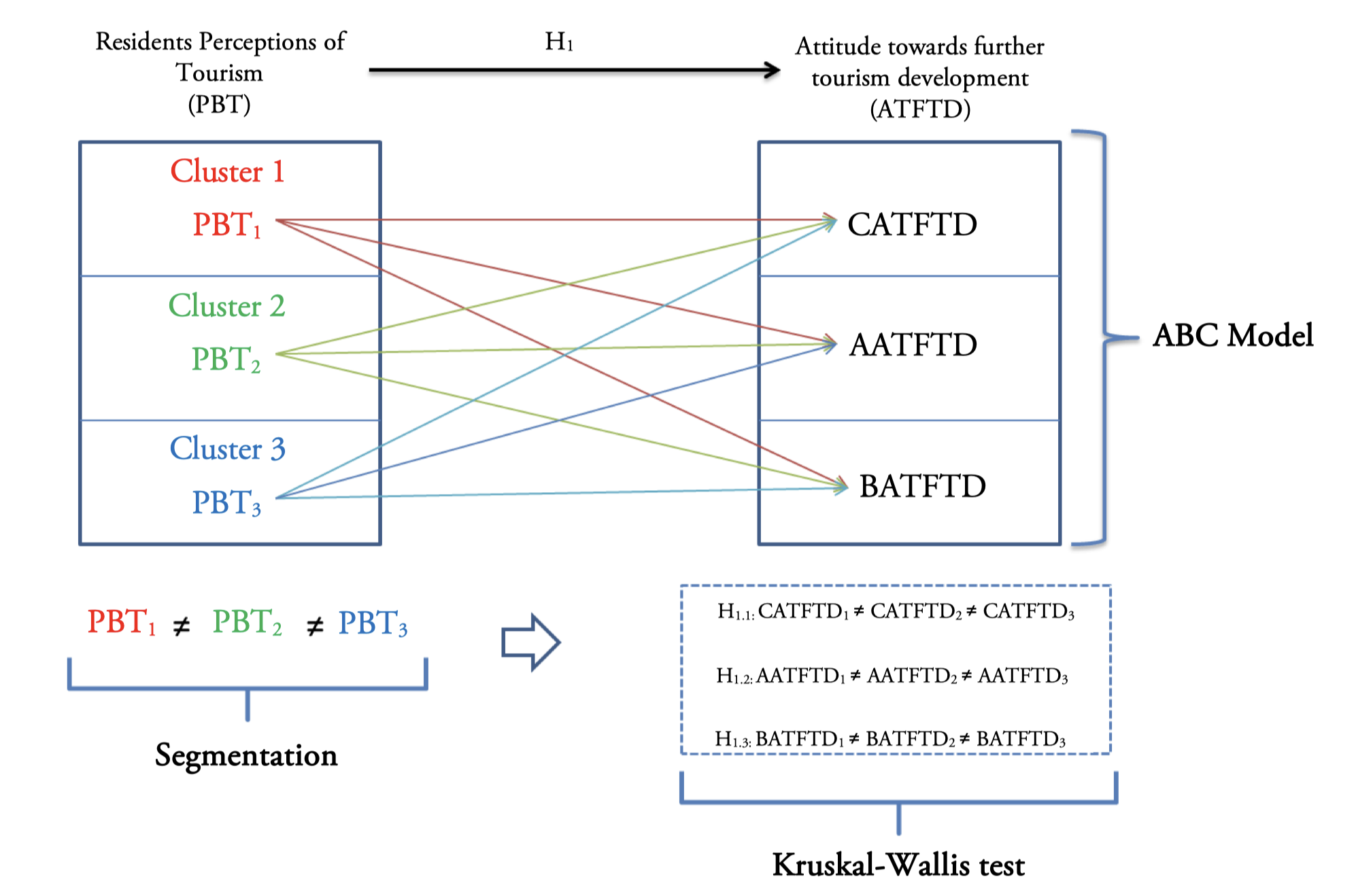
H1. Segments of residents with varying perceptions of tourism's personal and community benefits will show significant differences in their attitudes toward further tourism development.
H1.1. Segments of residents with different perceptions of the personal and community benefits of tourism (PPBT and PCBT) will also show significant differences in their cognitive attitudes towards further tourism development (CATFTD).
H1.1.1 Segments of residents with different perceptions of the personal and community benefits of tourism (PPBT and PCBT) will also show significant differences in their level of conviction that tourism is a source of wealth and well-being for Rio Tinto and its citizens (CWWBT)
H1.1.2 Segments of residents with different perceptions of the personal and community benefits of tourism (PPBT and PCBT) will also show significant differences in their level of knowledge about tourism development projects (LKTDP).
H1.2. Segments of residents with different perceptions of the personal and community benefits of tourism (PPBT and PCBT) will also show significant differences in their affective attitude towards further tourism development (AATFTD).
H1.2.1. Segments of residents with different perceptions of the personal and community benefits of tourism (PPBT and PCBT) will also show significant differences in their attitudes towards further tourism development in the locality (ATFTD).
H1.2.2. Segments of residents with different perceptions of the personal and community benefits of tourism (PPBT and PCBT) will also show significant differences in their attitudes towards an increased number of tourists in the locality (ATFT).
H1.3. Segments of residents with different perceptions of the personal and community benefits of tourism (PPBT and PCBT) will also show significant differences in their behavioral attitudes towards further tourism development (BATFTD).
H1.3.1 Segments of residents with different perceptions of the personal and community benefits of tourism (PPBT and PCBT) will also show significant differences in their motivation to promote the locality (MTPL).
H1.3.2 Segments of residents with different perceptions of the personal and community benefits of tourism (PPBT and PCBT) will also show significant differences in their recommendation behavior (RB).
Figure 1.
Model for Hypothesis 1, based on Social Exchange Theory (SET). Source: Authors' own.
Source: Authors' own.
Figure 1. Model for Hypothesis 1, based on Social Exchange Theory (SET). Source: Authors' own.
2.3. Residents' perception of current tourism development in their locality.
Several authors have highlighted the need to expand the theoretical framework for studying residents' attitudes (Ko & Stewart, 2002; Rasoolimanesh & Seyfi, 2020). While SET has thus far been the theoretical framework predominantly used in most studies focused on residents’ support for tourism, this approach can be enriched by integrating several theories, allowing for a more comprehensive interpretation of the results. Johnson & Snepenger (2006) posit that the stages in the TALC are critical for understanding the perceived overall impacts of tourism development.
The TALC is grounded in the concept that tourist areas are dynamic and that, as a result, they change and evolve through various phases (exploration, involvement, development, consolidation, and stagnation) determined by the number of tourists in the destination. The number of tourists gradually increases during these phases until it surpasses the critical threshold, resulting in environmental, social, and economic challenges.
Parallel to this development, following the ITI framework (Doxey, 1975), residents’ attitudes towards tourists and tourism change over time, shifting from positive and favorable feelings towards the presence of tourists (euphoria) to a more neutral stage of apathy, eventually leading to negative emotions (irritation and antagonism).
Considering these two theories, it becomes apparent that variables such as the "number of tourists" and, more specifically, "tourist density" are key factors in predicting residents' attitudes towards tourism. These variables can be measured objectively (based on the ratio of visitors to the territorial area of the destination) or subjectively by measuring the local population’s perception of the current extent of tourist development in their locality concerning its potential for tourism development. From this perspective, one might expect that residents in destinations with limited tourist development would display more favorable attitudes toward an increased presence of tourists and greater tourism development in their locality.
Although some authors question the universal validity of Doxey’s (1975) saturation model (Faulkner & Tideswell, 1997; Lepp, 2007), numerous studies suggest that the level of tourism development perceived by residents (LTDP) negatively influences residents’ attitude towards tourism development (ATTD) (Allen et al., 1988; Allen et al., 1993; Harrill, 2004; Smith & Krannich, 1998; Vargas et al., 2011).
In accordance with the TALC and ITI, and considering residents' attitudes from a three-dimensional perspective (affective, cognitive, and behavioral), the following hypotheses were tested:
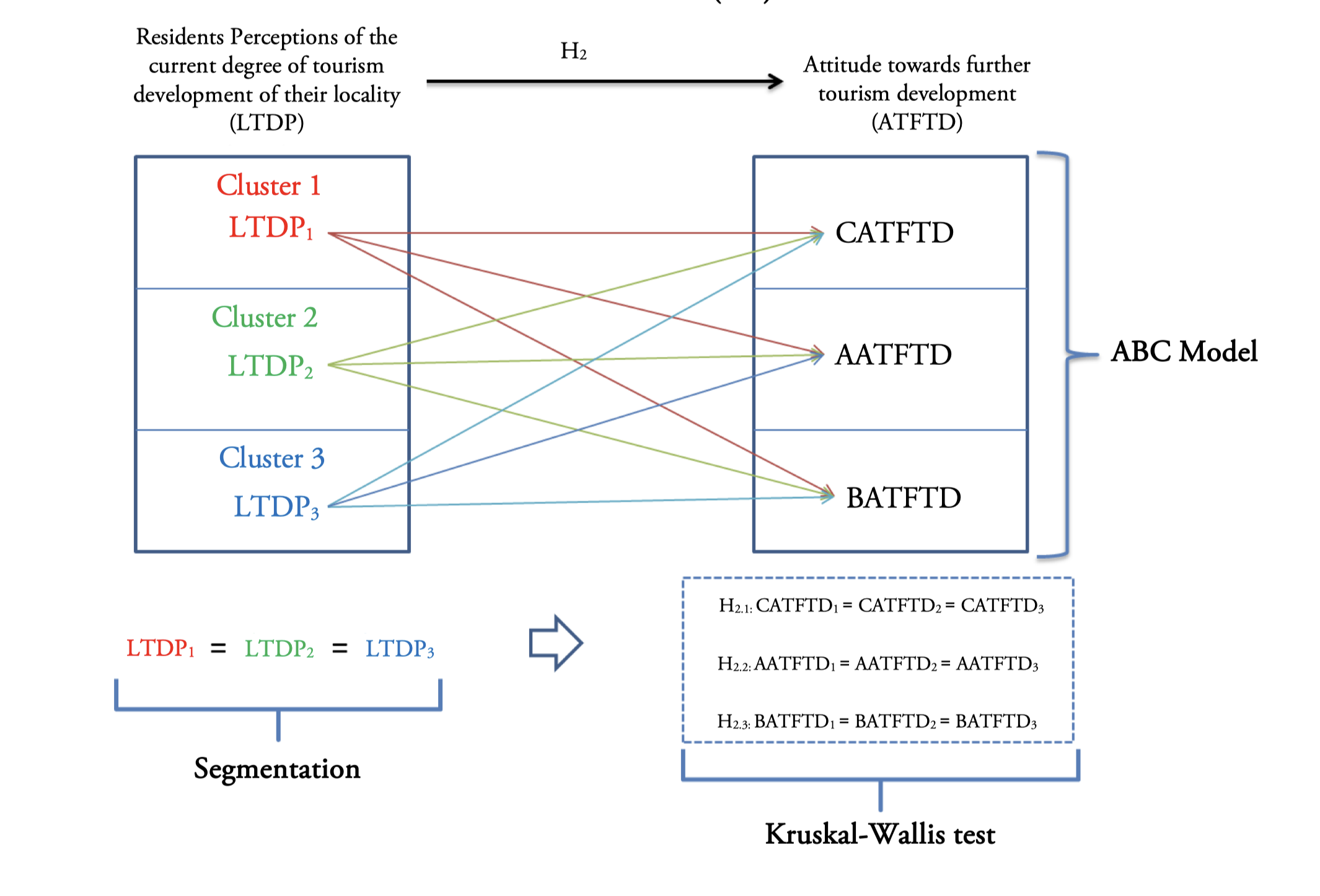
H2. Segments of residents with similar perceptions of the current level of tourism development in their locality will not differ in their attitudes towards further tourism development.
H2.1. Segments of residents with similar perceptions of the current level of tourism development in their locality (LTDP) will not differ in their cognitive attitude towards further tourism development (CATFTD).
H2.1.1. Segments of residents with similar perceptions of the current level of tourism development in their locality (LTDP) will not differ in their level of conviction that tourism is a source of wealth and well-being for Rio Tinto and its citizens (CWWBT)
H2.1.2. Segments of residents with similar perceptions of the current level of tourism development in their locality (LTDP) will not differ in their level of knowledge about tourism development projects (LKTDP).
H2.2. Segments of residents with similar perceptions of the current level of tourism development in their locality (LTDP) will not differ in their affective attitude towards further tourism development (AATFTD).
H2.2.1. Segments of residents with similar perceptions of the current level of tourism development in their locality (LTDP) will not differ in their attitudes towards further tourism development in the locality (ATFTD)
H2.2.2. Segments of residents with similar perceptions of the current level of tourism development of their locality (LTDP) will not differ in their attitudes towards an increased number of tourists in the locality (ATFT)
H2.3. Segments of residents with similar perceptions of the current level of tourism development in their locality (LTDP) will not differ in their behavioral attitudes towards further tourism development (BATFTD).
H2.3.1 Segments of residents with similar perceptions of the current level of tourism development in their locality (LTDP) will not differ in their motivation to promote the locality (MTPL).
H2.3.2 Segments of residents with similar perceptions of the current level of tourism development in their locality (LTDP) will not differ in their recommendation behavior (RB).
Figure 2.
Model for Hypothesis 2, based on the Tourism Area Life Cycle (TALC) and the Index of Tourist Irritation (ITI).
Source: Authors' own.
2.4. Segmenting resident perceptions of tourism impacts in destinations at the early stages of tourism development
A comprehensive search was conducted using the most relevant scientific search engines (EBSCOhost, ISI Web of Knowledge, Scopus, and Google Scholar) to provide a theoretical context for the study outlined in this paper. The search utilized the keywords “segmentation” and “cluster” in conjunction with “residents.” Annex 1 presents the most relevant research on the segmentation of residents’ perceptions, extracted from peer-reviewed scientific journals within the field of tourism, with the requirement that they employ data-driven segmentation on a multivariate basis. A total of 49 studies were identified for the period under review (1988–2022).
Establishing direct equivalences between segments across different studies is challenging and unwise (Fredline & Faulkner, 2000; Weaver & Lawton, 2001) due to variations in the variables applied to assess the perception of impacts and the different types of factor analysis applied before segmentation. Despite this challenge, the review provides an overview of the segmentation studies conducted on residents' perceptions of tourism. This overview offers a preliminary understanding of the commonly identified segments and their characteristics.
When examining the stage of tourism development, the studies listed in Annex A can be categorized as follows: 22.5% of the studies pertain to the early stages of the tourism life cycle (exploration/involvement, emerging, or predevelopment); 26.5% correspond to destinations in the development/consolidation phase; 26.5% represent destinations in the final stage of development (stagnation or maturity phase); and the remaining 24.5% correspond to studies covering areas with high to low levels of tourism, or do not specify the stage of tourism development.
Due to space limitations, we have focused solely on analyzing the results from segmentation studies in destinations similar to the one under investigation, according to the early stages of the Butler tourism life cycle. (See Annex).
Schofield (2011) and Wassler et al. (2019) focused their attention on urban environments in the early stages of tourism development and proposed three segments similar in character and proportion to those found in previous research. Schofield (2011) identifies these as "anti-tourism" (16%), "pro-tourism" (36%), and "uncertain" (49%), while Wassler et al. (2019) refer to them as "low-support" (21.4%) "high-support" (39.7%), and "neutral" (38.9%).
In a study focusing on two rural communities in Turkey experiencing relatively new tourism development, Sinclair-Maragh et al. (2015) identified four segments. The first three segments were classified based on the two most significant impact factors perceived by residents. In contrast, a fourth segment comprises “inconsequential” residents (13.1%) who show little interest in the impacts of tourism development. The study conducted by Vareiro et al. (2013) in Guimarães (Portugal), an industrial town where the tourism industry had recently developed, identified three groups among residents: "skeptics" (19%), "moderately optimistic" residents (40%), and "enthusiasts" (42%). Scalabrini and Remoaldo (2020) analyzed residents’ perceptions in Joinville (Santa Catalina State, Brazil) regarding their tourism development, particularly based on culture. This study identified four groups: Moderate Optimists (16%), Optimists (30%), Sceptics (23%), and Enthusiasts (31%). Lopes et al. (2019), in their study conducted among residents of a rural community in Northeast Portugal (Boticas), also identified three groups: Neutral (20%), Moderately optimistic (33%), and Optimistic (47%).
According to the ITI, studies focusing on segmenting residents in destinations in their early stages of tourism development tend not to identify groups with anti-tourism behavior. However, our study, conducted in a mining town in the southwest of Spain, characterized as an industrial tourism destination currently in the phase of emerging tourism development, complements and contrasts with the findings of the studies mentioned above.
3. Methodology
3.1. Aim of the research
The aim was to segment residents according to their perceptions of the impact of tourism on a personal and community level. Following this segmentation, we set out to determine whether segments of residents with different perceptions of tourism also show different attitudes toward tourism development (distinguishing between the cognitive, affective, and behavioral components of their attitudes).
To this end, cluster analysis and the Kruskal-Wallis test were applied consecutively to the responses provided by a sample of 346 residents in an old mining enclave currently in an emerging phase of tourism development.
3.2.
Study site
Minas de Riotinto is a town located in Andalusia (Spain), whose economy, for more than 5,000 years, has almost exclusively centered around mining. The importance of this mining activity is underscored by the fact that it is home to Europe’s largest open-pit mine, known as The Corta Atalaya, which was operational from 1907 to 1992 and employed over 2,000 workers.
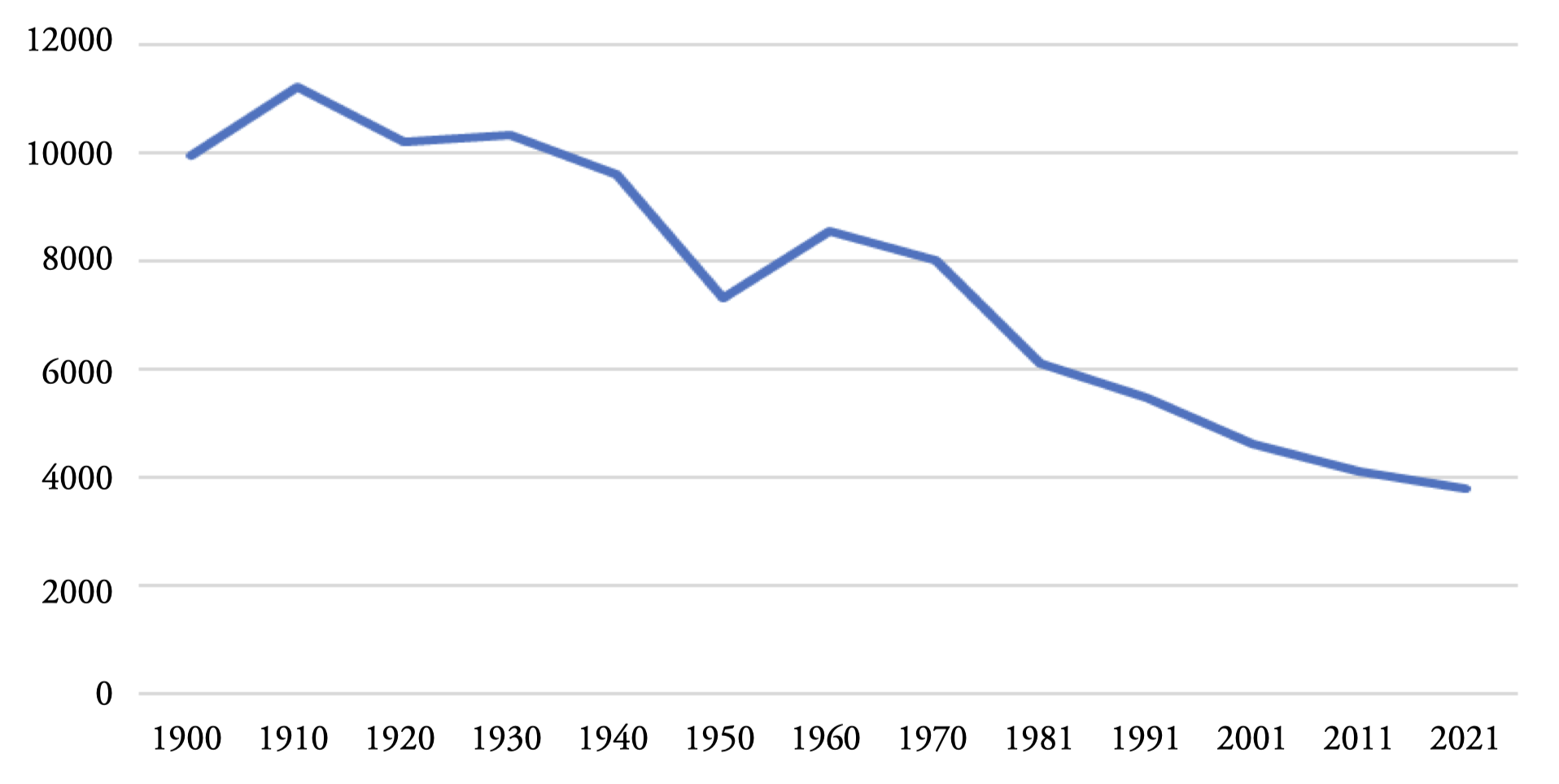
In the latter half of the 20th century, the mining industry faced a crisis driven by various factors, including a decline in ore prices, competition from new markets, and the emergence of alternative materials such as optical fiber. These challenges gradually eroded the viability of mining operations in the region, leading to the closure of the copper mine in 1986 when it was no longer economically sustainable. This downturn, as illustrated in Figure 3, triggered a demographic crisis, resulting in a 50% reduction in the population over the course of a century. As of 2022, the population stood at 3,738 inhabitants, a stark contrast to the more than 11,000 residents recorded at the beginning of the 20th century (Sistema de Información Multiterritorial de Andalucía, 2023).
Figure 3.
Population trend in Minas de Riotinto (1900-2021).
Source: Authors' own (based on the Multiterritorial Information System of Andalusia, 2023).
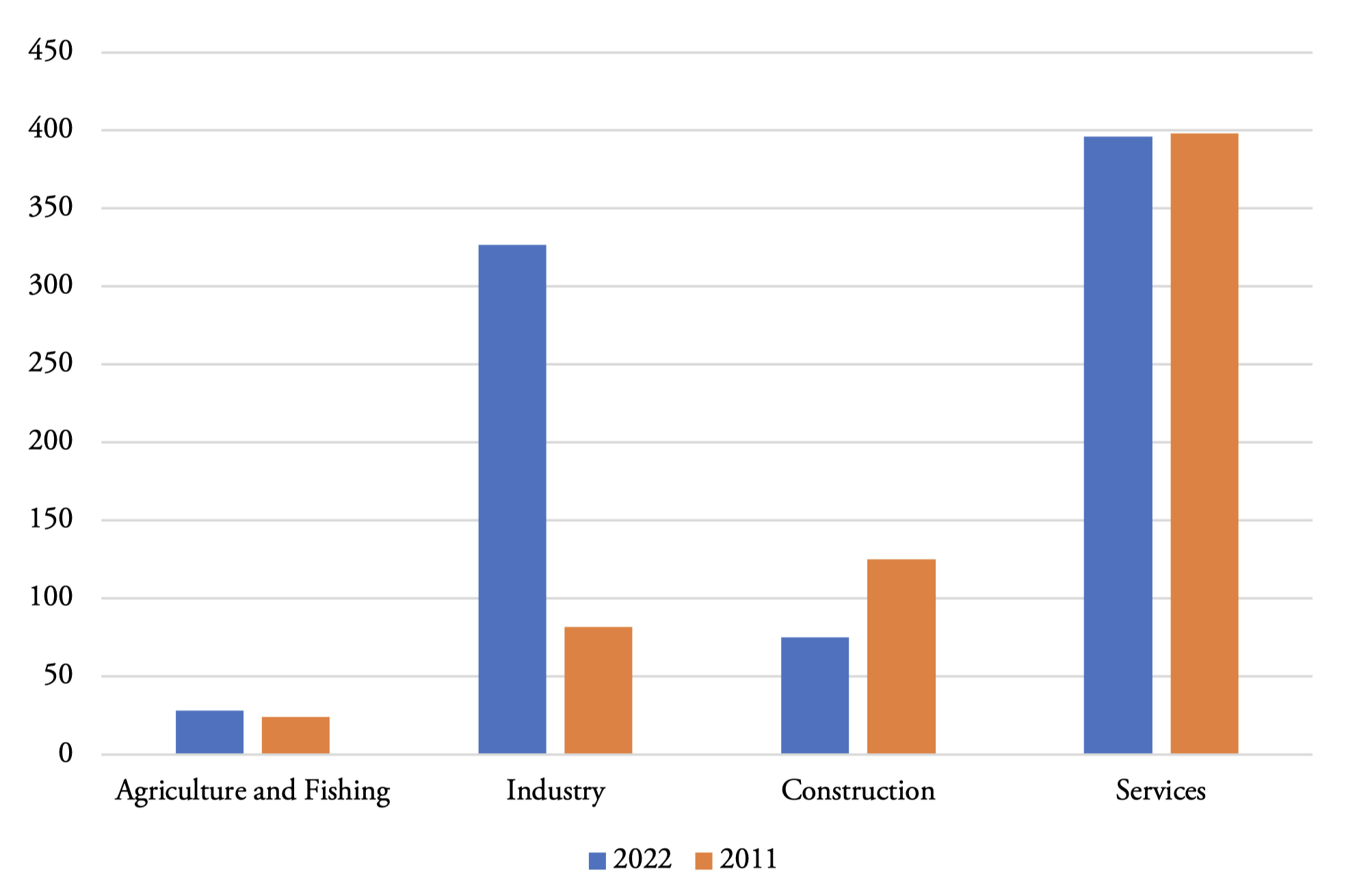
The mines have been reactivated, and ore extraction is again in progress. Although mining activity no longer plays the central role that it once did in the region, efforts have been made to revive and diversify the local economy through industrial mining tourism. Notably, in 2011, the number of employment contracts in the services and construction sectors exceeded those in the industrial sector. However, with the recent reactivation of the mine, the number of contracts in the industrial sector has risen, highlighting the current diversification of the region’s economic activities.
The most striking example of the region’s attractiveness to tourists is the Riotinto Mining Park, which has been operational for 25 years, welcoming 96,935 visitors in 2022 (only 40 less than in 2019). These numbers represent a recovery from the drastic drop in visitor levels observed in 2020 and 2021 (41,803 and 62,245 visitors, respectively) due to COVID-19 restrictions (Rio Tinto Foundation, 2023).
The Mining Park provides information on the history of Riotinto County, with its English heritage and unique landscape, which attracted interest from NASA due to its striking resemblance to Mars. Since 2022, the Riotinto Mining Park has significantly expanded, offering six different tourist attractions throughout the year: (1) a tour of the old mining railway along a recovered 11-kilometer route that immerses the visitor in the River Tinto ecosystem; (2) a visit to the Peña del Hierro mine, showing both open-cast and underground mining by traveling more than 200 meters along one of its galleries; (3) a visit to the iconic Corta Atalaya; (4) Mining Museum, the most comprehensive Spanish museum showing the rich history of the mining territory; (5) House 21 in the English quarter, which reproduces the way of life of the British colony that managed Riotinto for eight decades; and (6) the "Mars on Earth" circuit, a journey that aims to highlight the parallels identified by scientists between the environment of the red planet and the Rio Tinto region (Fundación de Río Tinto, 2023).
Figure 4.
Comparison of annual hiring rates according to productive sector (2011-2022).
The most striking example of the region’s attractiveness to tourists is the Riotinto Mining Park, which has been operational for 25 years, welcoming 96,935 visitors in 2022 (only 40 less than in 2019). These numbers represent a recovery from the drastic drop in visitor levels observed in 2020 and 2021 (41,803 and 62,245 visitors, respectively) due to COVID-19 restrictions (Rio Tinto Foundation, 2023).
The Mining Park provides information on the history of Riotinto County, with its English heritage and unique landscape, which attracted interest from NASA due to its striking resemblance to Mars. Since 2022, the Riotinto Mining Park has significantly expanded, offering six different tourist attractions throughout the year: (1) a tour of the old mining railway along a recovered 11-kilometer route that immerses the visitor in the River Tinto ecosystem; (2) a visit to the Peña del Hierro mine, showing both open-cast and underground mining by traveling more than 200 meters along one of its galleries; (3) a visit to the iconic Corta Atalaya; (4) Mining Museum, the most comprehensive Spanish museum showing the rich history of the mining territory; (5) House 21 in the English quarter, which reproduces the way of life of the British colony that managed Riotinto for eight decades; and (6) the "Mars on Earth" circuit, a journey that aims to highlight the parallels identified by scientists between the environment of the red planet and the Rio Tinto region (Fundación de Río TintoRio Tinto Foundation, 2023).
Given this rapid expansion of tourism in Minas de Riotinto, various local companies and new agents have launched initiatives to create interesting local routes and services. These endeavors aim to diversify and enrich the overall tourist experience for those visiting the region. However, the considerable and increasing demand for tourism starkly contrasts the limited accommodation options available. Currently, the region offers only 74 places for lodging, including a hostel restaurant and a handful of Victorian-style rural houses (Registro de Turismo de AndalucíaAndalusian Tourism Register, 2023). As a result, most visitors to Minas de Riotinto are day-trippers who do not stay overnight, leading to a loss in tourist spending in the region.
Minas de Riotinto has recently been declared a "Tourist Municipality" by The Andalusian Board. This designation emphasizes the significant growth in tourism witnessed by the municipality and reflects the commitment of the regional public administration to promote tourism as a strategic avenue for economic diversification in the area.
3.3. Sample and data collection
In 2017, the population of Minas de Riotinto consisted of 3924 inhabitants, which is the reference year for this study. Of these inhabitants, 3,361 (85.65%) were 18 or older, making them the target population for the study. The study sample consisted of 346 individuals (Table 1). The sampling method used (stratified according to gender and age), and the sample sizes (determined with a margin of error of ±5%, a confidence level of 95.5% [2σ], and a population variance of 50%) were chosen to ensure that the sample is statistically representative of the local population at the community level.
Table 1.
: Distribution of the sample of Minas de Riotinto residents. Source: Authors' own.
| 20-29 years | 30-44 years | 45-64 years | 65 years and above | TOTAL | |
| MALES | 26 | 43 | 64 | 35 | 168 |
| FEMALES | 23 | 40 | 62 | 53 | 178 |
Source: Authors' own.
A structured questionnaire was administered to this sample between May and July 2017 (under the direction of two interviewers who had received prior training in the data collection method). The population under study was exclusively made up of permanent residents. After eliminating cases with missing values, the final sample for analysis consisted of 344 residents.
3.4. Measurement instrument
This study considered 17 psychological variables organized into seven thematic blocks (Table 2). Each of these variables was assessed using a five-point Likert scale. The questionnaire was created by adapting variables examined in previous studies regarding residents’ attitudes towards tourism.
In addition, the study also considered seven sociodemographic variables and one variable related to economic dependence on tourism activity. These additional variables were included to construct the sociodemographic and economic profile of the clusters.
Table 2.
: Questionnaire items and descriptive statistics.
| Variable | Items and Likert Scale | Mean | Std. Deviation | Item Sources |
| Perception of the personal benefits of tourism (PPBT) | To what extent do you think that the development of tourism benefits or will benefit you personally? (1. Not at all- 5.Very much) | 2.95 | 1.336 | Harrill (2004); Ko and Stewart (2002); McGehee and Andereck (2004); Perdue et al. (1990); Vargas-Sánchez et al. (2009a, 2011, 2015). |
| Perception of the overall community benefits of tourism (PCBT) | In general, the benefits of tourism development outweigh its costs (at a community level) (1. Completely disagree- 5. Completely agree) | 4.05 | 1.113 | Vargas-Sánchez et al. (2011, 2015). |
| Perception of the benefits and costs of tourism according to its nature (PBCT) | Perception of the economic benefits of tourism (PEBT) (1. Completely disagree - 5. completely agree) | 4.08 | 1.161 | Ap (1992); Kayat (2002); Ko and Stewart (2002); Ribeiro, et al. (2013); Tosum (2002); Vargas-Sánchez et al. (2011, 2015). |
| Perception of the economic costs of tourism (PECT) (1. Completely disagree - 5. Completely agree) | 3.73 | 0.979 | ||
| Perception of the sociocultural benefits of tourism (PSBT) (1. Completely disagree- 5. Completely agree) | 3.73 | 0.925 | ||
| Perception of the sociocultural cost of tourism (PSCT) (1. Completely disagree- 5. Completely agree) | 2.22 | 1.102 | ||
| Perception of the environmental benefits of tourism (PENBT) (1. Completely disagree- 5. Completely agree) | 4.03 | 1.061 | ||
| Perception of the environmental cost of tourism (PENCT) (1. Completely disagree- 5. Completely agree) | 1.94 | 1.147 |
Table 2. cont.
Questionnaire items and descriptive statistics
| Variable | Items and Likert Scale | Mean | Std. Deviation | Item Sources |
| Perception of the current level of tourism development in the locality (LTDP) | Regarding the opportunities that, in your opinion, tourism could bring to your locality, do you consider that the current degree of tourism development is... (1. Very low-5. Very high) | 2.65 | 0.972 | Vargas-Sánchez et al. (2011, 2015). |
| Attitude towards further tourism development in the locality (Affective component) (AATFTD) | I am in favor of greater tourist development in my locality (ATFTD) (1. Completely disagree- 5. Completely agree) | 4.72 | 0.735 | Vargas-Sánchez et al. (2011, 2015). |
| I would like the number of tourists visiting my town to increase (ATFT) (1. Completely disagree- 5. Completely agree) | 4.70 | 0.721 | Vargas-Sánchez et al. (2011, 2015). | |
| Attitude towards further tourism development in the locality (Cognitive component) (CATFTD) | I am convinced that tourism is a source of wealth and well-being for Rio Tinto and its citizens (CWWBT) (1. Not convinced-5. Very convinced) | 4.19 | 0.990 | Woo et al. (2015); Nunkoo and So (2016). |
| Level of knowledge about tourism development projects that are proposed for my town (LKTDP) (1. Zero – 5. Very high) | 2.51 | 1.153 | Nunkoo and So (2016); Rasoolimanesh et al. (2016). | |
| Attitude towards further tourism development in the locality (Behavioral component) (BATFTD) | To what extent am I motivated to promote my locality? (MTPL) (1. Not motivated -5. Highly motivated) | 3.81 | 1.142 | Ribeiro et al. (2017). |
| How often do I recommend tourists/visitors/friends/family to visit tourist attractions in Rio Tinto (RB) (1. Never-5. Very frequently) | 4.01 | 1.007 | Chen and Raab (2012); Jeuring and Haartsen (2017). |
Table 2: Questionnaire items and descriptive statistics. Source: Authors' own.
3.5. Study methods and data analysis
This study followed a structured methodology composed of four main stages:
1. The first stage involved calculating univariate statistics for all survey items. This step aimed to establish the profile of the sample in terms of sociodemographic variables, perceptions, and attitudes.
2. The second stage focused on segmenting the residents based on two key variables: PPBT (perception of the personal benefit of tourism ) and PCBT (perception of the benefits and costs of tourism according to its nature). Initially, a two-stage cluster analysis was conducted as an exploratory tool to determine the optimum number of clusters, select the segmentation criteria, and assess the quality of the groupings. Subsequently, a k-means non-hierarchical analysis cluster was conducted to refine this study further to identify profiles of residents with similar perceptions of tourism at the intra-group level while maintaining as much heterogeneity as possible.
3. In the third stage, the study focused on identifying and analyzing the sociodemographic and economic profiles of the established clusters. Additionally, the aim was to determine whether there were significant differences in these variables between the clusters.
4. In the fourth stage, Kruskal-Wallis and Bonferroni-Dunn post-hoc tests were used to analyze the identified clusters. The dependent variables under consideration were as follows:
·
· - Various perception items excluded in the first stage, specifically PBCT items, were included to evaluate the quality of segmentation.
· - The variable LTDP was used to explore possible differences in the perceived level of tourism development between the clusters.
· - Six items measuring the three variables CATFTD, AATFTD, and BATFTD were utilized to examine and test the hypotheses concerning differences in attitudes between the groups.
The statistical package SPSS Statistics 25 was used for data analysis purposes.
4. Results
4.1. Univariate statistics
Regarding the sociodemographic profile of the sample, 51.7% of the study population consists of women, and almost 39% of the sample are aged between 36 and 55, while almost a quarter of the surveyed individuals are over 65 years old.
Around 71% of the residents have lived in the town since birth, while only 15% have lived there for less than half of their lives.
Only 17% of individuals over 18 have a university education, although the percentage of people with no education is also very low (10%), with vocational training and elementary school having almost equal weight. One-third of the surveyed population is employed, almost 27% are retired, and 10% are unemployed.
Notably, the tourism sector does not appear to be a significant source of employment for the local population, as 84% of those surveyed are not personally involved in tourism. This percentage drops to 73% when considering the absence of family employment ties (see Table 4). These numbers might help to understand why the residents of Minas de Riotinto have a neutral perception (average of 2.95 out of 5 points) of the personal benefit they stand to gain from tourism development in their locality (Table 2). This perception is similar to that reported in a study by Vargas-Sanchez et al. (2009a), conducted in the same locality a decade earlier (reporting a mean of 3.30 at that time-2006).
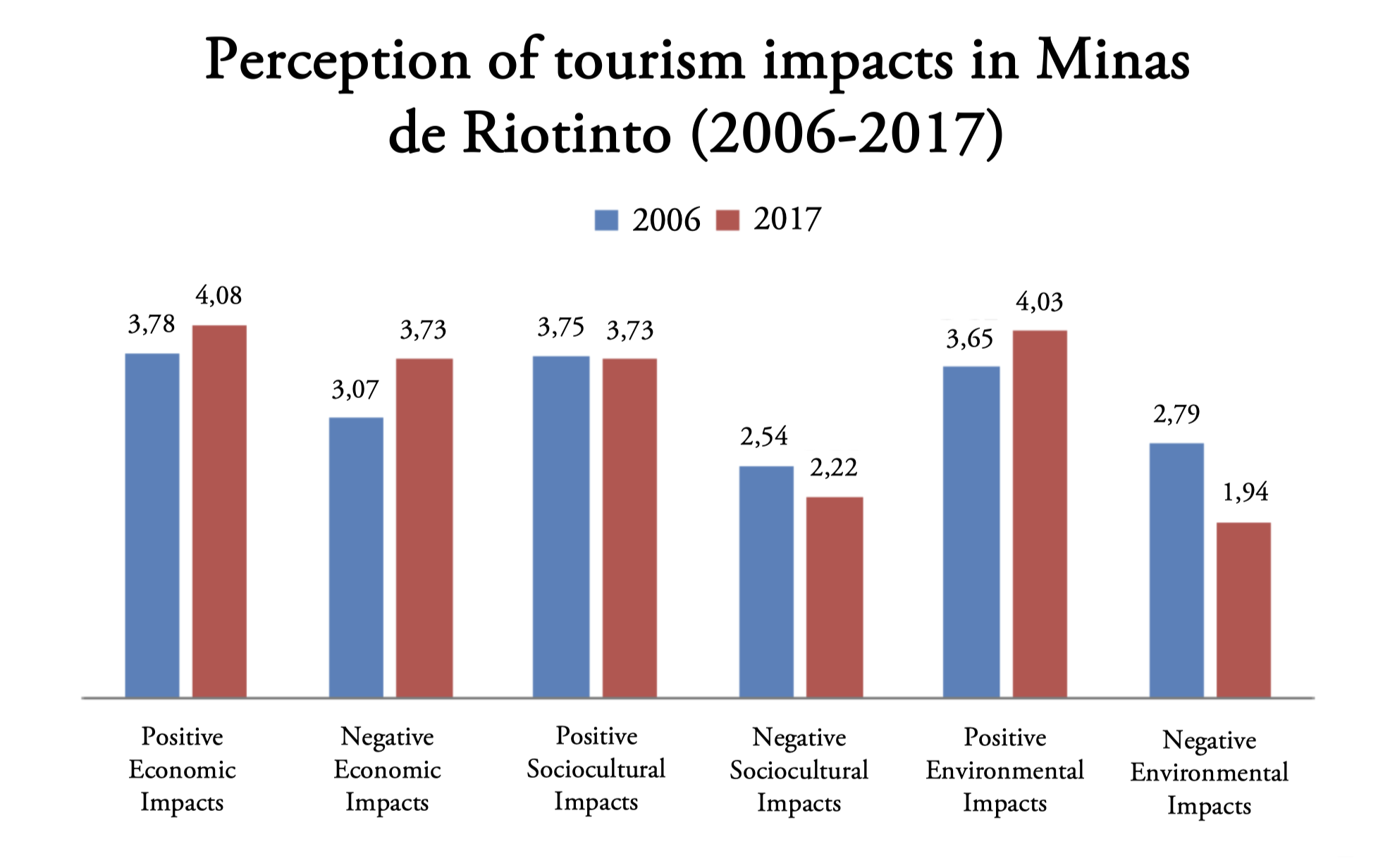
However, the residents explicitly acknowledge that tourism positively impacts the community at a global level (as indicated by their response to the single item, "the benefits outweigh the costs at the global level," with a mean rating of 4.05). This perception of the benefits outweighing the costs is consistent across all tourism effects on the community. The largest difference between perceived benefits and costs is observed in the case of environmental effects (+2.09), followed by sociocultural effects (+1.51), and less pronounced in the case of economic effects (+0.35). Comparing these results with those reported by Vargas-Sanchez et al. (2009a) shows that, over the course of a decade (Figure 5): (1) the residents’ perception of both the positive and negative economic effects and environmental benefits of tourism activity has intensified (narrowing the gap between the two); (2) the perception of negative sociocultural and environmental impacts has decreased even further (widening the gap between sociocultural and environmental benefits/cost); (3) while residents now perceive a lesser net economic benefit, they perceive a greater net sociocultural and environmental benefit.
The degree of tourism development residents perceive in Minas de Riotinto is low to medium (with a mean score of 2.65), consistent with the emerging stage in which this industrial tourism destination finds itself.
Figure 5.
: Perception of community tourism impacts in Minas de Riotinto (2006-2017).
Source: Authors' own.
In the section focusing on the affective or emotional component of attitude, the residents of Minas de Riotinto express strong support for increasing the number of tourists (mean rating of 4.70) and further tourism development in their locality (mean=4.72) compared to a mean rating of 4.66 a decade earlier (Vargas-Sanchez et al., 2009a). At the cognitive level, residents are convinced that tourism activity serves as a source of wealth and well-being for Riotinto and its residents (mean rating = 4.19). However, they feel poorly informed about tourism development projects in their locality (mean rating=2.51). Finally, at the behavioral level, residents are highly motivated to promote their locality as a tourist destination (3.81), often engaging in pro-tourism behaviors such as recommending the place to tourists, friends, or family (4.01).
4.2. Resident segmentation.
The variables considered for segmenting residents based on their perceptions were as follows: PPBT, PCBT, PEBT, PECT, PSBT, PSCT, PENBT, and PENCT.
To ensure the analysis was not affected by multicollinearity issues and given the strong bivariate correlations observed between a significant portion of the six variables assessing the perception of the effects of tourism according to sign and nature, these six variables were initially excluded from the cluster analysis. However, they were later reintroduced into the analysis when verifying the quality of the segmentation.
The two-stage cluster analysis effectively yielded three clusters, demonstrating good segmentation quality and a high proportion of both variables (PPBT, PCBT), exceeding 95%. Based on these results and considering the statistical criteria and theoretical insights from the previous literature review, a non-hierarchical k-means cluster analysis was conducted, forming three groups (Table 3). The initial cluster centers or means for each of the three groups were set as follows: 1.00, 1.00, and 5.00 (for the variable PPBT) and 5.00, 1.00, and 3.00 (for the variable PCBT).
Based on the final areas determined for each cluster and supported by insights from the related literature, we categorized the three segments according to their perceptions of PPBT, PCBT, CATFTD, AATFTD, and BATFTD.
Group 1: “Disinterested and moderate supporters” (55.2%). This cluster consists of residents who hold a moderate level of interest in tourism and support it to a certain extent. They perceive the various benefits associated with tourism with moderate intensity (mean between 3.6 and 4) and believe the benefits outweigh the costs. Notably, residents in this cluster do not perceive PSCT and PENCT.
These residents explicitly believe that the benefits of tourism outweigh its costs for the good of their community (mean=4.23). This perception is more prominent than the implicit perception derived from the gaps between the benefits and costs of each type of effect (4.08), which is closely aligned with their conviction that tourism is a source of wealth and well-being for Riotinto and its residents (4.22). However, they clearly believe that tourism does not benefit them personally (2.08).
Regarding AATFTD, even though this group has limited knowledge about tourism development projects in their area (2.31), they show a very favorable affective attitude towards further tourism development and an increased presence of tourists in the locality (with mean scores of 4.73 and 4.75, respectively). However, this positive attitude does not necessarily translate into pro-tourism intentions and behaviors.
Group 2: “Incongruous and impulsive residents” (7.8%). Members of this relatively small group show a notable disparity between their perceptions and attitudes, and concerning the latter, between the constituent affective, behavioral, and cognitive components. In terms of their perceptions, they believe that tourism does not benefit them personally (2.33), and they struggle to distinguish between the various positive and negative effects of tourism, often leaning towards the belief that its costs outweigh the benefits. This contrasts with their tenuous conviction that tourism is a source of wealth and well-being for Riotinto and its residents (3.41).
Despite this complex picture of perceptions and beliefs and the fact that this group has limited knowledge about tourism development projects (2.48), their support for tourism development in the area and the increased presence of tourists is strikingly evident. This is particularly reflected in their AATFTD scores, with a mean of 4.37 in both cases and, to a lesser extent, in BATFTD. This group appears to be driven more by impulsive, emotional reactions than rational considerations. Interestingly, despite their ostensibly unfavorable perceptions of tourism, they often engage in behaviors such as recommending visits to the locality to outsiders (3.93), which goes far beyond their tenuous intentions or motivations (3.26).
Group 3: “Interested and enthusiastic supporters” (36.9%). This cluster unequivocally perceives that tourism activity will personally benefit them and is also beneficial for the wider community (means of 4.39 and 4.36, respectively).
Members of this group are strongly aware of the various positive effects of tourism (mean ratings ranging between 4.0 and 4.6), and, similar to Cluster 1, they do not perceive the sociocultural and environmental costs (PSCT and PENCT). Aligned with their belief in the overall benefits of tourism for themselves and their community, these residents fully support further tourism development and an increase in the number of tourists in the locality (means of 4.80 and 4.72, respectively). They are highly motivated to promote their locality (4.08) and frequently recommend it as a destination to tourists, friends, and family (4.20).
Table 3.
: Final cluster centers/means and Kruskal-Wallis test for perceptions and attitudes.
| Final cluster centers/means | Kruskal-Wallis | Bonferroni-Dunn post-hoc tests | |||||
| Cluster 1 (n=190, 55.2%) | Cluster 2 (n=27, 7.8%) | Cluster 3 (n=127, 36.9%) | H-Kruskal-Wallis | Sig | Pairwise Comparisons (Significant differences) | ||
| Perception of the personal benefit of tourism (PPBT) | 2.08 | 2.33 | 4.39 | 239.377 | 0.000 | (1-3)*** (2-3)*** | |
| Perception of the global community benefit of tourism (PCBT) | 4.23 | 1.30 | 4.36 | 86.306 | 0.000 | (1-2)*** (2-3)*** | |
| Perception of the benefits and costs of tourism according to its nature (PBCT) | Perception of the economic benefits of tourism (PEBT) | 3.96 | 2.74 | 4.55 | 48.345 | 0.000 | (1-2)*** (2-3)*** (1-3)*** |
| Perception of the economic cost of tourism (PECT) | 3.64 | 2.93 | 4.06 | 29.179 | 0.000 | (1-2)** (2-3)*** (1-3)*** | |
| Perception of the sociocultural benefits of tourism (PSBT) | 3.63 | 2.96 | 4.03 | 28.703 | 0.000 | (1-2)** (2-3)*** (1-3)*** | |
| Perception of the sociocultural cost of tourism (PSCT) | 2.04 | 2.48 | 2.43 | 11.307 | 0.004 | (1-3)*** | |
| Perception of the environmental benefits of tourism (PENBT) | 3.98 | 3.11 | 4.34 | 21.445 | 0.000 | (1-2)*** (2-3)*** (1-3)** | |
| Perception of the environmental cost of tourism (PENCT) | 1.81 | 2.26 | 2.04 | 6.909 | 0.032 | Not significant | |
| Perception of the current level of tourism development in the locality (LTDP) | 2.58 | 2.44 | 2.80 | 3.735 | 0.155 | Not significant | |
| Attitude towards further tourism development in the locality (Affective component) (AATFTD) | I am in favor of greater tourism development in my locality (ATFTD) | 4.73 | 4.37 | 4.80 | 4.160 | 0.125 | Not significant |
| I would like the number of tourists visiting my town to increase (ATFT) | 4.75 | 4.37 | 4.72 | 3.237 | 0.198 | Not significant | |
| Attitude towards further tourism development in the locality (Cognitive component) (CATFTD) | I am convinced that tourism is a source of wealth and well-being for Rio Tinto and its citizens (CWWBT) | 4.22 | 3.41 | 4.33 | 12.324 | 0.002 | (1-2)*** (2-3)*** |
| Level of knowledge about tourism development projects that are proposed for my town (LKTDP) | 2.31 | 2.48 | 2.84 | 16.755 | 0.000 | (1-3)*** | |
| Attitude towards further tourism development in the locality (Behavioral component) (BATFTD) | To what extent am I motivated to promote my locality? (MTPL) | 3.70 | 3.26 | 4.08 | 11.294 | 0.004 | (1-3)** (2-3)** |
| How often do I recommend tourists/visitors/friends/family to tourist attractions in Rio Tinto (RB) | 3.89 | 3.93 | 4.20 | 6.606 | 0.037 | (1-3)** | |
Significant at 0.1 level (*); Significant at 0.05 level (**); Significant at 0.01 level (***).
To ensure the analysis was not affected by multicollinearity issues and given the strong bivariate correlations observed between a significant portion of the six variables assessing the perception of the effects of tourism according to sign and nature, these six variables were initially excluded from the cluster analysis. However, they were later reintroduced into the analysis when verifying the quality of the segmentation.
The two-stage cluster analysis effectively yielded three clusters, demonstrating good segmentation quality and a high proportion of both variables (PPBT, PCBT), exceeding 95%. Based on these results and considering the statistical criteria and theoretical insights from the previous literature review, a non-hierarchical k-means cluster analysis was conducted, forming three groups (Table 3). The initial cluster centers or means for each of the three groups were set as follows: 1.00, 1.00, and 5.00 (for the variable PPBT) and 5.00, 1.00, and 3.00 (for the variable PCBT).
Based on the final areas determined for each cluster and supported by insights from the related literature, we categorized the three segments according to their perceptions of PPBT, PCBT, CATFTD, AATFTD, and BATFTD.
Group 1: “Disinterested and moderate supporters” (55.2%). This cluster consists of residents who hold a moderate level of interest in tourism and support it to a certain extent. They perceive the various benefits associated with tourism with moderate intensity (mean between 3.6 and 4) and believe the benefits outweigh the costs. Notably, residents in this cluster do not perceive PSCT and PENCT.
These residents explicitly believe that the benefits of tourism outweigh its costs for the good of their community (mean=4.23). This perception is more prominent than the implicit perception derived from the gaps between the benefits and costs of each type of effect (4.08), which is closely aligned with their conviction that tourism is a source of wealth and well-being for Riotinto and its residents (4.22). However, they clearly believe that tourism does not benefit them personally (2.08).
Regarding AATFTD, even though this group has limited knowledge about tourism development projects in their area (2.31), they show a very favorable affective attitude towards further tourism development and an increased presence of tourists in the locality (with mean scores of 4.73 and 4.75, respectively). However, this positive attitude does not necessarily translate into pro-tourism intentions and behaviors.
Group 2: “Incongruous and impulsive residents” (7.8%). Members of this relatively small group show a notable disparity between their perceptions and attitudes, and concerning the latter, between the constituent affective, behavioral, and cognitive components. In terms of their perceptions, they believe that tourism does not benefit them personally (2.33), and they struggle to distinguish between the various positive and negative effects of tourism, often leaning towards the belief that its costs outweigh the benefits. This contrasts with their tenuous conviction that tourism is a source of wealth and well-being for Riotinto and its residents (3.41).
Despite this complex picture of perceptions and beliefs and the fact that this group has limited knowledge about tourism development projects (2.48), their support for tourism development in the area and the increased presence of tourists is strikingly evident. This is particularly reflected in their AATFTD scores, with a mean of 4.37 in both cases and, to a lesser extent, in BATFTD. This group appears to be driven more by impulsive, emotional reactions than rational considerations. Interestingly, despite their ostensibly unfavorable perceptions of tourism, they often engage in behaviors such as recommending visits to the locality to outsiders (3.93), which goes far beyond their tenuous intentions or motivations (3.26).
Group 3: “Interested and enthusiastic supporters” (36.9%). This cluster unequivocally perceives that tourism activity will personally benefit them and is also beneficial for the wider community (means of 4.39 and 4.36, respectively).
Members of this group are strongly aware of the various positive effects of tourism (mean ratings ranging between 4.0 and 4.6), and, similar to Cluster 1, they do not perceive the sociocultural and environmental costs (PSCT and PENCT). Aligned with their belief in the overall benefits of tourism for themselves and their community, these residents fully support further tourism development and an increase in the number of tourists in the locality (means of 4.80 and 4.72, respectively). They are highly motivated to promote their locality (4.08) and frequently recommend it as a destination to tourists, friends, and family (4.20).
Based on the final areas determined for each cluster and supported by insights from the related literature, we categorized the three segments according to their perceptions of PPBT, PCBT, CATFTD, AATFTD, and BATFTD.
Group 1: “Disinterested and moderate supporters” (55.2%). This cluster consists of residents who hold a moderate level of interest in tourism and support it to a certain extent. They perceive the various benefits associated with tourism with moderate intensity (mean between 3.6 and 4) and believe the benefits outweigh the costs. Notably, residents in this cluster do not perceive PSCT and PENCT.
These residents explicitly believe that the benefits of tourism outweigh its costs for the good of their community (mean=4.23). This perception is more prominent than the implicit perception derived from the gaps between the benefits and costs of each type of effect (4.08), which is closely aligned with their conviction that tourism is a source of wealth and well-being for Riotinto and its residents (4.22). However, they clearly believe that tourism does not benefit them personally (2.08).
Regarding AATFTD, even though this group has limited knowledge about tourism development projects in their area (2.31), they show a very favorable affective attitude towards further tourism development and an increased presence of tourists in the locality (with mean scores of 4.73 and 4.75, respectively). However, this positive attitude does not necessarily translate into pro-tourism intentions and behaviors.
Group 2: “Incongruous and impulsive residents” (7.8%). Members of this relatively small group show a notable disparity between their perceptions and attitudes, and concerning the latter, between the constituent affective, behavioral, and cognitive components. In terms of their perceptions, they believe that tourism does not benefit them personally (2.33), and they struggle to distinguish between the various positive and negative effects of tourism, often leaning towards the belief that its costs outweigh the benefits. This contrasts with their tenuous conviction that tourism is a source of wealth and well-being for Riotinto and its residents (3.41).
Despite this complex picture of perceptions and beliefs and the fact that this group has limited knowledge about tourism development projects (2.48), their support for tourism development in the area and the increased presence of tourists is strikingly evident. This is particularly reflected in their AATFTD scores, with a mean of 4.37 in both cases and, to a lesser extent, in BATFTD. This group appears to be driven more by impulsive, emotional reactions than rational considerations. Interestingly, despite their ostensibly unfavorable perceptions of tourism, they often engage in behaviors such as recommending visits to the locality to outsiders (3.93), which goes far beyond their tenuous intentions or motivations (3.26).
Group 3: “Interested and enthusiastic supporters” (36.9%). This cluster unequivocally perceives that tourism activity will personally benefit them and is also beneficial for the wider community (means of 4.39 and 4.36, respectively).
Members of this group are strongly aware of the various positive effects of tourism (mean ratings ranging between 4.0 and 4.6), and, similar to Cluster 1, they do not perceive the sociocultural and environmental costs (PSCT and PENCT). Aligned with their belief in the overall benefits of tourism for themselves and their community, these residents fully support further tourism development and an increase in the number of tourists in the locality (means of 4.80 and 4.72, respectively). They are highly motivated to promote their locality (4.08) and frequently recommend it as a destination to tourists, friends, and family (4.20).
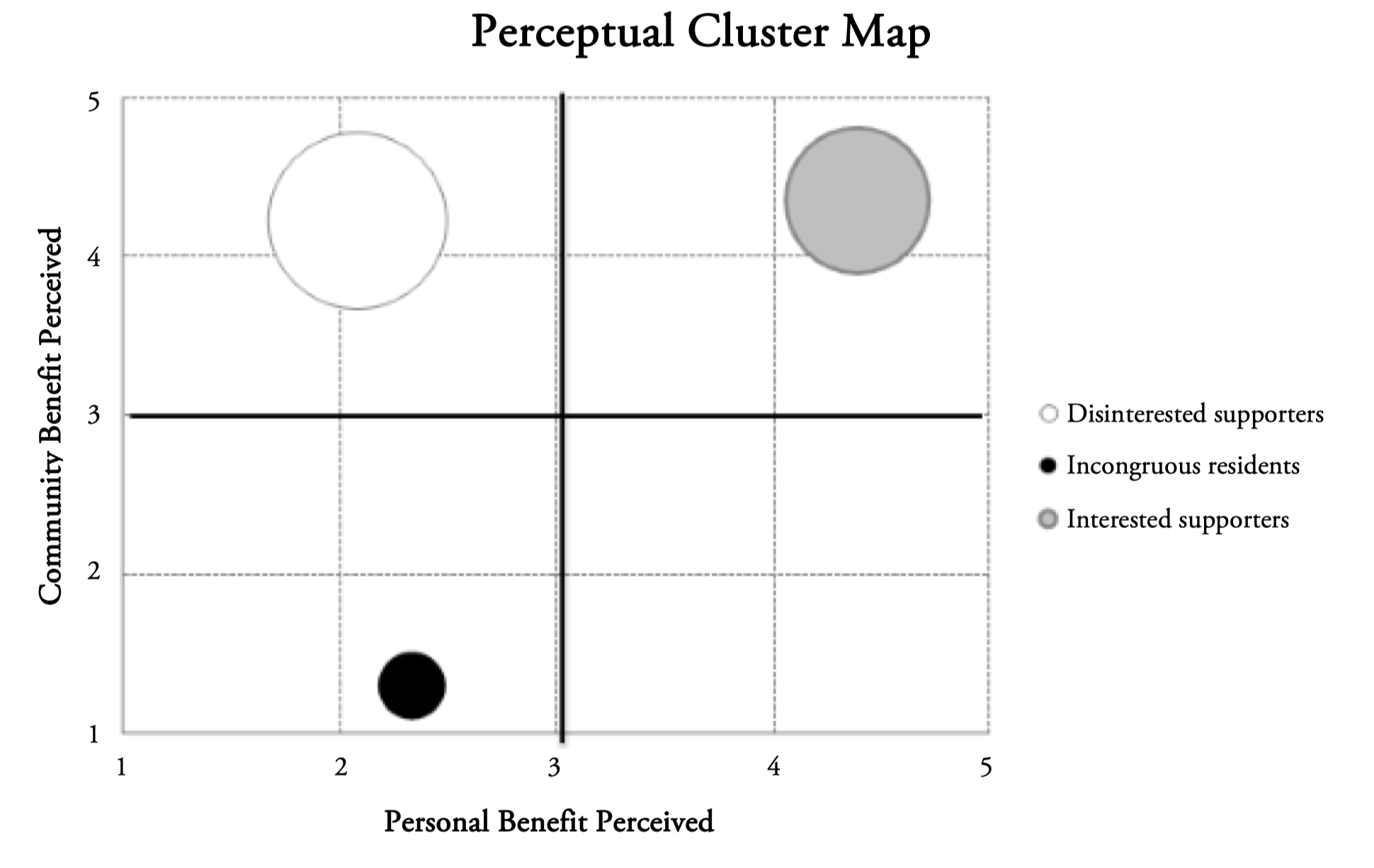
Moreover, as expected from a well-executed segmentation strategy, the three groups differ significantly regarding PPBT and PCBT, as illustrated in Figure 6.
Figure 6.
: Perceptual Cluster Map (Perceived Community Benefit/ Personal Benefit).
It is worth noting that, in all the groups, the mean ATFTD and ATFT scores are above 4, indicating a strong AATFTD. While some residents hold unfavorable views of tourism (complete or considerable disagreement), this minority accounts for less than 4% of the sample. This group can be considered a purely token group in the locality. Consequently, none of the identified groups indicated opposition to tourism development in the area.
4.3. Sociodemographic and economic profile of the clusters.
Starting with “age”, the continuous analysis of this variable revealed that Cluster 1 has a mean age of 52.4 years, Cluster 2 has a mean age of 42.0 years, and Cluster 3 has a mean age of 46.8 years (Table 4). This demonstrates that the “incongruous and impulsive residents” are younger on average than the “interested and enthusiastic supporters” while the "disinterested and moderate supporters” have the oldest mean age.
A similar trend emerges when examining the variable "years of residence in the locality." Cluster 1 has a mean of 46.7 years, Cluster 2 has 28.7 years, and Cluster 3 has 40.4 years. This suggests that the “incongruous and impulsive residents” are relatively recent arrivals to the locality, while the “disinterested and moderate supporters” have resided in the area the longest. Subtracting the respective means (age – years of residence) reveals that the values are very similar in Clusters 1 and 3 (5.7 and 6.4 years, respectively). In contrast, Cluster 2 has a notably higher difference of 13.3 years, the mean age at which the resident moves to the locality. The same trend is evident when comparing the percentage of time that residents in Clusters 1 and 3 have been living in the locality (88% and 84%, respectively) with Cluster 2 (66%), which is significantly lower.
These findings suggest that the two groups of residents who strongly perceive that the benefits of tourism outweigh the costs are those who have spent their entire lives in the locality. On the other hand, the “incongruous and impulsive residents” who perceive tourism differently have spent a smaller percentage of their lives in the municipality. It would be interesting to analyze whether there is any relationship between these results and Community Attachment Theory.
Concerning the "level of educational attainment variable," the "disinterested and moderate supporters" group has a lower mean education level, with 43.4% having either not studied or having completed only elementary school. The “interested and enthusiastic supporters” are characterized by the prevalence of high school and professional studies (55.9%), while the “incongruous and impulsive residents” group consists mainly of individuals with elementary school and professional qualifications, with around two-thirds having completed these levels of education.
Finally, concerning the "resident's employment relationship with tourism activity, whether at a personal or family level," some notable patterns emerge among the clusters. Cluster 1 has a lower percentage of individuals with a personal connection to tourism activity (9.0%) and a slightly higher percentage with a family connection (21.2%). These results are consistent with the fact that individuals in this group also perceive that they personally benefit less from tourism activity. In contrast, in Cluster 3, 36.2% of respondents reported having family members employed in tourism-related roles. In Cluster 2, a third of residents have a personal employment relationship with tourism (with the highest percentage among the three groups). Interestingly, this cluster does not perceive that tourism benefits them personally but still supports continued tourism activity in the municipality.
Cross-tabulation and Pearson’s chi-squared test (Table 4) were then used to profile the clusters in terms of gender, age, civil status, years of residence in the locality, level of educational attainment, employment status, and personal and family employment relationships with tourism. Significant differences were found between the clusters for these variables (except for gender and civil status) at the 0.10 significance level, which is commonly accepted in these cases, according to Hair et al. (2010). The only exception to this pattern was the employment status variable, which was not significant when assessed at the traditional 0.05 level.
Table 4.
: Sociodemographic and economic profile of the clusters. Source: Authors' own.
| Cluster 1 (55.2%) | Cluster 2 (7.8%) | Cluster 3 (36.9%) | Total (100%) | Statistics | |
| Gender | Chi-square = 1.461, p = 0.482 | ||||
| Male | 46.3% | 44.4% | 52.8% | 48.3% | |
| Female | 53.7% | 55.6% | 47.2% | 51.7% | |
| Age | Chi-square =27.653, p = 0.002 | ||||
| Aged 18 to 25 | 7.4% | 14.8% | 11.8% | 9,5% | |
| Aged 26 to 35 | 12.1% | 14.8% | 15.0% | 13.6% | |
| Aged 36 to 45 | 15.3% | 40.7% | 19.7% | 18.8% | |
| Aged 46 to 55 | 18.9% | 7.4% | 26.0% | 20.8% | |
| Aged 56 to 65 | 18.9% | 14.8% | 7.1% | 14.2% | |
| Older than 65 | 27.4% | 7.4% | 20.5% | 23.1% | |
| Civil status | Chi-square = 3.724, p = 0.445 | ||||
| Married | 62.1% | 55.6% | 55.9% | 59.2% |
Table 4. cont.
Sociodemographic and economic profile of the clusters
| Cluster 1 (55.2%) | Cluster 2 (7.8%) | Cluster 3 (36.9%) | Total (100%) | Statistics | |
| Single | 17.9% | 18.5% | 26.0% | 21.1% | |
| Other | 20.0% | 25.9% | 18.1% | 19.7% |
Table 4. cont.
Sociodemographic and economic profile of the clusters
| Cluster 1 (55.2%) | Cluster 2 (7.8%) | Cluster 3 (36.9%) | Total (100%) | Statistics | |
| Years of Residence in the Locality | Chi-square =28.097, p = 0.000 | ||||
| 1 to 15 | 5.8% | 33.3% | 15.0% | 11.6% | |
| 16 to 30 | 18.9% | 18.5% | 19.7% | 19.1% | |
| 31 to 45 | 20.5% | 25.9% | 22.0% | 21.7% | |
| 46 to 60 | 26.3% | 22.2% | 23.6% | 24.9% | |
| Over 60 | 28.4% | 0.0% | 19.7% | 22.8% | |
| Educational Level | Chi-square = 19.434, p = 0.035 | ||||
| Uneducated | 12.7% | 0.0% | 8.7% | 10.1% | |
| Elementary school | 30.7% | 29.6% | 18.1% | 26.4% | |
| High school | 18.0% | 7.4% | 20.5% | 18.0% | |
| Professional Education | 22.2% | 37.0% | 35.4% | 28.1% | |
| University education: Diploma or degree | 14.3% | 18.5% | 15.0% | 14.8% | |
| University education: Master or doctorate | 2.1% | 7.4% | 2.4% | 2.6% | |
| Occupation | Chi-square = 21.486, p = 0.090 | ||||
| Employed | 31.1% | 48.1% | 32.3% | 32.7% | |
| Self-employed | 5.8% | 11.1% | 8.7% | 7.2% | |
| Civil servant | 8.4% | 14.8% | 9.4% | 9.2% | |
| Retiree/pensioner | 32.6% | 7.4% | 22.0% | 26.6% | |
| Student | 2.6% | 7.4% | 7.9% | 4.9% | |
| Homemaker | 8.4% | 0.0% | 4.7% | 6.9% | |
| Unemployed | 9.5% | 11.1% | 13.4% | 11.0% | |
| Other | 1.6% | 0.0% | 1.6% | 1.4% | |
| Personal employment relationship with tourism | Chi-square = 18.102, p = 0.000 | ||||
| Yes | 9.0% | 33.3% | 23.6% | 16.5% | |
| No | 91.0% | 66.7% | 76.4% | 83.5% | |
| Family employment relationship with tourism | Chi-square = 9.089, p = 0.011 | ||||
| Yes | 21.2% | 22.2% | 36.2% | 27.0% | |
| No | 78.8% | 77.8% | 63.8% | 73.0% |
Source: Authors' own.
Table 4: Sociodemographic and economic profile of the clusters. Source: Authors' own.
4.4. Results of the Kruskal-Wallis and Bonferroni-Dunn post-hoc tests.
The Kolmogorov-Smirnov test (Clusters 1 and 3) and the Shapiro-Wilk test (Cluster 2) revealed that the dependent variables do not follow a normal distribution. Additionally, the samples are not balanced, and the nature of the variables under study further complicates using ANOVA for group comparisons. Consequently, a non-parametric equivalent, the Kruskal-Wallis test, was employed. Moreover, we used the Bonferroni-Dunn test for post-hoc comparisons (Lubin et al., 201305; 166). (See Table 3).
4.4.1. Results from the Kruskal-Wallis test to verify the quality of the segmentation.
The results of the Kruskal-Wallis test used to assess the quality of the segmentation test based on variables related to the perceived impacts of tourism confirmed the effectiveness of the segmentation procedure. Except for the PENCT variable, this test consistently yielded significant values (p<0.05), revealing significant group differences for these variables. Subsequent post-hoc analyses, conducted using the Bonferroni-Dunn post-hoc test, confirmed significant differences between all the groups in the case of PEBT, PECT, PSBT, and PENBT. In the case of PSCT, a significant difference was only observed between Cluster 1 and Cluster 3.
4.4.2. Results from the Kruskal-Wallis test to explore differences in the perceived level of tourism development
Concerning the variable LTDP, the Kruskal-Wallis test yielded a non-significant value (p>0.05). This indicates the absence of statistically significant differences between the means of the three segments. In all three cases, the mean values range between 2.44 and 2.80, suggesting that residents perceive a low to medium LTDP in Minas de Riotinto. This result demonstrates clear consistency between the subjective perception of the residents and the objective analysis presented in Section 3.2 (“Study Site”) and aligns with the characteristics of a destination at an involvement phase of tourism development.
4.4.3. Results from the Kruskal-Wallis test to explore group differences in attitudes
· - Cognitive dimension of attitude
Regarding the two variables that represent CATFTD in the locality (CWWBT and LKTDP), the Kruskal-Wallis test revealed statistically significant differences between the groups (level of significance of p<0.01 in the first case and p<0.001 in the second). Hypothesis H1.1 can thus be accepted. In contrast, hypothesis H2.1 must be rejected.
Subsequent post-hoc analyses using the Bonferroni-Dunn post-hoc test enabled us to determine which pairs of groups showed significant differences in mean scores. In the case of CWWBT, significant differences were observed between Groups 1 and 2 and Groups 2 and 3, which were the pairs of groups for which the segmentation initially revealed differences in PCBT.
In the case of LKTDP, significant differences were only found between Groups 1 and 3, which were heterogeneous regarding PPBT.
xTherefore, we can conclude that residents with different levels of PCBT also differ in CWWBT and that groups of locals who differ significantly in PPBT also differ in their LKTDP.
· - Affective dimension of attitude
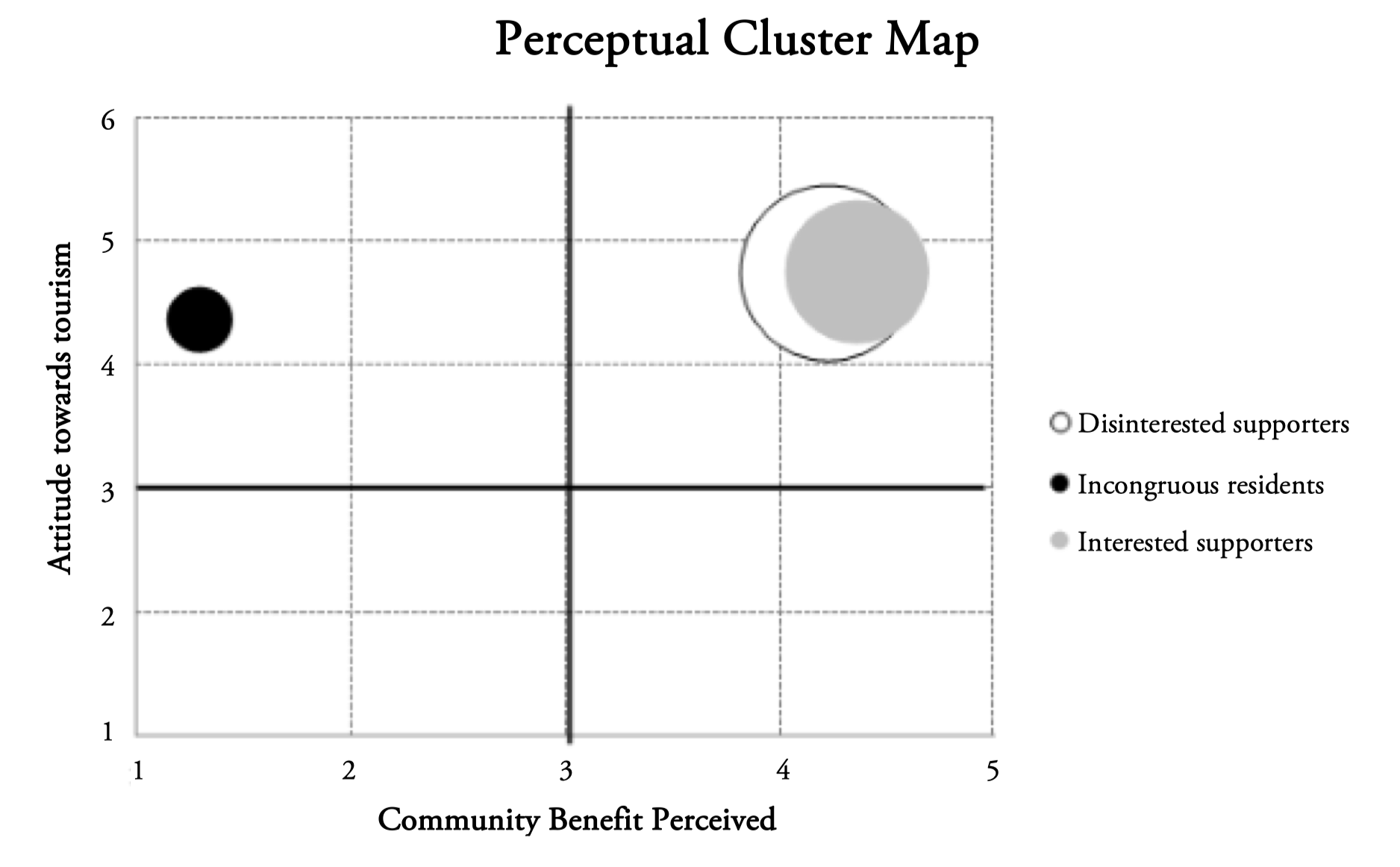
Considering the two items that constitute AATFTD (ATFTD and ATFT), no significant differences in the mean scores were found between the clusters (p>0.05). This result contradicts what might be expected on the basis of SET (Figures 7 and 8) and implies that Hypothesis H1.2 of this study (based on SET) must be rejected.
Figure 7.
: Perceptual Cluster Map (Residents' attitude towards tourism (affective attitude) vs perceived personal benefit derived from tourism).
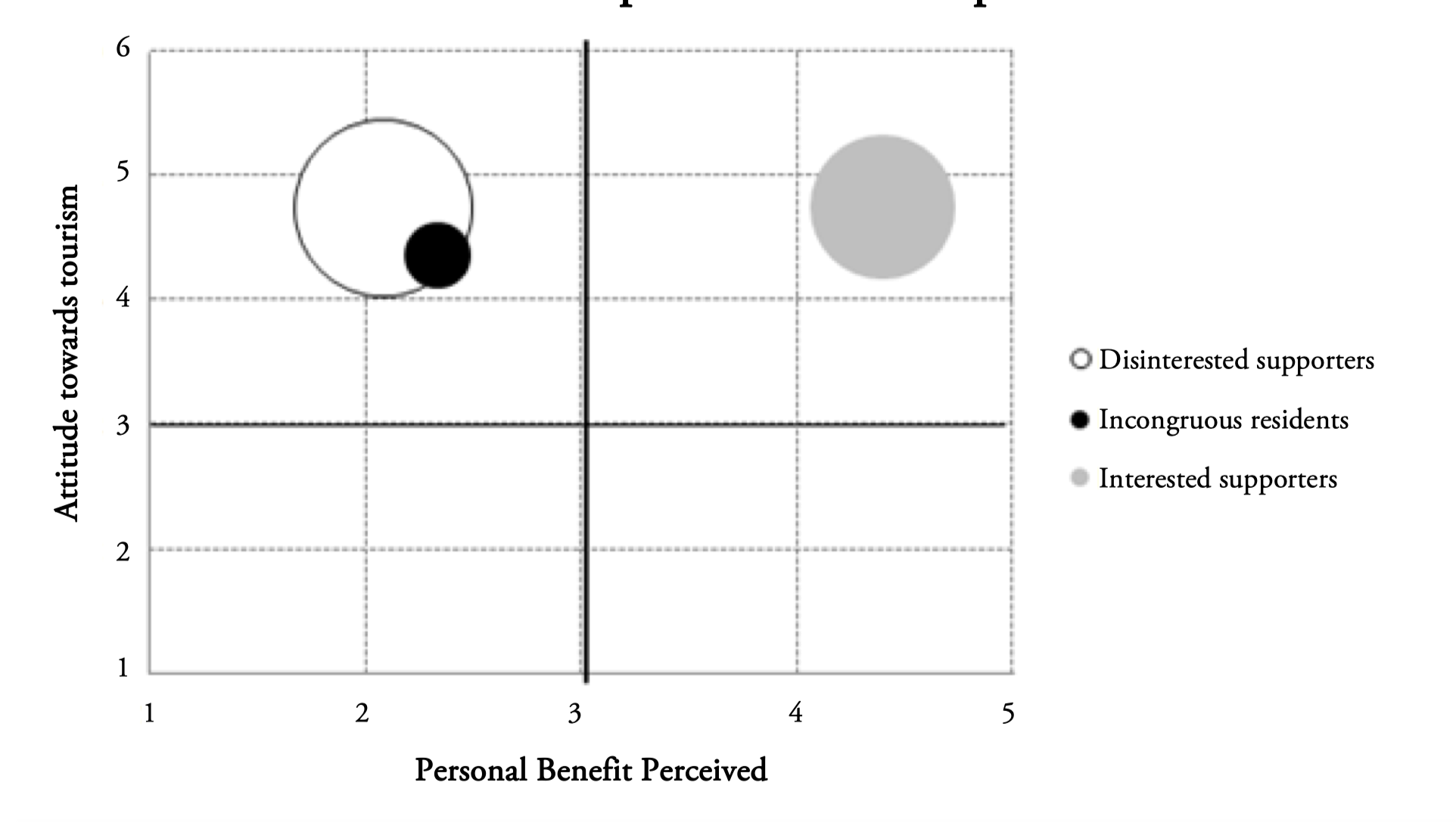
Figure 8.
Perceptual Cluster Map (Residents'’ attitude towards tourism (affective attitude) vs perceived community benefits derived from tourism).
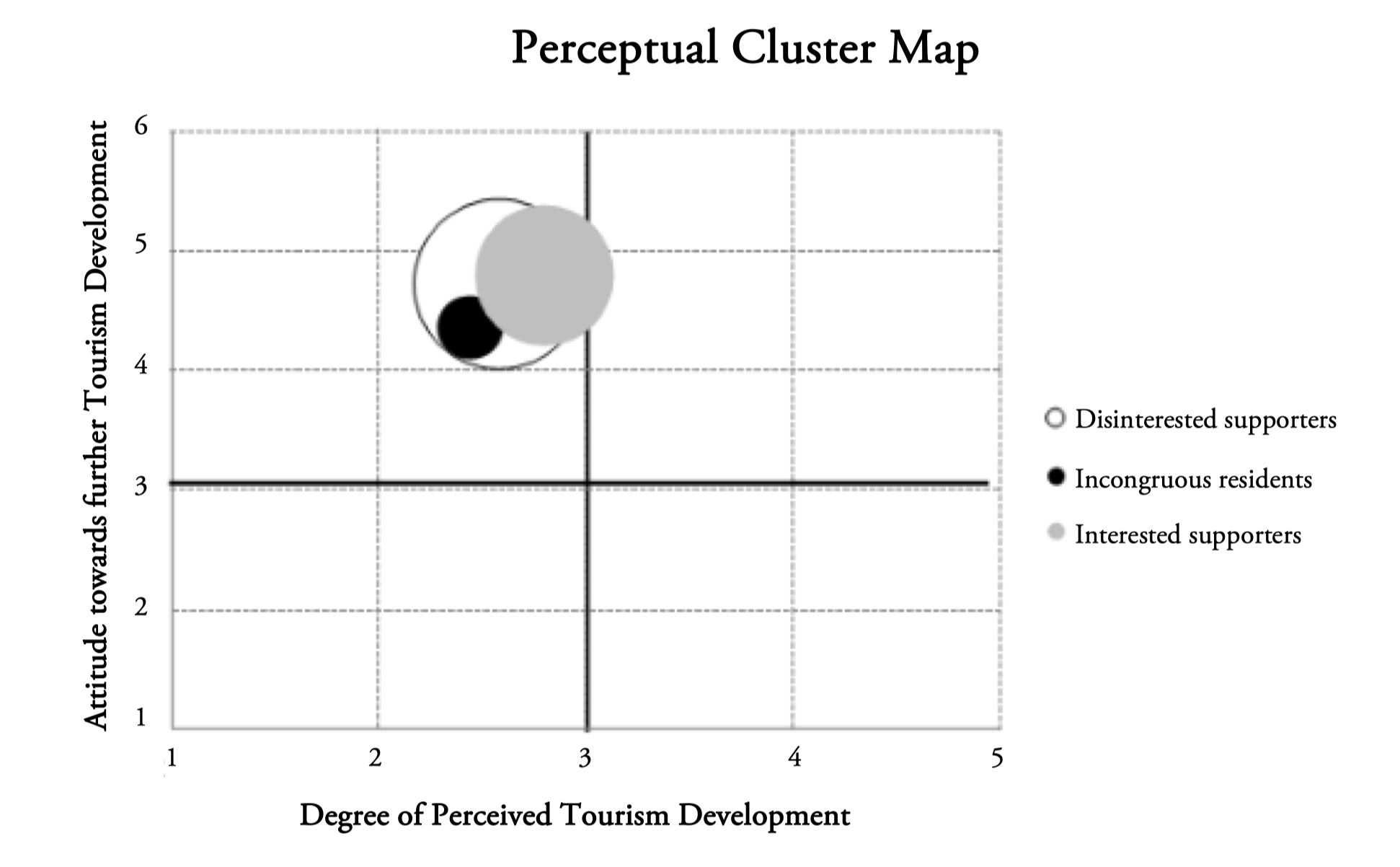
The results of this research appear to support our Hypothesis H2.2. No differences were observed in the mean scores of AATFTD between the three clusters, similar to the results found for LTDP in Minas de Riotinto (as seen in Section 4.2.2.). This is clearly illustrated by the concentration of the three clusters in the first quadrant of Figure 9.
Figure 9.
Perceptual Cluster Map (Residents'’ attitude towards tourism (affective attitude) vs level of perceived tourism development).
Source: Authors'’ own.
· - Behavioral dimension of attitude
BATFTD is represented in the study by two variables: MTPL and RB.
The Kruskal-Wallis test revealed statistically significant differences in the means of both variables, with a significance level of p<0.01 in the case of MTPL and p<0.05 in the case of RB.
Post-hoc analyses revealed significant differences in the means between Clusters 1 and 3 and Clusters 2 and 3 for the variable MTPL – precisely the groups that differ regarding PPBT. In the case of RB, differences were found between Clusters 1 and 3, which are the groups that differ the most in terms of PPBT.
Consequently, we can conclude that residents who differ in their PPBT will also differ in both their MTPL and (in particular) their RB. As a result, hypothesis H1.3 can be accepted, whereas hypothesis H2.3 must be rejected for the same reasons described for CWWBT.
Table 5.
Hypothesis testing results
| Hypothesis | Cognitive Component | Affective Component | Behavioral Component |
| H1 (based on SEM) | H1.1 Accepted | H1.2. Rejected | H1.3. Accepted |
| H2 (based on TALC) | H2.1 Rejected | H2.2. Accepted | H2.3. Rejected |
Source: Authors'’ own.
Table 5: Hypothesis testing results. Source: Authors' own.
5. Discussion and Conclusions
In our analysis of the Minas de Riotinto residents, adopting a segmentation approach has allowed us to identify three major groups, ranked in descending order according to their significance within the overall community. These groups are characterized as follows: “disinterested and moderate supporters,” “interested and enthusiastic supporters,” and “incongruous and impulsive residents.”
The “disinterested and moderate supporters” are individuals who, despite not believing that they personally benefit from tourism, recognize the net positive impact of this activity on their community. They firmly believe that tourism is a source of wealth and well-being for the local population. This support is expressed in the promotion of the destination in a moderate/moderate way.
Conversely, the “interested and enthusiastic supporters” unequivocally perceive tourism'’s personal and community benefits. They, therefore, fully support tourism development in their locality, not only affectively but also with a high level of motivation and persistent/intense pro-tourism behaviors.
Finally, the “incongruous and impulsive residents” represent a smaller faction of the community. These residents emotionally support tourism development despite harboring negative perceptions of its impact at both a personal and community level. There is a clear disconnect between this group’s perceptions and attitudes, not only in terms of the affective components but also regarding cognitive and behavioral aspects. Consequently, we have classified this group as “impulsive.” Their pro-tourism behaviors appear to be primarily driven by their emotions rather than being guided by a rational process aligned with their perceptions and motivations. According to some studies (Cardona & Álvarez-Basi, 2017), this inconsistency between perceptions and attitudes within this group could be due to the limited time they have resided in the locality, which has prevented them from forming an established opinion of the impacts of tourism, resulting in mixed responses. Furthermore, this apparent inconsistency could also be attributed to the relatively recent introduction of tourism development in Minas de Riotinto, which is why some residents still lack a clear understanding of its consequences for the region.
From a general standpoint, one of the most striking findings, compared to previous studies in this mining community, is the absence of residents with unfavorable or even neutral attitudes toward tourism development. This absence is evident across all dimensions of attitude but is particularly pronounced in the affective or emotional component. Regardless of their varying perceptions of the personal and community benefits of tourism, the three groups of residents express a strong interest in seeing a growth in tourism activity and an increased presence of tourists in their locality in the future. This conclusion is unprecedented in the literature we have reviewed, in addition to studies conducted in other destinations at the early stages of tourism development.
Contrary to expectations based on Social Exchange Theory (SET) and the findings of previous segmentation studies (Pavlić et al., 2020), the results from the Kruskal- Wallis test reveal that all three groups of residents exhibit a clear positive affective attitude towards tourism development in Minas de Riotinto. Additionally, there is no significant difference in mean scores between these groups despite their mixed perceptions of the personal and community impacts of tourism.
In accordance with SET, Oviedo-García et al. (2008) and Lee & Back (2003) concluded that residents who personally benefit from tourism are more supportive of tourism, observing greater support among those who directly benefit than those who benefit indirectly through the community. However, the results produced in Minas de Riotinto suggest that the affective attitude towards an increased influx of tourists and further tourism development is unrelated to their perceptions of its community and personal benefits.
While past empirical research conducted in Minas de Riotinto (Vargas et al., 2009) contradicts these findings, they align theoretically with the TALC and the ITI. These theoretical frameworks help us understand the euphoric attitude of some residents who, irrespective of the cluster to which they belong, perceive that the current level of tourism development in their locality is still low to medium in relation to its potential. This perception leads them to express favorable sentiments towards the continued development of tourism. In light of this analysis, the TALC/ ITI offers better insights into the emotional dimension of residents’ attitudes towards tourism than SET.
Different conclusions emerge when examining the other two dimensions of residents’ attitudes, that is, the cognitive and behavioral components.
Regarding the cognitive component of attitude, specifically the variable of “conviction”, we observed that, in line with SET, the groups of residents that differ considerably in their overall perception of the community effects also differ significantly in the cognitive attitude variable. Notably, both the “disinterested and moderate supporters” and “interested and enthusiastic supporters” display a much stronger degree of “conviction” than the “incongruous and impulsive residents” group. Concerning the cognitive component and the "“knowledge"” variable, it is evident that the degree of “knowledge” of the tourism development projects of the locality seems to be greater among residents who perceive personal benefits from tourism activity (“interested and enthusiastic supporters”) than those who do not (“disinterested and moderate supporters”).
In summary, the results of this study regarding the cognitive attitude variable are aligned with the principles of SET. However, differences in the “conviction” variable appear to stem from the differing perceptions of the community effects of tourism. In contrast, variations in the "“knowledge"” variable seem to lie in the different perceptions of personal benefits.
Finally, concerning the behavioral component, this study has explored two variables: the motivation to engage in pro-tourism behavior and the actual pro-tourism behavior of promoting the destination. In the first case, significant differences in motivation were observed in the group of “interested and enthusiastic supporters” in line with the principles of SET.
Regarding the pro-tourism behavior variable, it is evident that this behavior is more prevalent in the “interested and enthusiastic supporters” group than in the “disinterested and moderate supporters” group. These findings suggest that residents’ motivation to engage in pro-tourism behaviors and their actual participation in such activities are significantly influenced by the extent to which they perceive the personal benefits of tourism. This observation is in accordance with the principles of SET.
In light of the present results, we conclude that while the affective dimension of residents’ attitudes is consistent with the TALC, the cognitive and behavioral components appear to be supported by SET. Specifically, "“knowledge,"” “motivation,"” and “pro-tourism behavior” are determined by residents’ perceptions of the personal benefits gained from tourism, whereas “conviction” is influenced by their perceptions of its community benefits.
Our findings also have important practical implications for the municipality of Riotinto and other tourism destinations in the early stages of development.
For the local authorities of Riotinto, our results show how its residents generally hold a positive view of tourism development in the region. As a result, tourism activities should continue to be part of the region’s socio-economic development plans. However, beyond the mere attitudinal support expressed by residents, local managers must implement actions to raise awareness among residents regarding the personal and community benefits of tourism. Such initiatives could help to increase residents'’ active involvement in promoting tourism development. In this regard, the following specific measures could be implemented to reinforce the behavioral component of residents’ attitudes: a) organizing participatory workshops that involve residents, seeking their input and opinions on various issues related to tourism development within their area; b) establishing programs offering free visits to local tourist attractions, with a particular focus on residents who have been living iIn the area for the least amount of time; c) implementing initiatives that encourage and engage the local population in the promotion of the destination; and d) introducing tourism entrepreneurship programs targeting the local population.
The global potential of Minas de Riotinto as a mining tourism destination highlights the broader relevance of these findings since the practical implications of our results apply to other destinations with similar characteristics.
6. Limitations and future lines of research
While our work makes a valuable contribution to this area of research, it is not exempt from certain limitations.
The findings presented here build on previous research carried out over the course of a decade in this municipality. However, it would be prudent to update these results with a new survey, especially in light of the potential impact of the COVID-19 pandemic on the tourism sector. Additionally, a comparative analysis with results from other mining towns belonging to the ERIH would be beneficial, using the present study as a starting point for replication in other destinations.
From a methodological standpoint, it would be advisable to cross-verify the results using alternative statistical techniques such as multi-group analysis, applying Structural Equation Modeling, regression analysis, or alternative segmentation methods such as hybrid-fuzzy segmentation (Martín et al., 2020).
This study has examined attitudes from a three-dimensional perspective. However, it would be worthwhile to formulate and test new models that interconnect the variables analyzed in this study, adopting a one-dimensional perspective. This approach could potentially help to establish connections between perceptions, attitudes, intentions, and behaviors, creating a model that combines SET with TRA or TP, following the proposal made by Chen and Raab (2012) and the conceptual framework developed by Plaza et al. (2020).
References
Aguiló- Perez, E. J., & Rosello-Nadal, J. (2005). Host Community Perceptions: A Cluster Analysis. Annals of Tourism Research, 32(4), 925-941.
Ajzen, I. (1991). The theory of planned behavior. Organizational Behavior and Human Decision Processes, 50 (2), 179–211. https://doi.org/10.1016/0749-5978(91)90020-T.
Ajzen, I., & Fishbein, M. (1980). Understanding attitudes and predicting social behavior. Engle-wood-Cliffs. , N.J.: Prentice-Hall.
Andriotis, K., & Vaughan, R. (2003). Urban Residents’ Attitudes Toward Tourism Development: The Case of Crete. Journal of Travel Research, 42 (2), 172-185.
Andrade, M., & Caamaño-Franco, I. (2018). Theoretical and methodological model for the study of social perception of the impact of industrial tourism on local development. Social Sciences, 7(11), 217.
Andrade-Suárez, M., & Caamaño-Franco, I. (2020). The relationship between industrial heritage, wine tourism, and sustainability: A case of local community perspective. Sustainability, 12(18), 7453.
Allen, L., Long, P. T., Perdue, R., & Kieselbach, S. (1988). The impact of tourism development in residents perceptions of community life, Journal of Travel Research, 2, 16-21.
Allen, L. R., Hafer, H. R., & Long, P. T. (1993). Rural Residents’' Attitudes Toward Recreation and Tourism Development. Journal of Travel Research, 31 (4), 27-33.
Ap, J. (1992). Residents’ Perceptions of Tourism Impacts. Annals of Tourism Research, 19, 665–690.
Boley, B. B., & Strzelecka, M. (2016). Towards a Universal Measure of Support for Tourism. Annals of Tourism Research, 61, 238-241.
Birame Sarr, Sène-Harper, A., Matias M & Gonzalez-Hernandez (2021). Tourism, social representations and empowerment of rural communities at Langue de Barbarie National Park, Senegal, Journal of Sustainable Tourism, 29:8, 1383-1402, DOI: 10.1080/09669582.2020.1855437
Brida, J., Osti, L. & Barquet, A. (2010). Segmenting Residents' Perceptions Towards Tourism. A Cluster Analysis with a Multinomial Logit Model of a Mountain Community. International Journal of Tourism Research 12 (5), 591-602.
Brida, J., Osti, L., & Faccioli, M. (2011). Residents’ Perception and Attitudes Toward Tourism Impacts: A Case Study of the Rural Community of Folgaria (Trentino-Italy). Benchmarking an International Journal, 18 (3), 359-385.
Brida, J., Riaño, E., & Zapata-Aguirre, S. (2011). Residents’ Attitudes and Perceptions Towards Cruise Tourism Development: A Case Study of Cartagena de Indias (Colombia). Tourism and Hospitality Research, 11 (3), 181-196.
Brougham, J.E., & Butler, R.W. (1981). A Segmentation Analysis of Residents Attitudes to the Social Impacts of Tourism. Annals of Tourism Research, 8 (4), 569-590.
Butler, R. W. (1980). The Concept of a Tourist Area Cycle of Evolution: Implications for Management of Resources. Canadian Geographer, XXIV (1), 5-12. https://doi.org/10.1111/j.1541-0064.1980.tb00970.x
Camprubí, R., and Garau-Vadell, J.B. (2022), Residents risk perception of P2P vacation accommodation, Journal of Place Management and Development, 15(2), 167-181. https://doi.org/10.1108/JPMD-06-2020-0051
Cardona, J. L., & Álvarez-Basi, D. (2017). Segmentation of the residents of Punta del Este (Uruguay): Five points of view on tourism. International Journal of Scientific Management and Tourism, 3 (3), 111-133.
Cardona, J. L., & Cantallops, A. S. (2015). Segmenting residents by their attitudes: Literature review. PASOS, 13 (4), 837-848.
Chen, S. C. (2011). Residents’ Perceptions of the Impact of Major Annual Tourism Events in Macao: Cluster Analysis. Journal of Convention & Event Tourism, 12, 106-128.
Chen, S., & Raab, C. (2012). Predicting resident intentions to support community tourism: Toward an integration of two theories. Journal of Hospitality Marketing & Management, 21(3), 270-294.
Da Cruz Vareiro, L. M., Remoaldo, P. C., & Ribeiro, J. A. C. (2018). Atributos do destino cultural e satisfação dos turistas: diferenças entre a primeira vez e visitas repetidas. Revista Brasileira de Gestão e Desenvolvimento Regional, 14(3).
Davis, D., J. Allen, J., & Cosenza, R. (1988). Segmenting Local Residents by Their Attitudes, Interests and Opinions Toward Tourism. Journal of Travel Research 27 (2), 2-8.
Deery, M., Jago, I., & Fredline, L. (2012). Rethinking Social Impacts of Tourism Research: A New Research Agenda. Tourism Management, 33 (1), 64-73. https://doi.org/10.1016/j.tourman.2011.01.026
Doxey, G. V., (1975).: «A Causation Theory of Visitor-Resident Irritants. Methodology and Research Inferences»., Proceedings of the Travel Research Association, 6th Annual Conference, pp. 195-198, Salt Lake City.
Dyer, P., Gursoy, D., Sharma, B., & Carter, J. (2007). Structural modeling of resident perceptions of tourism and associated development on the Sunshine Coast, Australia. Tourism Management, 28 (2), https://doi.org/10.1016/j.tourman.2006.04.002
Doumi, M., Kyriakaki, A. & Stavrinousdis, T. (2020). Small-Scale Cultural Tourism Events: Residents' Perceptions on Their Quality and Impacts Tourism, Analysis, 2-3, 293(11) https://doi.org/10.3727/108354220X15758301241800
Eusebio, C., & Carneiro, M.J. (2019). "Impact of Tourism on Residents' Quality of Life: Segmentation Analysis and Marketing Implications." In Best Practices in Hospitality and Tourism Marketing and Management. Applying Quality of Life Research (Best Practices), edited by A. Campón-Cerro, J. Hernández-Mogollón & J. Folgado-Fernández. Cham: Springer
Evans, T. (1993). Residents’ Perceptions of Tourism in Selected New Zealand Communities: a Segmentation Study. PhD diss., University of Otago, Dunedin, New Zealand.
Faulkner, B., & Tideswell, C. (1997). A Framework for Monitoring Community Impacts of Tourism. Journal of Sustainable Tourism, 5(1), 3-28. https://doi.org/10.1080/09669589708667273
Fredline, E. & Faulkner, B. (2006). Host community reactions: A cluster analysis. Annals of Tourism Research, 27 (3), 763-784 https://doi.org/10.1016/S0160-7383(99)00103-6
Fredline, E., & Faulkner, B. (2000). Community perceptions of the impacts of events. Events Beyond 2000: Setting the Agenda, 60.
Fredline, E., & Faulkner, B. (2001). Residents’ Reactions to the Staging of Major Motorsport Event Within Their Communities: A Cluster Analysis. Event Management, 7 (2), 103-114.
Fundación Riotinto (2023). Fundación Riotinto, https://fundacionriotinto.es/ (09/09/2023).
García, F. A., Vázquez, A. B., & Macías, R. C. (2015). Resident’'s attitudes towards the impacts of tourism. Tourism Management Perspectives, 13, 33-40.
Garau‐Vadell, J. B., Díaz‐Armas, R., & Gutierrez‐Taño, D. (2014). Residents’ Perceptions of Tourism Impacts on Island Destinations: A Comparative Analysis. International Journal of Tourism Research, 16(6), 578-585.
González-Reverté, F. (2022). The Perception of Overtourism in Urban Destinations. Empirical Evidence based on Residents’ Emotional Response, Tourism Planning & Development, 19 (5), 451-477. https://doi.org/10.1080/21568316.2021.1980094
Gu X, Hunt CA, Lengieza ML, Niu L, Wu H, Wang Y &Jia X. (2021). Evaluating Residents’ Perceptions of Nature-Based Tourism with a Factor-Cluster Approach. Sustainability. 13(1):199. https://doi.org/10.3390/su13010199
Guerra, T., Moreno, P., de Almeida, A. S. A., & Vitorino, L. (2022). Authenticity in industrial heritage tourism sites: Local community perspectives. European Journal of Tourism Research, 32, 3208-3208.
Gursoy, D., Jurowki, C., & Uysal, M. (2002). Resident attitudes: A Structural Modeling Approach. Annals of Tourism Research, 29(1), 79-105. https://doi.org/10.1016/S0160-7383(01)00028-7
Gursoy, D., Rutherford, D. G. (2004). Host attitudes toward tourism: An Improved Structural Model. Annals of Tourism Research, 31(3). https://doi.org/10.1016/j.annals.2003.08.008
Gursoy, D., Ouyang, Z., Nunkoo, R., & Wei, W. (2019). Residents’ impact perceptions of and attitudes towards tourism development: A meta-analysis. Journal of Hospitality Marketing & Management, 28(3), 306-333.
Hadinejad, A., Nunkoo, R., D., Moyle, B., Scott, N., & Kralj, A. (2019). Residents’ attitudes to tourism: a review. Tourism Review. https://doi.org/doi:10.1108/tr-01-2018-0003
Hair, J. F., Black, W. C., Babin, B. J., & Anderson, R. E. (2010). Advanced diagnostics for multiple regression: A supplement to multivariate data analysis. Advanced Diagnostics for Multiple Regression: A Supplement to Multivariate Data Analysis.
Harrill, R. (2004). Residents’ attitudes toward tourism development: A literature review with implications for tourism planning. Journal of Planning Literature, 18 (3), 251-266.
Harril, R., Uysal, M., Cardon, P., Vong, F., & Dioko, L. (2011). Resident Attitudes Toward Gaming and Tourism Development in Macao: Growth Machine Theory as a Contest for Identifying Supporters and Opponents. International Journal of Tourism Research, 13(1), 41-53.
Haralambopoulos, N., & Pizam, A. (1996). Perceived impacts of tourism: The case of Samos, Annals of Tourism Research, 23(3), 503-526. https://doi.org/10.1016/0160-7383(95)00075-5
Instituto de Estadística y Cartografía de Andalucía (2023). https://www.juntadeandalucia.es/institutodeestadisticaycartografia consultada el 10/10/2023.
Iroegbu, H. & Chen, J.S. (2001). Urban Residents’ Reaction Toward Tourism Development: Do Subgroups Exist?, Tourism Analysis, 6 (2), 155-161.
Jeuring, J., & Haartsen, G. (2017). Destination Branding by Residents: The Role of Perceived Responsibility in Positive and Negative Word-of-Mouth. Tourism Planning & Development, 14(2), 240-259., https://doi.org/10.1080/21568316.2016.1214171
Johnson, D., Snepenger, D.J., & Akis, S. (1994). Residents' perceptions of tourism development. Annals of Tourism Research 21(3), 629-642. https://doi.org/10.1016/0160-7383(94)90124-4.
Johnson, D., & Snepenger, D. J. (2006). Residents’' Perceptions of Tourism Development over the Early Stages of the TALC, In Julkaisussa: Butler, RW (toim.). The Tourism Area Life Cycle, (pp. 222-236).
Jurowski, C., Uysal, M., & Williams, D. R. (1997). A Theoretical Analysis of Host Community Resident Reactions to Tourism. Journal of Travel Research, 36(2), 3-11. https://doi.org/10.1177/004728759703600202.
Kang, S. K., & Lee, J. (2018). Support of marijuana tourism in Colorado: A residents’ perspective using social exchange theory. Journal of Destination Marketing & Management, ., 319–320. https://doi.org/doi:10.1016/j.jdmm.2018.03.003
Kayat, K. (2002). Power, social exchanges and tourism in Langkawi: rethinking resident perceptions. International Journal of Tourism Research, 4(3), 171-191. https://doi.org/10.1002/jtr.375
Ko, D. W., & Stewart, W. P. (2002). A Structural Equation Model of Residents’ Attitudes for Tourism Development. Tourism Management, 23(5), 521-530.
Kuvan, Y., & Akan, P. (2005). Residents’ Attitudes Toward General and Forest-Related Impacts of Tourism: The Case of Belek, Antalya. Tourism Management, 26(5), 691-706.
Lankford, S., & Howard, D. R. (1994). Developing a tourism impact attitude scale. Annals of Tourism Research, 21(1), 121-139., https://doi.org/10.1016/0160-7383(94)90008-6
Lawton, L. (2005). Resident Perceptions of Tourist Attractions on the Gold Coast of Australia. Journal of Travel Research 44 (2), 188-200.
Lee C. K., & Back, K. J. (2003). Pre and post-casino impact of residents' perception. Annals of Tourism Research, 30, 868–885.
Lee, T. H. (2013). Influence analysis of community resident support for sustainable tourism development. Tourism Management, 34, 37–46. https://doi.org/doi:10.1016/j.tourman.2012.03.007
Lepp, A. (2007). Residents’ attitudes towards tourism in Bigodi village, Uganda. Tourism Management, 28 (3), https://doi.org/10.1016/j.tourman.2006.03.004
Liepins, R. (2000). Exploring Rurality through "Community": Discourses, Practices, and Spaces Shaping Australian and New Zealand Rural "Communities. Journal of Rural Studies, 16, 325–341.
Lopes, H., Remoaldo, P., & Ribeiro, V. (2019). Residents’ perceptions of tourism activity in a rural North-Eastern Portuguese community: a cluster analysis. Bulletin of Geography. Socio-economic Series, 46(46), 119-135. doi https://doi.org/10.2478/bog-2019-0038
Lubin Pigouche, P., Macía Antón, M. A., & Rubio De Lemus (2013). Psicología Matemática II, Ed. UNED, Universidad Nacional de Educación a Distancia, España, p.p. 1115.
Madrigal, R. (1995). Residents’ Perception and the Role of Government. Annals of Tourism Research 22(1), 86-102.
Martin, S. (1995). Montanans’ Attitudes and Behavioral Intentions Toward Tourism: Implications for Sustainability. In S. McCool & A. Watson (Eds.), Linking Tourism, the Environment, and Sustainability, (p p. 69-76). Ogden UT: US Department of Agriculture.
Martín, C., Moreira, P., & Román, C. (2020).: A hybrid-fuzzy segmentation analysis of residents’ perception towards tourism in Gran Canaria. Tourism Economics, vol. 27 (7), 1282-1304). https://doi.org/10.1177/1354816619873463.
McGehee, N. G., & Andereck, K. L. (2004). Factors Predicting Rural Residents’ Support of Tourism. Journal of Travel Research, 43(2), 131-140. https//doi.org/10.1177/0047287504268234
Moreira, P. E., & Vargas, A. (2022). Social perception of tourism. Quantitative studies based on public opinion surveys in Spanish destinations. Journal of Tourism and Heritage Research, 5 (2), 265-288.
Mueller, J. T., & Tickamyer, A. R. (2020). Climate change beliefs and support for development: Testing a cognitive hierarchy of support for natural resource-related economic development in rural Pennsylvania. Journal of Rural Studies, 80, 553-566., https://doi.org/10.1016/j.jrurstud.2020.10.043.
Nguyen, V. H. (2022). , "Segmenting local residents by perceptions of tourism impacts in Sapa, Vietnam: a cluster analysis.," International Journal of Tourism Cities, 8 (1), 153-167. https://doi.org/10.1108/IJTC-03-2021-0046
Nunkoo, R., & Ramkissoon, H. (2010). Modeling community support for a proposed integrated resort project. Journal of Sustainable Tourism, 18(2), 257–277. doi:https://doi.org/10.1080/09669580903290991
Nunkoo, R., & Ramkissoon, H. (2011). Developing a community support model for tourism. Annals of Tourism Research, 38(3), 964–988. https://doi.org/doi:10.1016/j.annals.2011.01.017
Nunkoo, R., Smith, S. L. J., & Ramkissoon, H. (2013). Residents’ attitudes to tourism: A longitudinal study of 140 articles from 1984 to 2010. Journal of Sustainable Tourism, 21 (1), 5-25.
Nunkoo, R., & So, K. K. (2016). Residents’ Support for Tourism. Journal of Travel Research, 55, 847 - 861.
Olya, H. G. (2023). Towards advancing theory and methods on tourism development from residents' perspectives: Developing a framework on the pathway to impact. Journal of Sustainable Tourism, 31(2), 329-349.
Oviedo-Garcia, M. A., Castellanos-Verdugo, M., & Martin-Ruiz, D. (2008). Gaining residents’ support for tourism and planning, International Journal of Tourism Research, 10, 95–109.
Plaza-Mejía, Porras-Bueno, & Flores-Ruiz., (2019). Residentes y turistas ante el turismo industrial minero en las localidades de Lousal (Grândola Alentejo/Portugal) y Riotinto (Huelva/Andalucía/España), Ed. GEIDETUR, Huelva, España.
Plaza-Mejía, M. Á., Porras-Bueno, N., & Flores-Ruiz, D. (2020). The Jungle of Support: What Do We Really Mean When We Say “Residents’ Support”? Sustainability, 12(18), 7795.
Parra-Camacho, D., Añó-Sanz, V., Calabuig-Moreno, F., & Ayora-Pérez, D. (2016). Residents’ Perceptions About the Legacy of America’s Cup. Cuadernos de Psicología del Deporte, 16 (1), 325-338.
Pavlić, I., Portolan, A., & Puh, B. (2020). Segmenting Local Residents by Perceptions of Tourism Impacts in an Urban World Heritage Site: The Case of Dubrovnik. Journal of Heritage Tourism, 15(.4), 398-409., DOI: https://doi.org/10.1080/1743873X.2019.1656218.
Perdue, R. R., Long, P. T., & Allen, L. (1990). Resident Support for Tourism Development. Annals of Tourism Research, 17(4), 586-599.
Petrzelka, P.,; R.S. Krannich, R. S., ; J. Brehm, J., and C. Koons (2005). Rural tourism and gendered nuances, Annals of Tourism Research, 32(4), 1121-1137.
Pizam, A., Neumann, Y., & Reichel, A. (1978). Dimensions of tourist satisfaction with a destination area, Annals of Tourism Research, 5 (3), 314-322. https://doi.org/10.1016/0160-7383(78)90115-9.
Presenza, A., Chiappa, G., & Sheehan, L. (2013). Residents’ Engagement and Local Tourism Governance in Maturing Beach Destinations. Evidence from an Italian Case Study. Journal of Destination Marketing & Management, 2, 22-30.
Rasoolimanesh, S. M., Jaafar, M., Ahmad, A. G., & Barghi, R. (2016). Community Participation in World Heritage Site Conservation and Tourism Development. Tourism Management, 58, 142-153.
Rasoolimanesh, S. M., Ringle, C. M., Jaafar, M., & Ramayah, T. (2017). Urban vs. rural destinations: Residents’ perceptions, community participation and support for tourism development. Tourism management, 60, 147-158.
Rasoolimanesh, S. M., & Seyfi, S. (2020). Residents’ perceptions and attitudes towards tourism development: a perspective article, Tourism Review, 76(1), 51-57.
Registro de Turismo de Andalucía (2023). Informe de la Oferta Turística de Minas de Riotinto, Consejería de Justicia, Administración Local y Función Pública, Andalucía.
Ribeiro, M. A., Pinto, P., Silva, J. A., & Woosnam, K. M. (2017). Residents’ attitudes and the adoption of pro-tourism behaviours: The case of developing island countries. Tourism Management, 61, 523-537.
Ribeiro, M. A., Valle, P. O., & Silva, J. A. (2013). Residents’ Attitudes towards Tourism Development in Cape Verde Islands. Tourism Geographies, 15 (4), 654-679. https://doi.org/10.1080/14616688.2013.769022
Ryan, C., & Cooper, C. (2004). Residents’ Perceptions of Tourism Development: the Case of Raglan, New Zealand. Tourism Review International 8 (1), 1-15.
Ryan, C., A., Scotland, A., & Montgomery, D. (1998). Residents' Attitudes to Tourism Development: A Comparative Study between the Rangiteki, New Zealand and Bakewell, United Kingdom. Progress in Tourism and Hospitality Research, 4 (2), 115-130.
Ryan, C., & Montgomery, D. (1994). The Attitudes of Bakewell Residents to Tourism and Issues in Community Responsive Tourism. Tourism Management 15 (5), 358-369.
Scalabrini, B.C.E., & Remoaldo, P. C. (2020). Percepción de los residentes hacia el turismo en una ciudad industrial brasileña: un análisis de cluster. Revista Brasileña de Gestión y Desarrollo Regional, 16 (1) https://doi.org/10.54399/rbgdr.v16i1.5359
Schofield, P. (2011). City residents' attitudes to proposed tourism development and its impacts on the community. International journal of tourism research, 13(3), 218-233.
Schoroeder, T. (1992). Host Community Perceptions of Tourism's Impacts: A Cluster Analysis. Vision in Leisure and Business, 10(4), 43-48.
Sharpley, R. (2014). Host Perceptions of Tourism: A Review of the Research. Tourism Management, 42, 37-49. https://doi.org/10.1016/j.tourman.2013.10.007
Sheldon, P. J., & Abenoja, T. (2001). Resident attitudes in a mature destination: The case of Waikiki. Tourism Management, 22(5), 435-443.
Sinclair-Maragh, G., Gursoy, D., & Vieregge, M. (2015). Residents׳ perceptions toward tourism development: A factor-cluster approach. Journal of Destination Marketing & Management, 4(1), 36-45., https://doi.org/10.1016/j.jdmm.2014.10.001.
Sistema de Información Multiterritorial de Andalucía (2023). Demografía, Instituto de Estadística y Cartografía de Andalucía, Andalucía.
Smith, M. B. (1947). The personal stating of public opinions: A study of attitudes towards Russia. Public Opinion Quarterly, 11, 507-523.
Smith, M. D. & Krannich, R. S. (1998). Tourism dependence and resident attitudes. Annals of Tourism Research, 27(4), 783-802. https://doi.org/10.1016/S0160-7383(98)00040-1
Snepenger, D.J., Murphy, L. & Snepenger, M. (2001). The Embrace-Withdrawn Continuum Scale: Operationalizing Residents’ Responses Toward Tourism Development. Journal of Travel Research, 40 (2), 155-161.
Stahlberg, D., & Frey, D. (1992). “Actitudes I. Estructura, medida y funciones”, in M. Hewstoney (Ed.). Introducción a la psicología social, (pp.147-170). Barcelona: Ariel.
Stylidis, D. (2018). Residents’ Place Image: A Cluster Analysis and its Links to Place Attachment and Support for Tourism. Journal of Sustainable Tourism 26 (6), 1007-1026. doi: 10.1080/09669582.2018.1435668.
Stylidis, D., Sit, J. K., & Biran, A. (2016). An exploratory study of residents’ perception of place image: The case of Kavala. Journal of travel research, 55(5), 659-674.
Stylidis, D., Sit, J. K. & Biran, A. (2018). Residents’ Place Image: a Meaningful Psychographic Variable for Tourism Segmentation? Journal of Travel &Tourism Marketing 35 (6), 715-725. doi:10.1080/10548408.2018.1425176.
Su, L., & Swanson, S. R. (2020). The effect of personal benefits from, and support of, tourism development: The role of relational quality and quality-of-life. Journal of Sustainable Tourism, 28(3), 433-454.
Teye, V., Sirakaya, E., & Sönmez, S. F. (2002). Residents' Attitudes Toward Tourism Development. Annals of Tourism Research, 29(3), 668-688.
Thyne, M. & Lawson, R. (2001). Research Note: Addressing Tourism Public Policy Issues through Attitude Segmentation of Host Communities. Current Issues in Tourism 4 (2-4), 392-400. doi:10.1080/13683500108667895
Tosum, C. (2001). Host Perceptions of Impacts: A Comparative Study. Annals of Tourism Research, 29(1), 231-253.
Vareiro, L. M. D. C., Remoaldo, P. C., & Cadima Ribeiro, J. A. (2013). Residents' perceptions of tourism impacts in Guimarães (Portugal): a cluster analysis. Current Issues in Tourism, 16(6), 535-551.
Vargas-Sanchez, A., Hariani, D., & Wijayanti, A. (2020). Perceptions of halal tourism in Indonesia: Mental constructs and level of support. International Journal of Religious Tourism and Pilgrimage, 8(4), 5.
Vargas-Sánchez, A., Oom do Valle, P., Costa Mendes, J., and Silva, J. A., (2015), Residents' attitude and level of destination development: An international comparison, Tourism Management, 48, 199-210.
Vargas-Sánchez, A., Plaza-Mejía, M. A., & Porras-Bueno, N. (2009a). Understanding Residents' Attitudes toward the Development of Industrial Tourism in a Former Mining Community. Journal of Travel Research, 47(3), 373-387.
Vargas Sánchez, A., Porras-Bueno, N., Plaza-Mejía, M.A.; (2009b). Turismo Industrial Minero en la Provincia de Huelva, pp.129. Colecciones: Collectánea, España, p.p. 129.
Vargas-Sánchez, A., Porras-Bueno, N., & Plaza-Mejía, M. A. (2014). Residents’ Attitude to Tourism and Seasonality. Journal of Travel Research, 53(5), 581-596.
Vargas-Sánchez, A., Porras-Bueno, N., & Plaza-Mejía, M. A. (2011). Explaining Residents’ Attitudes to Tourism: Is a Universal Model Possible? Annals of Tourism Research, 38(2), 460-480.
Vong, C.K.F. & McCartney, G. (2005). Mapping Resident Perception of Gaming Impact. Journal of Travel Research 44 (2), 177-187.
Wassler, P., Nguyen, T. H. H., & Schuckert, M. (2019). Social representations and resident attitudes: A multiple-mixed-method approach. Annals of Tourism Research, 78, 102740. https://doi.org/10.1016/j.annals.2019.06.007
Wassler, P., Hong, T., Quyen, L. & SchucKert, M., (2019). Social representations and resident attitudes: A multiple-mixed-method approach, Annals of Tourism Research, 78, 102740 https://doi.org/10.1016/j.annals.2019.06.007
Weaver, D. B., & Lawton, L. J. (2001). Resident perceptions in the urban–rural fringe. Annals of tourism research, 28(2), 439-458.
Weaver, D., & Lawton, L. (2013). Resident Perceptions of a Contentious Tourism Event. Tourism Management 37, 167-175.
Woo, E., Kim, H., & Uysal, M. (2015). Life satisfaction and support for tourism development. Annals of Tourism Research, 50, 84-97. https://doi.org/10.1016/j.annals.2014.11.001
Williams, J., & Lawton, R. (2001). Community Issues and Resident Opinions of Tourism. Annals of Tourism Research 28 (2),: 269-290.
Xie, P. F. (2006). Developing industrial heritage tourism: A case study of the proposed Jeep museum in Toledo, Ohio. Tourism management, 27(6), 1321-1330.
Xie, P. F., Lee, M. Y., & Wong, J. W. C. (2020). Assessing community attitudes toward industrial heritage tourism development. Journal of Tourism and Cultural Change, 18(3), 237-251.
Young, I. (2000). Illusion and Democracy. Oxford: Oxford University Press
Yu C-P., Chancellor H.C. & Tian S. (2011). Measuring Residents’ Attitudes toward Sustainable Tourism: A Reexamination of the Sustainable Tourism Attitude Scale. Journal of Travel Research, 50(1), 57-63. https://doi.org/10.1177/0047287509353189.
Zheng, D., Ritchie, B. W., Benckendorff, P. J., & Bao, J. (2019). The role of cognitive appraisal, emotion, and commitment in affecting resident support toward tourism performing arts development. Journal of Sustainable Tourism, 27(11), 1725-1744.
ORCIDZhou, Y., & Ap, J. (2009). Residents’ Perceptions Toward the Impacts of the Beijing Olympic Games. Journal of Travel Research 48 (1), 78-91.
Zhou, Y. (2010). Resident Perceptions Toward the Impacts of the Macao Grand Prix. Journal of Convention & Event Tourism 11 (2), 138-153.
Información adicional
Clasificación JEL: R23; R30.