Articles
From fashion to sustainability: the key role of industrial districts
From fashion to sustainability: the key role of industrial districts
Investigaciones Regionales - Journal of Regional Research, núm. 60, pp. 117-132, 2024
Asociación Española de Ciencia Regional

Esta obra está bajo una Licencia Creative Commons Atribución-NoComercial 4.0 Internacional.
Recepción: 06 Diciembre 2023
Aprobación: 26 Enero 2024
Abstract: Sustainability issues are increasingly influencing firms’ decision making, leading to the creation of new business models for finding solutions to environmental and societal challenges. This work aims to explore what is the role played by industrial districts in firms’ orientation towards sustainability. It implements a Propensity Score Matching technique on a novel datatabase with information on 1300 Italian fashion firms. Their sustainability orientation is measured using the Quantitas Intelligent Business Analyzer (QIBA), an original Natural Language Processing-based data mining technique, which allows scraping firms' websites and analyzing their content adopting a Term Frequency–Inverse Document Frequency weighting scheme. Findings suggest the existence of a sustainability-driven industrial district effect, i.e. a positive association between the sustainability orientation of fashion firms and their localization in industrial districts.
Keywords: Fashion, Environmental sustainability, Social sustainability, Natural Language Processing, Industrial districts, Made in Italy.
Resumen: Las cuestiones de sostenibilidad están influyendo cada vez más en la toma de decisiones de las empresas, lo que lleva a la creación de nuevos modelos de negocio para encontrar soluciones a los desafíos ambientales y sociales. Este trabajo tiene como objetivo explorar cuál es el papel desempeñado por los distritos industriales en la orientación de las empresas hacia la sostenibilidad. Se implementa una técnica de Propensity Score Matching en una nueva base de datos con información sobre 1300 empresas de moda italianas. Su orientación hacia la sostenibilidad se mide utilizando el Quantitas Intelligent Business Analyzer (QIBA), una técnica original de minería de datos basada en procesamiento de lenguaje natural, que permite extraer información de los sitios web de las empresas y analizar su contenido mediante un esquema de ponderación de Term Frequency–Inverse Document Frequency. Los hallazgos sugieren la existencia de un efecto impulsado por la sostenibilidad en los distritos industriales, es decir, una asociación positiva entre la orientación hacia la sostenibilidad de las empresas de moda y su localización en distritos industriales.
Palabras clave: Moda, Sostenibilidad ambiental, Sostenibilidad social, Natural Language Processing, Distritos industriales, Made in Italy.
1. Introduction
Sustainability is now at the heart of managerial decisions and firms' strategies, it orients customers’ purchasing behaviors, and it affects development and innovation policies (Markman et al., 2016; Nawaz and Koç, 2018; Belussi and Trippl, 2018). This work specifically focuses on the association between firms’ location in industrial districts (IDs) and their sustainability orientation. Studies about IDs proliferated in the last decades (see Becattini et al., 2014; Lazzeretti et al. 2019, and Sedita et al., 2021, for reviews) after their re-discovering by Giacomo Becattini (Becattini, 1979; 1990) building on the intellectual groundwork by Marshall (1920). Becattini (1979; 1990) proposed to adopt IDs as a unit of analysis for understanding a relevant part of the socio-economic structure of the Italian production system. He particularly stressed how the concentration of firms and local communities in spatially bounded places were able to spur the flexible production of high-quality goods and to fuel knowledge flows and local entrepreneurial dynamism. Stemming from his original contribution, the literature has span on a diverse combination of topics, suggesting that IDs are favored places where to develop innovations and leading the global competition based on localized superior know how, the sedimentation of social capital, and the competitive positioning within global value chain. In our paper, we suggest that IDs are functional units of analysis to study the transition towards sustainability, especially when it comes to the typical Made in Italy sectors (such as Italian fashion, food, furniture, machinery, and related sectors).
Following the inspiration and seminal works by Fiorenza Belussi on the fashion IDs (Sammarra and Belussi, 2006; Aage and Belussi, 2008; Belussi, 2000), we focus on companies operating in the fashion sector, as an industry which tends to agglomerate in space across different phases of the value chain and to be often – although not always - localized in IDs (Samarra and Belussi, 2006). Studying the relations between the fashion industry and sustainability is relevant because the fashion industry was responsible for 2.1 billion tons of carbon emission, as estimated in 2018, accounting for around 4% of the global total, although other studies report that this estimation could even be near 8-10% (United Nations, 2019). According to the World Economic Forum and Boston Consulting Group (2021), this industry is also one of the eight supply chains responsible for more than 50% of overall global air pollution. To respond to the urgent call for more responsible production, fashion firms are increasingly developing and using eco-fashion (sustainable and ethical fashion) production processes and marketing strategies (Joergens, 2006; Fletcher, 2008; Chan and Wong, 2012).
The adoption of sustainable business models is not only limited to slow fashion firms (i.e., those adopting more sustainable production techniques, producing more durable goods, or designing season-less clothing), nor to the luxury ones, but also to fast fashion brands (i.e., those characterized by low cost and flexibility in design and speed to market) (Torelli et al., 2012; Kapferer and Michaut-Denizeau, 2014; De Angelis et al., 2017). Such an emergent trend is also certainly associated with the demand side. In fact, as claimed by Kotler (2011), a relevant group of consumers considers sustainability as a key criterion in their consumption choice.
The sample we investigated in this contribution is composed of 1300 Italian fashion companies. Then, we used data mining through Natural Language Processing (NLP) techniques to collect information on the sustainability orientation of firms from the websites of all the companies. Specifically, data was obtained using the Quantitas Intelligent Business Analyzer (QIBA), a web crawling and scraping tool (Toschi et al., 2019). We adopted the Term Frequency–Inverse Document Frequency (TF-IDF) weighting scheme, a commonly used tool in information retrieval from documents of different lengths (Paik, 2013), to depict the content of the sustainability communications addressed by fashion firms. Finally, implementing a Propensity Score Matching (PSM) technique (Caliendo and Kopeinig, 2008), we investigated whether fashion firms located in IDs show a higher or lower orientation to sustainability than their peers located outside. To do so we also exploited firm-level georeferenced, economic, and financial data and information on Italian industrial districts identified through the Local Labor Systems based on ISTAT (2023).
The contribution of this study is twofold. First, it concurs to define the key role of IDs in supporting the sustainability transition of firms. Second, it offers a novel methodology to measure the sustainability orientation of firms. This is important as it provides a distinctive way to quantitatively measure firms' sustainability also beyond traditionally used secondary data and voluntary reports and, specifically, social sustainability that is inherently difficult to measure.
The article is structured as follows. Section 2 casts light on the sustainability of the fashion industry and puts forward the hypotheses, Section 3 illustrates the empirical setting, Section 4 presents data and methodology, Section 5 shows the results, finally Section 6 offers a discussion and some conclusive remarks.
2. Industrial districts and the sustainability of fashion
On the one hand, the fashion industry is generally in the eye of the storm because of the social and environmental impact of the production processes, which are often proved to pollute the environment, exploit child labor and low-paid and precarious work in developing countries, and to adopt greenwashing strategies to hide its bad actions to consumers, and so forth. On the other hand, this industry shows exemplar cases of firms adopting sustainable business models based on circular economy practices and green innovations, relying on fair trade, promoting pro-sustainability awareness campaigns, developing healthy working environments, and so forth.
In order to establish a positive balance between virtuous actions and bad practices, changes at the organizational level are expected, which span from internal initiatives and decisions regarding the management of the supply chain, through the adoption of a greener and pro-societal approach (de Brito et al., 2008). The responsibility for actions oriented towards the limitations of the negative effect of the production process on the society and the environment is necessarily spread among all the actors of the value chain. The more the value chain is kept under control, the higher the probability to change organizational practices for the good (Svensson et al., 2018). Seuring and Müller (2008) highlighted three distinctive features of a sustainable supply chain management: firms need to consider a longer part of the supply chain, with a higher number of performance objectives (especially the ones related to environmental and social sustainability) and with an increased need for cooperation with other partners of the chain. Carbone and Blanquart (2008) added that the broadening of the number of stakeholders also requires the adoption of coordination methods for dealing with different sustainability driven needs.
In this context, the ID’s supply chain appears to be an interesting point of departure to observe the sustainability orientation of firms, mainly for three reasons.
Firstly, after a period of extreme relocation of production sites from traditional producing places in Europe to developing countries with lower labour and input costs (Sammarra and Belussi, 2006), which posed challenges for sustainability, reverse relocation processes (Belussi and Sedita, 2020), and reshoring (Belussi, 2015), also stimulated by the recent COVID-19 pandemics, created the precondition for a more sustainable trend in the fashion industry. Local production systems have now the chance to become sustainability excellence, based on the exploitation of local highly specialised labour force, more sustainable energy resources, and the adoption of innovative eco-friendly materials.
Secondly, since the fashion industry is surely one of the sectors more influenced by fashion trends (Morgan and Birtwistle, 2009), the high sense of fashion and style, combined with an increasing attention towards sustainability matters (under the positive influence of Greta Thunberg and a multitude of social media influencers), of the local demand, trigger sustainable behaviors and anti-consumption movements.
Thirdly, since IDs are highly involved in international networks of production and consumption, relevant parts of global values chains are interrelated with both global and local sustainability. IDs frequently work in one or some related phases of the production typical of international value chains (Chiarvesio et al., 2010). Scholars underlined their need to be open to international networks and stakeholders at different levels in a balanced mix between local manufacturing and internationalization (i.e., in the supply of raw materials and technologies, in the demand identification, in the attraction of distant investors, under transnational regulations, etc.) (Belussi and Samarra, 2009), and between close and distant knowledge (Belussi and Sedita, 2010).
The literature about sustainability usually disentangles environmental and social aspects. Looking at both the environmental and social side of sustainability is certainly important here as highlighted by theoretical contributions about sustainability and IDs and clusters (Porter and Kramer, 2009) and specifically on SME's systems operating in the fashion industry (Battaglia et al., 2014).
An ID is inherently linked with social and environmental aspects by its very nature. In fact, it was originally defined as "as a socio-territorial entity which is characterized by the active presence of both a community of people and a population of firms in one naturally and historically bounded area. In the district, unlike in other environments, such as manufacturing towns, community and firms tend to merge." (Becattini, 1990, p. 38). Such systems are places of life and work with dense and frequent overlapping of activities, behaviors, and habits of local families with those of companies located in the same place (Becattini, 2004). Thus, in well-functioning IDs, also a "conscience of place" (Becattini, 2015) diffuses, and it is likely to carry and stimulate local care to social and environmental sustainability (Bellandi et al., 2021).
Thus, we aim at testing the following hypotheses:
· Hp1: Fashion companies operating in industrial districts show a stronger orientation towards environmental sustainability than those operating outside industrial districts.
· Hp2: Fashion companies operating in industrial districts show a stronger orientation towards social sustainability than those operating outside industrial districts.
The mechanisms mentioned above are certainly enhanced by typical to the ID internal functioning as knowledge diffusion and learning process by imitation and interaction, and they can be reinforced by the presence of material and immaterial specific public goods (Bellandi, 2006). The sustainability orientation of IDs’ firms might qualify as a specific public good that can be diffused among local firms (Bellandi et al., 2021). This could also apply when dealing with sustainability-based knowledge. More specifically, sustainability can become a systemic territorial phenomenon in the case of IDs (even beyond the firm level) (Bellandi et al., 2021). This contribution precisely aims at testing whether firms oriented to sustainability in the fashion value chain are more likely to be located within or outside IDs.
3. The Italian fashion industry: a constellation of industrial districts
Fashion goods in Italy are typically produced by a multitude of micro, small and medium sized companies which sometimes cluster in specific locations and support a local fragmentation of the production process in several IDs. Such socio-economic systems have been proven to be crucial for the emergence, development, and the international success of typical Made in Italy industries in general, and of the Italian fashion industry in particular (Becattini, 1998; Aage and Belussi, 2008; Belussi and Sedita, 2009). Recent available data estimated that the Italian fashion value chain is composed of 5929 companies distributed among 41 districts, with 64% of them belonging to textiles, clothing, and footwear sectors (Intesa Sanpaolo, 2020). Toscana, Veneto, Marche, and Lombardy emerge as the regions with the highest concentration of fashion IDs. Among them, those with the highest turnover and number of companies are the ten Italian fashion IDs listed in Table 1.
Italian fashion districts present a quite heterogeneous picture. For example, those specialized in goldsmith, leather goods, and sporting goods registered revenues growth between 2008 and 2019; while others specialized in sectors as textiles, clothing, footwear, tanning, knitwear, and eyewear, were recording a negative performance (Intesa Sanpaolo, 2021b). Moreover, Italian fashion districts are characterized by a higher degree of internationalization, measured by the number of foreign enterprises in the area, than all the other industries. For example, the historical textile and clothing district in Prato holds the top spot in the overall standing, with 124 foreign companies accounting for 14,6% of the total businesses located in the ID (Intesa Sanpaolo, 2022).
Table 1.
Top ten fashion industrial districts in Italy
| Industrial district | Specialization |
| Arezzo gold jewelry | “The city of gold”, it is one of the world’s most famous jewelry capitals |
| Prato textile and clothing | One of the largest in Europe, with each firm within the district specialized in one of the stages of textile manufacturing (spinning, warping, weaving, dyeing, trimming, and finishing) |
| Fermo footwear | In the provinces of Fermo, Ascoli Piceno and Macerata is located the largest concentration of footwear companies in Italy, specialized in the production of shoes components. It is characterized by the presence of few leading companies – like Tod’s and B.A.G (NeroGiardini) - and a high number of smaller companies (Intesa Sanpaolo, 2021c) |
| Florence leather and footwear | This district is famous for its high-quality leather goods, that range from footwear to bags, wallets, belts and suitcases. Both global luxury brands (such as Gucci, Ferragamo, LVMH, Yves Saint Laurent, and Balenciaga) and small and medium-sized local businesses can be found in the area (Intesa Sanpaolo, 2021a) |
| Belluno eyewear | Since the opening of the first factory in Calalzo di Cadore in the late 19th century, the district – which produces every type of eyewear components - has been one of the highest expressions of quality, design and innovation. In this area not only a myriad of micro-enterprises is located, but also some of the world’s leading companies, like Luxottica and Safilo. |
| Santa Croce sull’Arno leather and footwear | One of the largest tanning districts in Europe, also characterized by its close collaboration with the nearby Florence leather and footwear district. |
| Arzignano leather | Between Vicenza and Verona, it comprehends a complete and integrated supply chain – from tanning to recycling – that serves the automotive, furniture and fashion industries. |
| Biella textile | High-end yarns and textiles, such as wool and noble fibers, obtained from sheep breeding. |
| Montebellluna sportsystem-footwear | Specialized in sports equipment and footwear (Sammarra and Belussi, 2006), it has a long history of innovation – also being, among the leather districts, the one with the highest number of patents. Geox S.p.a., Stonefly S.p.a. and Garmont S.r.l. are some of the most important companies in the area (Intesa Sanpaolo, 2021a). |
| Como silk-textile | All processes of the silk textile chain - twisting, weaving, dyeing, printing, finishing – are present in the province, making it a region known worldwide loved by many luxury brands. |
Source: Intesa Sanpaolo (2022).
4. Data and Methodology
4.1. Data sources and collection
We investigated Italian firms operating in the fashion industry (textile, clothing, footwear, jewellery, and eyewear sectors). Economic and financial data of textile, clothing and footwear sectors were collected from the AIDA Bureau van Dijk database, whereas data on the jewellery and eyewear sectors were collected from the ORBIS Bureau van Dijk database. Selected companies have businesses with a turnover higher than € 400,000 in 2018 and not lower than €150,000 in 2019 and 2020, and assets higher than €0 during the 2018-2020 period. Specifically, data are about number of employees, production value, profit or loss before taxes, operating profit or loss, financial flow, total assets, equity, current ratio, profit margin, return on equity, return on capital employed, solvency ratio, number of advisors, number of group companies. Data on Italian IDs and their territorial extension were collected from ISTAT (2023). They allowed us to classify firms into two relevant categories depending on their location within or outside an ID.
The sustainability orientation of firms is proxied by their communication intensity about sustainability extracted from firms’ websites, as in Blasi et al. (2020; 2022). It is calculated implementing the Quantitas Intelligent Business Analyzer (QIBA), a web crawling and scraping tool developed in Python by Quantitas srl, a company providing services in business analytics and data analysis. It is a data enrichment solution based on machine learning and artificial intelligence capable of exploring the world wide web, allowing its users to obtain a great volume of significant, relevant information about specific companies (Toschi et al., 2019). The software follows a three-step process: starting from uploaded companies' information (the minimum being the business names and VAT numbers), QIBA operates the web scanning process, analysing each company’s webpage to extract different types of information (ranging from keywords connected to products and services to certificates), then presented and structured to make them more accessible and easier to interpret.
An in-depth data cleaning process, broken down in several steps and repeated various times, has been performed to corroborate if QIBA had correctly identified each company's website and to correct possible errors (for example, the inclusion of online journals in place of the right website). Starting from a list of more than 2400 companies, this phase of data pre-processing entails removing duplicates (178 cases), incorrect and erroneous data from the original dataset, to obtain a reliable, complete, usable and consistent database (Agarwal, 2013). Then, a number of critical cases which required to be manually verified were identified based on the proprietary algorithm of the software, Index2, that assigns a score reflecting the goodness of search results (Toschi et al., 2019). Along with data cleaning, data integration was also implemented (Agarwal, 2013). Hence, all the 364 companies for which a website was not indicated were controlled, finding that 154 companies have a website. They have been included in the dataset.
4.2. Baskets of Words
Information retrieval systems are designed to find documents relevant to a specific query in a document collection (Hiemstra, 2000), also allowing to rank them, from most to least pertinent, by comparing the words of the selected query with the terms present in each document. Assuming their ability to describe and identify a certain topic, the first step is choosing the most appropriate terms composing the basket of words (the query). In a NLP framework, a hybrid approach was adopted by applying a two-step procedure, starting from a qualitative lexicon-based strategy. This initial selection was then enriched and expanded using the word2vec package from R, a method for producing word embeddings (Mikolov et al., 2013).
The final list of selected keywords is composed of terms shown in Appendix A, which were then categorized in groups about environmental sustainability and social sustainability. We also collected data on certifications-based sustainability for robustness checks. In fact, since forms of greenwashing to attract consumers can be present, we also considered certifications as verifiable and reliable instruments of sustainability orientation (Richards et al., 2017; Blasi et al., 2020)[1].
The sustainability categories are described in Table 2.
Table 2.
Description of the four baskets of words
| Basket | Description |
| Environmental sustainability | It covers themes related to sustainability in respect to local sourcing and production, transparency across the supply chain, traceability of work processes and raw materials, the use of environmentally friendly raw materials (Henninger et al., 2016). |
| Socialsustainability | It is about measures of the social impact of businesses (e.g., impacts on local communities, fair wages and working conditions in the industry) (McKenzie, 2004). |
| Sustainability certifications | It includes standards and certifications adopted to demonstrate orientation to good environmental, social, or ethical practices. |
Source: our elaboration.
4.3. Term Frequency – Inverse Document Frequency (TF-IDF)
The TF-IDF is adopted in NLP for information retrieval (Paik, 2013). It is implemented to assess the strength and extent of companies' sustainability orientation. It consists of two components: the Term Frequency (TF) and the Inverse Document Frequency (IDF).
The TF measures how frequently a word appear in a document and follows three key hypotheses: the advanced TF hypothesis (a modified TF hypothesis that proposes that the rate of change of a word's weight should decrease as TF increases), the document length hypothesis (that regulated the TF value to consider that, in longer documents, terms are likely to be used more frequently than for shorter documents) and the term discrimination hypothesis (for which documents containing rarer terms should be preferred). In this case, the TF also includes the relative intra-document TF (RIFT), more effective for shorter queries, and the length regularized TF (RLTF), that performs better on longer queries (Paik, 2013).
The other component, IDF, assigns higher scores to documents containing rare, uncommon terms in the collection, offsetting the weighting of the TF component on the assumption that some terms can naturally appear frequently in a text, making them less unique identifiers (Paik, 2013). Many different versions of this measure exist and there is a need to choose the most suitable one, combining the TF-IDF with document length normalizations. The one proposed by Paik (2013) has been found to be the most effective when dealing with documents of various lengths - since it includes the two different within-document TF normalizations, which are then combined to obtain the final weight – allowing to obtain the most accurate retrieval result (Hiemstra, 2000).
4.4. Estimates of treatments effects by PSM
PSM is a popular methodology to estimate treatment effects (Caliendo and Kopeining, 2008). It allows to make comparisons of all-conditions-but-one being equal in a semi-parametric way (Abadie and Imbens, 2006). This methodology creates groups of objects of interests (in our case fashion firms) which are very similar regarding a set of relevant characteristics, except for the characteristics of primary interest – the treatment effect (in our case the fact that they are located within or outside IDs). Then the two groups are contrasted for the estimate of treatments effects and the resulting difference can be positive (fashion firms withing IDs are more oriented to sustainability) or negative (they are less oriented to sustainability). For the analysis, we inserted all the variables listed in Section 4.1. They are included to create very similar groups for the comparison. We matched each observation with its three nearest neighbours: for each fashion firms located within an ID the procedure matched the three most similar fashion firms - the closest regarding the propensity score.
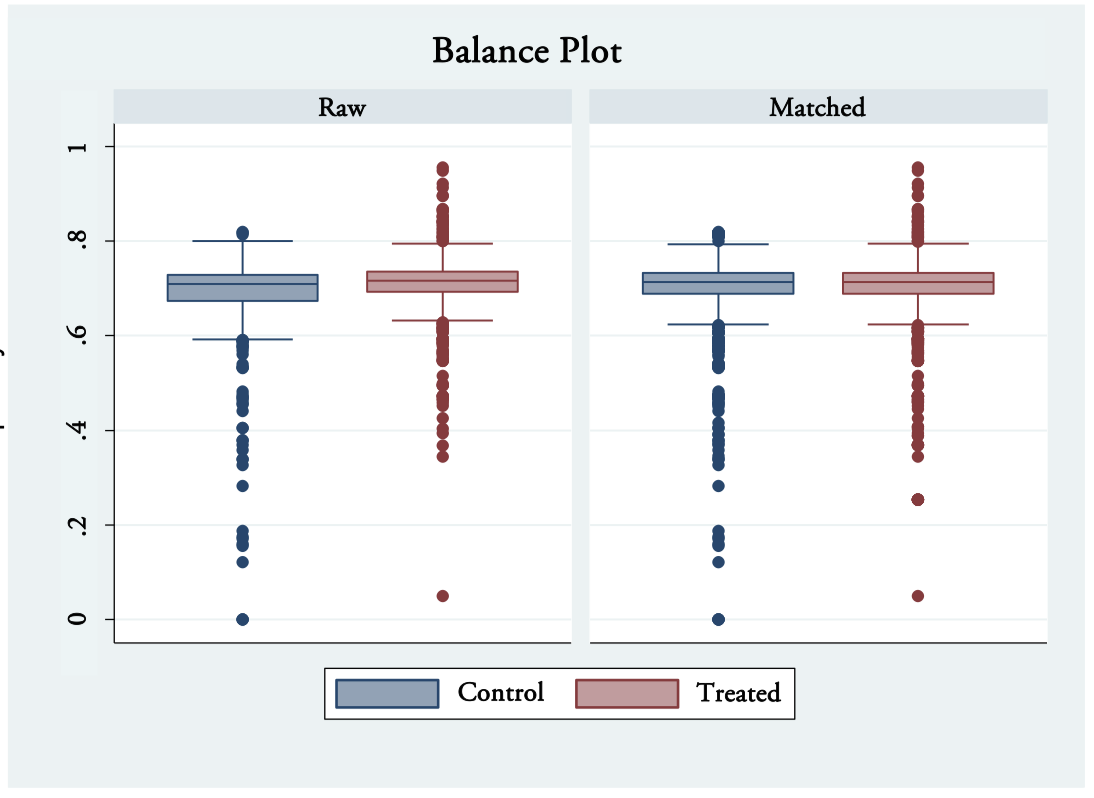
The picture in Appendix B shows the analysis of the balance among compared groups of observations. The box plots for the matched sample are similar. The medians, the 25th percentiles, and the 75th percentiles appear to be the same, although there may be some differences in the tails, the upper adjacent values, the lower adjacent values, and the outliers. Thus, this picture suggests that matching on the estimated propensity score appears to be balanced.
Once the matches were obtained, this methodology provided the average sustainability score of the set of interest. It fits well the analytical objectives of the present study, and it clearly overcomes potential concerns about selection bias, thus ensuring robust and reliable estimations. Estimations are computed with “teffects psmatch” in STATA-software.
5. Data analysis
5.1. Descriptive statistics
The QIBA methodology returned TF-IDF values which allowed to rank firms according to the baskets of words presented in Appendix A. The higher the score, the higher the intensity of communication about sustainability topics on the website. Table 3 presents several statistics on the sampled firms, including the three relevant sustainability dimensions together with economic and financial indicators.
Table 3.
Descriptive statistics
| Variable | Obs (% 0) | Mean | Std. dev. | Min | Max |
| Environmental sustainability | 1438 (21%) | 9,380447 | 8,385432 | 0 | 56,9699 |
| Social sustainability | 1438 (36%) | 1,488767 | 1,09763 | 0 | 3,269659 |
| Number of employees | 1335 | 145,5978 | 511,5798 | 1 | 13195 |
| Production value | 1340 | 41071,42 | 104549,8 | 0 | 2270739 |
| Profits or loss before taxes | 1340 | 2639,673 | 11901,03 | -61729,31 | 259968,7 |
| Operating profits or loss | 1340 | 2185,879 | 11346,86 | -61648,97 | 190414,7 |
| Financial flow | 1331 | 4189,084 | 19826,88 | -35385,47 | 446086 |
| Total assets | 1340 | 53738,68 | 174416,4 | 459,3997 | 3813589 |
| Equity | 1340 | 24285,26 | 75906,93 | -47239,64 | 1109637 |
| Current ratio | 1339 | 2,400273 | 2,453062 | 0,14 | 63,257 |
| Profit margin | 1333 | 5,081246 | 10,64511 | -72,452 | 79,709 |
| Return on equity | 1323 | 13,04862 | 29,6043 | -294,369 | 294,249 |
| Return on capital employed | 1316 | 10,20753 | 19,66445 | -282,083 | 114,834 |
| Solvency ratio | 1338 | 42,23552 | 21,14355 | -95,645 | 95,133 |
| Number of advisors | 1344 | 1,855655 | 2,185036 | 0 | 19 |
| Number of group companies | 1341 | 37,217 | 178,0328 | 0 | 1967 |
Note: financial indicators are measured in Euro. Source: our elaboration.
The TF-IDF analysis informed that environmental sustainability related words were the dominant ones, being present in 1278 of the websites, followed by social sustainability with 916 of companies mentioning these themes. Moreover, several businesses (251) only discussed environmental sustainability related topics and 23 companies deepened social themes alone.
Data suggests an heterogenous orientation towards sustainability, which become a moderate-to-high one when coming to environmental sustainability, probably because the conversation on this aspect is traditionally the most diffused. Environmental sustainability is the subtopic in which most companies are keen to talk about (the first 50 TF-IDF results are in the environmental sustainability basket), and also the one where the highest TF-IDF values were recorded. In fact, its average score is equal to 9.73 whereas, in the case of the social sustainability basket, this value is significantly lower: 2.16. Environmental sustainability also shows the greatest sample variance.
Table 4 shows indicators about fashion firms' orientation towards sustainability, distinguishing by those operating within and outside IDs. At a first glance, looking at mean values, it appears that sustainability indicators are slightly higher for firms located in IDs. Such a picture calls for a further enquiry applying the PSM methodology.
Table 4.
Sustainability indicators distinguishing between firms within or outside IDs
| Environmental sustainability | Social sustainability | ||
| District | Mean | 10,10981653 | 2,178141911 |
| St. Err. | 0,311071017 | 0,021841096 | |
| Median | 7,045647316 | 2,117262785 | |
| Mode | 23,31493935 | 1,5446947 | |
| St. Deviation | 8,54738024 | 0,5145421 | |
| Sample Variance | 73,05770897 | 0,264753573 | |
| Min | 3,280125112 | 1,37429016 | |
| Max | 56,96990075 | 3,264434746 | |
| Observations | 755 | 555 | |
| Environmental sustainability | Social sustainability | ||
| Non district | Mean | 9,319549095 | 2,136986197 |
| St. Err. | 0,343830815 | 0,029380599 | |
| Median | 6,467671888 | 2,032170901 | |
| Mode | 7,755887843 | 1,751606254 | |
| St. Deviation | 7,603249231 | 0,540954192 | |
| Sample Variance | 57,80939886 | 0,292631437 | |
| Min | 3,270030619 | 1,373196918 | |
| Max | 51,45644471 | 3,269658751 | |
| Observations | 489 | 339 | |
Source: our elaboration.
5.2. Results from the PSM
Table 5 shows estimates on treatment effects by PSM. The treatment model is a logit, variables regarding sustainability are standardized before the computation to allow for comparisons and robust standard errors are reported. Results are distinguished by environmental and social sustainability.
Coefficients are all positive and statistically significant at traditional statistical levels, suggesting a positive association between fashion firms' orientation towards sustainability and their location within IDs. Thus, they confirm all the hypotheses included in Section 2 and suggest the existence of a sustainability-driven ID effect. Specifically, findings suggest that firms operating in IDs are more oriented towards environmental and social sustainability than firms operating outside such socio-economic systems.
Table 5.
Estimates on treatment effects by PSM (environmental and social sustainability)
| District vs non-district | Coeff. | Robust std. err. | P value | Number of obs. |
| Environmental sustainability | 0,1876288*** | 0,0546552 | 0,001 | 1288 |
| Social sustainability | 0,152721* | 0,0627912 | 0,015 | 1288 |
Source: our elaboration.
Fashion firms operating within IDs seem to benefit from a plus in terms of sustainability orientation. Both district level and internal factors should be at work, simultaneously. In fact, in addition to their internal capability to meet sustainability challenges, firms operating within IDs also enjoy a territorial advantage that may led them to a higher sustainability orientation. This is relevantly liked with the cooperation-competition mix typical of firms operating within industrial IDs (Dei Ottati, 1994). On the one hand, cooperation among firms within IDs seems to be likely to be associated with the spread of sustainability-based knowledge; on the other hand, competition among the same set of companies is expected to push them to invest more in sustainability commitment and related innovative outcomes as another, more and more relevant, competitive advantage.
One of the main consequences of the detected sustainability-ID association is for efficiency in coordination among firms and other organizations, and for continuous innovation, as two core characteristics of well working IDs often highlighted by the literature on the theme (Bettiol et al., 2021; Broekel et al., 2021). In fact, sustainability can be an important driver of both efficiency and innovation, thus reinforcing key advantages of firms operating within IDs and of the system as a whole. For example, the network of interacting firms may lead to an efficient use of resources, limiting waste of resources and energy (Albino et al., 2012). Moreover, institutions at different levels may be likely to design pro-environmental and pro-social policies to moderate or overcome the impacts of the productive side on the local community and environment (Mazzanti and Zoboli, 2009). Finally, this detected association can also be recalled in promoting the sustainable qualities of products and services of firms operating within IDs (Appolloni, et al., 2022).
However, it is not just about being in the right place (Gertler, 2003) because a valuable and effective orientation to specific attitudes and knowledge requests a proactive approach (Camisòn and Villar-Lòpez, 2011). As suggested by the sample variance (especially the one computed on environmental sustainability) included in Table 4, sustainability-based knowledge spillovers do not flow freely and spontaneously within industrial districts, as sometimes argued by the literature (Giuliani, 2007). In the case under study, this means that a firm needs to create internal learning capabilities and to trigger their absorptive capacity for a better understanding and assimilation of others’ sustainability-based knowledge.
As a robustness check, we also computed the same model but investigated fashion firms' communications about their pro-sustainability certifications. This is important because firms might also communicate pro-environmental and pro-social attitudes as the outcome of greenwashing behaviors (Delmas and Burbano, 2011). Certifications can capture firms' more genuine sustainability orientation and signal the implementation of concrete actions in favor of sustainability (Richards et al., 2017). Findings reported in Table 6 confirm the positive association between fashion firms' orientation toward sustainability (measured by the communication of sustainability certifications) and their location within IDs.
Table 6.
Estimates on treatment effects by PSM (certifications)
| District vs non-district | Coeff. | Robust std. err. | P value | Number of obs. |
| Sustainability certifications | 0,2437612*** | 0,0570736 | 0,000 | 1288 |
Source: our elaboration.
6. Discussion and conclusions
The investigation into the role of industrial districts (IDs) in shaping the sustainability orientation of firms, particularly in the fashion industry, is a novel and underexplored area, especially in terms of quantitative analysis using large databases, as highlighted by Bellandi and Stefani (2023). Our study aimed to fill this gap by examining whether fashion firms within or outside IDs exhibited varying degrees of orientation towards different sustainability domains. The findings revealed a higher inclination towards environmental and social sustainability among firms located within IDs compared to those operating outside them. This discovery unveils a previously unidentified ID effect in the case of sustainability.
This work contributes a fresh perspective on the role of IDs in fostering a transition towards a more sustainable future. Despite occasional criticisms associating IDs with adverse environmental outcomes due to their strong manufacturing nature (Bellandi et al., 2021), our results challenge this notion. Drawing from the theory of knowledge spillover entrepreneurship (Audretsch and Keilbach, 2007), we argue that efficient knowledge diffusion in IDs can lead to more entrepreneurial opportunities, particularly in sustainability. When companies within such IDs possess sustainable knowledge, a symbiotic relationship is established, benefiting neighboring firms, especially those with a proactive attitude and efficient sustainability-related knowledge absorptive capacity.
This study holds implications not only for IDs but also for the fashion industry. As early as 2014, Vivienne Westwood emphasized the imperative to "Buy Less, Choose Well, Make it Last," signaling the growing awareness of the crucial link between fashion and sustainability. Achieving sustainable development in the fashion industry involves significant innovations and changes to mitigate its environmental impact and ensure the well-being of workers, aligning with the principles of the World Commission on Environment and Development (1987).
Scientific inquiry into the intersection of fashion and sustainability is recent but substantial, focusing on consumer perspectives, sustainable supply chain management, new business models, and the role of luxury fashion in driving a sustainable paradigm shift (Blasi et al., 2020). This contribution delves into the current state of the fashion industry's sustainability in social and environmental aspects, highlighting both progress and persistent challenges. Notably, as fashion companies and policymakers increasingly integrate sustainability into their strategies, our findings emphasize the need for collaborative efforts across the supply chain, institutions, governments, and consumers.
The study underscores the pivotal role of supply chains as "core activators" of sustainability orientations. Collaboration within and outside the value chain, the establishment of standards and targets, and enhanced traceability and transparency are identified as key elements for improving the industry's sustainability performance. While the Made in Italy fashion industry has thrived due to the leadership of IDs, there is still room for improvement in environmental and social orientation, acknowledging the sector's relative lag behind other industries.
Methodologically, our work breaks new ground by providing a comprehensive overview based on firm-level fine-grained data from a large dataset, addressing concerns related to external validity common in single case study approaches. The managerial significance lies in reaffirming the importance of sustainable practices, particularly in areas dominated by IDs. Companies in these places where IDs are located can strategically benefit from the exchange of sustainability-related knowledge.
However, the study has limitations. The focus on a specific country, Italy, calls for future research to explore other contexts, considering the influence of IDs and fashion traditions. Additionally, incorporating qualitative methods such as interviews and field observations could enhance the quali-quantitative understanding of sustainability practices. Finally, it's crucial to acknowledge that this study primarily assessed firms' communication of sustainability attitudes, leaving room for future investigations into concrete actions and specific measures.
Appendix
Appendix A
| Environmental sustainability: Antibacterial, Assessment, Bio, Biodegradable, Biodegradables, Biodiversity alliance, Biomass, Bioplastic, Climate change, Carbon, Carbon credit, Carbon footprint, Carbon free, Carbon negative, Carbon neutrality, Carbon positive, Circular economy, Closed loop, Co2, Environmental code of conduct, Combustible, Compostable, Compostables, Cradle, Cradle to cradle, Carbon credit, Eco, Eco®, Ecology, Ecologic, Ecosystem, Ecofriendly, Emission, Energy, Forest, Fossil, Greenhouse gas, Green, Green deal, Green guard, Green innovation, Global warming, Environmental, Environment, Environmental impact, Environmental footprint, Environmental innovation, Paris agreement, Pollution, Polluting, Product lifecycle, Kyoto protocol, Lca, Life cycle analysis, Life cycle assessment, Natural, Naturals, Net zero, Net zero goal, Organic, Organics, Package free, Plastic free, Post-consumer, Recondition, Recovery, Recycle, Recycled, Reduce, Regenerated, Reusable, Reuse, Recyclable, Recyclables, Recycled, Recycled cotton, Recycles, Recycling, Reforestation, Regenerated, Renewable, Renewable energy, Reuse, Reusable, Reused, Sustainable, Sustainable packaging, Sustainability, Sustainability®, Traceability, Washable, Waste, Water footprint, Zero emission, Zero waste, Zero water, 0 km. |
| Social sustainability: Anti-corruption, Anti-corruption, B corp, B impact assessment, B impact report, B lab, Benefits, Benefit corporation, Code of conduct, Code of ethics, Code of social conduct, Ethical code, Corporate social responsibility, CSR, Declaration of interdependence, Equity, Ethics, Ethical, Ethical code, Global impact investing rating system, Global reporting initiative, Gri, Honesty, Human rights, Hybrid enterprise, No profit, Social enterprise, Social innovation, Social entrepreneurship, Social innovation, Social responsibility, Sustainability reporting, Sustainability®, Sustainable, Transparency, Workers. |
| Certifications based sustainability: Bci, Better cotton initiative, Brcgs etrs, C2c, Certification, Certified, Certify, Certifications council®, Certipur, Confidence in textiles, Cotton bci, Cradle to cradle, Cruelty free, Csqa, Dap, Ecolabel, Emas, Epd, Fsc, Fsc®, Gots, Greenlabel, Grs, Iso 14001, Iso 14021, Iso 14024, Iso 14025, Iso 17025, Iso 21401, Iso 26000, Iso 37001, Iso 37101, Iso 45001, Iso 50001, Iso 9001, Iso14064, Iso14067, Lga, Ocs, Oeko, Oeko-tex, Pdr 42, Pefc, Rcs, Rms, Rvs, Sa8000, Smeta, Sr 10, Tex®, Vegan. |
Appendix B
References
Aage, T., & Belussi, F. (2008). From Fashion to Design: Creative Networks In Industrial Districts. Industry And Innovation, 15(5), 475-491.
Abadie, A., & Imbens, G. W. (2006). Large Sample Properties Of Matching Estimators For Average Treatment Effects. Econometrica, 74(1), 235-267.
Ajzen, I. (1991). The Theory Of Planned Behavior. Organizational Behavior And Human Decision Processes, 50(2), 179-211.
Appolloni, A., Jabbour, C. J. C., D'adamo, I., Gastaldi, M., & Settembre-Blundo, D. (2022). Green Recovery In The Mature Manufacturing Industry: The Role Of The Green-Circular Premium And Sustainability Certification In Innovative Efforts. Ecological Economics, 193, 107311.
Audretsch, D. B., & Keilbach, M. (2007). The Theory Of Knowledge Spillover Entrepreneurship. Journal Of Management Studies, 44(7), 1242-1254.
Battaglia, M., Testa, F., Bianchi, L., Iraldo, F., & Frey, M. (2014). Corporate Social Responsibility And Competitiveness Within Smes Of The Fashion Industry: Evidence From Italy And France. Sustainability, 6(2), 872-893.
Becattini, G. (1979). Dal Settore Industriale Al Distretto Industriale. Alcune Considerazioni Sull'unità Di Indagine Dell'economia Industriale. Rivista Di Economia E Politica Industriale, 5(1), 7-21.
Becattini, G. (1990). The Marshallian Industrial District As A Socio-Economic Concept. In F. Pyke, G. Becattini, and W. Sengenberger. Industrial Districts And Inter-Firm Cooperation In Italy, (pp. 413– 431). International Institute For Labour Studies.
Becattini, G. (1998). Distretti Industriali E Made In Italy: Le Basi Socioculturali Del Nostro Sviluppo Economico. Bollati Boringhieri.
Becattini, G. (2000). Il Distretto Industriale: Un Nuovo Modo Di Interpretare Il Cambiamento Economico. Rosenberg & Sellier.
Becattini, G. (2004). Industrial Districts. A New Approach To Industrial Change. Edward Elgar
Becattini, G. (2015). La Coscienza Dei Luoghi: Il Territorio Come Soggetto Corale. Donzelli Editore.
Becattini, G., Bellandi, M., & De Propris, L. (Eds.). (2014). A Handbook Of Industrial Districts. Edward Elgar Publishing.
Bellandi, M. (2006). A Perspective On Clusters, Localities, And Specific Public Goods. In C. Pitelis, R. Sugden, & J. R. Wilson (Eds.). Clusters And Globalisation. The Development Of Urban And Regional Economies, (pp. 96-113). Cheltenham: Edward Elgar.
Bellandi, M., Ruiz-Fuensanta, M. J., & Santini, E. (2021). Factors Of Environmental Sustainability In Italian Industrial Districts: A Composite Environmental Sustainability Index. In S. Sedita, & S. Blasi, (Eds.). Rethinking Clusters: Place-Based Value Creation In Sustainability Transitions, (pp. 111-124). Springer International Publishing.
Bellandi, M. & Stefani, G. (2023). New Approaches To Sustainable Development In Clusters And Regional Innovation Systems, Sustainability.
Belussi, F. (2000). Tacchi A Spillo. Il Distretto Calzaturiero Della Riviera Del Brenta Come Forma Organizzata Di Capitale Sociale. Cleup.
Belussi, F. (2015). The International Resilience Of Italian Industrial Districts/Clusters (Id/C) Between Knowledge Re-Shoring And Manufacturing Off (Near)-Shoring. Investigaciones Regionales-Journal Of Regional Research, (32), 89-113.
Belussi, F., & Sedita, S. R. (2009). Life cycle vs. multiple path dependency in industrial districts. European Planning Studies, 17(4), 505-528.
Belussi, F., & Sedita, S. R. (2010). The Evolution Of The District Model: ‘Reverse Relocation’and The Case Of The Leather-Tanning District Of Arzignano. European Review Of Industrial Economics And Policy, (1).
Belussi, F., & Sammarra, A. (Eds.). (2009). Business Networks In Clusters And Industrial Districts: The Governance Of The Global Value Chain. Routledge.
Belussi, F., & Sedita, S. R. (2012). Industrial Districts As Open Learning Systems: Combining Emergent And Deliberate Knowledge Structures. Regional Studies, 46(2), 165-184.
Belussi, F., & Trippl, M. (2018). Industrial Districts/Clusters And Smart Specialisation Policies. In F. Belussi, F. & J. L. Hervas-Oliver (Eds.), Agglomeration And Firm Performance, (pp. 283-308).
Bettiol, M., Capestro, M., De Marchi, V., Di Maria, E., & Sedita, S. R. (2021). Industrial Districts And The Fourth Industrial Revolution. Competitiveness Review: An International Business Journal, 31(1), 12-26.
Blasi, S., Fano S., Sedita S. R., & Toschi G. (2022) A Network Perspective Of Cognitive And Geographical Proximity Of Sustainable Tourism Organizations: Evidence From Italy. International Journal Of Contemporary Hospitality Management [Preprint]. Available at: https://doi.org/10.1108/Ijchm-03-2022-0366
Blasi, S., Brigato, L., & Sedita, S. R. (2020). Eco-Friendliness And Fashion Perceptual Attributes Of Fashion Brands: An Analysis Of Consumers' Perceptions Based On Twitter Data Mining. Journal Of Cleaner Production, 244, 118701. https://doi.org/10.1016/J.Jclepro.2019.118701
Broekel, T., Lazzeretti, L., Capone, F., & Hassink, R. (2021). Rethinking The Role Of Local Knowledge Networks In Territorial Innovation Models. Industry And Innovation, 28(7), 805-814.
Caliendo, M., & Kopeinig, S. (2008). Some Practical Guidance For The Implementation Of Propensity Score Matching. Journal Of Economic Surveys, 22(1), 31-72.
Chan, T., & Wong, C. W. Y. (2012). The Consumption Side Of Sustainable Fashion Supply Chain: Understanding Fashion Consumer Eco-Fashion Consumption Decision. Journal Of Fashion Marketing And Management: An International Journal, 16(2), 193–215.
Chiarvesio, M., Di Maria, E., & Micelli, S. (2010). Global Value Chains And Open Networks: The Case Of Italian Industrial Districts. European Planning Studies, 18(3), 333-350.
De Angelis, M., Adigüzel, F., & Amatulli, C. (2017), The Role Of Design Similarity In Consumers' Evaluation Of New Green Products: An Investigation Of Luxury Fashion Brands. Journal Of Cleaner Production, 141, 1515–1527.
De Brito, M. P., Carbone, V., & Blanquart, C. M. (2008). Towards A Sustainable Fashion Retail Supply Chain In Europe: Organisation And Performance. International Journal Of Production Economics, 114(2), 534-553.
Dei Ottati, G. (1994). Cooperation And Competition In The Industrial District As An Organization Model. European Planning Studies, 2(4), 463-483.
Dei Ottati, G. (2003). Trust, Interlinking Transactions And Credit In The Industrial District. In From Industrial Districts To Local Development, (pp. 108-130). Edward Elgar Publishing.
Dei Ottati, G. (2018). Marshallian Industrial Districts In Italy: The End Of A Model Or Adaptation To The Global Economy? Cambridge Journal Of Economics, 42(2), 259-284.
Delmas, M. A., & Burbano, V. C. (2011). The Drivers Of Greenwashing. California Management Review, 54(1), 64-87.
Fletcher, K. (2008). Sustainable Fashion And Textile Products, Sustainable Fashion And Textiles.
Gertler, M. S. (2003). Tacit Knowledge And The Economic Geography Of Context, Or The Undefinable Tacitness Of Being (There). Journal Of Economic Geography, 3(1), 75-99.
Giuliani, E. (2007). The Selective Nature Of Knowledge Networks In Clusters: Evidence From The Wine Industry. Journal Of Economic Geography, 7(2), 139-168.
Henninger, C. E., Alevizou, P. J., & Oates, C. J. (2016). What Is Sustainable Fashion? Journal Of Fashion Marketing And Management, 20(4), 400-416.
Hiemstra, D. (2000). A Probabilistic Justification For Using Tf×Idf Term Weighting In Information Retrieval. International Journal On Digital Libraries, 3(2), 131–139. https://doi.org/10.1007/S007999900025
Intesa Sanpaolo (2021a). Distretti Italiani Della Filiera Della Pelle: Percorsi Di Internazionalizzazione E Prospettive. Industry Research,1–24.
Intesa Sanpaolo (2021b). Economia E Finanza Dei Distretti Industriali, 13.
Intesa Sanpaolo (2021c). Monitor Dei Distretti - Le Calzature Di Fermo. Industry Research, 1–14.
Intesa Sanpaolo (2022). Economia E Finanza Dei Distretti Industriali. 14.
Istat (2023). Reports And Data available from https://www.Istat.It/It/Archivio/252261
Joergens, C. (2006). Ethical Fashion: Myth Or Future Trend? Journal Of Fashion Marketing And Management, 10(3), 360–371.
Kapferer, J. N., & Michaut-Denizeau, A. (2014). Is Luxury Compatible With Sustainability Luxury Consumers' Viewpoint. Journal Of Brand Management, 21(1), 1–22. https://doi.org/10.1057/Bm.2013.19
Kotler, P. (2011). Reinventing Marketing To Manage The Environmental Imperative. Journal Of Marketing, 75(4), 132-135.
Lazzeretti, L., Capone, F., Caloffi, A., & Sedita, S. R. (2019). Rethinking Clusters. Towards A New Research Agenda For Cluster Research. European Planning Studies, 27(10), 1879-1903.
Markman, G. D., Russo, M., Lumpkin, G. T., Jennings, P. D., & Mair, J. (2016). Entrepreneurship As A Platform For Pursuing Multiple Goals: A Special Issue On Sustainability, Ethics, And Entrepreneurship. Journal Of Management Studies, 53(5), 673-694.
Marshall, A. (1920) Principles Of Economics (8th Edition). Macmillan.
Mazzanti, M., & Zoboli, R. (2009). Embedding Environmental Innovation In Local Production Systems: Sme Strategies, Networking And Industrial Relations: Evidence On Innovation Drivers In Industrial Districts. International Review Of Applied Economics, 23(2).
Mckenzie, S. (2004). Social Sustainability: Towards Some Definitions. Hawke Research Institute Working Paper Series N. 27.
Mikolov, T., Sutskever, I., Chen, K., Corrado, G. S., & Dean, J. (2013). Distributed Representations Of Words And Phrases And Their Compositionality. Advances In Neural Information Processing Systems, V.26.
Morgan, L. R., & Birtwistle, G. (2009). An Investigation Of Young Fashion Consumers' Disposal Habits. International Journal Of Consumer Studies, 33(2), 190-198.
Nawaz, W., & Koç, M. (2018). Development Of A Systematic Framework For Sustainability Management Of Organizations. Journal Of Cleaner Production, 171, 1255-1274.
Paik, J. H. (2013). A Novel Tf-Idf Weighting Scheme For Effective Ranking, In Proceedings Of The 36th International Acm Sigir Conference On Research And Development In Information Retrieval. SIGIR'13. Acm, 343–352.
Porter, M. E., & Kramer, M. R. (2019). Creating Shared Value. In G. G. Lenssen & N. C. Smith (Eds.), Managing Sustainable Business, (pp. 323–346). Springer.
Richards, M., Zellweger, T., & Gond, J. P. (2017). Maintaining Moral Legitimacy Through Worlds And Words: An Explanation Of Firms' Investment In Sustainability Certification. Journal Of Management Studies, 54(5), 676-710.
Sammarra, A., & Belussi, F. (2006). Evolution And Relocation In Fashion-Led Italian Districts: Evidence From Two Case-Studies. Entrepreneurship And Regional Development, 18(6), 543-562.
Seuring, S., & Müller, M. (2008). From A Literature Review To A Conceptual Framework For Sustainable Supply Chain Management. Journal Of Cleaner Production, 16(15), 1699-1710.
Svensson, G., Ferro, C., Hogevold, N., Padin, C., & Sosa Varela, J. C. (2018). Developing A Theory Of Focal Company Business Sustainability Efforts In Connection With Supply Chain Stakeholders. Supply Chain Management: An International Journal, 23(1), 16-32.
Torelli, C. J., Özsomer, A., Carvalho, S. W., Keh, H. T., & Maehle, N. (2012). Brand Concepts As Representations Of Human Values: Do Cultural Congruity And Compatibility Between Values Matter? Journal Of Marketing, 76(4), 92–108.
Toschi, G., Vitali, G., Schiavon, D., Chinellato, D., & Ianuale, N. (2019). Tecniche Di Web Scraping E Text Mining Per La Definizione Dei Settori Industriali: Un’applicazione A Piemonte E Veneto, In. Xl Conferenza Italiana Di Scienze Regionali, P. 15.
World Commission On Environment And Development (1987). Report Of The World Commission On Environment And Development: Our Common Future. United Nations.
World Economic Forum And Boston Consulting Group (2021). Net-Zero Challenge: The Supply Chain Opportunity, 1–46.
Información adicional
JEL Clasiffication: M00; Q01; R11