Monográficos
Short supply chains and Protected Designations of Origin: the case of Parmigiano Reggiano (Italy)
Cadenas alimentarias cortas y Denominaciones Protegidas de Origen: el caso del Parmigiano Reggiano (Italia)
Short supply chains and Protected Designations of Origin: the case of Parmigiano Reggiano (Italy)
Ager. Revista de Estudios sobre Despoblación y Desarrollo Rural, no. 25, pp. 43-64, 2018
Centro de Estudios sobre la Despoblación y Desarrollo de Áreas Rurales

This work is licensed under Creative Commons Attribution-NonCommercial-NoDerivs 4.0 International.
Received: 19 May 2017
Accepted: 03 July 2018
Abstract: Short food supply chains are considered a tool for promoting the local economy and meeting consumers’ quality requirements. This paper analyses the case of a Protected Designation of Origin (PDO) product that is marketed both world-wide and through a short supply chain (Parmigiano Reggiano). The case study shows that short chains can be an important trade channel for consumers, producers and rural development. Parmigiano Reggiano dairy factories with direct sales are more resilient than those without direct sales. The study also shows that the successful implementation of a short supply chain requi- res efficient governance.
Keywords: PDO, short food supply chain, resilience, rural development.
Resumen: Las cadenas alimentarias cortas se consideran una herramienta para promover la eco- nomía local y cumplir con las exigencias de calidad por parte de los consumidores. Este artículo analiza el caso de un producto con Denominación Protegida de Origen que se comercializa tanto a escala global como a través de una cadena corta (Parmigiano Reggiano). El estudio de caso muestra que las cadenas cortas pueden ser un canal importante para consumidores y productores, así como para el desarrollo rural. Las fábricas lácteas de Parmigiano Reggiano con venta directa son más resilientes que aquellas que care- cen de venta directa. El estudio también muestra que implantar exitosamente una cadena corta requiere una gobernanza eficiente.
Palabras clave: Denominación Protegida de Origen, cadena corta alimenticia, resiliencia, desarrollo rural.
Short food supply chains: a conceptual framework
In recent decades, producers have developed short food supply chains (hence- forth, SFSCs) in many different forms in response to globalisation in both EU and non- EU countries (Santini and Paloma 2013).
Consumer concerns about food quality play a major role in this trend. The main reasons for buying from local producers include greater variety of products, better safety and traceability, better taste and freshness, less packaging concealing the pro- duct, environmental concerns (De Sainte-Marie et al. 2012) and face to face relations- hips between consumers and producers (Lyson and Green 1999).
An extensive literature is available on SFSCs. According to Marsden et al. (2000) and Renting et al. (2003), classification of SFSCs is made according to the distance covered by the product from the place of production to the place of consumption: face to face, spatial proximity or long distance.
There are three interpretative approaches to SFSCs. One is a political-economic perspective, where SFSCs are studied as a response to the inequalities of the agri-food system (Sunding 2003; Dupuis and Goodman 2005) and consumers are willing to pay a premium price to support local development paths (Umberger et al, 2009; Chang and Lusk 2009). Another approach is a social perpsective, in which SFSCs are conside- red as a form of alternative market to correct the effects of social exclusion and marginalization produced by capitalism (Holloway and Kneafsey 2000; Van der Ploeg and Renting 2004; Kneafsey et al. 2008; Borec and Prisenk 2013). A third approach is to interpret SFSCs as an expression of territorial governance according to a network perpsective. Brunori et al. (2011) state that SFSCs are a strategy of spatial, cultural, social and economic reconnection between production and consumption, enabled through the development of synergies between agriculture and other sectors at local level. SFSCs are an instrument for reforging links between territorial partners, as well as a marketing channel (Bellows et al. 2010). For more details of these aspects of SFSCs, see Santini and Paloma (2013) and Fabbrizzi et al. (2014).
A specific feature of SFSC products is the level of quality and sustainability per- ceived by consumers. To develop a more inclusive view of how socially constructed cri- teria are coordinated in processes of food quality assessment by the consumer, many researchers have used convention theory (Boltanski and Thevenod 1991; Wilkinson 1997; Nygård and Storstad 1998; Kirwan 2006). In contrast with neo-classical theory which says that the price mechanism incorporates all the information inherent in a pro- duct, convention theory considers quality as an endogenous social construct which con- tributes to coordinating economic activity (Wilkinson 1997). More precisely, quality is also the result of formal rules (civic convention) or informal rules (domestic and opinion conventions). In civic conventions, there is collective commitment built on a recognized common interest and coordination to avoid conflicts (Ponte and Gibbon 2005). Domestic convention is based on direct relationships and personal trust enabled by physical and cultural proximity (Boltanski and Thevenot 1991). In opinion convention, product quality is judged with reference to the opinions of others (Marescotti 2000). These conventions contribute to the acknowledgement of local ties between actors which allow them to communicate and negotiate (Renard 2003).
SFSCs are often characterised by bottom-up development. Consumer perception of intrinsic and extrinsic quality leads to search for producers in what can be termed domestic or opinion convention. When several consumers search for the same perceived quality, information exchange and sharing objectives can lead them to form groups or associations in order to aggregate demand vis a vis SFSC producers. Consumer groups in turn lead producers to coordinate production in order to meet consumer needs. Where this occurs, domestic convention is often institutionalised in a civic agreement, by way of production guidelines or codes of specifications as a civic agreement. The type of governance operating in the SFSC is a key element in the transformation of an infor- mal agreement into a formal one. In fact, if governance is inadequate, the fundamental principles of local food systems, such as re-connection of producer and consumer, the direct exchange and the shared goals and values, tend not to be realized. These out-comes require a kind of governance that is able to capture the varied, hybrid and flexible reality, and not simply reflect their potential (Mount 2012).
De Roest et al. (2014) define chain governance as a key attribute for both local and global chains where producers of PDO products are represented by a collective body. They also identify qualitative indicators to monitor the chain governance, aimed at describing “the specificity of chain management regarding the capacity to manage internal and external relations and thus to adopt appropriate and effective manage- ment actions” (De Roest et al., 2014: 54). These are trust-based internal relationships, trust-based external relationships, self-governance capability and chain-based value governance.
Trust-based internal relationships measures the level of trust-based relations between chain actors, based on absence of conflicts, trust among chain partners and continuity of chain relations, while trust-based external relationships involves chain partners’ capability to mobilize support from social movements, citizens and policy actors. Self-governance capability implies the ability to create distinctiveness and, finally, chain-based value governance refers to governance models suggested by Gereffi et al. (2005), which is based on the complexity and codification of transactions and competence of suppliers. Gereffi et al. (2005) define five governance models: market (the market linkages can be transitory or can persist over time, with repeated transactions; the costs of switching to new partners are low for both parties); modular (suppliers produce as per customer’s specifications and take full responsibilities for competencies surrounding process technology), relational (there are complex interac- tions between buyers and sellers, which often creates mutual dependence and high levels of asset specificity), captive (small suppliers are transactionally dependent on much larger buyers and face significant switching costs) and hierarchy (characterized by vertical integration).
A short supply chain for a PDO product shows specific features when the pro- duct has a world wide reputation and is sold on distant markets. To our knowledge, there is no literature describing the develpment of this type of chain for a PDO pro- duct marketed world wide. Therefore, the aim of this research is to analyze the short supply chain strategy developed by a local institution (PDO Consortium) for a world- famous PDO product, Parmigiano Reggiano cheese, in order to meet the challenge of the economic crisis and new consumer quality expectations.
Section 2 describes the case study, including the analysis of Parmigiano Reggiano supply-chain, the governance of ”Consorzio del formaggio Parmigiano Reggiano” and the development of the Parmigiano Reggiano short supply chain.
Section 3 discusses the role of such a short supply chain, with particular reference to cooperative cheese dairy factories, in the face of the economic crisis and it draws con- clusions. The case study uses data of the Consorzio del formaggio Parmigiano Reggiano database and sector and academic publications, and interprets it in the light of concepts of convention theory and literature on governance.
A case study:the Parmigiano Reggiano short supply chain
Historical background of PR supply chain
Parmigiano Reggiano (henceforth, PR) has always been an expression of its ter- ritory and Italy in the world since its origins, which are dated back to the Middle Age (Arfini et al. 2006). Historians agree on locating Parmigiano Reggiano first production in the southern part of the Po River by Benedictine monks in the area (De Roest and Menghi 2000). In the whole of Northern and Central Italy, it turned to be one of the most widely appreciated and expensive products so much it was mentioned by Boccaccio as a symbol of opulence and good living (Magagnoli 2017). Large land estates, sharecropping fams, monasteries and saltworks contributed to the develop- ment of this cheese that could be kept for years. The designation of origin was pro- bably the result of a hystorical process involving trade channels and communication routes. Parma was in fact the place where dairy production from a wider area was concentrated for sale, and the place from where it was shipped. This process was also fostered by the higher commercial value that a cheese “from Parma” (i.e. shipped from Parma) enjoyed on the market (Magagnoli 2017). The need for an official designation of origin became clear at the beginning of the twentieth century. In 1926, the VII Dairy International Congress dealt with the issue of the definition of “the names of the types of cheese derived from their areas of origin” to prevent frauds towards buy- ers and, in 1928, the voluntary Consortium for the protection of the Grana Reggiano was established (www.parmigiano-reggiano.it). Consortium role in protection of PR was formalized in 1955 by the Italian legislator when the Controlled Designation of Origin (CDO) of PR was established and the concept of “area of origin” and quality standards were defined as well.
The PR supply chain and market
PR is one of the most representative PDO products of the longstanding Italian gastronomic tradition. PR is produced exclusively in the area defined by the code of specifications (Parma, Reggio Emilia, Modena and part of the Provinces of Mantova and Bologna) and the cows’ diet is fodder produced in the same area. The code of spe- cifications defines the method of processing milk into cheese, maturation (up to 12 months) and the cutting of cheese, which must also take place within the area defined by the code.
In 2016, the PR supply chain produced 3.5 million wheels of cheese in 332 dairy factories, which collect milk from 3,544 farms (www.parmigiano-reggiano.it).
The PR supply-chain includes mainly three types of interacting actors: farmers, cheese dairies factories and wholesalers, a Consortium driving a qualitative and stra- tegic governance for its members and other public and private players that impact the supply chain (figure 1).
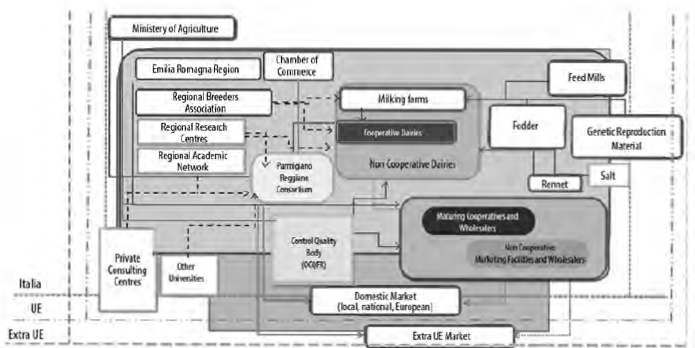
Figure 1.
The PR production system
Source: Arfini and Mancini (in press).
There are three typologies of farmers: i) those who deliver milk to cooperative cheese dairy factories of which they are members; ii) those who sell their milk to non- cooperative small-scale or industrial dairy factories; iii) those who process the milk they produce in their own dairy factories.
Cheese dairy factories are differently organized too. Some of them are farm- owned, others are industrial factories and the third category includes cooperative factories. Cooperative dairy factories have always played an important role in the develpment of more disadvanted areas, mainly on the mountains, as they were and are the main, if not the exclusive, source of income for farmers supplying milk. A com- mon feature of PR dairy factories is that they are single-product businesses, as the milk is used exclusively for the production of this cheese.
PR supply chain is undergoing a fundamental restructuring with a rapid fall in the number of dairy factories and rapid rise in the production capacity of each one (www.parmigiano-reggiano.it). In 1992, the date of EEC Reg. 2081/92 on PDOs, the number of dairy factories stood at 733. In the period 1992-2012, the number of dairy factories shrank and over half of cooperative dairy factories went out of business. Although shranking can to an extent be seen as ‘natural’, closure of cooperatives was extremely negative as it led to the closure of farms, and put farming as well as human presence and livelihoods in the countryside at considerable risk (Arfini et al. 2006; Arfini and Mancini, in press).
One of the main challenges faced by PR supply chain is the end market chang- ing. Consumption of PR on the Italian market today takes place in a context of eco- nomic crisis, which has decreased purchasing power of Italian households as well as food consumption in real terms. A key factor in domestic demand for PR today is the price difference with its main competitor, Grana Padano. This is a similar cheese which has a long ripening period, but it is produced using more industrial techniques and is less expensive than PR. If the retail price difference between these two cheeses rises, some consumers, particularly outside the PR production area, will switch over to Grana Padano. In other words, demand varies according to the absolute price level of PR and the price difference with Grana Padano (De Roest and Menghi 2000; Giacomini 2010; Cersosimo 2011). Stagnation in PR consumption is also a result of changes in diet in Italy. In fact, despite cheese consumption in Italy is steady1, hard ‘grana’ cheese is often being replaced by lower calorie fresh cheeses. Finally, the degree of penetration of PR on the domestic market is very high. Data show that around 60% of Italian households consume PR (Arfini et al. 2006) and nearly 100% consume PR and/or Grana Padano (Rama 2010). The domestic market for PR is there- fore a mature market.
The Parmigiano Reggiano Consortium (CFPR)
A specific feature of the PR production system is the role played by a third party institution, CFPR, which sets the rules for all supply chain actors and oversees promo- tion of the product on the market.
By statute, CFPR has the following tasks (art. 4): i) the protection of the desig- nation of origin of PR cheese; ii) monitoring of the production and sale of PR cheese;iii) the valorisation of PR cheese production; iv) the promotion and dissemination of information about the PDO and related labelling, aiming to generally protect the interests of this designation; v) the promotion of consumption in Italy and abroad, as well as vi) the development and support of any initiative of a commercial or other nature aiming to valorise PR cheese and improve its image.
The consortium model has benefitted from the strong protection afforded by Italian and EU legislations which are favourable to GI schemes as an instrument for rural development and have made of them a major feature of the European agricul- ture model (Stranieri and Tedeschi 2017; Mancini 2016).
As well as CDO recognition, the National Ministry assigned responsibility for inspection of typical products to Consortia, which for a time carried out public func- tions despite being private bodies. And, although the 1992 EC regulations on PDO and PGI took the role of inspection away from Consortia and gave it to designated inspec- tion authorities (and/or certification bodies), another Italian law (Law No. 526/99) intervened to ensure that Consortia played a key role in the production system (Mancini 2016).
As per EU Reg. 1152/2012, CFPR has the status of an inter-branch organization. From a theoretical point of view, inter-branch organizations (Williamson 1991; Perrier-Cornet and Sylvander 2000) are considered as hybrid organizational forms. They are “governance structures” which manage transactions, characterized by the availability of goods held by autonomous units, without leading to the unification into a single company (Menard 1997). Such governance structures are based on cooperation between operators in the supply chain, defined by long-term contractual relationships which do not however affect their autonomy or respective rights of owner- ship. In hybrid forms, the relationships between the parts are regulated, or rather “governed” in Williamson’s terms, by the principle of authority, with part of the deci- sion-making powers transferred to a third party institution. In the case of traditional products linked to local areas and bearing designation labels, the third party institu- tion which is granted powers of governance, as noted by Perrier-Cornet and Sylvander, may be “Groups” (as defined by the EU Reg. 1151/2012) such as Protected Consortium or inter-branch organisations, or producers organization that group and represent farmers. So the CFPR influences the strategies of companies throughout the supply chain, directly or indirectly affecting the quality of the milk and cheese, and defines promotional activities.
In pursuing its aims, CFPR collaborates with institutions located in the area of production, such as professional associations, universities, research centres, the certi- fication body in charge of controlling compliance of producers with the code of spec- ifications, intermediate institutions (Chambers of Commerce, LEADER organizations, Trade Fair organizations) and other public institutions (including Regional parks). Relationships between these institutions and CFPR are facilitated by spatial proximity and personal relationships between members. CFPR also collaborates with institutions outside the area, such as the Ministry of Agricultural and Forestry Policy (figure 1).
CFPR has responded to difficulties in the supply chain and on the domestic market by adopting different strategies. First, it rationalized supply in a supply regu- lation plan approved by the Ministry of Agricultural and Forestry Policy. The plan was based on the EU Reg. 261/2012 as regards contractual relations in the milk and milk products sector, and its key element was the continuation of “PR milk quotas” given to farmers. The aim was to regulate supply and re-balance the relationships of strength between farmers and dairy factories in the supply chain (Giacomini and Manfredi 2013). Another measure adopted by the CFPR to rationalize supply on the domestic market is promotion of exports, for which it has renewed financial support. In 2016, 37 per cent of total PR production volume was sold on foreign markets (www.parmigiano-reggiano.it).
CFPR has for many years promoted technical and marketing innovation too. The PR supply chain now collaborates with external actors, such as food manufactur- ers and retailers working towards new packing and consumption models (Mancini and Consiglieri 2016).
The development of the PR SSC is a further attempt to counter unfavourable market conditions and is a strategy to support PR producers, especially in less advan- taged areas.
The PR SSC in Parma Province
The SSC described here is found in the PR production area within the Province of Parma, which is the area on the left hand side of the blue line in figure 2.
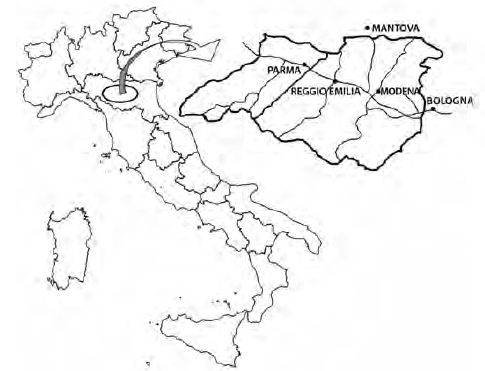
Figure 2.
PR area of production as defined in the code of specifications
Source: Authors’ elaboration on PR code of specifications
PR area of production as defined in the code of specifications
Direct selling at the dairy factory is a growing SSC model in the Province of Parma. Out of the 180 dairy factories in business in 2012, 49 had a website, 66 had a dairy outlet and 8 sold to consumers through e-commerce. Out of the 66 dairy facto- ries with outlets, 7 were also equipped to sell through e-commerce and 36 only had their own web-site. Many of the dairy factories with outlets lie on routes identified and advertised for tourists as strade enogastronomiche or “Food and wine routes”. The Province of Parma hosts Le strade dei vini e dei sapori di Parma which include three different routes travelling from north to south of the Province; one for ham, one for culatello ham and one for the porcini mushroom. The routes also give dairy factories the opportunity for contact with tourists and customers.
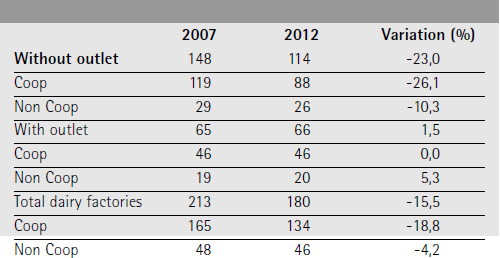
Source: authors’ elaboration on CFPR
In the period 2007-2012, cheese dairy factories without a retail outlet fell by 23 per cent, of which 26 per cent being cooperatives and 10 per cent not. Cheese dairy factories with outlets rose by 1.5 per cent (table 1). Data shows that cooperative fac- tories are the most involved in disclosures, except for those also selling on-site through their outlets.
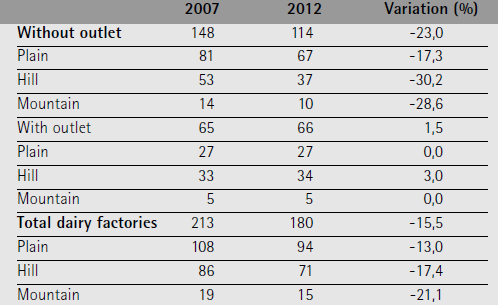
Source: Authors’ elaboration on CFPR
Looking at location by height above sea level, the percentages of dairy factories closures in hills and mountains reached 30 per cent and 28 per cent respectively; but the percentage of dairy factories selling on site slightly rose in hilly areas and held steady for those placed in mountainous areas (table 2).
Source: Authors’ elaborations on CFPR
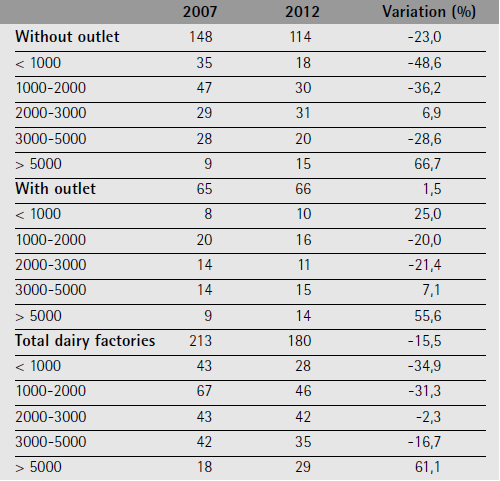
Looking at the size of the dairy factories gives further insight. The first is that many small dairy factories, often independent ones, have built up their valuechain thanks to their outlets. The second is that this SSC boosts value. Not only have dairy factories with outlets not closed down, but they have been able to thrive thanks to economies of scale. In particular, dairy factories in the most critical band of pro- duction volume, those producing between 1,000 and 3,000 tons of milk, have been able to increase their production capacity (table 3).
The CFPR has played a key role in this by promoting dairy factories which sell directly to the customer on its website, providing dairy factories with a standardized outlet format and training courses for health, safety and fiscal matters, as well as marketing strategies, and technical tools.
The CFPR web site (www.parmigiano-reggiano.it) is rich in information on the production system, code of specifications, certification system and recipes with PR as ingredient. It is one of the main communication tools for PR producers and promotes dairy factories which sell cheese directly. It gives in a user-friendly manner an image of quality and trust for the whole system while at the same time providing practical information. In detail, the website shows the locations of the dairy factories, specifies whether the dairy factories sell on site or by e-commerce and provides consumers with contact details for outlets.
The second interesting initiative of the CFPR is the development of the outlet design, which enables standardization in terms of format of outlets, format for per- sonnel and merchandising of cheese items and gadgets, and technological tools.
Every farm outlet is free to sell any food product, but the following goods are usually on sale: PR cheese (at different age, quality, and weight); other cheeses (ricotta, other GI cheeses); local GI products (Salame di Felino PGI, other types local salami, Porcini Mushrooms of Borgotaro PGI); non local GI products (e.g. PDO Olive oil); GI wine from Parma area; traditional pasta (local and non-local); PR gadgets and recipe leaflets; other products (food and non-food) according to the location of the dairy factory.
Outlet staffs wear a standard uniform designed by CFPR and a catalogue of the gadgets and gift items is available. PR is often bought as a gift, so accoutrements such as special cheese knives are often sold with it, and the gift-wrapping also comes from the Consortium.
Thirdly, CFPR coordinates the supply of technology, skills and assistance, with the aim of helping the outlets to comply with regulations on health, safety, labelling and traceability.
The staff are also trained how to guide tourists round the cheese factory and describe the production process and its artisan and natural features. Training is a very important component of the SSC strategy as dairy personnel usually have little formal education and experience in direct sales.
The aims of the CFPR here are to standardize the image and to supply PR pro- ducers with skills and equipment as cheaply as possible.
Discussion and conclusion
The main finding of the case study is the resilience to economic crisis of dairy factories selling on site. As noted above, figures for 2007-2012, the years of deepest crisis for the economy in general and PR in particular, show a fall of 15 per cent in the number of dairy factories, from 213 to 180. Cooperative dairy factories were the type for which adaptation to market requirements was the most difficult and were the worst hit; they fell from 165 to 134 (–18.8 per cent). However, a higher resilience to the recent market challenges was shown by cooperatives selling both through the conventional, long distribution channel and the direct channel, i.e. factory outlets.
Direct sales overcome one of the main problems affecting the conventional PR chain which is the added value retaining by those actors who are closest to the end market, i.e. wholesalers and, particularly, large retailers. Marketing strategies of the conventional supply chain imply multiple “hand to hand” transfers before final con- sumers. This is particularly true for cooperative dairy factories that, still today, age cheese in the shortest possible time and then sell it to wholesalers in batches at 12 months, as soon as it has been branded ( De Roest et al. 2004; Arfini et al. 2006). This makes the cooperatives able to pay farmers who have provided the dairy with the milk but there are some drawbacks in this strategy. Firstly, the product loses its origin- based specificity because it is difficult for customers to trace the product back to the cheese dairy factory and its place of origin. Despite the important role played by farm- ers and dairy factories in the production of high-quality milk and cheese, the origin of the product in the end market is lost. Secondly, dairy factories are prevented from adopting sales strategies or differentiating products while wholesalers are the actors who define strategies, making de facto cooperative dairy factories “price-taker” agents. Wholesalers age cheese the second and third year and develop sales strategies (i.e., packaging, portioning, pricing, sales channels, advertising, promotions, etc.) to place it on the market. However, the strong contractual power of large retailers is a problem for wholesalers too, given that retailers sell about 70 per cent of PR at pro- motional prices on the Italian market (Giacomini 2010). A time serial analysis of the price trend on the wholesale market of 12-month matured PR cheese shows that pri- ces are sensitive to output quantity, which is typical of a commodities market (Giacomini et al. 2012). As a PDO product, however, PR should behave as a niche pro- duct, with a degree of price stability.
Alternative marketing channels –such as direct sales– are able to counterforce cooperatives weaknesses and represent a tool to foster rural and less advantaged areas where cooperatives are mainly placed. Still today, 110 dairy factories and 1,100 farms are in mountainous areas (www.parmigiano-reggiano.it) where Parmigiano Reggiano is the main and often the only economic activity and income source for people.
Contribution of direct channel to the resilience of cheese dairy factories to new market challenges has been made possible by a strategy rooted in the past, which can be explained by convention theory and primarily by domestic convention. In the PR production system, local food is “conceived as food with strong roots in a specific geo- graphical place, which gives the product its identity” (Belletti et al. 2012) and its value is not given by price or capacity to bring to table the best food purchased on the mar- ket at the lowest price. Local food ensures support for farmers and ensures positive externalities, both social and environmental. It is appreciated by consumers and citi- zens from the same community. This means that the farmer has an incentive to choose the optimal solution within a community of consumers and citizens, which can create new attributes for agricultural production, and also improve the relation- ship with the environment and social welfare as a whole (Renting et al. 2003; Sylvander et al. 2006; Sonnino and Marsden 2006).
Territorial reputation also plays a key role in the process of product valorization. The PR SSC in Parma Province is embedded in an environment which throughout his- tory has been socially and economically dedicated to food production2. The collective nature of its reputation, deriving from the behaviour of numerous different agents (Tirole 1996), has become an asset which is shared by a network of firms (Raynaud and Valceschini 1998) whose behaviour in turn impacts on the reputation of other firms in the network. Territorial reputation also includes “spillover reputation”, which gives central place to the reputation of the actors managing development processes or cri- sis situations (Mayer 2006; Yu and Lester 2008, Giacomini et al. 2010).
In this territorial context, the governance of the PR supply chain is also crucial in explaining the success of the PR SSC.
Trust-based relationships are active in both internal and external dimensions. The internal trust based relationships between operators along the chain are based on the guarantee that all will comply with the rules of production defined by CFPR and institutionalized in the code of specifications. In the external dimension, the PR sup- ply-chain, through CFPR, is closely connected with territorial and policy stakeholders. Because the code of specifications is recognized by both Italian and European legisla- tion, public institutions play a key role in the supply chain by guaranteeing the quality of the product and punishing fraudulent imitations and other abuses. The supply chain is also supported by public institutions making policy intervention, including the Emilia-Romagna Regional Authority and the Chambers of Commerce.
In terms of self-governance capacity, the close link with the area implies a high level of distinctiveness for the PR supply chain and for the product itself. This distinc- tiveness derives primarily from the biophysical features of grazing land as well as its his- torical significance. Soil characteristics and climate conditions have a direct influence on the composition of the hay fed to cattle and the specific fermentation characteristics of cheese. The high level of distinctiveness enables PR to mobilize the support of local and national institutions and thus remain competitive on global markets.
Chain-based value governance comprises three different levels. At farm level, the governance is mainly hierarchical when the dairy factories are cooperatives, as the chain is vertically integrated and captive when the relationship is established by con- tract. At dairy factory level, governance in the relationships between dairy factories and wholesalers is again mainly hierarchical or captive, due to the close integration of the chain and the high switching costs. In the relationship between wholesalers and large retailers, the governance reflects a mixture of market and hierarchy models, with relatively instable trade relationships and large-scale retailers in the dominant role. Complex interactions between buyers and sellers often create mutual dependence and high levels of asset specificity.
Therefore, the governance of the PR supply chain is complex. It involves multi- ple agents who are both internal and external to the production system and who relate to one another in different ways.
This complex governance has developed over time and has always aimed at making the PR production system sustainable. In fact, the PR production system has provided the area with economic, social and environmental positive externalities for hundreds of years, and guaranteed a source of income for farmers, food for the people60and protection for the environment. Nowadays, however, the sustainability of the sys- tem is being undermined by competitive pressures, as shown by the decreasing num- ber of farms and dairy factories in less productive areas and by the increasing strength of large retailers who retain most of the added value.
CFPR is an institution which today is facing the triple challenge of the eco- nomic crisis, consumers’ quality expectations and the need for sustainability. It has responded by adopting different strategies and has been able to do this thanks to its established role in setting the rules for the supply chain over the last century. CFPR has defined strategies for increasing sales in both distant and local markets. SSC is just one of the strategies it is promoting. For promoting the SSC strategy, CFPR exploited a domestic convention and reinforced it through civic conventions, namely the European PDO logo and the governance of the CFPR itself. The case study shows that a SSC has given producers a useful opportunity and been successful in improving their resilience in the face of economic crisis.
Acknowledgments
We would like to thank the anonymous reviewers for their careful reading of our manuscript and their insightful comments and suggestions.
References
Arfini, F., Mancini, M. C. (in press). “Synergies exploitation between localized agri-food systems and short supply chains for Gographical Indications as a response to agri-food system challanges: an evidence from Italy”. In Localising Global Food: Short food supply chains as responses to agri-food system challenges, eds. S. Skordili and A. Kalfagianni. London: Routledge.
Arfini, F., Boccaletti, S., Giacomini, C., Moro, D. and Sckokai, P. 2006. Case studies: Parmigiano Reggiano. Bruxelles: DG JRC/IPTS.
Belletti, G., Casabianca, F., Marescotti, A. 2012. “Local food quality and local resources”. In Local agri-food systems in a global world: market, social and environmental challenges, eds. F.61Arfini, M. C. Mancini and M. Donati: 71-95. Newcastle Upon Tyne: Cambridge Scholars Publishing.
Bellows, A. C., Alcaraz, G. and Hallman, W. K. 2010. “Gender and food, a study of attitudes in the USA towards organic, local, US grown, and GM-free foods”. Appetite 55 (3): 540-550.
Boltanski, L. and Thévenot, L. 1991. De la justification. Les économies de la grandeur. Paris: Gallimard.
Borec, A. and Prisenk, J. 2013. “Models of partnerships and organisational forms in short food supply chains in the Slovenian mountains”. Economics of Agriculture 60 (2): 277-286.
Brunori, G., Rossi, A. and Malandrin, V. 2011. “Co-producing transition: Innovation process in farms adhering to solidarity-based purchase groups (GAS) in Tuscany, Italy”. International Journal of Sociology of Agriculture and Food 18 (1): 28-53.
Cersosimo, D. 2011. I consumi alimentari. Evoluzione strutturale, nuove tendenze, risposte alla crisi. Roma: Gruppo 2013.
Chang, J. B. and Lusk, J. L. 2009. “Fairness and food choice”. Food Policy 34: 483-491.
CLAL. 2018. Italy: dairy sector. https://www.clal.it/en/?section=quadro_italia.
De Roest, K., Pignedoli, S., Belletti, G., Menozzi, D. and Arfini, F. 2014. Italian case study: local and global cured ham chains. Brussels: Glamur.
De Roest, K., Menghi, A. and Corradini, E. 2004. “Costi di produzione e di trasformazione del latte in Emilia Romagna”. Centro Ricerche Produzioni Animali (10) 2: 25-37.
De Roest, K. and Menghi, A. 2000. “Reconsidering ‘traditional’ food: the case of Parmigiano Reggiano cheese”. Sociologia Ruralis 40: 439-451.
De Sainte Marie, C., Amiaud, B., Magda, D., Plantureux, S., Agreil, C., Mestelan, P., Boussou, V. and Mougey, T. 2012. “Promouvoir la valeur agri-écologique des prairies: le concours agri- cole national des prairies fleuries”. Presented at Prairies permanentes: de nouveaux atouts pour demain (Paris).
DuPuis, E. M. and Goodman, D. 2005. “Should we go “home” to eat?: toward a reflexive politics of localism”. Journal of Rural Studies 21(3): 359-371.
Fabbrizzi, S., Menghini, S. and Marinelli, N. 2014. “The short food supply chain: A concrete exam- ple of sustainability. A literature review”. Rivista di Studi sulla Sostenibilità (2): 189-206.
Gereffi, G., Humphrey, J. and Sturgeon, T. 2005. “The governance of global value chains”. Review of International Political Economy 12 (1): 78-104.
Giacomini, C. 2010. “I mercati, la filiera e il comparto agro-industriale”. In Il Parmigiano Reggiano Nuove Opportunità per il Futuro, Camera di Commercio Industria Artigianato Agricoltura, Parma: 6 marzo.
Giacomini, C. and Manfredi, F. 2013. “Parmigiano: sistema di produzione in fase di trasforma- zione”. Parma Economica 3: 18-24.
Giacomini, C., Arfini, F. and De Roest, K. 2012. “Interprofession and typical products: the case of Parmigiano Reggiano cheese”. Sviluppo Locale 37-38: 125-150.
Giacomini, C., Arfini, F. and Menozzi, D. 2010. “Processi di qualificazione e spillovers: il caso del Prosciutto di Parma Dop”. La Questione Agraria 3: 55-81.
Kirwan, J. 2006. “The interpersonal world of direct marketing: examining conventions of qual- ity at UK farmers’ markets”. Journal of Rural Studies 22 (3): 301-312.
Kneafsey, M., Cox, R., Holloway, L., Dowler, E., Venn, L. and Tuomainen, H. 2008. “Reconnecting consumers, producers and food: exploring alternatives”. Oxford: Berg: 1- 224.
Holloway, L. and Kneafsey M. 2000. “Reading the space of the farmers’ market: a preliminary investigation from the UK”. Sociologia Ruralis 40 (3): 285-299.
Lyson, T. A. and Green, J. 1999. “The agricultural marketscape: A framework for sustaining agri- culture and communities in the Northeast”. Journal of Sustainable Agriculture 15 (2-3): 133-150.
Magagnoli, S. 2017. “Parmigiano Reggiano cheese. The industrialization of typicality”. In Cheese Manufacturing in the twentieth century: the Italian experience in an international con- text, eds. C. Besana, R. D’ Errico and R. Ghezzi: 163-180. Brussels: Peter Lang.
Mancini, M. C. 2016. “Socially equitable schemes in Latin America and the European Union: the role of geographical Indication Legislation”. In Globalization. Economic, political and social issues, ed. B. Gonzales, 207-239. New York: Nova Publisher.
Mancini, M. C. and Consiglieri, C. 2016. “Innovation and marketing strategies for PDO products: the case of ‘Parmigiano Reggiano’ as an ingredient”. Bio-Based and Applied Economics 5 (2): 153-174.
Marescotti, A. 2000. “Marketing channels, quality hallmarks and the theory of conventions”. In The socio-economics of origin labeled products in agri-food supply chains: spatial, insti- tutional and coordination aspects, eds. B. Sylvander, D. Barjolle and F. Arfini, 103-122. Paris: INRA.
Marsden, T., Banks, J. and Bristow, G. 2000. “Food supply chain approaches: exploring their role in rural development”. Sociologia Ruralis 40 (4): 424-438.
Mayer, K. J. 2006. “Spillovers and governance: an analysis of knowledge and reputational spillovers in information technology”. Academy of Management Journal 49 (1): 69-84.
Menard, C. 1997. “Le pilotage des formes organisationnelles hybrides”. Revue Économique 48 (3): 741-750.
Mount, P. 2012. “Growing local food: scale and local food systems governance”. Agriculture and Human Values 29 (1): 107-121.
Nygård, B. and Storstad, O. 1998. “De globalization of food markets? Consumer perceptions of safe food: The case of Norway”. Sociologia Ruralis 38 (1): 35-53.
Perrier-Cornet, P. and Sylvander, B. 2000. “Firmes, coordination et territorialité. Une lecture éco- nomique de la diversité des filières d’appellation d’origine”, Économie Rurale 258: 79-89.
Ponte, S. and Gibbon, P. 2005. “Quality standards, conventions and the governance of global value chains”. Economy and Society 34 (1): 1-31.
Rama, D. 2010. “Da ripensare il modello delle “grandi” DOP italiane? il caso del Grana Padano”.Agriregioneuropa 6: 20.
Raynaud, E,. Valceschini, E. 1998. “Competition regulation against quality policy: the ‘label rouge’ in the French poultry industry”. In Typical and traditional products: rural effects and agroindustrial problems, eds. F. Arfini and C. Mora, 529-546. Parma: Università degli Studi di Parma.
Renard, M. C. 2003. “Fair trade: quality, market and conventions”. Journal of Rural Studies 19 (1): 87-96.
Renting, H., Marsden, T., Banks, J. 2003. “Understanding alternative food networks: exploring the role of short food supply chains in rural development”. Environment and Planning A 35: 393-411.
Joint Research Centre. 2013. Short food supply chains and local food systems in the EU. A state of play of their socio-economic characteristics, eds. S. Santini and S.G. Paloma: 177. Luxembourg: European Commission Joint Research Centre Institute for Prospective Technological Studies.
Sonnino, R. and Marsden, T. 2006. “Beyond the divide: rethinking relationships between alter- native and conventional food networks in Europe”. Journal of Economic Geography 6: 181–199.
Stranieri, S. and Tedeschi, P. 2017. “The influence of the European institutions and policies on the Italian dairy sector”. In Cheese Manufacturing in the twentieth century: the Italian experience in an international context, eds. C. Besana, R. D’ Errico and R. Ghezzi, 95-111. Brussels: Peter Lang.
Sunding, D. L. 2003. “The role for government in differentiated product markets: looking to economic theory”. American Journal of Agricultural Economics 85 (3): 720-724.
Sylvander, B., Belletti, G., Marescotti, A. and Thévenod-Mottet, E. 2006. “Establishing a quality convention, certifying and promoting the quality of animal products: the case of beef”. In Livestock farming systems, eds. R. Rubino, L. Sepe, A. Dimitriadou and A. Gibon, 61-82. Benevento: European Association for Animal Production (EAAP).
Tirole, J. 1996. “A theory of collective reputations (with applications to the persistence of cor- ruption and to firm quality)”. The Review of Economic Studies 63 (1): 1-22.
Umberger, W. J., McFadden, D. D. T. and Smith, A. R. 2009. “Does altruism play a role in deter- mining US consumer preferences and willingness to pay for natural and regionally pro- duced beef?”. Agribusiness 25 (2): 268-285.
Yu, T. and Lester, R. H. 2008. “Moving beyond firm boundaries: A social network perspective on reputation spillover”. Corporate Reputation Review 11(1): 94-108.
Wilkinson, J. 1997. “A new paradigm for economic analysis? Recent convergences in French social science and an exploration of the convention theory approach with a consideration of its application to the analysis of the agrofood system”. International Journal of Human Resource Management 26 (3): 335-339.
Williamson, O. 1991. “Comparative economic organization: the analysis of discrete structural alternatives”. Administrative Science Quarterly 36: 75-79.