Abstract: How could rural communities prosper when the agricultural population was reduced to just a few percent? This study uses evidence from western Sweden to discuss rural industrialisation as a possible path of development. A paradox in occupational development is the starting point. While much of the rural population left the countryside in search of better job opportunities in the cities, many of the jobs within manufacturing were relocated from city to countryside. Scattered across rural Sweden, we find a number of small municipalities that became sites for growing industry, especially within mechanical engineering. The article argues that much of the industrial dynamism found in these regions was based on knowledge, labour, entrepreneurship and capital derived from the traditional rural structure of family farming and small-scale handicraft. One important engine was the disintegration of the older agrarian system, which freed resources previously bound to agriculture for the expansion of manufacturing. Developments are compared to the growth of industrial districts in “Third Italy” and Early Modern protoindustrialization. In the final section, rural industrialisation is discussed from an institutional perspective, in relation to the “Swedish model” of organized capitalism. It is argued that this model probably slowed the development of small-scale rural industries, supporting instead large-scale industrial concentration. However, in an institutional situation characterized by standardized central solutions, the flexible character of many rural industries actually offered an advantage – and this flexibility has been a strategic resource in the country’s industrial infrastructure.
Keywords:Rural industrialisationRural industrialisation,industrial districtsindustrial districts,Swedish modelSwedish model,protoindustrializationprotoindustrialization,peasantrypeasantry.
Resumen: ¿Cómo podían prosperar las comunidades rurales una vez que su población agraria quedaba reducida a un pequeño porcentaje? Este estudio utiliza evidencia de la Suecia occidental para examinar la industrialización rural como posible senda de desarrollo. Una paradoja en la dinámica de ocupación es el punto de partida. Mientras buena parte de la población rural dejaba el campo en busca de mejores oportunidades de trabajo en las ciudades, muchos de los empleos en el sector industrial eran relocalizados de la ciudad al campo. Dispersos por la Suecia rural encontramos una serie de pequeños municipios que se convirtieron en focos de crecimiento industrial, especialmente en ingeniería mecánica. El artículo argumenta que buena parte del dinamismo industrial de estas áreas se basó en conocimiento, mano de obra, emprendeduría y capital derivados de la estructura rural tradicional de la agricultura familiar y la artesanía a pequeña escala. Un importante motor fue la desintegración del sistema agrario antiguo, lo cual liberó recursos previamente ligados a la agricultura para la expansión de la industria. Estos desarrollos se comparan con el crecimiento de distritos industriales en la ”Tercera Italia” y la protoindustrialización de la edad moderna. En el apartado final, la industrialización rural se estudia desde una perspectiva institucional, en relación con el ”modelo sueco” de capitalismo organizado. Se argumenta que este modelo probablemente ralentizó el desarrollo de industrias rurales a pequeña escala, favoreciendo en su lugar la concentración industrial a gran escala. Sin embargo, en una situación institucional caracterizada por soluciones centrales estandarizadas, el carácter flexible de muchas industrias rurales ofrecía en realidad una ventaja, y esta flexibilidad ha sido un recurso estratégico en la infraestructura industrial del país.
Palabras clave: Industrialización rural, distritos industriales, modelo sueco, protoindustrialización, campesinado.
Artículos
From farms to firms: rural industrialisation under the “Swedish model” of organised capitalism
De granjas a empresas: la industrialización rural bajo el ”modelo sueco” de capitalismo organizado
Centro de Estudios sobre la Despoblación y Desarrollo de Áreas Rurales

This work is licensed under Creative Commons Attribution-NonCommercial-NoDerivs 4.0 International.
Received: 06 March 2018
Accepted: 22 October 2018
In an influential book, Sidney Pollard (1981) described the industrialisation of Europe as a “peaceful conquest” that gradually stretched out over region after region. For rural Europe, this process resulted in a disintegration of agrarian livelihood. Given the growing expectancies on living standard, the possibility of a better life outside of agriculture, the heavy rationalisation of farm work needed to maintain a competitive level of productivity and the subsequent vaporisation of agricultural employment, rural regions have been forced to develop new economic activities – or face the brutal fate of massive depopulation. Apart from some areas along the Mediterranean and in the Alps, where tourism has opened up unexpected possibilities, most rural regions have needed to industrialize to survive (Collantes 2009). But how could such a development be achieved?
This study uses the Swedish post-war case to discuss the prerequisites for and driving forces of rural industrialisation. One starting point is a paradox in occupational statistics: while much of the rural population left the countryside in search of better job opportunities in the cities, many of the job opportunities within Swedish manufacturing were relocated from city to countryside. Scattered over the rural provinces of western Sweden, we find small municipalities that became sites for a growing manufacturing industry. Three examples are examined in the study: Kvänum in Västergötland, a pronounced agricultural region that from the late 1930s69transformed into a centre for mechanical engineering; Ljungby, in south-western Småland, a former small-holder region that developed a successful production of elevator trucks; and finally, Orust on the Bohuslän coastline, where an old boatbuilding tradition gave rise to a production of fibreglass sailing yachts. How did these regions industrialize?
In contrast to influential theories explaining rural industrialisation as driven by the advantage of low wages or as the achievement of a culture of networking, this article argues that the industrial dynamic found in many Swedish rural regions after 1945 was based on knowledge, labour, entrepreneurship and capital derived from the traditional rural structure of family farming and small-scale handicraft. One important observation is the fact that most areas that experienced rising industrial employment after 1945 are located in regions with a historically strong freeholder tradition. It is argued here that the disintegration of the old agrarian system has been a major driving force in industrialisation, freeing resources previously bound to family farming for use in the expansion of manufacturing. Connections are drawn between the writings on early modern protoindustrialization and on the post-war rise of industrial district in “Third Italy”.
In the final section, rural industrialisation is discussed from an institutional point of view, in relation to the “Swedish model” of organised capitalism. It is argued that this model probably slowed the development of small-scale rural industries, instead supporting large-scale industrial concentration. Somewhat paradoxically, it can also be contended that, in an institutional situation characterized by standardized central solutions, the flexible character of many rural industries actually offered an advantage – and that this flexibility has been a strategic resource in the country’s industrial infrastructure.
During the post-war period, European countries took different paths towards modernity. The Swedish approach can be described as a modernisation “from above”, driven by the state, the trade unions, and the large export industries, and structured by a culture of negotiation and constructive agreement. Within the historiography, this institutional framework is known as the “the Swedish model” of organised70capitalism (Magnusson 2000: 232-57; Schön 2010: 312-3, 344-9; Mary Hilson 2008: 65-75). Its results were in many aspects impressive, both in term of economic growth and social accomplishments.
As in other European countries, Swedish decision-makers of the time faced an agrarian problem. After WWII, it was clear that most farms were too small to bear the costs of mechanisation and the provision of an income at level with other sectors of the economy. In order to solve these problems, a state-led policy of “structural rationalisation” was launched in 1947 (Flygare and Isacsson 2011; Magnusson 2000: 237; Schön 2010: 336, 367-71; Locke 2015). Authorities employed legal and economic tools to speed up the transition to larger farms. As a result, labour would be freed up for more productive use in other sectors of the economy, especially manufacturing. At the other end of the urbanisation chain, problems with housing in growing cities were addressed with the “Million Program” of 1965-1975, creating one million new homes in a decade. Systems of migrant subsidies and professional retraining were introduced to facilitate the transition of labour from rural to urban Sweden (Magnusson 2010: 237-9).
What both contemporary and subsequent observers often failed to recognize was that this rural exodus was in fact not accompanied by the growth of industrial employment in the cities. Instead, job opportunities within manufacturing moved in the opposite direction, from the city to the countryside. A few maps and figures, based on official Swedish population and occupation statistics, capture the main trends.
Map 1 depicts the development of industrial employment in central and southern Sweden 1945–2000. It should be noted that development is calculated in absolute numbers, as the number of industrial jobs created or disappeared within a 25 kilometre radius over the period.

Map 1.
Losses (blue) and gains (red) in industrial employment, 1945-2000: absolute numbers within a 25-kilometer radius
From farms to firms: rural industrialisation under the “Swedish model” of organised capitalism
Sources: Folkräkningen 1945; RAMS 2000.One trend is a decline in industrial employment in the metropolitan regions of Stockholm, Gothenburg and Malmö-Öresund. During the latter half of the 20th century, these regions increasingly specialized in administration and advanced services. Less successful examples of deindustrialisation are found in the old iron- making belt of Bergslagen. This region was dominated by large-scale processing industries that either closed down or were heavily rationalized after 1945. Other areas with shrinking industrial employment include Norrköping and Borås, both historical centres for the now almost extinct Swedish textile industry, and, more surprisingly, the Eskilstuna-Västerås region – a core area of the successful Swedish mechanical engineering tradition.
Of greater weight for this study, however, are the regions where industrial employment expanded over the period. These areas are mostly located in the southwest, especially in the provinces of Småland and Västergötland.
Figure 1 presents the development in four areas up till 2016: four rural municipalities in Västergötland (including the Kvänum-area), Ljungby-Markaryd in south-western Småland (including the elevator truck cluster), Orust on the west coast (with its boat building industry) and the Gnosjö region in north-western Småland. For comparison, developments at the national level, in Stockholm (representing metropolitan areas) and the province of Gävleborg (representing the Bergslagen belt) are included.
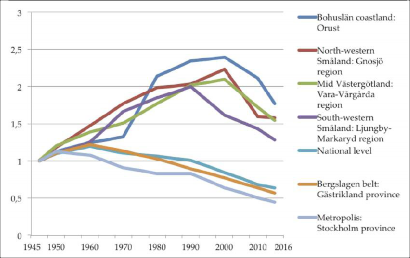
Figure 1.
Number of jobs within manufacturing industry in selected areas 1945–2016 (1945= 1)
Sources: SOS: Folk-/Folk- och bostadsräkningar 1945-90; RAMS 2000-2016 (www.scb.se). Manufacturing excluding construction. Gnosjö region: Gnosjö, Gislaved, Vaggeryd and Värnamo municipalities. Mid-Västergötland: Vårgårda, Vara, Grästorp, Essunga och Herrljunga municipalities; Orust muni- cipality; Ljungby and Markaryd: municipalities (all areas within the 2000 administrative borders).
In Stockholm, industrial employment peaked in the 1950s; in Gästrikland, this high point occurred during the following decade. But in the selected areas in73Västergötland, Småland and Bohuslän the upward trend continued, even through the industrial crises of the 1970s and 1980s. In Ljungby, the tipping point was reached during the 1990s. In the other three regions, it was not until after the turn of the century that industrial employment finally started to decrease.
These numbers cover all manufacturing employment, including sectors like the textile industry, which experienced a drastic reduction after 1945. Map 2 presents the development of employment within metalwork and mechanical engineering industries, the “locomotive” of Swedish post-war industrial growth. The map clearly illustrates the southwestern belt of expanding industry. In large parts of Västergötland and Småland, employment within mechanical engineering more than tripled over the studied period.
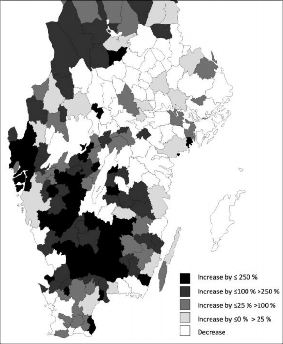
Map 2.
Employment development within mechanical engineering and metalwork industries 1945-2000
From farms to firms: rural industrialisation under the “Swedish model” of organised capitalism
Sources: Folkräkningen 1945; RAMS 2000.We will end the quantitative overview by analysing the agrarian structure. Map 3 measures the importance of family farming in 1945, right before the start of the campaign “of structural rationalisation” of agriculture. The geographical pattern reflected on the map is, however, older. The “freeholder belt” in western Sweden can be traced back to the 18th and 19th centuries when the nobility and the state sold most of its land to an advancing peasantry. In contrast, in the eastern parts of the country, most land remained in the hands of either the nobility or merchants engaged in the Bergslagen iron industry (Winberg 1990, 2000: 131-42; Gadd 2011: 134-8).
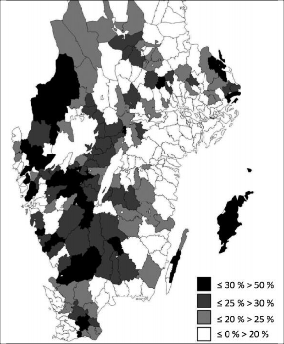
Map 3.
Number of family farmers as a percentage of the total workforce 1945
Data: Number of farms of 1–50 hectars (SOS: Jordbruksräkningen 1944) / total workforce (SOS: Folkräkningen 1945)
If we compare the areas with high concentrations of family farms after the war with the areas of growing industrial employment, we find that they correspond.
Regions with a high number of family farmers in 1945 (Map 3) were also regions that experienced rising employment within the manufacturing industry (Map 1), especially within mechanical engineering (Map 2).
How should this pattern be understood? What could the seemingly backward rural areas offer Swedish mechanical industry in a period characterised by an accelerated process of modernisation? In the following sections, three recurrent explanations of rural industrialisation processes will be discussed, focusing on the importance of cheap labour, social capital and rural entrepreneurship. These theories will then be contrasted with developments in the Kvänum, Ljungby and Orust areas.
The gradual relocation of manufacturing to the rural periphery was first noticed by economical geographers such as Gunnar Törnqvist (1963) and Lundmark and Malmberg (1988, 1995)1. They provided a seemingly simple explanation: low costs of production.
The basic argument is as follows: During the development of capitalism, simpler production was removed from geographically central regions that had industrialised earlier. Production here became too costly; local resources were used more efficiently in other sectors. Production was instead reallocated to “virgin” areas in the periphery, where land and labour was cheap and plentiful.
At first glance, this interpretation seems convincing. Parallels can be drawn to today’s world, where production is reallocating to low-cost countries. The same arguments are also common in historical discussions of rural industrialisation processes. Both early modern proto-industrialisation and post-war industrial expansion in Third Italy have been described as capital’s flight from the cities – with their high wages, guild restriction and trade unions – to rural districts with plenty of cheap and un-organized labour2.
What distinguishes the Swedish post-war case from the examples above is the institutional situation. By the 1940s, trade unions in Sweden had extended their reach into the industrial periphery. In 1952, the “Wage Solidarity Policy” was launched by the Swedish Trade Union Confederation (LO). The basic idea was to establish a common level of wages within manufacturing across the country, smoothing differences between industrial sectors and regions. In this way, low productive industries would be forced either to close or to rationalise. Efficient industries, on the other hand, would benefit. In the long run, salaries would rise for all workers. Although this policy was formulated by LO, it was also embraced by its counterpart, the Swedish Employers Association (SAF), who wanted to slow wage drift in urban areas (Schön 2010: 346; Magnusson 2000: 232-3, 235-7, 261, 275-6; Enflo & Rosés 2015). As the plan was implemented in the 1950s and 1960s, the possibility for new rural industries to gain a market foothold using a low wage strategy was gradually erased. Törnqvist and Lundmark-Malmberg do not consider this factor.
These trends demonstrate that we need to apply a wider approach to post-war Swedish rural industrialisation. Evidently, labour released from agriculture was part of the picture. But access to labour (cheap or not) cannot in and of itself explain a process of industrialisation. Factors like entrepreneurship, capital, and industrial know-how were also required. From where did these resources come?
One possible answer is that they were introduced from outside. Within the growing rural industrial belt in western Sweden, there are several examples of a large- scale industrialisation “from above”, achieved as a joint venture between industry and the state. In the 1960s, the small coastal municipality of Stenungsund in Bohuslän became a centre of the Swedish petrochemical industry. The state provided a seaport, a motorway to Gothenburg, and bridges to nearby islands housing sizable surplus populations from agriculture and fishery. The industry invested in factory plants. In Värö in Halland, similar joint private-public ventures resulted in a massive pulp factory and nuclear power plant. In Bengtfors in Dalsland, Volvo built a car-seat factory in exchange for favourable state credits3.
Above all, however, industrialisation within the “free-holder belt” was a process “from below”, based on local initiatives4. This is especially clear in the Gnosjö-region in Småland, the area with the strongest increase in industrial employment after 1945.
While the analysis of costs is one classical approach to the geographical history of industry, cultural analysis constitutes another tradition. Often, this discussion has centred on religion, as in Max Weber’s work The Protestant Ethic and the Spirit of Capitalism. In Sweden, researchers have mostly focused on the links between Lutheran free churches and successful business communities. The most powerful example is Gnosjö. The district is well known in Sweden for its entrepreneurial spirit and has been frequently used in the political debate as an alternative to the Swedish “maypole economy” (Brulin 2002) based on large, export-orientated industries.
The established picture of the “Gnosjö-phenomena” includes several components (Karlsson et al. 1992; Gummesson 1997; Wigren-Kristoferson 2003; Johannisson 2009): a Lutheran work ethic grown out of meagre highland soils and prayer meetings in the free congregations; a long tradition of small-scale industrial enterprise going back to 18th century proto-industrial wire production; and a strong start-up culture among local workers. Special weight is placed on the social atmosphere within the district. Karlsson el al. (1992: 10) sum up the discussion:
Most explanations of the Gnosjö phenomena emphasise the role of the local networks; local networks that are claimed to be centred among the many free churches in the community. Within these networks established business concepts are developed in a process of trial-and-error, where individual entrepreneurs join forces and learn from each other. Within these dense networks a mutual dependence has developed, where the border between cooperation and competition is blurred … and where the knowledge and contacts of one Gnösjö entrepreneur are the knowledge and contacts of other Gnosjö entrepreneurs.
It is worth pointing out that this interpretation reflects an important historiographical trend within the literature on Third Italy – here, scholars such as Giacomo Becattini (1990, 2004) have identified the culture of networking and cooperation as an essential component of the concept of the “industrial district”.
Whether free churches and social networks affected general Swedish post-war rural entrepreneurship remains a question, however. As shown by the historian Christer Winberg, the freeholder belt in western Sweden largely coincides with the Swedish “bible belt” (Map 4). In many areas, religious activity was, however, channelled through the State Church of Sweden. According to Winberg (2000: 31-40), religious culture in these areas was more hierarchical, characterized by the vertical relations between the rector and his parishioners.
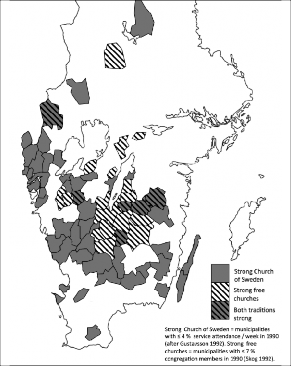
Map 4.
The Swedish Bible belt
Culture and religion were important. Potentially, the strong religiosity in western Sweden confirmed Weber’s original theory, which focused on Lutheran idea of vocation and ethics of labour. However, to fully grasp the question of post-war Swedish rural industrialisation, we must start with the region’s most central social institution: family farming. In this regard, the writings on Third Italy and early modern proto-industrialisation offer useful theoretical tools.
In Industrialisierung bevor Industrialisierung Kriedte et al. (1981: 11 ff., 38 ff.,95) discusses the social preconditions of proto-industrialisation. In this analysis, proto-industrialization was built on a relatively strong peasantry, free from feudal oppression and with secure access to land. But at the same time, land should not be too abundant. Typically, proto-industrialisation occurred in regions with poor conditions for arable farming, where the population had no choice but to turn to domestic industry in order to gain access to markets. Similar preconditions were present in regions of partitioned inheritance – where farms, generation after generation, were divided into smaller and smaller plots of land. These theories have later been criticized (Ogilvie 1996), but at least in the Swedish case they do capture the distribution of domestic industries very well. Here, most districts were located in the freeholder-dominated parts of the country, especially in forest and heathland regions where arable farming was of limited importance (Map 5).
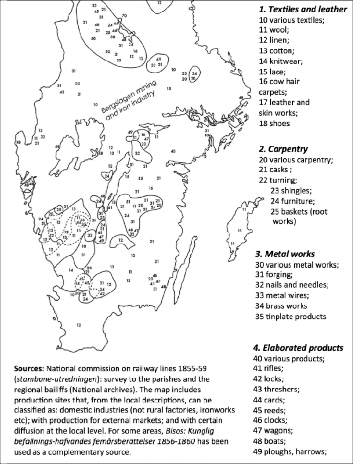
Map 5.
Domestic industries in central and southern Sweden 1855
The literature on Third Italy offers a similar idea. One crucial question after the “discovery” of the industrial districts in the 1970s was why this phenomenon was so widespread in the Northeast but almost absent in the south of Italy. According to Massimi Paci (1987) –and, in his footsteps Beccattini (2001: 23, 46) and Bull and Corner (1993)– agrarian social structure provided the answer. While peasants in the South were poor, unskilled, and hounded, the Northeast hosted a strong class of family farmers. The dominant form of tenure was sharecropping, often based on secure, long-term agreements.
Scholars identified the strong family economy as a social starting point of “Third Italy”. According to Paul Ginsburg (1990), a defining moment came after WWII, when the sharecropping system began to disintegrate. Many tenants were now able to buy their farms. But once the dream of owning a piece of land came true, these owners discovered that these plots were too small to live on. Many within the younger generation left agriculture, in search of a better future in the cities. But often these young men kept a hand in at the family farm. Later, some of them started their own businesses. With their farming backgrounds, they knew how to organise a family enterprise. Or, as Ginsburg (1990: 235) put it:
If the older generation could be left to look after the land, wives, brothers and cousins could be brought in to work in the new businesses. … Work and family were thus tied closely together, in a climate of economic dynamism, self-sacrifice and rapid social mobility.
In an article, the Danish historian Hull Kristansen (1992) comes to similar conclusions about the industrial expansion on the rural Jutland peninsula in Denmark after 1930. In his view, the foundation for this development was the 18th century agrarian reforms, which ended feudalism and made most Danish peasants into freeholders. A new social structure based on independent family enterprises was created. When the agrarian livelihood started to disintegrate during the 20th century, small-scale industries soon started to emerge as local population developed new types of family ventures. “Their yeoman heritage as independent, self-employed farmers or craftsman was a strong impetus towards their creation of new businesses, outside agriculture”, Hull Kristensen (1992: 135) concludes.
Compared to in Italy and Denmark, peasants in western Sweden were in an even better position. As shown by researchers, the strong Swedish freeholders were also of strategic importance in the development of rural industries in the 18-19th centuries protoindustrial phase of development. While in most of Europe, domestic industries were controlled by merchants from the cities, in Swedish districts such as Mark, Markaryd and Mora, local businessmen among the freeholders commonly organised the production5. In several areas, most notably in the cotton-weaving district of Mark, the freeholder putters out also lead the transition to factory production (Ahlberger 1988; Palmqvist 1988; see also Isacson and Magnusson 1987; and Magnusson 1996). What has not been discussed in the research, however, is the potential role of the strong Swedish family farmers in relation to 20th century rural industrialisation.
The following section examines industrialisation in three localities: The plains around Kvänum in Västergötland, home of cluster within mechanical engineering; the island of Orust in Bohuslän, where an old boatbuilding tradition developed into an industrial production of fibre-glass sailing yachts; and the Ljungby-Markaryd region in south-western Småland, specializing in heavy elevator trucks.
All three areas are located within the freeholder belt of western Sweden. Kvänum has a pronounced agricultural character with fertile soils and comparably large farmsteads, which typically specialize in grain. In the other two communities, farms have been smaller. Important in Orust was proximity to the sea, while in Ljungby, the location in the forests was critical. Orust and Kvänum are distinctly rural. The minor urban concentrations that exist today emerged during the 20th century, partly as a consequence of industrialisation. In contrast, Ljungby gained the legal status of a town in 1936. However, the industry discussed in this study emerged on the surrounding countryside.
Common for the three localities is the late start date of industrial production and its continued growth until the early 21st century. By 2007, the three studied clusters of production employed approximately 1,950 (in mechanical engineering in Kvänum), 900 (in boat building in Orust and its surrounding areas) and 1,050 (in the production of elevator trucks in Ljungy-Markaryd) workers (Annual company reports from www.allabolag.se; Roubert 2009: 100, 112). Today’s numbers are lower. The three districts have suffered heavy reductions in employment since the financial crisis of 20086. Considering these late developments, the extent to which industrialisation has been a long-time solution to the problems of rural society could be debated. The issue of rural de-industrialization, however, falls outside the scope of this investigation.
A few words should be said about the empirical base of the study. Industrialisation in Orust and Kvänum has been studied within the project “Det tredje Sverige”, founded by the Swedish Research Council. A number of sources were employed. The forms used to collect industrial statistics offer data on production, employment and wages. Marketing material archived at the National Library provide an image of the firms’ production. Registers on taxation, real estate and mortgages make it possible to trace the economic trajectories of individual entrepreneurs. Articles in newspapers and local historical literature provide contextual material. Finally, interviews were employed. In total, 93 individuals in the two communities were interviewed, mostly current or former industrial entrepreneurs. The part of the study involving data from Ljungby is based on previous historical analyses, mainly Carl Johan Rouberts’ (2009) doctoral dissertation on the truck elevator cluster.
The following sections analyse markets, entrepreneurship, wages, skills, social capital and cluster dynamics. As we will see, local preconditions were of vital importance for kicking off the industrialisation process.
In the agricultural district of Kvänum, arable farming was the starting point for manufacturing. The first industrial entrepreneurs were village blacksmiths who, during the 1930s, started to expand beyond the local agrarian markets with the production of straw fans and farm mills. During the period of intensified farm mechanisation after WWII, employment and the number of firms rose fast. The new entrepreneurs included former employees at the founding firms, as well as the owners of other rural workshops, typically involved in welding and tractor repairs. By the early 1960s, Kvänum had evolved into an import cluster of production for harvest-handling machinery such as grain dryers, straw choppers and screw conveyors.
Ljungby followed a similar track of development, but with forestry instead of agriculture as a point of departure. After WWII, the many saw mills in the region started to rationalize their businesses. The use of elevator trucks was one way to cut labour costs. The available American models were, however, expensive and poorly suited to local preconditions. Soon, a local production emerged in sawmills and minor workshops. Typically, worn-out truck chasses were used as building platforms.
The third area of the study, Orust, is at once both the oldest and the most recent of the three industrial milieus. According to local tradition, boatbuilding on theisland goes back to the Vikings. In the early 20th century, it was a common domesticindustry on the northern shores of the island. Most boats were built for small-scale coastal fishing. After WWII, production grew as local firms came to specialise in the rapidly expanding markets for leisure boats. It was, however, not until the final adoption of fibre-glass in the 1960s that production of an industrial scale was enabled.
A common feature of the three areas thus is how the first step in industrialisation was closely linked to needs within the local rural economy. The predominance of arable farming, forestry and fishery in the vicinity can be seen as an important demand condition, enabling local firms to develop a comparative advantage, as the sophisticated home market pressured them to create better and more innovative products. Knowledge of these sectors was deeply embedded in the local communities.
An equally important step was, however, when firms moved beyond this local area of competence. Once the workshops in Kvänum learned to produce agricultural machinery for national markets, they could and did re-use this knowledge to manufacture other sorts of products. By 2007, production of agricultural machinery only counted for a minor share of the industrial workforce. The largest products were washing machines, air conditioners and modular building systems for oil-rigs. Similarly, in Ljungby the production of elevator trucks for forestry facilitated otherdevelopments. By the early 20th century, four local factories manufactured heavy forklift trucks, reach stackers, container handlers and terminal tractors. Consumers included ports, container terminals and heavy industry around the world. In contrast, Orust has not moved beyond boatbuilding. But as early as the 1940s, the manufacture of coastal fishing boats was being surpassed by the manufacture of boats for leisure. Later, firms targeted more sophisticated global markets.
The fact that industrial production emerged out of a local context also means that most entrepreneurs were of local origin. Only in the case of Orust can we identify external actors of strategic importance: Knowledge of polyester and fibreglass technology was introduced by outsiders, attracted to the district by its accumulation of boatbuilding skills. The previous section highlighted the small-scale rural workshops as point of departure for industrialisation. In all three studied communities there was, however, another important source of entrepreneurship as well: family farming.
The strongest connection can be established in the case of Kvänum. Among the ten largest locally-started firms existing in 2007 eight originally started by farmers and/or sons of farmers. Seven had their first shop at a family farm. Given the initial specialisation in farm machinery in the district, this experience was of direct relevance for several of these businesses. In Orust, we can see a similar pattern. In 1964 ten wooden boat workshops in the district had grown large enough to employ at least five workers. All but two were started by farmers or sons of farmers.
In Ljungby, the Andersson brothers are a good example of the entrepreneurial links between farming and industrial enterprises (Roubert 2009: 71-80). The three brothers were born on a small family holding a few miles outside of town. The father combined farming with a range of other activities, including well drilling and compressor repairs. In addition, the family had a small-scale sawmill. The brothers helped out at the farm from an early age. They were soon involved in the maintenance of its machinery. Their first self-run business was started in 1960. The oldest brother now worked for one of the elevator truck pioneers, Dyreboverken. During the same period, he and a second brother built up production of similar machines at the farm. Production later moved into Ljungby, grew into a considerable industry, and was sold to Kalmar, the largest district firm. However, a few years later, the youngest brother started a new elevator truck business, Swetruck (by 2007 the second largest local producer of these items). The older brothers also built up new firms, among them the wheel loader manufacturer Ljungby Maskin, similarly started at the farm.
Several factors behind this transition from “firms to farms” can be identified. To start, the new industrial entrepreneurship can be understood as a prolongation of the traditional family enterprise within agriculture. Growing up on a family farm has also meant growing up within a family business. Due to farm mechanisation and the expectations of rising living standards during the post-war period, it became increasingly difficult to maintain this traditional farmer’s life. Instead, many freeholders developed new businesses within other sectors: electrical installations, groundwork, and plumbing. In some cases (as with the Andersson brothers) industrial enterprises also emerged. The fact that modern farm work involves the handling of a growing range of machinery has probably been of vital importance in this context.
The family farm has in itself been a strategic resource during this transition from agricultural to industrial enterprise. Without access to free facilities at the parent’s small hold, it would have been far more difficult for the Andersson brothers to set up a business of their own. In addition, the farm represented capital. In Kvänum, where farms were large and soils fertile, there are several examples of industrial expansion financed by such “landed capital”. (Nyström 2016: 129-31). Similar forces were at work in Ljungby and Orust. “Yes that is evident,” states one of the men of the Orust district during the 1970-80s, “we mortgaged everything we had” (interview). In the case of Ljungby’s Andersson brothers, it was the surety of the father, the owner of the freehold, which provided the credit necessary to start the first business (Roubert 2009: 72).
Apart from markets and entrepreneurship, another necessary factor in the process of industrialisation is labour. Given the continuous flow of young men from agriculture, firms in Kvänum, Orust and Ljungby were in an advantageous position7. How much did this rural workforce cost? And what skills and qualification did employers get in return? To what extent was rural industrialisation driven by low wages, as has been suggested by an influential school of research?
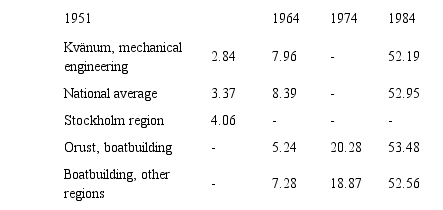
Table 1 presents the salaries paid in Kvänum and Orust compared to national averages (and, in one case, the Stockholm region) 1951-1984. Lamentably, no similar data from Ljungby are available.
Average wages in Kvänum (mechanical engineering) and Orust (boatbuilding) compared to national figures within the same sectors (Swedish crowns/hour)
Sources: Kvänum and boatbuilding: The forms from the firms used in the collection of industrial statistics, National archives, Stockholm: Kommerskollegium (1951); SCB (1964, 1974 and 1984). Mechanical engineering, natio- nal level and Stockholm: SOS: Lönestatistisk årsbok 1951; SOS: Industri 1964 and 1984.
Salaries in Kvänum and Orust were indeed low at the beginning of the studied period. But the most striking tendency in the table is the closing of the gap. In Kvänum, wages almost caught up to national levels by 1964. In Orust, the following decade was decisive.
Trade unions can be identified as a key factor in this process. In Kvänum, workers were already organised in the late 1930s at the larger firms. In Orust, the union breakthrough did not come until the transition from wood to fibreglass after 1964. It is possible that a growing competition between firms over labour contributed to the upward trend in salaries within the studied communities. But the levelling of wages must above all be attributed to the “solidarity wage policy”. The small wage differences in 1984, both between regions and sectors, illustrate its profound effect on the Swedish labour market.
Thus, low labour costs might have been an important driving force during the start-up phase of industrialisation. But in order to understand long-term industrial growth, a wider analysis must be employed.
For local firms, the levelling of wages must have had a major impact. If industries in Kvänum, Orust and Ljungby were supposed to pay the same price for labour as industries in Stockholm or Gothenburg, they would also have needed to reach similar levels of labour productivity. How could this have been achieved?
In terms of labour-saving technology, the rural enterprises were seldom in the fore. High productivity must have been reached by other means, for example through a strong labour ethic (potentially a product of Lutheran heritage) or a more skilled workforce. The level of formal education in these areas was low. Still, it could be argued that the workforce was in possession of tacit knowledge that proved important during industrialisation.
In Orust, the handicraft skills within boat building were a key factor behind the district’s success. Hulls of fibreglass could be manufactured anywhere in the country. But only in Orust could this production be combined with crafted wooden interiors, based on the boat builder s sense of curves. When the markets for mass-produced boats collapsed in the late 1970s, Orust firms such as Hallberg-Rassy, Najad and Malö continued their expansion, producing fewer bur far more expensive yachts for a lucrative premium market.
In Kvänum and Ljungby, rural mechanical workshops provided a corresponding handicraft base for industrialisation. Traditionally, the success of these shops was based in their ability to customise production with shifting local needs. After industrialisation, firms often maintained much of this craft-based flexibility. In addition, the experience of agricultural work was highly present in these districts. As Roubert (2009: 179) pointed out, the farmer s sons in the Ljungby region offered “many advantages for the employers” as they were “practically endowed and independent in mind and hand”.
These factors were probably of strategic importance as the studied communities made their path towards industrialisation. While industry under the “Swedish model” largely developed along the mass-production paradigm, where work was cut into pieces and subordinated to growing white-collar departments, work in these districts remained grounded in a craft-based mode of production. This is how a former overseer describes production at Plåt-Mekano (today’s Swegon) in Kvänum during the 1950s:
It was more like if everybody learned everything and could jump in all over in production. The workforce was highly flexible and that was one of the foundations of the firm. There was no one with a pen around, the boss lacked all education. Innovations and improvement often came from below (interview).
Interestingly, the description comes quite close to what Michael Piore and Charles Sabel (1984) labelled “flexible specialisation”, a key concept in the 1980-1990s debate about historical alternatives to mass production.
If cheap labour has been one influential explanation for the growth of rural industries, the existence of social networks has been another. To Becattini, social capital and cooperation were integral to the concept of the industrial district. As discussed earlier, similar ideas are highly visible in the literature on Swedish Gnosjö. Here, the free churches were identified as nodes of the local business networks.
Orust, Ljungby and Kvänum are located outside the belt of free congregations. Instead, the Church of Sweden has been strong (see map 4). In my interviews, one recurrent question was about the impact of the religious tradition on the local business culture. To most of the informants, the existence of such a connection seemed like a far-fetched idea. It is, nevertheless, clear that the social climate in the investigated areas differed from that of Gnosjö. There was less cooperation, weaker networks and a higher degree of distrust between firms.
Apart from religious tradition, the absence of networking culture could also be understood as a consequence of the local state of competition. In 1978, a regional report made the following analysis of the Bohuslän boatbuilding industry:
Even if some forms of cooperation, such as common purchases, existed previously, not so any longer – this investigation unfortunately shows that there is a high degree of distrust towards such activities. One reason is probably that several yards produce almost identical boats and also direct their marketing towards the same categories of clients. On the basis of competition many fear to possibly favour other yards at their own expense (Fritidsbåtsindustrin i Göteborgs och Bohus län, p. 40).
A similar assessment could be made with regards to producers of straw choppers in Kvänum, or to manufacturers of elevator trucks in Ljungby. In all these places, we find examples of disloyal competition: employees or sub-contractors starting competing production, local firms copying designs or innovations from their neighbours. In Orust, such incidents built up what one informant described as “a Berlin Wall” between two of the leading firms (interview with a local sub-contractor producing fibreglass hulls). But, in spite of this harsher corporate culture, the local sailing yacht industry has still been very successful.
At this point in the analysis, we must make a distinction. Orust, Kvänum and Ljungby might have lacked the network culture attributed to Gnosjö and “Third Italy”. But this did not hinder the development of a cluster-based industrial dynamic with external benefits. These included access to a labour force with the right qualifications; subcontractors offering specialized services; and a rapid spread of knowledge and information within the districts. “It is thanks to the hard competition on this island that we have managed to succeed”, explained Bo Olsson at Malö Yachts in an interview. He continued: “If we had been alone we would never been able to keep abreast with the international development. We would have been forced to close down long ago” (Dagens Nyheter July 27, 1997).
For the district as a whole, the clustering of firms was a source of flexibility and resilience. A solitary firm manufacturing fibreglass yachts, straw choppers or forklift trucks could only opt for one solution to important technological or market-related problems. However, within the multitude of firms in an industrial district, a multitude of solutions could be tested. The best one could then spread as firms copied and further developed the ideas of their neighbours. Similarly, in the event of crisis, the closure of a solitary firm was the end of local industry. However within an industrial district the closure of one firm could facilitate the reallocation of district resources (labour, know-how, production facilities, customers) to more successful neighbours.
In Orust, the leisure boat crisis between 1975-1985 illustrates this tendency. Several local firms went out of business, among them Vindövarvet (the largest producer) and IW-varvet (the third largest producer). This enabled other yards that had managed to better situate themselves in the market to grow. By the late 1980s, Hallberg-Rassy, Najad and Malö, originally small-scale businesses located next to one another in the small bay of Kungviken, were the new leaders of the district. Behind their success was a new district concept marrying fibreglass and wood to produce exclusive family yachts. Competition between the three businesses was razor-sharp. Questions of who copied whom in the development of the new concept remain delicate. The reasonable conclusion is that it was a common achievement, driven by rivalry between the firms.
Becattini and the Swedish school of “Gnosjö-studies” identified a culture of intended cooperation between firms as a pathway to successful regional development. The discussion above highlights how external benefits could be an unintended consequence of the clustering of firms.
How could rural communities prosper in an industrial society where the agricultural population is reduced to just a few percent? This study uses evidence from western Sweden to discuss rural industrialisation as a possible historical path of development. One starting point for the investigation is the fact that many rural localities in the country actually managed the transition from agrarian to industrial society quite well. Over the period from 1945-2000, there was a gradual process of re- allocation of industrial employment in Sweden from the urban centres to the rural and semirural periphery. What were the prerequisites for and driving forces behind this development?
Three local communities have been investigated: Kvänum on the agricultural plains of Västergötland, Ljungby in the Småland forest region and Orust on the Bohuslän coast. The main point of the article is that there was a connection between the social setting of rural society on the one hand, and rural industrialization on the other. In the studied communities, rural industrialization did not depend primarily on lower rural wages and exogenous investments, but on the endogenous dynamics of a small-farmer society. The growth of manufacturing was essentially a process “from below” based on knowledge, labour, entrepreneurship, and the capital from minor92family enterprises within farming and handicraft. The three communities exemplify the potential industrial force of agrarian society in an almost archetypical way. But how representative are they for European and Swedish rurality?
One factor connecting results with the Swedish macro level is social structure. A striking pattern is how Swedish post-war rural industrialisation mainly occurred in areas with strong family farmers. The case studies have identified plausible casual links between the social setting in the “freeholder belt” and subsequent industrial developments. The disintegration of the agrarian livelihood was the main driving force behind industrialisation. This unravelling incentivised farmers’ and farmers’ son’s development of other sources of livelihood, freeing resources previously bound to agriculture to be used in the expansion of manufacturing.
But none of these developments occurred automatically. Within the freeholder belt of western Sweden, we can also find examples of exogenous industrialisation, based on the introduction of external know-how and entrepreneurship. Another common pattern is the growth of solitary firms, without the supporting structure of the cluster. There were also many places where no industrialisation occurred. What made preconditions in the studied communities so advantageous for industrialisation was a core of place-bound knowledge coupled with a strong local demand: in Kvänum from arable farming, in Ljungby from forestry, in Orust from coastal fishing. At the same time, other regions might have had conditions that stimulated industrial growth in other spheres of production.8
As pointed out by Erik Dahmén (1950: 342 ff) large parts of Småland and Västergötland experienced the rapid expansion of small-scale industrial enterprises over the inter-war period. This development reasonably can have laid the foundation for the massive increase in manufacturing employment over the following decades. The growing rural industries included, for example, metal manufacturing (as in Gnosjö), furniture (Tibro and parts of Småland), tricot (Gällstad in Sjuhärad) and ready-made houses (the Sävsjö-Vetlanda-Eksjö tringle). Several of these districts were grounded in proto-industrial traditions. The emergence of new firms often seems to have followed a pattern similar to that of Kvänum, Ljungby and Orust. “Often the new firms grow up at the farm of the founders’ parents”, Olle Gummesson (1997: 66) points out in his book on Gnosjö, “they started in an outbuilding or in a free space in the barn”.
In the European context, the connection between family farming and industrialisation constituted an important thread in the 1970s debate on early modern protoindustrialization. According to Kriedte et al., a strong peasantry under economic pressure to find new sources of family income was the ultimate growing ground for the rural industry. The present study points at the potential validity of this theory even in later periods, when agrarian life all over Europe began to dissolve.
In general, Western European peasants strengthened their position during the early modern period. The 19th century was in many aspects the golden age of the family farm. Why then did this rural social structure not lead to more rural industrialization in other areas of Europe? Perhaps cases such as Kvänum, Ljungby and Orust can serve as counter-examples that might help answer this intriguing question. But attention must also be drawn to regions that have followed a similar path of development. Jutland in Denmark, the Swiss alps, the Black Forest in Germany and the zones of minifundios in the Spanish Levante are some possible examples (see respectively Hull Kristensen 1992; Collantes 2009; Herrigel 1996; Benton 1992; and Boix and Galletto 2006).
The most powerful parallel is, however, Third Italy. Here, industrialisation was also a process from below, based on the entrepreneurship, labour, and cultural values derived from local handicraft and farming. Here, these resources also gave rise to regional clusters of small- and medium-sized farms. Here, there was also a prehistory of proto- industrial production, resulting in a post-war blend of “old” and “new” districts. Interestingly, researchers in the two countries have followed similar trajectories, identifying cheap labour, social networks and rurally-based entrepreneurship as the main explanations to industrial growth. Given the many similarities, the regions of locally grounded industrialisation within the Swedish freeholder belt might be labelled a “Third Sweden”.
Two historical preconditions differentiate the Swedish case from the Italian: a stronger peasantry and a stronger state. While the sharecroppers of Tuscany and Emilia-Romagna were subordinated tenants until after WWII, most peasants in Västergötland and Småland were already full-fledged freeholders in the 18th or early 19th century. And while Italy was united only in 1871, Sweden has been governed as a single unit since the Middle Ages.
The strong Swedish peasantry facilitated agrarian involvement in industrialisation beyond what has been identified in Italy. This involvement is also an important reason for the distinct rural character of many manufacturing regions. In Third Italy, most industries were concentrated in the cities, often founded during the region’s94Renaissance-era blossoming. In “Third Sweden”, industries often emerged in areas that until recently were pure countryside.
The role of the strong state is more complex. Central administration in Sweden was established in the 17th century as a joint venture between the Crown and the nobility. The impetus for this alliance was extracting resources from the rural population, in terms of taxes and soldiers, to wage war in Europe. It was not until after the breakdown in Sweden’s imperial ambitions in the Great Nordic War (1700-1721) that the state saw fit to defend the property rights of peasants at earnest (Winberg 1990; Gadd 2011). At the same time, however, the state also sought to protect other groups within society and maintain an order based on the estate of the realms. Throughout the early modern period, the juridical division between town and country was upheld, providing urban burgers with a monopoly on industry and commerce. Thus, in spite of many peasant-friendly reforms during the 18 and 19th centuries, there was still a basic assumption that peasants should remain peasants. It was not until Sweden’s liberal breakthrough in the 1840-60s that legal restrictions on rural trades and industries were finally lifted (Schön 2010: 43-6).
During the post-war period, a similar urban-rural divide was resurrected through the social contract of the “Swedish model”. As pointed out, this model was based on a culture of negotiation and compromise between the Social Democratic government, the trade unions, and the major Swedish export industries. Each of these parties was driven by the desire to hasten the country’s economic modernisation, in order to create more resources to apportion. Farmers, represented by the Farmer’s Party (Bondeförbundet), the National Federation of Farmer’s (Lantbrukarnas riksförbund), and the Farmer’s Product Cooperatives (Bondekooperationen) were also present at the negotiation table. They were granted price subsidies, protective customs, and favourable credits for farm mechanisation. In exchange, they offered political support for the government’s welfare reforms and policy of “structural reformation” of agriculture. However, as in the early modern period, rural interests outside of the agricultural sector were not included in the social contract.
The programme of “structural rationalisation” was based on the underlying assumption that farmers should remain farmers – or leave agriculture and become full- time wage earners. If a farmer wanted to receive subsidies for farm mechanisation or authorisation from the Local Committee of Agriculture (Lantbruksnämnden) to buy land, it was not a good idea to use the property for small-scale business or combine farming with a part-time job at the local sawmill. The emergence of a zone of interactivity between industry and agriculture at the household level, so strategic in Kvänum’s, Ljungy’s and Orust’s paths to industrialisation, was not encouraged. At the95same time, a series of reforms shifted control over local juridical and administrative matters from the countryside to urban centres. Municipal planning was often designed to serve population concentrations, supplying services to and supporting industries in the new municipality centres (Locke 2015; Wångmar 2013, Åberg and Ahlberger 2015; Nyström 2016: 134-5).
The wage solidarity policy established as part of the Swedish model must have further hampered rural industrialisation. As previously discussed, this policy dictated equal pay for equal work, regardless of locale or branch of industry. The ambition was to speed up the modernisation of manufacturing and to encourage the growth of productivity. Several studies have shown how regional wage differences were gradually erased as a consequence of this policy (Olsson 1979; Holmlund and Dahlberg 1978; Enflo and Rosés 2015; Lundmark and Malmberg 1988: 161). Scholars have focused less on how regional industrial dynamics were affected by the levelling of salaries9.
The consequences for small-scale rural industries in the industrial periphery must have been profound. The new wage setting policy foreclosed the possibility of employing a low-cost strategy of competition to enter markets. A hypothetical present-day comparison would be a situation in which emerging industries in Asia or Africa were forced to offer European salaries to their workers. In areas such as Gnosjö and Kvänum, the implementation of the “wage solidary policy” over the 1950s and 1960s impelled firms to rapidly reach productivity on a level with urban industries. However, it is reasonable to expect that other emerging nuclei of small-scale rural production failed to meet the new requirements. In districts specializing in labour- intensive production, the standardization of wages soon became a driving force in deindustrialisation. Textile industry, once so prominent in the Sjuhärad district, disintegrated over the 1960s-1980s. The furniture industry in Tibro and Småland later experienced a similar dynamic. Instead, mechanical engineering became the key area of specialisation in most regions. This process contrasts with developments in Third Italy, where confection, shoe, and furniture industries long remained important sources of industrial expansion.
The wage solidarity policy must also have affected the forces of industrial decentralisation, so important in the Italian path of development. Given wage uniformity, the incentives for large industries in Stockholm or Gothenburg to subcontract production to small firms in the rural periphery were limited. Such an outsourcing strategy could still be attractive to companies as a solution to the growing scarcity of manpower in cities. But then the disadvantages of decentralisation in terms of loss of control must be considered. In the end, massive investments in labour-saving technology might have been the best option available.
Similarly, the elimination of wage differences must have hampered the emergence of new, small start-ups. An industrial employee in Kvänum, Orust or Ljungby was indeed attractively paid, especially given the low costs of living in the countryside. In such a situation, the idea of embarking down the difficult and uncertain road of entrepreneurship must have been less of a temptation. Thus, while “Third Italy’s” unregulated labour market situation gave rise to decentralised subcontracting networksbased on the continuous emergence of new, small-scale entrepreneurs, sweatshops and labour-cost-driven competition – the Swedish model stimulated industrial concentration, mechanisation, rationalisation, and productivity-driven competition.
Still, if this model of interpretation were taken to its logical conclusion, no rural industrialisation “from below” would have occurred. Other factors must be considered. One possible hypothesis is that the flexible character of many small-scale rural industries – due to the dominant paradigm of a mass-production and planning “from above”– actually offered a comparable advantage, and that this flexibility has been a strategic resource in Sweden’s industrial infrastructure. Several of the factors highlighted by the school of “flexible specialisation” have been identified in this study: a thriving local entrepreneurship, a craft-based industrial competence and cluster dynamics within industrial districts.
In the end, the very fact that industries in areas such as Kvänum, Ljungby, Orust and Gnosjö continued to grow, despite the elimination of labour cost advantages, illustrates the strength of the underlying forces of rural industrialisation. Here, the inherent social dynamic of rural society, derived from the strong Swedish peasantry, triumphed over the central institutional model, derived from the strong Swedish state.
This paper is the result of the research project ”Det tredje Sverige” (The Third Sweden) conducted with the support of The Swedish Research Council (VR). The author is grateful to Rachel Pierce for language editing and to the two anonymous reviewers for constructive comments.
Map 1.
Losses (blue) and gains (red) in industrial employment, 1945-2000: absolute numbers within a 25-kilometer radius
From farms to firms: rural industrialisation under the “Swedish model” of organised capitalism
Sources: Folkräkningen 1945; RAMS 2000.Figure 1.
Number of jobs within manufacturing industry in selected areas 1945–2016 (1945= 1)
Sources: SOS: Folk-/Folk- och bostadsräkningar 1945-90; RAMS 2000-2016 (www.scb.se). Manufacturing excluding construction. Gnosjö region: Gnosjö, Gislaved, Vaggeryd and Värnamo municipalities. Mid-Västergötland: Vårgårda, Vara, Grästorp, Essunga och Herrljunga municipalities; Orust muni- cipality; Ljungby and Markaryd: municipalities (all areas within the 2000 administrative borders).
Map 2.
Employment development within mechanical engineering and metalwork industries 1945-2000
From farms to firms: rural industrialisation under the “Swedish model” of organised capitalism
Sources: Folkräkningen 1945; RAMS 2000.Map 3.
Number of family farmers as a percentage of the total workforce 1945
Data: Number of farms of 1–50 hectars (SOS: Jordbruksräkningen 1944) / total workforce (SOS: Folkräkningen 1945)
Map 4.
The Swedish Bible belt
Map 5.
Domestic industries in central and southern Sweden 1855
Average wages in Kvänum (mechanical engineering) and Orust (boatbuilding) compared to national figures within the same sectors (Swedish crowns/hour)
Sources: Kvänum and boatbuilding: The forms from the firms used in the collection of industrial statistics, National archives, Stockholm: Kommerskollegium (1951); SCB (1964, 1974 and 1984). Mechanical engineering, natio- nal level and Stockholm: SOS: Lönestatistisk årsbok 1951; SOS: Industri 1964 and 1984.
