THEME SECTION: Inclusive educational practices in higher education: current dilemmas
Non-teaching staff’s perceptions of accessibility and inclusion in Portuguese higher education institutions 1,2
Perceções de pessoal técnico-administrativo de instituições de ensino superior portuguesas sobre acessibilidade e inclusão
 Eugenia Esperanza Núñez Nogueroles eugenia@unex.es
Sofia Freire
Eugenia Esperanza Núñez Nogueroles eugenia@unex.es
Sofia Freire
Non-teaching staff’s perceptions of accessibility and inclusion in Portuguese higher education institutions 1,2
Educação e Pesquisa, vol. 51, e282784, 2025
Faculdade de Educação da Universidade de São Paulo
Received: 29 January 2024
Revised document received: 24 February 2025
Accepted: 08 April 2025
Funding
Funding source: Unidade de Investigação e Desenvolvimento em Educação e Formação
Contract number: UIDB/04107/2020
Funding statement: Work funded by Fundação para a Ciência e a Tecnologia (FCT), IP, within the scope of the Unidade de Investigação e Desenvolvimento em Educação e Formação (UIDEF) (UIDB/04107/2020, https://doi.org/10.54499/UIDB/04107/2020). Contact: asraposo@ie.ulisboa.pt
Abstract: This study focuses on non-teaching staff’s perceptions of accessibility and inclusion in higher education in Portugal. The aim was to explore non-teaching staff’s positioning and knowledge regarding inclusion and students with disabilities as well as their willingness to acquire new knowledge for addressing the specific needs of students with disabilities, and also to explore non-teaching staff’s perception of their institution regarding shared values and attitudes concerning inclusion and disability, actions developed for promoting students’ participation, and accessibilities. 229 non-teaching staff, who were working in different services from several Portuguese universities participated in the study; they were mainly female (80%), in average they were 46.7 years old (SD = 9.88) and had been working in the institution in average for 14.9 years (SD = 11.12). An online questionnaire was purposely constructed for the study. Results show that participants have a positive positioning regarding inclusion, and have as well positive perceptions considering the values and attitudes shared by other members of their institution. Nevertheless, they report low knowledge in terms of some practices that would facilitate communication with students with disabilities and about international agreements on this area; however, they are also willing to participate in training concerning these topics. They tend to perceive their institutions as accessible in different domains, and have identified a number of actions developed by the institution for addressing inclusion and creating equal opportunities for success for all its students.
Keywords: Non-teaching staff, Higher education, Inclusion, Accessibility, Disability.
Resumo: O tema deste artigo são as perceções do pessoal técnico-administrativo sobre questões de acessibilidades e inclusão no ensino superior em Portugal. Em particular, o objetivo do estudo foi explorar o posicionamento e o conhecimento do pessoal técnico-administrativo sobre inclusão de estudantes com deficiência no ensino superior, bem como a sua vontade de adquirir novos conhecimentos para responder às necessidades específicas destes estudantes, e ainda explorar a sua perceção sobre valores e atitudes partilhados por diferentes membros na sua instituição, ações desenvolvidas para promover a participação dos estudantes com deficiência e acessibilidades nas instituições de ensino superior. O estudo envolveu 229 participantes, que trabalhavam em diferentes serviços de várias universidades portuguesas; eram predominantemente do sexo feminino (80%), tinham, em média, 46,7 anos (DP = 9,88) e encontravam-se a trabalhar na instituição, em média, há 14,9 anos (DP = 11,12). Um questionário online foi construído intencionalmente para o estudo. Os participantes revelaram um posicionamento positivo em relação à inclusão, e uma perceção globalmente positiva sobre os valores e atitudes partilhados por outros membros da sua instituição. No entanto, também demostraram um baixo conhecimento sobre algumas práticas que facilitariam a comunicação com estudantes com deficiência e sobre acordos internacionais nessa área. Apesar disso, revelaram-se dispostos a participar em formações sobre esses tópicos. Globalmente, também revelaram uma perceção positiva das suas instituições, tendo em conta questões de acessibilidade e identificaram uma série de ações desenvolvidas pela instituição para abordar a inclusão e criar oportunidades iguais de sucesso para todos os seus estudantes.
Palavras chave: Pessoal técnico-administrativo, Ensino superior, Inclusão, Acessibilidade, Deficiência.
Introduction
Access to higher education for groups that traditionally would not reach this educational level is resulting in diversity becoming a growing phenomenon. One of these groups is constituted by students with disabilities. Indeed, Claeys-Kulik et al. (2019) report that, out of the 159 higher education institutions from 36 European systems that took part in the INVITED survey, 92% of the respondents addressed students with disabilities as a dimension of diversity. At a national level, according to the Portuguese Disability and Human Rights Observatory (Pinto et al., 2023), in 2022/2023 there was a 35% increase in the number of students with disabilities in higher education (3753 students compared to the 2779 students on the previous academic year).
Despite being a growing population, studies in many countries have been highlighting difficulties that students with disabilities face in participating and concluding their studies (e.g., Claeys-Kulik et al., 2019; Kimball et al., 2017; Pinto et al., 2023; Solis-Grant, 2024; Viñas Sánchez et al., 2023; Ziliotto, 2020). And indeed, students with disabilities still encounter many barriers in higher education, which restricts their possibility to participate in learning and social experiences, or to develop a sense of belonging and of personal self-worth. According to Booth & Ainscow (2002, 2016), these barriers are located within different, but interconnected, dimensions of the institutions; barriers might emerge from the values, attitudes and beliefs shared by the community (culture), from the principles exposed by the institution and actions carried out in order to implement those principles (politics) and from the practices adopted by each element of the community.
Thus, access to and widening of the participation of students with disabilities require institutional commitment, policies involving teachers, students and technical-administrative staff, and coordinated actions at various levels of the system (Márquez et al., 2021; Polo Sánchez et al., 2018; Solís-Grant et al., 2023), as well as a sense of shared responsibility in the development of these actions (Solís-Grant et al., 2023). As Solís-Grant et al. (2023, p. 10) state, “this responsibility can show through inclusive language, respectful and collaborative treatment, willingness to help those who need it, recognition of minority groups, and acceptance of diversity.” This calls for “campus-wide” or “whole-of-institution” approaches, that defend the need of addressing every level – services, products, environments, facilities, administrative as well as learning and social interactions, physical and digital accessibility, assessment methods, teaching resources, materials design, extracurricular activities, among others – in order to promote participation, learning and educational success of all its students (Hockings, 2010; Lawrie et al., 2017; Zorec et al., 2022).
Therefore, knowing how higher education institutions are organising themselves to respond to the growing diversity of students (and, in particular, students with disabilities) turns out to be essential. A positive positioning on the part of all members of the academic community will be a first step in ensuring that inclusion is successful; in fact, positive beliefs and attitudes towards diversity facilitate participation in the educational context and success (López-Gavira et al., 2019; Navarro-Mateu et al., 2020; Orozco; Moriña, 2020). Furthermore, training (notably, of faculty members) has also been pointed out as a key dimension for being increasingly sensible and supportive of the specific needs of students with disabilities, and for being open to make adjustment to own practices (e.g., Carballo et al., 2019; Murray et al., 2014).
Accessibility is another key dimension. It “refers to the inclusive practice of removing barriers to ensure equal access for persons with disabilities to, among others, built environments, goods and services, as well as facilities” (Broderick, 2020). The Preamble to the Convention on the Rights of Persons with Disabilities (United Nations, 2006) recognises “the importance of accessibility to the physical, social, economic and cultural environment, to health and education and to information and communication, in enabling persons with disabilities to fully enjoy all human rights and fundamental freedoms.” The European Commission, in its Strategy for the Rights of Persons with Disabilities 2021-2030, underlines the relevance of the “Universal Design approach for better accessibility and [the] provision of reasonable accommodation for persons with disabilities into all actions” (European Commission, 2021). In line with the aforementioned Strategy, developing institutional policies that address accessibility is a key issue. Accordingly, in the Estratégia Nacional para a Inclusão das Pessoas com Deficiência 2021–2025 (National Strategy for the Inclusion of People with Disabilities 2021-2025), the Portuguese government highlights the central role of accessibility as a precondition for participation in society and the economy, underlining the need to optimise the accessibility of built spaces, transport and information and communication technologies, and encourages accessibility and universal design in academic curricula as well.
In this study, we explored these dimensions from the point of view of the non-teaching staff. From among the actors who are part of the higher education community, teachers as well as students with disabilities have been the focus of a great number of pieces of research (Morgado Camacho et al., 2017; Sniatecki et al., 2015); however, not enough attention has been paid to non-teaching staff’s perspective (Polo Sánchez et al., 2018). Those studies which have dealt with the latter concentrate mainly on the perceptions of disability support service employees (Lopez-Gavira et al., 2019; Moliner García et al., 2019; Moriña; Morgado, 2018; Fossey et al., 2017) and university library staff (Martins et al., 2018; Pinto Neto, 2014; Howe, 2011). Polo Sánchez et al. (2018), though, covered a wider variety of non-teaching staff. Results showed that the administrative and service staff have a positive stance towards people with disabilities, and that having contact with people with disabilities influences employees’ attitudes towards students with disabilities in a positive way. Those studies which have Portugal as their geographical focus show that the accessibility of infrastructure still entails a barrier to inclusion (Martins et al., 2018) and that there is a need for cooperation/dialogue between the libraries and other services in the institution, in particular the IT department and the students’ support office (Pinto Neto, 2014) in order to improve access to information for students with (sensory) disabilities.
Therefore, since non-teaching staff form an integral part of the educational community and are frequently the first contact that people with disabilities have with the institution, this study aims to explore non-teaching staff’s positioning and knowledge regarding inclusion in higher education as well as their willingness to acquire new knowledge for addressing the specific needs of students with disabilities, and also to explore non-teaching staff’s perception of their institution regarding shared values and attitudes concerning inclusion and disability, actions developed for promoting students’ participation, and accessibilities.
Barriers to participation and success
Students with disabilities still face numerous barriers during their time in higher education. There are several types of accessibilities that should be addressed in order to move forward to achieve the inclusion of all in the context of higher education. Among them, the lack of teacher training concerning inclusive methodologies, difficulties of access to material resources, lack of funding for support programmes, inaccessible technologies, regulations that are not applied, lack of information, and architectural or infrastructural barriers can be stressed (Fernández-Batanero et al., 2022). Zorec et al. (2022) developed a study with 18 students with disabilities and 28 representatives of wider stakeholders (disability services, teaching support, assistive technology, library, government bodies, non-profit organizations, charities, etc.), with the goal of exploring physical and digital aspects of the campus, having identified barriers that limit students’ access to indoor and outdoor facilities, as well as to communication and information. Regarding the latter, digital surroundings were also taken into consideration, underlining the importance of checking whether the institutional website, the educational platform and other software are accessible to all. Furthermore, after examining the mobility difficulties experienced by people with locomotor disabilities on a day-to-day basis, Polo Sánchez and López Justicia (2005) consider the following barriers existing in the physical environment: urban architectural barriers (i.e., those found on public roads and spaces, pavements, crossings at different levels, obstacles on streets, parks and gardens that are not accessible); architectural barriers in buildings (i.e., those found inside buildings, steps, stairs, corridors, small lifts), and barriers to transport (i.e., those found in the different means of transport, inaccessibility to public transport, difficulties in parking private vehicles).
In addition to physical accessibility, the United Nations (2014, p. 1) also mentions the access to “information and communication, including information and communications technologies and systems, and to other facilities and services open or provided to the public.” In the context of higher education, access to information turns out to be a sine qua non condition for acquiring knowledge; thus, ensuring this kind of accessibility is indispensable for students to be able to learn.
In Spain, the Fundación Universia has been carrying out every two years since 2011 a study on the degree of inclusion of the Spanish university system with respect to the reality of students with disabilities (Viñas Sánchez et al., 2023). Considering the academic year 2021-2022 (n= 57 universities), 45.6% of the surveyed institutions reported having implemented universal accessibility and design for all plans and 87.7% stated that they take accessibility criteria into consideration when it comes to the construction of new facilities, their acquisition or rental. Regarding digital accessibilities in particular, 52.6% of the universities have accessibility certification for their websites, according to the criteria established by the Web Accessibility Initiative (WAI); the lowest score refers to specific accessible leisure and adapted sport programmes for students with disabilities, since they only exist in 26,3% of the 57 surveyed universities.
In Portugal, a series of barriers have been identified. By means of a case study which was developed at the Universidade do Algarve using semi-structured interviews, Borges et al. (2017) collected teaching and non-teaching staff’s testimonies which reveal that there are still numerous physical and architectural barriers that restrict mobility and access. When taking a look back at the first ten years of the Portuguese Grupo de Trabalho para o Apoio a Estudantes com Deficiências no Ensino Superior (GTAEDES), Aguardenteiro Pires et al. (2015) carry out a brief review of what has been published on students’ perceptions of conditions for access to and attendance at Portuguese higher education and highlight the stereotypical and discriminatory attitudes shown by the academic community, difficulties in obtaining adapted documentation and information in a timely manner, lack of specific teacher training, difficulties in access and mobility on and off campus and lack of well-organised specialised services. Notably, more recent data from the Portuguese directorate of higher education (Pinto et al., 2023) shows that most higher education institutions have specific legislation for addressing the needs of students with disabilities (75.8% of the responding institutions); it addition, it reports an increment in the number of institutions that have available services that provide support to students with disabilities (67.4%) and/or that produce educational resources (although this percentage is still low; 23% of higher education institutions). Regarding accessibilities, most institutions declare that their central buildings are accessible (73.7%) and that all their buildings are accessible (74.9%).
Methodology
The study presented in this paper is part of a wider project that aims to understand the perspectives of different actors involved in the daily life of Portuguese higher education institutions (i.e., teachers, students without disabilities, students with different types of disabilities and non-teaching staff), in order to analyse the current situation of inclusion at this educational level on a national scale. In particular, the goal of this paper is twofold: first, to characterize non-teaching staff positioning and knowledge regarding inclusion in higher education, as well as their willingness to acquire new knowledge for addressing the specific needs of students with disabilities. Second, to explore non-teaching staff’s perception of their institution regarding shared values and attitudes concerning inclusion and disability, actions developed for promoting students’ participation, and accessibilities. In order to reach these goals, a quantitative approach was used, with the construction and a nation-wide application of a questionnaire.
Participants
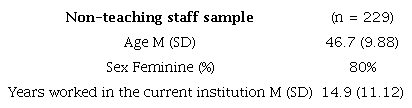
A total number of 229 non-teaching staff members occupying a wide variety of positions (e.g., library, academic services, directorate) and belonging to more than 14 institutions participated in the study. Most participants were from the two biggest Portuguese universities (32% were working at the University of Lisbon and 13% at the University of Oporto). 80% of the participants were female, their mean age was 46.7 years old (SD = 9.88) and they had been working on the institution, on average, for 14.9 years (SD = 11.12) (Table 1). Most of the participants mentioned having already served a student with a disability. However, only 10% of them had received training on inclusion and disability.
Data collection
A questionnaire was purposefully constructed for this study (Freire; Núñez-Nogueroles, 2024b). The questionnaire is organized in different parts and it is composed of items of different nature. For characterizing participants’ position regarding inclusion and students with disabilities, as well as their perception concerning shared values and attitudes of different groups of their institution, nine items measured on a five-point response scale, ranging from 1 = strongly disagree to 5 = strongly agree, were used (e.g., “The students at my institution generally have a positive attitude towards inclusion in higher education”; “Access to higher education is a right for students with disabilities”).
In addition, nine items requiring a YES/NO answer were used for assessing participants’ knowledge for addressing the specific needs of students with disabilities (e.g., “Do you know Portuguese Sign Language?”), their knowledge of the main international and national political guidelines for inclusion (e.g., “Do you know about national legislation on people with disabilities?”) and their knowledge on specific actions and measures implemented in their institution for promoting students’ participation and equal opportunities for success (e.g., “My institution has specific regulation for students with disabilities”). For assessing their perception regarding accessibilities, six items measured on a five-point response scale, ranging from 1 = strongly disagree to 5 = strongly agree (e.g., “All administrative procedures, such as the enrolment process, change of group assignment, internship management, are accessible”) were used.
Finally, for assessing participants’ willingness to acquire new knowledge for addressing the specific needs of students with disabilities, two items measured on a five-point response scale, ranging from 1 = completely disagree to 5 = totally agree, were used (e.g., “I would like to have more training on the characteristics and needs of students with different types of disability in order to be able to serve them better”).
To reach the study’s goals, a descriptive strategy of analyses was adopted, relying on descriptive statistics (percentages as well as means and standard deviation, depending on the nature of the variables analysed).
Procedures
The process of constructing the questionnaire involved several steps. First of all, both authors searched for questionnaires that would fit the goals of the study. As questionnaires are mainly directed to students and teachers, and as such do not capture the specific experiences and perceptions of the non-teaching staff, authors built a questionnaire (based on Álvarez-Rebolledo et al., 2019; Cook et al., 2009; González-Badía Fraga et al., 2022; Kokhan et al., 2021; Sniatecki et al., 2015; Solís-Grant et al., 2022) that would address the non-teaching staff and the particular goals of this study. An initial version of the questionnaire was filled-in by two non-teaching staff members, both of whom work in different services, which nonetheless requires direct interaction with students. In addition, the two non-teaching staff members have a long experience in the institution, had already served students with disabilities and are known by the second author by their positive positioning regarding inclusion. After they had filled-in the questionnaire, the second author of the paper carried on a structured interview with each one for exploring their evaluation of the questionnaire, in terms of its dimension and how long it took them to fill it in, the clarity of each item (and ideas for improving it), the relevance of each item considering the study’s goals and whether important information was not being asked (and, in that case, suggestions for introducing new items). Both authors discussed and confronted the information collected from the non-teaching staff, made modifications on the initial version of the questionnaire, and created its online version, which was subsequently checked for its accessibility.
The Portuguese General-Directorate for Higher Education and structures of higher education institutions (such as Pedagogical Councils, Governing Bodies) supported the dissemination of the online questionnaire to all the higher education institutions in Portugal. Data was collected during the year 2022/2023.
Ethical procedures
Data were collected after obtaining permission from the participants, who received a LINK for the questionnaire. Firstly, they were informed about the goals and the relevance of the study, about the ethical procedures taken (e.g., anonymity and privacy of data collected) and they were provided with the contacts of the first author for any question or doubt. Before moving on to the questionnaire, participants had to give their active consent. Only after their consent, they could have access to the questionnaire.
The study was authorised by the Ethics Committee of the Institute of Education of the University of Lisbon.
Results
Globally, participants take a positive stance on inclusion in higher education. They tend to strongly agree that inclusion is a students’ right, that resources need to be allocated for welcoming students with disabilities and for creating conditions that enable students with disabilities to be as successful as their peers. Finally, they see inclusion as an opportunity for community development, namely in terms of how each one perceives each other regarding each one’s needs (Table 2).

As for knowledge about legislation and international guidelines for inclusion, although most of the participants are familiar with the national legislation on people with disabilities (56%), 72% of the participants are not familiar with international agreements. In addition, most of them mention that they do not know Portuguese Sign Language (89% of the participants) and are not familiar with audio-description procedures for people who are blind or have low vision (83% of the participants), practices that would favour communication and interaction with students with sensory disabilities. Finally, most of the participants (89%) are not familiar with evacuation procedures for students with physical/motor or sensory disabilities (i.e., visual and/or hearing) in the event of a fire (Table 3).

Notably, non-teaching staff is very interested in receiving training on the characteristics and needs of students with different types of disabilities in order to be able to serve them better (83% of the participants) and willing to take part in events where students with disabilities share information about their disabilities and their experiences in higher education (74% of the participants).
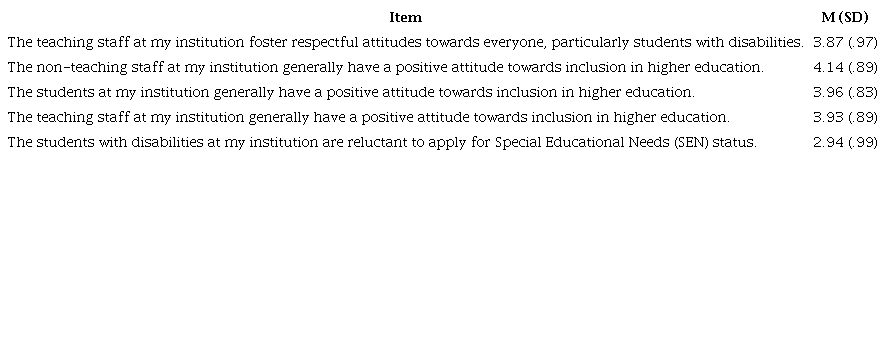
Considering non-teaching staff’s perception of values and attitudes shared by the members of their institution (i.e., teaching staff, non-teaching staff, students), participants have a very positive perception of their institutions (Table 4). In general, they tend to agree that teaching as well as non-teaching staff and also students have a positive attitude towards inclusion in higher education, and that the teaching staff foster respectful attitudes towards everyone. Nevertheless, they tend to be neutral (i.e., neither disagree nor agree) in regard to students with SEN applying for the Special Educational Needs (SEN) status.
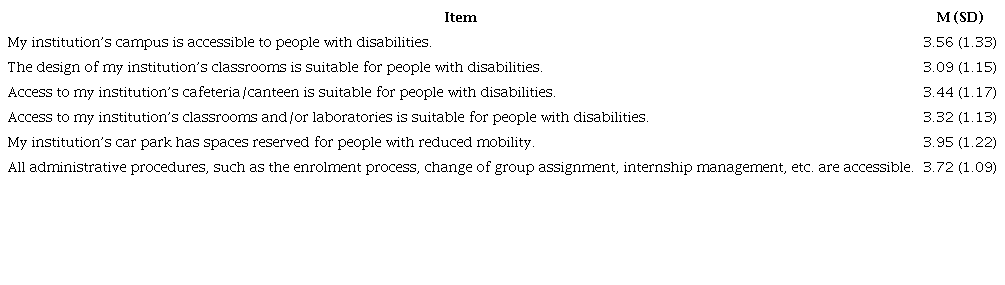
In addition to the neutral stance regarding students’ reluctance to apply for the SEN status, non-teaching staff also show a neutral perception regarding their institution’s accessibilities, particularly regarding classrooms design and access, as well as access to cafeteria/ canteen (i.e., they tend to neither disagree nor agree). However, they also tend to agree that the administrative procedures are accessible (Table 5).
Finally, in terms of institutional actions and measures for addressing the specific needs of some students (Table 6), results show that only 49% of the non-teaching staff find that the institution provides awareness actions regarding inclusion and disability, and 42% hold the opinion that the institution disseminates that information.
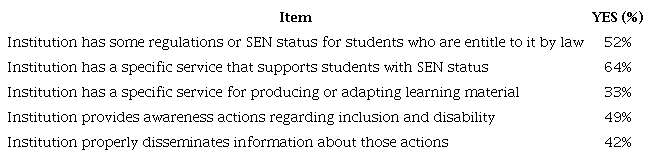
Furthermore, although most of the participants (64%) agrees that their institution has a specific service that supports students with SEN status, less agree that it has some regulations or SEN status for students who are entitled to it by law (52%) and even less agree that their institution has a specific service for producing or adapting learning material (33%) (Table 6).
Discussion and conclusions
Findings show that non-teaching staff has a positive attitude and perceive their institution’s stance on inclusion favorably. This view is particularly important because values are considered to be at the core of inclusion, being in the light of them that policies and practices should be enacted (Booth; Ainscow, 2002, 2016). In fact, favourable attitudes turn out to be essential to promote inclusive environments (Solís-Grant et al., 2023).
Despite this positive stance, results also reveal some lack of knowledge on the part of the non-teaching staff about certain aspects, among which two can be underscored: international agreements signed by Portugal on the rights of students with disabilities, and practical knowledge, specifically about Portuguese Sign Language and audio description. The second one entails a problem in terms of accessibility, since it can pose difficulties in assisting students with disabilities and limit their participation. Given that many of the participants have already worked with students with disabilities, this barrier turns out to be relevant. However, it must be acknowledged that we do not know whether the disability these students had was a sensory one (i.e. deafness / blindness or low vision) or not. The lack of knowledge on the part of non-teaching staff is in line with the fact that few participants have received training in areas related to these aspects. Nevertheless, it is worth mentioning that the non-teaching staff is open and willing to take part in training programmes. Importantly, being aware of and value inclusion is not enough when it comes to getting involved with training in these issues; it is essential as well that institutions establish conditions that favour staff’s involvement with training, namely by creating a consistent staff’s training policies and incentives. And this requires political action from the institution and a commitment to inclusion and equity (Freire; Núñez-Nogueroles, 2024a).
Moreover, many participants in the study reported lack of regulations for students with disabilities or of specific services for supporting these students. These results slightly contradict data collected by the higher education directorate (Pinto et al., 2023). Thus, it seems that more than not having regulations or services for addressing the specific needs of students with disabilities, these results suggest a lack of staff’s knowledge regarding what exists in the institution (namely, about regulations and support services). In addition, although showing available to participate in training events/programmes, many participants in the study tended to report that their institution do not organize training actions about inclusion and disability. Together, these results point out the need to involve all members of the institution and to proactively implement concerted actions in various dimensions of the institution in order to create equitable conditions of participation and success for all the students (Freire; Núñez-Nogueroles, 2024a).
In relation to future research avenues, it will be interesting to focus on accessibilities other than physical; for instance, the institutions’ websites, the educational platforms and the apps involved in the teaching and learning process are useful tools nowadays that should be available to every student. Other resources must be checked as well in order to reach high accessibility standards. For example, as Mulliken & Atkins (2009) declare, if the provision of services such as alternative format books is integrated into academic libraries rather than being supplied as accommodations by the office for disability services, we will be moving towards a more universal design in higher education. Furthermore, it is essential for researchers to delve into the degree of implementation of these practical issues if real progress is to be made. Indeed, not only setting goals is needed; it is imperative to assess whether they are being achieved or not. Monitoring the extent to which institutions are accessible is crucial for taking steps towards full inclusion in higher education (United Nations, 2014).
References
AGUARDENTEIRO PIRES, Lilia; SECO, Graça; MARTINS, Gracinda. Apoio a estudantes com necessidades especiais no ensino superior: a experiência de 10 anos do GTAEDES. In: CONFERÊNCIA INTERNACIONAL PARA A INCLUSÃO 2015 (INCLUDIT), 3.,2015; FREIRE, Carla Sofia; MANGAS, Catarina; SOUSA, Célia (org.). Leiria. Livro de atas da [...]. Leiria: [s. n.], 2015. p. 58-68. Disponível em: https://rc.cplp.org/Record/rcaap_b2414c5bd0db9ef8b99ef7b22ed29fae/Description#tabnav. Acesso em: 20 maio 2025.
ÁLVAREZ-REBOLLEDO, Alondra Marina; SANTOS CARRETO, María Guadalupe; BARRIOS GONZÁLEZ, Érika Egelontina. Propiedades psicométricas del cuestionario "Percepción de la inclusión educativa en nivel superior". Sinéctica: Revista Electrónica de Educación, Tlaquepaque, v. 53, p. 1-21, 2019. Disponível em: https://www.scielo.org.mx/pdf/sine/n53/2007-7033-sine-53-00009.pdf. Acesso em: 20 maio 2025.
BOOTH, Tony; AINSCOW, Mel. Índex para a inclusão: desenvolvendo a aprendizagem e a participação na escola. Bristol: Centre for Studies on Inclusive Education (CSIE), 2002.
BOOTH, Tony; AINSCOW, Mel. The index for inclusion: a guide to school development led by inclusive values. 4. ed. Bristol: Centre for Studies on Inclusive Education (CSIE), 2016.
BORGES, Maria Leonor; MARTINS, Maria Helena; LUCIO-VILLEGAS, Emilio; GONÇALVES, Teresa. Desafios institucionais à inclusão de estudantes com necessidades educativas especiais no ensino superior. Revista Portuguesa de Educação, Braga, v. 30, n. 2, p. 7-31, 2017. https://doi.org/10.21814/rpe.10766
BRODERICK, Andrea. Of rights and obligations: The birth of accessibility. The International Journal of Human Rights, London, v. 24, n. 4, p. 393-413, 2020. https://doi.org/10.1080/13642987.2019.1634556
CARBALLO, Rafael; MORGADO, Beatriz; CORTÉS-VEGA, María Dolores. Transforming faculty conceptions of disabilities and inclusive education through a training programme. International Journal of Inclusive Education, Abingdon, v. 25, n. 7, p. 843-859, 2019. https://doi.org/10.1080/13603116.2019.1579874.
CLAEYS-KULIK, Anna-Lena; JØRGENSEN, Thomas Ekman; STÖBER, Henriette. Diversity, Equity and inclusion in european higher education institutions: results from the INVITED project. Brussels; Geneva: European University Association, 2019. Disponível em: https://www.eua.eu/publications/reports/diversity-equity-and-inclusion-in-european-higher-education-institutions-results-from-the-invited-project.html. Acesso em: 20 maio 2025.
COOK, Lysandra; RUMRILL, Phillip; TANKERSLEY, Melody. Priorities and understanding of faculty members regarding college students with disabilities. International Journal of Teaching and Learning in Higher Education, v. 21, n. 1, p. 84-96, 2009. Disponível em: https://files.eric.ed.gov/fulltext/EJ896246.pdf. Acesso em: 20 maio 2025.
EUROPEAN COMMISSION. Communication from the Commission to the European Parliament, the Council, the European Economic and Social Committee and the Committee of the Regions. Union of equality: strategy for the rights of persons with disabilities 2021-2030. Brussels: European Commission, 2021. Disponível em: https://eur-lex.europa.eu/legal-content/EN/TXT/PDF/?uri=CELEX:52021DC0101. Acesso em: 20 maio 2025.
FERNÁNDEZ-BATANERO, José María; MONTENEGRO-RUEDA, Marta; FERNÁNDEZ-CERERO, José. Access and participation of students with disabilities: the challenge for higher education. International Journal of Environmental Research and Public Health, Basel, v. 19, p. 11918, 2022. https://doi.org/10.3390/ijerph191911918
FOSSEY, Ellie; CHAFFEY, Lisa; VENVILLE, Annie; ENNALS, Priscilla; DOUGLAS, Jacinta; BIGBY, Christine. Navigating the complexity of disabilities support in tertiary education: perspectives of students and disabilities service staff. International Journal of Inclusive Education, Abingdon, v. 21, n. 8, p. 822-832, 2017. https://doi.org/10.1080/13603116.2017.1278798
FREIRE, Sofia; NÚÑEZ-NOGUEROLES, Eugenia-Esperanza. Desafios e oportunidades no ensino superior: inclusão, diversidade e equidade. In: FREIRE, Sofia; NÚÑEZ-NOGUEROLES, Eugenia-Esperanza (coord.). Inclusão no ensino superior: experiências, políticas, culturas e práticas. Lisboa: Instituto de Educac¸a~o, Universidade de Lisboa, 2024a. p. 11-28. (Educação XXI). Disponível em: https://repositorio.ulisboa.pt/bitstream/10400.5/96127/1/EXXI_SFreireENogueroles_InclusaoNoEnsinoSuperior_EBOOK.pdf. Acesso em: 20 maio 2025.
FREIRE, Sofia; NÚÑEZ-NOGUEROLES, Eugenia-Esperanza (coord.) Inclusão no ensino superior: experiências, políticas, culturas e práticas. Lisboa: Instituto de Educac¸a~o, Universidade de Lisboa, 2024b. (Educação XXI). Disponível em: https://repositorio.ulisboa.pt/bitstream/10400.5/96127/1/EXXI_SFreireENogueroles_InclusaoNoEnsinoSuperior_EBOOK.pdf. Acesso em: 20 maio 2025.
GONZÁLEZ-BADÍA FRAGA, Juan; CAZORLA MARTÍN, Beatriz; GUTIÉRREZ HIDALGO, Nieves. Las personas con discapacidad en el Sistema Universitario Andaluz: informe de situación. Sevilla: Consejería de Igualdad, Políticas Sociales y Conciliación, Junta de Andalucía, 2022. Disponível em: https://www.juntadeandalucia.es/sites/default/files/2022-05/Informe%20Discapacidad%20Universidad_Web.pdf. Acesso em: 20 maio 2025.
HOCKINGS, Christine. Inclusive Learning and teaching in higher education: A synthesis of research. EvidenceNet, New York, 2010. Disponível em: https://s3.eu-west-2.amazonaws.com/assets.creode.advancehe-document-manager/documents/hea/private/inclusive_teaching_and_learning_in_he_synthesis_200410_0_1568037026.pdf. Acesso em: 20 maio 2025.
HOWE, Abigail. Best practice in disabilities provision in higher education libraries in England specializing in art, media, and design. New Review of Academic Librarianship, Philadelphia, v. 17, n. 2, p. 155-184, 2011. https://doi.org/10.1080/13614533.2011.610213
KIMBALL, Ezekiel; WELLS, Ryan; OSTIGUY, Benjamin; MANLY, Catherine; LAUTERBACH, Alexandra. Students with disabilities in higher education: A review of the literature and an agenda for future research. In: PAULSEN, Michael (ed.). Higher education: handbook of theory and research. v. 31. Cham: Springer, 2016. p. 91-156. https://doi.org/10.1007/978-3-319-26829-3_3
KOKHAN, Sergey; ROMANOVA, Elena; SKALIY, Alexander; KOWALSKI, Vitold; TANEVA, Svetlana; NADEINA, Luiza. Adaptation problems of teachers and students with disabilities in the university pedagogical process in Russia. Palaestra, Champaign, v. 35, n. 2, p. 15-23, 2021. Disponível em: https://www.researchgate.net/publication/352401111_Adaptation_Problems_of_Teachers_and_Students_With_Disabilities_in_the_University_Pedagogical_Process_in_Russia. Acesso em: 20 maio 2025.
LAWRIE, Gwen; MARQUIS, Elizabeth; FULLER, Eddie; NEWMAN, Tara; QIU, Mei; NOMIKOUDIS, Milton; ROELOFS, Fritis; van DAM, Lianne. Moving towards inclusive learning and teaching: A synthesis of recent literature. Teaching and Learning Inquiry, Calgary, v. 5, n. 1, p. 1-13, 2017. https://doi.org/10.20343/teachlearninqu.5.1.3
LÓPEZ-GAVIRA, Rosario; MORIÑA, Anabel; MORGADO, Beatriz. Challenges to inclusive education at the university: the perspective of students and disabilities support service staff. Innovation: The European Journal of Social Science Research, Vienna, v. 34, n.3, p. 1-13, 2019. https://doi.org/10.1080/13511610.2019.1578198.
MÁRQUEZ, Carmen; SANDOVAL, Marta; SÁNCHEZ, Sergio; SIMÓN, Cecilia; MORIÑA, Anabel; MORGADO, Beatriz; MORENO-MEDINA, Irene; GARCÍA, José Antonio; DÍAZ-GANDASEGUI, Vicente; ELIZALDE SAN MIGUEL, Begoña. Evaluación de la inclusión en educación superior mediante indicadores. Reice: Revista Iberoamericana sobre Calidad, Eficacia y Cambio en Educación, Madrid, v. 19, n. 3, p. 33-51, 2021. https://doi.org/10.15366/reice2021.19.3.003.
MARTINS, Maria Helena; BORGES, Maria Leonor; GONÇALVES, Teresa. Attitudes towards inclusion in Higher Education in a Portuguese university. International Journal of Inclusive Education, Abingdon, v. 22, n. 5, p. 527-542, 2018. https://doi.org/10.1080/13603116.2017.1377299.
MARTINS, Maria Helena Venâncio; MELO, Francisco Vieira de; MARTINS, Cátia. Serviços para estudantes com deficiência nas universidades: dificuldades e desafios. Educação em Revista, Belo Horizonte, v. 37, p. e27022, 2021. https://doi.org/10.1590/0102-469827022
MOLINER GARCÍA, Odet; YAZZO ZAMBRANO, Maria Angelica; NICLOT, Daniel; PHILIPPOT, Thierry. Universidad inclusiva: percepciones de los responsables de los servicios de apoyo a las personas con discapacidad. Revista Electrónica de Investigación Educativa, Mexicali, v. 21, n. e20, p. 1-10, 2019. https://doi.org/10.24320/redie.2019.21.e20.1972
MORGADO CAMACHO, Beatriz; LOPEZ-GAVIRA, Rosario; MORIÑA DÍEZ, Anabel. The ideal university classroom: stories by students with disabilities. International Journal of Educational Research, v. 85, p. 148-156, 2017. https://doi.org/10.1016/j.ijer.2017.07.013
MORIÑA, Anabel; MORGADO, Beatriz. University surroundings and infrastructures that are accessible and inclusive for all: listening to students with disabilities. Journal of Further and Higher Education, London, v. 42, n. 1, p. 13-23, 2018. https://doi.org/10.1080/0309877X.2016.1188900
MURRAY, Christopher; LOMBARDI, Allison; SEELY, John; GERDES, Hillary. Effects of an intensive disabilities-focused training experience on university faculty self-efficacy. Journal of Postsecondary Education and Disabilities, Huntersville, v. 27, n. 2, p. 179-193, 2014.
NAVARRO-MATEU, Diego; FRANCO-OCHOA, Jacqueline; VALERO-MORENO, Selene; PRADO-GASCÓ, Vicente. Attitudes, sentiments, and concerns about inclusive education of teachers and teaching students in Spain. Frontiers in Psychology, Lausanne, v. 11, n. 521, 2020. https://doi.org/10.3389/fpsyg.2020.00521
NÚÑEZ-NOGUEROLES, Eugenia-Esperanza; FREIRE, Sofia. Inclusão no ensino superior: experiências e perspetivas de diversos intervenientes no processo educativo. In: FREIRE, Sofia; NÚÑEZ-NOGUEROLES, Eugenia-Esperanza (coord.). Inclusão no ensino superior: experiências, políticas, culturas e práticas. Lisboa: Instituto de Educac¸a~o, Universidade de Lisboa, 2024. p. 118-131. (Educação XXI). Disponível em: https://repositorio.ulisboa.pt/bitstream/10400.5/96127/1/EXXI_SFreireENogueroles_InclusaoNoEnsinoSuperior_EBOOK.pdf. Acesso em: 20 maio 2025.
OROZCO, Inmaculada; MORIÑA, Anabel. Exploring the beliefs of Spanish teachers who promote the development of inclusive pedagogy. International Journal of Inclusive Education, Abingdon, p. 1-16, 2020. https://doi.org/10.1080/13603116.2020.1866686
PINTO, Paula Campos; BENTO, Sofia; PINTO, Teresa Janela; NECA, Patrícia. Pessoas com deficiência em Portugal: indicadores de direitos humanos 2023. Lisboa: Observatório da Deficiência e Direitos Humanos (ODDH): Instituto Superior de Ciências Sociais e Políticas (ISCSP): Universidade de Lisboa, 2023. Disponível em: http://oddh.iscsp.ulisboa.pt/index.php/pt/2013-04-24-18-50-23/publicacoes-dos-investigadores-oddh/item/610-relatorio-oddh-2023. Acesso em: 20 maio 2025.
PINTO NETO, Lígia Maria Fortes. O papel social da biblioteca universitária na inclusão do indivíduo portador de deficiência visual. Cadernos BAD, Braga, v. 1, p. 19-31, 2014. https://doi.org/10.48798/cadernosbad.1046
POLO SÁNCHEZ, María Tamara; FERNÁNDEZ-JIMÉNEZ, Carolina; FERNÁNDEZ CABEZAS, María. The attitudes of different partners involved in Higher Education towards students with disabilities. International Journal of Disabilities, Development and Education, St Lucia, v. 65, n. 4, p. 442-458, 2018. https://doi.org/10.1080/1034912X.2017.1406066
POLO SÁNCHEZ, María Tamara; LÓPEZ JUSTICIA, María Dolores. Barreras de acceso al medio físico de los estudiantes con discapacidad motora de la Universidad de Granada. Revista Electrónica de Investigación Psicoeducativa, Almería, v. 7, n. 3, p. 121-132, 2005. https://doi.org/10.25115/ejrep.v3i7.1175
PORTUGAL. Resolução do Conselho de Ministros n.º 119/2021. Estratégia nacional para a Inclusão das pessoas com deficiência 2021 -2025. Diário da República, Lisboa, 1. série, n. 169, 2021. Disponível em: https://files.diariodarepublica.pt/1s/2021/08/16900/0000300071.pdf. Acesso em: 20 maio 2025.
SNIATECKI, Jessica; PERRY, Holly; SNELL, Linda. Faculty attitudes and knowledge regarding college students with disabilities. Journal of Postsecondary Education and Disabilities, Huntersville, v. 28, n. 3, p. 259-275, 2015. Disponível em: https://files.eric.ed.gov/fulltext/EJ1083837.pdf. Acesso em: 20 maio 2025.
SOLÍS-GRANT, María José. Valores, atitudes e crenças promotoras de inclusão. In: FREIRE, Sofia; NÚÑEZ-NOGUEROLES, Eugenia-Esperanza (coord.). Inclusão no ensino superior: experiências, políticas, culturas e práticas. Lisboa: Instituto de Educac¸a~o: Universidade de Lisboa, 2024. p. 76-88. (Educação XXI). Disponível em: https://repositorio.ulisboa.pt/bitstream/10400.5/96127/1/EXXI_SFreireENogueroles_InclusaoNoEnsinoSuperior_EBOOK.pdf. Acesso em: 20 maio 2025.
SOLÍS-GRANT, María José; BRETTI-LÓPEZ, María José; ESPINOZA-PARÇET, Camila; PÉREZ-VILLALOBOS, Cristhian; RODRÍGUEZ-NÚÑEZ, Iván; PINCHEIRA-MARTÍNEZ, Cristian; SEPÚLVEDA-CARRASCO, Cristóbal. Inclusion in the university: who assumes responsibility? A qualitative study. PLoS ONE, San Francisco, v. 18, n. 1, p. e0280161, 2023. Disponível em: https://journals.plos.org/plosone/article?id=10.1371/journal.pone.0280161. Acesso em: 20 maio 2025.
SOLÍS-GRANT, María José; ESPINOZA-PARÇET, Camila; SEPÚLVEDA-CARRASCO, Cristóbal; PÉREZ-VILLALOBOS, Cristhian; RODRÍGUEZ-NÚÑEZ, Iván; PINCHEIRA-MARTÍNEZ, Cristian; GÓMEZ-VARELA, Juan Pablo; ARÁNGUIZ-IBARRA, Daniela. Inclusion at universities: psychometric properties of an inclusive management scale as perceived by students. PLoS ONE, San Francisco, v. 17, n. 1, p. e0262011, 2022. https://doi.org/10.1371/journal.pone.0262011
UNITED NATIONS. Convention on the Rights of Persons with Disabilities. [ S. l .]: United Nations, 2016. Disponível em: https://www.ohchr.org/en/instruments-mechanisms/instruments/convention-rights-persons-disabilities. Acesso em: 20 maio 2025.
UNITED NATIONS. General comment No. 2 (2014) on accessibility. [ S. l .]: United Nations, 2014. Disponível em: https://digitallibrary.un.org/record/812025. Acesso em: 20 maio 2025.
VIÑAS SÁNCHEZ, Sonia; GAGO CASTRO, Marta; SÁNCHEZ PÉREZ, Carlos (coord.). VI Estudio sobre la Inclusión de Personas con Discapacidad en el Sistema Universitario Español. Fundación Universia, 2023. Disponível em: https://biblioteca.fundaciononce.es/publicaciones/otras-editoriales/vi-estudio-sobre-la-inclusion-de-personas-con-discapacidad-en-el. Acesso em: 20 maio 2025.
ZILIOTTO, Denise Macedo. A aprendizagem de alunos com NEE no ensino superior em Portugal: a contribução dos estatutos institucionais. Interfaces da Educação, Paranaíba, v. 11, n. 33, p. 386-406, 2020. https://doi.org/10.26514/inter.v11i33.4161
ZOREC, Klavdija; DESMOND, Deirdre; BOLAND, Trevor; McNICHOLL, Aoife; O'CONNOR, Anne; STAFFORD, Gillian; GALLAGHER, Pamela. A whole-campus approach to technology and inclusion of students with disabilities in higher education in Ireland. Disabilities & Society, 2022. https://doi.org/10.1080/09687599.2022.2114885
Notes
Author notes