Ciência e Tecnologia de Alimentos
Stabilization of açaí (Euterpe oleracea Mart.) juice by the microfiltration process
Suco de açaí estabilizado utilizando processo de microfiltração
Stabilization of açaí (Euterpe oleracea Mart.) juice by the microfiltration process
Acta Scientiarum. Technology, vol. 38, no. 1, pp. 7-11, 2016
Universidade Estadual de Maringá
Received: 17 March 2015
Accepted: 28 September 2015
Abstract: Açaí berry, a Brazilian palm fruit widely distributed in northern South America, is acknowledged for its functional properties such as high antioxidant capacity and anti-inflammatory activities. Although the açaí juice is highly appreciated in Brazil and even worldwide, its commercialization is still limited. Microfiltration process is largely applied in juice processing, eliminating many of the traditional processing steps and reducing time, energy and addition of clarifying agents. Furthermore, microfiltration process may eliminate microorganisms and compounds responsible for turbidity in the juice. Current assay applies a microfiltration process to obtain a stabilized açaí permeate pulp. Microfiltrations of açaí pulp were carried out in a dead end configuration with a flat membrane of 0.22 μm pore size. Permeate pulp was characterized according to its turbidity, lipid concentration and microbiological analysis. Initial permeate flux was 103 kg m-2 h-1. After an initial flux decline during 30 min., due to membrane compaction and fouling occurrences, flux was stabilized at 20 kg m-2 h-1. The microfiltration process reduced the initial açaí pulp turbidity by 99.98% and lipids were not identified in the permeate. Microbiological analysis showed that the contamination by microorganism decreased in the permeate pulp when compared to that in raw açaí pulp.
Keywords: açaí, stabilization, membrane process, microfiltration.
Resumo: O açaí é um fruto da Amazônia reconhecido por suas propriedades funcionais, devido à sua elevada capacidade antioxidante e anti-inflamatória. Apesar da apreciação do suco de açaí no Brasil e no mundo, sua comercialização ainda é limitada. O processo de microfiltração é largamente aplicado no processamento de sucos, eliminando etapas de processamento tradicionais, reduzindo tempo, energia e adição de agentes de clarificação. Ademais, a microfiltração pode eliminar micro-organismos e compostos responsáveis pela turbidez do suco. Este estudo visou à aplicação do processo de microfiltração para obtenção de permeado estabilizado de polpa de açaí. Microfiltrações da polpa foram realizadas em um módulo de filtração com membrana plana com tamanho de poro de 0,22 μm. O permeado foi caracterizado quanto à turbidez e concentração de lipídeos, além de análises microbiológicas. O fluxo de permeado inicial foi de 103 kg m-2 h-1. Após um declínio fluxo inicial durante 30 minutos, devido à compactação e ao entupimento da membrana, o fluxo foi estabilizado em 20 kg m-2 h-1. A microfiltração reduziu a turbidez inicial da polpa de açaí em 99,98%, e lipídeos não foram identificados no permeado. As análises microbiológicas mostraram que houve diminuição da contaminação por micro-organismos no permeado em relação à polpa de açaí.
Palavras-chave: açaí, estabilização, processos de separação por membranas, microfiltração.
Introduction
Açaí is a Brazilian dark purple berry fruit averaging 2 cm in diameter, with a nutty flavor, lingering metallic undertones and a creamy, oily texture (Schreckinger, Lotton, Lila, & de Mejia, 2010). Its palm, Euterpe oleracea, is widely distributed in northern South America, mainly in the Amazonian delta. The fruit is generally consumed as juice and it is acknowledged for its functional properties in food and nutraceutical products, due to its extremely high antioxidant capacity and potential anti-inflammatory activities. Açaí fruit has received international interest mainly due to its potential health benefits associated to phenolic composition and antioxidant capacity (Del Pozo-Insfran, Brenes, & Talcottt, 2004; Lichtenthaler et al., 2005; Schauss et al., 2006; Rufino et al., 2011). Muller, Gnoyke, Popken, and Bohm (2010) showed that the oxygen radical absorbance capacity rate of the açaí juice is nearly twice as high when compared to its ferricreducing antioxidant power and Trolox equivalent antioxidant capacity, revealing the excellent capacity of açaí anthocyanins to scavenge peroxyl radicals.
Although highly appreciated in Brazil and even worldwide, the commercialization of the açaí fruit is still limited since it is a highly perishable fruit and processing is essential to preserve its bioactive compounds (Del Pozo-Insfran et al., 2004; Gallori, Bilia, Bergonzi, Barbosa, & Vincieri, 2004; Coisson, Travaglia, Piana, Capasso, & Arlorio, 2005). Pavan, Schmidt, and Feng (2012) proposed three drying methods (freeze-drying, refractance window-drying (RW), and hot-air drying) to dehydrate açaí juice, and concluded that the three methods produced samples with low water activity and relatively good product stability during storage.
Microfiltration is characterized as a non-thermal treatment. It is actually a potential process for fruit juice industries due to a better conservation of sensorial characteristics and phytochemical properties (Laorko, Tongchitpakdee, & Youravong, 2013). Microfiltration process may provide high quality, natural fresh taste and additive free food products. It is also simple, easy to scale up and characterized as a low energy consumption process (Cassano, Conidi, Timpone, D'Avella, & Drioli, 2007; Coutinho et al., 2009).
Juice microfiltration reduces many of the traditional steps in processing, such as time, energy and addition of clarifying agents (Echavarria et al., 2012). Further, the microfiltration process eliminates microorganisms and compounds which cause juice turbidity (Coutinho et al., 2009; Girard & Fukumoto, 2000). Membrane technology has been largely applied for the processing of some juices, such as apple, tomato, pineapple and passion fruit juices (Domingues, Ramos, Cardoso, & Reis, 2014; Girard & Fukumoto, 2000). Machado, Haneda, Trevisan, and Fontes (2012) analyzed the influence of the microfiltration process on the antioxidant capacity of the obtained permeate of açaí juice and observed that this parameter was reduced by 36 and 27% for açaí juices with and without enzymatic pretreatment, respectively. Similarly, Cruz et al. (2011) verified that the microfiltration process of açaí pulp did not significantly influence the contents of bioactive components and the antioxidant activity of permeate and concentrated fractions. Couto et al. (2011) showed that the nanofiltration process was able to retain over 99% of the anthocyanins in the açaí pulp. Although membrane filtration processing is suitable for açaí juice treatment, its application still needs further studies.
Current study proposes a microfiltration process to obtain a stabilized açaí permeate pulp. Açaí permeate pulp stabilization has been evaluated mainly in terms of turbidity and microbial count reductions which will ensure an easier commercialization of the juice. Moreover, decrease in the lipid contents in açaí permeate pulp was also evaluated to verify the influence of the microfiltration process on this nutritional parameter. Since açaí juice is a high nutritional fat product, reduction in lipid contents may increase its consumption.
Material and methods
Commercial frozen açaí pulp (medium type, 11-14% total solids) was purchased on the local market in Uberlândia, Minas Gerais State, Brazil, and stored at -10ºC until processing. Before processing, the açaí pulp was defrosted at room temperature and microfiltrated without any dilution and/or pretreatment.
Microfiltration processes were carried out using a cellulose ester microfiltration membrane (Milipore) with 0.22 μm pore size in a dead-end filtration cell (Figure 1) with total capacity of 1.5 L and 6.36 x 10⁻³ m2 of permeation area. Operation conditions were 1.0 bar of transmembrane pressure and temperature of 25ºC.
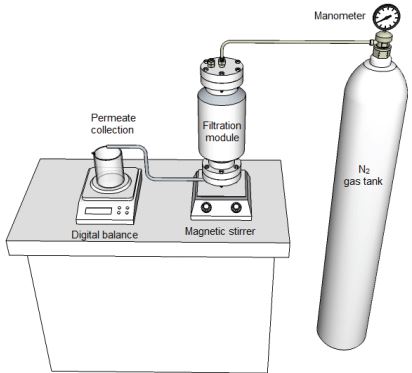
Figure 1
Dead-end filtration cell.
Permeate flux due to filtration time was calculated by Equation (1).

where J is the permeate flux (kg m-2 h-1); A is the filtration area (m2); m (kg) is the measured permeate mass at filtration time t (h).
Raw and permeate açaí pulps were characterized according to their moisture, total solids, ashes, pH, lipids (AOAC, 2000) and turbidity. Turbidity was measured with a Nova Organica HD 114 turbidity meter (Brazil).
Microbiological analysis (mold and yeast, total counts and coliforms) were carried out in raw and permeate açaí pulps according to the Bacteriological Analytical Manual (2001). These analyses were also carried out in permeate samples stored for 24h and 30 days, at room temperature (25 ± 5ºC), with and without conservative additions. Sodium benzoate or benzoic acid was used as conservative agent at a concentration of 0.01% (m m-1). Further, permeate samples were stored at 5ºC without the addition of conservatives. These samples were packed in 50 mL glass vials, which were sealed with rubber stoppers and aluminum seals. All microbiological analyses were conducted in triplicate for each sample.
Results and discussion
Figure 2 presents permeate flux according to filtration time during açaí pulp microfiltration and shows the typical behavior of a microfiltration process curve at a dead-end operation. Figure 2 reveals that the permeate flux decreases very rapidly during the first minutes of the procedure; the decrease rate diminishes with time and becomes very small for periods longer than 2 hours. The flow remains almost constant for the remainder of the microfiltration operation.
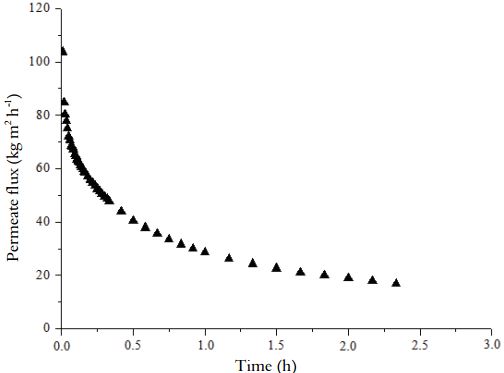
Figure 2
Permeate flux over time in the membrane during the microfiltration.
The initial permeate flux reached 103.7 kg m-2 h-1 and abruptly decreased in the first 30 minutes of filtration, probably due to the formation of the cake ayer on the membrane surface. After approximately 90 min. of operation, the permeate flux remained constant and the final flow equaled 16.8 kg m-2 h-1. The concentration factor was equal to 2. Açaí pulp is rich in lipids (5-7% on a wet basis), protein and insoluble dietary fibers (Rufino et al., 2011; Schauss et al., 2006) and this abrupt flux decline is probably due to the deposition of these and other compounds on the membrane surface. Machado et al. (2012) showed that the enzymatic pretreatment increased the observed permeate flux of açaí juice (up to 83 L h-1 m-2 for a 0.2 μm pore size membrane) due to the pectinase action on pectin-protein complexes. Cruz et al. (2011) observed a similar steady state permeate flux (18 L h-1 m-2) during the filtration of açaí pulp using a polymeric membrane. However, higher flux rates were registered by Cruz et al. (2011) and Couto et al. (2011) when they used ceramic membranes (about 100 L h-1 m-2) in a cross-flow filtration. The cross-flow filtration probably reduced fouling occurrences and increased the permeate flux.
Table 1 shows the properties of açaí pulp before and after the microfiltration process. Further, pH rate was not significantly affected by the processing, a fact already reported by Campos et al. (2002) and Carneiro, Sa, Gomes, Matta, and Cabral (2002) for microfiltrations of cashew apple and pineapple juices, respectively. There was a great reduction in the turbidity rate after the microfiltration process due to the removal of macromolecules from the raw pulp. Domingues et al. (2014) also observed a decrease in turbidity after microfiltration of passion fruit juice. Decrease in turbidity enhances juice commercialization due to lower decantation of suspended solids. The applied analytical method did not detect lipids in the permeate juice and showed that the microfiltration process was able to reduce significantly the lipid content in the raw pulp. Reduction may contribute towards the nutritional characteristics of açaí juice, featured as a high fat food. Cesar et al. (2014) showed that the use of pectinolytic enzymes associated to chitosan as a clarifying agent for açaí resulted in a clear lipid-free juice.
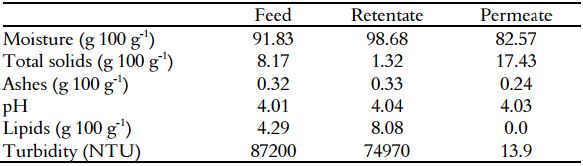
Table 2 presents the results of microbiological analysis for feed and permeate açaí pulp samples.

n.m.: not measured.
According to Brazilian requirements for juices and drinks, mesophilic bacteria counts must be less than 102 MPN mL-1, but there are no Brazilian specific requirements for molds and yeast. Molds and yeast and mesophilic bacteria counts were less than 10 CFU mL-1 and total coliforms were less than 0.3 mL-1 for all stored açaí permeate samples. The microfiltration process reduced total coliform concentration of açaí pulp after 1 or 30 days of storage for all permeate samples (at room temperature or refrigerated, with or without the addition of conservatives). Mold and yeast concentrations of permeate samples stored at room temperature during 1 and 30 days increased after the microfiltration process. Increase may be associated to the manipulation of the sample or the spores may have crossed through the membrane. Since this sample was stored at room temperature, it is possibly that the favorable conditions of substrate, temperature and humidity triggered mold and yeast development. However, increase did not occur when permeate samples were stored at 5ºC (refrigerated) and when conservatives were added. There was no proliferation of bacteria, mold and yeast in any sample and, thus, the microfiltration process ensured the required product stabilization.
Considering the nutritional composition of the fruit pulps, it may be presumed that they are able to sustain the growth of bacteria, molds and yeasts. However, pH is lower than the range that favors bacterial growth, or has rates below that at which bacterial growth is possible. In the case of açaí pulp, Brazilian law establishes minimum and maximum pH rates respectively at 4.0 and 6.2.
Campos et al. (2002) verified shelf-life stability of cashew apple juice clarified by microfiltration using a 0.3 μm pore size polyethersulfone membrane at 200 kPa of transmembrane pressure and temperature of 30ºC. According to their results, the microfiltration process stabilized cashew apple juice. Carneiro et al. (2002) showed that the microfiltration process produced a clarified pineapple juice that fulfills the requirements of microbiological safety, whilst Oliveira, Doce, and Barros (2012) showed that the microfiltration process was as efficient as pasteurization to treat passion fruit juice.
Conclusion
The proposed microfiltration process was able to produce a stabilized açaí pulp, free from microorganisms and suspend solids. The addition of conservative agents (sodium benzoate or benzoic acid at a concentration of 0.01 wt%) or even storage at refrigerate conditions (5ºC) improved reductions in mold and yeast concentrations of permeate açaí samples. Reduction in turbidity was greater than 99%. This clarified pulp may be mainly used in carbonated beverages and sports drink liqueurs, in which the presence of suspended solids is not desired. Lipid reduction was equal to 100% and this reduction may contribute towards the nutritional characteristics of açaí juice, considered a high fat food.
Acknowledgements
The authors would like to thank FAPEMIG, CNPq and CAPES Brazil for their financial support.
References
Association of Official Analytical Chemists (AOAC). (2000). Official methods of analysis of AOAC international. (17th ed.). Gaithersburg, MD: AOAC.
Bacteriological Analytical Manual Online (2001). Chapter 18. Yeasts, molds and mycotoxins. Retrived from http://www.fda.gov/Food/FoodScienceResearch/LaboratoryMethods/ucm071435.htm
Campos, D. C. P., Santos, A. S., Wolkoff, D. B., Matta, V. M., Cabral, L. M. C., & Couri, S. (2002). Cashew apple juice stabilization by microfiltration. Desalination, 148(1-3), 61-65. doi: 10.1016/S0011-9164(02)00654-9
Carneiro, L., Sa, I. D., Gomes, F. D., Matta, V. M., & Cabral, L. M. C. (2002). Cold sterilization and clarification of pineapple juice by tangential microfiltration. Desalination, 148(1-3), 93-98. doi: 10.1016/S0011-9164(02)00659-8
Cassano, A., Conidi, C., Timpone, R., D'Avella, M., & Drioli, E. (2007). A membrane-based process for the clarification and the concentration of the cactus pear juice. Journal of Food Engineering, 80(3), 914-921. doi: 10.1016/j.jfoodeng.2006.08.005
Cesar, L. T., Cabral, M. F., Maia, G. A., Figueiredo, R. W., Miranda, M. R. A., Sousa, P. H. M., ... Gomes, C. L. (2014). Effects of clarification on physicochemical characteristics, antioxidant capacity and quality attributes of açaí (Euterpe oleracea Mart.) juice. Journal of Food Science and Technology, 51(11), 3293-3300. doi: 10.1007/s13197-012-0809-6
Coisson, J. D., Travaglia, F., Piana, G., Capasso, M., & Arlorio, M. (2005). Euterpe oleracea juice as a functional pigment for yogurt. Food Research International, 38(8-9), 893-897. doi: 10.1016/j.foodres.2005.03.009
Coutinho, C. D., Chiu, M. C., Basso, R. C., Ribeiro, A. P. B., Goncalves, L. A. G., & Viotto, L. A. (2009). State of art of the application of membrane technology to vegetable oils: A review. Food Research International, 42(5-6), 536-550. doi: 10.1016/j.foodres.2009.02.010
Couto, D. S., Dornier, M., Pallet, D., Reynes, M., Dijoux, D., Freitas, S. P., & Cabral, L. M. C. (2011). Evaluation of nanofiltration membranes for the retention of anthocyanins of acai (Euterpe oleracea Mart.) juice. Desalination and Water Treatment, 27(1-3), 108-113. doi: DOI 10.5004/dwt.2011.2067
Cruz, A. P. G., Mattietto, R. D., Taxi, C. M. A. D., Cabral, L. M. C., Donangelo, C. M., & da Matta, V. M. (2011). Effect of microfiltration on bioactive components and antioxidant activity of acai (Euterpe oleracea Mart.). Desalination and Water Treatment, 27(1-3), 97-102. doi: doi: 10.5004/dwt.2011.2064
Del Pozo-Insfran, D., Brenes, C. H., & Talcottt, S. T. (2004). Phytochemical composition and pigment stability of acai (Euterpe oleracea Mart.). Journal of Agricultural and Food Chemistry, 52(6), 1539-1545. doi: 10.1021/Jf035189n
Domingues, R. C. C., Ramos, A. A., Cardoso, V. L., & Reis, M. H. M. (2014). Microfiltration of passion fruit juice using hollow fibre membranes and evaluation of fouling mechanisms. Journal of Food Engineering, 121, 73-79. doi: 10.1016/j.jfoodeng.2013.07.037
Echavarria, A. P., Falguera, V., Torras, C., Berdun, C., Pagan, J., & Ibarz, A. (2012). Ultrafiltration and reverse osmosis for clarification and concentration of fruit juices at pilot plant scale. Lwt-Food Science and Technology, 46(1), 189-195. doi: 10.1016/j.lwt.2011.10.008
Gallori, S., Bilia, A. R., Bergonzi, M. C., Barbosa, W. L. R., & Vincieri, F. F. (2004). Polyphenolic constituents of fruit pulp of Euterpe oleracea Mart. (Acai palm). Chromatographia, 59(11-12), 739-743. doi: 10.1365/ s10337-004-0305-x
Girard, B., & Fukumoto, L. R. (2000). Membrane processing of fruit juices and beverages: A review. Critical Reviews in Biotechnology, 20(2), 109-175. doi: 10.1080/07388550008984168
Laorko, A., Tongchitpakdee, S., & Youravong, W. (2013). Storage quality of pineapple juice non-thermally pasteurized and clarified by microfiltration. Journal of Food Engineering, 116(2), 554-561. doi: 10.1016/ j.jfoodeng.2012.12.033
Lichtenthaler, R., Rodrigues, R. B., Maia, J. G. S., Papagiannopoulos, M., Fabricius, H., & Marx, F. (2005). Total oxidant scavenging capacities of Euterpe oleracea Mart. (Acai) fruits. International Journal of Food Sciences and Nutrition, 56(1), 53-64. doi: 10.1080/ 09637480500082082
Machado, R. M. D., Haneda, R. N., Trevisan, B. P., & Fontes, S. R. (2012). Effect of enzymatic treatment on the cross-flow microfiltration of acai pulp: Analysis of the fouling and recovery of phytochemicals. Journal of Food Engineering, 113(3), 442-452. doi: 10.1016/ j.jfoodeng.2012.06.022
Muller, L., Gnoyke, S., Popken, A. M., & Bohm, V. (2010). Antioxidant capacity and related parameters of different fruit formulations. Lwt-Food Science and Technology, 43(6), 992-999. doi: 10.1016/j.lwt.2010.02.004
Oliveira, R. C., Doce, R. C., & Barros, S. T. D. (2012). Clarification of passion fruit juice by microfiltration: Analyses of operating parameters, study of membrane fouling and juice quality. Journal of Food Engineering, 111(2), 432-439. doi: 10.1016/j.jfoodeng.2012.01.021
Pavan, M. A., Schmidt, S. J., & Feng, H. (2012). Water sorption behavior and thermal analysis of freeze-dried, Refractance Window-dried and hot-air dried acai (Euterpe oleracea Martius) juice. Lwt-Food Science and Technology, 48(1), 75-81. doi: 10.1016/j. lwt.2012.02.024
Rufino, M. D. M., Perez-Jimenez, J., Arranz, S., Alves, R. E., Brito, E. S., Oliveira, M. S. P., & Saura-Calixto, F. (2011). Acai (Euterpe oleraceae) 'BRS Para': A tropical fruit source of antioxidant dietary fiber and high antioxidant capacity oil. Food Research International, 44(7), 2100-2106. doi: 10.1016/j.foodres.2010.09.011
Schauss, A. G., Wu, X. L., Prior, R. L., Ou, B. X., Patel, D., Huang, D. J., & Kababick, J. P. (2006). Phytochemical and nutrient composition of the freeze-dried Amazonian palm berry, Euterpe oleraceae Mart. (Acai). Journal of Agricultural and Food Chemistry, 54(22), 8598-8603. doi: 10.1021/Jf060976g
Schreckinger, M. E., Lotton, J., Lila, M. A., & de Mejia, E. G. (2010). Berries from South America: a comprehensive review on chemistry, health potential, and commercialization. Journal of Medicinal Food, 13(2), 233-246. doi: 10.1089/jmf.2009.0233
Author notes
flaviocaldeira@iftm.edu.br