Engenharia Agrícola
The performance of curauá fiber as sorbent of the diesel and biodiesel oils
Desempenho da fibra de curauá como sorvente de óleos diesel e biodiesel
The performance of curauá fiber as sorbent of the diesel and biodiesel oils
Acta Scientiarum. Technology, vol. 38, no. 3, pp. 295-300, 2016
Universidade Estadual de Maringá
Received: 28 April 2015
Accepted: 15 December 2015
Abstract: Curauá (Ananas erictifolius) fiber was investigated as sorbent of diesel and biodiesel oils, and compared with peat, which is used commercially. The sorption tests were carried out for the unclassified fiber and within the granulometry ranges £ 180; 180-425; 425-850 and 850-3350 μm, in the times 5, 10, 20, 40, 60 and 1440 min. The sorbents were also submitted to a physycal-chemical and energetic characterization. The unclassified curauá fiber presented a medium sorption capacity of the diesel oil of 1.12 g oil g fiber-1, similar to the one found for peat, which was 1.25 g oil g peat-1, whereas the biodiesel sorption was 1.16 g oil g fiber-1, higher than the peat sorption, 0.85 g oil g peat-1. The peat showed the highest mean sorption value of both oils in the 180-425 mm granulometry, decreasing with its increase. With the granolumetry increase, the curauá fiber experienced an increase in the biodiesel sorption, but remained constant regarding the diesel sorption. The calorific power of the sorbents after sorption was higher, due to the sorbed oil
Keywords: vegetable fibers, sorption, energy.
Resumo: A fibra de curauá (Ananas erictifolius) foi investigada como sorvente de óleos diesel e biodiesel e comparada com a turfa utilizada comercialmente. Os testes de sorção foram realizados para a fibra sem classificação e nas faixas granulométricas de £ 180; 180-425; 425-850 e 850-3350 μm, nos tempos de 5, 10, 20, 40, 60 e 1.440 min. Os sorventes também foram submetidos à caracterização físico-química e energética. A fibra de curauá sem classificação apresentou capacidade de sorção média de óleo diesel de 1.12 g óleo. g fibra-1, semelhante ao determinado para a turfa 1.25 g óleo. g turfa-1, enquanto a sorção de biodiesel foi de 1.16 g óleo. g fibra-1, superior à turfa, 0.85 g óleo. g turfa-1. A turfa exibiu os maiores valores médios de sorção dos dois óleos na granulometria de 180-425 mm, decaindo com o aumento desta. Com o aumento da granulometria, a fibra de curauá teve aumento da sorção de biodiesel e manteve-se constante quanto à sorção de diesel. O poder calorífico dos sorventes após a sorção foi superior em virtude do óleo sorvido.
Palavras-chave: fibras vegetais, sorção, energia.
Introduction
Accidents involving oil spills and its derivatives in the soil and in water bodies are usual and worrisome producing negative effects on the animal and human health, as well as the flora, affecting the economy, tourism and leisure due to the properties of those materials (Annunciado, Sydenstricker, & Amico, 2005; Lim & Huang, 2007; Aguilera, Méndez, Pásaro, & Laffon, 2010).
In order to remove or recover the oil in situ, physical, chemical and biological processes can be used (Salanitro et al., 1997; Ribeiro, Smith, & Rubio, 2000; Hussein, Amer, & Sawsan, 2011). In oil spills, sorbent materials are commonly used, and they may be natural or synthetic (Choi & Cloud, 1992; Lee, Han, & Rowell, 1999; Inagaki, Konno, Toyoda, Moriya, & Kihara, 2000; Teas et al., 2001; Sayed & Zayed, 2006; Srinivasan & Viraraghavan, 2008; Wu & Zhou, 2009; Franca, Oliveira, Nunes, & Alves, 2010; Peng, Lan, Guo, Yan, & Dang, 2013).
In order to select an oil sorbent, oleophilicity, hydrofobicity, retention over time, the recovery of oil from sorbents, the amount of oil sorbed per unit weiht of sorbent, and the reusability an biodegradability of sorbent are important factors to be observed (Teas et al., 2001; Adebajo, Frost, Kloprogge, Carmody, & Kokot, 2003). Usually, inorganic and natural sorbents have the ability to absorb only tens of grams per sorbent gram, and its oil/water selectivity is not very high (Wu et al., 2014). Yet, they are ecological, biodegradable and low cost materials.
There are studies about the raw oil and diesel’s sorption; however, on the biodiesel, which has an increasing production, there is little or nothing in the literature. With the incentive to biofuel production, especially the biodiesel, a product which competes directly with the fossil diesel, it is interesting that methods which aim at repairing diesel accidents can also be tested with the biodiesel. The study which compares pollution fighting methods for both fuels, may be applied to a possible situation and as an incentive to the production of biofuels, since these are less harmful to the environment (Ferla-Oliveira, Leão, Caraschi, Oliveira, & Gonçalçves, 2011).
In the present study, the curauá fiber (Ananas erictifolius) was experimentally determined as sorbent for the diesel and biodiesel oils, and was compared with the commercial sorbent, based on peat.
Material and methods
During the sorption assays the commercial diesel oil (S1800) was used and obtained in a Petrobras gas station, in Botucatu, São Paulo State, Brazil, as well as the biodiesel produced by Biopar company, in Rolândia, Paraná State, Brazil.
The curauá fiber (Ananas erictifolius), used as a sorbent, was provided by Poematec company, in Santarém, Pará State, Brazil, and the commercial peat sorbent was obtained with Ecosorb company, from Americana, São Paulo State, Brazil.
Characterization of the biosorbents
The curauá fiber were separately grounded in a knife mill. The curauá fiber and the commercial peat sorbent were classified in a set of ASTM sieves (3350, 850, 425 and 180 mm) in mechanical sieve-shaking.
After the granulometric classification of the sorbents, they were classified as to the humidity by the TAPPI T264 cm-97 standard (Technical Association of Pulp and Paper Industry [Tappi], 2000d), and the ash by the TAPPI T211 om-93 standard (Technical Association of Pulp and Paper Industry [Tappi], 2000a) standard. The oil content was determined by the method described by Silva and Queiroz (2002), by extraction in soxhlet with petroleum ether.
The lignin was determined using the TAPPI T222 om-98 standard (Technical Association of Pulp and Paper Industry [Tappi], 2000b), and the holocellulose by the TAPPI T249 cm-00 standard (Technical Association of Pulp and Paper Industry [Tappi], 2000c). The cellulose determination was made based on the holocellulose content, after a 1 g sample of holocellulose was treated with 15 mL of 24.0% potassium hydroxide for 15 hours. The hemicellulose content was obtained by the difference between the holocellulose content and cellulose.
The hydrophobicity test was determined according to Ribeiro, Rubio, and Smith (2003).
The calorific power was determined in a bomb calorimeter ALEMMAR Model KL-5, according to the NBR 8633 standard (Associação Brasileira de Normas Técnicas [ABNT], 1984).
Sorption experiment
The sorption assays were performed for the unclassified sorbents, that is, without granulometric classification, and for the £ 180; 180-425; 425-850 and 850-3350 mm granulometries, using the method described by Lee, Han, and Rowell (1999), where 0.5 g of the sorbent were placed in contact with 20 g of oil in a 20 to 25ºC temperature, during times of 5, 10, 20, 40, 60 and 1440 min, in triplicate. The materials were filtered in a nylon filter with a 60 mesh opening, with the aid of a filtration system QUIMIS under vacuum for 1 min, and then weighed. The sorption was calculated by the equation:
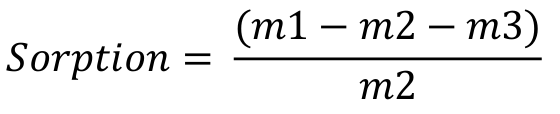 (1)
(1)where:
m1 = sorbent mass (g) + oil (g)
m2 = sorbent mass (g)
m3 = filter mass (g) + oil (g)
Statistical analysis
The experimental design was completely randomized in factorial arrangement with three factors: two biosorbents (tested with the diesel and biodiesel oils), six exposure times, four granulometries with three repetitions per treatment.
The experimental data were submitted to analysis of variance (ANOVA) and, afterwards, to the Tukey Test with significance level of 5%. The software Statistica 7.0 and graphical plot were used in the statistical analysis.
Results and discussion
he curauá fiber presents an ash content inferior to the peat’s, due to the different characteristics and origins of both materials (Table 1). The high ash content present in peat is related to the mineral content of the plants that originate it, as well as the feeding waters of the peateries, which bring minerals in solution or in dispersion, or even in the very own substratum above which the deposit is formed (Toledo, 1999). Ribeiro, Smith, and Rubio (2000) determined an ash content of 9.8% for peat, lower than the content determined in this study (15.2%), however, the peat with ash content between 10 and 15% is considered pure (Moraes, 2001).
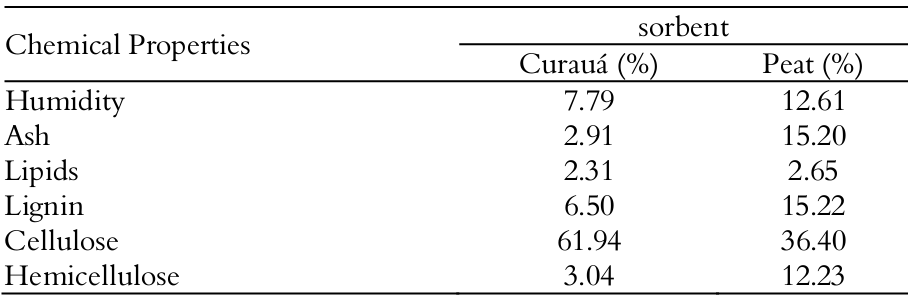
For the curauá fiber, contents of lignin, cellulose and hemicellulose of 6.50, 61.94 and 3.04%, respectively (Table 1) were determined. These contents are close to the ones found in the literature; for lignin (1.0-7.5%), cellulose (69.0-74.1%) and hemicellulose (9.9-21.1%) (Satyanarayana, Guimarães, & Wypych, 2007; Santos & Girioli, 2008; Santos, Spinacé, Fermoselli, & De Paoli, 2009). Thus, the curauá fiber has a lignin and hemicellulose content lower than the peat.
The peat presented a higher hydrophobicity compared to the curauá fiber; 66.9 and 0.0%, respectively. The poor hidrofobicity of natural sorbents is because the free hydroxyl groups. Sun, Sun and Sun (2002) have demonstrated that acetylation of free hydroxyl groups in rice straw with acetic anhydride have a more hydrophobic characteristic. Sorbents with high hydrophobicity show a higher sorption, due to the sorbent’s affinity with the organical phase (Choi & Cloud, 1992; Lee et al., 1999; Ribeiro et al., 2000; Annunciado et al., 2005; Lim & Huang, 2007). However, the hydrophobicity is not the only factor that influences the sorption, for usually the sorption by fiber mechanism is ruled by sorption (absorption and adsorption), capilarity, or by the combination of the three of them (Choi & Moreau, 1993).
The sorption values for the unclassified samples submitted to sorption assays of diesel and biodiesel in times of 5, 10, 20, 40, 60 and 1440 min are presented in Table 2.
The mean sorption of diesel in the investigated times showed that the peat had a better performance than the curauá fiber, 1.23 g oil g fiber-1 and 1.12 g oil g peat-1, respectively. However, in the biodiesel sorption the curauá fiber was 36% higher than peat, (1.16 g oil g fiber-1 versus 0.85 g oil g peat-1) (Table 2). For both diesel sorption time sorbent differed only 1440 min where peat showed better performance. For biodiesel sorption two sorbents differ in the 5 min time the curauá fiber had a better performance. Paulauskiene, Jucike, Juscenko, and Baziuke (2014) studied five natural sorbents, the results of maximum sorption capacity of diesel belongs to peat, 6,334 g g-1 and sawdust has the lowest diesel sorption 1,628 g g-1.
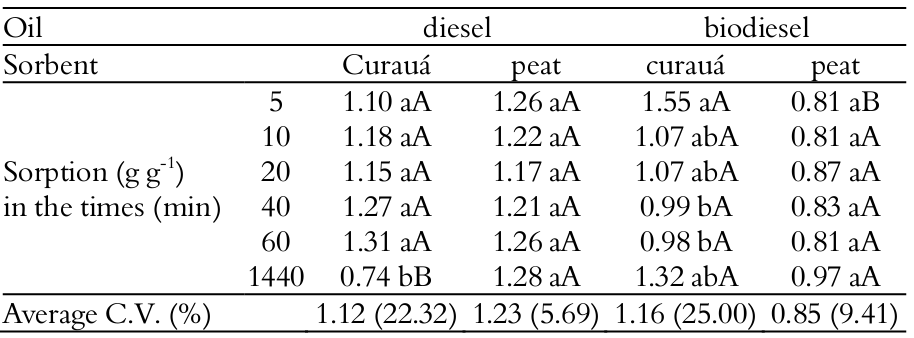
Means followed by the same lowercase letter in the column do not differ from each other at 5% probability by Tukey’s test. Means followed by the same capital letter in the line do not differ from each other at 5% probability by Tukey’s test.
The sorption analysis in the four granulometries £ 180; 180-425; 425-850 and 850-3350 mm, showed that the mean sorption of the diesel and biodiesel oils for the curauá and peat sorbents, for each granulometry, presented a significant difference in the biosorbent versus granulometry interaction (F = 9.272; p < 0.05) (Figure 1).
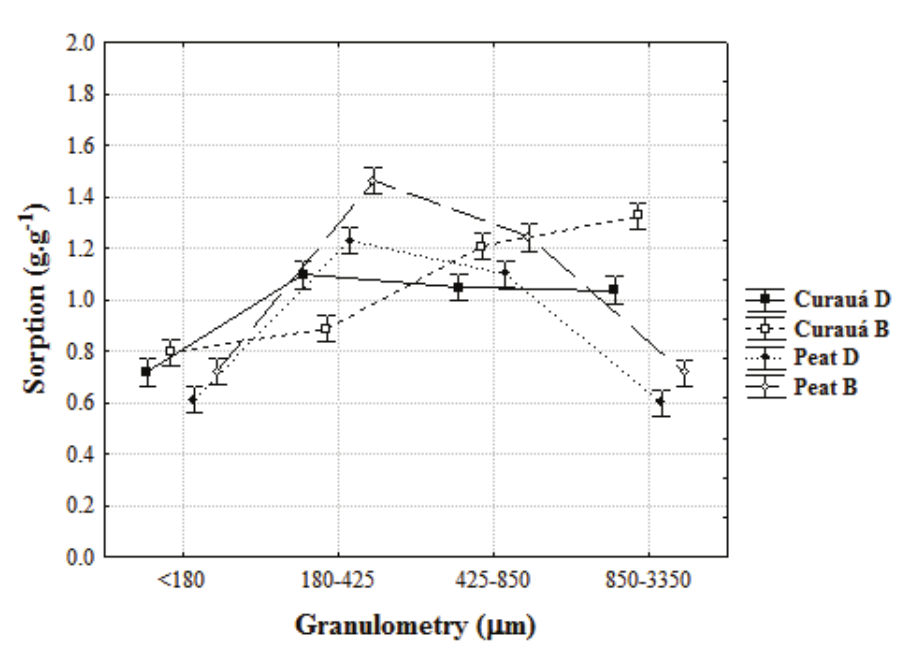
Figure 1
Mean sorption values of diesel and biodiesel and standard error regarding the sorbent’ granulometry (Curauá and Peat)
The sorbents’ behavior regarding the mean sorption of the diesel and biodiesel oils presented similar values in the granulometry £ 180 mm (Figure 1). The peat presented the highest mean sorption values for both oils in the granulometry 180-425 mm, decreasing with the granulometry’s increase. The curauá fiber increased the biodiesel sorption as the granulometry increased, and remained constant regarding the diesel sorption, but in the 850-3350 mm granulometry it presented a sorption of diesel and biodiesel of 1.05 g oil g fiber-1 and 1.35 g oil g fiber-1, respectively.
Lee, Han, and Rowell (1999) observed that the kenaf fiber had a sorption capacity of diesel between 2.34-6.36 g oil g fiber-1, and as this work that the sorption capacity increases with the increase of granulometry. Pore size is an important parameter for absorbent material as it affects the rate at which a fluid flows into or thorough a capillary network (Karan, Rengasamy, & Das 2011). In a series of vegetable materials investigated as sorbents of crude oil, the decrease in granulometry resulted in an increase in sorption capacity (Annunciado et al., 2005). Since the oil is more viscous as well as heavy, having a higher specific gravity, it goes on to the fiber and moves into the interior of the fibrous mass (Karan et al., 2011). The sorption is influenced by the viscosity of the oils, and the decrease in viscosity reduces the absorption inside the pores and capillaries, the crude oil presents a higher sorption of materials due to the adherence to their surfaces and inside the pores during the drainage (Teas et al., 2001).
When analyzing the biosorbent interaction, the exposure time to biodiesel and the granulometry, there was a significant difference (F = 3.45; p < 0.05). It was observed a distinct behaviour for each biosorbent regarding the mean biodiesel sorption (Figure 2). For the lowest granulometry it was verified a higher homogeneity of the sorption results of the oils in each time for the two investigated sorbents.
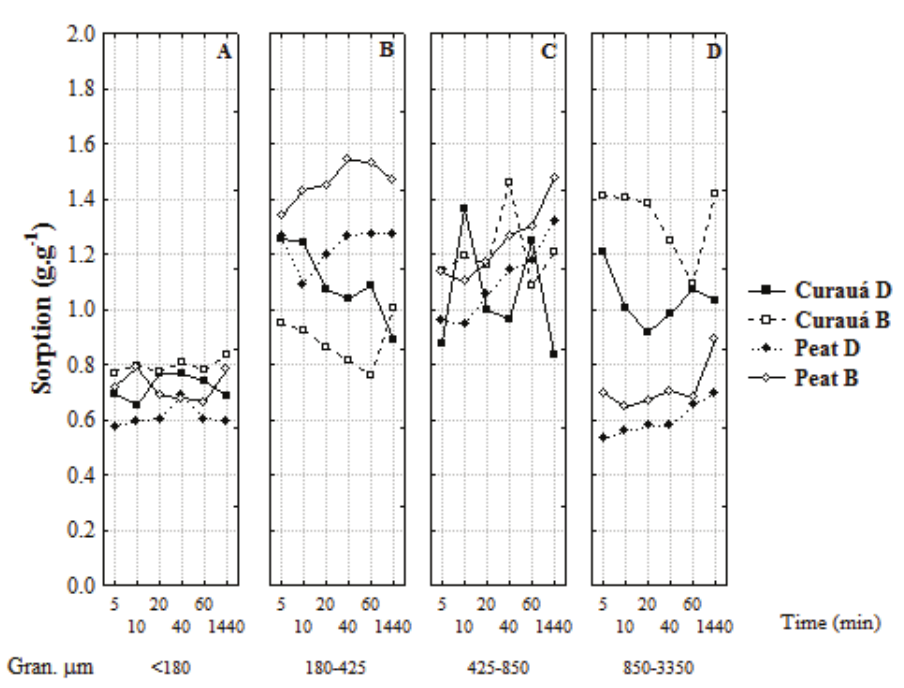
Figure 2
Mean sorption values of diesel and biodiesel regarding the granulometry and time of exposure for the following sorbents: curauá fiber and peat. A) ≤ 180 μm; B) 180-425 μm; C) 425-850 μm and D) 850-3350 μm
For the curauá’s highest granulometry it is verified a decrease in the biodiesel sorption in the times 40 and 60 min, which increases again in the time 1440 min (Image 2D). The oil with higher viscosity tends to have higher initial sorption ratio (Wei, Mather, Fotheringham, & Yang, 2003). When comparing the sorption capacity, in the granulometry 180-425 mm, the peat was more effective in all the times (Figure 2B).
Ferla-Oliveira, Leão, Caraschi, Oliveira, and Gonçalçves (2011) verified that for the coconut fiber the increase in granulometry positively influenced the increase in the sorption of the diesel and biodiesel oils. The granulometry control contributes to a good performance of the sorbents, besides, the sorption is dependent on their superficial area (Annunciado et al., 2005).
The curauá fiber, in its highest granulometry, was 31% more effective for the diesel sorption, and 40% for the biodiesel sorption. Saito, Ishii, Ogura, Maemura, and Suzuki (2003) found that for the Sugi Bark fiber, the 600 mm size was 50% more effective than the fiber with 53 mm, after 15 min of immersion.
Upon approval by the competent environmental authority, after usage, the sorbents must be collected and sent for proper disposal (Lopes, Milanelli, & Gouveia, 2005). When not reused, the sorbents are incinerated. Due to the sorbents’ energetic content and the sorbed oils, in Table 3 are presented the results of the Calorific Power of the sorbents, in natura and after sorption of the diesel and biodiesel oils in the time of 60 min. The time of 60 min was chosen because for diesel and biodiesel sorption by sorbents unclassified have no significant difference in sorption up to this time.

The peat presented calorific power of 16823.6 kJ kg-1 and, according to Moraes (2001), it can be considered a fuel when the calorific power is higher than 14653.8 kJ kg-1. The curauá fiber in natura presented a calorific power higher than peat. After the oils (diesel and biodiesel) sorption, were found higher calorific power values for peat, since the oils (diesel and biodiesel) sorption by peat was higher (Table 2).
Conclusion
From the results, it is possible to conclude that the curauá fiber without granulometric classification presents a diesel sorption similar to the commercial peat sorption, in the biodiesel sorption the curauá fiber was 36% higher than peat. The peat showed the highest mean sorption values of both oils in the granulometry of 180-425 mm, decreasing with the granulometry’s increase. With the granolumetry’s increase, the curauá fiber had an increase in the biodiesel sorption and remained constant regarding the diesel sorption. The calorific power of the sorbents after sorption was higher due to the sorbed oil
References
Adebajo, M. O., Frost, L. R., Kloprogge, J. T., Carmody, O., & Kokot, S. (2003). Porous materials for oil spill cleanup: a review of synthesis and absorbing properties. Journal of Porous Materials, 10(3), 159-170.
Aguilera, F., Méndez, J., Pásaro, E., & Laffon, B. (2010). Review on the effects of exposure to spilled oils on human health. Journal of Applied Toxicology, 30(4), 291-301.
Annunciado, T. R., Sydenstricker, T. H. D., & Amico, S. C. (2005). Experimental investigation of various vegetable fibers as sorbent materials for oil spills. Marine Pollution Bulletin, 50(11), 1340-1346.
Associação Brasileira de Normas Técnicas. (1984). NBR 8633: Carvão vegetal: Determinação do poder calorífico - Método de ensaio. Rio de Janeiro, RJ: ABNT.
Choi, H. M., & Cloud, R. M. (1992). Natural sorbents in oil spill cleanup. Environmental and Science Technology, 26(4), 772-776.
Choi, H. M., & Moreau, J. P. (1993). Oil sorption behavior of various sorbents studied by sorption capacity measurement and environmental scanning. Microscopy Research and Technique, 25(5), 447-455.
Ferla-Oliveira, A., Leão, L. A., Caraschi, J. C., Oliveira, C. L., & Gonçalçves, J. E. (2011). Características físico-químicas, energética e desempenho da fibra de coco na sorção de óleos diesel e biodiesel. Revista Energia na Agricultura, 26(3), 1-13.
Franca, A. S., Oliveira, L. S., Nunes, A. A., & Alves, C. C. (2010). Microwave assisted thermal treatment of defective coffee beans press cake for the production of adsorbents. Bioresource Technology, 101(3), 1068-1074.
Hussein, M., Amer, A. A., & Sawsan, I. I. (2011). Heavy oil spill cleanup using law grade raw cotton fibers: Trial for practical application. Journal of Petroleum Technology and Alternative Fuels, 2(8), 132-140.
Inagaki, M., Konno, H., Toyoda, M., Moriya, K., & Kihara, T. (2000). Sorption and recovery of heavy oils by using exfoliated graphite Part II: Recovery of heavy oils and recycling of exfoliated graphite. Desalination, 128(3), 213-218.
Karan, C. P., Rengasamy, R. S., & Das, D. (2011). Oil spill cleanup by structured fibre assembly. Indian Journal of Fibre & Textile Research, 36(2), 190-200.
Lee, B. G., Han, J. S., & Rowell, R. M. (1999). Oil sorption by lignocellulosic fibers. In T. Sellers & N. A. Reichert (Ed.), Kenaf properties, processing and products
Lim, T. T., & Huang, X. (2007). Evaluation of kapok (Ceiba pentadra (L) Gaertn.) as a natural hollow hydrophobic-oleophilic fibrous sorbent for oil spill cleanup. Chemosphere, 66(5), 955-963.
Lopes, C. F., Milanelli, J. C. C., & Gouveia, J. L. M. (2005). Materiais absorventes. Revista Meio Ambiente Industrial, 53(1), 42-46.
Moraes, J. F. S. M. (2001). Turfa nos Estados de Alagoas, Paraíba e Rio Grande do Norte. Informe de recursos minerais, série oportunidades minerais, exame atualizado de projeto. Recife, PE: CPRM.
Paulauskienė, T., Jucikė, I., Juščenko, N., & Baziukė, D. (2014). The use of natural sorbents for spilled crude oil and diesel cleanup from the water surface. Water Air Soil Pollut, 225(1959), 1-12.
Peng, D., Lan, Z., Guo, C., Yan, C., & Dang, Z. (2013). Application of cellulase for the modification of corn stalk: Leading to oil sorption. Bioresource Technology, 137(1), 414-418.
Ribeiro, T. H., Rubio, J., & Smith, R. W. (2003). A dried hydrophobic aquaphyte as an oil filter for oil/water emulsions. Spill Science & Technology Bulletin, 8(5-6), 483-489.
Ribeiro, T. H., Smith, R. W., & Rubio, J. (2000). Sorption of oils by the nonlinving biomass of a Salvínia sp. Environmental and Science Technology, 34(24), 5201-5205.
Saito, M., Ishii, N., Ogura, S., Maemura, S., & Suzuki, H. (2003). Development and water tank tests of Sugi bark sorbent (SBS). Spill Science & Technology Bulletin, 8 (5-6), 475-482.
Salanitro, J. P., Dorn, P., Huesemann, M., Moore, K., Rhodes, I. A., Ricejackson, L., … Wisniewski, H. (1997). Crude oil hydrocarbon bioremediation and soil ecotoxicity assessment. Environmental and Science Technology, 31(6), 1769-1776.
Santos, P. A., & Girioli, J. C. (2008). Uso de fibras vegetais como agente de reforço para termoplásticos. Newsletters, 6(1), 4-12.
Santos, P. A., Spinacé, M. A. S., Fermoselli, K. K. G., & De Paoli, M. A. (2009). Efeito da forma de processamento e do tratamento da fibra de curauá nas propriedades de compósitos com Poliamida-6. Polímeros: Ciência e Tecnologia, 19(1), 31-39.
Satyanarayana, K. G., Guimarães, J. L., & Wypych, F. (2007). Studies on lignocellulosic fibers of Brazil. Part I: Source, production, morphology, properties and applications. Composites: Part A, 38(7), 1694-1709.
Sayed, S. A., & Zayed, A. M. (2006). Investigation of the effectiveness of some adsorbent materials in oil spill clean-ups. Desalination, 194(1-3), 90-100.
Silva, D. J., & Queiroz, A. C. (2002). Análise de alimentos: métodos químicos e biológicos. Viçosa, MG: UFV.
Srinivasan, A., & Viraghavan, T. (2008). Removal of oil by walnut shell media. Bioresource Technology, 99(17), 8217-8220.
Sun, X. F., Sun, R., & Sun, J. X. (2002). Acetylation of rice straw with or without catalysts and its characterization as a natural sorbent in oil spill cleanup. Journal of Agriculture and Food Chemistry, 50(22), 6428-6433.
Teas, C., Kalligeros, S., Zanikos, F., Stournas, S., Louis, E., & Anastopoulos, G. (2001). Investigation of the effectiveness of sorbent materials in oil spills clean up. Desalination, 140(3), 259-264.
Technical Association of Pulp and Paper Industry. (2000a). T211 om-93. Ash in wood. Atlanta, GA: Tappi. CD-ROM.
Technical Association of Pulp and Paper Industry. (2000b). T222 om-98. Lignin in wood. Atlanta, GA: Tappi. CD-ROM.
Technical Association of Pulp and Paper Industry. (2000c). T249 cm-00. Holocellulose in wood. Atlanta, GA: Tappi. CD-ROM.
Technical Association of Pulp and Paper Industry. (2000d). T264 cm-97. Preparation of wood for chemical analysis. Atlanta, GA: Tappi. CD-ROM.
Toledo, L. M. A. (1999). Considerações sobre a turfa no Brasil. Akrópolis Revista de Ciências Humanas da Unipar, 7(28), 27-41.
Wei, Q. F., Mather, R. R., Fotheringham, A. F., & Yang, R. D. (2003). Evaluation of nonwoven polypropylene oil sorbents in marine oil-spill recovery. Marine Pollution Bulletin, 46(3), 780-783.
Wu, B., & Zhou, M. H. (2009). Sorption of styrene from aqueous solutions with oil absorptive resin. Journal of Environmental Management, 90(1), 217-221.
Wu, D., Fang, L., Qin, Y., Wu, W., Mao, C., & Zhu, H. (2014). Oil sorbents with high sorption capacity, oil/water selectivity and reusability for oil spill cleanup. Marine Pollution Bulletin, 84(1-2), 263-267.
Author notes
adrianaferla@ufpr.br