Tecnologia de Alimentos
Evaluation of chemical characteristics and correlation analysis with pulp browning of advanced selections of apples grown in Brazil
Avaliação das características químicas e análises de correlação com o escurecimento da polpa de seleções avançadas de maças cultivadas no Brasil
Evaluation of chemical characteristics and correlation analysis with pulp browning of advanced selections of apples grown in Brazil
Acta Scientiarum. Technology, vol. 39, no. 1, pp. 103-110, 2017
Universidade Estadual de Maringá

This work is licensed under Creative Commons Attribution-NonCommercial-NoDerivs 4.0 International.
Received: 22 May 2015
Accepted: 11 September 2015
Abstract: In this research, the total phenolic content (TPC) and antioxidant capacity (FRAP and DPPH•× assays) of pulps and peels of advanced selection of apples grown in Brazil were investigated. The correlation analyses between the activity of polyphenoloxidase enzyme (PPO), vitamin C content, total titratable acidity, and color parameters were performed. The results indicated that the data differed significantly among the apple genotypes studied. The peels of the selection Epagri 170-91 and Epagri 170-25 showed the highest TPC and antioxidant capacities. In addition, the pulps of the Epagri 170-91 presented the highest TPC and antioxidant capacities, the lowest enzymatic browning, highest amount of vitamin C and lowest enzymatic activity when compared with other genotypes. The TPC and antioxidant capacities were significantly correlated in all genotypes analyzed. High correlation values between enzymatic browning and factors that affect the apple color were also found in all analyzed pulps, except between enzymatic browning and TPC. The results demonstrated that the enzymatic browning and TPC, as well as the antioxidant capacity and chemical characteristics, vary considerably depending on the apple genotypes and fruit tissues analyzed.
Keywords: Antioxidant capacity, phenolic compounds, enzymatic browning, polyphenoloxidase enzyme, apple genotypes.
Resumo: Neste trabalho, o conteúdo de fenólicos totais (CFT) e a capacidade antioxidante (ensaios FRAP e DPPH•) de polpas e cascas de seleções avançadas de maçã cultivadas no Brasil foram investigados. Análises de correlação entre a atividade da enzima polifenoloxidase (PPO), o teor de vitamina C, acidez titulável e parâmetros de cor foram realizadas. Os resultados indicaram diferença significativa entre os diferentes genótipos de maçã estudados. As cascas das seleções Epagri 170-91 e Epagri 170-25 apresentaram os maiores resultados para CFT e capacidade antioxidante. Além disso, a polpa da seleção Epagri 170-91 apresentou os melhores resultados de CFT e capacidade antioxidante, além do menor escurecimento enzimático, maior teor de vitamina C e menor atividade enzimática quando comparada com as polpas de outros genótipos. A capacidade antioxidante e o CFT foram significativamente correlacionados em todos os genótipos analisados. Valores elevados de correlação entre escurecimento enzimático e fatores que afetam a cor da maçã também foram encontrados em todas as polpas analisadas, exceto entre escurecimento enzimático e CFT. Os resultados demonstraram que o escurecimento enzimático e o CFT, bem como a capacidade antioxidante a as características químicas, variam consideravelmente dependendo do genótipo de maçã e da parte da fruta analisada.
Palavras-chave: capacidade antioxidante, compostos fenólicos, escurecimento enzimático, enzima polifenoloxidase, genótipo de maçã.
Introduction
Over the last few years, epidemiological studies have shown a close relationship between a diet rich in fruits and vegetables, and the reduction of chronic and cardiovascular risks. This protective effect can be attributed mainly to the antioxidants, which are compounds that help to prevent the cellular damages such as, cancer, inflammation,atherosclerosis, and aging, which are caused by free radicals and reactive species of oxygen and nitrogen present in human body (Barros, Ferreira, & Genovese, 2012; Boroski et al., 2011). In natural foods there are several phytochemical compounds which can act like antioxidants. Among theses compounds, the most found are polyphenols, vitamin C, carotenoids and tocopherols (Boyer & Liu, 2004; Sun, Xu, Zhang, Hu, & Zeng, 2011)
Apple (Malus domestica Borkh) is an important source of monosaccharides, minerals, dietary fiber, and also of biologically active compounds, such as vitamin C and phenolic compounds, which act like natural antioxidants (Minussi et al., 2003). The benefic effects of apple to the health are many, and from the epidemiological studies confirmed that the apple plays an important role in the reduction of chronic disease risks, helping to keep a healthy life (Wu et al., 2007).
Due to its benefits, the apple is one of fruits most widely accepted by population; however, researches have shown that phenolic compounds presented in the fruits also is related to sensory characteristics, as astringent and bitter flavors, color and enzymatic browning (Alper & Acar, 2004; Drogoudi & Pantelidis, 2011). The apple, after cutting, it is carried to deterioration, which is caused by enzymatic browning, becoming it inappropriate for consumption due to the formation of dark color. The enzymatic browning reaction occurs due to presence of the polyphenoloxidase enzyme (PPO) that catalyzes the oxidation reaction of phenolic compounds (Eissa, Fadel, Ibrahim, Hassan, & Elrashid 2006; Oliveira, Soares, Paula, & Viana 2008). This reaction has a large negative impact on the quality of apples and their derivatives, because it results in changes on flavor, appearance, and other organoleptic properties (Pristijono, Wills, & Golding, 2006).
In recent years there has been growing interest in development of new apple cultivars (advanced selections) in order to obtain fruits that are resistant to pests and diseases, and which have low production cost and better nutritional quality (Furlan, Dantas, Denardi, Becker, & Mantovani, 2010). Thereby, due to the need for information on the characteristics of the bioactive compounds and the quality of new fruit cultivars, the aim of the present study was to evaluate the antioxidant capacity, TPC, and the characteristic of enzymatic browning of advanced apple selections, comparing with three marketed and known cultivars, and to perform the analyses of correlation between the obtained data.
Material and methods
Samples
The apple samples (2 kg of each label) were acquired from the Experimental Station of Agricultural Research and Rural Extension of Santa Catarina (Portuguese acronym EPAGRI), located in Caçador city, Santa Catarina State, Brazil (26° 49’ 9.56” S and 50° 59’ 6.77” W). Seven apple genotypes of advanced selections were labeled as: Epagri-170/25, Epagri-170/40, Epagri-170/65, Epagri-170/91, Epagri-M11/00, Epagri-M3/02, and Epagri-M15/07, plus three cultivars apple samples, Monalisa, Jazz and Daiane were collected at commercial harvest time.
Extraction of antioxidant compounds
Extractions were performed using 2.5 g of lyophilized sample and 25.0 mL of aqueous acetone 80%, under magnetic stirring for 1h, protected from light, and at room temperature. Then, solutions were centrifuged (6535 g) during 15 min., and supernatant was collected and transferred to a 50.0 mL volumetric flask, completing the volume. The solutions were stored in the refrigerator (-18ºC) for later analyses. The sample extract solutions were used for determination, in triplicate, of total phenolic contents and antioxidant capacities, using FRAP and DPPH• methods.
Total phenolic content (tpc) and antioxidant capacity
The total phenolic contents (TPC) of the samples were determined from the Folin-Ciocalteu method, according to the methodology reported by Singleton and Rossi (1965). Determination of antioxidant capacity from the DPPH• assay was performed according to Ma et al. (2011). The method of the ferric reduction antioxidant power (FRAP) was carried out according to Benzie and Strain (1996).
Activity of polyphenoloxidase enzyme (PPO)
The enzyme extract was obtained according to the methodology reported by Jang and Moon (2011). Apple pulps (25.0 g) were crushed with 50.0 mL of phosphate buffer solution (50.0 mmol L-1, pH 5.0) and 2.5 g of polyvinylpyrrolidone (PVP) for 2 min. The mixture was filtered and then centrifuged (6535 g) during 30 min., at 4ºC. The supernatant solution was used as enzyme extract for further analyses. The PPO activity was determined according to the methodology described by Gawlik-Dziki, Szymanowska, and Baraniak (2007).
Vitamin C content
The vitamin C content in the apple pulps was determined by applying the titration method with 2,6-dichlorophenolindofenol Association of Official Analytical Chemists (AOAC, 1997). Fresh apple sample (15.0 g), previously homogenized, was mixed with 50.0 mL of oxalic acid solution (1%). The mixture was titrated with 2,6-dichlorophenolindofenol solution (0.02%), and the endpoint of the titration was considered as the point where the solution showed a persistent pink color. The results were expressed in mg of ascorbic acid per 100 g of sample fresh weight (mg AA 100 g-1 FW).
Total titratable acidity (TTA)
The determination of TTA was performed according to the methodology reported by Carvalho, Mantovani, and Carvalho (1990). 10.0 g of the apple pulps were crushed with distilled water for 2 min., and the resultant solution was transferred to a 100 mL volumetric flask, having its volume completed with distilled water. This solution was titrated with 0.1 mol L-1 NaOH solution, using phenolphthalein as indicator, until the pink color was obtained. The TTA was expressed in g of malic acid per 100 g of sample fresh weight (g MA 100 g-1 FW).
Color analyses
The color of apple pulp surfaces were analyzed by the use of a colorimeter (MiniScan EZ, Model MSEZ0231), according to the system recommended by CIE (L*, a* and b*), where L* indicates brightness from white to black, a* indicates the chromaticity axis from green (-) to red (+), and b* the chromaticity axis from blue (-) to yellow (+). Four longitudinal slices were cut and peeled from each apple, and the core portion was discarded (Holderbaum, Kon, Kudo, & Guerra, 2010). For each sample, the color was measured immediately after cutting and after 12 hours of exposure to the light and atmospheric air. All measurements were performed in triplicate, and the color expressed about the coordinates L*, a* e b*. The browning of samples (ΔE) was calculated from the equation 1 (Guerra, Romagnoli, & Vignali, 2012).
 [Equation 1]
Statistical analysis
All data were expressed as result averages along with its standard deviations of three replicates. The data were submitted to variance analysis (ANOVA) followed by tukey’s test using the software STATISTIC 7.0 (StatSoft). Differences at the 5% level (p < 0.05) were considered statistically significant.
Results and discussion
TPC and antioxidant capacity
Antioxidant capacity of fruits and vegetables is an important indicator of their potential in vitro as health promoters (Barros et al., 2012). The antioxidant compounds most commonly found in apple consist of the procyanidins, catechin, epicatechin, chlorogenic acid, phloridzin, and the quercetin conjugates. In the apple pulps, there is some catechin, procyanidin, epicatechin, and phloridzin, but these compounds are found in much lower concentrations than in the peels (Boyer & Liu, 2004). Due to the importance of compounds responsible by the antioxidant capacity, several assays have been applied to evaluate the antioxidant capacity in vitro from different matrices. Especially for vegetables analysis, FRAP and DPPH• assays are the most commonly applied (Barizão et al., 2013; Roginski & Lissi, 2005). In respect to phenolic compound contents the main employed methodology is the Folin-Ciocalteu reagent (Pérez-Jiménez et al., 2008). Figure 1 shows the antioxidant capacities and TPC for pulps and peels of different apple samples. According to Figure 1, it can be observed that the antioxidant capacity obtained by both employed methodologies were higher for the peels than the apple pulps. This is in agreement with the TPC values, which showed the highest values for the peels in all evaluated genotypes. These results are in agreement with other authors (Barros et al., 2012; Carbone, Giannini, Picchi, Scalzo, & Cecchini, 2011; Vieira et al., 2011; Guimarães, Souza, & Ferreira, 2010). The peels can contain high content of these compounds because they are found in external part of the fruits, thus they are more predisposed to the synthesis of phenolic compounds than the internal parts, such as the pulps, and they act as protection agents of vegetables and fruits against pathogens, predators, and UV radiation (Naczk & Shahidi, 2006).
The result shows that antioxidant capacity values of the apple pulps by FRAP and DPPH• assays ranged from 4.3 to 8.6 mmol Fe2+ 100 g-1 DW (Figure 1a) and from 1.3 to 5.1 mmol TE 100 g-1 DW (Figure 1b), respectively. TPC values ranged from 401.8 to 674.2 mg GAE 100 g-1 DW for the different apple genotypes (Figure 1c). Additionally, the apple peels showed antioxidant capacity values which ranged from 16.1 to 49.6 mmol Fe2+ 100 g-1 DW by the FRAP assay (Figure 1a), and from 7.1 to 92.2 mmol TE 100 g-1 DW by the DPPH• assay (Figure 1b), while TPC values ranged from 1086.7 to 3735.2 mg GAE 100 g-1 DW (Figure 1c).
Significant differences (p < 0.05) of the antioxidant capacity values and phenolic contents were observed between the apple genotypes. The best results were obtained for the selections Epagri-179/91, Epagri-170/25 and Epagri-M3/02 for both pulps and peels. On the other hand, the lowest values were observed for the pulps of genotypes Monalisa, Daiane and Epagri-170/65, while the genotypes Jazz and Epagri M11/00 showed lowest results for the peels. McGhie, Hunt, and Barnett, (2005) reported that the growing site may also influence in the composition of apple phenolic compounds and its antioxidant capacity. However, in this study the ten apple genotypes were grown in the same place, and using the same techniques. Thus, the results obtained in this study shown that the apple cultivar was the main responsible for the difference in the biosynthesis of phenolic compounds.
The high values of TPC collaborates for the highest antioxidant capacity values in the peels, once the phenolic compounds are considered the largest class of antioxidants found in fruits and vegetables (Hervert-Hernández, García, & Goñi, 2011; Rockenbach et al., 2011). This can be proved through the correlation analyses between TPC and antioxidant capacities (Figure 2). The high values of Pearson’s correlation coefficient (R ) show the contribution of phenolic compounds for the antioxidant capacity.
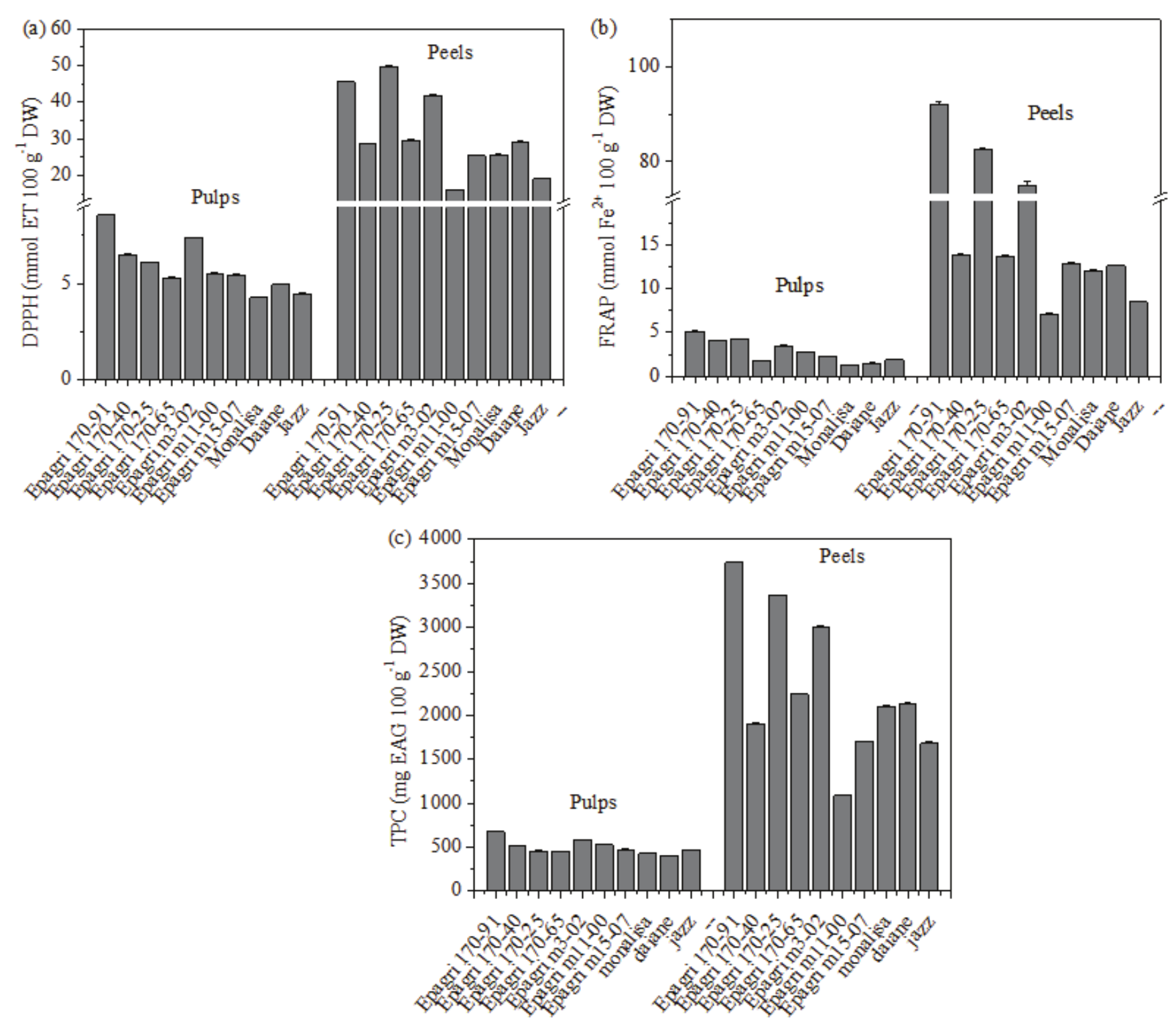
Figure 1.
Antioxidant capacities by DPPH• (a) and FRAP (b) assays, and TPC (c) of the pulps and peels of apples.
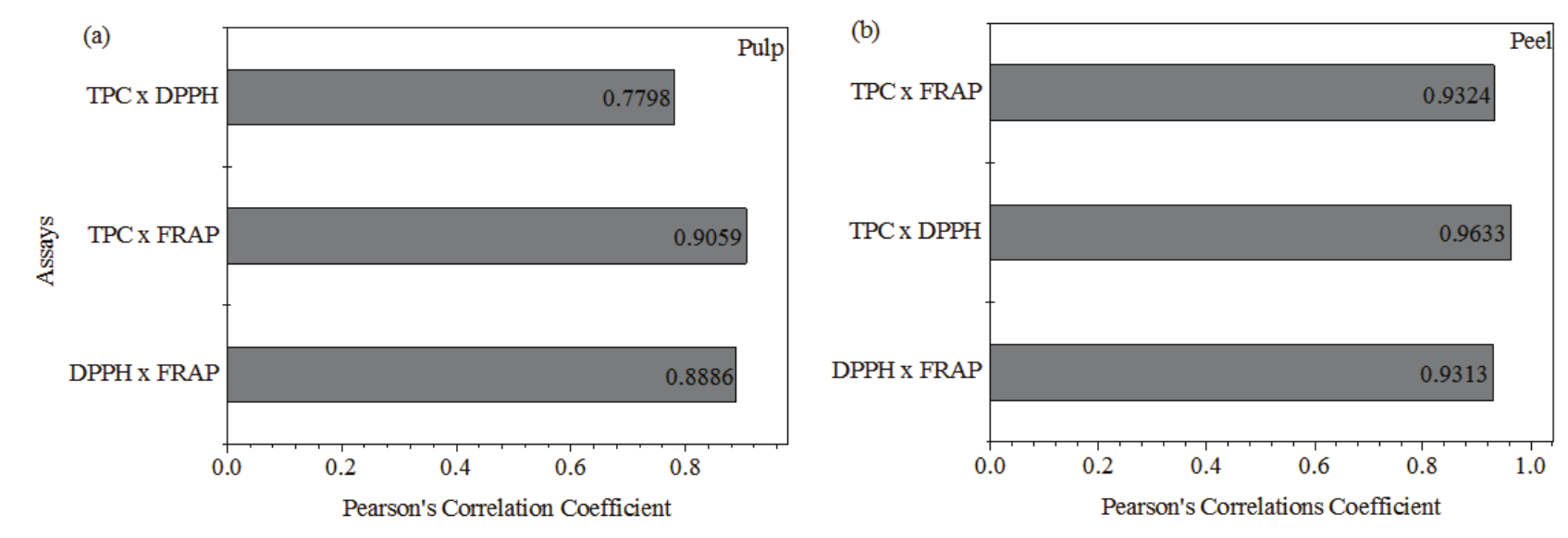
Figure 2
Values of Person’s correlation coefficient for the analyses of DPPH•, FRAP and TPC in the (a) pulps and (b) peels of apples.
Evaluation of color and pulp darkening
The surface color of apple pulp is the most important quality attribute, which directly influences consumer acceptance and the fruit appearance (Vieira et al., 2009). Figure 3 shows the color parameters L*, a*, and b* of apple pulps immediately after cutting and after 12h of light and atmospheric air. Figure 3a shows that initial values of parameter a* were low, and that after the exposure to air, they increased significantly for most of the analyzed samples. This demonstrates that there is a tendency of the pulps to red color, indicating that all of them were darkened. Among the sample results, the selection Epagri 170/25 showed the smallest variation of parameter a* (-0.67), followed by selections Epagri 170/91 (+4.40), Epagri 170/40 (+8.07), and Epagri 179/65 (+8.43). The small variation of this parameter can be an indication of a low browning. On the other hand, negative values for parameter b* indicates a tendency to blue color, while positive values are an indicative for the yellow color. This shows that there is a tendency of all pulps to the yellow color, which is characteristic of apple pulps (Guerra et al., 2012).
The parameter L* values range from 0 to 100 and indicate the brightness of a matrix. L* values close to 100 means that the samples are clear, and values close to 0 means that the samples show dark coloration. In the present study, the pulps of all genotypes showed high initial values (> 50), as was expected, once the apples have a clear natural coloration. After analysis time, the parameter L* values decreased significantly (Figure 3c).
Table 1 shows values of browning variation (ΔE) for all selections/cultivars analyzed. According to results, the selections Epagri 170/25 and Epagri 170/91 showed lower values of ΔE. This feature of higher resistance to browning is important, because it changes the appearance of fruits and modifies its organoleptic properties, rendering them unfit for consumption (Haminiuk, Oliveira, Baggio, & Masson, 2005).
The browning of apples is resultant of a reaction from the PPO action, which catalyzes the oxidation reaction of phenolic compounds, promoting the formation of melanin and brown pigments, when the apples are exposed to atmospheric air (Queiroz Silva, Lopes, Fialho, & Valente-Mesquita, 2011). However, browning reaction of apples may be related to endogenous factors, such as: PPO activity, substrate concentration (phenolic compounds), presence of acid substances (malic acid), and protector agents (Vitamin C) (López-Nicolás, Núñes-Delicado, Sánchez-Ferrer, & García-Carmona, 2007). So, analyses of PPO activity, total titratable acidity (TTA), and vitamin C content were performed for pulps of all studied genotypes (Table 1).
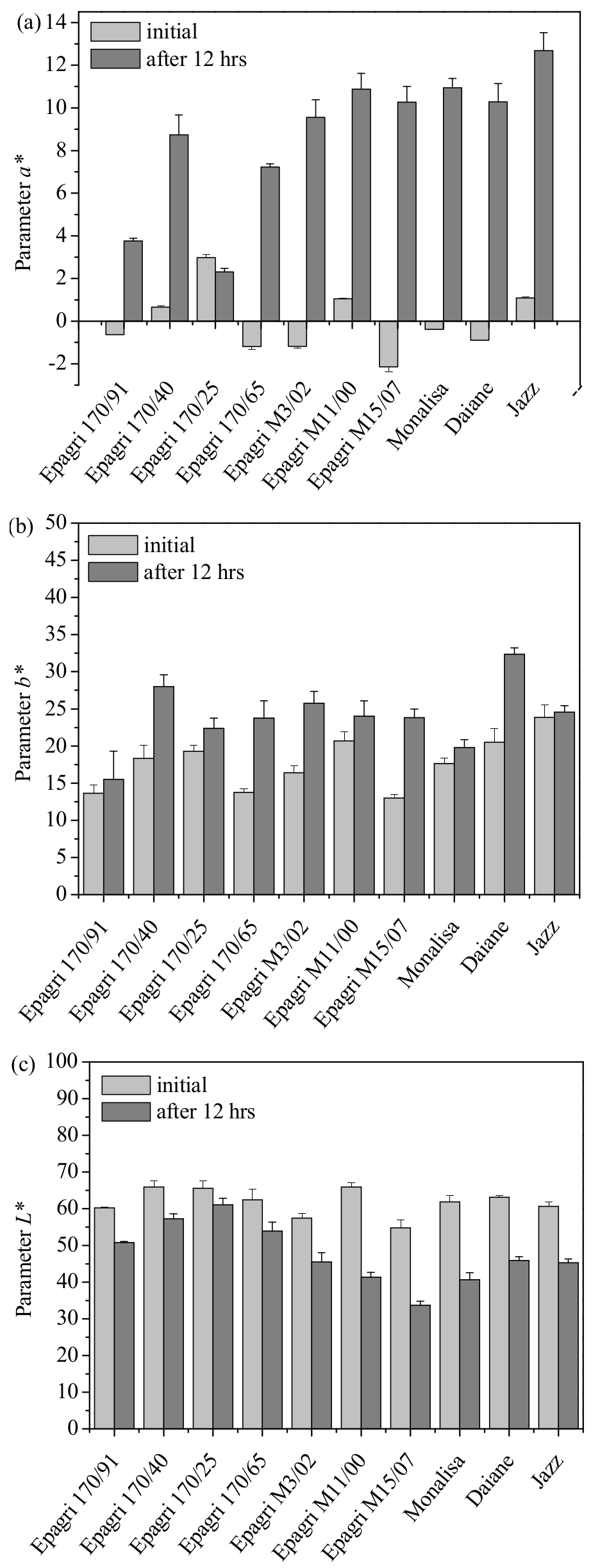
Figure 3.
Color parameters a* (a), b* (b) and L* (c) of the apple pulps, after cutting and after 12h of exposure to the light and atmospheric air.
| Genotype | ∆E | PPO (U g-1) | TTA (g MA 100 g-1 FW) | Vitamin C (mg AA 100 g-1 FW) |
| Epagri-170/91 | 11.19 b ± 0.63 | 7.30ab ± 0.83 | 0.61a ± 0.02 | 4.46b ± 0.08 |
| Epagri-170/40 | 16.62 c ± 0.83 | 11.3bc ± 1.15 | 0.42c ± 0.01 | 3.44c ± 0.11 |
| Epagri-170/25 | 5.12 a ± 0.02 | 5.73a ± 0.46 | 0.52b ± 0.03 | 7.79a ± 0.07 |
| Epagri-170/65 | 16.77 cd ± 0.96 | 7.3ab ± 0.83 | 0.37d ± 0.02 | 2.79d ± 0.13 |
| Epagri-M3/02 | 18.65 cd ± 0.19 | 16.7de ± 1.15 | 0.16f ± 0.003 | 2.00ef ± 0.10 |
| Epagri-M11/00 | 26.77 f ± 0.48 | 18.9e ± 1.85 | 0.11g ± 0.004 | 1.56f ± 0.04 |
| Epagri-M15/07 | 26.81 f ± 1.07 | 22.0f ± 2.00 | 0.22e ± 0.004 | 2.37de ± 0.10 |
| Monalisa | 24.24 ef ± 0.82 | 12.7cd ± 1.15 | 0.24e ± 0.004 | 1.74f ± 0.05 |
| Daiane | 23.74 e ± 1.92 | 21.3f ± 2.31 | 0.25e ± 0.004 | 2.50d ± 0.14 |
| Jazz | 19.31 d ± 0.54 | 16.7de ± 1.15 | 0.36d ± 0.004 | 3.84c ± 0.40 |
As can be seen, the values of PPO activity, TTA, and Vitamin C content presented significant differences (p < 0.05) among the studied genotypes. TTA values ranged from 0.11 to 0.61 g MA 100 g-1 FW and the Vitamin C content from 1.56 to 7.79 mg AA 100 g-1 FW, which is in agreement with the data reported in the literature for apple analyses (Chagas et al., 2012; Czelusniak, Oliveira, Nogueira, Silva, & Wosiacki, 2003; Drogoudi, Michailidis, & Pantelidis, 2008). The highest values of TTA and Vitamin C content were found for the selections Epagri 170/25 and Epagri 170/91, which consequently, showed the lowest PPO activity values. The low values of PPO activities are in agreement with ΔE values determined for these genotypes
Correlation analysis
The values of PPO activity, TTA, TPC and Vitamin C content were correlated with ΔE values, and evaluated from the Pearson’s correlation coefficients (R ) (Figure 4). According to results, ΔE showed significant negative correlations with Vitamin C content and TTA (R >-0.85). This suggests that Vitamin C amount and the TTA level delay the apple pulps browning due to the inhibition of PPO activity (Lee, Lee, & Park, 2007). This observation agrees with negative correlations between PPO x Vitamin C content (R = -0.6395) and PPO x TTA (R = -0.7532), indicating that high levels of TTA and Vitamin C decrease the PPO activity in apple pulps. Similar results have been reported by Kim, Brecht, and Talcott (2007), who worked with Mangifera indica L. The positive correlation between PPO x ΔE evidence that PPO is the major responsible by pulp browning of the analyzed apples. This occurs because PPO catalyzes the oxidation reaction of phenolic compounds (Queiroz et al., 2011). Additionally, a low and negative correlation was found between TPC x ΔE (R = -0.3165), showing that the phenolic compounds do not contribute significantly for pulp browning.
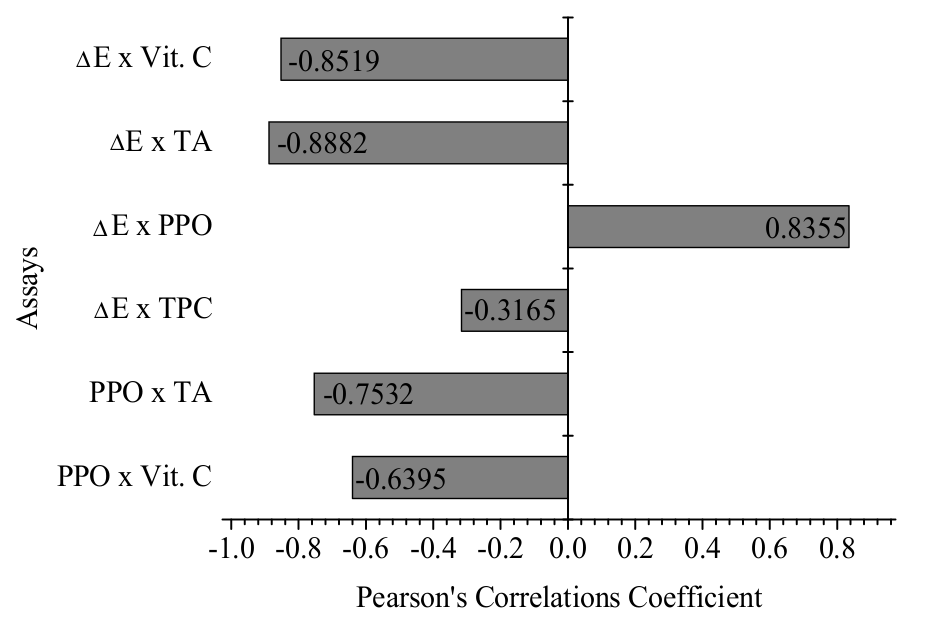
Figure 4.
Pearson’s correlation coefficients for the values of PPO activity, TTA, TPC and Vitamin C content with browning variation values (ΔE).
Conclusion
Phenolic compounds contribute significantly for antioxidant capacity determined in peels and pulps of apples. Significant differences (p < 0.05) between the analyses confirmed that apple genotypes and the studied parts are determining for composition of bioactive compounds in apples, being the peels responsible by the highest values of total phenolic and antioxidant capacity. The peels and pulps of the selections Epagri-170/91 and Epagri-170/25 showed high values of TPC and antioxidant capacity, and the best results for TTA, Vitamin C content and PPO analyses. In addition, the selections Epagri-170/25 and Epagri-170/91 were also resistant to browning. Correlation analysis between the factors that affect the apples color indicated that the Vitamin C may decrease the reaction of pulp browning through the inhibition of PPO, being its activity the main responsible by the browning of analyzed fruits.
Acknowledgements
The authors acknowelegde the financial support provided by Capes, CNPq and Fundação Araucária.
References
Alper, N., & Acar, J. (2004). Removal of phenolic compounds in pomegranate juices using ultrafiltration and laccase-ultrafiltration combinations. Nahrung, 48(3), 184-187.
Association of Official Analytical Chemists. (AOAC). (1997). Official methods of analysis of the AOAC. (2nd ed.). Washington, DC: AOAC.
Barizão, E. O., Martins, A. C., Ercoli, L., Kvitschal, M. V., Silva, R., Pezoti Junior, O., … Almeida, V. C. (2013). Extraction from flesh of new developed apple cultivar using response surface methodology. Food Analytical Methods, 6(5), 9-18.
Barros, H. R. M., Ferreira, T. A. P. C., & Genovese, M. I. (2012). Antioxidant capacity and mineral content of pulp and peel from commercial cultivars of citrus from Brazil. Food Chemistry, 134(4), 1892-1898.
Benzie, I. F. F., & Strain, J. J. (1996). The ferric reducing ability of plasma (FRAP) as a measure of “antioxidant power”: The FRAP Assay. Analytical Biochemistry, 239(1) 70-76.
Boroski, M., Aguiar, A. C., Boeing, J. S., Rotta, E. M., Wibby, C. L., Bonafé, E. G., … Visentainer, J. V. (2011). Enhancement of pasta antioxidant activity with oregano and carrot leaf. Food Chemistry, 125(2), 696-700.
Boyer, J., & Liu, R. H. (2004). Apple phytochemicals and their health benefits. Nutrition Journal, 3(5), 1-15.
Carbone, K., Giannini, B., Picchi, V., Scalzo, R., & Cecchini, F. (2011). Phenolic composition and free radical scavenging activity of different apple varieties in relation to the cultivar, tissue type and storage. Food Chemistry, 127(2), 493-500.
Carvalho, C. R. L., Mantovani, D. M. B., & Carvalho, P. R. N. (1990). Análises químicas de alimentos. Campinas, SP: Instituto de Tecnologia de Alimentos.
Chagas E., Chagas, P., PIO, R., Neto, J., Sanches, J., Carmo, S. A., ... Carvalho, A. S. (2012). Produção e atributos de qualidade de cultivares de macieira nas condições subtropicais da região Leste paulista. Ciência Rural, 42(10), 1764-1769.
Czelusniak, C., Oliveira, M. C. S., Nogueira, A., Silva, N. C. C., & Wosiacki, G. (2003). Qualidade de maçãs comerciais produzidas no Brasil: aspectos físicos-químicos. Brazilian Journal of Food Technology, 6(1), 25-31.
Drogoudi, P. D., Michailidis Z., & Pantelidis G. (2008). Peel and flesh antioxidant content and harvest quality characteristics of seven apple cultivars. Scientia Horticulturae, 115(2), 149-153.
Drogoudi, P. D., & Pantelidis, G. (2011). Effects of position on canopy and harvest time on fruit physico-chemical and antioxidant properties in different apple cultivars. Scientia Horticulturae, 129(4), 752-760.
Eissa, H. A., Fadel, H. H. M., Ibrahim, G. E., Hassan, I. M., & Elrashid, E. A. (2006). Thiol containing compounds as controlling agents of enzymatic browning in some apple products. Food Research International, 39(8), 855-863.
Furlan, C. R. C., Dantas, A. C. M., Denardi, F., Becker, W. F., & Mantovani, A. (2010). Resistência genética dos acessos do banco de germoplasma de macieira da epagir à mancha foliar de Glomerella (Colletotrichum gloeosporioides). Revista Brasileira de Fruticultura, 2(2), 507-514.
Gawlik-Dziki, U., Szymanowska, U., & Baraniak, B. (2007). Characterization of polyphenol oxidase from broccoli (Brassica oleracea var. botrytis italica) florets. Food Chemistry, 105(3), 1047-1053.
Guerra, L., Romagnoli, G., & Vignali, G. (2012). Extraction of Golden Delicious apple puree: Experimental comparison of three different methods. Journal of Food Engineering, 110(2), 169-174.
Guimarães, R., Sousa, M. J., & Ferreira, I. C. F. R. (2010). Contribution of essential oils and phenolics to the antioxidant properties of aromatic plants. Industrial Crops and Products, 32(2), 152-156.
Haminiuk, C. W. I., Oliveira, C. R. G., Baggio, E. C. R., & Masson, M. L. (2005). Efeito de pré-tratamentos no escurecimento das cultivares de maçã Fuji e Gala após o congelamento. Ciência e Agrotecnologia, 29(5), 1029-1033.
Hervert-Hernández, D., García, O. P., & Goñi, I. (2011). The contribution of fruits and vegetables to dietary intake of polyphenols and antioxidant capacity in a Mexican rural diet: Importance of fruit and vegetable variety. Food Research International, 44(5), 1182-1189.
Holderbaum, D. F., Kon, T., Kudo, T., & Guerra, M. P. (2010). Enzymatic browning, polyphenol oxidase activity, and polyphenols in four apple cultivars: Dynamics during Fruit Development. HortScience, 45(8), 1150-1154.
Jang, J., & Moon, K. (2011). Inhibition of polyphenol oxidase and peroxidase activities on fresh-cut apple by simultaneous treatment of ultrasound and ascorbic acid. Food Chemistry, 124(2), 444-449.
Kim, Y., Brecht, J. K., & Talcott, S. T. (2007). Antioxidant phytochemical and fruit quality changes in mango (Mangifera indica L.) following hot water immersion and controlled atmosphere storage. Food Chemistry, 105(4), 1327-1334.
Lee, M. Y., Lee, M. K., & Park, I. (2007). Inhibitory effect of onion extract on polyphenol oxidase and enzymatic browning of taro (Colocasia antiquorum var. esculenta). Food Chemistry, 105(2), 528-532.
López-Nicolás, J. M., Núñes-Delicado, E., Sánchez-Ferrer, A., & García-Carmona, F. (2007). Kinetic model of apple juice enzymatic browning in the presence of cyclodextrins: The use of maltosyl-b-cyclodextrin as secondary antioxidant. Food Chemistry, 101(3), 1164-1171.
Ma, X., Wu, H., Liu, L., Yao, Q., Wang, S., Zhan, R., … Zhou, Y. (2011). Polyphenolic compounds and antioxidant properties in mango fruits. Scientia Horticulturae, 129(1), 102-107.
Mcghie, T. K., Hunt, M., & Barnett, L. E. (2005). Cultivar and growing region determine the antioxidant polyphenolic concentration and composition of apples grown in New Zealand. Journal of Agricultural and Food Chemistry, 53(8), 3065-3070.
Minussi, R. C., Rossi, M., Bologna, L., Cordi, L., Rotilio, D., Pastore, G. M., & Durán, N. (2003). Phenolic compounds and total antioxidant potential of commercial wines. Food Chemistry, 82(3), 409-416.
Naczk, M., & Shahidi, F. (2006). Phenolics in cereals, fruits and vegetables: Occurrence, extraction and analysis. Journal of Pharmaceutical and Biomedical Analysis, 41(5), 1523-1542.
Oliveira, T. M., Soares, N. F. F., Paula, C. D. P., & Viana, G. A. (2008). Uso de embalagem ativa na inibição do escurecimento enzimático de maçãs. Semina: Ciências Agrárias, 29(1), 117-128.
Pérez-Jiménez, J., Arranz, S., Tabernero, M., Díaz-Rubio, M. E., Serrano, J., Goñi, I., & Saura-Calixto, F. (2008). Updated methodology to determine antioxidant capacity in plant foods, oils and beverages: Extraction, measurement and expression of results. Food Research International, 41(3), 274-285.
Pristijono, P., Wills, R. B. H., Golding, J. B. (2006). Inhibition of browning on the surface of apple slices by short term exposure to nitric oxide (NO) gas. Postharvest Biology and Technology, 42(3), 256-259.
Queiroz, C., Silva, A. J. R., Lopes, M. L. M., Fialho, E., & Valente-Mesquita, V. L. (2011). Polyphenol oxidase activity, phenolic acid composition and browning in cashew apple (Anacardium occidentale L.) after processing. Food Chemistry, 125(1), 128-132.
Rockenbach, I. I., Rodrigues, E., Gonzaga, L. V., Caliari, V., Genovese, M. I., Gonçalves, A. E. S. S., & Fett, R. (2011). Phenolic compounds content and antioxidant activity in pomace from selected red grapes (Vitis vinifera L. and Vitis labrusca L.) widely produced in Brazil. Food Chemistry, 127(1), 174-179.
Roginski, V., & Lissi, E. A. (2005). Review of methods to determine chain-breaking antioxidant activity in food. Food Chemistry. Food Chemistry, 92(2), 235-254.
Singleton, V. L., & Rossi, J. A. (1965). Colorimetric of total phenolics with phosphomolybdic-phosphotungstic acid reagents. American Journal of Enology and Viticulture, 16(3), 144-146.
Sun, Y., Xu, W., Zhang, W., Hu, Q., & Zeng, X. (2011). Optimizing the extraction of phenolic antioxidants from kudingcha made from Ilex kudingcha C. J. Tseng by using response surface methodology. Separation and Purification Technology, 78(3), 311-320.
Vieira, F. G. K., Borges, G. S. C., Copetti, C., Pietro, P. F., Nunes, E. C., & Fett, R. (2011). Phenolic compounds and antioxidant activity of the apple flesh and peel of eleven cultivars grown in Brazil. Scientia Horticulturae, 128(3), 261-266.
Vieira, F. G. K., Borges, G. S. C., Copetti, C., Amboni, R. D. M., Denardi, F., & Fett, R. (2009). Physico-chemical and antioxidant properties of six apple cultivars (Malus domestica Borkh) grown in southern Brazil. Scientia Horticulturae, 122(3), 421-425.
Wu, J.; Gao, H.; Zhao, L.; Liao, X.; Chen, F.; Wang, Z.; Hu, X. (2007). Chemical compositional characterization of some apple cultivars. Food Chemistry, 103(1), 88-93.
Author notes
vcalmeida@uem.br