Ciência, Tecnologia de Alimentos e Engenharia de Alimentos
Sensory perception in the replacement of NaCl by MSG in fish burgers
Percepção sensorial na substituição de NaCl por MSG em hambúrgueres de pescado
Sensory perception in the replacement of NaCl by MSG in fish burgers
Acta Scientiarum. Technology, vol. 39, 05, pp. 565-572, 2017
Universidade Estadual de Maringá

This work is licensed under Creative Commons Attribution 4.0 International.
Received: 07 July 2015
Accepted: 03 August 2016
Abstract: In meat products, sodium chloride (NaCl) simultaneously promotes different functionalities, such as modifying the osmotic pressure and the consequent reduction of microbial growth, solubilization of proteins and the improvement of sensory attributes. Although the recognized technological importance, there is increasing pressure to reduce sodium in food. Accordingly, strategies have emerged aiming at replacing part of the NaCl in food formulations, including the replacement of NaCl with monosodium glutamate (MSG). MSG is one of the compounds responsible for the fifth basic taste, also known as umami. The present study aimed to evaluate the sensory perception in the replacement of NaCl with MSG in different formulations of fish burgers through a ranking test and word association. The results indicated that it is possible to replace up to 50% NaCl with MSG without compromising the sensory quality of the fish product and that the cognitive word association technique proved to be an important tool in the perception of fish burgers formulated with different concentrations of NaCl and MSG.
Keywords: fish burger, ranking test, sensory profile, synergism, umami, word association.
Resumo: Cloreto de Sódio (NaCl) em produtos cárneos promove de forma simultânea diferentes funcionalidades, como modificação da pressão osmótica e consequente redução do desenvolvimento microbiano; solubilização das proteínas e melhoria de atributos sensoriais. Embora, haja o reconhecimento de sua importância tecnológica, há uma crescente pressão para a redução de sódio nos alimentos. Nesse sentido, estratégias surgem com o intuito de substituir parte do NaCl em formulações alimentícias. Entre essas, a substituição de NaCl por Monoglutamo de Sódio (MSG). MSG é um dos responsáveis pelo quinto gosto básico denominado de umami. O presente trabalho teve como objetivo avaliar a percepção sensorial na substituição de NaCl por MSG em diferentes formulações de hambúrguer de pescado por meio das técnicas-teste de ordenação e associação de palavras. Os resultados indicaram que é possível substituir em até 50% de NaCl por MSG sem que haja comprometimento da qualidade sensorial em produto de pescado e que a técnica cognitiva associação de palavras mostrou-se como importante instrumento na percepção de hambúrgueres de pescado formulados com diferentes concentrações de NaCl e MSG.
Palavras-chave: hambúrguer de pescado, teste de ordenação, perfil sensorial, sinergismo, umami, associação de palavras.
Introduction
Umami, the fifth taste, meaning ‘delicious’ in Japanese, was first defined as the characteristic taste elicited by glutamates, and has since also been associated with monosodium glutamate (MSG), and with disodium salts of the nucleotides inosine monophosphate (IMP), guanosine monophosphate (GMP) and adenosine monophosphate (AMP) (Fuke & Ueda, 1996, Gabriel, Kohmura, Kouda, Furuhata, & Kimura, 2012, Dang, Gao, Ma, & Wu, 2015).
Although defined as 'delicious', an aqueous solution of MSG is not considered pleasant and is often difficult for consumers to identify (Yamaguchi, 1991, Fuke & Ueda, 1996). However, its addition in food improves the taste (Baryłko-Pikielna & Kostyra, 2007). The flavor enhancing effect of MSG in food is potentiated by the presence of very small concentrations of nucleotides (Yamaguchi, 1991, Fuke & Ueda, 1996, Baryłko-Pikielna & Kostyra, 2007). Because of this ability, MSG is used as an additive to a variety of foods, both industrial and homemade.
Other studies suggest that the flavor enhancing effect of MSG is related to the simultaneous presence of NaCl at adequate concentration and ratio to each other (Fuke & Shimizu, 1993, Bellisle, 1999, Baryłko-Pikielna & Kostyra, 2007). This interesting compensatory relationship between the tastes of MSG and NaCl is important in lowering sodium intake. Partial replacement of NaCl with MSG stimulates a significant reduction in intake, while maintaining palatability, since MSG contains a third of Na present in table salt (NaCl). NaCl is 39.3% Na+ and MSG is 12.3% Na+ (Bellisle, 1999). This is a very important data because there is a direct relationship between an excessive intake of sodium and an increased incidence of hypertension (Weiss, Gibis, Schuh, & Salminen, 2010, Lee, 2011).
Parallel to the importance of reducing sodium intake, the introduction of fish consumption in populations with low consumption of this food is emphasized (Mitterer-Daltoé, Carrillo, Queiroz, Fiszman, & Varela, 2013a, Mitterer-Daltoé, Latorres, Queiroz, Fiszman, & Varela, 2013b). To induce the habit of fish consumption, the strategic solution is to make available healthy processed fish products that are convenient and better suited to modern consumer demands (Olsen, Heide, Calvo, & Toften, 2008, Mitterer-Daltoé, Queiroz, Fiszman, & Varela, 2014), for example, fish burgers (Corbo et al., 2008). According to the legislation, burger is a raw product, semi-fried, boiled, fried, frozen or chilled (Brasil, 2000).
Research relating to new product development and integration with the consumer market is often found in the literature (Chung et al., 2014, Pelsmaeker, Gellynck, Delbaere, Declercq, & Dewettinck, 2015, Sotiles, Mitterer-Daltoé, Lima, Porcu, & Cunha, 2015), and according to Mitterer-Daltoé et al. (2014) the concern with health is important in choosing a product. ‘Healthy eating’ is a trending issue in many countries, and many people have a great interest in reducing their daily sodium intake (Panouillé, Saint-Eve, Loubens, Déléris, & Souchon, 2011, Nasri, Septier, Beno, Salles, & Thomas-Danguin, 2013, Choi, Kim, Haubo, Christensen, & Lee, 2014), and the salt-reduction effect of umami substances can be used to make a low-sodium diet more palatable (Fuke & Shimizu, 1993).
With the knowledge of all these facts, the goal of this study is to evaluate sensory perception in the replacement of NaCl with MSG in different formulations of fish burger through word association and ranking test.
Material and methods
Subjects
The assessors (8) were selected from 21 volunteers, who have some experience in sensory analysis, using the triangular test (American Society for Testing and Materials [ASTM], 2010), using NaCl solutions at 0.30% (absolute threshold) (Yamaguchi, 1991) and 0.33%, based on the threshold of a 0.026% difference. (Laurila, Lahteenmaki, Rita, & Tuorila, 1996). Participants were warned that, for each group of samples presented, two were identical and one different and the assessors should make a circle around the different sample.
To meet the statistical requirements, the two samples were presented to the candidates in 6 possible combinations (AAB; BAA; ABA; BBA; BAB; ABB), using balanced complete blocks on a plastic cup with a three digit code.
Fish burger elaboration
Fish burger formulations (Nile tilapia) containing different concentrations of NaCl and MSG were prepared: A = 100% NaCl; B = 100% MSG; C = 50% NaCl and 50% MSG; D = 75% NaCl and 25% MSG; E = 25% NaCl and 75% MSG.
For the preparation of formulations, tilapia (Oreochromis niloticus) fillets were obtained from a city market in Pato Branco, state of Paraná, Brazil. The fillets (79% of formulation) were homogenized in an Industrial Blender High Speed (Metvisa LAR.2) for two minutes, adding ice (10%), vegetable fat (5%), soy protein (4%), salt (NaCl/MSG) (1.5%), sodium tripolyphosphate (0.50%), and antioxidant BHT (0,01%). Burgers were shaped in round aluminum molds (12.5 cm diameter), weighing approximately 40 g each, and were then frozen at -18°C in Freezer Consul 300 for 2 days. Figure 1 illustrates the steps of fish burger elaboration.
Fish burger samples
For sensory analysis, fish burgers were thawed in a cooler (4°C) for 24 hours. Later, the fish burgers were cooked on a grill Britânia (Grill Saúde) until reaching an internal temperature of 72°C. Fish burgers were removed from the grill and immediately subsampled by cutting in the following dimensions (1.5 x 1.5 x 1.0 cm). The subsamples were then placed in covered glass containers in a circulating water bath (Novatecnica) (55°C) for temperature equilibration before serving to the sensory panel using balanced complete blocks on a plastic plate with a three digit code. Distilled water and plain crackers were provided to clean the palate between samples.
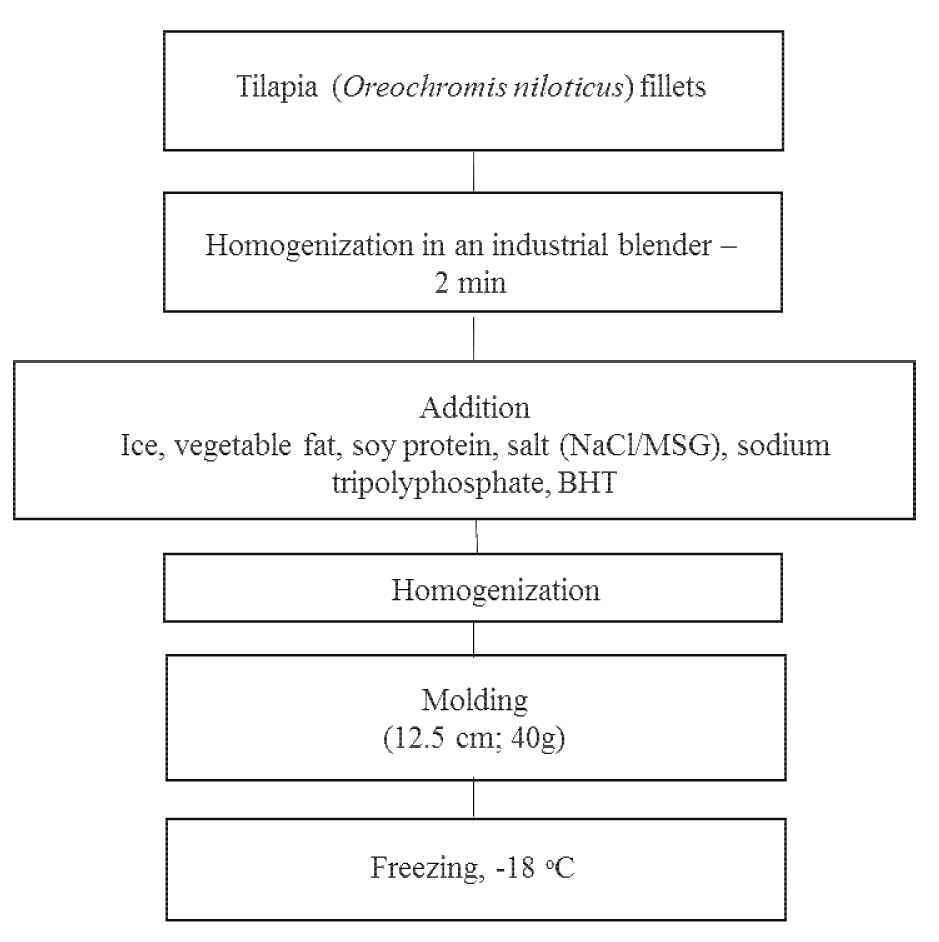
Figure 1.
Steps for fish burger elaboration.
Sensory evaluation of fish burger
All selected assessors were asked to rank the samples in ascending order according to the salty taste and preference.
Parallel to the ranking test, the word association technique (WA) was applied to determine the cognitive perception of each sample. The method was applied as described by Ares, Giménez, and Gámbaro (2008). The stimuli used for each sample was: ‘Please write down the first four words, descriptions, associations, thoughts or feelings that comes to your mind when you eat the following sample’.
Analysis of the word association data was based on Antmann, Ares, Salvador, Varela, and Fiszman (2011). In order to verify the cognitive sensory perception about the different fish burger formulations, the participants were asked to answer the following question: ‘Please write the first four words and/or phrases that come to your mind when you test the sample’. All the associations provided by the participants were included. The associations were then grouped into different categories. Three researchers performed the grouping procedure, separately. After individually evaluating the data, they checked the agreement between the classifications. The final categories and the names were determined by consensus between the researchers, who considered their three independent classifications. Since the data were obtained by a team composed of 8 selected assessors, the categories mentioned by more than 25% of the participants were included in the analysis.
Statistical analysis
The results of the selection of candidates with acuity to detect different threshold values for sodium chloride were evaluated by sequence analysis, according to graphical method (International Organization for Standartization [ISO], 2004, Augusto, Queiroz, & Viotto, 2005). The decision system was obtained through hypothesis testing Ho: p1 ≤ p0, and using the values p0 = 0.33 (probability of a correct response when no perceptible difference exists), p1 = 0.66 (probability of a correct response when a perceptible difference does exist), for α risk = 0:05 (probability of concluding that a perceptible difference exists when one does not) and β risk = 0.10 (probability of concluding that no perceptible difference exists when one does).
Ranking test were evaluated by Friedman's Test and significant mean difference (International Organization for Standartization [ISO], 2006).
The results of the word association technique were analyzed by the Wilcoxon test applied to evaluate the contrast between sample pairs (González, Liste, & Felpeto, 2011). Correspondence analysis (CA) was used to determine the association between formulations and word associations (Guerrero et al., 2010, Beh, Lombardo, & Simonetti, 2011). CA is a multidimensional scaling multivariate technique that uses non-metric data in the crossed design to create percentage maps including all variable categories (Hair, Black, Babin, Anderson, & Tatham, 2009).
Data were analyzed using Statistica 12.7 (Dell Inc., 2015).
Results and discussion
Selection of assessors with acuity to detect different threshold values for sodium chloride
Figure 2 illustrates the results of the selection of candidates with acuity to detect different threshold values for sodium chloride assessed by the Wald sequential analysis using a triangle test.
Straight lines of acceptance and rejection that were obtained through the sequential test for the selection of assessors were: An: 2.0994 + 0.4948n and Rn: -1.6412 + 0.4948n. Only 8 out of the 21 candidates evaluated demonstrated acuity in identifying the distinction between the solutions.
The acuity of the candidates selected for the identification of the differences between the samples was higher than p0 (0.33), with candidates J4 and J5 with the best performance, requiring only 4 tests to certify their inclusion in the selected sensory panel.
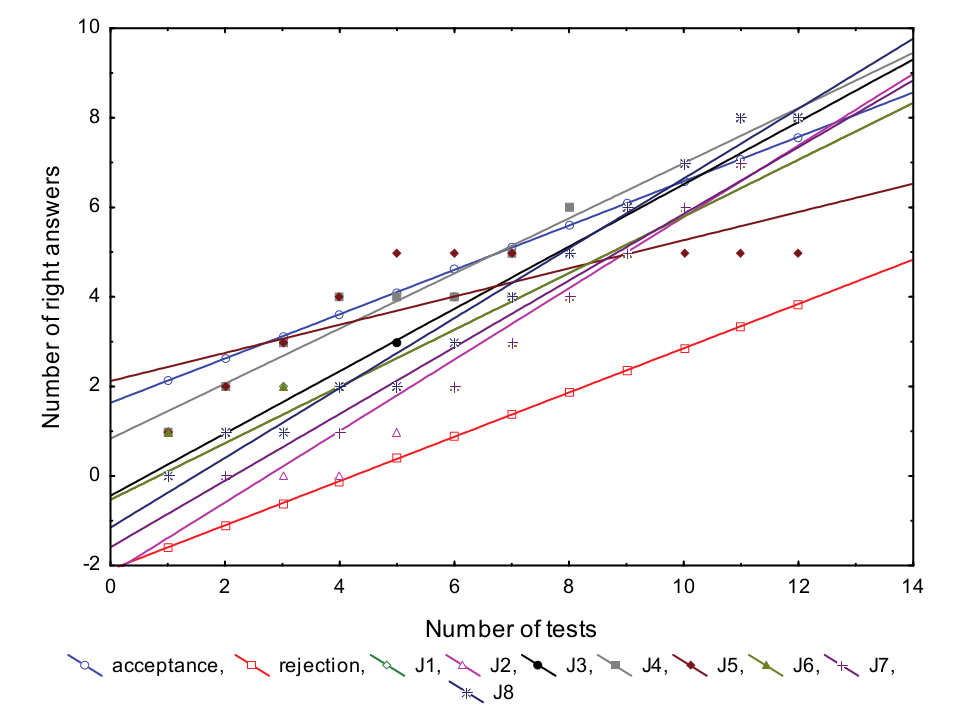
Figure 2.
Performance of candidates selected to compose the perception evaluation team in the replacement of NaCl with MSG in different formulations of fish burger.
Therefore, 8 panelists will be used in the next evaluation. The use of these panelists as measuring devices is analogous to using any scientific instrument to elicit measurements of specific parameters for products under study. The instrument was selected for its capability to provide the desired measurement as accurately and consistently as possible (Lawless & Heymann, 1999, Meilgaard, Civille, & Carr, 2007).
Ranking test for salty taste and preference for different fish burger formulations
The ranking test facilitates to assess differences among several samples based on the intensity of a single attribute or of an overall impression. It is indicated for assessing products like for descriptive criterion or for a hedonic preference (ISO, 2006), for example. Table 1 and 2 list the results of the ranking test completed by the selected candidates. Regarding the evaluation of the salty taste, it is verified that formulation A, corresponding to the composition with 100% NaCl, differed only from formulation B, which corresponds to 100% of MSG, suggesting a possibility of substituting the NaCl with MSG in up to 75% in the fish hamburger formulation (Table 1). However, in evaluating the preference data it seems that formulation A was the most preferred and differed significantly from formulation E (75% MSG, 25% NaCl), the least preferred and, finally, indicating a replacement of up to 50% NaCl with MSG without compromising the sensory quality of fish products (Table 2).
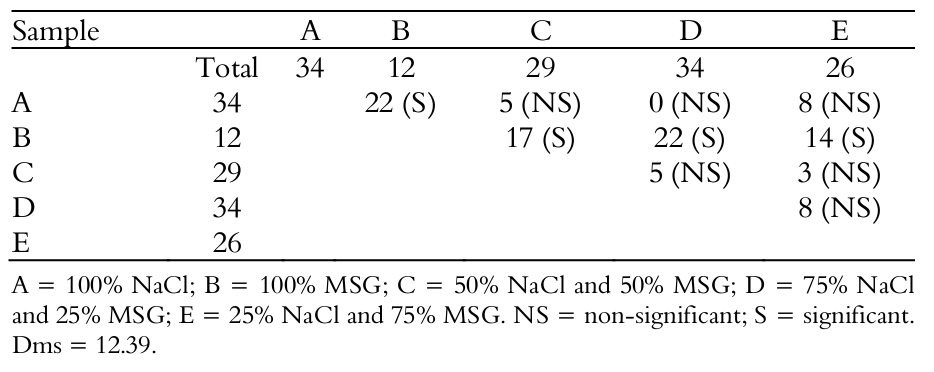
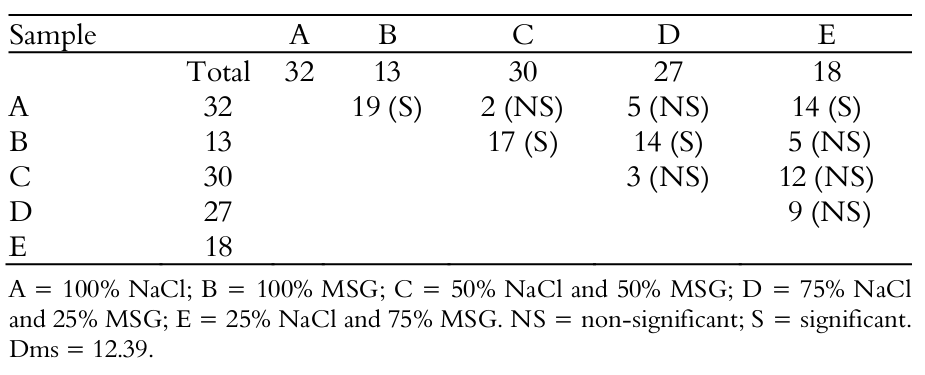
An important synergistic relationship between MSG and NaCl is clear when evaluating the results of the ‘salty taste’ ranking, considering the non-significant difference between formulation A and formulations C, D and E, defined by the sensory panel. The compensatory relationship of MSG and NaCl has been reported in other studies (Yamaguchi & Takahashi, 1984, Fuke & Shimizu, 1993, Bellisle, 1999, Keast & Breslin, 2002, Baryłko-Pikielna & Kostyra, 2007) highlighting the importance in lowering sodium intake. Yamaguchi and Takahashi (1984) studied the sensory interactions between MSG and NaCl and its effect on saltiness and palatability of clear soups prepared from dried skipjack, a kind of dried fish. The optimal level of MSG and NaCl in the soup was 0.38 and 0.81%, respectively. For the authors, this compensatory relationship can be reproduced with all foods.
The indication of the need to replace the MSG by 50% in this study may be related to the type of raw material used, namely, the fish. According to (Baryłko-Pikielna & Kostyra, 2007), the diversity of hedonic responses in the study of the interaction of umami substances with different food raw materials can be caused by the interaction of glutamates and the naturally added umami substances present. As we know, fish is an important source of umami substances (Fuke & Shimizu, 1993).
The low preference for formulations B (100% MSG) and E (75% MSG and 25% NaCl) is possibly related to the need for appropriate concentrations and ratios of MSG and NaCl for each type of food product. According to Yamaguchi and Takahashi (1984) and Baryłko-Pikielna and Kostyra (2007), the addition of MSG alone in the food resulted in decrease of its hedonic value and adding both MSG and NaCl eliminated the decrement in hedonic values for low concentrations of MSG, exactly what was found in the present study. Thus, MSG enhanced the palatability of fish burgers and both the NaCl and the MSG contributed to this enhancement.
Word association and correspondence analysis to analyze the perception of different formulations
Word association is a useful cognitive method for gathering perceptions of food consumers (Roininen, Arvola, & Lahhteenma¨ki, 2006, Ares & Deliza, 2010, Mitterer-Daltoé et al., 2013a). This methodology is based on the assumption that providing a stimulus to a person and asking what ideas come to his/her mind can provide relatively unrestricted access to that person's mental representations about the stimulus (Roininen et al., 2006). For this study, the stimulus was the test of each sample of different formulations. When a person deals with food products, the associations that first come to the respondent mind may be the most important (Roininen et al., 2006). And the importance of each association is derived from what the participants responded (Fiszman, Varela, Díaz, Linares, & Garrido, 2014).
In the present study, assessors mentioned 120 terms in relation to fish burgers, and the number of categories discussed and grouped by the researchers totaled 11. Table 3 shows the final categories.
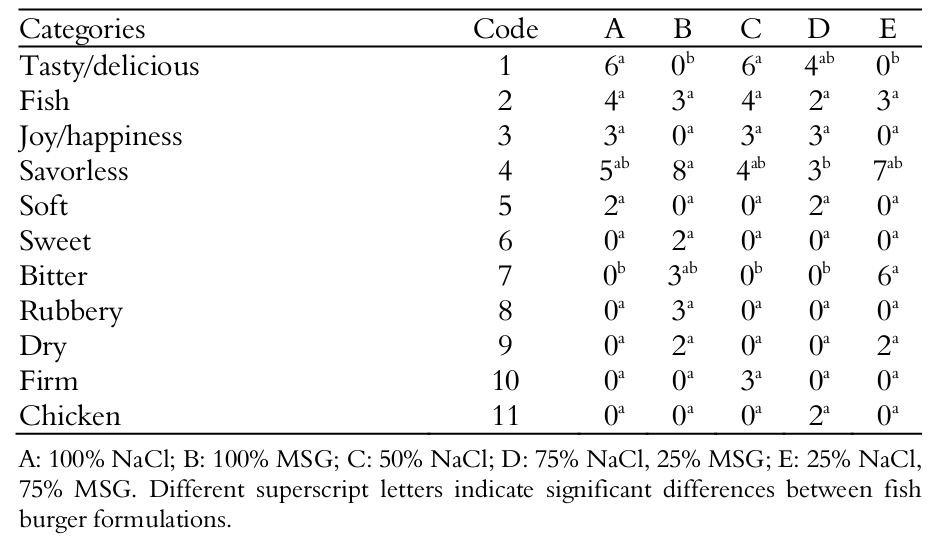
The more positive hedonic terms ‘tasty/delicious’ were spontaneously mentioned for formulations A and B, justifying the fact that these formulations present the highest score in preference. In these same formulations, along with D, although with no significant difference from the others, the category ‘joy/happiness’ is highlighted, suggesting a relationship between consumption of fish derivatives (when tasty) with fun. This result can be explained by the origin of the assessors. The assessors are from southern Brazil, characterized for not having fish consumption habits (Mitterer-Daltoé, Latorres, Carbonera, Pastous-Madureira, & Queiroz, 2012, Mitterer-Daltoé et al., 2013a) or when they do, it is normally in holidays, such as Good Friday, or when they go to some fishing ponds in the summer.
Other category that is worth mentioning is ‘savorless’, mainly associated with formulations B and E, corroborating the synergistic relationship between NaCl and MSG and the need for appropriate concentrations and ratios between these two additives (Baryłko-Pikielna & Kostyra, 2007). ‘Sweet’ is another category that can explain the synergism between NaCl and MSG; this category was mentioned only for formulation B, the sample in which the salt was completely replaced with MSG. The absence of NaCl and the presence of MSG gave a sweet taste, once monosodium glutamate is characterized by enhanced sweetness (Keast & Breslin, 2002).
A curious result is the perception of the term ‘bitter’ for formulations B and E, which had higher percentages of MSG, since it is known the ability of umami in suppressing bitterness (Breslin, 1996, Keast & Breslin, 2002), including the interaction between bitter and umami tastes at the taste receptor level (Kim, Jin, Kim, Misaka, & Rhyu, 2015). Although singular, its appearance in the word association cognitive test is pronounced, as it was cited by 75% of the assessors for formulation E. It is worth mentioning that at no time the participants were introduced, induced to use or given a list of terms. Factors such as raw materials, ingredients, and texture or additive concentrations may be related to this behavior.
‘Bitter’, ‘rubbery’ and ‘dry’ were perceptions of negative sensory terms that emerged for the formulations that had the lowest preference scores, helping to understand the preferences of the different formulations.
In order to better visualize and explain the perception of each formulation and analyze the degree of association between formulations and the words produced during the word association test, a correspondence analysis (CA) (Guerrero et al., 2010, Beh et al., 2011) was conducted.
Figure 3 shows the results of the correspondence analysis carried out for the words produced by the assessors. The first two dimensions explained 78.22% of the association between the formulations and the words produced by the assessors.
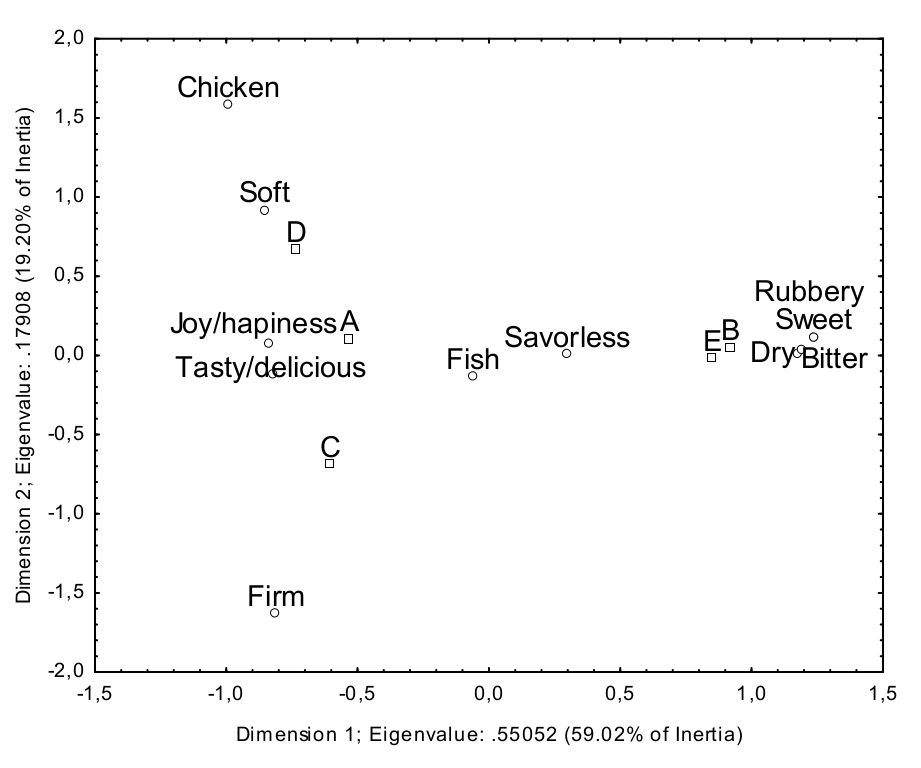
Figure 3.
Correspondence analysis of the word associations and different formulations. A = 100% NaCl; B = 100% MSG; C = 50% NaCl and 50% MSG; D = 75% NaCl and 25% MSG; E = 25% NaCl and 75% MSG.
The formation of groups and profiles is observed on the basis of associations, considering the quality indicator of samples that varied from 63.6 to 97.08%, proving the good explanation of the formulations and indicating the good quality representation of the graph. The ‘Quality’ indicates the sum of the relative contributions, and it is part of the variability of each profile explained by both axes; the closer to 1, the better the representation of this profile (González et al., 2011). Formulations A, D and C were ranked close to the terms joy/happiness, tasty/delicious and soft, which corroborates and explains the perception and preference for these formulations. Formulations B and E were the least preferred and well explained by the terms ‘bitter’, ‘rubbery’, ‘sweet’ and ‘dry’ confirming the negative perception of these samples. Characteristics that suggest possible technological consequences of high replacements of NaCl with MSG, indicating the need for further studies to better understand the technological application of MSG in food formulations.
Conclusion
With the aid of a selected sensory panel, it was found that it is possible to replace up to 50% NaCl with MSG without compromising the sensory perception and hedonic preferences of fish products.
A cognitive word association technique proved to be an important tool with the perception of fish burgers formulated with different concentrations of NaCl and MSG, and the combination of WA and CA allowed improving the sensory profile of different formulations of fish burgers.
Our findings help to understand and strengthen the campaign to reduce sodium in the diet of consumers, always valuing the sensory issue. However, the range of information on the umami taste deserves further research, particularly with regard to the perception and knowledge from Western societies. An important question is to explore the relationship with a glutamate post-ingestive sensation of satiety (Gabriel et al., 2012), an area of increasing interest in the food science (Fiszman et al., 2014).
Acknowledgements
The authors are grateful to the Ministry of Education and Coordenação de Aperfeiçoamento de Pessoal de Nível Superior (Capes).
References
American Society for Testing and Materials. (2010). Standard test method for sensory analysis. Triangle Test, 1(1), 1-8.
Antmann, G., Ares, G., Salvador, A., Varela, P., & Fiszman, S. (2011). Exploring and explaining creaminess perception: consumers’ underlying concepts. Journal of Sensory Studies, 26(1), 40-47.
Ares, G., & Deliza, R. (2010). Identifying important package features of milk desserts using free listing and word association. Food Quality and Preference, 21(6), 621-628.
Ares, G., Giménez, A., & Gámbaro, A. (2008). Understanding consumers’ perception of conventional and functional yogurts using word association and hard laddering. Food Quality and Preference, 19(7), 636-643.
Augusto, M. M. M., Queiroz, M. I., & Viotto, W. H. (2005). Seleção e treinamento de julgadores para avaliação do gosto amargo em queijo prato. Food Science and Technology, 25(4), 849-852.
Baryłko-Pikielna, N., & Kostyra, E. (2007). Sensory interaction of umami substances with model food matrices and its hedonic effect. Food Quality and Preference, 18(5), 751-758.
Beh, E. J., Lombardo, R., & Simonetti, B. (2011). Short communication an european perception of food using two methods of correspondence analysis. Food Quality and Preference, 22(2), 226-231.
Bellisle, F. (1999). Glutamate and the UMAMI taste: sensory, metabolic, nutritional and behavioural considerations. A review of the literature published in the last 10 years. Neuroscience & Biobehavioral Reviews, 23(3), 423-438.
Brasil. Ministério da Agricultura, Pecuária e Abastecimento. (2000). Instrução normativa n. 20, de 31 de julho de 2000. Regulamento técnico de identidade e qualidade de hambúrguer. Diário Oficial da União, Brasília, DF.
Breslin, P. A. S. (1996). Components of Flavour Interactions among salty , sour and bitter compounds. Trends in Food Science and Technology, 2244(96), 390-399.
Choi, Y., Kim, J., Haubo, R., Christensen, B., & Lee, H. (2014). Superior performance of constant-saltier-reference DTF and DTFM to same-different tests by consumers for discriminating products varying sodium contents. Food Quality and Preference, 37, 100-108.
Chung, H. E. E. S., Hong, H., Kim, K., Cho, C., Moskowitz, H. R., & Lee, S. (2014). Consumer attitudes and expectations of ginseng food products assessed by focus groups and conjoint analysis. Journal of Sensory Studies, 26(5), 346-357.
Corbo, M. R., Speranza, B., Filippone, A., Granatiero, S., Conte, A., Sinigaglia, M., & Del Nobile, M. A. (2008). Study on the synergic effect of natural compounds on the microbial quality decay of packed fish hamburger. International Journal of Food Microbiology, 127(3), 261-267.
Dang, Y., Gao, X., Ma, F., & Wu, X. (2015). LWT - Food science and technology comparison of umami taste peptides in water-soluble extractions of Jinhua and Parma hams*. LWT - Food Science and Technology, 60(2), 1179-1186.
Dell Inc. (2015). Dell Statistica (data analysis software system), version 12. Retrieved form software.dell.com
Fiszman, S., Varela, P., Díaz, P., Linares, M. B., & Garrido, M. D. (2014). What is satiating? Consumer perceptions of satiating foods and expected satiety of protein-based meals. Food Research International, 62, 551-560.
Fuke, S., & Shimizu, T. (1993). Sensory and preference aspects of umami. Trends in Food Science and Technology, 41(8), 246-251.
Fuke, S., & Ueda, Y. (1996). Interactions between umami and other flavor characteristics. Trends in Food Science & Technology, 7(12), 407-411.
Gabriel, A. S., Kohmura, E., Kouda, T., Furuhata, Y., & Kimura, T. (2012). Umami taste research and beyond: the challenge for Ajinomoto Co., Inc. Nature Outlook, 21(1), 0-0.
González, C., Liste, A., & Felpeto, A. (2011). Tratamiento de datos con r, statistics y spss. Vigo, ES: Diaz de Santos.
Guerrero, L., Claret, A., Verbeke, W., Enderli, G., Zakowska-Biemans, S., Vanhonacker, F., … Hersleth, M. (2010). Perception of traditional food products in six European regions using free word association. Food Quality and Preference, 21(2), 225-233.
Hair, J., Black, W., Babin, B., Anderson, R., & Tatham, R. (2009). Análise multivariada de dados (6th ed.). Porto Alegre, RS: Bookman.
International Organization for Standartization. (2004). International standard sensory analysis - methodology sequential analysis. Genebra, SW: ISO.
International Organization for Standartization. (2006). International standard ISO - Sensory analysis – methodology - ranking. Genebra, SW: ISO.
Keast, R. S. J., & Breslin, P. A. S. (2002). An overview of binary taste – taste interactions. Food Quality and Preference, 14(2), 111-124.
Kim, J., Jin, H., Kim, Y., Misaka, T., & Rhyu, M. (2015). Umami – bitter interactions : The suppression of bitterness by umami peptides via human bitter taste receptor. Biochemical and Biophysical Research Communications, 456(2), 586-590.
Laurila, E., Lahteenmaki, L., Rita, H., & Tuorila, H. (1996). Pleasantness in relation to difference threshold of NaCl in mashed potato Difference thresholds. Food Quality and Preference, 3293(96), 225-228.
Lawless, H., & Heymann, H. (1999). Sensory evaluation of food. New York City, NK: Aspen Publishers.
Lee, G. (2011). A salt substitute with low sodium content from plant aqueous extracts. Food Research International, 44(2), 537-543.
Meilgaard, M., Civille, G., & Carr, T. (2007). Sensory evaluation techniques (4th ed.). Boca Raton, FL: CRC Press.
Mitterer-Daltoé, M. L., Carrillo, E., Queiroz, M. I., Fiszman, S., & Varela, P. (2013a). Structural equation modelling and word association as tools for a better understanding of low fish consumption. Food Research International, 52(1), 56-63.
Mitterer-Daltoé, M. L., Latorres, J. M., Queiroz, M. I., Fiszman, S., & Varela, P. (2013b). Reasons underlying low fish consumption where availability is not an issue. a case study in Brazil, one of the world’s largest fish producers. Journal of Sensory Studies, 28(3), 205-216.
Mitterer-Daltoé, M. L., Queiroz, M. I., Fiszman, S., & Varela, P. (2014). LWT - Food Science and Technology are fish products healthy? Eye tracking as a new food technology tool for a better understanding of consumer perception. LWT - Food Science and Technology, 55(2), 459-465.
Mitterer-Daltoé, M., Latorres, J., Carbonera, N., Pastous-Madureira, L., & Queiroz, M. (2012). Potencial de inserção de empanados de pescado na merenda escolar mediante determinantes individuais Potential inclusion of breaded fish products in school meal by individual determinants. Ciência Rural, 42(11), 2092-2098.
Nasri, N., Septier, C., Beno, N., Salles, C., & Thomas-Danguin, T. (2013). Enhancing salty taste through odour – taste taste interactions : Influence of odour intensity and salty tastants. Nature, 28(1), 134-140.
Olsen, O. S., Heide, M., Calvo, D., & Toften, K. (2008). Explaining intention to consume a new fish product : A cross-generational and cross-cultural comparison. Food Quality and Preference, 19(7), 618-627.
Panouillé, M., Saint-Eve, A., Loubens, C., Déléris, I., & Souchon, I. (2011). Food hydrocolloids understanding of the in fl uence of composition, structure and texture on salty perception in model dairy products. Food Hydrocolloids, 25(4), 716-723.
Pelsmaeker, S., Gellynck, X., Delbaere, C., Declercq, N., & Dewettinck, K. (2015). Consumer-driven product development and improvement combined with sensory analysis : A case-study for European filled chocolates. Food Quality and Preference, 41, 20-29.
Roininen, K., Arvola, A., & Lahhteenma¨ki, L. (2006). Exploring consumers perceptions of local food with two different qualitative techniques : Laddering and word association. Food Quality and Preference, 17(1-2), 20-30.
Sotiles, A. R., Mitterer-Daltoé, M. L., Lima, V., Porcu, O. M., & Cunha, M. A. (2015). Technological use of green banana and birdseed flour in preparing cookies. Acta Scientarium. Technology, 37(4), 423-429.
Weiss, J., Gibis, M., Schuh, V., & Salminen, H. (2010). Advances in ingredient and processing systems for meat and meat products. Meat Science, 86(1), 196-213.
Yamaguchi, S. (1991). Basic properties of umami and effects on humans. Physiology and Behavior, 49(4), 833-841.
Yamaguchi, S., & Takahashi, C. (1984). Interactions of monosodium glutamate and sodium chloride on saltiness and palatability of a clear soup. Journal of Food Science, 49, 82-85.
Notes