Engenharia de Pesca
Association between nocturnal and diurnal aeration in Nile tilapia rearing tanks
Associação entre aeração noturna e diurna em tanques de cultivo de tilápia do Nilo
Association between nocturnal and diurnal aeration in Nile tilapia rearing tanks
Acta Scientiarum. Technology, vol. 40, 2018
Universidade Estadual de Maringá

This work is licensed under Creative Commons Attribution 4.0 International.
Received: 29 February 2016
Accepted: 20 October 2016
Abstract: The present study has assessed the benefits of the association between nocturnal and diurnal aeration of water on Nile tilapia’s culture tanks’ water and soil quality, as well as to fish growth performance. There were control tanks without mechanical aeration. In the nocturnal tanks, the aeration was provided daily from 22:00 h up to 06:00 h. The diurnal tanks were provided with aeration daily from 10:00 h up to 18:00 h. In the nocturnal and diurnal tanks, the culture water was aerated from 10:00 h up to 06:00 h. The concentration of NH3 was significantly lower in the diurnal aerated, and nocturnal + diurnal aerated tanks when compared to the non-aerated tanks. The best water quality management to attain simultaneously high DO2 and low NH3 concentration was the nocturnal + diurnal aeration of water. The nocturnal + diurnal aeration of water has not shown any clear advantage on fish growth performance after 10 weeks when compared to the nocturnal aeration of water. It was concluded that the nocturnal + diurnal aeration of water is a water quality management superior to the nocturnal aeration because it achieves a better water quality
Keywords: aquaculture, Oreochromis niloticus, water quality.
Resumo: O presente trabalho teve por objetivo determinar os benefícios da associação entre a aeração noturnal e diurna da água de tanques de cultivo da tilápia do Nilo, em relação à qualidade de água, do solo e do desempenho zootécnico. Foram utilizados tanques sem aeração; tanques noturnos, com aeração fornecida diariamente das 22 às 06 h; tanques diurnos, com aeração fornecida diariamente das 10 às 18 h; e tanques noturnos + diurnos, com aeração fornecida das 10 às 06 h do dia seguinte. As concentrações de NH3 da água de cultivo foram significativamente menores nos tanques diurnos e noturnos + diurnos, quando comparados aos tanques sem aeração. Nos tanques com aeração noturna e diurna se obteve, simultaneamente, elevadas concentrações de O2 dissolvido na água e baixas concentrações de NH3. Embora a aeração noturna e diurna da água não tenha apresentado claras vantagens para o desempenho zootécnico após dez semanas de cultivo, concluiu-se que a associação da aeração noturna com a diurna é um manejo de qualidade de água superior à aeração apenas noturna por propiciar melhor qualidade de água.
Palavras-chave: aquicultura, Oreochromis niloticus, qualidade de água.
Introduction
The concentration of dissolved oxygen in water (DO2) is a critical factor for the success of fish culture because it directly affects the respiratory rate of these animals, which influences their survival and growth. When submitted to low levels of DO2, fish generally lose appetite and, consequently, suffer from body growth impairment (Tran-Duy, Schrama, van Dam, & Verreth, 2008). Previous studies have demonstrated that fish have a greater tolerance against ammonia toxicity if living in DO2 rich environments (Thorarensen et al., 2010; Dong, Zhang, Qin, & Zong, 2013). Mechanical aeration is the straightforward management of water quality to provide DO2 to the culture water. Up to a certain limit, the greater the mechanical aeration rate used, the higher the fish stocking density that can be used by the producer (Li, Li, & Wang, 2006). As a rule, the DO2 concentrations in aquaculture waters should be equal or higher than 4 mg L-1 to attain better growth results (Boyd, 2000).
The nocturnal aeration of water is the most common regimen of water aeration used in aquaculture. The DO2 concentration of water can be reduced up to zero overnight without proper aeration. Pawar, Jena, Das, and Bhatnagar (2009) and Das, Jena, Mishra, and Pati (2012) have observed significant improvement in fish growth performance due to nocturnal aeration of water. However, despite its clear benefits, the nocturnal aeration of water has its limitations. Kimpara, Santos, and Valenti (2013) have observed that nocturnal aeration of water was not capable to prevent the thermal stratification of water. Silva, Lima, Vale, and Sá (2013) have found that the ammonia removal by the nocturnal aeration of water was insignificant. Furthermore, the nocturnal aeration of water does not prevent the oversaturation of water with DO2, a situation that can cause the gas bubble disease in fish (Espmark, Hjelde, & Baeverfjord, 2010).
Generally, fish farmers turn on their mechanical aerators during daylight just in the rainy or heavily cloudy days. These weather conditions curb photosynthesis and, consequently, elicit low DO2 concentrations in water. Besides, the mechanical aerators can be operated during the daylight to prevent the thermal stratification of water, which can cause anoxia in the pond bottom. Additionally, the use of the aerators in the daylight can reduce the concentrations of ammonia by volatilization (Gross, Boyd, & Wood, 2000), as well as it can prevent the dangerous oversaturation of water with DO2. The cost of aeration is relatively small compared to the value of the aquaculture crop, generally not exceeding 10% of that value (Boyd, 1998). Therefore, it would be reasonable to combine the strengths of the nocturnal and diurnal regimes of water aeration, seeking an even better water quality. The present study has assessed the benefits of the association between nocturnal and diurnal aeration of water on Nile tilapia’s culture tanks, in regard to their water and soil quality, as well as to the fish growth performance.
Material and methods
One thousand masculinized Nile tilapia juveniles, Oreochromis niloticus (body weight = 0.75 ± 0.07 g), were obtained from a nearby producer and hauled up to the laboratory facilities. Initially, fish were maintained for four days in one 1,000 L polyethylene circular tank for acclimation. In that period, the animals were fed on a commercial diet for omnivorous tropical fish with 49.4% crude protein. That diet was allowed at 10% of the stocked biomass daily, being evenly split in four meals at 08:00, 11:00, 14:00 and 17:00 h.
The study was carried out in the outdoor culture system of the laboratory, which is comprised by twenty 250-L polyethylene circular tanks. At the onset of the experiment, Nile tilapia juveniles (body weight = 1.03 ± 0.02 g) were equally allotted into the culture tanks at eight fish per tank (32 fish m-3). The culture tanks were submitted to different water aeration regimes for 10 weeks. There were three control groups and one experimental treatment, each one with five replicates. There were also tanks that have not received any mechanical aeration over the entire experimental period (non-aerated tanks). In the nocturnal tanks, the mechanical aeration was provided daily from 22:00 h up to 06:00 h (8 hours of aeration daily). The diurnal tanks were provided with mechanical aeration daily from 10:00 h up to 18:00 h (8 hours of aeration daily). In the nocturnal + diurnal tanks, the culture water was aerated from 10:00 h up to 06:00 h (20 hours of aeration daily). The mechanical aeration of the culture water was provided by one 2.5 hp air blower, which was connected to PVC pipes and air stones. The water aeration started at the 3rd experimental week to simulate a commercial fish farm schedule remaining until the end.
Over the entire experimental period, fish were fed on commercial diets at 08:00 h, 11:00 h, 14:00 h and 17:00 h. No water exchange was performed over the whole period, just replenishment to maintain the initial level. The tank bottom was filled with a 5-cm layer of gross sand to allow water-soil interactions.
The water quality of the culture tanks was monitored by regular observations of the following variables: (1) pH (pH meter mPA210 - MS Tecnopon), (2) temperature and specific conductance at 09:00 and 15:00 h (conductivity meter CD-4303 – Lutron), (3) dissolved oxygen (08:00 h; dissolved oxygen meter YSI 55), (4) total ammonia nitrogen (TAN; indophenol method), (5) nitrite (sulfanilamide method), (6) free CO2 (titration with standard Na2CO3 solution), (7) reactive phosphorus (molybdenum blue method), (8) total alkalinity (titration with H2SO4 standard solution), (9) total hardness (titration with EDTA standard solution), (10) soluble iron (colorimetric Herapath method) and (11) total dissolved sulfide (titration with standard Na2S2O3 solution). The water quality variables were monitored daily (1), twice a week (2), weekly (3, 4) and fortnightly (5 – 11). The water samplings were always carried out between 08:00 and 09:00 h. The Emerson’s formula (El-Shafai, El-Gohary, Nasr, van der Steen, & Gijzen, 2004) was used to estimate the concentration on non-ionized ammonia (NH3) in water. The H2S concentration of water was estimated according to Boyd (2000). Except when stated otherwise, all water quality determinations were carried out according to Clesceri, Greenberg, and Eaton (1998). The gross primary productivity was determined by the clear and dark bottle method. The soil determinations of pH and organic carbon were carried out every other week following the guidelines provided by Boyd, Wood, and Thunjai (2002). Briefly, ten grams of dried and ground samples of soil were put into a Becker containing 10 mL of distilled water. A not-continuous 20-min blend was made using a glass rod. Next, the pH electrode was inserted into the blend to record its value. For the organic carbon determinations, one gram of soil was digested with 10.00 mL potassium dichromate and 20 mL sulfuric acid for 30 min. After the addition of 100 mL distilled water, the suspension was filtered. Drops of a ferroin solution was added to the filtrate, which was titrated with a 0.5N iron sulfate until the ferroin turning point. The concentration of organic carbon was obtained by applying the volume of iron sulfate into the appropriate formula. In the week before the last one (9th week), the temperature, pH and concentrations of TAN, NH3 and DO2 in water were observed on a diel basis (24 h). For that, water samplings were collected every two hours.
The variables of growth performance analyzed were: survival (%), fish final body weight (g), specific growth rate (% day-1; SGR = [Ln (final weight) - Ln (weight initial)]/ days of culture) x 100), weekly growth rate (g), fish yield (g m-3 day-1), food conversion ratio (FCR = feed consumed/ body weight gain), and protein efficiency ratio (PER = weight gain /protein consumed).
The final results of water quality and growth performance were analyzed by the one-way ANOVA. When a significant difference was detected between the treatments (p < 0.05), the means were compared two by two with the Tukey’s test. The assumptions of normal distribution (Shapiro-Wilk’s test) and homogeneity of variance (Levene’s test) were checked before the analyses. The SPSS v.15.0 and Windows Excel 2010 software were used for the statistical analyses.
Results and discussion
Water and soil quality
In the non-aerated tanks, the concentrations of DO2 in water declined progressively over time reaching 2.61 ± 1.61 mg L-1 at the end of the period. The same trend was seen in the diurnally aerated tanks, which exhibited a final DO2 concentration of 2.15 ± 1.00 mg L-1 (Figure 1). Those two DO2 results have not significantly differed between themselves (p > 0.05). As expected, the nocturnal aeration of water has avoided the decrease of DO2 in water over the experimental period. The final DO2 concentration in the nocturnal tanks was 6.12 ± 1.64 mg L-1. A similar result was found in the 20-h aerated tanks, i.e., those tanks with nocturnal + diurnal aeration. Their final DO2 concentration was 6.42 ± 0.5 mg L-1 (Figure 1). Those two DO2 results have not differed significantly between themselves (p > 0.05). Therefore, there is no rationale in associate the nocturnal with the diurnal aeration of water aiming just higher DO2 levels in water.
In green waters, the concentrations of DO2 during the daylight increase due to photosynthesis. It is common to have waters supersaturated with DO2 over the afternoons. There is a withdrawal instead of an input of DO2 when aerators are applied in supersaturated DO2 waters (Ludwig, 2003). In non-aerated tanks, the absence of photosynthesis during the night causes a fast decline in the concentrations of DO2 in water (Alam & Al-Hafedh, 2006).
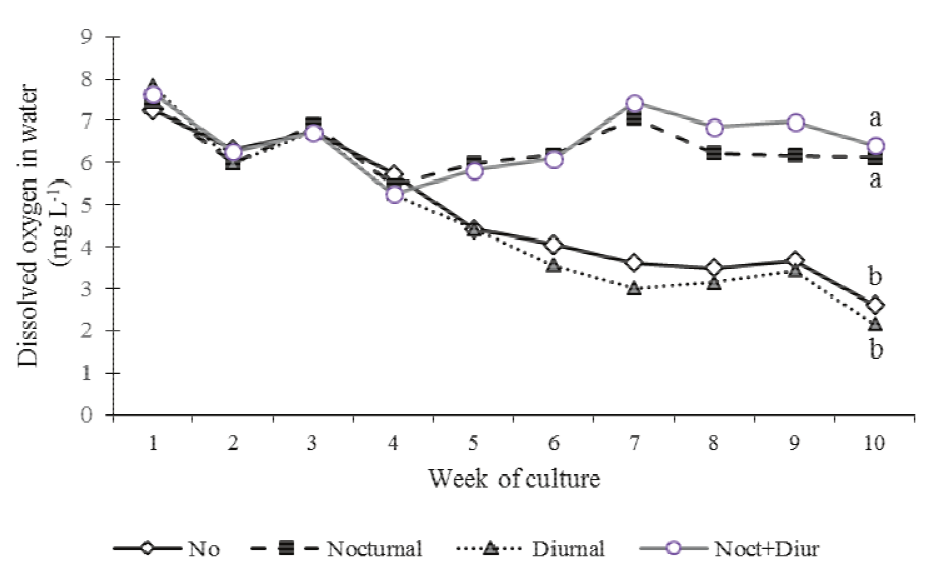
Figure 1.
Concentration of dissolved oxygen in water at 08:00 h of Nile tilapia tanks submitted to different water aeration regimes (n = 5). Nocturnal aeration: 22:00 h – 06:00 h; diurnal aeration: 10:00 h – 18:00 h; nocturnal + diurnal aeration: 10:00 h – 06:00 h. In the last week, symbols with distinct letters represent means significantly different between themselves by the Tukey’s test (ANOVA, p < 0.05).
The concentrations of NH3 in the culture waters have increased progressively in all tanks over time (Figure 2). There was a sharp increase in the concentrations of NH3 beyond the 8th experimental week, especially in the non-aerated and nocturnally aerated tanks. At the end of the experimental period, the concentrations of NH3 were significantly lower in the diurnally aerated, and nocturnal + diurnal aerated tanks when compared to the non-aerated tanks (p < 0.05). The results on Figure 2 suggest that the diurnal aeration of water removes more ammonia than nocturnal aeration. However, as the diurnal aeration was unable to maintain high levels of DO2 during the night, the best water quality management to attain simultaneously high DO2 and low NH3 concentrations is the nocturnal plus diurnal aeration of water. Silva et al. (2013) have also observed a decrease in the concentrations of ammonia in continuously aerated Nile tilapia rearing tanks. The decrease of total ammonia was probably due to the volatilization of gaseous NH3 carried out by the diurnal aeration. There is a natural rising in the concentrations of NH3 in water as the temperature and pH of water increase over the afternoons. Therefore, afternoon is the best period of the day to remove NH3 by volatilization. According to Gross, Boyd, and Wood (1999), NH3 volatilization can withdraw a significant amount of ammonia from water. Gross et al. (2000) has observed that 12.5% of the total ammonia in American catfish tanks was removed by volatilization.
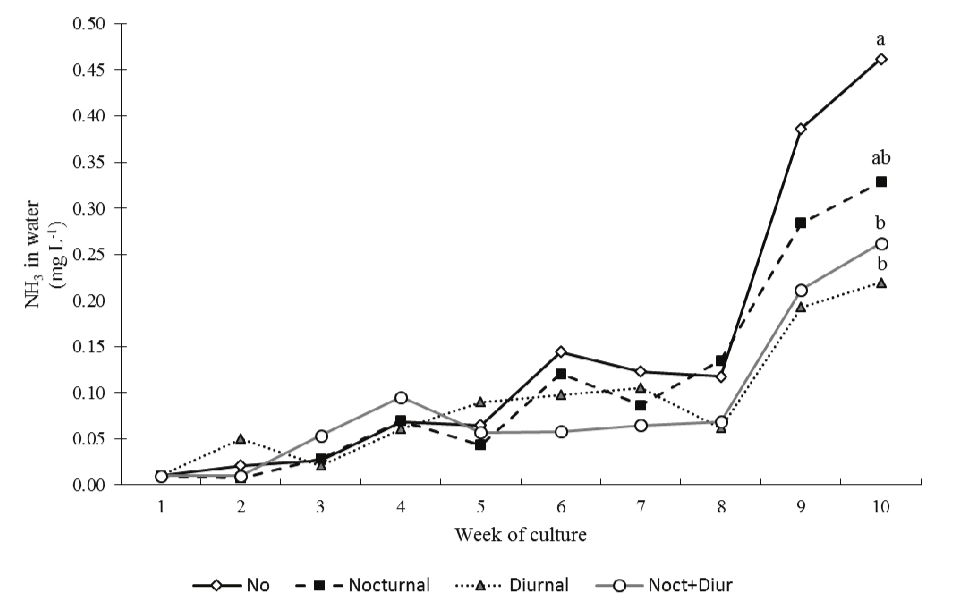
Figure 2.
Concentration of non-ionized ammonia (NH3) in water between 08:00 h and 09:00 h of Nile tilapia tanks submitted to different water aeration regimes (n = 5). Nocturnal aeration: 22:00 h – 06:00 h; diurnal aeration: 10:00 h – 18:00 h; nocturnal + diurnal aeration: 10:00 h – 06:00 h. In the last week, symbols with distinct letters represent means significantly different between themselves by the Tukey’s test (ANOVA, p < 0.05).
Temperature, pH, specific conductance, total alkalinity and total hardness of water have not differed significantly between the treatments (29.4 ± 0.07°C, 8.52 ± 0.05, 924 ± 29 µS cm-1, 143.9 ± 6.5 mg L-1 CaCO3 and 193.7 ± 2.7 mg L-1 CaCO3 respectively; Table 1). Similarly, the concentrations of soluble iron, total sulfide and the gross and net primary productivities have also not significantly varied between the treatments (0.44 ± 0.19 and 1.49 ± 0.67 mg L-1, 0.89 ± 0.14 and 0.60 ± 0.14 mg O2 L-1 hour-1, respectively; Table 1).
The lowest concentrations of free CO2 in water were observed in the nocturnal + diurnal aerated tanks, which differed significantly from the non-aerated tanks (p < 0.05; Table 1). The nocturnal aeration of water is prone to remove significant amounts of CO2 from the water because the highest levels of CO2 occur overnight (Abbink et al., 2012).
There was a significantly lower concentration of nitrite (NO2-) in the nocturnal + diurnal aerated tanks (Table 1; p < 0.05). This result agrees with Avnimelech, Mozes, and Weber (1992), who observed lower concentrations of nitrite in continuously aerated tanks, and with Lima, Cavalcante, Rebouças, and Sá (2016), who concluded that the afternoon aeration of water is an efficient management to remove nitrite from fish tanks. Although that seems promising, it is probably cheaper to apply common salt to the culture water aiming at lessening nitrite toxicity.
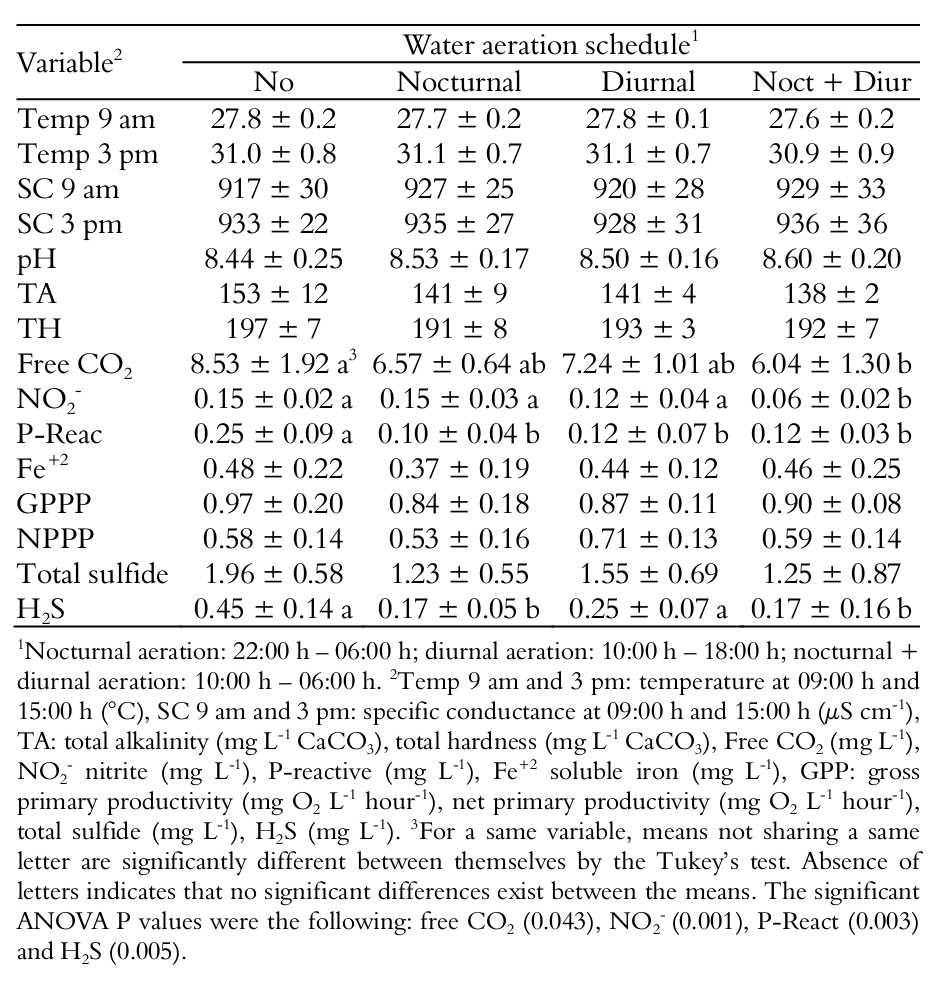
The aeration of water, regardless its regimen (nocturnal, diurnal, and nocturnal + diurnal), has significantly decreased the concentrations of reactive phosphorus in water (Table 1; p < 0.05). In well-aerated waters, a superficial oxidative layer is formed onto the sediments, which avoids or minimizes the diffusion of soluble phosphorus from the underlying soil to the water column. Besides, the phosphates tend to precipitate to the bottom in well-oxygenated waters (Wu, Wen, Zhou, & Wu, 2014).
The concentrations of H2S in water were reduced by water aeration, mainly in the nocturnal, and nocturnal + diurnal regimes (Table 1; p < 0.05). At night, the decrease of water pH promotes the formation of H2S according to the following reaction: H2S ↔ HS- + H+ (Blodau, 2004). Therefore, nocturnal aeration is capable to significantly reduce the concentrations of H2S in water by volatilization.
The differences between the treatments for soil pH were not significant (p > 0.05). No clear pattern was seen for the variations of soil pH over time, an observation also made by Pawar et al. (2009) in a carp study. On average, the pH of soil in the experimental tanks was 7.82 ± 0.24. The concentrations of organic carbon in soil tankl increased in all treatments over time (Figure 3). Significantly more organic carbon was observed in the non-aerated tanks’ soil on the 8th experimental week (p < 0.05). Higher rates of organic matter mineralization are expected in well-aerated waters than in the hypoxic ones, such as those in the non-aerated tanks.
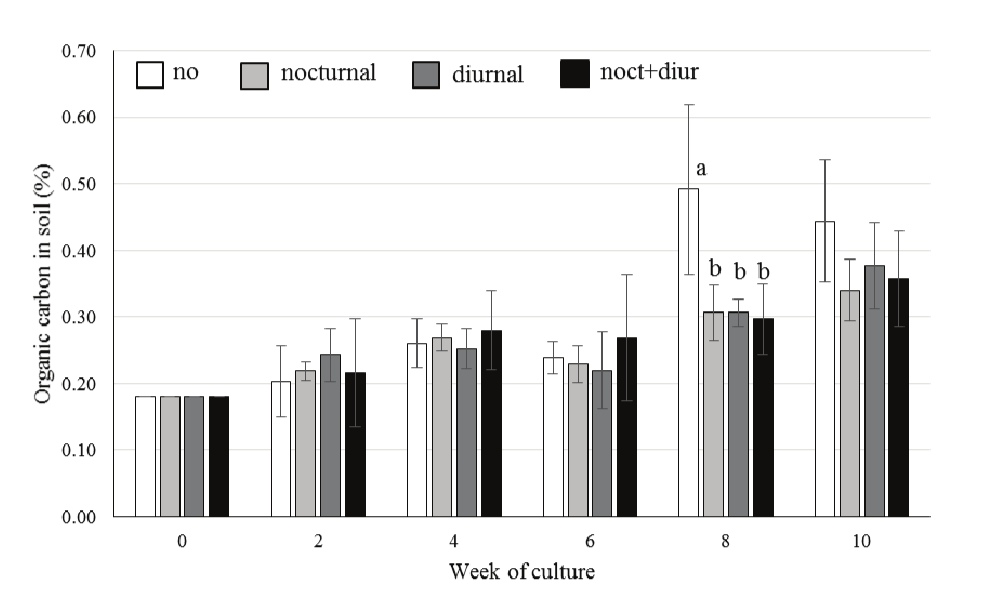
Figure 3.
Concentration of organic carbon in Nile tilapia tanks’ soils. The tanks were submitted to different water aeration regimes for 10 weeks (n = 5). Nocturnal aeration: 22:00 h – 06:00 h; diurnal aeration: 10:00 h – 18:00 h; nocturnal + diurnal aeration: 10:00 h – 06:00 h. Columns with distinct letters represent means significantly different between themselves by the Tukey’s test (ANOVA, p < 0.05). Absence of letters indicates no significant differences between the means.
Diel water quality monitoring
Over the diel monitoring, the temperature, pH and concentrations of DO2 and NH3 increased during the daylight up to 14:00 h – 16:00 h and decreased afterwards until the next morning (Figure 4). The non-aerated and diurnally aerated tanks showed concentrations of DO2 below 4 mg L-1 from 20:00 h to 08:00 h. In those tanks, the DO2 concentrations were as low as 0.25 mg L-1 at 06:00 h. On the other hand, the DO2 concentrations were always above 4 mg L-1 in the diurnally, and nocturnally and diurnally aerated tanks, for that same period (Figure 4). Interestingly, the DO2 concentrations in the middle of the afternoon for the diurnally, and nocturnally and diurnally aerated tanks were markedly lower than those for the non-aerated, and nocturnally aerated tanks. That fact points out that the aeration of water over the warmest and lightest hours of the day helps to lessen the DO2 supersaturation of water. The supersaturation of water with DO2 may be troublesome because it can cause the gas bubble disease in fish (Salas-Leiton et al., 2009). The variations of TAN (total ammonia N) in water over 24 hours have not presented distinct patterns for any of the water aeration regimes considered. At 14:00 h, there was less NH3 in the nocturnally and diurnally aerated tanks than in the nocturnally aerated ones (Figure 4). This result strengthens the previous suggestion that afternoon is the best period of the day to remove water NH3 by volatilization.
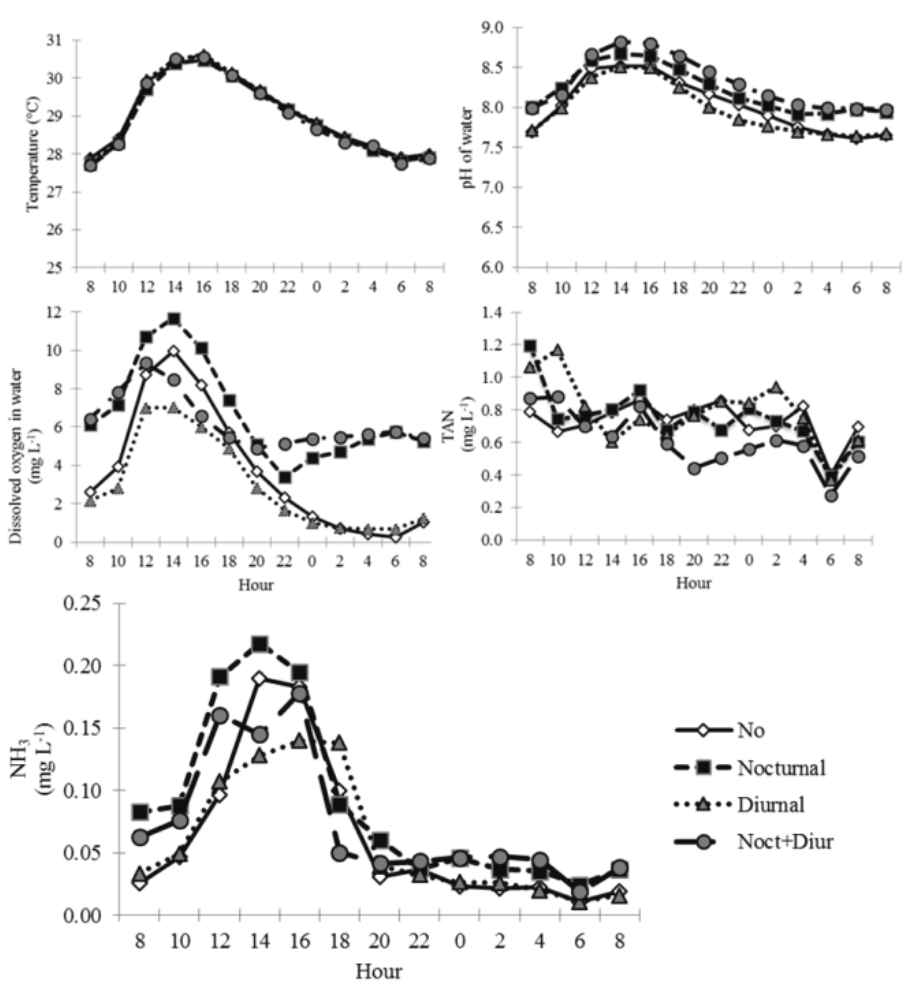
Figure 4.
Diel variations of temperature, pH, total ammonia nitrogen (TAN), NH3 and dissolved oxygen (DO2) in tanks submitted to different water aeration regimes for 10 weeks (n = 5). Nocturnal aeration: 22:00 h – 06:00 h; diurnal aeration: 10:00 h – 18:00 h; nocturnal + diurnal aeration: 10:00 h – 06:00 h.
Growth performance
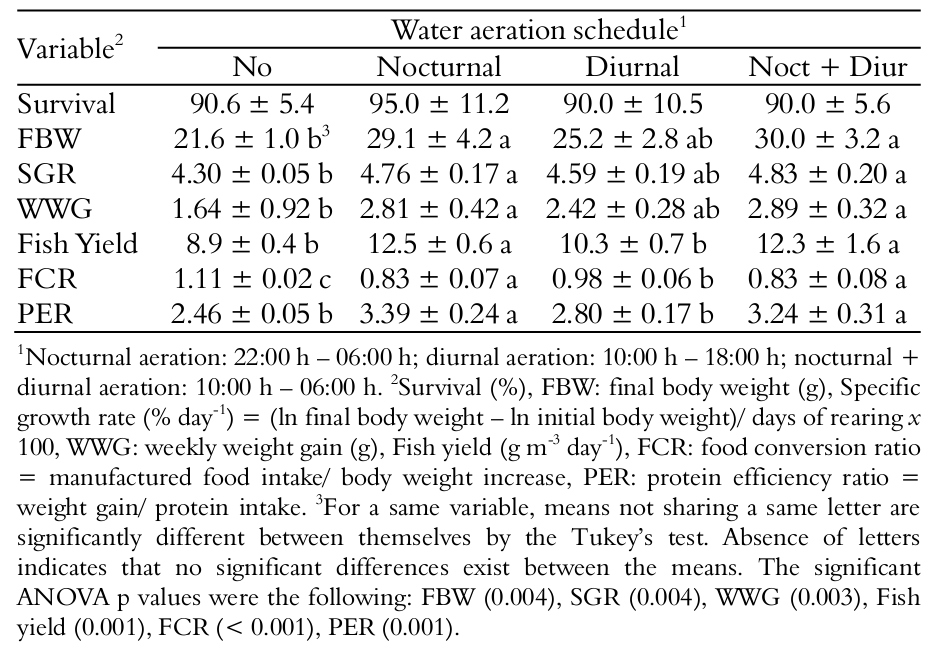
Fish survival was greater than 90% in all treatments and there were no significant differences between them. The results of final body weight, specific growth rate, weekly weight gain, fish yield and PER (protein efficiency ratio) for the nocturnally, and nocturnally and diurnally aerated tanks were significantly higher than those on the non-aerated tanks (Table 2; ANOVA, p < 0.05). Similarly, the best FCR (food conversion ratio) results were observed in the nocturnally, and nocturnally and diurnally aerated tanks. No significant differences were found between those two treatments for any of the growth performance variables. Kimpara et al. (2013) obtained similar results in a Macrobrachium rosenbergii study. Therefore, no clear advantage can be drawn from the nocturnal + diurnal aeration of water in relation to fish growth performance when compared to the nocturnal aeration of water.
The significantly lower concentrations of nitrite in the nocturnally and diurnally aerated tanks, when compared to the nocturnally aerated ones (Table 1), were not capable to improve fish growth performance in the former tanks. However, it is hypothesized that the better water quality in the nocturnally and diurnally aerated tanks can improve fish growth in more stressful culture media, such as those where fish is submitted to high stocking densities. The profitability of nocturnal plus diurnal aeration management, however, needs to be assessed in further studies.
Conclusion
The best water quality management to attain simultaneously high DO2 and low NH3 is the association between nocturnal and diurnal aeration of water. In the present work, however, the improved water quality of the nocturnally and diurnally aerated tanks has not drawn clear benefits to soil quality and fish growth performance, when compared to tanks aerated just at night.
References
Abbink, W., Garcia, A. B., Roques, J. A. C., Partridge, G. J., Kloet, K., & Schneider, O. (2012). The effect of temperature and pH on the growth and physiological response of juvenile yellowtail kingfish Seriola lalandi in recirculating aquaculture systems. Aquaculture, 330-333, 130-135.
Alam, A., & Al-Hafedh, Y. (2006). Diurnal dynamics of water quality parameters in an aquaculture system based on recirculating green water technology. Journal of Applied Sciences and Environmental Management, 10(2), 19-21.
Avnimelech, Y., Mozes, N., & Weber, B. (1992). Effects of aeration and mixing on nitrogen and organic matter transformations in simulated fish ponds. Aquacultural Engineering, 11(3), 157-169.
Blodau, C. (2004). Evidence for a hydrologically controlled iron cycle in acidic and iron rich sediments. Aquatic sciences, 66(1), 47-59.
Boyd, C. E. (1998). Pond aquaculture water quality management. Dordrecht, NL: Kluwer Academic Publishers.
Boyd, C. E. (2000). Water quality. An introduction. Dordrecht, NL: Kluwer Academic Publishers.
Boyd, C. E., Wood, C. W., & Thunjai, T. (2002). Aquaculture pond bottom soil quality management. Corvallis, OR: Oregon State University.
Clesceri, L. S., Greenberg, A. E., & Eaton, A. D. (1998). Standard methods for the examination of water and wastewater (20th ed.). Washington, DC: American Public Health Association.
Das, P. C., Jena, J., Mishra, B., & Pati, B. K. (2012). Impact of aeration on the growth performance of silver barb, Puntius gonionotus, during fingerling rearing. Journal of the World Aquaculture Society, 43(1), 128-134.
Dong, X., Zhang, X., Qin, J., & Zong, S. (2013). Acute ammonia toxicity and gill morphological changes of Japanese flounder Paralichthys olivaceus in normal versus supersaturated oxygen. Aquaculture Research, 44(11), 1752-1759.
El-Shafai, S. A., El-Gohary, F. A., Nasr, F. A., van der Steen, N. P., & Gijzen, H. J. (2004). Chronic ammonia toxicity to duckweed-fed tilapia (Oreochromis niloticus). Aquaculture, 232(1-4), 117-127.
Espmark, A. M., Hjelde, K., & Baeverfjord, G. (2010). Development of gas bubble disease in juvenile Atlantic salmon exposed to water supersaturated with oxygen. Aquaculture, 306(1), 198-204.
Gross, A., Boyd, C. E., & Wood, C. W. (1999). Ammonia volatilization from freshwater fish ponds. Journal of Environmental Quality, 28(3), 793-797.
Gross, A., Boyd, C. E., & Wood, C. W. (2000). Nitrogen transformations and balance in channel catfish ponds. Aquacultural Engineering, 24(1), 1-14.
Kimpara, J. M., Santos, A. A. O., & Valenti, W. C. (2013). Effect of water exchange and mechanical aeration on grow‐out of the Amazon River prawn in ponds. Journal of the World Aquaculture Society, 44(6), 845-852.
Li, Y., Li, J., & Wang, Q. (2006). The effects of dissolved oxygen concentration and stocking density on growth and non-specific immunity factors in Chinese shrimp, Fenneropenaeus chinensis. Aquaculture, 256(1), 608-616.
Lima, F. R. S., Cavalcante, D. H., Rebouças, V. T., & Sá, M. V. C. (2016). Interaction between afternoon aeration and tilapia stocking density. Acta Scientiarum. Animal Sciences, 38(1), 23-30.
Ludwig, G. M. (2003). The effect of continual, nocturnal, or no aeration on water chemistry and plankton standing crops in highly-fertilized sunshine bass, Morone chrysops x M. saxatilis, fingerling production ponds without fish. Journal of Applied Aquaculture, 14(1-2), 23-41.
Pawar, N. A., Jena, J. K., Das, P. C., & Bhatnagar, D. D. (2009). Influence of duration of aeration on growth and survival of carp fingerlings during high density seed rearing. Aquaculture, 290(3), 263-268.
Salas-Leiton, E., Cánovas-Conesa, B., Zerolo, R., López-Barea, J., Cañavate, J. P., & Alhama, J. (2009). Proteomics of juvenile Senegal sole (Solea senegalensis) affected by gas bubble disease in hyperoxygenated ponds. Marine Biotechnology, 11(4), 473-487.
Silva, F. J. R. R., Lima, F. R. S., Vale, D. A., & Sá, M. V. C. (2013). High levels of total ammonia nitrogen as NH4+ are stressful and harmful to the growth of Nile tilapia juveniles. Acta Scientiarum. Biological Sciences, 35(4), 475-481.
Thorarensen, H., Mallya, Y., Gunnarsson, S., Arnason, J., Arnason, I., Jonsson, A. F., … Imsland, A. K. (2010). The effect of oxygen saturation on the growth and feed conversion of Atlantic halibut (Hippoglossus hippoglossus L.). Aquaculture, 309(1), 96-102.
Tran-Duy, A., Schrama, J. W., van Dam, A. A., & Verreth, J. A. J. (2008). Effects of oxygen concentration and body weight on maximum feed intake, growth and hematological parameters of Nile tilapia, (Oreochromis niloticus). Aquaculture, 275(1), 152-162.
Wu, Y., Wen, Y., Zhou, J., & Wu, Y. (2014). Phosphorus release from lake sediments: Effects of pH, temperature and dissolved oxygen. KSCE Journal of Civil Engineering, 18(1), 323-329.
Notes