Engenharia Mecânica
Fitting new constructal models for the thermal potential of earth-air heat exchangers
Determinando novos modelos constructais para o potencial térmico de trocadores de calor solo-ar
Fitting new constructal models for the thermal potential of earth-air heat exchangers
Acta Scientiarum. Technology, vol. 40, 2018
Universidade Estadual de Maringá

This work is licensed under Creative Commons Attribution 4.0 International.
Received: 07 February 2016
Accepted: 31 March 2016
Abstract: Relying on the Constructal Design method, this paper introduces new periodic models for the thermal potential of Earth-Air Heat Exchangers (Eahe). As a case study, it analyses the best spacing for three ducts arranged triangularly in order to maximize the heat transfer between soil and air. More specifically, the ratio s between the horizontal and vertical spaces among the ducts is set free to vary up to limiting global constraints. This paper aims to better understand how the variations in s affect the thermal performance of Eahe. As an additional contribution, some relationships between and the thermal potential of Eahe are mathematically and continuously stated. This allows establishing additional results for the efficiency and energetic performance of Eahe, as well as recommend arrangements in the shape of isosceles triangles with base and height unitary.
Keywords: constructal design, Eahe, energy performance, numerical simulation.
Resumo: Baseando-se no método Constructal Design, este artigo introduz novos modelos periódicos para o potencial térmico de trocadores de calor solo-ar (TCSA). Como estudo de caso, analisa-se o melhor espaçamento para três dutos visando maximizar a transferência de calor entre o solo e o ar. Mais especificamente, a razão s entre os espaçamentos horizontais e verticais dos dutos é deixada livre para variar até atingir restrições globais limitantes. O objetivo deste trabalho é melhorar a compreensão de como as variações de s afetam o desempenho térmico de TCSA. A contribuição nova é o estabelecimento de modelos matemáticos contínuos para as relações entre e o potencial térmico de TCSA. Isto permite obter resultados e conclusões adicionais quanto à eficiência e ao desempenho energético de TCSA, bem como recomendar a adoção de dutos arranjados na forma de triângulos isósceles com base e altura unitárias.
Palavras-chave: teoria constructal, TCSA, performance energética, simulação numérica.
Introduction
From the Constructal Law (Bejan & Zane, 2012), the geometrical configuration of a finite-size flow system must evolve to ease the access of the currents that flow through it, otherwise, it will not persist in time. Following this principle, the design in engineering has to begin discovering the flow architecture that facilitates flow access between a point source and a volume, and vice versa. Observing the evolutionary designs which improve flow access in nature, they have turned to be dendritic. Bearing in mind that this is not result of chance, the so-called Constructal Design has been used to discover the best geometrical shapes for different applications in heat transfer (Biserni, Rocha, Stanescu, & Lorenzini, 2007; Lorenzini et al., 2013), fluid mechanics (Reis, 2006; Cetkin, Lorente, & Bejan, 2010) and convection heat transfer (Rocha, Lorente, & Bejan, 2009; Kim, Lorente, & Bejan, 2010), just to mention a few.
Therefore, the Constructal Design can be very useful to help finding the optimal geometry arrangements which enhance the energy performance of Earth-Air Heat Exchangers (Eahe). Eahe are sets of fans and buried ducts that take advantage of the thermal inertia of the superficial layers of soil, since it presents lower temperatures than the external air during summer and vice versa in the winter. Hence, the fans blow the air inside the ducts (from the constructal point of view: the ‘point source’), where it exchanges heat with the surrounding soil (the ‘volume source’), and comes out inside a building or house at a milder temperature, thus saving electrical energy for air conditioning (Brum, Rocha, Vaz, Santos, & Isoldi, 2012; Vaz, Sattler, Brum, Santos, & Isoldi, 2014). That said, an important question to design better Eahe is posed in the Figure 1. How one should arrange the ducts to improve the Eahe performance? So far, related questions have been pursued in several works, e. g. (Rocha, Lorent, Bejan, & Anderson, 2012; Rodrigues et al., 2015).
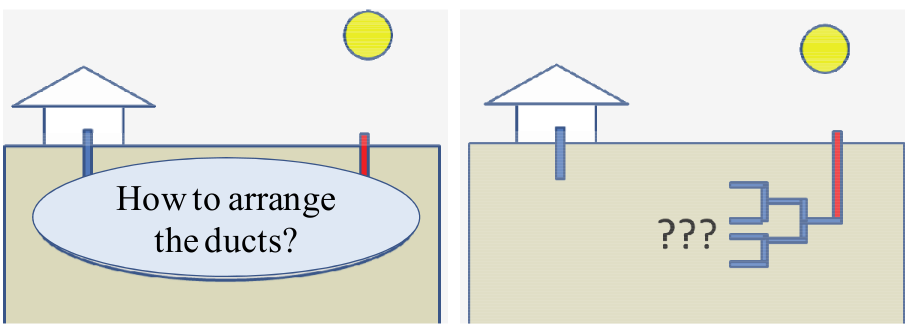
Figure 1.
Design question for Eahe.
This paper addresses some of these questions through
the case study of Eahe composed by three ducts and
using the method of constructal design, which
consists of morphing freely the flow configuration towards the direction of the
main currents that flow through it subjected to constraints (volumes). Here,
the current is heat, and it flows between the ducts and the ground. As in (Rodrigues et al., 2015), the ducts
assembly is assumed to occupy a constant volume VEAHE whose
center is buried at a depth Daveinside a portion of soil with constant
volume Vs. It is assumed that the Eahe volume takes the shape of a triangular prism while the
soil is a parallelepiped. Two spacings among the ducts are considered: a
horizontal Sh
and a vertical one Sv,
which are free to vary under constraints, such as a fixed volume fraction  , which is the ratio between VEAHE and Vs.
Then, the general objective is to understand how the heat exchange varies (or
is maximized) as the structure evolves assuming different values for the ratio s = Sh / Sv.
, which is the ratio between VEAHE and Vs.
Then, the general objective is to understand how the heat exchange varies (or
is maximized) as the structure evolves assuming different values for the ratio s = Sh / Sv.
As it is shown ahead, from the values of the temperature fields on the ducts inlets and outlets, averages of their differences, called thermal potentials of Eahe are computed. This work presents new models for the thermal potentials in function of the ratio s . Among other results, this allows to establish important findings, from the constructal point of view, such as the best shape for the ducts assembly.
Material and methods
This study assesses the performance
of many different geometrical arranges of three ducts buried in a three-dimensional
portion of soil with height Hs
= 15 m, width Ws= 10 m and length Ls = 26
m, as illustrated by Figure 2a. Each duct is a right circular cylinder with
length = 26, and diameter d = 0.127 m. Furthermore, their centers
are placed at the corners of an isosceles triangle around a fixed center point 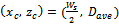 , as in the Figure 2b. Here, Dave= 3 m which is the depth recommended by previous researches (Brum et al., 2012)
for Eahe with only one duct, considering experimental
data obtained in the Brazilian city of Viamão (Vaz et al., 2014). From Figure 2b, one also notices that (, )
is the center of a rectangle whose base and height measure, respectively, Shand
Sv.
These numbers represent the horizontal and vertical spacings among the ducts.
, as in the Figure 2b. Here, Dave= 3 m which is the depth recommended by previous researches (Brum et al., 2012)
for Eahe with only one duct, considering experimental
data obtained in the Brazilian city of Viamão (Vaz et al., 2014). From Figure 2b, one also notices that (, )
is the center of a rectangle whose base and height measure, respectively, Shand
Sv.
These numbers represent the horizontal and vertical spacings among the ducts.
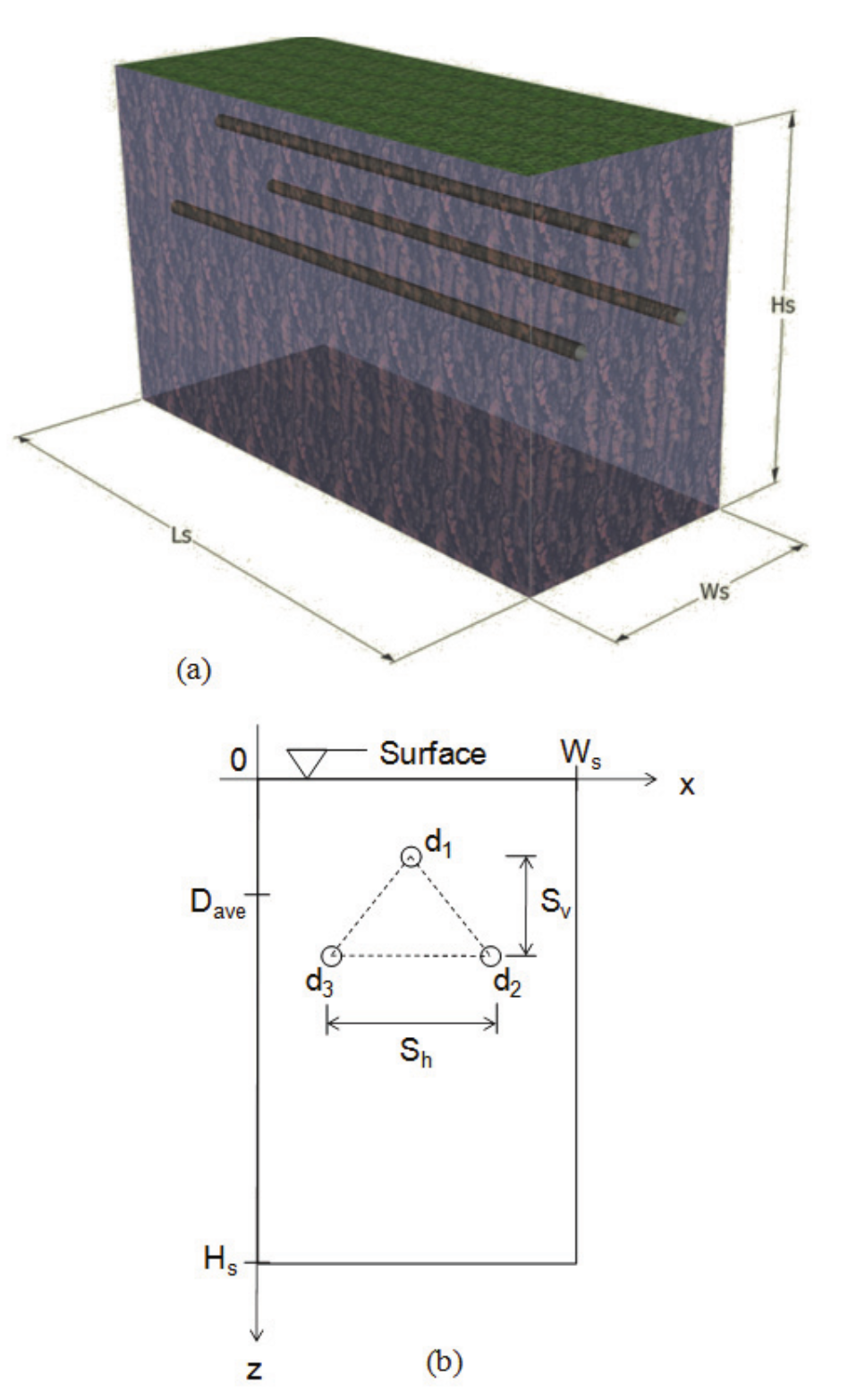
Figure 2.
(a) Soil and ducts three-dimensional view; and (b) Cross section view.
Basically, one objective here is to
understand how the differences between the air temperatures on the outlet and
inlet sides of the ducts are maximized as the triangular shape of the
arrangements vary. More specifically, the degree of freedom is the ratio
between Sh
and Sv,
subject to fixed constraints: the volume occupied by the Eahe VEAHE and the volume of the soil
considered Vs. The VEAHE
constraint can be replaced by the volume fraction  , i.e., the ratio between VEAHE and Vs.
Three-dimensionally speaking, the Eahe is assumed to
be a triangular prism and the soil a parallelepiped, then
, i.e., the ratio between VEAHE and Vs.
Three-dimensionally speaking, the Eahe is assumed to
be a triangular prism and the soil a parallelepiped, then  is defined by Equation 1:
 (1)
(1)Since the ducts cannot intersect and they have to be inside the soil, it should be imposed further constraints, which are: Sh > d, Sv > d, Sh < Ws – 2 d, Sv < 2 Dave - 0.5. As it has been done in related studies (Rodrigues et al., 2015), this research considered many different ratios Sh/Svfor three different volume fractions, whose values are properly summarized in the next section.
To simulate numerically the temperature fields, the computational domain was constructed and discretized using the Gambit software. The solution of governing equations and post-processing were done with the Fluent software which employs the finite volume method. All cases employed tetrahedral cells whose quantity varied around 33000 and 720000 for the ducts and the soil regions, respectively. The mesh was more refined in the ducts to improve precision. In the soil, the cells could have a maximal interval size of 10d/3. These numbers came from mesh independence tests performed in previous research (Rodrigues et al., 2015). To avoid unnecessary complications, the ducts were simply assumed to be cylindrical perforations in the soil, i. e., their thickness and material properties were neglected. This simplification has already been adopted in many studies (Brum et al., 2012; Brum, Isoldi, Santos, Vaz, & Rocha, 2013a; Brum, Vaz, Rocha, Santos, & Isoldi, 2013b; Vaz et al., 2014; Rodrigues et al., 2015) since it was previously validated against experimental data. Regarding time discretization, all simulations used a time step of 3600 s, with a maximum of 200 interactions per time step, covering a total period of two years.
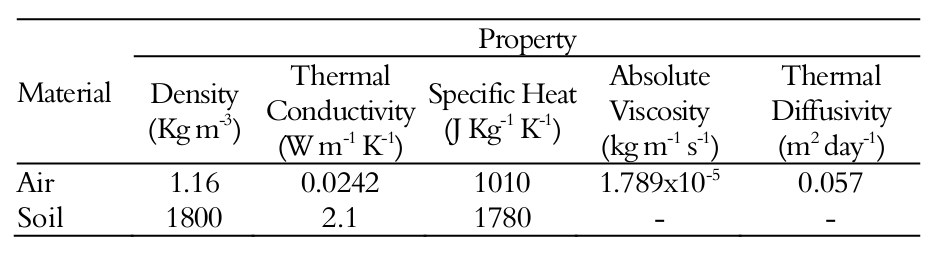
This study also considered the experimental data from (Vaz et al., 2014) to represent the air and clay soil from the Brazilian city of Viamão, whose thermo-physical properties are assembled in Table 1. Furthermore, using the least squares method as in (Brum, Ramalho, Rocha, Isoldi, & Santos, 2015), the soil surface and air temperatures along one year in that city were modeled, respectively, by the Equation 2 and 3:
 (2)
(2)
 (3)
(3)where:
The temperatures are in 0C and the time t in days. Hence, these equations were used, in this order, to impose boundary conditions for the temperature on the upper surface of the computational domain and at the inlet of each duct. Also at the inlet, it was imposed a velocity of 1.0 m s-1. At the outlet it was prescribed the atmospheric pressure. As for the other surfaces, they were considered thermally insulated. For the initial condition, the temperature in all domain is considered equal to the soil mean temperature, i. e., 18.700C.
The simulations involved a very complete computational model for Eahe (Brum et al., 2012; Brum et al., 2013b; Vaz et al., 2014). Except for the soil, where the evaluation of the transient temperature field considers only the conservation equation of energy, inside the ducts the time-averaged conservation equations of mass, momentum and energy (Wilcox, 2002; Versteeg & Malalasekera, 2007) were used to model a transient, incompressible, turbulent forced convective flow. The Reynolds Stress Model (RSM) was used to deal with the turbulence; for the treatment of transient pressure and velocity fields it was used the Coupled algorithm; to handle numerical instabilities from the advection terms of conservation equations of momentum and energy, as well as, for equations of the closure model, it was employed the upwind scheme. Finally, the results were considered converged when the residuals for mass, momentum, and energy between two consecutives iterations were lower than 10-3, 10-3 and 10-6, respectively.
Results and discussion
Modeling the instantaneous thermal potential
Many studies (Brum et al., 2012; 2013a; 2013b; Vaz et al., 2014; Rodrigues et al., 2015) analyze Eahe by a performance criteria called thermal potential PT, which is often defined simply by the time average of the differences between the air temperatures on the outlet and inlet sides of the ducts.
This paper formally defines the PT further ahead after developing other important concepts. First, for Eahe with q ducts, let dk be the difference between the air temperatures on the outlet To,kand on the inlet Ti,k of the k-th duct in the time t, that is, by Equation 4:
 (4)
(4)Thus, let the instantaneous thermal potential P be defined by the mean of the q temperature differences, which is in the Equation 5:
 (5)
(5)
Indeed, for Eahe arrangements similar to the one shown in Figure 2, P is a function of many variables besides time. However, from the perspective of the constructal design (Bejan & Lorente, 2008; Rodrigues et al, 2015) there is a particular interest to understand the relationship between the thermal potential and the geometrical degrees of freedom Sh and Sv, which represent, respectively, the horizontal and vertical spacings among the ducts.
A major contribution of this paper is to find that P can be written in the form of Equation 6:
 (6)
(6)where:
s = Sh/Sv, b, c and d are real constants, a is a function of s, and t stands for time, as before. In physical terms, it is usual to say that: a represents the potential amplitude, b its angular frequency, c the phase, and d the mean value. As it is shown later, this means that the intensity of the thermal potential of Eahe is directly related to s.
It has already been noticed in previous studies (Vaz et al., 2014; Brum et al., 2015) that the temperatures on the inlet and outlet of Eahe have a periodical behavior well captured by sine based functions. Even though works e. g. (Rodrigues et al., 2015) have studied some correspondence between and the thermal potential, they have not attempted to model their relationship. As shown in Figure 3, where there is a comparison of the instantaneous thermal potential P for three different values of s, under the same volume fraction  , the fraction s influences directly the amplitudes, hardly changing their frequency, phase, or mean value.
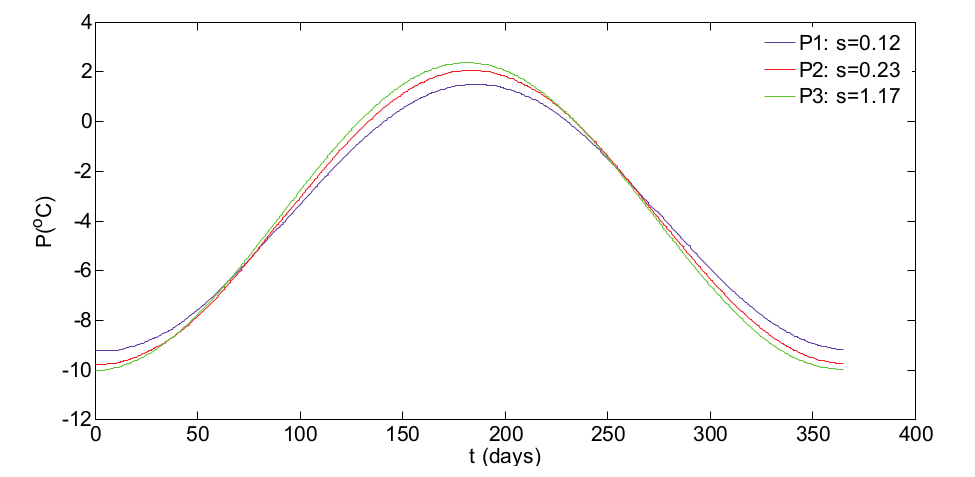
Figure 3.
Three cases of thermal instantaneous potentials along one year for u = 0.01 .
To further verify this hypothesis, it
was first considered individually m
different cases of ratios s = Sh/Sv for the same volume fraction  . Then, the instantaneous thermal potentials were modeled in the form of
Equation 7:
. Then, the instantaneous thermal potentials were modeled in the form of
Equation 7:
 (7)
(7)where:
aj, bj, cj, and djare real coefficients which are determined by the least squares method as in (Brum et al., 2015).
The Table 2 presents the approximate values of for the corresponding volume fractions  = 0.01, 0.007 and 0.003. Hence, for each value of
  it was considered m = 14 different values of s.

Regarding the values of the coefficients aj, cjand, dj all of them are presented, approximately, in the Table 3, 4 and 5, considering the volume fractions  = 0.01, 0.007 and 0.003, respectively. Since the instantaneous thermal potential is periodic, and its period is one year, then bj should be equal to
  , because it represents the angular frequency, and the year was simulated with 365 days. Thus, as expected, for all cases, the numerical results gave
  .
.
From the Table 3 to 5, the coefficients cjand dj relatively vary much less than ajwith respect to the variable s. For example, taking  = 0.007, the standard deviations (Bulmer, 1979) of aj, cj and, dj are 0.32, 0.03 and 0.03, respectively. In all cases, the standard deviations for bj were negligible. Therefore, it is very reasonable to approximate the coefficients bj, cj and, dj by their respective mean values and only obtain a classical polynomial fitting, by least squares (Gerald & Wheatley, 2004), to the coefficient aj as a function of s.


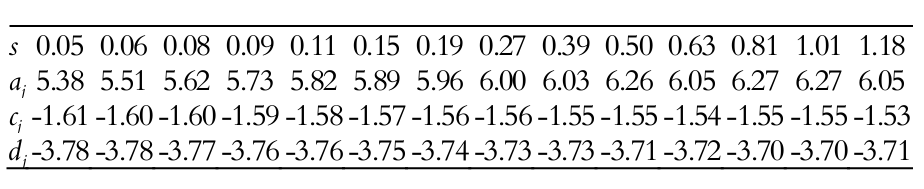
All things considered, for the temperature fields obtained numerically, it is possible to develop the following three functions to model the instantaneous thermal potential.
For  = 0.01, Equation 8:
 (8)
(8)where, Equation 9:
 (9)
(9)For  = 0.007, Equation 10:
 (10)
(10)where, Equation 11:
 (11)
(11)For  = 0.003, Equation 12:
 (12)
(12)where, Equation 13:
 (13)
(13)In all these equations, the units for P and t are, respectively, 0C and days. The variable s is dimensionless. Here, it is important to highlight that the fourth degree polynomials were adopted to increase precision. The Figure 4 compares the graphics of the discrete results aj and its three fitting polynomials of degree 4, 3 and, 2 respectively named: a4(s), a3(s) and a2(s). As shown, a4(s) follows the data more closely. In fact, for this case, there is a Pearson’s R correlation coefficient (Bulmer, 1979) among a4 (sj) and aj of 0.997.
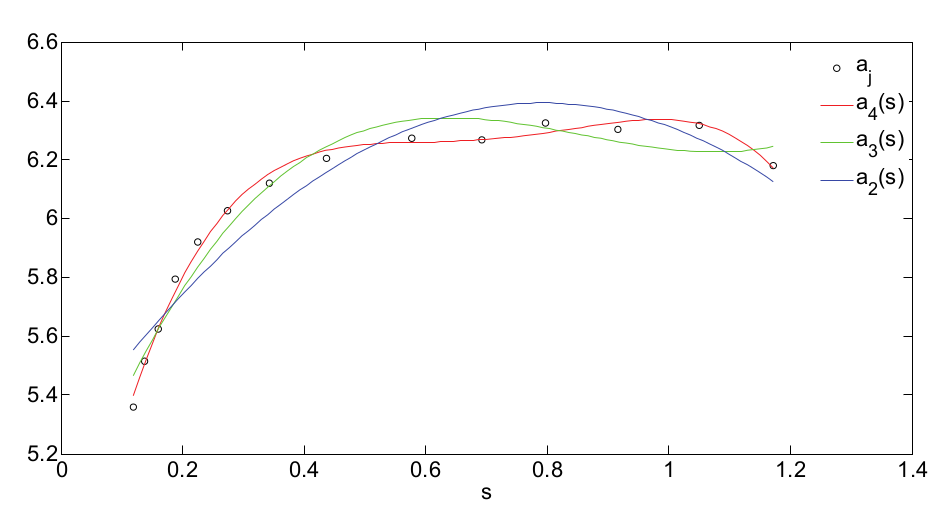
Figure 4.
Comparison between aj and its fitting polynomials an (s) of degree n for u = 0.01.
For Eahe projects, a main objective is to maximize the differences (positive or negative) between the temperatures on the ducts outlet and inlet. Therefore, it is very important to compute the maximum and minimum of the instantaneous thermal potential functions.
Hence, using these newly developed function, one first step is to find the maximum amplitude of the instantaneous potential which is given by the functions a(s). Since these functions are polynomials, their maximum values occur where their first derivatives are zero, or at the boundaries of the intervals considered for the variable s (Stewart, 2006).
In the case of  = 0.01, s varies in the interval [0.12, 1.17]. The derivative of a(s)
is given by Equation 14:
= 0.01, s varies in the interval [0.12, 1.17]. The derivative of a(s)
is given by Equation 14:
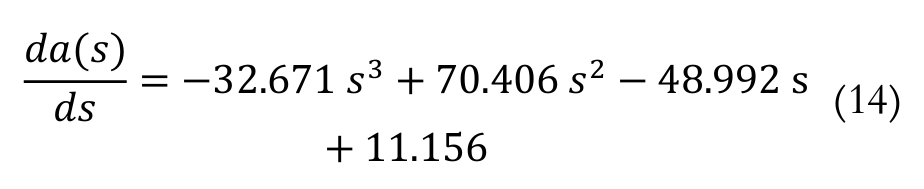 (14)
(14)which is zero, approximately, at s = 1. Since a(0.12) = 5.40, a(1.00) =
6.34 and a(1.17) = 6.17, then it is
possible to conclude that the maximal amplitude of the instantaneous thermal
potential is approximately 6.340C which occurs for a relation  .
.
Making similar computations for  = 0.007 and
  = 0.003, the maximal amplitude
also occurs when
= 0.003, the maximal amplitude
also occurs when  , changing only its values for 6.310C and 6.310C,
respectively. Thus, from these comparisons, the volume fraction
, changing only its values for 6.310C and 6.310C,
respectively. Thus, from these comparisons, the volume fraction  = 0.01 gives the best thermal
performance for the cases considered in this paper.
= 0.01 gives the best thermal
performance for the cases considered in this paper.
Looking at these results from the
geometrical aspect, they also represent a contribution to the Constructal Theory (Bejan, 1997; Bejan & Lorente, 2008). An
important question for the design of Eahe is how to
find the flow architecture (ducts spacings and shapes of their arrangements)
which increases the heat exchange with the soil. In this sense, it is possible
to interpret the set of simulations presented here as an analysis of the
evolution of Eahe (particularly, its instantaneous
thermal potential P ) under free
changes in its flow configurations (horizontal and vertical spacings: s) up to limiting constraints. At the
end, inside the variation of volume fractions  ) studied, one finds out that robust arrangements for the ducts take the
shape of isosceles triangles with unitary base and height. This goes along with
the results of a related study (Rocha et al., 2012), where it is found that the
best shapes for sets of four heat pumps tend to squares, for similar ranges of
volume fractions also adopted in this paper.
) studied, one finds out that robust arrangements for the ducts take the
shape of isosceles triangles with unitary base and height. This goes along with
the results of a related study (Rocha et al., 2012), where it is found that the
best shapes for sets of four heat pumps tend to squares, for similar ranges of
volume fractions also adopted in this paper.
After computing the maximum value of
the amplitude as a function of s, it
is possible to find the maximum and minimum values of the instantaneous thermal
potential relatively to the time t.
In particular, it is convenient to focus the analysis, from here on,
considering  = 0.01 and the potential function
defined by the Equation 8 and 9, since the higher amplitude was achieved for
this volume fraction.
= 0.01 and the potential function
defined by the Equation 8 and 9, since the higher amplitude was achieved for
this volume fraction.
Therefore, as the maximum and minimum values of the sine function are, respectively, and - , they occur at the following days. Maximum:  Minimum:
  .
.
As expected, these results agree with the graphics in Figure 3, where the maximum value of the instantaneous thermal potential occurs almost at the middle of the year (after days, during the winter) while its minimum value occurs at the beginning of the year (in the summer). Based on these data, the maximum and minimum values for the instantaneous thermal potential, for all cases studied, are given by Equation 15 and 16:
 (15)
(15)
 (16)
(16)Thermal potential
Given these results, it is all set to define the so-called thermal potential PT used in many references (Brum et al., 2012; 2013a; 2013b; Vaz et al., 2014; Rodrigues et al., 2015) from the concept of the instantaneous thermal potential P, introduced in this paper. In general, the PT in these studies can be seen as monthly mean values of P.
Considering the numerical simulations, adopting a fixed value for the ratio s, the months can be discretized in n + 1 times t0, t1, …, tn equaly separated by intervals of size  . Thus, the monthly thermal potential can be computed by the Equation 17:
 (17)
(17)which is equivalent to Equation 18:
 (18)
(18)Hence, continuously speaking, if  , the thermal potential can be formally defined by Equation 19:
 (19)
(19)for each fixed value of s.
From these analyses, the highest thermal potential for cooling is achieved in January (from the day 0 to 31) for a ratio s = 1. Furthermore, it is given by Equation 20:
 (20)
(20)On the other hand, the highest thermal potential for heating occurs in July (among the days 181 to 212) and it is given by Equation 21:
 (21)
(21)Eahe’s efficiency
Although the thermal potential gives
one way to compare different arrangements of Eahe, it
is not a dimensionless quantity and it does not offer a clear measure of
efficiency. In this regard, one can use the temperature ratio  (Pfafferott,
2003), defined by Equation 22:
(Pfafferott,
2003), defined by Equation 22:
 (22)
(22)where:
Ti and To are the temperatures on the inlet and on the outlet of the ducts, respectively, while Tsoil is the soil temperature.
In this study, it is computed an average of the temperature ratio along intervals of days [c, d], through the Equation 23:
 (23)
(23)where:
P (t, s) is the instantaneous thermal potential defined in Equation 8 and 9; Tms = 18.70C, which is the mean temperature of the soil at the center of the Eahe installations, i.e., at the point (x, z) = (Ws /2, Dave), relatively to Figure 2b; Ta(t) is the temperature of the air on the ducts inlet, which is given in Equation 3.
Ideally,  should be a scale unit because,
at first sight, the absolute value of the differences between the temperatures
on the outlet and inlet of Eahe should not be higher
than the absolute value of the differences between the temperatures on the
inlet and in the soil. Besides, if the heat exchange is perfect, the
temperature on the outlet should be equal to the temperature in the soil.
However, this is not true, particularly, in the spring and in the fall, when
the air temperature can be equal to the soil temperature.
should be a scale unit because,
at first sight, the absolute value of the differences between the temperatures
on the outlet and inlet of Eahe should not be higher
than the absolute value of the differences between the temperatures on the
inlet and in the soil. Besides, if the heat exchange is perfect, the
temperature on the outlet should be equal to the temperature in the soil.
However, this is not true, particularly, in the spring and in the fall, when
the air temperature can be equal to the soil temperature.
Thence, it is convenient to compute
the Eahe efficiency at the peak of the Brazilian
summer, in January, and at the peak of winter, in July. The Table 6 presents
some results of efficiency in these months. As expected, the Eahe are more efficient when  . To raise or reduce s around this value reduces the
efficiency. Furthermore, the best performance for Eahe
occurs in the winter, when they achieve 92.9% of efficiency.
. To raise or reduce s around this value reduces the
efficiency. Furthermore, the best performance for Eahe
occurs in the winter, when they achieve 92.9% of efficiency.

Energetic performance
A final important concern regarding Eahe is to determine its heat transfer rate, or its monthly energy performance, which can be computed (for each duct) by the Equation 24 (Pfafferott, 2003):
 (24)
(24)where:
 = 1 m s-1,
  = 1.16 = Kg m-3 and cair = 1010J/(Kg K-1) represent, respectively, the average velocity, the density and the specific heat of the air in the ducts; AD = 0.0127 m2 is the cross section area of the ducts; PT is the thermal potential previously defined in Equation 19, computed over a month.
Therefore, considering the peak months, the volume fraction  = 0.01 and the ratio s = 1, in average, the Eahe have a cooling power of 440.7 W in January and a heating power of 103,4 W in July. In energetic therms, this means 327.9 KWh in January and 77.0 KWh in July.
Conclusion
With the constructal design method, one examines the evolution of the thermal potential as the geometry of flow configuration varies in the direction of greater flow access for its currents. In this study, the current is heat, and it flows from the ducts of Eahe to the soil or vice versa. The objective is to determine the shape and spacing among the ducts which increase the heat exchange.
Based on constructal design, this paper introduces mathematical models to determine thermal potentials of Eahe composed by three ducts. Using the concept of instantaneous thermal potential P, which is an average of the differences between the air temperatures on the ducts outlets and inlets, this essay not only finds that P is periodic but also that its amplitude is affected directly by the ratio s between the ducts horizontal and vertical spacing.
This leads to new models for P in function of and the time t. From these models, inside the range of simulations studied, this paper finds: the best volume fraction for Eahe ( = 0.01); the maximal amplitude of P (6.340C); the best spacing among the ducts (occurring for
 ); the best shape (the results point that the ducts should be arranged forming an isosceles triangle with unitary base and height); the days and months with higher potentials and its values (occurring in January and July). It also allows computing the Eahe efficiency in the best months of winter (92.9%) and summer (88.6%), and the energetic performance, which achieves a maximum of 327.9 KWh in January.
As a final remark, the methodology employed for the first time in this paper, to model the instantaneous thermal potential, considered only three ducts as a case study. Its applicability to analyze other cases and geometries with only two ducts, or more than three, should be the subject of forthcoming works.
Acknowledgements
R. da S. Brum thanks to CNPq for her doctoral scholarship. L. A. Isoldi thanks to CNPq (Process: 445558/2014-8). E. D. dos Santos, L. A. Isoldi and L. A. O. Rocha thank to CNPq for financial support.
References
Bejan, A. (1997). Advanced engineering termodynamics. New York City, NY: John Wiley & Sons.
Bejan, A., & Lorente, S. (2008). Design with constructal theory. Hoboken, NJ: John Wiley & Sons.
Bejan, A., & Zane, J. P. (2012). Design in nature. New York City, NY: Doubleday.
Biserni, C., Rocha, L. A. O., Stanescu, G., & Lorenzini, E. (2007). Constructal H-shaped cavities according to Bejan’s theory. International Journal of Heat and Mass Transfer, 50(11-12), 2132-2138.
Brum, R. S., Isoldi, L. A., Santos, E. D., Vaz, J., & Rocha, L. O. (2013a). Two-dimensional computational modeling of the soil thermal behavior due to the incidence of solar radiation. Engenharia Térmica (Thermal Engineering), 12(2), 63-68.
Brum, R. S., Ramalho, J. V. A., Rocha, L. A. O., Isoldi, L. A., & Santos, E. D. (2015). A Matlab code to fit periodic data. Revista Brasileira de Computação Aplicada, 7(2), 16-25.
Brum, R. S., Rocha, L. A. O., Vaz, J., Santos, E. D., & Isoldi, L. A. (2012). Development of simplified numerical model for evaluation of the influence of soil-air heat exchanger installation depth over its thermal potential. International Journal of Advanced Renewable Energy Research, 1(9), 505-514.
Brum, R. S., Vaz, J., Rocha, L. A. O., Santos, E. D., & Isoldi, L. A. (2013b). A new computational modeling to predict the behavior of earth-air heat exchangers. Energy and Buildings, 64, 395-402.
Bulmer, M. G. (1979). Principles of statistics. New York City, NY: Dover Publications Inc.
Cetkin, E., Lorente, S., & Bejan, A. (2010). Natural constructal emergence of vascular design with turbulent flow. Journal of Applied Physics, 107(11), 114901-114910.
Gerald, C. F., & Wheatley, P. O. (2004). Applied numerical analysis. Boston, MA: Pearson/Addison-Wesley.
Kim, Y., Lorente, S., & Bejan, A. (2010). Constructal multi-tube configuration for natural and forced convection in cross-flow. International Journal of Heat and Mass Transfer, 53(23-24), 5121-5128.
Lorenzini, G., Biserni, C., Link, F. B., Isoldi, L. A., Santos, E. D., & Rocha, L. A. O. (2013). Constructal Design of T-shaped cavity for several convective fluxes imposed at the cavity surfaces. Journal of Engineering Thermophysics, 22(4), 309-321.
Pfafferott, J. (2003). Evaluation of earth-to-air heat exchangers with a standardised method to calculate energy efficiency. Energy and Buildings, 35(10), 971-983.
Reis, A. H. (2006). Constructal view of scaling laws of river basins. Geomorphology, 78(3-4), 201-206.
Rocha, L. A. O., Lorente, S., & Bejan, A. (2009). Tree-shaped vascular wall designs for localized intense cooling. International Journal of Heat and Mass Transfer, 52(19-20), 4535-4544.
Rocha, L. A. O., Lorente, S., Bejan, A., & Anderson, R. (2012). Constructal design of underground heat sources or sinks for the annual cycle. International Journal of Heat and Mass Transfer, 55(25-26), 7832-7837.
Rodrigues, M. K., Brum, R. S., Vaz, J., Rocha, L. A. O., Santos, E. D., & Isoldi, L. A. (2015). Numerical investigation about the improvement of the thermal potential of an earth-air heat exchanger (Eahe) employing the constructal design method. Renewable Energy, 80, 538-551.
Stewart, J. (2006). Cálculo volume I. São Paulo, SP: Pioneira Thomsom Learning.
Vaz, J., Sattler, M., Brum, R. S., Santos, E. D., & Isoldi, L. A. (2014). An experimental study on the use of Earth-Air Heat Exchangers (Eahe). Energy and Buildings, 72, 122-131.
Versteeg, H. K., & Malalasekera, W. (2007). An introduction to computational fluid dynamics – the finite volume method. London, UK: Pearson Education.
Wilcox, D. C. (2002). Turbulence modeling for CFD. La Canada, CA: DCW Industries.
Notes
Author notes
jairo.ramalho@ufpel.edu.br