Engenharia Mecânica
Energetic Analysis using theoretical modeling and the characteristic equation method in a small absorption chiller with LiBr/H2O
Análise energética de um chiller de absorção de LiBr/H2O de pequeno porte utilizando modelagem teórica e o método equação característica
Energetic Analysis using theoretical modeling and the characteristic equation method in a small absorption chiller with LiBr/H2O
Acta Scientiarum. Technology, vol. 40, 2018
Universidade Estadual de Maringá

This work is licensed under Creative Commons Attribution 4.0 International.
Received: 25 January 2017
Accepted: 28 July 2017
Abstract: This paper sets out to examine a small absorption chiller that uses the pair LiBr/ H2O with a 4.5 kW nominal capacity, using theoretical modeling and the characteristic equation method. The idea is to compare two ways of simulating and evaluating absorption systems by analyzing the temperatures and flow rates of external hot, chilled and cold water circuits, as well as the values of the overall heat transfer coefficients of each component. Energetic analysis is based on conserving mass and energy by taking into consideration the overall heat transfer coefficients and their respective areas via the UA products of the 5 components of the absorption chiller. The characteristic equation method is based on Duhring’s rule of the internal temperature which is founded on saturation mean temperatures and the Duhring coefficient (B). The results of comparing the activation of thermal power and the cooling capacity of the Rotartica absorption chiller, obtained by theoretical modeling and from the characteristic equation values, were good since the mean relative errors found were 4% lower for most of the operating conditions examined.
Keywords: absorption chiller, characteristic equation, lithium bromide, water.
Resumo: Este trabalho tem como objetivo o estudo energético de um chiller de absorção de pequeno porte que utiliza o par LiBr/H2O de 4,5 kW através da modelagem teórica e o método da equação característica. A idéia é comparar duas formas de avaliar os sistemas de absorção visando as temperaturas e vazões dos circuitos externos de água fria, quente e gelada, assim como os valores dos coeficientes globais de cada componente. A análise energética esta baseada na conservação da massa e energia levando em consideração os coeficientes globais de transferência de calor e suas respectivas áreas através dos produtos UA dos 5 componentes do chiller de absorção. O método da equação característica baseia-se na regra de Duhring relacionando as temperaturas internas de saturação em função das temperaturas medias externa e o coeficiente de Duhring (B). A comparação dos resultados da energia de ativação térmica e da capacidade de refrigeração do chiller de absorção Rotartica, obtido pela modelagem teórica e pelo método da equação característica foi boa já que os erros relativos médios encontrados foram inferiores em 4% para a maioria das condições de operação.
Palavras-chave: chiller de absorção, equação característica, brometo de lítio, água.
Introduction
Investigating how to use energy resources more efficiently is increasingly the subject of studies in academia and industry due to the high in-country demand for energy by the residential, commercial and industrial sectors and indeed, all over the world. A second reason for such studies is to seek to reduce the high costs of processing for generation (Ochoa, Dutra, Henríquez, & Santos, 2016; Ifaei, Rashidi, & Yoo, 2016a; 2016b).
Absorption refrigeration equipment represents an alternative component that could be used for optimizing energy systems since such equipment can take advantage of thermal waste to drive these systems, thereby increasing their overall efficiency (Ochoa, Dutra, & Henríquez, 2014a; Shirazi, Taylor, White, & Morrison, 2016). Absorption chillers have been studied by several authors in different ways, for example, as components of a cogeneration system (Ochoa, Dutra, Henríquez, & Rohatgi, 2014b; Daghigh & Shafieian, 2016; Singh, 2016; Talukdar & Gogoi, 2016), as a single refrigeration component (Martínez, Martínez, & Bujedo, 2016), as solar integrated systems(Monné, Alonso, Palacín, & Serra, 2011; Abdullah, Saman, Whaley, & Belusko, 2016) or for conducting fundamental studies on heat and mass transfer (Albert, Marschall, & Bothe, 2014).
Numerical and experimental studies have been undertaken on absorption refrigeration systems (Myat et al., 2011; Moreno-Quintanar, Rivera, & Best, 2012; Marc, Sinama, Praene, Lucas, & Castaing-Lasvignottes, 2015), with a view to examining the influence of the internal and external parameters on the COP and its capacity (Bakhtiari, Fradettel, Legros, & Paris, 2011; Ochoa, Dutra, Henríquez, Santos, & Rohatgi, 2017b), to assessing performance and evaluating equipment (Chen, Gong, Wan, Luo, & Wan, 2015; Porumb, Porumb, & Balan, 2017). Other studies have applied thermo-economic analysis, also known as exergoeconomic analysis (Ochoa et al., 2014b; Ochoa et al., 2016) to find the irreversibilities and the cost of the equipment, that could aid an economic feasibility study of polygeneration plants that use an absorption chiller as an integrated component (Angrisani et al., 2011).
When any absorption chiller is studied, energetically or exergetically, various pieces of information are required, such as internal temperatures, overall heat transfer coefficients, mass flow rates and other parameters that are frequently not easy to find and/or calculate (Zinet, Rulliere, & Haberschill, 2012; Xu, Zhang, & Xiao, 2016). Therefore, it is important to find and/or develop simulation tools that enable the activation of thermal power and cooling capacity of the chiller to be predicted by using variables that are easy to measure (e.g, the external circuit temperatures of hot, chilled and cold water) (Albers, Nurzia, & Ziegler, 2010; Ochoa et al., 2016). In this context, the characteristic equation method could be applied in ways that the literature has already demonstrated (Albers, 2014).
This method when applied to absorption refrigeration systems enables the performance of an absorption chiller and a heat pump to be investigated by using algebraic equations that represent the activation of thermal power and cooling capacity, and also by the COP method based on the characteristic temperature difference, by the work presented in Hellmann (apud Albers, Nurzia, & Ziegler, 2010).
The characteristic equation method is underpinned by thermodynamic principles and the specific operating parameters of the equipment which, when represented by simple analytical equations, provide an excellent means by which to simulate energy plants, such as industrial drying processes, polygeneration plants, and refrigeration and air conditioning processes. At first, this method was introduced in Japan to deal with absorption refrigeration areas (Helm, Hagel, Pfeffer, Hiebler, & Schweigler, 2014), on characterizing an absorption heat pump that uses the pair lithium bromide/water as a function of the external circuit. The characteristic equation method in absorption chiller and heat pumps has been used in numerous research studies, e.g., Ziegler and Albers (2009); Albers (2014), as a tool that enables the partial load behavior and control strategies in absorption refrigeration systems to be investigated.
Taking as a basis the study presented by Hellmann (apud Albers, Nurzia, & Ziegler, 2010), refrigerating capacity can be analyzed by examining the total temperature difference (∆∆t), (Gutiérrez-Urueta, Rodríguez, Ziegler, Lecuona, & Rodríguez-Hidalgo, 2012; Helm, Hagel, Pfeffer, Hiebler, & Schweigler, 2014), where the characteristic equation method has been used as a simulation tool and for analysis so as to implement a control strategy for solar absorption refrigeration systems. In Albers & Ziegler (2005), there was discussion and analysis of the influence of the internal irreversibilities on the characteristic equation and their impact on the operational behavior of absorption chillers. It is important to recall that this method allows modifications and adaptations to be undertaken in order to make better predictions of how single- and double-effect absorption systems will operate. Another adaptation of this method was conducted on chillers with adiabatic absorbers by Gutiérrez-Urueta et al. (2012) who performed an extension of the methodology proposed by Hellmann (apud Albers, Nurzia, & Ziegler, 2010), to predict the behavior of single effect chillers and heat pumps by using simple algebraic equations. Lately, the characteristic equation method has been used to monitor cooling systems of the German federal agency for the environment with regard to the control strategy for solar absorption cooling systems. As a main result of this application, costs - when compared with using the conventional system- were reduced by the significant amount of 5% (Albers, 2014).
This paper presents an energetic study of a small absorption chiller that uses the pair LiBr/ H2O with 4.5 kW of nominal capacity by means of theoretical modeling and the characteristic equation method. The idea is to compare two ways to simulate and evaluate absorption systems by examining the temperatures and flow rates of external circuits of hot, chilled and cold water, and determining the values of the overall heat transfer coefficients of each component. The goal of this paper is to demonstrate the versatility of the characteristic equation method so as to predict the behavior of absorption chillers based on the external average temperature and flow rates of the water circuit, as well as UA product. It does so by using two simple algebraic equations of the activation of thermal power and the cooling capacity of an absorption chiller.
Material and methods
The absorption refrigeration equipment modeled in this paper is a single effect hot water fired absorption chiller of 4.5 kW of nominal capacity (manufactured by Rotartica) and uses LiBr/H2O as a working fluid. In fact, this kind of absorption chiller, a Rotartica chiller (EcoFriend, 2016), is a special type of absorption refrigeration equipment because the absorption cycle is carried out in a hermetically welded spheroid container of approximately 500 mm in diameter by 500 mm long, rotated at 400 rpm about a horizontal axis, as seen in Evola, Le Pierrès, Boudehenn, and Papillon (2013) in which a dynamic analysis was carried out. However, this absorption has also been investigated and described by several authors (Gilchrist, Lorton, & Green, 2002; Izquierdo, Lizarte, Marcos, & Gutiérrez, 2008; Monné et al., 2011). What makes this chiller different when compared with a conventional absorption chiller is the rotation of the components, namely whole systems (evaporator – absorber; generator – condenser) rotate in order to improve both the heat transfer process and also the efficiency of the cooling production. However, consideration has to be given to extra electricity being consumed so as to maintain the rotation.
Description of the single stage absorption cycle
This paper presents a small single effect absorption chiller that uses LiBr/H2O as the working fluid, in the steady state, based on the mass, species and energy balance. As is known, a single effect absorption refrigeration system is a device that, basically, consists of a generator, a condenser, an absorber, an evaporator, expansion valves and pumps, Figure 1. The operation takes place with three internal and external fluids, where the internal ones are mixed in with the LiBr/H2O solution, which passes through points 1-6 (responsible for the desorption and absorption processes) and refrigerant vapor, which passes through points 7-10 (responsible for the cooling effect). There are three external circuits, namely, the hot, cold and chilled water circuits. The hot water circuit (points 11-12) represents the activation source for the absorption chiller, the cold water circuit (points 13-16) represents the dissipation source of the systems, and the chilled water circuit (points 17-18) represents the cooling capacity of the chiller. The properties of the LiBr/H2O solution were determined using the methodology presented by Kim and Infante (2006) and implemented in Ochoa et al. (2014a and 2014b) and for the pure water, the data tabulated in Rogers and Mayhew (1992) were used.
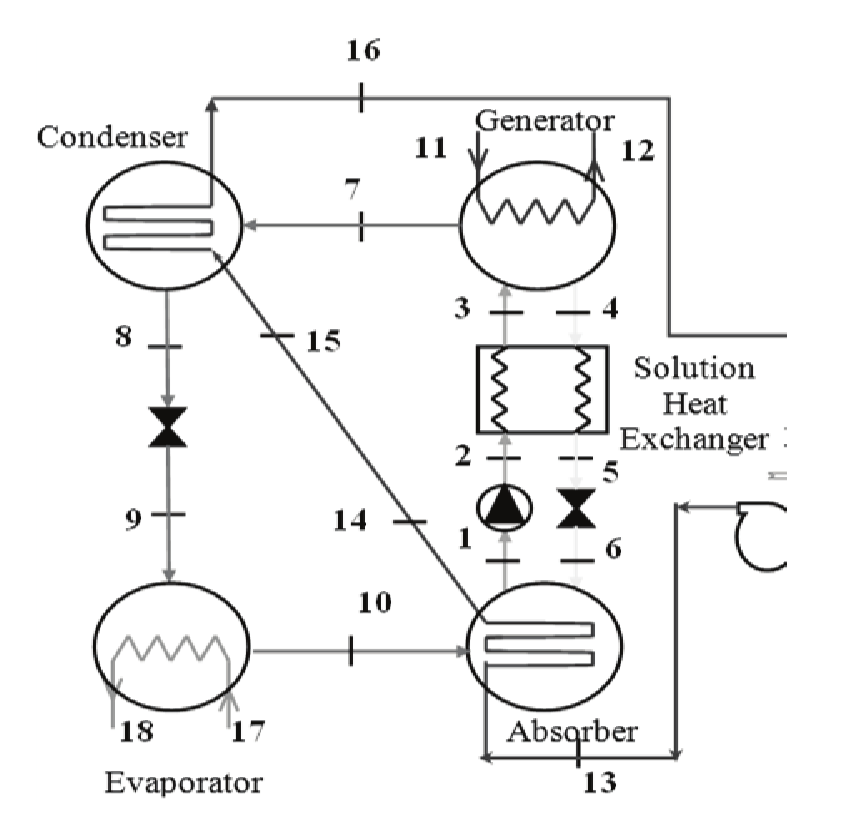
Figure 1.
Single Stage Absorption Cycle (Ochoa et al., 2016).
Energetic model
The energetic modeling of this absorption refrigeration system was accomplished by applying the energy, mass and species balances on all the components of the absorption chiller, based on some simplifying assumptions, which are listed below:
· The process of pumping of the solution is considered isentropic;
· The heat exchange with the surroundings is negligible;
· The variations in kinetic and potential energy are negligible;
· The entire process occurs in the steady state;
· The refrigerant circuit, i.e. states 7, 8, 9 and 10, is driven only by water;
· The overall coefficients of the heat exchanger are considered constant in the whole process.
By applying the first Law of Thermodynamics to each component and also the mass and species balances (absorber, generator, condenser, evaporator and the solution heat exchanger), the set of equations for the energetic model of the absorption chiller was established. The small absorption refrigeration system is formed by five heat exchangers, these being the components that govern the cycle. Therefore, the energetic modeling will be presented in a general way, shown in Figure 2 and Table 1. Further information about energetic modeling is reported in Ochoa et al. (2014a and 2014b; 2016).
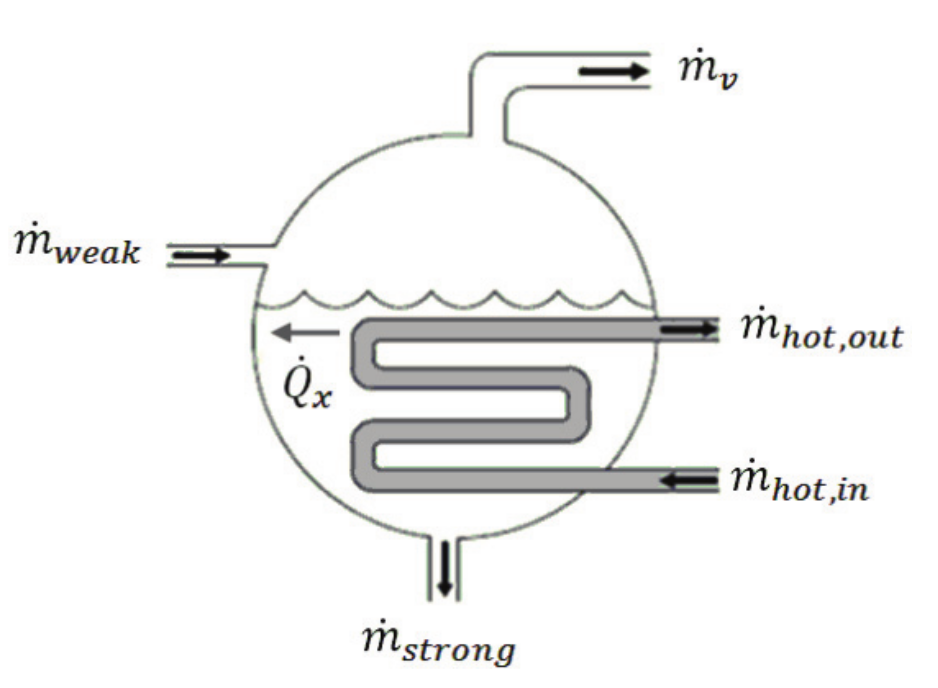
Figure 2.
Scheme of heat exchangers absorption chiller (Ochoa et al., 2014a).
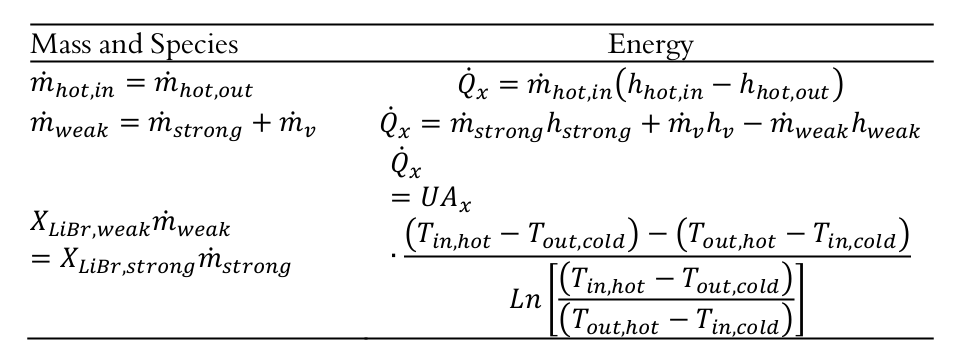
where:
 ; represented the hot mass flow,
 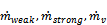 , represented the mass flow of weak, strong and vapor flow mass,
  , heat flow exchange, and
  , the UA product from the heat exchanger.
Characteristic equation method
The application of the characteristic equation is based on thermodynamic fundamentals and the nominal characteristics of the chiller (Zinet et al., 2012; Albers, 2014). The main objective of this method is to determine the behavior of the absorption chiller from the average temperatures of external circuits, taking into account specific characteristics of the chiller, such as the overall heat transfer coefficients and flow rates. Describing how to implement the characteristic equation method was explained by Equations 1 to 44. The method is based on the Duhring rule, which enables a relationship to be made between the internal average temperatures of each heat exchanger of the chiller, the strong and weak concentrations of the system (at the same vapor pressure) and the solution saturation temperatures by using a linear equation with slope B and intersection Z, expressed as Equation 1:
 (1)
(1)Considering the four main components of the system (absorber, evaporator, condenser and generator), and calculating the heat flow as a function of the overall heat transfer coefficient and heat exchanger area, product (UAx), and the average logarithmic difference (ΔTlmx) as Equation 2:
 (2)
(2)where, Equation 3:
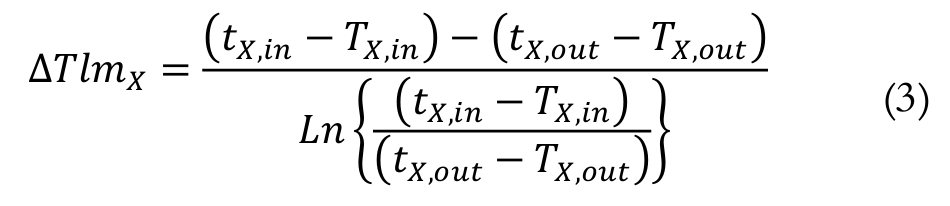 (3)
(3)The subscript X represented the chiller components (absorber, evaporator, condenser and generator). The temperatures of the external water circuit (hot, cold and chilled) are represented by the letter (t ) and the temperatures of the internal circuit of the chiller are represented by the letter (T ).
In heat exchangers, the difference in temperature between the hot and cold fluids (ΔT=Thot-Tcold ), varies with the position of the heat exchanger, its length being greater for the flow in parallel to that of the countercurrent flow. For this reason the average difference in the logarithmic temperature is commonly used for the entrances and exits of hot and cold fluids of the exchanger. However, according to the literature consulted for analyzing the heat exchangers of absorption refrigeration systems (Kohlenbach & Ziegler, 2008a; 2008b; Myat et al., 2011), the term (ΔTlmx) of the characteristic equation can be replaced by the mean temperature difference between the hot and cold fluids (ΔTlmx ≈tX-TX).
Whereas tX is the average temperature of the external fluid and TX is the average temperature of the internal fluid, the heat exchanger flows can be expressed as Equation 4at7:
 (4)
(4)
 (5)
(5)
 (6)
(6)
 (7)
(7)The subscripts (E, A, G, C ), represent the evaporator, absorber, generator and condenser, respectively.
On applying the first Law of Thermodynamics to the absorption refrigeration system, Figure 1, and considering the steady-state in the energy and mass balance of the system, each heat flow can be expressed according to the enthalpy difference and flow rate of the cycle as Equation8 at 13:
 (8)
(8)
 (9)
(9)
 (10)
(10)
 (11)
(11)
 (12)
(12)
 (13)
(13)For the thermal compressor (Generator – solution heat exchanger – Absorber), this can be expressed as follows Equation 14 at 16:
 (14)
(14)
 (15)
(15)
 (16)
(16)
where, Equation 17at20:
 (17)
(17)
 (18)
(18)
 (19)
(19)
 (20)
(20)Analogously to the generator, this can be expressed as Equation 21at 23:
 (21)
(21)
 (22)
(22)
 (23)
(23)By combining Equations 4-7 of the heat exchangers, and the equations of the internal circuit of the chiller (Equation 12, 20 and 22), a system of equations depending on the cooling capacity of the chiller and the temperature difference between the external circuits and internal can be found, expressed as Equation 24at 27:
 (24)
(24)
 (25)
(25)
 (26)
(26)
 (27)
(27)Applying Equation 1 of the Duhring rule for two temperature levels (high and low), it can find the following relationships can be found Equation 28 and 29:
 (28)
(28)
 (29)
(29)Finally, Equation 30 can be determined, as follows:
 (30)
(30)The B term of equation 30 is given by the slope of the Duhring diagram, commonly estimated for the solution of LiBr/H2O between 1.1 to 1.2, (Ziegler & Albers, 2009). By combining the Equations 24 to 27 and taking Equations 29 and 30 into consideration, the average external temperatures of the cold, hot and chilled water circuit are determined, expressed as Equation 31:
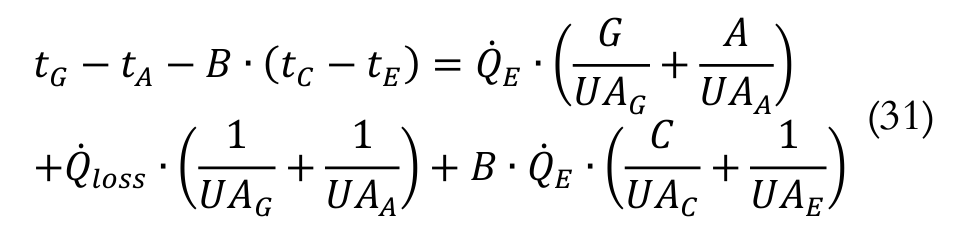 (31)
(31)The term on the left can be represented by the total temperature difference (ΔΔt ), as Equation 32:
 (32)
(32)In Equation 32, this term may be interpreted as the difference between the temperature thrust (Δtthrust) and temperature lift (Δtlift), as Equation 33:
 (33)
(33)where, Equation 34 and 35:
 (34)
(34)
 (35)
(35)The total temperature difference can also be defined in terms of the design parameters, such as Equation 36 and 37:
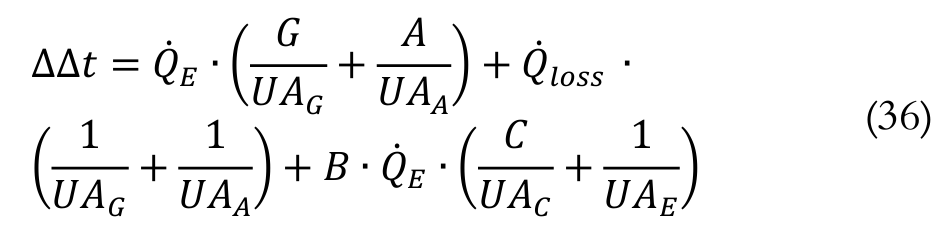 (36)
(36)
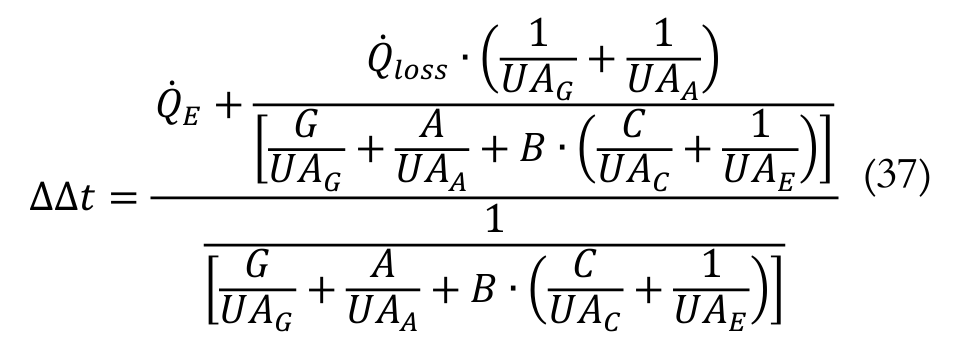 (37)
(37)This fraction of the total temperature difference can be simplified based on two parameters; (SE ) which represents the proportion of the global coefficient of each component of the chiller (evaporator, condenser, absorber and generator) and (αE ) which represents the distribution of the overall heat transfer coefficients inside the equipment, such as Equation 38 at40:
 (38)
(38)
 (39)
(39)
 (40)
(40)There is a relationship between the parameters (SE, αE and Qloss ) which is called the minimum total temperature difference, expressed as Equation 41:
 (41)
(41)The total temperature difference is defined as Equation 42:
 (42)
(42)Hence, the activation of thermal power (generator) and cooling capacity (evaporator) of the absorption chiller can be expressed as Equation 43 and 44:
 (43)
(43)
 (44)
(44)Discussion and results
The results from the energetic analysis using the theoretical modeling based on the mass, species and energy balance and the characteristic equation method was compared with experimental data published by the CREVER Group-URV in Spain and also by adapting the activation of thermal power and cooling capacity based on two correlations taken from the literature (Ziegler & Albers, 2009; Kühn, 2013).
Nominal conditions of the Rotartica absorption chiller
The nominal temperatures of the cold, chilled and hot water of the Rotartica absorption chiller were 40, 12 and 90°C, the flow rate was 1.98, 1.56 and 0.90 m3 hour-1, respectively, and the flow rate of the pumped LiBr/H2O solution was 0.030 kg s-1 (Rotartica, 2008; Monné, Alonso, Palacín, & Guallar, 2011; EcoFriend, 2016). The products (UA ) needed to obtain the coefficients of thermal power absorption chiller were extracted from the literature published by the CREVER Group-URV in Spain and also (Rotartica, 2008; Monné, Alonso, Palacín, & Guallar, 2011; Evola et al., 2013), and these were estimated by taking the nominal conditions from the manufacturer’s catalogue using the backward method with a pinch temperature, Table 3.

The adjusted experimental correlations which were obtained from the data published by the CREVER Group-URV in Spain, and adapted in accordance with the methodology presented in Kühn (2013), express as Equation 45 and 46:
 (45)
(45)
 (46)
(46)The experimental data of the Rotartica absorption chiller were extracted from the literature, which used ranges of operating temperature range (7-15°C chilled water, 80-100°C hot water, and 32-45°C cold water). Nineteen (19) operating conditions of the absorption chiller were selected. Table 4 shows the values of the parameters of the Equation 45 and 46.

Comparison of the results from the Theoretical modeling, the characteristic equation method, experimental data and the adjusted experimental correlation adjusted
The results from applying the theoretical modeling and also the characteristic equation method were compared by considering the activation of thermal power (Qg ), the cooling capacity (Qe ) and also the COP of the absorption chiller. Additionally, these results were also compared to those that used the experimental data and the results coming from the adjusted correlation of these experimental data.
The values of the characteristic equation parameters that define the cooling capacity (Equation 43) and the activation of thermal power (Equation 44) of the absorption chiller from the nominal data were: SE= 0.226 kW K-1, αE = 0.292 kW K-1, G =1.047, ∆∆tminE=2.576 K and the Duhring coefficient (B ) selected was 1.15 (Ziegler & Albers, 2009).
Figure 3 and 4 compare the results for the activation of thermal power and the cooling capacity of the absorption chiller results which were obtained by the theoretical modeling (Qg_teo;Qe_teo ), the characteristic equation method (Qg_ce;Qe_ce ), the experimental data (Qg_exp;Qe_exp ) and the adjusted experimental correlation (Qg_mod;Qe_mod ), when set against the total difference in temperature that considered the entire operational range of the equipment. The relative mean errors were calculated for all variables, using the general Equation 47, expressed as:
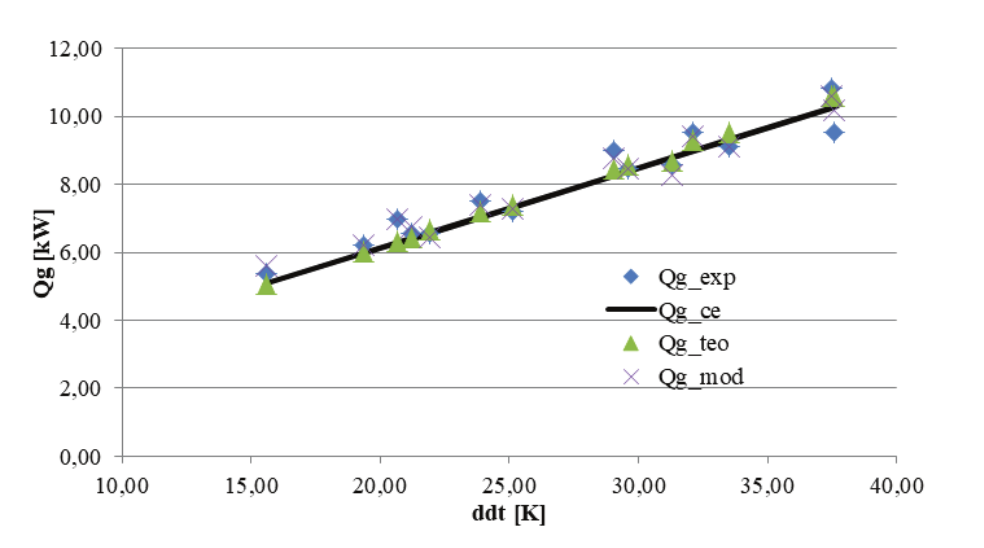
Figure 3.
Comparison of the activation of thermal power (Qg ) results obtained by the theoretical modeling, characteristic equation method, experimental data and the correlations adjusted.
Figure 3 shows the results obtained by the theoretical modeling and the characteristic equation method of the activation of thermal power throughout the operating range of the absorption chiller. In the same context, these results when compared with those from the experimental data were good because the maximum and minimum differences are 7% and less than 1%, respectively.
Figure 4 shows the results obtained by the theoretical modeling, the characteristic equation method, the experimental data and the adjusted correlations of the cooling capacity throughout the operating range of the absorption chiller.
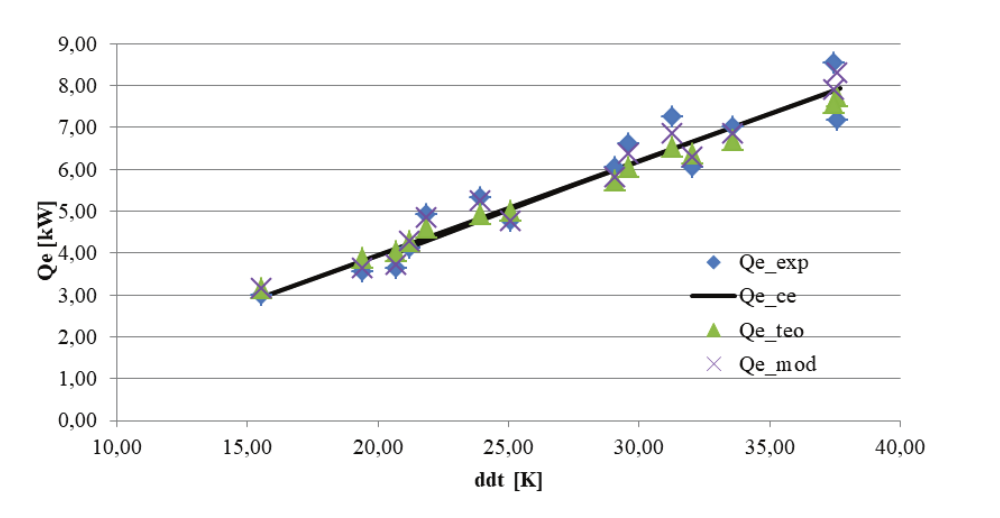
Figure 4.
Comparison of the cooling capacity (Qe ) results obtained by the theoretical modeling, characteristic equation method, experimental data and the correlations adjusted.
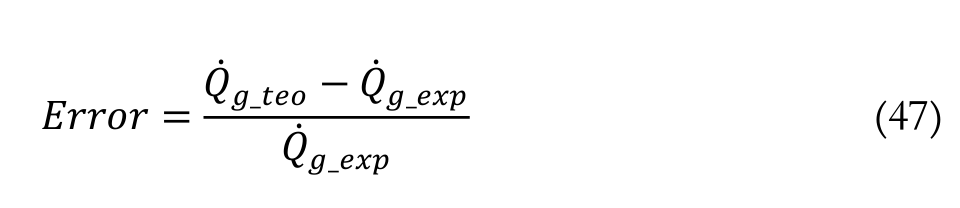 (47)
(47)Just as for the activation of thermal power, the comparison between the theoretical results and those obtained by the characteristic equation were very good throughout the operating range; however, there is bigger discrepancy between the results than in the activation of thermal power, which do not exceed an error rate of 11%, the minimum relative error being 1%.
Figure 5 shows the COP results of the Rotartica absorption chiller obtained by the theoretical modeling, the characteristic equation method, the experimental data and the adjusted correlations.
Note that there are differences between the theoretical results and those obtained by the characteristic equations, and also from the experimental data and the adjusted correlations from these experimental data. These deviations are the product of error propagation in the activation of thermal power and the cooling capacity, which again were attributed to uncertainties in the manufacturer's data and also to simplifying assumptions from the theoretical modeling. In the comparisons between the results with the experimental data and the results from the adjusted correlations, the deviation could also be associated with experimental data uncertainties, which were around 4%.
These values represented a small discrepancy if the overall uncertainties involved in the operation of the absorption chiller operation are taken into account. However it should be noted that these deviations were not larger than 4% in most operating conditions, especially for nominal operating conditions of the absorption chiller for which the hot, chilled and cold water temperatures were 90, 12 and 40°C, respectively, represented by a ΔΔt of 32K where the deviation was not greater than 1%.
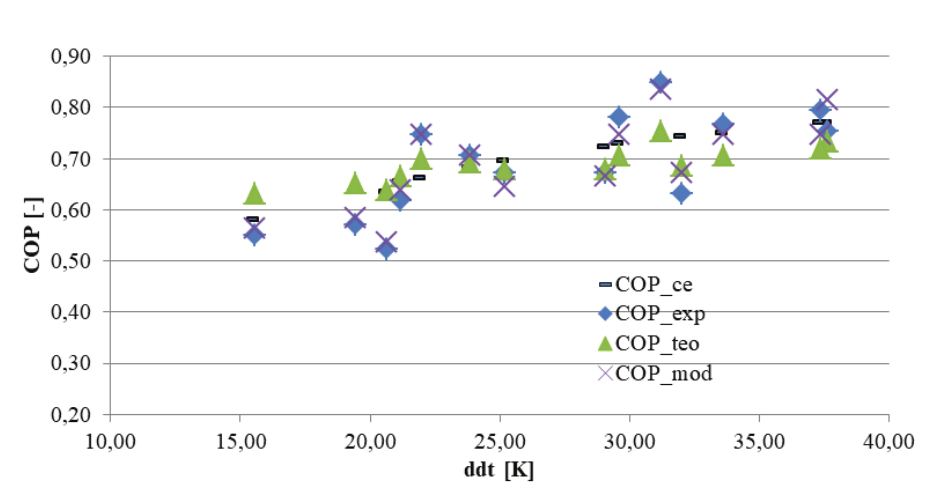
Figure 5.
Comparison of the COP results obtained by the theoretical modeling, characteristic equation method, experimental data and the correlations adjusted.
Figure 6 shows the relative errors of the results of the activation of thermal power and cooling capacity which were obtained by the theoretical modeling, the characteristic equation method, the experimental data and the adjusted correlations.
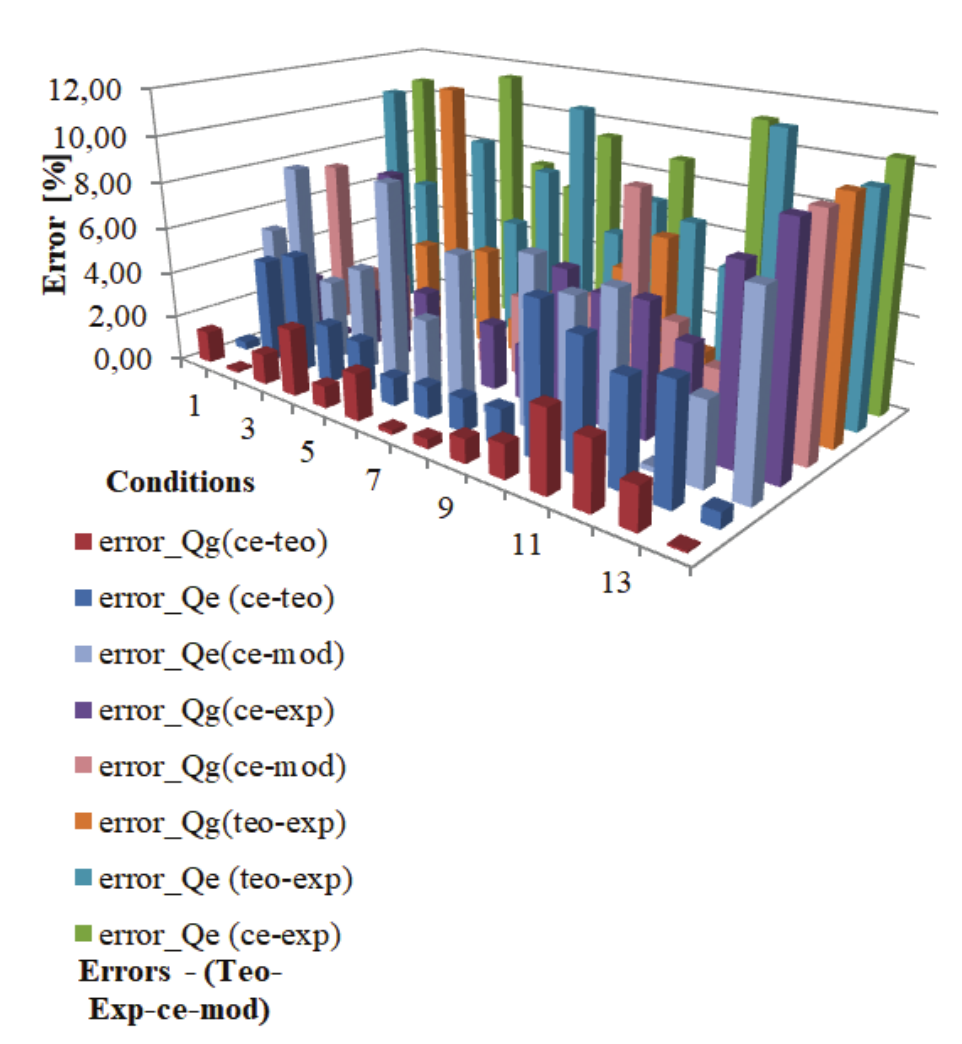
Figure 6.
Comparison of the relative’s errors of the results obtained by the theoretical modeling, characteristic equation method, experimental data and the correlations adjusted.
As already mentioned, Figure 6 shows there was good agreement between the results obtained from the theoretical modeling and from the characteristic equation method, and also from comparing the experimental data and results from the adjusted correlation. For most chiller operating ranges, including the nominal condition, the deviations were 6% lower. The maximum errors of the results (around 11%) were found in the cooling capacity. However, in order to evaluate the overall uncertainties involved in the absorption chiller operation, this could be considered a good adjustment to predicting the thermodynamic behavior of the absorption chiller.
Given the results obtained in this study, it was demonstrated that using either method, the performance of the absorption chiller could be predicted with good precision. However, using the characteristic equation method is much better and easier because fewer data were needed to predict the performance of the absorption refrigeration equipment (nominal data and/or experimental values).This confirms the versatility of the characteristic equation method to predict the behavior of the absorption chiller over the operational range from the average temperature and flow rates of the chilled, hot and cold water circuits, as well as the overall heat transfer coefficients and the areas of heat exchange (UA product). By using two simple algebraic equations (straight lines), the activation of thermal power and the cooling capacity of the absorption chiller can be found. This is a good alternative as a thermodynamic analysis tool in combined heat and cooling cogeneration plant, or in any processes that use an absorption chiller as an integrated component.
Conclusion
The results from comparing the activation of thermal power and the cooling capacity of a Rotartica absorption chiller, and which were obtained by theoretical modeling and the characteristic equation values were good, since the mean relative errors found were 4% lower for most operating conditions examined, except for one condition where the error was around 6%;
The activation of thermal power and cooling capacity found from the characteristic equation method and also the theoretical modeling when compared with the experimental data showed excellent a good agreement since the maximum and minimum errors were 11 and 1%, respectively;
Acknowledgements
The first author thanks the program science without border - Cnpq-Brazil, for the scholarship of the Post-doctoral study (PDE:203489/2014-4) and also thanks Professor Alberto Coronas for his support during the Post-doctoral study at the Rovira and Virgili University and also the Staff from the Crever group. The authors thank Facepe/Cnpq for financial support for research project APQ-0151-3.05/14.
References
Abdullah, G. F., Saman, W., Whaley, D., & Belusko, M. (2016). Optimization of standalone solar heat fired absorption chiller for typical Australian homes. Energy Procedia, 91(1), 692-701. doi 10.1016/j.egypro.2016.06.232
Albers, J. (2014). New absorption chiller and control strategy for the solar assisted cooling system at the German federal environment agency. International Journal of Refrigeration, 39(1), 48-56. doi 10.1016/j.ijrefrig.2013.08.015
Albers, J., & Ziegler, F. (2005). Improved control strategies for solar assisted cooling systems with absorption chillers using a thermosyphon generator. In Proceedings of the International Solar Air Conditioning, (p. 1-6). Kloster Banz, GE.
Albers, J., Nurzia, G., & Ziegler, F. (2010). Simulation and experimental analysis of a solar driven absorption chiller with partially wetted evaporator. Journal of Solar Energy Engineering, 132(1), 11-16. doi 10.1115/ES2008-54102
Albert, C., Marschall, H., & Bothe, D. (2014). Direct numerical simulation of interfacial mass transfer into falling films. International Journal of Heat and Mass Transfer, 69(1), 343-357. doi 10.1016/j.ijheatmasstransfer.2013.10.025
Angrisani, G., Canelli, M., Roselli, C., Russo, A., Sasso, A., & Tariello, F. (2011). A small scale polygeneration system based on compression/absorption heat pump. Applied Thermal Engineering, 114(1), 1393-1402. doi 10.1016/j.applthermaleng.2016.10.048
Bakhtiari, B., Fradettel, L., Legros, R., & Paris, J. (2011). A model for analysis and design of H2O–LiBr absorption heat pumps. Energy Conversion and Management, 52(1), 1439-1448. doi 10.1016/j.enconman.2010.09.037
Chen, X., Gong, G., Wan, Z., Luo, L., & Wan, J. (2015). Performance analysis of 5 kW PEMFC-based residential micro-CCHP with absorption chiller. International Journal of Hydrogen Energy, 40(33), 10647-10657. doi 10.1016/j.ijhydene.2015.06.139
Daghigh, R., & Shafieian, A. (2016). An investigation of heat recovery of submarine diesel engines for combined cooling, heating and power systems. Energy Conversion and Management, 108(1), 50-59. doi 10.1016/j.enconman.2015.11.004
EcoFriend (2016). Rotartica’s Solar-Powered air Conditionig. Retrieved from http://www.ecofriend.com/rotartica-s-solar-powered-air-conditioning.html
Evola, G., Le Pierrès, N., Boudehenn, F., & Papillon, P. (2013). Proposal and validation of a model for the dynamic simulation of a solar-assisted single-stage LiBr/water absorption chiller. International Journal of Refrigeration, 36(1), 1015-1028. doi 10.1016/j.ijrefrig.2012.10.013
Gilchrist, K., Lorton, R., & Green, R. J. (2002). Process intensification applied to an aqueous LiBr rotating absorption chiller with dry heat rejection. Applied Thermal Engineerging, 22(1), 847-854. doi 10.1016/S1359-4311(01)00123-5
Gutiérrez-Urueta, G., Rodríguez, P., Ziegler, F., Lecuona, A., & Rodríguez-Hidalgo, M. C. (2012). Extension of the characteristic equation to absorption chillers with adiabatic absorbers. International Journal of Refrigeration, 35(1), 709-718. doi 10.1016/j.ijrefrig.2011.10.010
Helm, M., Hagel, K., Pfeffer, W., Hiebler, S., & Schweigler, C. (2014). Solar heating and cooling system with absorption chiller and latent heat storage - A research project summary. Energy Procedia, 48(1), 837-849. doi 10.1016/j.egypro.2014.02.097
Ifaei, P., Rashidi, J., & Yoo, C. (2016a). Thermoeconomic and environmental analyses of a low water consumption combined steam power plant and refrigeration chillers – Part 1: Energy and economic modelling and analysis. Energy Conversion and Management, 123(1), 610-624. doi 10.1016/j.enconman.2016.06.036
Ifaei, P., Rashidi, J., & Yoo, C. (2016b). Thermoeconomic and environmental analyses of a low water consumption combined steam power plant and refrigeration chillers-Part 2: Thermoeconomic and environmental analysis. Energy Conversion and Management, 123(1), 625-642. doi 10.1016/j.enconman.2016.06.030
Izquierdo, M., Lizarte, R., Marcos, J. D., & Gutiérrez, G. (2008). Air conditioning using an air-cooled single effect lithium bromide absorption chiller: Results of a trial conducted in Madrid in August 2005. Applied Thermal Engineerging, 28(1), 1074-1081. doi 10.1016/j.applthermaleng.2007.06.009
Kim, D. S., & Infante, F. C. A. (2006). A Gibbs energy equation for LiBr aqueous solutions. International Journal of Refrigeration, 29(1), 36-46. doi 10.1016/j.ijrefrig.2005.05.006
Kohlenbach, P., & Ziegler, F. (2008a). A dynamic simulation model for transient absorption chiller performance. Part I: The model. International Journal of Refrigeration, 31(1) 217-225. doi 10.1016/j.ijrefrig.2007.06.009
Kohlenbach, P., & Ziegler, F. (2008b). A dynamic simulation model for transient absorption chiller performance. Part II: Numerical results and experimental verification. International Journal of Refrigeration, 31(1), 226-233. doi 10.1016/j.ijrefrig.2007.06.010
Kühn, A., (2013). Thermally driven heat pumps for heating and cooling. Berlin, GE: TU Berlin Publishing.
Marc, O., Sinama, F., Praene, J., Lucas, F., & Castaing-Lasvignottes, J. (2015). Dynamic modeling and experimental validation elements of a 30 kW LiBr/H2O single effect absorption chiller for solar application. Applied Thermal Engineering, 90(1), 980-993. doi 10.1016/j.applthermaleng.2015.07.067
Martínez, J. C., Martínez, P. J., & Bujedo, L. A. (2016). Development and experimental validation of a simulation model to reproduce the performance of a 17.6 kW LiBr–water absorption chiller. Renewable Energy, 86(1), 473-482. doi 10.1016/j.renene.2015.08.049
Monné, C., Alonso, S., Palacín, F., & Serra, F. (2011). Monitoring and simulation of an existing solar powered absorption cooling system in Zaragoza (Spain). Applied Thermal Engineering, 31(1), 28-35. doi 10.1016/j.applthermaleng.2010.08.002
Monné, C., Alonso, S., Palacín, F., & Guallar, J. (2011). Stationary analysis of a solar LiBr e H2O absorption refrigeration system. International Journal of Refrigeration, 34(2), 518-526. doi 10.1016/j.ijrefrig.2010.11.009
Moreno-Quintanar, G., Rivera, W., & Best, R. (2012). Comparison of the experimental evaluation of a solar intermittent refrigeration system for ice production operating with the mixtures NH3/LiNO3 and NH3/LiNO3/H2O. Renewable Energy, 38(1), 62-68. doi 10.1016/j.renene.2011.07.009
Myat, A., Thu, K., Kim, Y. D., Chakraborty, A., Chun, W. G., & Choon, K. N. (2011). A second law analysis and entropy generation minimization of an absorption chiller. Applied Thermal Engineering, 31(1), 2405-2413. doi 10.1016/j.applthermaleng.2011.04.004
Ochoa, A. A. V., Dutra, J. C. C., & Henríquez, J. R. G. (2014a). Energy and exergy analysis of the performance of 10 TR lithium bromide/water absorption chiller. Revista Técnica de la Facultad de Ingeniería, 37(5), 38-47.
Ochoa, A. A. V., Dutra, J. C. C., Henríquez, J. R. G., & Rohatgi, J. (2014b). Energetic and exergetic study of a 10RT absorption chiller integrated into a microgeneration system. Energy Conversion and Management, 88(1), 545-553. doi 10.1016/j.enconman.2014.08.064
Ochoa, A. A. V., Dutra, J. C. C., Henríquez, J. R. G., & Santos, C. A. C. (2016). Dynamic study of a single effect absorption chiller using the pair LiBr/H2O. Energy Conversion and Management, 108(1), 30-42. doi 10.1016/j.enconman.2015.11.009
Ochoa, A. A. V., Dutra, J. C. C., Henríquez, J. R. G., Santos, C. A. C., & Rohatgi, J. (2017a). The influence of the overall heat transfer coefficients in the dynamic behavior of a single effect absorption chiller using the pair LiBr/H2O. Energy Conversion and Management, 136(1), 270-282. doi 10.1016/j.enconman.2017.01.020
Ochoa, A. A. V., Dutra, J. C. C., Henríquez, J. R. G., Santos, C. A. C., & Rohatgi, J. (2017b). Techno-economic and Exergoeconomic Analysis of a micro cogeneration system for a residential use. Acta Scientiarum. Technology, 38(3), 327-338. doi 10.4025/actascitechnol.v38i3.28752
Porumb, R., Porumb, B., & Balan, M. (2017). Numerical investigation on solar absorption chiller with LiBr-H2O operating conditions and performances. Energy Procedia, 112(1), 108-117. doi 10.1016/j.egypro.2017.03.1071
Rogers, G. F. C., & Mayhew, Y. R. (1992). Thermodynamic and transport properties of fluids: SI units (4th ed.). Oxford, UK: Blackwell Publishers.
Shirazi, A., Taylor, R. A., White, S. D., & Morrison, G. (2016). A systematic parametric study and feasibility assessment of solar-assisted single-effect, double-effect, and triple-effect absorption chillers for heating and cooling applications. Energy Conversion and Management, 114(1), 258-277. doi 10.1016/j.enconman.2016.01.070
Singh, O. K. (2016). Performance enhancement of combined cycle power plant using inlet air cooling by exhaust heat operated ammonia-water absorption refrigeration system. Applied Energy, 180(1), 867-879. doi 10.1016/j.apenergy.2016.08.042
Talukdar, K., & Gogoi, T. K. (2016). An investigation of heat recovery of submarine diesel engines for combined cooling, heating and power systems. Energy Conversion and Management, 108(1), 468-477. doi 10.1016/j.enconman.2015.11.004
Technical page ROTARTICA, (2008). Retrieved from http:// www.rotartica.com.
Xu, Y., Zhang, S., & Xiao, Y. (2016). Thermodynamic analysis of a trigeneration system consisting of a micro gas turbine and a double effect absorption chiller. Applied Thermal Engineering, 107(1), 1183-1191. doi 10.1016/j.applthermaleng.2011.06.016
Ziegler, F., & Albers, J. (2009). Influence of external flow rates on characteristic equations of absorption chillers. KI Kälte Luft Klimatechnik, 45(1), 18-22.
Zinet, M., Rulliere, R., & Haberschill, P. (2012). A numerical model for the dynamic simulation of a recirculation single-effect absorption chiller. Energy Conversion and Management, 62(1), 51-63. doi 10.1016/j.enconman.2012.04.007
Notes
Author notes
ochoaalvaro@recife.ifpe.edu.br