Engenharia Civil
Wave reflection from submerged rectangular obstacles: experiments and predictive formula
Reflexão de ondas em obstáculos retangulares submersos: experimentos e fórmula preditiva
Wave reflection from submerged rectangular obstacles: experiments and predictive formula
Acta Scientiarum. Technology, vol. 40, 2018
Universidade Estadual de Maringá

This work is licensed under Creative Commons Attribution 4.0 International.
Received: 07 June 2017
Accepted: 14 September 2017
Abstract: This paper presents an experimental study on wave reflection from submerged rectangular objects (shelves) in a 2-D laboratory flume. Preliminary tests using resistive wire probes and an acoustic Doppler anemometer were first conducted to confirm that a piston-type wavemaker was able to produce sinusoidal waves in the channel, without significant reflection from the boundaries. Then, measurements of water surface displacements using the two-fixed probe method and considering the presence of submerged rectangular obstacles provided reflection coefficients for different wave parameters and submergence conditions. Dimensional analysis was conducted and a dimensionless relationship was obtained to describe the reflection coefficient as a function of the wave slope and the water-to-shelf depth ratio. This relationship can be potentially used to predict ocean wave reflection from submerged obstacles for similar conditions as those evaluated in the present study.
Keywords: dimensional analysis, laboratory flume, submerged obstacles, wave reflection.
Resumo: Este trabalho apresenta um estudo experimental acerca da reflexão de ondas em obstáculos retangulares submersos em um canal de laboratório bidimensional. Testes preliminares, com o uso de sondas resistivas e um anemômetro acústico Doppler, foram conduzidos inicialmente para confirmar que um gerador de ondas, do tipo pistão, era capaz de produzir ondas senoidais no canal, sem reflexão significativa das bordas. Em seguida, foram realizadas medições dos deslocamentos da superfície da água no canal usando o método de duas sondas fixas, porém considerando a presença de obstáculos submersos, as quais permitiram a avaliação do coeficiente de reflexão para diferentes parâmetros de ondas e condições de submersão. Posteriormente, realizou-se análise dimensional e obteve-se uma relação adimensional que descreve o coeficiente de reflexão como uma função da declividade das ondas e da relação entre as profundidades da água e do obstáculo submerso. Essa relação pode ser potencialmente usada para prever a reflexão de ondas oceânicas em obstáculos submersos para condições semelhantes às avaliadas no presente estudo.
Palavras-chave: análise dimensional, canal de laboratório, obstáculos submersos, reflexão de ondas.
Introduction
The proper knowledge of physical processes involved in the generation and propagation of gravity waves is fundamental in coastal engineering. When gravity waves enter a region with rocks, continental shelves, coastal structures or other obstacles where the water depth suddenly changes, reflected waves interact with incident waves and modify the wave field characteristics (Mei, 1989). Many analytical, numerical and experimental studies have long been carried out to analyze incident and reflected wave dynamics, which is not well understood yet, especially at larger scales (Bartholomeusz, 1958; Devillard, Dunlop, & Souillarb, 1988; Rey, Belzons, & Guazzelli, 1992; Stamos, Hajj, & Telionis, 2003; Ardhuin and Roland, 2012). Besides, available solutions for such problem are usually complex, involving either Fourier analysis and/or differential equations that are solved numerically.
The study of wave reflection from submerged obstacles is less frequent than that from emerged obstacles. Nevertheless, the construction of immersed structures such as submerged breakwaters has become more popular, as they are more favorable for sediment transport and water quality conservation than emerged breakwaters. Abul-Azm (1994), Stamos and Hajjj (2001), and Christou, Swan, and Gudmestad (2008) conducted experimental/numerical studies to investigate wave reflection from submerged objects at the laboratory scale. More recently, Young and Testik (2011) performed lab experiments and proposed a simple empirical equation to predict the reflection coefficient as a function of the ratio of submergence depth to incident wave height.
The aim of the present study is: (1) to evaluate wave reflection from a submerged rectangular object in a 2-D laboratory flume; (2) to test the equations available in the literature for replicating the lab data; and (3) to obtain a predictive formula for estimating the reflection coefficient in such systems.
Experimental setup and procedure
The experiments were carried out in a glassed-wall laboratory flume with height of 1.0 m, width of 0.75 m and length of 24.4 m (Figure 1). A piston-type wavemaker (paddle) controlled by a computer was used to produce gravity waves, in which water surface displacements were measured by resistive wire probes (wave gauges), also connected to a computer. LabView codes were used to control and monitor the system. An absorption device (i.e., beach) was also employed to minimize wave reflection from the end of the flume. A schematic of the experimental setup used in this study is shown in Figure 2.
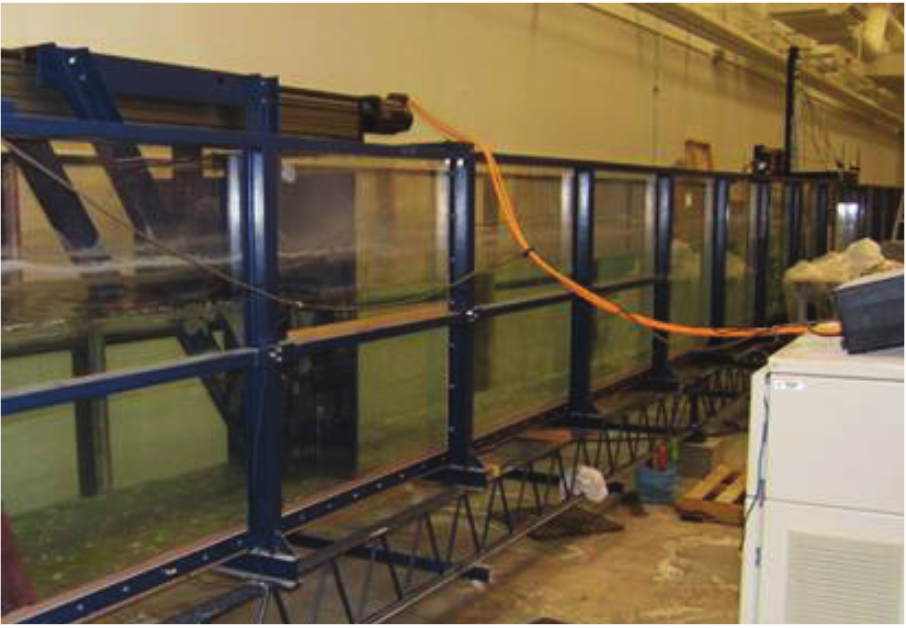
Figure 1.
Side view of the wave tank used in the present study.
Preliminary tests were conducted to investigate whether the wavemaker was able to produce sinusoidal waves in the flume, without the shelf (submerged rectangular obstacle). The measurements of water surface displacements were compared to the linear water theory, as described by Dean and Dalrymple (1991). Horizontal and vertical wave velocities were also measured with an acoustic Doppler velocimeter (ADV) from Sontek/YSI, and then compared with the linear wave theory. The abovementioned tests were important to confirm that wave reflection from the channel boundaries was negligible.
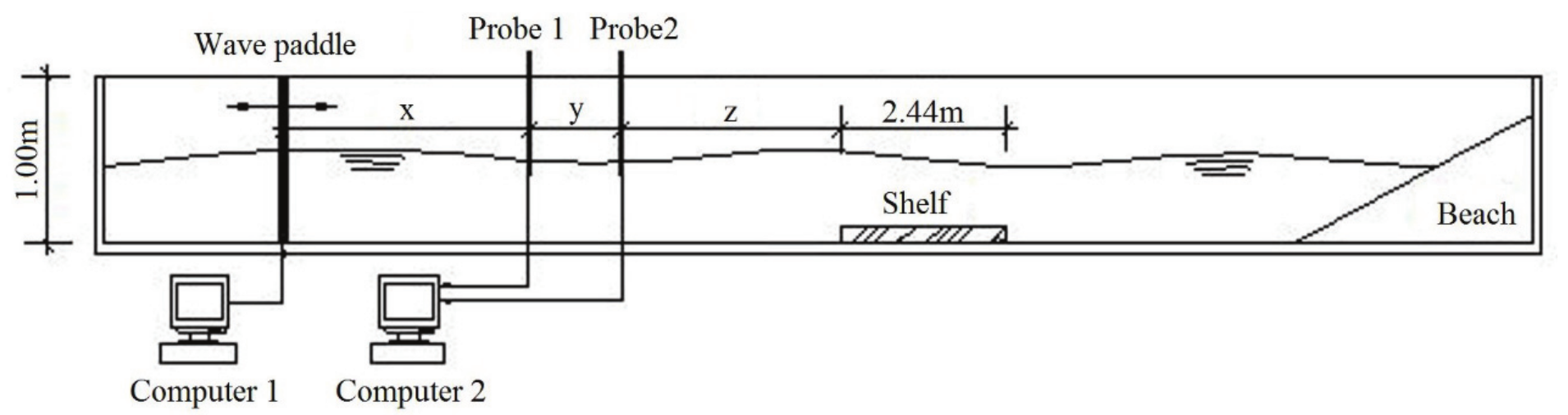
Figure 2.
Schematic of the experimental setup.
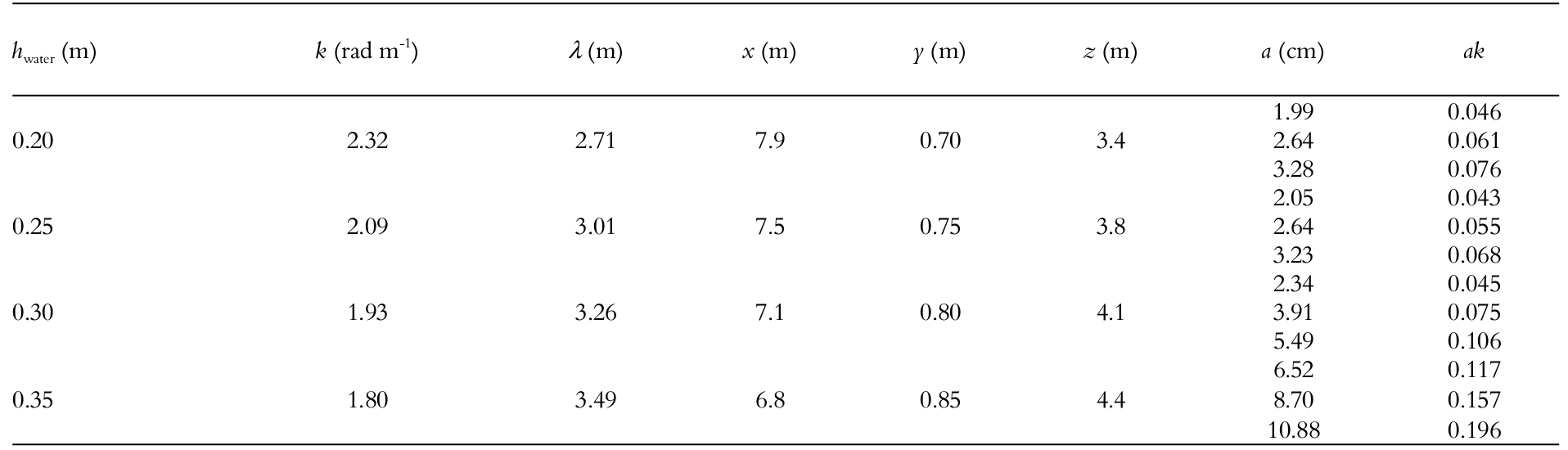
Several methods have been developed for measuring the reflection coefficient in laboratory flumes. In this study, the classical method of Goda and Suzuki (see Hughes, 1993) has been employed, in which two wave gauges (probes) are fixed upstream of the reflecting structure (see Figure 2). The experiments were equipped with a rectangular shelf with height hshelf = 0.1 m, width bshelf = 0.75 m, and length lshelf = 2.44 m, fixed at the bottom of the flume. The wavemaker was used to produce the waves for water depths hwater of 0.20, 0.25, 0.30, and 0.35 m. For each depth, a fixed wave number k and three sets of wave amplitudes a were used. A frequency f = 0.5Hz was considered for all the tests. The wave lengths (=2/k) varied for each water depth such that the distances from probes 1 to 2 (y = 0.25) and from probe 2 to the shelf (z = 1.25) were set according to the recommendations of Goda and Suzuki. In addition, a distance x larger than 6.0 m was adopted for all the tests to minimize the impact of the wavemaker on wave reflection. Table 1 lists the details of experimental conditions.
Wave gauge data (water surface displacement) were recorded by a second computer at sampling rates larger than the Nyquist frequency for the present study (> 1.0Hz) to avoid aliasing of the signal (see Bendat & Piersol, 2000). The probes were calibrated before and after the tests to ensure that no significant drift or non-linearity has occurred during the test period. The replicability of the results was also verified for each water depth.
The simultaneous acquisition of water surface displacements allowed separating incident and reflected waves by employing the abovementioned method of Goda and Suzuki. Hence, the total power of incident and reflected signals was calculated for each test and the average reflection coefficient Kr was estimated as the square root of the reflected to incident power, by using Matlab (MathWorks).
Assuming that the parameters that characterize the problem described here are the incident a and reflected ar wave amplitudes, incident wave number k, water depth hwater, shelf height hshelf, shelf width bshelf, and shelf length lshelf, the reflection coefficient can be expressed in terms of the following dimensionless parameters by invoking Buckingham’s Pi theorem:
 (1)
(1)Finally, a dimensionless relationship can be obtained by fitting experimental data to the general form described by Equation (1).
Results and discussion
Figure 3 shows typical results of the preliminary tests (with one probe), in which no submerged rectangular obstacle (shelf) were used. The measurements of water surface displacements matched very well with the linear water theory, with a coefficient of determination R2 > 0.99. This gives reliability to the system, which indicates that wave reflection from the flume boundaries was not significant. Horizontal and vertical wave velocities measured with the ADV also matched well with the linear water theory, with R2 > 0.95 in both cases. Figure 4 shows typical results of ADV measurements compared to the linear water theory.
Figure 5 shows typical results of the two-probe tests including the effect of reflection from the shelf. The time series indicates wave heights h1 and h2(measured from probes 1 and 2) for a slope = 0.117 and a relative water depth hwater/hshelf = 3.5. It is seen that the waves present some degree of nonlinearity, contrasting to the results shown in Figures 3 and 4 (for linear wave measurements). Note that this nonlinearity was more pronounced in the tests with higher values of and lower values of hwater/hshelf. On the other hand, the other dimensionless parameters shown in Equation (1), i.e., khwater, hwater/bshelf, hwater/lshelf, did not affect significantly the wave behavior. This implies that and hwater/hshelfcontrol the reflection from the shelf.
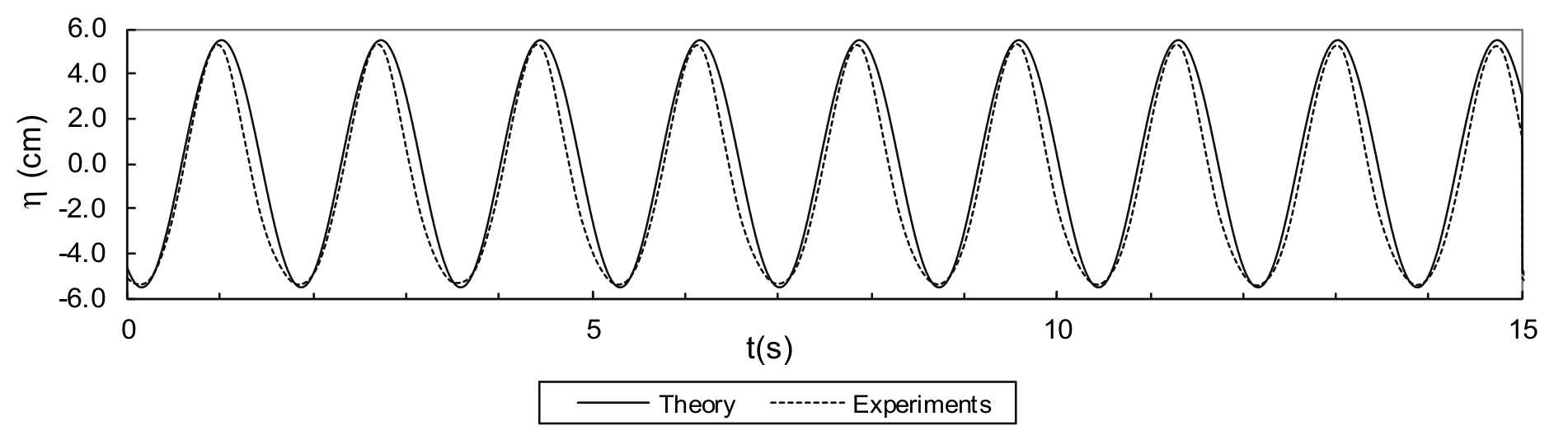
Figure 3.
Comparison of water surface displacements obtained from the experiments (no submerged obstacle) and from the linear wave theory.
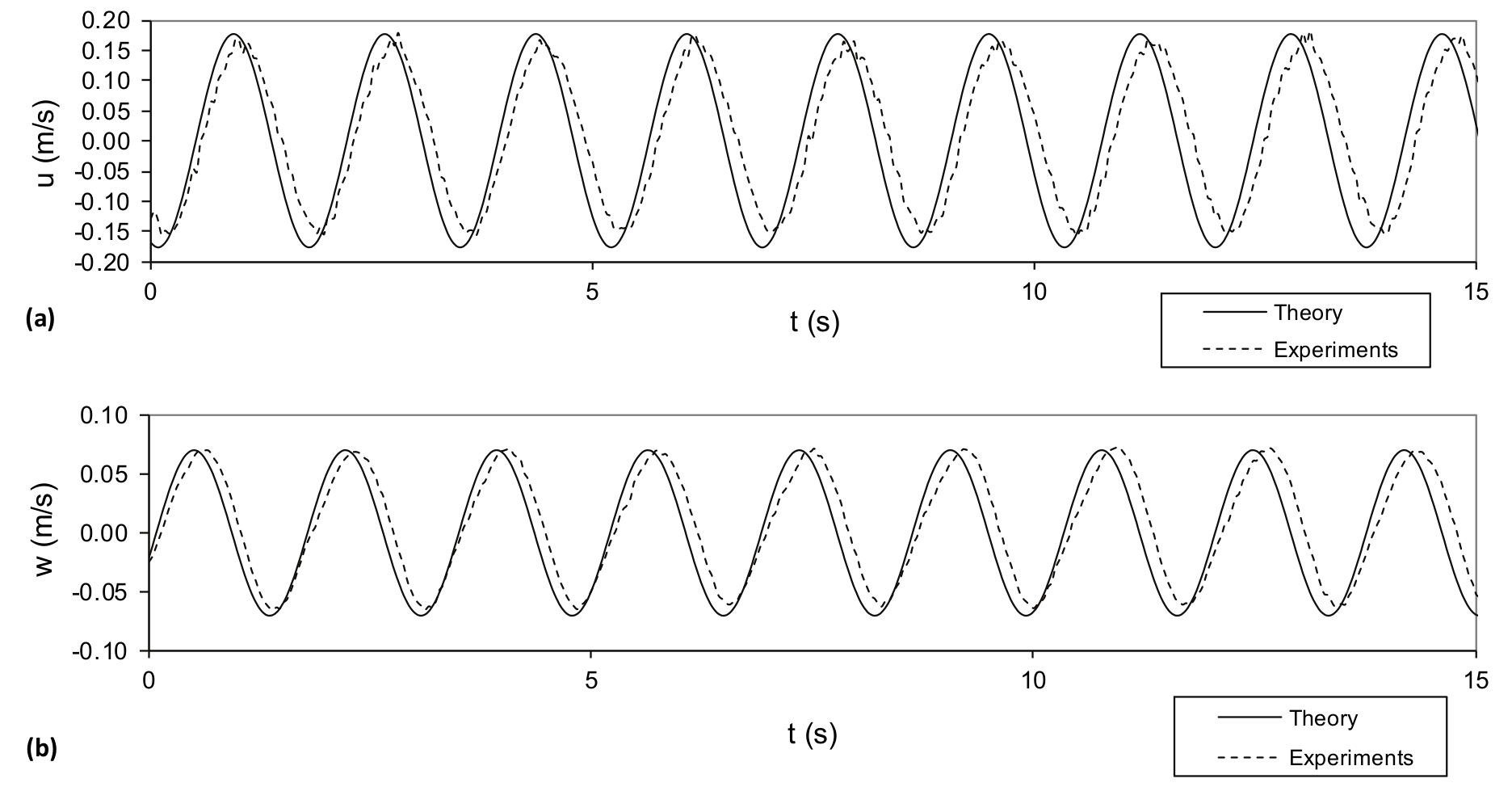
Figure 4.
Comparison of horizontal (a) and vertical (b) wave velocities obtained from ADV measurements (no submerged obstacle) and from the linear wave theory.

Figure 5.
Time series of wave heights h1 and h2 measured from probes 1 and 2 for a slope ak = 0.117 and a relative water depth hwater/hshelf = 3.5.
The reflection coefficients obtained in the present study were within a range from 0.047 to 0.255, which are in agreement with the values reported in the literature. Nevertheless, the classical formula of Bartholomeusz (1958) and the more recent equation of Young and Testik (2011) did not predict well the present data, as depicted in Figure 6. Note that their experiments included wave lengths of about 2-5 m, amplitudes a of 5-20 cm, and shelf heights hshelf of 0.1-0.3 m, which are similar to the values listed in Table 1. This discrepancy may be due to the highly nonlinear wave behavior observed in their tests, as compared to the quasi-linear waves investigated here (see Figure 5). On the other hand, Figures 7 and 8 illustrate the variation of the reflection coefficient as a function of the wave slope and the water-to-shelf depth ratio, respectively, obtained from the present study. It is clear that the reflection coefficient decreases with both parameters, which suggests that higher wave slopes cause larger energy dissipation and, as a consequence, less reflection; while higher water-to-shelf depth ratios result in larger submergence depths, which increase wave transmission and reduces the reflection coefficient.
Figure 9 shows that the use of a combined dimensionless parameter given by ()2(hwater/hshelf) provides a clear trend for the decay of the reflection coefficient. Therefore, the following power-law formula could be obtained by curve fitting:
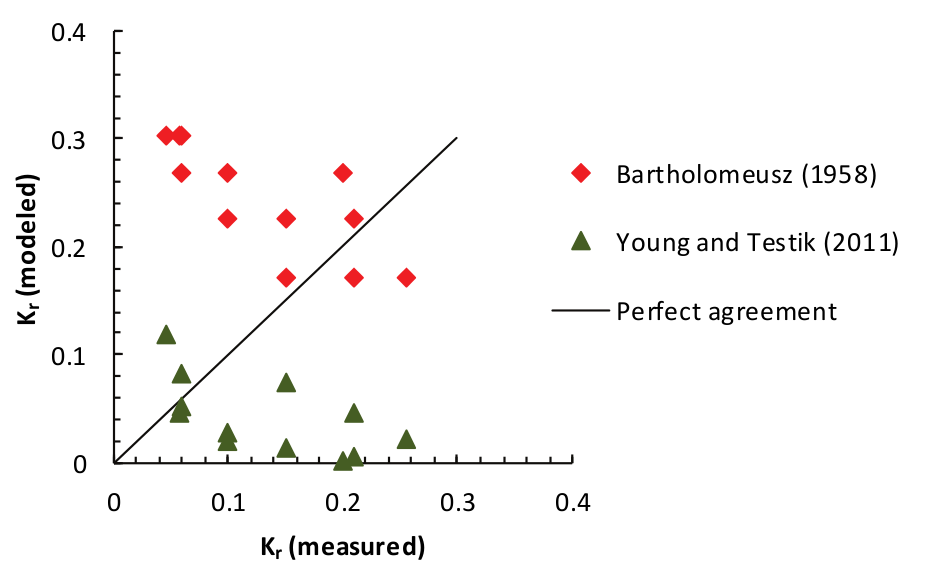
Figure 6.
Comparison of the reflection coefficients obtained from previous formulae (modeled) to the present data (measured).
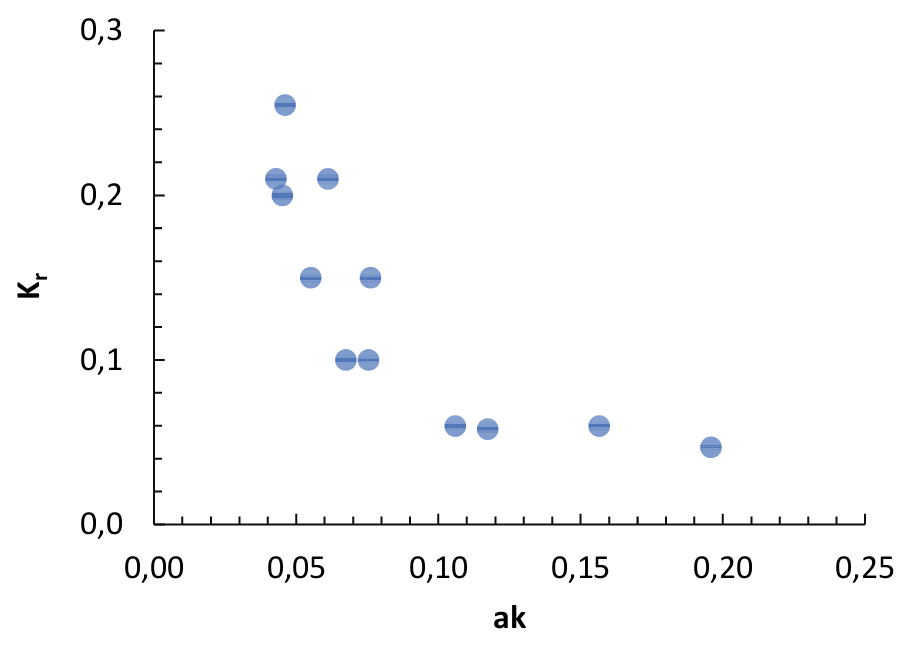
Figure 7.
Reflection coefficient vs. wave slope (present data).
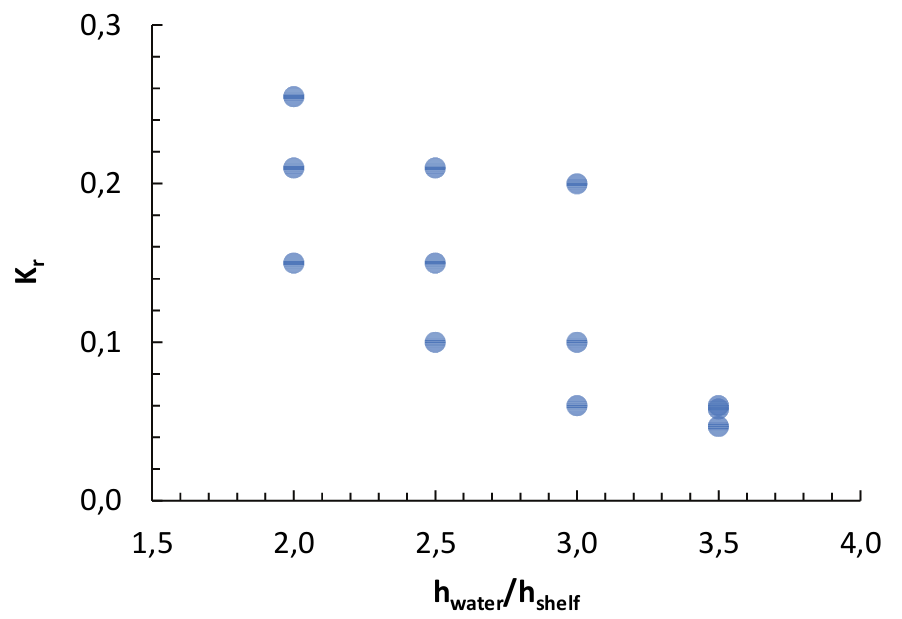
Figure 8.
Reflection coefficient vs. water-to-shelf depth ratio (present data).
 (2)
(2)
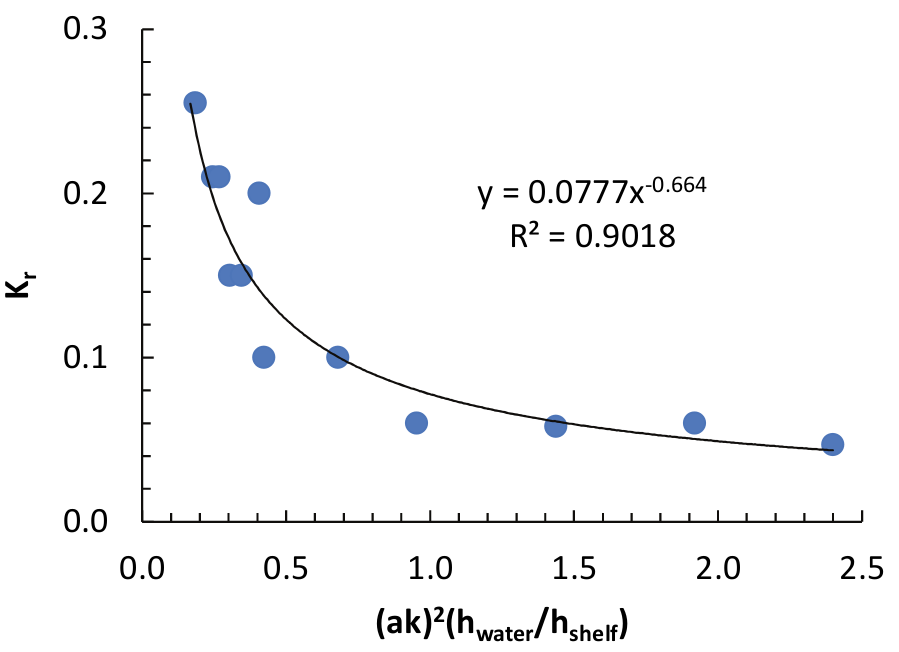
Figure 9.
Dimensionless relationship for the reflection coefficient (present data).
Equation (2) adjusted well to the experimental data, with a coefficient of determination R² = 0.9018. This suggests that the parameters adopted herein are appropriate to describe wave reflection from submerged rectangular objects. The power of 2 in the wave slope also indicates that this parameter is more relevant than the water-to-shelf depth ratio, which has a power of 1. Thus, it is expected that the decay in the reflection coefficient as shown in Figure 9 was caused mainly by an increase in energy dissipation other than an increase in wave transmission. In addition, other non-power-law forms for Equation (2) were also evaluated, but the resulting correlations presented coefficients of determination R² < 0.9. Observe that the data depicted in Figure 9 refers to tests under the following conditions: 0.02 < < 0.20 and 1.32 < hwater/hshelf < 3.5. Therefore, caution should be taken when applying Equation (2) to predict the reflection coefficient for other test conditions.
Conclusion
This study showed that the reflection coefficient is inversely dependent on a dimensionless parameter given by the square of the wave slope multiplied by the water-to-shelf depth ratio. This was attributed to higher energy dissipation caused by higher wave slopes, in addition to larger wave transmission caused by greater water-to-shelf depth ratios. A power-law dimensionless formula could be obtained with a good fit to the experimental data. This relationship is proposed as a direct way to estimate wave reflection from submerged rectangular obstacles, which can be seen as a simplified case for situations such as propagating waves over flat structures.
Acknowledgements
The experiments described in the present study were performed in the Graduate Hydraulics Laboratory at the University of Alberta, Canada. The writer is thankful to Perry Fedun for building the experimental apparatus.
References
Abul-Azm, A. G. (1994). Diffraction through wide submerged break waters under oblique. Ocean Engineering, 21(7), 683-706.
Ardhuin, F., & Roland, A. (2012). Coastal wave reflection, directional spread, and seismoacoustic noise sources, Journal of Geophysical Research, 117(6), C00J20, doi: 10.1029/2011JC007832.
Bartholomeusz, E. F. (1958). The reflexion of long waves at a step. Proceedings of the Cambridge Philosophical Society, 54(1), 106-118.
Bendat, J. S., & Piersol, A. G. (2000). Random data: analysis and measurement procedures (3rd ed.). New York, NY: Wiley-Interscience.
Christou, M., Swan, C., & Gudmestad, O. T. (2008). The interaction of surface water waves with submerged breakwaters. Coastal Engineering, 55(12), 945-958.
Dean, R. G., & Dalrymple, R. A. (1991). Water wave mechanics for engineers and scientists. Singapore: World Scientific Publishing.
Devillard, P., Dunlop, F., & Souillarb, D. (1988). Localization of gravity waves on a channel with random bottom. Journal of Fluid Mechanics, 186(1), 521-538.
Hughes, S. A. (1993). Physical models and laboratory techniques in coastal engineering. Advanced Series on Ocean Engineering, 7, 568.
Mei, C. C. (1989). Applied dynamics of ocean surface waves. Advanced Series on Ocean Engineering, 1, 740.
Rey, V., Belzons, M., & Guazzelli, E. (1992). Propagation of surface gravity waves over a rectangular submerged bar. Journal of Fluid Mechanics, 235(2), 463-479.
Stamos, D. G., & Hajj, M. R. (2001). Reflection and transmission of waves over submerged breakwaters. Journal of Engineering Mechanics - ASCE, 127(2), 99-105.
Stamos, D. G., Hajj, M. R., & Telionis, D. P. (2003). Performance of hemi-cylindrical and rectangular submerged breakwaters. Ocean Engineering, 30(6), 813-828.
Young, D. M., & Testik, F. Y. (2011). Wave reflection by submerged vertical and semicircular breakwaters. Ocean Engineering, 38(10), 1269-1276.
Notes
Author notes
iran@deha.ufc.br