Matemática
Numerical simulation of twisted tapes fitted in circular tube consisting of alternate axes and regularly spaced tapes
Simulação numeral de fitas torcidas instaladas em tubos circulares consistindo de eixos alternados e de espaçamento das fitas
Numerical simulation of twisted tapes fitted in circular tube consisting of alternate axes and regularly spaced tapes
Acta Scientiarum. Technology, vol. 40, 2018
Universidade Estadual de Maringá

This work is licensed under Creative Commons Attribution 4.0 International.
Received: 27 May 2017
Accepted: 28 July 2017
Abstract: A comparative investigation of enhanced heat transfer and friction factor by insertion of twisted tapes consisting of alternate axes and regularly spaced tapes in a round tube under wall heat flux condition is presented in this paper. This effort encompassed the flow velocity to be in range of 500 < Re < 1750. All verifications are assumed to be in laminar condition. The two scenarios are verified using numerical procedure, CFD tools, for two types of twisted tapes: short width twisted tape and center cleared twisted tape. The results show that in both types, using alternate axes improved thermal properties. Also the tube friction factor which represents the flow resistance grows with alternate axes twisted tapes. Investigation of regularly spaced twisted tapes also showed that putting the tapes in closer distance can improve flow disturbance. While rotating the middle part helped the flow disturbance, the amount of rotation is also important. Investigation of the free space between twisted tapes compound with the rotation effects showed that the twisted tapes set with smaller space ratios can give better thermal performance.
Keywords: heat transfer, Nusselt number, friction factor, Reynolds number, laminar flow.
Resumo: O estudo é sobre uma investigação comparativa do aumento da transferência de calor, e o fator de atrito pelas inserções de fitas torcidas compostas por eixos alternativos e de fitas regularmente espaçadas em tubos, cujo os tubos estão sobre uma parede de fluxo de calor. Esse trabalho abrangeu a velocidade do fluxo para estar entre 500 < Re < 1750. Todas as verificações são assumidas em condição laminar. Os dois cenários são verificados usando o procedimento numérico, CFD, para os dois tipos de fitas torcidas: fita torcida de largura curta e a fita torcida sem obstruções em seu centro. Os resultados mostraram que ambas as fitas usando eixo alternado melhoraram o seu desempenho nas propriedades térmicas. O fator de atrito do tubo no que representa a resistência do fluxo cresce com as fitas torcidas. A investigação das fitas torcidas regularmente espaçadas também mostrou que colocando as fitas em uma distância próxima pode melhorar agitação do fluxo. Enquanto a rotação da parte do meio ajudou a agitação do fluxo, a quantidade de rotação também é importante. A pesquisa do espaço livre entre as fitas torcidas em conjunto com os efeitos da rotação mostraram que as fitas torcidas com menor espaçamento podem melhorar o desempenho térmico.
Palavras-chave: transferência de calor, número de Nusselt, fator de atrito, número de Reynolds, fluxo laminar.
Introduction
Heat exchangers are broadly utilized in many fields such as air conditioning, refrigerators, power generation stations and etc. Economically, to reduce the costs and size of a heat exchanger, it is logical to consider variables like heat transfer coefficient and flow resistance. The increment of heat transfer coefficient mostly yields to the increase in flow resistance. Most designers prefer to promote techniques through which th flow resistance is minimized whereas the heat transfer coefficient is enhanced. Consequently, many researchers put forward to their opinions in solving the problem. Amongst the ways for improving the thermal properties the heat exchangers, passive methods need no external power source. So many studies are interested in passive techniques. Twisted tapes inserts are classified in this criterion and many researchers verified the use of twisted tapes for heat transfer enhancement. In this way fluid-based enhancement is preferred in comparison with surface-based enhancement. Liu and Yang (2007), Yang and Liu (2008) have proposed a principle for increasing efficiency for core flow through (1) fluid disturbance enhancement in core flow, (2) strengthening temperature uniformity in the core flow, (3) diminishing flow disturbance in the boundary flow and etc. Axial heat transfer distribution and friction factor for the tubes equipped with broken twisted tapes in various ratios are experimentally investigated by Chang, Yang, and Liou (2007). They revealed that the decrease of twist ratio enhanced both the local Nusselt number and mean friction factor. Naphon (2006) proposed non-isothermal correlation for predicting the thermal-hydraulic behavior of horizontal pipe with twisted tapes inserts. He investigated the effect of using twisted tapes in tubes and studied the differences. Eiamsa-ard, Wongcharee, Eiamsa-ard, and Thianpong (2010) verified using delta-winglet twisted tapes in tubes. They experimentally focused on the heat transfer and the thermal performance factor characteristics in those tubes.
Date (2000) studied the use of twisted tapes swirl generators in tubes through numerical methods. He considered the flow to be in laminar condition and focused on the heat transfer considering the influences of properties variations and buoyancy on system calculation. Ray and Date (2001, 2003) worked on square ducts fitted with twisted tapes in both laminar and turbulent conditions separately. In both conditions they concentrated on the heat transfer rate. Kazuhisa, Hidetoshi, Saburo, and Chikahiro (2004) numerically investigated the influence of the secondary flow on heat transfer augmentation and temperature field mixing. They also studied the dependence of secondary flow transition and local Nusselt number to the gravity. Heat transfer increment and friction factor are also studied in tubes in turbulent conditions by Rahimi, Shabanian, and Alsairafi (2009). They used turbulence model for cases containing different kinds of twisted tapes inserts and described the tangential velocity and turbulence intensity in their work. Other researchers like Eiamsa-ard, Thianpong, and Promvonge (2006) and Saha, Dutta, and Dhal (2001) also tried different types of twisted tapes like regularly spaced twisted tapes fitted in circular tube, studying the heat transfer characteristic and friction factor. In recent years, thanks to numerical tools development, three-dimensional analysis of thermal-hydraulic properties of the flow inside round tubes fitted with twisted tapes was interesting for Eiamsa-ard, Wongcharee, and Sripattanapipat (2009), Zhang and Qian (2005) and Zhuo-Xiong (2008). Different researchers used different methods for solving differential equation. Deepmala, Mishra, Marasi, Shabanian, and Nosrati (2017) used chebyshev polynomial basis functions to solve the Fredholm and Volterra integro-differential equations. Mishra (2017) investigated existence and behavior of solutions to some nonlinear integral equations with applications. In this paper a numerical method is used for solving nonlinear differential equations.
Considering all researches in this field, applying new ideas improving the thermal properties of heat exchangers is still fruitful and interesting. So in this work it is tried to verify the alternate axes and regularly spaced twisted tapes in more details to interpret more clearly the flow phenomenon and its thermal-hydraulic characteristics. Here, 3D numerical method is applied for the flow simulation, and the tube surface Nusselt number and friction factor are investigated for various cases. The streamlines and cross-sectional profiles are also employed to have better insight to the physics of the problem.
Geometry configuration
In this article two types of twisted tapes are defined for investigation of aforesaid techniques. For alternate axes cases, the alternation point is considered to be in the middle length of the tube. In the other technique, two different space ratios are investigated. The first model is consisted of free space half of the twisted tape length. In the second model the free space is as long as the twisted tape length. Getting acquainted with the models, the effect of rotation angle of twisted tapes was of interest in this effort. The angles of 45 and 90o were studied. The tube dimensions are considered to be 500 and 20 mm in length (L) and diameter (D), respectively. The thickness of the twisted tape inserts is assumed to be 1 mm. The 180º twist pitch (H) is 50 mm and thus the relative twisted ratio (H/D) is 2.5. For center cleared twisted tape the clearance is defined as C = 8 mm and the other twisted tape is of W = 16 mm size. Figures 1-3 show the alternate axes and regularly spaced twisted tapes in different configurations.
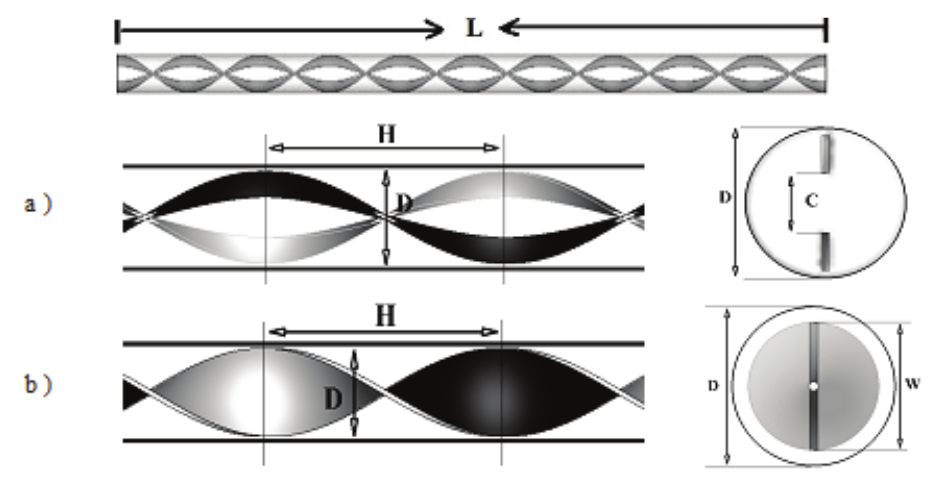
Figure 1.
Full tube length and a) Center-cleared twisted tape, b) short width twisted tape.
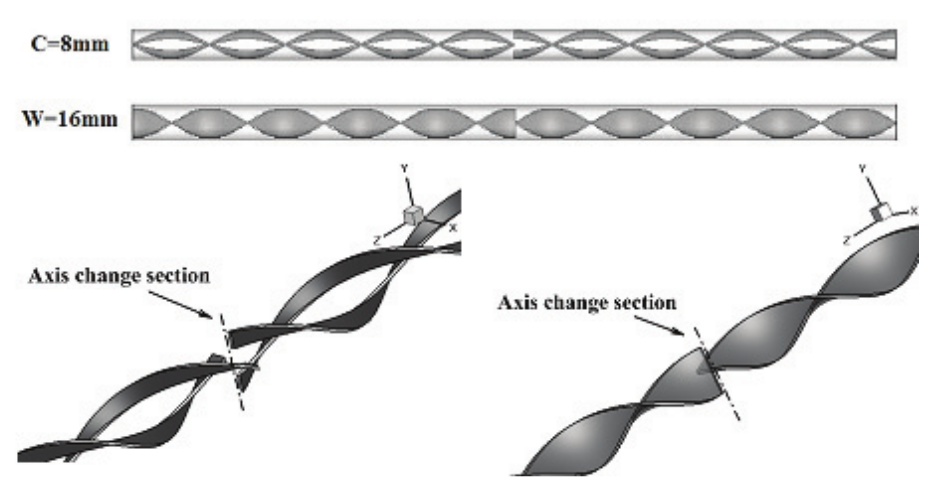
Figure 2.
Alternated axes for both types of twisted tape.
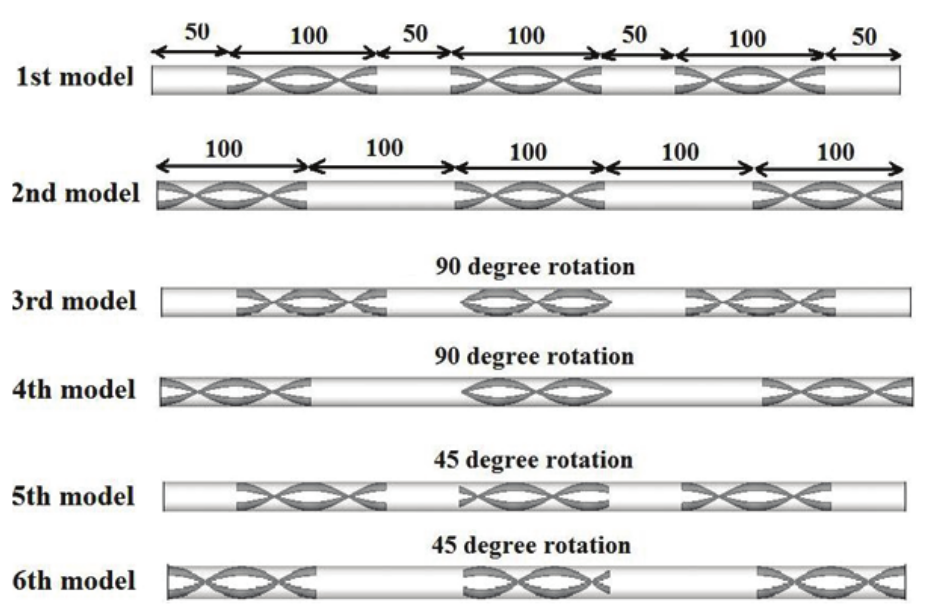
Figure 3.
6 Regularly spaced twisted tapes configurations (distances in mm).
Governing equations and numerical method
Variables to be investigated in this article are the surface Nusselt number and friction factor, which are defined by following Equation 1 and 2:
 (1)
(1)
 (2)
(2) In all cases the problem is solved for different flow rates which are associated to various Reynolds number described as: . In this effort, the Re number is set to 500, 750, 1000, 1250, 1500 and 1750 for each case.
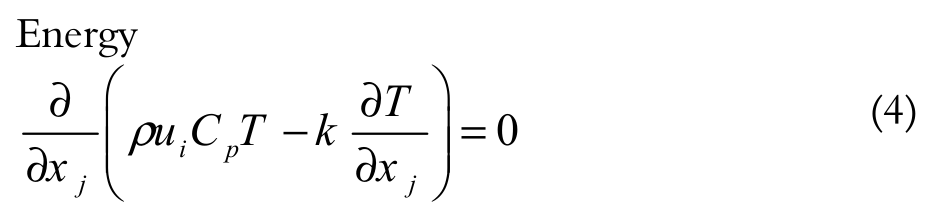
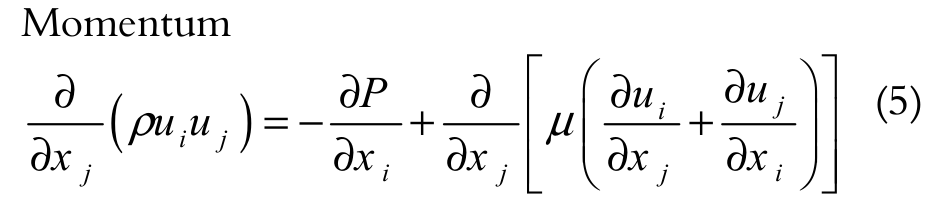
There are some assumptions like the fluid incompressibility and temperature independency of thermo-physical properties. Convection heat transfer and radiation to the surroundings and conduction inside the twisted tapes are neglected. Considering the three-dimensional nature of the problem, the condition is laminar and steady. Consequently, the continuity, energy and momentum Equation 3, 4 and 5:
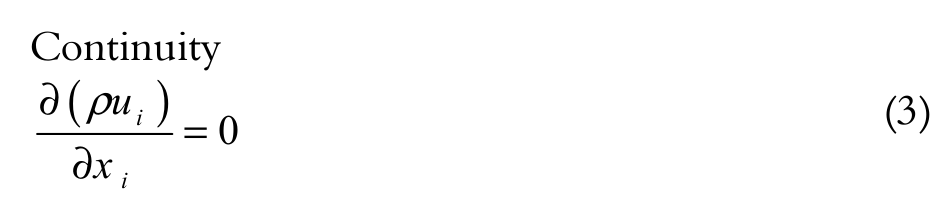 (3)
(3)
 (4)
(4)
 (5)
(5)where:
k is the thermal conductivity, ρ is the density, μ is the dynamic viscosity and Cp is the specific heat at constant pressure. The temperature and velocity profiles are considered to be in fully developed status at the inlet. At the outlet, the pressure-outlet condition was defined. Supposing Tc and uc as the temperature and the velocity at the centerline of the tube, q as the tube surface heat flux, R as the inner radius and r as the radial distance, Equation 6 and 7 represent the temperature and velocity distribution, respectively.
 (6)
(6)
 (7)
(7)All walls of the domain are considered to be in no-slip condition, and the tube wall releases constant heat flux.
The so-called governing equations are solved through finite volume method employing CFD commercial software Fluent 6.3.26. The numerical model comprises the standard pressure and second order upwind scheme for discretization of momentum and energy equations. ‘SIMPLE’ algorithm was chosen for the pressure-velocity coupling.
Result and discussion
Generally, numerical investigations require a good comprehension of the geometry of the problem. This purpose is obtained by efficiently meshing the geometry to be prepared for verification. The number and type of mesh elements are also important for the precision of the solution. In this effort, the mesh elements are of tetrahedral type, for acceptably covering the geometry curvature. In order to investigate the mesh independency of the results, different mesh numbers for a specific case (W = 16 mm) were chosen to be tested in Re = 1000.
The obtained results are presented in Figure 4.
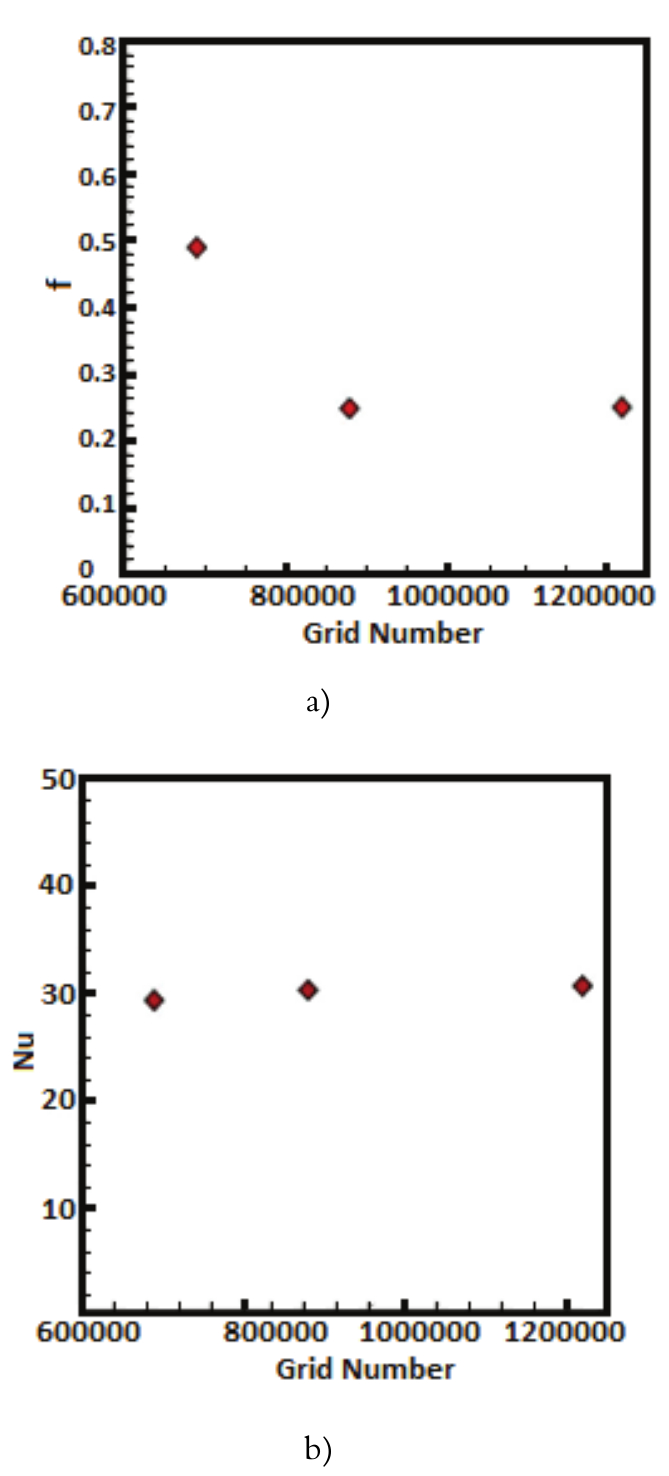
Figure 4.
Grid independency through verification of Nusselt number (a) and friction factor (b).
Amongst mesh numbers of 690000, 880000 and 1220000 the results for surface Nusselt number and friction factor had no sensible change after mesh number of 880000. So this mesh configuration was preferred for simulations.
Alternated axes
Numerical investigation for alternate axes yielded to the results for surface Nusselt number and friction factor presented in Figure 5 and 6, respectively. As it is seen in Figure 5, by increasing the Reynolds number the tube surface Nusselt number is enhanced. This can be attributed to more efficient destruction of the thermal/velocity boundary layer obtained through enhancing the Re number. In other words, uneven behavior of the swirl flow induced by alternate axes twisted tape can lead to flow fluctuation and better fluid mixing (reverse flow).
Figure 6 represents that the friction factor with alternate axes twisted tape is more than typical twisted tape. This is mostly attributed to the enhanced dissipation of dynamic pressure caused by a flow resistance swirl flow as well as an extra disturbance at the alternate point.
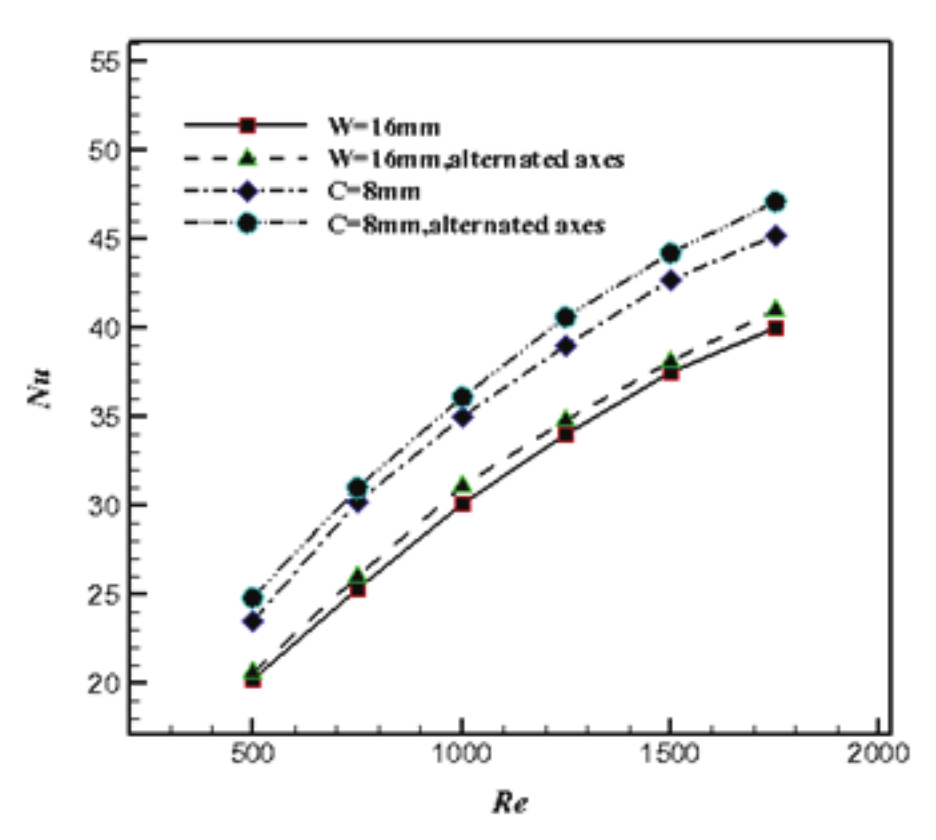
Figure 5.
Variation of Nusselt number with Reynolds number for alternate axes technique.
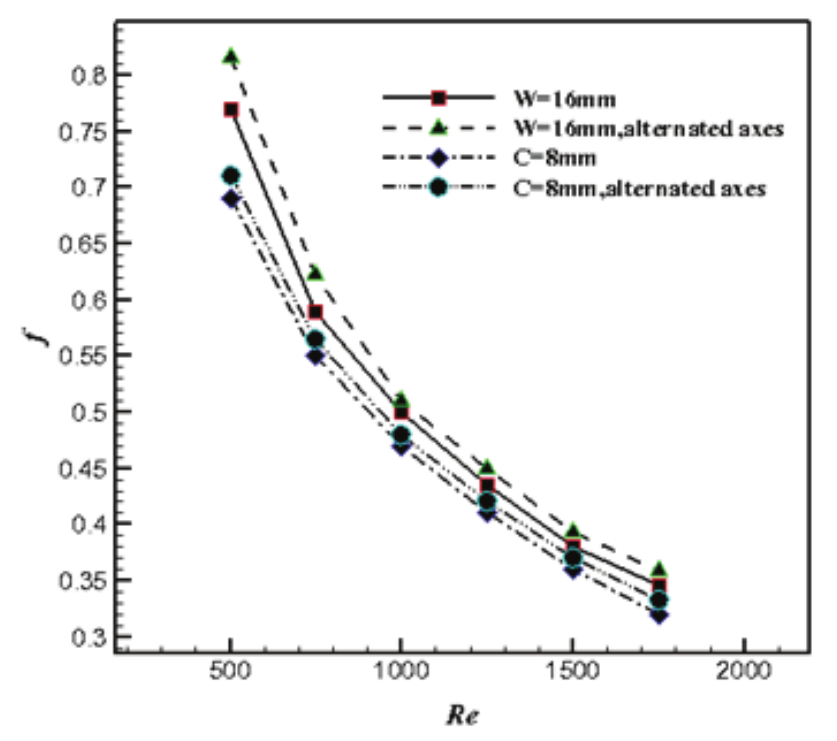
Figure 6.
Variation of friction factor with Reynolds number for alternate axes technique.
In order to have a comprehensive overview on the effect of alternate axes on twisted tapes flow behavior, the flow streamlines for both twisted tape types in typical and alternate axes condition are shown in Figure 7.
Observing the results, it is interpreted that in alternate axes twisted tape inserts fluid stream which directly encounters a crosswise edge of the tape at an alternate point was separated. This matter effectively promoted the fluid mixing. Moreover, there are also the collisions of streams delivered from different sides of the twisted tapes when they faced each other behind the alternate point.
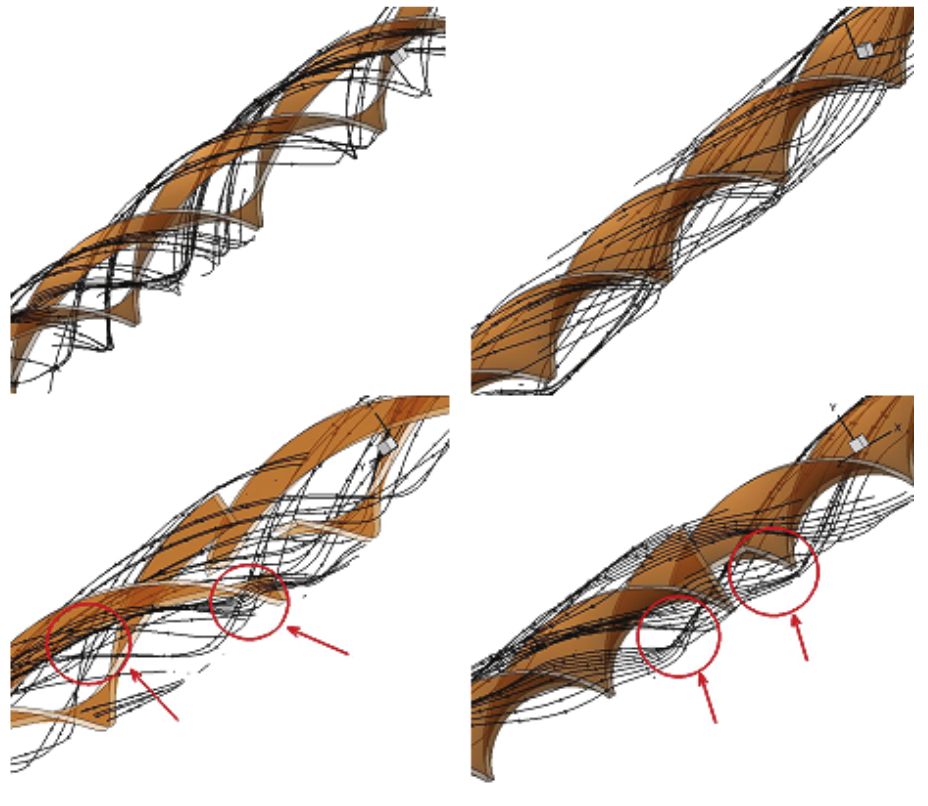
Figure 7.
Streamlines for alternate axes and typical twisted tapes.
Regularly spaced
Figure 8 and 9 represent the results for 6 regularly spaced configurations employing surface Nusselt number and friction factor. In Figure 8, it can be seen that the Nusselt number increases with the Reynolds number and the heat transfer rate is higher for the twisted tape set with higher inlet velocity, because of stronger swirl flow formed in the twisted tape inserts. Due to the tangential velocity component, the mixing of fluid between fluid at the wall region and fluid at the core region, induced by the generated centrifugal force, has significant ability to enhance heat transfer rate. Also it is clearly seen in Figure 9 that the friction factor continues to decrease with Reynolds number.
As it has been announced in Figure 3, two space ratios were considered for investigation. Having observed the results, it can be comprehended that the use of small value of space ratio yields to a higher heat transfer rate than that of large value of space ratio. As a matter of fact, the large free-spacing between the twisted tapes is found to be not sufficient to maintain the swirl intensity to extent to the next twisted tape. The swirling flow decays faster in the large free-spacing because it is too far to reach the next twisted tape to build up swirling flow again.
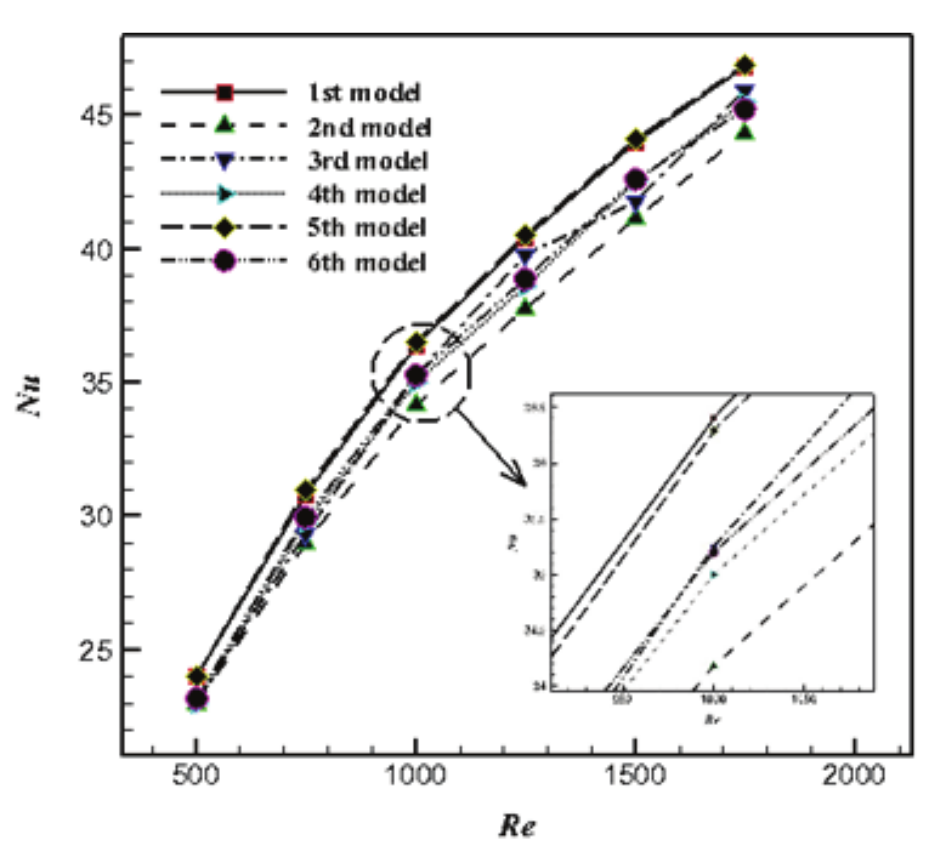
Figure 8.
Variation of Nusselt number with Reynolds number for regularly spaced technique.
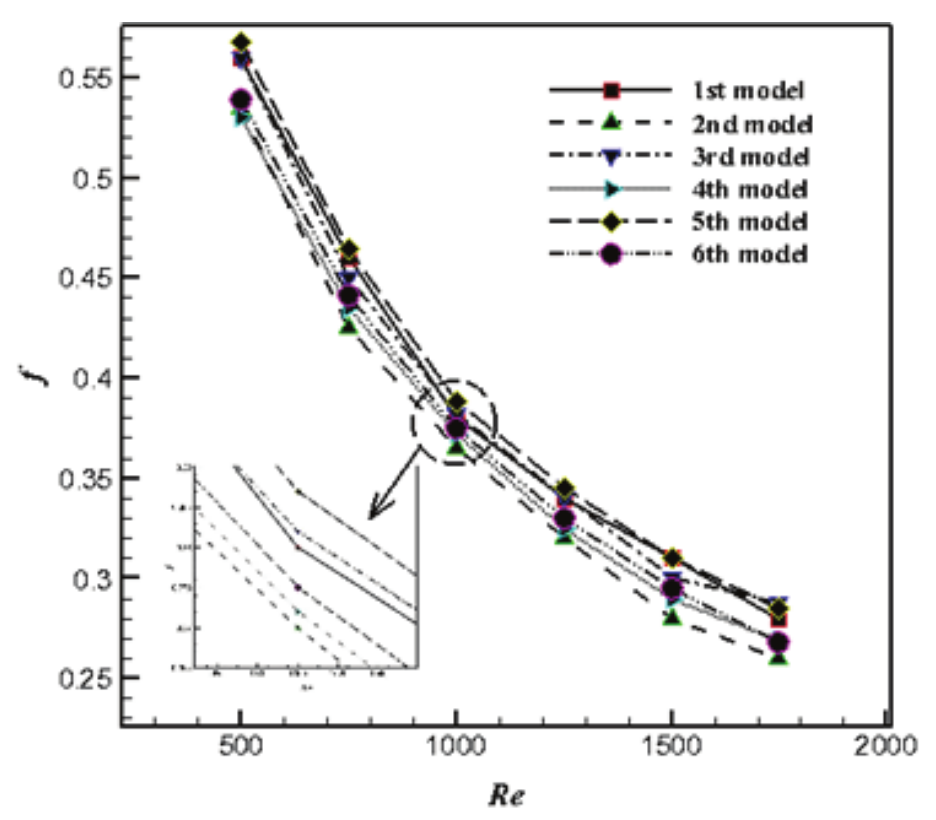
Figure 9.
Variation of friction factor with Reynolds number for regularly spaced technique.
In the arrangement of the twisted tapes offered in this article, the swirling flow remains active in the free-spacing but at different swirl strength. It is seen that the friction factor was more for the cases with small space ratios. The reason is that the small space leads to have higher tangential contact between the swirling flow and the tube surface before decaying of the swirling flow. The presence of the free-spacing region is to reduce the surface areas that affect considerably the pressure loss of fluid flow. It is believed that the large friction occurring from the full-length twisted tape insert can be decreased substantially by using the regularly spaced twisted tape.
In order to verify the phenomenon in these 6 configurations, cross sectional view of the velocity profiles in the middle section of the tube length are presented in Figure 10. As it is obvious, the model which can disturb the flow more than the others can make better heat transfer rate due to better flow mixing. The velocity profile for the 5th configuration shows better thermal performance, since the velocity magnitude near the tube walls have greater amount in comparison with the other models which offer very low velocity magnitude (V = 0.01). It can be said that 45 degree rotation of the middle section twisted tape, strengthened the tangential velocity to disturb the thermal layer adjacent to the tube wall. In the 3rd configuration it can be seen that the flow has greater amount for the velocity which can be attributed to the mid-line axial velocity. The 90 degree rotation of the twisted tape accelerated the axial velocity in comparison with the tangential velocity and it yields to weaker thermal performance. For the 2nd, 4th and 6th configurations as discussed former, the behavior has no sensible change because of far distance between the twisted tapes. All these matters admire the results shown in Figure 8.
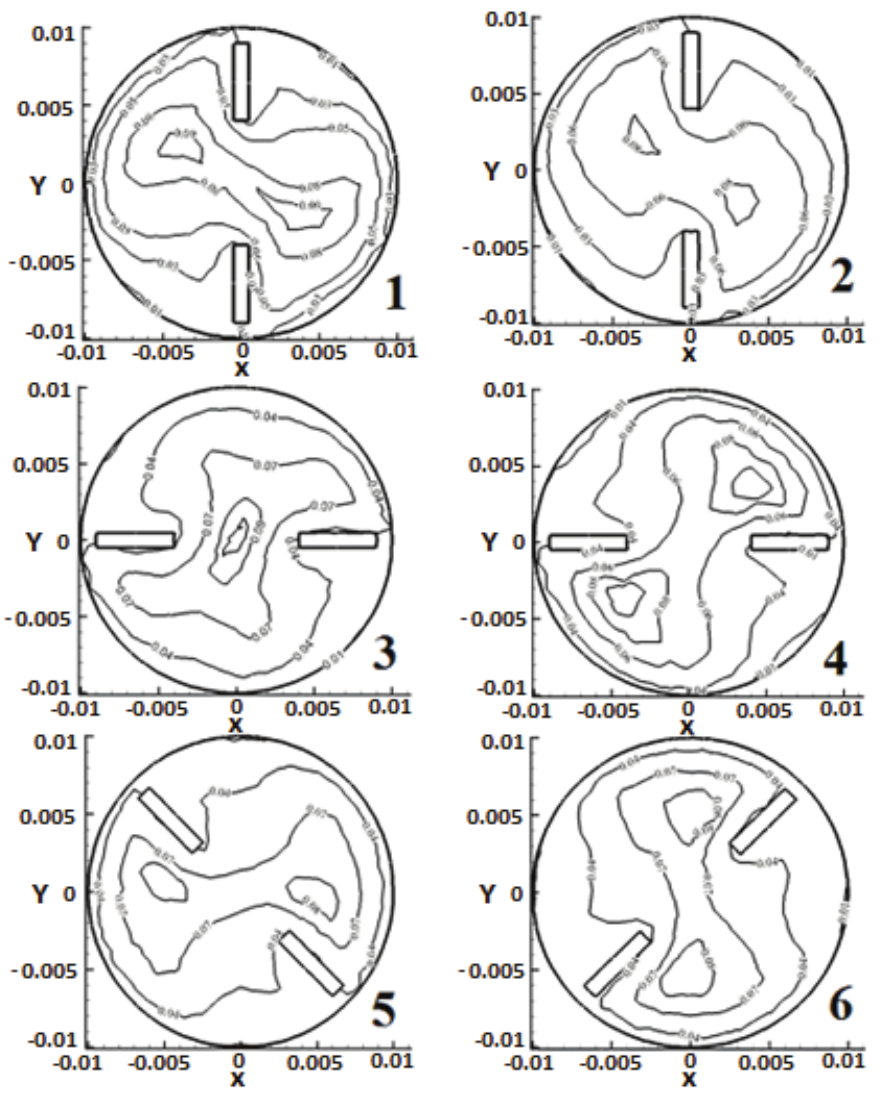
Figure 10.
Velocity profiles for cross-section of the tube in L/2 for 6 regularly spaced configurations.
Conclusion
The numerical analysis of heat and fluid flows through a round tube fitted with alternate axes and regularly spaced twisted tapes is carried out, with the aim of heat transfer enhancement and investigation of different ideas.
From the computations, it can be found that enhancing heat transfer with passive method using different types of twisted tape constructions in the round tube can improve the heat transfer rate efficiently. However, the friction factor of the tube with the twisted tape insert also increases. For the alternate axes technique it can be said that alternation leads to flow regime disturbance and normally enhances the heat transfer and friction factor. The streamlines also reveal the issue. So using alternation of the axis can be a beneficial idea for both short-width and center-cleared twisted tapes. Investigation of the free space between twisted tapes compound with the rotation effects showed that the twisted tapes set with smaller space ratios can give better thermal performance. Also the rotation of 45 degree of the middle section twisted tape can improve the performance due the strong flow disturbance transferred between the twisted tapes. It should be uttered that the friction factor had the same behavior. It was increased because of the enhancement of surface contact. The increase in heat transfer and friction can be explained by the swirling flow as a result of the secondary flows of the fluid. Because the regularly spaced twisted tapes show less friction factor in comparison with the full length twisted tapes, employing this technique can be a promising way and the optimum value of the space ratio should be in acceptable range to get benefit of a better heat transfer rate and reduction of pressure loss.
References
Chang, S. W., Yang, T. L., & Liou, J. S. (2007). Heat transfer and pressure drop in tube with broken twisted tape insert. Experimental Thermal and Fluid Science, 32(2), 489-501. doi: 10.1016/j. exp therm flu sci.2007.06.002
Date, A. W. (2000). Numerical prediction of laminar flow and heat transfer in a tube with twisted-tape insert: Effects of property variations and buoyancy. Journal of Enhanced Heat Transfer, 7(4), 217-229. doi: 10.1615/JEnhHeatTransf.v7.i4.10
Deepmala, V. N., Mishra, H., Marasi, H., Shabanian, M. S., & Nosrati, S. (2017). Solution of voltra-fredholm integro-differential equations using chebyshev collocation method. Global Journal of Technology and Optimization, 8(210) 1-4. doi: 10.4172/2229-8711.1000210.
Eiamsa-ard, S., THianpong, C., & Promvonge, P. (2006). Experimental investigation of heat transfer and flow friction in a circular tube fitted with regularly spaced twisted tape elements. International Communications in Heat and Mass Transfer, 33(10), 1225-1233. doi: 10.1016/j.icheatmasstransfer.2006.08.002
Eiamsa-ard, S., Wongcharee, K., & Sripattanapipat, S. (2009). 3-D Numerical simulation of swirling flow and convective heat transfer in a circular tube induced by means of loose-fit twisted tapes. International Communication in Heat and Mass Transfer, 36(9), 947-955. doi: 10.1016/ j. ic heat mass transfer.2009.06.014
Eiamsa-ard, S., Wongcharee, K., Eiamsa-ard, P., & Thianpong, C. (2010). Heat transfer enhancement in a tube using delta-winglet twisted tape inserts. Applied Thermal Engineering, 30(4), 310-318. doi: 10.1016/j.applthermaleng.2009.09.006
Kazuhisa, Y., Hidetoshi, H., Saburo, T., & Chikahiro, S. (2004). Numerical simulation on heat transfer enhancement in twisted-tape-inserted tubes. Journal of Enhanced Heat Transfer, 11, 379-389. doi: 10.1615/JEnhHeatTransf.v11.i4.160
Liu, W., & Yang, K. (2008). Mechanism and numerical analysis of heat transfer enhancement in the core flow along a tube. Science in China Series E: Technological Sciences, 51(8), 1195-1202. doi: 10.1007/s11431-008-0167-9
Mishra, L. N. (2017). On existence and behavior of solutions to some nonlinear integral equations with Applications (Tese de Doutorado). National Institute of Technology, Silchar, Ph.D. Thesis, National Institute of Technology, Silchar 788010, Assam, India.
Naphon, P. (2006). Heat transfer and pressure drop in the horizontal double pipes with and without twisted tape insert. International Communications in Heat and Mass Transfer, 33(2), 166-175. doi: 10.1016/j.icheatmasstransfer.2005.09.007
Rahimi, M., Shabanian, S. R., & Alsairafi, A. A. (2009). Experimental and CFD studies on heat transfer and friction factor characteristics of a tube equipped with modified twisted tape inserts. Chemical Engineering and Processing: Process Intensification, 48(3), 762-770. doi: 10.1016/j.cep.2008.09.007
Ray, S., & Date, A. W. (2001). Laminar flow and heat transfer through square duct with twisted tape insert. International Journal of Heat and Fluid Flow, 22(4), 460-472. doi: 10.1016/S0142-727X(01)00078-9
Ray, S., & Date, A. W. (2003). Friction and heat transfer characteristics of flow through square duct with twisted tape insert. International Journal of Heat and Mass Transfer, 46(5), 889-902. doi: 10.1016/S0017-9310 (02)00355-1
Saha, S. K., Dutta, A., & Dhal, S. K. (2001). Friction and heat transfer characteristics of laminar swirl flow through a circular tube fitted with regularly spaced twisted tape insert. International Journal of Heat and Mass Transfer, 44(22), 4211-4223. doi: 10.1016/S0017-9310 (01)00077-1
Yang, K., & Liu, W. (2007). Forming an equivalent thermal boundary layer for fully-developed laminar tube flow and its field synergy analysis. Journal of Engineering Thermophysics (in Chinese), 28(2), 283-285.
Zhang, L., & Qian, W. (2005). 3D numerical simulation of flow and heat transfer in self-rotating twisted tape- inserted tube. Journal Chemical Industry and Engineering, 56(9), 1633-1638.
Zhuo-Xiong, Z. (2008). A new turbulence modulation in second-order moment two-phase model and its application to horizontal channel. Journal of Hydrodynamics, 20(3), 331-338. doi: 10.1016/S1001-6058(08)60065-7
Notes
Author notes
mrahimi@mut.ac.ir