Ciência, Tecnologia de Alimentos e Engenharia de Alimentos
Hygroscopic behavior of acerola powder obtained by spray-drying
Hygroscopic behavior of acerola powder obtained by spray-drying
Acta Scientiarum. Technology, vol. 41, 2019
Universidade Estadual de Maringá
Received: 13 February 2017
Accepted: 11 May 2017
Abstract: Acerola is a tropical fruit characterized by a high content of vitamin C. The food sorption isotherms reflect the way that the water binds to the food. This study aimed to fit mathematical models to the adsorption isotherms of the acerola pulp powder obtained by spray-drying, and. It was used acerola pulp containing 17.1% (m m-1) maltodextrin, and a spray-dryer with drying air temperature of 154°C. The mathematical models of GAB, BET, Henderson, and Oswin were applied to determine the isotherms, using temperatures of 25, 35 and 45°C. The hygroscopicity, degree of caking and solubility analysis were performed to characterize the powders. The powder showed hygroscopicity of 5.18, degree of caking of 3.67 and solubility of 94.88%. The evaluated mathematical models showed mean relative errors ranging from 10.18 to 29.13% and a coefficient of determination (R2) ranging from 0.939 to 0.977. At 25°C, the Oswin model was the best fitted, whereas at 35 and 45°C the best fitting was obtained by the Henderson model. Type III (J-shape) isotherms were obtained, typical of high-sugar foods. The powder showed a low hygroscopicity and degree of caking in addition to a high solubility.
Keywords: dehydration, tropical fruit, isotherm.
Introduction
Acerola is a tropical fruit of great economic and nutritional potential, whose agroindustrial interest is due mainly to its high content of vitamin C, which associated with its carotenoids and anthocyanins, making it a prominent food (Mesquita & Vigoa, 2000).
Drying technologies make possible to process the fruit in the form of powder, increasing its availability, reducing post-harvest losses, providing value and enabling a wide application in many food formulations on an industrial scale (Mata et al., 2005). The fruit powder is characterized by its high hygroscopicity, which causes the phenomenon called caking and other undesirable effects. To avoid these problems, the addition of a drying adjuvant is essential. The maltodextrin is the most widely used aid in the spray-drying process because of its low cost and low hygroscopicity; it prevents the binding of the particles, has an antioxidant effect and a high retention (65 to 80%) of volatile substances (Jaya & Das, 2004; Anselmo, Mata, & Arruda, 2006). It also has well defined physical properties and it is soluble in water, which has made the maltodextrin a popular additive in the food industry (Mosquera, Moraga, & Martínez-Navarrete, 2010).
The physical, chemical and microbiological stabilities of food depend substantially on the water content, its availability, and interaction with other food components. For fruit powder, the hygroscopic equilibrium isotherms are important (Anselmo et al., 2006). The isotherms are necessary to determine the water content required to stabilize the product in order to prevent the growth of microorganisms, and other reactions that modify the product. The relationship between the water content of a particular product and the equilibrium relative moisture at a specific temperature may be expressed by using mathematical equations known as isotherms or hygroscopic equilibrium curves (Resende, Corrêa, Goneli, & Ribeiro, 2006).
In order to predict the behavior of adsorption isotherms, several authors have proposed empirical and theoretical mathematical models to fit the equilibrium moisture curves of various products as a function of the water activity (Bezerra, Costa, Afonso, Maia, & Clemente, 2011). Among the most used mathematical models for adsorption isotherms, the BET, GAB, Henderson, and Oswin are the most prominent. The model of BET (Brunauer-Emmett-Teller) is the most widely used in food systems. The model of GAB (Gugghenein, Anderson, and De Bôer) is suitable for the analysis of fruit and vegetables, and it is able to well approximate the most of the experimental isotherms for water activity up to about 0.9. The model of Henderson well describes the behavior of food with water activity ranging from 0.1 to 0.75, and it is applied to grains, cereals, and fruits. The model of Oswin well relates the moisture content of many foods with water activity up to approximately 0.5 (Blahovec, 2004; Andrade, Lemus, & Pérez, 2011).
This study aimed to analyze, by fitting mathematical models, the adsorption isotherms of acerola pulp powder obtained by spray-drying, and characterize the obtained powder as its hygroscopicity, caking, and solubility.
Material and methods
The acerola pulps used in the experiments were acquired from a processing company in Fortaleza, the capital of Ceará state, Northeast Brazil. Before the drying process, 17.1% (m m-1) maltodextrin (dextrose equivalent 20) was added to the pulps. After homogenization, 400 g of the mixture was dehydrated in a spray-dryer (Model MSD 1.0, Labmaq Brazil). The dryer conditions were: drying air temperature of 154°C, feed flow of 0.5 L hour-1, drying air flow of 3.5 m3 min-1, pressurized air flow of 30 L min-1, and an atomizer nozzle of 1.2 mm. The drying conditions and pulp formulation were previously defined by experimental design. The obtained powder was stored in packaging made of Pet/Aluminum/Polyethylene with a grammage of 122 g m2 -1, until the beginning of the analysis.
To characterize the powders, the hygroscopicity was performed according to Goula and Adamopoulos (2008) under temperature of 24°C and 75% relative humidity, using a saturated solution of NaCl; the degree of caking was also calculated according to Goula and Adamopoulos (2008), and the solubility was determined according to Cano-Chauca, Stringheta, Ramos, and Cal-Vidal (2005). All the analyses were performed in triplicate.
To determine the adsorption isotherms, six closed cells containing saline solutions were used in order to make the relative humidity of the internal environment, according to Greenspan (1977). Saturated saline solutions of CH3COOK, K2CO3, NaBr, SnCl2, KCl, and BaCl2, with water activities of 0.21, 0.44, 0.58, 0.76, 0.84, and 0.90, respectively, were used. Aluminum crucibles containing 1.0 g of powder were placed in triplicate in each cell. The cells containing the samples were taken to an oven (BOD), with temperature control, where they were left until reaching constant mass (variance less than 1%). When the samples reached the equilibrium at temperatures of 25, 35 and 45°C, the water activity was determined using an AquaLab water activity meter (Model 4TEV).
The equilibrium moisture content (X0) of the samples was calculated according to the Equation 1, also used by Moreira, Rocha, Afonso, and Costa (2013):
 (1)
(1)where:
in X0 = equilibrium moisture content (g g-1);
Meq = mass of the sample in equilibrium (g);
MS = sample dry mass (g).
The models of GAB, BET, Henderson, and Oswin were fit to determine the isotherms, using the equations shown in Table 1.
The fittings were performed using the Statistica software version 7.0. The magnitude of the determination coefficient (R²) and the mean relative error (E) were considered to evaluate the models according to the Equation 2.
 (2)
(2)where:
in, E = mean relative error (%);
Mi = experimental values;
Mpi = values predicted by the model;
n = number of experimental data.
Results and discussion
The results of the characterization of acerola pulp powder obtained by spray-drying are shown in Table 2. The hygroscopicity showed values of 5.18, and according to the classification of GEA Niro Research Laboratory (2003), the acerola pulp powder may be classified as a non-hygroscopic powder. This result was similar to those found by Oliveira, Costa, and Afonso (2014) who obtained 8.51% for the lyophilized yellow mombin (Spondias mombin L.) pulp powder; and Fontes, Silva, Sampaio-Neta, Costa, and Rodrigues (2014), which obtained 7.48, 5.17 and 5.26% of hygroscopicity for powders of prebiotic juice of pineapple, melon and orange, respectively.
The degree of caking of the obtained acerola powder showed a value of 3.67% (Table 2), and it is within the desirable range which is up to 34% for food powders as described by Jaya and Das (2004). Higher values were found by Oliveira et al. (2014), 6.64% for freeze-dried yellow momb pulp powder. Goula and Adamopoulos (2010) obtained from 5.9 to 24.8% for concentrated orange juice powder by spray-dried at 110 to 140°C. The variations of caking may be explained by the different concentrations of sugar found in fruits. Food powders with high hygroscopicity may present a phenomenon called caking, which causing an agglomeration of the powder. This effect is attributed to water absorption on the surface of the particles, forming a saturated solution and thereby making the particles sticky and able to form hydrogen bonds, causing the caking (Goula & Adamopoulos, 2008). Fruit products usually contain a high amount of sugar in their composition, generating hygroscopic and sticky powders, tending to agglomeration (Oliveira, Tonon, Nogueira, & Cabral, 2013b).
The acerola pulp powder showed a solubility of 94.88% (Table 2), similar to that found by Caparino et al. (2012) who evaluated mango powder obtained by spray-drying and found solubility of 95.31%, and Oliveira et al. (2013b) who found values above 90% in strawberry pulp powder with maltodextrin. This high value of solubility indicates that the acerola pulp powder has potential as a rapid preparation product, such as drinks and desserts. The solubility of the powder is associated with the spray-drying process, increasing the surface area of the powder, and also due to the addition of maltodextrin, which is a coating agent resulting in a highly soluble product.
The fitting results of the mathematical model proposed to the experimental data are shown in Table 3. For the acerola powder obtained by spray-drying, at the analyzed temperatures, the evaluated models showed mean relative errors ranging from 12.91 to 29.13%. The models also showed coefficients of determination (R2), ranging from 0.939 to 0.977.
The best fits were from Oswin and Henderson models. The choice of models was due to the mean relative error (E) presenting greater variation than the coefficient of determination (R2). At 25°C, the better fitted to the experimental data was from Oswin model, with 12.91% error. At 35 and 45°C, the best fits were from Henderson model, with mean relative error of 13.69 and 14.76%, respectively. Pena, Mendonça, and Almeida (2010), evaluating the isotherms of açaí (Euterpe oleracea) powder, found mean relative errors of 6.4, 7.3, and 8.6% applying the models of GAB, Oswin, and BET, respectively. Catelam, Trindade, and Romero, (2011), studying the isotherms of passion fruit (Passiflora edulis) pulp dehydrated by spray-drying and lyophilized, found the best fitting using the GAB model. Moura Neto, Rocha, Afonso, and Costa (2015), studying the behavior of isotherms of yellow mombin powder obtained by spray-drying, found the best fitting for the models of BET and Henderson. According to Pena, Ribeiro, and Grandi (2000), for guarana powder obtained by spray-drying, the Henderson and Oswin were the best fitting models among the models of two parameters, and BET and GAB were the best fitting models among those of three parameters. Jain, Verma, Sharma, and Jain (2010) found that the fittings of Henderson and Oswin were good to represent the isotherms of dehydrated papaya cubes.
Through the GAB and BET models, it is possible to evaluate the moisture content in the molecular monolayer (Xm) of food. There was a difference between the values of Xm, for both models; the model of BET showed slightly higher values. Similarly, Oliveira, Afonso, and Costa (2011), for sapodilla (Manilkara zapota L.) lyophilized powder, found a higher value of moisture content in the molecular monolayer applying the model of BET. Moura Neto et al. (2015) and Canuto, Afonso, and Costa (2014) observed the same behavior for mango and papaya pulp powder, respectively.
It was observed an increase in the water content in the monolayer (Xm) with the temperature increase (Table 3). Several authors report this behavior, such as Moreira et al. (2013), Moura Neto et al. (2015), and Oliveira, Clemente, Afonso, and Costa (2013a). Ferreira and Pena (2003) observed the same trend and suggested that the increase in the temperature promotes changes in the product physical structure, thus exposing a larger number of active sites with affinity to the water molecule; in addition, the increase of the temperature increases the solubility of the solutes present in the product.


The values of the sorption constant C for the acerola pulp powder showed a decreasing trend with the temperature increase (Table 3). Moreira et al. (2013) reported similar results for the mango pulp powder. Pedro, Telis-Romero, and Telis (2010), studying the passion fruit powder, also found this behavior at temperatures between 30 and 40°C. According to Gabas , Telis, Sobrala, and Telis-Romero (2007), this decrease in the sorption constant C is expected because the increase in temperature reduces the adsorbate-adsorbent interaction.
The models of Oswin and Henderson provide the best fit to the experimental data, showing values of ‘a’ and ‘b’ within the range required to represent sorption isotherms of biological materials (Table 3). According to Blahovec (2004), the model of Oswin must present a > 0 and 1 ≥ b >0, where as the model of Henderson must be a > 0 and b ≥ 1. Several authors report similar results, such as Moura Neto et al. (2015), Canuto et al. (2014), and Moreira et al. (2013).
The adsorption isotherms of acerola pulp powder obtained by spray-drying are shown in Figure 1. There was an increase in water activity with the increase of the equilibrium moisture content (Xeq). The retention of moisture is accentuated in powder with water activities above 0.75, that is, exposing this powder in environments with relative humidity above 75% may result in excessive water gain. This result was similar to those found by Pena et al. (2010) who evaluated the isotherms of açaí powder, and Moura Neto et al. (2015) who studied the isotherms of yellow mombin pulp powder. On the other hand, Moreira et al. (2013) observed this increase in isotherms of mango pulp powder with water activity around 0.55. These behaviors are influenced by the concentration of sugars and drying adjuvants.
At the studied temperatures (Figure 1), the isotherms show similar behavior and close values of water activity and moisture equilibrium. However, there is a trend to a higher water absorption at higher temperatures, in this case, 45°C, this is a common phenomenon for products rich in sugar, such as fruit powders. Several authors report this behavior in isotherms of high-sugar foods (Goula, Karapantsios, Achilias, & Adamopoulos, 2008), which may be explained by the increase of the solubility of sugars with the increase of the temperature. Moura Neto et al. (2015) observed the same behavior for the isotherms of yellow mombin pulp powder.
The obtained isotherms (Figure 1) are type III, according to the classification of Brunauer (1943). Such behavior was also verified by Pedro et al. (2010), for the isotherms of passion fruit powder, Moreira et al. (2013) for mango powder, and Gomes, Figueiredo, and Queiroz (2002) for acerola pulp powder. The typical form of an isotherm reflects how the water binds to the system, so that weaker interactions with the water molecules generate a higher water activity, thus, the product becomes more unstable (Andrade et al., 2011). The evaluated isotherms showed a flatter area in their first part, in other words, J-shape isotherms, which are typical of food rich in soluble components such as sugars (Al-Muhtaseb, Mcminn, & Magee, 2004). According to Pedro et al. (2010), this shape of the isotherms is a characteristic of foods with high sugar content, which adsorb small amounts of water at low water activity, and high amounts at high water activities. This behavior may be explained by the fact that at low water activity, the physical water adsorption in the active sites -OH occurs only on the surface of the present crystalline sugars (Goula et al., 2008).
The temperature effect on the sorption isotherm is very important since the foods are exposed to a range of temperatures during the storage and processing. The temperature affects the mobility of water molecules and the dynamic equilibrium between the steam and adsorbed phase. The isotherms of the acerola pulp powder showed an inversion of the temperature effect (Figure 2). According to Goula et al. (2008), the equilibrium moisture content decreases with the increase of the temperature at a constant water activity, this trend may be attributed to a reduction in the total number of active sites for bound water as a result of physical and/or chemical change induced by the temperature. However, there may be an inversion of the temperature effect on the isotherms, resulting in an increase of the equilibrium moisture content with the increase of the temperature.
The inversion of the temperature effect observed in this study is similar to that reported by Moreira et al. (2013) and Ribeiro, Costa, and Afonso (2016). According to Pedro et al. (2010), some studies show the inversion of the temperature effect at water activity higher than 0.7, in products with a high sugar content, such as fruit, which may be explained by an increase of the sugar solubility, in water, caused by the temperature increase. For the powder obtained in this study, the inversion of the temperature effect occurred between the isotherms at 35 and 25°C at water activity between 0.35 and 0.45, and between the isotherms at 45 to 35°C at water activity between 0.65 and 0 70.

Figure 1.
Sorption isotherms of acerola pulp powder obtained by spray-drying according to Oswin (25°C) and Henderson (35 and 45°C) models.
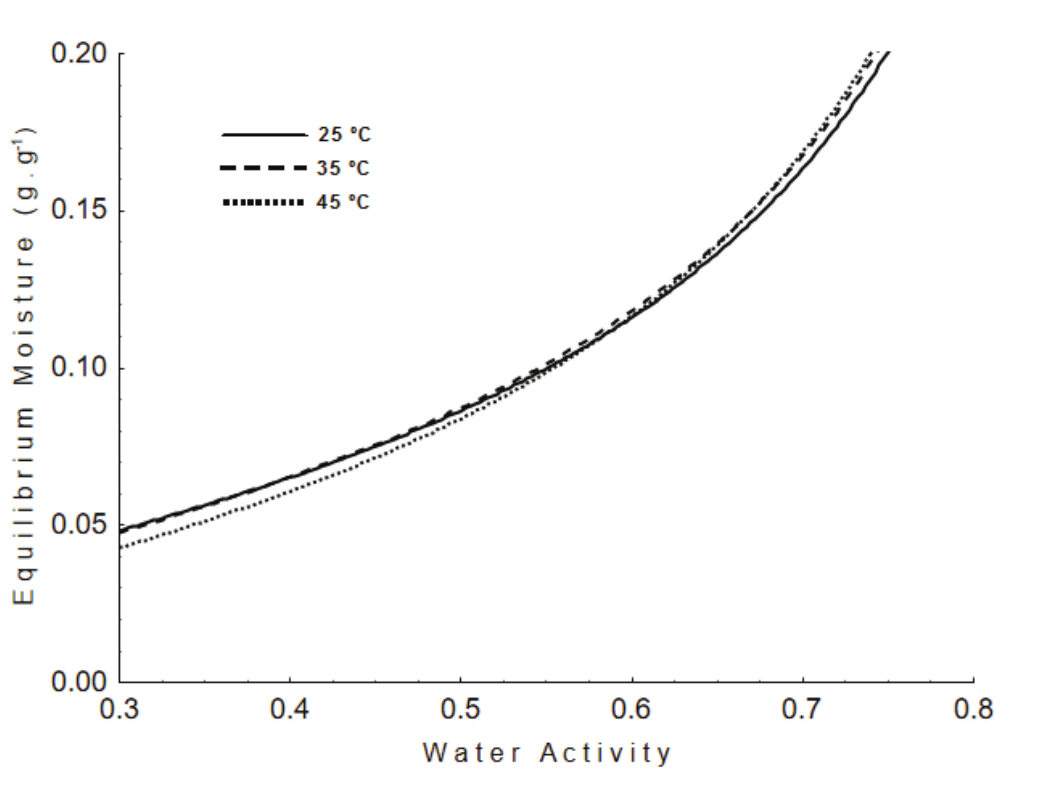
Figure 2.
Detail of the sorption isotherms of acerola pulp powder obtained by spray-drying according to Oswin (25°C) and Henderson (35 and 45°C) models.
Conclusion
The acerola powder obtained by spray-drying showed low hygroscopicity and degree of caking, and high solubility in water, giving the product a good stability and rehydration capacity.
The isotherms were best fitted by the Oswin and Henderson models. They showed the typical hygroscopic behavior of high-sugar foods with type III isotherms. They also showed an inversion of the temperature effect, indicating that there was a change in the mobility of water molecules, causing an increase in the equilibrium moisture content, with the temperature increase.
References
Al-Muhtaseb, A. H., Mcminn, W. A. M., & Magee, T. R. A. (2004). Water sorption isotherms of starch powders Part 1: Mathematical description of experimental data. Journal of Food Engineering, 61(3), 297-307. doi: 10.1016/S0260-8774(03)00133-X
Andrade, R. D., Lemus, R., & Pérez, C. E. (2011). Models of sorption isotherms for food: uses and limitations. Vitae, Revista de la Facultad de Química Farmacéutica, 18(3), 325-334.
Anselmo, G. C. S., Mata, M. E. R. M. C., & Arruda, P. C. (2006). Determinação da higroscopicidade do cajá em pó por meio da secagem por atomização. Revista de Biologia e Ciências da Terra, 6(2), 58-65.
Bezerra, T. S., Costa, J. M. C., Afonso, M. R. A., Maia, G. A., & Clemente, E. (2011). Avaliação físico-química e aplicação de modelos matemáticos na predição do comportamento de polpas de manga desidratadas em pó. Revista Ceres, 58(3), 278-283. doi: 10.1590/S0034-737X2011000300005
Blahovec, J. (2004). Sorption isotherms in materials of biological origin mathematical and physical approach. Journal of Food Engineering, 65(4), 489-495. doi: 10.1016/j.jfoodeng.2004.02.012
Brunauer, S. (1943). The absorption of the gases and vapors I. Physical adsorption. Princeton, NJ: Princeton University Press.
Cano-Chauca, M., Stringheta, P. C., Ramos, A. M., & Cal-Vidal, J. (2005). Effect of the carriers on the microstructure of mango powder obtained by spray drying and its functional characterization. Innovative Food Science and Emerging Technologies, 5(4), 420-428. doi: 10.1016/j.ifset.2005.05.003
Canuto, H. M. P., Afonso, M. R. A., & Costa, J. M. (2014). Hygroscopic behavior of freeze-dried papaya pulp powder with maltodextrin. Acta Scientiarum. Technology, 36(1), 179-185. doi: 10.4025/actascitechnol.v36i1.17499
Caparino, O. A., Tang, J., Nindo, C. I., Sablani, S. S., Powers, J. R., & Fellman, J. K. (2012). Effect of drying methods on the physical properties and microstructures of mango powder. Journal of Food Engineering, 111(1), 135-148. doi: 10.1016/j.jfoodeng.2012.01.010
Catelam, K. T., Trindade, C. S. F., & Romero, J. T. (2011). Water adsorption isotherms and isosteric sorption heat of spray-dried and freeze-dried dehydrated passion fruit pulp with additives and skimmed milk. Ciência e Agrotecnologia, 35(6), 1196-1203. doi: 10.1590/S1413-70542011000600021
Ferreira, C. D., & Pena, R. S. (2003). Comportamento higroscópico da farinha de pupunha (Bactris gasipaes). Ciência e Tecnologia de Alimentos, 23(2), 251-255. doi: 10.1590/S0101-20612003000200025
Fontes, C. P. M. L., Silva, J. L. A., Sampaio-Neta, N. A., Costa, J. M. C., & Rodrigues, S. (2014). Dehydration of prebiotic fruit drinks by spray drying: operating conditions and powder characterization. Food Bioprocess Technology, 7(10), 2942-2950. doi: 10.1007/s11947-014-1343-5
Gabas, A. L., Telis, V. R. N., Sobrala, P. J. A., & Telis-Romero, J. (2007). Effect of maltodextrin and arabic gum in water vapor sorption thermodynamic properties of vacuum dried pineapple pulp powder. Journal of Food Engineering, 82(2), 246-252. doi: 10.1016/j.jfoodeng.2007.02.029
GEA Niro Research Laboratory (2003). Analytical methods dry milk products. GEA niro analytical methods, Me- thods 14 a and 15 a. Soeborg, DK: GEA Niro Research Laboratory.
Gomes, P. M. A., Figueiredo, R. M. F., & Queiroz, A. J. M. (2002). Caracterização e isotermas de adsorção de umidade da polpa de acerola em pó. Revista Brasileira de Produtos Agroindustriais, 4(2), 157-165. doi: 10.15871/1517-8595/rbpa.v4n2p157-165
Goula, A. M., & Adamopoulos, K. G. (2010). A new technique for spray drying orange juice concentrate. Innovative Food Science and Emerging Technologies, 11(2), 342-351. doi: 10.1016/j.ifset.2009.12.001
Goula, A. M., Karapantsios, T. D., Achilias, D. S., & Adamopoulos, K. G. (2008). Water sorption isotherms and glass transition temperature of spray dried tomato pulp. Journal of Food Engineering, 85(1), 73-83. doi: 10.1016/j.jfoodeng.2007.07.015
Goula, A., & Adamopoulos, K. (2008). Effect of maltodextrina addition during spray dryin of tomato pulp in dehumified air: I. Drying kinetics and recovery. Dry Technology, 26(6), 714-725. doi: 10.1080/07373930802046369
Greenspan, L. (1977). Humidity fixed points of binary saturated aqueous solutions, journal of research of the national bureau of standards - a. Physics and chemistry, 81a(1), 89-96.
Jain, S. K., Verma, R. C., Sharma, G. P., & Jain, H. K. (2010). Studies on moisture sorption isotherms for osmotically dehydrated papaya cubes and verification of selected models. Journal Food Science Technology, 47(3), 343-346. doi: 10.1007/s13197-010-0056-7
Jaya, S., & Das, H. (2004). Effect of maltodextrin, glycerol monostearate and tricalcium phosphate on vaccum dried mango powders properties. Journal of Food Engineering, 63(2), 125-134. doi: 10.1016/S0260-8774(03)00135-3
Mata, M. E. R. M. C., Duarte, M. E. M., Alsemo, G. C. S., Rodrigues, E., Guedes, M. A., Cavalcanti, A. S. R. R. M., & Oliveira, C. C. A. (2005). Obtenção de graviola em pó pelo processo de liofilização. Revista Brasileira de Produtos Agroindustriais, 7(2), 165-172. doi: 10.15871/1517-8595/rbpa.v7n2p165-172
Mesquita, P. C., & Vigoa, Y. G. (2000). La acerola. Fruta marginada de america con alto contenido de ácido ascórbico. Alimentaria, 37(309), 113-126.
Moreira, T. B., Rocha, E. M. F. F., Afonso, M. R. A., & Costa, J. M. C. (2013). Comportamento das isotermas de adsorção do pó da polpa de manga liofilizada. Revista Brasileira de Engenharia Agrícola e Ambiental, 17(10), 1093-1098. doi: 10.1590/S1415-43662013001000011
Mosquera, L. H., Moraga, G., & Martínez-Navarrete, N. (2010). Effect of maltodextrin on the stability of freeze-dried borojó (Borojoa patinoi Cuatrec.) powder. Journal of Food Engineering, 97(1), 72-78. doi: 10.1016/j.jfoodeng.2009.09.017
Moura Neto, L. G., Rocha, E. M. F. F., Afonso, M. R. A., & Costa, J. M. C. (2015). Adsorption isotherms of hog plum (Spondias mombin L.) pulp powder obtained by spray dryer. Acta Scientiarum. Technology, 37(2), 273-277. doi: 10.4025/actascitechnol.v37i2.25001
Oliveira, D. M., Clemente, E., Afonso, M. R. A., & Costa, J. M. C. (2013a). Hygroscopic behavior of lyophilized powder of Grugru Palm (Acrocomia aculeata). American Journal of Analytical Chemistry, 4(10), 1-7. doi: 10.4236/ajac.2013.410A3001
Oliveira, G. S., Costa, J. M. C., & Afonso, M. R. A. (2014). Caracterização e comportamento higroscópico do pó da polpa de cajá liofilizada. Revista Brasileira de Engenharia Agrícola e Ambiental, 18(10), 1059-1064. doi: 10.1590/1807-1929/agriambi.v18n10p1059-1064
Oliveira, M. I. S., Tonon, R. V., Nogueira, R. I., & Cabral, L. M. C. (2013b). Estabilidade da polpa de morango atomizada utilizando diferentes agentes carreadores. Brazilian Jounal of Food Technology, 13(4), 310-318. doi: 10.1590/S1981-67232013005000037
Oliveira, V. S., Afonso, M. R. A., & Costa, J. M. C. (2011). Caracterização físico química e comportamento higroscópico de sapoti liofilizado. Revista Ciência Agronômica, 42(2), 342-348. doi: 10.1590/S1806-66902011000200012
Pedro, M. A. M., Telis-Romero, J., & Telis, V. R. N. (2010). Effect of drying method on the adsorption isotherms and isosteric heat of passion fruit pulp powder. Ciência e tecnologia de alimentos, 30(4), 993-1000. doi: 10.1590/S0101-20612010000400024
Pena, R. S., Mendonça, N. B., & Almeida, M. D. C. (2010). Comportamento higroscópico do açaí em pó. Revista Brasileira de Produtos Agroindustriais, 12(2), 153-161.
Pena, R. S., Ribeiro, C. C., & Grandi, J. G. (2000). Aplicação de modelos matemático bi e triparamétricos na predição das isotermas de adsorção de umidade de guaraná (Paullinia cupuna) em pó. Ciência e Tecnologia de Alimentos, 20(1), 8-11. doi: 10.1590/S0101-20612000000100002
Resende, O., Corrêa, P. C., Goneli, A. L. D., & Ribeiro, D. M. (2006). Isotermas e calor isostérico de sorção do feijão. Ciência e Tecnologia de Alimentos, 26(3), 626-631. doi: 10.1590/S0101-20612006000300022.
Ribeiro, L. C., Costa, J. M. C., & Afonso, M. R. A. (2016). Hygroscopic behavior of lyophilized acerola pulp powder. Revista Brasileira de Engenharia Agrícola e Ambiental, 20(3), 269-274. doi: 10.1590/1807-1929/agriambi.v20n3p269-274
Author notes
ribeiro.lucianac@gmail.com