Matemática
Prioritization of product-service business model elements at aerospace industry using analytical hierarchy process
Prioritization of product-service business model elements at aerospace industry using analytical hierarchy process
Acta Scientiarum. Technology, vol. 41, 2019
Universidade Estadual de Maringá
Received: 01 July 2017
Accepted: 07 November 2017
Abstract: The paper aims to propose a business model framework under a product-service approach in the aerospace industry based on the main elements identified in the literature. Through a Multi Criteria Decision Method - the AHP (Analytical Hierarchy Process) - a set of elements was prioritized by nine specialists from the industry for establishing a fractional ownership business model in the civilian market of a Brazilian helicopter manufacturer. The results indicate ten elements for composing the business model framework, in which value proposition, customers and culture are part of it. The practical implication of this study indicates an opportunity to boost the integration of product and service in the aerospace industry, specially using AHP for business model construction. For future researches, others companies can be considered in the study. In addition to manufacturers, service firms or operators of helicopters can compose the specialists group. Besides, another Multi Criteria Decision Method can be applied aiming to do a comparative analysis of the results among the methods. The paper fulfills a gap about how business model is structured in a product-service integration context, especially in an industry originally considered as manufacturer.
Keywords: servitization, components, framework, innovation, aeronautic, AHP.
Introduction
Products are missing a differential among manufacturers in terms of technology innovation. The development of new technologies that allow the copying or improvement of goods offered by competitors resulted from a phenomenon called ‘commodity trap’, which hampers companies to differentiate their products and to sustain that differentiation over time, leading to products that are sold on the basis of their cost, not their value (Chesbrough, 2011). Besides, technology by itself has no single objective value, until it is commercialized in some way via a business model and captures economic value from that (Chesbrough, 2010). Thus, business model innovation seems to be an alternative to try to avoid product or technology competition.
According to Dubosson-Torbay, Osterwalder, and Pigneur (2001), business model concept became popular by the influence of ICT (Information and Communications Technology) and by an increasing complexity and uncertainty involving managers to make decisions. This phenomenon was led by the Information Age from the 80s (Applegate, 2001), guiding the research subjects about business models. One of these research subjects refers to the construction of frameworks encompassing elements that relate to each other for ‘telling a story’ of how the business model works. The framework aims to describe, visualize, assess and change business models, through an understanding visualization via a provided template (Osterwalder & Pigneur, 2010; Fielt, 2011). With nine building blocks (customer segments; value proposition; channels; customer relationships; revenue streams; key resources; key activities; key partnerships and cost structure), Osterwalder and Pigneur (2010) proposed a framework – the Canvas Model - that defines business model as a way of how an organization creates, deliveries and captures value. Other authors share of the same understanding about value being part of the business model. For Morris, Schindehutte, and Allen (2005, p. 729), “[…] there is no business without a defined value proposition, and the creation of value provides a justification for the business entity”. Teece (2010) states that the essence of business model is identifying the manner by which the enterprise delivers value to customers, entices customers to pay for value, and converts those payments to profit. Business model describes the value logic of an organization in terms of creating and capturing customer value. It offers an integrated approach to value with a focus on customer value and value creation (Fielt, 2011).
Considering that value is provided to customers through services rather than products (Barquet, Oliveira, Amigo, & Rozenfeld, 2013) and that companies are viewing services as a source of added value with potential to dominate the operations of companies traditionally considered manufacturers (Rivas-Hermann, Köhler, & Scheepens, 2015), there has been increased opportunities for companies innovating their business model from a product oriented effort to a service oriented one, or even integrating both in order to secure long-term growth and to remain competitive in the marketplace (Jacob & Ulaga, 2008).
Services are rapidly emerging for economic growth in developed countries (Jung, Lee, Jung, Kim, & Shin, 2012) and they are increasingly being embodied in manufactured products reflected in the innovative effort and expertise captured in the final value of products, as well as design, technical assistance and other ‘intangible’ aspects (Organization for Economic Co-operation and Development [OECD], 2000). This movement is called servitization (Vandermerwe & Rada, 1988). Over time, other terminologies have arisen such as functional products; service dominant logic; industrial product-service system and product-service system (Alonso-Rasgado, Thompson, & Elfström, 2004; Meier, Roy, & Seliger, 2010; Barquet et al., 2013; Reim, Parida, & Ortqvist, 2015).
Product Service System (PSS) means a set of products and services aiming to jointly fulfill users’ needs through a single company or an alliance of them (Goedkoop, Van Halen, Te Riele, & Rommens, 1999). Later, environmental issues for offering optimal solutions of products and services have influenced studies of Yoon, Kim, and Rhee (2012) and Rivas-Hermann et al. (2015) which added the aspect of environmental sustainability in the PSS approach. Although PSS is not inherently sustainable (Cook, 2014), researches also consider it as fundamental dimension of PSS, since services can extend the product’s life cycle (Vandermerwe & Rada, 1988) and manufacturers become more responsible for upgrades and material recycling (Mont, 2002), which contributes to a more conscious product usage and increases resource productivity (Aurich, Fuchs, & Wagenknecht, 2006).
In this sense, innovation in services is a sustainable way to grow a business and addresses the pressures that companies are facing with the commoditization of products, transforming products into platforms that incorporate value-added services (Chesbrough, 2011). Although they must continue to advance their products, the real basis for competition shifts toward the join of products and services available to their customers through their product (Chesbrough, 2011). However, the development of service-oriented business models for manufacturing companies suffers due to traditional business model frameworks not having a high relevance for servitizing manufacturing companies (Roos & O’Connor, 2015) and the non-existence of an absolute model describing product-service offerings in the current literature (Gaiardelli, Resta, Martinez, & Albores, 2014). Furthermore, knowledge about how companies can adopt and implement product-service system is still narrowed (Reim et al., 2015).
Several studies involving PSS and automotive, maritime and machinery industries (Yoon et al., 2012; Gaiardelli et al., 2014; Rivas-Hermann et al., 2015) have been found in the literature but few in the aerospace. Focusing on this industry, trends and outlooks identify PSS as the future for competition in this sector, which supports researches about this theme. In this sense, the objective of this paper is to prioritize the elements to construct a PSS business model in the context of a manufacturing aerospace industry. To this end, the following questions must be answered:
- What are the elements of a business model under a product-service integration based on the literature?
- Wherein the business model elements differ?
- Which elements should be prioritized to design a PSS business model in a manufacturing aerospace industry, through a Multi Criteria Decision Method (MCDM)?
Based on the answers, it is intended to propose a framework with a set of elements for the aerospace sector, specially a helicopter industry interested in moving from a manufacturing business model toward a PSS business model. The framework will be a tool guide for decision makers in the transformation process for product-service purposes in the aerospace industry analyzing each element of the framework for making the transition.
Perspectives for integrating product and service in the aerospace industry
One opportunity for integrating product and service in the aerospace industry refers to the business model of fractional ownership. This business model is in line with the Use-Oriented Service (UOS) category defined by Tukker (2004). UOS indicates that the business model is not oriented to the sales of products, which remain in the property of the provider and made available and shared in different forms by users through leasing, sharing or renting. In these cases, the provider is responsible for the fixed costs of the product, e.g. maintenance and repair. The user just pays for the use of the product.
According to Advisory Circular No. 91-84 (Federal Aviation Administration [FAA], 2009), the fractional ownership concept dates from 1986 with the creation of an industry program that offered increased flexibility in aircraft ownership and operation. At that time, this program used existing aircraft acquisition concepts, including shared aircraft ownership, and provided the management of the aircraft by an aircraft management company. The aircraft owners that participated in the program purchased a minimum share of an aircraft, shared that specific aircraft with others having an ownership interest in that aircraft, and participated in an aircraft exchange with other owners of the program. The aircraft owners used a common management company to maintain the aircraft, lease the aircraft among the owners and provide other aviation expertise and professional management services. Since then, the number of companies offering fractional ownership programs has grown. During the 1990s this growth was substantial and sustained. In 2015, there were 837 aircraft dedicated to fractional operations, up from 823 in 2014, and the number of fractional owners was 4,369, a slight decline from 2014, when there were 4,402 owners (General Aviation Manufacturers Association [GAMA], 2015).
Worrells, Newmyer, and Ruiz (2001) studied the history of fractional ownership comparing to other means of air travel, highlighting the challenges for the future. Two challenges predicted by the authors were global economic factors and regulation. The first challenge still remains due to economic oscillations. In terms of regulation, the discussion is about how to qualify fractional ownership as commercial air transport operations or non-commercial general aviation operations (International Civil Aviation Organization [Icao], 2004).
In 2003, the rules of the Fractional Aircraft Ownership Program were issued by the FAA (Federal Aviation Administration), the American Aeronautic Regulator Agency. Part 91 - Subpart K, a section of the non-commercial rules defines the requirements to regulate this kind of operation. Similarly, in Europe, the European Aviation Safety Agency (EASA) considers that fractional ownership operations be treated as non-commercial (Daoust, 2006). In Brazil, the National Civil Aviation Agency - ANAC (Agência Nacional de Aviação Civil) has proposed a regulation that is being processed for approval through RBAC No. 91, Subpart K, with the same specifications of FAA. According to Part 91 - Subpart K (Electronic Code of Federal Regulations [E-CRF], 2016), a ‘Fractional Ownership Program’ or simply ‘Program’ means any system of aircraft ownership and exchange that consists of requirements for administrative and aviation support services; employment; furnishing; contracting, training and qualification of personnel, including pilots and other crewmembers; scheduling and coordination of the program, aircraft and crews.
Based on these requirements, the company should structure itself, in addition to producing and selling the helicopter through interests, to offer the administrative services related above. These aspects will influence the elements to build the product-service business model in the helicopter industry chosen for this study. A MCDM will be applied to identify the most appropriate elements for this purpose.
Material and methods
According to Triantaphyllou, Shu, Sanchez, and Ray (1998), Multi Criteria Decision Methods (MCDM) play a critical role in many real-life problems in government, industry or business activities, considering the need to evaluate a set of alternatives in terms of a set of decision criteria that can conflict with each other. It involves three steps: (1) Determining the relevant criteria and alternatives; (2) Attaching numerical measures to the relative importance of the criteria and to the impacts of the alternatives on these criteria; (3) Processing the numerical values to determine a ranking of each alternative. In general terms, MCDM aims to distinguish the evaluation criteria and to define the preference structure or weights (Yang & Tzeng, 2011).
There are different methods in the literature for conducting multi-criteria analysis being employed with different applications in the aerospace sector. For instance, the study of Lupo (2015) evaluated the service quality of airports through one of the most traditional methods, the Electre (Elimination et Choix Traduisant la Réalité) method. Another popular method, the AHP (Analytical Hierarchy Process) is used to analyze air traffic management (Castelli & Pellegrini, 2011) and to assess the potential of multi-airport systems (Zietsman & Vanderschuren, 2014). Another well-known method, the Topsis (Technique for Order Preference by Similarity to Ideal Solution) was employed by Barros and Wanke (2015) to analyze the efficiency of airlines in Africa. The most recently developed method - the BWM (Best Worst Method) - (Rezaei, 2016) is used for bundling configurations in air freight surface transport (Rezaei, Hemmes, & Tavassy, 2017).
This study applies the AHP method to evaluate the set of criteria to propose a framework of elements for a PSS business model. This method, developed by Saaty in the 1970´s, uses pairwise comparisons for a set of criteria to judge the relative importance of one criterion over another in a fundamental scale from 1 to 9 through the construction of a square matrix. The judgments are made by specialists or decision makers and then synthesized in the use of eigenvectors to determine which variables have the highest priority (Akash, Mamlook, & Mohsen, 1999; Joshi, Banwet, & Shankar, 2011). This method gives a result with the relative importance of each criterion and also prioritizes it, evaluating the consistency or quality of the solution obtained (Salgado, Mello, & Salomon, 2012). The AHP process encompasses the following steps (Amiri, 2010):
Step 1: Considering C = {Cj |j = 1, 2,...., m} the set of criteria, a pairwise comparison matrix is constructed with a scale of relative importance. Following the scale of Saaty (1980), an attribute when compared with itself always takes the value 1, thus all the diagonal entries of the pairwise comparison matrix are 1. The numbers 3, 5, 7 and 9 mean moderate importance, strong importance, very strong importance, and extreme importance; and 2, 4, 6 and 8 indicate intermediary values between 3, 5, 7 and 9. The result of the pairwise comparison on m criteria can be summarized in an (m_m) evaluation matrix A in which every element aij (i,j = 1,2,..., m) is the quotient of weights of the criteria, where Equation 1:
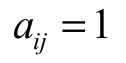 (1)
(1)and Equation 2:
 (2)
(2)Step 2: The geometric mean calculation normalizes and finds the relative weights for each matrix. The relative weights are given by the right eigenvector (w) corresponding to the largest Eigen value (max) as Equation 3:
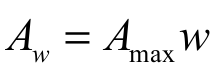 (3)
(3)If the pairwise comparisons are consistent, matrix A has rank 1 and max = m.
Step 3: The quality of the output of AHP is related to the consistency of the pairwise comparison judgments. The consistency is defined by the relation between the entries of A (Equation 4):
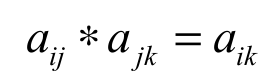 (4)
(4)The consistency index CI is Equation 5:
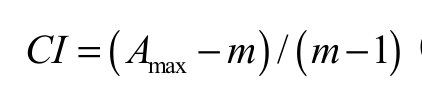 (5)
(5)The final consistency ratio (CR), which concludes whether the evaluations are sufficiently consistent, is calculated as the ratio of the CI and the random index (RI), according Equation 6:
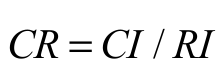 (6)
(6)The accepted upper limit value for CR is 0.10. If the final consistency ratio exceeds this value, the evaluation procedure has to be repeated to improve consistency (Saaty, 1980).
The use of AHP in this paper is justified by the following advantages, according to Goodwin and Wright (2004): formal structuring of the problem; simplicity of pairwise comparisons; redundancy allows consistency to be checked automatically and versatility. Besides the aerospace application (Jia, Tong, Wang, & Li, 2016); Zietsman and Vanderschuren, 2014), there are also studies using AHP for PSS business model evaluation (Chiu, Kuo, & Kuo, 2015). The use of AHP is also justified because it is a method that evaluates the consistency between the judgments, boosting the quality of the results. Finally, the AHP does not require the use of software for the judgments, which makes the analysis simpler.
Phase 1: Case study and definition of the product-service business model elements
This research consisted of one division of the aerospace sector, the helicopter industry. The helicopter is a versatile transport mode. It can be employed for different applications and missions in the civilian, military and governmental markets. For the purpose of this study, the discussion has focused just on the civilian market. The main benefits of using helicopters as a civil transportation encompasses: reducing airport congestion and traffic delay; increasing the effectiveness of the transport supply by providing a door-to-door service with significant time savings for travelers and providing access for smaller communities that lack airports or good surface transport infrastructure (Correnti, Capri, Ignaccolo, & Inturri, 2007).
It was studied a Brazilian subsidiary of an Original Equipment Manufacturer. This company manufactures helicopters and offers additional services, especially maintenance, retrofit, spare parts selling, engineering design and training. Over the last ten years, the company has experienced more striking results in the manufacturing business. From 2015, this started to reverse, indicating opportunities to boost investment in services considering the service-based economy trend with a decline in the share of manufacturing in GDP - Gross Domestic Product (Chesbrough, 2011).
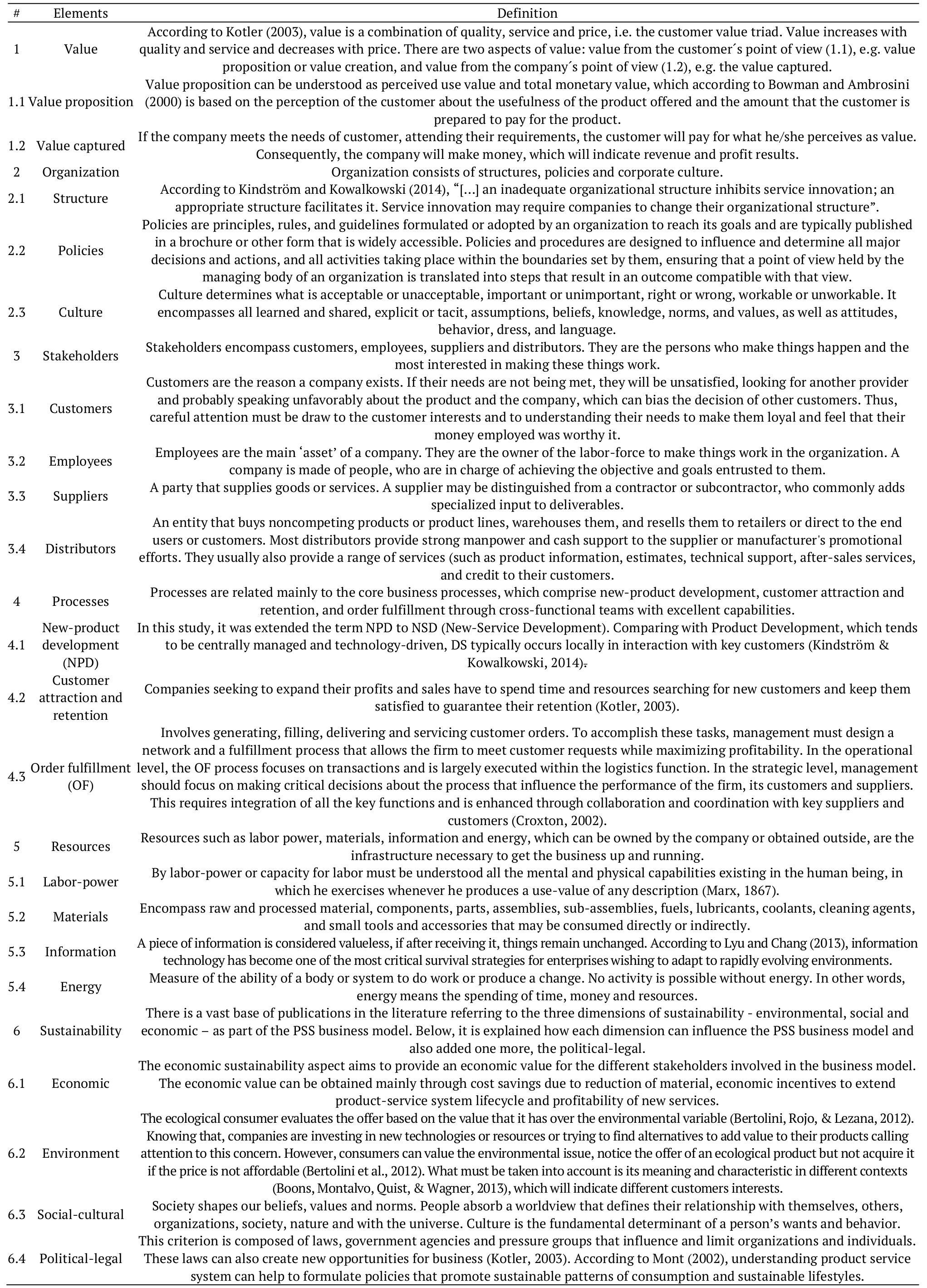
Considering a scenario of economic constraint between 2015 and 2016, with no prospects of selling to government and military segments due to government budget cuts and the lack of confidence of civilian buyers to acquire a new helicopter, a business model innovation would be an alternative to reverse this condition. Thus, it was proposed to the company to evaluate a new business model considering the integration between product and service - the fractional ownership – described in the section above. The elements (defined in Appendix A) to construct this new business model were identified in the literature and selected for this study based on how they are connected to the characteristics of an organization and to the product and service dimensions. They resulted in Figure 1, which synthesizes these elements in a hierarchy of criteria and sub criteria to be evaluated through the AHP method.
Phase 2: Method description
The AHP method has two approaches to prioritize elements by decision makers: the Aggregation of Individual Priorities (AIP) and the Aggregation of Individual Judgments (AIJ). In AIP, the final priorities of the alternatives obtained from the judgments of each specialist are grouped. In AIJ, the comparisons of each specialist are aggregated individually (Salgado, Mello, & Salomon, 2012). For this study, it was employed the AIP approach. Although the specialists work in the same company, with the exception of one of the judges selected for this research, they have different views and understandings about the PSS business model. Therefore, AIP is the most suitable for this purpose (Forman & Peniwati, 1998). The number of experts invited was based on the studies of Chiu et al. (2015) and Zietsman and Vanderschuren (2014). The first study was attended by three specialists and the second had the participation of twelve specialists in the hierarchy prioritization of their respective works.
Aiming to use a number of specialists within the same range (3-12) of those used in these authors´ studies, nine experts were invited for the judgments of this work. Eight judges belong to the same manufacturing helicopter company and one external judge with experience in business models. Table 1 shows the experts’ operating area, function and the time of experience in their function.
The matrix of judgments was structured in an Excel Worksheet and then submitted to specialists. The analysis process was done through face-to-face interview using a semi-structured questionnaire explaining the definition of each business model element, how to do the evaluation and a description about the new business model proposition, the fractional ownership.
The consistency ratios (CR) of the judgments are showed in Table 2. Considering that all of them are less than 0.10, the weights are shown to be consistent and are used in the selection process.


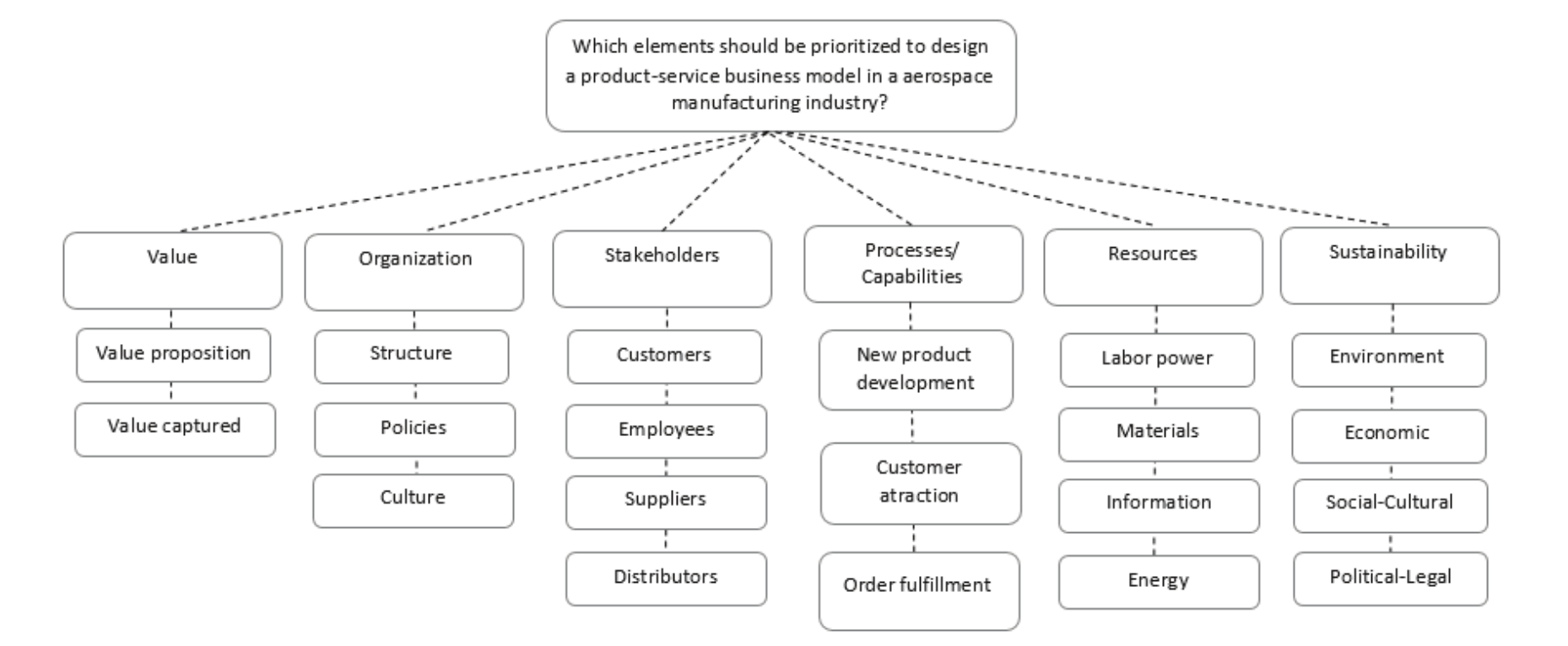
Figure 1.
Hierarchy of criteria to design a product-service business model in the aerospace industry.
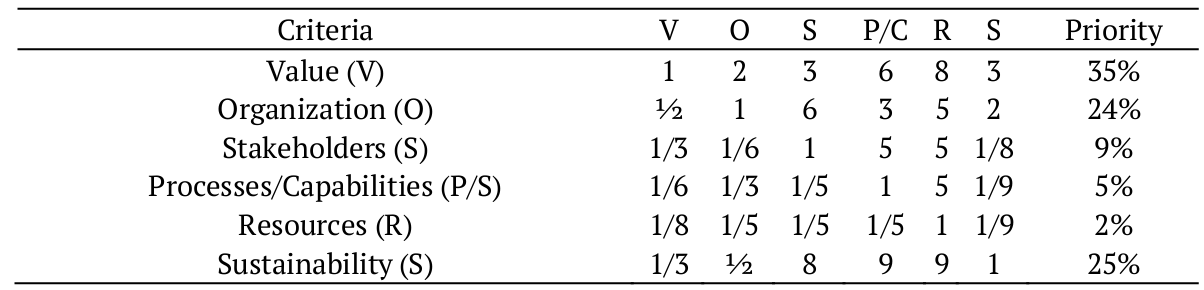
As example, Table 3 and 4 present the judgments for the Criteria and for the Sub criterion Process/Capabilities respectively by one of the specialists interviewed, a Helicopter Seller with 15 years of experience.
The final result obtained by the AHP method with all the specialists is discussed in the next section.
Results and discussion
Conducting the AHP analysis through the criteria identified in the hierarchy presented in Figure 1, it follows the results in Table 5.
In the second ranking group, there are Value Captured (8.60%); Policies (7.14%) and Structures (6.89%). These criteria indicate internal results of a new value proposition, a service orientation culture meeting customer’s needs. In other words, when the company positions itself with a new business model, decision makers expect investment in a new market to bring value to the company. And it is important that policies and structures are built to attend this new market based on the culture of innovation.
Next, it is observed the results for Employees (5.96%); Customer Attraction and Retention (5.95%) and New Product Development (4.79%). This indicates that for a new business mode configuration, employees must be capable and prepared for the new market demand that arises. In fact, this element was the one of great concern among the specialists. Considering the company´s core business in terms of engineering and manufacturing, there is a need for training and empowering people in new tools and processes with a service perspective. In line with this, Customer Attraction and Retention and New Product Development are the key processes to translate the fractional ownership idea into a tangible physical asset bundled with service activities aiming to attend market opportunities.
In the tenth position, Information (3.71%) shows its importance taking into account the necessary data and subsidies to guide the new business model. From the point of view of the specialists, information about market demand, customer requirements, competitors, potential risks and legislation will boost the company’s administrative board decision to move forward to the new business model.

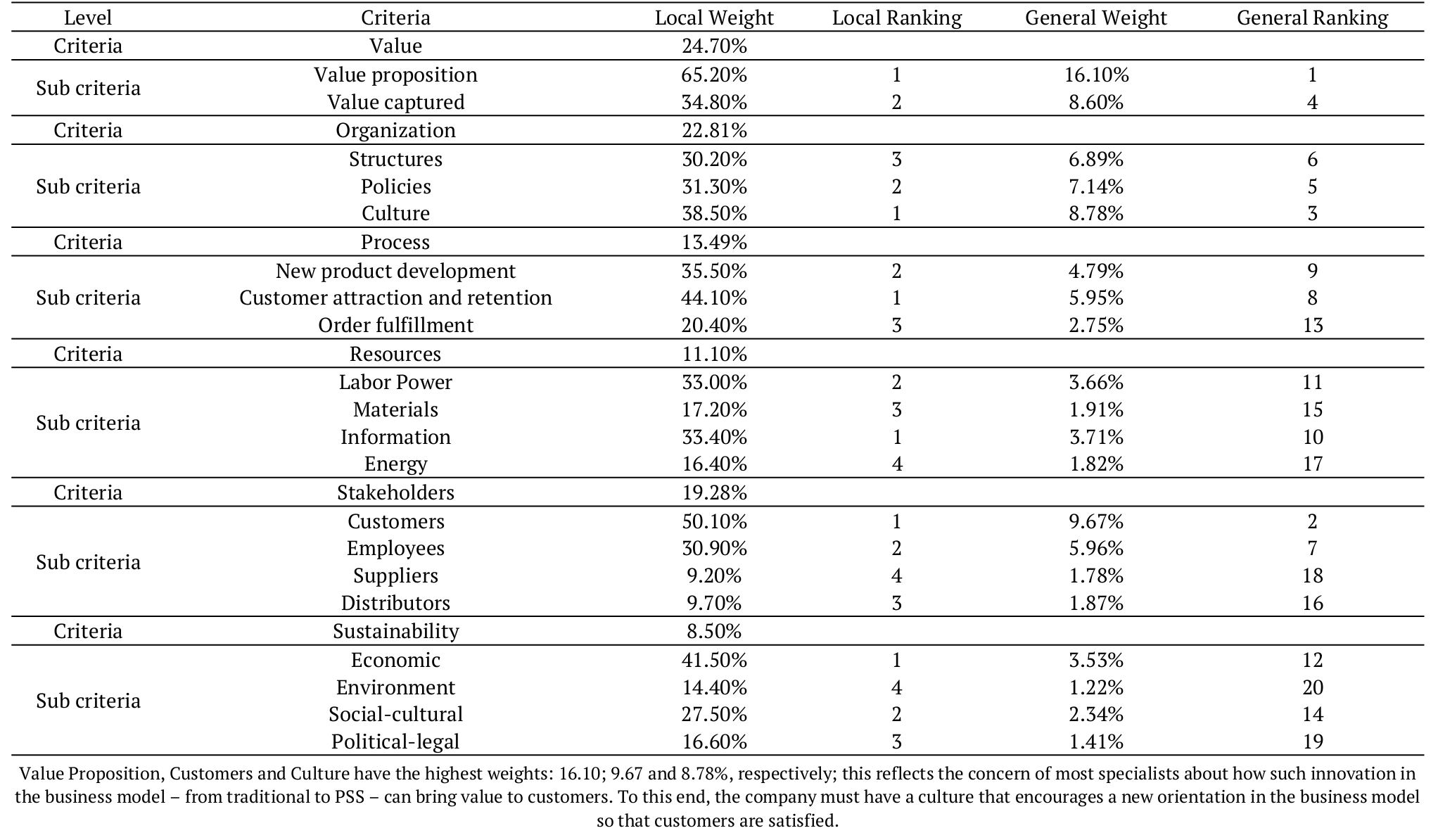
Finally, there are a mix of internal and external aspects in the last ranking groups, namely: Labor Power (3.66%); Economic (3.53%); Order Fulfillment (2.75%); Social-cultural (2.34%); Materials (1.91%); Distributors (1.87%); Energy (1.82%); Suppliers (1.78%); Political-legal (1.41%) and Environment (1.22%). Our attention is drawn to the criterion Environment that appears with the lowest weight. Although the literature indicates this aspect as an important issue in PSS business models, for the specialists it is not so relevant. They argue that environment is an aspect that represents more of a fashion opportunity than a necessity on its own. It means that, if there is a sturdy legal requirement that pushes companies to create alternatives or solutions to environment degradation, then the company will think about how to do that. Otherwise, the factor decision for changing will always be the market appeal. In addition, Environment, Economic Social-cultural and Political–legal are external aspects that influence the business, but they will not be part of the business model construction.
Based on the AHP results, therefore, it concludes that the main elements to guide a traditional business model through a product-service one in the aerospace sector are: Value Proposition (VP); Customers (CUS); Culture (CUL); Value Captured (VC); Policies (POL); Structures (STR); Employees (EMP); Customer Attraction and Retention (CAR); New Product Development (NPD) and Information (INF). Figure 2 shows the result in a framework considering the top ten elements identified by the specialists and the interference with the external factors in the business model.
Value and customers are part of this framework as well as of the others in the literature researched (Osterwalder & Pigneur, 2010; Barquet et al., 2013). The sense of value is to satisfy customers’ needs and then transform it in results, reflecting in revenue generation for the firm.
The elements that differentiate from the literature consider the following aspects:
- The main concern of the specialists is whether the company is well prepared for a change in the business model. That is why the aspects of culture, policies, structures and employees were emphasized by them, drawing attention to the fact that they must be mature enough for the new business model orientation.
- In terms of the environment sustainability, researches have showing the relation between the correct product usage through services and environmental impact (Yoon et al., 2012; Reim et al., 2015; Rivas-Hermann et al., 2015). For the present study, however, this element was not prioritized by the specialists to be part of the framework.
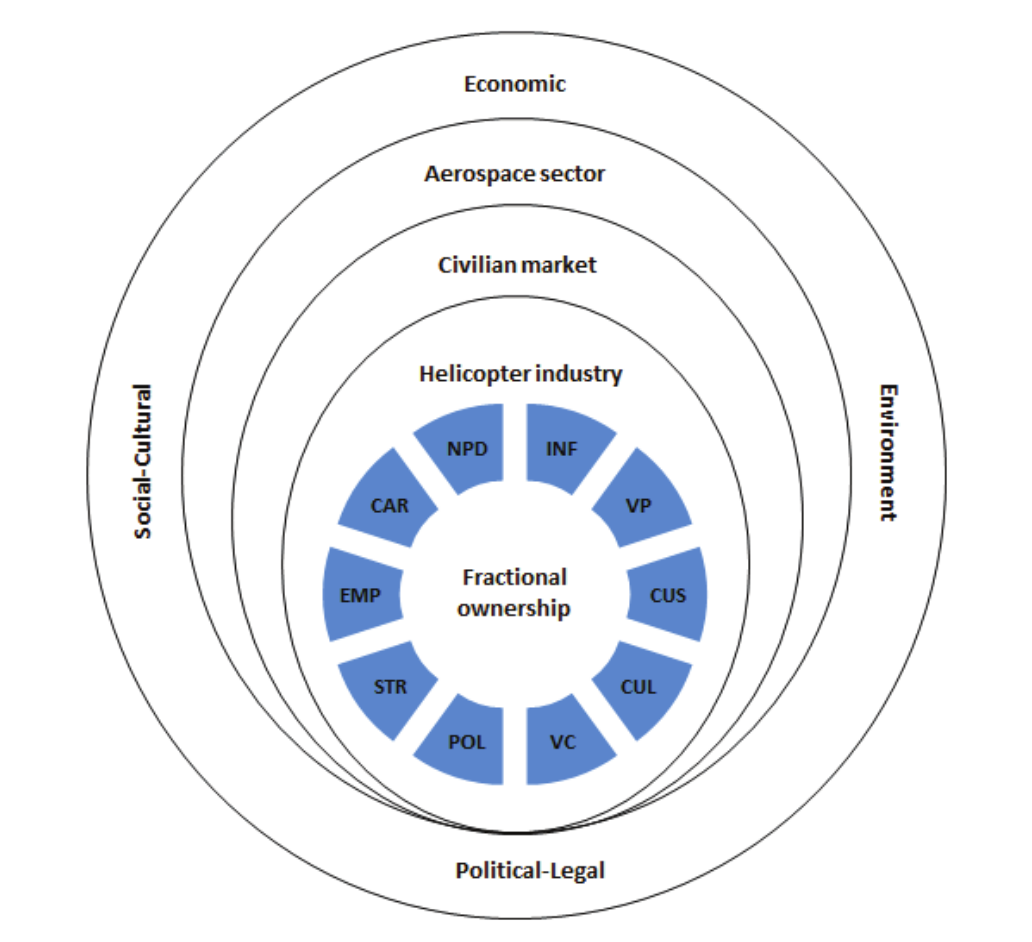
Figure 2.
Framework of elements for the fractional ownership business model.
- Other external factors such as political-legal and social-cultural have been qualified as elements for some frameworks in the literature as well. Legal and regulatory aspects can influence significantly the new business model construction, depending on the type and context of the business model. Considering the fractional ownership, the aeronautical regulation defines the rules and responsibilities of the manufacturer in the new business proposed. Besides, the social-cultural orientation of new customers interested in an economy of sharing can indicate the success or failure of the new business model.
- Although the external elements were not considered for the set of elements prioritized in the initial position, the specialists understand that they should be part of the framework indirectly, considering that they influence customer desires and the company´s actions for changing the business model.
- Finally, the elements identified in this research shed light on the aspects considered more relevant by the specialists chosen for this study. Although they are aware of the other business model frameworks existing in the literature, especially the Canvas, the elements prioritized by them must be taken in account in a business model innovation during the implementation phase of the new business model in the aerospace industry, mainly the fractional ownership.
Conclusion
This study represents a contribution to PSS and business model literature through the AHP method aiming to construct a business model framework for the aerospace sector. For managerial contribution, the study guides companies in the decision-making process to innovate their business model. Based on a set of elements in the literature, they were prioritized to conduct the transition from a traditional business model to a PPS business model in a helicopter manufacturing company, the fractional ownership. For future researches, additional cases can be analyzed and other MCDMs can be applied for a comparative analysis of the results.
References
Akash, B., Mamlook, R., & Mohsen, M. S. (1999). Multi-criteria selection of electric power plants using analytical hierarchy process. Electric Power Systems Research, 52(1), 29-35. doi: 10.1016/S0378-7796(99)00004-8
Alonso-Rasgado, T., Thompson, G., & Elfström, B. O. (2004). The design of functional (total care) products. Journal of Engineering Design, 15(6), 515-540. doi: 10.1080/09544820412331271176
Amiri, M. P. (2010). Project selection for oil-fields development by using the AHP and fuzzy TOPSIS methods. Expert Systems with Applications, 37(9), 6218-6224. doi: 10.1016/j.eswa.2010.02.103
Applegate, L. M. (2001). Emerging networked business models: lessons from the field. Cambridge, MA: Harvard Business School Case Services.
Aurich, J., Fuchs, C., & Wagenknecht, C. (2006). Life cycle oriented design of technical Product- Service Systems. Journal of Cleaner Production, 14(17), 1480-1494. doi: 10.1016/j.jclepro.2006.01.019
Barquet, A. P. B., Oliveira, M. G., Amigo, C., & Rozenfeld, H. (2013). Employing the business model concept to support the adoption of product–service systems (PSS). Industrial Marketing Management, 42(5), 693-704. doi: 10.1016/j.indmarman.2013.05.003
Barros, C. P., & Wanke, P. (2015). An analysis of African airlines efficiency with two-stage TOPSIS and neural networks. Journal of Air Transport Management, 44-45, 90-102. doi: 10.1016/j.jairtraman.2015.03.002
Bertolini, G. R. F., Rojo, C. A., & Lezana, A. G. R. (2012). Modelo de análise de investimentos para fabricação de produtos ecologicamente corretos. Gestão da Produção, 19(3), 575-588. doi: 10.1590/S0104-530X2012000300010
Boons, F., Montalvo, C., Quist, J., & Wagner, M. (2013). Sustainable innovation, business models and economic performance: an overview. Journal of Cleaner Production, 45, 1-8. doi: 10.1016/j.jclepro.2012.08.013
Bowman, C., & Ambrosini, V. (2000). Value creation versus value capture: towards a coherent definition of value in strategy. British Journal of Management, 11(1), 1-15. doi: 10.1111/1467-8551.00147
Castelli, L., & Pellegrini, P. (2011). An AHP analysis of air traffic management with target windows. Journal of Air Transport Management, 17(2), 68-73. doi: 10.1016/j.jairtraman.2010.05.006
Cook, M. (2014). Fluid transitions to more sustainable product service systems. Environmental Innovation and Societal Transitions, 12 1-13. doi: 10.1016/j.eist.2014.04.003
Chesbrough, H. (2010). Business model innovation: opportunities and barriers. Long Range Planning, 43(2-3), 354-363. doi: 10.1016/j.lrp.2009.07.010
Chesbrough, H. (2011). Open Services Innovation: rethinking your business to grow and compete in a new era. San Francisco, CA: Jossey-Bass.
Chiu, M. C., Kuo, M. Y., & Kuo, T. C. (2015). A Systematic methodology to develop business model of a product service system. International Journal of Industrial Engineering, 22(3), 369-381.
Correnti, V., Capri, S., Ignaccolo, M., & Inturri, G. (2007). The potential of rotorcraft for intercity passenger transport. Journal of Air Transport Management, 13(2), 53-60. doi: 10.1016/j.jairtraman.2006.11.009
Croxton, K. L. (2002). The order fulfillment process. The International Journal of Logistics Management, 14(1), 19-32. doi: 10.1108/09574090310806512
Daoust, D. (2006). European agency studies fractional-ownership rules, AINonline, Business Aviation. Retrieved from http://www.ainonline.com/aviation-news/aviation-international-news/2006-10-11/european-agency-studies-fractional-ownership-rules
Dubosson-Torbay, M., Osterwalder, A., & Pigneur, Y. (2001). E-business model design, classification, and measurements. Thunderbird International Business Review, 44(1), 5-23. doi: 10.1002/tie.1036
Electronic Code of Federal Regulations [E-CRF]. (2016). Title 14: aeronautics and space, chapter I, subchapter F, part 91 - general operating and flight rules, subpart k - fractional ownership operations. Retrieved from https://www.ecfr.gov/cgi-bin/ECFR?page=browse
Federal Aviation Administration [FAA]. (2009). Advisory circular no. 91-84, fractional ownership programs. Retrieved from https://www.faa.gov/regulations_policies/advisory_circulars/
Fielt, E. (2011). Business service management: understanding business models. Smart Services CRC, 3, 1-50.
Forman, E., & Peniwati, K. (1998). Aggregating individual judgments and priorities with the analytic hierarchy process. European Journal of Operational Research, 108(1), 165-169. doi: 10.1016/S0377-2217(97)00244-0
Gaiardelli, P., Resta, B., Martinez, V., & Albores, P. (2014). Classification model for product-service offerings. Journal of Cleaner Production, 66, 507-519. doi: 10.1016/j.jclepro.2013.11.032
General Aviation Manufacturers Association [GAMA]. (2015). General aviation statistical databook & 2016 industry outlook. Retrieved from https://gama.aero/facts-and-statistics/statistical-databook-and-industry-outlook/
Goedkoop, M. J., Van Halen, C. J. G., Te Riele, H. R. M., & Rommens, P. J. M. (1999). Product service systems: Ecological and economic basics. The Netherlands, NL: Product Innovation Technology Management.
Goodwin, P., & Wright, G. (2004). Decision analysis for management judgment. Chichester, GB: Wiley.
International Civil Aviation Organization [ICAO]. (2004). Assembly 35th session, harmonizing states’ regulations for international fractional ownership operations, presented by the international business aviation council. Retrieved from http://www.icao.int/Meetings/AMC/MA/Forms/AllItems.aspx
Jacob, F., & Ulaga, W. (2008). The transition from product to service in business markets: an agenda for academic inquiry. Industrial Marketing Management, 37(3), 247-253. doi: 10.1016/j.indmarman.2007.09.009
Jia, L., Tong, Z., Wang, C., & Li, S. (2016). Aircraft combat survivability calculation based on combination weighting and multiattribute intelligent grey target decision model. Mathematical Problems in Engineering, 2016, 1-9. doi: 10.1155/2016/8934749
Joshi, R., Banwet, D. K., & Shankar, R. (2011). A Delphi-AHP-TOPSIS based benchmarking framework for performance improvement of a cold chain. Expert Systems with Applications, 38(8), 10170-10182. doi: 10.1016/j.eswa.2011.02.072
Jung, J.-Y., Lee, J. S., Jung, J.-H., Kim, S.-K., & Shin, D. (2012). A methodology for performance measurement in manufacturing collaboration. International Journal of Industrial Engineering, 19(3), 149-160.
Kindström, D., & Kowalkowski, C. (2014). Service innovation in product-centric firms: a multidimensional business model perspective. Journal of Business & Industrial Marketing, 29(2), 96-111. doi: 10.1108/JBIM-08-2013-0165
Kotler, P. (2003). Marketing management (11th ed.). New Jersey, NJ: Prentice Hall.
Lupo, T. (2015). Fuzzy ServPerf model combined with ELECTRE III to comparatively evaluate service quality of international airports in Sicily. Journal of Air Transport Management, 42, 249-259. doi: 10.1016/j.jairtraman.2014.11.006
Lyu, J. J., & Chang, C.-H. (2013). Exploring business models for application service providers with resource based review. International Journal of Industrial Engineering, 20(11-12), 602-613.
Marx, K. (1867). Capital volume one, chapter six: the buying and selling of labor-power. Retrieved from https://www.marxists.org/archive/marx/works/1867-c1/ch06.htm
Meier, H., Roy, R., & Seliger, G. (2010). Industrial Product-Service Systems – IPS. CIRP Annals, 59(2), 607-627. doi: 10.1016/j.cirp.2010.05.004
Mont, O. (2002). Clarifying the concept of product-service system. Journal of Cleaner Production, 10(3), 237-245. doi: 10.1016/S0959-6526(01)00039-7
Morris, M., Schindehutte, M., & Allen, J. (2005). The entrepreneur's business model: Toward a unified perspective. Journal of Business Research, 58(6), 726-735. doi: 10.1016/j.jbusres.2003.11.001
Organization for Economic Co-operation and Development [OECD]. (2000). The service economy, business and industry policy forum series. Paris, FR: OECD.
Osterwalder, A., & Pigneur, Y. (2010). Business model generation: a handbook for visionaries, game changers, and challengers (2nd ed.). Toronto, CA: Wiley.
Reim, W., Parida, V., & Ortqvist, D. (2015). Product-Service Systems (PSS) business models and tactics a systematic literature review. Journal of Cleaner Production, 97, 61-75. doi: 10.1016/j.jclepro.2014.07.003
Rezaei, J. (2016). Best-worst multi-criteria decision-making method: Some properties and a linear model. Omega, 64, 126-130. doi: 10.1016/j.omega.2015.12.001
Rezaei, J., Hemmes, A. F., & Tavassy, L. (2017). Multi-criteria decision-making for complex bundling configurations in surface transportation of air freight. Journal of Air Transport Management, 61, 95-105. doi: 10.1016/j.jairtraman.2016.02.006
Rivas-Hermann, R., Köhler, J., & Scheepens, A. E. (2015). Innovation in product and services in the shipping retrofit industry: a case study of ballast water treatment systems. Journal of Cleaner Production, 106, 443-454. doi: 10.1016/j.jclepro.2014.06.062
Roos, G., & O’Connor, A. (2015). Government policy implications of intellectual capital: an Australian manufacturing case study. Journal of Intellectual Capital, 16(2), 364-389. doi: 10.1108/JIC-02-2015-0016
Saaty, T. L. (1980). The analytic hierarchy process. New York, NY: McGraw-Hill.
Salgado, E. G., Mello, C. H. P., & Salomon, V. (2012). Analytic hierarchy prioritization of new product development activities for electronics manufacturing. International Journal of Production Research, 50(17), 4860-4866. doi: 10.1080/00207543.2012.657972
Teece, D. J. (2010). Business models, business strategy and innovation. Long Range Planning, 43(2-3), 172-194. doi: 10.1016/j.lrp.2009.07.003
Triantaphyllou, E., Shu, B., Sanchez, S. N., & Ray, T. (1998). Multi-criteria decision making: an operations research approach. Encyclopedia of Electrical and Electronics Engineering, 15, 175-186.
Tukker, A. (2004). Eight types of product-service system: eight ways to sustainability? In: Experiences from SusProNet. Business Strategy and the Environment, 13(4), 246-260. doi: 10.1002/bse.414
Vandermerwe, S., & Rada, J. (1988). Servitization of business: adding value by adding services. European Management Journal, 6(4), 314-324. doi: 10.1016/0263-2373(88)90033-3
Worrells, D. S., Newmyer, D. A., & Ruiz, J. R. (2001). The evolution of fractional ownership: a literature review. Journal of Aviation/Aerospace Education & Research, 10(2), 41-59. doi: 10.15394/jaaer.2001.1277
Yang, J. L., & Tzeng, G. H. (2011). An integrated MCDM technique combined with DEMATEL for a novel cluster-weighted with ANP method. Expert Systems with Applications, 38(3), 1417-1424. doi: 10.1016/j.eswa.2010.07.048
Yoon, B., Kim, S., & Rhee, J. (2012). An evaluation method for designing a new product-service system. Expert Systems with Applications, 39(3), 3100-3108. doi: 10.1016/j.eswa.2011.08.173
Zietsman, D., & Vanderschuren, M. (2014). Analytic hierarchy process assessment for potential multi-airport systems – the case of Cape Town. Journal of Air Transport Management, 36, 41-49. doi: 10.1016/j.jairtraman.2013.12.004
Author notes
mafersalomon@gmail.com