Química
Blueberry Jam: correlation of rheological parameters and water activity with sensorial attributes
Blueberry Jam: correlation of rheological parameters and water activity with sensorial attributes
Acta Scientiarum. Technology, vol. 41, 2019
Universidade Estadual de Maringá
Received: 26 June 2017
Accepted: 25 October 2018
Abstract: The present research studied gelling agent and fruit variety effects on the correlation between the rheological properties and water activity with sensorial parameters of blueberry jam. Sensorial tests were performed and sensorial attributes evaluated were flavor, color, texture and appearance. Rheological parameters were evaluated using texturometer (Texture Analyser, TA- TX2) with 1.0 cm2 probe, and water activity using water activity meter equipment (Texto 65-PC). Regarding to sensory analysis, the results showed that there was greater preference in conventional jam with ‘Climax’ fruit variety, for all attributes. The Pearson correlation values showed that water activity had positive correlation with color, except for ‘light’ product elaborated with ‘Climax’ variety; texture, flavor and appearance had negative correlation with water activity for ‘light’ samples. About the correlation between the sensory attributes and rheological parameters, the negative value of the Pearson correlation indicate that the texture measures were not correlated with texture sensory attribute, for all samples.
Keywords: berries, gels, sensory analysis, physico-chemical properties, texture, interdependence.
Introduction
Blueberry is one of the most popular and nutritious fruits containing main dietary nutrients and bioactive components that are beneficial to human health (Castagnini, Zapata, Quinteros, & Noceti, 2017). Most of the advantages associated with the dietary intake of blueberry and its derivatives include a disease-free and healthy life (Zou & Hou, 2017).
The United States is the world´s largest producer of blueberries, harvesting 84 percent of global production. The first group introduced in Brazil was formed by the Rabbiteye species (Silveira, Raseira, Nava, & Couto, 2011). According to Reque et al. (2014), Brazilian blueberry has reached great value in foreign markets, proving to be a good horticultural alternative.
On the other hand, its high perishability, even under refrigeration, is one of the major problems in the blueberry trade. In this context, the industrialization of the fruit emerges as an attempt to reduce waste, enabling consumers to continue enjoying its functional benefits for longer periods of time (Goldmeyer, Penna, Melo, & Rosa, 2014). The development of jellies are one of the most widely used processes to this end, because it follows a simple methodology, requires little equipment, and results in a product of great acceptability (Guilherme et al., 2012; Schafaschek, Hickel, Pereira, Oliveira, & Toledo, 2016; Curi et al., 2017).
Jellies are made by cooking crushed or chopped fruits with sugar until the mixture reaches 65º Brix (Lago, Santos, Lima, Gomes, & Silva, 2011). Besides sugar, acid and pectin are also required to obtain jams and an appropriate combination of these components must be respected in order to achieve a higher quality of the final product (Chen et al., 2015).
Jelly texture is an essential quality attribute. By definition, the consistency of a jelly must be such that when extracted from its container, it is capable of maintaining the semi-solid state. In addition, color, aroma and flavor are important attributes for the acceptance of the product (Abu-Gahannan & Crowley, 2006).
The proposal of this study includes the formulation of four Blueberry jams from the fruit of the ‘Climax’ and ‘Powder Blue’ varieties. Conventional and ‘light’ jellies were developed and high methoxyl pectin (HM) and low methoxyl (LM) pectin was used for gelling. The products were analyzed according to their water activity and texture properties (hardness and tack adhesive force). Subsequently, the correlation of these properties with the sensory attributes was analyzed.
Material and methods
Material
Fruits from the southeastern regions of Brazil (‘Climax’, and ‘Powder Blue’ varieties) were used for the processing into jellies. The received fruits were selected (fruits with damaged peels were discarded and the maturation stage was tested using a texture measuring equipment (Texture Analyser, TA- TX2 with 1.0 cm2 probe), washed and then sanitized in chlorinated water (25 ppm). The fruits were pulped by a pulp machine (Macanuda, DMCI model) to prepare the pulp.
Jelly preparation
The conventional jellies were processed according to Santos et al. (2012), with modifications: these authors processed the jelly by adding 0.2% pectin to the pulp, previously screened in a polyethylene mesh screen (16 mesh). In this work, the pulp/sugar proportion of 3/2 was used; high methoxylation pectin at 1.0% of the amount of pulp was used. Cooking was done in a stainless steel jacketed cooker (Kromodinâmica), adding pulp until up to 30% of the sucrose amount and heading until the mixture reached 35° Brix (measured in a refractometer). Once this consistency was achieved, the remaining sugar with hydrated pectin (in 0.15 kg of water for each 0.008 kg of pectin) was added and the mixture was kept under heating till it reached 67° Brix.
The ‘light’ formulations were prepared according to Lago et al. (2011), where the sucrose amount was 50% of the amount in conventional jellies; low methoxylation pectin was added at 1.5% of the amount of pulp, being all added at once and processed in a stainless steel jacketed cooker (Kromodinâmica) until the product reached a total solids content corresponding to 37° Brix. At this stage, CaCl2 was added (55 mg per gram of pectin). A xantana and carrageenan mix (1: 1 w w-1) was used at a proportion of 2% of the sucrose weight. Gums were used to increase the ‘light’ jam’s consistency and coloration.
Once processed, the jellies were hot-packaged in 250 g glass jars, closed with a metal lid (previously sanitized at 100ºC for 20 min.), inverted for 15 min. and then cooled by immersion in a stream of water and stored at room temperature.
Analytical method
The fruit samples and jellies were evaluated regarding the following parameters: pH (Adolfo Lutz 1985, Institute, method N. 4.7.1); acidity (Adolfo Lutz Institute, 1985, N.4.7.2); total soluble solids (Adolfo Lutz Institute, 1985, 315/IV); humidity (Adolfo Lutz Institute, 1985, 309/IV); water activity, using a water activity meter (Texto 65-PC) and texture, using texture measuring equipment (Texture Analyser, TA- TX2) with a 1.0 cm2 probe. Hardness (which has an inverse relation with spreadability), adhesive strength and adhesiveness were selected among the texture properties.
Sensorial analysis
The products were also evaluated by a group of 50 untrained judges in a sensorial acceptance test with a nine-point hedonic scale and purchase intent; the test was performed in an individual booth and the samples were served in codified (with three numerals) white glass. The sensorial attributes evaluated were: flavor, color, texture and appearance. The results were submitted to Anova and the Tukey Test with a significance level of 5%. The Research Ethics Committee approved this present study (registration no. 0455/07), and each taster received a consent form to sign.
Results and discussion
The average yield of each formulation can be seen in Table 1.
Table 1 reveals that the ‘light’ formulations (FB and FD) have a higher yield due to less water evaporation during processing.
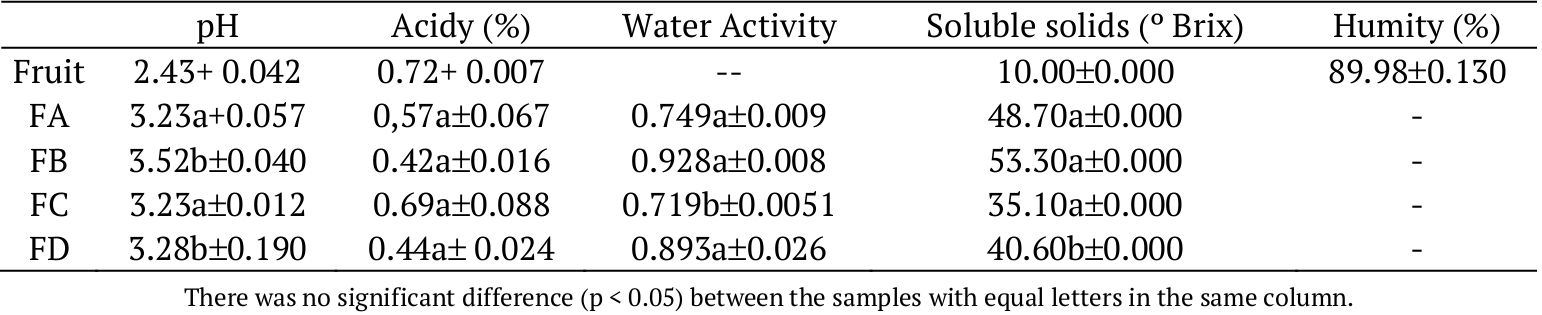
The physicochemical analyses of the products were done in triplicate, and the results shown in Table 2 correspond to the means of three repetitions with the respective standard deviations. In this table, the means with the same letter in the same column indicate that the values do not differ significantly ( = 5%).
The results presented in Table 2 corroborate Ferreira, Rosso, and Mercadante (2010), Koponen, Happonen, Matilla, and Torronen (2007), Rodrigues, Rockenback, Gonzaga, Mendes, and Fett (2011), Pinto, Moreira, Cardoso, and Pantola (2011), Lago et al. (2011) and Damiani et al. (2012). The shortest processing time for the ‘light’ jellies had a water activity between 21.5 (FB) and 22.96% (FD) in excess, comparing with standard jelly (FA and FC). The lower percentage of sugar in the light products provides greater amount of free water in this jelly.
The sensory analysis results are shown in Tables 3, where MDS is the medium difference standard. The rheological parameters are shown in Table 4.
According to the results in Table 3, there was a greater preference in FC for all attributes. The table also shows that FA and FC presented no significant difference between color and flavor. On the other hand, the ‘light’ products (FB and FD) differed from the other formulations, with lower scores for all attributes.



According to the results of Table 4, a great difference in the rheological properties of ‘light’ and conventional jellies prepared from the fruits of the variety ‘Powder Blue’ (FA and FB) can be observed, since the hardness of the product was virtually halved. One possible explanation for this, according to Christensen (1986), is that high methoxylation pectins require at least 50% of soluble solids and a pH around 3.2 for gelling; in this case, the gel formation occurs by hydrogen bonding, required for both sugar and acid. According to Thrimawithana, Young, Dunstan, and Alany (2010), the gel strength is related to the molecular weight of pectin, increasing as its molecular weight increases.
With respect to the hardness of the conventional and ‘light’ formulations prepared from the ‘Climax’ (FC and FD) variety, it was observed that the change in value of both formulations was lower. A possible cause for this is that the molecules may have been partially broken during processing with a consequent decrease in the molecular weight as well as higher demethoxylation of esterified groups (Bobbio & Bobbio, 2003).
Regarding the ‘light’ jellies (FB and FD), the hardness values were consistent with the results obtained by Nachtigall, Souza, Malgarim, and Zambiazi (2004) and Lago et al. (2011), also showing no apparent influence of the fruit variety on the fluidity of jellies.
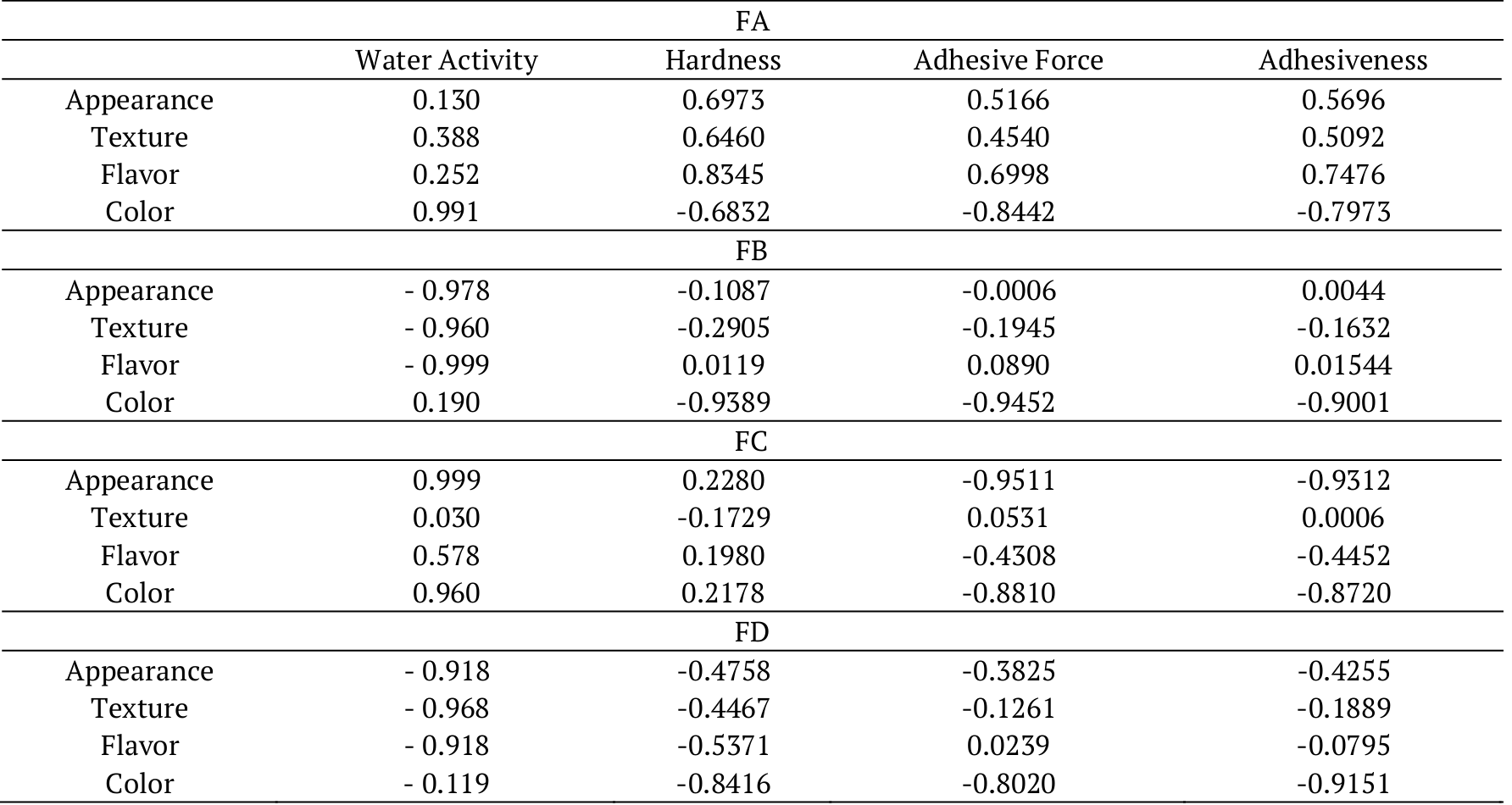
Table 5 shows the Pearson correlation values between the sensory analysis data and the rheology and water activity analysis. The correlation coefficient of a couple variables is necessarily restricted to the range [-1, +1]. Statistically independent variables have a correlation coefficient equal to zero. Variables connected by a perfectly linear relationship have a correlation coefficient equal to +1 when this relationship is positive, or equal to – 1 when this relationship is negative (Barros, Scarminio, & Bruns, 2007). In this present work, the samples were considered to have a correlation if the correlation coefficients were ≥ 0, 75 (in module).
Table 5 shows that the water activity had a positive correlation with the color attribute in FB and FC. Still regarding the water activity, FA showed a negative correlation with appearance and taste (respectively -0.978 and -0.999) and FC showed a positive correlation with the overall impression (0.999). For the ‘light’ samples (except color in FB), all the sensory attributes were negatively correlated with water activity. This is because the free water can participate both in chemical and enzymatic reactions, leading to sensory changes in the product, such as degradation of the polysaccharides present (pectins and gums) that lead to decreased firmness of the gel.
The sensory texture attribute was not correlated with the texture measurements in the texture measuring equipment. Moreover, there was a negative correlation between the attribute color and the hardness, adhesive strength and adhesion measurements in the ‘light’ samples (FB and FD).
Conclusion
The previous results allow for the following conclusions:
The degree of methoxylation of pectin strongly influenced the rheological parameters, reflecting the lower acceptance of the texture attribute among consumers;
Conventional jams presented no significant difference between color and flavor and had better acceptance;
The ‘light’ products differed from other formulations, with lower scores;
Water activity had a positive correlation with color for the ‘light’ and conventional products prepared with the Climax variety;
Texture, flavor and appearance had a negative correlation with water activity for the ‘light’ samples;
Texture measurements were not correlated with the sensory texture attribute for all samples.
Acknowledgements
The authors would like to thank Fapesp - Brazil (Process number 2007/59114-4) and the University of Taubaté (São Paulo State, Brazil).
References
Abu-Gahannan, N., & Crowley, H. (2006). The effect of low temperature blanching on the texture of whole processed potatoes. Journal of Food Engineering, 74(3), 335-344. doi: 10.21427/D7T44J
Barros, B. N., Scarminio, I. S., & Bruns, R. E. (2007). Como fazer experimentos: pesquisa e desenvolvimento na ciência e na indústria. Campinas, SP: Unicamp.
Bobbio, F. O., & Bobbio, P. A. (2003). Manual de laboratório de química de alimentos. São Paulo, SP: Varela.
Castagnini, J. M., Zapata, L. M., Quinteros, C. F., & Noceti, A. (2017). Multiple response optimization of blueberry juice depectinization. Ciência Rural, 47(4), e20160501. doi: 10.1590/0103-8478cr20160501
Chen, J., Liu, W., Liu, C. M., Li, T., Liang, R., & Luo, S. (2015). Pectin modifications: a review. Critical. Reviews in Food Science and Nutrition, 55(12), 1684-1698. doi: 10.1080/10408398.2012.718722
Christensen, S. H. (1986). Pectins. In M. Glicksman (Ed.), Food hydrocolloids III (p. 205-230). Boca Raton, FL: CRC Press.
Curi, P. N., Carvalho, C. S., Salgado, D. L., Pio, R., Silva, D. F., Pinheiro, A. C. M., & Souza, V. R. (2017). Characterization of different native american physalis species and evaluation of their processing potential as jelly in combination with brie-type cheese. Food Science and Technology, 38(1), p. 112-119. doi: 10.1590/1678-457X.01317
Damiani, C., Asquieri, M. E. R., Lage, M. E., Oliveira, R. A., Silva, F. A., Pereira, D. E. P., & Boas, E. V. B. V. (2012). Study of the shelf-life of a mixed araça (Psidium guineensis Sw.) and marolo (Annona crassiflora Mart.) jam. Ciência e Tecnologia de Alimentos, 32(2), 334-343. doi:10.1590/S0101-20612012005000050
Ferreira, D. S., Rosso, V. V., & Mercadante, A. Z. (2010). Compostos bioativos presentes em amora-preta (Rubus spp.). Revista Brasileira de Fruticultura, 32(3), 664-674. doi: 10.1590/S0100-29452010005000110
Goldmeyer, B., Penna, N. G., Melo, A., & Rosa, C. S. R. (2014). Características físico-químicas e propriedades funcionais tecnológicas do bagaço de mirtilo fermentado e suas farinhas. Revista Brasileira de Fruticultura, 36(4), 980-987. doi: 10.1590/0100-2945-380/13
Guilherme, P. R., Zaika, W. R., Quast, E., Battestin, L., Salvucci, R. C., Ormenese, C., & Raupp, D. S. (2012). Desenvolvimento de geleia de tamarillo contendo polpa integral. Brazilian Journal of Food Technology, 15(2), 141-149. doi: 10.1590/S1981-67232012005000007
Instituto Adolfo Lutz [IAL]. (1985). Normas analíticas do Instituto Adolfo Lutz. São Paulo, SP: Débora Rebocho.
Koponen, J. M., Happonen, A. M., Matilla, P. H., & Torronen, A. R. (2007). Contents of anthocyanins and ellagitannins in selected foods consumed in Finland. Journal of Agriculture and Food Chemistry, 55(4), 1612-1619. doi: 10.1021/jf062897a
Lago, E. S., Santos, G. V., Lima, F. A., Gomes, E., & Silva, R. (2011). Physical-chemical, caloric and sensory characterization of light jambolan (Syzygium cumini Lamarck) jelly. Food Science and Technology, 31(3), 666-673. doi: 10.1590/S0101-20612011000300018
Nachtigall, A. M., Souza, E. L., Malgarim, M. B., & Zambiazi, R. C. (2004). Geleias light de amora preta. Boletim do Centro de Pesquisa de Processamento de Alimentos, 22(2), 337-354. doi: 10.5380/cep.v22i2.1199
Pinto, N. A. V., Moreira, W. A., Cardoso, L. M., & Pantola, L. A. (2011). Jaboticaba peel for jelly preparation: an alternative technology. Food Science and Technology, 31(4), 864-869. doi:10.1590/S0101-20612011000400006
Reque, P. M., Steffens, R. S., Jablonski, A., Flôres, S. H., Rios, A. O., & Jong, E. V. (2014). Cold storage of blueberry (Vaccinium spp.) fruits and juice: anthocyanin stability and antioxidant activity. Journal of Food Composition and Analysis, 33(1), 111-116. doi: 10.1016/j.jfca.2013.11.007
Rodrigues, E., Rockenback, I. I., Gonzaga, L. V., Mendes, C. R., & Fett, R. (2011). Phenolic compounds and antioxidant activity of blueberry cultivars grown in Brazil. Food Sceince and Technology, 31(4), 911-917. doi: 10.1590/S0101-20612011000400013
Santos, P. R. G., Cardoso, L. M., Bedetti, S. F., Hamacek, F. R., Moreira, A. V. B., Martino, H. S. D., & Pinheirosant’Ana, H. M. (2012). Geleia de cagaita (Eugenia dysenterica DC.): desenvolvimento, caracterização microbiológica, sensorial, química e estudo da estabilidade. Revista do Instituto Adolfo Lutz, 71(2), 281-290.
Schafaschek, T. P., Hickel, E. R., Pereira, H. L., Oliveira, C. A. L., & Toledo, V. A. A. (2016). Performance of Africanized honeybee colonies settled by queens selected for different traits. Acta Scientarum Animal Science, 38(1), 91-100. doi: 10.4025/actascianimsci.v38i1.26840
Silveira, T. M. T., Raseira, M. C. B., Nava, D. E., & Couto, M. (2011). Blueberry pollination in southern Brazil and their influence on fruit quality. Revista Brasileira de Fruticultura, 33(1), 81-88. doi: 10.1590/S0100-29452011005000041
Thrimawithana, T. R., Young, S., Dunstan, D. E., & Alany, R. G. (2010). Texture and rheological characterization of kappa and iota carrageenan in the presence of counter ions. Carbohydrate Polymers, 82(1), 69-77. doi: 10.1016/j.carbpol.2010.04.024
Zou, Y., & Hou, X. (2017). Sonication enhances quality and antioxidant activity of blueberry juice. Food Science and Technology, 37(4), p. 599-603. doi: 10.1590/1678-457x.27816
Author notes
dhguima@usp.br