Biotecnologia
Comparative effect of temperature on the performance of Typha domingensis pers. and Pontederia parviflora Alexander in phytotreatment
Comparative effect of temperature on the performance of Typha domingensis pers. and Pontederia parviflora Alexander in phytotreatment
Acta Scientiarum. Technology, vol. 41, 2019
Universidade Estadual de Maringá
Received: 10 August 2017
Accepted: 24 December 2017
Abstract: The study evaluated the performance of the species Typha domingensis Pers and Pontederia parviflora Alexander in wastewater treatment at the pilot scale. Six units of each species were built. Analyses were performed in March, June, July and November in batch system with sampling every 12 hours and a hydraulic retention time of 48 hours. Tests for performance between species and for influence of temperature were performed by analysis of variance, factorial ANOVA and principal component analysis (PCA). The evaluation of treatment performance was from physical and chemical parameters (temperature, potential of hydrogen, alkalinity, suspended solids, chemical oxygen demand) in the influent and effluent systems. The results indicated no significant difference in the performance of the species but emphasized the interference of temperature on nutrient removal capacity of both systems. The best removal efficiencies were found for volatile suspended solids (83-94 and 80-97%) and COD (38-70 and 39-74%) for T. domingensis and P. parviflora respectively, in periods of low and high temperatures.
Keywords: constructed wetlands, aquatic macrophytes, removal efficiency.
Introduction
The trend towards increasing pollution loads from human activities coupled with the lack of adequate basic sanitation conditions leads to several environmental and public health problems, such as the contamination of water sources and the proliferation of waterborne diseases. The amount and concentration of the waste products varies widely depending on the manufacturing processes used and the methods of effluent control (Gallego, Hospido, Moreira, & Feijoo, 2008).
Through biotechnology, phytoremediation emerges as a promising alternative capable of solving environmental problems at reduced implementation and operation costs, with greater ease of application and less impact on the environment (Deval, Mane, Joshi, & Saratale, 2012). Phytotreatment stations with rooted plants constitute an important dimension among natural treatments and cannot be defined as waste treatment processes that use only gravitational force, since they are constituted by microorganisms, plants and animals (Olguín & Sánchez-Galván, 2010).
In Brazil, the first reports of the use of wetlands built for these purposes date back to the early 1980s (Salati Jr., Salati, & Salati, 1999). The aquatic macrophytes used in these studies vary from floating to emergent species presenting great potential for decontamination and improvement of water quality (Jabeen, Ahmad, & Iqbal, 2009). Preferably the plants used should have well-developed aerenchyma in the stem and adventitious roots and, preferably, should be native to the region (Naime & Garcia, 2005).
The system, as featured by low cost of investment, simple operation and maintenance, stable decontamination effect and a certain ornamental value, etc., has attracted many scholars to conduct researches, and it’s used to treat sewages of different types (Vymazal, 2009). Santos, Augusto, and Camargo (2015), used artificial wetlands system to treat sewages of aquaculture, Xian, Hu, and Chen (2010) used floating beds system of aquatic plants to dispose sewages from pig breeding system, Ramos, Borges, Gonçalves, and Matos (2017) treat sewages of pig with emergent aquatic macrophytes, in treatment of septic tank sludge. Some studies testing the flow as Jong and Tang (2014), vertical flow Calderón-Vallejo, Andrade, Manjate, Madera-Parra, and Von Sperling (2015), Andrade, Sperling, and Manjate (2017) or influence of recirculation Lavrora and Koumanova (2010), Foladori, Ruaben, and Ortigara (2013).
The species can respond differently to each type of pollutant, requiring studies more detailed in relation to the different types of effluents. The potential for growth of the plants, optimal development conditions (climate, media saturation, etc.) to optimize phytoremediation processes. Several plant species have been used and indicated for cultivation in the systems, with naturally occurring species being preferred in locations with similar conditions or that support anaerobic / anoxic conditions occurring in the system (Vymazal, 2013).
Pontederia parviflora, native species, was tested for its metal phytoextraction potential and presented good performance being pointed as a hyperaccumulating species (Souza, Ribeiro, Lima, Carvalho, & Silva, 2009). Typha domingensis, which is very common in the country, is often used in organic effluent phytotreatment systems, also showing good performance (Martins, Reissmann, Favaretto, Boeger, & Oliveira, 2007).
Thus, aiming to increase knowledge about native species, this study presents the evaluation of a little-known species, Pontederia parviflora Alexander, comparing it with a widely used species, Typha domingensis Pers, in the treatment of sanitary sewage under different conditions of temperature.
Material and methods
In order to simulate a vertical flow phytotreatment station, twelve systems were assembled in containers waterproofed with plastic and a sand support. At the bottom of the container, a circular shaped hose with perforations at the top was wrapped with voile to avoid clogging by sand and connected to a tap for sampling. The systems were completed with 2.5 liters of sanitary sewage collected in the sewer system of the university, and the stipulated retention time was 48 hours.
The twelve systems were separated into six systems of Pontederia parviflora and six systems of Typha domingensis. The operation of the systems was batch wise and the arrangement was intercalated by species to subject them to the same environmental conditions. To test the influence of temperature on plant efficiency, four replicates were performed at low temperatures (in July and June), and high temperatures (in November and March).
Parameters analyzed
Physicochemical analyses of total alkalinity, chemical oxygen demand (COD) using the closed reflux colorimetric method (Eaton, Clesceri, Rice, & Greenberg, 2005), volatile suspended solids (VSS) and total suspended solids (TSS) by gravimetric method, were performed using the methods described by Rice, Baird, Eaton, and Clesceri (2012). Data on temperature and pH were obtained with a Hanna HI9828 multiparameter probe. These analyses were performed at intervals of 12 hours until completing the 48 hours of the retention time.
Data analysis
Statistical analyses employed compared the performance of both species in each month, as well as the individuality of each system throughout the study period. The chemical and physical parameters were evaluated and later confronted by factorial analysis of variance (ANOVA) and Principal Component Analysis (PCA). These data are treated as efficiency of each plant system and were evaluated by ANOVA to check for difference between the systems and a new analysis was run to independently verify the difference in each system between the periods.
The assumptions of the factorial ANOVA were met for both normality and homogeneity of the variances by the Levene test. The influence of the period was ordinated by PCA, which presented in the first axis 75% of the distribution of the months and in the second axis 18%.
Results and discussion
Temperature and physicochemical parameters
Values of temperature in November and March were within the ideal range for mesophilic microbial activity, around 25 to 35°C (Table 1). Months with low temperatures were below 20°C, which ends up reducing the metabolism of both microorganisms and aquatic plants. Temperatures below 20°C are psychrophilic and impair microbial metabolism (Prata, Matos, Cecon, Lo Monaco, & Pimenta, 2013). The reduction of the temperature reduced COD removal efficiency (Zhang & Wang 2013; Amorim, Fia, Silva, Chaves, & Pasqualin, 2015).
This influence of temperature on the metabolic activity of microorganisms reflected in the values of pH and alkalinity. It was possible to verify the reduction in pH in the systems of both species in all the analyzed periods, always remaining close to the neutrality at the end of the period, between 6.5 and 7.4 (Table 1). With the exception of the batch of July, which in the first hours presented a pH reduction from 7.7 to 7.4, with a subsequent increase to 7.8 at the end of 48 hours. Fia, Matos, Queiroz, Cecon, and Fia (2010) also observed similar reductions pH, but this did not interfere with the metabolic processes of the systems. The treatment station of Souza, Bastos, Gomes, and Pulschen (2015) also remained between 6.9 and 7.4, being in accordance with the Article 18 of Decree n. 8468/76. Even though it is slightly alkaline, its value is still within the range acceptable for bacterial development (6.3 to 7.9) (Vymazal & Kröpfelová, 2009), also allowing the best absorption by aquatic plants (Ólguin & Sánchez-Galván, 2010).
This fact, occurring in July, may indicate a predominance of the nitrification process in the first hours, given the consumption of total alkalinity and consequent reduction of pH (Ólguin, Sánchez-Galvan, & Pérez-Pérez, 2007). Nevertheless, the increase in pH observed may be related to the predominance of denitrification processes, since for each gram of NO3- consumed, 3.0 g of total alk. mg Ca CO3 L-1 are formed, generating an increase in pH (Kadlec, 1995).
The buffering effect on effluents when undergoing phytotreatment systems has already been observed in other studies, such as Kadlec, Burgoon, and Henderson (1997) and Gschlöbl, Steinmann, Schleypen, and Melzer (1998). The stability in the system is noticeable not only by the tendency to neutrality of the pH values, but also by the increase of alkalinity in the system output after 48 hours.
COD, total alkalinity, SST and SSV
The relationship between total alkalinity and organic matter decomposition is direct and consequently linked to COD concentrations. The months that clearly demonstrate this relationship are the months with higher temperatures, and it is possible to observe the decrease in COD values preceded by the increase in total alkalinity (Figure 1A and B).
In terms of COD removal efficiency, the systems with P. parviflora reached removals from 39 to 74%, with the lowest percentage in June and the highest in November. While T. domingensis showed efficiency between 38 and 70%, the lowest was found in the cold months, and the highest in November. High values of COD reduction in phytotreatment systems are quite common and are associated with the increase of oxygenation that the plants promote in the environment and allow greater assimilation of C by microorganisms (Caselles-Osorio & Garcia, 2007). Silva, Bernardes, and Ramos (2015) verified the influence of the root system on stimulating the decomposition of organic matter and assimilation of carbon for microorganisms. Efficient removals were observed in Typha latifolia, 78 and 92% in municipal sewage, Typha angustifolia, 68% in anaerobic effluents from pig farming (Chung, Wu, Tam, & Wong, 2008) and in systems with Pontederia sagittata, 80% in the treatment of sugarcane residue (Ólguin, Sánchez-Galván, González-Portela, & López-Vela, 2008).
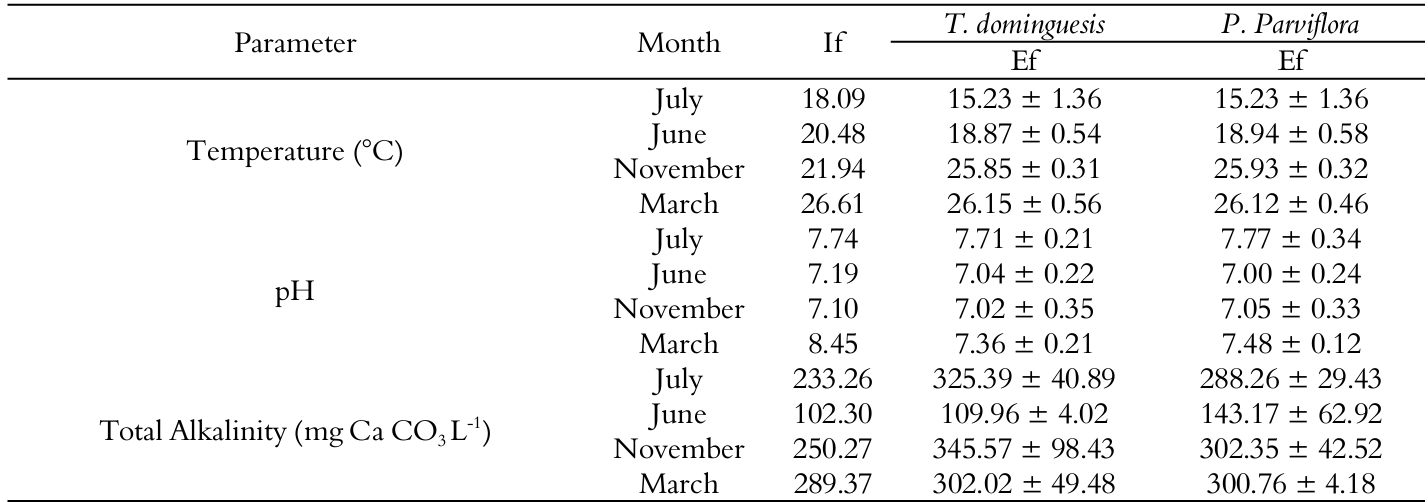
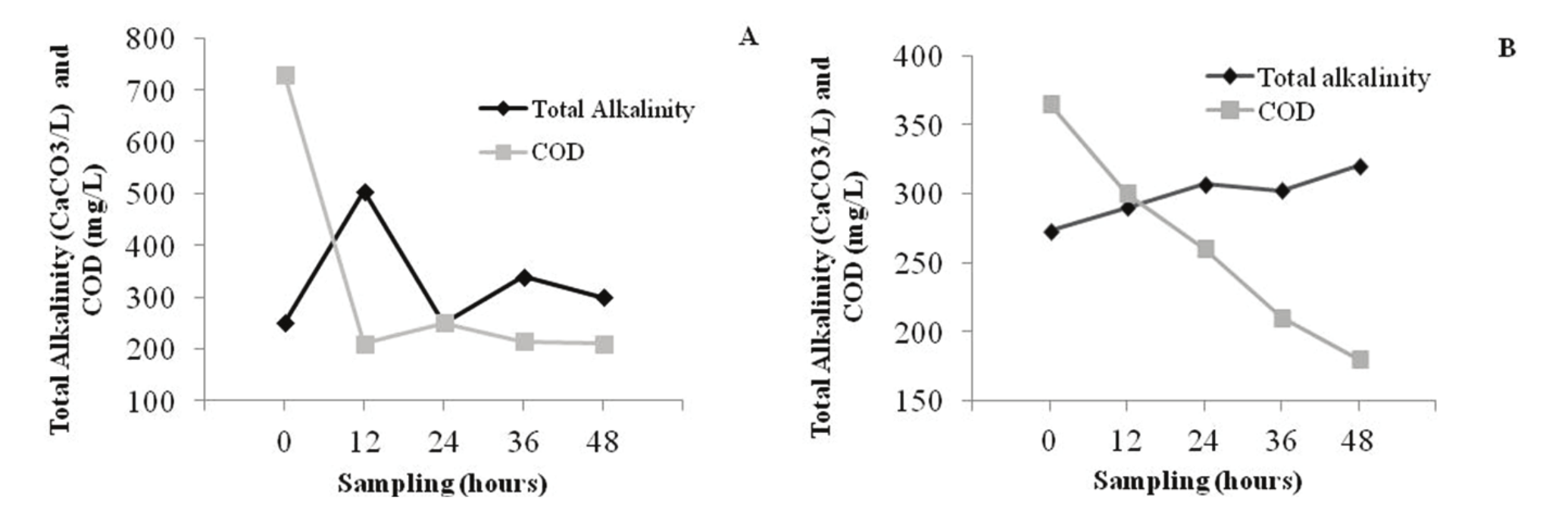
Figure 1.
Variation in results of alkalinity and COD: A) T. domingensis in November and B) P. parviflora in March.
The results of total (TSS) and volatile (VSS) suspended solids were very satisfactory, obtaining in both systems efficiency values above 80%, except for TSS in July (Table 2). The physical processes was responsible for this efficiency, which retains from colloids to millimeter particles contained in the effluent. The plant contributes in these processes with the root system that expands the filtration time (Naime & Garcia, 2005). At high temperatures (high 20ºC) Fia et al. (2015), obtained efficiencies removal of 90%. Other studies had lower efficiency than that observed in this study, Matos, Freitas, and Lo Monaco (2010) obtained efficiency of 64,6 and 72% in studies of Prata et al. (2013) and Dordio and Carvalho (2013).
The decrease in VSS was related to the action of microorganisms that degrade the organic matter, making it soluble, that is, it is a biological process, which has the temperature of the environment as a limiting factor. This was observed by the lower values of efficiency found in the colder months, especially in July. Even after 48 hours, it was possible to observe the presence of SSV in the effluent. This portion of organic material may be associated with detachments of plant material or even, related to the microorganisms, dead and/or alive, present in the environment.
In wetland soils constructed to treat domestic sewage, the greater the microbial activity, the better, as this will ensure the greatest possible removal of MO present in the sewage, mineralized and removed from the sewage (Silva et al., 2015).
Comparative P. parviflora and T. domingensis
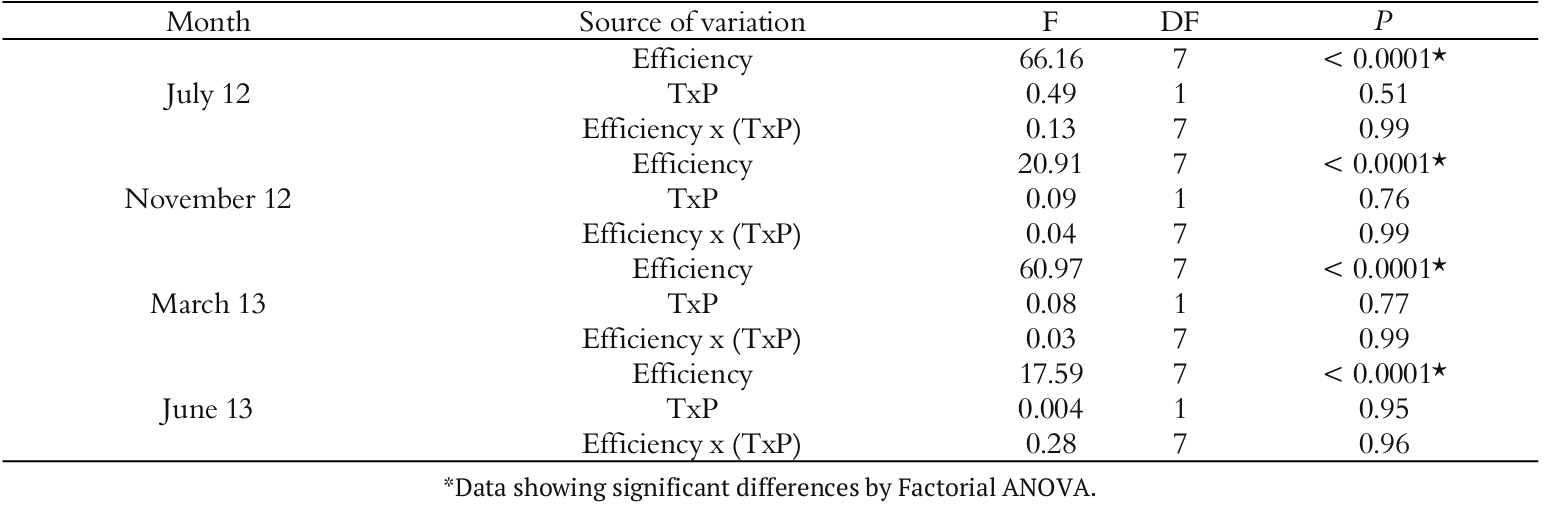
The independent treatment according to the different species indicated a significant difference between the influent and the effluent. ANOVA evidenced a significant difference between all factors (Table 3), mainly for P. parviflora. This reflects, for example, the COD reductions that have reached 70%. Using pH as a benchmark of system performance, it was observed that pH values were always tending to neutrality (not exceeding 7.8 after 48 hours). This demonstrates the stability of the systems, an important aspect that guarantees both microbial and plant absorption performance (Amorim et al., 2015).
It was also possible to observe the influence of the period, in which the experiment occurred, again more significant for P. parviflora (Table 3). When ordination the treatment systems by PCA, the greatest difference between abiotic variables also occurred between periods of the year, with the distancing of the month of June in relation to the others (Figure 2). This positioning is mainly related to COD, with PCA 1 explaining 75% of the distribution.
The isolation of June can be explained by the large thermal variation that occurred during the experiment, with a sharp drop in temperature, promoting a difference of more than 10°C in the same day. That is, the species exhibited stable metabolism at temperatures above 20°C and suffer from reductions in this parameter. York et al. (2013) also verified metabolic alterations in emergent macrophytes with variations of 10ºC in short periods of time, but emphasized that this factor did not prevent the good assimilation of the plants, a behavior similar to that observed in this study.
Al-Hamdani and Ghazal (2009) observed a reduction in the metabolism of aquatic species after 7 days of temperatures below 20ºC. The temperature range indicated as ideal for tropical aquatic species is between 23 and 32ºC (Lee, Park, & Kim, 2007).
In the test of species performance, it was verified that there is a significant difference in the treatment by the two species, since the variables of the crude effluent and the treated effluent were significant (Table 4). Between the plants there was no difference in the treatment, regardless of the month (TxP and efficiency x [TxP]), so it is possible to affirm that the performance of the two species was similar.
During the analysis, it was possible to verify the variations in alkalinity values in the summer months, in both T. domingensis and P. parviflora systems. This may be related to biological processes of anaerobic decomposition and aeration reactions of nitrification with formation of H+, decreasing the pH, with a slight consumption of alkalinity. On the other hand, to the high respiratory rate of microorganisms and the processes of nitrate reduction in an anoxic environment with H+ consumption, implying an increase in the buffering capacity of the medium (Mander, Maddison, Soosaar, & Karabelnik, 2011). Variations that could possibly be related to the dynamic stability of the system.
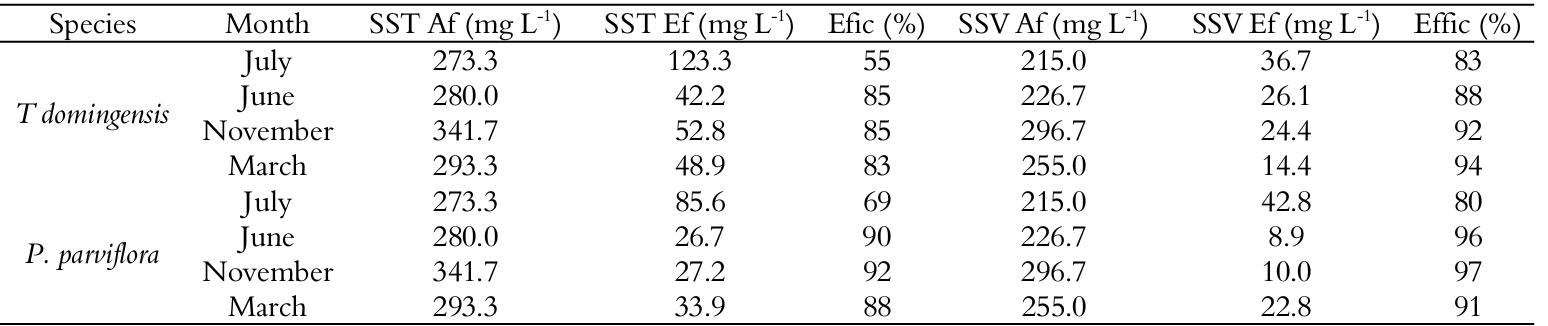
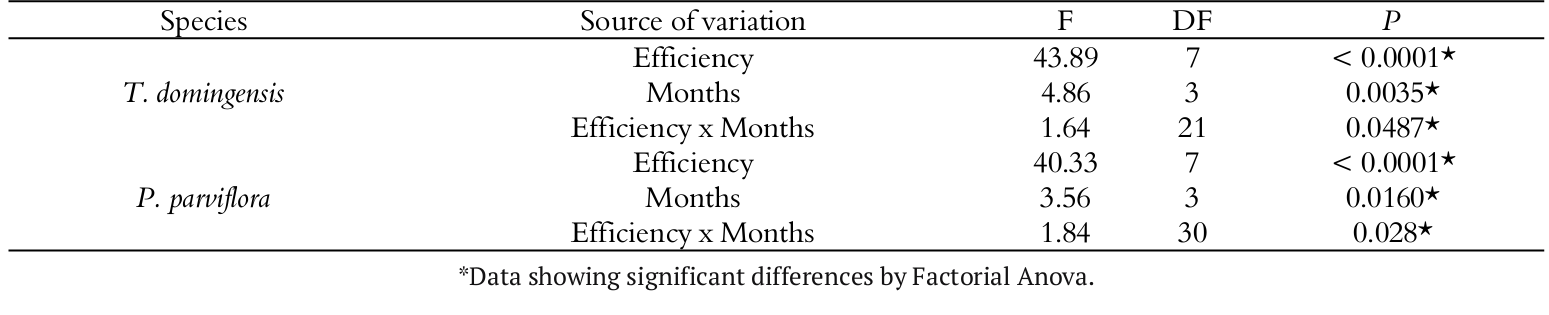
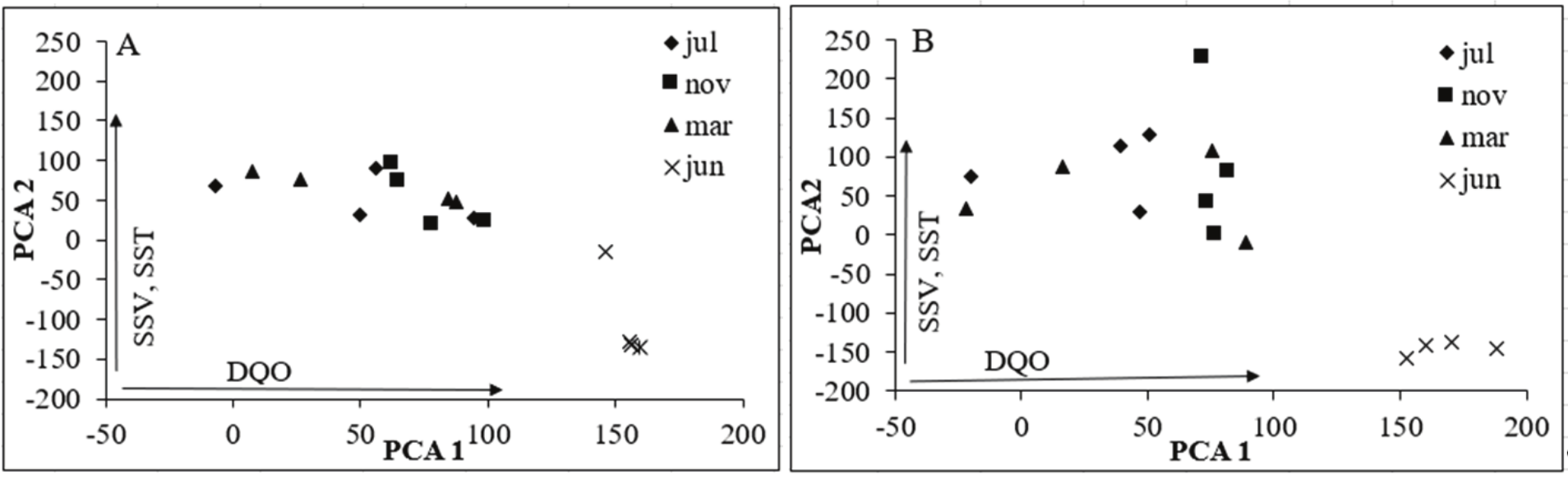
Figure 2.
Ordination of treatment systems for periods of the year: A) Typha domingensis systems and B) Pontederia parviflora systems. Chemical oxygen demand (COD),Volatile suspended solids (VSS), Total suspended solids (TSS).
A study on phytotreatment by root zone system in subtropical China pointed out that only 14% of N were incorporated into the biomass of the plants, 39% were released into the medium and 47% was removed by nitrification/denitrification and absorbed by bacteria or assimilated by algae (Lu et al., 2009).
In general, the performance of the two species was very similar and was directly related to the period of the year, in colder regions of the country this can be an important condition to ensure the efficiency of this type of treatment.
Conclusion
The study demonstrated that T. domingensis and P. parviflora show similar behavior in terms of efficiency in domestic sewage treatment. However, the temperature was a determining factor in the treatment processes, and for the most part, greater efficiencies were observed in the warmer months and the lower ones in the colder months.
The efficiency of organic matter removal was very significant. P. parviflora achieved removals from 39 to 74% of COD, while T. domingensis showed efficiency between 38 and 70%.
References
Al-Hamdani, S. H., & Ghazal, J. J. (2009). Selected physiological responses of Salvinia minima to various temperatures and light intensities. American Fern Journal, 99(3), 155-161. doi: 10.1640/0002-8444-99.3.155
Amorim, F., Fia, R., Silva, J. R. M., Chaves, C. F. M., & Pasqualin, P. P. (2015). Unidades combinadas RAFA-SAC para tratamento de água residuária de suinocultura: Parte II Nutrientes. Engenharia Agrícola, 35(5), 931-940. doi: 10.1590/1809-4430-Eng.Agric.v35n5p931-940/2015
Andrade, C. F., Sperling, M. V., & Manjate, E. S. (2017). Treatment of septic tank sludge in a vertical flow constructed wetland system. Engenharia Agrícola, 37(4), 811-819. doi: 10.1590/1809-4430-eng.agric.v37n4p811-819/2017
Calderón-Vallejo, L. F., Andrade, C. F., Manjate, E. S., Madera-Parra, C. A., & Von Sperling, M. (2015). Performance of a system with full- and pilot-scale sludge drying reed bed units treating septic tank sludge in Brazil. Water Science Technology, 71(12), 1751-1759. doi: 10.2166 / wst.2015.134
Caselles-Osorio, A., & Garcia, J. (2007). Impact of different feeding strategies and plant presence on the performance of shallow horizontal subsurface-flow constructed wetlands. Science of the Total Environment, 378(3), 253-262. doi: 10.1016/j.scitotenv.2007.02.031
Chung, A. K. C., Wu, Y., Tam, N. F. Y., & Wong, M. H. (2008). Nitrogen and phosphate mass balance in a sub-surface flow constructed wetland for treating municipal wastewater. Ecological Engineering, 32(1), 81-89. doi: 10.1016/j.ecoleng.2007.09.007
Deval, C. G., Mane, A. V., Joshi, N. P., & Saratale, G. D. (2012). Phytoremediation potential of aquatic macrophyte Azolla caroliniana with references to zinc plating effluence. Emirates Journal of Food and Agriculture, 24(3), 208-223.
Dordio, A., & Carvalho, A. J. P. (2013). Constructed wetlands with light expanded clay aggregates for agricultural wastewater treatment. Science of the Total Environment, 463-464, 454-461. doi: 10.1016/j.scitotenv.2013.06.052
Eaton, A. D., Clesceri, L. S., Rice, E. W., & Greenberg, A. E. (2005). Standard methodos for the examination of water and wastewater (21th ed.). Washington, DC: American Public Health Association, American Water Works Association, Water Polution control Federation.
Fia, R., Matos, A. T., Queiroz, M. E. L. R., Cecon, P. R., & Fia, F. R. L. (2010). Desempenho de sistemas alagados no tratamento de águas residuárias do processamento dos frutos do cafeeiro. Revista Brasileira de Engenharia Agrícola e Ambiental, 14(12), 1323-1329. doi: 10.1590/S1415-43662010001200011
Fia, F. R. L., Matos, A. T., Fia, R., Borges, A. C., & Abreu, E. C. (2015). Influência da carga de nutrientes e da espécie cultivada na remoção de K, Na, Cu e Zn da água residuária da suinocultura tratada em sistemas alagados construídos. Revista Ambiente & Água, 10(3), 542-553. doi: 10.4136/ambi-agua.1216
Foladori, P., Ruaben, J., & Ortigara, A. R. C. (2013). Recirculation or artificial aeration in vertical flow constructed wetlands: A comparative study for treating high load wastewater. Bioresource Technology, 149, 398-405. doi: 10.1016/j.biortech.2013.09.099
Gallego, A., Hospido, A., Moreira, M. T., & Feijoo, G. (2008). Environmental performance of wastewater treatment plants for small populations. Resources, Conservation and Recycling, 52(6), 931-940. doi: 10.1016/j.resconrec.2008.02.001
Gschlöbl, T., Steinmann, C., Schleypen, P., & Melzer, A. (1998). Constructed wetlands for effluent polishing of lagoons. Water Research, 32(9), 2639-2645. doi: 10.1016/S0043-1354(98)00047-5
Jabeen, R., Ahmad, A., & Iqbal, M. (2009). Phytoremediation of heavy metals: Physiological and molecular mechanisms. The Botanical Review, 75(4), 339-364. doi: 10.1007/s12229-009-9036-x
Jong, V. S. W., & Tang, F. E. (2014). Organic matter and nitrogen removal at planted wetlands treating domestic septage with varying operational strategies. Water Science Technology, 70(2), 352-360. doi: 10.2166 / wst.2014.237
Kadlec, R. H. (1995). Overview: surface flow constructed wetlands. Water Science and Technology, 32(3), 1-12. doi: 10.1016/0273-1223(95)00599-4
Kadlec, R. H., Burgoon, P. S., & Henderson, M. E. (1997). Integrated natural systems for treating potato processing wastewater. Water Science and Technology, 35(5), 55-62. doi: 10.1016/S0273-1223(97)00077-2
Lavrora, S., & Koumanova, B. (2010). Influence of recirculation in a lab-scale vertical flow constructed wetland on the treatment efficiency of landfill leachate. Bioresource Technology, 101(6), 1756-1761. doi: 10.1016/j.biortech.2009.10.028
Lee, K. S., Park, S. R., & Kim, Y. K. (2007). Effects of irradiance, temperature and nutrients on growth dynamics of seagrass: a review. Journal of Experimental Marine Biology and Ecology, 350(1-2), 144-175. doi: 10.1016/j.jembe.2007.06.016
Lu, S. Y., Zhang, P. Y., Jin, X. C., Xiang, C. S., Gui, M., Zhang, J., & Li, F. M. (2009). Nitrogen removal from agricultural runoff by full-scale constructed wetland in China. Hydrobiologia, 621(1), 115-126. doi: 10.1007/s10750-008-9636-1
Mander, Ü., Maddison, M., Soosaar, K., & Karabelnik, K. (2011). The impact of pulsing hydrology and fluctuating water table on greenhouse gas emissions from constructed wetlands. Wetlands, 31(6), 1023-1032. doi: 10.1007 / s13157-011-0218-z
Martins, A. P. L., Reissmann, C. B., Favaretto, N., Boeger, M. R. T., & Oliveira, E. B. (2007). Capacidade de Typha domingensis na fitorremediação de efluentes de tanques de piscicultura na bacia do Iraí- Paraná. Revista Brasileira de Engenharia Agrícola e Ambiental, 11(3), 324-330. doi: 10.1590/S1415-43662007000300013
Matos, A. T., Freitas, W. S., & Lo Monaco, P. A. V. (2010). Eficiência de sistemas alagados construídos na remoção de poluentes de águas residuárias da suinocultura. Revista Ambiente & Água, 32(6), 1144-1155. doi: 10.4136/ambi-agua.142
Naime, R., & Garcia, A. C. (2005). Utilização de enraizadas no tratamento de efluentes agroindustriais. Estudos Tecnológicos, 1(2), 9-20. Retrieved from http://www.estudostecnologicos.unisinos.br/pdfs/42.pdf
Olguín, E. J., & Sánchez-Galván, G. (2010). Aquatic phytoremediation: Novel insights in tropical and subtropical regions. Pure and Applied Chemistry, 82(1), 27-38. doi: 10.1351/PAC-CON-09-02-13
Ólguin, E. J., Sánchez-Galvan, G., & Pérez-Pérez, P. (2007). Assessment of the phytoremediation potential of Salvinia minima Baker compared to Spirodela polyrrhiza in high-strength Organic Wastewater. Water Air and Soil Pollution, 181(1), 135-147. doi: 10.1007 / s11270-006-9285-9
Ólguin, E. J., Sánchez-Galván, G., González-Portela, R. E., & López-Vela, M. (2008). Constructed wetland mesocosms for the treatment of diluted sugarcane molasses stillage from ethanol production using Pontederia sagittata. Water Research, 42(14), 3659-3666. doi: 10.1016/j.watres.2008.05.015
Prata, R. C. C., Matos, A. T., Cecon, P. R., Lo Monaco, P. A. V., & Pimenta, L. A. (2013). Tratamento de esgoto sanitário em sistemas alagados construídos cultivados com lírio-amarelo. Engenharia Agrícola, 33(6), 1144-1155. doi: 10.1590/S0100-69162013000600007
Ramos, N. F. S., Borges, A. C., Gonçalves, G. C., & Matos, A. T. (2017). Tratamento de águas residuárias de suinocultura em sistemas alagados construídos, com Chrysopogon zizanioides e Polygonum punctatum cultivadas em leito de argila expandida. Engenharia Sanitaria e Ambiental, 22(1), 123-132. doi: 10.1590/s1413-4152201687067
Rice, E. W., Baird, R. B., Eaton, A. D., & Clesceri, L. S. (2012). Standard methods for the examination of water and wastewater (22nd ed.). Washington, DC: American Public Health Association; American Water Works Association; Water Environment Federation.
Salati Jr., E., Salati, E., & Salati, E. (1999). Wetland projects developed in Brazil. Water Science and Technology, 40(3), 27-35. doi: 10.1016/S0273-1223(99)00416-3
Santos, O., Augusto, A., & Camargo, A. F. M. (2015). Artificial wetlands for treatment of harvest effluents from grow‐out ponds of the Amazon river prawn. Aquaculture Research, 46(11), 2676-2684. doi: 10.1111 / are.12423
Silva, S. C., Bernardes, R. S., & Ramos, M. L. G. (2015). Remoção de matéria orgânica do esgoto em solo de wetland construído. Engenharia Sanitaria e Ambiental, 20(4), 533-542. doi: 10.1590/S1413-41522015020040075357
Souza, C. F., Bastos, R. G., Gomes, M. P. M., & Pulschen, A. A. (2015). Eficiência de estação de tratamento de esgoto doméstico visando reuso agrícola. Revista Ambiente & Água, 10(3), 587-597. doi: 10.4136/ambi-agua.1549
Souza, D. C., Ribeiro, R., Lima, S. B., Carvalho, K. Q., & Silva, J. R. (2009). Tolerância e hiperacumulação de cobre em Pontederia parviflora Alexander. Ciência & Tecnologia, esp.(2), 329-344. Retrieved from periodicos.rc.biblioteca.unesp.br/index.php/olam/article/view/2828/2467
Vymazal, J., & Kröpfelová, L. (2009). Removal of nitrogen in constructed wetlands with horizontal sub-surface flow: a review. Wetlands, 29(4), 1114-1124. doi: 10.1672/08-216.1
Vymazal, J. (2009). The use constructed wetlands with horizontal sub-surface flow for various types of wastewater. Ecological engineering, 35(1), 1-17. doi: 10.1016/j.ecoleng.2008.08.016
Vymazal, J. (2013). Vegetation development in subsurface flow constructed wetlands in the Czech Republic. Ecological Engineering, 61(B), 575–581. doi: 10.1016/j.ecoleng.2013.06.015
Xian, Q., Hu, L., & Chen, H. (2010). Removal of nutrients and veterinary antibiotics from swine wastewater by a artificial macrophyte floating bed system. Journal of Environmental Management, 91(12), 2657-2661. doi: 10.1016/ j.jenvman.2010.07.036
York, P. H., Gruber, R. K., Hill, R., Ralph, P. J., Booth, D. J., & Macreadie, P. I. (2013). Physiological and morphological responses of the temperate seagrass Zostera muelleri to multiple stressors: investigating the interactive effects of light and temperature. PLoS ONE, 8(10), 763-770. doi: 10.1371/journal.pone.0076377
Zhang, C., & Wang, Y. (2013). Purification effect of subsurface flow constructed wetland on livestock wastewater. Transactions of the Chinese Society of Agricultural Engineering, 29(17), 160-168. doi: 10.3969/j.issn.1002-6819.2013.17.021
Author notes
dcsouza@utfpr.edu.br