Civil Engineering
Effect of lime on the mechanical response of a soil for use in unpaved forest roads
Effect of lime on the mechanical response of a soil for use in unpaved forest roads
Acta Scientiarum. Technology, vol. 42, 2020
Universidade Estadual de Maringá

This work is licensed under Creative Commons Attribution 4.0 International.
Received: 27 September 2018
Accepted: 03 April 2019
Abstract: . The main objective of this study was to propose the application of soil-lime mixtures asa primary coating layerof unpavedforestroads based on the premise that this layer can be considered mechanically similar to a flexible pavementsub base layer, aiming to fill a gap in the current technical literature and engineering practice in this field of knowledge. In the study, a laboratory test program was carried out in a residual gneiss soil encompassing: (i) geotechnical characterization tests; (ii) compaction tests at the standard Proctor energy on soil specimens and on soil-lime mixturespecimens prepared with lime contents of 2, 4 and 6% related to the dry soil mass; (iii) unconfined compressive strength tests on soil specimens compacted at the standard Proctor optimum parameters; and (iv) unconfined compressive strength tests on specimens of soil-lime mixtures compacted at the standard Proctor optimum compaction parameters with lime contents of 2, 4 and 6%, and cured at 22.8°C in the curing periods of 3, 7, 28 and 90 days. The results showed that the addition of lime resulted in: (i) reduction in soil maximum dry unit weight (gdmax) and increase in soil optimum water content (wopt);and(ii) significant gains in soil unconfined compressive strength that evidenced the expressive occurrence of pozzolanic reactions in the mixtures.Based on the hypothesis of a similar requirement for soil-cement and soil-lime mixtures, the tested soil-lime mixtures met the minimum mechanical strength (1.2MPa) required for application as a primary coating layer of unpaved forest roads.
Keywords: stabilization, compaction, mechanical strength.
Introduction
For economic reasons, a forest road network does not follow the technical requirements of design and construction of public roads,since its cost significantly affects the end value of the removed wood(Crispim et al., 2015). The economic aspect and construction period are main constraints in the implementation of these roads, and most of them are built as dirtroads(Silva, Minette, Souza, Moraes, &Schettino, 2016).
The Brazilian unpaved forest road network commonly present subgrade in clayey or sandy soils that after compaction become the foundation of the road pavement. According to EmmertandPereira (2016),a primary coating layer of selected soil constructed over the subgrade or an uncoated subgrade frequently composes their engineering structure. As for the soil used in the primary coating layer of unpaved forest roads, there is no Brazilian national technical standard recommendation available.
Regardingbearing capacity, it could be assumed that the primary coating layer of unpaved forest roads is technically similar to the subbase layer of a conventional flexible pavement. From this point of view, and following the Brazilian National Department of Transport Infrastructure - DNIT recommendations, the primary coating layer soil should exhibit minimum CBR of 20% and maximum CBR expansion of 1% (DNIT, 2006).
Currently, these values are higher than the bearing capacity of the majority of road subgrade soils from the Zona da Mata Norte, state of Minas Gerais, Brazil, in general with CBR lower than 11% (mature residual soils – Latosols and Argissols), and commonly below 6% [young residual soils (saprolite) and soft soils] at the Proctor standard compaction effort. In these situations, soil stabilization can be a recommended technique to improve the mechanical response of subgrade soils to function as a primary coating layer of unpaved forest roads(Azadegan, Yaghoubi, & Jie, 2013).
Soil stabilization refers to the process of changing geotechnical properties of the soil to improve its strength and durability, it has been used to improve the characteristics of road subgrade soils to meet required long-term performance (Negi, Faizan, Siddhart, & Singh, 2013). For road pavements, lime is among the most used chemical agents for the stabilization of subgrades and other pavement soillayers (Dash& Hussain, 2012;Baldovino, Moreira, Teixeira,Izzo,&Rose, 2018).
The improved characteristics of compacted lime-treated soils are very important to geotechnical engineering applications such as unpaved forest roads.Recent studies by Chittoori,Puppala, Reddy, and Marshall (2012) clearly demonstrated the environmental and cost benefits of using an excavated material treated with lime rather than an imported material.
In Brazil, there is no DNIT technical standard for the design of soil-lime mixtures. However, in the context of using soil-lime mixtures as a primary coating of unpaved forest roads, as a premise, minimum unconfined compressive strength could be established based on the soil-cement mixture requirement for the subbase layer.
In this sense, the Paraná Department of Highways - DER/PR (DER, 2005) arbitrates the minimum unconfined compressive strength of 1.2 MPa for using soil-cement mixtures as flexible pavement subbase layer. On the other hand, the São Paulo Department of Highways - DER/SP (DER, 2006)provides a standard for the design of the soil-lime base and subbase layers based on the CBR test, not taking into account directly the effect of the mixture curing period on its mechanical strength. Besides, there is the consideration that CBR is not a laboratory testing practice recommended for the evaluation of the mechanical strength of lime stabilized reactive soils (TRB, 1987).
The addition of a percentage of lime [CaO, Ca(OH)2] to a soil raises the rate of strength development and the final strength due to the formation of secondary cementitious products (Pomakhina, Deneele, Gaillot, Paris, &Ouvrard, 2012; Dewindt,Deneele, &Maubec, 2014; Deneele, Le Runigo, Cui, Cuisinier, & Ferber, 2016).According to the necessity to reduce the use of raw material and the consumption of natural resources, studies are requiredto optimize use of lime in soil stabilization.
In the stabilization process, lime interacts with amorphous soil clay particles through endothermic reactions, promoting a series of physicochemical transformations, which results in changes in plasticity and strength of soils (Beetham,Dijkstra, & Dixon, 2014; 2015). Hatim and Mohamed (2018)report that addition of lime to a clayey soil promotes cation exchange reactions that affect the thickness of its double diffuse layer and, in general, with a decrease in the liquid limit, increase in the plastic limit and, therefore, decrease in the plasticity index. Besides the modification in soil plasticity, the addition of lime to a clayey soil can also create middle-long term cement bonding among the soil particles through pozzolanic reactions that increase its strength and stiffness (Consoli, Lopes Jr., Prietto, Festugato, &Cruz, 2011;Chemeda, Deneele, Christidis, &Ouvrard, 2015).Therefore, it is common to associate addition of lime to clayey soils with the improvement in their workability, due to cation exchange reactions with the consequent flocculation-agglomeration of fine particles, and the gain of mechanical strength, due to pozzolanic reactions.
The mechanical strength of soil-lime mixtures is usually evaluated through unconfined compressive strength and depends on several variables, such as soil and lime types, lime content, temperature, curing period, and compaction effort (Al-Mukhtar, Lasledj, & Alcover, 2014; Vitale,Deneele, Paris,&Russo, 2017).According to these authors, in general, the mechanical strength of lime-treated soil increases with the lime content and period and temperature of cure of the mixtures.
Another most used soil improvement technique is compaction, commonly associatedwith chemical stabilization of soils for road engineering applications. In 1933, Ralph R. Proctor published his observations on the compaction of landfills in soils, contributing significantly to the development of this technique by presenting the ratio between the dry unit weight and the water content, for a given compaction effort (Basheer, 2001).The method commonly utilized is the Proctor compaction test, regulated in Brazil by the Brazilian Association of Technical Standards - ABNT (ABNT, 2016d) and by the Brazilian National Department of Highways (DNIT, 2013). Regarding compaction, in Brazil, there is no national standard establishing the compaction effort requirement of soil-lime mixtures for road engineering applications. Commonly, it is used the standard Proctor compaction effort following the national recommendation for compaction of soil-cement mixtures (DNIT, 2010).
In this context, the objective of this study was to characterize soil-lime mixtures to analyze the influence of lime content on the soil compaction parameters and to study the effect of lime content and curing period on the mechanical strength of the mixtures for application as a primary coating layer of unpaved forest roads.
The originality of this studylies on the application of soil-lime mixtures as aprimarycoating layer of forest unpaved roads based on the premise that this layer can be regarded as technically similar to the subbase layer of conventional flexible road pavement, from the mechanical strength standard requirement.The relevance of this research focuses on that the current extension of the Brazilian unpaved forest roads network exceeds 600,000 km, commonly composed of a primary coating and, or a subgrade soil improvement layer, depending on the road relevance as wood transport routesbetween forests and cellulose factories.However, in the design and construction of these roads, there is no established technical, mechanical strength requirement, and frequently they present trafficability problems under medium and heavy rain conditions.
Material and methods
Soil and chemical stabilizer
The soil analyzed in this study was classified geotechnically as mature residual gneiss soil and pedologically as Red-Yellow Latosolin accordance to theBrazilian Soil Classification System (SiBCS) (Embrapa, 2013). The collection site of a disturbed sample was the Alto dos Barbados, in the Campus of the Federal University of Viçosa, Minas GeraisState Brazil, on the Belo horizonte of a cut slope at the geographical coordinates 20°45’11.1” South latitude and 42°51’31.2” West longitude.The summarized data from Velten, Lima, Fontes, and Carvalho (2012) regarding, respectively, soil mineralogy and chemistry are listed in Tables 1, 2, and 3.
Data in Table 1 support that the sand fraction of the soil showed quartz as the dominant mineral, even though peaks of kaolinite and mica were identified. The kaolinite peaks in the sand fraction of this soil are classified as pseudomorphic mica. The clay fraction showed kaolinite as the dominant mineral, as well as hematite, goethite, gibbsite and hydroxy-interlayered-vermiculite (HIV) peaks.
| Soil fractions | Soil |
| Fraction ≥ 53 mm | Quartz, Kaolinite, Mica |
| Fraction < 53 mm | Kaolinite, Hematite, Goethite, Gibbsite, HIV |
| Chemical parameters | ||||||||||||
| pH in H2O | PZC | P | K | Na | Ca2+ | Mg2+ | Al3+ | H + Al | SB | CEC (t) | CEC (T) | |
| mgdm-3 | cmolcdm-3 | |||||||||||
| 5.81 | 6.00 | 2.2 | 8 | 0.0 | 0.00 | 1.11 | 0.00 | 0.6 | 1.13 | 1.13 | 1.73 | |
| Chemical parameters | ||||||||||
| V | m | SSI | OMC | P-rem | Zn | Fe | Mn | Cu | B | S |
| % | dagkg-1 | mgL-1 | mgdm-3 | |||||||
| 65.3 | 0.0 | 0.00 | 0.38 | 4.0 | 5.39 | 44.2 | 16.2 | 1.13 | - | - |
The chemical characterization of the soil, presented in Tables 2 and 3, follow the standard procedures proposed by Embrapa (1997). The soil presented pH higherthan 5, low organic matter content and little amount of exchangeablebases. Regarding the PZC, defined as soilpH at the point of zero charge, it is higher than thesoil pH. When the soil pH is lower than the soil PZC, it presents more positive than negative charges in the clayey mineral surfaces, which favors anionic absorption.
The chemical stabilizer used in the soil-lime mixtures was a commercial calcitic hydrated lime, CH-III type, commercialized in the city of Viçosa, in the contents of 2, 4, and 6% related to the dry soil mass. For instance, DNIT (2006) refers to lime contents up to 5 to 6% for lime improved, and lime stabilized soils for road applications.The chemical composition of the hydrated lime is shown in Table 4.
| Component | Amount (%) |
| CaO | 74.0 |
| MgO | 0.7 |
| SiO2 | 1.5 |
| Calcination losses | 22.0 |
| Available CaO | 70.0 |
| Ca(OH)2 available | 92.0 |
| CaO on the non-volatile base | 92.0 |
| Maximum non-hidrated CaO | 1.0 |
| Maximum excessive moisture | 1.0 |
Geotechnical characterization, compaction and unconfined compressive tests
The soil geotechnical characterization followed the ABNT recommendations, including: liquid limit (ABNT, 2016a), plastic limit (ABNT, 2016b), particle size analysis (ABNT, 2016c), compaction tests (ABNT, 2016d), specific density of solids (ABNT, 1984)and unconfined compressive tests (ABNT, 1992)performed in soil and mixtures specimens compacted at the standard Proctor effort.
Considering that there is no DNIT standard for compaction of soil-lime mixtures for road engineering applications in Brazil, compaction of soil and soil-lime mixtures occurred at the standard Proctor effort, following the DNIT recommendation for soil-cement mixtures (DNIT, 2006).
Lime was mixed with the soil samples at 0, 2, 4, and 6% by weight of dry soil. In the preparation of lime-soil mixtures, the addition of lime to the dry soil was performed by inclusion of water, mixture, cure of mixtures during 1-hour (TRB, 1987; Al-Swaidani, Hammoud, & Meziab, 2016), and compaction at the standard Proctor effort (ABNT, 2016d) to obtain the compaction curves. Cure of mixtures favors cation exchange reactions between soil and lime, which produces changes in the electric charge densities present in the clay particles and culminates in their flocculation (Di Santi, Fratalochi, Mazzieri, & Pasqualini, 2014).
After determination of the compaction curves, triplicate specimens presenting 100 mm in height and 50 mm in diameter, which defines a height/diameter ratio of two, were compacted at their optimum compaction parameters for unconfined compressive tests. In sequence, the mixture specimens were sealed in transparent plastic bags to prevent loss of moisture and cured during 3, 7, 28, and 90 days in moisture curing room at average temperature of 22.8oC.
The adopted curing periods reflect conditions to the occurrence of short-term reactions through cationic exchanges (up to 3 days) and medium and long-term reactions through pozzolanic reactions (7 to 90 days), responsible for significant gains in the mechanical strength of mixtures.
For the unconfined compressive test,which was performed with speed of 1.0 mmmin.-1 the specimens had to follow a set of conditions: the specimen dimensions with tolerances of ± 0.5 mm in diameter and ± 1 mm in height, the apparent dry unit weight with a tolerance of ±1% of target value, and the moisture content with a tolerance of ± 0.5% of target value. After testing, the unconfined compressive strength adopted was the average of the maximum failure stresses of the three specimens with a tolerance of ± 5% around the mean. In cases where the standard deviation exceeded the pre-established tolerance, three new specimens were compacted and tested.
Application of soil-lime mixtures in unpaved forest roads
As a premise and regarding mechanical strength requirement, in this study, it was assumed that the primary coating layer of unpaved forest roads is technically similar to the subbaselayer of conventional flexible road pavement. Therefore, following the DER/PR standard for soil-cement subbase layer (DER, 2005) a minimum unconfined compressive strength of 1.2 MPa is required for the design of soil-lime mixtures as primary coating layer of unpaved forest roads.
Results and discussion
Geotechnical characterization tests
The grain size distribution curve of the soil is illustrated in Figure 1 and the geotechnical characterization, including the soil classification following the Transportation Research Board System(TRB) and Unified Soil Classification System (USC), as well as the methodologyMiniaturaCompactado Tropical (MCT)(Nogami&Villibor, 1995)can be observed in Table 5. The grain size distribution presented in Table 5 follows the ABNT standard (ABNT, 1995).
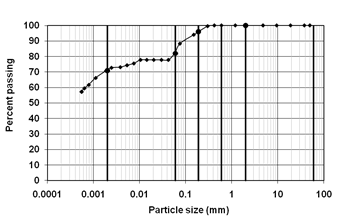
Figure 1.
Grain size distribution of soil following the ABNT standard (ABNT, 1995).
| Clay (%) | Silt (%) | Sand (%) | LL (%) | PL (%) | PI (%) | Gs | |
| 71 | 11 | 18 | 82 | 44 | 38 | 2.74 | |
| Soil classification systems | |||||||
| TRB | A-7-5 (20) | ||||||
| USC | CH | ||||||
| MCT | LG’ | ||||||
According to ABNT (1995), data in Figure 1 and Table5 indicate soil geotechnical characterization as silty-sandy clay. Also, soil classifications following the USC, TRB and MCT systems, respectively, are high compressibility silt, clayey soil, and lateritic clayey soil. Regarding the soil-lime mixture reaction mechanisms, the clay fraction of 71%, plasticity index (PI) of 38% and soil mineralogy favor the occurrence of pozzolanic reactions and, therefore, a substantial gain in mechanical strength of mixtures compared to the soil.
Compaction tests
The curves from the standard Proctor compaction tests are illustrated in Figure 2, and the optimum compaction parameters [maximum dry unit weight (gdmax) and optimum water content (wopt)] for lime contents of 0, 2, 4, and 6% are listed in Table 6.
Data in Figure 2 and Table 6 indicate that increases in lime content in soil-lime mixtures led to increases in the optimum water content and decrease in the maximum dry unit weight, as reported in the literature (TRB, 1987; Hatim&Mohamed, 2017). Specifically, the reduction of the peaks, shown in Figure 2, corresponds to the maximum specific dry weight on the ordinate axis, and the increase in the optimum water contents with displacement of the curve to the right side on the abscissa axis.
There was an increase of 3.55% in the optimum water content in the 6% lime curve compared to the soil curve. Cation exchange reactions between the clay fraction of soil and lime, with consequent agglomeration-flocculation of the particles of colloids of clay minerals, explain this phenomenon. These reactions result in a decrease of the soil diffuse double layer and consequently in clay particle flocculation in an edge-face structure.
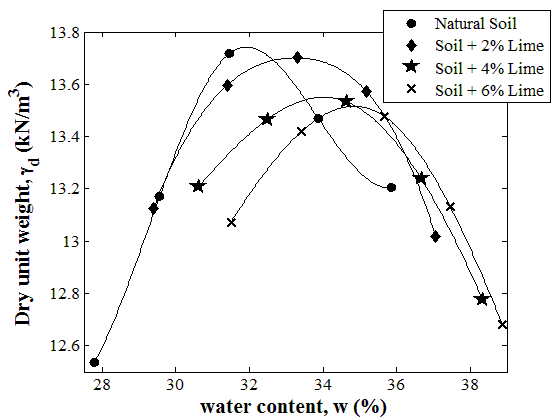
Figure 2.
Compaction curves of soil and soil-lime mixtures.
| Material | wopt(%) | gdmax(kNm-3) |
| Soil (0% lime) | 31.45 | 13.72 |
| Soil + 2% lime | 33.30 | 13.70 |
| Soil + 4% lime | 34.24 | 13.53 |
| Soil + 6% lime | 35.00 | 13.48 |
The improvement in the compaction properties of the soil moves into a moisture range that can be easily compacted. This effect is clearly advantageous when used on soils with a high water content. A treatment with lime therefore makes it possible to transform a sticky plastic soil, which is difficult to compact, into a stiff, easily handled material. After compacting, the soil has excellent load-bearing properties (Hatim&Mohamed, 2017).
Unconfined compressive tests
The relationship between the maximum average unconfined compressive strength of specimens of soil-lime mixtures and the curing periods of 3, 7, 28, and 90 days, as well as the unconfined compressive strength of the natural soil (NS) is shown in Figure 3.
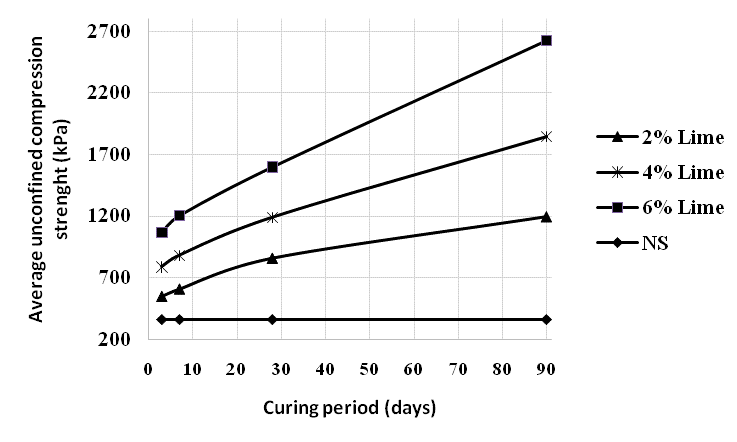
Figure 3.
Unconfined compressive strength versus curing period of soil and mixtures.
Compared to the soil, significant gains in the unconfined compressive strength of mixtures with the increase in lime content and curing periods are observed in Figure 3.According to Consoli et al. (2012) andConsoli, Prietto, da Silva Lopes, and Winter (2014) the increase in soil-lime mixture strength is directly related to the decrease of pores and the increase in lime volume. The most significant mixture reported in this study refers tothe lime content of 6% and curing time of 90-days, with an increase of around 730%. Also, with 6% lime, there is a steady unconfined compressive strength gain between 7 and 90-days curing time contrarily to Di Sante et al. (2014), who identified the time interval approximately between 3 and 30 days as a time for development of most of the cementation reactions.
These gains observed in Figure 3 are mostly related to the development of pozzolanic reactions between lime and soil clay fraction in the presence of water, which give rise to the formation of hydrated calcium silicate and hydrated calcium aluminate through reactions between lime, silica and free alumina in the clay particles (Al-Swaidani et al., 2016). The interaction between calcium ions and the clay fraction causes the dissolution of silica and alumina from the clay fraction particles in a high pH environment. The dissolved ions combine with the calcium ions and form cementitious agents that interconnect the clay particles, and are responsible for significant increases in mechanical strength.
The resistance gain of the mixtures may also be related to the mineralogy of the soil under analysis. Velten et al. (2012) performed a mineralogical characterization of the same soil and, through the X-ray diffraction test, verified in the clay fraction that it presents kaolinite as the main mineral. Iron and aluminum oxides, mainly hematite and gibbsite, were also detected, which give the soil high adsorption capacity. The presence of hematite is associated with its more reddish coloration, which is a remarkable characteristic that this mineral confers to soils, due to its high pigmentation power. It is generally found in warmer and lower moisture environments with high iron release rates, low organic matter and high pH.
Maubec, Deneele, and Ouvrard (2017) analyzed two different clays, kaolin and bentonite, and observed that addition of lime led to an increase of mechanical properties of these clays. These improvements were faster with bentonite, even if the long-term performance reached by kaolinite was higher. The coupling between macroscopic and physico-chemical aspects showed that these improvements are linked to the development of secondary compounds, such as calcium silicate hydrates, hydrogarnet and calcium carboaluminate hydrate phases.
The Ca-ion at higher pH promotes linkage between particles and provides the most efficient way to form dense, tightly packed flocs, which behave as individual coarse grained materials as silt or sand (Vitale et al., 2017).The presence of a high pH environment is essential to guarantee the effectiveness of lime [CaO or Ca(OH)2]stabilization of clays by means of pozzolanic reactions. At these high pH levels, the solubility of silica and alumina is largely increased. Thus, as long as the lime is available in the systemand the pH remains high enough to maintain the solubility, pozzolanic reactions continue over time to form bonding compounds that cause long-term strength increase (Al-Mukhtar et al., 2014).
According to Di Sante et al. (2014) at the end of cementation reactions, pH value is expected to hold steady. At the same time, measurements of cations concentration in the water indicates occurrence of reaction mechanisms, as follows: calcium concentration should initially increase due to hydrated lime dissociation and then decrease during cation exchange and pozzolanic reactions; not further reduction in Ca2+ concentration with time means no more reactions taking place in the mixture. Sodium and potassium concentrations are expected to increase during cation exchange and hold steady at the end of this exchange, clearly marking the end of short term reactions.
Despite the fact that the soil chemical composition showed potassium in higher content than sodium (Table 2), sodium exchanged to a greater extent than potassium. The reasons for this evidence are that sodiumcomes before potassium in the lytropic series together with the capacity of some clay minerals to fix potassium. In fact, in clay minerals, especially in illite, Na+and Ca2+ are very ineffective in removing K+ ions, mainly those located in the edge interlayer sites that resultto be non-exchangeable cations.
Applications of mixtures in the improvement of subgrade soils and primary coating of unpaved forest roads
According to data in Figure 3, the unconfined compressive strength observed in the 7-day curing period for the lime content of 6%, in the 28-day curing period for lime contents of 4 and 6%, and in the 90-day curing period for all lime contents exceeded 1.2 MPa, which is the minimum value recommended by DER (2005) for application of soil-cement mixtures as subbase layer of a flexible pavement. Therefore, based on the hypothesis of a similar requirement for soil-cement and soil-lime mixtures, the tested soil-lime mixtures met the minimum mechanical strength required for application as a primary coating layer of unpaved forest roads.
Conclusion
Data from this research support that with increasing lime content, there wereincreases in the optimum water content and reductions in the maximum dry unit weight caused by cation exchange reactions. Results of unconfined compressive strength tests support application of soil-lime mixtures as a primary coating layer of unpaved forest roads. Readers attention and scientific impact of this research are associated with the proposal of a technical-economical viable solution, the application of cemented soil mixture as primary coating of unpaved forest roads of the Brazilian forest-based companies, in order to solve their trafficability problems under medium to high-intensity rain conditions.
Acknowledgements
The authors thank CAPES, for granting a master’s scholarship to the first author, and CNPq, through grant number 305949/2014-4, for supporting this research.
References
Al-Mukhtar, M., Lasledj, A., & Alcover, J. F. (2014). Lime consumption of different clayey soils. Applied Clay Science, 95(1), 133-145. DOI: 10.1016/j.clay.2014.03.024
Al-Swaidani, A., Hammoud, I., & Meziab, A. (2016). Effect of adding natural pozzolana on geotechnical properties of lime-stabilized clayey soil. Journal of Rock Mechanics and Geotechnical Engineering, 8(5), 714-725. DOI: 10.1016/j.jrmge.2016.04.002
Associação Brasileira de Normas Técnicas [ABNT]. (1984). NBR 6508: Grãos de solos que passam na peneira de 4,8 mm - determinação da massa específica. Rio de Janeiro, RJ.
Associação Brasileira de Normas Técnicas [ABNT].(1992). NBR 12770. Solo coesivo - determinação da resistência à compressão não confinada. Rio de Janeiro, RJ.
Associação Brasileira de Normas Técnicas [ABNT].(1995). NBR 6502. Solos e rochas. Rio de Janeiro, RJ.
Associação Brasileira de Normas Técnicas [ABNT]. (2016a). NBR 6459: Solo - determinação do limite de liquidez. Rio de Janeiro, RJ.
Associação Brasileira de Normas Técnicas [ABNT]. (2016b). NBR 7180. Solo - determinação do limite de plasticidade. Rio de Janeiro, RJ.
Associação Brasileira de Normas Técnicas [ABNT]. (2016c). NBR 7181: Solo - análise granulométrica. Rio de Janeiro, RJ.
Associação Brasileira de Normas Técnicas [ABNT]. (2016d). NBR 7182: Solo - ensaio de compactação. Rio de Janeiro, RJ.
Azadegan, O., Yaghoubi, E., & Jie, J. (2013). Evaluation of the performance of lime and cement treated base layers in unpaved roads. ElectronicJournalof Geotechnical Engineering, 18(2), 647-660.
Baldovino, J. A., Moreira E. B., Teixeira, W., Izzo, R. L. S., & Rose, J. L. (2018). Effects of lime addition on geotechnical properties of sedimentary soil in Curitiba, Brazil. Journal of Rock Mechanics and Geotechnical Engineering, 10(1), 188-194. DOI: 10.1016/j.jrmge.2017.10.001
Basheer, I. A. (2001). Empirical modeling of the compaction curve of cohesive soils. Canadian Geotechnical Journal, 38(1), 29-45. DOI: 10.1139/t00-068
Beetham, P., Dijkstra, T., & Dixon, N. (2014).Lime diffusion and implications for lime stabilization practice, Compendium of Papers from the Transportation Research Board 93rd Annual Meeting, Washington, DC, US: TRB.
Beetham, P., Dijkstra, T., & Dixon, N. (2015). Limestabilization for earthworks: a UK perspective. Proceedings of the Institution of Civil Engineers,Ground Improvement, 168(2), 81-95.DOI: 10.1680/grim.13.00030
Chemeda, Y. C., Deneele, D., Christidis, G. E., & Ouvrard, G. (2015). Influence of hydrated limeon the surface properties and interaction of kaolinite particles. Applied Clay Science, 107(1), 1-13. DOI: 10.1016/j.clay.2015.01.019
Chittoori, B., Puppala, A., Reddy, R., & Marshall, D. (2012). Sustainable reutilization of excavated trench material. GeoCongress, 225(1),4280-4289. DOI: 10.1061/9780784412121.440
Consoli, N. C., Lopes Jr., L. S., Prietto, P. D. M. Festugato, L., & Cruz, R.C. (2011). Variables controlling stiffness and strength of lime stabilized soils. Journal of Geotechnical and Geoenvironmental Engineering, 137(6), 628-632. DOI: 10.1061/(ASCE)GT.1943-5606.0000470
Consoli, N. C., Dalla Rosa, A., Gauer, E. A., Santos, V. R., Moretto, R. L., & Corte, M. B. (2012). Key parameters for tensile and compressive strength of silt-lime mixtures. Geotechnique Letters, 2(3),5-81. DOI: 10.1061/(ASCE)0899-1561(2009)21:5(210)
Consoli, N. C., Prietto, P. D. M., Silva Lopes, L., & Winter, D. (2014). Control factors for the long term compressive strength of lime treated sandy clay soil. TransportationGeotechnics, 1(3), 36-129. DOI: 10.1016/j.trgeo.2014.07.005
Crispim, F. A., Lima, D. C., Silva, C. H. C., Shaefer, C. E. G. R, Carvalho, C. A. B., & Brandão, E. H. (2015). Compactação de solos em laboratório: efeito do diâmetro e do número de camadas do corpo de prova. Revista Árvore, 39(3), 535-542. DOI: 10.1590/0100-67622015000300014
Dash, S. K., & Hussain, M. (2012). Lime stabilization of soils: reappraisal. Journal of Materials in Civil Engineering, 24(6), 707-714. DOI: 10.1061/(ASCE)MT.1943-5533.0000431
Deneele, D., Le Runigo, B., Cui, Y. J., Cuisinier, O., & Ferber, V. (2016). Experimental assessment regarding leaching of lime-treated silt.Construction and Building Materials, 112(1), 1032-1040. DOI: 10.1016/j.conbuildmat.2016.03.015
Departamento de Estradas de Rodagem do Estado do Paraná [DER]. (2005). ES - P17/05: Pavimentação: solo-cimento e solo-melhorado com cimento. Curitiba, PR: DER/PR (DG/AP).
Departamento de Estradas de Rodagem do Estado de São Paulo [DER]. (2006). ET-DE-P00/005: Sub-base ou base de solo-cal. São Paulo, SP: EMURB.
Departamento Nacional de Infraestrutura de Transportes [DNIT]. (2006). Manual de pavimentação. Rio de Janeiro, RJ: MT-DNIT.
Departamento Nacional de Infraestrutura de Transportes [DNIT]. (2010). ES 143/10: Pavimentação - base de solo-cimento. Rio de Janeiro, RJ.
Departamento Nacional de Infraestrutura de Transportes [DNIT]. (2013). 164/2013-ME: Solos - Compactação utilizando amostras não trabalhadas - Método de Ensaio. Rio de Janeiro, RJ.
Dewindt, L., Deneele, D., & Maubec, N. (2014). Kinetics of lime/bentonitepozzolanic reactions at 20 and 50°C: batch tests and modelling. Cement and Concrete Research, 59(1), 34-42.DOI: 10.1016/j.cemconres.2014.01.024
Di Sante, M., Fratalochi, E., Mazzieri, F., & Pasqualini, E. (2014). Time of reactions in a lime treated clayey soil and influence of curing conditions on its microstructure and behavior. Applied Clay Science, 99(1), 100-109.DOI: 10.1016/j.clay.2014.06.018
Emmert, F., & Pereira, R. S. (2016). Geotechnical characterization and soils classification for forest roads: case study. Ciência Florestal, 26(2), 601-613. DOI: 10.5902/1980509822760.
Empresa Brasileira de Pesquisa Agropecuária [Embrapa]. (1997). Manual of Methods and Analysis of Soils. Rio de Janeiro, RJ: National Service of Soils Researches and Conservation.
Empresa Brasileira de Pesquisa Agropecuária [Embrapa]. (2013). Sistema Brasileiro de Classificação de Solos(3a.ed.). Brasília, DF: Embrapa.
Hatim, A., & Mohamed, M. (2017). The effects of compaction delay and environmental temperature on themechanical and hydraulic properties of lime-stabilized extremely highplastic clays. Applied Clay Science, 150(1), 333-341. DOI: 10.1016/j.clay.2017.09.019
Hatim, A., & Mohamed, M. (2018). The effects of lime content and environmental temperature on themechanical and hydraulic properties of extremely high plastic clays.Applied Clay Science, 161(1), 203-210. DOI: 10.1016/j.clay.2018.04.012
Maubec, N., Deneele, D., & Ouvrard, G. (2017). Influence of the clay type on the strength evolution of lime treated material. Applied Clay Science, 137(1), 107-114. DOI: 10.1016/j.clay.2016.11.033
Negi, A. S., Faizan, M., Siddhart, D. P., & Singh, R. (2013). Soil stabilization using lime. InternationalJournalof Innovative Research in Science, Engineering and Technology, 2(2), 448-453.
Nogami, J. S.; & Villibor, D. F. (1995). Pavimentação de baixo custo com solos lateríticos. São Paulo, SP: Vilibor.
Pomakhina, E., Deneele, D., Gaillot, A. C., Paris, M., & Ouvrard, G. (2012). Investigation of pozzolanic reaction occurring in lime-treated Ca-bentonite. Cement and Concrete Research, 42(4), 626–632. DOI: 10.1016/j.cemconres.2012.01.008
Silva, F., Minette, L. J., Souza, A. P., Moraes, A. C., & Schettino, S. (2016). Classification of forest roads and determination of route using geographic information system. RevistaÁrvore, 40(2), 329-335. DOI: 10.1590/0100-67622016000200015
Transportation Research Board [TRB]. (1987). Lime stabilization, reactions, properties, design, and construction (State of Art Report 5). Washington, D.C.: National Research Council.
Velten, R. Z., Lima, D. C., Fontes, M. P. F., & Carvalho, C. A. B.(2012). Electroomosis in the remediation of tropical soils contaminated with cadmium: effect of the incubation time. Soils & Rocks, 35(1), 39-49.
Vitale, E., Deneele, D., Paris, M., & Russo, G. (2017). Multi-scale analysis and time evolution of pozzolanic activity of lime treated clays. Applied Clay Science, 141(1), 36-45. DOI: 10.1016/j.clay.2017.02.013