Chemical Engineering
Impact of citric acid on the drying characteristics of kiwifruit slices
Impact of citric acid on the drying characteristics of kiwifruit slices
Acta Scientiarum. Technology, vol. 42, e40570, 2020
Universidade Estadual de Maringá

Esta obra está bajo una Licencia Creative Commons Atribución 4.0 Internacional.
Recepción: 24 Noviembre 2017
Aprobación: 12 Enero 2018
Abstract: Kiwifruit slices were dried at four different air drying temperatures of 50, 55, 60 and 70ºC and at 2 m s-1 air velocity by using a cabinet dryer in this study. The drying, rehydration and colour characteristics were significantly influenced by pretreatment and drying temperature. The drying time decreased with the increase in drying temperature. The drying rate curves showed that the entire drying process took place in the falling rate period. Five well-known thin-layer models were evaluated for moisture ratios using nonlinear regression analysis. The results of regression analysis indicated that the Midilli & Kucuk model the best to describe the drying behaviour with the lowest c2 and RMSE values, and highest R2 value. The effective moisture diffusivity of the dried kiwifruit slices was calculated with Fick’s diffusion model, in which their values varied from 4.19×10⁻¹⁰ to 6.99×10⁻¹⁰ m2 s-1 over the mentioned temperature range. The dependence of effective diffusivity coefficient on temperature was expressed by an Arrhenius type equation. The calculated values of the activation energy of moisture diffusion were 10.37 and 19.08 kJ mol-1 for citric acid and control samples, respectively.
Keywords: citric acid, drying, effective moisture diffusivity, kiwifruit, mathematical modeling.
Introduction
Kiwifruit (Actinidia deliciosa) originates from China, and become a favourite fruit because of its flavours and taste. The world’s kiwifruit production reached 3447604 metric tons and Turkey produced about 31795 metric tons of kiwifruit in 2014. China, Italy, New Zealand, Chile and Greece are the leading kiwifruit growing countries (Food and Agricultural Organization [FAO], 2017). Kiwifruit is rich in vitamin A, vitamin C, vitamin E, potassium, calcium, iron, magnesium, proteins, minerals and it also has strong antioxidant capacity due to a wide number of phytonutrients including carotenoids, lutein, phenolic, flavonoids and chlorophyll (Izli, Izli, & Taşkın, 2017). Kiwifruit can be consumed fresh as well as dried, frozen and processed for juice, jams, jellies, syrups and confectionery. Since kiwifruits soften quickly and lose vitamin even when refrigerated, they tend to have very short shelf-life. To prolong its shelf-life, the water inside the kiwifruit should be removed in order to have a long-term product without a significant change in quality. The most common method for this purpose is drying (Izli et al., 2017).
Drying is one of the oldest methods of preserving and processing agricultural products by using heat and mass transfer. It has become necessary because most fruits are highly perishable owing to their high moisture content and the need to make them available all year round and at locations where they are not produced. In addition to preservation, the reduced weight and bulk of dehydrated products decreases packaging, handling and transportation costs (Omolola, Jideani, & Kapila, 2017).
Pretreatments prior to drying could greatly increase the water diffusion, reduce drying time. Moreover, they have been reported to help reduce some of undesired changes. The main purpose of pretreatment is generally to inactivate enzymes such as polyphenoloxidase, peroxidase and phenolase and to inhibit some undesirable chemical reactions, which cause many adverse changes of a product (Hiranvarachat, Devahastin, & Chiewchan, 2011). Potassium and sodium hydroxide, potassium carbonate, potassium metabisulphate, methyl and ethyl ester emulsions, citric and ascorbic acids are some of the most common and commercially used pretreatments (Doymaz, 2004;Baomeng, Xuesen, & Guodeong, 2014;Ozdemir, Ozturk, & Tüfekçi, 2016).
Several researches have studied the drying of kiwifruits such as convective, microwave, freeze drying, and heat-pipe drying (Maskan, 2001;Simal, Femenia, Garau, & Rosselló, 2005;Darici & Şen, 2015; Ergun, Koç, & Dirim, 2016;Li, Yuan, Xiao, & Yang, 2016;Darvishi, 2017;Mahjoorian et al., 2017). However, there is no information for drying of kiwifruit slices pretreated with citric acid solution. The purpose of the present work was to investigate the effect of temperature and citric acid solution on the drying, rehydration and colour characteristics of kiwifruit slices in the cabinet dryer, to fit the experimental data to five thin-layer models, and to calculate the effective moisture diffusivity and activation energy.
Material and methods
Materials
Fresh kiwifruit was purchased from a supermarket in Istanbul. For each experimental run, kiwifruits were washed with fresh water to remove the kiwifruit fines adhered to the fruit surface and cut into ring with a diameter about 5 cm and thickness of 6±0.2 mm. After slicing, these kiwifruit slices divided into two lots before use. One lot of samples was pre-treated with solution of citric acid (1% w w-1) at 20°C for 2 min. (Citric acid). Anhydrous citric acid of extra purity grade was purchased from Merck (Darmstadt, Germany; CAS number:77-92-9) and was used without further purification. The other lot was untreated (Control).
The initial moisture content of the fresh kiwifruit was determined using the AOAC method (Association of Official Analytical Chemists [AOAC], 1990). The initial moisture content of the fresh samples was measured in triplicate and was determined as 5.12±0.05 kg water kg-1 dry matter (d.b.).
Drying procedure
The drying of kiwifruit slices was investigated in experimental drying cabinet (APV & PASILAC Limited of Carlisle, Cumbria, UK). The cabinet dryer was described previously by Doymaz (2004). It basically consists of a centrifugal fan to supply the air-flow, an electric heater, an air filter and an electronic proportional controller. The air temperature is controlled by means of a proportional controller. The air velocity above the product is measured with an anemometer (AM-4201, Lutron, Taipei, Taiwan) with a sensitivity of ± 0.1 m s-1. The air passed through heating unit and heated to be desired temperature and channelled to the drying tunnel. The air temperature in the dryer is regulated to ±1°C using a temperature controller. The samples were dried in a perforated tray (radius: 29 cm, and height: 7 cm). Weight loss of samples was recorded by using a digital balance (model BB3000, Mettler-Toledo AG, Grefensee, Switzerland), which has 0-3000 g measurement range with reading accuracy of ±0.1 g.
The dryer was started about 30 min. before drying experiments to achieve steady-state conditions before each drying run. Then, the samples weighing about 70±0.5 g was spread on the tray. The drying experiments were conducted at 50, 55, 60 and 70°C air temperatures and constant air velocity of 2±0.1 m s-1. Air flowed perpendicular to drying surfaces of the samples. Weight loss of samples was recorded at regular intervals of 15 min during drying. Drying was stopped when the moisture content of samples were approximately 0.17±0.5 kg water kg-1 dry matter (d.b.). Then, the dried samples were packed into polyethylene bags, which were then heat-sealed and stored in incubators at ambient temperature. The experiments were replicated three times and the average of the moisture ratio at each value was used for drawing the drying curves.
Mathematical modelling
In the present study, five common models listed in Table 1 were applied to describe drying characteristics of kiwifruit slices by fitting the experimental drying data of at different temperatures. The moisture content (M) and moisture ratio (MR) of kiwifruit slices were calculated using the following Equation 1 and 2:

(1)

(2)
where:
M is the moisture content (kg water kg dry matter-1),
Wi is the weight of sample (kg), and
Wd is the dry matter content of sample (kg).
M0, Me and Mt are the initial moisture content, the equilibrium moisture content, the moisture content at t (kg water kg dry matter-1), respectively, and t is drying time (min.). The moisture ratio (MR) was simplified to Mt/M0 instead of (Mt - Me)/(M0 - Me) by some authors (Ismail, Figen, & Pişkin, 2015;Nadian et al., 2017) because of the values of Me small compared with Mt or M0 for long drying time.
Data analysis
The statistical analysis of the experimental data was done using Statistica 8.0.550 (StatSoft Inc., Tulsa, OK, USA) software package. The parameters of models were estimated using a non-linear regression procedure based on the Levenberg-Marquardt algorithm. Coefficient of determination (R2), reduced chi-square (c2) and root mean square error (RMSE) were useful parameters for selecting the most suitable drying model. These parameters can be described in Equations 3, 4 and 5 follows:

(3)

(4)

(5)
where:
MRexp,i and MRpre,i are experimental and predicted dimensionless moisture ratios, respectively; N is number of observations; and z is number of constants. Higher R2 and lower c2 and RMSE values indicate good fitness of the established model (Olanipekun, Tunde-Akintunde, Oyelade, Adebisi, & Adenaya, 2015;Mahjoorian et al., 2017).
Computation of effective moisture diffusivity and activation energy
Fick’s second law of diffusion equation, symbolized as a mass-diffusion equation for drying agricultural products in a falling rate period is shown in Equation 6:

(6)
The solution of diffusion equation (Equation 7) for slab geometry is solved by Crank (1975) and supposed uniform initial moisture distribution, negligible external resistance, constant diffusivity and negligible shrinkage:

(7)
where:
Deff is the effective moisture diffusivity (m2 s-1), L is the half-thickness of the slab in samples (m), and n is positive integer. As time increased, just the first term can be used to estimate the drying rate (n=0), and then Equation 7 converges into Equation 8.
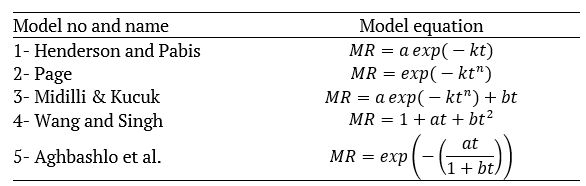
Table 1.
Thin-layer drying models.
a, b, k, n: empirical constants and coefficients in drying models.

(8)
The effective moisture diffusivity (Deff) values are determined by the slope of a straight line when ln (MR) versus time is plotted from Equation 9:

(9)
An Arrhenius type equation is generally used to model the effect of temperature on the effective moisture diffusivity, according Equation 10:

(10)
where:
D0 is the pre-exponential factor (m2 s-1), Ea is the activation energy (kJ mol-1), R is the universal gas constant [kJ/(mol´K)], and T is temperature (°C).
Rehydration
To determine the rehydration characteristics of the dried kiwifruit slices, dried samples were immersed in distilled water maintained at 20°C. About five g of the dried slices was weighed accurately and placed into a 400 mL beaker containing 300 mL distilled water, agitated and allowed to rehydrate for 7 hours. At the end of this time, the samples were removed from water, drained and weighed. The rehydration was expressed by moisture content of the kiwifruit slices during rehydration process. Rehydration ratio (RR) of the kiwifruit slices was calculated as follow Equation 11:

(11)
Rehydration analyses were performed in triplicate and the results were presented as the replicates mean.
Color measurements
Color values of the fresh and dried samples were measured by chroma meter (CR-13, Konica Minolta, Tokyo, Japan), calibrated previously with a white standard tile. Three readings of three different replicates were performed for each sample. The color values of the samples were expressed as L (whiteness/darkness), a (redness/greenness), and b (yellowness/blueness). The total color differences (DE) and Chroma calculated using Equations12 and 13, respectively:

(12)

(13)
Results and discussion
Drying curves
Figure 1 represents the variations of moisture content with drying time for drying of kiwifruit slices at 50, 55, 60 and 70°C. As it was expected, air temperature affected the drying curves decreasing the drying time of samples. The increase in air temperature resulted in a decrease in the drying time. For example, the drying time of samples reduced from 480 to 315 min when the air temperature was increased from 50 to 70°C. These results agreed with the findings of Simal et al. (2005), Darici and Şen (2015), and Mahjoorian et al. (2017) for kiwi slices.
Effect of citric acid solution
The effect of the pretreatment on changes in the moisture content of kiwifruit slices with drying time is shown in Figure 1. The pre-treated samples dried faster than the control samples. The drying time required reaching final water content (0.17 kg water kg dry matter-1) for control samples were 480 min at 50°C, respectively. Corresponding value for the pre-treated samples with citric acid solution was 375 min at the same temperature. The difference in drying time was close to 28%. This result shows that citric acid solution contributed to increase the permeability of the cell membranes of kiwifruit slices, leading to an increase in water diffusivity. Similar observations about the effect of pre-treatment on drying characteristics were reported in previous investigations on different fruits and vegetables, as well (Falade & Solademi, 2010;Osidacz & Anbrosio-Ugri, 2013;Ozdemir et al., 2016).
Drying rate
The characteristic of drying rate curves (drying rate versus moisture content) of kiwifruit slices, using the four temperatures are presented in Figure 2. It is apparent that drying rate decreased continuously with improving drying time. The drying rate reached its maximum values at higher drying air temperatures. The moisture removal inside the kiwifruit slices were higher at high drying air temperatures, because the migration of moisture to the surface and the evaporation rate from surface to air slows down with decreasing the moisture in the product, the drying rate clearly decrease. It is shown that the curves in Figure 2 present only the falling-rate period with the absence of a constant-rate period. This shows that diffusion was domain physical mechanism governing moisture movement in drying process. These results are in agreement with the observations of earlier researchers on kiwifruit drying (Chin, Siew, & Soon, 2015;Darici & Şen, 2015).
Evaluation of drying models
Non-linear regression analysis was done according to five drying models presented in Table 1. The best mathematical model the fit the experimental data was chosen based on maximized R2 and minimized c2 and RMSE. The results of statistical analysis undertaken on the models for air drying are summarized in Table 2. The good agreement between the experimental and predicted variables indicates that the selected model (Midilli & Kucuk) could be used satisfactorily to predict the drying of kiwifruit slices. The values of R2, c2, and RMSE for the selected models vary between 0.9976 and 0.9998, 0.000009 and 0.000203, and 0.024175 and 0.101808, respectively. Figure 3 compare the experimental data with the predicted ones using different models for kiwifruit slices at 50, 55, 60 and 70°C. The predictions using the Midilli & Kucuk model showed MR values banded along a straight line, which proved the suitability of this model in describing the drying characteristics of kiwifruit slices.
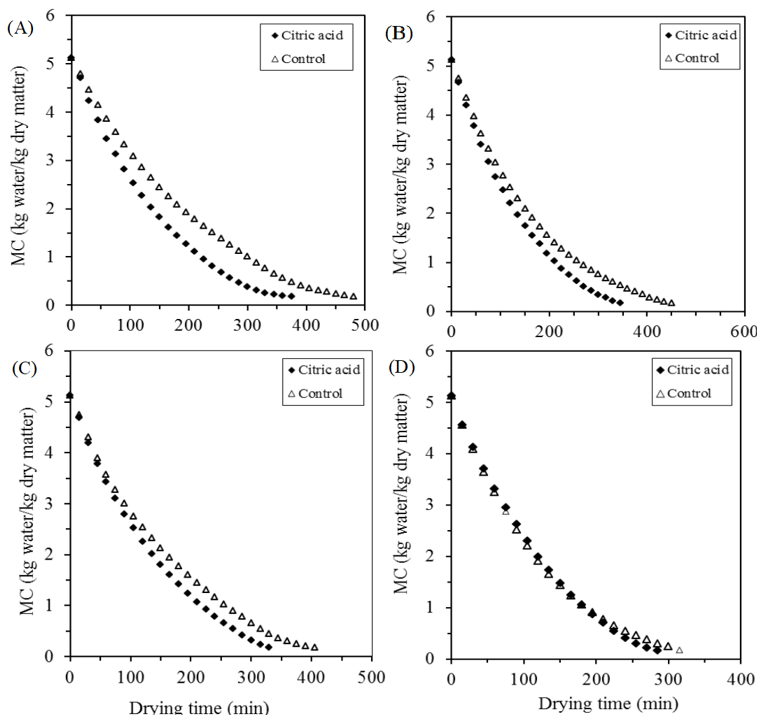
Figure 1.
Drying curves of kiwifruit slices at different temperatures (A: 50, B: 55, C: 60, and D: 70°C).
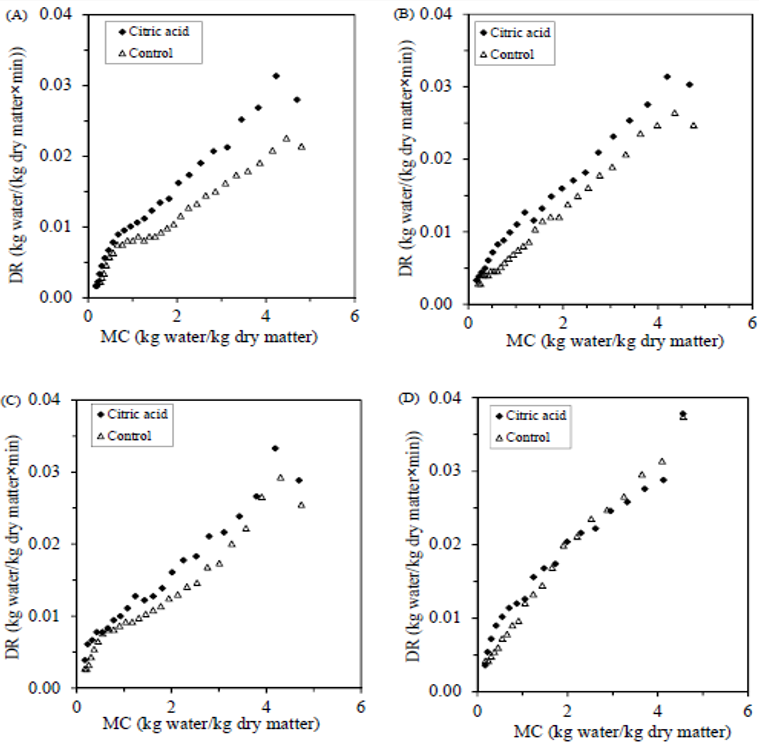
Figure 2.
Comparison of drying rate versus moisture content of kiwifruit slices (A: 50, B: 55, C: 60, and D: 70°C).
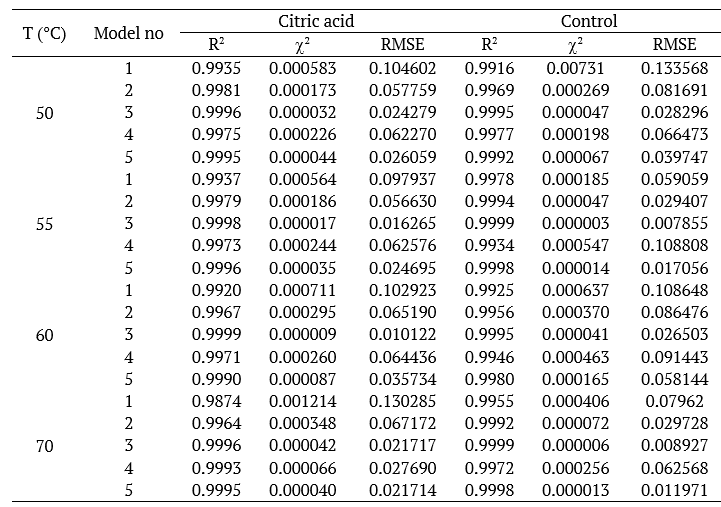
Table 2.
Statistical values of thin-layer drying of kiwifruit slices.
Effective moisture diffusivity
The effective moisture diffusivity values for different temperatures, calculated from Equation 9, are given in Figure 4. The determined values of the effective moisture diffusivity (Deff) were found to range between 3.78´10-9 and 6.57´10-9 m2 s-1. It can be seen that the values of Deff increased greatly with dipping solution. Due to influence of dipping solution on internal mass transfer of kiwifruit slices during drying, pre-treated samples had higher effective moisture diffusivity values. Another observed that the values of Deff increased with the increase of drying temperatures. This is probably due to the fact that an increase in drying temperature results in greater absorption of moisture, which increases the moisture gradient between the samples and ambient and that leads to an increase in the effective moisture diffusivity. The values of Deff are within the normal range 10-12 - 10-8 m2 s-1 for drying of food materials (Zogzas, Maroulis, & Marinos-Kouris, 1996). Deff values in this study are close to the values of 6.75´10-10 to 1.28´10-9 m2 s-1 reported by Li et al. (2016), 2.9´10-10 to 7.8´10-10 m2 s-1 by Simal et al. (2005), 4.55´10-11 to 2.12´10-10 m2 s-1 by Mahjoorian et al. (2017), and 2.346´10-10 to 4.7´10-10 m2 s-1 by Darici and Şen (2015) for the hot-air drying of kiwifruit slices at different temperatures. The differences between the results could be due to the composition structure, shape and initial moisture content of material, as well as the drying temperature, pretreatments, and drying equipment.
According to Equation 10, the values of ln(Deff) versus 1/(T+273.15) were plotted, presented in Figure 4 and activation energy was calculated. Equation 14 and 15 shows the effect of temperature on Deff of the samples with following coefficients.
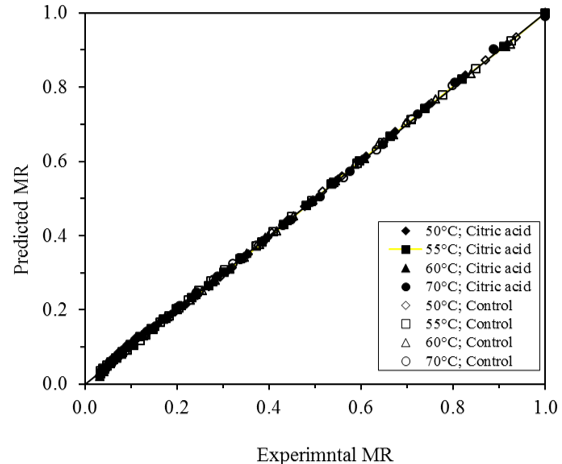
Figure 3.
Comparison of experimental and predicted moisture ratio values using Midilli & Kucuk model.
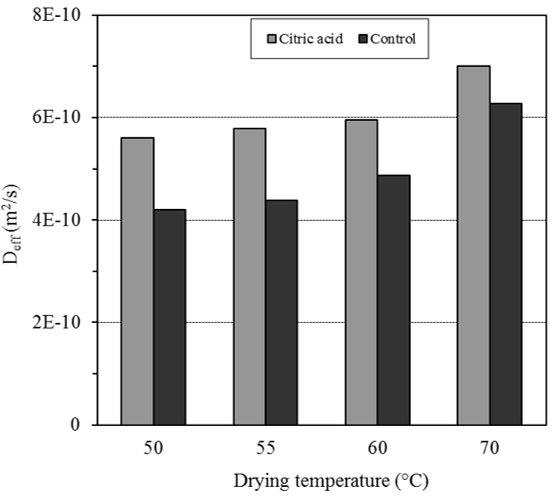
Figure 4.
Variation of effective moisture diffusivity with air-drying temperature.
Activation energy
Citric acid:

(14)
Control:

(15)
Using Equation 14 and 15, the values of activation energy were found to be 10.37 and 19.08 kJ mol-1 for citric acid and control samples, respectively. The similar values to those proposed in the literature for drying of kiwifruit slices: 27 kJ mol-1 (Simal et al., 2005), and 34.33-38.07 kJ mol-1 (Darici and Şen, 2015). The pre-treated kiwifruit slices showed lower activation energy than the control samples. Pretreating of kiwifruit slices resulted in a decrease in the activation energy require for mass diffusion during air drying.
Rehydration characteristics
Rehydration is a widely used quality index for dried products. Rehydration values provide information about the changes in physical and chemical properties of a dried sample attributed to drying and treatments preceding dehydration (Karacabey, Baltacioglu, Cevik, & Kalkan, 2016). To investigate the effect of drying conditions on final product quality, the values rehydration ratio of dried kiwifruit slices were calculated by using Equation 11 and shown in Figure 6. The RR values of dried samples increased with increase temperature from 50 to 60°C. The highest value of RR was achieved at 60°C dried samples. After this temperature, the value of RR decreased as drying temperature increased. Furthermore, the RR values of pre-treated samples with citric acid solution were higher than those control ones at all temperatures. It can be said that citric acid solution caused the low physical damage in the samples.
Color
Color is one of the most important quality parameters of dried products and a decisive factor for the consumer acceptance of the product (Li et al., 2016). The color values (L, a and b) of the fresh samples were measured as 50.37, -4.62, and 15.01, respectively. Table 3 represents L, a, b, ΔE, and C values of dried kiwifruit slices. The obtained results from Table 3 for color values at various conditions indicated that pre-treatment and temperature have considerable effect on the color of kiwifruit slices. Table 3 shows that L values of pre-treated samples with citric acid and control samples decreased from 54.55 to 47.66, and 50.60 to 47.43 at drying air temperatures ranging from 50 to 70°C, respectively. This result can be related to oxidative reactions that occur during drying process which is potentiated by air temperature. However, the pre-treated samples with citric acid solution displayed higher L (lightness) values compared to those control ones. The values of a and b are shown in Table 3.
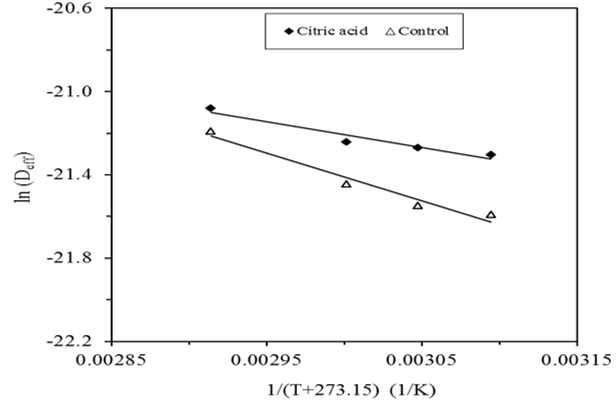
Figure 5.
Arrhenius-type relationship between effective moisture diffusivity (Deff) and air-drying temperature.
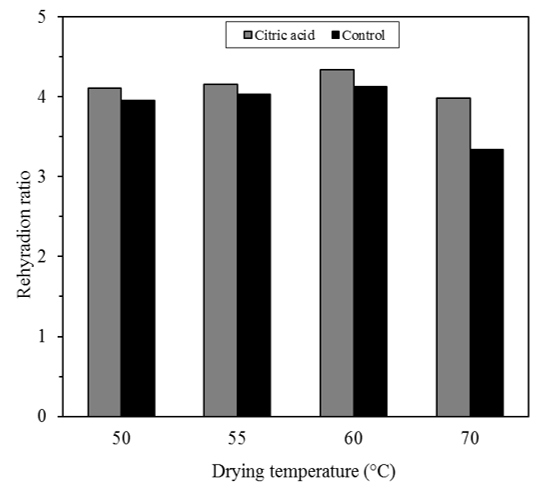
Figure 6.
Rehydration ratio versus air drying temperature.
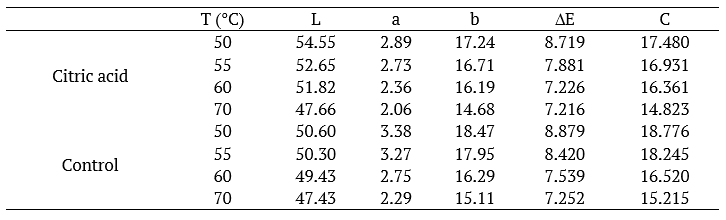
Table 3.
Results of color values for dried kiwifruit slices.
It showed that a decrease in a and b values during drying under different drying temperatures. The loss of b value indicates that the yellowness of samples decreased due to application of drying air temperatures, and it may be due to degradation of carotenoid pigments, nonenzymatic Maillard browning and formation of brown pigments. With increasing in air temperature from 50 to 70°C, ΔE was decreased from 8.719 to 7.216, respectively. The chroma (C) values showed a decrease during drying process. The obtained value for chroma shows the saturation degree of color and is corresponding to the color strength (Aidani, Hadadkhodaparast, & Kashaninejad, 2017).
Conclusion
Drying characteristics of kiwifruit slices were investigated by using a cabinet dryer at various temperatures of 50, 55, 60 and 70°C. The drying time was shortened when air temperature increased from 50 to 70°C. The drying process of kiwi occurs almost completely in the falling-rate period and a constant-rate drying period is not observed. In order to explain the drying kinetics of kiwifruit slices, five models in the literature were applied and fitted to the experimental data. According to the results of regression analysis, the experimental data were well predicted by the Midilli & Kucuk model. The effective moisture diffusivity was found in the range of 4.19´10-10 to 6.99´10-10 m2 s-1 as the drying temperature increased from 50 to 70°C. The value of activation energy was determined to be 10.37 and 19.08 kJ mol-1 for citric acid and control samples, respectively. The highest rehydration ratio value was obtained in 60°C dried kiwifruit slices. With increasing in air drying temperature, L, a, b, ΔE and C values were decreased.
References
Aidani, E., Hadadkhodaparast, M., & Kashaninejad, M. (2017). Experimental and modeling investigation of mass transfer during combined infrared-vacuum drying of Hayward kiwifruits. Food Science & Nutrition, 5(3), 596-601. doi: 10.1002/fsn3.435
Association of Official Analytical Chemists [AOAC]. (1990). Official method of analysis (15th ed.). Arlington, VA: AOAC Inc.
Baomeng, Z., Xuesen, W., & Guodong, W. (2014). Effect of pre-treatments on drying characteristics of Chinese jujube (Zizyphus jujuba Miller). International Journal of Agricultural and Biological Engineering, 7(1), 94-102. doi: 10.3965/j.ijabe.20140701.011
Chin, S. K., Siew, E. S., & Soon, W. L. (2015). Drying Characteristics and quality evaluation of kiwi slices under hot air natural convective drying method. International Food Research Journal, 22(6), 2188-2195.
Crank, J. (1975). The mathematics of diffusion (2nd ed.). Oxford, UK: Clarendon Press.
Darici, S., & Şen, S. (2015). Experimental investigation of convective drying kinetics of kiwi under different conditions. Heat and Mass Transfer, 51(8), 1167-1176. doi: 10.1007/s00231-014-1487-x
Darvishi, H. (2017). Quality, performance analysis, mass transfer parameters and modeling of drying kinetics of soybean. Brazilian Journal of Chemical Engineering, 34(1), 143-148. doi: 10.1590/0104-6632.20170341s20150509
Doymaz, I. (2004). Effect of pre-treatments using potassium metabisulphide and alkaline ethyl oleate on the drying kinetics of apricots. Biosystems Engineering, 89(3), 281-287. doi: 10.1016/j.biosystemseng.2004.07.009
Ergun, K., Koç, G. Ç., & Dirim, S. N. (2016). Determination of the drying and rehydration kinetics of freeze dried kiwi (Actinidia deliciosa) slices. Heat and Mass Transfer, 52(12), 2697-2705. doi: 10.1007/s00231-016-1773-x
Falade, K. O., & Solademi, O. J. (2010). Modeling of air drying of fresh and blanched sweet potato slices. International Journal of Food Science and Technology, 45(2), 278-288. doi: 10.1111/j.1365-2621.2009.02133.x
Food and Agricultural Organization [FAO]. (2017). Food and Agricultural Organization statistica database. Retrived from http://faostat3.fao.org/download/Q/QC/E
Hiranvarachat, B., Devahastin, S., & Chiewchan, N. (2011). Effects of acid pretreatments on some physicochemical properties of carrot undergoing hot air drying. Food and Bioproducts Processing, 89(2), 116-127. doi: 10.1016/j.fbp.2010.03.010
Ismail, O., Figen, A. K., & Pişkin, S. (2015). Effects of open-air sun drying and pre-treatment on drying characteristics of purslane (Portulaca oleracea L.). Heat and Mass Transfer, 51(6), 807-813. doi: 10.1007/s00231-014-1452-8
Izli, N., Izli, G., & Taşkın, O. (2017). Drying kinetics, colour, total phenolic content and antioxidant capacity properties of kiwi dried by different methods. Journal of Food Measurement and Characterization, 11(1), 64-74. doi: 10.1007/s11694-016-9372-6
Karacabey, E., Baltacioglu, C., Cevik, M., & Kalkan, H. (2016). Optimization of microwave-assisted drying of Jerusalem artichokes (Helianthus tuberosus L.) by response surface methodology and genetic algorithm. Italian Journal of Food Science, 28(1), 121-130. doi: 10.14674/1120-1770/ijfs.v466
Li, W., Yuan, L., Xiao, X., & Yang, X. (2016). Dehydration of kiwifruit (Actinidia deliciosa) slices using heat pipe combined with impingement technology. International Journal of Food Engineering, 12(3), 265-276. doi: 10.1515/ijfe-2015-0165
Mahjoorian, A., Mokhtarian, M., Fayyaz, N., Rahmati, F., Sayyadi, S., & Ariaii, P. (2017). Modeling of drying kiwi slices and its sensory evaluation. Food Science & Nutrition, 5(3), 466-473. doi: 10.1002/fsn3.414
Maskan, M. (2001). Drying, shrinkage and rehydration characteristics of kiwifruits during hot air and microwave drying. Journal of Food Engineering, 48(2), 177-182. doi: 10.1016/S0260-8774(00)00155-2
Nadian, M. H., Abbaspour-Fard, M. H., Sadrnia, H., Golzarian, M. R., Tabasizadeh, M., & Martynenko, A. (2017). Improvement of kiwifruit drying using computer vision system (CVS) and ALM clustering method. Drying Technology, 35, 709-723. doi: 10.1080/07373937.2016.1208665
Olanipekun, B. F., Tunde-Akintunde, T. Y., Oyelade, O. J., Adebisi, M. G., & Adenaya, T. A. (2015). Mathematical modeling of thin-layer pineapple drying. Journal of Food Processing and Preservation, 39(6), 1431-1441. doi: 10.1111/jfpp.12362
Omolola, A. O., Jideani, A. I., & Kapila, P. F. (2017). Quality properties of fruits as affected by drying operation. Critical Reviews in Food Science and Nutrition, 57(1), 95-108. doi: 10.1080/10408398.2013.859563
Osidacz, R. C., & Anbrosio-Ugri, M. C. B. (2013). Physicochemical quality of eggplant dehydrated with varied preatments. Acta Scientiarum. Technology, 35( 1), 175-179. doi: 10.4025/actascitechnol.v35i1.10551
Ozdemir, Y., Ozturk, A., & Tüfekçi, S. (2016). Effect of two dipping pretreatment on drying kinetics of golden berry (Physalis peruviana L.). African Journal of Agricultural Research, 11(1), 40-47. doi: 10.5897/AJAR2014.8937
Simal, S., Femenia, A., Garau, M. C., & Rosselló, C. (2005). Use of exponential, Page’s and diffusional models to simulate the drying kinetics of kiwi fruit. Journal of Food Engineering, 66(3), 323-328. doi: 10.1016/j.jfoodeng.2004.03.025
Zogzas, N. P., Maroulis, Z. B., & Marinos-Kouris, D. (1996). Moisture diffusivity data compilation in foodstuffs. Drying Technology, 14(10), 2225-2253. doi: 10.1080/07373939608917205
Notas de autor
doymaz@yildiz.edu.tr