Ciência, Tecnologia Alimentar e Engenharia de Alimentos
Drying of foods under intermittent supply of microwave energy: proposal for a mathematical model
Drying of foods under intermittent supply of microwave energy: proposal for a mathematical model
Acta Scientiarum. Technology, vol. 43, e51037, 2021
Universidade Estadual de Maringá
Recepción: 18 Noviembre 2019
Aprobación: 05 Julio 2020
Abstract: Intermittent microwave drying improves the quality of the dehydrated product, because reduces the effect of microwave hot spots. Mathematical modelling is essential to understand the physics of this drying process and to optimize the operation conditions. However, there are few modelling studies about intermittent microwave drying. This work proposed a mathematical model based on mass balances of liquid and vapor water in which a non-equilibrium formulation described the water phase change. The microwave heating, described by Lambert’s law, was accounting as source term on the thermal energy conservation equation. The numerical solution used the finite element method, and the experimental drying of potato samples validated the simulated drying. The values of moisture content and temperature obtained by numerical solution of the model showed good agreement with experimental data. From this, it was observed the presence of three periods in the drying kinetics: an initial heating phase almost without drying, follow by a phase with constant drying rate, and final a decrease of drying rate and temperature increasement. The model results showed that the interior temperature was higher than the surface temperature of sample, and there was water evaporation inside the potato. In additional, the gradients of temperature were reduced due to intermittency of the microwave power. This redistribution of temperature could contribute to the improvement of product quality during drying.
Keywords: numerical simulation, microwave heating, non-equilibrium phase change, lambert’s law.
Introduction
The use of electromagnetic energy at microwave frequency coupled to different drying methods (convection, vacuum, lyophilizing) has been widely used for dehydrating fruits and vegetables (Monteiro, Link, Tribuzi, Carciofi, & Laurindo, 2018; Barreto, Tribuzi, Marsaioli Junior, Carciofi, & Laurindo, 2019; Das & Arora, 2018; Ando et al., 2019; Wang et al., 2019). The use of microwave energy not only reduces drying time, but also allows for dehydrated products of high quality and crispy texture to be obtained (Monteiro et al., 2018; Barreto et al., 2019, Ando et al., 2019).
Microwaves are capable of penetrating foods and dissipating energy in the form of heat as a result of two mechanisms: dipolar rotation and ionic conduction. When drying, food is volumetrically heated, leading to a quick increase of internal temperature and vaporization of water. The vapor generated increases internal pressure that pushed the liquid water to the food surface. As a result, removal of water is faster and drying times are significantly reduced (Zhu, Gulati, Datta, & Huang, 2015; Gulati, Zhu, & Datta, 2016; Joardder, Kumar, & Karim, 2017; Kumar, Joardder, Farrell, Millar, & Karim, 2016b).
Although microwave drying is a very inviting method, one of the major drawbacks of electromagnetic heating is the existence of hot spots inside the food. Major problems related to non-uniform microwave heating are the overheating and consequent loss of end quality of the dehydrated product. In order to avoid such issue, intermittent supply of electromagnetic energy during drying might be a viable option (Gunasekaran & Yang, 2007a, 2007b;Vadivambal & Jayas, 2010; Kumar, Karim, & Joardder, 2014).
At the drying with intermittent supply of electromagnetic energy, the magnetron of the drier (microwave generator) usually operates in ‘on-off’ cycles. The food material is heated for a certain period of time (magnetron ‘on’) and remains for another period not heated (magnetron ‘off’). When not under heating, the temperature gradients inside the food are minimized, as the thermal energy is transferred to less heated zones areas. In this manner, the thermal effects upon thermosensitive compounds and also energy consumption are minimized (Kumar et al., 2014). Several studies employing intermittent supply of microwave energy have demonstrated improvements on sensory and nutritional properties of dehydrated foods, such as bananas (Ahrné, Pereira, Staack, & Floberg, 2007), red pepper (Soysal, Ayhan, Eştürk, & Arıkan, 2009b), oregano (Soysal, Arslan, & Keskin, 2009a), pineapples (Botha, Oliveira, & Ahrné, 2012), carrots (Zhao et al., 2014), apples (Aghilinategh, Rafiee, Hosseinpour, Omid, & Mohyasebi, 2015), pumpkins (Junqueira, Corrêa, & Ernesto, 2017), quinces (Dehghannya, Hosseinlar & Heshmati, 2018), mushrooms (Wang et al., 2019), and potatoes (Dehghannya, Kadkhodaei, Heshmati, & Ghanbarzadeh, 2019). These studies also evidence that, for each type of food, microwave potencies and the frequency of heat pulses utilized must be carefully determined, as variations of these parameters can directly influence the quality of the final product.
Mathematical models can be used to better understand mass and heat transfers involved in the drying process. Nevertheless, few studies have demonstrated theoretical models in order to describe drying of foods with intermittent supply of microwave energy (Zhu et al., 2015; Gulati et al., 2016; Joardder et al., 2017; Kumar, Joardder, Farrell, & Karim, 2016a; Kumar et al., 2016b; Kumar, Joardder, Farrell, & Karim, 2018). Recently, Gulati et al. (2016) proposed a model which describes the drying process, including multiphase transport (water, vapor and air) in a porous medium (including capillarity, diffusion and advection transport), propagation of electromagnetic waves (calculated from Maxwell equations of the electromagnetism) and deformation of porous matrix (momentum balance). Even though these authors describe the drying process accurately, this model requires advanced numerical methods for solving the equations, high-end computers with great processing capacity and long periods of time required for calculations.
Thus, the present study aimed to propose an alternative mathematical model to describe the drying process with intermittent microwave heating. The model includes the transport of the liquid and vapor water, coupled with heat transfer and microwave heating. For validation of the mathematical model, experimental data obtained from drying of potatoes were used
Material and methods
Experimental procedure
Potatoes (Solanum tuberosum) used in drying experiments were acquired from local markets (Umuarama, State of Paraná, Brazil). Dry basis moisture content (Xbs) of the samples (6.6 ± 0.3 kg kg-1) was assessed by gravimetric method using a lab oven (Marconi, MA035, Brazil) at 105°C for 24h (Association of Official Analytical Chemists [AOAC], 2005).
A domestic microwave oven with a frequency of 2450 MHz, nominal potency of 800W and turn table with angular speed of 0,2 π rad s‑1 (Panasonic, NN-ST568WRUK, Brazil) was used in the drying experiments. The oven allows for use of 10 levels of potency (from 10 to 100%). At 100%, the magnetron of the oven operates continuously, while at levels ranging from 10 to 90%, the magnetron operates by switching from maximum power to zero power in time cycles of 22 s per cycle. The experiments were all carried out at a potency level of 10% (4 s magnetron ‘on’ and 18 s magnetron ‘off’), for a total drying time of 20 minutes.
For the drying experiments, the potatoes were washed and cut into cylindrical shape of 18 mm diameter and 10 mm height. Next, one sample was placed at the border of the turn table of the microwave oven, and heating at a 10% level power was carried out.
Samples kept at the border of the turn table are subject to different patterns of electromagnetic field distribution, making the heating process more efficient (Geedipalli, Rakesh, & Datta, 2007; Pitchai et al., 2014). In order to obtain the drying kinetics, the microwave oven was turn off at pre-established intervals (30, 60, 90, 120, 150, 300, 600, 900 and 1200 s) so measures of moisture content and temperature could be taken. Moisture content was determined via gravimetric method in a lab oven at 105°C for 24h, and temperature was assessed with a digital infrared thermometer (Minipa, MT-320A, Brazil). For each time interval, a new potato sample was used to reduce variability of the experimental results. Drying kinetics (Xbs vs t) and surface heating kinetics (T vs t) were obtained in triplicates.
Mathematical modeling
Microwaves penetrate the potato resulting in the rapidly increasing the internal temperature of the food, leading to evaporation of the water and reducing moisture content. Figure 1 illustrates a three-dimensional schematic representation of the sample, the axisymmetric two-dimensional calculation domain and transport mechanisms of mass and heat considered for the mathematical model.
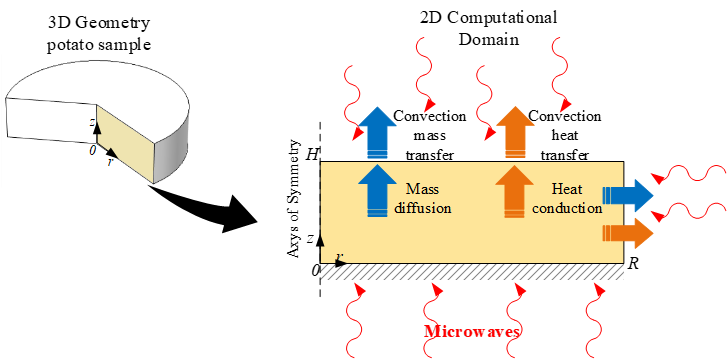
Figure 1. Schematic representation of the sample, calculation domain and transport mechanisms considered for the model.
Mass and heat transfer
To describe changes in moisture content in the sample, two mass balances were utilized, one for liquid water and another for vapor water, as given by Equations 1 and 2, respectively.
 [1-2]
[1-2]in which, ci is the mass concentration (kg m-³) and Di is the effective diffusion coefficient (m2 s-1). Sub-indexes l and v indicate water in liquid and vapor states, respectively.
Mass transfer, in both liquid and vapor phases, was modeled using Fick’s law with an effective diffusion coefficient (Di) and the phase change rate, I ̇ (kg m-³s), was described using a non-equilibrium approach according to Equation 3 (Malafronte et al., 2012).
 [3]
[3]Here, Kvap is the evaporation constant (1/s). For processes which involve microwave heating, usually Kevap = 1000 s-1 is used (Zhu et al., 2015; Gulati et al., 2016; Kumar et al., 2016a; Joardder et al., 2017; Kumar et al., 2018). Additionally, the vapor water was assumed as ideal gas, thus the equilibrium vapor concentration, c(v,eq), was calculated according to Equation (4).
 [4]
[4]In this equation Mw is the molar mass of water (Kg kmol-1), R is the ideal gas constant (J mol-1 K-1), T is the local temperature (K), Psat is the saturated vapor pressure of the water (Pa) at given T obtained by Antoine’s equation and aw is water activity.
Local thermal equilibrium was assumed and heat transfer in the sample was described using Fourier’s law, thus the conservation of thermal energy was described as:
 [5]
[5]in which, ρ is specific mass (Kg m-3), cp is specific heat (J Kg-1 K-1), k is the thermal conductivity (W m-1 K-1), ΔHvap is the latent heat of water vaporization (J Kg-1), QMV is the volumetric generation of thermal energy from microwave heating (W m-³), and f(t) is a periodic function of time which describes intermittent aspect of the microwave energy supply.
Before the drying process, it was assumed that temperature and moisture of a sample were uniform and that the concentration of vapor water was negligible. Thus, the initial conditions for Equations 1, 2 and 5, were described as:
 [6,7,8]
For the symmetry condition in the central axis, r = 0, and assuming that there is no heat and mass transfer at the base of the sample, z = 0 (Figure 1), the boundary conditions for mass and heat conservation equations were given by Equations 9, 10 and 11
 [9,10,11]
The water (liquid and vapor) and heat transferred from the surface of the sample (r = R and z = H, Figure 1) were transported to the surrounding air by convection, according to Equations 12, 13 and 14.
 [12,13,14]
In which hm is the convective mass transfer coefficient (m s-1), hT is the convective heat transfer coefficient (W m-2 K-1), UR is the relative humidity and Tair is the air temperature (K).
Microwave heating
During drying, there is reduction of the moisture content of the sample, which modifies the dielectric constant (ε’) and constant loss (ε’’) of the potato, that leads to change in microwave heating rate. Additionally, the amount of microwave dissipated is also influenced by geometry of the sample and its dimensions. In this study, it is assumed that microwaves are evenly distributed over the material surface, and that propagation inside the material occurs perpendicularly to the surface. In order to model the electromagnetic heating, Lambert’s model for cylindrical sample was used (Equation 15) (Sanga, Mujumdar, & Ranghavan, 2002; Romano, Marra, & Tammaro, 2005; Kostoglou & Karapantsios, 2006, Fan et al., 2012)
 [15]
[15]The total microwave power, Qt, was experimentally determined (160.3 W ± 25.4 W) by heating a water container of dimensions and geometry similar to that of the potato samples used in this study, following methodologies from previous studies (Arballo, Campañone, & Mascheroni, 2012; Kumar et al., 2016b). Attenuation constant α (1 m-1) was determined as a function of the dielectric constant (ε’) and of the constant loss (ε’’), as shown in Equation 16 (Sadiku, 2012).
 [16]
[16]where λ0 (m) is the wavelength of the microwaves in the free space.
The intermittent behavior of the electromagnetic energy supply was described by the product of the QMW function with the periodic function f(t). A representation of the f(t) is shown in Figure 2
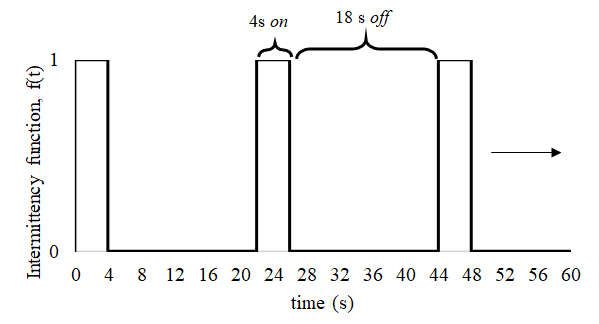
Figure 2. Schematic representation of the intermittency function f(t).
Parameters of the model
Table 1 summarizes the parameters used for solving the mathematical model. These parameters were obtained from literature. Thermodynamic and transport properties, as density (ρ), specific heat (cp) and thermal conductivity (k), were described as functions of moisture content in dry basis (Xbs). The coefficient diffusion of liquid water (Dl) as temperature dependent and the dielectric properties (ε’ e ε’’) as moisture content dependent.
Numerical solution
The mathematical model was solved using the finite element method using a commercial computational code (COMSOL Multiphysics® version 5.3). The Equations 1 (liquid water) and 2 (vapor water) were solved using Chemical Reaction Engineering Module with the interface Transport of Dilute Species, and the Heat Transfer Module with the interface Heat Transfer in Solids was used to solve the Equation 5 (thermal energy).
Triangular elements whit second order interpolation function were used for discretization. As showed in Figure 3, mesh elements of 0.36 mm (inside the domain), 0.18 mm (at surface domain) and ‘boundary layers mesh’ were used, resulting in a mesh with 8,316 elements and 31,751 degrees of freedom. Direct resolution solver PARDISO solved the linear systems, and the transient problem was solved with the Backward Differentiation Formula (BDF) with a maximum time step restriction of 0.5 s. The numerical resolution was carried out in a workstation Intel Xeon E3-1240 3.5 GHz with 16 GB of RAM memory (ThinkStation P310 Signature Edition, Lenovo), taking an average time of 10 hours to simulate a drying process of 20 minutes.

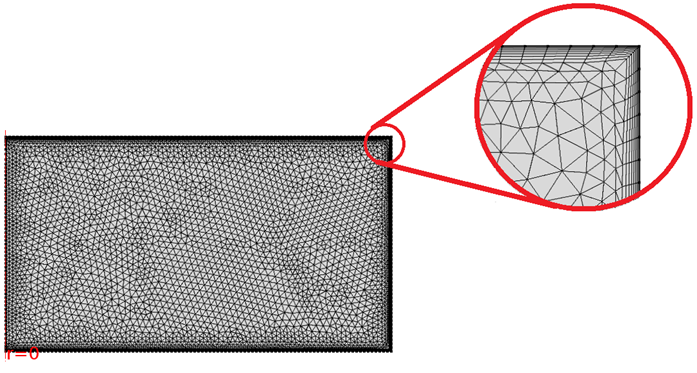
Figure 3. Schematic representation of the computational mesh.
Results and discussions
Figure 4 shows the experimental data of the moisture content and the surface temperature of the potato, and the values obtained by numerical solution of the model. The model predicted well the drying kinetics (Figure 4a) and the temperature (Figure 4b), following the experimental curves behavior. The moisture content was reduced from 6.6 Kg Kg-1 to values lower than 0.1 Kg Kg-1, after 20 min. of drying, while the temperature increased rapidly at the beginning of the process and then remain close to an average value (~70ºC) until the end of the drying.
The present model describes the transport of mass in potato assuming diffusion mechanisms, i.e., the mass flux is due the presence of the concentration gradients. This simplification may be one reason of the differences between experimental and calculated data (Figure 4). During the microwave drying the water can be evaporate inside the sample leading a pressure increasement. As demonstrated by Zhu et al. (2015) and Teleken et al. (2020) this pressure gradient is an important driving force for the moisture flow in the food. In addition, a more detailed description of the microwave heating, using Maxwell’s equations could also contribute to a better description of the experimental data. The Maxwell’s equations are able to account for the standing wave effect inside the sample, while the Lambert’s law (Equation 16) does not (Yang & Gunasekaran, 2004).
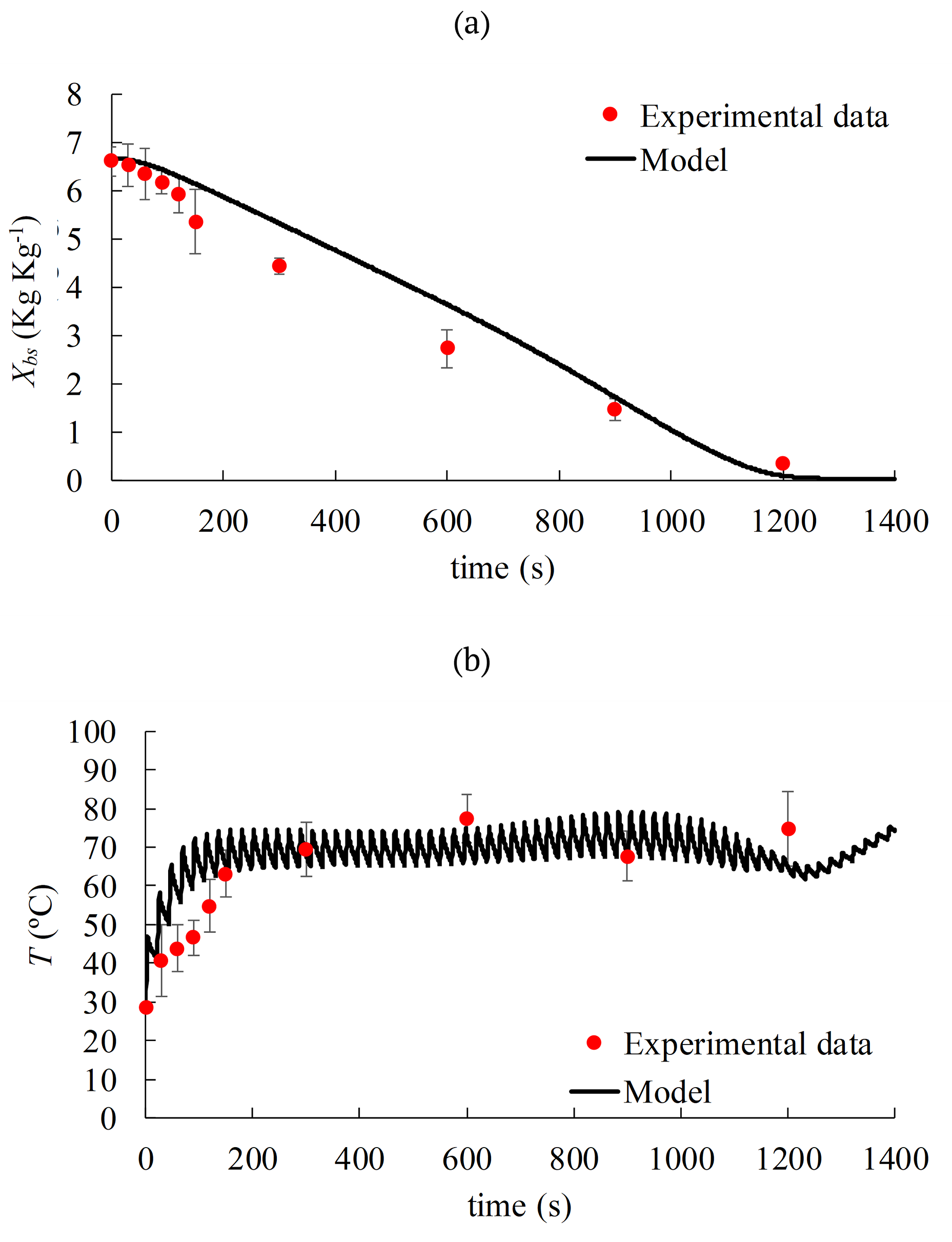
Figure 4. Model validation by comparing computed (continuous line) and (a) experimental intermittent drying kinetics (dots) and (b) temperature at sample surface (dots).
The computed values for overall drying rate (dXbs dt-1), average sample temperature (Tmed) and total energy dissipated in the sample (Qtotal) are showed in Figure 5a. These results evidence that the drying process presents three stages. In the beginning, a short period of heating and low drying rate (0-150s). The microwave energy is mainly converted in sensible heat, resulting in increasement of the potato temperature while the moisture remains constant. The temperature increases until approaching the saturated vapor pressure of water, then, the moisture is reduced as vapor has been produced. In this period, the temperature and drying rate oscillate around the constant values (70ºC and 0.006 kg Kg-1 s-1, respectively), because the dissipated microwave energy is converted mainly in latent heat. In the third drying period, drying rate decrease and temperature increase. Three drying stages in microwave drying have also been observed by Li, Zhang and Li (2008) model, during microwave vacuum drying of wood, and by Kowalski, Musielak and Banaszak (2010) model, during microwave convective drying of ceramics samples.
It also was found in Figure 5 that, the amount of microwave power dissipated in the samples varies considerable with the moisture content. For moisture content, Xbs, ranging from 2.5 e 6.7 Kg Kg-1, there is a slight variation of the dissipated energy, between 120 and 145 W, approximately. However, when the moisture content decreases to values lower than 2.5 Kg Kg-1, there is a substantial reduction of dissipated microwave energy. Water is a dipolar molecule and the main compound of the potato subjected to microwave heating, and thus, as the moisture content decreases, less electromagnetic energy is converted into thermal energy (Zhu et al., 2015).
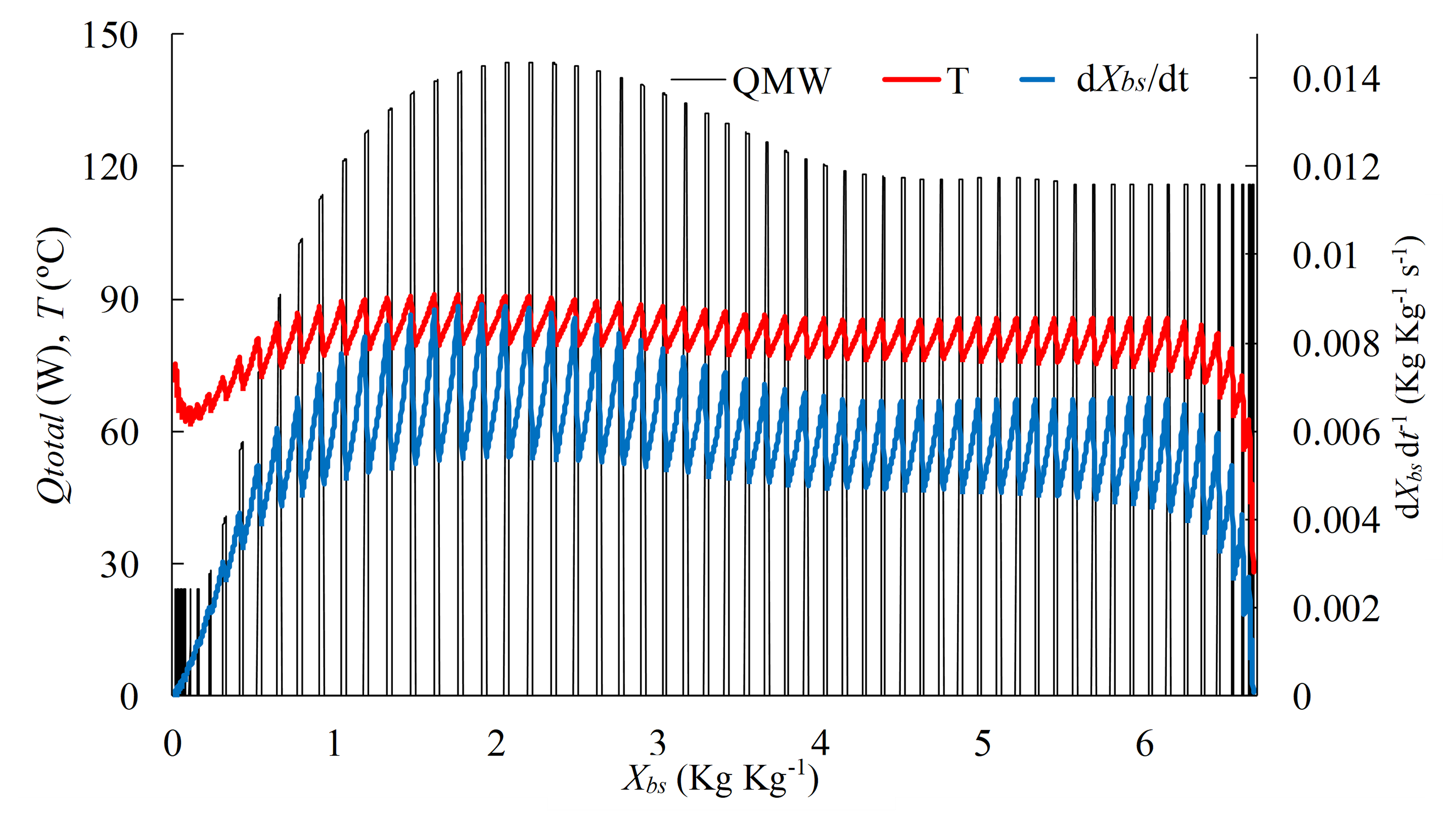
Figure 5. Overall intermittent drying rate, average sample temperature, and total energy dissipated in a sample as function of the moisture content.
The oscillatory behavior of temperature (Figure 4b, potato surface, and Figure 5a, potato average temperature) is due to the intermittent supply of microwave by the magnetron. When the magnetron ‘on’, the dissipation of microwave energy tends to concentrate close to the central axis of the sample (hot spots), as illustrated in Figure 6. In the period of the magnetron ‘off’, the thermal energy is transmitted by conduction to the other areas of the material which are less heated, thus decreasing temperature gradients (Figure 6). Similar fluctuating temperature profiles were reported by Kumar et al. (2016a, 2018) under intermittent microwave drying of cylindrical samples of apple. This redistribution of temperature could contribute in the improvement of the dehydrated product quality.
The greatest increase in temperature (microwave dissipation) occurs at the center of the potato because for cylinder-shaped samples the electromagnetic waves which fall upon the radial surface are refracted and directed to the center of the sample (Zhang & Datta, 2005a, 2005b) (Figure 6). In additional, the lowest temperatures observed at the surface and edges of sample are due to intense removal of moisture (evaporative cooling).
Moisture distribution in the sample is shown in Figure 7. It can be observed that the moisture content of the surface is reduced near to zero after about 1,200 s of drying. Additionally, the moisture content close to the center of the potato also reduced, because of the greatest microwave dissipation in this place and the consequent water evaporation inside the sample. Gulati, Zhu, Datta, Huang (2015) observed experimentally, during microwave drying of spherical samples of potatoes, the evaporation of water inside the samples.
Photographs taken from the surface of the potato samples after the drying are showed in Figure 8 and it can be observed burnet regions close to the center of the sample. This result is in accordance with simulations which predicted greater temperature increases (Figure 6) and greater moisture content decreases (Figure 7) close to the center of the sample. The quality of dehydrated food, result from physical modifications during drying. These changes depend on the rate and uniformity of heating, as well as the transport of the moisture. The proposed mathematical model can be a useful tool for the investigation of complex transport process inside the food and to optimize the operation contitions to obtain hight quality dehydrated food.
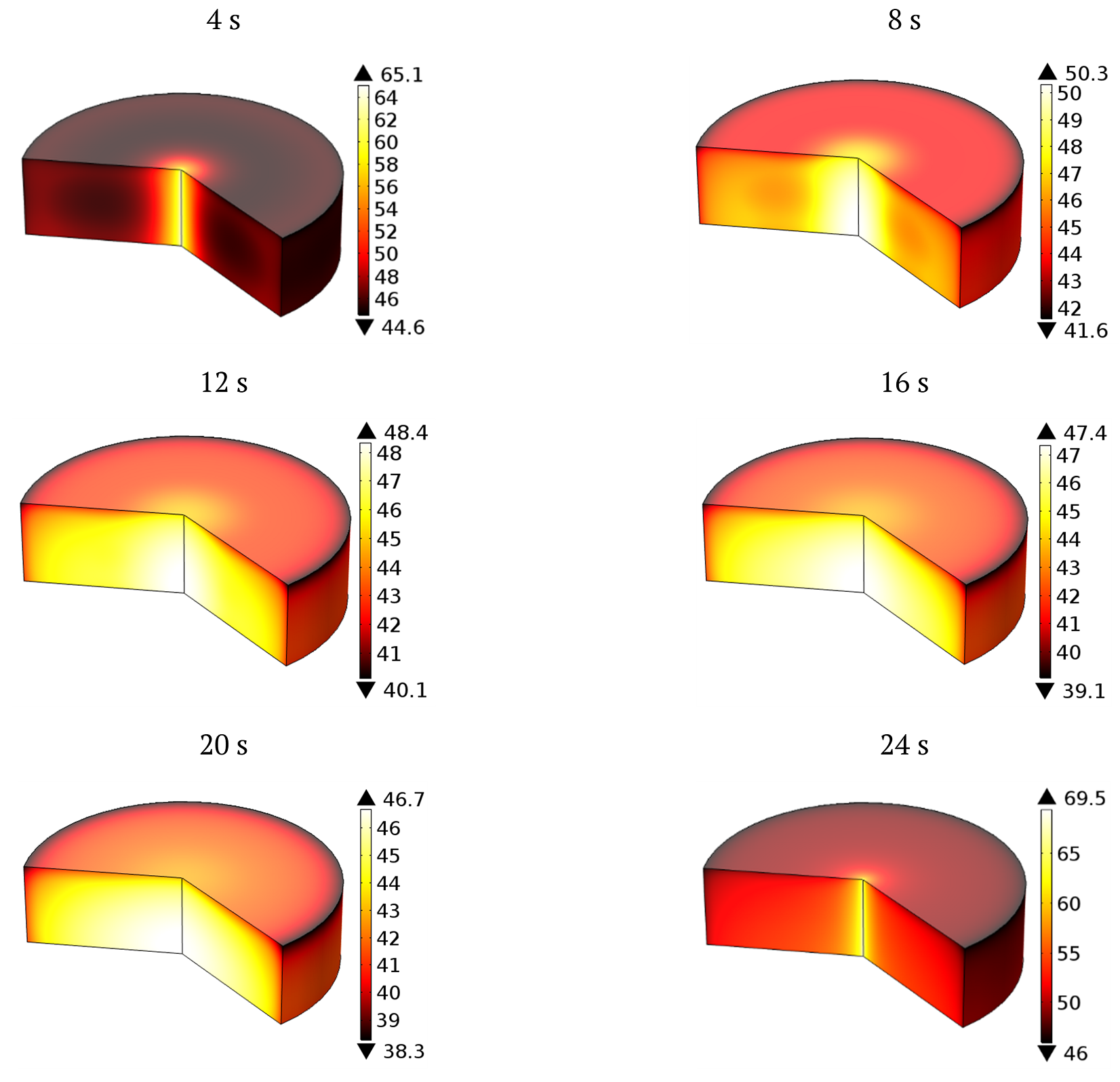
Figure 6. Temperature profiles (T, ºC) inside samples at the first heating cycle: 0-4s of magnetron turned ‘on’ followed by 4-22s of magnetron turned ‘off’.
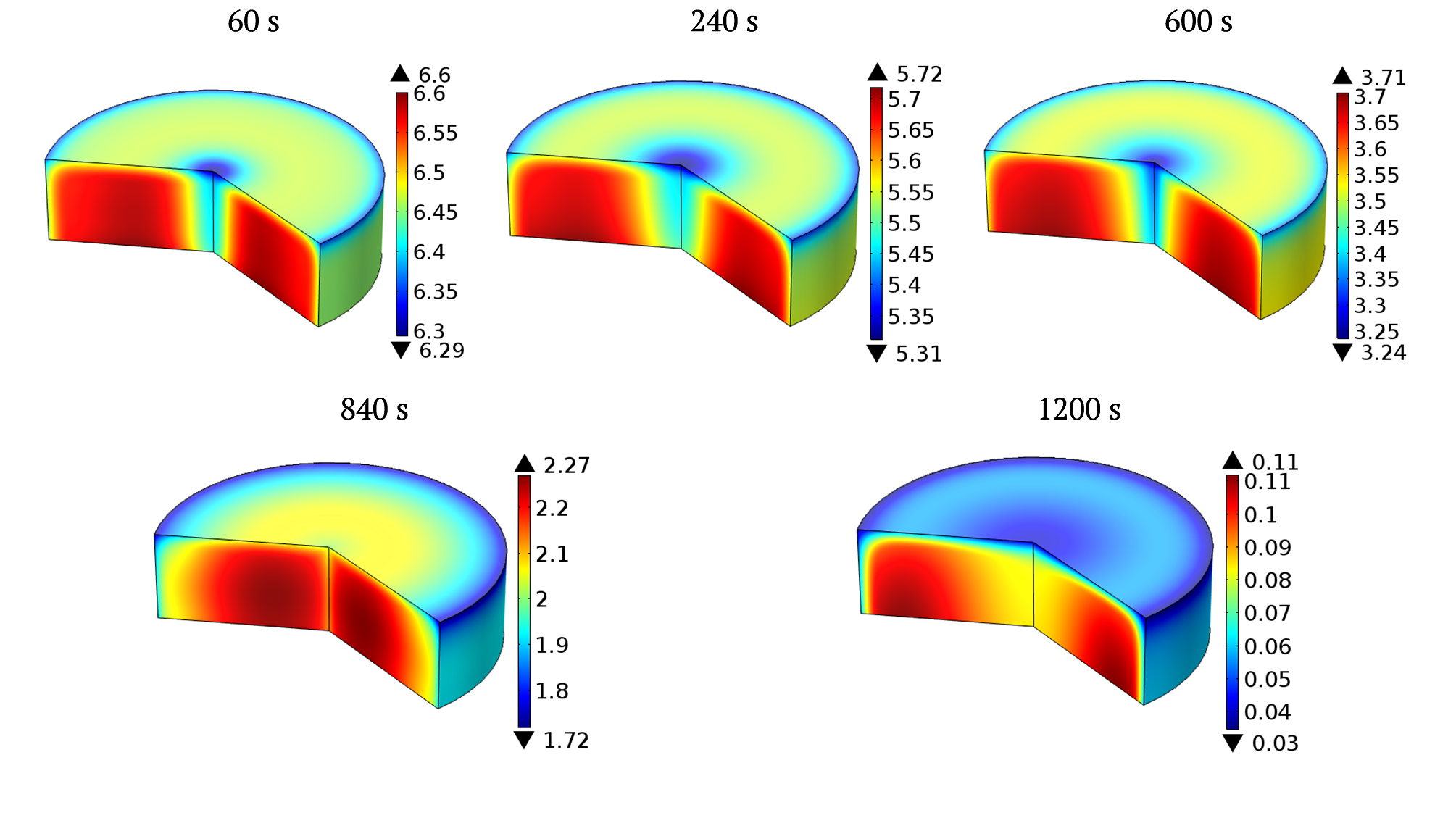
Figure 7. Moisture profiles in dry basis Xbs inside the sample during the intermittent drying.
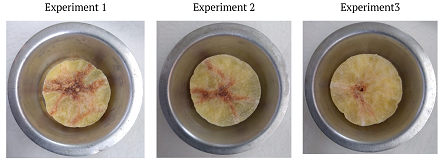
Figure 8. Photographs of the surface of the samples after 20 minutes of intermittent drying. (triplicates).
Conclusion
The proposed model coupling heat and mass transport phenomena allowed the evaluation of temporal and spatial of the temperature and moisture content (liquid water and vapor) within the potato sample during the drying process. The intermittent supply of microwave energy resulted at the reduction of thermal gradients inside the sample, which is crucial for the quality of dehydrated foods. In addition, the experimental and numerical results showed the presence of three periods in the drying kinetics: an initial heating phase, follow by a longer phase with constant drying rate, and a short final phase with decreasing drying rate.
References
Aghilinategh, N., Rafiee, S., Hosseinpour, S., Omid, M., & Mohyasebi, S. S. (2015) Optimization of intermittent microwave-convective drying using response surface methodology. Food Science and Nutrition, 3, 331-341. doi: 10.1002/fsn3.224
Ahrné, L. M., Pereira, N. R., Staack, N., & Floberg, P. (2007). Microwave convective drying of plant foods at constant and variable microwave power. Drying Technology, 25, 1149-1153. doi: 10.1080/07373930701438436
Ando, Y., Hagiwara, S., Nabetani, H., Sotome, I., Okunishi, T., Okadome, H., ... Tagawa, A. (2019). Effects of prefreezing on the drying characteristics, structural formation and mechanical properties of microwave-vacuum dried apple. Journal of Food Engineering, 244, 170-177. doi: 10.1016/j.jfoodeng.2018.09.026
Arballo, J. R., Campañone, L. A., & Mascheroni, R. H. (2012). Modeling of microwave drying of fruits. Part II: effect of osmotic pretreatment on the microwave dehydration process. Drying Technology, 30, 404-415. doi: 10.1080/07373937.2011.645100
Association of Official Analytical Chemists [AOAC]. (2005). Official Methods of Analysis (18th ed.). Gaithersburg, MD: AOAC.
Barreto, I. M. A., Tribuzi, G., Marsaioli Junior, A., Carciofi, B. A. M., & Laurindo, J. B. (2019). Oil-free potato chips produced by microwave multiflash drying. Journal of Food Engineering, 261, 133-139. doi: 10.1016/j.jfoodeng.2019.05.033
Botha, G. E., Oliveira, J. C., & Ahrné, L. (2012) Microwave assisted air drying of osmotically treated pineapple with variable power programmes. Journal of Food Engineering, 108, 305-311. doi: 10.1016/j.jfoodeng.2011.08.009
Chen, J., Pitchai, K., Birla, S., Negahban, M., Jones, D., & Subbian, J. (2014). Heat and mas transport during microwave heating of mashed potato in domestic oven – model development, validation and sensitivity analysis. Journal of Food Science, 79, 1991-2004. doi: 10.1111/1750-3841.12636
Das, I., & Arora, A. (2018). Alternate microwave and convective hot air application for rapid mushroom drying. Journal of Food Engineering, 223, 208-219. doi: 10.1016/j.jfoodeng.2017.10.018
Dehghannya, J., Hosseinlar, S., & Heshmati, M. K. (2018). Multi-stage continuous and intermittent microwave drying of quince fruit coupled with osmotic dehydration and low temperature hot air drying. Innovative Food Science & Emerging Technologies, 45, 132-151. doi: 10.1016/j.ifset.2017.10.007
Dehghannya, J., Kadkhodaei, S., Heshmati, M. K., & Ghanbarzadeh. (2019). Ultrasound-assisted intensification of a hybrid intermittent microwave - hot air drying process of potato: quality aspects and energy consumption. Ultrasonics, 96, 104-122. doi: 10.1016/j.ultras.2019.02.005
Dhall, A., & Datta, A. K. (2011). Transport in deformable food materials: a poromechanics approach. Chemical Engineering Science, 66, 6482-6497. doi: 10.1016/j.ces.2011.09.001
Fan, D., Li, C., Ma, W., Zhao, J., Zhang, H., & Chen, W. (2012). A study of the power absorption and temperature distribution during microwave reheating of instant rice. International Journal of Food Science + Technology, 47(3), 640-647. doi: 10.1111/j.1365-2621.2011.02888.x
Geedipalli, S. S. R., Rakesh, V., & Datta, A. K. (2007). Modeling the heating uniformity contributed by a rotating turntable in microwave ovens. Journal of Food Engineering, 82, 359-368. doi: 10.1016/j.jfoodeng.2007.02.050
Gulati, T., Zhu, H., & Datta, A.K. (2016). Coupled electromagnetics, multiphase transport and large deformation model for microwave drying. Chemical Engineering Science, 156, 206-228. doi: 10.1016/j.ces.2016.09.004
Gulati, T., Zhu, H., Datta, A. K., Huang, K. (2015). Microwave drying of spheres: Coupled electromagnetics-multiphase transport modeling with experimentation. Part: II: Model validation and simulation results. Food and Bioproducts Processing, 96, 326-337. doi: 10.1016/j.fbp.2015.08.001
Gunasekaran, S., & Yang, H. (2007a) Effect of experimental parameter on temperature distribution during continuous and pulsed microwave heating. Journal of Food Engineering, 78, 1452-1456. doi: 10.1016/j.jfoodeng.2006.01.017
Gunasekaran, S. & Yang, H. (2007b) Optimization of pulsed microwave heating. Journal of Food Engineering, 78, 1457-1462. doi: 10.1016/j.jfoodeng.2006.01.018
Holtz, E., Ahrné, L., Rittenanuer, M., & Rasmuson, A. (2010). Influence of dielectric and sorption properties on drying behavior and energy efficiency during microwave convective drying of selected food and non- food inorganic materials. Journal of Food Engineering, 97, 144-153. doi: 10.1016/j.jfoodeng.2009.10.003
Jia, L. W., Islam, M. R., & Mujumdar, A. (2003). A simulation study on convection and microwave drying of different food products. Drying Technology, 21, 1549-1574. doi: 10.1081/DRT-120024679
Joardder, M. U. H., Kumar, C., & Karim, M. A. (2017). Multiphase transfer model for intermittent microwave-convective drying of food: considering shrinkage and pore evolution. International Journal of Multiphase Flow, 95, 101-119. doi: 10.1016/j.ijmultiphaseflow.2017.03.018
Junqueira, J. R. J., Corrêa, J. L. G., & Ernesto, D. B. (2017). Microwave, convective, and intermittent microwave-convective drying of pulsed vacuum osmodehydrated pumpkin slices. Journal of Food Processing and Preservation, 41(6), e13250. doi: 10.1111/jfpp.13250
Kostoglou, M., & Karapantsios, T. D. (2006). Approximate computation of heat sources in axisymmetric microwave heating. AIChE Journal, 52(1), 408-413. doi: 10.1002/aic.10636
Kowalski, S., Musielak, G., & Banaszak, J. (2010). Heat and mass transfer during microwave-convective drying. AIChE Journal, 56(1), 24-35. doi: 10.1002/aic.11948
Kumar, C., Karim, M. A., & Joardder, M. U. (2014). Intermittent drying of food products: A critical review. Journal of Food Engineering, 121, 48-57. doi: 10.1016/j.jfoodeng.2013.08.014
Kumar, C., Joardder, M. U. H., Farrell, T. W., & Karim M. A. (2016a) Multiphase porous media model for intermittent microwave convective drying (IMCD) of food. International Journal of Thermal Sciences,104, 304-314. doi: 10.1016/j.ijthermalsci.2016.01.018
Kumar, C., Joardder, M. U. H., Farrell, T. W., & Karim, M. A. (2018). Investigation of intermittent microwave convective drying (IMCD) of food materials by a coupled 3D electromagnetics and multiphase model. Drying Technology, 36, 736-750. doi: 10.1080/07373937.2017.1354874
Kumar, C., Joardder, M. U. H., Farrell, T. W., Millar, G. J., & Karim, M. A. (2016b). Mathematical model for intermittent microwave convective drying of food materials. Drying Technology, 34, 962-973. doi: 10.1080/07373937.2015.1087408
Li, X., Zhang, B., Li, W. (2008). Microwave-vacuum drying of wood: model formulation and verification. Drying Technology, 26, 1382-1397. doi: 10.1080/07373930802333551
Malafronte, L., Lamberti, G., Barba, A. A., Raaholt, B., Holtz, E., & Ahrné, L. (2012). Combined convective and microwave assisted drying: Experiments and modeling. Journal of Food Engineering, 112, 304-312. doi: 10.1016/j.jfoodeng.2012.05.005
Mattea, M., Urbicain, M. J., & Rotstein, E. (1986). Prediction of thermal conductivity of vegetable foods by the effective medium theory. Journal of food Science, 51, 113-115. doi: 10.1111/j.1365-2621.1986.tb10848.x
Monteiro, R. L., Link, J. V., Tribuzi, G., Carciofi, B. A. M., & Laurindo, J. B. (2018). Effect of multi-flash drying and microwave vacuum drying on the microstructure and texture of pumpkin slices. LWT-Food Science and Technology, 96, 612-619. doi: 10.1016/j.lwt.2018.06.023
Pitchai, K., Chen, J., Birla, S., Gonzalez, R., Jones, D., & Subbiah, J. (2014). A microwave heat transfer model for a rotating multi-component meal in a domestic oven: development and validation. Journal of Food Engineering, 128, 60-71. doi: 10.1016/j.jfoodeng.2013.12.015
Romano, V. R., Marra, F., & Tammaro, U. (2005). Modelling of microwave heating of foodstuff: study on the influence of sample dimensions with a FEM approach. Journal of Food Engineering, 71, 233-241. doi: 10.1016/j.jfoodeng.2004.11.036
Sadiku, M. N. O. (2012). Elements of electromagnetics (5th ed.). Porto Alegre, RS: Bookman, Inc.
Sanga, E. C. M., Mujumdar, A. S., & Ranghavan, G. S. V. (2002). Simulation of convection-microwave drying for a shrinking material. Chemical Engineering and Processing, 41, 487-499. doi: 10.1016/S0255-2701(01)00170-2
Smith, J. M., Ness, H. C. van, Abbott, M. M. (2007). Introduction to chemical engineering thermodynamics (7th ed.). New York, NY: McGraw Hill Higher Education Inc.
Soysal, Y., Arslan, M., & Keskin, M. (2009a). Intermittent microwave-convective air drying of oregano. Food Science and Technology International, 15, 397-406. doi: 10.1177/1082013209346588
Soysal, Y., Ayhan, Z., Eştürk, O., & Arıkan, M. F. (2009b) Intermittent microwave–convective drying of red pepper: drying kinetics, physical (colour and texture) and sensory quality. Biosystem Engineering, 103, 455-463. doi: 10.1016/j.biosystemseng.2009.05.010
Teleken, J. T., Quadri, M. B., Oliveira, A. P. N., Laurindo, J. B., Datta, A. K., & Carciofi, B. A. M. (2020). Mechanistic understanding of microwave-vacuum drying of non-deformable porous media. Drying Technology. doi: 10.1080/07373937.2020.1728303
Vadivambal, R., & Jayas, D. S. (2010). Non-uniform temperature distribution during microwave heating of food materials – a review. Food and Bioprocess Technology, 3, 161-171. doi: 10.1007/s11947-008-0136-0
Wang, N., & Brennan, J.G. (1991). Moisture sorption isotherm characteristics of potatoes at four temperatures. Journal of Food Engineering, 14, 269-287. doi: 10.1016/0260-8774(91)90018-N
Wang, N., & Brennan, J.G. (1993) The influence of moisture content and temperature on the specific heat of potato measured by differential scanning calorimetry. Journal of Food Engineering, 19, 303-310. doi: 10.1016/0260-8774(93)90049-P
Wang, Q., Li, S., Han, X., Ni, Y., Zhao, D., & Hao, J. (2019). Quality evaluation and drying kinetics of shitake mushrooms dried by hot air, infrared and intermittent microwave-assisted drying methods. LWT-Food Science and Technology, 107, 236-242. doi: 10.1016/j.lwt.2019.03.020
Yang, H. W., & Gunasekaran, S. (2004) Comparison of temperature distribution in model food cylinders based on Maxwell’s equations and Lambert’s law during pulsed microwave heating. Journal of Food Engineering, 64, 445-453. doi: 10.1016/j.jfoodeng.2003.08.016
Zhang, H., & Datta, A. K. (2005a). Heating concentrations of microwaves in spherical and cylindrical foods. Part one: in planes waves. Food and Bioproducts Processing, 83(1), 6-13. doi: 10.1205/fbp.04046
Zhang, H., & Datta, A. K. (2005b). Heating concentrations of microwaves in spherical and cylindrical foods. Part two: in a cavity. Food and Bioproducts Processing, 83(1), 14-24. doi: 10.1205/fbp.04047
Zhao, D., An, K., Ding, S., Liu, L., Xu, Z., & Wang, Z. (2014). Two-stage intermittent microwave coupled with hot-air drying of carrot slices: drying kinetics and physical quality. Food and Bioprocess Technology, 8, 2308-2318. doi: 10.1007/s11947-014-1274-1
Zhu, H., Gulati, T., Datta, A. K., & Huang, K. (2015). Microwave drying of spheres: coupled electromagnetics-multiphase transport modeling with experimentation. Part I: Model development and experimental methodology. Food and Bioproducts Processing, 96, 314-325. doi: 10.1016/j.fbp.2015.08.003
Notas de autor
jhony_tt@yahoo.com.br