Abstract: Jaboticaba (Plinia spp.) peel is an emerging co-product with high levels of flavonoids, anthocyanins, and differentiated sensory characteristics. During the industrial processing of jaboticaba, as in the production of juices, only the pulp is used, and the peel is discarded. This work aimed to produce sequilho biscuits with different concentrations of jaboticaba peel flour (JPF) and evaluate the technological and sensory properties of the products. Biscuits with four concentrations of JPF (B1= 0.75%, B2= 1.5% B3= 2.25% and B4= 3.0%) were prepared. The physicochemical analysis, instrumental texture, color, total flavonoids, and total anthocyanins were evaluated. Sensory perceptions were investigated using the check-all-that-apply (CATA) questionnaire, hedonic scale, and purchase intention scale. Jaboticaba peel flour had high levels of total flavonoids (227.9±14.6 mg 100 g-1) and total anthocyanins (114.2±4.2 mg cyanidin-3-glycoside 100 g-1). Specific volume and bite force were not affected by the addition of JPF. The global impression for all biscuits elaborated with JPF ranged from approximately 6.5 to 7.5. It positively influenced the global impression of the biscuits, with associations with the CATA terms of fruit flavor, jaboticaba flavor, and fruit aroma. However, terms related to the texture, such as fibrous and hard, negatively influenced the global impression. It is recommended to produce sequilho biscuits with JPF addition up to 1.5%. This study demonstrated that the food industry could better exploit the jaboticaba peel, meeting consumer demand for products with differentiated sensory characteristics.
Keywords: Sensory analysis, CATA, food ingredients, food texture, sensory properties.
Ciência, Tecnologia Alimentar e Engenharia de Alimentos
Jaboticaba (Plinia jaboticaba (Vell.) Berg) peel flour as an anthocyanin-rich ingredient for the elaboration of sequilho biscuits: Effects on sensory and technological properties
Universidade Estadual de Maringá
Recepción: 21 Septiembre 2020
Aprobación: 15 Enero 2021
The jaboticaba tree (Plinia spp.) is originated from Brazil and presents different species, such as the P. cauliflora, P. trunciflora and, the most common, P. jaboticaba. It is a medium-sized tree, with an estimated production of up to 1,000 kg of fruits per plant (Baptistella & Coelho, 2019). The jaboticaba fruit has a dark skin with concentrated phenolic compounds, especially anthocyanins (Abe, Lajolo, & Genovese, 2012).
Anthocyanins are naturally occurring molecules belonging to the flavonoid class and responsible for most of the blue, violet, and red hues of vegetables, and delphinidin-3-glucoside and cyanidin-3-glucoside are the main flavonoids found in jaboticaba peel, approximately 504 mg of cyanidin-3-glucoside 100 g-1 (Santiago et al., 2018). Anthocyanins have a strong antioxidant capacity and a wide variety of health‐promoting properties for human health, such as cytoprotective, antimicrobial, and antitumor (Smeriglio, Barreca, Bellocco, & Trombetta, 2016).
During the industrial processing of jaboticaba, as in the production of juices, the pulp is used and the peel is discarded. Due to the high levels of anthocyanins (approximately 280 mg cyanidin kg−1) and also for the high levels of dietary fiber, the jaboticaba peel has been studied in the development of different products, such as natural colorant for food formulations (Santiago et al., 2018), extruded breakfast cereals (Oliveira, Alencar, & Steel, 2018), muffins (Micheletti et al., 2018), sausages (Almeida et al., 2015) and cookies (Zago, Caliari, Júnior, Campos, & Batista, 2015). Alves et al. (2014) demonstrated that one of the drawbacks in the use of jaboticaba peel for industrialization is the high moisture content. Using temperature up to 60°C, these authors showed that nutrients and antioxidants could be preserved in the dried peel.
Agroindustrial co-products discarded during industrial processing of fruits, such as peels, seeds, and pulp, can be dried and used to produce flours with high levels of phenolic compounds, anthocyanins, vitamins, and antioxidant capacity, constituting an excellent alternative to use these co-products as a source of nutrients in different formulations (Silva et al., 2020). Ascheri, Ascheri, and Carvalho (2006) studied the production of jaboticaba peel flour (JPF) from the residues generated from the production of jaboticaba juice by a food industry in Rio de Janeiro, Brazil, and described the characteristics of the product as flour with color and aroma characteristic of the fruits, slightly salty, sour and astringent, with considerable amounts of fiber, varying from 22 to 45 g 100 g-1. This flour could be added in food formulations, such as in traditional biscuits, and, therefore, conferring health benefits and differentiated sensory characteristics.
The sequilho biscuit is very appreciated by Brazilian consumers and is elaborated with corn starch as the main ingredient, followed by vegetable shortening, eggs, and sugar. The use of wheat flour is optional, and this formulation results in a biscuit with specific characteristics like very aerated, with high luminosity, white, and brittle. The addition of JPF in the sequilho formulation could improve its nutritional quality but, also, it could negatively modify its technological and sensorial characteristics.
When developing new products by including new ingredients such as fiber, it is essential to verify if its sensory acceptance is adequate. For that, affective methods like the hedonic scale are widespread. However, currently, the descriptive method Check-All-That-Apply (CATA) has been used to characterize the quality of biscuits elaborated with different raw materials (Mello, Almeida, & Melo, 2019; Dovi, Chiremba, Taylor, & Kock, 2017; Schouteten, De Steur, Lagast, De Pelsmaeker, & Gellynck, 2017). Using the CATA questionnaire is possible to obtain information about consumers' perception of products through non-trained consumers that are asked to try the products and to answer the CATA question by selecting all the terms that they consider appropriate to describe each of the samples (Ares & Jaeger, 2015).
In this way, the development of a sequilho biscuit with a flour rich in anthocyanins and produced from jaboticaba peel fruits may be an interesting alternative for differentiating the sensory characteristics of the biscuits and improve its nutritional value. This work aimed to produce and apply JPF in the production of sequilho biscuits, at different concentrations, and to evaluate the effects on their physical, chemical, and sensory characteristics.
Jaboticaba fruits from the species Plinia Jaboticaba (Vell.)Berg, popularly known in Brazil as jaboticaba Sabará, were collected in November 2018 in Santo Antônio do Itambé, Minas Gerais, and transported to the Department of Food Engineering of the Federal University of São João del-Rei, Campus Sete Lagoas-MG. The fruits were sanitized with a chlorinated solution (200 ppm) and stored at -15ºC until processing.
The pulp was removed manually, and the peel was placed on metal trays and dehydrated at 50ºC with ventilation for 22h in an electric oven (G. Paniz FTE 120), as performed by Santiago et al. (2018). Then, the dried jaboticaba reached a final moisture content of 6.23 ± 0.38% and was grounded in a knife grinder (Marconi MA 680, Brazil) followed by a second grind in a household mill (Philips Walita RI7761, Brazil). Jaboticaba fruits, peel, and flour produced are demonstrated in Figure 1.
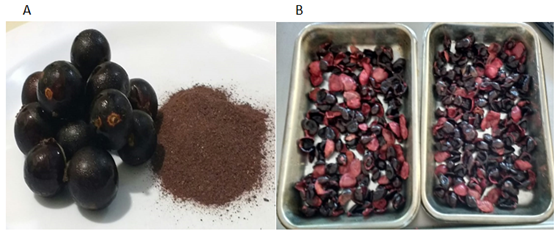
Figure 1. Jaboticaba fruits and flour (A) and the peels used for flour production (B).
The granulometry of the flour was verified using a sequence of eight stainless steel sieves, manually sieved, with a mesh opening of 125, 212, 250, 500, 600, 850, 1000, and 2000 mm. Then, the amounts retained in each sieve were weighed and expressed in percentages. Flour with particle size smaller than 500 µm (64.9% yield) was used for biscuit production.
Initially, preliminary tests were carried out to define a standard sequilho biscuit formulation, with adequate characteristics of expansion, flavor, aroma, and color, expected for a traditional sequilho biscuit (data not shown). Afterward, the JPF was added to the dough in different concentrations (from 1 to 10%), and it was verified that values greater than 3% alter the biscuit expansion, so this was the highest concentration used. Thus, five biscuit formulations were established, one control (BC) and four with the addition of JPF at the following concentrations: 0.75% (B1); 1.50% (B2); 2.25% (B3) and 3.00% (B4). The ingredients and proportions used in each formulation are shown in Table 1.
Table 1. Biscuits formulated with different concentrations of jaboticaba peel flour (JPF) (0%=BC; 0.75%=B1; 1.5%=B2; 2.25%=B3; 3.0%=B4).

The physicochemical analysis was performed in triplicates according to methods of the Adolfo Lutz Institute (Zenebon, Pascuet, & Tiglea, 2008). The pH was measured using a calibrated potentiometer (Gehaka PG 2000, Brazil). The total acidity was measured using 0.05 mol L-1 NaOH solution for titration, and the moisture content was evaluated using an automatic moisture analyzer (Marte ID 200) at 130ºC until constant weight (Kojić et al., 2019; Silva et al., 2019). Instrumental color was verified using the Konica Minolta CR400 colorimeter with CIELAB system, on the L* a* b* scale, with ten readings.
Total anthocyanins and total flavonoids were evaluated in triplicates, according to the spectrophotometric method described by Francis (1982), consisting in the extraction of metabolites contained in 1.5 g of the sample through maceration using 30 mL acidified ethanol [95% ethanol + hydrochloric acid 1.5 N (85:15)]. A spectrophotometer Shimadzu UV-1800 was used for reading extracts at 374 nm (for flavonoids) and 535 nm (for anthocyanins). Results were expressed as mg cyanidin-3-glucoside 100 g-1 (w.b) for total anthocyanins and mg flavonoids 100 g-1 (w.b.) for total flavonoids.
Texture properties of biscuits were determined using the Texture Analyzer TA.XTPlus (Stable Micro Systems) with a blade set HDP/BS probe at a constant speed of 2 mm sec-1 and trigger force of 20 g. The distance between the sample and the heavy-duty platform was 5 mm. The measurements were performed in fifteen replicates for each formulation of biscuit. The maximum force (N) during compression was determined from the curves in the force-time system using the Exponent Lite 5.1.1.0.
The specific volume of biscuits was measured according to AACC Method 10-05.01 (rapeseed displacement method) using proso millet seeds. The weight and volume of 15 biscuits from each formulation were recorded and used for the specific volume (cm3 g-1) calculation (American Association of Cereal Chemists [AACC], 2010).
Sensory tests were performed following the good sensory practices, according to Stone, Bleibaum, and Thomas (2012). All interventions in sensory tests were previously approved by the Research Ethics Committee of the Federal University of São João del-Rei (CAAE: 22682619.1.0000.5151).
Focus group and generation of descriptive terms for the CATA questionnaire
The first stage of the sensory evaluation consisted of forming a focus group composed of 13 non-trained consumers (2 men and 11 women), aged between 25 and 65 years. The group was conducted by two leaders, following the recommendations of Saint‐Denis (2018), and aimed to describe attributes for the five sequilho biscuit formulations (BC, B1, B2, B3 and, B4). In the first moment, participants were explained how they should describe the terms for each attribute (color, aroma, flavor, and texture) through free association, noting on the cards as many terms as they desired (Minim, 2018). For this, three biscuits of each formulation, in random order, were served in plastic dishes, accompanied by a glass of water. This evaluation was made individually.
In the second moment, the leaders held a group discussion to find out which terms were described for each biscuit formulation and, only those that were agreed upon by the group were recorded. Finally, it was verified if other terms used for expressing the characteristics of biscuits developed in other researches (Mello et al., 2019, Dovi et al., 2017,Tarancón, Sanz, Salvador, & Tárrega, 2014) could complement the attribute list to describe the samples. Thus, 18 terms were reached by the focus group, as follows: beige, white, brown, dark spots, fruity aroma, egg aroma, sweet aroma, adhesive, aerated, crunchy, hard in the mouth, hard, fragile, fibrous texture, starch flavor, vanilla flavor, fruit flavor, and jaboticaba flavor.
CATA questionnaire was elaborated according to Ares and Jaeger (2015), comprising the 18 sensory descriptors determined in the focus group and divided by category (color, aroma, texture, and flavor). Then, 132 consumers (45.5% male and 54.5 female), aged from 18-65 years old, were instructed to check all the terms that applied to each biscuit sample. After, consumers were asked to evaluate the sensory acceptance using a 9-point hedonic scale ranging from 1 ("dislike extremely") to 9 ("like extremely") for the attributes color, aroma, texture, flavor, and global impression. A purchase intention scale ranging from 1 ("I certainly would not buy) to 5 ("I would certainly buy") was also applied. The samples were served in three-digit coded disposable dishes, presented in balanced and random order, and written informed consent was obtained from all participants.
Physicochemical and texture results were evaluated by descriptive statistics, ANOVA, and Tukey test at 5% probability level. CATA data was evaluated by Cochran's Q test, correlation analysis, and principal coordinate analysis, using XLSTAT, Version 2017.4 (Addinsoft, New York, USA).
The JPF obtained presented moisture content of 6.23 ± 0.2%, pH equal to 6.2 ± 0.4, total acidity of 1.55 ± 0.05 g of citric acid 100 g-1 and color corresponded to L* 27.54 ± 1.66, a* 12.18 ± 0.26 and b* 8.61± 0.24. When added to biscuit formulations, it was found that the main influence of JPF was on the luminosity (L*), and the higher the addition, the lower the luminosity (p < 0.05) of biscuits, as it can be seen in Figure 2.Bender et al. (2016) point out that the dark coloring of an ingredient can limit its use in food products. On the other hand, it can be associated by consumers with whole ingredients and, therefore, healthier.
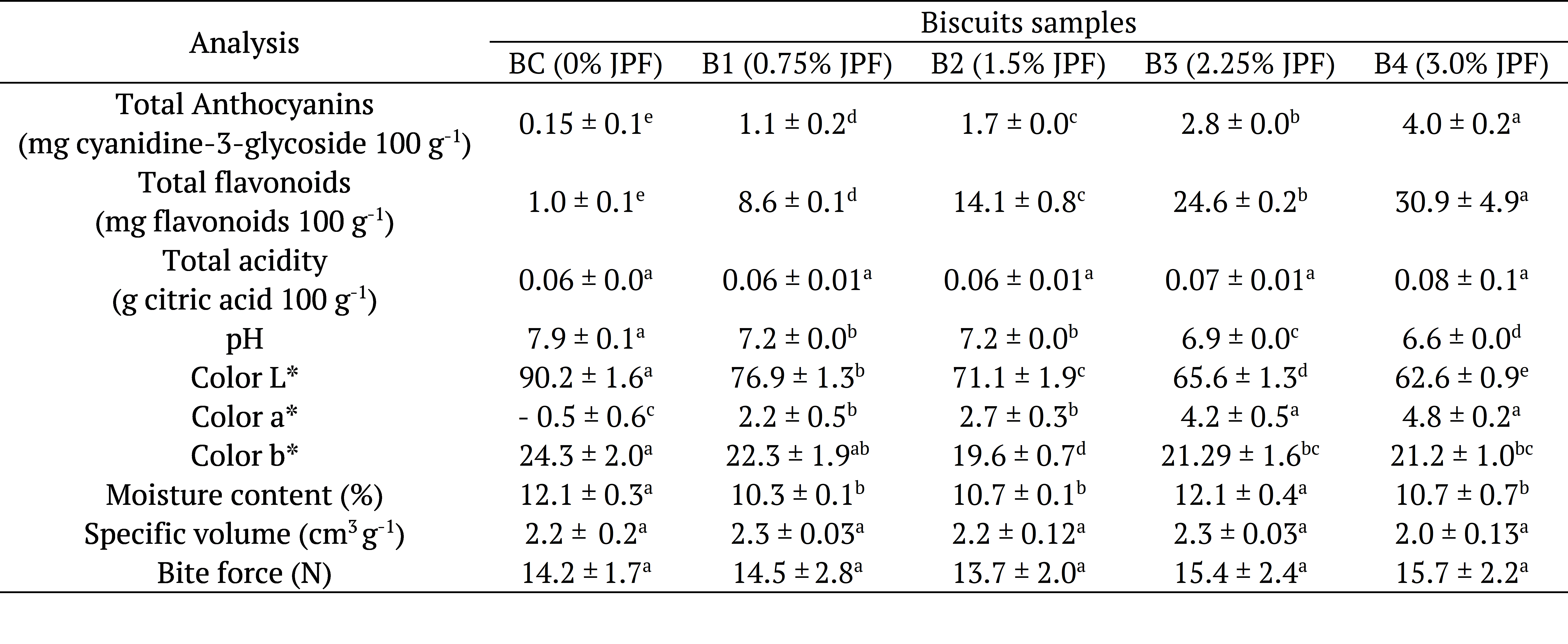
The values of a* increased with the addition of JPF, with a tendency to red, which is probably due to the high anthocyanin levels in the flour. The values of b* showed no relevant differences. Results obtained from the physicochemical analysis of biscuits are shown in Table 2.
The total acidity values of the biscuits were low and did not differ (p > 0.05) from each other, which can be explained due to the presence of sodium bicarbonate in the bakery powder used.
The texture (bite force) and specific volume of biscuits showed no difference (p > 0.05) among samples, with overall averages of 14.8 ± 2.2 N and 2.21 ± 0.11 cm3 g-1, respectively, demonstrating that the addition of JPF at the studied levels did not change the expansion and the hardness of the biscuits. Data are present in Table 2.
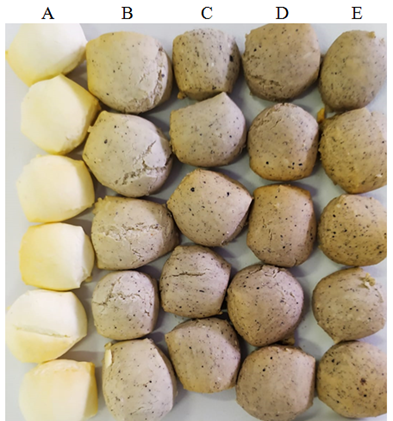
Figure 2. Photography of biscuits formulations with different concentrations of jaboticaba peel flour (JPF) (A= 0% JPF; B = 0.75% JPF; C=1.5% JPF; D= 2.25% JPF and, E=3.0% JPF).
Table 2. Results (mean ± standard deviation) of physicochemical analysis of sequilho biscuits elaborated with different concentrations of jaboticaba peel flour (JPF) (0%=BC; 0.75%=B1; 1.5%=B2; 2.25%=B3; 3.0%=B4). Values were expressed in wet basis (w.b.)*.
*Mean values followed by different letters in the same line differ at 5% probability.
The total flavonoid content of JPF was 227.9 ±14.6 mg 100 g-1 (w.b.), which is higher than that reported by Moura et al. (2016), who found 16.96 ± 1.15 mg 100 g-1 in dehydrated jaboticaba peels. Santiago et al. (2018), using HPLC, demonstrated that gallic and ellagic acids are the principal phenolic acids found in jaboticaba peel powder. The same authors described that other compounds, such as rutin, quercetin, protocatechuic acid, and p-coumaric acid, were also present.
Total anthocyanin content corresponded to 114.2 ± 4.2 mg of cyanidin-3-glucoside 100 g-1 (w.b), which is higher than that reported by Garcia, Silva, Cunha, and Damiani (2016) that found values of 41.30 ± 1.68 mg cyanidin-3-glucoside 100 g-1 in JPF. Santiago et al. (2018) found much higher values in encapsulated jaboticaba peel powder, corresponding to 504.39 mg of cyanidin-3-glucoside 100 g-1 (w.b).
Deng et al. (2012) described the values of anthocyanins (in mg cyanidin-3-glucoside 100 g-1) for other residues, such as blueberry peel (5.72 ± 0.30 mg 100 g-1); hawthorn peel (5.92 ± 0.22 mg 100 g-1), mango peel (6.12 ± 0.40 mg 100 g-1) and sweetsop peel (21.00 ± 0.88 mg 100 g-1). In this way, the anthocyanin values found in the present research are quite relevant and can be better exploited by the food industry and for different researches.
Regarding the biscuits, the total anthocyanins and total flavonoid contents were higher in B4 (4.00 ± 0.2 mg cyanidin-3-glucoside 100 g-1 and 30.89 ± 4.9 mg 100 g-1, respectively), differing (p < 0.05) from the other biscuits. A linear correlation between the increase of the JPF in the dough and the increase of anthocyanins (R2 = 0.9858) and flavonoids (R2 = 0.9919) in biscuits were observed. Total flavonoids and total anthocyanins values for each biscuit are presented in Table 2.
Garcia et al. (2016) used JPF to produce gluten-free noodles and obtained 3.08 mg cyanidin-3- glucoside 100 g-1 of the product, similar to the level found for the sequilho biscuit. Korus, Gumul, Krystyjan, Aw Juszczak, and Aw Korus (2017) developed gluten-free biscuits made with corn-acorn flour and corn-hemp flour, and the total anthocyanin values ranged from 22.8 ± 2.2 to 387 ± 5 mg cyanidin-3-glucoside 100 g-1. Croitoru et al. (2018) evaluated the anthocyanin content in muffins formulated with black rice, finding values from 27.54 ± 2.22 to 46.11 ± 3.91 mg 100 g-1. The total anthocyanin concentration in sequilho biscuits are fewer than those reported by other authors because sequilho biscuit has white color, so the amount of JPF added in the formulation is very limited.
Through the hedonic scale, it was verified that all attributes evaluated (color, flavor, aroma, texture, and overall impression) differed among the five biscuit formulations analyzed (p < 0.05). The control formulation had the highest score for all attributes except for aroma, which did not differ among BC, B1, and B2. The global impression for B1, B2, B3, and B4 ranged from approximately 6.5 to 7.5, confirming that the acceptance of sequilho biscuits at concentrations up to 5% is adequate.
As it can be seen in Figure 3, the formulations added with the highest concentrations of JPF (B3 and B4) had the lowest scores (p < 0.05) for the global impression, texture, taste, and color. Similar behavior was reported by Micheletti et al. (2018) in muffin elaborated with JPF. The authors reported that the higher the addition of JPF, the lower the acceptance of the product. A level of up to 9% of JPF in muffins was well accepted by children, obtaining similar sensory acceptance to the traditional product.
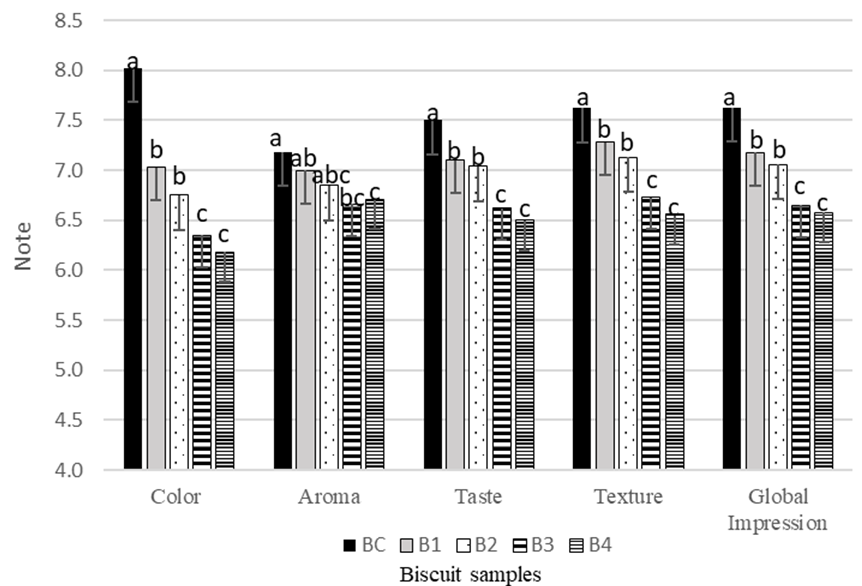
Figure 3. Sensory evaluation using a 9-point structured hedonic scale for different attributes of biscuits elaborated with different concentrations of jaboticaba peel flour (0%=BC; 0.75%=B1; 1.5%=B2; 2.25%=B3; 3.0%=B4). Different letters in columns of the same attribute differ from each other by Tukey's test (p < 0.05). Error bar represents the minimum significant difference (MSD) by the Tukey test.
About the purchase intention, BC formulation had the highest intention (p < 0.05), with an average score of 3.95, corresponding to the term "would probably buy", differing from the other samples. B1 and B2 did not differ from each other, with an average of 3.54, situating between the terms "probably would buy" and "I doubt if I would buy", indicating a market potential. Samples B3 and B4 did not differ from each other, with an average of 3.15, more closely related to the term "I doubt if I would buy", differing from the other formulations.
From the 18 terms suggested in the focus group, 15 showed significance (p < 0.05) for differentiating the samples by the Cochran's Q test. The terms "egg aroma", "aerated" and "starch flavor" were not significant to describe the products. Concerning color, formulation B1 had the highest association (p < 0.05) with the term "beige", while "white" had a strong association with BC. This fact is explained because BC was not added with JPF, maintaining the characteristics of a standard sequilho biscuit. The brown color was most associated (p < 0.05) with biscuits B3 and B4, which were produced with the highest concentrations of JPF.
Regarding the aroma, it was found that all formulations added of JPF were associated with the term "fruity aroma", differing from BC, which was less associated with such term. Regarding flavor, all biscuit added with JPF had higher associations with the terms "fruit flavor", differing (p < 0.05) from BC. Formulations B3 and B4 were more associated with the term "jaboticaba flavor".
Zago et al. (2015) suggest that the addition of a larger amount of vanilla essence to cookies elaborated with JPF could improve the sensory scores of this product. However, in the present research, the terms associated with the aroma and flavor of JPF, such as "fruit aroma", "fruit flavor", and "jaboticaba flavor", positively influenced the global impression.
Concerning the terms related to texture, the word "hard" was more associated with formulations B3 and B4 (p < 0,05) and, the term "melts in the mouth" was associated with formulation BC, while "fibrous texture" with B3 and B4. According to Santiago el al. (2018), JPF has 22.64% of dietary fiber, which justifies such associations of formulations B3 and B4 with these descriptive terms. All the attributes and the association with the different biscuit formulations can be seen in the correspondence analysis illustrated in Figure 4.
The terms "crunchy" and "sweet aroma" positively impacted the acceptance of biscuits, while the term "dark spots" negatively impacted the overall impression. In this study JPF with a particle size up to 500 µm (47.4% between 250 and 500 µm; 6.9% between 212 and 250 µm; 33.4% between 125 and 212 µm and 12.3% less than 125 µm) was used. In this way, an alternative to reduce the presence of dark spots would be a finer grinding, which was not possible using the knife mill. For this, a hammer mill or disc mill is more indicated.
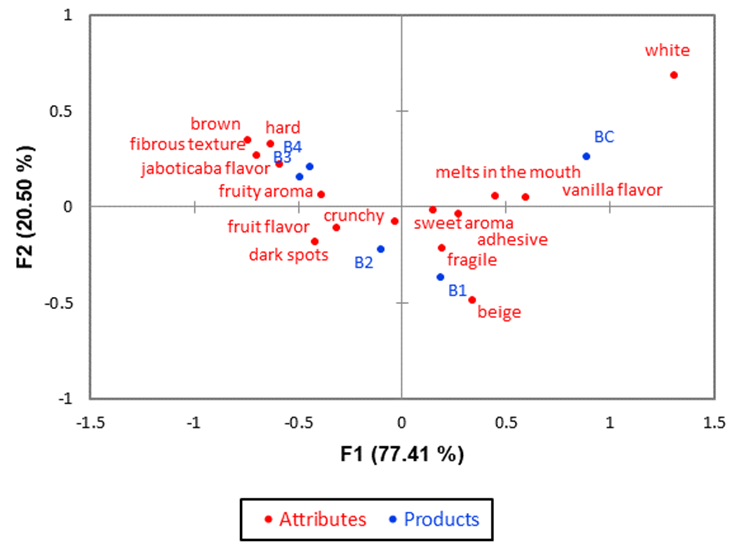
Figure 4. Representation of the biscuit samples elaborated with different concentrations of jaboticaba peel flour (JPF: 0%=BC; 0.75%=B1; 1.5%=B2; 2.25%=B3; 3.0%=B4) and the attributes in the first and second dimensions of the correspondence analysis.
The term "dark spots" had a positive correlation with "fibrous texture" and "brown", which were other terms that also negatively impacted the global impression. The term "crunchy" had a negative correlation with the terms "fibrous texture" and "hard". The consumers who checked the term "brown" associated this color with JPF-related terms, such as "fruit aroma", "fibrous texture", "fruit flavor" and "jaboticaba flavor". The color "white" was not associated with any of these descriptive terms, having a positive correlation with the term "vanilla flavor" and "melts in the mouth", which are characteristic of the standard biscuit.
As demonstrated by Ou, Wang, Zheng, and Ou (2019), polyphenol incorporation in bakery products, such as anthocyanin rich-ingredients, can negatively influence color and flavor of baked foods, decreasing the sensorial acceptance of the products. Even so, the inclusion of these ingredients should be encouraged since they have recognized health benefits. In the present study, it was verified that the addition of JPF alters the typical sensory characteristics of the sequilho biscuits and has a negative impact on the global impression of the product. Even so, according to the hedonic scale, all formulations had good acceptance, and B1 and B2 have the best market potentials from the biscuits added by JPF, as indicated by the purchase intention scale.
From the jaboticaba peel, it was possible to obtain flour with high levels of flavonoids and total anthocyanins. The higher the addition of JPF in the biscuits dough, the higher the values of such compounds in the product. Jaboticaba peel flour did not change the specific volume or bite force of the products. In the sensory analysis, it was found that the increase of JPF in the biscuit formulation decreases the acceptance, and the highest concentrations (2.25 and 3.0%) were associated with negative terms such as fibrous texture, brown, and dark spots. In this way, it is recommended to produce sequilho biscuits with JPF addition up to 1.5%. Under these conditions, it is possible to obtain biscuits with good acceptance and market potential. This study demonstrated that the food industry could better exploit the jaboticaba peel, meeting consumer demand for healthier products with differentiated sensory characteristics.
The authors are grateful for the financial support from the Federal University of São João del-Rei (UFSJ, PIBIC N.006/2018/PROPE), Brazil.
trombete@ufsj.edu.br
Figure 1. Jaboticaba fruits and flour (A) and the peels used for flour production (B).
Table 1. Biscuits formulated with different concentrations of jaboticaba peel flour (JPF) (0%=BC; 0.75%=B1; 1.5%=B2; 2.25%=B3; 3.0%=B4).
Figure 2. Photography of biscuits formulations with different concentrations of jaboticaba peel flour (JPF) (A= 0% JPF; B = 0.75% JPF; C=1.5% JPF; D= 2.25% JPF and, E=3.0% JPF).
Table 2. Results (mean ± standard deviation) of physicochemical analysis of sequilho biscuits elaborated with different concentrations of jaboticaba peel flour (JPF) (0%=BC; 0.75%=B1; 1.5%=B2; 2.25%=B3; 3.0%=B4). Values were expressed in wet basis (w.b.)*.
*Mean values followed by different letters in the same line differ at 5% probability.
Figure 3. Sensory evaluation using a 9-point structured hedonic scale for different attributes of biscuits elaborated with different concentrations of jaboticaba peel flour (0%=BC; 0.75%=B1; 1.5%=B2; 2.25%=B3; 3.0%=B4). Different letters in columns of the same attribute differ from each other by Tukey's test (p < 0.05). Error bar represents the minimum significant difference (MSD) by the Tukey test.
Figure 4. Representation of the biscuit samples elaborated with different concentrations of jaboticaba peel flour (JPF: 0%=BC; 0.75%=B1; 1.5%=B2; 2.25%=B3; 3.0%=B4) and the attributes in the first and second dimensions of the correspondence analysis.
