Artículo de investigación
Towards a Working Definition of Negotiation in Telecollaboration: Analysis of Teletandem Oral Sessions
Hacia una definición funcional de la negociación en la telecolaboración: análisis de sesiones de teletandem oral
 Solange Aranha solange.aranha@unesp.br
Laura Rampazzo laura.rampazzo@ifsp.edu.br
Solange Aranha solange.aranha@unesp.br
Laura Rampazzo laura.rampazzo@ifsp.edu.br
Towards a Working Definition of Negotiation in Telecollaboration: Analysis of Teletandem Oral Sessions
Colombian Applied Linguistics Journal, vol. 24, núm. 2, pp. 234-245, 2022
Universidad Distrital Francisco José de Caldas
Recepción: 05 Agosto 2021
Aprobación: 07 Marzo 2022
Abstract: As digital technology advances, geographically distant learners have been engaging in cross-cultural communication and negotiation via telecollaborative projects. Research has shown that negotiation of meaning is crucial for effective communication in these scenarios, but more studies on other types of negotiation are needed, given its importance for establishing cooperation. This paper aims at exploring the negotiation patterns between dyads in ten sessions selected from a Multimodal Teletandem Corpus and provides a working definition of negotiation in telecollaboration. The participants, who were university students in Brazil and abroad and were enrolled in language classes, met online to help with practicing each other’s language and were expected to exchange information about themselves in the first synchronous session. Through a qualitative analysis of the transcripts of the ten sessions, we identified moments in which the conversation was suspended to negotiate meaning, technology issues, separation of languages, and aspects related to the tasks requested by teachers. Our analysis shows that negotiation in telecollaboration may be motivated by aspects internal to the conversation, such as meaning, or by external factors, as with problems with equipments, tasks, or with deciding the language to be spoken. The findings suggest that negotiation serves an essential purpose, as it allows participants to make collaborative decisions and resolve conflicts that could otherwise prevent conversation from continuing. The results may prove useful for researchers and practitioners interested in telecollaboration, aiming to design experiences and guide participants through learning in such contexts.
Keywords: multimodal teletandem corpus (MulTeC), negotiation, telecollaboration, virtual exchange.
Resumen: A medida que avanza la tecnología digital, los estudiantes geográficamente distantes se han involucrado en la comunicación y negociación intercultural a través de proyectos de telecolaboración. Las investigaciones han demostrado que la negociación de significados es crucial para la comunicación efectiva en estos escenarios, pero se necesitan más estudios sobre otros tipos de negociación, dada su importancia para el establecimiento de la cooperación. Este artículo tiene como objetivo explorar los patrones de negociación entre pares en 10 sesiones seleccionadas de un Corpus de Tándem Multimodal y propone una definición funcional de negociación en telecolaboración. Los participantes, que eran estudiantes universitarios en Brasil y en el extranjero y estaban inscritos en clases de idiomas, se reunieron en línea para ayudar a practicar el idioma de cada uno, y se esperaba que intercambiaran información sobre ellos mismos en la primera sesión sincrónica. A través de un análisis cualitativo de las transcripciones de las 10 sesiones, identificamos momentos en los que se suspendió la conversación para negociar significados, cuestiones tecnológicas, separación de lenguas y aspectos relacionados con las tareas solicitadas por los profesores. Nuestro análisis muestra que la negociación en la telecolaboración puede estar motivada por aspectos internos de la conversación, como el significado, o por factores externos, como problemas con los equipos, tareas o con la decisión del idioma a hablar. Los hallazgos sugieren que la negociación tiene un propósito esencial, ya que permite a los participantes tomar decisiones colaborativas y resolver conflictos que, de lo contrario, podrían impedir que la conversación continuara. Los resultados pueden ser útiles para los investigadores y profesionales interesados e n la telecolaboración que busquen diseñar experiencias y guiar a los participantes a través del aprendizaje en dichos contextos.
Palabras clave: corpus multimodal de teletandem (MulTeC), negociación, telecolaboración, intercambio virtual.
Introduction
Telecollaboration and virtual exchange are terms used in the literature to describe the engagement of groups of students in online intercultural interaction and collaboration with groups from different contexts and geographical locations under the guidance of educators (Lewis and O’Dowd, 2016). According to Garcés and O’Dowd (2020), virtual exchange/telecollaboration is an approach to learning “where knowledge and intercultural understanding are constructed through learner-to-learner interaction and negotiation” (Garcés and O’Dowd, 2020, p. 2, our emphasis).
Indeed, several studies have dealt with investigating negotiation in telecollaboration and Computer-Mediated Communication (CMC), focusing on negotiation of meaning (Blake, 2000. Clavel-Arroitia, 2019. Clavel-Arroitia and PennockSpeck, 2015.van der Zwaard and Bannik, 2014,2019 –to mention a few), while others have concentrated on episodes with a focus on form (Fernandes and Telles, 2015. Franco, 2016). However, there is some evidence which suggests that there are other instances of negotiation that transcend meaning and form. Such studies base their discussion mostly on learner reports, written chat registers, e-mails, and only a few excerpts of synchronous video conversations of telecollaborative practices (Luz, 2012. Garcia, 2013). Nevertheless, these are not integrated into the language classroom. Fuchs (2016) also discusses negotiation, albeit on practices that involve asynchronous communication only, and Rampazzo (2017) presents a discussion of only part of synchronous sessions.
We believe that there is an urgent need for more data and analysis on how negotiation is articulated in synchronous oral telecollaborative sessions between participants, given that every and each type of negotiation helps with establishing cooperation and, at least in the scope of the telecollaborative project Teletandem Brasil: Foreign Languages for All (Telles, 2006), it seems to (i) be constitutive of the system of activity (Luz, 2012), (ii) help to solve issues that might be problematic (Garcia, 2013), and (iii) play an important role in maintaining communication (Rampazzo, 2017).
This paper aims at exploring the negotiation pattern of participants in teletandem, more specifically from the institutional integrated teletandem modality (iiTTD) (Aranha and Cavalari, 2014) when the practice is part of language courses. It analyzes the first synchronous sessions between participants in teletandem to expand the current understanding of negotiation in telecollaboration and provides a working definition of negotiation in telecollaboration. The research questions are “What aspects do learners negotiate when participating in iiTTD oral sessions?” and “How can the negotiation instances be classified?”. We argue that, by identifying the negotiation patterns that learners engage in, the study contributes to a better comprehension of partners’ negotiation in other telecollaborative practices. In addition, the study should be useful for both researchers and practitioners in guiding learners through establishing cooperation with their fellow participants.
Literature review
Institutional Integrated Teletandem
Teletandem Brasil: Foreign Languages for All (Telles, 2006) is a telecollaborative project that promotes virtual synchronous intercultural contact between Brazilian students who are learning a foreign language and learners of Portuguese abroad, so that they can help each other with practicing and improving their proficiency. In teletandem, students form dyads that meet weekly through VoIP technology.
Teletandem is based on the tandem principles of autonomy, reciprocity, and separation of languages (Brammerts, 1996. Vassallo and Telles, 2006), which means that participants (i) have some autonomy to make decisions about their own learning, (ii) should equally invest in their partners’ learning and alternate in the roles of language expert and learner (reciprocity), and (iii) should dedicate half of the time of each encounter to speaking and focusing on each language of the partnership (separation of languages).. The practice has been organized in different modalities (see Cavalari, 2018, for an updated account of the modalities of teletandem). One of said modalities is institutional integrated Teletandem (iiTTD), which is characterized as a mandatory activity for learners enrolled in language courses in both partner institutions. In iiTTD students (i) are subjected to the evaluation of their language instructors (besides their partner’s and self-evaluation); (ii) participate in the oral sessions during their language classes in an appropriate environment (such as a teletandem laboratory); and (iii) need to develop a set of tasks proposed by their language teachers (Aranha and Cavalari, 2014. Cavalari and Aranha, 2016). The instructors are also responsible for organizing a calendar to determine how many mandatory sessions will be held, as well as for preparing a tutorial to give participants information about the project and the tasks they are expected to carry out.
As proposed by Aranha and Leone (2017), teletandem practice is characterized by two macrotasks: teletandem oral sessions and mediation sessions. The former are related to the purpose of learning and practicing a foreign language, and they comprise each oral session and any microtasks associated with them, such as exchanging texts written in the target language for the partner to revise and answering questionnaires. On the other hand, the latter are linked to the purpose of promoting autonomous and reflective learning, and they comprise the writing of learning diaries, students’ oral presentation of their learning process, and faceto-face meetings to discuss aspects of the activity. These authors stress that, while the macrotasks are present in every teletandem learning scenario[4], the microtasks might not, depending on the decisions made by the teachers involved in a partnership.
What negotiation means in telecollaboration
In the fields of telecollaboration and CMC, negotiation of meaning (NoM) has been the central aspect of several studies. Some authors adopt Varonis and Gass’s (1985) discussion about NoM to analyze episodes of negotiation (Blake, 2000. ClavelArroitia, 2019. Clavel-Arroitia and Pennock-Speck, 2015. van der Zwaard and Bannik, 2014, 2019), focusing on how negotiations of meaning contribute to second language acquisition and interlanguage development. Varonis and Gass’ (1985) proposition is not situated in the contexts of telecollaboration or CMC.
However, their discussion of aspects of non-native speakers’ discourse has offered the theoretical basis for the other works mentioned in this section. Varonis and Gass (1985) suggest that NoM is motivated by non-understandings and argue that “negotiations of meaning exist within, but separate from, the main discourse, in effect putting the progression of the discourse on ‘hold’” (Varonis and Gass, 1985, p. 81). They emphasize that breakdowns in communication need to be negotiated so that the exchange of information may occur. The authors present a model for analyzing NoM episodes, composed of a trigger followed by a resolution, divided in indicator, response, and reaction to response. Their model and arguments are relevant because they suggest that NoM serves an important function: besides promoting students’ interlanguage, it also allows communication to happen.
Based on Varonis and Gass (1985), and Gass et al. (1998), Blake (2000) discusses NoM within CMC contexts. He argues that, when learners are working in pairs to solve real communication tasks, they might face linguistic problems. According to him, “at the point one partner notices a gap or suffers some confusion, the pair will suspend the normal flow of conversation or ‘push-down’, as it were, from the discourse of the task itself in order to resolve their miscommunication” (Blake, 2000, p. 121). His definition reinforces the one by Varonis and Gass (1985), in which episodes of negotiation will emerge in discourse, deviating the focus from the topic to solve a communication problem and suggesting that learners need to first deal with their difficulties in communication and then resume conversation.
In the area of telecollaboration, ClavelArroitia (2019) argues that NoM is also employed by learners in telecollaboration when difficulties in communication arise and, most of the time, when they are discussing topics of interest. The author investigated tandem exchanges in Spanish and English between secondary-education students, and she suggests that participants tend to use a diversity of strategies that allow for more negotiation of meaning, which indicates that learners find negotiation to be a relevant strategy for communication.
Van der Zwaard and Bannik (2019), presenting an adaptation of Varonis and Gass’ model (1985), state that, in CMC, NoM occurs when one of the participants of an interaction stops the conversational flow because of communication problems related to meaning. Their contribution advances in proposing a model that identifies two main types of response to a trigger: a task-appropriate response, when learners negotiate to get the task done; and a face-appropriate response, when they opt not to negotiate meaning and, instead, preserve their faces. The authors analyze data collected from two telecollaborative projects that involved students from the Netherlands and Australia, who randomly formed NS-NNS dyads and used English to communicate. They identified that task performance through video calls resulted in more episodes of negotiation of face than negotiation of meaning. Their findings suggest that the negotiation of face is present in telecollaboration and serves to advance communication.
In teletandem, some discussion of negotiation appears in the works by Luz (2012) and Garcia (2013), both investigating the institutional non-integrated modality –when the practice is a voluntary activity in both sides and learners are responsible for most of the decisions related to their teletandem learning experience[5]– and Rampazzo (2017), who examines participants of institutional integrated teletandem. Luz (2012) presents a case study and adopts Activity Theory (Engeström, 1987) in order to analyze the partnerships established between two Brazilian learners and their American counterparts. Through an analysis of mostly e-mail and written chat registers, the author argues that one of the aspects that constitutes the activity system in non-integrated teletandem is work division, which involves negotiating certain aspects of the partnerships, such as a time and date, the communication tool, and the schedule, as well as negotiation of conversation topics, tasks, and feedback modes. Despite not expanding the discussion of negotiation or indicating categories for the instances, Luz’s work sheds light on the fact that negotiation in non-integrated teletandem goes beyond that of meaning.
Similarly, Garcia (2013) proposes that teletandem participants from the non-integrated modality negotiate other aspects besides meaning. Using a variety of instruments –e-mails, participants’ reports, chat registers, and recordings of only a few oral sessions– but mostly focusing on reports and data from asynchronous or synchronous written communication, the author suggests that negotiation is a communication process through which people resolve conflicts, and she emphasizes that it is essential that teletandem dyads try to negotiate issues that might be problematic to the sessions. The author reports that participants negotiate on the following: (i) a time and date for the sessions; (ii) the length of each session and language separation; (iii) conversation topic; (iv) the tool to be used for communicating; (v) how to make corrections; (vi) meaning; and (vii) tasks. Garcia’s (2013) data of asynchronous and synchronous written communication and learner reports corroborate Luz’s (2012) findings, and, similarly, the author does not categorize the types of negotiation.
Rampazzo’s (2017) discussion suggests that negotiation plays a major structuring role in the rhetorical organization of the initial Teletandem Oral Session (iTOS) in the integrated modality. iTOS is a genre that occurs in teletandem practice (Aranha, 2014. Rampazzo, 2017, 2019, 2021. Rampazzo and Aranha, 2018, 2019b), that is, it is a goaldirected communicative event that exhibits patterns in its rhetorical structure. Each iTOS is organized in rhetorical parts[6], one of which is identified by Rampazzo (2017) as being dedicated to negotiating issues related to the partnership. Despite only observing part of the synchronous encounter (the first 15 minutes), Rampazzo’s (2017) results indicate that negotiation is an intrinsic component of the oral session in which learners discuss the principles of language separation, as well as technological issues, besides negotiating meaning.
Within telecollaborative environments, Fuchs (2016) also presents an investigation showing that negotiation is not limited to meaning. The author presents a study of a project in which learners from graduate programs in the US and in Turkey interacted via blogs and e-mails. Whereas Fuchs’s (2016) purpose is not to discuss the concept of negotiation, she comments that participants engaged in negotiation moments that she categorized following Breen and Littlejohn’s (2000) types: personal negotiation, interactive negotiation, and procedural negotiation. Although Breen and Littlejohn’s (2000) characterization is related to the language classroom setting, Fuchs’s (2016) work demonstrates that it is possible to apply it to telecollaborative contexts. Her study, which concentrates on asynchronous communication between learners, contributes to advancing the discussion that negotiation in telecollaboration transcends negotiation of meaning.
Breen and Littlejohn (2000) explain that there are three kinds of negotiation in contexts of communication, defined according to the purposes they serve. Personal negotiation refers to a psychological process at the individual level. It occurs when one negotiates the potential meanings of what they read/hear and how those meanings can be attributed to a text or when one has to negotiate between what they mean and the knowledge of the forms of expression and conventions; it is the kind of interpretive negotiation that occurs in one’s mind when thinking of the forms and conventions to express the intended meanings. Interactive negotiation is related to the negotiation that occurs in social interaction when one uses language to indicate their (mis)understanding or to modify and restructure one’s language to make things clearer. The authors explain that interactive negotiation occurs spontaneously in social interaction and relate the concept to that of negotiation of meaning. Procedural negotiation focuses less on meaning and more on reaching an agreement; it is the
kind of negotiation exemplified by discussions between people who are likely to have different interests or different points of view but who seek to reach an agreement on a matter, solve a shared problem or establish ways of working that are acceptable to them. (Breen and Littlejohn, 2008)
In the context of the language classroom, the authors state that procedural negotiation occurs when decisions need to be made regarding “who will work with whom, in what ways, with what resources and for how long, upon what subject matter or problem and for what purposes” (Breen and Littlejohn, 2000, p. 8). In other words, it is the kind of negotiation that is concerned with any and all the processes related to the language learning experience.
Regarding their proposed framework, Breen and Littlejohn (2000) also elucidate that all the types of negotiation are intertwined: procedural negotiation involves interactive negotiation for meaning, as reaching an agreement in decisions depends on the resolution of failures in understanding, and interactive negotiation derives from our need to understand and be understood.
In addition to the types of negotiations, research has also focused on negotiation of form. Within the teletandem context, Fernandes and Telles (2015) discuss episodes with focus on form while analyzing data from a Portuguese-English exchange. The authors explain that episodes that focus on form encompass both morphosyntax and meaning in language use, and they correspond to moments when teletandem partners talk about language, ask about it, or correct each other whenever problems or difficulties emerge. Although the authors do not use the term negotiation, it may be argued that such episodes are also instances of negotiation, given that, in order to discuss lexicon, grammar, and phonology, learners incidentally deviate from focusing on communicating intercultural content (Fernandes and Telles, 2015).
Based on the literature review on negotiations both in the language classroom and telecollaborative environments, we may argue that, once teletandem becomes a collaborative language learning environment, participants may also have to turn to different types of negotiation. Despite having proposed that other types of negotiations exist within teletandem, Luz (2012), Garcia (2013), and Rampazzo
(2017) either focus on reports from participants, asynchronous communication, synchronous written communication, or a small portion of synchronous video exchanges. There is still a need for observations of the entire length of oral sessions (synchronous video communication) and for the proposition of a clearly stated definition of negotiation in telecollaboration.
Methodology
Data for this study were gleaned from MulTeC (Multimodal Teletandem Corpus) (Aranha and Lopes, 2019), a corpus with multimodal data from 16 different cohorts collected between 2012 and 2015 from a partnership established between a public university in Brazil and a public university in the United States. MulTeC is a bilingual learner corpus (Portuguese and English) and comprises 581 hours 19 minutes of video data, 666 learning diaries, 351 chat conversations, 956 texts written in the learners’ target languages, and 132 questionnaires.
Ten initial Teletandem Oral Sessions (iTOS) are analyzed in this paper: three sessions recorded in 2012, two in 2013, three in 2014, and two in 2015, all from iiTTD. iTOS was selected because, as demonstrated by Rampazzo (2021), an introductory personal information exchange task as the one which occurs in iTOS is also common in telecollaborative projects with different designs. Therefore, the results of this research might also be relevant for other projects. All the selected sessions had been previously transcribed. In this paper, we refer to each session as iTOS-1, iTOS2, and so on (Table 1). Students were randomly paired up to form dyads, who interacted for eight weeks.
The selected sessions are from different learning scenarios, and task design varies from one scenario to another, which may affect the types of negotiation instances in which learners engage. Rampazzo (2017) and Rampazzo and Aranha (2018, 2019) have identified that changes in task design modify the rhetorical organization of the genre, and that such changes may also lead to different types of negotiation. Regarding the tasks proposed for iTOS, in 2012 and 2013, students were only advised to exchange information about themselves, i.e., they were free to talk about anything they wanted to during the first encounter; in 2014 and 2015, on the other hand, besides free conversation, they were also advised to take some time to comment on the texts written in Portuguese by the participant in the US and revised by the Brazilian learner before the first synchronous encounter. Students in Brazil attended an English language course, and students in the US, a Portuguese one. TOS were held in English and Portuguese. Most participants were undergraduate students (Table 1) and in their late teens and early twenties. Two participants from the American university were substitutes (from iTOS-3 and iTOS-10). The Brazilian students’ proficiency level in the target language was self-evaluated based on CEFR descriptors. MulTeC does not include questionnaires filled in by students from the American university, so we did not have access to their proficiency level. Gender was not selfdeclared.
As for the analysis procedures, the identification of negotiation instances took into account Varonis and Gass’ (1985) definition of negotiation (which has been extensively used to investigate NoM) as well as the one from Blake (2000). It should be noted, however, that we propose a broader definition of negotiation than the one presented by these authors, who focus on negotiation of meaning. We ratify that negotiation happens whenever the main discourse is put on hold (Varonis and Gass, 1985) and conversation is suspended so that learners can resolve the miscommunication (Blake, 2000), but we also suggest that negotiation in telecollaboration not only involves meaning but also aspects related to the management of the session.
| File in MulTeC | Referred to as | Country | Participants’ major | Self-declared proficiency | Gender | Tasks carried out in iTOS |
| 2012_I9F2_UGA2i_SOTi | iTOS-1 | Brazil | Languages | B1 | Female | Free conversation |
| USA | Economy | X | Male | |||
| 2012_I9F11_UGA2i_SOTi | iTOS-2 | Brazil | Languages | B1 | Female | |
| USA | English | X | Female | |||
| 2012_I9M1_UGA2i_SOTi | iTOS-3 | Brazil | Languages | B1 | Male | |
| USA | History | X | Male | |||
| 2013_I9F12_UGA2i_SOTi | iTOS-4 | Brazil | Languages | B2 | Female | |
| USA | Sociology | X | Female | |||
| 2013_I9M4_UGA2i_SOTi | iTOS-5 | Brazil | Languages | C1 | Male | |
| USA | Portuguese and Italian | X | Male | |||
| 2014_I9F9_UGA1i_SOTi | iTOS-6 | Brazil | Languages | X | Female | Free conversation + commenting on the text written by participant from the American university |
| USA | Business | X | Female | |||
| 2014_I9F13_UGA1i_SOTi | iTOS-7 | Brazil | Languages | X | Female | |
| USA | Spanish and International Relations | X | Female | |||
| 2014_I9M4_UGA1i_SOTi | iTOS-8 | Brazil | Languages | C1 | Male | |
| USA | PhD in Ecology and Geography | X | Male | |||
| 2015_I8F7_UGA3i_SOTi | iTOS-9 | Brazil | Languages | B1 | Female | Free conversation + commenting on the introductory e-mails exchanged before iTOS |
| USA | Science | X | Female | |||
| 2015_I8F14_UGA3i_SOTi | iTOS-10 | Brazil | Languages | B2 | Female | |
| USA | X | X | Female |
The recognition of all negotiation instances in our corpus considered the portions of the transcribed texts in which learners stopped the normal flow of conversation to either solve a problem (NoM, form, or technical issues) or arrange and agree on other aspects –that means that a portion of the texts was labeled as a negotiation instance when learners put the exchange of information on hold in order to resolve an issue. Considering that participants seem to spend most of their time in the initial oral session exchanging information about themselves (Rampazzo, 2017, 2021. Rampazzo and Aranha, 2018, 2019), normal conversation flow is understood here as conversation that conveys information about their personal and academic lives.
The portions of text in which learners interrupted the conversation about themselves to resolve/agree on issues were labeled as negotiation instances. We understand such instances as functional parts of iTOS in which learners intend to make decisions collaboratively or, to the very least, try to get the other to cooperate and do what they propose. Labeling of such instances consisted of extracting the portion of text from the moment information exchange about themselves (personal facts, experiences, opinions, etc.) was suspended until the moment it was resumed. The secondary author manually labeled all instances of negotiation in the corpus, and another independent coder did the same. The intercoder reliability was high (around 80%). Later, the codes were discussed by both authors of this paper. Figure 1 exemplifies the labeling of the corpus.
After identifying the negotiation instances, they were classified in two negotiation types: interactive, and procedural. No instances were classified as personal, as this reflects a psychological process at the individual level and refers to “the unobservable and complex mental processing that occurs in our search for understanding and our efforts to be understood” (Breen and Littlejohn, 2000, p. 6).
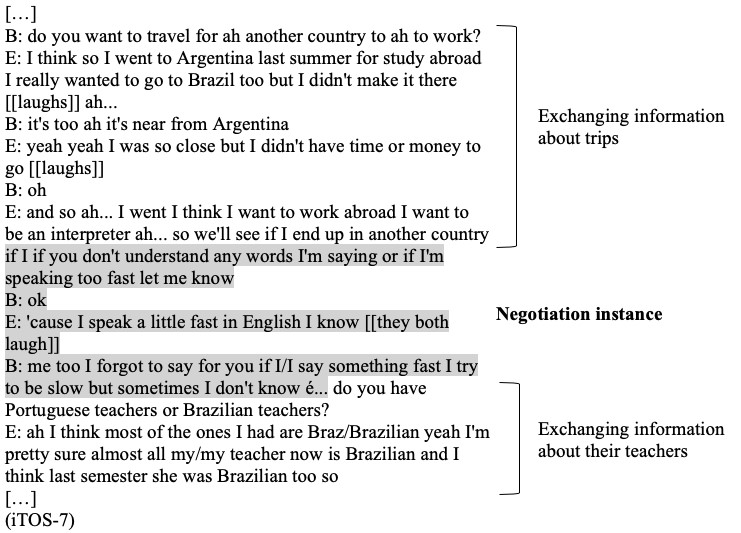
Figure 1
Example of negotiation instance tagging
Although interactive negotiation has been related to NoM only by Breen and Littlejohn (2002), in this paper, we adopted their terminology to classify all negotiation instances related to language processes (both meaning and form) once there is previous evidence that discussion on form also leads to talking about language and corrections whenever there are difficulties (Fernandes and Telles, 2015). In other words, if, on the one hand, deciding which form to use in order to express meaning could be a process of personal negotiation, in teletandem, evidence suggests that learners talk and correct each other on form, and it is also overtly social to use Breen and Littlejohn’s (2002) terms.
All other instances of negotiation –which were related to technology issues, separation of languages, and decision-making concerning the tasks– were classified into the procedural type, as they relate to decisions that need to be made regarding the teletandem environment.
In order to have a more comprehensive picture of the negotiation patterns that learners engage in, we identified how much of the sessions was dedicated to negotiating. To determine this percentage, we used the Word Count tool in Microsoft Word. Because the transcribed files are available in MulTeC in .txt format, we first converted them to .docx documents. For each transcribed file, the counting of the total number of words was already available. To calculate the number of words related to negotiation, we extracted the parts of the text that were labeled as negotiation instances. The results are shown in Table 2.
These quantitative results provide support and information for the analysis and discussion presented in the next section.
Results
| Session | Total of negotiation instances per session | Number of interactive negotiation instances | Number of procedural negotiation instances | Percentage of the session dedicated to negotiation |
| iTOS-1 | 20 | 17 | 3 | 21% Total number of words: 4.839 Number of words in negotiation: 1.032 |
| iTOS-2 | 33 | 24 | 9 | 19% Total number of words: 4.072 Number of words in negotiation: 790 |
| iTOS-3 | 10 | 6 | 4 | 11% Total number of words: 5.095 Number of words in negotiation: 582 |
| iTOS-4 | 22 | 19 | 3 | 21% Total number of words: 5.641 Number of words in negotiation: 1200 |
| iTOS-5 | 26 | 9 | 17 | 20% Total number of words: 7.007 Number of words in negotiation: 1.402 |
| iTOS-6 | 16 | 8 | 8 | 20% Total number of words: 3.642 Number of words in negotiation: 757 |
| iTOS-7 | 17 | 14 | 3 | 20% Total number of words: 5.010 Number of words in negotiation: 1.025 |
| iTOS-8 | 6 | 4 | 2 | 2% Total number of words: 5.689 Number of words in negotiation: 106 |
| iTOS-9 | 16 | 10 | 6 | 17% Total number of words: 3.958 Number of words in negotiation: 669 |
| iTOS-10 | 8 | 6 | 2 | 5% Total number of words: 2.577 Number of words in negotiation: 133 |
| Total | 174 | 117 | 57 | 16%Total number of words: 47.535 Total number of words in negotiation instances: 7.656 |
According to Table 2, the number of interactive negotiations is high in all sessions but one, which emphasizes the importance of this type of negotiation not only for asynchronous modes of communication as previous research suggest, but also for synchronous oral ones especially related to learning environments, as stated by the review in this paper.
Our data of synchronous teletandem oral sessions from iiTTD corroborate previous findings of non-integrated teletandem obtained from asynchronous communication, written synchronous communication, and participants’ reports (Luz, 2012. Garcia, 2013). The analysis indicates that the participants engage in both interactive and procedural negotiation throughout the first synchronous encounter, as dyads often have to suspend the conversation so they can negotiate meaning, form, teletandem principles, technology problems, and/or issues related to the previously established tasks that they need to carry out (procedural type).
Negotiation in iTOS seems to allow participants (i) to solve communication problems related to language processes, and (ii) to arrange contextbased aspects so that they can then resume the conversation. It occupies 16% of the iTOS, ranging from 2 to 21% depending on the session, with the following example shown in Figure 2.
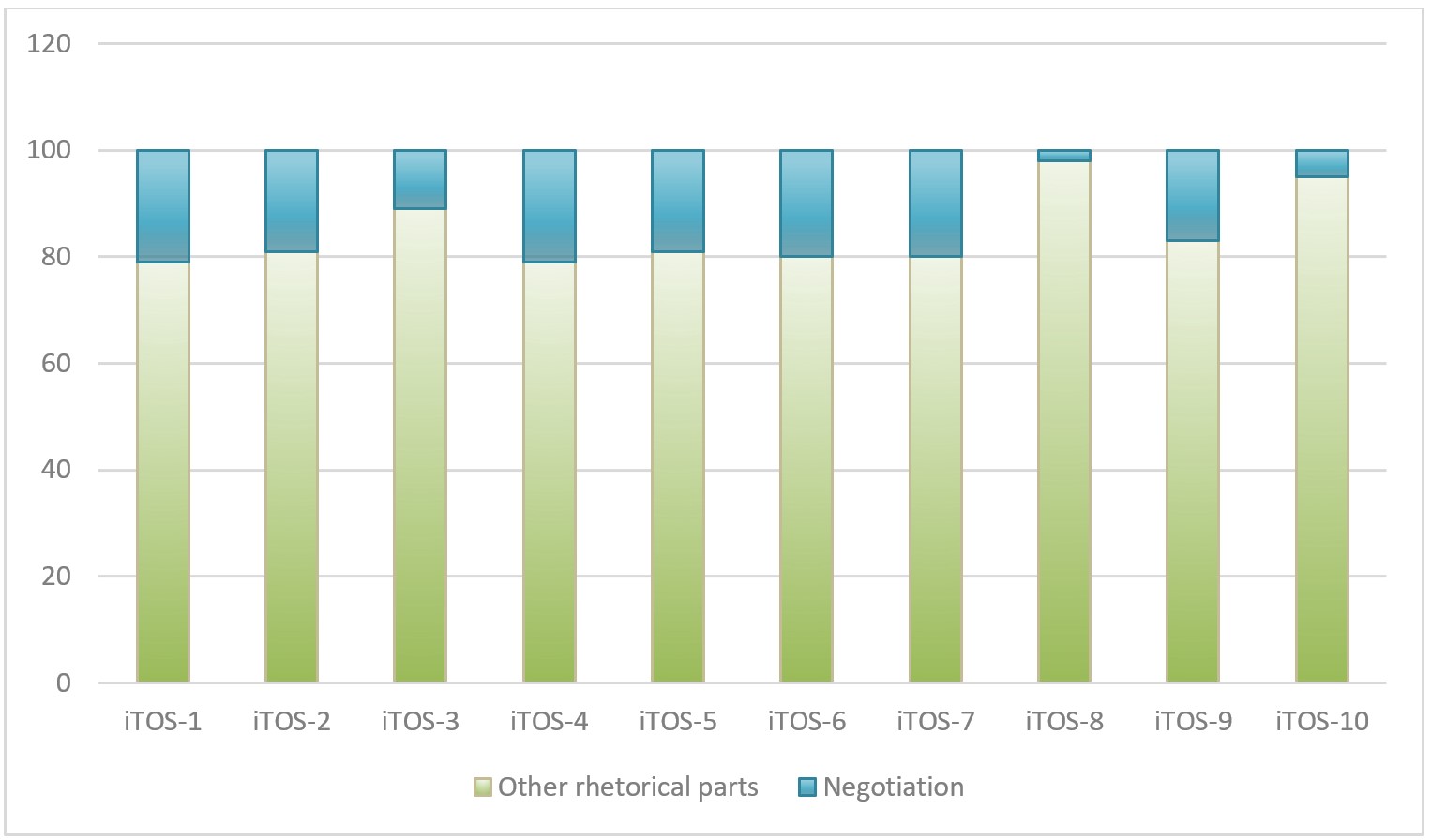
Figure 2
Percentage dedicated to negotiation in each initial teletandem oral session
Corroborating Garcia’s (2013) findings, in teletandem, students interact in two different languages, and miscommunication and uncertainties in the use of the target language motivate instances which focus on language processes, such as in the excerpt[7] from iTOS-4 illustrated below:
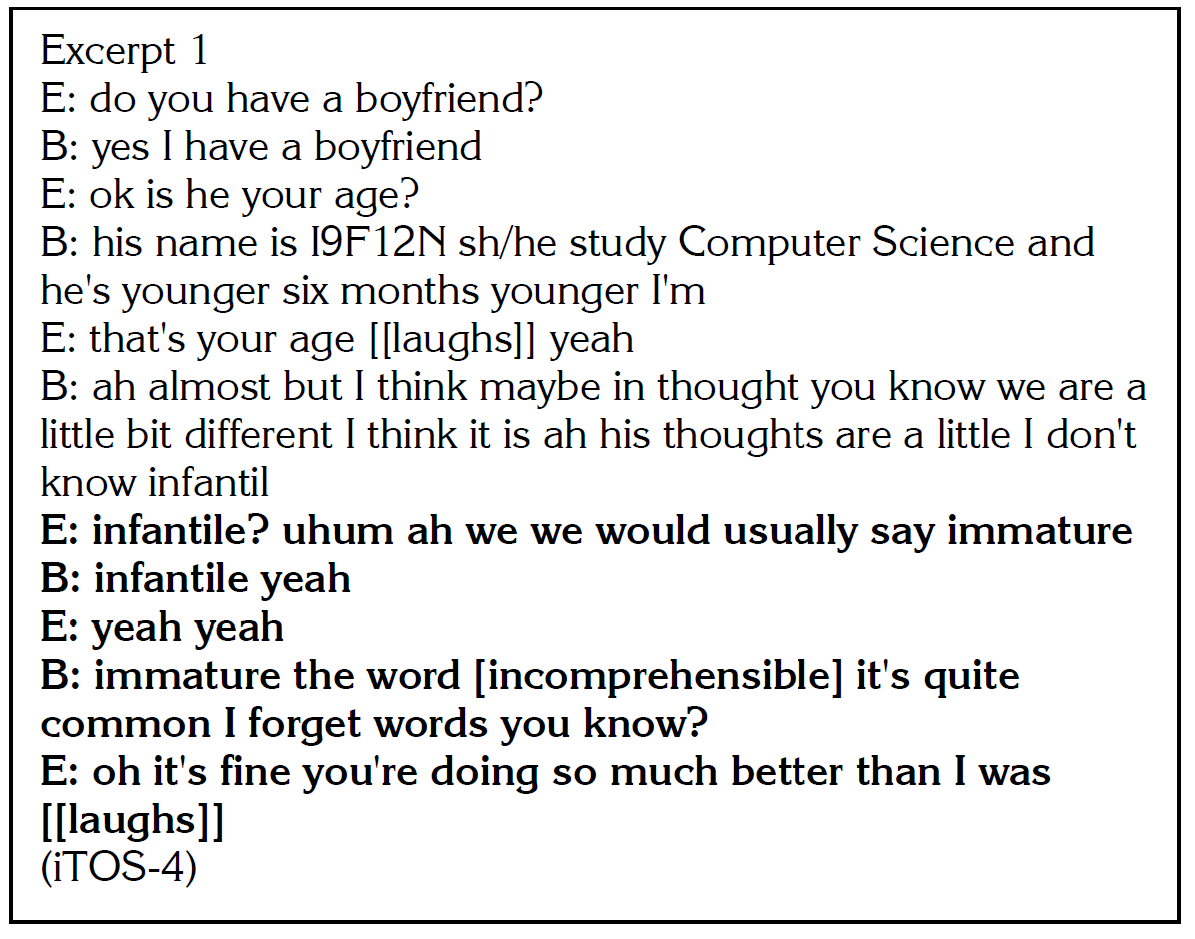
In Excerpt 1, students are talking in English about their relationships when the Brazilian participant used a word in Portuguese, infantil, which motivates her partner to offer input and provide new vocabulary: “immature”.
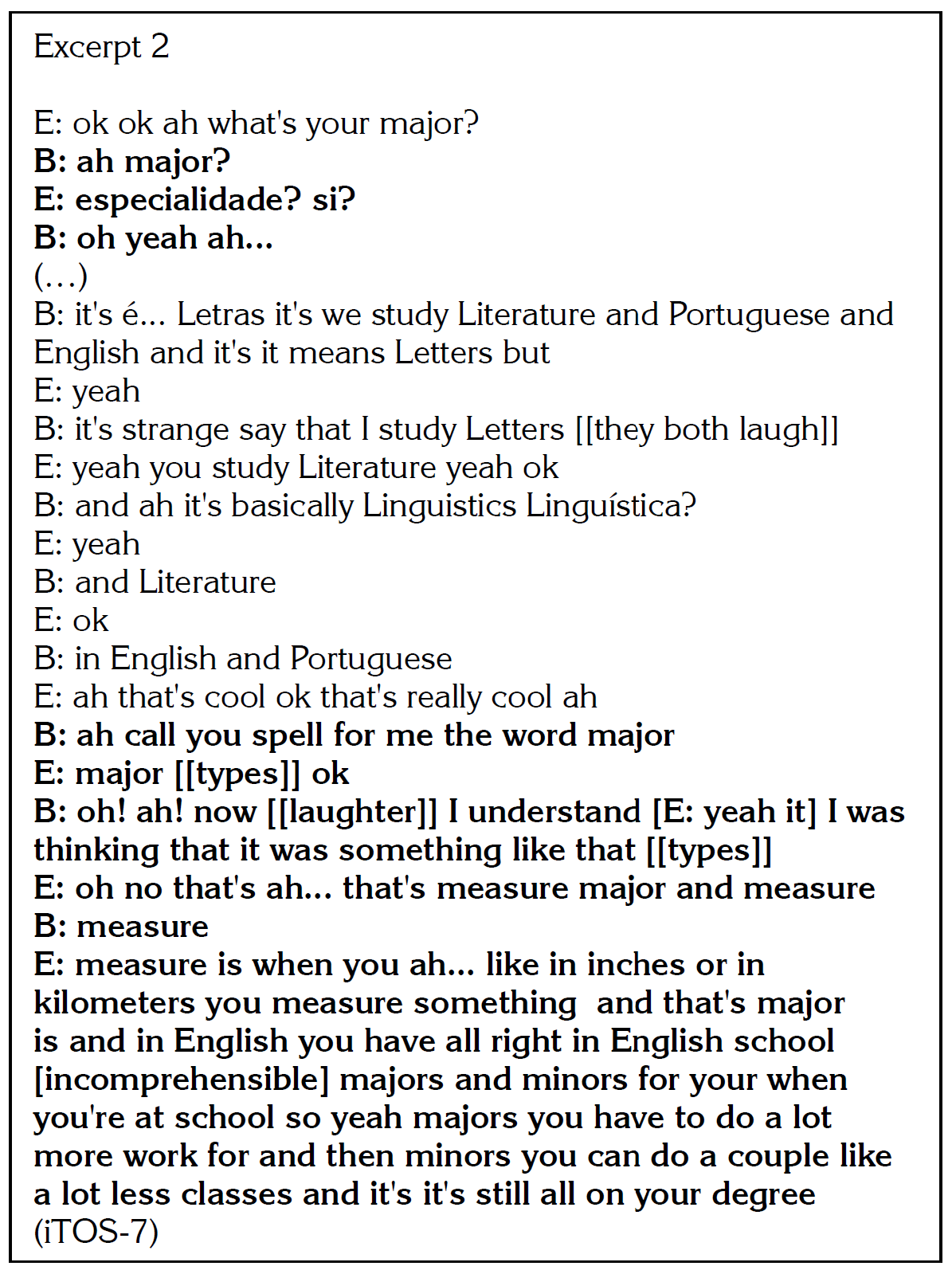
On some occasions, negotiation related to language processes occurs when students, in the position of learners of the target language, ask for clarification. In Excerpt 2, from iTOS-7, participants are talking about their studies, when the Brazilian student does not understand the word “major”, which later leads them to further negotiation when the Brazilian student pauses their conversation to ask for the spelling of the word:
Fuchs (2016) identified the negotiation types in asynchronous communication between learners using Breen and Littlejohn’s (2000) proposal, just as we did in this paper for the synchronous sessions. Instances of negotiation related to language processes in our corpus were classified as interactive negotiation. This type of negotiation occurs in communication when it is necessary to share, check, and clarify meanings or form. Out of 174 instances of negotiation, 117 were classified into this type. This finding differs from Fuchs’ (2016), who stated that participants engaged in procedural negotiations more often than in the interactive ones, which may be related to the asynchronous mode investigated by the author. We assume that this mode (synchronous) may have motivated more interactive negotiation, as, according to Breen and Littlejohn (2000, p. 7), such type “occurs in an ongoing and usually spontaneous way within immediate social activity”. In synchronous communication, interactive negotiation occurs whenever the issue that causes suspension in the dialogue emerges internally in the conversation, i.e., unknown vocabulary, (mis) pronunciation.
Besides interactive negotiation (117 of 174 occurrences), learners also engage in procedural negotiation during iTOS, as participants often have to suspend their conversation in order to solve technical problems and make decisions regarding the tasks they have to carry out and their learning process within this telecollaborative context. This corresponds to 56 instances in the corpus. The data show that the suspension in conversational flow in these cases is motivated by external matters, as participants need to put the information exchange on hold to observe the principles of the teletandem practice, deal with technology issues, and/or tend to demands previously given by instructors.
The procedural negotiation related to the principle of separation of languages in our corpus suggests that, in such moments, participants make an effort to observe the teletandem principles presented to them during the tutorial. Although Garcia (2013) predicted that participants in the non-integrated modality would also negotiate the language for each encounter, the occurrences might differ depending on the modality. In Garcia’s data (2013), for example, learners negotiate via email, and there is no evidence of such a negotiation happening in synchronous oral communication.
On the other hand, in our corpus of synchronous oral sessions, learners mostly choose to verify with their partners if it is appropriate to speak one language or another for that portion of the session, in what seems to be an attempt to preserve their faces by not imposing their preferences:
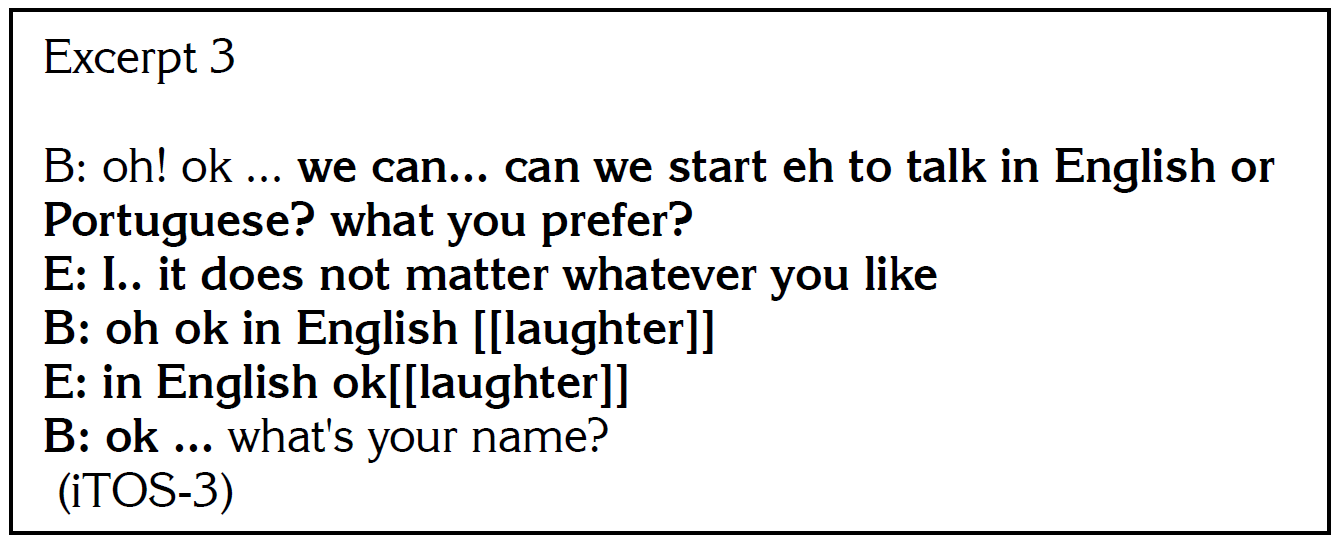
The negotiation of the principle of separation of languages indicates that suspension in conversation flow also occurs because learners are worried about/ committed to following the procedures described to them in the tutorial meeting. As Fuchs (2016) proposed, the presence of procedural negotiation in telecollaboration may illustrate that conversation is task-oriented in asynchronous encounters, and, specifically in teletandem, it may also be an indication that the oral session is also oriented towards following the teletandem principles of separation of languages and reciprocity; participants not only define a language to speak for each part of the session, but also consider their partners’ desires and contextual restrictions.
Also of a procedural nature, negotiation occurs when participants have issues related to the use of digital technologies, which is also related to the fact that interaction in telecollaboration is enabled through the use of VoIP technology. Such occurrences had not been identified in the studies by Luz (2012), Garcia (2013), or Fuchs (2016).

Negotiation of technology issues tends to be motivated by problems with the management of the technology and equipment. The negotiation here is also motivated by external demands, i.e., the issues that need to be solved are external to the conversation itself and related to the channel and tools used for communicating. Communication flow is suspended for explaining or solving the problem, and it is resumed once the difficulties are solved.
In excerpt 4, students have difficulties with the audio and video, which makes them interrupt the dialog about their studies to find a solution. It was only when the problems were resolved that they were able to resume (“ah… so keep going, you can talk”). Such instances were also classified into the procedural negotiation type because this is the kind of negotiation that happens when people “seek to reach agreement on a matter, solve a shared problem or establish ways of working that are acceptable to them” (Breen and Littlejohn, 2000, p. 8, our emphasis). This type of occurrence does not lead one to change or restructure language usage to make things clearer as in interactive negotiation, but rather to address technical issues external to the conversation, which are, however, common problems for both participants.
Another reason for procedural negotiation in iTOS was related to the tasks students need to carry out throughout the project. The tasks are typical of the integrated modality (Cavalari and Aranha, 2016. Aranha and Leone, 2017), so occurrences of this type were not identified by Luz (2012) and Garcia (2013), probably due to the non-integrated modality they studied. They were not observed in the first minutes of the sessions in the integrated modality examined by Rampazzo (2017) either. In some sessions, dyads pause the conversation to organize text exchange or exchange e-mails addresses for further communication. Negotiation in these occurrences is motivated by an external demand as well, the one imposed by the modality, which suggests that exchanging written texts is a task that learners need to carry out during the project.
In Excerpt 5, there are three negotiation instances: one internally motivated and of the interactive type –confirming how to say “now” in Portuguese– and two that are externally motivated and of the procedural type –figuring out how to use the chat tool and exchanging email addresses. It should be noted that the participants do not interrupt conversation in order to exchange e-mails. Instead, when the student from the American university notices a “gap” in the conversation –the topic of traveling is apparently over– she engages in negotiation, so that they can be prepared for a future task they need to carry out. Negotiation seems to fill in an empty space of silence.

Discussion
As the results indicate, during iTOS, learners often interrupt conversational flow in order to negotiate various issues that they understand to be relevant, which may be internally motivated, such as meaning and form, or a result of external demands, as with teletandem principles, technical difficulties, and task development. Despite occupying only 16% of sessions, negotiation serves to resolve miscommunication or lack of vocabulary/grammatical structures, deal with problems with the equipment, guarantee the observation of teletandem principles, and assist with task development.
Regarding the first research question (what aspects need to be negotiated during institutional integrated teletandem oral sessions?), we suggest that negotiation in teletandem is not restricted to negotiation of meaning, as also stated by Luz (2012), Garcia (2013), and Rampazzo (2017). Our proposition advances in advocating that negotiation in institutionally integrated teletandem may be not only internally motivated, as seems to be the case of negotiation of meaning (intrinsically connected to the conversation topic), but also externally motivated.
Negotiation in teletandem occurs not only when participants interrupt the normal flow of dialog, as proposed by Varonis and Gass (1978) and Blake (2000) for NoM, but also between one conversation topic and another, when one participant notices a gap in the conversation. In such cases, it is not meaning that is negotiated, but rather an external demand that leads to negotiation.
Based on our findings and on what Varonis and Gass (1978) propose for NoM, we argue that the different types of negotiation in telecollaboration (interactive and procedural) exist within, but separate from the main discourse. In other words, negotiation in teletandem is part of the interaction that occurs between participants in iTOS, but it does not constitute the action of exchanging information about themselves. Given that negotiation is embedded in the discourse in iTOS, we reinforce Rampazzo’s (2017) argument that it plays a major structuring role, as it is a rhetorical part, constitutive of the discourse, which allows learners to resolve issues that may be internally or externally motivated.
With respect to our second research question (how can the negotiation instances be classified?), our findings indicate that, in telecollaboration, just like in classroom settings, we may find instances of interactive and procedural negotiation, as proposed by Fuchs (2016). It seems that, in synchronous communication, there is a tendency towards the occurrence of more frequent instances of interactive negotiation, as linguistic issues arise and need to be discussed. Still, negotiation seems to serve essential purposes in telecollaboration because it is through interactive and procedural negotiation that problems with language use or with technology may be resolved in order for communication to be maintained, as well as it is through negotiation that participants may make decisions in collaboration with their partners, decisions that will most likely have an impact on arranging task completion.
Our study advances in proposing that not only is NoM is embedded the main discourse as proposed by Varonis and Gass (1985), but also other types of negotiation when it comes to telecollaborative exchanges. The results also suggest that not only is negotiation essential to resolve issues that might be problematic (Garcia, 2013), but also to guarantee the observation of teletandem principles, to fill empty spaces of silence, and to allow for task development. Moreover, the results indicate that interactive negotiation is a result of internal problems, whereas procedural negotiation is a result of external demands.
We thus propose that negotiation in telecollaboration be understood as a part of synchronous encounters that serves the purpose of allowing problems to be solved for the conversation to be resumed. Negotiation in telecollaboration: I. is embedded in the main discourse;
II. occurs whenever there is a suspension in the normal flow of conversation or when participants notice a gap in conversation;
III. may be internally motivated when participants need to solve a communication problem, or a response to external demands when learners need to arrange and agree on other issues that are central to the telecollaborative tasks and principles.
We suggest that such definition of negotiation in telecollaboration may inform both researchers and practitioners on designing exchanges –either aimed at language learning or exchanges with different goals– as well as with guiding and supporting participant learning through discussing the negotiation types and how they assist with learning in such environments for sustaining communication and cooperation.
Final remarks
This paper aimed at exploring the negotiation patterns of learners in telecollaboration, leading to a working definition of negotiation in telecollaboration. We have done so by engaging in a discussion of how participants in institutional integrated teletandem negotiate various issues, besides meaning, during the initial Teletandem Oral Session. Our analysis shares an understanding that negotiation plays a major structuring role in the organization of the initial oral session, and our findings indicate that negotiation in telecollaboration is both internally and externally motivated, i.e., it is not restricted to negotiation of meaning, as students often need to negotiate other issues as a response to external demands before resuming conversation. Learners engage in both interactive and procedural negotiation, besides personal negotiation, which, despite not being observable, is present in any other kind of negotiation. Interactive negotiation, which is related to language processes, was more frequent in our corpus than procedural negotiation, and it is associated with tech issues, task completion, and the observation of the principles. While negotiation instances occupy a small fraction of the sessions, they still have an important function in telecollaboration, allowing participants to make decisions in collaboration with their partners while following collaborative learning principles and to resolve issues that could otherwise prevent conversation from continuing. Finally, we argue that both researchers and practitioners may find our results useful to inform them on design issues and on guiding learners through virtual exchanges.
Regarding the limitations of this study, we would like to point out the fact that analysis has been restricted to the first synchronous encounter: the iTOS. Further studies could explore negotiation patterns in the subsequent sessions as well. In addition, other studies may investigate if there is any connection between the frequency of interactive negotiation instances and (a)synchronous exchanges, as suggested in this paper.
References
Aranha, S., & Cavalari, S. M. S. (2014). Os gêneros na modalidade de teletandem institucional integrado: a primeira sessão de interação. In: E. L. Nascimento, & R. H. R. Rojo (Eds.). Gêneros de texto/discurso e os desafios da contemporaneidade. Pontes Editores.
Aranha, S., & Cavalari, S. M. S. (2014). A trajetória do projeto Teletandem Brasil: da modalidade institucional não-integrada à institucional integrada. The Especialist, 35(2), 183-201. https://revistas.pucsp.br/index.php/esp/article/view/21467/15694.
Aranha, S., & Leone, P. (2017). The development of DOTI (Databank of oral teletandem interaction). In D. Fisher, & M. Beibewenger (Eds.). Investigating computer-mediated communication corpus-based approaches to language in the digital world (pp. 172-190). Universtiy Press, Faculty of Arts.
Aranha, S., & Lopes, Q. B. (2019). Moving from na internal databank to a sharable multimodal corpus: The MulTeC case. The Especialist, 40 (1). https://doi.org/10.23925/2318-7115.2019v40i1a8
Blake, R. (2000). Computer mediated communication: A window on L2 Spanish interlanguage. Language Learning and Technology, 4(1), 120-136. http://dx.doi.org/10125/25089
Brammerts, H. (1996). Tandem language learning via the internet and the International E-Mail Tandem Network. In D. Little & H. Brammerts (Eds), A Guide to Language Learning in Tandem via the Internet (pp. 9-21). Trinity College.
Breen, M. P., & Littlejohn, A. (2000). The significance of negotiation. In M. P. Breen, & A. Littlejohn (Eds.). Classroom decision-making: negotiation and process syllabuses in practice (pp. 5-38). Cambridge University Press.
Cavalari, S. M. S. (2018). Integrating telecollaborative language learning into Higher Education: a study on teletandem practice. BELT: Brazilian English Language Teaching Journal, 9(2), 417-432. https://doi.org/10.15448/2178-3640.2018.2.31927
Cavalari, S. M. S., & Aranha, S. (2016). Teletandem: integrating e-learning into the foreign language classroom. Acta Scientiarium. Language and Culture, 38(4), 327-336. https://doi.org/10.4025/actascilangcult.v38i4.28139
Clavel-Arroitia, B. (2019). Analysis of telecollaborative exchanges among secondary education students: communication strategies and negotiation of meaning. Porta Linguarum, 31, 97-116. https://www.ugr.es/~portalin/articulos/PL_numero31/6%20Analysis%20of%20Telecollaborative%20Exchanges%20among.pdf
Clavel-Arroitia, B., & Pennock-Speck, B. (2015). Telecollaboration in a secondary school context: Negotiation of meaning in English as lingua franca/Spanish tandem interactions. @ tic: revista d’innovació educativa, 15, 74-82. https://doi.org/10.7203/attic.15.6411
Engeström, Y. (1987). Learning by expanding. An activity-theoretical approach to developmental research. Orienta-Konsultit.
Fernandes, A. M. & Telles, J. A. (2015). Teletandem: enfoque na forma e o desenvolvimento do professor de língua estrangeira. Revista de Estudos da Linguagem, 23(1), 261-287. https://doi.org/10.17851/2237-2083.23.1.261-287
Foucher, A. (2010). Didactique des Langues-Cultures et Tice: scenarios, tânches, interactions. Education. Université Blaise Pascal-ClermontFerrand II.
Franco, G. R. (2016). Aspectos linguísticos emergentes em sessões de teletandem: uma análise a partir da conscientização da linguagem [Master’s thesis, Universidade Estadual Paulista Júlio de Mesquita Filho]. Repositório institucional UNESP. https://repositorio.unesp.br/handle/11449/143924
Fuchs, C. (2016). “Are you able to access this website at all?” – team negotiations and macrolevel challenges in telecollaboration. Computer Assisted Language Learning, 29(7), 1152-1168. https://doi.org/10.1080/09588221.2016.1167091
Garcés, P., & O’Dowd, R. (2020). Upscaling virtual exchange in university education: Moving from innovative classroom practice to regional governmental policy. Journal of Studies in International Education, 25(3), 283-300. https://doi.org/10.1177/1028315320932323
Garcia, D. N. M. (2013). O que os pares de Teletandem (não) negociam: práticas para um novo context online interativo para o Ensino/ aprendizagem de línguas estrangeiras no século XXI. Editora Unesp.
Garcia, D. N. M. (2015). A logística das sessões de interação e mediação no teletandem com vistas ao ensino; aprendizagem de línguas estrangeiras. Estudos Linguísticos, 44(2), 725-738. https://revistas.gel.org.br/estudoslinguisticos/article/view/1007/589
Gass, S., Mackey, A., & Pica, T. (1998). The role of input and interaction in second language acquisition: introduction to the special issues. The Modern Language Journal, 82(3), 299-307. https://doi.org/10.1111/j.1540-4781.1998.tb01206.x
Lewis, T., & O’Dowd, R. (2016). Online intercultural exchange and foreign language learning: a systematic review. In R. O’Dowd & T. Lewis (Eds.), Online intercultural exchange: Policy, pedagogy, practice (pp. 29-72). Routledge.
Luz, E. B. P. (2012). Variáveisinfluenciadoras da continuidade ou descontinuidade de parcerias de Teletandem à luz da teoria da atividade [Doctoral dissertation, Universidade Estadual Paulista Júlio de Mesquita Filho]. Repositório Institucional UNESP. http://hdl.handle.net/11449/103516
O’Dowd, R. (2018). From telecollaboration to virtual exchange: state-of-the-art and the role of UNICollaboration in moving forward. Journal of Virtual Exchange, 1, 1-23. https://doi.org/10.14705/rpnet.2018.jve.1
Rampazzo, L. (2017). Gêneros textuais e telecolaboração: uma investigação da sessão oral de teletandem inicial [Master’s thesis, Universidade Estadual Paulista Júlio de Mesquita Filho]. Repositório Institucional UNESP. http://hdl.handle.net/11449/150055
Rampazzo, L. (2021). Gêneros do intercâmbio virtual: recorrência retórica e uso de polidez no primeiro encontro síncrono. [Doctoral dissertation, Universidade Estadual Paulista Júlio de Mesquita Filho]. Repositório Institucional UNESP. http://hdl.handle.net/11449/210956
Rampazzo, L. (2019). Gêneros oclusos na telecolaboração: a variação na estrutura retórica da sessão oral de teletandem inicial. Revista Estudos Linguísticos, 48(3), 1535-1553. https://doi.org/10.21165/el.v48i3.2175
Rampazzo, L., & Aranha, S. (2018). A sessão oral de teletandem inicial: a estrutura retórica do gênero. DELTA: Documentação e Estudos em Linguística Teórica e Aplicada, 31(1). https://revistas.pucsp.br/index.php/delta/article/view/41392
Rampazzo, L., & Aranha, S. (2019). Telecollaboation and genres: a new perspective to understand language learning. Journal of Virtual Exchange, 2, 35637. https://doi.org/10.21827/jve.2.35637
Swales, J. M. (2004). Research genres: Explorations and applications. Cambridge University Press.
Telles, J. A. (2006). Projeto Teletandem Brasil: línguas estrangeiras para todos - ensinando e aprendendo línguas estrangeiras in-tandem via MSN Messenger. Faculdade de Ciências e Letras de Assis, UNESP.
van der Zwaard, R., & Bannik, A. (2019). Toward a comprehensive model of negotiated interaction in computer-mediated communication. Language Learning & Technology, 23(3), 116135. https://www.lltjournal.org/item/1012544699/
van der Zwaard, R., & Bannik, A. (2014). Video call or chat? Negotiation of meaning and issues of face in telecollaboration. System, 44, 137-148. https://doi.org/10.1016/j.system.2014.03.007
Varonis, E. M, & Gass, S. (1985). Non-native/ non-native conversations: a model for negotiation of meaning. Applied Linguistics, 6(1), 71-90. https://doi.org/10.1016/j.system.2014.03.007
Vassallo, M. L., & Telles, J. A. (2006). Foreign language learning in-tandem: theoretical principles and research perspectives. The ESPecialist, 27(1), 83-118. https://citeseerx.ist.psu.edu/viewdoc/d?doi=10.1.1.845.2443&rep=rep1&type=pdf
Notes