Article
Governance structure and its links with justice in the context of cooperative organizations1
Estruturas de governança e seus vínculos com a justiça no contexto das organizações cooperativas
 Rafael Todescato Cavalheiro rafaeltodescato@hotmail.com
Andréia Maria Kremer andréiakremer@hotmail.com
Régio Marcio Toesca Gimenes regiomtoesca@gmail.com
Rafael Todescato Cavalheiro rafaeltodescato@hotmail.com
Andréia Maria Kremer andréiakremer@hotmail.com
Régio Marcio Toesca Gimenes regiomtoesca@gmail.com
Governance structure and its links with justice in the context of cooperative organizations1
Enfoque: Reflexão Contábil, vol. 43, no. 2, pp. 1-13, 2024
Universidade Estadual de Maringá
Received: 19 February 2022
Revised document received: 11 July 2022
Accepted: 06 September 2022
ABSTRACT
Objective: Cooperative organizations have unique characteristics in their processes and control structures. Given the nature of the relationships that permeate them, justice has stood out as the basis of these relationships, given that the organizations involved seek justice when comparing the rewards and costs involved in interactions. The objective of this essay is to present a theoretical model that makes it possible to explain the links between the governance package (PGov) and the cooperative members' perception of justice and how both reflect on the relational performance of cooperative organizations.
Method: This study adopts the theoretical essay method, and assumes the epistemological dimension of structuralism, which generally seeks to explore the structure of the phenomenon and, through its essence, determine its determinant links and interrelationships (Triviños, 1997).
Originality/Relevance: Despite advances in understanding the role of control and governance in interorganizational relationships (Ding, Dekker, & Groot, 2013), studies that consider the perspective of justice are still scarce (Dhaundiyal & Coughlan, 2020; Su, Zhang and Guo (2020), and who strive to understand the impacts of these links on performance, which is a differential of the model presented in this essay. Results: This study proposes a model for analyzing the links between the PGov, Organizational Justice and its effects on relational performance. To do so, it was based on the governance and management control structures defended by van der Meer-Kooistra and Scapens (2008), in organizational justice, outlined in its three aspects: distributive justice, procedural justice and interactional justice, addressed by Luo (2007), as well as the notions of relational performance adopted by Su et al. (2020).
Theoretical/methodological/practical contributions: The application of the model can bring practical contributions, specifically for the review of the cooperative's PGov and the governance structures to be reformulated (or not), in order to reinforce the justice perceived by the cooperative members. In this way, it is believed that the use of the model will enable the ideal channels of justice to be identified, enhancing the reach of the governance structure and the achievement of the objectives of cooperative organizations.
Keywords: Distributive Justice+ Procedural Justice+ Interactional Justice+ Cooperative.
RESUMO
Objetivo: As organizações cooperativas possuem características singulares em seus processos e estruturas de controle. Dada a natureza dos relacionamentos que as permeiam, a justiça tem se destacado como base dessas relações, haja vista que, as organizações envolvidas buscam justiça ao comparar as recompensas e os custos envolvidos nas interações. O objetivo deste ensaio é apresentar um modelo teórico que possibilite explicar os vínculos entre o pacote de governança (PGov) e a percepção de justiça dos cooperados e como ambos refletem no desempenho relacional das organizações cooperativas.
Método: Este estudo adota o método do ensaio teórico e assume a dimensão epistemológica do estruturalismo, que geralmente busca explorar a estrutura do fenômeno e, por meio de sua essência, determinar seus vínculos e inter-relações determinantes (Triviños, 1997).
Originalidade/Relevância: Apesar dos avanços no entendimento do papel do controle e governança em relações interorganizacionais (Ding, Dekker, & Groot, 2013), ainda são escassos os estudos que consideram a perspectiva da justiça (Dhaundiyal & Coughlan, 2020; Su et al., 2020), e que se esforçam para compreender os impactos desses vínculos no desempenho, sendo esse um diferencial do modelo apresentado no presente ensaio.
Resultados: Esse estudo propõe um modelo de análise dos vínculos entre o PGov, Justiça Organizacional e os seus reflexos no desempenho relacional. Para tanto, fundamentou-se nas estruturas de governança e controle gerencial defendidas por van der Meer-Kooistra e Scapens (2008), na justiça organizacional, delineada em seus três aspectos: justiça distributiva, justiça processual e justiça interacional, abordadas por Luo (2007), bem como, nas noções de desempenho relacional adotadas por Su, Zhang e Guo (2020).
Contribuições teóricas/metodológicas/práticas: A aplicação do modelo pode trazer contribuições práticas, especificamente para a revisão do PGov da cooperativa e as estruturas de governança serem reformuladas (ou não), de modo a reforçar a justiça percebida pelos cooperados. Dessa forma, acredita-se o uso do modelo possibilitará que os canais de justiça ideais possam ser identificados, potencializando o alcance da estrutura de governança e o atingimento dos objetivos das organizações cooperativas.
Palavras-chave: Justiça distributiva, Justiça processual, Justiça interacional, Cooperativa.
1 INTRODUCTION
The view of firms from the perspective of the New Institutional Economics (NIE) argues that transactions have costs, with rare exceptions. Furthermore, this approach focuses on the economic functionality and efficiency of different types of arrangements, as well as the economic motivations that trigger and/or influence the processes of institutional change (Coase, 1937; Schepker, Oh, Martynov, & Poppo, 2014; Williamson, 1975). Thus, the search for maximizing efficient results, based on the behaviour of individuals within an organization and the way they are coordinated, has been the focus of Transaction Cost Theory (TCT).
The TCT brings two basic assumptions, the first is the limited rationality of economic agents and, the second, the opportunism present in the actions of economic agents, which implies the emergence of transaction costs (Williamson, 1975). Due to the existence and importance of transaction costs, there is a need to build governance structures that allow dealing with uncertainty and variability, reducing opportunistic behaviour and minimizing transaction costs. In this sense, considering that one of the main objectives of governance structures is the minimisation of transaction costs, it can be understood that this search contributes significantly to the choice of governance structure. Thus, the structures of governance are shaped to coordinate transactions between agents, seeking to minimise transaction costs and efficiency of results.
This way of looking at organizations places the economic agents involved in the transaction as a central element and can be applied in quite different contexts. Among the types of organizations, there are those for profit and not-for-profit, and organizations with an economic objective, but without a profit objective (Bialoskorski Neto, Barroso, & Rezende, 2012). Cooperatives are an institutional type with different characteristics from profit-oriented companies (Novkovic, 2008). While those who invest in a profit-oriented-type company mainly seek to maximise their wealth, those who found a cooperative are concerned with providing themselves with essential services at lower prices, with not only economic benefits, but also social (Helmberger & Hoos, 1962).
The challenge of modern cooperatives is to maintain their role as a productive system centred on human beings and their well-being, while at the same time developing to the point of being able to compete with market-oriented companies (Zylbersztajn, 1994). Agricultural cooperatives are the pioneers of this type of organization. Agricultural cooperatives, which have a complex control system, both in terms of structure and process, which requires monitoring of economic results and the provision of services to cooperative members. In Brazil, the agricultural cooperative system maintains, by its own characteristic, the contractual non-obligation in transactions between the members and the cooperative, as well as there is no contractual obligation that determines the participation of the cooperative member and his cooperative (Bialoskorski Neto, 2007). This brings complexity and challenges for the managers of the cooperatives, given the opening for the existence of contractual opportunisms and deviations that are not interesting for the economic efficiency of the cooperative. In this sense, given the nature of cooperatives, the theoretical elements of TCT may not be sufficient to analyse and explain their transactions and structures (Delarmelina & Salles, 2016).
Changes in the competitive market have driven agricultural cooperatives to seek professionalization in management and in relationships with their members (Costa & Melo, 2017; Simioni, Siqueira, Binotto, Spers, & Araújo, 2009; Zylbersztajn, 1994), without ceasing to (or try to) follow the cooperative values of democracy, equality, equity and solidarity and the ethical values of honesty, openness, social responsibility and care for others. From the perspective of cooperative members, in addition to being part of an organization that follows (or tries to) follow such values, participating in a cooperative is advantageous due to the provision of services, commercialization of production, technical assistance, learning, financial return and discounts on investments (Breitenbach, Brandão, & Zorzan, 2017; Fischer & Qaim, 2012).
Despite the advantages offered to cooperative members, such benefits are not strong enough to overcome the competitive price attribute (Breitenbach et al., 2017), and the maintenance of the frequency of contractual exchanges is conditioned to the level of competition established in the market, so as not to negatively affect the profitability of their productive activity (Simioni et al., 2009), which reveals the presence of opportunistic behavior on the part of cooperative members. This type of behavior is known as free-rider and has been identified, among others, in American agricultural cooperatives (Cook, 1995) and also in Brazil (Pivoto, Finger, Waquil, & Souza, 2013; Simioni et al., 2009). Such behavior arises “when the member joins the cooperative only to benefit from the positive externalities generated by the cooperative's activities, without participating, transacting or investing in the organization” (Pivoto et al., 2013, p. 110).
The presence of opportunistic behavior in this environment brings problems to the development of the cooperative and hurts the cooperative values themselves. For Zylbersztajn (2002, p. 15) “the relationship with the cooperative member cannot be taken as stable by nature, but must be fostered and worked on strategically, according to each particular situation”. Therefore, discussions about the characteristics of management control systems and the complexity of governance of cooperatives are essential, given that they have unique characteristics in their processes and control structures (Bialoskorski Neto et al., 2012), and have formal and informal mechanisms that involve the cooperative-cooperative relationship (Zylbersztajn, 2002). In interorganizational relationships, it is necessary to go beyond the limits of the Management Control System (MCS), and consider the governance structure that permeates the relationship (van der Meer-Kooistra & Scapens, 2008).
In this theoretical essay, we opted for the approach of van der Meer-Kooistra and Scapens (2008). This approach argues that the governance structure must enable the design of an adequate governance package (PGov), using elements provided by the external environment, while others must be agreed between the parties (internal). The governance structure needs to support knowledge and information sharing, cooperation, trust, learning, flexibility, standardization and change in the role of group leaders (van der Meer-Kooistra & Scapens, 2008).
Given the nature of interorganizational relationships, justice has emerged as the basis of these relationships, given that the organizations involved seek justice when comparing the rewards and costs involved in interactions (Brown, Cobb, & Lusch, 2006; Luo, Liu, Yang, Maksimov, & Hou, 2015). In the context of cooperatives, the relationship between the perception of justice and governance is rarely studied, despite the impact that the interpersonal relationships of members have on the performance of agricultural cooperatives (Su et al., 2020).
As with strategic alliances (Luo, 2007), helping members realize justice within the cooperative can give them confidence in the partnership and their ability to cooperate can increase. It is important to note that, according to Konovsky (2000), fairness in relation to a decision affects lower-order attitudes, such as self-esteem and social identity, as well as higher-order and long-term attitudes, such as commitment, trust and social harmony. Therefore, the violation of organizational justice can stimulate intense negative emotional responses and create hostile climates that can encourage opportunism, and managers should invest in practices and policies that increase the perception of justice (Trada & Goyal, 2017).
The concern with corporate governance is essential for cooperatives, and their internal public should be one of the main focuses, which, ultimately, represents a great source of resources (Zylbersztajn, 2002). In this sense, the present question is presented: how PGov and justice are related, and how does this interaction reflect on the relational performance of cooperatives? Therefore, the objective of this essay is to present a theoretical model that makes it possible to explain the links between the PGov and the cooperative members' perception of justice and how both reflect on relational performance.
As a method, this theoretical essay follows the path suggested by Meneghetti (2011), that is, it adopts the reflective capacity to understand the reality of cooperatives. In this sense, the governance and management control structures are initially presented. Next, organizational justice is outlined in its three aspects: distributive justice, procedural justice and interactional justice and relational performance. Finally, a model for analyzing the links between the PGov and organizational justice is proposed, as well as its effects on relational performance.
2 THEORETICAL BASIS OF THE MODEL
2.1 Governance and Management Control Structures
The contexts of interorganizational relationships share many characteristics of innovative activities, as they involve relatively equal and autonomous parties, with intense knowledge sharing, cooperation, learning, trust and leadership exchanges (van der Meer-Kooistra & Scapens, 2008). The high levels of uncertainty, continuous change, flexibility, creativity, learning, knowledge creation, communication and information sharing, led Kamoche and Cunha (2001) to propose a minimum governance structure in the context of innovation: the Social Structure and the Structure Technique.
The Social Structure concerns the social ties between the parties, which shape the character of the interactions between those involved, such as: expected behavior patterns, norms and values, commitments made to each other, how they communicate and share information, who assumes the role of leadership and when and how they learn, among others (Kamoche & Cunha, 2001). The Technical Structure relates to the technical aspects of transactions and production and information processes, such as: interfaces between the parties, product resources and production techniques, the parties' technical skills, systems and information processing and knowledge of available accounting procedures and techniques (Kamoche & Cunha, 2001). This model defines the responsibilities, priorities and procedures for the participants, at the same time creating “maneuver zones”, where there can be interaction, communication and knowledge creation (van der Meer-Kooistra & Scapens, 2008).
Starting from this minimal structure (Social and Technical), van der Meer-Kooistra and Scapens (2008) expanded this framework to interorganizational relationships, adding two types of structure: Economic and Institutional. The Economic Framework consists of specific economic arrangements made by the parties, such as performance measures, efficiency standards, relationship duration, frequency and volume of transactions, quality schedules and requirements, and the parties' general understanding of their market positioning (van der Meer-Kooistra & Scapens, 2008). The Institutional Structure, on the other hand, comprises legal regulations and other external regulations, along with internal organizational arrangements, the type of contract and the formal nature of the relationship (van der Meer-Kooistra & Scapens, 2008).
Table 1 provides an overview of the elements that make up the four structures that form the basis for the governance of interorganizational relationships used as a reference in this theoretical essay.
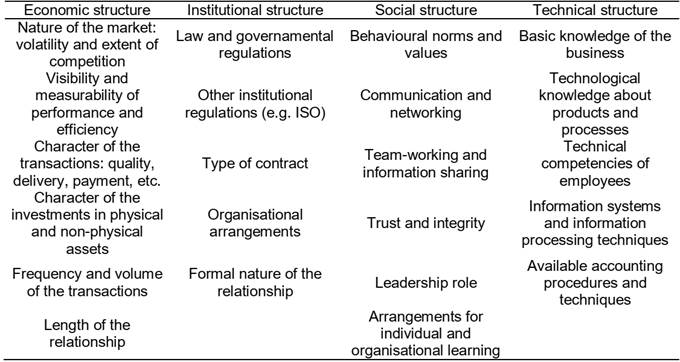
Table 1
Overview of the elements of the four governance structures.
Note. Source: van der Meer-Kooistra and Scapens (2008, p. 375).
The van der Meer-Kooistra and Scapens (2008) governance model was designed to analyze lateral relationships, which are characterized by the presence of substantial interdependence between parties, considerable complexities in relationships, and an environment of continuous change. Despite this, it is adequate to understand the processes of governance and management control of cooperatives, as it focuses on the analysis of the modes of coordination between organizations (interorganizational relationships). This argument is based on the premise that cooperatives are permeated by complex vertical relationships, which aim to increase the competitiveness of the participants.
In this sense, the perception of justice of the members of the cooperative can impact its governance structure, just as governance can influence the perception of justice of those involved. This is an important point to consider, as unfair systems can lead to inappropriate behavior, feelings of injustice, lack of commitment, low performance and dissatisfaction (Frezatti, Rocha, Nascimento, & Junqueira, 2016). Therefore, in the next section, the theoretical bases for the analysis of the perception of justice are presented.
2.2 Organizational Justice
Organizational justice emerges from Psychological Theory and its application in the scope of Management Accounting can be expanded, with the adoption of a more dynamic perspective on the relationships between managerial accounting practices and psychological processes (Hall, 2016). In this theoretical essay, organizational justice will be outlined in three aspects: distributive justice, procedural justice and interactional justice.
The development of organizational justice as a field of research was marked by the insertion of the Theory of Equity in the 1960s (Adams, 1965). This theory, by focusing on the perception of impartiality in the distribution of results in the work environment, especially regarding salary and promotion decisions, embodied the first aspect of organizational justice, called distributive justice (Luo, 2007).
Concern with the process of allocating results rather than distributing them has shifted the focus of research from organizational justice to procedural justice, which is promoted by the adoption of fair criteria and processes on the way to achieving results (Colquitt, 2001; Lind & Tyler, 1988). In addition, according to Bies and Shapiro (1987), interpersonal treatment is also important and reflects on the perception of justice, therefore, the adequacy of behavior and treatment given to those involved during the process of seeking results, as well as, in the distribution represents an aspect of organizational justice, called interactional justice.
Although aspects of organizational justice focus on the micro level of the organizational environment, its core principles are potentially applicable to meso-level phenomena, whether within a single organization or across organizations (Kim & Mauborgne, 1993). According to Luo (2007), fairness is an essential aspect in interorganizational relationships, especially regarding the establishment of procedures, incentive structure and communication. The author points out that “without procedural, distributive and interactional justice, the formalization and structure of incentives governed structurally and contractually may not sufficiently motivate each party to commit necessary resources, beyond what is specified in a contract” (Luo, 2007, p. 645).
Poppo and Zenger (2002) mention that formal contracts can undermine trust and thus encourage opportunistic behavior. Furthermore, in the analysis of these relationships, it should be considered that strong forms of opportunism usually violate formal contracts, while weak forms of opportunism violate social contracts (Liu, Liu, & Li, 2014).
2.2.1 Distributive justice
Distributive justice can be defined as the fair distribution of benefits and harms, rewards and costs and other things that affect the well-being of individual members of a given group (Colquitt, 2001). Distributive justice has as its central point the encouragement of effective cooperation, which promotes the well-being of group members in the economic, social, psychological and physiological areas, that is, follows the basic principles of equity, equality and necessity (Tyler, 1994).
Luo (2007) highlights that the perception of distributive justice usually arises from comparisons with an internal or external reference. In the case of cooperatives, this reference could be with a member of the cooperative itself or with members of other cooperatives, or even with the market. According to Trada and Goyal (2017), distributive injustice has strong effects on opportunism, followed by procedural and interactional injustice, which suggests the need to consider the importance of distributive justice in defining the PGov of cooperatives.
2.2.2 Procedural justice
Procedural justice refers to perceptions of the fairness of the formal procedures that govern decisions (Luo, 2007), and assumes that fair treatment determines individuals' reactions to these decisions (Lind & Tyler, 1988). In this sense, procedural justice in interorganizational relationships is perceived by border agents (boundary spanners), as processes are seen as impartial and fair, especially in terms of strategic decision-making and procedures that affect the gains and interests of companies involved (Luo, 2007).
Greenberg (1987) mentions that the main determinants of justice perceptions are process control, voice opportunity and work relationships. In addition, procedural justice is visualized when procedures and criteria are transparent, adjustable, correctable, impartial, representative, non-discriminatory and follow specified contractual norms (Luo, 2007). As highlighted in this subsection, procedural justice focuses on the formal aspect of the exchange process (Skarlicki & Folger, 1997). In the next subsection, interactional justice will be presented, which emphasizes the social aspect of the process.
2.2.3 Interactional justice
Interactional justice focuses on individuals' perceptions of the quality of interpersonal treatment received during the decision-making process and other organizational procedures (Luo, 2007). This aspect of justice includes several behaviors related to social sensitivity, such as: respect, honesty, dignity and politeness (Cropanzano, Prehar, & Chen, 2002).
Sensitivity and the provision of justifications or explanations to the recipient of justice are important elements for interactional justice to occur (Luo, 2007). In the context of interorganizational relationships, the person who represents a company in the adoption of formal procedures or in making critical decisions is also usually seen as a representative of organizational justice (Rupp & Cropanzano, 2002), this is relevant because, as interpersonal behaviors determine interactional justice, it influences the cognitive, affective and behavioral reactions of the parties involved (Luo, 2007), which reflect in the short and long term of the relationship.
Luo (2007) points out that when the differences in objectives between the parties are high, it becomes essential that procedural and distributive justice reinforce each other. Interactional justice, on the other hand, complements procedural justice by providing social elements that support the structuring of management processes adopted by the group, while complementing distributive justice by incorporating socially embedded reward elements in a system of sharing gains and benefits (Luo, 2007). These elements suggest a multiple relationship between organizational justice and organizational performance, which is the basis considered in this essay for the composition of the analysis model presented in the next section.
2.3 Relational Performance
Relational performance can be defined as the general satisfaction of those involved in achieving organizational goals and improving their competitive position and learning (Krishnan, Martin, & Noorderhaven, 2006; Walter, Lechner, & Kellermanns, 2008; Wang & Dyball, 2019). Ring and Van de Ven (1994) mention that the links between relationships and the perception of justice are manifested in a higher level of cooperation, which is important for cooperatives.
Lee and Cavusgil (2006) suggest that relationship-based governance, as opposed to contractual governance, is more effective and influential in strengthening the interorganizational partnership, as it stabilizes the alliance and facilitates the transfer of knowledge between partners. Mahama (2006) identified a positive relationship between the management control system and performance in the supply chain. The author also found that socialization processes are indirectly related to performance. In the context of rural cooperatives, the relationship between relational perception and governance is usually seen in the dimensions of trust, information sharing and common solutions (Su et al., 2020).
As contracts are increasingly personalized, with high levels of relational governance (and vice versa) and these choices interact with the ability to generate improvements in the performance of exchanges (Poppo & Zenger, 2002), it is important to understand the reflexes of governance on performance, incorporating relationship aspects into the analysis. Langfield-Smith (2008) identified that governance structures, as well as behavioral controls, exit controls, social controls and processes that led to the development of trust and risk mitigation, were part of the governance package of the interorganizational relationship (Langfield-Smith, 2008). From this theoretical perspective, this essay proposes a relationship between the PGov and the behavioral aspects (justice) perceived by the cooperative members and that such perceptions can influence the PGov design and, consequently, impact the cooperative's relational performance.
3 MODEL FOR ANALYZING THE LINKS BETWEEN THE PGOV AND ORGANIZATIONAL JUSTICE
This essay adopts the epistemological dimension of structuralism, which in general seeks to explore the structure of the phenomenon and, through its essence, determine its determinant links and interrelationships (Triviños, 1997). This choice was made due to the objectives of the present essay, which proposes the analysis of the formal and informal structures of governance and control that permeate cooperatives and their links with organizational justice.
According to the perspective of structuralism, social reality is a set of phenomena, and it is necessary to discover the relationships between them, through the construction of explanatory models. In view of this, the present essay will focus on the analysis of governance structures and the perception of organizational justice present in cooperatives. In addition, through the creation of a model, it is intended to analyze separately the components of the PGov that influence the perception of justice of the cooperative members and how this reflects on the relational performance.
Based on the theoretical bases presented in the previous sections, the following analysis model is proposed.
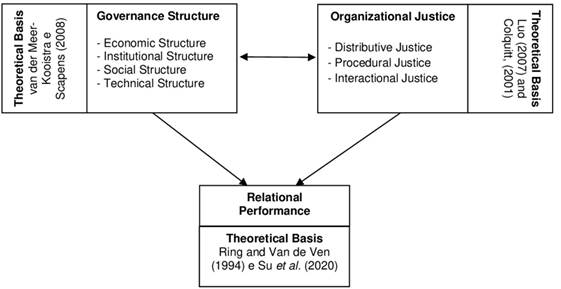
Figure 1
Model for analyzing the links between the PGov, Organizational Justice and its effects on relational performance.
The four structures of van der Meer-Kooistra and Scapens (2008) can be used to diagnose the PGov adopted by the cooperative. Such diagnosis can be carried out through the application of a questionnaire to the manager(s) of the cooperative, in addition to document analysis.
The Economic Structure consists of specific economic arrangements made by the parties to organize the relationship between cooperative and cooperative members. To understand the chosen economic structure, it is necessary to analyse the nature of the market in which the cooperative operates, the volatility and extent of competition, both between cooperatives and with profit-oriented companies. It is also important to consider the visibility and measurability of the cooperative's performance and efficiency and how such information reaches the cooperative members, as well as the duration of the relationship, which is a critical element for agricultural cooperatives. In addition, it is essential to identify the nature of transactions (quality, delivery, payment, among others), the nature of investments (in physical and non-physical assets) and the frequency and volume of transactions of each member. The Institutional Structure comprises the legal regulations and other external regulations, along with the internal organizational arrangements, the type of contract and the formal nature of the relationship. In order to understand the institutional governance structure, it is necessary to identify the laws and government regulations that regulate the cooperative's purposeful activity, in addition to other institutional regulations (e.g. ISO), the type of contract, the organizational arrangements and the formal nature of the relationship with the cooperative members.
The Social Framework emphasizes the strengthening of existing social bonds between the parties, which has the potential to shape the character of interactions between cooperative members and cooperatives. The social governance structure encompasses the behavioural norms and values that permeate the relationship between cooperative members and the cooperative, communication and networking, teamwork and information sharing, trust and perceived integrity, the leadership role and how it is seen by cooperative members, as well as arrangements for individual and organizational learning. The Technical Structure relates to the technical aspects of transactions and production and information processes. In this structure, it is necessary to emphasize basic business knowledge, technological knowledge about products and processes, technical skills of employees, information systems and information processing techniques, as well as available accounting procedures and techniques. The cooperative's internal knowledge and know-how and how members and management engage with them is crucial here.
Based on the organizational justice logic developed by Luo (2007) for strategic alliances, it is considered in this essay that each type of justice has a unique property and plays a unique role in improving cooperative performance. From this perspective, under the aegis of the principle of equity, distributive justice improves performance with greater tolerance and less opportunism. Emphasizing the principle of instrumentality, procedural justice improves cooperative performance through the formalization and improvement of routines that guide frequent exchanges or reduce relational risk through an institutional structure that restricts the pursuit of particular incentives. Following the principle of social change, interactional justice reinforces relational attachment through intensified communication, socialization and knowledge sharing. The dimensions of justice (distributive, procedural and interactional) work together to improve the performance of the cooperative, complementing each other by stimulating exchanges between those involved. These three dimensions can be used to identify the cooperative members' perception of justice, in addition to the perception of impact on relational performance.
The use of subjective performance measures is supported by Geringer and Hebert (1991). According to Roehrich et al. (2020), studies that explore the link between governance and performance generally adopt perceptive measures. In this sense, data collection can be carried out through the application of a questionnaire, aiming to identify the perception of justice and its links with the PGov. The data collection instrument can be adapted from studies by Dhaundiyal and Coughlan (2020), Luo (2007), Su, Zhang and Guo (2020), Wang and Dyball (2019) and Walter, Lechner and Kellermanns (2008).
To analyze the data, it is suggested to use partial least squares structural equation modeling (PLS-SEM), because this approach is robust and provides alternative solutions, even when problems arise in the analysis (Hair Jr., Black, Babin, Anderson, & Tatham, 2009). This choice was made in similar studies such as those by Dhoundiyal and Coughlan (2020) and Wang and Dyball (2019). In addition to the statistical analysis, a content analysis can be carried out (Bardin, 2011), in order to triangulate the results of the perception of justice with the governance structure, as well as its reflexes on the cooperative's relational performance.
The elements that make up the economic, institutional, social and technical structures can be important channels of justice in the context of cooperatives. Such elements represent the main drivers of the strengthening of existing social bonds in the cooperative context and can be determinant and determined by the perception of those involved regarding the three aspects of justice (distributive, procedural and interactional). The challenge for future studies is to understand the existence and strength of the relationship between the elements of governance structures (economic, institutional, social and technical) and the aspects of organizational justice. After understanding this dialectical relationship between governance structures and organizational justice, it is important to understand how these elements reflect on the cooperative's relational performance, that is, how the governance structure and the perception of organizational justice impact the general satisfaction of those involved in achieving organizational objectives and improve the competitive position and learning of cooperatives.
4 FINAL CONSIDERATIONS
Understanding the links between the PGov and organizational justice in cooperatives and their impact on performance is important, as it will help to identify how each type of justice works and how controls and governance structures are established in the cooperative context. In this way, it is believed that the ideal channels of justice can be identified, enhancing the scope of the governance structure and the achievement of the organization's objectives.
Despite advances in understanding the role of control and governance in interorganizational relationships (Ding, Dekker, & Groot, 2013), studies that consider the justice perspective are still scarce (Dhaundiyal & Coughlan, 2020; Su et al., 2020), and who strive to understand the impacts of these links on performance, which is a differential of the model presented in this essay.
The theoretical model presented here is not restricted to cooperatives, and it is possible to extend the analysis model to Local Productive Arrangements (LPAs), consortium, joint ventures, among other partnerships, which is the main contribution of this study. It is important to emphasize that the application of the model can bring practical contributions, specifically for the review of the cooperative's PGov and the governance structures to be reformulated (or not), in order to reinforce the justice perceived by the cooperative members. It should be noted that, when applying the model proposed here, the reality and idiosyncrasies of cooperatives must be taken into account, escaping the organizational vacuum, often seen in management studies, as mentioned by Lopes (2017). In this sense, it is suggested that future studies apply the model, in order to contribute to the management and governance of cooperative organizations, which play a fundamental role in the country's development.
REFERENCES:
Adams, J. S. (1965). Inequity In Social Exchange. In Advances in Experimental Social Psychology(Vol. 2, pp. 267-299). https://doi.org/10.1016/S0065-2601(08)60108-2
Bardin, L. (2011). Análise de Conteúdo(1st ed.). São Paulo: Almedina Brasil.
Bialoskorski Neto, S. (2007). Um ensaio sobre desempenho econômico e participação em cooperativas agropecuárias. Revista de Economia e Sociologia Rural, 45, 119-138. https://doi.org/10.1590/S0103-20032007000100006
Bialoskorski Neto, S., Barroso, M., & Rezende, A. (2012). Co-operative governance and management control systems: an agency costs theoretical approach. Brazilian Business Review, 9(2), 68-87. https://doi.org/10.15728/bbr.2012.9.2.4
Bies, R. J., & Shapiro, D. L. (1987). Interactional fairness judgments: The influence of causal accounts. Social Justice Research, 1(2), 199-218. https://doi.org/10.1007/BF01048016
Breitenbach, R., Brandão, J. B., & Zorzan, M. (2017). Vantagens e oportunismo no relacionamento entre associados e cooperativa de laticínios. Interações(Campo Grande), 18(2), 45. https://doi.org/10.20435/inter.v18i2.1393
Brown, J. R., Cobb, A. T., & Lusch, R. F. (2006). The roles played by interorganizational contracts and justice in marketing channel relationships. Journal of Business Research, 59(2), 166-175. https://doi.org/10.1016/j.jbusres.2005.04.004
Coase, R. H. (1937). The Nature of the Firm. Economica, 4(16), 386-405. https://doi.org/10.1111/j.1468-0335.1937.tb00002.x
Colquitt, J. A. (2001). On the dimensionality of organizational justice: A construct validation of a measure. Journal of Applied Psychology, 86(3), 386-400. https://doi.org/10.1037/0021-9010.86.3.386
Cook, M. L. (1995). Agricultural Cooperatives: A Neo-Institutional Approach. American Journal of Agricultural Economics, 77(5), 1153-1159.
Costa, E. G. & Melo, A. A. O. (2017) Governança corporativa: conflitos de agência em cooperativas de crédito mineiras. Gestão & Planejamento, 18(jan./dez.), 386-409.
Cropanzano, R., Prehar, C. A., & Chen, P. Y. (2002). Using social exchange theory to distinguish procedural from interactional justice. Group and Organization Management, 27(3), 324-351. https://doi.org/10.1177/1059601102027003002
Delarmelina, N., & Salles, A. O. T. (2016). Um estudo sobre a comercialização da produção de cooperativas agropecuárias sob a ótica da Teoria dos Custos de Transação. Custos e @gronegócio on Line, 12(4), 34-69.
Dhaundiyal, M., & Coughlan, J. (2020). The impact of alliance justice capability on the performance of strategic alliances in the Indian IT sector: the mediating role of inter-firm commitment. Cogent Business & Management, 7(1), 1-17. https://doi.org/10.1080/23311975.2020.1719587
Ding, R., Dekker, H. C., & Groot, T. (2013). Risk, partner selection and contractual control in interfirm relationships. Management Accounting Research, 24(2), 140-155. https://doi.org/10.1016/j.mar.2013.04.007
Fischer, E., & Qaim, M. (2012). Linking Smallholders to Markets: Determinants and Impacts of Farmer Collective Action in Kenya. World Development, 40(6), 1255-1268. https://doi.org/10.1016/j.worlddev.2011.11.018
Frezatti, F., Rocha, W., Nascimento, A. R., & Junqueira, E. (2016). Controle Gerencial: uma abordagem da contabilidade gerencial no contexto econômico, comportamental e sociológico. São Paulo: Atlas.
Geringer, J. M., & Hebert, L. (1991). Measuring Performance of International Joint Ventures. Journal of International Business Studies, 22(2), 249-263. https://doi.org/10.1057/palgrave.jibs.8490302
Greenberg, J. (1987). A Taxonomy of Organizational Justice Theories. Academy of Management Review, 12(1), 9-22. https://doi.org/10.5465/amr.1987.4306437
Hair Jr., J. F., Black, W. C., Babin, B. J., Anderson, R. E., & Tatham, R. L. (2009). Análise multivariada de dados(6th ed.). Porto Alegre: Bookman.
Hall, M. (2016). Realising the richness of psychology theory in contingency-based management accounting research. Management Accounting Research, 31, 63-74. https://doi.org/10.1016/j.mar.2015.11.002
Helmberger, P., & Hoos, S. (1962). Cooperative enterprise and organization theory. Journal of Farm Economics, 44(2), 275-290. https://doi.org/10.2307/1235830
Kamoche, K., & Cunha, M. P. e. (2001). Minimal Structures: From Jazz Improvisation to Product Innovation. Organization Studies, 22(5), 733-764. https://doi.org/10.1177/0170840601225001
Kim, W. C., & Mauborgne, R. A. (1993). Procedural Justice, Attitudes, and Subsidiary Top Management Compliance With Multinationals’ Corporate Strategic Decisions. Academy of Management Journal, 36(3), 502-526. https://doi.org/10.2307/256590
Konovsky, M. A. (2000). Understanding procedural justice and its impact on business organizations. Journal of Management, 26(3), 489-511. https://doi.org/10.1177/014920630002600306
Krishnan, R., Martin, X., & Noorderhaven, N. G. (2006). When does trust matter to alliance performance? Academy of Management Journal, 49(5), 894-917. https://doi.org/10.5465/AMJ.2006.22798171
Langfield-Smith, K. (2008). The relations between transactional characteristics, trust and risk in the start-up phase of a collaborative alliance. Management Accounting Research, 19(4), 344-364. https://doi.org/10.1016/j.mar.2008.09.001
Lind, E. A., & Tyler, T. R. (1988). The Social Psychology of Procedural Justice. Boston: Springer US.
Liu, Y., Liu, T., & Li, Y. (2014). How to inhibit a partner’s strong and weak forms of opportunism: Impacts of network embeddedness and bilateral TSIs. Industrial Marketing Management, 43(2), 280-292. https://doi.org/10.1016/j.indmarman.2013.08.010
Lopes, A. B. (2017). A Teoria dos Contratos, Governança Corporativa e Contabilidade. In A. B. Lopes & S. Iudícibus(Eds.), Teoria Avançada da Contabilidade(2nd ed., pp. 173-187). São Paulo: Atlas .
Luo, Y. (2007). The independent and interactive roles of procedural, distributive, and interactional justice in strategic alliances. Academy of Management Journal, 50(3), 644-664. https://doi.org/10.5465/AMJ.2007.25526452
Luo, Y., Liu, Y., Yang, Q., Maksimov, V., & Hou, J. (2015). Improving performance and reducing cost in buyer-supplier relationships: The role of justice in curtailing opportunism. Journal of Business Research, 68(3), 607-615. https://doi.org/10.1016/j.jbusres.2014.08.011
Machinski, P. A., Faria, M. C. de, Moreira, V. R., & Ferraresi, A. A.(2016). Agricultural insurance mechanisms through mutualism: the case of an agricultural cooperative. RAUSP Management Journal, 51(3), 266-275. https://doi.org/10.1016/j.rausp.2016.06.004
Meneghetti, F. K. (2011). O que é um ensaio-teórico?. Revista de Administração Contemporânea, 15(2), 320-332. https://dx.doi.org/10.1590/S1415-65552011000200010
Novkovic, S. (2008). Defining the co-operative difference. The Journal of Socio-Economics, 37(1), 2168-2177. https://doi.org/10.1016/j.socec.2008.02.009
Pivoto, D., Finger, M. I., Waquil, P., & Souza, M. de. (2013). O problema do carona nas cooperativas agropecuárias do Rio Grande do Sul. Revista de Política Agrícola, 22(4), 109-122.
Poppo, L., & Zenger, T.(2002). Do formal contracts and relational governance function as substitutes or complements? Strategic Management Journal, 23(8), 707-725. https://doi.org/10.1002/smj.249
Ring, P. S., & Van De Ven, A. H. (1994). Developmental Processes of Cooperative Interorganizational Relationships. Academy of Management Review, 19(1), 90-118. https://doi.org/10.5465/amr.1994.9410122009
Rodrigues, J. A., Lauermann, G. J., Moreira, V. R., Ferraresi, A. A., & Souza, A. (2018). Estrutura de capital e peculiaridades regionais nas cooperativas agropecuárias do Paraná - Brasil. Revista de Economia e Sociologia Rural, 56(2), 213-224. https://doi.org/10.1590/1234-56781806-94790560202
Roehrich, J. K., Selviaridis, K., Kalra, J., Van der Valk, W., & Fang, F. (2020). Inter-organizational governance: a review, conceptualisation and extension. Production Planning & Control, 31(6), 453-469. https://doi.org/10.1080/09537287.2019.1647364
Rupp, D. E., & Cropanzano, R. (2002). The mediating effects of social exchange relationships in predicting workplace outcomes from multifoci organizational justice. Organizational Behavior and Human Decision Processes, 89(1), 925-946. https://doi.org/10.1016/S0749-5978(02)00036-5
Schepker, D. J., Oh, W.-Y., Martynov, A., & Poppo, L. (2014). The Many Futures of Contracts: Moving Beyond Structure and Safeguarding to Coordination and Adaptation. Journal of Management, 40(1), 193-225. https://doi.org/10.1177/0149206313491289
Simioni, F. J., Siqueira, E. S., Binotto, E., Spers, E. E., & Araújo, Z. A. S. de. (2009). Lealdade e oportunismo nas cooperativas: desafios e mudanças na gestão. Revista de Economia e Sociologia Rural, 47(3), 739-765. https://doi.org/10.1590/S0103-20032009000300010
Skarlicki, D. P., & Folger, R. (1997). Retaliation in the workplace: The roles of distributive, procedural, and interactional justice. Journal of Applied Psychology, 82(3), 434-443. https://doi.org/10.1037/0021-9010.82.3.434
Su, X., Zhang, H., & Guo, S. (2020). A Model and Complexity Analysis of the Relationship Based on Organizational Justice and Embeddedness Theories. Complexity, 1-16. https://doi.org/10.1155/2020/6129840
Trada, S., & Goyal, V. (2017). The dual effects of perceived unfairness on opportunism in channel relationships. Industrial Marketing Management, 64, 135-146. https://doi.org/10.1016/j.indmarman.2017.01.008
Triviños, A. N. S. (1997). Introdução à Pesquisa em Ciências Sociais: a Pesquisa Qualitativa em Educação(Vol. 1). São Paulo: Atlas . https://doi.org/10.33081/formação.v1i20.2335
Tyler, T. R. (1994). Psychological models of the justice motive: Antecedents of distributive and procedural justice. Journal of Personality and Social Psychology, 67(5), 850-863. https://doi.org/10.1037/0022-3514.67.5.850
Van der Meer-Kooistra, J., & Scapens, R. W. (2008). The governance of lateral relations between and within organisations. Management Accounting Research, 19(4), 365-384. https://doi.org/10.1016/j.mar.2008.08.001
Walter, J., Lechner, C., & Kellermanns, F. W. (2008). Disentangling alliance management processes: Decision making, politicality, and alliance performance. Journal of Management Studies, 45(3), 530-560. https://doi.org/10.1111/j.1467-6486.2007.00749.x
Wang, A., & Dyball, M. C. (2019). Management controls and their links with fairness and performance in inter‐organisational relationhttps://doi.org/10.1111/acfi.12408
Williamson, O. E. (1975). Markets and hierarchies: analysis and antitrust implications. Nova York: Free Press.
Zylbersztajn, D. (1994). Organização de cooperativas: desafios e tendências. RAUSP Management Journal, 29(3), 23-32.
Zylbersztajn, D. (2002). Quatro estratégias fundamentais para cooperativas agrícolas. XIVSeminário de Política Econômica: Cooperativismo e Agronegócio. Viçosa: UFV.
Notes
Author notes
E-mail: rafaeltodescato@hotmail.comE-mail: andréiakremer@hotmail.comE-mail: regiomtoesca@gmail.comEndereço dos Autores: Rua: João Rosa Góes, nº 1761, Vila Progresso - Dourados - MS. 79825-070