Ciências da Saúde
Transcranial direct current stimulation and physiotherapy in the treatment of fibromyalgia: case series
Estimulação transcraniana por corrente contínua e fisioterapia no tratamento da fibromialgia: série de casos
Transcranial direct current stimulation and physiotherapy in the treatment of fibromyalgia: case series
Acta Scientiarum. Health Sciences, vol. 40, 2018
Universidade Estadual de Maringá
Received: 06 February 2017
Accepted: 30 October 2017
Abstract: Because of the multifaceted character of fibromyalgia, new treatments have been proposed to control the symptoms. Among them, transcranial direct current stimulation(tDCS) stands out. The objective of this work was to analyze the effectiveness of transcranial direct current stimulation associated with physical therapy regarding the pain and quality of life of patients with fibromyalgia. A prospective case series study was carried out with a sample of 4 female patients. Information regarding age, marital status, education, and occupation were collected, and the Visual Analog Scale for pain, McGill Pain Questionnaire and Fibromyalgia Impact Questionnaire were applied. Anodal stimulation was performed on the left primary motor cortex with an intensity of 2.0mA for 20 minutes daily for 2 consecutive weeks. After the neurostimulation session, the patients were subjected to physical therapy treatment for 30 minutes. The results demonstrated that the patients had a reduction in the scores of all the employed instruments after treatment. There was a positive correlation between quality of life and pain. These findings demonstrate that tDCS in conjunction with physical therapy is an option for reducing the algesic status and improving the quality of life of patients with fibromyalgia.
Keywords: electrical stimulation, fibromyalgia, chronic pain.
Resumo: Devido ao caráter multifacetado da fibromialgia, novos tratamentos têm sido propostos para controlar os sintomas. Entre eles, destaca-se a estimulação transcraniana por corrente contínua (ETCC). O objetivo deste trabalho foi analisar a eficácia da estimulação transcraniana por corrente contínua associada à fisioterapia em relação à dor e qualidade de vida de pacientes com fibromialgia. Um estudo prospectivo de série de casos foi realizado com uma amostra de 4 pacientes do sexo feminino. Foram coletadas informações referentes à idade, estado civil, escolaridade e ocupação, e foram aplicadas a Escala Visual Analógica para dor, o Questionário de Dor de McGill e o Questionário de Impacto da Fibromialgia. A estimulação anódica foi realizada no córtex motor primário esquerdo com uma intensidade de 2.0mA por 20 minutos diários, durante 2 semanas consecutivas. Após a sessão de neuroestimulação, os pacientes foram submetidos a tratamento fisioterapêutico por 30 minutos. Os resultados demonstraram que os pacientes tiveram redução nos escores de todos os instrumentos empregados após o tratamento. Houve correlação positiva entre qualidade de vida e dor. Esses achados demonstram que a ETCC em conjunto com a fisioterapia é uma opção para reduzir o status algésico e melhorar a qualidade de vida dos pacientes com fibromialgia.
Palavras-chave: estimulação elétrica, fibromialgia, dor.
Introduction
Fibromyalgia is considered a non-inflammatory, chronic rheumatic syndrome that predominantly affects women and is characterized by widespread musculoskeletal pain and the presence of tender points in certain anatomical regions. Sleep disorders, fatigue and mood changes are also present, which negatively interfere with the quality of life of patients (Clauw, 2014; Borchers & Gershwin, 2015).
The etiology of this disease is not yet well defined mainly due to the absence of a neurophysiologicalsubstrate related to the pathophysiology of fibromyalgia, which can lead to confusion in the diagnosis by the exclusionof other diseases, such as major depression and chronic fatigue syndrome. However, evidence points to a central nervous system (CNS) dysfunction in fibromyalgia, related to changes in the processing of pain that primarily affect the pain modulation mechanisms (Yunus, 2007; Burgmer, Pogatzki-Zahn, Gaubit, Wessoleck, Heuft, & Pfleiderer, 2009; Jensen et al., 2012).
The conservative treatment strategy for fibromyalgia has been considered in a comprehensive and multidisciplinary manner due to the diversity of systems and symptoms involved. This strategy consists of a combination of pharmacological and non-pharmacological treatments, directed according to the intensity of the symptoms presented and in compliance with the patient’s biopsychosocial factors (Heymann, 2010). However, no treatment has been found to be effective in alleviating the entirerange of fibromyalgia symptoms (Heymann et al., 2010).
Given the failure of conservative treatments, studies that use a therapeutic regime targeting the CNS has been used and has presented significant results (Marlow, Bonilha, & Short, 2013). One of these alternatives is transcranial direct current stimulation (TDCS), which consists of the non-invasive neuromodulation of the brainusing a technique that applies direct current electrical stimulation to the cerebral cortex. TDCS is able to modulate the neural activity of the stimulated area (Riberto, Alfieri, Pacheco, Leite, Kaihami, Fregni, & Battistella, 2011), resulting in therapeutic effects that lead to an improved quality of life in patients withmultiple neuropsychiatric disorders (Brunoni et al., 2012; Shiozawa, Silva, Cordeiro, Fregni, & Brunoni, 2013) and proving to be a safe tool with a facile application (Brunoni, Amadera, Berbel, Volz, Rizzerio & Fregni, 2011; Shiozawa et al., 2014).
Although there are reports in the literature of the potential effects of using TDCS to reduce symptomatology in fibromyalgia, most studies have involved theuse of this technique as a single therapeutic resource, without taking into account the combination of the application of TDCS with physical rehabilitation(Fagerlund, Hansen, & Aslaksen, 2015; Foerster et al., 2015).
Therefore, the objective of this study was to analyze the effects of TDCS in conjunctionwith physical therapy on the pain and quality of life of patients with fibromyalgia.
Material and methods
Study Design
This is a case series study developed in the clinic of our institution according to the standards of Resolution 466/12 of the Ministry of Health and under approval by the local Ethics Committee(#39796914.5.0000.5188/2015).
Sample
A total of 4 women were entered in the study. These women had a clinical diagnosis of fibromyalgia according to the criteria of the American College of Fibromyalgia (ACR) (Wolfe et al., 2010), witha score above 3 points on the Visual Analog Scale (VAS) for pain (Jensen, Karoly & Braver, 1986). To participate in the study, the patients voluntarily agreed to sign the informed consent form.
The exclusion criteria were the inability of patients to participate in the 10 sessions, depression with a score ≥ 29 on the Beck Depression Inventory, the use of CNS modulators, being pregnant, the presence of implanted metal or electronic devices, and the participation in any form of physical therapy (such as physiotherapy, occupational therapy and physical activity).
Instruments
The instruments used for the evaluation of pain were the VAS (Jensen et al., 1986) and a multidimensional scale, the McGill Pain Questionnaire (MPQ) (Pimenta & Teixeira, 1996). The VAS is composed of numbers from 0 to 10, in which0 indicates the absence of symptoms, and 10 represents the highest intensity possible. The MPQ is formed by a set of 68 descriptors that are organized into 20 groups of the characterization of pain (sensory, affective, evaluative, and mixed).Every word has an assigned value ranging from 0 to 5, and the Total Pain Index (TPI) is the sum of all the groups, with the total score ranging from 0 to 68. The participants are advised to choose only one or no descriptor out of the 20 groups.
The impact on quality of life was measured with the Fibromyalgia Impact Questionnaire (FIQ) (Marques, Santos, Assumpcao, Matsutani, Lage, & Pereira, 2006), which is a questionnaire composed of 10 items that assess the impact of fibromyalgia on functional capacity and professional activities, in addition to quantifying the primary symptoms. The FIQ score ranges from 0 to 100, where 0 indicates no impact, and 100 indicates the largest possible impact (severe: 70-100; moderate: 50-70; and mild: 0-50).
Intervention Protocol
For 5 consecutive days a week (excepting weekends), the study patients underwent 10 treatment sessions with 20 minutes of transcranial electrostimulation and 30 minutes of physiotherapy.
The parameters used in the TDCS were 20 minutes of stimulation (TCT Research Limited) per day for 2 weeks (excluding weekends).Electrodes surrounded by 5×7-cm sponges moistened with saline solution (NaCl 0.9%) were employed. The intensity of the applied current was 2mA, and the current density was 0.05A m-2. The placement of the electrodes was based on the International 10/20 System of the Electroencephalogram (EEG) usedto map the positions where the electrodes were fixed to register the signals (Schomer & Da Silva, 2012). For the present study, region C3 on the left, corresponding to the primary motor cortex, was chosen for the application of an anodic current, and the reference electrode was placed atthe right supraorbital area, corresponding to the frontal polar region, to closethe circuit.
After each electrostimulation session, the participants received physiotherapy treatment for 30 minutes. The exercises were conducted based on the Brazilian Consensus on Fibromyalgia Treatment protocol (Heymann et al., 2010) and consisted of global stretching exercises,muscle strengthening and training in daily life activities.
Data Analysis
The statistical procedures were conducted with Statistical Package for the Social Sciences (SPSS) version 23.0 for Windows. Initially, the normality of the data was verified by means of the Kolmogorov-Smirnov test. The socio demographic data were analyzed with descriptive statistics. Pre- and post-treatment measurements were compared with the Wilcoxon test. To analyze the correlation between pain intensity and quality of life, the Spearman test was employed. In all the analyses, 5% (α = 0.05) was adopted as the level of significance.
Results
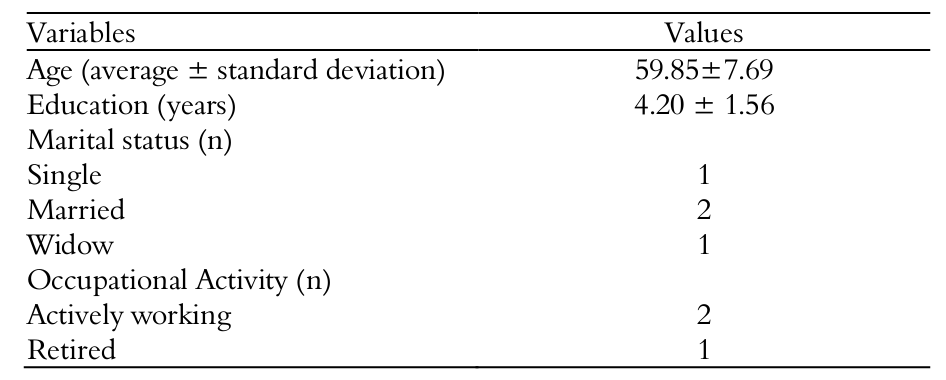
Initially, 6 women who met the criteria for inclusion in this study were recruited. Two volunteers were excluded from the study because treatment was discontinued due to problems with transport (n= 1) and scheduling conflicts with work activities (n = 1).A total of 4 women with an average age of 59.85 ± 7.69 were entered into the study. None of the participants mentioned serious adverse effects from the therapy, in which only slight transitory itching and tingling were reported in only the first minutes of applying the current. Table 1 presents the socio demographic characteristics of the participants.
Absolute changes mentioned by the participants in relation to the pre- and post-treatment measurements are displayed in Figure 1.
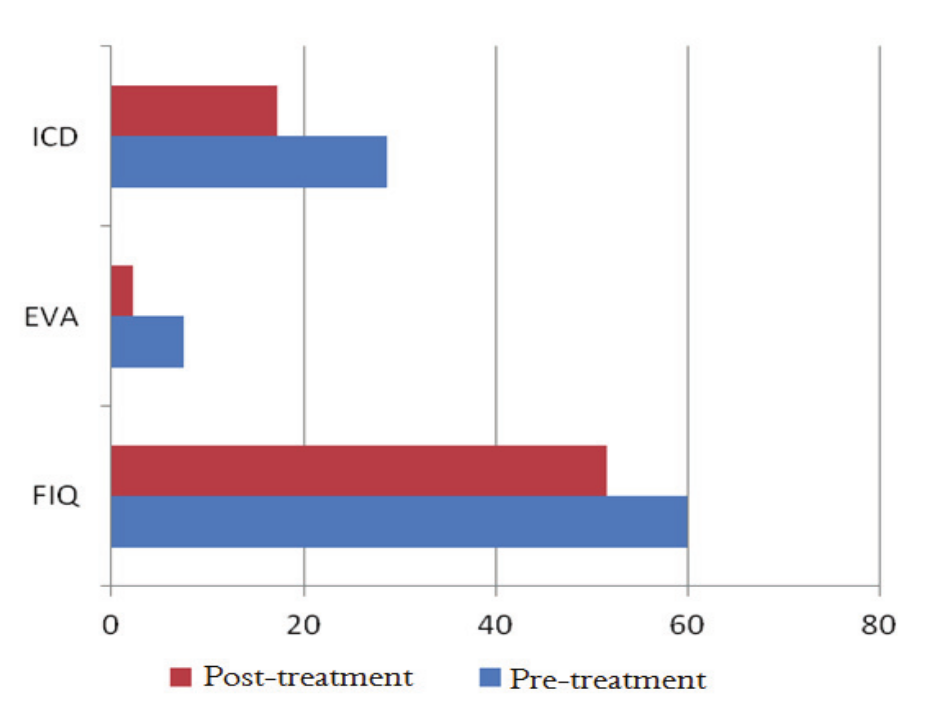
Figure 1.
Effect of TDCs through TPI, VAS and FIQ in patients with fibromyalgia. Legend: VAS = Visual Analog Scale; TPI = Total Pain Index; FIQ = Fibromyalgia Impact Questionnaire.
The Wilcoxon test indicated improvement regarding both pain intensity,as evaluated by the VAS (z = 2.83; p = 0.024) and TPI (z = 2.32; p = 0.035), and quality of life according to the FIQ (z = 2.97; p =0.001).
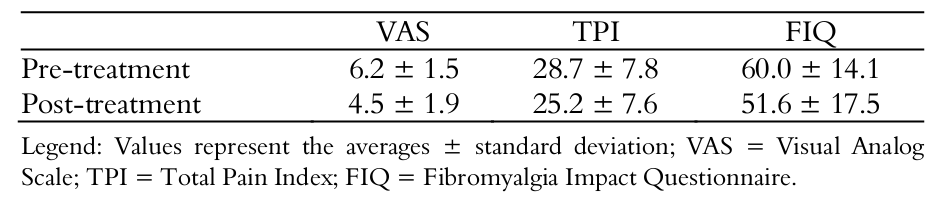
Regarding the outcomes evaluated in this study, an improvement was observed in both the instruments that measure pain and those that measure quality of life, as can be observed in Table 2. The VAS score was improved by 24.2%, and the TPI in the McGill assessment improved 12.3%,while the FIQ score improved 14%.
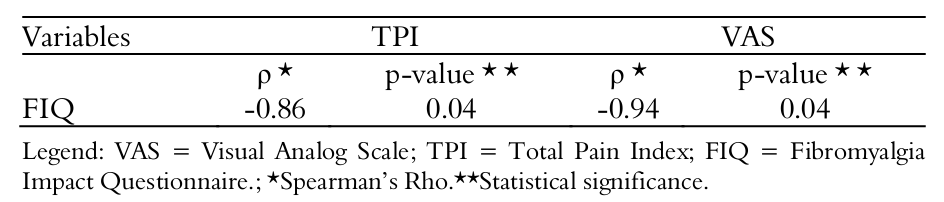
The Spearman test was performed to analyze the correlation between quality of life and pain. Table 3 presents the correlation indices between these measurements. A strong positive relationship was observed between pain and quality of life (ρ > 0.8).
Discussion
This preliminary study aimed to evaluate the effects of TDCS on pain and quality of life in women with fibromyalgia. A statistically significant difference in the pre- and post-treatment measurements after performing neurostimulation associated with physiotherapy was observed in this population.
The participants in this study presented a socio demographic profile similar to those of previous studies conducted in Brazil (Pimenta & Teixeira, 1996; Marques et al., 2006; Schomer & Da Silva, 2012; Gequelim, Dranka, Furlan, Mejia, & Paiva, 2013). According to these studies, most of the patients diagnosed with fibromyalgia are females, aged between 20 and 60 years old, are married and have children. According to the literature, the study participants had an average of 8 ± 3.5 years of education, and regarding occupation, most did not work outside the home, were housewives or were retired.
Pain is the main symptom that characterizes fibromyalgia as the decisive factor in the functional limitations presented by affected patients (Lima & Fregni, 2008). Regarding this aspect, the present study observed a significant reduction in pain post-treatment, demonstrating a relevant therapeutic effect. The effects of painkillers found in the present study corroborate the findings in previous studies, which point to the primary motor cortex as the central locus for pain modulation (Boggio, Zaghi, Lopes, & Fregni, 2008; Saavedra, Mendonça, & Fregni, 2014).This modulation of pain would be mediated by the inhibition of pathways related to processing the feeling of pain, particularly the M1-thalamic-inhibitory connections (Fregni et al., 2006; Antal, Terney, Kuhnl, & Paulus, 2010; Villamar et al, 2013). In a similar study, Jales et al. (2015) treated 10 female patients with active stimulus of the primary motor cortex and also observed positive results regarding pain, with an average reduction of 40% in VAS scores after the treatment with TDCS.
Regarding the improvement in quality of life, results similar to those found in the present work were observed by Riberto et al. (2011) and Valle et al. (2009), who observed an improvement in quality of life as evaluated with the FIQ when using the same technique in patients subjected to treatment with anodal TDCS on M1.
The results of the present work indicate that the lower the pain intensity, the better the quality of life. Studies have reinforced the concept that pain is closely related to quality of life, and this relationship would be more intense in patients with chronic and diffuse pain, such as with fibromyalgia (Cunha & Mayrink, 2011; Antunes et al., 2013). In most cases, chronic conditions seriously impair quality of life, and improving quality of life also implies an improvement in the clinical status of patients (Tander, Cengiz, Alayli, İlhanli, Canbaz, & Canturk, 2008).
Despite significant findings, our study has limitations, including the small sample size and the absence of comparison with a control group. Therefore, future studies should be conducted with larger samples and with patient follow-up, allowing the evaluation of the long-term effects of the therapeutics.
Conclusion
According to the results observed in the present study, the TDCS treatment was effective in reducing pain and improving the quality of life of patients with fibromyalgia. Thus, this is a safe, easy-to-apply, non-pharmacological and low-cost option that is valid for the treatment of fibromyalgia.
References
Antal, A., Terney, D., Kühnl, S., & Paulus, W. (2010). Anodal transcranial direct current stimulation of the motor cortex ameliorates chronic pain and reduces short intracortical inhibition. Journal of Pain and Symptom Management, 39(5), 890-903. Doi: 10.1016/j.jpainsymman.2009.09.023.
Antunes, R. S., Macedo, B. G. D., Amaral, T. D. S., Gomes, H. D. A., Pereira, L. S. M., & Rocha, F. L. (2013). Pain, kinesiophobia and quality of life in chronic low back pain and depression. Acta Ortopedica Brasileira, 21(1), 27-29. Doi 10.1590/S1413-78522013000100005.
Boggio, P. S., Zaghi, S., Lopes, M., & Fregni, F. (2008). Modulatory effects of anodal transcranial direct current stimulation on perception and pain thresholds in healthy volunteers. European Journal of Neurology, 15(10), 1124-1130. Doi: 10.1111/j.1468-1331.2008.02270.x.
Borchers, A. T., & Gershwin, M. E. (2015). Fibromyalgia: a critical and comprehensive review. Clinical Reviews in Allergy & Immunology, 49(2), 100-151. Doi: 10.1007/s12016-015-8509-4.
Brunoni, A. R., Nitsche, M. A., Bolognini, N., Bikson, M., Wagner, T., Merabet, L., ... Fregni, F. (2012). Clinical research with transcranial direct current stimulation (tDCS): challenges and future directions. Brain Stimulation, 5(3), 175-195. Doi: 10.1016/j.brs.2011.03.002.
Brunoni, A. R., Amadera, J., Berbel, B., Volz, M. S., Rizzerio, B. G., & Fregni, F. (2011). A systematic review on reporting and assessment of adverse effects associated with transcranial direct current stimulation. The International Journal of Neuropsychopharmacology, 14(8), 1133-1145. Doi: 10.1017/S1461145710001690.
Burgmer, M., Pogatzki-Zahn, E., Gaubitz, M., Wessoleck, E., Heuft, G., & Pfleiderer, B. (2009). Altered brain activity during pain processing in fibromyalgia. Neuroimage, 44(2), 502-508. Doi: 10.1016/j.neuroimage.2008.09.008.
Clauw, D. J. (2014). Fibromyalgia: a clinical review. Jama, 311(15), 1547-1555. Doi: 10.1001/jama. 2014.3266.
Cunha, L. L., & Mayrink, W. C. (2011). Influence of chronic pain in the quality of life of the elderly. Revista Dor, 12(2), 120-124. Doi: 10.1590/S1806-00132011000200008.
Pimenta, C. A. M., & Teixeira, M. J. (1996). Questionário de dor McGill: proposta de adaptação para a língua portuguesa. Revista da Escola de Enfermagem. USP, 30, 473-483. Doi: 10.1590/S0080-62341996000300009.
Fagerlund, A. J., Hansen, O. A., & Aslaksen, P. M. (2015). Transcranial direct current stimulation as a treatment for patients with fibromyalgia: a randomized controlled trial. Pain, 156(1), 62-71. Doi: 10.1016/j.pain.0000000000000006.
Foerster, B. R., Nascimento, T. D., De Boer, M., Bender, M. A., Rice, I. C., Truong, D. Q., ... Da Silva, A. F. (2015). Excitatory and inhibitory brain metabolites as targets and predictors of effective motor cortex tDCS therapy in fibromyalgia. Arthritis & Rheumatology (Hoboken, NJ), 67(2), 576. Doi: 10.1002/art.38945.
Fregni, F., Gimenes, R., Valle, A. C., Ferreira, M. J., Rocha, R. R., Natalle, L., ... Boggio, P. S. (2006). A randomized, sham‐controlled, proof of principle study of transcranial direct current stimulation for the treatment of pain in fibromyalgia. Arthritis & Rheumatism, 54(12), 3988-3998. Doi: 10.1002/art. 22195.
Gequelim G. C., Dranka, D., Furlan J. A., Mejia, M. M., & Paiva, E. S. (2013). Clinical and epidemiological study of fibromyalgia in a university hospital in Southern Brazil. Revista Brasileira de Clinica Médica, 11(4), 344-349.
Heymann, R. E., Paiva, E. D. S., Helfenstein Jr, M., Pollak, D. F., Martinez, J. E., Provenza, J. R., ... Fonsenca, M. C. M. (2010). Brazilian consensus on the treatment of fibromyalgia. Revista Brasileira de Reumatologia, 50(1), 56-66. Doi: /10.1590/S0482-50042010000100006.
Jensen, K. B., Loitoile, R., Kosek, E., Petzke, F., Carville, S., Fransson, P., ... Kong, J. (2012). Patients with fibromyalgia display less functional connectivity in the brain’s pain inhibitory network. Molecular pain, 8(1), 1-9. Doi: 10.1186/1744-8069-8-32.
Jales Jr, L. H., Costa, M. D. D. L., Jales Neto, L. H., Ribeiro, J. P. M., Freitas, W. J. S. D. N., & Teixeira, M. J. (2015). Transcranial direct current stimulation in fibromyalgia: effects on pain and quality of life evaluated clinically and by brain perfusion scintigraphy. Revista Dor, 16(1), 37-42. Doi: doi.org/10.5935/1806-0013.20150008.
Jensen, M. P., Karoly, P., & Braver, S. (1986). The measurement of clinical pain intensity: a comparison of six methods. Pain, 27(1), 117-126. Pmid: 3785962.
Lima, M. C., & Fregni, F. (2008). Motor cortex stimulation for chronic pain systematic review and meta-analysis of the literature. Neurology, 70(24), 2329-2337. Doi: 10.1212/01.wnl.0000314649.38527.93.
Marlow, N. M., Bonilha, H. S., & Short, E. B. (2013). Efficacy of transcranial direct current stimulation and repetitive transcranial magnetic stimulation for treating fibromyalgia syndrome: a systematic review. Pain Practice, 13(2), 131-145. Doi: 10.1111/j.1533-2500.2012.00562.x.
Marques, A. P., Santos, A. M. B., Assumpção, A., Matsutani, L. A., Lage, L. V., & Pereira, C. A. B. (2006). Validation of the brazilian version of the fibromyalgia impact questionnaire (FIQ). Revista Brasileira de Reumatologia, 46(1), 24-31. Doi: 10.1590/S0482-50042006000100006.
Riberto, M., Alfieri, F. M., Pacheco, K. M. B., Leite, V. D., Kaihami, H. N., Fregni, F., & Battistella, L. R. (2011). Efficacy of transcranial direct current stimulation coupled with a multidisciplinary rehabilitation program for the treatment of fibromyalgia. The Open Rheumatology Journal, 5(1). Doi: 10.2174/1874312901105010045.
Saavedra, L. C., Mendonca, M., & Fregni, F. (2014). Role of the primary motor cortex in the maintenance and treatment of pain in fibromyalgia. Medical Hypotheses, 83(3), 332-336. Doi: 10.1016/j.mehy.2014. 06.007.
Schomer, D. L., & Da Silva, F. L. (2012). Niedermeyer's electroencephalography: basic principles, clinical applications, and related fields. Philadelphia, PA: Lippincott Williams & Wilkins.
Shiozawa, P., Silva, M. E., Cordeiro, Q., Fregni, F., & Brunoni, A. R. (2013). Transcranial direct current stimulation (tDCS) for the treatment of persistent visual and auditory hallucinations in schizophrenia: a case study. Brain Stimulation, 6(5), 831-833. Doi: 10.1016/j.brs.2013.03.003.
Shiozawa, P., Fregni, F., Benseñor, I. M., Lotufo, P. A., Berlim, M. T., Daskalakis, J. Z., ... Brunoni, A. R. (2014). Transcranial direct current stimulation for major depression: an updated systematic review and meta-analysis. The International Journal of Neuropsychopharmacology, 17(09), 1443-1452. Doi: 10.1017/S1461145714000418.
Tander, B., Cengiz, K., Alayli, G., İlhanli, İ., Canbaz, S., & Canturk, F. (2008). A comparative evaluation of health related quality of life and depression in patients with fibromyalgia syndrome and rheumatoid arthritis. Rheumatology International, 28(9), 859-865. Doi: 10.1007/s00296-008-0551-6.
Valle, A., Roizenblatt, S., Botte, S., Zaghi, S., Riberto, M., Tufik, S., ... Fregni, F. (2009). Efficacy of anodal transcranial direct current stimulation (tDCS) for the treatment of fibromyalgia: results of a randomized, sham-controlled longitudinal clinical trial. Journal of Pain Management, 2(3), 353-361. Pmid: 21170277
Villamar, M. F., Wivatvongvana, P., Patumanond, J., Bikson, M., Truong, D. Q., Datta, A., & Fregni, F. (2013). Focal modulation of the primary motor cortex in fibromyalgia using 4× 1-ring high-definition transcranial direct current stimulation (HD-tDCS): immediate and delayed analgesic effects of cathodal and anodal stimulation. The Journal of Pain, 14(4), 371-383. Doi: 10.1016/j.jpain.2012. 12.007.
Wolfe, F., Clauw, D. J., Fitzcharles, M. A., Goldenberg, D. L., Katz, R. S., Mease, P., ... & Yunus, M. B. (2010). The American College of Rheumatology preliminary diagnostic criteria for fibromyalgia and measurement of symptom severity. Arthritis Care & Research, 62(5),600-610. Doi: 10.1002/acr.20140.
Yunus, M. B. (2007). Fibromyalgia and overlapping disorders: the unifying concept of central sensitivity syndromes. Seminars in Arthritis and Rheumatism, 36(6), 339-356. Doi: 10.1016/j.semarthrit.2006.12.009.
Notes
Author notes
suellenandrade@gmail.com