Ciências da Saúde
Football society players over the age of 55: how stressful can a match be?
Football society players over the age of 55: how stressful can a match be?
Acta Scientiarum. Health Sciences, vol. 43, e53357, 2021
Universidade Estadual de Maringá
Recepción: 26 Abril 2020
Aprobación: 14 Abril 2021
Abstract: This study aimed at assessing the physical activity level, heart rate and the salivary cortisol level of football society players. The sample consisted of 19 male masters football players with an average age of 56.7 ± 3.9 years. The long form of the International Physical Activity Questionnaire (IPAQ) and Polar. heart rate monitors were used as instruments, in addition to Salivette® tubes to measure salivary cortisol. Data analysis was performed by using the repeated measures Analysis of Variance (ANOVA) with Bonferroni post hoc test, and Spearman’s Rank Correlation Coefficient. The results showed that the salivary cortisol concentration indicated an index of 1.97 ng/ml at the beginning of the match; 40 minutes after that these values increased to 8.00 ng/ml, and 60 minutes after the match had started they reached 8.40 ng/ml. Considering the post-match moment, a moderate and positive correlation between the salivary cortisol concentration and heart rate (average and maximum) was seen. In conclusion, the physical effort expended during football Society practice needs to be monitored due to the high heart rate and high increase in the salivary cortisol concentration of this age group.
Keywords: Physical activity level, heart rate, salivary cortisol, football society.
Introduction
The World Health Organization [WHO] (2019) points to cardiovascular diseases as the main cause of death in the world. At the same time, according to data from the Brazilian Institute of Geography and Statistics (Instituto Brasileiro de Geografia e Estatística [IBGE], 2016), Brazil has 14.3% of its population over the age of 60. At this stage, the aging process contributes to a gradual decrease in the quality of life, which makes the elderly susceptible to constant changes with regard to biological, psychological and social aspects; moreover, the older adults tend to face difficulties in relation to their health status (Sgarbieri & Pacheco, 2017; Merquiades et al., 2009).
The incidence of cardiovascular diseases increases dramatically with aging and represents an important cause of morbidity, mortality and worse quality of life for elderly people (Wajngarten, 2010; Rodgers et al., 2019). In addition, regarding the elderly, heart failure affects more than 5% of the population aged 65 to 75 and 10-20% above 80 years of age, besides being the main cause of the older population hospitalization (Azad & Lemay, 2014). The practice of physical activities can be seen as a preventive measure in face of the appearance of locomotor disabilities that results from the biological aging process (Vaz & Nodin, 2005). Sport helps to improve physical and mental functions, in addition to reverting some effects of chronic diseases to keep the elderly in movement and independent (Mcphee et al., 2016).
Considering that many older adults are sedentary, the loss of physical fitness focused on health usually hinders the practice of many activities that could be pleasurable and contribute to the preservation of an adequate degree of autonomy (Maciel, 2010). The effectiveness of a particular sport to improve health will depend not only on the prevalence and participation in sport, but also on the physical demands of the activity practiced (Luo, Newton, Ma’ayah, Galvão, & Taaffe, 2018). Both professional and recreational football is an acyclic sport modality, characterized by intermittent effort with short recovery intervals between actions, interspersing high and low intensity effort (Krustrup, Dvorak, Junge, & Bangsbo, 2010). During the match, brief maximum intensity effort occurs with markedly anaerobic characteristics, such as starts, kicks and jumps that determine the result of the game (Luo et al., 2018).
In a systematic review on recreational football played by adults over the age of 40 Luo et al. (2018) found that although the training intensity had not been prescribed in most studies, the monitoring of the session indicated that the average training intensity was at least 76% of the maximum heart rate (HRmax). Considering several sport modalities, it is common to use Heart Rate (HR) as an instrument to control training intensity (Oliveira, Ferreira, Mattos, Silva, & Lima, 2012). The HR is responsible for providing cardiovascular information as a basis so that the coach has a view on the athlete's training status. This is the most practical indicator for the control of training intensity (Souza et al., 2015).
Throughout the aging process there is also a gradual decrease in adaptive capacity or recovery from stress, which is associated with changes in the immune system that make the elderly (60 years or older) more vulnerable to the emergence of diseases (Corazza et al., 2014). Competitive stress occurs regardless of the athlete's level, age and experience, and it is one of the main determinants of sports performance, although the way each athlete responds to stressors differs from one individual to another and depends on how each person deals with the situations he/she needs to face (Jorge, Santos, & Stefanello, 2010). Stress reduction has also been recognized as a benefit of regular moderate exercise (Fleshner, 2005).
One of the most important endocrine responses to stress is the increase in cortisol levels (Holanda et al., 2011). Studies have shown that high stress can affect psychological and physical performance in the elderly (Kandhalu, 2013; Taha & Mounir, 2019). This implies the pathogenesis of a large number of somatic and psychiatric disorders, including depression, Alzheimer's disease, memory deficits, obesity, diabetes, metabolic syndromes, hypertension and osteoporosis (Brumby et al., 2011; Vaz, Guilherme, Guilherme, & Adriana, 2013; Almeida, Gomes, & Nascimento, 2014; Cozma et al., 2017). However, cortisol also plays a central role with regard to the response to stress; high stress can determine physical and psychological impairment, moderate stress, with a slight increase in cortisol level, but it can also have a positive effect in the sense of coping with difficulties and physical performance (Mura et al., 2014).
According to WHO (2019), the population aging process is one of the greatest triumphs of humanity and also one of the great challenges to be faced by society. In view of this, despite the large number of studies on young people or adults, little attention has been paid to the elderly with different histories of physical exercise practice. Due to the increasing participation of older adults in physical activity programs with competitive, preventive or rehabilitative purposes, besides considering the doubts related to the influence of stress and exercise load on cardiac autonomic activity, the present study aimed at assessing the physical activity level, heart rate and the salivary cortisol level of football society players over the age of 55.
Methods
Sample
Nineteen male masters football players with an average age of 56.7 + 3.9 years participated in the present study, which was approved by the Standing Committee on Ethics in Research with Humans of the Brazilian university referred to as Universidade Estadual de Maringá, opinion number 3.282.011. All participants, after being informed about the procedures to which they would be submitted, signed a Free Informed Consent Form.
Instruments
Two instruments were used for a better characterization of the sample: the economic classification criteria established by the Brazilian Association of Research Companies (in Portuguese: Associação Brasileira de Empresas de Pesquisa [ABEP], 2009) in order to classify the socioeconomic level; and the long form of the International Physical Activity Questionnaire (IPAQ) to evaluate the physical activity level of the football society players, according to Matsudo et al. (2001).
Polar® F01 heart rate monitors were used to measure the intensity of physical effort during the football society match. Salivette® tubes (Sarstedt, Germany) were used to collect salivary cortisol. Considering the salivary parameters, the supernatant was used to measure the salivary protein profile with the method developed by Bradford (1976). The Bradford assay is based on the binding of the Coomassie Blue reagent to proteins. Bovine serum albumin is used as a standard and the test is carried out in triplicate. The absorbance reading is performed on a spectrophotometer at 595 nm. Considering the present study, the salivary osmolality was measured by using the Freezing Point Osmometer (Model 5520, WESCOR, Massachusetts, USA); the measurement was performed in duplicate and the values expressed in mOsm kg-1 H2O. In order to measure the salivary cortisol, the Enzyme-Linked Immunosorbent Assay (ELISA) by Salimetrics LLC® (D&G commercial kit - State College, PA, USA) was used according to the protocol determined by the manufacturer. The kit contains all the reagents necessary for measuring the cortisol, including the standard ones to establish the standard curve. The values were obtained by using the microplate reader (ELX 800, Bio-Tek Instruments, Inc., USA).
Procedures
First, it is noteworthy that the football society does not have its own federation or confederation. It is a collective sports game (8 players - one goalkeeper and 7 outfield players) played in a grass field with dimensions of 60 x 40 meters. Due to the lack of standardization, this game has different denominations in Brazilian Portuguese, that is, futebol sete, futebol soçaite or futebol suiço, whose rules and dimensions are adapted in the different regions of Brazil. This modality will be referred to as football society in the present study.
After contextualizing the football society modality, the participants were instructed to eat at least two hours before the data collection, always between 3:30 pm and 5:30 pm to minimize the effects of the circadian rhythm. They should not drink water or eat any food 5 minutes before the sample collection, besides not brushing their teeth within 30 minutes of the protocol or use lip cosmetics.
The participants were instructed to arrive 1 hour before the start of each match in the assessment room that was close to the football field where the games occurred. The ABEP and IPAQ questionnaires were applied in the afternoon due to the fact that cortisol production is related to the circadian cycle with peak levels in the morning and at night, which could interfere with the results.
The heart rate monitors had the chest strap placed in the region close to the xiphoid process of the sternum bone, and the watch on the player's wrist.
In order to collect the salivary cortisol, the necessary kits were prepared and left outside the football field. The participants were given the cotton wool that was inside the salivette and instructed to chew it for 2-3 minutes. This procedure was performed four times, at the beginning of the match, at the end of the first half, at the end of the second half, and at the end of the third half, that is, the end of the game, which had 1 hour long, divided into three halves of 20 minutes each with an interval of 5 minutes between one half and another.
Shortly after collection, the saliva samples were kept on ice and taken to the laboratory where they were frozen at -20°C to precipitate mucins. Then, after being defrosted, they were centrifuged at 1500 g × 15 min. The supernatants were collected and stored at -80°C until measurement.
Statistical analysis
In order to verify the data normality, Shapiro Wilk test was used. Thus, descriptive statistics was used to represent the frequency and percentage. For comparing the salivary cortisol concentration at different moments of the match, repeated measures Analysis of Variance (ANOVA) was used with Bonferroni post hoc test. To avoid the occurrence of a Type 1 error, Bonferroni correction was performed with a significance level of p < 0.01. To check the correlation between heart rate and cortisol, Spearman's Rank Correlation Coefficient was used. The significance level of p < 0.05 was established for the analysis of the variables.
Results
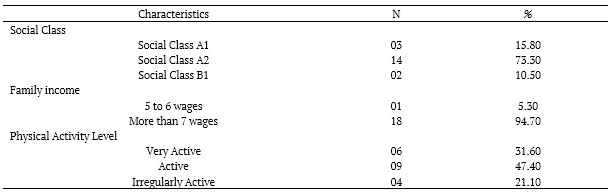
Table 1 shows that the football society players have a family income above 7 wages (93.3%). This corroborates the data that categorize these players according the social class strata A2 (73.3%). It was found that the football society players investigated in the present study have a very active (31.60%) and active (47.40%) profile with a total of seventy-nine percent (79.0%), in addition to having a high level of habitual physical activity. This means that these individuals comply with moderate-to-vigorous activity recommendations during three or more days a week for 20 or more minutes per session, in addition to moderate activities or walking during five or more days a week for 30 minutes or more per session. It is highlighted that 21.10% evaluated themselves as irregularly active, that is, they assumed meeting any of the criteria related to the IPAQ recommendation regarding frequency or physical activity length.
Source: the authors
Considering the elderly physical activity level, several studies have been carried out in Brazil. Silva, Goulart, Lanferdini, Marcon, and Dias (2012) concluded that active older adults have a better quality of life compared to sedentary ones. Barbosa, Teixeira, Orlandi, Oliveira, and Concone (2015) found that the physical activity level has a different influence on the elderly’s quality of life in both rural and urban areas, however, having competitive motivation for the practice of physical activities as the focus, Silva, Castanho, Chiminazzo, Barreira, and Fernandes (2016) found that the competitive factor is what less motivate the older adults to practice physical activities, thus, no studies were found that investigated the participation of men over the age of 55 in competitive sport events.
Table 2 shows the results with regard to the average and maximum heart rate of the football society players during the match.

P.S.: bpm - beats per minute; md – median. Source: the authors.
Considering that the average age of the subjects investigated in the present study is 56.7 years, and given the HRmax = 220-age equation (Robergs & Landwehr, 2002), the HRmax estimated will be 220-56, thus, 163.3 beats per minute (bpm).
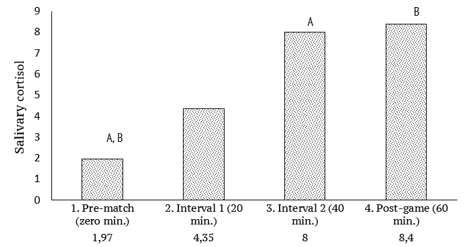
Figure 1. Comparison of the salivary cortisol level of football society players at different moments of the match (n = 19). P.S.: Significant difference (repeated measures ANOVA/Bonferroni post hoc) p<0.01 between: cortisol ng/ml- (a: 1 and 3; b: 1 and 4). Source: The authors.
The results found by measuring the salivary cortisol concentration at different moments of a football society match showed statistically significant differences between the pre-match physical condition and that of the second half of the game. After 40 minutes of football society practice the salivary cortisol concentration increased approximately four times. This fact occurred when comparing the pre-match and post-match physical conditions. Although there was an increase of only 5% in relation to the previous condition (2nd half interval), this value increased by about 50% when the comparison was made by assessing the salivary cortisol concentration in the pre-match condition (pre-match = 1.97 ng mL-1 - post-match = 8.40 ng mL-1). This occurrence is very similar when the analysis of the salivary cortisol concentration is expressed in mmol L-1.
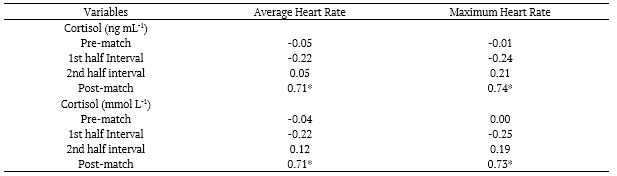
Table 3 shows the results related to the correlation between the cortisol level and the average and maximum heart rate at different moments of the match for the masters football society players over the age of 55.
*p < 0.05. Source: the authors
The two conditions for measuring salivary cortisol (ng mL-1 and nmol L-1) are highly and positively correlated, as well as statistically relevant at the post-match moment. Although estimating the moment when heart rate data were collected is not possible, the statistical calculation establishes a relationship between these two physiological variables, that is, measured between 40 minutes and 60 minutes of the match.
Discussion
The present study investigated the physical activity level, heart rate and salivary cortisol level of masters football society players over the age of 55, in addition to assessing the changes in heart rate and salivary cortisol levels at different moments (pre-match, during, and post-match). The results showed that the players exceeded the maximum heart rate by more than 10% at least once during the match, and they played football society with an average heart rate of 84% in relation to the HRmax (Table 2).
Considering this age group (+55 years old) a physical condition is invariable as a consequence of the aging process, that is, the decrease in cardiovascular performance, which refers to the reduction of cardiac output, stroke volume, maximum heart rate and maximum oxygen consumption (Ferrari, Radaelli, & Centola, 2003). This condition has implications in the sense of maintaining the HRmax (Coelho et al., 2011), and this intensity can only be maintained due to the intermittent pattern of football games. Thus, the heart rate is greatly changed during a match (Alexandre et al., 2012). Intensity in football game was the object of investigation of Bankoff, Marchi Neto and Moreira (2009). The authors evaluated the performance and found that the heart rate was between 120 and 170 bpm, that is, 60 to 85% maximum heart rate for young individuals. Although there are few data available in the literature for comparison, the results found in the present study show that the average heart rate of Masters football society players (+55 years old) was at about 84% in relation to the HRmax. These results are worrisome, since they are similar to or higher than those found in players much younger than the subjects assessed in the other studies mentioned.
The intensity of physical exercise performed by football society players has a significant role and deserves attention because in extreme cases the individual with cardiovascular disease may have a ‘sudden death’, since about 25% of the occurrences is due to heart failure (Ponikowski et al., 2016). In addition, a high heart rate can be a strong predictor of cardiovascular death in older men (+65 years old) (Tadic, Cuspidi, & Grassi, 2018).
Sudden death refers to an unexpected non-traumatic fatal event that occurs within an hour after the onset of symptoms in an apparently healthy individual (Priori et al., 2015). However, doctors often believe that older patients with heart failure die mainly because the heart muscle’s pump function is reduced, and they underestimate the importance and occurrence of sudden death (Rohde et al., 2018). Regarding sportspeople over the age of 35, the heart disorders are the main causes of sudden death, especially coronary artery disease (Colombo, Ghorayeb, Garcia, & Francisco, 2019).
Sudden death is not only related to high heart rate, but also to cortisol high level (Figure 1 and Table 3), which reveals values strongly similar to those that can cause cardiovascular death of people with and without pre-existing cardiovascular disease, that is, a specific link with cardiovascular mortality exists. This suggests that high levels of cortisol can be particularly harmful to the cardiovascular system (Vogelzang et al., 2010).
Another significant result found was that after 40 minutes of football society practice, the concentration of salivary cortisol increased by approximately four times (Figure 1). The results showed that the salivary cortisol concentration doubled after 20 minutes (the 1st half of the match), and it doubled again after the other 20 minutes (the 2nd half). Following this line of analysis, 40 minutes after the football society match had started, the players still participated in another half of 20 minutes (3rd half of the match – 2nd half interval and post-match). Regarding this new measurement (post-match), the salivary cortisol concentration remained unchanged from the point of view of a statistically significant difference.
Studies that have addressed associations with disease-related factors in the elderly have shown mean cortisol concentrations from 20 to 50% higher in older adults compared to younger adults (Ferrari et al., 2001; Joseph et al., 2005; Walston et al., 2006; Moffat et al., 2019). However, no article was found in the literature that had assessed the salivary cortisol concentration level in the elderly during the practice of intermittent physical activity, as in the case of football society, which was the focus of the present study. Regarding the practice of competitive sport, Moreira, Arsati, Arsati, Silva, and Araújo (2009) and Filaire, Alix, Ferrand, and Verger (2009) found that the salivary cortisol concentration was higher during the competition day, with no variation before and after the match. This is opposite to the results obtained in the present study, mainly considering pre and post-match moments, since the variation in salivary cortisol was 400% greater when compared to the pre-match data collection, which implies in a statistically significant difference at different moments of the match.
The data of the present study add negative effects related to stressful practice (football society) to the research field due to the increase in salivary cortisol seen during the match, since some studies (Haneishi et al., 2007; Kumari et al., 2010) have shown that healthy elderly people with higher salivary cortisol showed lower physical performance. Besides the physiological component, the psychological one also influences the increase in salivary cortisol during competition (Moreira et al., 2009).
Similar to the present study, other investigations have identified higher post-match cortisol concentrations when assessing hormonal responses after a rugby match (Cormack, Newton, & McGuigan, 2008), football (Coelho et al., 2011) and during an experimental football match (Ispirlidis et al., 2008). Although performed in the laboratory, the studies by Hoogeveen and Zonderland (1996) with professional cyclists found an increase in cortisol concentration immediately after the end of tests, and showed that cortisol levels increased by 39%. Thus, the authors concluded that the increase in salivary cortisol occurs when the practice of intense physical exercise raises the plasma levels of several stressor hormones and influences the immune response.
This significant increase in the salivary cortisol concentration is a response of the organism during and after stressors (Jorge et al., 2010), which show the intensity of the physical/physiological effort performed by the Football Society players during a competitive match. Theoretically, this additional stressor may arise from interactions with other factors, such as the match situation and the importance of the game (Santos, Kuczynski, Machado, Osiecki, & Stefanello, 2014).
The association between salivary cortisol and the average and maximum heart rate at the post-match moment (Table 3) may indicate that the physiological stress is at such a level that it neither allows the cardiac recovery nor that the decreased cortisol concentration is processed or recovered by the body anymore due to the high physical/physiological stress of the players over the age of 50 (Bueno & Gouvêa, 2011). Exercise can act as a stimulus for the hypothalamus-pituitary-adrenal axis, which results in a significant increase in circulating cortisol levels. Thus, the cortisol levels increase at a rate relatively proportional to the intensity of exercise (Hill et al., 2008). Regarding the elderly, prolonged increase of cortisol causes a reduction in the hippocampus volume and deficits related to memory tasks that are dependent on the hippocampus (Lupien et al., 1988).
The physiological demand that a masters football society match (+55 years old) imposes on the players significantly changed both, the heart rate and the salivary concentration., which indicates that the physical demand of a recreational football society match can cause significant stress to the human physiological system and must be monitored even during recreational activities.
In terms of health in general, it is emphasized that chronic stress is considered to have a negative impact on individuals, regardless of being older, which may result in a higher incidence of obesity, type 2 diabetes mellitus and cardiovascular disease. Such evidences correspond to the role played by the cortisol physiological effect, that is, a mediator of the adaptive response to stress that is involved in several other essential functions, such as energy metabolism, regulation of the immune system and bone metabolism (Peeters, Schoor, Rossum, Visser, & Lips, 2008; Teo, McGuigan, & Newton. 2011). It is noteworthy that the stress related to the aforementioned diseases is not the same as that assessed in the present study, and the stimulus required when performing aerobic or anaerobic physical exercises can increase resistance to new types of stress, an effect known as adaptation to training (Cruzat, Rogero, Borges, & Tirapegui, 2007).
The main limitations of this study refer to the difficulty of obtaining a larger sample due to problems related to the data collection with ecological validity, in addition to the difficulty of finding in the literature data on the participation of men over the age of 55 in events with intermittent intensity of physical effort, in addition to the lack of reference standards regarding this age group. It is believed that the use of IPAQ as an instrument to verify the physical activity level of the participants did not correctly diagnose the level of physical condition of the football society players. On the other hand, this investigation will contribute in the sense of providing initial reference values for a sport that is widely practiced in Brazil and with a growing number of participants.
Conclusion
It is concluded that although the players have reported themselves as having an active profile for playing football society, the physical and physiological effort performed by individuals over the age of 55 needs to be monitored due to the high effort demand, which sometimes indicates an extremely high average heart rate, besides the fact that the HRmax is exceeded at certain moments. Parallel to this increase in heart rate, a significant increase in the cortisol concentration occurs, which is doubled after 20 minutes of practice and quadrupled after 40 minutes, entering a plateau when measured 60 minutes after the match started.
In this sense, football players over the age of 55 with habitual physical activity level and categorized as being active or very active are likely to have their technical performance affected. Further studies that involve this population profile during the practice of football society, whether as leisure or competition, should be carried out with concern on the occurrence of injuries or even on more serious impairment related to health status.
References
Associação Brasileira de Empresas de Pesquisa [ABEP]. (2009, March 16). Critério de classificação econômica Brasil. Retrieved from www.abep.org
Alexandre, D., Silva, C. D., Hill-Haas, S., Wong, D. P., Natali, A. J., De Lima, J. R. P., … Karim, C. (2012). Heart rate monitoring in soccer. Journal of Strength and Conditioning Research, 26(10), 2890-2906. DOI: https://doi.org/10.1519/jsc.0b013e3182429ac7
Almeida, M. C., Gomes, C. M., & Nascimento, L. F. (2014). Spatial distribution of deaths due to Alzheimer's disease in the state of São Paulo. Brazil. São Paulo Medical Journal, 132(4), 199-204. DOI: https://doi.org/10.1590/1516-3180.2014.1324610
Azad, N., & Lemay, G. (2014). Management of chronic heart failure in the older population. Journal of Geriatric Cardiology, 11(4), 329-337. DOI: 10.11909/j.issn.1671-5411.2014.04.008
Barbosa, A. P., Teixeira, T. G., Orlandi, B., Oliveira, N. T. B., & Concone, M. H. V. B. (2015). Nível de atividade física e qualidade de vida: um estudo comparative entre idosos dos espaços rural e urbano. Revista Brasileira de Geriatria e Gerontologia, 18(4), 743-754. DOI: https://doi.org/10.1590/1809-9823.2015.14182
Bankoff, A. D. P., Marchi Netto, F. L., & Moreira, S. A. (2009). Estudo de frequência cardíaca durante uma partida de futebol de campo: um estudo de caso. Movimento & Percepção, 10(14), 404-413.
Bradford, M. M. (1976). A rapid and sensitive method for the quantitation of microgram quantities of protein utilizing the principle of protein–dye binding. Analytical Biochemistry, 7(72), 248-254. DOI: 10.1006/abio.1976.9999
Brumby, S., Chandrasekara, A., McCoombe, S., Torres, S., Kremer, P., & Lewandowski, P. (2011). Reducing psychological distress and obesity in Australian farmers by promoting physical activity. BMC Public Health, 11(1), 1-7. DOI: https://doi.org/10.1186/1471-2458-11-362
Bueno, J. R., & Gouvêa, C. M. C. P. (2011). Cortisol e exercício: efeitos. secreção e metabolismo. Revista Brasileira de Prescrição e Fisiologia do Exercício, 5(29), 435-445.
Cruzat, V. F., Rogero, M. M., Borges, M. C., & Tirapegui, J. (2007). Aspectos atuais sobre estresse oxidativo. exercícios físicos e suplementação. Revista Brasileira de Medicina do Esporte, 13(5), 336-334.
Coelho, D. B., Mortimer, L. A., Condessa, L. A., Morandi, R. F., Oliveira, B. M., Marins, J. C. B., ... Garcia, E. S. (2011). A Intensity of real competitive soccer matches and differences among player positions. Revista Brasileira de Cineantropometria & Desempenho Humuano, 13(5). 341-347.
Colombo, C. S. S. S., Ghorayeb, N., Garcia, T. G., & Francisco, R. C. (2019). Sudden Cardiac Death in Sports: Why Its Prevalence is So Different by Gender? International Journal of Cardiovascular Sciences,32(4), 414-417. DOI: https://doi.org/10.5935/2359-4802.20190053
Corazza, D. I., Sebastião, É., Pedroso, R. V., Andreatto, C. A. A., Coelho, F. G. M., Gobbi. S., … Santos-Galduróz, R. F. (2014). Influence of chronic exercise on serum cortisol levels in older adultss. European Review of Aging and Physical Activity, 11(1), 25-34. DOI: https://doi.org/10.1007/s11556-013-0126-8
Cormack, S. J., Newton, R. U., & McGuigan, M. R. (2008). Neuromuscular and endocrine responses of elite players to an Australian rules football match. International Journal of Sports Physiology, 3(3), 359-374. DOI: https://doi.org/10.1123/ijspp.3.3.359.
Cozma, S., Dima-Cozma, L. C., Ghiciuc, C. M., Pasquali, V., Saponaro, A., & Patacchioli, F.R. (2017). Salivary cortisol and α-amylase: subclinical indicators of stress as cardiometabolic risk. Brazilian Journal of Medical and Biological Research, 50(2), e5577. DOI: http://dx.doi.org/10.1590/1414-431X20165577
Ferrari, A. U., Radaelli, A., & Centola, M. (2003). Invited review: aging and the cardiovascular system. Journal of Applied Physiology, 95(6), 2591-2597.
Ferrari, E., Cravello, L., Muzzoni, B., Casarotti, D., Paltrom, M., Solerte, S. B., ... Magri, F. (2001). Age-related changes of the hypothalamic-pituitary-adrenal axis: pathophysiological correlates. European Journal of Endocrinology, 144(1), 319-329.
Filaire, E., Alix, D., Ferrand, C., & Verger, M. (2009). Psychophysiological stress in tennis players during the first single match of a tournament. Psychoneuroendocrinology, 34(1), 150-157. DOI: https://doi.org/10.1016/j. psyneuen.2008.08.022
Fleshner, M. (2005). Physical activity and stress resistance: sympathetic nervous system adaptations prevent stress-induced immunosuppression. Exercise and Sport Sciences Reviews, 33(3), 120-126.
Haneishi, K., Fry, A. C., Moore, C. A., Schilling, B. K., Li, Y., & Fry, M. D. (2007). Cortisol and stress responses during a game and practice in female collegiate soccer players. The Journal of Strength & Conditioning Research, 21(2):583-8. DOI: https://doi.org/10.1519/R-20496.1
Hill, E. E., Zack, E., Battaglini, C., Viru, M., Viru, A., & Hackney, A. C. (2008). Exercise and circulating cortisol levels: the intensity threshold effect. Journal of Endocrinological Investigation, 31(7), 587-91. DOI: https://doi.org/10.1007/BF03345606.
Holanda, C. M. A., Guerra, R. O., Nóbrega, P. V. N., Costa, H. F., Piuvezam, M. R., & Maciel, Á. C. C. (2012). Salivary cortisol and frailty syndrome in elderly residents of long-stay institutions: a cross-sectional study. Archives of Gerontology and Geriatrics, 54(2), e146-e151. DOI: https://doi.org/10.1016/j.archger.2011.11.006
Hoogeveen, A. R., & Zonderland, M. L. (1996). Relationships between testorterone. cortisol and performance in professional cyclist. International Journal of Sports Medicine, 17(6), 423-428. DOI: https://doi.org/10.1055/s-2007-972872
Instituto Brasileiro de Geografia e Estatística [IBGE]. (2010). SIS 2016: 67.7% dos idosos ocupados começaram a trabalhar com até 14 anos. Retrieved from https://censo2010.ibge.gov.br/noticias-censo.html? busca=1&id= 1&idnoticia=3326&t=sis-2016-67-7-idosos-ocupados-comecaram-trabalhar-14-anos&view=noticia
Ispirlidis, I., Fatouros, I. G., Jamurtas, A. Z., Nikolaidis, M. G., Michailidis, I., Douroudos, I., ... Taxildaris, K. (2008). Time-course of changes in inXammatory and performance responses following a soccer game. Clinical Journal of Sport Medicine, 18(5), 423-431. DOI: https://doi.org/10.1097/JSM.0b013e3181818e0b
Jorge, S. R., Santos, P. B., & Stefanello, J. M. F. (2010). O cortisol salivar como resposta fisiológica ao estresse competitivo: uma revisão sistemática. Journal of Physical Education, 21(4), 677-686.
Joseph, C., Kenny, A. M., Taxel, P., Lorenzo, J. A., Duque, G., & Kuchel, G. A. (2005). Role of endocrine-immune dysregulation in osteoporosis. sarcopenia. frailty and fracture risk. Molecular Aspects of Medicine, 26(3), 181-201. DOI: https://doi.org/10.1016/j.mam.2005.01.004
Kandhalu, P. (2013). Effects of cortisol on physical and psychological aspects of the body and effective ways by which one can reduce stress. Berkeley Scientific Journal, 18(1), 14-16.
Krustrup, P., Dvorak, J., Junge, A., & Bangsbo, J. (2010) Executive summary: the health and fitness benefits of regular participation in small-sided football games. Scandinavian Journal of Medicine & Science in Sports, 20(Suppl 1), 132-135. DOI: https://doi.org/10.1111/j.1600-0838.2010.01106.x
Kumari, M., Badrick, E., Sacker, A., Kirschbaum, C., Marmot, M., & Chandola, T. (2010). Identifying patterns in cortisol secretion in an older population. Findings from the Whitehall II study. Psychoneuroendocrinology, 35(7), 1091-1099. DOI: https://doi.org/10.1016/j.psyneuen.2010.01.010
Luo, H., Newton, R. U., Ma’ayah, F., Galvão, D. A., & Taaffe, D. R. (2018). Recreational soccer as sport medicine for middle-aged and older adultss: a systematic review. BMJ Open Sport & Exercise Medicine, 4(1), e000336. DOI: http://dx.doi.org/10.1136/bmjsem-2017-000336
Lupien, S. J., Leon, M., Santi, S., Convit, A., Tarshish, C., Nair, N. P. V., … Meaney, M. J. (1998). Cortisol levels during human aging predict hippocampal atrophy and memory deficits. Nature Neuroscience, 1(1), 69-73. DOI: https://doi.org/10.1038/271
Maciel, M. G. (2010). Atividade física e funcionalidade do idoso. Motriz, 16(4), 1024-1032. DOI: https://doi.org/10.5016/1980-6574.2010v16n4p1024
Matsudo, S., Araújo, T., Matsudo, V., Andrade, D., Andrade, E., Oliveira, L. C., & Braggion, G. (2001). Questionário internacional de atividade física (IPAQ): estudo de validade e reprodutibilidade no Brasil. Revista Atividade Física & Saúde, 6(2), 5-18. DOI: https://doi.org/10.12820/rbafs.v.6n2p5-18
McPhee, J. S., French, D. P., Jackson, D., Nazroo, J., Pendleton, N., & Degens, H. (2016). Physical activity in older age: perspectives for healthy ageing and frailty. Biogerontology, 17(3), 567-580. DOI: https://doi.org/10.1007/s10522-016-9641-0
Merquiades. J. H., Agra. J. H. M., Albuquerque. K. M. D., Costa. R. C., & Navarro. A. C. (2009). A importância do exercício físico para a qualidade de vida dos idosos. Revista Brasileira de Prescrição e Fisiologia do Exercício, 3(18), 597-614 .
Moffat, S. D., Na, Y., Resnick, S. M., Diamond, M. P., & Ferrucci, L. (2019). Longitudinal change in cortisol levels across the adult life span. The Journals of Gerontology: Series A, 75(2), 394-400.
Moreira, A., Arsati, F., Arsati, Y. B. O. L., Silva, D. A., & Araújo, V. C. (2009). Salivary cortisol in top-level professional soccer players. European Journal of Applied Physiology, 106(1), 25-30. DOI: 10.1007/s00421-009-0984-y
Mura, G., Cossu, G., Migliaccio, G. M., Atzori, C., Nardi, A. E., Machado, S., & Carta, M. G. (2014). Quality of life. cortisol blood levels and exercise in older adultss: results of a randomized controlled trial. Clinical Practice & Epidemiology in Mental Health, 13(10), 67-72.
Oliveira, T. P., Ferreira, R. B., Mattos, R. A., Silva, J. P., & Lima, J. R. P. (2012). A ingestão hídrica acelera a recuperação da frequência cardíaca pós-exercício. Revista de Educação Física UEM, 23(2), 271-276. DOI: 10.4025/reveducfis.v23i2.12670
Peeters, G. M. E. E., Schoor, N. M., Rossum, E. F. C., Visser, M., & Lips, P. (2008). The relationship between cortisol. muscle mass and muscle strength in older persons and the role of genetic variations in the glucocorticoid receptor. Clinical Endocrinology, 69(4), 673-682. DOI: https://doi.org/10.1111/j.1365-2265.2008.03212.x
Ponikowski, P., Voors, A. A.. Anker, S. D., Bueno, H., Cleland, J. G. F., Coats, A. J. S., ... Meer, P. (2016). 2016 ESC Guidelines for the diagnosis and treatment of acute and chronic heart failure. European Journal of Heart Failure, 18(8), 891-975. DOI: https://doi.org/10.1002/ejhf.592
Priori, S. G., Blomström-Lundqvist, C., Mazzanti, A., Blom, N., Borggrefe, M., Camm, J., .... Veldhuisen, V. (2015). 2015 ESC Guidelines for the management of patients with ventricular arrhythmias and the prevention of sudden cardiac death. European Heart Journal, 36(1), 2793-2867.
Robergs, R. A., & Landwehr, R. (2002). The surprising history of the ‘HRmax= 220‑age’ equation. Journal of Exercise Physiologyonline, 5(2), 1-10.
Rodgers, J. L., Jones, J., Bolleddu, S. I., Vanthenapalli, S., Rodgers, L. E., Shah. K., … Panguluri, S. K. (2019). Cardiovascular risks associated with gender and aging. Journal of Cardiovascular Development and Disease, 6(2), 1-18. DOI: https://doi.org/10.3390/jcdd6020019
Rohde, L. E. P., Montera, M. W., Bocchi, E. A., Clausell, N. O., Albuquerque, D. C., Rassi, S., ... Martins, W. A. (2018). Diretriz brasileira de insuficiência cardíaca crônica e aguda. Arquivos Brasileiros de Cardiologia, 111(3), 436-539. DOI: https://doi.org/10.5935/abc.20180190
Santos, P. B., Kuczynski, K. M., Machado, T. A., Osiecki, A. C. V, & Stefanello, J. M. F. (2014). Psychophysiological stress in under-17 soccer players. Journal of Exercise Physiologyonline, 17(2), 67-79.
Silva, M. F., Goulart, N. B. A., Lanferdini, F. J., Marcon, M., & Dias, C. P. (2012). Relação entre os níveis de atividade física e qualidade de vida de idosos sedentários e fisicamente ativos. Revista Brasileira de Geriatria e Gerontologia, 15(4), 635-642. DOI: https://doi.org/10.1590/S1809-98232012000400004
Silva, A. N. C., Castanho, G. K. F., Chiminazzo, J. G. C., Barreira, J., & Fernandes, P. T. (2016). Fatores motivacionais relacionados à prática de atividades físicas em idosos. Psicologia em Estudo, 21(4), 677-685. DOI: https://doi.org/10.4025/psicolestud.v21i4.32198
Sgarbieri. V. C., & Pacheco. M. T. B. (2017). Healthy human aging: intrinsic and environmental factors. Brazilian Journal of Food Technology, 20(1), e2017007. DOI: https://doi.org/10.1590/1981-6723.00717
Souza, E. G., Istchuk, L. L., Lopez, J. A., Silva, K. A., Almeida Batista, L., Gonçalves, H. R., & Stanganelli, L. C. R. (2015). Comparação entre frequência cardíaca máxima predita e mensurada em atletas adolescentes de Futsal. Revista Brasileira de Futsal e Futebol, 7(26), 455-459.
Tadic, M., Cuspidi, C., & Grassi, G. (2018). Heart rate as a predictor of cardiovascular risk. European Journal of Clinical Investigation, 48(3), e12892. DOI: https://doi.org/10.1111/eci.12892
Taha, M. M., & Mounir, K. M. (2019). Acute response of serum cortisol to different intensities of resisted exercise in the elderly. Bulletin of Faculty of Physical Therapy, 24(1), 20-25. DOI: https://doi.org/10.4103/bfpt.bfpt_13_18
Teo, W., McGuigan M. R., & Newton, M. J. (2011). The effects of circadian rhythmicity of salivary cortisol and testosterone on maximal isometric force. maximal dynamic force. and power output. The Journal of Strength and Conditioning Research, 25(6), 1538-1545.
Vaz, F. C., Guilherme, M., Guilherme, P. L., & Adriana, P. (2013). Cortisol e atividade física: será o estresse um indicador do nível de atividade física espontânea e capacidade física em idosos? Revista Brasília Médica, 50(2), 143-152.
Vaz, R. A., & Nodin, N. (2005). A importância do exercício físico nos anos maduros da sexualidade. Análise Psicológica, 23(3), 329-339.
Vogelzangs, N., Beekman, A. T. F., Milaneschi, Y., Bandinelli, S., Ferrucci, L., & Penninx, B. W. J. H. (2010). Urinary cortisol and six-year risk of all-cause and cardiovascular mortality. The Journal of Clinical Endocrinology & Metabolism, 95(11), 4959-4964. DOI: https://doi.org/10.1210/jc.2010-0192
Wajngarten, M. (2010). O coração no idoso. Jornal Diagnósticos em Cardiologia. 13(43), 1-9.
Walston, J., Hadley, E. C., Ferrucci, L., Guralnik, J. M., Newman, A. B., & Studenski, S. A. (2006). Research agenda for frailty in older adultss: toward a better understanding of physiology and etiology: summary from the American Geriatrics Society/National institute on aging research conference on frailty in older adultss. Journal of the American Geriatrics Society, 54(6), 991-1001. DOI: https://doi.org/10.1111/j.1532-5415.2006.00745.x
World Health Organization [WHO]. (2019). Ageing and life course. Retrieved from https://www.who.int/ageing/en/
Notas de autor
luferreira.ed@gmail.com