Ciências da Saúde
Recepción: 25 Julio 2020
Aprobación: 23 Febrero 2021
DOI: https://doi.org/10.4025/actascihealthsci.v43i1.54483
Abstract: The aim of this study was to detect early hypertension, diabetes and obesity, as well as their risk factors, in 105 young shooters from Tiro de Guerra 11-002 in the city of Ituiutaba-MG. This is a cross-sectional mixed study. A semi-structured questionnaire that contained questions related to the sociodemographic context, health status, lifestyle, eating habits, and psychosocial variables was applied. Blood pressure, anthropometric indexes, and lipid and glycemic profiles were measured. Descriptive and inferential statistics, including Pearson’s correlation test and Spearman’s coefficient, considering significative value (p < 0.05). The shooters had an average of 18.9 years old, most educated and brown. Anthropometric indices indicated a mainly eutrophic population, and normotensive and desirable lipid and glycemic profiles. However, overweight, high blood pressure, and self-declaration of family history for chronic diseases were identified. In addition, most shooters affirmed to ingest alcoholics beverages, to have insufficient time of physical activity, and to be aware of their levels of stress, pressure and anxiety and a few hours of sleep. Overall, the shooters showed good anthropometric and biochemical indicators of blood. Risk behavior, such as drinking alcoholic beverages and smoking, low level of physical activity and self-perception of stress, anxiety and pressure were also noted.
Keywords: hypertension, nutritional status, psychology, adolescent, quality of life.
Introduction
Non-communicable diseases (NCDs) are the leading cause of death worldwide, with premature mortality, affecting mainly the low-income populations (World Health Organization [WHO], 2018). In Brazil, the probability of premature mortality from NCDs is 17% and the percentage of deaths is 74% (World Health Organization [WHO], 2020).
As they are diseases that have a long latency period, they can be observed in individuals of all ages, including the youngest (Silva, Vecchia, & Braga, 2016; Brasil, 2020), usually resulting in suffering and disabilities, which reflects directly on the quality of life, increasing financial costs to the patient, their family and the health system (Brasil, 2011; Malta & Silva Jr, 2013). Among the NCDs, systemic arterial hypertension (SAH) affects 24.5% of the Brazilian adults aged 18 years or older and a total of 11.8% men aged 18 to 34 years (Brasil, 2020).
In addition to the elderly, SAH has reached more and more young individuals, initially presented as prehypertension and later as SAH in adolescents, and these clinical conditions are more prevalent in males aged 15 to 17 years, being significant in all regions of the country especially in the North (Bloch et al., 2016). The prevalence of SAH in younger groups occurs due to weight gain (Brevidelli, Coutinho, Costa, & Costa, 2015; Bloch et al., 2016; Ciaccia et al., 2018; Enes, Camargo, & Justino, 2019; Silva et al., 2019).
A set of risk factors responsible for the development of NCDs can be understood in two aspects: the modifiable risk factors that include the consumption of alcohol and tobacco, physical inactivity and inadequate nutrition; and those non-modifiable that include high blood pressure, overweight and obesity (OBS), inadequate blood glucose levels and lipid profile, and family history in first-degree relatives (Brasil, 2011; Sociedade Brasileira de Diabetes, 2019; Malachias et al., 2016; World Health Organization [WHO], 2013). Moreover, these risk factors have been associated with psychosocial disorders, such as stress, anxiety and depression, resulting in increased morbidity due to cardiovascular diseases (CVDs) (see Borba, Lemos, & Hayasida, 2015).
The military environment is a place of male representativeness and the entrance of women in this profession is recent (Cappelle & Melo, 2010). The way people enter the military institutions is democratic, without restrictions or impasses in terms of socioeconomic, cultural, ethnic or religious aspects. However young females are dismissed the mandatory military exercise (Brasil, 2021). Even so, studies with this young population who have recently entered the military service are rare, since most of them are held with military adults present in the civil service (Ferreira, Bonfim, & Augusto, 2011; Barbosa & Silva, 2013; Bezerra et al., 2015; Cordeiro, Silva, Simão, Freitas e Silva, & Pereira, 2016; Bernardo et al., 2018). The Tiro de Guerra is a military institution of the Brazilian Army in charge of training reservists for the army, so that the convened can conciliate military training with work or study (Brasil, 2021).
In order to participate in the Tiro de Guerra, good mental and physical health conditions are generally required. Although this group presents a small probability of being affected by more serious health problems, they are exposed to daily situations of intense stress and pressure, which could favor the triggering of NCDs with the combination of external factors. In this sense, the present study evaluated the early identification of NCDs such as SAH, DM and OBS, in young volunteers incorporated in the Tiro de Guerra 11-002 in the city of Ituiutaba-MG, considering mainly biochemical indicators (glycemia and lipid profile), pressure levels, anthropometric data and life habits.
Material and methods
This is a cross-sectional mixed study conducted with 115 young shooters in the Tiro de Guerra 11-002 of Ituiutaba-MG from August to October 2015. On a previously scheduled date, the individuals who agreed to volunteer for the research and signed the Free and Informed Consent Form (FICF), upon approval by the Human Research Ethics Committee of the Federal University of Uberlândia (CEP/UFU no 006901/2015), completed a semi-structured self-responsive questionnaire and then passed through the collection of peripheral blood samples, anthropometric measurements and blood pressure.
The semi-structured questionnaire consisted of questions regarding sociodemographic variables (age, education level and ethnicity), health (anthropometric and clinical data - systolic (SBP) and diastolic (DBP) blood pressure values, family history of first degree relatives for SAH, DM and OBS), lifestyle (practice, modality and frequency of physical activity, tobacco use and alcohol consumption), eating habits (self-perception of healthy eating and daily consumption of fruits, vegetables, fatty foods, red meat, sweets or sugary foods), and variable of psychosocial order (self-perception, during the previous week, of their quality of sleep, stress, depression, anxiety and pressure, as well as the determination of low, high and extreme degrees).
All parameters of lifestyle and self-perception were guided before being answered by the shooters. In the case of tobacco use, ‘smoker’ was considered to be one who claimed to have consumed 100 or more cigarettes, ‘ex-smoker’ to be a person who smoked more than 100 cigarettes, but abandoned the use of tobacco (Centers for Disease Control and Prevention [CDC], 1994), and ‘no smoker’ one who has never smoked. In the case of alcohol consumption, only the consumption or not of alcoholic beverages was considered, regardless the amount of doses and the daily or weekly frequency. The categorization of self-reported healthy eating took into account the 10 steps of healthy eating (Brasil, 2014). On the other hand, psychosocial disorders and aspects related to sleep were studied with the intention of tracking and not estimating the prevalence of possible psychosocial disorders to mental health (Ramires, Passarini, Flores, & Santos, 2009), including questions such as ‘Did you consider yourself a ‘stressed person in the last week?', 'Or anxious?', 'Or depressed?', 'Or pressured?'. When the answer was ‘yes’, its status was subsequently measured as: ‘low’, ‘high’ or ‘extreme’. As for sleep, the shooters were asked 'How do you feel when you wake up?', with the possibility of an answer, such as 'very tired', 'tired', 'rested' or 'very rested', and the number of uninterrupted hours of sleep was also evaluated, being possible the answers 'less than 6 hours', '6 to 8 hours' and 'more than 8 hours'.
The venous blood collection from the shooters was done after 8 hours of fasting, in dry tube BD Vacutainer® with clot activator, being the sample processed by Laboratório Pasteur de Análises Clínicas S/C Ltda of Ituiutaba-MG. The lipid profile analysis was performed using the colorimetric technique for triglyceride (> 150 mg dL-1) and total cholesterol (> 190 mg dL-1) levels, and the selective surfactant methodology for the HDLc (< 40 mg dL-1) and LDLc (> 130 mg dL-1) fractions, determining a dyslipidemia (Faludi et al., 2017). The glycemia dosage by the enzymatic and colorimetric system allowed the measurement of the critical glycemic values that determine the normoglycemic individual (< 100 mg dL-1), pre-diabetic or with increased risk for DM (≥ 100 mg dL-1 and < 126 mg dL-1) and diabetic (≥ 126 mg dL-1). There was no suspected case for DM, therefore no diagnosis was made with a new fasting blood glucose measurement in a second blood sample (Sociedade Brasileira de Diabetes, 2019). Biochemical analyses were performed using diagnostic kits following the manufacturer's protocol (LabTest Diagnostica®, Brazil).
The anthropometric data, such as waist circumference (WC) and hip circumference (HC), which resulted in the waist and hip circumference ratio (WHR), were obtained by a single measurement using a measuring tape. For WC measurement, it was considered the midpoint between the iliac crest and the costal edge, with the shooter in an orthostatic position, with the upper limbs positioned parallel to the body and in the expiratory phase of breathing. The upper waist circumference is an indicator of abdominal OBS and the risk for CVD increases when its value is ≥ 102 cm (National Institutes of Health, 2002). The results of the WHR were obtained by dividing the value of WC by the HC, which was measured by the height of the largest trochanter of the femur, being considered WHR ≥ 0.95 (Pereira, Sichieri, & Marins, 1999), as a risk for the development of SAH and other metabolic disorders associated with eating habits and OBS. Weight measurements were performed with the shooters standing in the center of the G-Tech Glass 200® digital scale platform, with their feet together and arms along the body. Height was measured using a stadiometer, with the shooter in an upright position, with the feet joined and close to the scale. Height and weight measurements determine the Body Mass Index (BMI) – body adiposity measure (Associação Brasileira para o Estudo da Obesidade e da Síndrome Metabólica [Abeso], 2016). Cutoff points recommended by the Brazilian Association of Obesity (Abeso, 2016) were used, being low weight (BMI < 18.5 kg m-2), eutrophic (BMI 18.5 and 24.9 kg m-2), overweight (BMI 25.0 and 29.9 kg m-2), and OBS (BMI ≥ 30.0 kg m-2). For anthropometric measurements the weight values of the official clothing and shoe (2.4 kg) were discounted, along with the height of the official shoe (2 cm) and the measurement of the clothing for WC (1 cm) and HC (2 cm).
Wrist blood pressure monitors G Tech® and Medeqco® were used to measure both the SBP and DBP, performing two measurements on the right arm in the sitting position considering its average, as recommended by Brazilian Hypertension Guidelines (Barroso et al., 2021 ). For the classification of BP the following parameters were used: optimal (SBP < 120 mmHg and DBP < 80 mmHg), normal (SBP 120 to 129 mmHg and/or DBP 80 to 84 mmHg), prehypertension (130 to 139 and/or DBP 85 to 89 mmHg), stage I SAH (SBP 140 to 159 mmHg and/or DBP 90 to 99 mmHg) and stage II SAH (SBP 160 to 179 mmHg and/or DBP 100 to 109 mmHg) (Barroso et al., 2021 ). Shooters who presented isolated systolic hypertension (SBP ≥ 140 mmHg and DBP <90 mmHg) or isolated diastolic hypertension (SBP <140 mmHg and DBP ≥ 90 mmHg) had a higher prevalence of being classified as white coat hypertension (Barroso et al., 2021). It is worth mentioning that individuals classified as prehypertension and SAH were instructed to seek medical attention to confirm the diagnosis and treatment.
The data were plotted using Microsoft Excel 2010® software and analyzed using descriptive statistics, considering sample n, mean, standard deviation (SD) and absolute, relative and inferential frequencies. The Person correlation was applied in the anthropometric variables, considering weak correlation (0.31-0.50), moderate correlation (0.51-0.70) and strong correlation (0.71-0.9) (Miot, 2018). Moreover, the correlation between the variables related to mental disorders and sleep disorders was evaluated using Spearman correlation test, with the following correlation degrees: weak correlation (< 0.4), moderate correlation (≥ 0.4 - < 0.5) and strong correlation (≥ 0.5) (Scattolin, Diogo, & Colombo, 2007). The significance of 5% using the BioEstat 5.0 program was considered for all analyzes in this study.
Results
A total of 115 young people crowded into the Tiro de Guerra were recruited. Among them, 10 individuals (8.7% of the population) were excluded either because of their absence on the collection day, or because they did not fast properly. Thus, 105 male individuals in the 18 to 21 age group (18.9 ± 0.66 years), representing 91.3% of the total of young shooters present in the military institution, were part of the survey. Moreover, most shooters are graduated from high school (70.5%) and self-declared brown (46.7%).
Table 1 presents the data on anthropometric variables, commonly used as a parameter to evaluate the nutritional status and body fat distribution. In this study, we observed a predominantly eutrophic population, considering the data on the BMI classification (72.4%).
In addition, the WC indicator (96.2%) did not reveal abdominal OBS and the WHR (93.3%) did not indicate a risk for CVD. However, overweight has also been identified, being 18% for BMI and 3.8% for WC; and risk for CVD by increased WHR (6.7%). Correlation between anthropometric measurements indicated a positive strong association for BMI and WC (r = 0.7920, 95% CI 0.71 - 0.85) with p <0.0001. These data reveal that BMI and WC increase concomitantly.
Table 1. Anthropometric variables measurements of shooters (n = 105), Ituiutaba, MG, 2015.
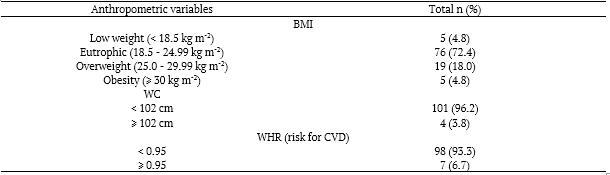
BMI: Body Mass Index; WC: Waist circumference; WHR: Waist and hip ratio; CVD: Cardiovascular diseases. Classification as described by Abeso (2016) and Pereira et al. (1999).
The diagnosis of SAH based on SBP and BPD measurements revealed that 17.1% of the shooters were hypertensive (Table 2). The biochemical markers for glycemia and lipid profile of most shooters were below the critical value of dyslipidemia and hyperglycemia, total cholesterol (95.1%, n = 97; < 190 mg dL-1), HDLc (74.5%, n = 76,> 40 mg dL-1), LDLc (96.1%, n = 98, < 130 mg dL-1), triglycerides (93.1%, n = 95, < 150 mg dL-1) (Faludi et al., 2017) and blood glucose (98.0%, n = 100, < 100 mg dL-1) during fasting were considered desirable or normal (Sociedade Brasileira de Diabetes, 2019).
Table 2. Systemic arterial hypertension of shooters (n = 105), Ituiutaba, MG, 2015.
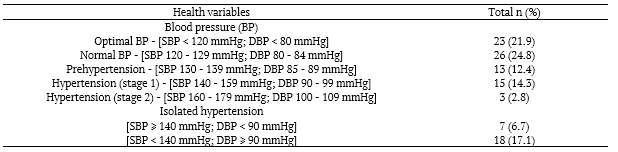
SBP: systolic blood pressure; DBP: diastolic blood pressure. Reference values based on the Brazilian Guideline of Arterial Hypertension (Barroso et al., 2021).
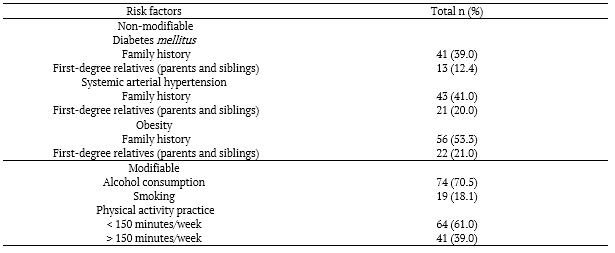
According to the biochemical parameters, no shooter had a characteristic glycemic level for the diagnosis of DM (≥ 126 mg dL-1). However, 39.0% reported family history for this disease, 12.4% of them in first-degree relatives (parents and siblings). A similar profile can be observed for SAH, in which 41.0% of the shooters claimed to have a family history, 20.0% were in first-degree relatives. As for the OBS, the number of positive responses for family history was higher (53.3%), and 21.0% reported having obese parents or siblings (Table 3).
For modifiable risk factors, it was found that 70.5% declared to be alcohol consumers, including spirits drinks (whiskey, tequila, vodka, among others) and fermented beverages (beers, wines and blends). Furthermore, 18.1% of the shooters self-reported as smokers, being tobacco the most used cigarette (Table 3).
In this study, the practice of physical activity was evaluated in relation to the time interval allocated during the week (World Health Organization [WHO], 2010). In the Brazilian military academy, all shooters perform military physical training (MPT), a specific type of regular-oriented physical activity, with the aim of promoting physical fitness, which is critical to the performance of military activities, as well as general physical health and affective (Brasil, 2015). In this regard, the shooters who practice only MPT do not meet the recommendations for minimum weekly physical activity time established by the World Health Organization (WHO, 2010). Only 39.0% of the shooters declared to practice physical activity, weekly, in the recommended time (> 150 min.), with cycling, soccer and weight training being the most cited modalities (Table 3).
Table 3. Risk factors of shooters (n = 105), Ituiutaba, MG, 2015.
In relation to shooter’s eating habits, 52.4% reported good self-perception of healthy eating (Table 4). Furthermore, it was possible to observe a significant intake of foods with antioxidant, anti-inflammatory, as well as protective properties for CVD and cancers, such as fruits (83.8%) and vegetables (82.9%) (Brasil, 2014). On the other hand, when questioned about red meat intake, fat foods such as fried and baked, besides sugary food, the data showed high frequencies of consumption (69.5, 63.8 and 55.2%, respectively), since the shooters stated that they ingest them at least once or twice a day (Table 4).
Table 4. Eating habits of shooters (n = 105), Ituiutaba, MG, 2015.
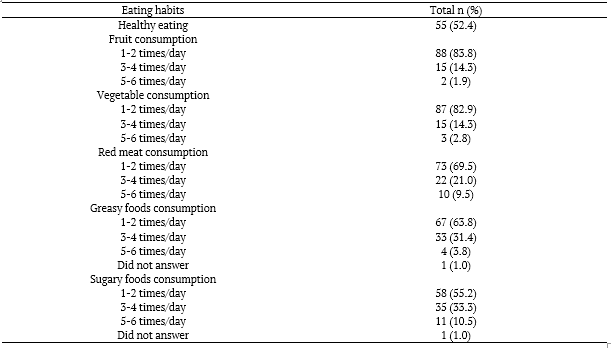
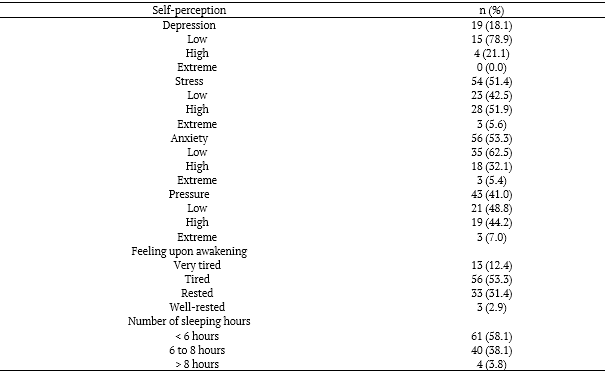
Table 5 presents data about the self-perception of behavioral disorders and sleep-related aspects. For the self-perception of depression, 18.1% of the shooters self-reported depressive, of which, 78.9% in the low degree, while for stress and anxiety, 51.4 and 53.3% stated that they feel stressed and anxious, respectively, being the first most reported disorder in the high degree (51.9%) and the second in the low degree (62.5%). In addition, 41% of the shooters reported feeling pressured, with the low degree being the most prevalent (48.8%).
Regarding the aspects related to sleep, including the self-awareness to waking up and sleeping hours, 53.3% of young shooters have declared tired and most of them mentioned to sleep less than six hours (58.1%) (Table 5).
Table 5. Self-perception of behavioural disorders and aspects related to sleep (n = 105), Ituiutaba, MG, 2015.
The perception degree of depression, anxiety, stress and pressure, as well as sleep aspects were correlated by Spearman correlation. There was a moderate, positive and significant correlation between the perception of both depression and pressure (ρ = 0.4366, p < 0.01) and depression and stress (ρ = 0.4069, p < 0.01), and a weak, positive and significant one for both anxiety and pressure (ρ = 0.2656, p < 0.01), and depression and anxiety (ρ = 0.2528, p < 0.01) (Table 6). These results indicate that the greater the perception of depression and anxiety, the greater the feeling of pressure, while the greater perception of anxiety and stress is associated with a greater degree of self-perception of depression (Table 6). It is important to note that this analysis and others listed below were considered, although p is less than 0.3, as also performed by Scatollin et al. (2007), even though biologically negligible by Miot (2018).
Table 6. Correlation between the perception of stress, anxiety, depression, pressure and perception by awakening in shooters, Ituiutaba, MG, 2015.
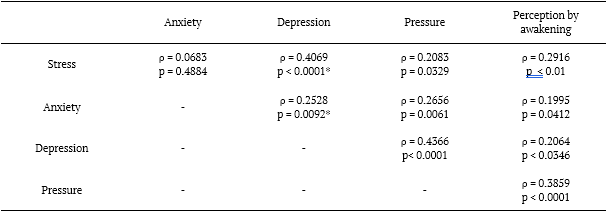
ρ = correlation coefficient, *p < 0.05.
The correlation between behavioral disorders and sleep aspects revealed weak positive significance for stress (ρ = 0.2916, p < 0.01), and for pressure and perception by awakening (ρ = 0.3859, p < 0.01) (Table 6).
In this sense, the data reveal that the more stressed and pressured the shooters are, the more tired they self-perceived. There was no significant correlation between the hours of sleep and behavioral disorders, or with the feeling upon awakening.
Discussion
The prevalence of young men, graduated from high school or pursuing higher education, was due to the fact that the study was performed at the 11th Military Region of the Tiro de Guerra 11-002, where army recruits graduate from military service in early adulthood. Enlistment in the military service in Brazil is mandatory for young men aged 18 years or older. Those who are physically or mentally disabled, in breach of law, support the family or who are taking an exam and/or enrolling in educational institutions are dismissed (Brasil, 1964). In this sense, the profile of the shooter entering the Tiro de Guerra analyzed in this study seems to be the young man who wishes to join the military service, who does not have an employment bond or who has not registered or enrolled in higher education.
The data revealed that the young shooter profile from Ituiutaba-MG completed high school or was in school training and self-declared as brown. Regarding socioeconomic issues in relation to inequality in access to higher education in Brazil, Carvalho and Waltenberg (2015) evaluating data from the National Household Sample Survey (Pnad) of 2003 and 2013 showed that the highest incidence of enrollments in higher education is where the family head has a higher level of education and higher per capita household income of 1.5 minimum wages. Furthermore, investigating the profile of those entering public and private higher education in potential demand, the authors observed that the highest enrollment rates are from women, whites, and who has a home with a father with higher education and high family income (Carvalho & Waltenberg, 2015).
Genetic, ethnic, age, physical conditioning, sex and other characteristics can interfere in the prediction of overweight and OBS, which is why the use of a single anthropometric parameter is limiting in this analysis. BMI is a generic and less predictive measure of body fat, but due to its practicality and cost, it is the most widely used assessment. Thus, the combination of anthropometric measures, such as WC and BMI, reduces the bias in the analysis of overweight and OBS (Abeso, 2016) .
Among the anthropometric parameters evaluated, the BMI and WHR are justified due to easy application and association with disease and death (Afonso & Sichieri, 2002; Ulguim, Renner, Pohl, Oliveira, & Bragança, 2019). Following the international classification of OBS, according to the BMI (Abeso, 2016), it was observed that most of the shooters were classified as eutrophic, although individuals with underweight, overweight and OBS have also been identified. According to Neves (2008), when the BMI indicates prevalence of overweight individuals, it may be due to the large amount of muscle mass. This was also observed in shooters, since good physical conditioning is one of the requirements for their professional performance (Brasil, 2015).
Thus, to better assess the prevalence of OBS, other anthropometric measures were used in the evaluation, as the waist and hip circumference. Considering the BMI and WC about 5% of the shooters were classified as obese, and 6.7% had high risk for the development of CVD according to WHR (≥ 0.95). Carvalho et al. (2015), evaluating young university students, revealed that in the male population there was a positive association between anthropometric measurements (BMI, WC and WHR) and blood pressure levels (SBP and DBP). In this sense, anthropometric parameters can be risk indicators for the occurrence of future cardiovascular events.
A population-based study with schoolchildren aged 12-17 years revealed that OBS (7.3%, 95% CI 6.6 - 8.1) and SAH (13%, 95% CI 11.5 - 14.6) are more prevalent in male adolescents, with OBS being more present in the younger ones and SAH in the older ones (Bloch et al., 2016). In a systematic review, Niehues, Gonzales, Lemos, Bezerra, and Haas (2014) showed that the highest prevalence of OBS was in the southeast (15.4%) and south (10.4%) in children and adolescents (2 to 19 years old). On the other hand, in shooters from the Tiro de Guerra of Alfenas-MG (Santos et al., 2019) and Maringá-PR (Mantovan, Vier, Kaetsu, & Martins, 2007) there were variations in the prevalence of overweight and OBS, taking into account that these studies (Niehues et al., 2014; Bloch et al., 2016; Santos, Duarte, Rodrigues, & Paula, 2019) are limited to the prediction of overweight only by BMI. Our study predicts overweight from BMI and WC, revealing that shooters in Ituiutaba-MG have a lower proportion of overweight compared to Brazilian adolescents.
Studies have revealed the presence, generally high, of SAH in military (Barbosa & Silva, 2013; Bezerra et al., 2015; Hilgenberg, Santos, Silveira, & Cominetti, 2016), reinforcing the need, maintenance and innovation of health policies and preventive programs, monitoring the treatment of NCDs, especially for younger people to adopt good health practices. According to Vigitel (Brasil, 2020) in a telephone survey in Brazilian capitals and in the Federal District, 24.5% of Brazilians presented a medical diagnosis for SAH, 21.2% were men and the frequency of diagnosis increases with age and the least amount of school time. Still, national NCDs mortality statistics in 2016 indicated 74% of total deaths and 28% caused by CVD (WHO, 2018), although Brant et al. (2017) revealed a decrease in mortality from these diseases in Brazil in recent years, occurring in a heterogeneous way among the brazilian states.
The presence of SAH in the investigated group may be related mainly to alcohol intake. In Brazil, alcohol consumption among young people has been expressive and worrying for the occurrence of NCDs (Garcia & Freitas, 2015; Brasil, 2020). The evaluation of other risk factors related to the development of SAH and metabolic disorders associated with overweight, genetic factors and lifestyle habits, such as tobacco use, insufficient physical activity, high calorie, sugar and fat intake, family history for SAH and DM help tracking the risk behaviors for the development of NCDs in the investigated group and allows the gathering of evidence to interpret prevalences (Brasil, 2011; Malachias et al., 2016; Sociedade Brasileira de Diabetes, 2019).
The prevalence of unhealthy living habits is common in studies conducted with the military (Ferreira et al., 2011; Barbosa & Silva, 2013; Jesus, Mota, & Jesus, 2014; Cordeiro et al., 2016). Most young shooters investigated performs physical activity, however, insufficiently (< 150 minutes/week) (WHO, 2010), which in fact may have allowed the establishing of NCDs, as the sedentary lifestyle is associated with weight gain. Physical activity contributes beneficially to the health, physical and mental state of any individual Thornton et al., 2016), as it can reduce blood pressure and improve blood biochemical aspects, helping disease prevention and control.
Anthropometric indices, undesirable lipid profile and unhealthy living habits are risk factors for the development of NCDs, especially in younger groups (Palheta et al., 2016; Lopes, Rezende, & Calábria, 2017; Freire & Calábria, 2018). In this context, low HDLc (< 40 mg dL-1) levels detected in blood samples of shooters can be justified by insufficient physical activity performed by this population group. Still on the assessment of biochemical parameters, total cholesterol (< 190 mg dL-1), triglycerides (< 150 mg dL-1) (Faludi et al., 2017), and glycemia (< 100 mg dL-1) during the fasting (Sociedade Brasileira de Diabetes, 2019), revealed that the lipidic and glycemic levels were desirable and/or normal.
The ERICA study Faria-Neto et al. (2016) evaluating the lipid profile of Brazilian adolescents aged 12-17 years old identified that young males had, on average, normal levels of total cholesterol (143.6 mg dL-1, 95% CI 142.4 - 144.8), LDLc (83.4, 95% CI 82.2 - 84.5), triglycerides (76.4 mg dL-1, 95% CI 74.7 - 78.1) and HDL (44.9 mg dL-1, 95% CI 44.4 - 45.5) close to the desirable parameter. In addition, the male population had a low prevalence of dyslipidemia, as revealed in shooters of Ituiutaba-MG. Another study investigating shooters from Tiro de Guerra in Alfenas-MG observed a low prevalence of dyslipidemia (27.17%) (Santos et al., 2019). In summary, the variations in the reference values used by most studies in the area and the prevalence of low HDL-c in the shooters investigated in Ituiutaba-MG should be considered, being higher than in the abovementioned studies.
The smoking practice commonly begins at puberty and settles during adolescence (Reinaldo, Goecking, & Silveira, 2012). What has been observed is that the tobacco industry has resorted to marketing and advertising techniques in order to increase their sales and consequently their income, seeking to reach the most vulnerable groups such as young people (Saraiva, Chaves, Duarte, & Amaral, 2017), being men the greatest consumers (Brasil, 2020).
This study also showed a high prevalence of young shooters that declared to consume alcoholic beverages. The search Vigitel (Brasil, 2020) revealed that the abusive consumption of alcohol is higher among men (25.3%) and, despite the practice decreasing with age, increases with the longest amount of schooling. Other studies with military men corroborate the data obtained from the shooters in Ituiutaba-MG, revealing a high prevalence of consume of alcoholic drinks (Barbosa & Silva, 2013), with its ingestion of more than three times a week (Goulart Filho et al., 2018).
The Food Guide for the Brazilian Population (Brasil, 2014) considers that healthy food is a social and cultural construction, moreover it is a delicate nutritional balance, which reflects the individual’s state of health and well-being. However, there are some elements that may hinder good food practice, such as economic issues and eating out (Bezerra & Sichieri, 2010; Fazzio, 2012). Despite the investigated shooters claim to have a good diet, evaluating specific groups of food, this same population consumes red meat excessively, greasy foods such as fried and baked goods, and sugary foods. Other studies justify this feeding profile by the condition, time and place of work of the military, and habits of the youngsters in this age group (Cordeiro et al., 2016; Fontes et al., 2016; Hilgenberg et al., 2016).
Among the young shooters, through biochemical blood analysis, DM was not identified, despite the first-degree family history for the disease that was mentioned in the questionnaire. In the investigations performed by Silva et al. (2018) and Silva et al. (2019) there was also no significant diagnosis for this disease. It is worth noting that other risk factors influence the prevalence of DM such as rapid urbanization, epidemiological and nutritional transition, sedentary lifestyle, overweight, population growth and aging, as well as the presence of other morbidities including psychosocial factors (Borba et al., 2015; Sociedade Brasileira de Diabetes, 2019).
According to Silva and Vieira (2008), the pressure that the military and police suffer from the afflicted society and in the organizational sphere of work is an important influence for the increase of fatigue and psychiatric disorders. The exercise of the military profession is accompanied by situations considered harmful to health, such as the quantity and quality of sleep, that, when classified as bad, leads to a decrease in the income and performance of daily activities (Almondes & Araújo, 2003; Bernardo et al., 2018). With the investigated shooters here, it was no different, because about half of them reported feeling pressure and fatigue.
It is important to note that sleep problems do not derive only from workload, but also from mental and psychiatric disorders that can affect young people (Hestetuna, Svendsenb, & Oellingrath, 2018). Thus, the combination of risk situations, working hours, demand for good performance and poor quality of sleep, among others, can induce psychological distress, leading to poor quality of life, with mental health deterioration.
The beginning of adulthood is followed by many social changes that can generate stress, pressure and frustrating situations. Mental disorders are related to numerous psychosocial factors that include personal and shared experiences in the social environment (Ramires et al., 2009). In the case of the investigated shooters, the results indicated that the greater the awareness for depression and anxiety, the greater the feeling of pressure; and the more stressed and anxious, the higher the shooter’s depression degree is. In addition, the data reveal that stress and pressure self-perceived influence the shooter’s self-perception upon awakening. Epidemiological data reveal that 29% of active US military had attributable risk of depression (Ramsawh et al., 2014), while 57.3% of the military police of Santa Maria-RS had stress symptoms and self-declared irritability, fatigue and excessive emotional sensitivity, result of a weakened mental health (Oliveira & Bardagi, 2010).
It is possible to perceive that both mental health and quality of sleep, are extremely important issues which need to be evaluated, so that the previous factors can be in balance with the physical health of any individual, ensuring improvement in quality of life.
The Tiro de Guerra is an environment that requires discipline, rules, among other military issues, which often become stressful for those who experience the military environment, in addition to other obligations that must be met, including school. This can be proven by the study of Martins and Kuhn (2013) which indicates a higher prevalence of common mental disorders among young recruits newly inducted into the military service than in any other categories of policing.
The limitation of this study is related to the bias that the data collection instrument has when measuring variables. Thus, the assessment of self-perceived food and psychosocial variables and behaviors in relation to food intake and practice, alcohol consumption and tobacco use may be omitted or diverge from the reality of the research participant. To reduce this bias, shooters were instructed and clarified before answering the questionnaire and blood pressure, weight and height measurements were taken by trained professionals and researchers.
Conclusion
Most of the evaluated shooters showed good indexes of pressure levels, lipid and glycemic profile, and measurements of BMI and WC. The presence of the borderline lipid profile, hypertension and obesity, and its family history were not discarded. In addition, drinking and smoking habits, excessive consumption of food rich in fats and sugars, and the insufficient time to perform physical activity was observed in this population, as well as aspects related to self-perception of stress, anxiety, depression and poor quality of sleep. This results pointing to the need of preventive actions directed to decrease the incidence rates and premature mortality caused by NDCs.
Acknowledgements
To Laboratório Pasteur de Análises Clínicas Ltda, Dra. Fábia Lima de Macedo Aidar and her team for technical support in blood collection and biochemical analysis. To the students Ana Claudia Borges, Janyne Vilarinho Melo, Jessyka Carla Passos Palheta and Patrícia das Dôres Lopes for the assistance in the collection of the measures and application of the questionnaire.
References
Afonso, F. M., & Sichieri, R. (2002). Associação do índice de massa corporal e da relação cintura/quadril com hospitalizações em adultos do Município do Rio de Janeiro, RJ. Revista Brasileira de Epidemiologia, 5(2), 153-163. DOI: https://doi.org/10.1590/S1415-790X2002000200003
Almondes, K. M., & Araújo, J. F. (2003). Padrão do ciclo sono-vigília e sua relação com a ansiedade em estudantes universitários. Estudos de Psicologia, 8(1), 37-43. DOI: https://doi.org/10.1590/S1413-294X2003000100005
Associação Brasileira para o Estudo da Obesidade e da Síndrome Metabólica [ABESO]. (2016). Diretrizes Brasileiras de Obesidade 2016. São Paulo, SP: Abeso.
Barbosa, R. O., & Silva, E. F. (2013). Prevalência de fatores de risco cardiovascular em policiais militares. Revista Brasileira de Cardiologia, 26(1), 45-53.
Bernardo, V. M., Silva, F. C., Ferreira, E. G., Bento, G. G., Zilch, M. C., Sousa, B. A., & Silva, R. (2018). Atividade física e qualidade de sono em policiais militares. Revista Brasileira de Ciências do Esporte, 40(2), 131-137. DOI: https://doi.org/10.1016/j.rbce.2018.01.011
Barroso, W. K. S., Rodrigues, C. I. S., Bortolotto, L. A., Mota-Gomes, M. A., Brandão, A. A., Feitosa, A. D. M., … Nadruz, W. (2021). Diretrizes brasileiras de hipertensão arterial – 2020. Arquivos Brasileiros de Cardiologia, 116(3), 516-658.
Bezerra, C. C. A., Santos, A. T., Uchôa, F. N. M., Daniele, T. M. C., Uchôa, N. M., Cerqueira, G. S., & Santos, R. L. (2015). Perfil de pressão arterial de policiais militares na cidade de Russas-CE. Revista Saúde & Ciência, 4(2), 54-60. DOI: https://doi.org/10.35572/rsc.v4i2.251
Bezerra, I. N., & Sichieri, R. (2010). Characteristics and spending on out-of-home eating in Brazil. Revista de Saúde Pública, 44(2), 221-229. DOI: https://doi.org/10.1590/S0034-89102010000200001
Bloch, K.V., Klein, C.H., Szklo, M., Kuschnir, M. C. C., Abreu, G.A., Barufaldi, L.A.,... Silva, T. L. N. (2016). ERICA: prevalências de hipertensão arterial e obesidade em adolescentes brasileiros. Revista de Saúde Pública, 50(suppl. 1), 1s-12s. DOI: https://doi.org/10.1590/S01518-8787.2016050006685
Borba, C. S., Lemos, I. G. S., & Hayasida, N. M. A. (2015). Epidemiologia e fatores de risco cardiovasculares em jovens adultos: revisão da literatura. Revista Saúde & Desenvolvimento Humano, 3(1), 51-60.
Brant, L. C. C., Nascimento, B. R., Passos, V. M. A., Duncan, B. B., Bensenõr, I. J. M., Malta, D. C., ... Ribeiro, A. L. P. (2017). Variations and particularities in cardiovascular disease mortality in Brazil and brazilian states in 1990 and 2015: estimates from the global burden of disease. Revista Brasileira de Epidemiologia, 20(Suppl. 1), 116-128. DOI: https://doi.org/10.1590/1980-5497201700050010
Brasil. Presidência da República. Casa Civil. Subchefia para Assuntos Jurídicos. (1964). Lei No 4.375, de 17 de agosto de 1964. Lei do Serviço Militar. Retrieved from http://www.planalto.gov.br/ccivil_03/leis/l4375.htm
Brasil. Ministério da Saúde. (2011). Plano de ações estratégicas para o enfrentamento das doenças crônicas não transmissíveis (DCNT) no Brasil 2011-2022. Brasília, DF: Ministério da Saúde.
Brasil. Ministério da Saúde. (2014). Guia alimentar para a população brasileira. Brasília, DF: Ministério da Saúde.
Brasil. Ministério da Defesa. (2021, August 31). Exército Brasileiro. Retrieved from https://www.eb.mil.br/
Brasil. Ministério da Defesa. (2015). Treinamento físico militar. Brasília, DF: Ministério da Defesa.
Brasil. Ministério da Saúde. (2020). Vigitel Brasil 2019: vigilância de fatores de risco e proteção para doenças crônicas por inquérito telefônico. Brasília, DF: Ministério da Saúde.
Brevidelli, M. M., Coutinho, R. M. C., Costa, L. F. V., & Costa, L. C. (2015). Prevalence and factors associated with overweight and obesity among adolescents of a public school. Revista Brasileira em Promoção da Saúde, 28(3), 379-386. DOI: https://doi.org/10.5020/18061230.2015.p379
Cappelle, M. C. A., & Melo, M. C. O. L. (2010). Mulheres policiais, relações de poder e de gênero na polícia militar de Minas Gerais. Revista de Administração Mackenzie, 11(3), 71-99.
Carvalho, C. A., Fonseca, P. C. A., Barbosa, J. B., Machado, S. P., Santos, A. M. d., & Silva, A. A. M. d. (2015). The association between cardiovascular risk factors and anthropometric obesity indicators in university students in São Luís in the State of Maranhão, Brazil. Ciência & Saúde Coletiva, 20(2), 479-490. DOI: https://doi.org/10.1590/1413-81232015202.02342014
Carvalho, M. M., & Waltenberg, F. D. (2015). Desigualdade de oportunidades no acesso ao ensino superior no Brasil: uma comparação entre 2003 e 2013. Economia Aplicada, 19(2), 369-396.
Centers for Disease Control and Prevention [CDC]. (1994). Cigarette smoking among adults - United States, 1992, and changes in the definition of current cigarette smoking. Morbidity and Mortality Weekly Report, 43(19), 342-346.
Ciaccia, M. C. C., Vieira, A. M., Oliveira, H. N., Bonfim, A. M. S., Salata, N. A., Rosenberger, J., ... Rullo, V. E. V. (2018). Alta prevalência de obesidade em adolescentes de escolas da rede municipal de Santos e fatores associados. Revista Brasileira de Obesidade, Nutrição e Emagrecimento, 12(72), 486-494.
Cordeiro, A. K. R., Silva, K. S. M., Simão, J. V. C., Freitas e Silva, P. M., & Pereira, H. S. (2016). Avaliação da síndrome metabólica em policiais militares de Campina Grande - PB. Journal of Biology & Pharmacy and Agricultural Management, 12(4), 44-50.
Enes, C. C., Camargo, C. M., & Justino, M. I. C. (2019). Ultra-processed food consumption and obesity in adolescents. Revista de Nutrição, 32(1), 1-11. DOI: https://doi.org/10.1590/1678-9865201932e180170
Faludi, A. A., Izar, M. C. O., Saraiva, J. F. K., Chacra, A. P. M., Bianco, H. T., Afiune Neto, A., ... Salgado Filho, W. (2017). Atualização da diretriz brasileira de dislipidemias e prevenção da aterosclerose – 2017. Arquivos Brasileiros de Cardiologia, 109(2 Supl.1), 1-76.
Faria-Neto, J. R., Bento, V. F. R., BaenaI, C. P., OlandoskiI, M., Gonçalves, L. G. O., Abreu, G. A., ...Bloch, K. V. (2016). ERICA: prevalência de dislipidemia em adolescentes brasileiros. Revista Saúde Pública, 50(Supl. 1), 1s-10s. DOI: https://doi.org/10.1590/S01518-8787.2016050006723
Fazzio, D. M. G. (2012). Envelhecimento e qualidade de vida: uma abordagem nutricional e alimentar. Revisa, 1(1), 76-88.
Ferreira, D. K. S., Bonfim, C., & Augusto, L. G. S. (2011). Fatores associados ao estilo de vida de policiais militares. Ciência & Saúde Coletiva, 16(8), 3403-3412. DOI: https://doi.org/10.1590/S1413-81232011000900007
Fontes, I. S. S., Sampaio, C. G., Santos, C. G., Barros, A. M. M. S., Fontes, D. S., Santos, I. M. C., & Santos Junior, L. J. (2016). Síndrome metabólica em militares de uma unidade da polícia de Aracaju, Sergipe. Scientia Medica, 26(3), 1-6. DOI: https://doi.org/10.15448/1980-6108.2016.3.24160
Freire, V. A. F., & Calábria, L. K. (2018). Hábitos alimentares de universitários de um curso de ciências biológicas em Ituiutaba, MG. DêCiência em Foco, 2(2), 19-30.
Garcia, L. P., & Freitas, L. R. S. (2015). Heavy drinking in Brazil: results from the 2013 national health survey. Epidemiologia e Serviços de Saúde, 24(2), 227-237. DOI: https://doi.org/10.5123/S1679-49742015000200005
Goulart Filho, E. Z., Silveira, M. A. M., Pereira Neto, P. H., Bezerra, J. P. G., Penido. A., Guerra, A.P., ... Nascimento, L. L. (2018). Fatores de risco cardiovasculares em militares da 7. circunscrição de serviço militar. Revista Eletrônica de Trabalhos Acadêmicos - Universo, 3(5), 1-17.
Hestetuna, I., Svendsenb, M. V., & Oellingrathc, I. M (2018). Sleep problems and mental health among young Norwegian adolescents.Nordic Journal of Psychiatry, 72(8), 1-8. DOI: https://doi.org/10.1080/08039488.2018.1499043
Hilgenberg, F. E., Santos, A. S. A. C., Silveira, E. A., & Cominetti, C. (2016). Cardiovascular risk factors and food consumption of cadets from the brazilian air force academy. Ciência & Saúde Coletiva, 21(4), 1165-1174. DOI: https://doi.org/10.1590/1413-81232015214.15432015
Jesus, G. M., Mota, N. M., & Jesus, E. F. A. (2014). Risco cardiovascular em policiais militares de uma cidade de grande porte do nordeste do Brasil. Revista Brasileira de Ciências do Esporte, 36(3), 692-699. DOI: https://doi.org/10.1590/2179-325520143630017
Lopes, P. D., Rezende, A. A. A., & Calábria, L. K. (2017). Risk factors for non-communicable diseases in university students. Revista Brasileira em Promoção da Saúde, 30(4), 1-11. DOI: https://doi.org/10.5020/18061230.2017.6842
Malachias, M. V. B., Souza, W. K. S. B., Plavnik, F. L., Rodrigues, C. I. S., Brandão, A. A., Neves, M. F. T., ... Moreno Júnior, H. (2016). 7ª Diretriz Brasileira de Hipertensão Arterial. Arquivos Brasileiros de Cardiologia, 107(3), 1-83.
Malta, D. C., & Silva Jr, J. B. (2013). O Plano de ações estratégicas para o enfrentamento das doenças crônicas não transmissíveis no Brasil e a definição das metas globais para o enfrentamento dessas doenças até 2025: uma revisão. Epidemiologia e Serviços de Saúde, 22(1), 151-164.
Mantovan, H. F., Vier, B. P., Kaetsu, E. Y., & Martins, A. P. I. (2007). Fatores associados à hipertensão arterial em jovens integrantes do tiro de guerra de Maringá. Ciência, Cuidado e Saúde, 6(Supl. 2), 370-376. DOI: https://doi.org/10.4025/cienccuidsaude.v6i0.5332
Martins, L. C. X., & Kuhn, L. (2013). Prevalência de transtornos mentais comuns em jovens brasileiros recém-incorporados ao serviço militar obrigatório e fatores associados. Ciência & Saúde Coletiva, 18(6), 1809-1816. DOI: https://doi.org/10.1590/S1413-81232013000600031
Miot, H. A. (2018). Correlation analysis in clinical and experimental studies. Journal Vascular Brasileiro, 17(4), 275-279. DOI: https://doi.org/10.1590/1677-5449.174118
National Institutes of Health. (2002). Third report of the national cholesterol education program (NCEP) expert panel on detection, evaluation, and treatment of high blood cholesterol in adults (adult treatment panel III). Retrieved fromhttps://www.nhlbi.nih.gov/files/docs/resources/heart/atp-3-cholesterol-full-report.pdf
Neves, E. B. (2008). Prevalência de sobrepeso e obesidade em militares do exército brasileiro: associação com a hipertensão arterial. Ciência & Saúde Coletiva, 13(5), 1661-1668.
Niehues, J. R., Gonzales, A. I., Lemos, R. R., Bezerra, P. P., & Haas, P. (2014). Prevalence of overweight and obesity in children and adolescents from the age range of 2 to 19 years old in Brazil. International Journal of Pediatrics, 2014(1), 1-7. DOI: https://doi.org/10.1155/2014/583207
Oliveira, P. L. M., & Bardagi, M. P. (2010). Estresse e comprometimento com a carreira em policiais militares. Boletim de Psicologia, 59(131), 153-166.
Palheta, J. C. P., Lopes, P. D., Borges, A. C., Martins, D. S., Melo, J. V., Rosa, T.A., ... Calábria, L. K. (2016). Hábitos de vida e perfil lipídico de estudantes de uma universidade pública. Horizonte Científico, 10(1), 1-16.
Pereira, R. A., Sichieri, R., & Marins, V. M. R. (1999). Razão cintura/quadril como preditor de hipertensão arterial. Cadernos de Saúde Pública, 15(2), 333-344. DOI: https://doi.org/10.1590/S0102-311X1999000200018
Ramires, V. R. R., Passarini, D. S., Flores, G. G., & Santos, L. G. (2009). Fatores de risco e problemas de saúde mental de crianças. Arquivos Brasileiros de Psicologia, 61(2), 1-14.
Ramsawh, H. J., Fullerton, C.S., Mash, H. B., Ng, T. H. H., Kessler, R. C., Stein, M. B., & Ursano, R. J. (2014). Risk for suicidal behaviors associated with PTSD, depression, and their comorbidity in the U.S. army. Journal of Affective Disorders, 161(1), 116-122. DOI: https://doi.org/10.1016/j.jad.2014.03.016
Reinaldo, A. M. S., Goecking, C. C., & Silveira, B. V. (2012). Impacto das imagens de prevenção do uso de tabaco veiculadas em maços de cigarro na perspectiva de adolescentes. Revista Mineira de Enfermagem, 16(3), 364-372.
Santos, T. L., Duarte, S. M. S., Rodrigues, M. R., & Paula, F. B. A. (2019). Avaliação do perfil lipídico em atiradores do tiro de guerra de Alfenas-MG. Revista Farmácia Generalista, 1(2), 10-24.
Saraiva, A. G. S., Chaves, C. M. C. B., Duarte, J. C., & Amaral, M. O. P. (2017). A dependência de tabaco em estudantes de enfermagem. Revista de Enfermagem Referência, 1(12), 9-18.
Scattolin, F. A. A., Diogo, M. J. D’E., & Colombo, R. C. R. (2007). Correlação entre instrumentos de qualidade de vida relacionada à saúde e independência funcional em idosos com insuficiência cardíaca. Cadernos de Saúde Pública, 23(11), 2705-2715. DOI: https://doi.org/10.1590/S0102-311X2007001100018
Silva, A. D. S., Cruz, B. S. V., Rodrigues, G. M. d. M., Quaresma, P. d. C., Assunção, E. R. S., & Souza, R. A. G. (2019). Índices de obesidade e hipertensão arterial sistêmica nos adolescentes brasileiros. Brazilian Journal of Health Review, 2(1), 461-468.
Silva, B. G., Souza, W. B., Macedo, B. M. G., Baltazar, D. M. D., Diniz, E. P., Pereira, M. L. A., & Peres, N. D. (2018). Rastreamento de agravos e identificação das necessidades de saúde de policiais militares em um batalhão da cidade de Betim – MG. Conecte-se! Revista Interdisciplinar de Extensão, 2(4), 114-124.
Silva, L. L. T., Vecchia, B. P., & Braga, P. P. (2016). Adolescer em pessoas com doenças crônicas: uma análise compreensiva. Revista Baiana de Enfermagem, 30(2), 1-9. DOI: https://doi.org/10.18471/rbe.v30i2.14281
Silva, M. B., & Vieira, S. B. (2008). O processo de trabalho do estado militar e a saúde mental. Saúde e Sociedade, 17(4), 161-170. DOI: https://doi.org/10.1590/S0104-12902008000400016
Sociedade Brasileira de Diabetes. (2019). Diretrizes da sociedade brasileira de diabetes: 2019-2020. São Paulo, SP: Clannad.
Thornton, J. S., Frémont, P., Khan, K., Poirier, P., Fowles, J., Wells, G. D., & Frankovich, R. J. (2016). Physical activity prescription: a critical opportunity to address a modifable risk fator for the prevention and management of chronic disease: a position statement by the canadian academy of sport and exercise medicine. British Journal of Sports Medicine, 50(18), 1109-1114. DOI: https://doi.org/10.1136/bjsports-2016-096291
Ulguim, F. O., Renner, J. D. P., Pohl, H. H., Oliveira, C. F., & Bragança, G. C. M. (2019). Health workers: cardiovascular risk and occupational stress. Revista Brasileira de Medicina do Trabalho, 17(1), 61-68. DOI: https://doi.org/10.5327/Z1679443520190302
World Health Organization. [WHO]. (2010). Global recommendations on physical activity for health. Geneva, CH: World Health Organization.
World Health Organization [WHO]. (2013). Global action plan for the prevention and control of noncommunicable diseases 2013–2020. Geneva, CH: World Health Organization.
World Health Organization [WHO]. (2018). Noncommunicable diseases country profiles 2018. Geneva, CH: World Health Organization.
World Health Organization [WHO]. (2020). Noncommunicable diseases progress monitor 2020. Geneva, CH: World Health Organization.
Notas de autor
lkcalabria@ufu.br
