Geografia
Desertification increased in Argentinian Patagonia: anthropogenic interferences
Aumento da desertificação na Patagônia Argentina: interferências antrópicas
Desertification increased in Argentinian Patagonia: anthropogenic interferences
Acta Scientiarum. Human and Social Sciences, vol. 38, no. 1, pp. 65-71, 2016
Universidade Estadual de Maringá
Received: 17 December 2015
Accepted: 07 April 2016
Abstract: The United Nations [UN] declared 2015 as the International Year of Soils and hopes thatthis initiative will serve to mobilize society for the importance of soil as a key part of the environment andthe dangers surrounding their degradation in the world. The work will address the desertification processin Argentinian Patagonia, in order to intensify this process over time by human occupation. For thisanalysis, we used historical and current references, addressing an evolutionary outlook, illustrated withmaps and quantitative data. The methodology focused on analysis of the first records of the phenomenon, identification and perception of it as a problem that has natural characteristics, but this is powered byanthropic processes with a soil occupation which is different from what the environment would bear withexploration of possibilities that did not consider the native vegetation and the natural system. The resultsidentified point to a sheep and cattle herd growth in parallel with the evolution of desertification. It ispossible to mention the characters responsible for such changes, which result in an environmental, socialand economic imbalance, and alternatives for the process to be attenuated or mitigated are suggested.
Keywords: human interference, productive loss, environmental degradation.
Resumo: A Organização das Nações Unidas [ONU] decretou 2015 como o Ano Internacional dos Solos e espera que a iniciativa sirva para mobilizar a sociedade para a importância dos solos como parte fundamental do meio ambiente e os perigos que envolvem a degradação deles em todo o mundo. O trabalho abordará o processo de desertificação na Patagônia Argentina, observando-se a intensificação desse processo ao longo do tempo pela ocupação humana. Para esta análise, foram utilizadas referências bibliográficas históricas e atuais, que abordam um panorama evolutivo, ilustrado com mapas e dados quantitativos. A metodologia concentrou-se na análise dos primeiros registros do fenômeno, na identificação e na percepção do mesmo como um problema que apresenta características naturais, porémestá sendo potencializado por meio de processos antrópicos com uma ocupação do solo divergente da que omeio ambiente suportaria, com possibilidades de exploração que não consideraram a vegetação nativa e osistema natural. Os resultados identificados apontam para um crescimento do rebanho de ovinos e bovinosem paralelo com a evolução do processo de desertificação. Podem-se apontar os personagens responsáveis pelas modificações, que resultam em um desequilíbrio ambiental, social e econômico, e sugerem-sealternativas para que o processo seja atenuado ou mitigado.
Palavras-chave: interferências humanas, perda de produtividade, degradação ambiental.
Introduction
Argentinian Patagonia is a political-administrativeand economic space shaped by its natural andenvironmental characteristics. This area is naturally awater deficit region corresponding to a Geographical area inserted between the Andes Mountain Range andthe Atlantic Ocean from 53° south, extending up 36° South latitude (Lorusso, 2012).
Precipitation rates for the region are expressed in Figure 1 corresponding to approximately 200 mm annually in the region of the central plateaus where desertification rates are more accentuated. There isalso the incidence of cold winds predominantly from the west, unlike the part near the Andes Mountain Range where rainfall levels increase presenting an annual average close to 400 and 2,000 mm, at the most.
Proposed by Paruelo et al. (1998), the climate hasan important effect on the structure and functioningof the Patagonian ecosystems mainly through theimpact into the dynamics of water.
Patagonia is mostly a chill semi-desert. Its Argentinian area has an extension of 770,000 km2 and en compasses a variety of plains covered by scrubland steppes environments with pastures intheir Andean and southern areas.
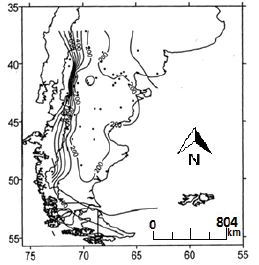
Figure 1
Precipitation rates in the Argentinian Patagonia.
Paruelo, Beltrán, Jobbágy, Sala, & Golluscio, 1998.Three-quarters of the Argentinian territory, where 26% of the population lives, has arid climateand semiarid region. According to the Ministry of Natural Resources and Human Environment, in Argentina, over 60 millions of hectares are suffering different types of erosion and every year 650,000 hectares are affected by some degree of degradation.
Oliva (2006) the Patagonian steppes have received ovine animals since late nineteenth century and have reached its heyday in the 1950s, with approximately 20 million animals, having been one of the contributing activities for the desertification process. From the endof 1970 there was some decay due to loss of lives tock directly associated with degradation, and also to thedecline in prices of wool and the increase in cost and production.
Methodology
Organizations of the United Nations for food and agriculture declared 2015 as the International Year of Soils, due to the increase in the degradation of them around the world. Based on this topic it was noted that this problem occurs inall continents and at all latitudes, thus considered the Argentinian Patagonia as a point of investigation with large bibliographic references available provided by the National Observatory of Land Degradation and Desertification, developed by the Argentinian government to reverse and mitigate the process in the Argentinian territory.
Works and maps developed were analyzed by the Centre which scales the process in that region of the planet and evidenced visiting the region in 2013 noting the causative processes of desertification there.
It established a historical analysis of employment for the region and confronting with the available literature, of which we analyze the causes of the imbalance and the duration of the process in theregion.
A visit to the f ield was carried out to completethe procedures, collecting data and observations that contributed to outline a process of analysis of the proposal, since its inception, the negative effects that it causes in society, from local to national level, and consequently possible proposals for mitigation by the responsible authorities and in particular those addressing the Argentinian Patagonia in particular.
Discussion
According to Matallo Junior (2009) the term desertification was first mentioned by the French researcher Louis Lavauden in 1927.
It has been popularized by Andre Aubreville inthe 40s, after a decade of experiments related to land degradation in the Great American Plains Matallo Junior (2009).
According to Matallo Júnior (2009) there is great discussion upon the differences between desertification and desertization or formation of deserts.
Deserts are the result of climate changes and desertification is the result of inadequate management of natural resources in arid zones (Matallo Júnior, 2009).
At the United Nations Conference on Desertification in 1977, in Nairobi, Kenya, it has defined this process as the reduction or destruction of the biological potential of the land, which in one ultimately results in desert conditions (Rodrigues, 1992).
Desertification is one aspect of the general deterioration of ecosystems under the combined pressures of an adverse climate and áreas overexploitation (Rodrigues, 1992).
In the United Nations Convention to combat desertification held in the Rio de Janeiro in 1992, this process was defined as, “[…] land degradation from arid, semiarid and sub-humid areas resulting from several factors, such as climate variation andthe human activities […]” (ONU, 1992, p. 149).
In Patagonia desertification appears like the main ecological and productive problem. That is why asfrom 1990 the National Institute for Agricultural Technology, in conjunction with public anddeprived and national provincial, have started to address this question comprehensively by means of the Prevention and Control Project, the project did not get the expected response by the complexity that the problem presents itself.
The researches for the identification, mitigation and reversion of this process were developed through research and monitoring as of 1990 by means of remote sensing and aerial imaging frames of land degradation in the Argentinian territory, being shown in (Table 1). Follow-up was retroactive, being implemented only in the 1990s, but the problem still dates back to the beginning of the century, when researchers pointed to environmental problems resulting from the misuse of the soil. The monitoring goes back tothe 1950s, to the present day, showing the evolution of the affected area (Ministry of Environment and Sustainable Development).
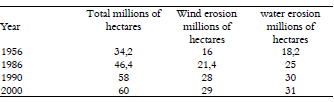
Expresses the relation of the increase in desertification area over the years and corresponding percentage of the types of degradation.
Institute of Soil and Agrotechnics [INTA] (1957);. Foundation for Education, Science and Culture [FECIC] (1988); Institute of Soil and Agrotechnics [INTA] (1990); INTA-CIRN personal communication (2000).In 2011 the National Observatory of degradation of lands and desertification was created, an Argentine government initiative with the German government to create a current, interactive and participative platform, aiming to minimize, reverseand mitigate the effects of long exploration of few decades without cares with the environment in Argentinian Patagonia.
Discussion and research policies have been drawn in conjunction with academic and scientific institutions with the purpose of planning policies reversal from this process of environmental degradation in Patagonia.
In order to understand the problem of the extension in question maps were drawn up presents itself with different categories of degradation (Figure 2).
Degradation of the soil is the sum of processes that can cause total or partial loss of productivity and yield thereof. Depending on the nature of process, differ three types of degradation. (Pla Sentís, 1990).
Still according to Pla Sentís (1990) three types ofdegradation may occur.
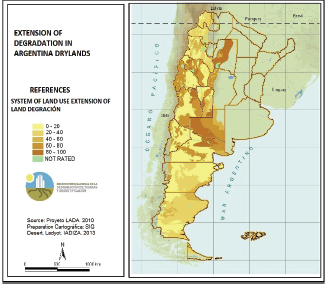
Figure 2
Shows the extent of degradation of dry land inArgentina.
Observatorio Nacional de la Degradación de Tierras y Desertificación (2013)
-
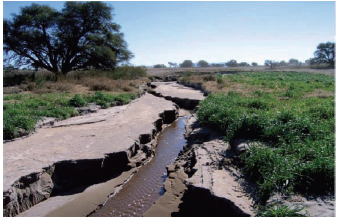
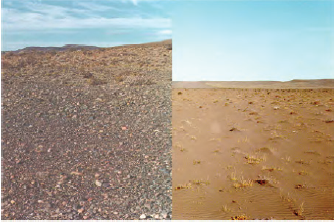
Physical degradation: Because of its importance in the country, it includes water erosion (Figure 3) and wind power (Figure 4), and the deterioration of the soil structure, with phenomena such as the sealing, forming crusts and pans by virtue of the heavy machinery
-
Chemical degradation: loss of fertility or nutrients included acidification and alkalization, salinization and pollution from indiscriminate use of herbicides, pesticides and fertilizers (Pla Sentís, 1990).
-
Biological degradation: Biological degradation is considered as the loss of organic matter and change of the soil flora and fauna (microflora, worms, etc.) (Pla Sentís, 1990).
Jong (2007) claims that the process of desertification is directly related to the degradationand social conflict. Proposed by Jong (2007) it is impossible to solve the economic conflict and social implications abstractly, only with survey of more or less general pictures on the functioning of the economy, without specifying a particular situation. So in this case, the reference is given to the livestock activity Patagonia, and as referred this work is the distinction of a process in which their essential characteristics that affect the planet earth.
Among the five monopolies that drive the globalization of polarization mechanisms of its current stage, four of them are directly related to the phenomenon of desertification:
-
Technological Monopoly (heavy Agriculture machinery detention);
-
Controlling of global financial markets (producers and exporters states);
-
Monopoly of access to the planet's natural resources (water access fertile regions);
-
The monopolies in mass media (retention of information to the influencers).
Proposed by Abraham et al. (2013)
[…] desertification and land degradation is the product of complex interactions of natural factors (climate, soil, vegetation, etc.) and human factors (social, economic, cultural, etc.). In order to understand those interactions and validate the best practices and/or to evaluate the real impact of specific policies of observation, a greater detailing scale is necessary. In order to address it, from the LADA, a small number of pilot sites, in which acomprehensive evaluation covering both biophysical and socio-economic factors started, have been identified. In these places the methodology of the‘five capitals’ (human, social, physical, financial and natural) was adopted […] (Abraham et al., 2013, p. 5 ).
According to the background document drawn up by (Observatorio Nacional de la Degradación de Tierras y Desertificación, 2012), there have been alot of efforts - global, regional and at the national level - to know the extent, trend and the cost of soil degradation. Including the Land Degradation evaluation the Arid Zones project (LADA, for its acronym in English) proposed a framework for evaluating land degradation at different scales so thatit may provide a baseline and assist reports andbetter priority investment (targets).
Proposed by National Observatory of land degradation and desertification of (2012) through background document, the LADA contributions tocombat the soil degradation are:
-
Assess the extent, type, rate and the impact of land degradation in the world (GLADA) supplemented with national studies on six pilot countries;
-
Provide a methodological framework for establishing a baseline for monitoring the success ofthe actions taking to tackle soil degradation;
-
Increased national capacity in monitoring and evaluation of soil degradation;
-
Compilation and exchange of useful information for planning to combat land degradation interventions.
Those adoptions could be effective, given the degree of interaction they would have with the different sectors of society and to adopt an interactive and participative stance, choosing specific spots, or sites as the naming of the project, to real time monitoring.
Another differential is the research and the insertion of different scales of research and approach, so that the methodology is readapted and to get a satisfactory answer.
In (Figure 5), the various categories of degradation for the whole territory of dry lands in Argentina, from not degraded to the extreme degradation of scale are expressed considering Patagonia (black circle) a territory almost entirely inserted into arid and semi-arid and with the problem of strong desertification process in approximately half of the territory.
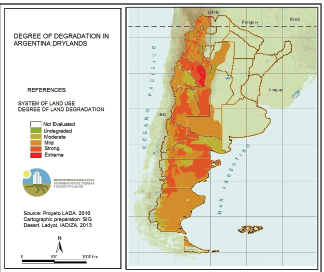
Figure 5
Degree of dry land degradation in Argentina.
Observatorio Nacional de la Degradación de Tierras y Desertificación (2013)In order to address the desertification process, adiagnosis identifying the responsible factors for the environment change was created from the goals setin 2012 by the Centre. This diagnosis identified some indicators such as, causes indentified in shorttime and different scale approaches; observed and detected negative consequences and posible answers pointed by the participation of the scientific community, government and population that is directly affected by the processes, in order to stopthe impacts, as specified beforehand.
Causes of desertification
According to Adeel, Safriel, Niemeijer, & White. (2005), desertification is caused by a combination of factors that change over time and vary by location.These include indirect factors such as population pressure, socioeconomic and policy factors, and international trade as well as direct factors such asland use patterns and practices and climate related processes.
Adeel et al. (2005) describes three main causes of desertification: Desertification is taking place due to indirect factors driving unsustainable use of scarcenatural resources by local land users. This situation may be further exacerbated by global climate change.
Social, Economic, and Policy Factors: Policies leading to unsustainable resource use and lack of supportive infrastructure are major contributors to land degradation; Globalization Phenomena, Many ongoing processes of globalization may amplify or attenuate the driving forces of desertification by removing regional barriers, weakening local connections, and increasing the interdependence among people and between nations; change of patterns, Land use practices are responses for changes in the provision of ecosystem services, and they may also cause changes in this provision. (Adeel et al., 2005).
Although the weather, soil, landscape forms, and vegetation cover interact to determine erosion rates and the vegetation cover that in its final analysis provides different levels of soil protection. Thus, environmental and agricultural policies that cause major changes in land use and vegetation may be responsible for increased rates of erosion (Morganand Kickson, 1998 apud Guerra and Mendonça, 2011):
-
Natural Factors (climate situation of aridity and semiarid; Shrubby and grass vegetation cover, low density, predominantly strong winds over the year; water and wind erosion vulnerability);
-
Anthropogenic Factors (sheep farming by extensive method; Deforestation; Agricultural irrigation);
-
Naturally vulnerable areas (natural areas which support high biodiversity and fragile balance; spaces with occurrence of endemic species, agricultural frontier areas).
Possible causes of the observed process
A table indicating the causes identified in the environment was elaborated through this analysis. (Fundación Patagonia Tercer Milenio, 2004)
-
Lack of public policies and land use planning; Lack of awareness at the political and management level; Land ownership problems; Decrease in local development.
-
Unsustainable management practice; Excessive livestock farming; Deforestation.
-
Degradation and overuse of natural resources; Scarcity and contamination of surface wáter resources by the use of water; recurrent droughts and high evapotranspiration rates.
Negative consequences
With all information gathering; monitoring on the field and development of researches, thenegative aspects arising from the inadequate land use over time was noted:
-
Superficial degradation of Water resources and contamination of groundwater; Climate and microclimate change; Increase of albedo; air and soil dryness; increased periods and intensity of the observed droughts. (Food and Agriculture Organization of the United Nations [FAO], 2015);
-
Soil degradation, lowest vegetation cover and consequent impoverishment of nutrients; Salinization of soils; Gullies formation processes and possible grooves; Compaction and loss of infiltration capacity, increased superficial drainage; Shorteningof the useful life of artificial reservoirs by thetransport of sediments; Increase of flooding; Increased desert area;
-
Reduction of sustainable development; Productivity of soil loss; Degradation of wetlands; Pressure on further farmland; Release of carbon; Lower capacity to absorb of the atmosphere aerosols. (FAO, 2015);
-
Social economic problems have an impact onterritorial imbalance as rural exodus; urbanswellings; marginality; decreased productivity; migration between provinces, these in turn have an impact in the form of loss of livestock and production structure; land withdrawal and poverty, diseases and mortality. (Observatorio Nacional de la Degradación de Tierras y Desertificación, 2012);
-
Loss of biological diversity; Microorganisms and native fauna loss of habitat (FAO, 2015);
-
Destruction and cultural heritage loss (Archaeological and Paleontological Sites) (FAO, 2015);
-
Removal of native populations as Tehuelches and Mapuches for occupied area, causing ethnical conflicts (Observatorio Nacional de la Degradaciónde Tierras y Desertificación, 2012).
Final consideration
In conclusion it can be inferred that the desertification process has increased over the years by the activities implemented in a historical and social context different from the present. Among the lessons learned the appreciation of the efforts made in projects and programs between agencies of Argentina stands out, and through the group and interactive participation, effects which prove the interaction and the viability of multidisciplinary projects emerge. An observatory is the appropriate instrument to ensure the temporary continuation of such initiatives, where management is based on the research, combining the role of scientific / technical sector with the political one in the context of National Action Program to Combat Desertification.
The process of desertification is quite difficult tobe controlled and requires a high investment for recovering sterile or degraded areas. To minimize the process some mitigation actions and reordering policies of these areas critically affected were outlined, in order to decrease:
-
Creation of reversal projects through scientific research and scientific monitoring;
-
Control of ovine animals farming and replacement of herds by species of lower impact of degradation. Studies show, animal husbandry expansion is declining because of pressure fromnon-governmental organizations (NGOs) and evenby government initiatives, but over the decades ithas prioritized the creation of ovine that took placeof native species like the Guanaco (Lama guanicoe), (Baldi, 2015). The resistance occurred because the creators prefer these species specifically in this environment because the shortage of water makesfinest wool and consequently greater appreciation ofit;
-
Creation of Green Belts, as a barrier to the wind and sediments;
-
Differentiated economic activity as conscioustourism. The process together with society; government and academia has an effect when the exclusive interests are put aside and although therehas been lots of time without major interferences and the rollback processes of degradation and desertification do not get immediate response, the initial positive steps can be observed when society gets aware through the dissemination of information that the soil is responsible for countless benefits from the local level to the planet.
Acknowledgements
The authors thank CNPq for granting the researcher, which in turn allowed the research.
References
Abraham, E., Pietragalla, V., Corso, M. L., Cueva, J., Maccagno, P., Therburg, A.,... M. Román. (2013). Institucionalización del monitoreo de la desertificación en la Argentina: diseño e implementación del Observatorio Nacional de Degradación de Tierras y Desertificación. Anais 2nd Scientific Conference United Nations Convention to Combat Desertification (p. 133). Bonn, DE.
Adeel, Z., Safriel, U., Niemeijer, D. & White, R. (2005). Millennium ecosystem assessment, ecosystems and humanwell-being: desertification synthesis. Washington, DC: World Resources Institute.
Baldi, B., Lichtenstein G., González, B., Funes, M., Cuéllar, E., Villalba, L., Hoces, D.,… Puig, S. (2015). Lama Guanicoe. In The iucn red list of threatened species 2008: e.t11186a3260654. Retrieved from http://dx.doi.org/10.2305/IUCN.UK.2008.RLTS.T11186A3260654.en
Jong, G. M. (2007). Desertificacion en la Patagonia: análisis para la acción. Revista Gecon, 6(1-6), 1-15.
Food and Agriculture Organization of the United Nations [FAO]. (2015). International Year of Soil. Discover soil.Retrieved http://www.fao.org/soils-2015/en/
Foundation for Education, Science and Technology [FECIC]. (1988). Retrieved from http://fecic.org.ar/index.php
Fundación Patagonia Tercer Milenio, (2004). Comarcacentral: Síntesis ejecutiva, Chubut. Argentina, AR. Retrieved from http://www.patagonia3mil.com.ar/wpcontent/uploads/documentos2/noroeste.pdf
Guerra, A. T. J., & Mendonça, J. K. S. (2011). Erosão dos Solos e a Questão Ambiental. In A. C. Vitte, & A. J. T.Guerra (Org.), Reflexões sobre a Geografia Física no Brasil (225-251). Rio de Janeiro, RJ: Bertrand Brasil.
Institute of Soil and Agrotechnics [INTA]. (1957). Retrieved from http://inta.gob.ar/suelos
Institute of Soil and Agrotechnics [INTA]. (1990). Retrieved from http://http://inta.gob.ar/documentos/environmental-improvements-without-environmental-policiesargentine-agriculture-and-manufacturing-exports-in-the-1990s
Institute of Soil and Agrotechnics [INTA/CIRN]. (2000).Pessoal Communication. Retrieved from http://estadisticas.ambiente.gob.ar/archivos/web/Indicadores/file/multisitio/pdf/19_%20%20Porcentaje%20de%20hect%C3%A1reas%20erosionadas.pdf
Lorusso, S. G. (2012). Programa de Acción Nacional de Luchacontra la Desertificación-PAN (Documento de Base).Buenos Aires: National Observatory of landdegradation and desertification. Retrieved from http://www.desertificacion.gob.ar/proyectos-endesarrollo/
Matallo Junior, H. (2009). Glossary of Terms and Conceptsused in the context of the UNCCD. Brasília: MMA.
Michelena, R. O. (2011). Land degradation in Argentina prevention and control. In Anais from 65th National Academy of Agronomy and Veterinary (344-357). Argentina, AR.
Ministry of Environment and Sustainable Development. (2016). Eroded soil surface erosion by type. Retrieved from http://www.ambiente.gov.ar/?idarticulo=5509
Observatorio Nacional de la Degradación de Tierras y Desertificación. (2012). Metodología general y específica para la implementación del Sistema Nacional de Monitoreo y Evaluación de la Degradación de Tierras, Desertificación y de Manejo Sustentable National. Retrieved http://www.desertificacion.gob.ar/wp-ontent/uploads/2013/07/Sist-Nac-Monitoreo.pdf
Observatorio Nacional de la Degradación de Tierras y Desertificación. (2013). Degree of dry land degradation in Argentina. Retrieved http://www.desertificacion.gob.ar/nivelespacial/regional-provincial
Oliva, G. (2006). Perspectivas de control de la desertificaciónen la Patagonia, después de 15 años de esfuerzos. In La desertificación y el futuro de los pastizales patagônicos (1-10).Argentina, AR: Santa Cruz. Retrieved http://www2.inia.cl/medios/biblioteca/serieactas/NR33806.pdf
Organização das Nações Unidas [ONU]. (1992).Conferência das Nações Unidas sobre Meio Ambiente e Desenvolvimento (Agenda 21, Série açãoparlamentar n. 56). Rio de Janeiro, RJ.
Paruelo, J. M., Beltrán, A., Jobbágy, E., Sala, O. E., & Golluscio, R. A. (1998). The climate of Patagonia: general patters and controls on biotic processes. Ecologia Austral, 8 (2), p. 85-101.
Pla Sentis, I. (1990). Methodological problems to evaluatesoil physical degradation. In Transactions of the 14th International Congress of Soil Science, Kyoto, Japan, August 1990. (pp. 96-100).
Rodrigues, V. (1992). Avaliação do quadro da Desertificação no nordeste do Brasil: Diagnósticos perspectivas. Fortaleza, ICID.
Sitio Argentino de Producción Animal. (1998).Desertification of Chubut. Retrieved http://www.produccion-animal.com.ar/produccion_y_manejo_pasturas/pasturas%20naturales/95-desertificacion_chubut.pdf
Soares, D. B., Mota Filho, F. O., & Nóbrega, R. S. (2011).Sobre o Processo de Desertificação. Revista Brasileira de Geografia Física, 1(1), 174-188.
Author notes
Programa de Pós-graduação em Ciências da Engenharia Ambiental, Escola de Engenharia de São Carlos, Cx. Postal 292, 13560-970, São Carlos, São Paulo, Brazil. elissandrovoigt@usp.br