Deixis and multiple blends: the role of recursion in meaning construction
Dêixis e mesclagem múltipla: o papel da recursividade na construção do significado
Deixis and multiple blends: the role of recursion in meaning construction
Acta Scientiarum. Language and Culture, vol. 38, no. 2, pp. 153-159, 2016
Universidade Estadual de Maringá
Received: 07 October 2015
Accepted: 03 December 2015
Abstract: Current paper draws on Mental Spaces Theory to analyze first and second person singular pronouns (1PS and 2PS, respectively) in British English and Brazilian Portuguese. The analysis is based on attested data obtained from electronic corpora (the British National Corpus for British English and the Portuguese Corpus for Brazilian Portuguese). The main claim is that 1PS and 2PS pronouns are cognitively complex and prompt for elaborate meaning construction. First, it is argued that 1PS and 2PS pronouns conventional meanings (i.e., reference to the speaker and hearer) is emergent from simplex conceptual integration networks. Secondly, evidence is brought to the fact that these pronouns also show non-conventional meanings which may rise recursively through multiple blending.
Keywords: personal pronouns, blending, multiple blends.
Resumo: Este artigo adota o referencial da Teoria dos Espaços Mentais (Fauconnier 1994, 1997; Fauconnier & Turner 2002) para analisar pronomes de primeira e segunda pessoa do singular (1PS e 2PS, respectivamente) do Inglês Britânico e do Português Brasileiro. A análise baseia-se em dados atestados, obtidos a partir de corpora eletrônicos (British National Corpus, para o Inglês Britânico e o Corpus do Português, para o Português Brasileiro). O principal argumento do trabalho é o de que pronomes de 1PS e 2PS são cognitivamente complexos, envolvendo processos elaborados de construção do significado. Em primeiro lugar, argumenta-se que o significado convencional dos pronomes (isto é, referência a falante e ouvinte) ativa redes de integração conceptual de tipo simplex. Em seguida, apresentam-se evidências de que os pronomes também apresentam significados não convencionais, que podem surgir recursivamente por meio de mesclagem múltipla.
Palavras-chave: pronome pessoal, mesclagem conceptual, mesclagem múltipla.
Introduction
In the mental-spaces framework, the mind creates multiple cognitive spaces and engages in creative on-line meaning construction as discourse unfolds. According to Fauconnier (1994, 1997), linguistic expressions not only build new mental spaces, but also establish elements and relations within spaces. In the development of the theory, the notion of conceptual blending (or conceptual integration) has progressively gained prominence. It refers to a basic mental operation that constructs a partial match between two input spaces to project selectively from those inputs into a novel blended space, which dynamically develops emergent structure of its own. Conceptual integration leads to global insight in as much as it provides conceptual compressions by which diffuse ranges of meaning can be manipulated.
Following this line of investigation, the present study discusses the meaning of first and second person singular personal pronouns from a mental spaces perspective, with special emphasis on the notions of blending and multiple blends (Fauconnier, 1994, 1997; Fauconnier & Turner, 2002; Turner, 2014). The analysis is based on attested data from two unrelated languages, English and Portuguese. More specifically, the data was drawn from the following sources: the British National Corpus (http://www.natcorp.ox.ac.uk/, retrivied on July 15, 2015) and the Portuguese Corpus (http://www.corpusdoportugues.org/x.asp, retrivied on July 15, 2015), which contain written and spoken British English (Davies, 2004) and Brazilian Portuguese (Davies & Ferreira, 2006), respectively.
The aim of the paper is twofold. Firstly, it is argued that first and second person pronouns conventional meanings typically involve the kind of conceptual integration that Fauconnier and Turner (2002) have called ‘simplex network’. Secondly, it is claimed that first and second person pronouns may also have non-conventional meanings, which trigger successive blending in which blends at one level can be inputs at another (‘multiple blends’). In this case, the blended space from one conventional network may function as input to another blending network. As we shall see, non-conventional first person pronouns can be used to explicitly code the speaker, but implicitly code the addressee(s), and/or non-participants in the speech event. By the same token, non-conventional second person pronouns may explicitly code the hearer, but implicitly refer to people in general, including the actual person who uttered the sentence.
First and second person deictic pronouns
Deixis has been traditionally defined as the most obvious way in which the relationship between language and context is reflected in the structure of languages (Lyons, 1977; Levinson, 1983, 2004; Yule, 1996). In fact, deictic phenomena are expressed by any grammatical features tied directly to the circumstances of the utterance, which include speaker, hearer(s), location and time of the speech event.
Particularly in relation to person deixis, traditional accounts usually focus on conventional uses of personal pronouns. Thus, it is normally recognized that first and second person singular pronouns conventional meanings refer to the speaker and to the hearer(s), as in (1) and (2) respectively:
(1) ‘I’ live in Rio.
(2) ‘You’ are late.
It has been rarely recognized in traditional accounts, though, that personal pronouns may have non-conventional meanings which are productive in ordinary language use. More recently, however, Cognitive Linguistics has provided new tools that can contribute to the description and explanation of non-conventional pronominal meanings. For example, a thoughtful teacher might give the following advice to her students:
(3) If ‘I’ want my grades to improve, ‘I’ have to work hard.
Clearly, both occurrences of the pronoun ‘I’ in (3) do not refer to the actual speaker, but to her students (i.e., the hearers in the speech event). Similarly, someone who enters a crowded store may utter the following complaint to someone next to her:
(4) ‘You’ must have patience to shop here.
Again, the use of ‘you’ in (4) does not only indicate the hearer, but also refers to the speaker herself and to any other customer.
Examples such as (3) and (4), which are largely attested in real language use, indicate that first and second person pronouns also display non-conventional meanings which require explanation.
It has been pointed out in the literature that personal pronouns conventional meanings (e.g. the use of I to indicate the speaker, and the use of you to indicate the hearer(s)) are prototypically structured by the deictic Idealized Cognitive Model, whereas less conventional pronominal meanings would fit this ICM less well (Lakoff, 1987; Marmaridou, 2000). It has also been claimed that first person pronouns in computer roleplaying games show non-conventional meanings; the pronoun ‘I’ can be understood to blend characters and people who access the computer interface (Tea & Lee, 2004).
These contributions shed important light on the meaning of personal pronouns. But going a step further, this paper suggests to generalize the analysis by assuming that blending is involved in both conventional and non-conventional pronominal meanings. A brief review of the literature is provided, with special emphasis on blending operations that are relevant to the approach advocated here.
Blending, recursion and grammar
Conceptual blending has been proposed as a fundamental cognitive mechanism, responsible for human ability to create new ideas. It can be illustrated by Fauconnier’s now classic example (Fauconnier, 1997, p. 18), the “[…] computer virus […]”, which blends hacker's nefarious computer programs and biological viruses. The cross-space mapping for this blend is based on shared properties (e.g., the element is present, but unwanted; the element is able to replicate; and so on).
The idea that conceptual integration may involve recursion has been claimed to be one crucial corollary of the overarching goal of blending to achieve human scale. As Fauconnier and Turner have pointed out, this kind of recursion happens routinely in the development of science:
If we start with a wave such as we see at the seashore, and then consider sound, and recognize that sound, though a different phenomenon, still has longitudinal motion in a medium, we can make a new blended category wave that now includes various kinds of ‘longitudinal’ waves. That new category wave can be an input to a new blending network, whose other input has electromagnetic phenomena. The blended space in the new network now has a category wave that includes ‘electromagnetic’ waves (Fauconnier & Turner, 2002, p. 335, grifos do autor).
As the example illustrates, recursion allows the compression of many different phenomena into an intelligible scenario at human scale.
Fauconnier and Turner (2002) also distinguished four main types of integration networks: simplex, mirror, single-scope and double-scope. In the simplex network, one input consists of a frame (e.g. schematic organization of knowledge such as ‘human kinship’, including the roles of father, mother, son, etc.) and the other input consists of specific elements (e.g Paul, Sally, etc). The blend integrates the frame and the values. For example, the sentence ‘Paul is the father of Sally’ prompts for the construction of this blend, as illustrated in Figure 1 below:
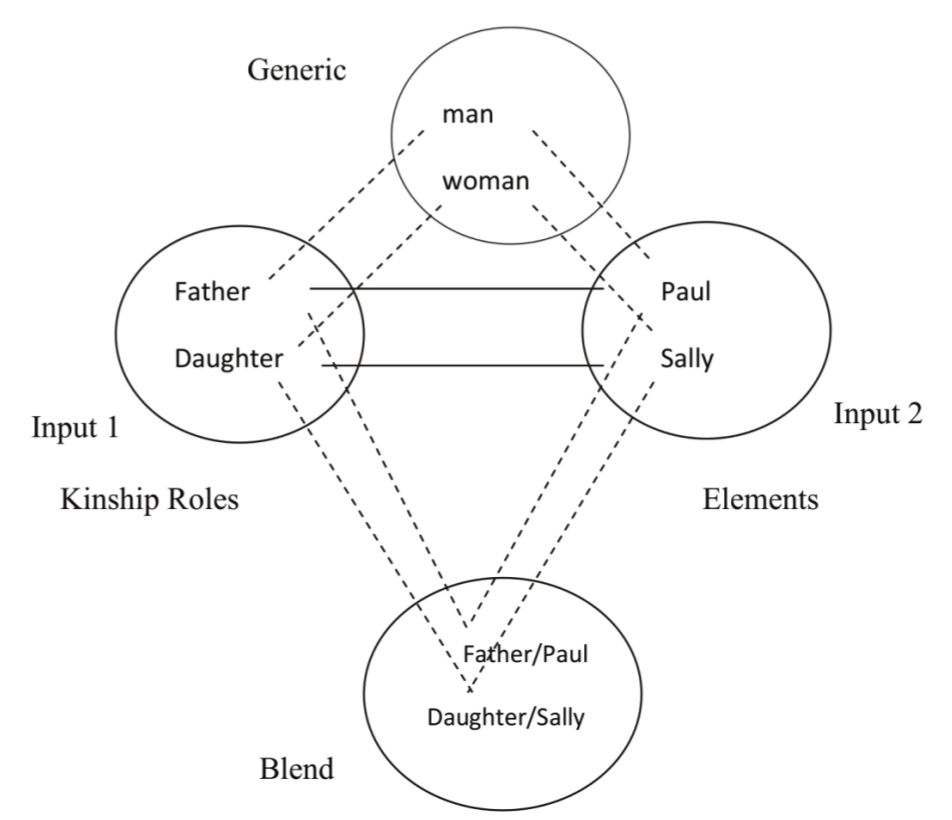
Figure 1
Simplex network (‘Paul is the father of Sally’)
In mirror networks, a common organizing frame is shared by all spaces in the network (cf. the Buddhist Monk example in Fauconnier & Turner, 2002). In Single-Scope networks, the organizing frames of the inputs are different; however, the blend inherits only one of those frames. For example, in the Conduit Metaphor (Reddy, 1979), ‘physical transfer of objects’ is the organizing frame for the conceptual integration network of ‘verbal communication’, as illustrated by sentences like ‘He gave me an idea’. In Double-Scope networks, essential frame properties are brought in from two inputs which differ fundamentally in content and topology; these sharp differences offer the possibility of rich clashes in the blended space (cf. the Computer Desktop example in Fauconnier & Turner, 2002).
These four main types of integration networks involve at least four spaces (two inputs, a generic space, and a blended space). However, conceptual integration is a dynamic operation that can apply repeatedly, having outputs that become inputs for further blending. Fauconnier and Turner (2002) indicate two main ways in which networks can be multiple blends (or megablends): either several inputs are projected in parallel[1] or they are projected successively into intermediate blends which themselves serve as inputs for further blends. This latter case is particularly relevant to the aims of this paper, and can be exemplified by the sentence ‘Paul is the father of the boss of Sally’, represented in Figure 2:
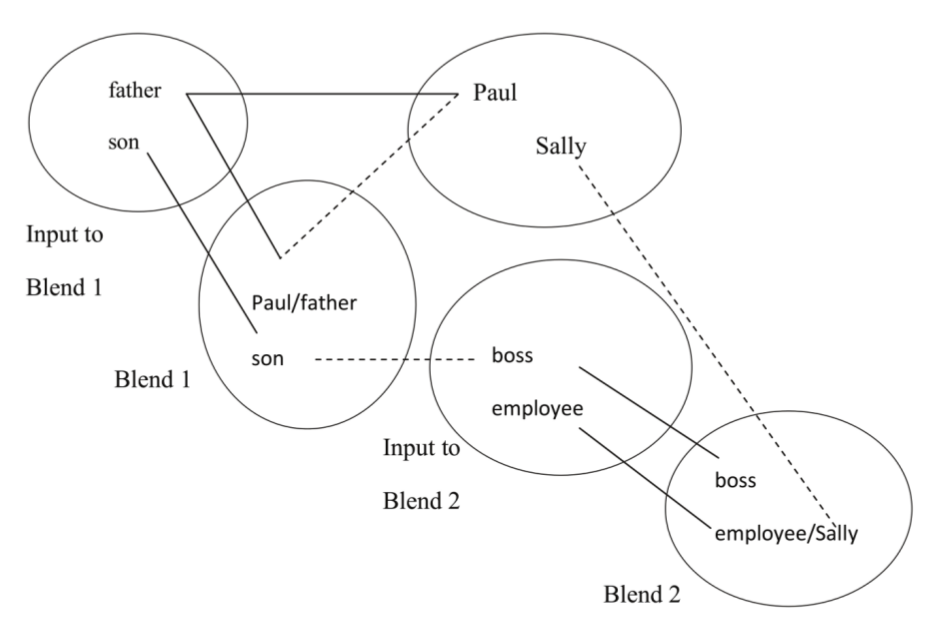
Figure 2
The megablend ‘Paul is the father of the boss of Sally’
Figure 2 shows composed integration networks prompted by composed syntactic clues (‘the father of the boss of’). According to Fauconnier and Turner (2002), roles such as ‘father’, ‘son’, ‘boss’ and ‘employee’ are open-ended connectors, which by default attach to elements (e.g. Paul, Sally). But it is possible to compose expressions by letting the open-ended connectors attach to other roles (e.g. ‘son’ attached to ‘boss’).
Grammatical categories
Grammatical categories are also human-scale elements, grounded in human-scale conceptual structures (e.g. objects, events, processes, etc.). As Fauconnier and Turner have noted, it is striking that, among thousands of languages studied by linguists, a very small number of basic grammatical categories have been attested:
This formally surprising observation is explained by the principles, power, and goals of blending. In particular, it is explained by these three things: (1) Grammatical categories are human-scale elements; (2) Novel grammatical constructions are created through blending from existing grammatical constructions; (3) The Human-Scale/Recursion Principle places value on having human-scale blended spaces (Fauconnier & Turner, 2002, p. 385).
Although it is easier to recognize that morphological combinations in a single word (e.g. Chunnel) may prompt for a specific blending scheme (Fauconnier and Turner, 2002), examples such as the ‘computer virus’ show that it is possible to use existing grammar (Noun-Noun compound) and existing vocabulary (‘computer’ and ‘virus’) to prompt for a new blend. The new blend, in its turn, becomes a candidate for any blending template that takes ‘Noun’ as an input (e.g. ‘computer virus’ → ‘first-generation computer virus’). This process of ‘recursion’ preserves category from input to blend and creates the possibility for multiple successive blends.
Regarding personal pronouns, recent work has pointed out that conventional meanings of first and second person pronouns build up blended spaces. Langacker (2007) has indicated that the full semantic characterization of first and second person pronouns involves, at least, two cognitive domains related to the ‘speech event scenario’ in which interlocutors alternate in the roles of speaker and hearer. Given that the current speaker (S) is also a potential hearer (H’), and the current hearer (H) is also a potential speaker (S’), the speech event scenario can be represented by a blended space in which the interlocutors have a dual role (S/H’ and H/S’).
As for non-conventional pronominal meanings, it has also been suggested that personal pronouns prompt for blends which are partly structured by the deictic ICM and partly structured by other ICMs which are set up locally (Anunciação & Ferrari, 2009; Andrade & Ferrari, 2013; Ferrari, 2014; Fontes & Ferrari, 2015).
Generalizing from these studies, it will be further suggested here that both conventional and non-conventional meanings of first and second person pronouns can be explained through distinct but related types of blending networks.
Conventional meanings and simplex conceptual integration
In this section it is suggested that the conventional meanings of first and second person personal pronouns integrate roles and values in the simplest way. Meaning construction corresponds to what Fauconnier and Turner (2002, p. 120) have labeled “[…] simplex integration networks […]”, as illustrated in Figure 3:
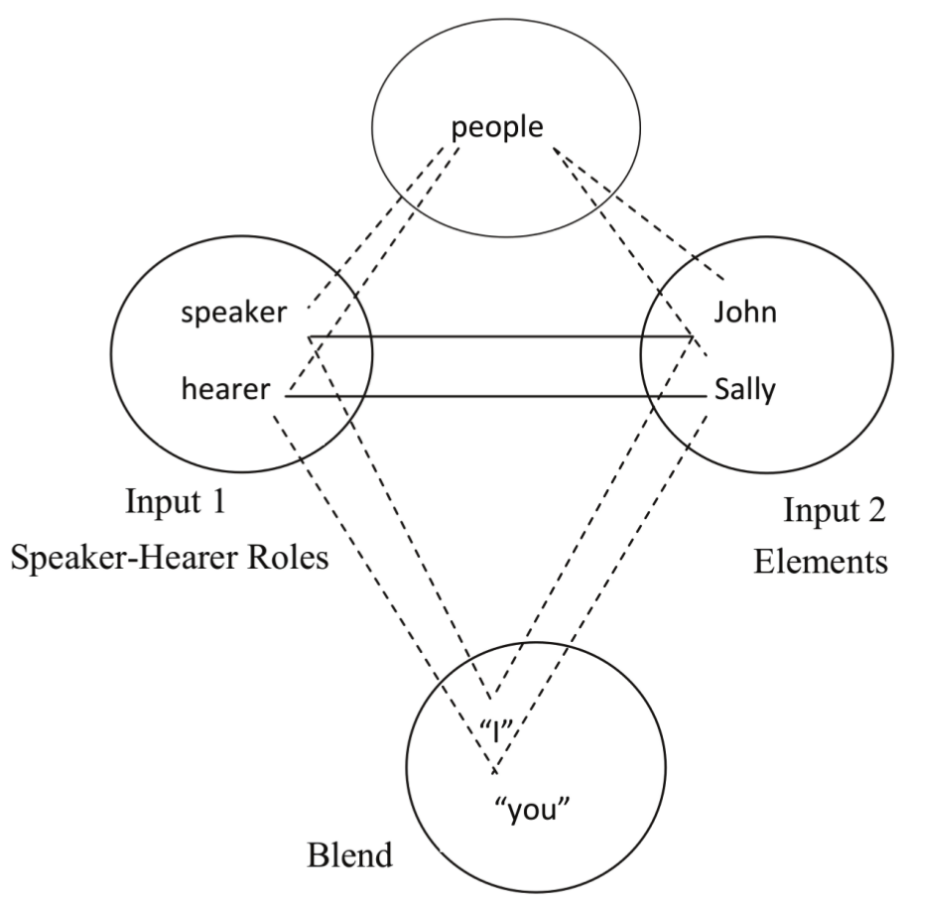
Figure 3
Conventional meanings of 1st person and 2nd person singular pronouns
In the simplex network blending represented in Figure 3, ‘human communicative interaction’ provides an effective frame, which includes the roles of speaker and hearer (Input 1). When John conceives himself as the speaker, he has created a blend by which one of the roles in the communicative interaction frame is integrated with the element John in the actual speech event space (e.g. I’m John). By the same token, when Sally is conceived as the hearer, the hearer’s role is integrated with the individual Sally in the speech situation (e.g. You’re Sally). The cross-space mapping between the input spaces is a role-to-value connection.
Non-conventional meanings and multiple blends
As mentioned before, it is assumed that non-conventional meanings also involve blending. But, in this case, blending occurs recursively. What happens is that the blended space associated to conventional uses may function as an input space for a new blend, and create more complex integration networks (‘multiple blends’).
Non-conventional first person singular pronouns
As for first person pronouns, let’s first consider one British English example that is part of a book on reason and spontaneity in which the philosopher, A. C. Graham (1985), discusses the relation between means and ends:
(5) The mere fact that ‘I’ have set myself the end X, with Y as a necessary means to it, (…), does not guarantee ‘me’ from being mistaken in doing Y (Anyone who supposed that it did would indeed be guilty of the Naturalistic Fallacy without appeal.) If for example ‘I’ am pursuing X in the expectation of enjoying it, but when ‘I’ get it am disappointed, (…), then ‘I’ was mistaken in doing Y. Every choice of means, however well argued, proves groundless with the discrediting of the end, yet that ‘I’ did not have the fun I expected is itself no more than a fact.
Although the writer uses ‘I’ all through the paragraph (and ‘me’ in the oblique syntactic position), context makes it clear that he is not referring exclusively to himself; first person deictic reference is used here to indicate anyone who has set herself the end X, anyone who is pursuing X in the expectation of enjoying it, and so on. In this case, the pronoun departs from its prototypical conventional semantics, and the formation of an intermediate blend serves as input for a further one:
As shown in Figure 4, Speaker[2] is linked to Graham, and both are compressed in Blend 1. Then, the blended element ‘speaker/Graham’ is connected to ‘people’ in a new input space structured by the ‘Means and ends’ frame. In the blend space 2, ‘speaker/Graham’ and ‘people’ are fused into a ‘single person’[3].
Let’s move now to a parallel Brazilian Portuguese example in which the speaker makes a philosophical argument on the relations between thought and reality[4]:
(6) pensar a realidade - não é retratar a realidade - é exatamente tentar uma solução - não é? (...) quando ‘eu’ penso ‘eu’ penso - como o próprio Marx dizia - tentando transformar essa realidade - adequar essa realidade - a - algo que me seja - satisfatório a algo que venha solucionar os meus problemas[5].
In example (6), the meaning of the first person pronoun ‘eu’ also involves multiple blends; its diagrammatic representation is similar to the one presented for example (5) in Figure 4. The role ‘speaker’ is linked to the actual philosopher, and both are compressed in Blend 1. The blended element ‘speaker/actual philosopher’ is connected to ‘people’ in a new input space structured by the ‘Thought and reality’ frame. In the blend space 2, ‘speaker/philosopher’ and ‘people’ are compressed onto a ‘single person’, and fused.
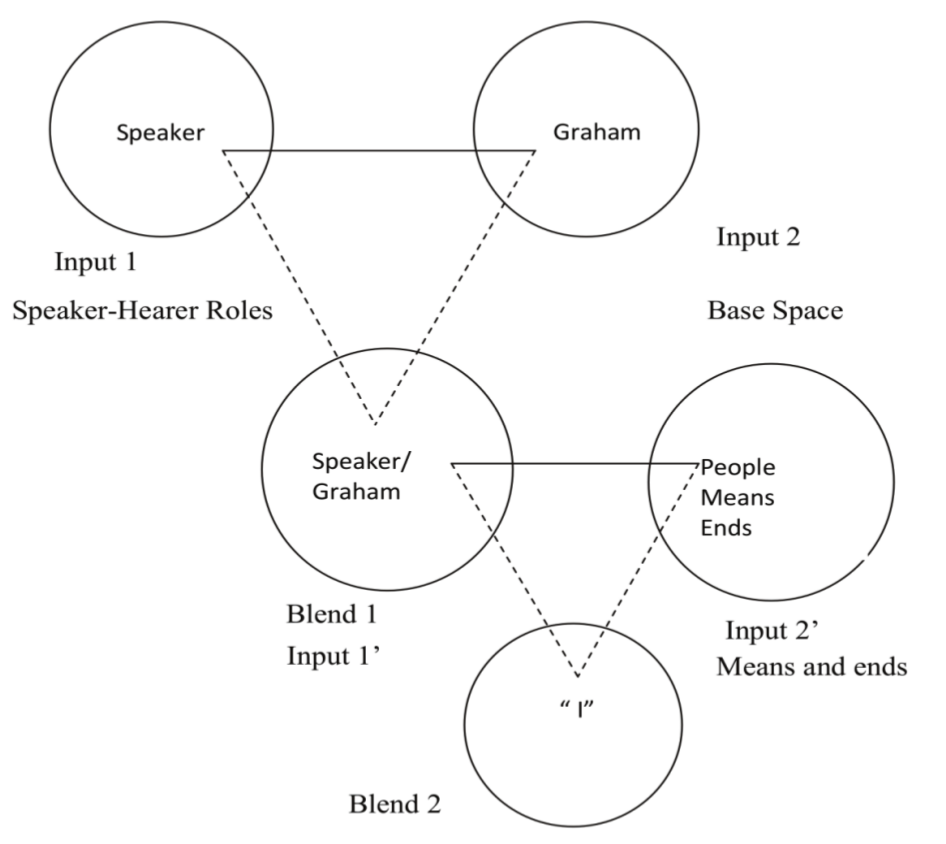
Figure 4
Multiple blends (non-conventional first person)
Non-conventional second person singular pronouns
Second person pronouns also show non-conventional uses. The next example is part of an interview in which the American actress Goldie Hawn talks about her family life:
(7) The happy couple live in a cosy house overlooking the sea in the posh Los Angeles suburb of Pacific Palisades. It's the perfect American family -- minus the marriage certificate.' Kurt and I don't need to get married,' she says.' We are married in every sense. Maybe we will go through the actual ceremony at some point.' But when ‘you’ feel perfectly happy with something why change it?
The pronoun ‘you’, italicized in (7), explicitly codes the Hearer. Yet, it also refers to anyone who feels perfectly happy with something. Meaning construction can be represented as in Figure 5:
Figure 5 shows that, initially, the Hearer is connected to the journalist who interviews Goldie Hawn; both are fused in Blend 1. Then, the blended element ‘hearer/journalist’ is connected to ‘people (who are perfectly happy with something)’ in a new input space structured by the ‘Emotional life’ frame, and both entities are mapped onto a ‘single person’ in Blend 2.
In Brazilian Portuguese, a similar tendency can be observed; second person singular pronouns also show non-conventional usages. The following example is a transcription of oral speech, in which the speaker comments on the advantages and disadvantages of modernizing postal services[6]:
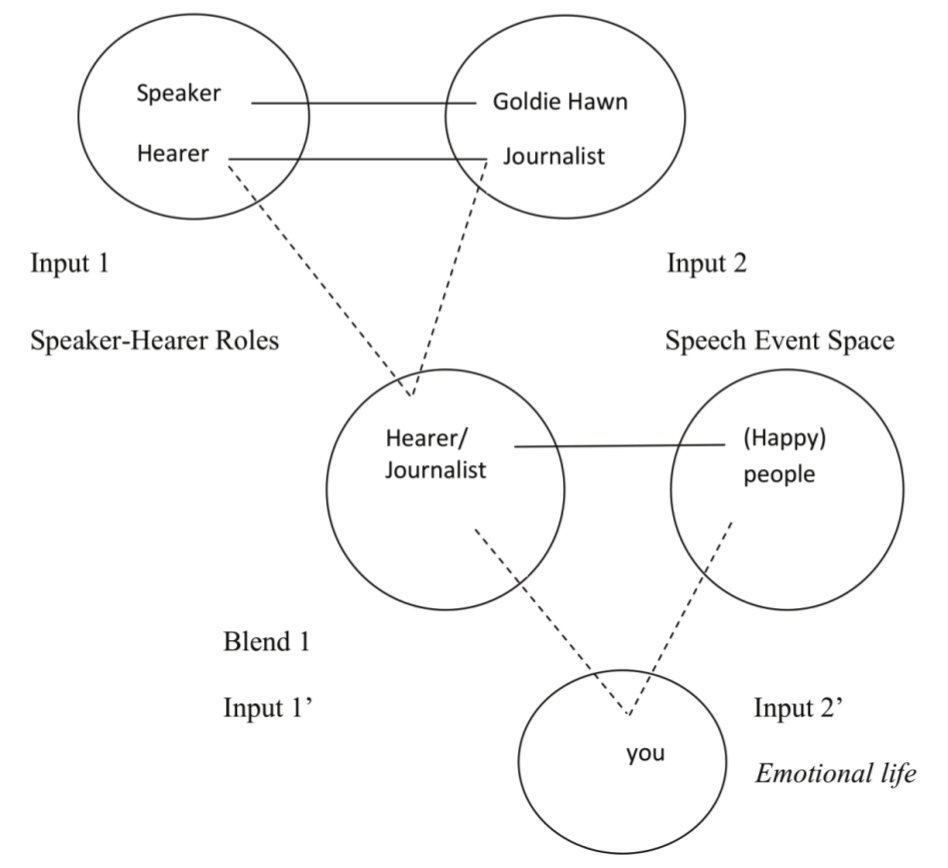
Figure 5
Multiple blends (non-conventional second person)
(8) a seleção é feita por uma máquina então se se tem envelope de tamanho diferente a máquina às vezes rejeita ou então interrompe - a coisa - é um processo mecânico que eles estão utilizando agora recentemente – hoje por exemplo ‘você’ pra colocar uma carta nos correios não precisa mais ir até a agência[7].
As it is easy to notice, the second person ‘you’ in example (8) does not refer exclusively to the hearer. In fact, the pronoun indicates anyone who might need to mail a letter. The complex mapping scheme prompted by the pronoun is similar to the one diagrammed in Figure 5. Input 2 has the actual speaker and hearer. The hearer’s role, in input 1, is connected to the actual hearer, in input 2; both are fused in Blend 1. Then, the blended element ‘hearer/actual hearer’ is connected to ‘people (who needs to mail a letter)’ in a new input space structured by the ‘Postal services’ frame, and both entities are mapped onto a ‘single person’ in Blend 2.
Conclusion
Current research has taken a mental spaces approach to the analysis of first and second person singular pronouns in British English and Brazilian Portuguese. First, it is claimed that, in both languages, these pronouns get their conventional reference via simplex conceptual integration networks which blend the roles of speaker and hearer with actual individuals who participate in specific speech eve nts. Secondly, it is argued that both pronouns can have non-conventional meanings which arise from meaning extensions via multiple blending.
The main contribution of this paper is to provide an integrated account of first and second person pronouns by explaining the semantics of conventional and non-conventional meanings, in two unrelated languages, through blending networks. These results are in line with recent findings in mental spaces theory, which indicate that blending is a central feature of grammar.
References
Andrade, H., & Ferrari, L. (2013). Aspectos genéricos da dêixis: o caso dos pronomes ‘you’ e “we” em inglês. Revista Philologus, 19(55), 283-294.
Anunciação, J., & Ferrari, L. (2009). ‘Quando eu não sou eu’; mesclagem conceptual em dêiticos de 1ª pessoa. In L. Ferrari (Org.), Espaços mentais e construções gramaticais; do uso linguístico à tecnologia. Rio de Janeiro, RJ: Imprinta.
Davies, M. (2004). BYU-BNC. (Based on the British National Corpus from Oxford University Press). Retrived from http://corpus.byu.edu/bnc/
Davies, M., & Ferreira, M. (2006). Corpus do Português: 45 million words, 1300s-1900s. Retrived from http://www.corpusdoportugues.org
Fauconnier, G. (1994). Mental spaces. Cambridge, UK: Cambridge University Press.
Fauconnier, G. (1997). Mappings in thought and language. Cambridge, UK: Cambridge University Press.
Fauconnier, G., & Turner, M. (2002). The way we think; conceptual blending and the mind's hidden complexities. New York, NY: Basis Books.
Ferrari, L. (2014). Blending, subjectivity and deixis: evidence from English and Brazilian Portuguese. In Selected Proceedings of the 4th UK-Cognitive Linguistics Conference (p. 102-116). London, UK: UK Cognitive Linguistics Association.
Fontes, V., & Ferrari, L. (2015). Dêixis e mesclagem: a expressão pronominalizada 'a gente' como categoria radial. Revista Philologus, 21(62), 45-60.
Graham, A. C. (1985). Reason and spontaneity. London, UK: Curzon Press. Retrived from http://corpus.byu.edu/bnc/
Lakoff, G. (1987). Women, fire and dangerous things; what categories reveal about the mind. Chicago, IL: The University of Chicago Press.
Langacker, R. (2007). Constructing the meanings of personal pronouns. In G. Radden, K. Köpcke, T. Berg, & P. Siemund (Eds.), Aspects of meaning construction (171-187). Amsterdam, Netherlands: John Benjamins.
Levinson, S. C. (1983). Pragmatics. Cambridge, UK: Cambridge University Press.
Levinson, S. C. (2004). Deixis. In L. R. Horn, & G. L. Ward (Eds.), The Handbook of pragmatics (p. 97-121). Oxford, UK: Blackwell Publishing.
Lyons, J. (1977). Semantics (v. 2). Cambridge, UK: Cambridge University Press.
Marmaridou, S. (2000). Pragmatic meaning and cognition. Amsterdam, Netherlands; Philadelphia, PH: John Benjamins Publishing Company.
Reddy, M. (1979). The conduit metaphor. In A. Ortony (Ed.), Metaphor and thought (p. 284-324). Cambridge, UK: Cambridge University Press.
Tea, A., & Lee, B. (2004). Reference and blending in a computer role-playing program. Journal of Pragmatics, 36, 1609-1693.
Turner, M. (2014). The origin of ideas. Oxford, UK: Oxford University Press.
Yule, G. (1996). Pragmatics. Oxford, UK: Oxford University Press.
Notes
Author notes
lilianferrari@uol.com.br