Literatura
The deep search of knowledge: George Chapman's glosses in The Shadow of Night (1594)
The deep search of knowledge: as glosas de George Chapman em The Shadow of Night (1594)
The deep search of knowledge: George Chapman's glosses in The Shadow of Night (1594)
Acta Scientiarum. Language and Culture, vol. 39, no. 3, pp. 321-327, 2017
Universidade Estadual de Maringá

This work is licensed under Creative Commons Attribution 4.0 International.
Received: 08 June 2016
Accepted: 09 May 2017
Abstract: This paper addresses the glosses of the first edition of George Chapman's philosophical elegy, The Shadow of Night (1594), as a specific and common practice of prescriptive work, produced by Renaissance authors following the ancient tradition of the auctoris interpretatio. Assuming the gloss as an exposition and scrutiny of the places of poetic invention and elocution, Chapman puts himself in the position of both annotator and authorizer of his text, defining a particular legibility for the poem within the learned circles of the English court of Shakespeare’s time. Considering the view of the glossarial practice as an emulation of the ancient scholium work of ‘exposing the difficulties’ of a literary text and thus legitimizing it as fit to enter the proper tradition, this paper discusses, 1. the implications of Chapman's glosses for the poem's immediate reception; 2. the importance of authorized role models (Servius, Macrobius, Cornutus) for the glossarial practice; and 3. the idea that a text does not possess a congenital clearness of its own, but can only be understood through the continuous process of a specific glossarial assessment.
Keywords: poetics, rhetoric, Elizabethan poetry, theory of styles.
Resumo: Este artigo trata das glosas da primeira edição de The Shadow of Night (1594) que elegia a filosófica de George Chapman como uma prática prescritiva desenvolvida por autores do século XVI em emulação à tradição antiga da auctoris interpretatio. Presumindo a glosa como lugar de exposição e escrutínio das tópicas poético-retóricas, Chapman cumpre a função de comentador e legitimador de sua própria invenção poética, definindo a legibilidade específica de seu poema para a recepção dos meios letrados da corte inglesa dos tempos de Shakespeare. Considerando a prática da glosa como emulação da antiga forma do escólio que ‘abria as dificuldades’ do texto literário e autorizava suas invenções dentro de uma tradição letrada específica, este artigo propõe discutir 1. as implicações das glosas de Chapman para a primeira recepção de seu poema; 2. a importância das autoridades que funcionam como modelos a serem imitados (Sérvio, Macróbio, Cornuto); 3. a ideia de que um texto poético não possui uma clareza congênita absoluta, mas que necessita de um processo contínuo de leitura analítica e interpretativa.
Palavras-chave: poética, retórica, poesia elisabetana, teoria dos estilos.
Introduction
In response to the accusation of being ‘The Prince of dark shadows’, as it had been said of him in an anonymous letter that was circulating in the Spanish court, poet Luis de Góngora wrote the following: “[…] much honor has been given me by making myself obscure to the ignorant, for that is the distinction of learned men: that his speech should sound Greek to others” (Góngora, 1613, p. 43)[1].
Since the late 1580s, Góngora's poems were being read in manuscript in several learned circles both in Spain and abroad, leading to a very intense dispute as to the novelty of his poetic style and motivating the production of glosses and commentaries to his poems (Grigera, 2005). Also in the 1580s, in France, poet Saluste du Bartas was defending, against the ‘vulgar crowd’ that thought otherwise, the deliberate effort of mixing styles and genres in his famous poem La Sepmaine, ou Création du Monde, arguing that “[…] because of a great novelty of poetic subject, a new and strange method was allowed to me” (Bartas, 1611)[2]. As a result of this novelty, an extensively annotated edition of Du Bartas' poem was published in 1585, with glosses and comments. In England, in the 1590s, George Chapman was proposing to “[…] strike that fire out of darkness, which the brightest Day shall envy for beauty […]” (Chapman, 1875 [1594], p. 3)[3], giving the necessary authorization for his lofty poetic inventions and ‘strange’ elocution, as he defines it, through the practice of glossing and composing dedicatory epistles. Besides Góngora, Du Bartas and Chapman, of course, many other poets throughout the European courts were amplifying the ancient practice of emulation: they used ‘new’ models for imitation – such as the very old Greek lyric poetry of Pindar and the treatises on style that had been recently edited in Italy – and revived the custom of annotating and authorizing their poetic inventions in the vernacular languages.
Given the wide scope of this discussion, I propose to focus, in this paper, on the glosses given to Chapman's elegy The Shadow of Night (Figure 1) – presumably written by the author himself (Snare, 1989) – and examine the different prescriptive and epideictic functions they assume within the poetic work as a whole. George Chapman (1559-1634) was a prolific poet, playwright and translator during the reigns of Elizabeth I and James I. Contemporary to Shakespeare, Chapman was better known in his lifetime for his works for the stage: his comedies The Blind Beggar of Alexandria (1596) and An Humorous Day’s Mirth (1597) and Monsieur Olive (1605) were played by Philip Henslowe’s company ‘The Lord Admiral’s Men’. So were his tragedies, such as Bussy D’Ambois (1607). Chapman is referred to in Francis Meres’ Palladis Tamia (1598) as one of the best writers in the English language, being compared to such contemporaries as Shakespeare and Marlowe:
As the Greeke tongue is made famous and eloquent by Homer, Hesiod, Euripedes, Æschylus, Sophocles, Pindarus, Phocylides, and Aristophanes; and the Latine tongue by Virgil, Ovid, Horace, Silius Italicus, Lucanus, Lucretius, Ausonius, and Claudianus: so the English tongue is mightily enriched and gorgeously invested in rare ornaments and resplendent abiliments by Sir Philip Sidney, Spenser, Daniel, Drayton, Warner, Shakespeare, Marlowe, and Chapman (Meres, 1933, [1598], p. 73).
He was also famous for his translations of Homer’s Iliad and Odyssey from Greek to English; though he began translating the epics in the 1590s, a complete edition was only published in 1616, with the title The Whole Works of Homer. Chapman ’s elegy The Shadow of Night certainly benefited from his poetic findings as he translated Homer’s epics. The effect of an elevated type of speech, so characteristic of the verses in The Shadow of Night, was often produced by using English analogues of Greek epithets, compound adjectives and nouns.
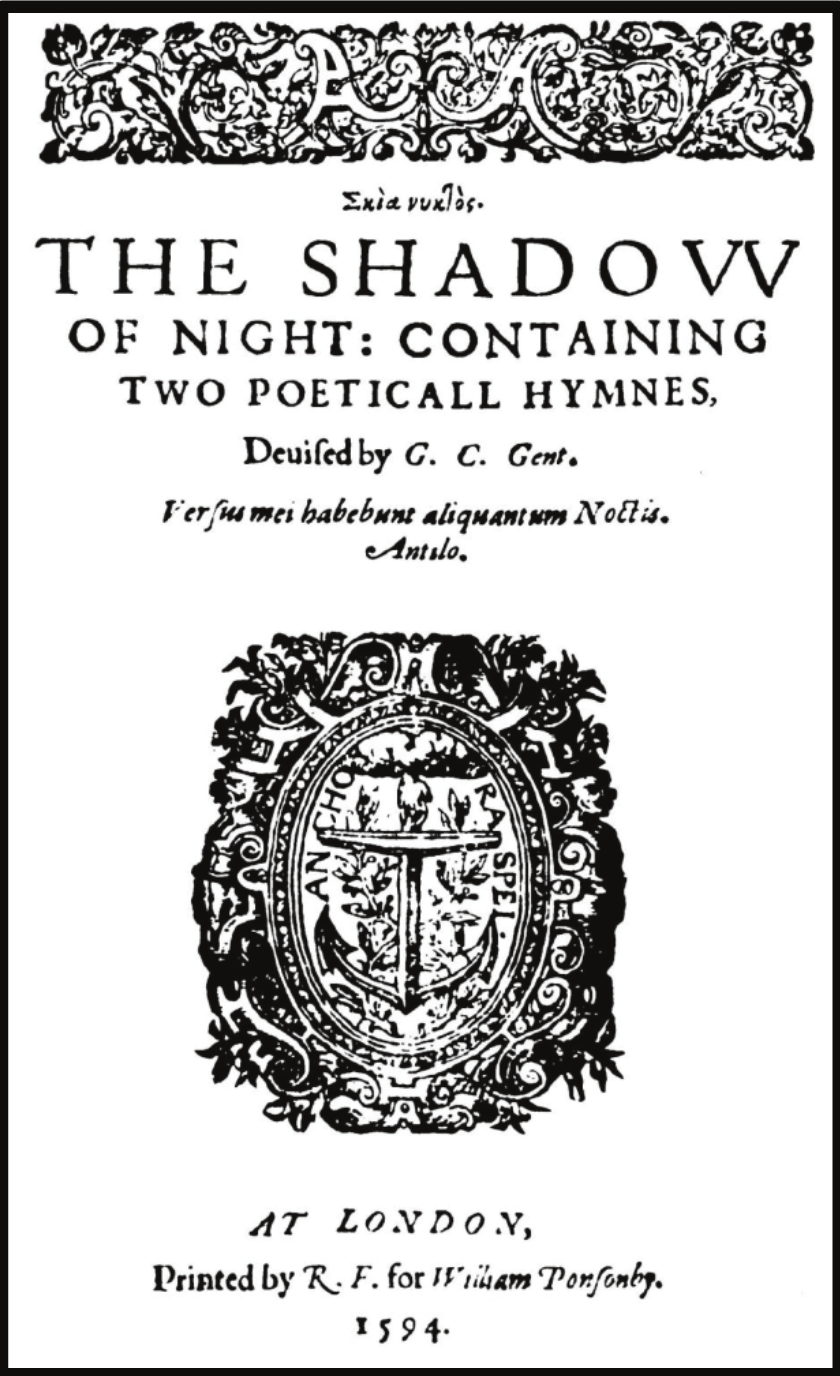
Figure 1.
George Chapman’s The Shadow of Night, first published in 1594.
As to prefatory texts, such as dedicatory epistles, poems, prologues and also glosses and commentaries, they became, throughout the 16th century, the proper vehicle for scholarly disputatio on poetic and rhetorical issues. For this reason, these texts acquire a prescriptive nature not always observed by modern criticism, which, up to recent times, have read them through the romantic categories of originality, authenticity and self-expression. Just as in the case of Góngora's letter praising his select audience, Chapman's dedicatory epistles to his poetic works have the prescriptive task of establishing authority for the type of style he is operating with and of defending his choices in contrast to other poetic possibilities available. In that sense, there is no discontinuity between what came to be called ‘paratext’, or accompanying materials, and the poems themselves, since they all operate within the same network of symbolic representation, differing only in the more immediate conventions of the type of discourse they embody. In this analysis, I adopt the view that the practice of glossing and commentaries on vernacular poetry is a systematic emulation of the ancient practice of the auctoris interpretatio, resulting in new functions given to the old techniques of annotation. As in the case of Vergil, who was ‘acquitted’ of being obnoxiously obscure in the fourth book of the Aeneid by Servius' vouching for his borrowings of Euripides, Ennius et alii, so poetry composed in the vernacular languages underwent an equivalent process of ongoing authentication in the 16 and 17th centuries. Many examples of this trend could be given: Ludovico Dolce's exposition of obscure places of invention and difficult words in Ariosto's Orlando Furioso, in 1547; Mureto's commentaries on Ronsard's Les Amours, in 1553; Francesco Sansovino's brief commentaries on Bembo's Le Rime, in 1561; Fernando de Herrera's annotations of Garcilaso's poems, in 1580; Ludovico Castelvetro's short and precise annotations of Petrarch's sonnets, in an edition of 1582, among others (Cf. Grigera, 1994).
In 1579, the edition of Edmund Spenser's The Shepheardes Calender was published, in London, with the glosses signed by the initials ‘E.K.’. In the dedicatory epistle to Gabriel Harvey, E.K. exposes the lack of annotated editions of poetry in English, and justifies his own glossarial practice by placing himself side by side with the ‘learned of other nations’:
Hereunto have I added a certain Gloss or scholion for the exposition of old words & harder phrases: which manner of glossing and commenting, well I wote, will seem strange & rare in our tongue: yet for so much as I knew many excellent & proper devices both in words and matter would pass in the speedy course of reading, either as unknown, or as not marked, and that in this kind, as in other we might be equal to the learned of other nations, I thought good to take the pains upon me [...] (Spenser, 1586, dedicatory epistle).
As fundamental studies have shown (Starnes, 1942), E.K.'s glosses draw on many types of material available at the time, such as compilations of mythology – as Boccaccio's Genealogia Deorum and Natalis Comes' Mythologiae, for example –, dictionaries and compendia. Though at first E.K.'s use of these so-called ‘secondary sources’ would seem to imply a likewise ‘second-rate’ type of work, he was in fact just doing what the ‘learned of other nations’, as he said, were doing as well, to a lesser or greater extent. Any careful examination of the great bulk of the annotations and glosses in the commented editions of vernacular poetry would show how much the authors were drawing from these very resourceful compilations, even if they did not name them explicitly. Acknowledging this fact is relevant because it shows that both the production and annotation of poetic inventions followed the same pattern of working within an already established prescriptive practice. Further, it implies a referential mode of producing texts: if poets were emulating ancient and contemporary authors, the authorization for doing so came from an equivalent emulation of the scholium tradition. The scholium tradition, in its turn, had always used examples from the poetic works themselves – besides the texts of philosophers or previous scholiasts – in order to explain or give reference to the specific place of invention or mode of elocution under examination. The writing of poetry and the writing of comments, therefore, have always informed each other in a more or less mutual mode of operation, differing less in the contents they both mobilize than in the specific functions they assume in the cultural production of their time.
Glossing and the ‘deep search of knowledge’
In the editions of his poems and translations, George Chapman followed, such as E.K., ‘the learned of other nations’. His dedicatory epistles, poetic inventions, side annotations and glosses all belong to the contemporary prescriptive practice of both producing and authorizing specific uses of topoi, words and wording. In the opening paragraph of his epistle to Mathew Roydon in The Shadow of Night, Chapman allegorizes the battle of searching for and defending what he considers the ‘best’ knowledge by using the topoi of armed fighting taken from Hesiod:
It is an exceeding rapture of delight in the deep search of knowledge (none knoweth better than thyself sweet Matthew) that maketh men manfully indure the extremes incident to that Herculean labour. From flints must the Gorgonian fount be smitten. Men must be shod by Mercury, girt with Saturn’s adamantine sword, take the shield from Pallas, the helm from Pluto, and have the eyes of Graea (as Hesiodus armes Perseus against Medusa) before they can cut off the viperous head of benumming ignorance, or subdue their monstrous affections to most beautifull judgement (Chapman, 1875 [1594], p. 3).
In establishing an analogy between the physical and intellectual strength necessary to produce a lofty poetic invention and the combat apparatus needed to fight enemies in battle, Chapman draws on a common feature of both: the preparation for confronting opposing forces. In fact, according to the rules of emulation, any prescriptive activity entails a dispute of opposing discourses, since a specific proposition is not only put forward as valid or acceptable, but as the most efficient in opposition to other options. The dedicatory epistle is the normative place for asserting the author's poetic proposition, as it functions, rhetorically, as the proemium in oratory. Likewise, the prefatory text needs authorization; Chapman does that through glossing his own invention with the commonplace formula of ‘ut dixit’: ‘as Hesiodus armes Perseus’ and so on.
Besides asserting his place of authority in the battlefield of erudition and learned poetic production – his analogy had the benefit of placing him side by side with Perseus –, Chapman develops his argument by anticipating his opponents' attacks and disqualifying them. This is a common rhetorical technique, widely used in oratory and in dedicatory texts, unrelated to Chapman's personal feelings towards empirical people. So his dedicatory epistle is metaphorically distributing his opponents on the larger allegorical battlefield of his discourse: a whole parade of ‘passion-driven men’, ‘judgement’s Butchers’, ‘Intonsi Catones’ and so on are placed on the page as the rival pawns in a chess board. Likewise, Chapman brings forth his allies, also metaphorizing them so as to represent ‘true Nobility’ by using Greek-like compound epithets: ‘deep-searching Northumberland’ and ‘skill-embracing heir of Hunsdon’, all of whom supposedly have ‘high-deserving virtues’ (Chapman, 1875 [1594], p. 3). The use of compound epithets in the dedicatory epistle shows that Chapman not only makes his poetic inventions present throughout the different textual parts of his poem, but the stylistic marks of elocution are there as well. Both in Hymnus in Noctem and in Hymnus in Cynthiam – the titles of the two parts of The Shadow of Night – compound epithets are abundant, such as ‘all-ill-purging purity’, ‘soul-winging music’, ‘tear-stilling mourning’, ‘life-disdaining fight’ and so forth.
The last sentence of the epistle serves as another assertion of the type of poem that is being proposed, according to its style. Chapman represents the intended audience of his work in the following terms: “I rest as resolute as Seneca, satisfying myself if but a few, if one, or if none like it” (Chapman, 1875 [1594], p. 3). This statement, in the discursive whole of The Shadow of Night, functions to establish the legibility of the poem, that is, to define the specific perspective according to which the poem should be read – considering its lofty invention and elevated style – and the adequate conventions that it calls into play. By emulating Horace's “[...] odi profanum vulgo et arceo [...]” (Horace, 2004, p. 140) - “I hate the vulgar people and keep myself away from them […]” - and Persius' “Quis leget haec? Nemo, Hercule, nemo; uel duo, uel nemo […]” (Persius, 2004, p. 46) - “Who is going to read this? No one, by Hercules, no one. Well, maybe one or two […]”-, Chapman is following the ancient rhetorical strategy of instituting the poem's style and legibility in opposition to and in competition with other ones available – say, the elegant style of Sidney's pastorals. As a result, his poem enters its proper poetic line – one that, such as Persius' satires, uses the forceful style combined with gravity, fullness and vigor, producing an elevated type of speech. Such as Saluste du Bartas, Góngora and others, Chapman had the recently edited Hellenistic manuals of style available to him – of Hermogenes, Demetrius of Phalerum, Dionysius Longinus and their commentators. These works not only gave a wider possibility of mixing styles within genres – expanding the traditional division of the three genera dicendi – but also gave many examples of ancient Hellenistic poetry and oratory, amplifying the scope of authors that could be emulated (Grigera, 1994, Biester, 1997, Silvares, 2015).
As to the glosses, the first one comes as a side annotation in the fifth page of Hymnus in Noctem. Referring to the verse that qualifies the poets as Promethean, having ‘more-than-human souls’, the gloss addresses the author in the third person, and reads thus:
He calls them Promethean Poets in this high conceit, by a figurative comparison betwixt them, that as Prometheus with fire fetched from heaven, made men: so Poets with the fire of their souls are said to create those Harpies, and Centaurs, and thereof he calls their souls Genial (Chapman, 1875 [1594], p. 17).
This gloss gives an explanation of the poetic invention by analogy, based on the common premise present both in the myth of Prometheus and in the Aristotelian understanding of the poet as a maker, that is, as having capacity for creation (Aristotle, 1995). This also explains the qualification of the souls of poets as genial – productive, generative. Though this topic of invention is a common one, Chapman defines the poetic figure as a ‘high conceit’, not so much for the analogy itself, but for the striking sharpness of the phrasing of it: before the typically long chain of adjuncts that follow it, the concise attribution of ‘Promethean’ to ‘poets’ is packing together a set of possible analogical relations between the adjective and the noun. The gloss here has the typical function of making explicit what in the poetic formula was covert; but in this case, the analogy is not so far-fetched as to really require such an open explanation, specially one that does not entail any sort of source-giving. Rather, it seems that the gloss here has the supplementary function of showing selected examples of ‘high conceit’ in the poem as might pass unnoticed by the reader. As E.K. stated in the epistle to The Shepheardes Calender, one of the reasons he decided to give glosses to the poem was because he “[...] knew many excellent & proper deuises both in wordes and matter would passe in the speedy course of reading, either as vnknowen, or as not marked […]” (Spenser, 1586), as quoted above.
Most of the glosses listed at the end of Hymnus in Noctem have typical functions: 1) explaining the use of vocabulary with specific meanings – such as ‘insolence’ being used to mean ‘rareness’, and ‘the blest’ used to mean ‘the virtuous’; 2) expounding, in a more detailed fashion, what the periphrases refer to, such as ‘Rich-taper'd sanctuary of the blest’ standing for ‘the Night’, because of the relief night it gives to virtuous men, according to a passage in Aratus; and 3) most frequently, the glosses serve as source-giving, either for authorizing the poetic inventions or elucidating them. As his sources for Hymnus in Noctem, Chapman mentions only Greek poets: Hesiod, Aratus, Lycophron, Callimachus, Homer and the Orphic hymns, and uses Plato and Natalis Comes' Mythologiae once to explain specific
assumptions implied in his inventions. Even though the glosses only mention Greek poets – and, of course, there is a reason for that, since Chapman is aiming at the elevated style as proposed in Longinus and others[4] – the imitation he makes of Latin poets and works, such as Ovid's Metamorphosis, is implied. Again, the glosses function both to elucidate obscure places by explaining and source-naming, and to authorize the poet's use of them, so as to place him – or ‘weigh him together’ – side by side with the recepti scriptores, as the selected group of writers are named in Quintilian.
After the last gloss to Hymnus in Noctem, a general comment appears which constitutes a remarkable example of this authorization procedure. It reads:
For the rest of his own invention, figures and similes, touching their aptness and novelty he hath not laboured to justify them, because he hopes they will be proud enough to justify themselves, and prove sufficiently authentical to such as understand them; for the rest, God help them, I cannot do as others, make day seem a lighter woman then she is, by painting her (Chapman, 1875 [1594], p. 9).
As I have argued, Chapman's epistle, hymns, glosses, annotations and comments all belong to a single and coherent symbolic practice of representation that constitutes his whole poetic invention. The genre they present themselves in is, of course, diverse, but the prescriptive nature of his discourse remains present in every case. In the comment transcribed above, Chapman speaks of justifying his inventions, figures and similes – that is, the topoi he uses, the stylistic solutions and the analogies (the more than frequent formula ‘so... as’) that he produces. But this justification process is not done in general terms or for general purposes – he circumscribes it by saying ‘touching their aptness and novelty’. This is remarkable, because the whole scholarly disputation in the late 16th century and early 17th century regarding the new readings and the new emulation of ancient and contemporary authors moves around the ideas of adequateness and novelty (remembering that ‘aptness’, in Chapman's time, is closer to the idea of convenience and properness, following the Latin aptus). Spanish scholars had a very hot epistolary debate on whether or not ‘la nueva poesía de don Luís de Góngora’, as they often called it, could be justified as apt or convenient in relation to the genre of the composition; if on the one hand the more traditional readings of Horace and Cicero condemned the mixture of styles, on the other hand other authorities were being brought up to defend this ‘novelty’ (Cf. Ribas, 1616). The process of justification occurs in relative terms, not in absolute ones.
The glosses listed at the end of Hymnus in Cynthiam follow the same pattern of the previous ones, and give as sources of poetic invention Homer, Hesiod and the Orphic hymns, as before, but also other Greek poets and scholars: Euripides, Menander, Nicander and Strabo; the Roman poet Catullus and also Cicero; and the Italian scholar Lilius Gyraldus. There are two significant types of gloss that appear in this section. The first type is when the author glosses his poetic inventions justifying them not with ancient authorities, but by common usage (the Latin idea of consuetudo). So the second gloss refers to a periphrasis of the moon, and reads: “He calls her the Soul of the Night, since she is the purest part of her according to common conceit” (Chapman, 1875 [1594], p. 17). This is an example of the late 16th century, the understanding of prescription as a living and active practice that has no end; glossing belongs to this system and constitutes a continuous judgment of poetry and authorization of poets. In the twelfth gloss, referring to the verses that give the attributes of purity and chastity to Diana – and, by extension, to the moon – the author justifies thus: “These are commonly known to be the properties of Cynthia” (Chapman, 1875 [1594], p. 17). Likewise, an already established poetic usage, or custom, is brought up in this gloss to authorize the invention. In a similar manner, a second type of gloss appears in Hymnus in Cynthiam to indicate the adequacy of using contemporary references in poetry. The nineteenth gloss reads:
The Wall is a most excellent river in the Low Countries, parting with another river, called the Maze, near a town in Holland called Gurckham, and runs up to Guelderland under the walls of Nimiguen. And these like similes, in my opinion, drawn from the honorable deeds of our noble countrymen, clad in comely habit of Poesy, would become a Poem as well as further-fetched grounds, if such as be Poets nowadays would use them (Chapman, 1875 [1594], p. 17-18).
Just as the Roman poets referred to local rivers and mountains of their contemporary cities, so the 16th century's poets were advocating in favor of using descriptions of their own regions as legitimate topoi.
Góngora, for example, used the names of obscure places around the Globe in order to expand the range of possible references in his poems – including the name of a town in Bolivia rich in emeralds that took years of glossing to be understood. The idea is that the emulation of ancient Greek or Latin works entails an amplification of the matter and similes used in the ancient texts, making the vernacular poetry not only as ‘weighty’ as the ancient ones, but at times able even to surpass them in certain parts. In France, the poets of La Pléiade, such as Ronsard and Du Bellay, were calling themselves classique, that is, as belonging to the best in the contemporary additions to the normative elencha auctorum. The competitive essence of emulation itself stimulates an amplification of topoi, words and phrasing, as poets not only display their erudition, but also their wit, showing versatility in the new use they make of authorized sources[5].
As to Chapman, I would like to point out that the practice of glossing also takes place inside the poems themselves. In Hymnus in Noctem, the figure of Orpheus is referred through the periphrasis ‘the sweetest Muses’ son’. The verses that follow give a poetic account of the mythological fable relating to Orpheus – with the ‘heavenly rapture of his Music’ he captivated rocks, animals, winds and floods, and submitted them all to his will. This image comes as a figurative example of perfect wisdom being able to provoke persuasion through love of an equally perfect artistic expression. The glossing of the mythological fable appears more explicitly in the following verses, when the poet refers to Orpheus' descent into the underworld to retrieve Eurydice. The verses say:
And that in calming the infernal kind,
To wit, the perturbations of his mind,
And bringing his Eurydice from hell
(Which Justice signifies) is proved well
(Chapman, 1875 [1594], p. 6)
Chapman explicitly glosses/comments on the fable when he ‘opens up’ or exposes the hidden meaning behind the allegorical figure. Orpheus' actions do not only represent, but actually signify something relevant to human affairs. Francis Bacon makes this type of glossing of the myths in The Wisdom of the Ancients, first published in Latin, in 1609. In Chapman, the glossing of myths, fables and poetic inventions appear all the time within the poems themselves. In fact, the practice of glossing – understood in its function of exposing, or expounding a place of invention – is an equivalent process to the amplification of poetic topoi, and constitutes one of Chapman's most frequent ways of emulating ancient poetic materials.
Conclusion
In this paper, I attempted to give some examples of Chapman's use of the gloss in the 1594 edition of The Shadow of Night. Not only does the poet add brief scholia to the two hymns that make up the whole of his poem, but he also undertakes an equivalent task of glossing his poetic inventions and authorizing them in the dedicatory epistle, in side annotations, in a brief comment appended to the glosses and throughout the poem itself through the amplification of the topoi that he selected to use. In doing so, Chapman is giving continuation to the ancient practice of textual scrutiny that became systematically emulated and amplified in the 16th century – scholars and poets throughout the Christian courts were exercising prescriptive work in emulation to those of Servius, Macrobius and Cornutus, for example. The gloss, the commentary and the annotation not only had the didactic and scholarly function of explaining difficult places of invention and elocution, but also exerted a significant social role in authorizing the poet and his work within the delimited circle of erudition. After passing through the scrutiny of the glossator, the poetic text in the vernacular languages could claim a place within the already established consuetudo of classical ‘treasure’, as often said. Thus, besides having a clear prescriptive function, the practice of glossing also participates in the larger domain of the epideictic discourse, defining new authorities for the new genres that were being composed through the mixture of styles. But the epideictic discourse entails a dispute as to whether or not a particular poetic proposition can be justified as to its ‘aptness and novelty’. As to that, Chapman undertakes the task not only of glossing ‘The golden chain of Homer’s high device’, as he poetically puts it in one of the verses of The Shadow of Night, but also of glossing his own lofty inventions, many of which are a result of mixing styles. In the competitive line of epideictic discourse, Chapman represents the intended audience of his poetic labors as ‘such as understand them’. To the others, he says, “God help them, I cannot do as others, make day seem a lighter woman then she is, by painting her” (Chapman, 1875 [1594], p. 9).
References
Aristotle. (1995). Poetics (S. Halliwell, trad.). Cambridge; UK: Harvard University Press, Loeb Classical Library.
Bartas, S. (1611). Advertissement de G. De Saluste Sieur du Bartas, sur sa Premiere et Seconde Sepmaine. In Les Ouvres de G. De Saluste du Bartas [...]. Paris, FR.
Biester, J. (1997). Lyric wonder: Rhetoric and wit in Renaissance English poetry. Ithaca, NY: Conrnell University Press.
Chapman, G. (1594). The shadow of night: Containing two poeticall Hymnes, Deuised by G. C. Gent. [...]. London, UK.
Chapman, G. (1875). The Works of George Chapman: Poems and Minor Translations. Introduction by Algernon Charles Swinburne. London, UK: Chatto and Windus.
Góngora, L. de (1613). Carta de Don Luis de Góngora, en respuesta de la que le escribieron. In Arancón, A. M. (Ed., 1978). La Batalla en torno a Góngora – selección de textos (p. 43). Barcelona, ES: Antoni Bosch.
Grigera, L. L. (1994). La retórica en la España del siglo de oro. Salamanca, ES: Ediciones Universidad Salamanca.
Grigera, L. L. (2005). Por la estafeta he sabido / que me han apologizado: Otra lectura de la polémica en torno de las Soledades. In R. P. M. Piñero (Ed.), Dejar hablar a los textos: Homenaje a Francisco Márquez Villanueva (p. 949-960). Sevilla, ES: Universidad de Sevilla.
Horace. (2004). Odes and Epodes (N. Rudd, trad.). Harvard, MA: Harvard University Press, Loeb Classical Library.
Meres, F. (1933). Francis Mere’s treatise, Poetrie: a critical edition. Urbana, IL: The University of Illinois.
Persius. (2004). Satire I, in Juvenal and Persius. Satires (S. M. Braund, trad.). Harvard, MA: Harvard University Press, Loeb Classical Library.
Ribas, Dias de. (1616) Discursos apologéticos por el estilo de Polifemo y Soledades. In Arancón, A. M. (Ed., 1978). La Batalla en torno a Góngora – selección de textos (p. 127-190). Barcelona, ES: Antoni Bosch.
Silvares, L. (2015). Nenhum Homem é uma Ilha: John Donne e a Poética da Agudeza. São Paulo, SP: Fap-Unifesp.
Snare, G. (1989). The mystification of George Chapman. London, UK: Duke University Press.
Spenser, E. (1586). The Shepheardes Calender, conteyning twelve Aeglogues proportionable to the twelve monethes [...]. London, UK.
Starnes, D. T. (1942). E.K.'s classical allusions reconsidered. Studies in Philology, 39(2), 143-159.
Notes
Author notes
lavinia.unifesp@gmail.com