Linguística
Euphemism: The commonplace of advertising culture
Eufemismo: o lugar comum da cultura publicitária
Euphemism: The commonplace of advertising culture
Acta Scientiarum. Language and Culture, vol. 40, núm. 2, 2018
Universidade Estadual de Maringá

Esta obra está bajo una Licencia Creative Commons Atribución 4.0 Internacional.
Recepción: 08 Abril 2018
Aprobación: 11 Septiembre 2018
Abstract: Politeness is a concern and necessity in advertising because of sensitization goals to be achieved in the midst of cultural, legal and competitive challenges. Thus, this study examined the utilization of euphemistic devices that facilitate mild persuasion in advertisements. Ten advertisements served as the data of investigation. The theoretical explication rested on Barthesian denotative and connotative annotations and Halliday’s transitivity concepts. The study revealed concealments in forms of the socio-cultural affiliation and association (solo), domination (power, the Hero), distinction (made of more), and superiority (Indomitables). Also, personification and personalization (bigger boy; your world), self-worth (greatness), borrowing (Naija), and transfer of professional meaning (credit card) functioned as replacements for seemingly inappropriate lexicons. Advertisers hide behind the metaphor (a taste of black), discrimination (choose greatness), and comparison (more, bigger) to expedite recipients’ response. Therefore, as euphemisms are everyone’s linguistic behavior, the study suggested that their analyses and applications need to follow a similar course. That might assist language users to curb communication crises.
Keywords: advertising, connotation, denotation, euphemism, transitivity.
Resumo: Polidez é uma preocupação e necessidade na publicidade por causa dos objetivos desensibilização a serem alcançados em meio a desafios culturais, legais e competitivos. Assim, este estudoanalisou a utilização de dispositivos eufemísticos que facilitam a persuasão em anúncios. Dez anúnciosserviram como dados de investigação. A explicação teórica baseou-se nas anotações denotativa e conotativabarthesianas e nos conceitos de transitividade de Halliday. O estudo revelou encobrimentos em formas deafiliação sócio-cultural e associação (solo), dominação (poder, o herói), distinção (feita de mais) esuperioridade (indomáveis). Além disso, personificação e personalização (maior menino; seu mundo),auto-estima (grandeza), empréstimo (‘Naija’) e transferência de significado profissional (cartão de crédito)funcionavam como substitutos para os léxicos aparentemente inapropriados. Anunciantes escondem-se portrás da metáfora (um gosto de preto), discriminação (escolha de grandeza) e comparação (mais, maior) paraagilizar a resposta dos destinatários. Portanto, como os eufemismos são o comportamento lingüístico detodos, o estudo sugeriu que suas análises e aplicações precisam seguir um curso semelhante. Isso podeajudar os usuários de idiomas a reduzir as crises de comunicação.
Palavras-chave: publicidade, conotação, denotação, eufemismo, transitividade.
Introduction
An advertisement (henceforth: ad) is an interface between manufacturers of goods and services and consumers. That is why Packard (1977) pinpoints advertising activities as the producers’ means of encircling recipients with appropriate fascinating resources of conviction. To Packard, those resources influence the human senses of hearing and perception as manifestations of emotion realized through imagination. All these inputs assist advertisers to achieve the desire of inspiring the target audience. Thus, an ad serves some business purposes of disseminating information to convince readers to patronize goods and services. The position that ads occupy seems to influence the advertising industry to channel strategies in persuading the audience. Euphemism, in this case, one could say, serves a useful purpose in advertisers’ domains to motivate the audience to consumption.
Apart from the organization that is germane, the text and image are fundamental in advertising plates (Sells & Gonzalez, 2003). In the theory of persuasion, advertisers do not employ the text and image haphazardly because of the intended persuasive warfare. The text and image in the advertising semiotic field promote goods and services. Owing to that claim, advertisers shape the text and image in such a way that creates a metaphorical domain for a product. In that sense, the duality of the text-cum-image performs an integral function of conceptual networks for products. One could argue that euphemism fulfills some socio-cultural routines and professional mappings in communications in representational forms. Allan and Burridge (1991, p. 11) explains that a euphemistic construct is deployed as an “[…] alternative to a dispreferred expression, in order to avoid possible loss of face either one’s face or, through giving offensive, that of the audience, or of some third party”. The crux of euphemism, in Allan and Burridge’s (1991) perspective, is that a term serves as substitution for the other.
In that regard, communicators utilize euphemism as an intentional facility in all facets of life to lubricate their social engagements. The code replacement could operate in professional conducts, cultural norms, religious issues, ceremonial activities, etc. As euphemistic expressions might activate as a concealment of altruism in certain quarters; they could also help in eliminating social taboos in society. In all these, interactants might deploy language nuances to cover or expound communication practices. The relationship between euphemism and advertising, one could attest, is based on social connections and concerns. On the one hand, euphemism is an element observed in all ramifications of life (McDonald, 1988). On the other hand, advertising prepares messages relating to socio-cultural norms (Ewen, 1976; Fiske, 1989; Hermerén, 1999). In a way, euphemism is a raw material of advertising going by its expansive jurisdictions.
Running along the Allan and Burridge’s (1991) phraseology of ‘dispreferred expression’, advertisers are mild in communicating their thoughts to the public because of the specific task of motivating readers to buy their products. Besides, sounding difference is a culture in the advertising persuasion. This is because every product in its competitive world intends to be distinguished from others in one way or another (Brierley, 1995). As advertisers avoid the repetitive use of the lexicon, ‘buy’ (Forceville, 1996); it becomes imperative for experts to disguise as a form of discernment of being cunning to renew communicative strengths. Having the foresight that the target audience are most times recalcitrant to advertising messages (Cook, 2001), publicists mandatorily avert repugnant messages. On that ground, advertising professionals, by all means, do away with offensive-cum-taboo constructions. Copywriters rather fabricate pieces of information parallel to consumers’ socio-cultural treasures (Willis, 1990) to excite readers. The above remarks, among others, inform the utilization of euphemisms as stimulating principles of persuasion. Therefore, the study taps its currency of analyzing euphemisms (Pfaff, Gibbs, & Johnson, 1997; Domiguez & Benedito, 2000) from the above perspectives to demonstrate the behaviors of the advertising industry toward euphemisms especially in the Nigerian context.
Treasuring euphemism
It is emphatic that English lexemes have etymological relationships. While some words are linked to wars, upheavals, neologisms, and cross-cultural transmissions (Fromkin, Rodman, & Hyams, 2003); others are connected to scientific inventions, invasions and perhaps, a desire to be different (Algeo & Pyles, 2002). Owing to those views, there are two prospects to the historical sources of euphemism. Alkire (2002) says that euphemism is a Latinized masculine lexicon ‘eupemismos’, meaning the deployment of words of good omen to readers. The argument draws on the Norman Conquest of 1066 on England. To Alkire, ‘euphemismos’ translated to euphemism is a member of the Middle English word stock. However, the claim of Enright (2004) considers euphemism as a lexicon originated from the Ancient Greek. The argument refers that: (i) ‘euphēeme/euphemia’ is an embodiment of two morphemes of ‘eu’ = well and ‘phēme’ = speaking. Linguistic accounts also report that the Greek lexemes of ‘euphēmizein’ and ‘euphemismos’ function as the use of precious words and the use of appropriate words to replace uncomplimentary inconvenient ones. This claim became effective in the 16th century (Ayer, Worthen, & Cherry, 1986). In some respect, both ‘euphēmizein’ and ‘euphemismos’ are advanced constructs of ‘eupheme’ in social reality.
Perhaps, the sensitivity of communicators to indirect expressions in diverse eco-social domains has influenced Radulović (2012) to classify roundabout expressions into orthophemism and dysphemism. Such categorization has to do with the conveying meaning from a source to another in an implicit form or shape either as a positive resemblance or negative marker. Out of these, the notions of positive euphemism (euphemism) and negative euphemism (dysphemism) have become very relevant in communication exercises. Although, there is a thin line between euphemism and dysphemism (Krӧll, 1984; Allan & Burridge, 2006), two of them could comfortably be accommodated in the same euphemistic framework. The distinctions lie in their engagement to realize social values. Euphemism and dysphemism are entwined social communicative facilities. Thus,Holder (2005, p. 118) accentuates that euphemism is mild but a varied expression employed to substitute inappropriate vocabulary.
Following such usage decoration, Bolinger (1987) elucidates a unique form of dysphemism as auditory malapropisms. The remodeling applies that the user’s inquisitiveness lies on “[…] the misuse of one word for another that resembles it in sound and is vaguely similar in meaning.” Advertising gurus sometimes deploy indefinite lexicons to fascinate readers especially in Nigeria (‘lyte’ for light; ‘luv’ for love; ‘kulture’ for culture; ‘ur’ for your; ‘4rm’ for from; etc.). Besides, euphemism creates association with figures of speech (Allan, 2001; Cruse, 2004), collocation (Zhou, 2015), political propaganda and public relations (Jačková, 2010), and manipulation of consumers that might lead to vagueness (Leech, 1966). Connecting those lines of defense to euphemism is an exposé of the behaviors of every language user, which is the motive for Bolinger (1987) to further posit that “[…] euphemism is everyman’s sin.” Substitution and integration of lexemic conceptual networks demonstrate the imagination prowess of an interlocutor in social contents. Out of socio-cultural spheres, advertising creators source material (euphemistically) to sensitize recipients to product patronization. In Myers’ (1994) point of view, advertising experts achieve persuasion through the commonplace of euphemism channeled through word connectives, behavioral associations, referent partnerships, and affiliation with narrators.
Theoretical scope
In the field of social semiotics, signification is fundamental, as it functions in different orders in connection to the environment. The first order in relation to the scope of the study is sign constructed within the signifier and signified domains. The second level is appreciated as denotation and connotation (Dalamu, 2018). Denotation and connotation display the degrees at which the signified expounds the signifier. Chandler (2012) illuminates a sign as something referring to another object outside itself. That comment implies that a sign is an illustration of an object in which human beings derive meanings. The signifier and the signified associate with the concept of sign (Saussure, 1916/1983). To this end, a sign is a plane where the signifier and the signified function in relation to a social context. Dyer (2005, p. 118) claims that the signifier is “[…] a material vehicle and the signified is ‘a mental concept or reference”. Dyer also adds that “[…] a signifier has potential but not the actual meaning whereas the signified is the meaning which the signifier refers to”. The signifier, one could argue, is either visual or auditory communicative object in the social system such as text, image and sound; the signified points to the meaning abstraction from the signified. That explanatory distribution illustrates the meaning decoded from the text, the image or the sound.
Having stated that the signified is the revealer of the meaning in the concept of the signifier, denotation and connotation initiate the order of meaning derivatives of a code (a code is a sign but a sign system is not always a code). This remark suggests that connotation unveils the semantic implications of an object in a way different from that of denotation (Dalamu, 2017a). Then, the dual concepts compose some distinctions of meaning-production levels for the signified (Panofsky, 1970). As associates of meaning exemplifications, the relationships of denotation and connotation are somewhat copulated. That characteristic has made it extremely difficult to clearly separate the former from the later. As intertwining entities, nevertheless, denotation serves as the first-order of meaning generation from a sign system or a code, while connotation expounds the meaning of an entity within the second-order of meaning derivative (Hjelmslev, 1961). Thus, connotation is precursory to denotation. That is why Barthes (1967) submits that denotation leads to clusters of connotation in order to supply additional meaning representations. The meaning realization in denotative sign is all-comers’ affair because of its literal, self-evident, commonsensical, and natural appearance. One might also add that the likelihood of dictionary meaning and universality (e.g. of text) positions denotation as disposing meaning at the first level (Hall, 1980). However, connotation is ‘polysemous’ and can be heavily cultural affiliated. In Fiske’s (1982) point of view, denotation is the photographic image and the process of its projection is connotatively discerned. Nonetheless, Wilden (1987) elucidates the former as digital and the later as analogue.
Although, scholars (Barthes, 1967; Fiske, 1982; etc.) have expressed their views on the orders of signification, it is crystal clear that both denotation and connotation exhibit cultural and ideological undertones. Socio-cultural and ideological values are the strongholds of language. The same principles seem applicable to images and their functional applications (Kress, 2010). Advertisers take cognizance of these contextual norms to make the fortresses the place of refuge in advertising communications. Then, experts construct every ad of
a community as an adaptation of that environment. Texts and images are deployed to rule readers based on the people’s cultural, social, and ideological expositions and fortifications else a copy of an ad functional in society A might be blurred in society B vice versa. Copywriters are quite aware that the essence of a good ad is not about simply translating the wordings of the frame; it is very significant to encode the right concepts, and those concepts may well vary from one culture to another (Goddard, 2002). Following Willemen’s (1994) estimation that the level of analysis determines the line that demarcates denotation and connotation, the study in the comparative reference, has utilized the former as meaning exemplification of the literal level and the later explores meaning at the metaphorical/multiple level.
Creating a connection with the duality of denotation and connotation of the image, Barthes (1967) suggests a third concept, which is the linguistic text as playing either the anchoring or the relaying role. Perhaps, the Barthesian proposal provides a backdrop for Forceville (1996) to argue that explanations of image can be subjective, while that of the text objective. The reason provided is that there are ‘concise’ theoretical works on the grammar of language whereas that of image is still unattainable. Dictionaries and theories on texts serve that purpose. Given that argument and Daramola’s (2008) position that the scope of an investigation allows for theoretical triangulation method (Sunderland, 2010), the author has adopted the transitivity system as textual processor of the selected advertising communications. Transitivity, in Halliday and Matthiessen’s (2004) premise, is the grammatical transpose of ideational metafunction, which accommodates experiential and logical relations. Three variables dominate experiential relation. These are participant, process and circumstance (Dalamu, 2017b). Participant, Thompson (2014) deduces, is either animate or inanimate elements, involved in the meaning-making procedures. And the process represents the goings-on in the communication. Bloor and Bloor (2013) describe the goings-on that the participant engages in as internal (thoughts, beliefs, feelings, etc) or external (happening, doing, sensing, etc.) world. Halliday and Matthiessen (2014) articulate that the experience shared might sometimes occur in a particular setting. On that note, Martin and Rose (2013), and Fontaine (2013) gloss that circumstantial devices augment the information that the participant and process provide the audience (Eggins, 2004).
Methodology
There are many euphemistic devices in the ads collected from the Punch newspaper and the Internet. However, the selection of the ads for analysis is prioritized based on their relevance to the study. Among the choice ads, the study gave preference to alcoholic drinks communications. The goal was to exemplify how ads of alcohol conceal information to inspire recipients to consumption. Before the transitivity analysis, in Figure 1, the author presented the text in clauses with slashes ‘//’ to show their scope. The procedure was based on Halliday and Matthiessen (2004) as a pointer to the limit of the simple clause. The transitivity system applied in Figure 1, which was later converted to Table 1, assisted the study to account for the linguistic components of the clauses in relation to content meanings. The frequency, as shown in Table 1, was later translated to Figure 2 in order to calculate and account for the position of each transitivity facility as appeared in Figure 1. The sequence might help readers to easily appreciate the flow of the goings-on. With the assistance of denotative and connotative terminologies, the discussion revolves around the transitivity system. The symbol ‘®’ indicates a registered company as Tx in the table is an abbreviation of text.
| Transitivity | Value | Total | |||||||||
| Tx1 | Tx2 | Tx3 | Tx4 | Tx5 | Tx6 | Tx7 | Tx8 | Tx9 | Tx10 | ||
| Material | 1 | 1 | 1 | 1 | 0 | 1 | 1 | 2 | 0 | 1 | 9 |
| Mental | 0 | 0 | 0 | 0 | 0 | 0 | 0 | 0 | 1 | 0 | 1 |
| Relational | 0 | 0 | 0 | 0 | 0 | 1 | 0 | 0 | 0 | 0 | 1 |
| Bahavioral | 0 | 0 | 0 | 0 | 0 | 0 | 0 | 0 | 0 | 0 | 0 |
| Verbal | 0 | 0 | 0 | 0 | 0 | 0 | 0 | 0 | 0 | 0 | 0 |
| Existential | 0 | 0 | 0 | 0 | 0 | 0 | 0 | 0 | 0 | 0 | 0 |
| Circumstance | 0 | 0 | 0 | 2 | 0 | 0 | 1 | 0 | 1 | 0 | 4 |
Data presentation
Figures 3 to 12 (The Punch Newspapers; www.guinness.com/en-af/advertising; http://www.sevenup.org/home/), with endpoint slashes, indicate the clauses of the advertising plates 1-10, explored in Figure 1.
Data analysis
Figure 1 below represents the systemic analysis of the selected ads’ texts.
The study translates the transitivity analysis in Figure 1 to a readable table and graph in Figure 2.
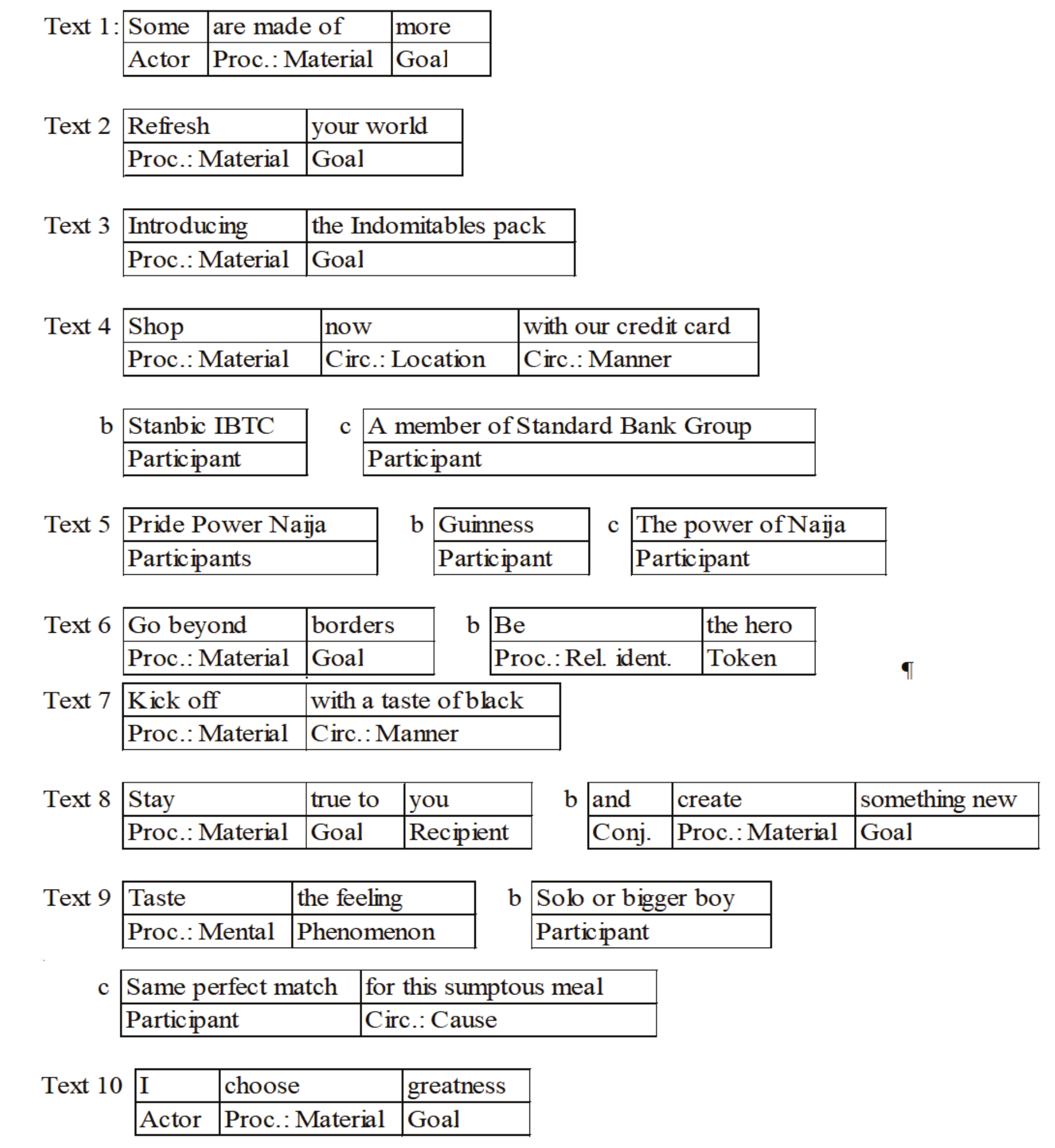
Figure 1.
Grammatical (transitivity) analysis of the ads.
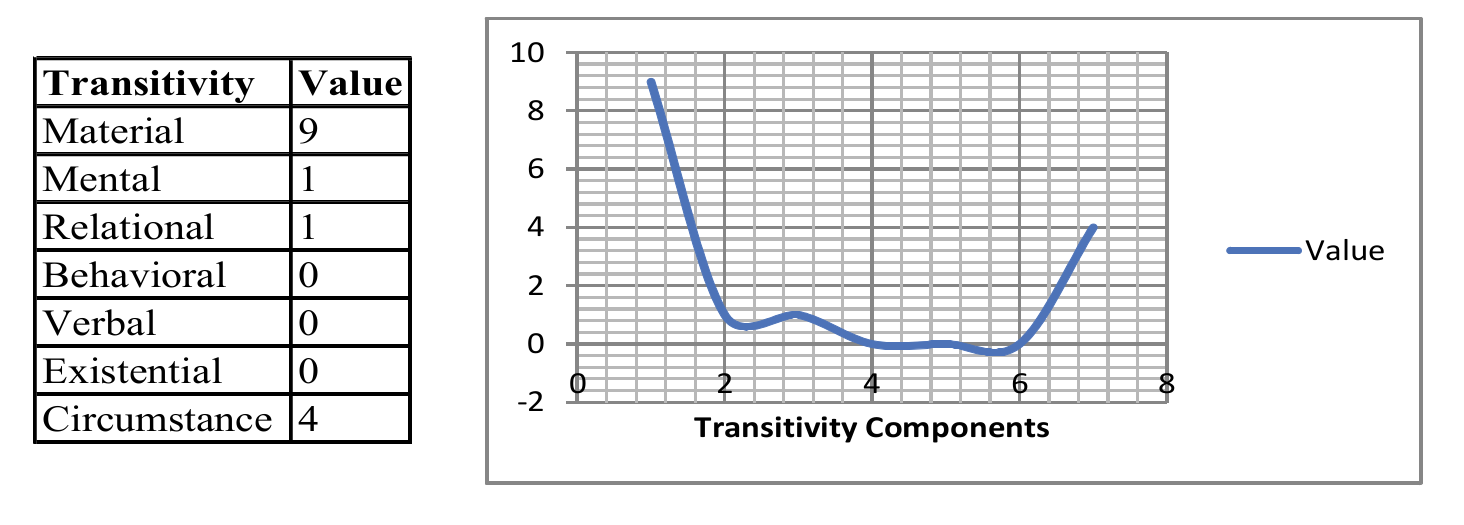
Figure 2.
Graphical illustration of the ads’ transitivity components

Figure 3.
//Some are made of more//.

Figure 4.
//Refresh your world//.

Figure 5.
//Introducing the ‘Indomitables’ pack//.

Figure 6
//Shop now with our credit card//
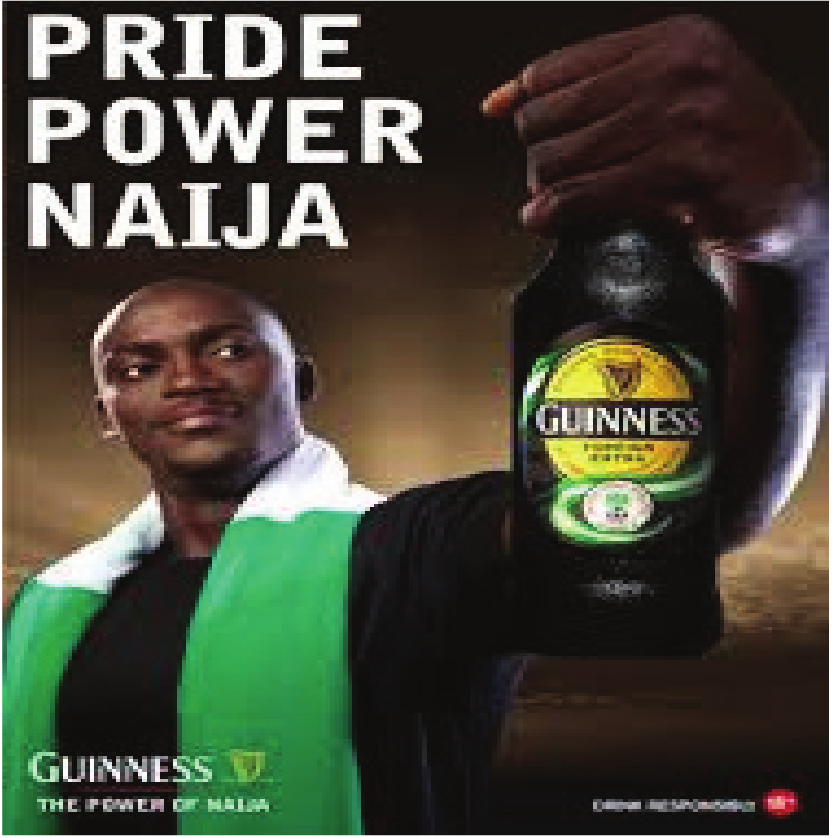
Figure 7.
//Pride power ‘Naija’//.

Figure 8.
//Go beyond borders// Be the hero//.
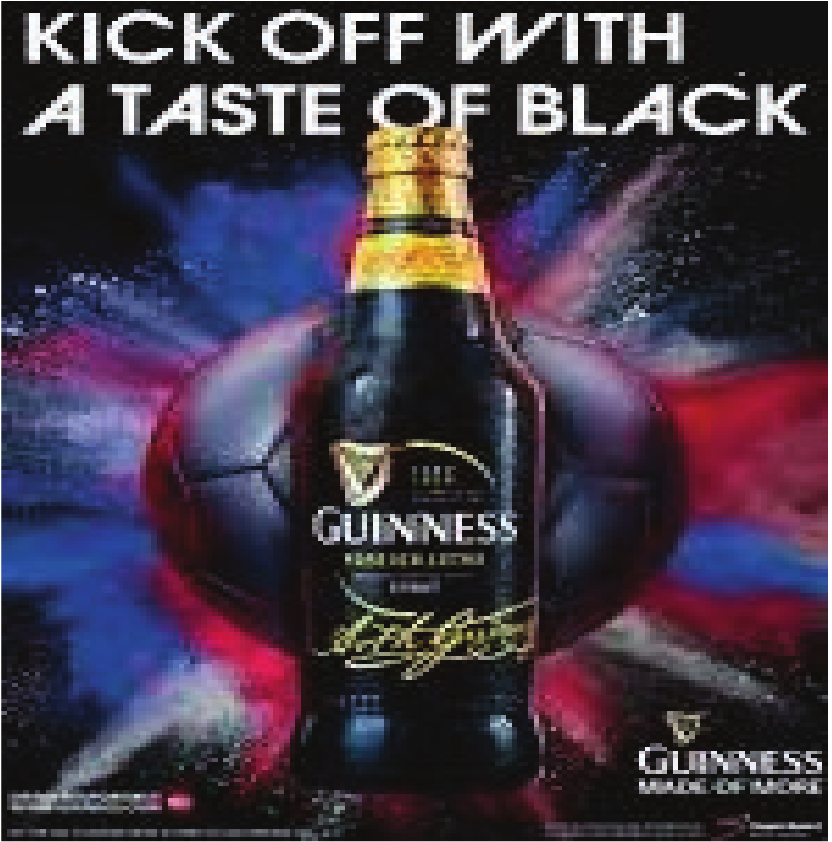
Figure 9.
//Kick off with a taste of black//.

Figure 10.
//Stay true to you and create something new//.

Figure 11.
//Taste the feeling// Solo or bigger boy// Same perfect match for this sumptuous meal//.

Figure 12.
// I choose greatness//.
Results
Following Dalamu’s (2017d) digital applications and reporting styles, Table 1 and Figure 2 display the grammatical components of the ads’ texts as the linguistic device, recurred in different semiotic slots.
Material Processes, as demonstrated in Figure 2, operate nine times more than any other process in the advertising texts. Besides the circumstantial elements that recur four times, Mental and Relational Processes function just once respectively. The appearance of the graph reveals that the advertisers fascinate the target audience through the deployment of the Material Processes, inspiring readers to act in accordance with the text. This exhibits that ‘happening’ and ‘doing’ dominate the information, circulated to the public. However, the circumstances, indicating location and means, serve as communicative devices enhancing the messages of the goings-on.
Discussion
The transitivity analysis, as applied in Figures 1 and 2, displays the texts in various semiotic slots taking care of denotative meanings, yet, leaving untouched connotative representations. As the transitivity attainment is limited to texts at their face values, the analyst utilizes the discussion medium as a channel of investigating discursively both denotative and connotative concerns of the images. That perspective has also helped in the semantic discourses of the texts. In all, descriptions of euphemistic devices of the advertising frames follow after Barthes (1967), Allan and Burridge (1991), Cruse (2004) as well as Domínguez (2005).
The clause in Figure 3, ‘Some are made of more’, from the point of view of the transitivity system, is declarative. The Material Process of ‘are made of’ employs ‘Some’ and ‘more’ as Actor and Goal respectively. The going-on, ‘are made of’, has ‘are’ as the marker of the verbal group with the phrasal verb, ‘made of’, indicating the composition of the internal contents of Guinness®. Such embodiment of constituents engineers the product to act in a certain manner that could be euphemistically projected. First, the lexicon, ‘Some’, constructs a sort of hypocritical idea for readers because it is a concealment of ‘Guinness’ alone. However, ‘Some’, refers to certain entities of indefinite amount. Of a truth, the advertiser cannot be concerned with any other object out there other than ‘Guinness’ which promotion is the motive of the ad. Referring to a few items, illustrated as ‘Some’, is evasive. In a sense, ‘Some’, is a pro-form of ‘Guinness’. The imagery clearly demonstrates that claim with the appearance of the butterfly larva, seemingly crawling on the arm of the tree. The process, ‘are made of more’, creates a probable misunderstanding for readers, in the sense that, the copywriter does not categorically state the elements that ‘are made of more’. It is an open statement inviting logical reasoning. Then, a question could emanate thus: Is it the butterfly larva or ‘Guinness’ that is superficial or any other entities in the social system? Lack of clarification leaves a recipient to his/her logical reasoning, as earlier mentioned.
The Goal, ‘more’, is manipulative. One could suggest that ‘more’ is comparative in meaning deductions. This refers that the way at which ‘Some’ (as concealed) gets things done is at a higher rate and ‘Guinness’ belongs to that group. Then, ‘more’ does not only portray speed; the stirring component also indicates quality as well as distinction (Bedroll, 2007). The images of different kinds of trees that the larva designs on the two leaves are a proof of that argument. The designed features connote a degree of perfection and excellence. Besides, it is referable that the advertiser does not only show the larva as being a distinguished designer in the domain of creativity; but that the larva has done an impossible task. Images in ads sometimes fail to match both the internal and external features of the product that they depict. Experts deploy such as fascinating objects to soothe consumers’ feelings in order to lure them to consumption (Boorstin, 1963). In another sense, the impossibility is exhibited in the two leaves accommodating about five grown trees (in two and three respectively). ‘Guinness’ equates the larva’s activities. The advertising expert taps from the animal kingdom to illustrate the excellence of ‘Guinness’, operating in a high social position and of good worth for human consumption. The distinctions that euphemisms accord ‘Guinness’ as being perfect, skillful and with unusual characteristics are attempts to sway recipients to the consumption of the beer. Such features, in the perspective of the advertiser, are consumers’ in order to perform beyond human expectations after drinking ‘Guinness’. Nevertheless, intoxication, which is dysphemism that the product might cause consumers, is hidden.
Command is the structure of Figure 4 as analyzed in Figure 1. The imperative clause, ‘Refresh your world’, has ‘Refresh’ as the Material Process accompanied with the Goal, ‘your world’.
The clause orders readers to patronize Pepsi®. Yet, ‘Refresh’ is a connotative tool of conviction in a perception that readers are asked to revitalize their strengths through ‘Pepsi’. This means that the beverage is an energizer, which consumption can reinvigorate consumers’ bodies. Instead of the advertiser to command consumers to drink the soft drink, the ad instructs recipients with syntactic taxonomies of periodic renewal and reloading. Moreover, ‘your world’ is metaphorical. ‘Your world’ is a concept that characterizes human stomach. As such, there is a transfer of meaning from one domain to another (Enright, 1985; Domínguez, 2005) as a means of pleasing the target audience. Observations also display the nominal group, ‘your world’, as an ambiguous linguistic organ. As ‘your world’ points to the consumer’s abdomen in a connotative form; it also illustrates the global world as the natural human inhabitant. The substituent seems to create confusion because only educated readers could decode the information in its propriety. The lexical euphemism further reveals concealment and individuality in the following dimensions. The thrilling structure attenuates the pains of hunger in a very polite way; and personalizes ‘world’ with possessive determiner, ‘your’, to convey ownership, familiarity and mutuality. ‘Your’ is a human referent to satisfy essence. The communication also evades the lexicon, drink, with the replacement of ‘Refresh’ and the text does not mention ‘Pepsi’ except that its image is positioned vertically on the frame. The goal of the euphemism is to be friendly in order to easily, cleverly and cunningly seduce the public to consumption.
Both the image and text of the ad in Figure 5 are euphemistic contents. The text, ‘Introducing the Indomitables pack’, is a fragmented clause. Some of the linguistic structures are deleted to achieve persuasion (Hoey, 2000; Carter & Nash, 2013). The clause has a Material Process, ‘Introducing’, which makes the communication to sound in a polite way. The ‘Indomitables pack’ is Goal, euphemized to inspire recipients, most of which are children. ‘Introducing’ operates as the marker of the clause because some linguistic facilities are considered eliminated. The evasion of the lexical items is perhaps for a reason of economy (Cook, 2001). Apart from the lexical concealment noticed, there is also an incredible morphological fabrication of the lexicon, ‘Indomitables’. To achieve such communicative prudery, the advertising professional eliminates the grapheme e from the word Indomie® so that the brand name can sensationally resonate as ‘Indomitable’. The substitution is impressionistic by conveying an overcoming message to readers. That coinage implies that consumers of ‘Indomie’ are physically and mentally strong to surmount all obstacles that come their ways. So, eating ‘Indomie’, in the point of view of the advertiser, represents prevalence over challenges of life. In other words, consumers of ‘Indomie’ play a domineering role in any situation they find themselves in the eco-social system. The consumers of ‘Indomie’, the ad claims, are superior over their counterparts. Notably, too, ‘Indomitables’, pluralized, adopts the font of the product, ‘Indomie’ as a reconstruction that affiliates with each other.
Although ‘Indomitables’ is hypocritical in disposition; it is metaphorical. The advertising guru creates a sense for children as demonstrated by the pictures of the memes. The western-children culture projected is humorous as well as fascinating. The comic creatures in caricature forms are animated to perform unusual tasks. The creature at the back of other characters is very amusing for constructing its shape as desires. The funny behavior is decorated thusly to attract children to patronize ‘Indomie’, having provided children a sense of belonging through cartooning animation. The act could be ornamental and alluring to children. Besides the beautification achieved in the reconstruction of ‘Indomie’ to ‘Indomitables’, the adornment structure nominalizes an adjective ‘Indomitable’ to ‘Indomitables’, which further collocates ‘pack’. The advertiser employs ‘Indomitable’ to substitute ‘Indomie’ as a connotation that portrays consumers of ‘Indomie’ Noodles® as unbeatable beings (Rawson, 1981). Does that mean, one could ask, champions in life are consumers of ‘Indomie’? Or the consumers of the noodle are always captains of institutions? The advertising creator prettifies the message in order to present ‘Indomie’ in a good light for general acceptability in the competitive food market.
The systemic analysis of Figure 6 demonstrates ‘Shop’ as Material Process, while ‘new’ and ‘with our credit card’ are circumstantial elements of location and manner respectively. In its entirety, the clause is imperative demanding goods-and-services from readers. ‘Now’ and ‘with our credit card’ are indicators of time and as additional information to the persuasive message. The substitution begins with the process ‘Shop’ as a reference to an act of buying. ‘Shop’ replaces buy as a transfer of meaning in order to please the target audience. The advertiser also euphemizes the physical resources for attaining the shopping exercise. The ad refers to the transactional instrument as ‘our credit card’. ‘Our’ is a possessive determiner, operating as a concealment of a team of financial professionals, which is illustrated in the proceeding text, that is, ‘Stanbic IBTC® a member of Standard Bank Group®’.
One also observes an evasive behavior in ‘our credit card’ as a nominal group. ‘Our credit card’ sounds as a free instrument of obtaining free cash from the bank. The deployment of ‘our credit card’ only suggests politeness; the financial recharge is that of consumers. So, with ‘our credit card’ seems deceitful for the cash content does not belong to ‘Stanbic IBTC’. In addition, ‘credit card’ also known as charge account is a collocation entry. There are also credit risk, credit agreement, credit facilities, credit limit, etc. (Channell, 2000). Another way in which the copywriter attempts to please recipients is by utilizing the acronym, ‘IBTC’, instead of providing the full stretch of the text. ‘IBTC’ mean Investment Bank Trust and Company (Farlex Inc., 2017), which readers are expected to supply (Goddard, 2002).
There are three pronounced images in the plate. From the perspective of Systemic Functional Linguistics (SFL) one could locate the frame as an entity of theme and rheme (Dalamu, 2017c). That points to the point of departure and the kernel of the message (Rashidi, 1992; Kress & van Leeuwen, 2003). The theme has two images of a lady and the shoe; the rheme has the logo of ‘Stanbic IBTC Bank’. To the public, the trademark only identifies the institution without spelling out the meaning of its elements to readers. The connotation of the symbolic sign is not only concealed; it is confusing for the semantic entailment is for the advertiser and not for readers. The thematic images – the lady and the shoe – culturally, perhaps, denote common meaning of the fashion world. However, the connotative meaning is hidden in the sense that shopping attracts some financial terms that the bank fails to emphasize. Readers, in the perspective of ‘Stanbic IBTC’, should think of the financial implications of buying one item or another, which the shoe represents.
‘Pride Power Naija’ in Figure 7 is a punctuated structure of a high degree. The assignment of Participants to the linguistic organs attests to that because there is no process to indicate their kinds. ‘Pride Power Naija’ is a combination of three nominal elements. The employment of the lexeme, ‘Pride’, is a substituent that portrays Guinness® with connotative attributes of self-esteem, superiority and beauty. Those features of dignity become necessary in order to nullify the mindsets of consumers, regarding alcoholic nature of the beer. ‘Pride’ conceals any negative thoughts about ‘Guinness’. As a result of that, the advertiser manifests politeness to represent the quality of ‘Guinness’. The creation of self-respect could excite recipients to patronize the product. In that regard, it is suggestible that if a copywriter gets the verbal creativity right, the public must surely consume the product (Ogilvy, 2013). That remark implies that powerful constructs work wonders in the psyches of readers.
The ad reveals the concealment of ‘Power Naija’ in the text below the frame, that is, ‘Guinness’, ‘the power of Naija’. ‘Pride’ as a euphemistic lexicon exalts ‘Guinness’ to a domineering position of influence. Thus, the product’s authority does not only perform competent roles; it makes consumers to have the capacity to be effective in great tasks. Such prominent conduct is metonymic (Pérez-Sobrino, 2017) as revealed through the picture of a young man in the frame. The punctuated clause also has ‘Naija’ as a word. The euphemistic demonstration of ‘Naija’ exhibits a borrowing exercise of the copywriter (Sagarin, 1968). ‘Naija’ is slang with a cultural undertone. The novel coinage represents shortening and a neologism form of Nigeria. The clipping-cum-neologism assists ‘Guinness’ to associate with a social norm in the Nigerian public sphere (Domínguez & Nerlich, 2002) as well as gaining access to manipulate the people. The muffler of green-white-green color around the neck of the young person connotatively illustrates the partnership of ‘Guinness’ with ‘Naija’ citizens.
There are two imperative clauses in Figure 8. These are ‘Go beyond borders’ and ‘Be the Hero®’. As the phrasal verb, ‘Go beyond’, is a Material Process on the one hand; ‘Be the Hero’, on the other hand, is Relational Process, identifying the personality of a consumer as a dignified human being. The two clauses have their participating entities as Goals, ‘borders’ and ‘the Hero’ respectively. The first euphemized concern of ‘Go beyond’ is the collocation appearance, which has made the two linguistic organs as inseparable elements that produce a singular meaning. Commanding readers to move ahead of others is an excitement that motivates recipients not to stop where the strengths of others end. Consumers are rather encouraged to navigate in a higher order as much as possible to create a marginal space in obtaining and producing a better result. The phrasal verb positions a reader, as someone who is a habitual performer that contributes differently to events. Thus, a recipient is phenomenal for the individual has agility to leave others who do not consume ‘Hero’ beer behind. This is attained by creating a remarkable distance for the unwilling. ‘Go beyond’ has other connotation concealed in the communication. Such counsel yields a greater result that surpasses others. The phrase also signifies an addition to what others had earlier done. These qualities will influence consumers of ‘Hero’ to break records as well as contributing appreciable margins, characterized with scores of distinctions.
Metaphorically, ‘Go beyond’ draws a comparison between a consumer of ‘Hero’ and others of different choices of beer. The advertiser taps the attributes of a consumer of ‘Hero’ as very significant to others, allergic to the beer. In that wise, the copywriter presents the figure as a high flier that pulls a greater weight in society by adopting and applying a different approach to matters. That procedure is a seeming strategy that permits the individual to succeed in an endeavor better than any other individual. It is on that basis that ‘Be the Hero’ becomes a concealed message substituted for go furthermost as the advancement to furthermore. The ‘Heroes’, the message states, are those who are charged with ‘Hero’, the beer. The consumption will energize a drinker to greater bravery in order to perform some extraordinary deeds. Thus, such individual could be labeled as a protagonist, a role model, and a probable legendary personality, leaving indelible marks behind the scenes (Grice, 1975). The image of the young artist standing akimbo is the referent to the argument. This is a handsome person, appearing for readers to envy.
Additional connotative comparison is the image of the bottle in a dignified manner. The bottle of ‘Hero’ is not only bold; it is also pronounced as well as higher than the young man. Another facility contributing to the euphemism is the glass accommodating the beer content in its foaming condition. The foaming connotes attraction. Out of the three images – a young artist, a bottle of ‘Hero’ and a glass of ‘Hero’ – the concern of the advertising practitioner is nothing more than ‘Hero’. The communication professional exhibits that by ensuring that ‘Hero’ is boldly embossed in both the bottle and the glass. Even the text illustrates that position.
The semantic entailment-cum-concealment also shows in the relationships among the heights of the young celebrity, the bottle, and the glass. The bottle is obviously higher than the young man; the glass is almost the height of the communication’s participant personality. That behavior connotes that the communication is for ‘Hero’ beer; nonetheless, all other tools only contribute to the sensitization tactic. Therefore, the substitution of ‘the Hero’ for the consumer is to satisfy the yearning of recipients and also to create a sense of belonging for consumers. The transferring of meaning is an evasion of anything that could offend readers of the ad. To pronounce the drinker as the Hero is more honorable than labeling the individual as the alcohol consumer. To dignify a consumer as ‘the Hero’ is a means of manipulating the drinker to be self-important, which could wheedle the pain of being an alcoholic. Despite the deceit, it is much better to exalt a consumer as a ‘hero’ than an alcoholic as displayed in Figure 8. That seems the method of survival for the producer of ‘Hero’ in the midst of criticisms, obscuring excess alcoholic consumptions.
Figure 9, ‘Kick off with a taste of black’, contains two components of the transitivity, that is, ‘Kick off’ as the Material Process, indicating an action and ‘with a taste of black’, a circumstantial element of manner, signaling accompaniment as well as cause. ‘Kick off’ conceals connotative meanings such as the beginning of a purposeful mechanism, launching of a sensible attack, and an invaluable tackle on an object. Significantly, the appearance of ‘Kick off’ in the ad is a probable proficient strike on a football successfully accomplished with one’s leg. The relationships of a Guinness® bottle and a football demonstrate such hit. A ‘Guinness’ bottle, given that operational status, exerts pressure on the ball to display a start up of a sporting event. The result is a water-like splash, observed after the ‘Kick off’, as shown in the frame of Figure 9. The ‘idiomaticity’ of ‘Kick off’ is a copywriter’s attempt to please recipients. It is much ethical to communicate to readers to ‘Kick off’ with ‘Guinness’ rather than announcing to them to ‘charge’ their actions with alcohol connotatively deployed as ‘a taste of black’.
‘Taste’ is a sensation, revealed through the tongue. This indicates a savory quality of the food in the form of aesthetic, understood through experience. Apart from the circumlocution being a substituted lexicon; the employment of ‘taste’ is dignifying (Levison, 1983). The sense is this: ‘taste’ is an inducement. Tasting, as the experience, might elevate the morale of a consumer to drink as much bottles as possible. The textual hypocrisy of the advertiser could accelerate excess consumption of ‘Guinness’. ‘Taste’ is a bait to raise the hope of selling the product. The concept of ‘black’ is a substitution that is ambiguous as well as ‘polysemous’. On the one hand, ‘black’ is a color code. On the other hand, ‘black’ refers to certain ethnic groups of African, Aboriginal, and Maori descents. Nevertheless, the verbal utilization of ‘black’ implies that an entity has the capacity to absorb all forms of light without reflecting anyone. It could be pleasing to recipients to understand that ‘Guinness’ is neither translucent nor lucid (Burridge, 2004). Thus, the product is indirectly more powerful than others. Then, ‘Guinness-black’, as the advertiser points out, subdues other beers underneath its social ‘regiments.’ In another interpretive vein, one might pinpoint the concealment of ‘black’ as connecting to blackcurrant as a product of edible fruits/berries. As blackcurrant is a beverage so is ‘Guinness’. The frivolity as well as the poetic license of the advertising industry (Xhignesse, 2016) toward social treasures might propel the advertiser of ‘Guinness’ to verbally label the product as resourceful in edible berries. In a simple way, ‘Kick off’, ‘taste’ and ‘black’ are terminologies of concealment and hypocrisy, explicating the behavior of the advertising practitioner toward euphemizing the ‘Guinness’ stout to great consumption.
‘Stay true to you and create something new’ of Figure 10 are punctuated and hidden. This is on the ground that the analyst suggests [Orijin® will] and [‘Orijin will assist you to’] as the deleted structures of the clauses. The two organs will produce the clauses in the following ways: [‘Orijin will’] ‘stay true to you’; [‘Orijin will assist you to’] ‘create something new’. The conjunction, ‘and’, only functions as a paratactic linker (Halliday & Matthiessen, 2004). The transitivity system illuminates as a Material Process, supporting the consumers of ‘Orijin’ like a manstrope. Also, ‘create’, a Material Process, in the domain of the systemic metafunction, exalts readers as individuals, who are imaginative with abilities to bring to an existence novel designs that are yet to be orchestrated in a social system. The two Material Processes of ‘Stay’ and ‘create’ have ‘true to’ and ‘something new’ as Goals respectively.
Furthermore, clause 8a indicates ‘you’ as another participant serving as Recipient. In the message, readers could interpret ‘you’ as referring to a particular individual or pointing to a collective taxonomy (Ang, 1991). In that respect, the deployment of ‘you’ is somewhat confusing because of the ambiguity that the component displays. ‘True’ also collocates ‘to’, illustrating the conformity of ‘Orijin’ to the promise of loyalty. ‘True to’ affirms and legitimizes the faithfulness of ‘Orijin’ to consumer in relation to generation of new ideas. In the advertiser’s discernment, the consumption of the product will induce readers to imagine ‘something new’, as earlier said, and it will construct a ‘new’ shape of objects that could serve as a mark of distinguishing consumers of ‘Orijin’ from the multitudes in the public space. The advertiser supplements the argument with the image of a local musician, representing the entertainment industry along with its cultural norms. The mission is to please and inspire the audience. The image connotes dignity with a remarkable ovation. Euphemizing ‘Orijin’ with the features of human entity (personification), though concealed, is deceitful to readers (Crystal, 1998). The substitution by zero (Halliday & Hasan, 1976) is also an evasive strategy to inform the audience to supply the missing linguistic items to create a link of the meaning potential (Goddard, 2002). Pleasing recipients is the foremost responsibility of ads. That seems the motive for ‘Orijin’ to prominently seduce the public with polite language and appropriate imagery. These are illuminated in terms of substitution, concealment, connotation, and evasion of profanity.
Figure 11 presents three clauses of which ‘Taste the feeling’ is imperative. The other two, ‘Solo or bigger boy’ and ‘Same perfect match for this sumptuous meal’, are fragmented facilities. The transitivity communicates ‘Taste’ as a Mental Process, reflecting a human perception in the practice of cookery. In other words, ‘Taste’ is an appealing lexeme, soliciting consumers to condescend in order to fraternize with the synthesized delicacy that Coca-Cola® has prepared for readers. It is from this point that the connotative nature of ‘Taste’ begins. Although concealed in meaning, the mental perception infers a sense of food consumption with the images of different bottles of ‘Coca-Cola’ with a plate of food in between the bottles. The Phenomenon of the transitivity is ‘the feeling’. ‘The feeling’, in that regard, is a substitution for semantic implications such as emotional sensitivity, intuitive impression and a response of a consumer’s stimuli to a practice in a compassionate degree. These could further manifest as an expression of the reader’s tremendous sensibility to certain event, stimulated with attraction. The politeness illustrates the willingness of the expert to proffer a sense of belonging to readers’ consciousness both internally and externally.
‘Solo’ as a participant in the text is semantically concealed and connotatively ‘polysemous’. The reasons are that the later might display ‘Solo’ as a piece of music performed by an individual; a concentrated coffee (i.e. espresso), a job executed or a construct in relation to sports. By sports, the study refers to a card-game and a Gaelic football game in Ireland, involving fifteen players, sometimes with the application of hands. Nonetheless, the former entailment in the Nigerian context does not have corresponding meanings with the above remarks. ‘Solo’ is slang in the Nigerian social sphere, implying a small size. The advertiser goes a borrowing to associate ‘Solo’ to a cultural norm for every reader of the ad to understand the message (Domínguez, 2005; Kress, 2010). Besides that substitution, ‘Solo or bigger’ indicates a comparative communication where a consumer could call for a ‘Coca-Cola’ bottle of his/her choice. The two different sizes are referents of that induction. The ad further illustrates a comparison that both the textual facilities and images stand for in personified forms. That seems the basis for labeling either of the bottles as ‘boy’.
The third clause, ‘Same perfect match for this sumptuous meal’, comfortably adopting a circumstance of cause, constructs an associative meaning with ‘Solo or bigger boy’ in the sense that the ad presents the entities – ‘Coca-Cola’ and food – as a joint demand. The utilization of perfect match is an indictment on other relative beverages, either of the alcoholic or non-alcoholic categories. This is because the concept of ‘perfect’ suggests that there is no drink of the past, present and future, and any other kind that can withstand the provision that ‘Coca-Cola’ has made for those who eat food. In the perspective of the advertising professional, the combination of ‘Coca-Cola’ and food has no equals. ‘Coca-Cola’, the copywriter emphasizes, provides the strong palatability of satisfaction for consumers of all races. However, one might query whether the product is better than water? Or that those people, who do not consumer sugar, could also consider the perfection articulated worthwhile? The ‘perfect match’ usage initiates a probable confusion. This pinpoints the extremity of the advertising communication regarding convincing recipients. The flying label inscribed as ‘new’ on the neck of the ‘Solo’ bottle connotatively gives recipients an impression that the current ‘Coca-Cola’ mixture is brand new and recently manufactured. The ‘Coca-Cola’ drink, the ad claims, has been revived to suit the ‘taste’ and meet the need of consumers. The text establishes euphemistic appreciations in terms of concealment in most of its ramifications. This tends to evoke solicitation for recipients’ favors.
The clause, ‘I choose greatness’, is declarative. It is a statement that provides consumers basic information about Guinness®. In the transitivity, ‘choose’, as the Material Process, has ‘I’ as Actor and ‘greatness’ as Goal. The Actor, ‘I’, is personalized, indicating a reference to oneself. The process, ‘choose’, and the participant, ‘greatness’, are euphemistic devices of the clause. One could locate concealment as well as substitution in the lexicons of ‘choose’ and ‘greatness’. The linguistic units are connotative with ‘polysemous’ semantic implications. Given those backdrops, ‘choose’ is representational in a paradigmatic form. Paradigmatic order is a kind of a kind, that is, one entity ‘hobnobs’ with another ones (Halliday & Matthiessen, 2014; Dalamu, 2017d). The ad is a good case that creates the option of ‘Guinness’ alone for consumers in the form of friendliness. The image of hand-cum-’Guinness’ glass depicts that assertion. The fusion of hand and glass is a wise way of demonstrating comparability potency of the message with something else. This relationship connotes that a consumer makes a choice out of the available drinks presented before the individual. As the advertiser is interested in selling ‘Guinness’; the individual is also very careful not to allow the promotion to harm or hurt anyone including competitors. Thus, the ad parades a business campaign of morality (Holder, 2002). The communication enterprise, nevertheless, emphasizes the quality of ‘Guinness’ as having an edge over other products in a mild manner. The deployment of ‘choose’ protects the idea of being offensive. Such language seems obedient to appropriateness by creating a sense of belonging for heterogeneous readers. This becomes a necessity because competitors are possible consumers of ‘Guinness’. Playing on lexemes in politeness could captivate recipients to the consumption of ‘Guinness’.
The term, ‘greatness’, is a substitution for ‘Guinness’ possessing euphemistic concealment in ‘polysemous’ forms. ‘Greatness’ represents arrogance. That is, the pride of the mind and power, expressed as self-aggrandizement from someone’s subconscious balance. The analyst could also connect that to superiority, admiration as well as command in relation to thoughts, actions and personal feelings. The characteristic of ‘greatness’ might have informed the tacking of some entities with the terminology. For instance, history has reported about Alexander the great, (in Europe) and Aloma the great (in Africa). In the contemporary, there is a renowned Great Britain in the European continent, and Great Akokites and Great Ife as slogans of some Nigerian universities in the African content. Fundamentally, on that ground, one could elucidate ‘greatness’ as an extraordinary ability, uncommon gift and blessing in the domain of an entity to accomplish required results, accommodated in great tasks. So, transferring ‘greatness’ to ‘Guinness’, apart from producing seemingly similar sounds, implies that its consumers are not only strong and powerful; they are also mighty in achieving great results. Thus, ‘Guinness’ is euphemized as a product of significance with an expression of gladness. In sum, the declarative clause, ‘I choose greatness’, is intimidating because the advertising narrator accents that to invite this seeming question from readers: What about you? The text and image are euphemistic devices of inspiration that could excite recipients to consumption. The persuasive tools explicate to readers as a privilege of choosing within a confined scope. Although, ‘Guinness’, as the preference, is discriminating in a very tactical model; the advertising expert markets the beer as the choice among assortments, the best among varieties and the most desired in the midst of diversities.
Conclusion
The goal of advertising is to influence recipients to consumption. That eco-social burden informs the nature of the messages disseminates to the target audience. Polite texts and images dominate the choice communications investigated. The author observes those qualities in the form of metaphors, substitutions, connotations, and ambiguities. The transfer of meanings assists advertisers to evade taboo constructs as well as linguistic-cum-semiotic elements that could either hurt or harm the products, individuals or institutions. Although, the intention to manipulate the audience to consumption is principal; the advertisers deploy their messages with caution through semantic options that dignify readers. Such behavior is either promoting the qualities of the products or attenuating pains in a way that readers can be pleased or comfortable. Euphemisms in advertising satisfy recipients by creating them a sense of belonging.
Given that alluring mission, the study reveals the substituent of distinction, adornment, personalization, and borrowing as concealed in the distinct behavior of the larva in Figure 3, ‘Indomitables’ in Figure 5, ‘your world’ in Figure 4, and ‘Naija’ in Figure 7. Connotations in terms of supremacy, replacements, personifications, and fashion parameters, as observed in ‘Power’ in Figure 7, ‘Hero’ in Figure 8, ‘Kick off’ in Figure 9, ‘Stay… to you’ in Figure 10, and superiority in Figure 12, are some of the euphemized communicative instruments in the analysis. Of importance are devices of comparison as in ‘more’ in Figure 3, and ‘bigger boy’ in Figure 11, which exhibit a mild manner of exerting authority over other competitive products. The study recommends euphemisms as worthwhile facilities of stimulating readers in marketing exercises. Such applications need to be extended beyond casual use of conviction for consumption. The utilization of euphemisms could be encouraged in all facets of human endeavors, perhaps, the practice could assist world citizens to avert crises especially those ones caused by verbal warfare. If researchers could embark on analyzing euphemisms as much as metaphors have enjoyed; the applications of the outcomes might prompt language users to remodel formula of their communicative etiquettes.
References
Algeo, J., & Pyles, T. (2002). The origins and development of the English language. Wadsworth, OH: Cengage Lear ning.
Alkire, S. (2002). Introducing euphemisms to language learners. The Internet TESL Journal, 8(5). Retrieved from http://iteslj.org/Lessons/Alkire-Euphemisms.html.
Allan, K. (2001). Natural language semantics. Malden, MA: Blackwell.
Allan, K., & Burridge, K. (1991). Euphemism and dysphemism: Language used as shield and weapon. New York, NY: Oxford University Press.
Allan, K., & Burridge, K. (2006). Forbidden words. Cambridge, GB: Cambridge University Press.
Ang, I. (1991). Desperately seeking the audience. New York, NY: Routledge.
Ayer, D. M., Worthen, T., & Cherry, R. L. (1986). English words from Latin origin and Greek elements. Tucson, AZ: University of Arizona Press.
Barthes, R. (1967). Elements of semiology. London, GB: Cape.
Bedroll, L. (2007). A very nice ways: How ‘to’ say very bad things. Naperville, IL: Sourcebooks.
Bloor, T., & Bloor, M. (2013). The functional analysis of English. Abingdon, GB: Routledge.
Bolinger, D. (1987). Language, the loaded weapon: The use and abuse of language ‘to’day. London, GB: Longman.
Boorstin, D. J. (1963). The image. London, GB: Penguin.
Brierley, S. (1995). The advertising handbook. London, GB: Routledge.
Burridge, K. (2004). Blooming English. New York, NY: Cambridge University Press.
Carter, R. & Nash, W. (2013). Seeing through language. Lexington, KY: Blackwell.
Chandler, D. (2012). Semiotics for beginners. Retrieved from http://s3.amazonaws.com/szmanuals/bb72b1382e20b6b75c87d297342dabd7.
Channell, J. (2000). Vague language. Shanghai, CN: Shanghai Foreign Language Education Press.
Cook, G. (2001). The discourse of advertising. New York, NY: Routledge.
Cruse, A. (2004). Meaning in Language: An introduction ‘to’ semantics and pragmatics. Oxford, GB: Oxford Textbooks in Linguistics.
Crystal, D. (1998). Language play. Chicago, IL: University of Chicago Press.
Dalamu, T. O. (2017a). Nigerian children specimens as resonance of print media advertising: What for? Communicatio, 11(2), 79-111.
Dalamu, T. O. (2017b). Narrative in advertising: persuading the Nigerian audience within the schemata of storyline. AFEL, 7, 19-45. doi: 10.1344/AFLM2017.7.2
Dalamu, T. O. (2017c). Maternal ideology in an MTN® advertisement: Analyzing socio-semiotic reality as a campaign for peace. Journal of Language and Education, 3(4), 16-26. doi: 10.17323/2411-7390-2017-3-4-16-26
Dalamu, T. O. (2017d). A discourse analysis of language choice in MTN® and Etisalat® advertisements in Nigeria (Ph.D. Thesis). University of Lagos, NG.
Dalamu, T. O. (2018). Akèrègbè, resourcing the past, communicating the present in shared cultural knowledge: A case study of GTB advertising. Communicatio, 12(1), 113-137.
Daramola, A. (2008). A child of necessity: An analysis of political discourse in Nigeria. Pragmatics, 18(3), 355-360.
Domínguez, P. J. C. (2005). Some theses on euphemisms and dysphemisms. Studia Anglica Resoviensia, 3(25), 9-16.
Domínguez, P. J. C., & Benedito, F. S. (2000). Lo que nunca se aprendió en clase: Eufemismos y disfemismos en el lenguaje erótico Inglés. Granada, ES: Comares.
Domínguez, P. J. C., & Nerlich, B. (2002). False friends: Their origin and semantics in some selected languages. Journal of Pragmatics, 34(12), 1833-1849. doi: 10.1016/S0378-2166(02)00024-3
Dyer, G. (2005). Advertising as communication. London, GB: Routledge.
Eggins, S. (2004). Introduction ‘to’ systemic functional linguistics. London, GB: Continuum.
Enright, D. J. (1985). Fair of speech: The uses of euphemism. Oxford, GB: OUP.
Enright, D. J. (2004). In other words. London, GB: Michael O´Mara Books Limited.
Ewen, S. (1976). Captains of consciousness: Advertising and the social root of consumer culture. New York, NY: McGraw-Hill.
Farlex Inc. (2017). Acronyms. Retrieved from http://acronyms.thefreedictionary.com/IBTC
Fiske, J. (1982). Introduction ‘to’ communication studies. London, GB: Routledge.
Fiske, J. (1989). Understanding popular culture. London, GB: Unwin Hyman.
Fontaine, L. (2013). Analyzing English grammar: A systemic functional introduction. Cambridge, GB: Cambridge University Press.
Forceville, C. (1996). Pic’to’rial metaphor in advertising. New York, NY: Routledge.
Fromkin, V., Rodman, R., & Hyams, N. (2003). An introduction ‘to’ language. Boston, MA: Thomson Heinle.
Goddard, A. (2002). The language of advertising. New York, NY: Routledge.
Grice, H. P. (1975). Syntax and semantics. New York, NY: Academics Press.
Hall, S. (1980). Encoding/decoding. In S. Hall, D. Hobson, A. Lowe, & P. Tillis (Eds.), Culture, media, language (p. 128-138). London, GB: Hutchinson.
Halliday, M. A. K., & Hasan, R. (1976). Cohesion in english. England, GB: Longman.
Halliday, M. A. K., & Matthiessen, M. I. M. (2004). An introduction ‘to’ functional grammar. London, GB: Hodder Arnold.
Halliday, M. A. K., & Matthiessen, M. I. M. (2014). Halliday’s introduction ‘to’ functional grammar. Abingdon, GB: Routledge.
Hermerén, L. (1999). English for sale: A study of the language of advertising. Lund, SE: Lund University Press.
Hjelmslev, L. (1961). Prolegomena ‘to’ a theory of language. Madison, WI: University of Wisconsin Press.
Hoey, M. P. (2000). Textual interaction. London, GB: Routledge.
Holder, R. W. (2002). How not ‘to’ say what ‘you’ mean: A dictionary of euphemisms. Oxford, GB: Oxford University Press.
Holder, R. W. (2008). Dictionary of euphemisms. New York, NY: Oxford University Press.
Jačková, M. (2010). Euphemisms in ‘to’day´s English (Bachelor Thesis). Tomas Bata University, Zlin, CZ.
Kress, G. (2010). Multimodality. New York, NY: Routledge.
Kress, G., & van Leeuwen, T. (2003). The grammar of visual design. New York, NY: Routledge.
Kröll, H. (1984). O eufemismo e o disfemismo no Português moderno. Lisbon, PT: Instituto de Cultura e Língua Portuguesa.
Leech, G. (1966). English in advertising: A linguistic study of advertising in Great Britain. London, GB: Longman.
Levison, S. C. (1983). Pragmatics. Cambridge, GB: Cambridge University Press.
Martin, J. R., & Rose, D. (2013). Working with discourse: Meaning beyond the clause. New York, NY: Bloomsbury Academy.
McDonald, J. (1988). A dictionary of obscenity, taboo and euphemism. London, GB: Sphere Books.
Myers, G. (1994). Words in ads. New York, NY: Arnold.
Ogilvy, D. (2013). The confessions of an advertising man. Harpenden, GB: Southbank Publishing.
Packard, V. (1977). The people shapes. Boston, MA: Little, Brown.
Panofsky, E. (1970). Meaning in the visual arts. London, GB: Penguin.
Perez-Sobrino, P. (2017). Multimodal metaphor and metonymy in advertising. Amsterdam, NL: John Benjamins Publishing.
Pfaff, K. L., Gibbs, R. W., & Johnson, M. D. (1997). Metaphor in using and understanding euphemism and dysphemism. Applied Psycholinguistics, 18(1), 59-83. doi: 10.1017/S0142716400009875
Radulović, M. (2012). Expressing values in positive and negative euphemisms. Facta Universitatis Series: Linguistics and Literature, 10(1), 19-28.
Rashidi, L. S. (1992). Toward an understanding of the notion of theme: An Example from Dari. In M. Davies, & L. Ravelli (Eds.), Advances in systemic linguistics: Recent theory and practice (p. 189-204). London, GB: Pinter Publisher.
Rawson, H. (1981). A dictionary of euphemisms and other doubletalk. New York, NY: Crown Publishers, Inc.
Sagarin, E. (1968). The Ana’to’my of Dirty Words. New York, NY: Lyle Stuart.
Saussure, F. (1916/1983). Course in general linguistics (Trad. Roy Harris). London, GB: Duckworth.
Sells, P., & Gonzalez, S. (2003). The language of advertising. Retrieved from http://www.york.ac.uk/language/staff/academic-research/peter-sells
Sunderland, J. (2010). Research questions in linguistics. In L. Litosseliti (Ed.), Research methods in Linguistics (p. 93-113). New York, NY: Continuun Group.
Thompson, G. (2014). Introducing functional grammar. Abingdon, GB: Routledge.
Wilden, A. (1987). The rules are no game: The strategy of communication. London, GB: Routledge & Kegan Paul.
Willemen, P. (1994). Looks and fictions: Essays in cultural studies and film theory. London, GB: BFI/Bloomington.
Willis, P. (1990). Common culture: Symbolic work at play in the everyday cultures of the ‘you’ng. Milton Keyes, GB: Open University Press.
Xhignesse, M. A. (2016). The trouble with poetic license. British Journal of Aesthetics, 56(2), 149-161. doi: 10.1093/aesthj/ayv053
Zhou, L.-N. (2015). Euphemism in modern American English. Sino-US English Teaching, 12(4), 265-270. doi: 10.17265/1539-8072/2015.04.004