linguística

Esta obra está bajo una Licencia Creative Commons Atribución 4.0 Internacional.
Recepción: 27 Febrero 2020
Aprobación: 18 Agosto 2020
DOI: https://doi.org/10.4025/actascilangcult.v42i2.52468
Abstract: The article is devoted to the problem of medical translation of non-equivalent terms from German into Russian. The purpose of the article is to identify the most frequent non-equivalent medical terms when translating into Russian in the most popular online medical journals in German. Research methods include a content analysis of the scientific literature on the research topic, classification of non-equivalent medical vocabulary and methods for its translation from German; frequency-functional analysis of medical terms in the German language. Research objectives include: content analysis of scientific linguistic literature on the topic of research; identification of the main features and methods of translation of medical texts; conducting an empirical study to identify the most frequent ones without equivalent lexical units in German texts of a medical orientation. The author of the article analyzes the historiography of the problem in Russian linguistics. The materials for empirical research were articles in 10 non-German medical popular scientific journals; the total volume of texts was 50 articles in German. The expected results of the study are obtaining new information about the frequency of medical German terms, the translation of which into Russian requires a descriptive translation.
Keywords: comparative linguistics, non-equivalent vocabulary, lexical gaps, medical terms, non-equivalent medical terms.
Resumo: Este artigo investiga o problema da tradução médica de termos não equivalentes do alemão para o russo. A proposta é identificar os termos médicos não equivalentes mais frequentes ao se traduzir para o russo a partir de periódicos online em alemão. Os métodos de pesquisa incluem uma análise de conteúdo da literatura linguística sobre o assunto investigado, classificação do vocabulário médico não equivalente e os métodos para sua tradução do alemão; análise funcional de frequência dos termos médicos na língua alemã. Os objetivos de pesquisa incluem: análise de conteúdo da literatura linguística sobre o assunto; identificação das principais características e métodos de tradução de textos médicos; condução de um estudo empírico para identificar os termos mais frequentes sem unidades lexicais equivalentes em textos alemães de orientação médica. Analisa-se a historiografia do problema na linguística russa. Os materiais para a pesquisa empírica foram artigos em 10 revistas científicas populares não alemãs da área médica; o volume total de textos corresponde a 50 artigos em alemão. Como resultado, espera-se obter novas informações sobre a frequência de termos médicos alemães, a tradução dos quais para o russo exigindo uma tradução descritiva.
Palavras-chave: linguística comparativa, vocabulário não equivalente, diferenças lexicais, termos médicos, termos médicos não equivalentes.
Introduction
Recently, in linguistic literature, more attention has been paid to the problems of studying the language of science as a special functional style and a special linguistic means category (Hopwood, 2018).
This is due, first of all, to the scientific knowledge progress, the increasing complexity of scientific research, the development of new independent scientific areas that are impossible without the information exchange, both within a monolingual staff and at the level of international contacts (Hopwood, 2018).
As well known, the categories and concepts of any knowledge field, “[…] acting as a result of language real facts generalization and speech, are fixed in the corresponding science language” (Browne, 2016, p. 123).
One of the most important elements in science language is terminology. In general, the theoretical terms, the system construction of concepts and, accordingly, terminology - can be considered as the final stage in scientific research. In other words, the obtained scientific results cannot become the property of mankind until the movement of thought has reached such a level of abstraction at which it is possible to combine the newly created concept with a certain symbol or sign.
Thus, a scientific term is a unit of metaxonomic level where science language systematization is done based on research into various linguistic facts (Browne, 2016).
As some researchers suggest, terms assigned to the corresponding concepts form a second-order system, in contrast to the concepts’ definitions, acting as a first-order system (Ivanova, 2016). In general, terminology can be represented as a multi-stage process result, at each stage of which the ordering degree of the terminological material increases, which ensures a greater accuracy in the object description. Attempts to create terminology (and generally construct terminological work) in isolation from existing metataxonomic systems, focusing only on some ideal objects, have not yet yielded positive results (Ivanova & Borissova, 2018). Just as a natural human language exists in speech, and it is realized through speech, the science language exists in speech and is realized through speech. The term reflects a person’s desire for the most rationalization of communication, both in written and oral form. The terminological vocabulary growth and the problem of its internationalization are becoming very relevant nowadays. This is due to the accelerating pace of the scientific and technological revolution (Lapteva & Furashova, 2017).
Terms and terminological systems are called upon to fulfill the same function as other lexical language units but the scope of their use is limited by the science framework that they serve. This characteristic gives the terminology specific features as well as reflects on the term and consists in the fact that it must function in its highly specialized term system, revealing all its structural, semantic and functional features. It is quite obvious that scientific terminology (like science language as a whole) may have a number of imperfections. Sometimes it is conventional, in other words, historically, and not rationally determined. At the same time, any terminology as a semiotic section can easily be deliberately influenced by “[…] all those who use it as a scientific knowledge instrument. Such a conscious intervention is associated, to a large extent, with the social need to automate the process of transmitting information - in annotation and abstracting, translation, etc” (Lee-Jahnke, 2002, p. 28).
However, over the years, interest in various terminology problems has steadily increased. Naturally-formed terminologies associated with systems of concepts usually have significant shortcomings, they contain ambiguous terms, “[…] the terms synonyms or homonyms, incorrectly orientating terms, moreover, many concepts of terminological systems have no terms analogy at all” (Curtis, Fry, Shaban, & Considine, 2017, p. 863).
The historiography of the problem under study is very extensive. As a general scientific problem, terminology is studied in a number of scientific works of domestic and foreign authors (Ivanova, 2016).
Terms, terminological systems and terminology as a whole lexical layer have been repeatedly studied (Barkhudarov, 2004;Montalt & González-Davies, 2014;Popova & Korepina, 2015;Manerko & Sharapkov, 2015; Osataeva, 2016;Nedyavila, 2017;Montalt, Zethsen, & Karwacka, 2018).
The relevance of the research topic is due to the fact that the German language is one of the most frequent languages of medical translation in Russia, due to the popularity of German clinics among our compatriots. High-quality medical care provided in Germany covers all demanded areas of medicine: surgical operations, examinations, medical treatment under the supervision of highly qualified doctors, rehabilitation, consultations and even obstetric care.
The German language has a number of features that are characteristic of medical translations into Russian. First of all, German is rich in long compound words and terms that in Russian would look like not one, but two, three or more words (for example, ‘die Nüchternblutzuckerwerte’- fasting blood glucose). Such words are difficult to understand, and for their correct translation we need to be able to lay out these long terms in their original components. Over time, science has become increasingly international and medical terms from other languages penetrate into the German language - most often from English and Latin. The task of a medical translator is to be thoroughly familiar with the translation field and to be able to recognize and correctly translate terms found in the text, even foreign ones.
Medical texts in form, content and importance to humans represent a special kind of texts. To carry out the analysis, a popular scientific and scientific medical literature were included from a sufficiently diverse range of relevant topics, since it is largely theoretical in nature and high degree of terminology.
German medical texts are distinguished by the presence of terms and professional lexical units.
To facilitate the translation of scientific medical texts, there are terminological dictionaries that cannot serve as reference material when translating non-equivalent terms.
Non-equivalent vocabulary refers to the lexical units of the source language that don’t have direct matches in the vocabulary in the translating language. Sometimes such lexical units are called untranslatable, but this is true only in terms of formal translation using a dictionary.
Despite the inconsistency with the specific word of the translating language, non-equivalent vocabulary can be translated without loss of semantics. It is believed that terms are by their very nature always unambiguous, without connotations and have an equivalent in the language of translation, which is also a term. However, as noted by V. Montalt, such terms are only ideally in practice, these principles are often violated, as a result of which some terms can be attributed to equivalent vocabulary (Montalt et al., 2018). In particular, A. N. Osataeva concludes that the translation of a medical text is fraught with certain difficulties, such as: the problem of translating medical terminology, the transmission of abbreviations, international and pseudo-international words, eponyms (a term or concept formed (at least partially) by any proper name (surname or geographical name), discrepancies in the classification and nomenclature of various organs and systems of the body; discrepancies in the research methodology and ways of presenting their results (Osataeva, 2016).
Based on the analysis of scientific literature on the topic of our study, we can state that, working with medical texts, the translator is faced with the whole set of problems, not limited to the translation itself of medical terminology. High saturation of such texts of highly specialized vocabulary is quite obvious. But medical texts have a number of other, no fewer specific features that are most pronounced with interlingual matching (Lyon Catholic University, 2016).
To prepare for an empirical case, we also studied the question of non-equivalent vocabulary classification. In scientific literature there are various classifications of non-equivalent vocabulary. Since it is characteristic of popular scientific medical texts cognitive information and the presence of certain vocabulary, in our empirical study were considered only those groups of terms that were found in popular scientific medical texts in German medical online popular-science journals.
The purpose of the article is to identify the most common non-equivalent medical terms in German medical scientific texts.
Research objectives include:
- Content analysis of scientific linguistic literature on the topic of research;
- Identification of the main features and methods of translation of medical texts;
- Consideration of the specifics of medical vocabulary that is not equivalent in the language of translation;
- Conducting an empirical study to identify the most frequent non-equivalent lexical units in German medical texts.
Material and methods
The frequency-functional analysis of German medical terms that do not have direct equivalents in the language of translation was carried out on the basis of 50 articles from 10 leading German medical popular scientific journals:
I. Apotheke Kurier
1. Kinderwunsch - familienplanung ohne hindernisse (Apotheken Kurier, 2020a).
2. Corona und die folgen fürs gewicht (Apotheken Kurier, 2020b)
3. Im home-office gegen rückenprobleme (Apotheken Kurier, 2020c).
4. Männer: wechseljahre & Co (Apotheken Kurier, 2020d).
5. Familienplanung ohne Hindernisse (Apotheken Kurier, 2020e).
II. ApothekenMedien GmbH & Co. KG
1. Biontech/Pfizer: corona-impfstoff im oktober einsatzbereit (Apotheke Adhoc, 2020)
2. Apotheker hat pures glück (Müller, 2020).
3. Botendienst-streit: wer fährt? (Müller, 2020a).
4. Um 20 prozent: übernahmepreise für apotheken stürzen ab (Apotheke Adhoc (2020a).
5. 2,5 millionen botendienste im mai klein (Klein, 2020).
III. ApothekenUmschau
1. Weiterhin lieferengpass bei shingrix (Tröbitscher, 2020).
2. Shingrix zukünftig ab volljährigkeit (Negt, 2020).
3. Grippeschutzimpfung: zweites modellprojekt in der oberpfalz (Apotheke Adhoc, 2020b).
4. Neu: keuchhusten-impfung für schwangere (Negt, 2020a).
5. Routineimpfungen für säuglinge: eine spritze weniger (Negt, 2020b).
IV. Deutsches Ärzteblatt
1. Eine neue interessenkonflikterklärung für medizinische zeitschriften (Taichman et al., 2020).
2. Mehr als 100.000 herzchirurgische eingriffe in Deutschland (Aerzteblatt.de, 2020).
3. IQWiG hält nutzenbewertung für nichtinvasive KHK-diagnostik für sinnvoll (Aerzteblatt.de. 2020a).
4. Stabile angina: revaskularisierung schützt (anfangs) nicht vor herzinfarkt, verbessert aber lebensqualität (Aerzteblatt.de, 2020b).
5. Ernährung: isoflavone und tofu senken herz-kreislauf-risiko (Aerzteblatt.de, 2020c).
V. Fachverlag für Gesundheitswissen
1. Medizinische fachgebiete: ein überblick (Gesundheitswissen, 2020).
2. Aromatherapie – portraits zu ätherischen ölen von a-z für ihre hausapotheke (Helm, 2020).
3. Histaminintoleranz: symptome, ursachen & lebensmittel (Gesundheitswissen, 2020a).
4. Schlafrestriktion: durch begrenzung schlafstörungen effektiv therapieren (Reinecke, 2020).
5. Homöopathische hausapotheke: was gehört hinein? (Fontaine, 2020).
VI. Gesunde medizin
1. Heilklima: einmal tief durchatmen (Ihre Apotheke, 2020).
2. Ganzheitliche therapien – der ursache auf den grund gehen (Ihre Apotheke, 2020a).
3. Herpesbläschen (Ihre Apotheke, 2020b).
4. Nervöse störungen sanft bei kindern ausgleichen (Ihre Apotheke, 2020c).
5. Allergien – was hilft? (Ihre Apotheke, 2020d).
VII. Kompass Gesundheit, das Magazin für Baden-Württemberg
1. Medienexperten in sachen gesundheit (Kompass Gesundheit, 2020).
2. Das schlafmagazin: ausgabe 4/2010 (Kompass Gesundheit, 2020a).
3. Phänomen schlaf (Kompass Gesundheit, 2020b).
4. Wer unter depressionen leidet, sollte ganz besonders auf einen guten schlaf achten! (Kompass Gesundheit, 2020c).
5. Nachtschichten von Ärzten und pflegepersonal: für die patienten nicht immer ungefährlich (Kompass Gesundheit, 2020d).
VIII. Medizin-welt: gesund durch wissen
1. CBD gegen schmerzen: natürliche schmerzfreiheit dank cannabidiol (Medizin-welt, 2020a)
2. Wie CBD öl HIV-kranken hilft, ihren alltag zu meistern (Medizin-welt, 2020b).
3. Hat kamillentee das potenzial zum neuen superfood? (Medizin-welt, 2020c).
4. Glasige augen - welche ursachen haben sie? (Medizin-welt, 2020d).
5. Schüßler-salze: anwendung und wirkung - zwölf salze müssen es sein (Medizin-welt, 2020e).
IX. Neue Apotheken Illustrierte
1. Aloe vera ist kein wundermittel (Aponet.de, 2020).
2. Heilpflanzenlexikon: erkältung (Aponet.de, 2020a).
3. Mariendistel schützt die leber (Aponet.de, 2020b).
4. Birkenblätter spülen die nieren (Aponet.de, 2020c).
5. Hauhechel hilft den harnwegen (Aponet.de, 2020d).
X. RatgeberGesund.de
1. Kopfschmerz, übelkeit: was tun bei sonnenstich? (Ratgeber Gesund.de, 2020).
2. Haut mit sommersprossen ist empfindlich (Ratgeber Gesund.de, 2020a).
3. Juckreiz plagt vor allem ältere menschen (Ratgeber Gesund.de, 2020b).
4. Erholung zuhause: urlaub auf balkonien (Ratgeber Gesund.de 2020c).
5. Vorfreude ist die schönste freude (Ratgeber Gesund.de, 2020d).
The research methodology is based on a contrastive linguistic approach: German articles were contrasted with full Russian translations. As part of an empirical study of the equivalent medical terminology of the German language, the article uses the classification of translation methods proposed by H. Lee-Jahnke (2002) and M. G. Titler (2018), who offers a classification of difficulties of medical translation applicable to language pair:
1. terminological problems;
2. difficulties in translating abbreviations;
3. difficulties in translating eponyms;
4. the permissibility of using Latinisms;
5. features of compatibility of linguistic units and text structure (Lovtsevich, Gich, & Far Eastern Federal University, 2018, p. 147-148).
Given the specifics of the analyzed texts, we can talk about the complete coincidence of the denotative values of individual lexical units of the German language and the Russian language. The proposed equivalents are most often presented in highly specialized terms (Zokirova, 2016). They are always unambiguous and have no translation options.
Typologically, medical texts combine the features of descriptive (localizing phenomena and changes in space and time) and instructive, that is, directive (giving instructions and recommendations for performing any actions) texts.
Descriptive texts may be provided by direct medical records as well as the results of laboratory and instrumental examinations or documentation on clinical trials of drugs, which can be displayed in tabular form.
Instructions are recommendations for the organization of treatment, documentation for medical equipment and instruments (Titler, 2018)
Results
A frequency analysis of data from terminological blocks is presented on the basis of an analysis of 50 medical texts of 10 different medical journals (5 articles from each site), and is graphically presented in Figure 1. An empirical study was processed in the Neural Designer program, which is used for advanced analytics and includes tools for descriptive, diagnostic, predictive and prescriptive analytics.
From a linguistic point of view, medical texts note the elimination of individual elements. Despite the fact that one of the characteristic features of the German syntax compared to the Russian language is the formal double composition. Lexical units are often borrowed from Latin or Greek. As a rule, Latin terminology means diseases as far as can be seen in Figure 1.
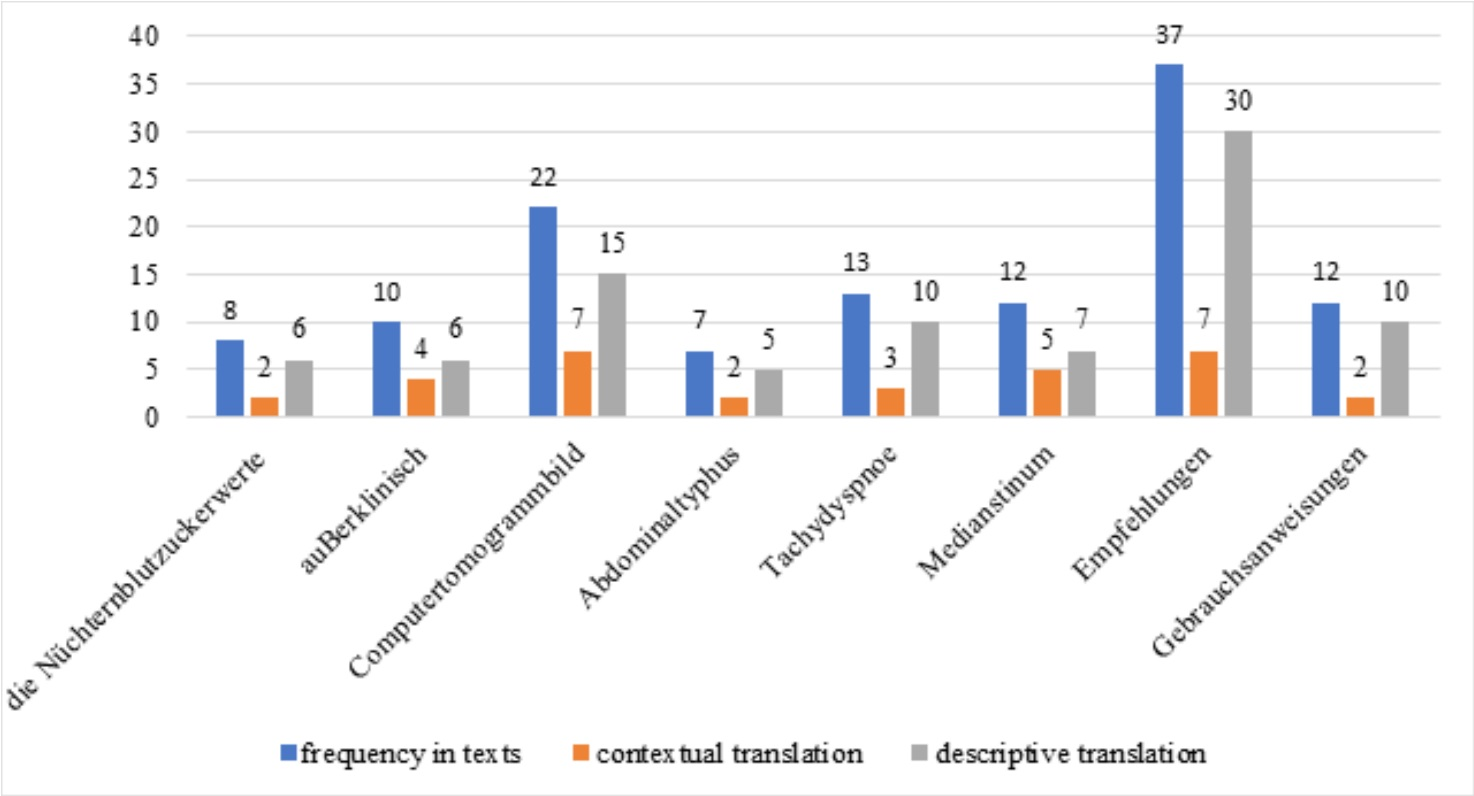
Figure 1.
The most frequent medical terms that do not have a direct equivalent, identified in the process of analyzing the texts of medical journals in Germany
compiled by the author using the program Neural Designer analytics
Thus, we can conclude that German medical texts are characterized by a high saturation of terminological and professional vocabulary, often borrowed or international, stylistically neutral in color. This vocabulary is formed in ways typical of the German language - suffixation, prefixation, suffix-prefixal way, word composition, abbreviation.
The elimination of individual members of the proposal gives an official protocol tone to medical texts in researched articles. The structure of the texts studied can be described as follows: the purpose, descriptive and instructive. The information presentations are similar to Russian medical texts.
The similarity in the structural and stylistic design of the corresponding Russian and German medical texts allows us to perceive and adequately convey the information contained in them. The comparative analysis method of terms’ semantics makes possible to use a descriptive method of translation as the main one for the translation of non-equivalent medical terminology.
Significantly more difficulties are caused by the abbreviations found in German texts of a medical orientation. Often, precisely such terminological blocks don’t have a direct equivalent in any language. The examples considered by us confirm this thesis. A frequency analysis of the data of terminological blocks is presented on the basis of an analysis of 50 medical texts of 10 different medical journals with Neural Designer analytics, and is graphically presented in Figure 2.
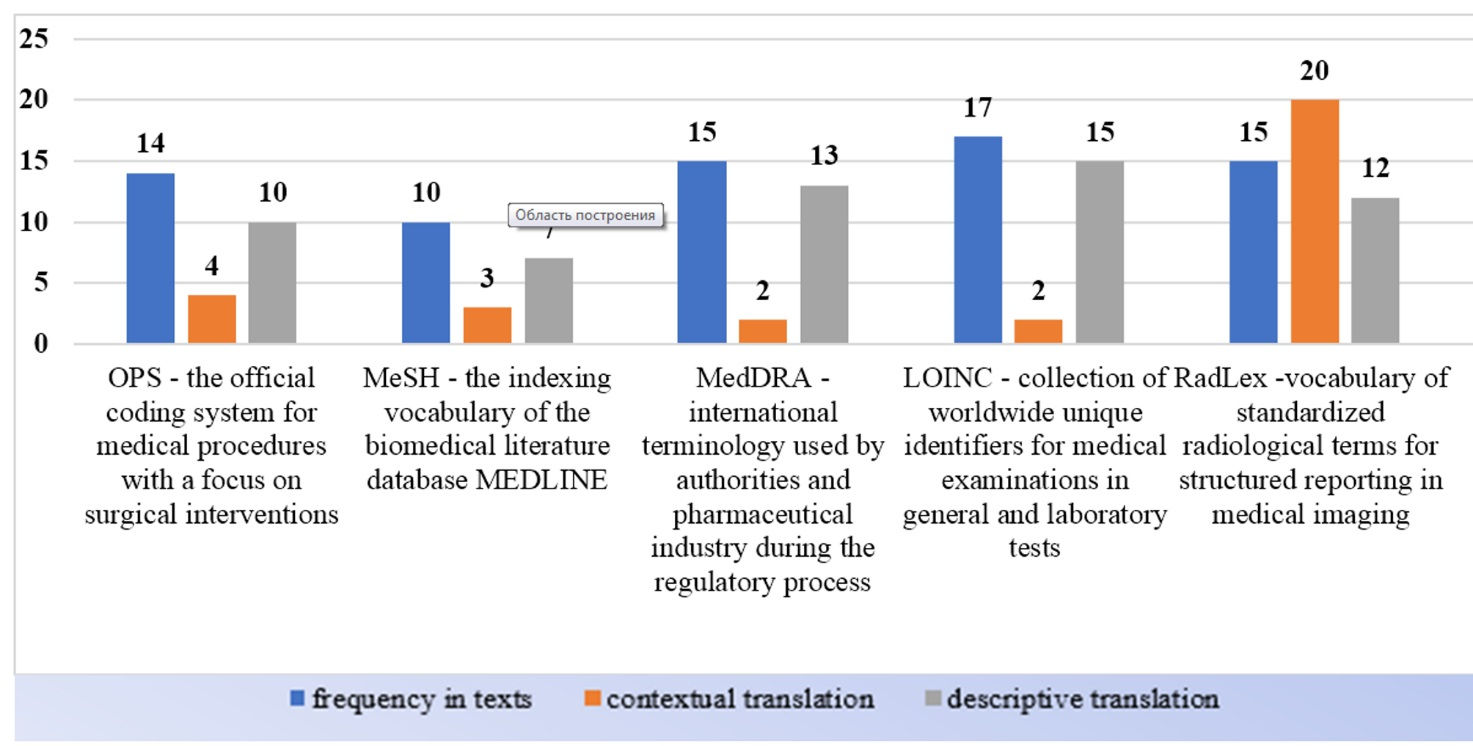
Figure 2.
Frequency of non- equivalent terms used as abbreviations in German medical texts
compiled by the author using the program Neural Designer analytics
In other cases, a translation into German covers no more or less synonyms than the original in English (for example, MeSH, RadLex), and also omits notes and definitions of volume. The German translation, which - in terms of size - far exceeds all other German medical dictionaries - is outdated and not officially available (Figure 3)
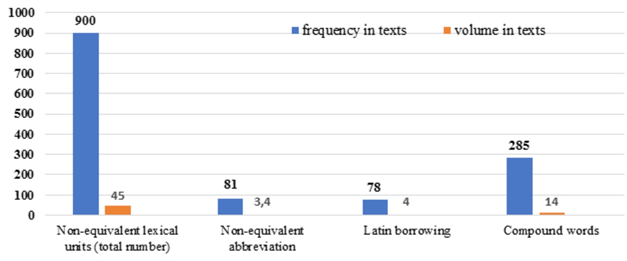
Figure 3.
The final analysis of the frequency of the identified non-equivalent lexical units in German medical texts, %
compiled by the author using the program Neural Designer analytics
The data shown in Figure 3 allow us to say that the equivalent vocabulary in the analyzed texts of German medical journals reaches 900 lexical units, i.e. approximately 45% of the total number of words. Abbreviations that do not have a direct equivalent in the Russian language are found in the total number of texts (50 scientific articles on medical topics) 81 times, making up 3.4% of words. Latin borrowings are represented by 78 lexical units, which accounted for approximately 4% of all studied lexical units that do not have an equivalent. The texts contained from 250 to 285 words of complex composition, that is, approximately 14% of all lexical units that did not have an equivalent. The number of abbreviations varied from 18 to 22 references in the texts, i.e. approximately 3%, respectively. The use of lexical units borrowed from different languages ranged from 250 to 267, or 14% of the words. The saturation of terminological and professional vocabulary, which does not have a direct equivalent in the Russian language, amounted to 900 lexical units in the studied texts in absolute terms, or approximately 45% of all medical terminology.
Our empirical study proves several points. First, the frequency analysis (Neural Designer analytics) showed that most of the equivalent vocabulary identified in the texts is represented by terms of highly specialized meaning and abbreviations. Secondly, our analysis allows us to say that it is the equivalent vocabulary that makes up almost half of the lexical units of medical terminology. This confirms the thesis about the increased complexity of translating medical texts from German.
Thirdly, the analyzed equivalent vocabulary is mainly translated in a descriptive way, judging by the frequency (Neural Designer analytics) of this kind of translation in annotated articles of German magazines.
The interpretation of equivalent vocabulary that has been established in translation studies as the vocabulary of source language, which has no equivalent in translating language, is internally contradictory, because usually immediately behind the definition of non-equivalency in translation works should list the methods of transmission equivalent vocabulary. In addition, such methods do exist - comparative linguistics descriptive translation method.
In other words, the non-equivalency still has the means to convey the meaning of equivalent vocabulary. In light of this, it is necessary to improve the interpretation so that this contradiction disappears.
Moreover, equivalence of vocabulary doesn’t mean that there is not at all an equivalent in the translation process. Such an equivalent ‘synthesized’ in the process of translation at the level of speech. In this context on-equivalence of vocabulary only means that in the system of translation language there is no ‘finished’ lexical equivalent or particular word with standard relevant collocations.
Thereby, non-equivalent vocabulary refers to foreign words and phrases denoting objects, processes and other realities of life that at this stage don’t have equivalents in the language of translation.
Speaking about the problems of non-equivalent vocabulary translation in medical texts, it seems advisable to focus on the translation process itself, as an activity, and as a result, as well as to identify approaches to the definition of non-equivalent vocabulary.
Discussion
Considering the main issue of translation studies - equivalence, i.e. the specific relationship between the texts of original language and translation language, allowing one to consider one text as a translation of another, do not ignore the premise of equivalence - translatability. By translatability we mean the fundamental possibility of translating the text (Barkhudarov, 2004).
When translating, language units are transferred from the original text to another sociocultural and linguistic environment. L. S. Barkhudarov (2004, р. 89), speaking of “[…] non-equivalent vocabulary […]”, identifies several ways of transmitting it when translated into another language. So, L. S. Barkhudarov identifies five main ways of transferring equivalent vocabulary to another language. However, the author of the classification makes a reservation: not every single type of transmission of equivalent vocabulary is able to give a complete and adequate translation, understandable to a representative of a different culture: the meaning of “[…] lexical education as a whole may remain unsolved” (Barkhudarov, 2004, p. 99). In this regard, there may be a combination of several (more often than two) of any of the methods when transmitting one reality / language unit, for example, translation transcription with descriptive translation.
Modern terminology researchers, in particular O. V. Prostotina and I. A. Skachinskaya, rightly point out specialized vocabularies do not always have time to fix educated lexical units, therefore, specialized literature should be used - journals, publications, and so on (Prostotina & Skachinskaya, 2018). The results of our study prove this thesis. Moreover, A. M. Fage‐Butler notes the specifics of the use of medical terms in popular science journals (Fage-Butler & Nisbeth Jensen, 2016). In our opinion, this problem deserves a separate and more thorough study using our proposed methodology: to use a computer program Neural Designer to extract terms and compare term by term in the source language with the target language.
The analysis carried out in our study also allows us to partially solve the problem of translation gaps, because, as S. M. Zokirova writes in her research (Zokirova, 2016), the problems of translation gaps can be solved by contrastive analysis with Neural Designer analytics.
H. B. Chen says in his study about the need of using statistics, quantitative indicators in medical text translation (Chen, Huang, Tan, Tjiu, & Chen, 2012), however, we need to clarify that statistical analysis is only required if there are data on the frequency of use of non-equivalent terms: their simple calculation is impossible, since each language is constantly updated with new terminology along with the development process of medicine itself.
In the course of our empirical research on the material of German scientific and popular magazines, we found that for translation non-equivalent medical terms, the most relevant methods of translation are contextual (to a lesser extent) and descriptive translation (the most common).These methods of translation and the frequency of their application to specific non-equivalent terms were shown in Figures 1, 2, and 3.
Non-equivalent terms are particularly difficult when translating medical texts. They are very numerous and require the translator to use special techniques for their adequate transmission.
To non-equivalent terminology, based on the results of our empirical research (using a computer program Neural Designer to extract terms and comparing term by term in the source language with the target language), we attributed two varieties of medical terms:
1. Terms naming phenomena (concepts) that are absent in domestic medical practice.
XI. Terms that refer to phenomena that arose in Russian reality not so long ago and have not yet formed a separate category in the relevant field. It is worth noting that this group of terms in PN does not have a term equivalent, but often there is an equivalent from another (often related) field of science. This equivalent will be able to convey the meaning, but will not satisfy the requirements for the terms, namely, it will not be characterized by the brevity and invariance of the structure and denote the species concept in the system.
In our opinion, the problem of nonequivalence should be considered by linguacultural approach in comparative linguistic framework. Such a consideration requires taking into account two aspects: vocabulary which belongs to the non-equivalent category because at this stage the translation language hasn’t yet proposed sufficiently good matches (in our study, specific abbreviations) and, secondly, vocabulary, which refers to the non-equivalent category because in the language of translation some equivalents cannot exist at all, and the only way out remains - tracing (constant non-equivalence). If the reason for the first non-equivalence is psychological, then the reason for the second is ever linguistic.
Conclusion
Based on the results of our study, we can conclude that some problems encountered during the medical text translation, are universal in nature and aren’t related to specifics of the German language. Such problems, in particular, are synonymy of terms, translation of eponyms, abbreviations, incomplete dictionaries. It is easy to see that these problems are mainly of terminological cause. Problems lying in the plane of morphology, syntax, stylistics, intercultural differences are highly specific, their set and essence vary significantly depending on language pairs. Therefore, medical texts translator must take into account the language system traits distinguishing the source and rendering languages, paying attention to correspondence and transformations related to all language levels. In this regard, mention should be made of the transfer medical texts pragmatic problem: to what extent the text translation should be close to structure and style standards of the German specialized texts. We claim maximum degree of this approximation since it will allow facilitate medical records management.
References
Aerzteblatt.de. (2020). Mehr als 100.000 herzchirurgische eingriffe in Deutschland. Retrieved from: https://www.aerzteblatt.de/nachrichten/114838/Mehr-als-100-000-herzchirurgische-Eingriffe-in-Deutschland.
Aerzteblatt.de. (2020a). IQWiG hält nutzenbewertung für nichtinvasive KHK-diagnostik für sinnvoll. Retrieved from: https://www.aerzteblatt.de/nachrichten/114274/IQWiG-haelt-Nutzenbewertung-fuer-nichtinvasive-KHK-Diagnostik-fuer-sinnvoll
Aerzteblatt.de. (2020b). Stabile angina: revaskularisierung schützt (anfangs) nicht vor herzinfarkt, verbessert aber lebensqualität. Retrieved from: https://www.aerzteblatt.de/nachrichten/111538/Stabile-Angina-Revaskularisierung-schuetzt-(anfangs)-nicht-vor-Herzinfarkt-verbessert-aber-Lebensqualitaet
Aerzteblatt.de. (2020c). Ernährung: isoflavone und tofu senken herz-kreislauf-risiko. Retrieved from: https://www. aerzteblatt.de/nachrichten/111322/Ernaehrung-Isoflavone-und-Tofu-senken-Herz-Kreislauf-Risiko
Aponet.de. (2020). Aloe vera ist kein wundermittel. Retrieved from: https://www.aponet.de/wissen/heilpflanzenlexikon/heilpflanzen-a-z/aloe.html
Aponet.de. (2020a). Heilpflanzenlexikon: erkältung. Retrieved from: https://www.aponet.de/wissen/heilpflanzenlexikon/anwendungsgebiete/erkaeltung.html
Aponet.de. (2020b). Mariendistel schützt die leber. Retrieved from: https://www.aponet.de/wissen/heilpflanzenlexikon/ heilpflanzen-a-z/mariendistel.html
Aponet.de. (2020c). Birkenblätter spülen die nieren. Retrieved from: https://www.aponet.de/wissen/heilpflanzenlexikon/heilpflanzen-a-z/birkenblaetter.html
Aponet.de. (2020d). Hauhechel hilft den harnwegen. Retrieved from: https://www.aponet.de/wissen/heilpflanzenlexikon/heilpflanzen-a-z/hauhechel.html
Apotheke Adhoc (2020). Biontech/Pfizer: corona-impfstoff im oktober einsatzbereit. Retrieved from: https://www.apotheke-adhoc.de/nachrichten/detail/coronavirus/biontechpfizer-corona-impfstoff-im-oktober-einsatzbereit-wettlauf-gegen-covid-19/
Apotheke Adhoc (2020a). Um 20 prozent: übernahmepreise für apotheken stürzen ab. Retrieved from: https://www.apotheke-adhoc.de/nachrichten/detail/apothekenpraxis/um-20-prozent-uebernahmepreise-fuer-apotheken-stuerzen-ab/
Apotheke Adhoc (2020b). Grippeschutzimpfung: zweites modellprojekt in der oberpfalz. Retrieved from: https://www.apotheke-adhoc.de/nachrichten/detail/politik/grippeschutzimpfung-zweites-modellprojekt-in-der-oberpfalz-bayerischer-apothekerverband/
Apotheken Kurier. (2020a). Kinderwunsch – familienplanung ohne hindernisse. Retrieved from: https://www.apothekenkurier.de/index.php/titel-artikel/1947-familienplanung-ohne-hindernisse
Apotheken Kurier. (2020b). Corona und die folgen fürs gewicht. Retrieved from: https://www.apothekenkurier.de/index.php/gesundheit/1942-corona-und-die-folgen-fuers-gewicht
Apotheken Kurier. (2020c). Im home-office gegen rückenprobleme. Retrieved from: https://www.apothekenkurier.de/index.php/gesundheit/1940-im-home-office-gegen-rueckenprobleme
Apotheken Kurier. (2020d). Männer: wechseljahre & Co. Retrieved from: https://www.apothekenkurier.de/index.php/gesundheit/1941-maenner-wechseljahre-co
Apotheken Kurier. (2020e). Familienplanung ohne hindernisse. Retrieved from: https://www.apothekenkurier.de/index.php/monatsthemen/1948-familienplanung-ohne-hindernisse
Barkhudarov, L. S. (2004). Questions of the general and private theory of translation, Language and translation. Moscow, RU: Academy.
Browne, A. (2016). Selected medical translation problems. Journal Prace Naukowe Akademii im. Jana Długosza w Częstochowie. Studia Neofilologiczne, 1(12), 121-128. Doi: 10.16926/sn.2016.12.09
Chen, H.-B., Huang, H.-H., Tan, C.-T., Tjiu, J., & Chen, H.-H. (2012). A statistical medical summary translation system. Proceedings of the 2º ACM SIGHIT International Health Informatics Symposium (p. 101-110). Miami, FL. Doi: 10.1145/2110363.2110378
Curtis, K., Fry, M., Shaban, R. Z., & Considine, J. (2017). Translating research findings to clinical nursing practice. Journal of Clinical Nursing, 26(5-6), 862-872. Doi: 10.1111/jocn.13586
Fage-Butler, A. M., & Nisbeth Jensen, M. (2016). Medical terminology in online patient-patient communication: evidence of high health literacy? Health Expectations, 19(3), 643-653. Doi: 10.1111/ hex.12395
Fontaine, F. (2020). Homöopathische hausapotheke: was gehört hinein? Retrieved from: https://www.gesundheitswissen.de/homoeopathie/homoeopathische-mittel/homoeopathische-%20hausapotheke-was-gehoert-hinein/
Gesundheitswissen. (2020). Medizinische fachgebiete: ein überblick. Retrieved from: https://www.gesundheitswissen.de/medizinische-fachgebiete/
Gesundheitswissen (2020a). Histaminintoleranz: symptome, ursachen & lebensmittel. Retrieved from: https://www.gesundheitswissen.de/ernaehrung/nahrungsmittelunvertraeglichkeit/histaminintoleranz-symptome-ursachen-lebensmittel/
Helm, B. (2020). Aromatherapie – portraits zu ätherischen ölen von a-z für ihre hausapotheke. Retrieved from: https://www.gesundheitswissen.de/alternative-medizin/pflanzenheilkunde/aetherische-oele/aromatherapie-portraits-zu-aetherischen-oelen-von-a-z-fuer-ihre-hausapotheke/
Hopwood, S. P. (2018). Key Challenges in Healthcare and Medical Translations. Retrieved from: https://www.daytranslations.com/blog/snag-health-translation/
Ihre Apotheke. (2020). Heilklima: einmal tief durchatmen. Retrieved from: http://www.apothekenratgeber.info/redaktion/thema/e/120888/
Ihre Apotheke. (2020a). Ganzheitliche therapien – der ursache auf den grund gehen. Retrieved from: http://www.apothekenratgeber.info/redaktion/thema/e/120963/
Ihre Apotheke. (2020b). Herpesbläschen. Retrieved from: http://www.apothekenratgeber.info/redaktion/thema/e/120848/
Ihre Apotheke. (2020c). Nervöse störungen sanft bei kindern ausgleichen. Retrieved from: http://www.apothekenratgeber.info/redaktion/thema/e/120936/
Ihre Apotheke. (2020d). Allergien – was hilft? Retrieved from: http://www.apothekenratgeber.info/redaktion/thema/e/120879/
Ivanova, S. V. (2016). Linguoculturology: studying the linguocultural universe. Vestnik Rossiyskogo Universiteta Druzhby Narodov. Seriya: Lingvistika, Bulletin of the Peoples’ Friendship University of Russia. Series: Linguistics, 20(2), 9-16.
Ivanova, S. V., & Borissova, A. S. (2018). Linguistics today: from interdisciplinarity to transdisciplinarity. Russian Journal of Linguistics, 22(1), 215-222. Doi: 10.22363/2312-9182-2018-22-1-215-222
Klein, L. (2020). 2,5 millionen botendienste im mai. Retrieved from https://www.apotheke-adhoc.de/nachrichten/detail/apothekenpraxis/25-millionen-botendienste-im-mai-kernzielgruppe-ue80/
Kompass Gesundheit. (2020). Medienexperten in sachen gesundheit. (2020). Retrieved from: http://www.kompass-gesundheit-bw.de/medizin
Kompass Gesundheit. (2020a). Das schlafmagazin: ausgabe 4/2010. Retrieved from: http://www.kompass-gesundheit-bw.de/medizin
Kompass Gesundheit. (2020b). Phänomen schlaf. Retrieved from http://www.kompass-gesundheit-bw.de/medizin
Kompass Gesundheit. (2020c). Wer unter depressionen leidet, sollte ganz besonders auf einen guten schlaf achten! Retrieved from: http://www.kompass-gesundheit-bw.de/medizin
Kompass Gesundheit. (2020d). Nachtschichten von Ärzten und pflegepersonal: für die patienten nicht immer ungefährlich. Retrieved from http://www.kompass-gesundheit-bw.de/medizin
Lapteva, N. Y., & Furashova, N. V. (2017). II international scientific conference “The universal and the national in the linguistic worldview “. Minsk, 14-15 October 2016. Bulletin of the Peoples’ Friendship University of Russia. Series: Linguistics, 21(1), 230-232.
Lee-Jahnke, H. (2002). L’enseignement de la traduction médicale: un double défi? Meta, 46(1), 145-153. Doi: 10.7202/003445ar
Lovtsevich, G. N., Gich, O. N., & Far Eastern Federal University. (2018). English and Russian terms ‘native speaker’: illusory equivalents. Russian Journal of Linguistics, 22(2), 436-447. Doi: 10.22363/2312-9182-2018-22-2-436-447
Lyon Catholic University. (2016). The terminological and phraseological challenges of medical translation. Retrieved from: https://medium.com/@ucly/the-terminological-and-phraseological-challenges-of-medical-translation-b8c81d6ab235
Manerko, L. A., & Sharapkov, A. N. (2015). European terminology studies: from the wusterian understanding of a term to the comprehension of cognition and communications. Bulletin of the Moscow Region State University. Series: Linguistics, 1(5), 24-32. Doi: 10.18384/2310-712X-2015-5-24-32
Medizin-welt. (2020a). CBD gegen schmerzen: natürliche schmerzfreiheit dank cannabidiol. Retrieved from: https://www.medizin-welt.info/aktuell/CBD-gegen-Schmerzen-Natuerliche-Schmerzfreiheit-dank-Cannabidiol/296
Medizin-welt. (2020b). Wie CBD öl HIV-kranken hilft, ihren alltag zu meistern. Retrieved from: https://www.medizin-welt.info/aktuell/Wie-CBD-Oel-HIV-Kranken-hilft-ihren-Alltag-zu-meistern/284
Medizin-Welt. (2020c). Hat kamillentee das potenzial zum neuen superfood? Retrieved from: https://www.medizin-welt.info/aktuell/Hat-Kamillentee-das-Potenzial-zum-neuen-Superfood/282
Medizin-Welt. (2020d). Glasige augen - welche ursachen haben sie? Retrieved from: https://www.medizin-welt.info/wissen/Glasige-Augen-welche-Ursachen-haben-sie/25
Medizin-Welt. (2020e). Schüßler-salze: anwendung und wirkung - zwölf salze müssen es sein. Retrieved from: https://www.medizin-welt.info/aktuell/Schuessler-Salze-Anwendung-und-Wirkung/112
Montalt, V., & González-Davies, M. (2014). Medical translation step by step: learning by drafting. London, UK: Routledge. Doi: 10.4324/9781315760377
Montalt, V., Zethsen, K., & Karwacka, W. (2018). Medical translation in the 21st century -challenges and trends. Current Challenges and Emerging Trends in Medical Translation, 1(10), 27-42. Doi: 10.6035/MonTI.2018.10.1
Müller, A. (2020). Apotheker hat pures glück. Retrieved from: https://www.apotheke-adhoc.de/nachrichten/detail/apothekenpraxis/aporetro-satire-apotheker-hat-pures-glueck/
Müller, A. (2020a). Botendienst-streit: wer fährt? Retrieved from: https://www.apotheke-adhoc.de/nachrichten/detail/politik/botendienst-streit-wer-faehrt/
Nedyavila, V. (2017). Challenges in Medical translation for outsourcing clinical trials. Retrieved from simultrans LLC website: https://www.simultrans.com/blog/challenges-in-medical-translation-for-outsourcing-clinical-trials
Negt, A. (2020). Shingrix zukünftig ab volljährigkeit. Retrieved from: https://www.apotheke-adhoc.de/nachrichten/detail/pharmazie/shingrix-zukuenftig-ab-volljaehrigkeit-empfehlung-zur-indikationserweiterung/
Negt, A. (2020a). Neu: keuchhusten-impfung für schwangere. Retrieved from: https://www.apotheke-adhoc.de/nachrichten/detail/pharmazie/neu-keuchhusten-impfung-fuer-schwangere-geaenderte-empfehlungen-stiko-zu-pertussis/
Negt, A. (2020b). Routineimpfungen für säuglinge: eine spritze weniger. Retrieved from: https://www.apotheke-adhoc.de/nachrichten/detail/pharmazie/routineimpfungen-fuer-saeuglinge-eine-spritze-weniger-stiko-aktualisiert-empfehlungen/
Osataeva, A. N. (2016). Osnovnyye problemy perevoda meditsinskikh terminov. Basic problems of translation of medical terms. Nauka, Tekhnika i Obrazovaniye - Science, Technology and Education, 6(24), 105-108.
Popova, A. Y., & Korepina, N. A. (2015). Translation problems of equivalent vocabulary. Bulletin of Irkutsk State Technical University, 1(96), 286-290.
Prostotina, O. V., & Skachinskaya, I. A. (2018). Specificity of translation of medical texts from English and German languages. Kazan Bulletin of Young Scientists, 2(4), 105-107.
Ratgeber Gesund.de. (2020). Kopfschmerz, übelkeit: was tun bei sonnenstich? Retrieved from: https://www.ratgebergesund.de/was-tun-bei-sonnenstich/
Ratgeber Gesund.de. (2020a). Haut mit sommersprossen ist empfindlich. Retrieved from: https://www.ratgebergesund.de/sommersprossen-empfindliche-haut/
Ratgeber Gesund.de. (2020b). Juckreiz plagt vor allem ältere menschen. Retrieved from: https://www.ratgebergesund.de/juckreiz-plagt-viele-senioren/
Ratgeber Gesund.de. (2020c). Erholung zuhause: urlaub auf balkonien. Retrieved from: https://www.ratgebergesund.de/urlaub-auf-balkonien/
Ratgeber Gesund.de. (2020d). Vorfreude ist die schönste freude. Retrieved from: https://www.ratgebergesund.de/vorfreude-ist-die-schoenste-freude/
Reinecke, F. (2020). Schlafrestriktion: durch begrenzung schlafstörungen effektiv therapieren. Retrieved from https://www.gesundheitswissen.de/innere-medizin/immunsystem/schlafrestriktion-durch-begrenzung-schlafstoerungen-effektiv-therapieren/
Taichman, D. B., Backus, J., Baethge, C., Bauchner, H., Flanagin, A., Florenzano, F., Frizelle, F. A., … Sahni, P. (2020). Eine neue interessenkonflikterklärung für medizinische zeitschriften. Deutsches Ärzteblatt, 1(117), 61-63. Retrieved from: https://www.aerzteblatt.de/archiv/212229/Eine-neue-Interessenkonflikterklaerung-fuer-medizinische-Zeitschriften
Titler, M. G. (2018). Translation research in practice: an introduction. OJIN: The Online Journal of Issues in Nursing, 23(2), Manuscript 1. Doi: 10.3912/OJIN.Vol23No02Man01
Tröbitscher, N. (2020). Weiterhin lieferengpass bei shingrix. Retrieved from: https://www.apotheke-adhoc.de/nachrichten/detail/pharmazie/weiterhin-lieferengpass-bei-shingrix-guertelrose-totimpfstoffs/
Zokirova, S. M. (2016). The notion of non-equivalent vocabulary in linguistics. International Journal on Studies in English Language and Literature, 4(7), 70-72. Doi: 10.20431/2347-3134.0407011
Notas de autor
maevskiy.ati@bk.ru
