Linguística
What cultural aspects should be taught in FL lessons? – A model for evaluating the cultural content in FL course-books
Que aspectos culturais devem ser ensinados nas aulas de língua estrangeira? – Um modelo de avaliação do conteúdo cultural em livros didáticos de língua estrangeira
What cultural aspects should be taught in FL lessons? – A model for evaluating the cultural content in FL course-books
Acta Scientiarum. Language and Culture, vol. 43, núm. 2, 2022
Universidade Estadual de Maringá
Recepción: 03 Febrero 2020
Aprobación: 22 Octubre 2020
Abstract: There is general agreement among intercultural scholars that FL course-books as dominant teaching materials have considerable influence on FL learners’ attitudes towards the target culture, as well as on their overall intercultural communicative competences (ICC). Therefore, in order to equip FL learners with the necessary intercultural knowledge and skills, much greater attention should be paid to the content of this fundamental didactic tool. A number of checklists and models have been elaborated in order to help to decide whether the particular teaching material has the potential to develop FL learners’ ICC. The present paper aims at summarising the results of document analyses that served to fine-tune the research instrument applied in a course-book package analysis. However, the findings of the research also provide a list of aspects that be treated in FL classrooms in order to develop learners’ ICC.
Keywords: FL education, FL course-books, intercultural communicative competences, intermediate level, document analysis, course-book analysis.
Resumo: Há um consenso geral entre pesquisadores interculturais de que o uso de livros-textos de língua estrangeira como o tipo de material dominante no ensino tem uma influência considerável nas atitudes dos aprendizes em relação à cultura alvo, bem como em suas competências comunicativas interculturais (CCI) como um todo. Portanto, a fim prover os estudantes de língua estrangeira com o conhecimento e as habilidades interculturais necessárias, uma atenção muito maior deve ser dada ao conteúdo dessa ferramenta didática fundamental. Vários modelos e listas de controle têm sido elaboradas para ajudar a decidir se um material de ensino particular tem o potencial de desenvolver as CCI dos aprendizes. O presente artigo tem por objetivo realizar um sumário dos resultados de análises de documentos que serviram para refinar o instrumento de pesquisa aplicado na análise de um conjunto de livros-textos. Entretanto, os resultados da pesquisa também fornecem uma lista de aspectos a serem tratados em aulas de língua estrangeira a fim de desenvolver as CCI dos alunos.
Palavras-chave: Educação em língua estrangeira, livros-textos de língua estrangeira, competências comunicativas interculturais, nível intermediário, análise de document, análise de livros-textos.
Introduction
According to Risager (1991), one of the new roles which FL textbooks should gradually acquire is that of mediator between the source culture, (also referred to as home culture or first culture, i.e.: the learner’s culture) and the target culture (where the target language is used as a first language), since they “[...] present the country in a nut-shell” (Risager, 1991, p. 191). What is more, Davcheva and Sercu (2003) emphasize that FL “[…] textbooks can significantly influence the way culture is taught in the FL classroom” (Davcheva & Sercu, 2003, p. 91). Therefore, as Byram (1991) puts it, this dominant role of FL course-books in developing ICC should be taken seriously by all those involved in FL education, especially course-book writers and teachers. With regard to the former, the aspects of ICC need to be taken into consideration when writing course-books. As far as FL teachers are concerned, they are expected to opt for such course-book packages that cater for a variety of ICC aspects suitably. This requires in-depth analysis of the selected teaching material(s), which should be based upon careful construction of a useful checklist, as inappropriately set guidelines might negatively affect the whole analysis and consequently the results of the investigation (Ansary & Babaii, 2002, Cunningsworth, 1984, Cunningsworth, 1995, Harmer, 1998). Therefore, the present paper is aimed at providing an overview of the results of the document analyses, i.e. of the categories and codes that were investigated in a course-book package analyses, and, which may be applied in case of investigating other course-books in Slovakia and throughout the whole world. However, the findings of the document analyses do not only serve as a checklist of criteria for analysing FL course-books; they can also be regarded as a framework of cultural aspects that should be treated in FL lessons.
The theoretical part, that provides the background of the study, deals with selected suggestions concerning the content of the course-books as well as with some models or checklists in terms of evaluating their intercultural potential. In addition, the concept of ICC and its aspects according to the Common European Framework for Reference in Languages (CEFR, 2001) are also discussed. The second part of the paper includes methodology, as well as discussion of the findings and conclusions.
Literature review
Recommendations on the cultural content in FL course-books
A number of recommendations have been provided both in terms of the cultural issues to be involved in FL course-book and lessons. According to Lafayette (1997), textbook publishers should take into consideration aspects, as follows: geographical monuments, historical events, major institutions (e.g., religious, political, etc.), artistic monuments (e.g., arts, literature, etc.), “[…] active everyday cultural patterns […]” (e.g., eating, shopping, etc.), “[…] passive […]” everyday cultural patterns (e.g., marriage, work), “[…] culture of the target language-related ethnic groups […]” and “[…] culture of non-European peoples speaking target language”. In addition, FL learners should also be able to “[…] act appropriately in common everyday situations, use appropriate common gestures and value different peoples and societies” (Lafayette, 1997, p. 123).
Similarly, Stern (1992) defines the cultural input of FL course-books and FL education in six areas, covering aspects which FL learners should have some familiarity with. They include geographical places, i.e., physical location to which FL learners are able to relate the target language; people and way of life, i.e., how they live, what they do and think; people and society, i.e., social, professional and economic groups; history; institutions; as well as art, music and other achievements.
As opposed to Lafayette and Stern’s viewpoint, Brooks (1997) argues that
[…] as long as we provide our students only with the facts of history and geography, economics and sociology, as long as we provide them only with a knowledge of the sophisticated structures of society such as law and medicine, or examples and appreciative comments on artistic creations such as poems, castles, or oil paintings, we have not yet provided them with an intimate view of where life’s action is, where the individual and the social order come together, where self meets life (Brooks, 1997, p. 25)
Hence, based on Hall’s scheme presented in The Silent Language, he (1959, in Brooks, 1997) constructed a list of 10 issues, as follows:
1. Symbolism: e.g., literature, art, myths, politics and religion;
2. Value: e.g., personal preference, morality, philosophy, etc.;
3. Authority: e.g., whose world is accepted at different stages in one’s life, etc.;
4. Order: e.g., dispositions towards a clear arrangements of thoughts, etc.;
5. Ceremony: e.g., dress, rituals;
6. Love: e.g., parent and child, husband and wife;
7. Honour: e.g., attitude towards ourselves, our families, friends or country;
8. Humour: e.g., what is witty and how it differs from one culture to another;
9. Beauty: e.g., in terms of the aesthetic sense of products of the human mind and hand;
10. Spirit: e.g., awareness of oneself as human at different phases and situations of life.
Brooks (1997) also emphasizes that culture should already be integrated in the early phases of the FL learning process, and, that it should be reflected in the teaching materials, as well.
Similarly, Risager (1991) elaborated a more profound, four-layer scheme of the cultural issues that should be covered by FL course-books and FL lessons. The first, so called “[…] micro level […]” includes “[…] phenomena of social and cultural anthropology […]”, i.e. “[…] the social and geographical definition of characters, material environment, situations of interaction, as well as interaction and subjectivity of the characters: feelings, attitudes, values, and perceived problems […]”, while “[…] macro level […]” refers to “[…] social, political, and historical matters […]”, i.e. “[…] broad social facts about contemporary society (geographical, economic, political, etc.), broad socio-political problems (unemployment, pollution, etc.) and historical background”. The third level covers “[…] international and intercultural issues […]”, i.e. “[…] comparisons between the foreign country and the pupils´ own, mutual representations, images, stereotypes, as well as mutual relations: cultural power and dominance, co-operation and conflict”. Finally, “[…] the point of view and style of the author […]” (Risager, 1991, p. 182-183) also has to be taken into consideration.
Models and checklists of investigating and evaluating the cultural content in FL course-books
In addition to the previous recommendations in terms of the cultural content of FL course-books, several checklists and models have also been designed to investigate and evaluate the cultural input in FL course-books.
Huhn (1978, in Byram 1989) distinguishes six criteria, as follows:
1. Cultural information must be accurate and contemporary;
2. The question of stereotypes must be handled critically;
3. It must provide a realistic picture of the foreign society;
4. It must be free from ideologies;
5. Facts should not be presented in isolation;
6. The historical material should be presented explicitly.
According to Cunningsworth (1984) the social and cultural context in the FL course must be comprehensible to the students and they should be able to interpret “[…] the relationships, behaviour, intentions, etc. of the characters portrayed in the book” (Cunningsworth, 1984, p. 92). His checklist also pays special attention to gender differences, e.g. it is important to examine whether women are treated equally to men, what inner qualities and physical attributes women are given, and what professional and social status women have. Other aspects focus on the inner lives of the characters portrayed in the course and the social background against which they exist. Similar criteria are also listed by Kilickaya (2004), that is, socio-cultural information, learners’ needs, stereotypes, generalisations and intercultural communication (Kilickaya, 2004).
Damen’s ‘textbook evaluation guide’ (1987) is divided into three parts. The first is focused on general information about the cultural content and its presentation; in evaluation a number questions are used, such as what specific cultural items are covered or how and through what method they are presented. The second part serves for the evaluation itself, i.e. giving personal opinion through answering a list of questions, e.g. whether the information is authentic, unbiased or problem-oriented, etc. Finally, the last part is designed to summarise the cultural load.
A further model for analysing the cultural content in FL textbooks was presented by Hatoss (2004). It resulted from a pilot study carried out as a content analysis of textbooks for English business communication within European context. The model focuses on the evaluation of three dimensions: text and visual input, methods used to teach the cultural content and aims set by the author/s or publisher/s of a particular textbook for developing learners’ intercultural competence. Input factors include sociolinguistic and pragmatic competences, sociocultural knowledge, as well as paralinguistic and semiotic input. With regard to the methods, implicit versus explicit as well as cognitive versus experiential teaching of the cultural input are concerned, and the criterion of the authors/publishers´ aims deals with the issue of assimilation.
Apart from the provided checklists, another set of categories and labelling codes was created by Reid (2014), who investigated how different aspects of ICC were implemented in teaching EFL at Slovak primary schools. In document analysis, she compared Slovak curricular documents with the CEFR, which also served as a core document for setting the categories and codes. Similarly to the previous checklist (by Hatoss, ibid.), hers takes into consideration all the aspects of ICC as described in CEFR (2001). Therefore, the next part of the paper deals with explaining the concept of ICC and its particular aspects according to the mentioned European core document in the field of FL education.
Understanding intercultural communicative competences according to Byram and the CEFR
The simplest and most frequent understanding of intercultural communicative competences is the ability of appropriate language use in a particular social setting (Byram, 1991, Hymes, 1974, in Brown, 2000, De Jong, 1996, Kachru & Nelson, 1996, Saville-Troike, 1996). The central idea of this definition can also be well-illustrated by Byram’s Model of intercultural communicative competences (1997), which consists of four dimensions, i.e., linguistic competence, sociolinguistic competence, discourse competence and intercultural competence (see Figure 1).
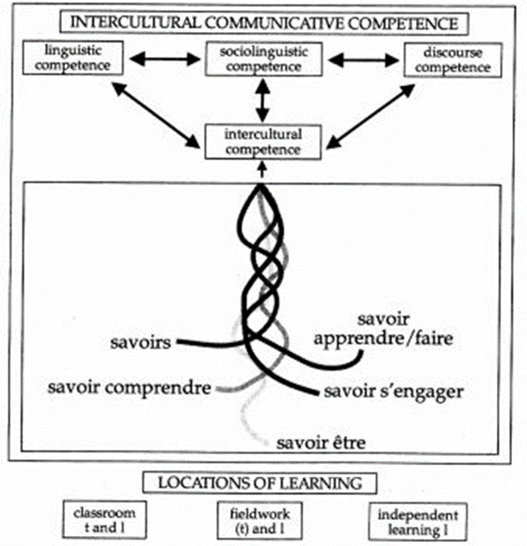
Figure 1.
Model of intercultural communicative competence (Byram, 1997, p. 73).
The model has also been accepted by the CEFR (2001) as the main curricular document of the European Union in the field of FL education, which was developed by the Council of Europe within the project entitled ‘Language Learning for European Citizenship’. The document proposes a framework for the elaboration of curricular documents, course syllabi, examinations as well as teaching materials for all European countries. It defines six reference levels of language proficiency, from Breakthrough (A1) and Waystage (A2), through Threshold (B1) and Vantage (B2), to Effective Mastery (C1) and Operational Proficiency (C2), providing illustrative scales of descriptors for each of them, in terms of what a FL user ‘can do’ at a particular stage. In addition, with regard to the components of ICC, a set of minimum requirements to ‘survive’ in the target country, i.e., for the Threshold level (B1), was elaborated and published as Threshold 1990 by J. A. Van Ek and John Trim (De Jong, 1996).
According to the CEFR (2001), all skills acquired by a person can contribute to the development of communicative competences; however, we have to differentiate between more language-connected abilities and less language- related skills. In these terms we have to distinguish between general and communicative language competences.
Drawing on the mentioned document general competences consist of declarative knowledge (savoir), skills and know-how (savoir faire), ‘existential’ competence (savoir être) and the ability to learn (savoir apprendre). While declarative knowledge comprises knowledge of the world, sociocultural knowledge and intercultural awareness, the ‘skills and know-how’ group stands for a sum of practical skills and know-how as well as intercultural skills and know-how. In addition, existential competence is connected with the individuals’ personality, as the ability to communicate is also affected by factors such as attitudes, motivations, values, beliefs, cognitive styles and personality types. Finally, the ability to learn refers to language and communication awareness, general phonetic awareness and skills, as well as to study and heuristic skills.
Furthermore, based on Byram’s model and the CEFR (2001), as one of the possible perceptions, communicative language competences can be understood as a sum of more language-related components which can be divided into linguistic, sociolinguistic and pragmatic competence. Firstly, linguistic competence includes lexical, grammatical, semantic, phonological, orthographic and orthoepic competence. Sociolinguistic competence involves “[…] linguistic markers of social relations, politeness conventions, expressions of folk-wisdom, register differences and dialect and accent” (CEFR, 2001, p. 118). Finally, pragmatic competence refers to the ability to use the language appropriately for particular purposes with regard to the sociocultural context and can further be divided into discourse, functional and design competence.
Byram (1997) divides intercultural competence into the following five groups: attitudes (savoir être), knowledge (savoirs), skills of interpreting and relating (savoir comprendre) and skills of discovery and interaction (savoir apprendre/faire), as well as critical cultural awareness (savoir s’engager). Attitudes refer to, for example, the willingness of the intercultural speaker to share his/her experience about others’ daily life; but can also mean that he/she is interested in others’ opinions on familiar or unfamiliar issues, or takes into consideration expectations about appropriate behaviour in a particular situation. Knowledge can be understood as the intercultural speaker’s familiarity with the historical events, cultural products, institutions or geographical features of his/her own and the interlocutor’s country. Skills of interpreting and relating comprise, for example, the readiness to identify the sources of misunderstandings and address them. Skills of discovery and interaction stand for identifying contemporary as well as historical relationships between cultures, behaving in accordance with the conventions of verbal and nonverbal interaction, etc. Finally, critical cultural awareness can be understood, for instance, in terms of identifying and interpreting values in one’s own and other cultures or being aware of potential conflicts between ideologies.
As aforementioned, the CEFR was one of the documents that were analysed in order to develop a model to be used in a course-book package analysis. However, based on this key document other materials, relevant in the field of FL education in Europe and in Slovakia, were also elaborated, such as Threshold 1990 (Van Ek & Trim, 1998), as well as two Slovak curricular documents, namely: The Slovak National Curriculum for the English Language ISCED 3 (ISCED 3, 2011) and The Goal Standards for students taking school leaving exam of English language at level B1 (Goal Standards, 2012).
The following part of the study contains the introduction of the sample as well as the description of the research instrument. In addition, the research objectives and questions are also included.
Research methodology
The given level was chosen mainly for the reason that the document analyses were part of the investigation focused on developing ICC at Slovak secondary schools; and, B1 presents the level of language proficiency that should be acquired by the majority of students in Slovakia by the end of their secondary school education. In addition, B1 level is also known as the Threshold level, that is the level when one “[…] has enough language to get by […]” or “[…] to survive […]” (CEFR, 2001, p. 38) in the country or community whose language he/she is learning.
The aim of the present study was to share the results of a document analysis which was part of a bigger investigation focused on an EFL course-book package analysis and took 2 years. Since FL course-books still play a key role in FL education, they have a considerable impact on the development of ICC, which is gaining more and more importance in today’s globalised word. However, a more culture-related FL teaching is not always reflected in everyday teaching practice, as can be concluded from the research carried out by Reid (2014), who investigated the ways in which different aspects of ICC were implemented in teaching EFL at Slovak primary schools. The results of the observations and interviews revealed that many teachers lack any knowledge of ICC and do not realize the importance of acquiring it. Hence, one of the objectives of the document analysis discussed in this study was to investigate whether Slovak key documents in EFL education, (described in the Research sample part), cater for the intercultural dimension of EFL teaching. Also, another aim was to analyse the selected European and Slovak key documents in EFL education, in order to identify the requirements that should be fulfilled by EFL course-books in terms of being suitable for developing ICC at B1 level. The given level was chosen mainly for the reason that the document analyses were part of the investigation focused on developing ICC at Slovak secondary schools; and, B1 presents the level of language proficiency that should be acquired by the majority of students in Slovakia by the end of their secondary school education. In addition, B1 level is also known as the “Threshold” level, that is the level when one “[…] has enough language to get by” or “[…] to survive […]” (CEFR, 2001, p. 38) in the country or community whose language he/she is learning .
Drawing on the mentioned research aims the following research question was formulated:
According to the selected European key documents in the field of EFL education, what specific requirements should be fulfilled by EFL lessons/EFL course-books to be suitable for B1 level in terms of developing ICC?
In addition, further research questions were defined, as follows:
1. In accordance with the European key documents in the field of FL education, what requirements should be fulfilled by EFL lessons/EFL course-books in order to be deemed suitable for B1 level in terms of developing sociolinguistic competence?
2. In accordance with the European key documents in the field of FL education, what requirements should be fulfilled by EFL lessons/EFL course-books in order to be deemed suitable for B1 level in terms of developing the aspects of pragmatic competence?
3. In accordance with the European key documents in the field of FL education, what requirements should be fulfilled by EFL lessons/EFL course-books in order to be deemed suitable for B1 level in terms of developing sociocultural competence?
4. In accordance with the European key documents in the field of FL education, what requirements should be fulfilled by EFL lessons/EFL course-books in order to be deemed suitable for B1 level in terms of developing para-linguistic competence?
5. In accordance with the European key documents in the field of FL education, what requirements should be fulfilled by EFL lessons/EFL course-books in order to be deemed suitable for B1 level in terms of developing intercultural competence?
In order to answer the above-given research questions, the documents were investigated through the method of content analysis, originally used in communication, journalism, sociology, psychology, and business (Neuendorf, 2002), which is considered to be one of the main methods of educational research today. As it is defined by Weber (1990), “[…] it is a research method that uses a set of procedures to make valid inferences from text” (Weber, 1990, p. 117). According to Cohen, Manion, and Morrison (2007), content analysis in a broader sense refers to the process of summarising and interpreting written data; whereas, in a narrower context, it is “[…] a strict and systematic set of procedures for rigorous analysis, examination and verification of the contents of written data” (Cohen et al., 2007, p. 475). One of the fundamental features of content analysis is that a vast amount of written data is reduced to smaller groups of information (Cohen et al., 2007), or as put by Weber (2007), long texts with loads of words are represented by fewer words or expressions. In addition, content analysis can be conducted with any written material, from documents to interview transcriptions and can be applied to examine large amounts of text (Cohen et al., 2007).
Two fundamental approaches to content analysis can be distinguished: a qualitative and a quantitative one. With regard to the present study, it can be regarded as qualitative since the focus was on the requirements provided by the examined materials, rather than the frequency of the defined codes.
The research instrument - developing categories and codes
Numerous scholars (Dörnyei, 2007, Flick, 2009, Weber, 1990, Zhang & Wildemuth, 2009) emphasise that the step of creating and applying a coding scheme is of crucial importance amongst the phases of content analysis, as it influences the outcomes of the whole study to the largest extent.
Categories and codes of the research instrument were selected based on four sources, as follows: the CEFR (2001), Threshold 1990 (Van Ek & Trim, 1998), A model for evaluating textbooks (Hatoss, 2004) and the set of categories and codes developed by Reid (2014). As a result, five categories, i.e. sociolinguistic competence, pragmatic competence, sociocultural competence, paralinguistic competence as well as intercultural competence and a sum of thirty-five codes were established (see Table 1).
Sampling strategy and research sample
With regard to the sampling strategy, purposive sampling, which is a typical feature of qualitative research, was opted for. “As its name suggests, the sample has been chosen for a specific purpose” (Cohen et al., 2007, p. 115). Specifically, in the case of the document analyses, the aim was to find requirements in terms of developing ICC at B1 level of language proficiency. For this purpose four documents were selected, as follows: the CEFR (2001) and Threshold 1990 (Van Ek & Trim, 1998), which can be considered as European key documents in the field of FL education, as well as the Slovak curricular documents, namely: The Slovak National Curriculum for the English Language ISCED 3 (ISCED 3, 2011) and The Goal Standards for students taking school leaving exam of English language at level B1 (Goal Standards, 2012).
Since the CEFR (2001) and Threshold 1990 (1998) are discussed in the Literature review part, the next part focuses mainly on the introduction of the Slovak curricular documents.

Table 1.
ategories and corresponding codes applied in the document analyses based on the CEFR (2001), Hatoss (2004), Reid (2014) and Threshold 1990 (Van Ek & Trim, 1998).
The Slovak education system is controlled by the School Act (245/2008), which was passed on 22nd May 2008, and it establishes two types of curricula: the ‘national curriculum’ and the ‘school curriculum’. The former (in Slovak: Celonárodný cieľový program vzdelávania) defines the basic stages and subjects, standards of students’ performance and model curricula. The latter (in Slovak: Cieľový program individuálnej inštitúcie vzdelávania), developed by individual schools, comprises subjects for each stage, taking into account specific features of the communities and regions where the institution in question is located. The national curriculum further specifies each core subject in terms of the knowledge, skills and understanding which the pupils are expected to develop during a given key stage. Thus, for the English language the programme of study consists of four levels, from preschool education through primary and lower secondary education to secondary education. However, since the present study investigates the requirements in terms of developing ICC at B1 level of language proficiency, (i.e. the level of the school leaving examinations at secondary schools), only the Slovak National Curriculum for the English Language ISCED 3 (Gadušová, Benčíková, Ormisová, & Vaššová, 2011) is examined.
In addition to ISCED 3, the objectives of EFL education at secondary schools in Slovakia are also specified by the Goal Standards for Students Taking School Leaving Exam of English Language at Level B1 (Goal Standards, ŠPÚ, 2013). Similarly to ISCED 3, this document was published by the National Institute for Education, elaborated and based upon the CEFR (2001), and is considered to be a key document in EFL education in Slovakia for the respective level.
The findings of the examination are discussed below; in addition, the conclusions, i.e. the answers to the research questions are provided in the final part of the paper.
Results and discussion
The results are discussed alongside the categories of the research instrument, i.e. sociolinguistic, pragmatic, sociocultural, para-linguistic and intercultural competences.
Sociolinguistic competence (see Table 2)
According to the illustrative scales of descriptors in the CEFR (2001), in terms of sociolinguistic competence, FL learners at level B1 are expected to be able to deal mostly with linguistic markers of social relations (codes No 1 – 3: greetings, addressing, expletives and fillers), and politeness conventions (codes No 5-7: negative politeness, appropriate use of please, thank you and similar expressions, impoliteness). Similarly, the examined Slovak curricular documents put the biggest emphasis on the development of the given aspects; even though, expletives and fillers, although the appropriate use of such expression as thank you and please are regarded of lesser importance.

Table 2.
Aspects of sociolinguistic competence that be treated in FL lessons and FL course-books at B1 level of language proficiency based on the CEFR (2001) and Threshold 1990 (Van Ek & Trim, 1998).
As far as codes No 8-10, i.e. expressions of folk wisdom, register differences, and dialect and accent differences are concerned, according to the CEFR (2001), it is only from level B2 that FL learners start to have “[…] an ability to cope with variation of speech, plus a greater degree of control over register and idiom” (CEFR, 2001, p. 122). However, the Slovak curricular documents claim that FL learners be able to use basic, common proverbs, sayings and idioms, and simple quotes.
In relation to register differences (code No 9), the Slovak documents are in agreement with the CEFR (2001) with regard to their preference for neutral register in which FL learners are expected to “[…] perform and respond to a wide range of language functions” (CEFR, 2001, p. 122). The reason for the preference is that neutral level of formality is most likely used by native speakers when communicating with foreigners. However, FL learners’ attention should also be drawn to more formal and informal registers so that they may become aware of the consequences of using them inappropriately.
Finally, with regard to dialect and accent (code No 10), according to the CEFR (2001) as well as the Slovak curricular documents, FL learners at level B1 are expected to understand standard dialect; even though the Goal Standards emphasises that learners be aware of differences between American and British English in vocabulary. Nevertheless, as Van Ek and Trim (1998) claim, FL users “[…] should be given experience in listening to a variety of norms, and/or regionally coloured speech (including the principal non-native varieties) which approximate to those norms and remain fully intelligible” (Van Ek & Trim, 1998, p. 116).
Pragmatic competence (See Table 3)
Regarding discourse competence (code No 11), it is emphasised in all the examined documents that FL learners at B1 level should be able to “[...] produce coherent stretches of language [...]” (CEFR, 2001, p. 123) in correspondence with the given topic, cause/effect, cohesion, coherence, style, register and rhetoric; while the focus is mainly on describing people, objects, places, activities, events, as well as narrating a story and writing personal letters. In addition, learners are also expected to be able to give simple presentations, make a phone call, develop short discourses, such as reports or messages, summarise the content or the idea of a text, write formal letters and opinion essays, and create a CV. Furthermore, in terms of interaction, they are expected to be able to “[...] exploit a wide range of simple language to deal with most situations likely to arise whilst travelling” (CEFR, 2001, p. 74).
Similarly to the previous competence, there was not any disagreement between the investigated documents in terms of the functional competence either. Thus, FL learners at B1 level are expected to use frequently occurring micro-functions and interaction schemata relatively accurately, but especially in relation to imparting and seeking information (code No 12), expressing finding out factual attitudes (code No 13), knowledge (code No 14), modality (code No 15), volition (code No 16) and emotions (code No 17). In addition, learners are also required to have a basic knowledge of expressions used when socialising (code No 19) and in suasion situations (code No 18).
Furthermore, with regard to the aspect of fluency, FL learners at level B1 should be able to use the strategies of structuring discourse (code No 20); concerning especially opening, turn-taking, ending the conversation, as well as summarising, using the means of hesitation, exemplification and enumeration) and communication repair (code No 21); i.e. trying out new words, requesting feedback, replacing, asking for correction and self-correction as the most important strategies.
Even though the aspect of interaction schemata is not particularly emphasised in the Slovak curricular documents, van Ek and Trim (1998, p. 83) claim that it may be useful to acquire certain verbal exchange patterns, such as making purchases, ordering food and drink, meeting people or having a discussion, since they occur relatively frequently and predictably.
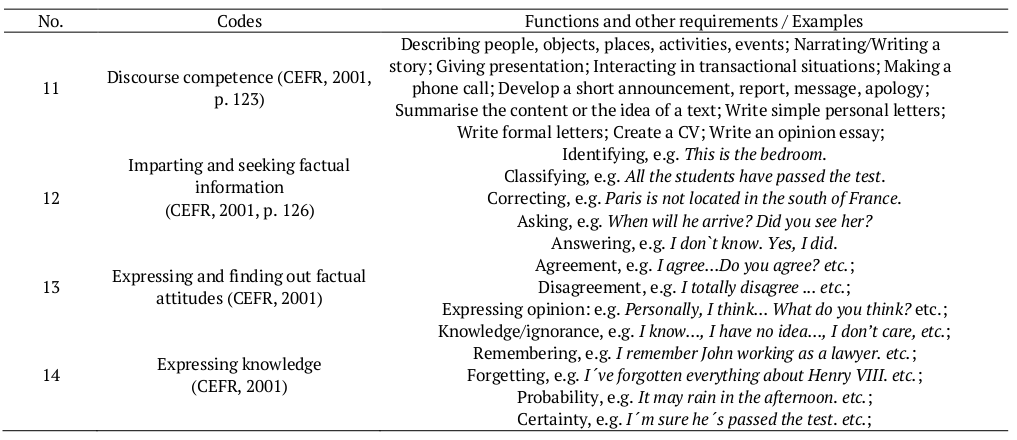
Table 3.
Aspects of pragmatic competence that be treated in FL lessons and FL course-books at B1 level of language proficiency based on the CEFR (2001) and Threshold 1990 (Van Ek & Trim, 1998).
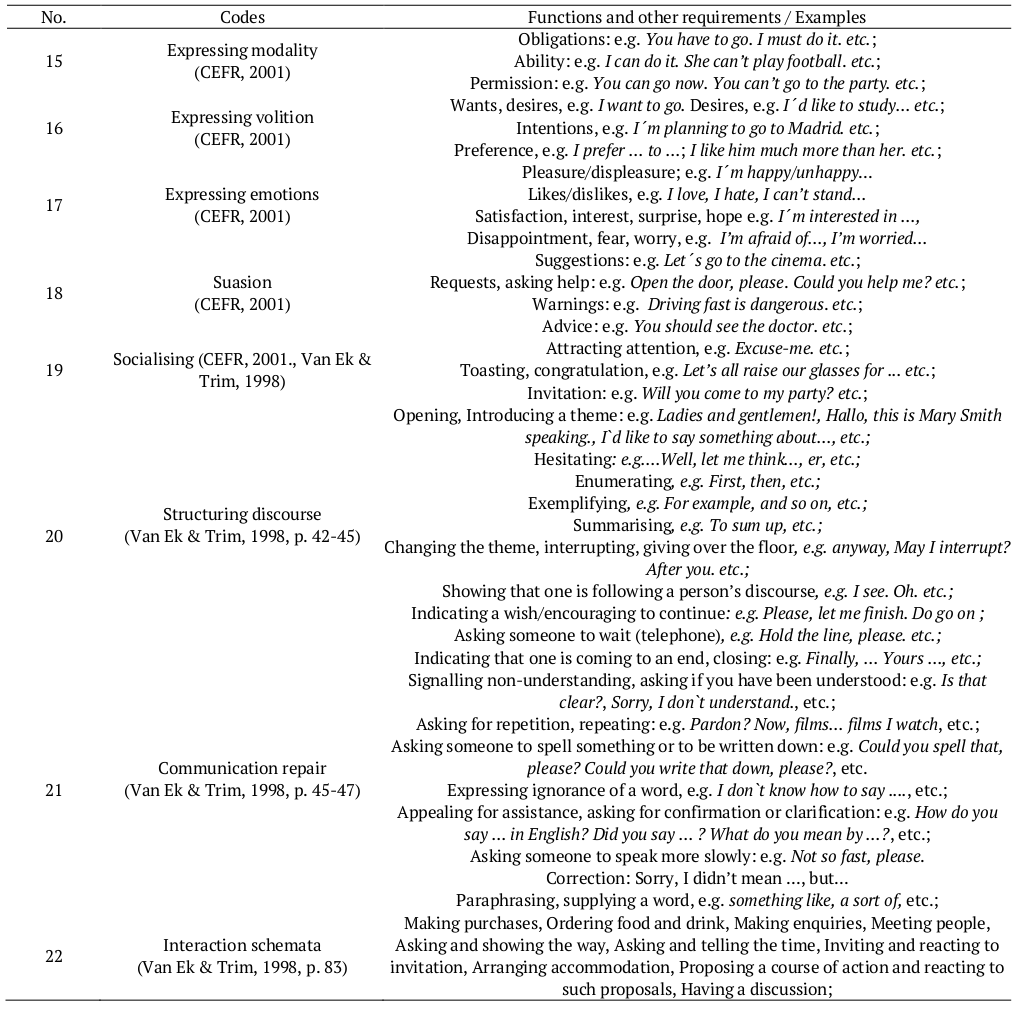
Sociocultural competence (See Table 4)
Regarding the requirements for this competence at B1 level, the CEFR (2001) does not provide any illustrative scales of descriptors, but states that it is up to the users of the Framework what knowledge of the society and culture of the target community the learner is expected to have. There are not any detailed instructions in the Slovak curricular documents either. In fact, the topics given for the oral form of school leaving examination do not really cater for the target culture. Hence, it is up to the teacher’s or the school’s decision to what extent they follow the cultural ‘realia’ of the target society.
However, in Threshold 1990 (1998, p. 95) there is a list of perspectives with which FL users at B1 level should be familiar. Firstly, with regard to issues of low culture – everyday living (code No 23), FL users at B1 level should be mainly acquainted with the facts about food, drink and meal times, major national holidays, working hours, and preferred leisure activities. This aspect is also mentioned in the Slovak curricular documents listing relatively identical issues. However, with high culture – arts (code No 24), there are not any requirements provided in any of the analysed documents.
Familiarity with living conditions (code No 25) in Van Ek and Trim’s (1998) understanding means that FL learners at B1 are aware of the “[…] living standards (including significant differences between major parts of a country) and the ethnic composition of the population” (Van Ek & Trim’s, 1998., p. 95). The other documents, however, do not cater for this aspect. Knowledge of interpersonal relations (code No 26) in Threshold 1990 (1998., p. 96) is narrowed to “[…] class structure of the country in question and relations between the classes, within the family, formality/informality in work situations and in contact with officials and major political groups” (Van Ek & Trim’s, 1998, p. 95). Familiarity with values, beliefs and attitudes (code No 27) translates as knowledge of “[…] the value generally attached to and prevalent attitude towards: social class, wealth and security, tradition, national identity and foreigners, politics, religion” (Van Ek & Trim’s, 1998, p. 95). The Slovak curricular documents, however, stress especially the awareness of customs and traditions in the target countries.
In Threshold 1990 (1998), aspects of social conventions and ritual behaviour (code No 28-29), are treated jointly and explained as familiarity with basic visiting rituals mainly in terms of “[…] punctuality, presents, dress, refreshments, drinks and meals, behavioural and conversational conventions and taboos, the length of stay and leave-taking” (Van Ek & Trim’s, 1998, p. 95). In addition, within this area, the learners are expected to recognize that eating and drinking habits which “[…] may differ from what is customary in their own country, and are ready to observe, and if appropriate, follow other’s examples” (Van Ek & Trim’s, 1998, p. 97). However, social conventions in the Slovak curricular documents are not specified in detail though quite frequently emphasised. Only the aspects of conversational conventions and taboos, family, religious and public celebrations are mentioned.

Table 4
Aspects of sociocultural competence that be treated in FL lessons and FL course-books at B1 level of language proficiency based on the CEFR (2001) and Threshold 1990 (Van Ek & Trim, 1998).
Para-linguistic competence (See Table 4)
Familiarity with practical actions (code No 30) is not treated in any of the documents. Similarly, there are not any descriptors of the aspect of extra linguistic speech (code No 32) either. However, knowledge of body language (code No 31) in van Ek and Trim (1998, p. 96) means awareness of “[...] conventions in different countries with regard to hand shaking, touching, embracing, kissing, gesticulation, close physical proximity and protracted direct eye contact”. What is more, learners are expected to bear in mind that neglecting such conventions may lead to embarrassment, misunderstanding or even conflicts. The Slovak curricular documents underline the importance of using nonverbal tools appropriately and avoiding gestures that may be insulting.
Finally, with regard to prosodic qualities (code No 33), the appropriate use of stress, (both primary and secondary, in words and sentences), and intonation is highlighted. Similarly, Van Ek and Trim (1998, p. 96) emphasise that
[…] learners at Threshold level should recognise and understand the most common intonations used in RP. In their own speech they should organise the phrasing, stressing and rhythm of tone groups in accordance with RP norms, and employ rising and falling nuclei appropriately (Van Ek & Trim, 1998, p. 96).
Based on the above discussed results, some modifications in the structure of sociocultural and paralinguistic competence seemed to be necessary; i.e. based on van Ek and Trim (1998), body language (code No 31) and prosodic qualities (code No 33) were transferred to the category of sociocultural competence. Furthermore, social conventions and ritual behaviour (code No 28-29) were combined into one code as social conventions and rituals (code No 28). In addition, since practical actions (code No 30) and extra linguistic speech (code No 32) are not recommended by any of the investigated materials, the category of paralinguistic competence has lost its relevance and was omitted (See Table 4).

Table 4.
Aspects of sociocultural competence that be treated in FL lessons and FL course-books at B1 level of language proficiency based on the CEFR (2001) and Threshold 1990 (Van Ek & Trim, 1998).
Intercultural competence (see Table 5)
Even though in the European documents no descriptors of intercultural awareness and intercultural skills and know-how are available (codes No 34-35), the requirements provided in the Slovak curricular documents could be summarised under the following four perspectives (see Table 5):
1. The role of first culture in developing ICC – reinforcing learner’s own cultural identity;
2. Understanding the similarities and differences between the target and the home culture;
3. Overcoming stereotypes;
4. Fostering cultural sensitivity towards other cultures;

Table 5.
Aspects of intercultural competence that be treated in FL lessons and FL course-books at B1 level of language proficiency based on the CEFR (2001) and Threshold 1990 (Van Ek & Trim, 1998).
Final considerations
In light of the above presented research findings, essential conclusions will be drawn by means of answering the further research questions.
1. In order to be suitable for developing sociolinguistic competence (see Table 2), EFL lessons and EFL course-books at B1 level should mainly deal with linguistic markers of social relations, i.e. greetings, addressing, expletives and fillers (codes No 1-3), as well as with politeness conventions, i.e. negative politeness, appropriate use of please, thank you and similar expressions, impoliteness (codes No 4-7). In addition, with regard to the expressions of folk wisdom (code No 8), teaching materials are expected to present basic, common proverbs, sayings and idioms, and simple quotes. Furthermore, in terms of register differences (code No 9), the emphasis in EFL lessons and EFL course-book packages should be put on neutral style paying adequate attention to more formal and informal registers. Finally, with regard to dialect and accent (code No 10), EFL courses should focus mainly on one standard variety of English, even though FL learners should also “[…] be given experience in listening to a variety of norms, and/or regionally coloured speech” (Van Ek & Trim, 1998, p. 116). In addition, EFL lessons and EFL teaching materials should also deal with lexical differences between American and British English.
2. In terms of appropriately developing pragmatic competence (see Table 3), EFL lessons and EFL course-books at B1 level should cater for all its three components, i.e. discourse, functional and design competences. Discourse competence (code No 11) should be developed by giving sufficient practice mainly in describing people, objects, etc., narrating a story and writing personal letters. Furthermore, the attention needs to be paid to imparting and seeking factual information (code No 11), expressing and finding out attitudes, such as expressing factual attitudes, knowledge, modality, volition and emotions (codes No 13-17), and likewise to selected micro-functions of suasion and socialising (codes No 18-19). In addition, FL learners should be given experience in using the strategies of structuring discourse and communication repair (codes No 20-21). Finally, with regard to design competence, EFL courses are required to deal with certain interaction patterns (code No 22).
3. In order to be suitable for developing the aspects of sociocultural competence (see Table 4) EFL lessons and EFL course-books at B1 level should provide for issues of low culture – everyday living (code No 23) such as food, drink and meal times, major national holidays, working hours, and preferred leisure activities. Even though high culture – arts (code No 24) are not particularly emphasised in any of the analysed documents, as Hatoss (2004) states, the cultural content should not be limited only to ‘low’ or ‘popular culture’ or everyday life issues. With respect to this argument, EFL courses have to provide some basic facts about the target countries’ arts, such as film, music, literature and visual arts. Furthermore, in terms of living conditions (code No 25) FL learners at B1 level should get acquainted mainly with the standard of living and the ethnic structure in the target societies. In addition, EFL courses are expected to offer information on interpersonal relation (code No 26), such as class structure, relations within the family, political groups and etc. Moreover, with regard to major values and attitudes (code No 27), the attention has to be drawn especially to social class, tradition, national identity and alike. Last but not least, with regard to social conventions and ritual behaviour (code No 28), EFL courses should teach visiting rituals, such as punctuality, giving/receiving presents, dress code, etc., as well as eating and drinking rituals in connection to refreshments, drinks and meals.
4. The suitability of the EFL courses in terms of developing para-linguistic competence (see Table 4) refers to teaching aspects of body language (code No 29), such as hand shaking, embracing, kissing, etc., as well as to raising awareness of the consequences in using them inappropriately. In addition, teaching materials should provide sufficient practice in practising prosodic qualities (code No 30), with a special emphasis on stress and intonation.
5. As to the requirements of developing intercultural competence (see Table 5), EFL lessons and EFL course-books are expected to raise FL learners’ awareness of the values of their own culture and of the target cultures, to foster understanding the similarities and differences between the target and their home culture, and to enhance overcoming stereotypes and cultural sensitivity to other cultures.
References
Ansary, H., & Babaii, E. (2002). Universal characteristics of EFL/ESL textbooks: a step towards systematic textbook evaluation. The Internet TESL Journal, 8(2). Retrieved on November 9, 2013 from http://iteslj.org/Articles/Ansary-Textbooks
Brooks, N. (1997). Teaching culture in the foreign language classroom. In P. R. Heusinkveld (Ed.), Pathways to culture: Readings on teaching culture in the foreign language class (p. 11-37). Yarmouth, ME: Intercultural Press.
Brown, H. D. (2000). Principles of language learning and teaching. White Plains, NY: Addison Wesley Longman.
Byram, M. (1989). Cultural studies in foreign language education. Clevedon, UK: Multilingual Matters.
Byram, M. (1991). Teaching culture and language: towards an integrated model. In D. Buttjes & M. Byram (Eds.), Mediating Languages and Cultures: Towards an Intercultural Theory of Foreign Language Education. (p. 17-32). Clevedon, UK: Multilingual Matters.
Byram, M. (1997). Teaching and assessing intercultural communicative competence. Clevedon, UK: Multilingual Matters.
Cohen, L., Manion, L., & Morrison, K. (2007). Research methods in education. New York, NY: Routledge. Retrieved on September 3, 2014 from https://bitlybr.com/jxurvqA
Council of Europe. (2001). A Common European Framework of Reference for language learning, teaching, assessment (CEFR). Strassbourg, FR: Cambridge University Press. Retrieved from http://www.coe.int/t/dg4/linguistic/Source/Framework_EN.pdf
Cunningsworth, A. (1984). Evaluating and selecting EFL teaching materials. Oxford, UK: Heinemann International.
Cunningsworth, A. (1995). Choosing your coursebook. Oxford, UK: Heinemannn English Language Teaching.
Damen, L. (1987). Culture learning: the fifth dimension in the language Classroom. Reading, MA: Addison-Wesley.
Davcheva, L., & Sercu, L. (2003). Culture in foreign language teaching materials. In L. Sercu, E. Bandura, P. Castro, L. Davcheva, C. Laskaridou, U. Lundgren, M. d. C. M. García & P. Ryan (Eds.), Foreign language teachers and intercultural competence. An international investigation (p. 90-109). Clevedon, UK: Multilingual Matters.
De Jong, W. (1996). Open frontiers: teaching English in an intercultural context. Oxford, UK: Reed Educational and Professional Publishing.
Dörnyei, Z. (2007). Research methods in applied linguistics : quantitative, qualitative and mixed methodologies. Oxford, UK : Oxford University Press.
Flick, S. (2009). An introduction to qualitative research. London, UK: SAGE Publications.
Gadušová, Z., Benčíková, E., Ormisová, M., & Vaššová, V. (2011). Štátny vzdelávací program. Anglický jazyk. Príloha ISCED 3. Úroveň B1. Bratislava: Štátny pedagogický ústav.
Harmer, J. (1998). How To Teach English?: an introduction to the practice of English language teaching. Harlow, UK: Longman.
Hatoss, A. (2004). A model for evaluating textbooks. Babel, 39(2), 25-32. Retrieved from http://eprints.usq.edu.au/1137/3/Hatoss_Babel_2004_PV.pdf
Kachru, B.B., & Nelson, C.L. (1996). World Englishes. In S. L. Mckay & N. H. Hornberger (Eds.), Sociolinguistics and language teaching (p. 71-102). Cambridge, UK: Cambridge University Press.
Kilickaya, F. (2004). Guidelines to evaluate cultural content in textbooks. The Internet TESL Journal [online], 10(12). Retrieved on November 8, 2003 from https://files.eric.ed.gov/fulltext/ED571265.pdf
Lafayette, R. C. (1997). Integrating the teaching of culture into the foreign language classroom. In P. R. Heusinkveld (Ed.), Pathways to culture: Readings on teaching culture in the foreign language class. (p. 119-148). Yarmouth, ME: Intercultural Press.
Neuendorf, K. A. (2002). The content analysis guidebook. Thousand Oaks, CA: Sage Publications. Retrieved on January 2, 2014 from https://academic.csuohio.edu/kneuendorf/SkalskiVitae/SkalskiNeuendorfCajigas17.pdf
Reid, E. (2014). Intercultural aspects in teaching English at primary schools. Frankfurt am Main, AL: Peter Lang Edition.
Risager, K. (1991). Cultural references in European textbooks: an evaluation of recent tendencies. In D. Buttjes & M. Byram (Eds.), Mediating languages and cultures: Towards an intercultural theory of foreign language education (p.181-192). Clevedon, UK: Multilingual Matters.
Saville-Troike, M. (1996). The ethnography of communication. In S. L. Mckay & N. H. Hornberger (Eds.), Sociolinguistics and Language Teaching (p. 351-382). Cambridge, UK: Cambridge University Press.
School Act, 245 (2008). Retrieved on October 28, 2021 from https://www.zakonypreludi.sk/zz/2008-245
Stern, H. H. (1992). Issues and options in language teaching. Oxford, UK: Oxford University Press.
Van Ek, J. A., & Trim, J. L. M. (1998). Threshold 1990. Cambridge, UK: Cambridge University Press.
Weber, R. P. (1990). Content Analysis. In R. P. Weber (Ed.), Basic Content Analysis (p. 117-124). Thousand Oaks, CA: Sage Publications. Retrieved on May 10, 2014 from http://wrt303sp08.files.wordpress.com/2008/01/weber_content-analysis.pdf
Zhang, Y., & Wildemuth, B. M. (2009). Qualitative analysis of content. In B. M. Wildemuth (Ed.), Applications of Social Research Methods to Questions in Information and Library Science (p. 308-19). Westport, CT: Libraries Unlimited. Retrieved on May 10, 2011 from https://www.ischool.utexas.edu/~yanz/Content_analysis.pdf
Notas de autor
zsandorova@ukf.sk