ORIGINAL PAPER
3D Printing and its Effect on Outsourcing: A Study of the Indian Aircraft Industry
 Vidhu Kampurath
Chaitanya Msrk
Vidhu Kampurath
Chaitanya Msrk
3D Printing and its Effect on Outsourcing: A Study of the Indian Aircraft Industry
Journal of Aerospace Technology and Management, vol. 10, e0718, 2018
Departamento de Ciência e Tecnologia Aeroespacial
Received: 24 December 2016
Accepted: 29 May 2017
ABSTRACT: Indian Aircraft Industry has emerged as one of the rapid growing industrial endeavors in the world, with automation in most of its production and manufacturing areas. Technological advancements have led to this growth and, over the years, competitiveness has made the industry to efficiently look for avenues and other strategic alliances. In this direction, 3D printing technology has opened many opportunities. This study is focused on explaining the 3D printing technology utilization for production and servicing apart from developing a methodology to outsource various automated technologies to the tier-2/tier-3 companies basing themselves on specified parameters and capabilities by using the 3D printing. 3D printing in manufacturing industry, particularly in aircraft manufacture, has brought in novel prospective along with new challenges posturing new methodologies and innovative approaches to meet the global standards. In this line, the Indian Aircraft Industry has started redistributing its sourcing by outsourcing of certain non-strategic facilities and parts that can be manufactured with the use of 3D printing/additive manufacturing, computerization and automation to outsiders, aiming at development of capabilities in the partnership industry, to provide the scope for generating high volume at the affiliated industries to pave way for a win-win ground. Already playing a good role in aircraft engine manufacture at Indian aircraft industry, 3D printing is going to play a more vital role in the total aircraft manufacture and avionics in the next few years, if the present scenario is pragmatic in line with the industrial needs. With the advantage of "low or zero" waste, less impact on environment, apart from possibility of local manufacture and just-in-time delivery, with greater specification of the final product, outsourcing of the parts and products for the entire aircraft manufacture will be a reality as per the current research, thriving on improved production volumes of similar parts for various end users. Research further suggests that outsourcing configuration is looking to invest in the new methods and "timely production" would become an assurance with 3D printing.
KEYWORDS: Automation, Digital reading, 3D printing, Additive manufacturing, Prototyping, Outsourcing, Virtual inventory, Indian Aircraft Industry.
INTRODUCTION
"3D printing" was initially developed as an automated method of producing "prototypes" and "prototype products" (Upcraft and Fletcher 2003). The competing technologies works based on edifying up of layers, layer by layer of "specific material such as plastic, nanometals, ceramics or metal powders, using a computer-aided design, which is therefore referred to as an 'additive' process, as each layer is 'printed' until a three-dimensional product is created" (Medlar 1990). 3D printing, therefore, is the "process of joining materials to make objects from 3D model data by printing them into three dimensional objects in a 3D printer" (Berman 2012) from raw materials in either liquid/semiliquid or particle form. "3D printing (which is generally known as 'additive manufacturing' (AM)), involves making of a three-dimensional object from a digital file or scan of the item. The 3D printing process is involved with building up of minute layers of material, layer by layer, giving the desired 3D shape" (Horn and Harrysson 2012). Instead of cutting or drilling something away to create an object, known as subtractive manufacturing, 3D printing adds layers, resulting in its name - additive manufacturing.
This 3D printing has brought new challenges in the industry. It is not possible for all the manufacturers to fabricate all the parts or to build everything in-house, even by using the latest technologies including 3D printing technology. They need to look for the new strategies with the development of new technology. A majority of the Fortune 500 companies are also outsourcing 3D printing projects for both prototypes and production runs to meet the benefits of concentrating on core competencies. Despite having a variety of resources at their disposal ‒ including own 3D printing equipment ‒ outsourcing for these firms can be a faster, less expensive and easier route. Outsourcing of aircraft parts manufacture and servicing has strategic importance in terms of capacity, technology, cost, experience, expertise and turnaround times. These specific issues are the main motivators for outsourcing 3D prints. This 3D technology is going to change the industrial production scenario and Indian Aircraft Industry (IAI) is not an exception. Resource constraint is always a bottleneck to production and servicing and how these constraints are to be converted into opportunity with new technology development in terms of 3D printing taking the aspects of waste reduction and timely production and attaining savings thereby.
Indian aircraft industry is on a high-growth trajectory and it is expected to become the world's largest by 2030 with both manufacturing and servicing capabilities, using new technologies in its stride. "Aircraft Industry in India, has ushered in the new era of expansion, driven by factors such as low-cost carriers (LCCs), modern airports, Foreign Direct Investment (FDI) in domestic airlines, advanced information technology (IT) interventions and growing emphasis on regional connectivity" (Bédier et al. 2008). "The world is focused on Indian aviation - from manufacturers, tourism boards, airlines and global businesses to individual travelers, shippers and businessmen. If we can find common purpose among all stakeholders in Indian aviation, a bright future is at hand" as stated by Mr. Tony Tyler, Director General and CEO, International Air Transport Association (IATA). "Indian domestic air traffic is expected to cross 100 million passengers by FY2017, compared to 81 million passengers in 2015, as per Centre for Asia Pacific Aviation (CAPA). India is among the five fastest-growing aviation markets globally with 275 million new passengers. The airlines operating in India are projected to record a collective operating profit of Rs 8,100 Crores (US$ 1.29 billion) in fiscal year 2016" according to Crisil Ltd. (Chan and Steev 2016).
3D printing is one such technological advancement, which is leading towards growth and expansion. "The world aerospace 3D printing market is projected to grow from USD 714.5 million in 2017 to USD 3,057.9 million by 2022, at a CAGR of 27.42% during the forecast period, 2017 to 2022" (IATA 2017). It is also expected to reach 40% CAGR as shown in Fig. 1.
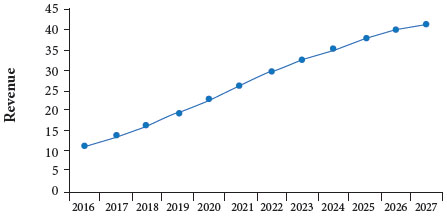
Figure 1
3D printing in aircraft industry - projected growth in million dollars.
In this direction, 3D printing in IAI has brought in novel prospective along with new challenges posturing new methodologies and innovative approaches to meet the global standards. IAI has started redistributing its sourcing by outsourcing of certain non-strategic facilities and parts that can be manufactured with the use of 3D printing/additive manufacturing, computerization and automation to outsiders, aiming at development of capabilities in the partnership industry, to provide the scope for generating high volume at the affiliated industries to pave way for a win-win ground. Aircraft Servicing, Maintenance, Repair & Overhaul (SMRO) is also expanding in the similar lines. This can be well described in terms of aircraft maintenance growth parametric as in Fig. 2.
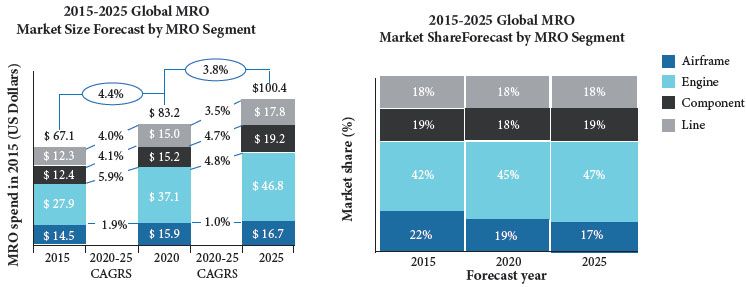
Figure 2
Aircraft servicing and MRO global market share forecast.
Outsourcing this new technology would help in economies of scale for the outsourcing agent/firm and maximize the number of parts that can be printed at a time for various customers by the outsourcing partner. It can further help in eliminating manufacturing and servicing bottlenecks such as the expenses of owning high-end 3D equipments. The major advantage for outsourcing aircraft servicing parts production is reducing the lead time that it takes to get a specific variety of material. How these advantages are taken on to the stride of IAI and how it is going to help other organizations, planning in the same direction, is explained in the paper. The case study questions there by stimulated are: 1. What are the 3D printing areas of aircraft parts and how the method of new technology outsourcing is being done at IAI?; 2. What are the challenges faced by IAI with the use of 3D printing?; 3. What the expected propositions as per the IAI outsourcing strategy?; 4. What are the gaps identified "between the requirements of the industry and suppliers" while 3D outsourcing at IAI?; 5. What are the advantages and drawbacks visualized by IAI, while adopting 3D printing?.
The directions for outsourcing 3D printing at IAI are explained in Fig. 3 and motivational reasons, in Fig. 4.
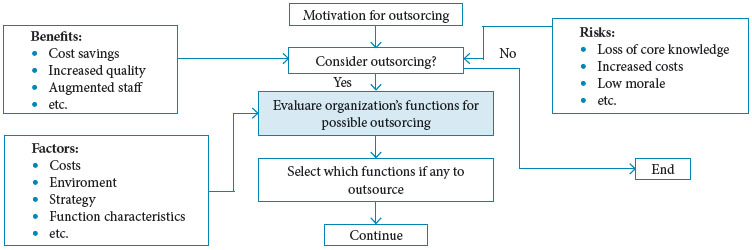
Figure 3
The motivation for outsourcing - directions.
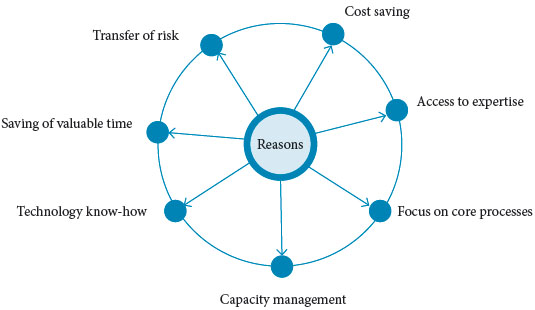
Figure 4
Motivation for outsourcing 3D printing of aircraft parts at IAI.
The rationale for utilizing "3D printing" for prototypes is convincing, compelling and preferred against traditional "reductive" manufacturing techniques or material removal machining processes that not only take longer time but is also more expensive apart from quantum wastage of material (Fig. 5 explains the potential mission). Mechanical parts and general items including accessories for aircraft, along with other consumer goods, can all be printed for review by the system designers, product designers and the engineers in the respective area, and then further revisions and revised printing is also uncomplicated. "Whereas mass production is viable due to economies of scale, it is uneconomical for 'one-offs' and prototypes. 3D printing will remove this differential, where every item produced is an original and tooling for one is as cheap as tooling for many" (Mohr and Khan 2015). Figure 6 indicates various additive manufacturing methods.
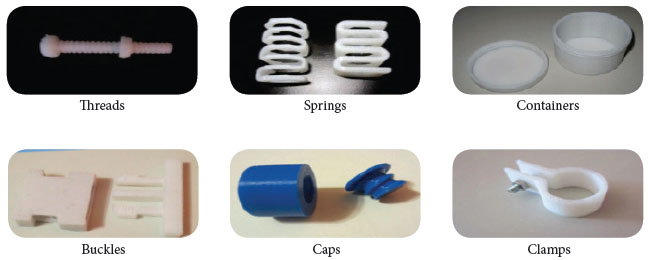
Figure 5
Parts manufactured using additive manufacturing.
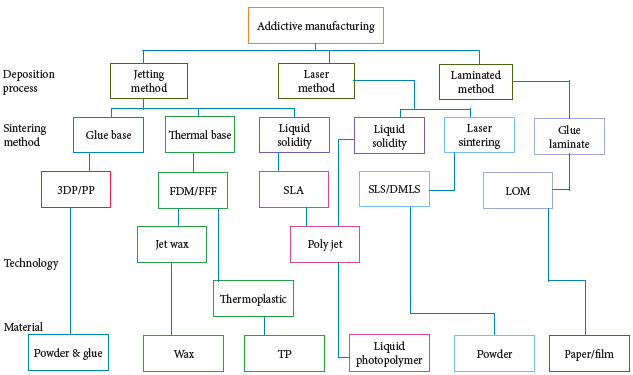
Figure 6
Additve manufacturing methods at IAI.
LITERATURE REVIEW
Taking the related threads from the article "The core competence of the corporation" by Dr. C.K. Prahalad and Gary Hamel, who coined the term "core competencies", which distinguish a company from its competitors and a firm need to keep its competitive advantage, the core activity(s) by keeping in-house (Prahalad and Hamel 1990). 3D printing requirements were also taken in the same direction to outsource. "Outsourcing allows airline management to focus attention on the core business of attracting and satisfying passengers or defence personnel with new aircraft or special purpose aircraft, while at the same time it releases capital and reduces the cost of support services as pleaded by Ghobrial (2005). "Airline maintenance quality is the result of well-trained mechanics maintaining the aircraft in accordance with the manufacturer's recommendations" (Rhoades et al. 2005).
Additive manufacturing has its traces in way back in the beginning of the 19th century, particularly in the fields of topography and photo-sculpture. However, in a Brief history of additive manufacturing and the 2009 roadmap for additive manufacturing, by Bourell et al. (2009), they cite that "in 1972 Ciraud released the first technology that truly represented today's definition of additive manufacturing".
"Ciraud's process is described as using 'meltable materials' and a beam of energy to melt it (the material), and thereby building layers, one on top of the other. Unfortunately, while there are drawings and sketches regarding Ciraud's invention, there is no proof that the technology was actually produced and executed" (Prinz et al. 1997). In a final report published by the Japanese and World Technology Evaluation Centers in 1997, Bourell again is a contributor on the historical perspective of additive manufacturing. "Here, the references Hideo Kodama as the first scientist known to have produced a functioning additive manufacturing system in 1981. Alan Herbert of 3M in 1982 then closely followed him. This time, there was proof that the technologies were developed and tested. Both Kodama and Herbert developed technologies where a prototype part was actually built, layer by layer" (Prinz et al. 1997).
"After a few years, Chuck Hull invented the stereolithography machine (SLA) in 1986. This machine is considered to be the first 3D printer" (Prinz et al. 1997). The stereolithography machine slowly poured liquid plastic to build plastic outputs. "Not surprisingly, this technology was very expensive and therefore, it was utilized only by large research universities, big companies, and government research labs. Today, there are three major additive manufacturing/3D printing methods. They are: 1) Fused Deposition Modeling (FDM), 2) Laser Sintering Platform (LSP), 3) and the Z-Printer Platform (ZPP)". (Medlar 1990).
Hull makes an excellent analogy regarding FDM technology; he likens it to a very sophisticated glue gun. This is currently the most commonly used 3D printer. "Laser Sintering Platforms can print other materials aside from plastic, viz.: metals, ceramics, etc. These printers are more sophisticated; however, they are also more expensive. Z-Printers, the third major technology, are also more sophisticated and again more expensive. It utilizes a powdery substance that solidifies with a sprayed binding chemical" (Hatch 2014). Thompson et al. "provided an overview of the major advancements, challenges and physical attributes related to Direct Laser Deposition (DLD) process" (Thompson et al. 2015).
The Atlantic Council, in "Could 3D printing change the world?" contended in 2014, that 3D printing could introduce both a manufacturing revolution and a fundamental shift to the global economy. The report identifies a broad range of potential impacts, including increased productivity in ageing societies (as a result of reduced labour requirements and health costs), low cost of local production in the developing world with reducing transport costs and waste, the reduction of global economic imbalances (the localization of production limits reliance on imports), the creation of new industries and professions, as well as trillions of dollars of new income for businesses based on innovative products and services including 3D printing (Langvardt 2015). The review of literature in relation to the IAI, outsourcing, aircraft maintenance engineering, parts requirements for maintenance, AOG situations, aircraft parts repair, rotable repair, component repair, component rebuilding, criteria for third-party vendors, monitoring and assessing vendor performance coupled with 3D printing technology and its outsourcing pros and cons, in the direction given through the following, is the step forward to this paper.
-
Mersie Amha Melke - 2010. "Outsourcing: an Air Carrier's perspective - its' pros and cons". Aircraft Maintenance Management Research ASCI 609 (Melke 2010). Embry-Riddle Aeronautical University Worldwide Online March 2010.
-
Hamad Al-kaabi, Andrew Potter, Mohamed Naim - 2010. "An outsourcing decision model for airlines' MRO activities". Journal of Quality in Maintenance Engineering (Medlar 1990). The gist of the explanation given by Al-kaabi.
-
Manda Varaprasada Rao - 2010. "There are several types of MRO services that make sense to keep 'in-house'. While low-tech, high-labor jobs (such as airframe maintenance) will not stay in-house, certain high-tech, low-labor positions (engines and avionics repair) could remain in-house if unions relax certain work rules to allow airlines to run more productively" ("Supply Chain Management Innovation - Best Practices in Aircraft Manufacturing & Servicing Industry in India" (Varaprasada Rao 2010).
-
Clare Scott - 2016. "New 3D Technologies From Israel - CES 2016 by Clare Scott (2016) - analyzed critically the new models that are going to emerge in next few years" (Thompson et al. 2015).
3D PRINTING OF AIRCRAFT PARTS
The digital file is an integral part of additive manufacturing. It includes the instructions for making the object, effectively telling the printer what to print. 3D modeling programs create the file for the product before it is sent to the printer. The printer reads the file and prints the layers that will result in the final product. Since 3D objects are created with many extremely thin layers, printers can make intricate, detailed products that would be difficult to manufacture with other methods.
"The promise of Additive Manufacturing (AM) is the use of fewer materials, lightweight alloys and to provide small cycle time towards rapid prototyping" (Flowers and Moniz 2002). "The AM processes would produce less scrap, address complex geometries and improve strength-to-weight ratios. AM has the potential to move manufacturing from mass production in large factories with dedicated machining and tooling lines to an era of mass customization and distributed manufacturing." (Chua et al. 1998). AM cost centers are currently more expensive than traditional CNC machining, and the production rate is slow. The powdered material availability and suitability in a variety of industrial applications is still evolving. The mechanical properties of the parts produced with AM have to be proven (The ASTM International Committee 2014) and are to meet the requirements of international aircraft regulations.
IAI has already started printing several parts for the "Kaveri Engine" in India through in-house printing as well as by outsourcing it to the collaborative partners in this area. The benefits of 3D printing of these parts reduced the manufacturing cycle time from 12 months to one and half months apart from other benefits lighter in weight, simpler design, innovative design features - more convoluted cooling stream pathways and support ligaments with higher robustness and durability.
"The production of 3D-printed parts in aircraft engines at IAI signals a paradigm shift that is happening with the emergence of additive manufacturing. Additive manufacturing not only offers the opportunity to design parts never before possible" (Thompson et al. 2016); engineers and scientists in additive manufacturing laboratories at IAI are working to design new methods of producing various critical parts using new materials by mixing and combining metal powders and composite materials using innovative technologies to print 3D avionic parts. Various aircraft parts printing visualization in this regard is given in Fig. 7.
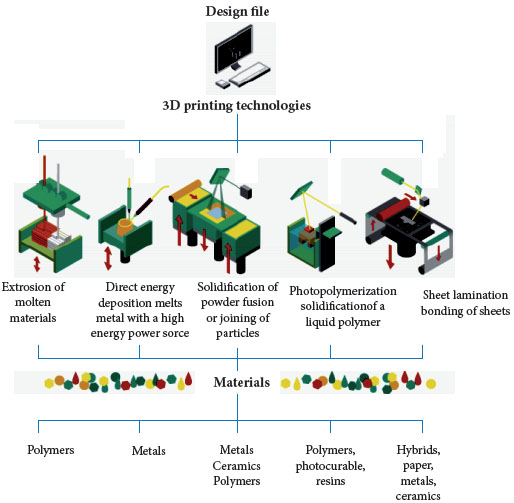
Figure 7
3D printing materials and machinery. Source: Wijk and Wijk (2015).
At IAI, the aircraft production with the introduction of "3D print products" brought in new dimension and has been described based on four key features comprising of "3D print" suppliers, contemporary market, technological know-how and aircraft regulations.
The scenarios in line with these 3D print applications were also developed at IAI especially for aircraft production. The selected "allusion scenario" characterizes a future where "individual customization fosters additive manufacturing technologies". The visualization of aircraft printing is detailed in Fig. 8.

Figure 8
Visualization of aircraft parts printing - individual customization using 3D printing.
The collaboration between aircraft manufacturers and suppliers of the aircraft industry has been improved significantly through partnerships for "3D print" parts and components. More conscientiousness has been transferred from OEMs to the suppliers and the suppliers contribute their own ideas to solve problems and develop various components using 3D printing/AM technologies, under constant consultation with the aircraft manufacturers. Simultaneously, the market accessibility for suppliers has also changed considerably, as the size of orders got increased within the last few years, only mega suppliers were able to handle these quantities with good "3D printing" facilities using several materials and compositions.
Due to the commitment of almost all aircraft manufacturers and many partnership firms/suppliers to implement AM-technologies/3D printing, in the production of aircraft parts, certification institutions including CEMILAC in India apart from foreign certification agencies FAA, CAA and JAA, among many others, have recognized the importance of the 3D printing/AM technologies stepping towards a common understanding in the value chain with IAI.
CHALLENGES TO THE USE OF 3D PRINTING IN AEROSPACE
Until now, 3D printing is chiefly used in aircraft industry for manufacturing prototypes, decorative non-vital parts and demonstration sample/specimens and not been used for large-scale production. "With 3D printing, the process for designing, modifying, developing and testing new parts has been achieved in shorter timeframes" (Marcus and Lakshminarayan 1992), in the recent past, creating greater efficiencies at IAI. However, there were other challenges:
-
Higher costs: the costs associated with the machinery and raw materials of 3D printing at present are almost 30 times costlier than the normal costs associated with traditional manufacturing processes as observed by 3D specialist companies like Stratasys and GE. These costs would naturally decrease with the innovations and technology changes that are taking place.
-
Speed of large-scale production: the major challenge with "3D printing is the speed of large-scale production. Quick setup time for each" (Janssen et al. 2014) built-up run paves the way for making a component by 3D printing and is the fast option for one-off/single part/single item of prototypes production, "But the total production time is effortlessly outpaced by conventional manufacturing methods when it comes to manufacturing parts in large numbers" (Autry et al. 2012).
-
Quality: product quality is another major concern at IAI with the use of 3D printing of components for aircraft. It is vital for IAI that parts produced for aircraft frame/body/fuselage or engines are free from defects and should withstand to various mechanical and thermal testing measures. "Selective laser melting technology, one of the leading methods of 3D printing, as of date, produces parts that can contain microscopic voids within the structure of the material. These components cannot be used in critical load-bearing applications within an aircraft and hence is a critical issue." (Vaezi et al. 2013). IAI had observed that the mechanical strengths are not in-line with the requirements of aircraft parts as the layer-by-layer printing technology needs additional methods to restructure the required properties into the components and looking forward for innovations in this direction.
-
Technology upgrade: new developments and volatility of technology innovation, as of now, given another method of "3D printing known as electron beam technology, which is a better method that is able to produce components and parts free from micro-voids" (Berman 2012). In such case, this method can safely be used to produce critical and highly stressed components, such as turbine blades in an aircraft engine and re-dome. However, it is too costly. "Electron beam technology works on a similar principle to that of selective laser melting, in that a powder is melted and allowed to cool into a solid form to gradually build up an object layer by layer" (Pham and Dimov 2012).
The real difference the 3D printing expected to bring to the aircraft industry can be broadly addressed in eight key essentials.
VETTING OUT DESIGNS
Materials improvements in "3D printing" are making various prototypes that are not just the copy of the look and feel of infusion-molded thermoplastics, yet can even reflect the properties for perfect functional testing. Rather than taking a 2D design plan to a tooling or shaping producer, designers, scientists and engineers utilize 3D printing for prototyping, and for finding configuration imperfections, which would ordinarily just surface only after tooling investments were made. At this juncture, reprototyping along with redesigning every now and then is prompting for more ideal items in general in the aircraft industry and at IAI in particular. Settling an outline defect should be possible basically by redesigning the 3D Computer Aided Design (CAD) file, reprint and then validate the same before investing in tooling.
MANUFACTURING AIDS
Many of the jigs, fixtures and other tools used for speeding up of the assembly lines as manufacturing aids are very important but are expensive as well as time-consuming in terms of set-up times. The additive manufacturing avoids such traditional manufacturing aids while printing the parts to produce durable and accurate parts for aircraft assembly lines today at IAI. "Manufacturing aids, such as custom tube flaring and bending dyes, jigs and fixtures, support bushings, cooling patterns, molds, locating plates/templates, and drill and saw guides became perhaps some of the best undisclosed secrets in 3D Printing. Using special 3D printing manufacturing aids" (Campbell et al. 2011) in 3D printing parametric would ensure a high level of quality at IAI which would help in maintaining efficiency along with quality.
PACKAGING
3D printing materials now reflect those utilized as a part of entangled environments with temperature/heat, pressure and stress which include elite thermoplastics like polycarbonate and Acrylonitrile Butadiene Styrene (ABS). "These materials, coupled with 3D printing, are being used to create custom thermoforming patterns. Custom thermoforming patterns would benefit from 3D printing as the technology can archive designs which vary in thickness, patterns with varying sizes and multiple shapes" (Evans 2002).
PRODUCTION
Material developments and new material innovations are changing the 3D printing methodologies. End product manufacturing is now with 3D printing rather than transferring from 3D printing into mechanical production systems like injection molding. IAI discovered that the intricacy with 3D printing embodiments is valuable for going away from more conventional production methods. IAI is finding 3D printing is ideal for complicated parts production and can also be outsourced to the partners at near site during the occasions of AOG as well as when:
-
3D printing is possible for the particular part design. At IAI, it is observed most frequently that multifunctional units, non-load bearing units, simple padding and ducting with complex geometry are feasible and these parts printing along with technology can be outsourced to the partners in the consortium.
-
The production volume of the quantum requirements at IAI is comparatively low and the overhead expenditure in tooling and fixing are very high. This is more so in case of the requirements of a particular part is very small like one part per aircraft. 3D printing is the more economical and right choice and can meet such small replacements in servicing aircraft. Even production of such parts for manufacture also found to be viable which would reduce the total cost of aircraft. As such, these simple production volumes of parts can also be outsourced to the partners who can combine similar requirements and increase production volume, to arrive at right sales volume.
-
The turnaround of a part or replacement of a part is simpler and shorter than a conventional production process or obtaining a part from a foreign source, as has been observed at IAI. 3D printing is a rapid process and the turnaround time or replacement time for the part can be linked with total servicing time of the aircraft, as there is no time lost in developing a tool. 3D print "design files" can be sent straight away to the outsourced printer for production at the near location and then can be "post-processed" as needed. To reduce idle time, the outsourced partners can go for combined volumes of production while meeting the current situation.
VIRTUAL INVENTORY
3D printing itself is a synonym of virtual inventory. Various designs are saved on computers or on storage discs or uploaded to the cloud. The 3D printing manufacturer will access the specific files as per requirements, print and ship parts to IAI or its customer. Now data supporting and data retrieval methods are more important and supporting the supply chain and the manufacturing floor to boost productivity would be helpful. The size and variety of material usage and capacity are going to become the deciding parameters of 3D printing with outsourced partners for specified parts at IAI.
However, the constraints are:
-
Printing process: 3D printing technologies including "fused deposition modeling" or "stereolithography" processes are not suitable for rapid prototyping and simple applications or low volumes of production.
-
Labor cost penalty: the pre- and post-printing cost including huge labor cost by way of salaries paid to employees, which are part of the total cost of production of an item becomes a criterion. Even though the cost for 3D printers and materials come down, the labor cost is going to be there as a deciding component as has been visualized by IAI.
ECONOMIES
It is also envisaged that manufacturing sector, especially the aircraft industry, may not change drastically, rendering traditional factories obsolete. The straightforward fact is the economies of 3D printing and its initial high cost and vast variety of parts needed by the aircraft industry possibly in lesser volume. Therefore, instead of looking at 3D printing as a substitute for the current manufacturing methods, it needs to look at the methods and modalities where the 3D printing can be used with its unique capabilities to complement the concurrent high-speed manufacturing processes including CNC.
LABOR COSTS
As has been visualized at earlier paragraphs, the important point in 3D printing is high labor cost. "3D printing does not happen 'at the touch of a button'; it involves considerable pre- and post-processing, which incur non-trivial labor costs requiring skilled manpower. The starting point for any 3D printing process is a 3D file that can be 'printed' (Gibson et al. 2011). "Just having an electronic CAD drawing is not sufficient; currently, there is no way to automatically convert the CAD drawing into a 3D file" (Mohr and Khan 2015). IAI is keenly looking for new technology in this regard.
IMPLICIT KNOWLEDGE & INVESTMENTS
"Creating printable files involves two steps: creating a three-dimensional volume model that can be printed, and 'slicing' that volume model in the best possible way to avoid material wastage and prevent printing errors" (Dimitrov et al. 2006). As has been noticed at IAI, these two steps require implicit and explicit knowledge. Immediately after printing the part, to make it usable readily, it needs to go through processes like recovery, cleaning, washing, polishing, apart from inspecting the same for suitability through various tests. As of now, the hardware items like bolts and nuts, brackets and connectors and other commonly used items, which are manufactured in bulk, with required quality aspects, are simpler to store in bulk and utilize instead of printing such items by using 3D printing. The investment in printing such parts will be much higher and IAI prefers to stock such inventories for lifetime requirements of the aircraft by "stock piling".
IMPLICATIONS OF 3D PRINTING - EXPECTED PROPOSITIONS
3D printing technologies as manufacturing technology for the IAI, by strategic insourcing and outsourcing, if used in prospective areas, the following propositions are expected:
-
Goods/spares/items that were previously produced in various countries/outsourced to other countries could be "near-sourced" to the location, which would reduce shipping costs and constraints.
-
Warehousing requirements would come down and inventory levels would also come down due to "mass customization" of products, as goods are made to order and products are stored in a computer file for production.
-
Logistics and related processes become nil or be near to zero, as manufacturing processes are increasingly rebundled into a single location or area with one or more facilities.
-
"'Downstream logistics' would also be affected. Build-to-order production strategies could fundamentally affect the manufacturer-wholesaler-retailer relationship. There will be no items on display with the firms making the shopping experience immeasurably different" (Campbell et al. 2011; Sachs et al. 1992). Orders are executed directly between the manufacturer and customer/client.
-
New logistic methods would be developed dealing with the storage and movement of the 3D printers, raw materials and "direct feed stocks".
-
The service parts logistics/spare parts retailers would be affected mainly in that the old stocks may become obsolete and outmoded.
The prices of 3D printers are falling and will continue to fall as a result of more companies employing the technology and it is expected to revolutionize the industry. The potential benefits that IAI deriving from 3D printing are:
-
Reduced need to outsource products from long distances: many manufacturing companies make products from outsourced parts, gathering these components from various factories before they come together in one area for assembly. Outsourcing parts to overseas or very far of distances is costly and time-consuming, which can reduce profit for manufacturing companies. With 3D printing, IAI could easily produce some of the parts on site or near site, saving time on assembly and money on outsourcing costs.
-
Better-managed inventory: IAI is able to manage inventory more effectively when utilizing 3D printing. Instead of incurring the high costs associated with either holding inventory or for on time deliveries, IAI and its partnership companies could print products or components on demand.
-
Reduced cost of prototypes: 3D printing is proved to be beneficial when creating prototypes during the design phase. Manufacturing multiple items of prototypes can be cost prohibitive for many companies, due to low volumes and high fixed costs.
-
Low volume manufacturing: when using subtractive manufacturing techniques, products are often cheaper to make in higher volumes. However, low-volume manufacturing becomes less expensive with 3D printing, at IAI, allowing for cost-effective customization of products. This also helped in improving localization of outsourcing and ancillary development for 3D printing.
-
High precision: parts are produced at IAI and its ancillaries to a specific design with particular precision using 3D printing. There is hardly any waste when compared with traditional methods. In addition, 3D printing machinery could be used to print a wide range of different parts that are needed by the industry without requiring a lengthy setup process. Replacement of parts can be quick without any additional study and part-number mismatch.
Many of the aircraft industries worldwide, including IAI, have already adopted 3D printing technology. As of now, IAI uses 3D printing to produce simple metallic parts and few plastic parts for aircraft. IAI is also using 3D printing for development of prototypes for its research and development. "At the company's Rapid Prototyping and Modeling Lab, located in Seattle, Boeing technicians use lasers to build components layer by layer. This technique, which is known as selective laser melting, uses high-powered laser energy to melt the starting material viz., plastic or metal powder, to create a solid layer of material. Gradually, these layers build up to make a component that exactly matches the computer-generated design model" (Mohr and Khan 2015). IAI is keen to adopt these technologies.
"NASA uses a similar 3D printing process to produce several of the parts used in its rocket engines. In 2012, NASA announced that it would be using selective laser melting to produce critical parts for the engines that will power its new space launch system, which is expected to have its maiden voyage in 2017. NASA engineers came across difficulties in manufacturing a critical part via traditional methods due to its sharply bent shape. Selective laser melting produced this small and vital component. Tests demonstrated, however, that the microscopic structure of the final product was not quite as strong as that of conventionally produced products" (NASA 2009; NASA 2010). IAI is taking cues from these experimentations.
VALUE ADDED OUTSOURCING THROUGH PARTNERS AT IAI
Outsourced partners of IAI have emerged as value-adding partners in industrial relationships from "component manufacture to avionics integration on the aircraft" in manufacturing and critical management in both manufacturing and servicing aircraft at IAI. These values could be derived effectively in IAI by keeping long-term strategic relationships with the suppliers.
Long-term business agreements and sustainable partnerships are the essence of the satisfied outsourcing partners at IAI in all their echelons. The win-win relationship between the giant aircraft industry and its partners, vendors and suppliers will be able to meet the challenges in the contemporary world, because of:
-
Rapid changes and complexity in technology.
-
Product life cycle and component becoming outdated.
-
Lead time shrinking for product introductions.
-
Increasing cost pressure.
-
Increased global manufacturers transaction activity.
-
Total demand and supply real-time view and production information.
-
Visibility in supply chain optimization.
-
Suppliers are placed at the centre of supply chain.
-
Supplier's solutions to innovative breakthrough.
"Technology is the key driver for innovations and thus decisive parametric for the competitiveness of industries" (Audretsch 1995). To transfer their potential into innovations, "it is necessary to align the technology development with current and future market requirements using Market Pull" (NRC 2012). Such market pull enables the AM industry to expand and track the demand-oriented technology strategies, and thus to efficiently and successfully advance AM technology into a reliable technology including the specialist partners through outsourcing in the specified areas. The requirements constitute a profound basis for the deduction of required technological advancements of AM technologies. A comprehensive assignment of requirements to innovation fields has been taken up and many of the identified requirements are decisive for more than one innovation field as per the study carried out at IAI. Figure 9 shows an extract of the assignment, indicating which requirements (row) the innovation fields (column) impose on this technology enhanced 3D printing outsourcing. Figure 9 is the indicative chart of the gaps between requirements of the industry and the supply pattern.
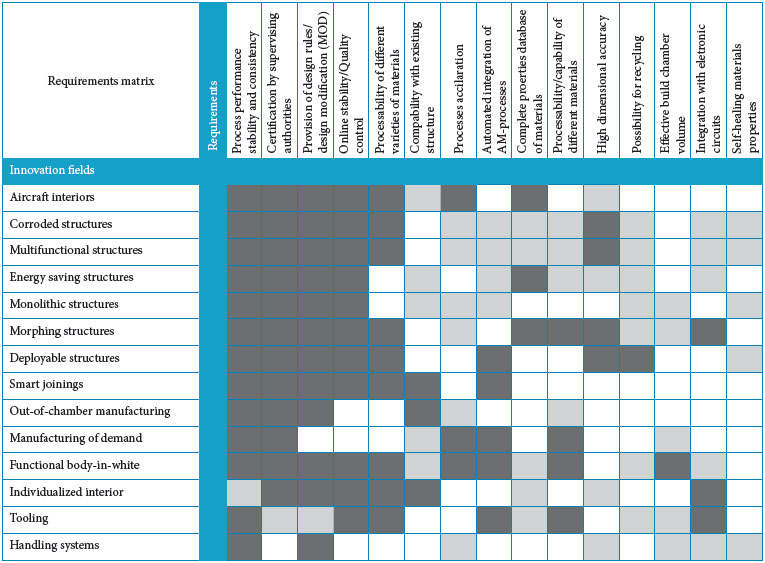
Figure 9
The gap between requirements of the industry and the supply partners.
-
High process stability and certification of AM processes and "AM-parts are relevant for the vast majority of the innovation fields across all three industries" (NRC 2012), especially for line replacement units, parts involved with aircraft safety and critical parts.
-
The provision of generally accepted "design rules is a basic prerequisite for most innovation fields in order to minimize costs and time effort for design" (NASA 2009).
-
On-line quality control processes are for instance crucial for the innovation fields aircraft interior and functional body-in-white.
-
The process-ability of "different materials with AM-machines is a requirement that is relevant for e.g. the Aircraft Interior and Morphing Structures, as the materials used range from magnesium to carbon-fibre-reinforced polymers" (Pham and Dimov 2012) and other multi-material designs, respectively.
-
To exploit the benefits of out-of-chamber manufacturing, flexible AM machines are required which are able to build up on existing 3D surface structures; otherwise the simultaneous machining of more than one machine on one part is not possible.
-
The availability of a database containing properties of AM materials (e.g. thermal characteristics, tensile strength etc.) is very important for multifunctional structures and functional body-in-white in order to assess functional properties under all circumstances.
The following are systems followed at IAI that made the critical outsourcing of 3D printing successful:
-
IAIs strategy to outsource or not to outsource.
-
Existence of a competitive outsourcing market.
-
Establishment of the latest tendering process.
-
Establishment of an advanced specification.
-
Establishment of a feasible payment structure.
-
Establishment of an appropriate contract administration process.
-
Establishment of a trustworthy contract document.
-
Management of transition outsourcing.
-
Establishment of mutually acceptable contract termination procedures.
CONCURRENT ENVIRONMENT AT IAI - RAPID PROTOTYPING
3D printing companies are quickly becoming an extensive channel for delivering quality products by various industries in the world. It has enabled good number of companies to fabricate premium products from the most intricate designs easily, especially the "A"-class parts used in aircraft industry, removing all the design barriers, which previously made it difficult for architects and designers to come up with better products. Now it is the turn of the owner to decide the said 3D printer and sourcing for materials for printing. IAI is linking with these owners as partners for various parts production by outsourcing such products which are not in the core competency. The present rapid prototyping technology in use with IAI is detailed in Fig. 10 and the trends of the future are given in Fig. 11.
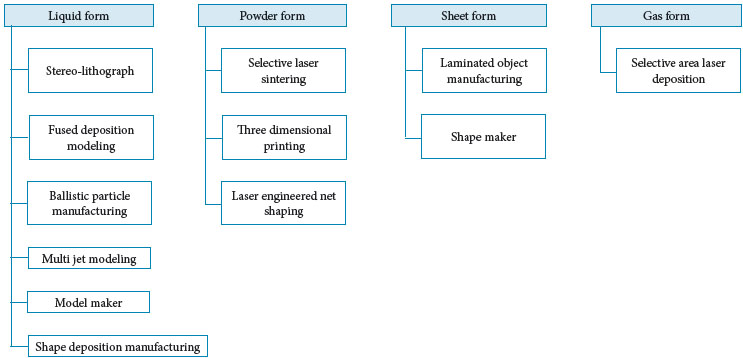
Figure 10
Current rapid prototyping technologies in use with IAI.
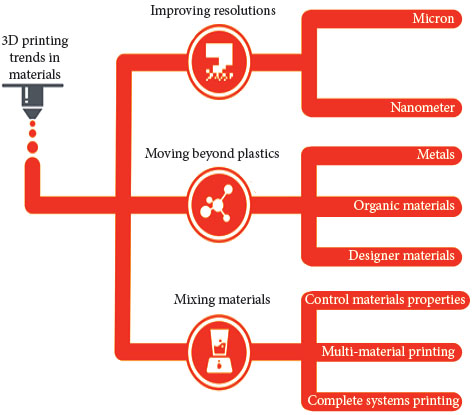
Figure 11
Tends in materials that are advancing the 3D printing industry.
IAI has decided to outsource the non-core products to be printed with outsourced agencies or partners. The reasons can be summarized as follows:
-
"Cost of 3D Printers has been consistently dropping over the years and strategically one need to understand that buying a 3D printer is still quite an expensive investment for any business" (Desai and Magliocca 2013). The cost of printer depends on quality requirements and type of inputs. Such printers could cost an organization heavily and if this cost is compared to the cost of outsourcing, it is clear that outsourcing is far more affordable. Outsourced partner can go for increased volume along with variety suitable to good number of partners.
-
For several range of products, a company may require variety of 3D printers. There are limitations for each product printing and the printer using a particular raw material.
-
Well-known 3D printing manufacturers generally go for various additive printing systems, and can therefore produce products from many diverse materials based on what is needed as per the orders on hand. No industry can have such solvency enough to purchase such quantum of machinery; therefore, outsourcing becomes a smart choice. It is also not logical for an industry to spend good amount of money in one area of just purchasing an additive printer when it can be outsourced.
3D printer purchase itself involves lot of technicality apart from new requirement of special skill training to the staff and officers, before and after purchase.
Meeting the expectations of the aircraft industry requirements by an outside agency or industry depends on its capability to spin the benefits from rapid prototyping and to print the finished product in accordance with the international standards like FAA, CAA, JAA and CEMILAC. It requires innovation in materials and knowledge of new processes and advances in both hardware and software with the right choice of materials, to achieve broader use of 3D printing especially in meeting the aircraft industry needs. The following concurrent trends are going to bring a great change in the near future:
-
Improving resolution: achieving various higher resolutions with finer details of interiors.
-
Using materials beyond plastics: utilizing a wide range of materials not limiting to PVC and plastics.
-
Integration and combination of materials and controlling their properties: different materials usage and their integration in finally attaining the product of the right quality, to create new combinations enhancing cognitive functionality.
Currently, 3D printers are using the FDM technology, building the parts layer-by-layer by heating the thermoplastic material and converting into semiliquid state. There after the extrusion process is considered as per requirements in the computer-controlled path. Sometimes FDM uses two materials, one for supporting and other for final product and supporting material is removed by various techniques. The systems of dual tip technology in the form of a schematic diagram are given in Fig. 12.
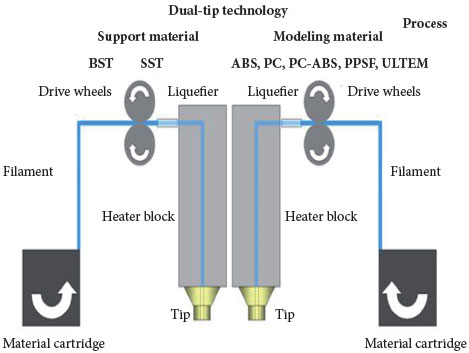
Figure 12
3D printing dual tip technology using combined use of materials.
FUTURE OUTLOOK OF 3D PRINTING STRATEGIES
IMPROVED DEVELOPMENT CYCLES
3D printing empowers researchers and engineers to prototype the products. Since tooling generation can be skipped-off to go straight to finished parts, it accelerates the general advancement and production process. The method thus became simple and made the aircraft manufactures go ahead with new technology striving towards meeting the demands of the regulatory authorities for the safety of the aircraft. "This also enables partnership companies to quickly test multiple configurations in order to determine the requirements" (Bourell et al. 2009) of the aircraft manufacture and preferences as per regulatory authority directions. The production cycle has thus been simplified and is a major breakthrough in the production process.
COMPLEX-DESIGN PARTS
"Engineers traditionally could design anything by considering the possibilities and limitations of various machining processes viz., milling, turning, casting, forging and welding. Still some designs are compromised and optimized for complex shapes" (Dimitrov et al. 2006). With 3D printing technology, complex components using variety of plastics and metals such as steel, aluminum etc. can be produced. Aerospace industry looked at this benefit from 3D printing with complex material combinations of titanium Ti6Al4V and Inconel 718 apart from usage of composite materials, prepregs and glass, which are giving superior flexible geometric shapes without compromising (Fig. 13).
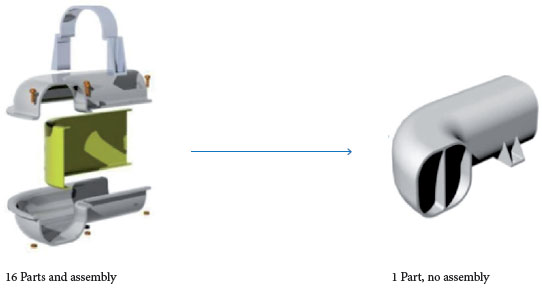
Figure 13
Manufacture of complex "fan blade edges" having complicated shapes to optimize airflow in single 3D print part.
CONSOLIDATION OF DESIGN
With 3D printing, the major advantage is producing parts with consolidation of design with high-level complexity, resulting in reduced assembly time and costs. The design modifications also became simple and need of joining various components was reduced. Such components are easy to outsource as a subassembly and printing the part using 3D process will be more attractive in terms of person-hours and machine-hours that are needed for production of the said subassembly (Fig. 14).
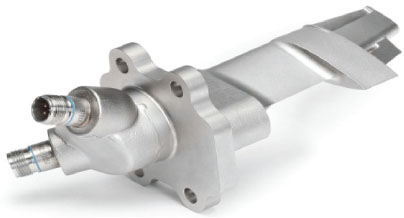
Figure 14
The complex part with different materials produced with 3D printing.
WEIGHT REDUCTION
Aircraft weight with all its accessories is the key parameter and the lower weight of the aircraft has double advantage to the industry. "Lighter weight leads to lower fuel consumption and reduced CO2 emissions along with the competitive advantage of reduced costs" (Hatch 2014). Such parts production is feasible with 3D printing, reducing the total weight of the component with improved geometry and optimized lattice structure (Fig. 15).
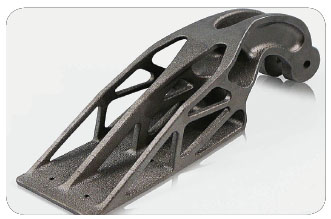
Figure 15
3D printed-nacelle hinge bracket for aircraft - weight reduced by 50% approximately.
MATERIAL EFFICIENCY
Several aircraft parts are made of titanium Ti6Al4V or superalloy Inconel 718, which are very expensive. These materials require special machining processes, requiring very long machine times, whereas the production of such items using 3D printing, without wastage of expensive material, is highly effective.
IN-PROCESS MANUFACTURING QUALITY ASSURANCE
The aircraft industry is preoccupied with the requirements of safe performance and reliability. Quality can be checked while printing the product using 3D printing process and inspection is feasible at every layer formulation. For traditional component production, intricate shapes inspection and testing is difficult and if a component to be dismantled for the purpose of inspection, the work involved can be estimated. With 3D printing modality, in-process manufacturing quality assurance reduces the quality inspection costs of components.
PLAN FOR 3D PRINTING - OUTSOURCING
The aircraft industry is, currently, the principal source of demand for AM or 3D printing process-grade systems. "Aircraft Industry leaders recognized the advantages of 3D printing and are seeking ways to exploit them" (Thompson et al. 2015). Now, they are depending on outsourcing methodologies to ensure productivity and marketability with their partners for effective utilization of technology. Figure 16 elaborates the plan for future for outsourcing of 3D parts at IAI.
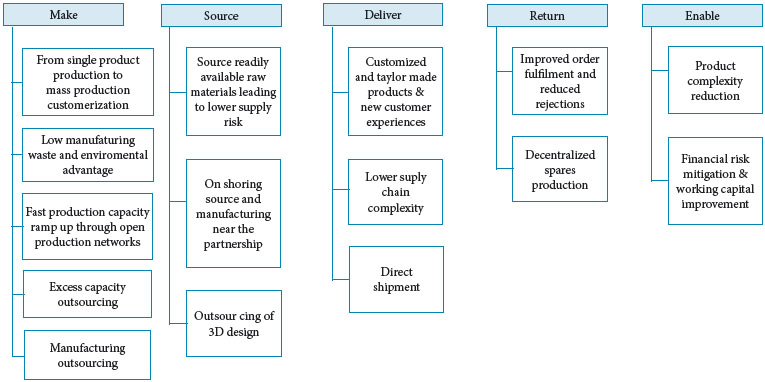
Figure 16
Plan for 3D printing outsourcing at IAI.
"This technology is a natural fit for aircraft industry" (Thompson et al. 2015), even though some challenges are yet to be addressed. "Multiple market surveys indicate that most businesses, if not already using, are evaluating 3D printing for product development and manufacturing of critical parts" (Manners-Bell and Lyon 2012), including the parts required in AOG (Action On Ground) situations. "The manufacturers are investing in training the designers and engineers for 3D printing and recruiting employees" (Manners-Bell and Lyon 2012) with expertise in AM skills to crest the wave of 3D printing. Few of the companies are acquiring the technology, machinery and new materials and combination metal technologies to produce different parts for different manufacturers. Few of them are trying to combine different sectors of automobile industry with the production of parts for the aerospace industry. "Additive manufacturing frees the designers from a lot of traditional constraints and allows engineers to create parts solely in the desired form, shape, size, fit and function." (Clott 2004).
Figure 16 gives 3D printing and its outsourcing plan for IAI. In the physical work environment is important and the 3D printing equipment, which would be companionable for variety of parts production instead of a single part. Some of IAI's partners manufacturing most AM-knowledgeable parts for their customers including IAI have equipment in-house for concept modeling, using all the avenues and some parts are used in functional prototyping.
CONCLUSION
In conclusion, this paper proposes 3D printing technology utilization in the aircraft industries for production and servicing, apart from developing a methodology to outsource various automated technologies to the tier-2/tier-3 companies basing themselves on specified parameters and capabilities. By using this innovation, the aircraft industry will reduce production time and expenses as well as in achieving greater accuracy in each product and qualitative final product. The study brought out various advantages, possibilities and drawbacks of this new technology use in aircraft industry.
3D printing technology brought many changes in supply chain management. The firms can manufacture product to precise customer's specifications; economical production of single quantity/one-off series and small batches of customized products; enjoy higher material efficiency and effective use of resources in the production processes, ramp-up global production capacity through exercising standardized 3D printing processes; outsource manufacturing to specialized service providers; alleviate material constraints by sourcing widely available raw materials, bringing back sourcing and manufacturing operations to the home market; utilize 3D design capabilities from all over the world; assistance from customer-centric products and their delivery practice; simplified supply chain network by disintermediation of linkages; development of courier express networks' by integrating several operations, advancing the order fulfilment, On-Time In Full with No Errors (OTIFNE); replacement of expensive spare parts inventory; decentralized spare parts production with JIT, cutting product complexity and benefit from resulting logistics simplification; and, finally, improve working capital and cash flow.
There are a number of elements that can be deduced from the above, which would formulate the 3D printing as the right choice:
-
Economical product customization: 3D printing permits cost-effective production of unique single quantity or in very small batches, tailor-made to the customer requirements and specifications.
-
Freedom of design: 3D printing provides freedom of design with standard CAD software, which can be used to design and redesign products. The CAD drawing file can be printed directly and redesigning can be simplified. The experts can do the specific design anywhere from any corner of the world.
-
Complex product manufacturing: 3D printing enables critical product designs produced easily, which are difficult and hard to produce, using traditional methods with all kinds of intricacies and no wastage.
-
Decentralized manufacturing: products designed in standard CAD software environments can be produced literally from any corner of the world, as long as compatible 3D printers are available. Since 3D printers are spreading throughout the world, this enables the manufacturing process physically closer to its customers.
3D printing technologies can be very flexible and efficient for small production runs, but there are some limitations to product quality and large-scale production runs that have to be taken into account. As such the main drawbacks are:
-
Limited product dimensions: based on the size of the print bed, the 3D print products are typically to be limited in size of the final product, especially in the home segment market. Still large products need to be manufactured using current and traditional technologies.
-
Reduced choice for materials: not all products can be from same raw material. There is a limit to the choice of materials in terms of type, colour, surface finish and properties that are to be met to meet the product quality requirements.
-
Lower precision: industrial precision yet to be reached by 3D printing technology.
-
Limited strength: due to the layered additive process, the products from 3D printing have shown limited strength, lower resistance to heat, temperature, pressure and moisture.
-
Technological hurdles: inherent stresses in-between layers do occur especially when metals and alloys are used as raw material for 3D printing. Because of critical components used in the aircraft, these parts will have direct impact on flight operations, safety and security. The oversight of the inspection agencies is crucial and 3D printing process needs to meet the said regulations. The printing process is in layers and these layers get cooled unevenly and the stresses that are inherent prove to be fatal for the component. The different quality characteristics of the components produced or printed laying them flat or at various angles can also cause different problems related to inherent stresses. Research is going on, related to these aspects of 3D printing. Outsourcing methodologies are being slowed because of these hurdles.
-
Possibility of misuse: unchecked production of dangerous goods is going to overcast shadow on 3D printing, as a hacked file from a strategic industry is dangerous to the humankind.
With the advantage of "low or zero" waste products, it will be a great boon to the environment. Localized manufacture and delivery of products with greater specifications of the final product, outsourcing of the parts and products for the entire aircraft manufacture will be a reality as per the current research, thriving on improved production volumes of similar parts for various end users. There were many constraints with large industrial partners also. They are looking for cost-effective methods and are slow to use mass scale utilization of the 3D print technology. The available printing materials are still limited and multiple mixes of materials is the need of the day to produce robust parts and assemblies. Printed parts are limited with bed size and larger printers are needed for larger parts. Wing production is feasible with 3D printing, but requires very large printer and thereby associated higher costs. The digital technology associated with 3D printing needs worldwide collaboration and is having huge scope for the younger generation to research in the areas of concern to solve various problems and improving the technological knowledge. Keeping this in mind 3D printing as of now should be considered as progeny culture for entrepreneurship and it can be stated as "traditional manufacturers" acquiring a well-designed new tool, which is going to develop profoundly.
REFERENCES
Audretsch DB (1995) Innovation and industry evolution. Cambridge: MIT Press.
Autry CW, Goldsby TJ, Bell JE (2012) Global macrotrends and their impact on supply chain management: Strategies for gaining competitive advantage. Upper Saddle River: Pearson Education.
Bourell DL, Beaman JJ, Leu MC, Rosen DW (2009) A brief history of additive manufacturing and the 2009 roadmap for additive manufacturing: looking back and looking ahead. Proceedings of RapidTech, pp. 24-25.
Berman B (2012) 3-D printing: The new industrial revolution. Business Horizons 55(2):155-162. doi: 10.1016/j.bushor.2011.11.003
Bédier C, Vancauwenberghe M, van Sintern W (2008) The growing role of emerging markets in aerospace. McKinsey Quarterly 2:114.
Campbell T, Williams C, Ivanova O, Garrett B (2011) Could 3D printing change the world? Technologies, potential, and implications of additive manufacturing. Washington, DC: Atlantic Council.
Chua CK, Chou SM, Lin SC, Eu KH, Lew KF (1998) Rapid prototyping assisted surgery planning. International Journal of Advanced Manufacturing Technology 14(9):624-630. doi: 10.1007/BF01192281
Clott CB (2004) Perspectives on global outsourcing and the changing nature of work. Business and Society Review 109(2):153-170. doi: 10.1111/j.0045-3609.2004.00189.x
Desai DR, Magliocca GN (2013) Patents, meet Napster: 3D printing and the digitization of things. Geo. LJ 102:16-91.
Dimitrov D, Schreve K, de Beer N (2006). Advances in three-dimensional printing-state of the art and future perspectives. Rapid Prototyping Journal 12(3):136-147. doi: 10.1108/13552540610670717
Evans MA (2002) The integration of rapid prototyping within industrial design practice (Doctoral dissertation). Loughborough University.
Flowers J, Moniz M (2002) Rapid prototyping in technology education. Technology Teacher 62(3):7.
Ghobrial A (2005) Outsourcing in the airline industry: policy implications. Journal of Transportation Law, Logistics and Policy 72(4).
Gibson I, Rosen D, Stucker B (2011) Additive manufacturing technologies: 3D printing, rapid prototyping, and direct digital manufacturing. New York: Springer.
Hatch M (2014) The Maker Movement Manifesto: Rules for innovation in the new world of crafters, hackers, and tinkerers. New York: McGraw Hill Education
Horn TJ, Harrysson OLA (2012) Overview of current additive manufacturing technologies and selected applications. Science Progress 95(3):255-282. doi: 10.3184/003685012x13420984463047
IATA (2017) International Air Transport Association. Annual Review 2017.
Janssen R, Blankers I, Moolenburgh E, Posthumus B (2014) TNO: The impact of 3-D printing on supply chain management. The Hague, Netherlands: TNO.
Langvardt K (2015) The Doctrinal Toll of 'Information as Speech'. Loyola University Chicago Law Journal 47.
Manners-Bell J, Lyon K (2012) The implications of 3D printing for the global logistics industry. Transport Intelligence 1-5.
Marcus HL, Lakshminarayan U, inventors; Board of Regents, The University Of Texas System, assignee. Method of producing parts and molds using composite ceramic powders. 1992. U.S. Patent 5,147,587.
Medlar (1990) Selective laser sintering offers instant wax models for investment casting. Incast III(3):12.
Melke MA (2010) An assessment of FAA's rule on reduction of fuel tank flammability (No. 2011-01-2520). SAE Technical Paper. doi: 10.4271/2011-01-2520
Mohr S, Khan O (2015) 3D printing and its disruptive impacts on supply chains of the future. Technology Innovation Management Review 5(11):20.
NASA (2009) Venus Flagship Mission Study; http://vfm.jpl.nasa.gov
NASA (2010) Space Technology Roadmaps. NASA Office of the Chief Technologist; http://www.nasa.gov/of-ces/oct/home/roadmaps/index.html
NRC (2012) NASA Space Technology Roadmaps and Priorities: Restoring NASA's Technological Edgeand Paving the Way for a New Era in Space. Washington, DC: The National Academies Press.
Pham DT, Dimov SS (2012) Rapid manufacturing: the technologies and applications of rapid prototyping and rapid tooling. London: Springer-Verlag.
Prahalad CK, Hamel G (1990) The core competence of the corporation. Harvard Business Review 79-91.
Prinz FB, Atwood CL, Aubin RF, Beaman JJ, Brown RL, Fussell PS, Lightman AJ, Sachs E, Weiss LE, Wozny MJ (1997) Rapid prototyping in Europe and Japan. JTEC/WTEC Panel. Japanese and World Technology Evaluation Centers.
Rhoades DL, Reynolds R, Waguespack Jr B, Williams M (2005) The effect of line maintenance activity on airline safety quality. Journal of Air Transportation 10(1):58.
Sachs E, Cima M, Williams P, Brancazio D, Cornie J (1992) Three dimensional printing: rapid tooling and prototypes directly from a CAD model. Journal of Engineering for Industry 114(4):481-488. doi: 10.1115/1.2900701
The ASTM International Committee (2014) F42 on additive manufacturing technologies; http://www.astm.org/COMMITTEE/F42.htm
Thompson SM, Bian L, Shamsaei N, Yadollahi A (2015) An overview of Direct Laser Deposition for additive manufacturing; Part I: Transport phenomena, modeling and diagnostics. Additive Manufacturing 36-62. doi: 10.1016/j.addma.2015.07.001
Thompson MK, Moroni G, Vaneker T, Fadel G, Campbell I, Gibson I, Bernard A, Schulz J, Graf P, Ahuja B, Martina F (2016) Design for Additive Manufacturing: Trends, opportunities, considerations, and constraints. CIRP Annals-Manufacturing Technology 65(2):737-760. doi: 10.1016/j.cirp.2016.05.004
Upcraft S, Fletcher R (2003) The rapid prototyping technologies. Assembly Automation 23(4):318-330.
Varaprasada Rao (2010) Supply chain management innovation - Best practices in aircraft manufacturing & servicing industry in India. Andhra University, Visakhapatnam India. 2(6):157-158.
Vaezi M, Chianrabutra S, Mellor B, Yang S (2013) Multiple material additive manufacturing-Part 1: a review. Virtual and Physical Prototyping 8(1):19-50.
Wijk AJM, Wijk I (2015) 3D printing with biomaterials, 3D printing with biomaterials: Towards a sustainable and circular economy. Burke: IOS Press.
Author notes
Conceptualization, Varaprasada Rao M; Methodology, Varaprasada Rao M, Chaitanya MSRK and Vidhu KP; Writing - Original Draft, Varaprasada Rao M, Writing - Review & Editing, Chaitanya MSRK and Vidhu KP.
Correspondence author: Varaprasada Rao Manda | Dean Academics | Godavari Institute of Engineering and Technology | NH-16 Rajanagaram, Rajamundry, AP 533296 - India | E-mail: annaprasad@rediffmail.com