Development of the intermediator of intercultural communication based on public argumentative speech
Desarrollo del intermediario de la comunicación intercultural basado en el discurso argumentativo público
Development of the intermediator of intercultural communication based on public argumentative speech
Opción, vol. 34, no. 85-2, pp. 149-185, 2018
Universidad del Zulia
Received: 01 December 2017
Accepted: 15 February 2018
Abstract: This article deals with the problem of argumentative communication in the form of a public speech at the Intercultural level from the standpoint of the Cognito-lingua cultural methodology of foreign language education; the subject of a special study is the question of the leading method of teaching public argumentative speech; the process of teaching public speech is presented as an integration of presentation and argumentative components in the context of Intercultural communicative competence; and special attention is paid to strategies and tactics of speech expression of public argumentative speech.
Keywords: Intermediator, public speech, communicate, presentation competence, experimental.
Resumen: Este artículo aborda el problema de la comunicación argumentativa en la forma de un discurso público en el nivel intercultural desde el punto de vista de la metodología cultural Cognito-lingua de la educación de lenguas extranjeras; el tema del estudio es la cuestión del método principal de enseñanza del discurso argumentativo público; el proceso de enseñanza del discurso público se presenta como una integración de los componentes argumentativos y de presentación en el contexto de la competencia comunicativa intercultural; y se presta especial atención a las estrategias y tácticas de expresión del habla pública argumentativa.
Palabras clave: intermediario, discurso público, comunicación, competencia de presentación, experimental.
1. INTRODUCTION
Expansion of International relations of the Republic of Kazakhstan in all spheres of life determined the social order for the training of a new type of specialist who will be able to take an active part in various forms of Intercultural communication, including delivering reports, presentations at numerous International conferences, symposia, both in Kazakhstan and abroad. The specialist of the new formation, as an active Intermediator of Intercultural communication, should be able not only correctly in terms of language to make his public speech, to argue key positions of his speech, but to be able to present his speech, i.e. should be able to establish contact with the audience, to draw attention to the subject of his speech, to maintain the interest and attention of the audience during his speech. Thus, with the importance and dominant role of dialogue forms of International communication, the Intermediator of Intercultural communication should possess the presentation skills of public argumentative speech in situations of Intercultural professional interaction. In the professional activity, the ability to present one's speech is significant for professions of all profiles. In the scientific literature, the concept of "presentation competence" appeared, which is considered as an integral component of Intercultural communicative competence. The formation of the presentation competence ensures the implementation of such communication functions as communicative- informative, communicative-regulatory, and affective-evaluative. The effectiveness of public speech, implemented on the basis of presentation competence, is largely determined by the ability to argue one’s speech (Nurhayati, 2018).
The study of the phenomenon of argumentation dates back to the times of antiquity and continues to be actively developed in our days. In the works of scientists, argumentation is regarded as an integral component of human cognition. The argument was studied by researchers of different sciences, such as ancient philosophy, modern logic and philosophy, rhetoric, linguistic studies, methodology of foreign language teaching. Possession of a public argumentative speech in order to achieve a certain communicative and pragmatic goal is to convince the interlocutors of the truth of any judgment and force them to accept this opinion should be considered as one of the important components of the training of the future teacher (Sulkarnaeva et al, 2018).An analysis of the works in teaching argumentation shows that a large amount of theoretical and experimental material in the study of this problem has been accumulated. However, despite numerous studies in this field, many questions of teaching public argumentative speech are clearly not sufficiently developed. Thus, the question of the leading method of teaching public argumentative speech from the standpoint of the Cognito linguacultural methodology of modern foreign language education and Intercultural communicative theory, implemented within the framework of the competence approach was not the subject of a special study. Teaching of public speech was not seen as the integration of presentation and argumentation in the context of Intercultural communicative competence; the methods of verbal expression of public argumentative speech have not been sufficiently studied. The current situation creates a contradiction between the socio-pedagogical relevance of training a specialist who has public argumentative speech skills at the Intercultural level and the insufficient development of the theory and practice of teaching. The resolution of this contradiction determines the relevance of our research topic, which we formulate as "Development of the Intermediator of Intercultural communication on the basis of public argumentative speech."
The aim of this article is theoretical justification and practical development of methods of teaching public argumentative speech in situations of Intercultural professional and pedagogical communication of students of language teaching specialties.
Objectives of the article:
- 1.
1. clarify the essence of key research concepts;
2. to reveal the structural lingua-didactic and linguistic nature of public argumentative speech;
3. to construct a methodological model of teaching public argumentative speech;
4. to develop and experimentally test the methodology of modeling the process of formation of Intercultural communication in the form of public speech.
2. MATERIAL AND METHODS
Argumentative communication from the position of the theory of Intercultural communication
Kazakhstan and foreign scientists have undertaken numerous studies in the field of argumentation. In most works, researchers considered the process of argumentation as an integral component of the act of communication. It is known that personal interaction is carried out in the act of communication. The research notes that effective, purposeful verbal communication presupposes a regulatory influence on the addressee. In this context, we can consider any type of communication as a change in the state of the participants in communication through mutual influence on their consciousness. The main function of communication is to change one entity's intentions, beliefs, actions, in general, the behavior of another subject, either in their own interests, or for the purposes of society.
Humankind has developed along the path of expanding the interconnection and interdependence of various countries, peoples and their cultures. This process covered various spheres of public life in all countries of the world. As a result, it is impossible to find ethnic communities that would not be affected by the cultures of other peoples and the wider social environment that exists in individual regions and in the world as a whole. This was reflected in the growth of cultural exchanges and direct contacts between state institutions, social groups, social movements and individuals of different countries and cultures. The cultural diversity of modern humankind is increasing. In this regard, the peoples are finding more and more means to preserve and develop their integrity and cultural appearance. This tendency to preserve cultural identity confirms that humanity, becoming more and more interconnected and unified, does not lose its cultural diversity. In the context of these tendencies of social development, it becomes extremely important to be able to determine the cultural characteristics of peoples in order to understand each other and achieve mutual recognition.In the context of these tendencies of social development, it becomes extremely important to be able to determine the cultural characteristics of peoples in order to understand each other and achieve mutual recognition.
Creator of the theory of Intercultural communication, Edward Hall not only convincingly and reasonably proved the closest relationship between culture and communication, but also focused the attention of scientists on the need to research not so many whole cultures as to study their individual behavioral subsystems. One cannot disagree with E. Hall in the understanding of culture and communication, as “communication is culture, culture is communication”. Analyzing the main idea of his book on the relationship of culture and communication, Edward Hall came to the conclusion that it is necessary to learn a culture of communication with other peoples. He believed that if culture can be studied, it means that the acquired knowledge can be taught. Thus, he was the first to suggest Intercultural communication not only as a subject of scientific research, but also as a topic for an independent training course. According to Hall E., the main goal of Intercultural communication is to study the practical needs of representatives of different cultures for their successful communication with each other (Hall, 1959).
Currently, in American communication, three main approaches to understanding intercultural communication are distinguished: functional, interpretiveand critical. The functional approach is based on psychological research describing and predicting the behavior of communicants (human behavior is predictable, and communication is influenced by culture). The main method of research here is an observation. The results of the study of this approach allow to reveal numerous cultural differences in many aspects of communication. However, this approach does not take into account the role of the context of communication. The Interpretative approach is based on anthropological and sociolinguistic research and proceeds from the fact that culture is created and maintained through human activity and therefore communication should be studied taking into account its context. The critical approach perceives culture as a set of different spheres, affecting both the culture and communication (all forms of human interaction are determined by their belonging to power). The leading method of research is the textual analysis (Martin and Nakayama, 2000). It seems to us legitimate to define the concept of "Intercultural communication", proceeding from the general concept of "communication", which is revealed in the works of Kazakhstan and Russian scientists as: "socially conditioned process of the exchange of thoughts and feelings between people in various spheres of their cognitive-labor and creative activity, mainly through verbal means of communication" (Sadokhin, 2002: 13).
Based on these definitions, Intercultural communication is defined as: "a combination of diverse forms of relations and communication between individuals and groups belonging to different cultures" (Sadokhin, 2002: 14). The modern interpretation of the concepts of "communication", "argumentative communication" does not include an indication of a specific sphere of human activity, and is defined as the process of interaction of two or more persons in which there is an exchange of activities, information and experience that involves achieving a certain result, or the realization of a certain goal (Borozdina, 2001). Of particular interest is the definition of "argumentative communication," proposed by Oschepkova (2004), who treats this concept as:
...Communication between communicants with a strong focus on impact with the aim of making possible changes in the beliefs of the opponent and establishing a consensus among the participants of communication through persuasive discourse. At the same time persuasive speech is based on tactics of logical and paralogical demonstration (Oschepkova, 2004: 13).
Argumentative or persuasive communication is characterized by exerting influence on the interlocutor. Its goal is to change, transform, modify the "picture of the world" of the communicant, who is only part of the objective picture of the situation and represents the knowledge, beliefs, faith, emotional and intellectual state of the communicant.
Formation and further development of the theory of argumentation gets into the works of such scientists as: Alekseev (1998) and Starchenko (1982). In the works of these scientists, the phenomenon of argumentation is investigated in various aspects. For example, in the works of Starchenko (1982) and others, the object of the study is the logical structure of argumentation, that is, the research is based on the logical approach. A purely logical view of the argumentation, in particular Kondakov (1976), reduces it to the process evidence (or refutation), in which only logical receptions are used. Argumentation is defined by him as a specific logical process in which a certain statement is used to support or weaken another statement, the truth of which is questionable or disputed. In this connection, the position of the representatives of the theory of argumentation and territory is more relevant to us, in their works the argumentation is presented as one of the possibilities of speech influence on human consciousness.
We consider important for our research the position of the theory of argumentation that argumentation, being intellectual and speech activity, is carried out through the construction of a certain kind of text. The text is considered as a universal means of argumentation, which embodies all the factors, called the means of argumentation. Considering the logical structure of argumentation, scientists have in mind the logical structure of the text, through which the argument is carried out. The structure of the argumentation text is characterized by the following logical components: the thesis, the argumentative part and the conclusions (Dem'yankov, 1989).With all the variety of texts formed in the process of argumentation, there is a generality of their logical structure. In any of them one can distinguish such structural components as (Nikifirov, 2003):
- 1.
1. Persuasion as the goal and result of argumentation is achieved through evidence.
2. A proof is a justification of the truth of a certain proposition with the help of other true and related – claims. Every proof includes three elements.
3. The thesis of the proof is the statement, the truth of which is justified in the process of proof.
4. Arguments (justification) of the proof are those statements that help to substantiate the truth of the thesis.
5. Demonstration (form) of evidence - the logical connection of arguments with the thesis.
6. The proof can exist without a refutation, but in a number of cases, it is necessary.
7. Refutation is the establishment of the falsity or unreasonableness of the thesis puts forward. The purpose of the refutation is to destroy the evidence put forward. Refutation is always secondary, which means that you must first approve something, prove something, and only then there is material for refutation. Since the proof consists of three elements, a refutation can be directed to each of them. The first way to refute the proof is to prove the falsity of its thesis. The second way is the criticism of arguments that is the conclusion that the thesis is not proved by showing the falsity or invalidity of the arguments of the opponent. The third way - refuting the demonstration - is to show that the thesis does not follow from the arguments given, that the conclusion is a logical error.
In linguistics, scientists (Kulikova, 2002; Lagutin, 2005; Morozova, 2004; Ivanova, 2003; Charaudeau, 1998; Chaveau, 1989) of various linguistic directions are engaged in studying the problem of verbal argumentation. In the works of these scientists, it is proved that for the expression of argument in various forms of verbal communication there is the presence of specific linguistic means. In the language means of syntactic level, scientists attribute the argumentative-illustrative nominative, appeal to the reader/listener, verifying statements, syntactic figures of motivation and expression of confidence, a rhetorical question; to language means of lexical level include metaphors, comparisons, irony. In studies of communicative linguistics, the argumentation is considered as a way to organize the text. The study of argumentation from a position of pragmatic linguistics has engaged Vasiliev (2001), Bogin (1989), Eemeren and Grootendorst (1992), Crable (1987) who believe that the argument requires statements, consisting of more than one sentence. It seems to us important to conclude that the statements formed for the realization of argumentation perform two functions: the function of argumentation and communicative function. Alekseev (1998), Demyankov (1989), Zernetskiy (1988), Mikhailov(n.d.) and others engaged in the study of verbal argumentation, based on the functional approach. Researchers of this direction distinguish the following argumentative functions:
- 1.
1. The thesis is a statement that we want the recipient to accept. The thesis is supported by other relevant information, but it does not support any other information.
2. Data is a thought expressed in language; it serves as a starting point for the derivation of the Thesis.
3. Foundation - a thought that serves as a bridge from the Data to the Thesis, it helps to make the Thesis more acceptable to the recipient.
4. Evidence (for the Foundation) - thoughts expressing details. If the Foundation is a general provision, then the Evidence is a factual confirmation of this situation.
5. Limiter - a thought expressed in a language that indicates the degree of confidence of the producer in the Thesis; it is often expressed in statistical terms, for example, in percentages.
6. The reservation is the linguistic expressions given by the opponent about conditions that are contrary to the thesis, or setting conditions in which the thesis acts, for example, "as long as", "if not", "under the given conditions."
In 2002, the Thomas and Killman (2002) styles were introduced as a method for identifying different types of conflict resolution. It seems to us possible to refer the concept of Thomas and Killman (2002) to the argumentative process, during which the efforts of the addressee will be aimed at proving the truth of his beliefs, while the addressee's field of activity will include the degree of readiness to perceive the convictions belonging to the addressee.
1. The Competing Style
The competing style of conflict resolution is aggressive and assertive. This type of conflict style tends to occur without concern for others' opinions. The style has its place in certain situations where decisiveness is necessary. Others may find the style off-putting, and when an individual uses this style too often, the result may be a lack of cooperation or feedback from others.
2. The Avoiding Style
This style of conflict resolution tends to avoid conflicts altogether, as the name implies. The style delays the conflict, and the person does not attempt to satisfy his own point of view or that of others. The person who uses this style is less assertive and cooperative in conflict situations. Those who use the avoiding style tend to leave situations and conflicts unresolved. But not using the avoiding style when it's necessary may result in hurt feelings in team situations.
3. The Compromising Style
The compromising style of conflict resolution is cooperative and assertive at the same time. This style helps to find common ground among team members and can find solutions to problems that satisfy everyone. There is a danger if you're seen as not having a firm set of values when compromising too often. Also, this style of conflict resolution finds solutions when the time is critical.
4. The Collaborating Style
The collaborating style is also cooperative and assertive at the same time, but actively seeks to find a resolution to a conflict that is seen as a win for both sides. Others may take advantage of this style of conflict resolution.
5. The Accommodating Style
With the accommodating style, a person puts aside her own needs and concerns in favor of others. This style is beneficial in situations where it is important to develop good feelings among a group or when it is necessary to keep the peace. Those who use the accommodating style tend to resist change.
Communication participants select the argumentative strategy and style depending on the goal, in particular: reaching a compromise, avoiding a decision, agreeing to cooperate, etc., and carry out speech actions in order to achieve the planned result. Thus, the results of the analysis allowed us to form a definition of the concept of "argumentation" as follows: argumentation refers to a two-way communicative planned process to solve the argumentative problem, in which the addressee acts and changes the ideas and beliefs of the audience or individual listeners with the help of argumentative significant verbal methods of influence, resulting in the adoption of theses and expression of consent with the addressee. For our study, the main points of the theory of argument are important, as well as such aspects as: 1) argumentation is an impact on the views and behavior of the person to whom it is addressed, by adequately used argumentative strategies; and 2) in the course of argumentation, a text is formed with a certain logical structure that can be used as a unit of instruction in oral communication with another language.
3. FINDINGS AND DISCUSSIONS
Modeling of public argumentative speech in situations of intercultural professional and pedagogical communication in this study assumes a purposeful dynamic process of argumentation by the argumentator of his point of view, position, opinion, judgment, etc. with the help of persuasion, justification, explication, proof, etc. The aim and final result of the training is the ability and readiness of students to generate argumentative texts in the form of a public speech in the context of Intercultural professional-pedagogical communication. Methodological modeling is implemented in the form of creating a model that is able to provide students with cognitive- communicative activity, oriented to the final result. Effective mastery and possession of the ability of Intercultural communication in the form of public speech is possible provided the formation of the presentation competence. The result of the formation of presentation competence and the criterion of its formation is a correctly constructed and successfully presented public speech. We consider presentation skills as part of a communicative process in which communicative skills have a dominant role. Many Western researchers argue that a significant characteristic of communication is its multidimensionality (versatility). In the process of choosing the topic of the discussion, certain forms and models of expression are used, the speed of speech, a set of means of non-verbal behavior and characteristics called "self- presentation" or "impression management" are selected. This implies a public presentation of yourself in a positive light as the most desirable type of person. The ability to make the right impression leads to social recognition, such as approval, friendship, influence (Hargie et al., 1994). It should be noted that the choice of the model of non-verbal behavior, the maintenance of interest, the ability to evoke sympathy, can be regarded as a component that has a great influence on the formation of presentation skills.
Thus, considering presentations as one of the elements of professional activity, we come to the conclusion that presentation skills can be correlated with a group of communicative skills associated with self-regulation of activities. The presentation process is an interactive communication process associated with presenting a prepared message to the audience. Each presentation is the result of a multidimensional work that aims to achieve understanding in the process of communication. In this regard, effective communication is a two-way process aimed at understanding and the necessary result. According to many foreign researchers, the basic principles of good communication can be considered the six basic provisions of effective communication (the six essential Cs of effective presentations): clarity; complete; concise; constructive; correctness; courteous (Smithsons and Whitehead, 1990).
On the basis of all of the above, we can conclude that due to changes in the education sector and the transition to a multilevel system of education, the ability of public speaking is significant for future FL teachers as active subjects of Intercultural communication. The development of presentation competence in the learning process is an important element in the formation of Intercultural communicative competence, the mastery of which promotes personal growth and preparation for future professional activity. In this regard, we consider it necessary to integrate presentation and argumentative components of Intercultural communicative competence for the formation of the ability and readiness of the mediator of Intercultural communication to Intercultural professional communication in the form of public speech. The ability to create an argumentative text of a public speech includes a set of interconnected private skills that ensure the generation and implementation of public argumentative speech. Mastering these private skills takes place consistently. In order for the student to organize speech impact and achieve communicative communication goals by solving a number of communicative tasks, first of all, he must master the skills to carry out communicative intentions within each stage aimed at forming a presentation competence. In presentation competence, we distinguish three consecutive stages: subject, procedural, speech-communicative. Each stage has its own system of exercises and problem-solving tasks.
The first type of exercises – argumentative-oriented exercises that prepare to generate public argumentative speech. This type of exercises includes:
-
‒ cognitive exercises;
‒ exercises that form the subject content of communication;
‒ exercises, introducing with metalinguistic material.
The second type of exercises simulates the ability to generate individual speech acts in public argumentative speech.
-
‒ exercises that form the skills to generate individual communicative acts (microtexts);
‒ exercises that form skills to generate integral reasoned statements (developed texts).
Exercises that promote the generation of argumentative speech:
-
‒ justify own point of view with arguments and connect them with the necessary means of communication;
‒ express an agreement with the presented point of view and justify own opinion with the help of ready-made arguments;
‒ express a disagreement with the presented opinion with the help of ready-made counterarguments;
‒ give an estimate of the opposite point of view, refute it with the help of arguments;
‒ construct a reasoned statement using facts, own knowledge, theoretical material, etc.;
‒ formulate own point of view on the proposed problems and justify it with the help of arguments;
‒ construct a reasoned statement based on the proposed questions, own knowledge, information of the text;
‒ identify the problem and argue its relevance for the development of professional activities.
The third type of exercises is a complex of Intercultural communicative types of exercises that includes professional problem- solving tasks. Such tasks can contain both statements and counterarguments. For example:
Situation # 1:
“Your colleague is taking part in international conference dedicated to the organization of exams in the secondary school. He has analyzed this problem and came to conclusion that the present organization of exams became out of date. While performing his speech in front of the audience he said: „The organization of exams in the secondary school is not suited to the requirements of modern foreign language education!‟ This situation caused culture shock and negative perception by the listeners. Why?”
Situation # 2:
“You are in the international conference. Your colleagues are discussing the problem of providing computers to teaching a foreign language. One of them insists that teaching a foreign language should be organized with the help of computers. Another one objects to the full usage of computers in teaching a foreign language. Support or disprove these ideas and prove your point of view with the help of arguments.”
Situation # 3:
“You take part in a discussion in the form of the international roundtable dedicated to the quality of private and state schools. One of your colleagues gave a talk on the advantages and priorities of private schools over the state ones in the quality of education. Another one convinces the audience that it‟s better to send your children to the state schools. Support or disprove these ideas and prove your point of view with the help of arguments.”
Situation # 4:
“You take part in the international seminar dedicated to the role of the teacher in the modern world. Your colleague addressed the meeting on the specific personal traits of character that the teacher should possess. Another one rejects his idea and affirms that the teacher should only demonstrate his/her professional skills. Support or disprove these ideas and prove your point of view with the help of arguments and examples from your own teaching experience.”
Situation # 5
“You take part in the international conference in the form of debates dedicated to the problem of using tests as a form of control. One of your colleagues supports the idea of using tests because of their positive characteristics such as validity, reliability, objectivity and etc. His opponent insists that in spite of test advantages this kind of work should not be used as a form of control because it does not make students think. Support or disprove these ideas and prove your point of view with the help of arguments.”
The next exercises contribute to the development of readiness and ability to reflect and combine the obtained theoretical knowledge and practical skills that are necessary for the design of new activities:
-
‒ define a communicative version of the argument text;
‒ find in the text arguments that substantiate, confirm or refute the main idea (thesis) of the argumentation text;
‒ identify and analyze the linguistic means used to express different communicative intentions (express own opinion, object, refute the opposite opinion, etc.);
‒ select from the text, meta-communicative means by which the addressee enters his/her opinion and the most important arguments;
‒ choose in the text, this means that serve to express the author's confidence in his rightness (uncertainty).
Also, special attention should be paid to the tasks that form the understanding and use of cultural and linguacultural knowledge of courtesy, while respecting the traditions, customs and style of communication of representatives of the country of the language being studied. The proposed typology of exercises is an interrelated and hierarchically arranged types of exercises. This typology of exercises eliminates discreteness in the holistic process of mastering public argumentative speech. Doing these exercises, students are constantly in a dynamic process of the verbal communicative activity. With such organization of the learning process, the student acts as an active "Intermediator of Intercultural communication" with a sufficiently high level of skills in public argumentative speech as one of the constituent components of the Intercultural communicative competence. So, the leading method in teaching public argumentative speech is professional problem-solving tasks.
4. RESULTS
The effectiveness of the developed methodology of teaching public argumentative speech in situations of Intercultural pedagogical communication was tested in the process of experimental work on the basis of the University of Foreign Languages and professional career in Almaty at the Faculty of pedagogical specialties.24 students of the 3rd year took part in experimental work. The choice of 3rd year students for the experiment is justified by the fact that FL is studied as a language for special purposes (LSP).This suggests that teaching language for special purposes is a process of developing skills of foreign language communication skills in the professional sphere of activity at the Intercultural level.3-year students of the language department are focused on achieving a common European level C1 in accordance to the European standard.
The aim of experimental work assumes the development of skills to generate the argumentative text of a public speech in situations of Intercultural professional and pedagogical communication.
The aim set out the following objectives of experimental work:
-
‒ to identify the motivation of students in the importance of skills of public argumentative speech in situations of Intercultural pedagogical communication;
‒ to establish the degree of the formation of skills correctly in the language plan to formalize students’ public speech, as well as to argue the key positions of their speech;
‒ to determine the presence of linguacultural knowledge that is necessary for communication in the form of a public speaking with representatives of another linguacultural society;
‒ to establish the initial level of students’ public argumentative speech in the field of Intercultural pedagogical communication.
Stages of experimental work:
-
‒ Organization of preparatory work for the experiment;
‒ Realization of aim and objectives of experimental work;
‒ Processing of the experimental data;
‒ Interpretation of the obtained results;
‒ Final conclusions of scientific research.
Experimental work was conducted in natural learning conditions. In preparation for the organization of the ascertaining experiment, the experimental (EG) and control (CG) groups of the same FL level were determined.
The aim of the ascertaining experiment was to identify the level of formation of the 3rd year students:
-
‒ The motivational-value component, which reflects the student's positive attitude to the role and importance of the possession of public argumentative speech in a professional- pedagogical activity;
‒ Skills to generate argumentative texts of public speaking, as well as a lingua-cultural knowledge, which are necessary for oral communication with representatives of another linguistic society.
To determine the formation of the motivation-value component, we used a method of questioning, which includes 10 questions according to the purpose of the study. According to the analysis of the answers received by us, the greatest number of positive answers was received on the following questions:
-
‒ "Do you consider it necessary and important to master the ability to argue your statement?"
‒ "Do you think that the possession of such a form of oral communication as public speech is impossible without the ability to argue?"
‒ "Do you consider it necessary to use special methods to teach the argumentative speech of public speaking?"
The greatest number of negative answers given to questions:
-
‒ "Is it possible to build a public speech without arguments?»
‒ "To what extent do you possess the strategies and tactics of argumentation that are necessary for the ability to argue the key positions of your speech?"
In response to a question,
-
‒ "In what specific situations, you may need to be able to argue the key positions of your speech?" In addition to the suggested answers, students added "seminars", "defense of course paper/diploma thesis," "presentation at a meeting," "discussions."
For statistical processing of the obtained quantitative data, we used the following mathematical formula:
- The coefficient of the formation of the students' motivational and value attitude to the use of public argumentative speech in situations of intercultural pedagogical communication;
- The sum of points;
N - the number of students.
Data obtained through mathematical processing are presented in the table below:
| Number of students | Result in % | ||||
| EG | CG | EG | CG | ||
| The optimal level of achievement of the result | 100-90% | 12 | 12 | - | - |
| High level | 89-75% | 12 | 12 | 23% | 20% |
| Satisfactory (average) level | 74-55% | 12 | 12 | 30% | 30% |
| Unsatisfactory (low) level | 54% and below | 12 | 12 | 47% | 50% |
According to the data presented in the table, it can be concluded that half of the students found an unsatisfactory level of formation of motivational-value attitude to the use of public argumentative speech in situations of intercultural professional-pedagogical communication.
Verification of the level of formation of skills necessary for the construction of argumentation texts of public speech was carried out using the method of testing. We used tasks with a free constructed answer. For the analysis and interpretation of the results of the ascertaining experiment, carried out in the form of an experimental cut, we developed a criterion-evaluation apparatus that includes parameters and criteria for assessing quality.
| № | Quality indicators | Quality assessment in% |
| 1. | Targeted - the ability to formulate the main thesis of the speech clearly. | 10% |
| 2. | Structural-compositional design of speech - the ability to construct a well-reasoned statement logically correct | 10% |
| № | Quality indicators | Quality assessment in% |
| 3. | Substantive content - knowledge of the subject matter of the argumentative speech. | 15% |
| 4. | Proof - a sufficient number of arguments necessary for convincing evidence of the truth or falsity of the main thesis. | 30% |
| 5. | Lingua-cultural correctness - the correspondence of oral communication in the form of a reasoned statement linguacultural norms adopted in the country of the language being studied. | 10% |
| 6. | Possession of met language - ability to use terminological vocabulary. | 15% |
| 7. | Possession of emotionally-effective skills of public speaking - the ability to master the attention of the audience, to support the interest of the public, the ability to convince listeners of the correctness of judgment. | 10% |
| Total: | 100% |
From the analysis of the results of this table for all parameters characterizing the correctness of the construction of public argumentative speech, students showed low rates. Their work lacked persuasiveness and impact on the recipient. These results confirmed the need to use special methods for teaching the argumentative public speech in professional-pedagogical activity at the intercultural level. The findings of the ascertaining experiment confirmed the validity of the determination of EG and CG as having the same starting level.
The educational tasks at the stage of the formative experiment
were:
-
‒ to identify the logical and structural parts of the text;
‒ to reveal the main idea of the argumentation text;
‒ to identify the main thesis of the argumentation text;
‒ to determine the arguments that confirm/disprove the main idea of the text.
Below are examples of some types of exercises.
In our study, we identified three consecutive stages aimed at developing presentation competence skills.
- 1.
1. Read the extract from the article. Define and formulate the main thesis of this extract.
2. Read the extract from the article and determine the presence or the absence of the logic in the structure of this extract.
3. Read the extract from the article and find the advantages and disadvantages of the summarizing arguments (or arguments in general).
- 1.
1. Read the extract from the article and create a new formulation of the theme (unexpected or even paradoxical) in order to attract people‟s attention.
2. Read the extract from the article and analyze the information: select necessary facts, put them in the logical order, add more supporting arguments.
3. Read the extract from the article and give different kinds of decisions, explanations, and arguments on the question “What cote aching models should we use in teaching young learners/students/adults? Why?”
- 1.
1. Read the extract from the article and express your point of view on this topic using cultural knowledge and skills.
2. Read the extract from the article and present a structural reproduction of this theme proving your case (define the theme under discussion, consider its different aspects, express your position).
3. Prove your position on the given situation (create 1 main thesis, 3 supporting arguments and 1 conclusion).
The post-experimental stage of the ascertaining stage of the experimental work was carried out after the completion of the formative experiment. The post-experimental stage involved the following objectives:
-
‒ to reveal the dynamics of the development of the motivational and value attitude of students to the role of public argumentative speech in professional-pedagogical activity;
‒ to reveal the level of skills to generate the argumentative text of a public speech.
To solve the first problem, we used the method of questioning.
| № | Questions | Dynamics of positive answers | |||
| EG | CG | ||||
| Pre- experiment al stage | Post- experimental stage | Pre- experimental stage | Post- experimenta l stage | ||
| 1 . | Do you think that the possession of such a form of oral communication as public speech is impossible without argumentation? | 48% | 78% | 47% | 58% |
| 2 . | Should we consider the ability to argue, as well as the ability to make presentation of your speech as an integral part of intercultural communicative competence? | 50% | 80% | 52% | 59% |
| 3 . | To what extent do you have the ability to argue the key positions of your speech? | 45% | 75% | 43% | 55% |
| Total: | 48% | 78% | 47% | 57% | |
The analysis of the results revealed positive dynamics. The gain for EG was 30%. Based on the results of the questionnaire, it seems to us legitimate to conclude that the developed method of teaching public argumentative speech in situations of Intercultural professional- pedagogical communication contributes to the increase of students' motivational-value relations to the importance of skills to argue and make a presentation of own speech. To control the formation of skills to generate argumentative text, we used problem-solving technique, which is based on a communicative task containing both arguments and counterarguments. The analysis of the results was carried out in accordance with the criteria-evaluation apparatus developed by us. Let us give a comparative analysis of the pre-experimental and post- experimental stages of the experimental and control groups in the following diagram in percentage.
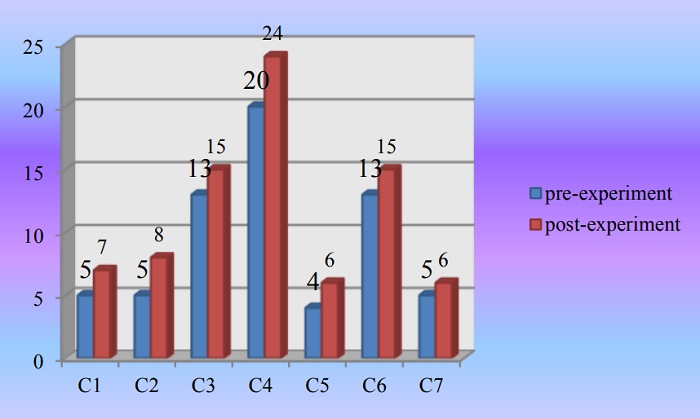
Figure 1
The diagram of the quality criteria of the ability to generate an argumentative text of a public speech before and after the experiment in the EG.
Experimental group (EG)
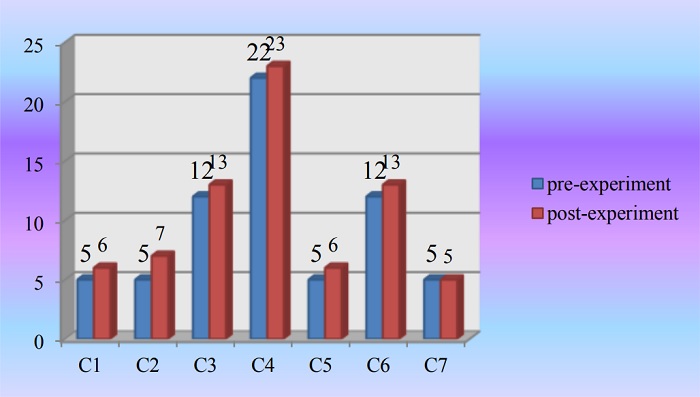
Figure 2
The diagram of the quality criteria of the ability to generate an argumentative text of a public speech before and after the experiment in the CG.
Control group (CG)
According to the results of the data in the table, the increase in qualitative indicator was 16% for EG and 7% for KG. The post- experimental stage indicates an increase in the indices in both groups. We present a comparative analysis of the pre-experimental and post- experimental stages of EG and CG in the following diagram in percentage.
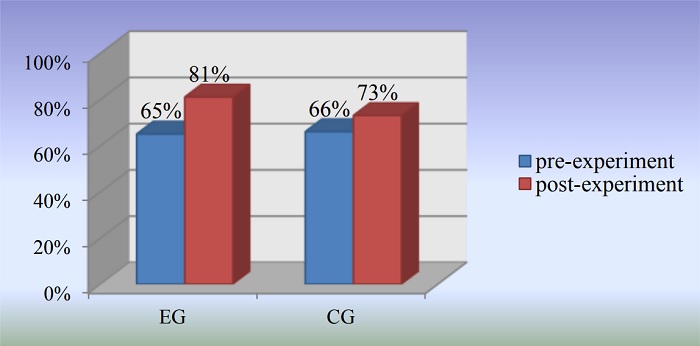
Figure 3
Diagram of comparative analysis of pre-experimental and post-experimental stages of EG and KG.
Thus, the conducted control stage confirms the effectiveness of the method of the intercultural professional-pedagogical communication in the form of public speech and the formation of presentation competence based on the use of problem-solving technique, as by all indicators we can see a steady growth of high, sufficient and average levels of the result.
5. CONCLUSION
Within the framework of Intercultural communication oral forms of communication play an important and dominant role. Specialists of the new format need to be able to argue the key positions of their speech, and also be able to make a presentation of their speech, thus, the teaching of public argumentative speech in the field of Intercultural professional-pedagogical communication is conditioned by the social order at the present stage. Our research was devoted to the development of Intermediator of Intercultural communication on the basis of public argumentative speech of students of senior years of a language university of pedagogical specialties.
Analysis of local and foreign literature, textbooks, manuals and programs showed the lack of theoretical and practical development of this problem. In this study, the problem of argumentative communication in the form of a public speech at the Intercultural level is first considered from the standpoint of the Cognitive lingua-cultural methodology of foreign language education; the subject of a special study is the question of the leading method of teaching public argumentative speech; the teaching of public speech is seen as the integration of presentation and argumentative components in the context of Intercultural communicative competence. To solve this problem, we used a technique of problem-solving tasks. A problem-solving task contains both arguments and counterarguments that contribute to the cognitive involvement of students in the learning process. In the process of research, we obtained the following scientific results:
1. The essence of the concept of "argumentative communication" is clarified, which is interpreted as a special type of speech communication and is defined as ... a purposeful, dynamic process of achieving mutual understanding in the course of verbal communication through influence, interaction, which gradually replace each other in the blocks of communication. The ability of argumentative communication in the form of public speech is a necessary condition for the successful socialization of the individual as an active Intermediator of Intercultural communication, as well as an important part of the professional training of the future teacher.
2. The lingua-didactic and lingua-stylistic features of public argumentative speech are considered, from the point of view of research of such argumentative strategies as: competing, avoiding, compromising, collaborating, accommodating.
3. The final result of teaching is the formation of Intermediator of intercultural communication who is able and ready to Intercultural professional communication in a form of public argumentative speech, as well as the formation of a presentation sub-competence of the Intercultural communicative competence.
REFERENCES
ALEKSEEV, A. 1998. Argumentation, Cognition, Communication. Knowledge. p. 162. Moscow.
BOGIN, G. 1989. Different approaches to the question of schemes for understanding the text. Text in language and speech activity. Higher School. pp. 20-33. Moscow.
BOROZDINA, G. 2001. Psychology of business communication. 2nd ed. INFRA-M. p. 295. Moscow.
CHARAUDEAU, P. 1998. Le discours propagandiste, Le francais dans le monde. pp. 100-103. Paris.
CHAVEAU, G. 1989. Analyse linguistique du discours polemique. No 52. pp. 34-41. Paris.
CRABLE, R. 1987. Argumentation et communication, théorie et pratique. p. 176. Paris.
DEM'YANKOV, V. 1989. Efficiency of argumentation as a speech impact. Problems of the effectiveness of speech communication: a collection of scientific and analytical reviews.
EEMEREN, F., and GROOTENDORST, R. 1992. Argumentation, Communication, and Fallacies: A Pragma-dialectical Perspective. Knowledge. p. 197. Moscow.
HALL, E. 1959. The Silent Language. Doubleday and Co., Inc. p. 240. New York.
HARGIE, O., SAUNDERS, C.and DICKSON, D.1994.Social skills in interpersonal communication. Routledge. p. 369. New York.
IVANOVA, S.F. 2003. Linguistic specifics of public speech. Knowledge. p. 128. Moscow.
KONDAKOV, N. 1976. A logical dictionary-reference. p. 656. Moscow.
KULIKOVA, O.V. 2002. Linguistic means of deploying arguments in a publicist text. p. 18. Moscow.
LAGUTIN, V. 2005. Linguastylistic implementation of the controversy in the press. p. 17. Moscow.
MARTIN, J., and NAKAYAMA, T. 2000. Intercultural Communication in Contexts. p. 363. London.
MIKHAILOV, V.On the specifics of the organization of reasoning in the process of scientific discussion. M.: Knowledge. p. 76. Moscow.
MOROZOVA, O. 2004. Argumentation in the texts of English public speech and the means of its linguistic realization. p. 19. Moscow.
NIKIFIROV, A. 2003. Logic and theory of argumentation. URAO. pp. 75-82. Moscow.
NURHAYATI, M. 2018. Wisdom values in traditional phrases the Mamuju tribe in shaping this study entitled local the character of society: antrpolinguistics approach. Supplement. No 1. pp. 307-320. Astra Salvensis. Romania.
OSCHEPKOVA, N. 2004. Strategies and tactics in the argumentative discourse: pragma linguistic analysis of the persuasiveness of reasoning (on the basis of political debates). p. 199. Kaluga. Russia
SADOKHIN, A. 2002. Fundamentals of intercultural communication: Textbook for high schools. UNITY-DANA. pp. 100-142. Moscow.
SMITHSONS, S., and WHITEHEAD, J. 1990. Interpersonal skills. Handbook for management trainees. Cronerpublishers Ltd.p. 312. UK.
STARCHENKO, A. 1982. On the methodological function of the theory of argumentation. Methodology for the development of scientific knowledge. Knowledge. pp. 26-52. Moscow.
SULKARNAEVA, G., KHAIRULLINA, L., BULGAKOVA, E. 2018. Hygienic and ergonomic design aspects of production systems. Supplement No 1. pp. 609-616. Astra Salvensis. Romania.
THOMAS, K., and KILMANN, R. 2002. Thomas-Kilmann conflict mode instrument.United States.
VASILIEV, L.G. 2001. Aspects of argumentation: material on general linguistics. p. 198. Tver.
ZERNETSKIY, P. 1988. Linguistic aspects of the theory of speech activity, language communication: processes and units. pp. 36-41. Tver. Russia