Model of developing professional thinking in modern education conditions
Modelo de desarrollo del pensamiento profesional en las condiciones educativas modernas
Model of developing professional thinking in modern education conditions
Opción, vol. 34, no. 85-2, pp. 458-478, 2018
Universidad del Zulia
Received: 15 January 2018
Accepted: 22 February 2018
Abstract: The problem of development of professional thinking at students is considered in the given article. The empirical data on the basis of diagnostic material were obtained by the pilot and experimental way. Results of diagnostics of an initial condition of understanding on the studied phenomenon allowed to determine the main directions of work on the development of professional thinking. The received results of the research will allow to improve the pedagogical process in higher education institution as the modern education system, places more and greater demands on the personality of the future specialist.
Keywords: model, professional thinking, student, professional activity.
Resumen: El problema del desarrollo del pensamiento profesional en los estudiantes se considera en el artículo dado. Los datos empíricos sobre la base del material de diagnóstico se obtuvieron por el método piloto y experimental. Los resultados del diagnóstico de una condición inicial de comprensión sobre el fenómeno estudiado permitieron determinar las principales direcciones de trabajo sobre el desarrollo del pensamiento profesional. Los resultados recibidos de la investigación permitirán mejorar el proceso pedagógico en la institución de educación superior, ya que el sistema educativo moderno impone cada vez más exigencias a la personalidad del futuro especialista.
Palabras clave: modelo, pensamiento profesional, estudiante, actividad profesional.
1. INTRODUCTION
The developed professional thinking is an important component of competence of students in the conditions of university training and allows to predict success of professional activity. The analysis of works of domestic and foreign scientists shows that in psychology various aspects of the problem of professional thinking are investigated in sufficient detail. The analysis of works on professional thinking shows versatility of researches depending on specifics of the profession and labor activity. Several directions were outlined in the works of philosophers, psychologists, experts in various fields. We tried to show in Table 1 the main directions which developed in science on studying of professional thinking.
| № | Full name of scientists | Name of the direction |
| 1 | Altshuller G. S., Belozertsev V.I., Kudryavtsev T.V., Lebedev O.G., Leviyeva S.N., Molyako V.A., Popov E.V., Pospelov D.L., Semibratov V.G., Smirnova V.S., Sergeyeva E.S., Rumyantseva E.A., Chebysheva V.V., Shemenev G.I., Shubas M.L., etc. | engineering and technical thinking |
| 2 | GerasimovS.A., KozintsevG. M., RommM.I., RyazanovE.A., EisensteinS.M., etc. | "genre" thinking of the film director |
| 3 | BrechtB., YershovP.M., TovstonogovG.L., StanislavskyK.S., etc. | scenic thinking |
| 4 | AranovskyM.G., BuryanekI., SokolovO.V., SokhorA.N., ShakhnazarovaN., etc. | musical thinking |
| 5 | BarabashYu.A., BakhtinM.M., VertsmanI.E., KhrapchenkoM.B., CorinaA.S. | specificsofartthinking |
| 6 | Vakhtomin N.K., Gryaznov B.S., Zotov L. ., Kopnin P.V., Lektorsky V.A., Loyfman I.Ya., Luk L.N., Pavlov T., Rakitov A.I., Ruzavin G.I., Sadovsky V.N., Stepin V.S., Uvarov A.I., Shvyrev V.S., Shtoff B.A., etc. | thinkinginresearchactivity |
| 7 | AbalkinL.I., DrachevV.K., KlepachN.Ya., MedvedevV.A., MikhaylovM.M., PopovV.D., SorokinD.E., StarostinS., GawksofV.P., EmdinG., etc.), thinkinginpoliticalactivity (BatalovE.Ya., VlasovaV.B., ZamoshkinYu.A., GromykoA.A., PanteneI. I., PlimakV.G., etc.), inmilitaryscience (AndreyevI.I., GalkinM.I., IlyichevN.M., ReutN.I., SuvorovN.V., TyushkevichS.A., ShavrovI. E., etc. | economic thinking |
| 8 | BallG.A., BabanskyYu.K., BrunnerD., GalperinP.Ya., DavydovV.V., KalmykovaZ.I., KrutetskyV.A., LeontyevA.N., LernerI.Ya., MatyushkinA.M., MenchinskayaN.A., SkatkinM.N., FriedmanL.M., GonobolinF.N., YesipovB.P., SlasteninV.A., OsipovaE.K., etc. | pedagogical thinking |
| 9 | Ilyenkov E.V., Petrova G.I., Shimina A. N., etc. | thinking of the schoolchild and student |
| 10 | BobrovN.S., KassirskyI.A., KopninP.V., OsipovI.N., KondratyevV.G., RogovinM.S., PopovA.S., SagatovskyV.N., SyrnevV.M., TarasovK.E., TurovskyM.B., ChernyakL.S., ChikinS.Ya., etc. | Medicalthinking |
| 11 | GabinskyG.A., ZhelnovM.V., MayorovG.G., etc. | religious and theological thinking |
| 12 | Luzgin I.M. | thinking of the lawyer |
The analysis of readiness of the problem on professional thinking shows a set of the researches, having a general-theoretical and methodological value for its understanding, but not considering features of development of varieties on professional thinking, proceeding from modern conditions of informatization and integration into world educational space. In general, the scientists investigate the specifics of varieties of professional thinking; give the characteristic of the common features of professional thinking; study determination by professionalizing and its results; investigate internal contradictions of this thinking. The main conclusion of authors inclines to the fact that professional thinking is useful for the system of the general and vocational education; it is useful also for the work with specialists in labor collectives, as it reveals regularities for the formation of the morality of the professional. However, poorly studied are questions of vocational training and the level of development of professional thinking in the context of competence-based approach, it is remained the sharp disagreements on natural "inclinations", evaluative and practical aspects of this type of thinking are very little studied, there is poorly studied a dialectic of professionalism and dilettantism. Thus, the analysis of the condition of problem on development of the professional thinking at students, presented in domestic and foreign literature, confirms the need of more profound studying of internal, resource, psychological conditions of professional development of the person, in particular, of factors of age and sex, opportunities of establishment the features of their manifestation in development of professionally important qualities for the purpose of use of the relevant data in scientific research, the organization of educational process in higher education institution and other spheres. Insufficient readiness of the problem on development of professional thinking at its undoubted importance caused the need of creation of the methodical system, allowing with a sufficient degree of efficiency to develop the above- mentioned phenomenon. The problem of development of professional thinking is connected with works on the general theory of thinking and it is based on the researches of features of professional thinking.
2. PARTICIPANTS
The total number of university students on the different specialties, participating in the experiment – is made 200, including in the experimental group (EG) - 100 and in the control group (CG) – 100 subjects.In total – 200 respondents. Base of the research: S. Toraighyrov Pavlodar State University.
3. METHODOLOGY
On the basis of the above-mentioned versions, we proceeded to an analysis of the concepts "professional thinking" and tried to define specifics of the training of professional staff. So, for example, considers that
Professionalizing, getting into all links of the public mechanism, extends type of thinking everywhere, for which the work acts as the main reference point. An essence of this thinking concludes not only in the specialization of cogitative actions in compliance with the special type of work. Such specialization is already outlined in the spiritual culture of the ancient society: it is enough to compare folklore of cattle- farmers, agricultural tribes, etc. (Batalov, 2006: 18).
He defines the professional thinking as type, which is characteristic, first of all, the fact that work (occupation, business) acts as its main determinant, connecting, "filtering", transforming influence of all other social factors. He allocates in professional thinking as varieties (engineering and technical, juridical, military and tactical, musical, medical, etc.), as an essence, the substantial forms of spiritual activity, arising because of work specialization. He writes: "The essence of these forms consists that specific material, the purpose, and technology, characteristic of these professionals, the relations, being transferred to the plan of spiritual activity, become concrete and general schemes of thinking" (Valiullina, 2007a: 24). He allocates as the main lines: subject and target, technological, social and technological and institutional.Valiullinain her dissertation work writes that development of professional thinking at students can be presented, in a broad sense, as the transition from academic thinking to actually professional thinking, and, in a narrow sense, as transformation of separate types and properties of cogitative activity of the person and receiving their new combinations depending on the subject, means, conditions, result of work, that is in formation of specific types of professional thinking – psychological, technical and others (Valiullina, 2007a). During her research, it is proved that the cumulative influence of the chosen specialty with other factors (age, sex, a course) are statistically significant for the following characteristics of professional thinking of students: operations of comparison and analysis; combinatory abilities; practical mathematical thinking and features of mastering of the professional categorical apparatus; figurative fluency, verbal creativity and practical thinking of the students. It was established by her the statistically reliable influence: age factor – on the flexibility of thinking, figurative fluency, combinatory abilities; processes of comparison, analysis, abstraction, reasoning, solution of logical tasks by students; on indicators of verbal creativity, mastering of the professional categorical apparatus; a factor of sex – on flexibility of thinking, verbal fluency and mobility of students' speech-intellectual processes. Also, it is statistically confirmed by Valiullina (2007a) cumulative influence of two factors – on flexibility of thinking, figurative fluency; processes of comparison, analysis, solution of logical tasks by the students; on indicators of verbal creativity, mastering of the professional categorical apparatus, practical mathematical thinking, practical thinking in general. In addition, it was established by the researcher the extent of influence of the factor of the chosen specialty on the development of a number of characteristics on professional thinking at students.
The research problem of professional thinking of the teacher is one of the fundamental in pedagogical psychology. Its importance is caused by a role of pedagogical thinking in the organization of teacher activity, his professional behavior and communication. The concept "professional thinking" is used in two meanings in psychology and pedagogical literature (Semyonov and Stepanov, 1983). In one sense - it is underlined the high vocational and qualification level of the specialist, it is about the features of thinking, expressing his qualitative aspect. In another sense - it is emphasized the features of thinking caused by the nature of professional activity, it means the subject aspect (mathematical, physical, ecological thinking, etc.). Korina (2008), investigating professional thinking of the music teacher, approves interrelation of professional and special knowledge, creative abilities, pedagogical abilities, professional and significant qualities of the personality, and aspiration to self-realization. The efficiency of formation of professional thinking at future specialist in a class, instrumental training, in her opinion, is reached at purposeful creative realization of the developed principles of methodical methods at stage- by-stage formation of professional musical abilities (prima vista, transposing, selection by ear, improvisation). Begidova and Hazova (2003) consider that professional thinking is the most important quality of the personality of specialist, mature form of mental activity. They believe that professional and creative thinking has one of the leading places in the structure of professional competence of the teacher, being the invariant of professionalism and important indicator of competitiveness at modern specialists, including the specialist in physical culture and sport. Scientists consider the professional thinking in unity with creativity and define thinking as follows:
creative thinking is mental activity which is carried out by unusual to the subject the most effective in this situation ways of the solution of objectives, and in the process of which there are found out new, original opportunities of use of the accumulated knowledge; as a result the subject of cogitative activity receives qualitatively new result and prerequisites for formation of new knowledge and abilities (Begidova and Hazova, 2003: 9).
The scientists include in structure professionally-creative thinking: the substantial (thinking directed to the solution of specific objectives), qualitative (quality of cogitative activity and/or result), and operational components (methods of its cogitative activity, ways of its implementation). So, the substantial component includes the disciplines of GEA (general educational activity), a DB, PA (pedagogical activity) forming professional thinking; in the qualitative component - a divergence, flexibility, originality, novelty, independence; in operational components - ways of intellectual actions, namely comparison, the analysis, synthesis, abstraction, generalization, a specification, variation.
The essence of concept "professional thinking of the teacher", defined by Korina (2008: 16), is valuable to us, and we will be based on it further. Professional thinking of the teacher is the specific mental activity in the course of which there is a generalized reflection and creative transformation in his mentality of the objective characteristics of pedagogical process, the modeling of processes of training and education, caused by specifics of the pedagogical phenomena, the purposes and problems of training and education and also professional experience of the teacher. The methodology of the formation at future teacher of professional thinking as system-forming competence of the teacher is considered in the research by (Gilmanshina, 2002a). She allocates seven of its main functions: explanatory, diagnostic, prognostic, projective, reflexive, management of pedagogical process and communicative (the first five can be carried to forms and methods of scientific thinking). Essence of professional thinking of the science teacher, according to Gilmanshina (2002b) is shown in synergetic effect of unity special and scientific (thinking in the field of subject specialization), pedagogical (scientific and applied) thinking and methodical thinking. Its feature is connected with feature of thinking in the field of subject specialization of the teacher. In this case Gilmanshina (2002b) considers professional thinking through a prism of the work of the teacher, therefore, subject specialization of the teacher found reflection in the structure of the studied phenomenon. The scientist claims, as professional thinking – is multicomponent personal education with complex structure so far as also his formation is long process of stage-by-stage implementation of a number of the interconnected intermediate purposes. She considers that knowledge sources (sociocultural, scientific and pedagogical, applied pedagogical, methodical, special and scientific subject) taking into account the principles (the humanization and humanitarization, diversification, fundamentalization, integration, innovation of professional activity) and selection criteria of the training material influence the content of system of formation of professional thinking on the basis of competence-based approach.
Thus, having studied literature sources, we came to opinion that professional thinking is considered as professional quality of the specialist, as the component of the general culture of the person, as psychic education, as the component of professional competence. Its specifics are shown in professional activity and are determined by the content of the tasks, the problem situations, solved by the specialist at various stages of work activity. As a result of the analysis of theoretical bases of professional thinking we gave the following definition: "Professional thinking is an integrated, multilevel reflection and transformation in a generalized view of the objective characteristics of professional activity, determined by its purposes and tasks, personal features of the specialist" (Gilmanshina, 2002b: 22). Professional thinking gains the special importance in connection with emergence in the labor market of wide-profile professions. It is a new type of professional activity, with other contents, functions and demanding the new way of orientation in a subject of the activity. There it is characteristic that such way of the organization of cognitive activity for the wide-profile worker will allow him to solve on the integrated indicative basis the polytypic professional problems: projecting, designing, production, technical systems operation. Therefore the development of professional thinking in modern conditions has relevant character. Having studied various scientific sources, we have approached to the modeling of development of professional thinking. In this connection, we suggest the scheme No. 1 - Criteria of the level of development on professional thinking at students, and the scheme No. 2 - The model of development of professional thinking at students in higher educational institution.
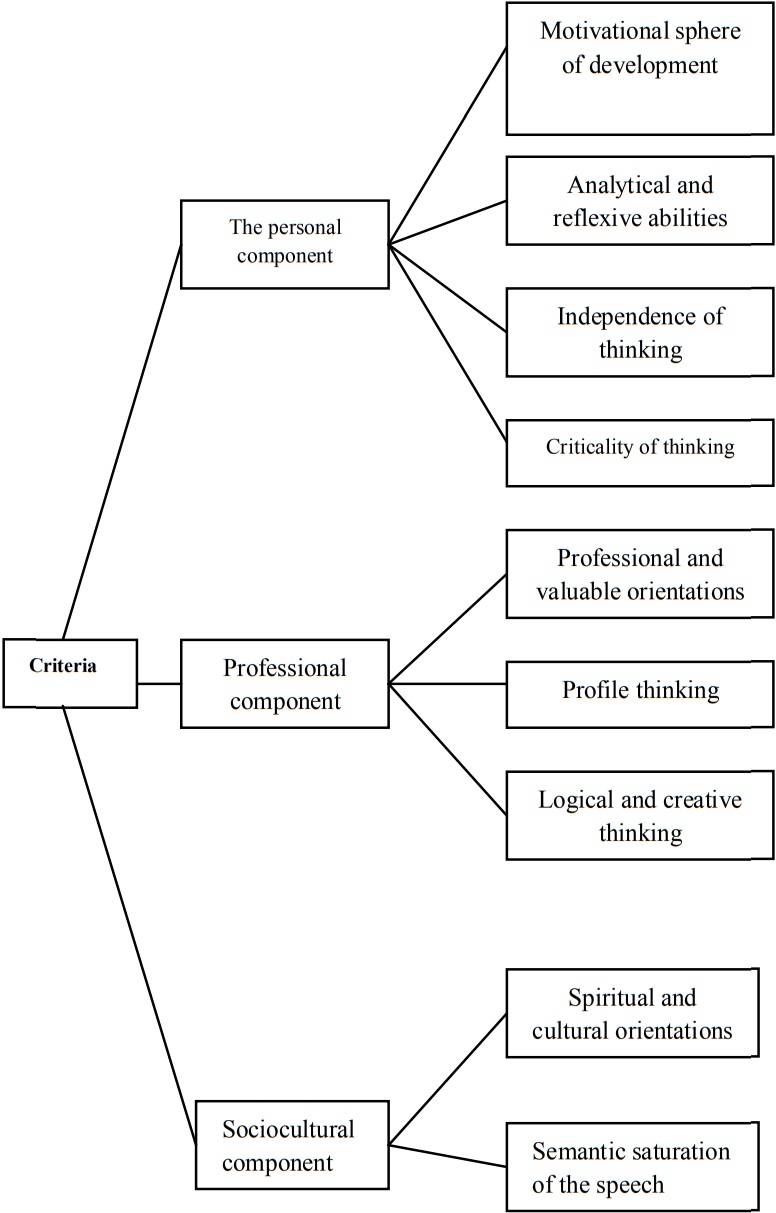
Scheme 1
Criteria of the level of development on professional thinking at students
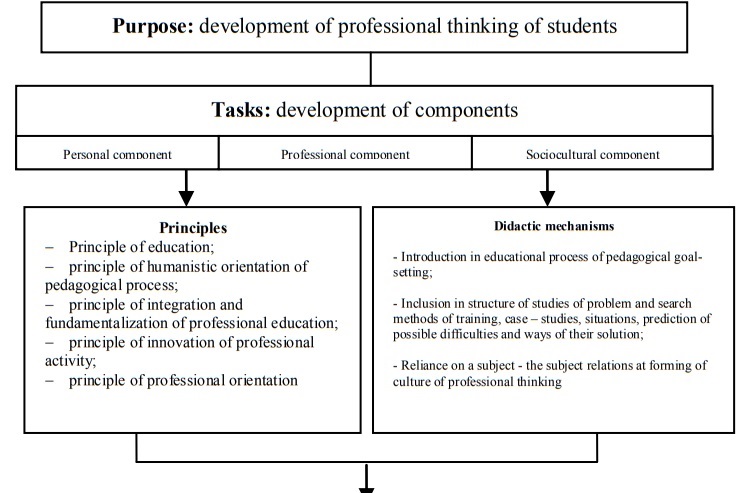
Scheme 2
The model of development of professional thinking at students in higher educational institution
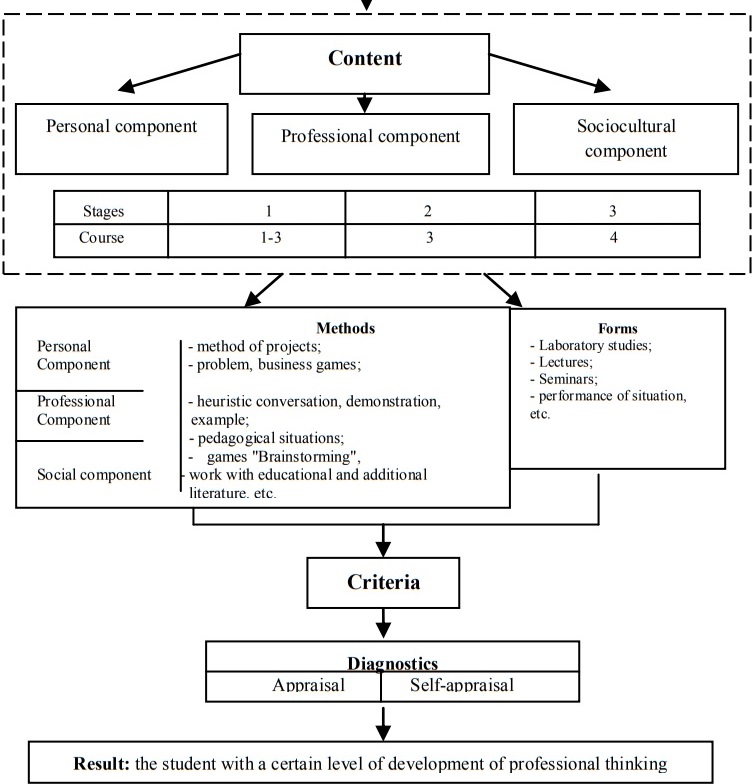
Scheme 2 (Cont.)
The model of development of professional thinking at students in higher educational institution
The practice of training of the specialists in higher education institutions is that activity in which there is formed the way of thinking and it is acquired the content of the knowledge of future professional activity, corresponding to it. As it is noted in the Internet resources, the multidisciplinary specialist of the general basis and subject does not see, and each variant of the subject acts for him as different subjects. It is important to mean these features of orientations at the organization of vocational training of the wide-profile specialist at the task of formation of his polytechnic thinking. In the course of training, the object of activity has to be disclosed to him in an invariant form and its diverse options — concrete forms of existence in which he also acts in different tasks. So, technical objects of different function, with the different principles of functioning have to perform in the general basis — first of all their system organization, the general type of structure and a variety of types of this form in different technical objects.
4. INSTRUMENTS AND PROCEDURE
There was organized the stating experiment for the purpose of determination of an initial condition of professional thinking. We used questionnaires by means of which we revealed understanding by the students of the essence of the concepts "thinking", "professional thinking". The methodical procedure of independent drawing up questions was used for research of theoretical and also heuristic thinking of the students. We used Valiullina’s (2007b) methods. The methods have the developing function, serves the purposes of formation of ability to see structural connections in the material, given at a lecture, that promotes further to find them in any information block; development of the ability to return to the question its initial sense that is a distinctive sign of the thinking person; on quality of the question judge about the professional level of asking the person. Examinees were offered to make 10 moderately difficult questions on the studied discipline and also 10 questions on the specialty. This method allows to estimate also the level of development of operations of the analysis, synthesis, and generalization of students. There is done development of practical skill on determination of questions, abilities to an observe abstraction level at the statement, to avoid repetitions and a semantic gap in formulations. The task can have the form of drawing up test tasks that gives to a diagnostic technique the developing function: performance already requires a more time expenditure, but also intellectual efforts, activization of creative abilities. Operations of comparison and generalization in thinking of students were investigated by means of the technique "Comparison of concepts" allowing to estimate the level of development of conceptual thinking.
5. RESULTS OF RESEARCH
During the pilot and experimental work we decided to find out what sense is put by students in the concept "thinking" and "professional thinking". In total 200 respondents have been captured. The question was asked: ―Give definition to the concept ―thinking‖. 40% of the interviewed students rather fully and competently answered; 56% of the students incompletely considered the conceptual content; 4% - found it difficult to answer. Further, it was offered to find out: "How do you understand the expression "professional thinking"?". Only 41% fully and substantially answered on the question; the incomplete answer was given by 40%. Also, we revealed in the course of the poll that students differentiate the concepts "thinking" and "professional thinking", "creative thinking". Using a number of techniques of Valiullina (2008) there were cases of failure to follow of the instruction by students. It was a consequence of misunderstanding of a wording of the instruction or conscious ignoring owing to certain motives. Data on this sign, shown more than 8% of examinees, also were included in the statistical analysis which allowed to determine the level of professional thinking. Misunderstanding of the instruction indicates poor quality of reproductive cogitative actions of the examinee and also is caused by features of speech and thought processes, in particular, by the level of development of the understanding, considered in modern researches as one of the components of professional thinking. Three groups of students were allocated on the basis of assessment of success of performance by examinees on all suggested techniques: with the high, average and low level of development of professional thinking. The number of the students having this or that level of development of professional thinking was established. Results demonstrate validity of the used methods to the research problem of the main characteristics of professional thinking at students. The results of the research have shown that students recognize and realize the problem of development and formation of professional thinking. Partially this problem can be solved during teaching the course on psychology and pedagogical sciences. In particular, we suggested the course "Leadership psychology". Purpose of this discipline seems to us in the following: to develop creative, professional thinking at future specialist; to give for listeners knowledge of fundamentals of science, so that it gave food for thought; to form outlook; to awake interest in science; convincingly to show ways of applying the studied knowledge in practice; to develop students’ skills of keeping records of reported knowledge; to improve, expand, deepen and consolidate this knowledge by independent work on lecture material. The lecture course "Leadership psychology" arms future specialist with scientific methodology, gives a scientific explanation of its regularities, functioning mechanisms. On the one hand, lectures have to show how the general theoretical ideas find the constructive development and the operational embodiment directly in practice, and with another - to help the future specialist to see that behind each concrete solution of the professional situation there is a certain concrete and methodical scheme and more general professional idea. Such quality of training gives the conscious impetus to the development of professional thinking. During the research, having studied the possibilities of content of teaching and educational process, we came to the following conclusions:
-
- In pedagogical process of higher education institution, there are potential opportunities for development of professional thinking at students;
- The content of educational disciplines has sufficient volume for development of the studied phenomenon;
- It is necessary the purposeful system of activity of teachers at a higher education institution for the development of professional thinking at students, coordination of actions between departments which are carried out the educational training in the specialty with an orientation to object of activity of the future specialist.
Thus, comparison of the received results of the stated experiment with the developed theoretical model had shown the need of organization of special work on development of professional thinking at students. The above-mentioned was resulted us in need of development the special-organized and experimental-pedagogical activities for the development of professional thinking at students which will include 3 stages: stating, forming and generalizing.
6. DATA ANALYSIS
The analysis of the results of experimental work gives the grounds to consider that development of professional thinking at students is necessary, and also it is possible to carry out in the conditions of the purposeful and systematic organization of experimental and pedagogical work.
7. CONCLUSION
From the methodological point of view for the development of the theoretical position of our research, great importance has the determination of the theoretical basis, clarifying the content of the key concept "professional thinking", development of criteria and application of diagnostic instruments. Development of professional thinking at students is one of the aspects of necessary training for professional activity.
8. DISCUSSION
During experimental and pedagogical work we gave the definition "professional thinking", the model of development of the studied phenomenon is developed. Results of diagnostics of the initial condition of understanding of the studied phenomenon determined the main directions of work on the development of professional thinking. The conducted research, having the theoretical and experimental character, affects only one of aspects of the multiple-factor problem and does not apply for an exhaustive solution of the problem on development of professional thinking at students. During the research and judgment of its results, there were outlined the new problems, the solution of which is essentially important. Among them: further theoretical and methodological research of different aspects of the problem on the development of professional thinking in the conditions of modernization of the education system.
REFERENCES
BATALOV, A.2006.Professional thinking: philosophical problems. Abstract of the thesis for the degree of Doctor of Philosophy. Kazakhstan.
BEGIDOVA, S., and KHAZOVA, S. 2003. Bases for formation of experience on professional and creative thinking of the teacher: Manual for students of higher education institutions of physical culture. Under the general editorship of M.Ya. Vilensky. Kazakhstan.
GILMANSHINA, S.2002a. Formation of professional thinking of the teacher. Higher education in Russia: scientific and pedagogical journal. MES RF. No 5.pp. 107-110. Moscow. Russia.
GILMANSHINA, S. 2002b.Professional thinking and features of its manifestation in the teacher activity. Structurally-functional and methodical aspects of activity of university complexes: materials of All-Russian Scientific-Methodical Conference. Kazan: Butlerov’s messages. pp. 22-24. Kazan. Russia.
KORINA, V. 2008. Formation of professional thinking of music teachers in the class of instrumental training in higher education institution. Scientific library of the theses and abstracts disserCat.http://www.dissercat.com/content/formirovanieprofessionalnogo-myshleniya-budushchikh-uchitelei-muzyki-vklasse-instrumentaln#ixzz5Lr4CsZMW. Kazakhstan.
SEMYONOV, I., and STEPANOV, S. 1983. Reflections in the organization of creative thinking and self-development of the personality. Psychology questions. No 2. pp. 35-42. Kazakhstan.
VALIULLINA, G. 2007a. Age and sex features of development of professional thinking at students: thesis of the Candidate of Psychological Sciences. Astrakhan. Russia.
VALIULLINA, G. 2007b. The test of structure of R. Amthauer’s intelligence in the research of gender and age features of professional thinking at students. Book: Problems of development of the personality in the changing Russia: materials of All-Russian Scientific-Practical Conference. pp. 7677. Astrakhan.Russia.
VALIULLINA, G. 2008. Methods "Fundamental concepts of your science" in the research of professional thinking at students. Book: Techniques of improvement of training for pedagogical staff: theory and practice: anniversary interuniversity collection of scientific works. Tatar Humanitarian-Pedagogical University. No 10. pp. 24-26. Kazan.Russia.