Abstract: This article is devoted to the international food security architecture assessment. Research object includes different international agencies, created since 1942, which performance is directly or indirectly related to food security, as well as the regulatory legal acts. The research hypothesis is that the quality of international regulation positively correlates with the quality of food security. This article analyzes the international agencies in a sub-objective, retrospective and level context through the institutional methodology. Based on the research, there are assessed the main development trends occurring in the field of international food security regulation in the light of new challenges and threats.
Keywords:international regulationinternational regulation, agricultural policy agricultural policy, food security system food security system.
Resumen: Este artículo está dedicado a la evaluación de la arquitectura de la seguridad alimentaria internacional. El objeto de investigación incluye diferentes agencias internacionales, creadas desde 1942, cuyo desempeño está relacionado directa o indirectamente con la seguridad alimentaria, así como con los actos legales regulatorios. La hipótesis de la investigación es que la calidad de la regulación internacional se correlaciona positivamente con la calidad de la seguridad alimentaria. Este artículo analiza las agencias internacionales en un contexto subobjetivo, retrospectivo y llano a través de la metodología institucional. Sobre la base de la investigación, se evalúan las principales tendencias de desarrollo que se producen en el ámbito de la regulación de la seguridad alimentaria internacional a la luz de los nuevos desafíos y amenazas.
Palabras clave: regulación internacional, política agrícola, sistema de seguridad alimentaria.
International food security regulation assessment
Evaluación de la regulación internacional de seguridad alimentaria
Universidad del Zulia
Received: 16 January 2018
Accepted: 23 February 2018
Food security is the most pressing problem of the mankind. The unstable international food market and the inflexible agricultural policy, approved in a number of states, require collective food security measures to be undertaken in the world. Many scientists emphasize that the ongoing processes are determined by economic, political and social factors (Magdy et al., 2012; Moldavan, 2014; Pchelianska, 2017). At the same time, world food security is understood as the preservation of food market stability with the availability of basic foodstuffs for all the countries in the world. It is obvious that the existing socio-economic differences of states (Misselhorn and Hendriks, 2017; Braitstein et al., 2017) make it very difficult to solve the world food security problem. In this regard, international agencies, which performance is directly or indirectly related to food security, as well as the regulatory legal acts, are the most important drivers in this area. Since the formal institutions crystallize the relations (international and national levels) to ground the further food security system architecting, it seems logical to pay attention to international agencies, which performance is directly or indirectly related to food security, as well as to the regulatory legal acts regulating this field (Kolesnikova & Kamasheva, 2017). According to foreign and domestic scientists, globalization is a mechanism that promotes the development of links between the national food security systems. There should be developed a universal mechanism with communication systems that would contribute to the world food security, which should be improved in terms of regulation.
New challenges and threats of the multi-level socio-economic relations between particular countries have a significant impact on the world food security system architecting. In this particular case, the problem is that a single universal mechanism is hard to design. Thus, this problem is relevant. Accordingly, there must be a new approach to the world food security development in the context of mature market relations and growing competition. At the national level, the food security system needs a new target, based on the international transparency and solidarity expressed as a unity of understanding and standards. Various aspects of such a multi-faced problem as the Radio frequency food security system development at different formation levels were considered by many Russian scientists (Sanakoeva et al., 2015; Karkh et al., 2015; Yashina and Baygulova, 2014).
We highly value the contribution of Russian and foreign scientists to the theory of the research issue, but it should be noted that their papers do not limit the scope for research, since a number of aspects, related to the sustainable food security system architecting in Russia, are still insufficiently considered and require a more detailed study. Many scientists emphasize the need to form a qualitative and a full-fledged system of formal institutions (legal framework) for effective international food security regulation (Ruiz-Martinez et al., 2015; Filipand Dragnea, 2017; Wilson, 2013).This article also analyzes the data illustrating the food security system architecting dynamics.
This article, which analyzes the scientific problems in accordance with the nature of the research object, is based on such methods of scientific knowledge as direct (empirical) analysis and synthesis, induction and deduction, and the historical method.
Since the international agencies play an important role in the food security (international and national levels), let us first analyze the transformations of the international food security regulation. The empirical basis for conclusions made in this section involves a database synthesized from various sources (Russian statistical year- book, 2015; System of information on the agricultural markets, 2012). The following items were considered as the research prerequisites:
-
- Analysis of international agencies, directly or indirectly regulating the international legal food security transformation in terms of regulation;
- This section is focused on the substantive characteristics of the international food security regulation;
- Law enforcement and judicial practices were not considered, as they require a separate detailed study;
- Any adopted act is an indicator of institutional will and activity in the relevant period, regardless of its regulatory impact.
Research object includes different international agencies, created since 1942, which performance is directly or indirectly related to food security, as well as the regulatory legal acts regulating this field.
Directives and regulations are the most common types of legislation regulating the food security in the European Union. Current food security measures are implemented and controlled by the international organizations shown in Figure 1.
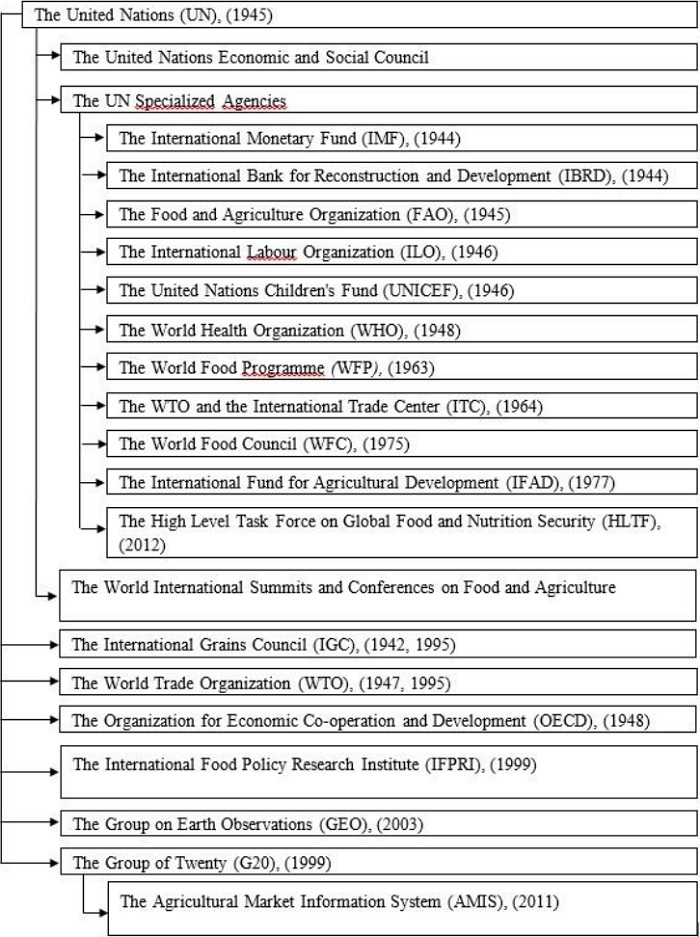
Figure 1
International agencies, which performance is directly or indirectly related to food security
The principal organizations are the Food and Agriculture Organization (FAO), established in 1945, and the International Fund for Agricultural Development (IFAD), established in 1977.The FAO cooperates with the International Monetary Fund (IMF), the International Labor Organization (ILO), the International Bank for Reconstruction and Development (IBRD), the World Health Organization (WHO), the World Food Program (WFP), the United Nations Children's Fund (UNICEF), the World Trade Organization(WTO) and the International Trade Center (ITC), the World Food Council (WFC), the International Fund for Agricultural Development (IFAD), and the High-Level Task Force on Global Food and Nutrition Security (established by the UN Secretary General Ban Ki-moon) and reformed in the Committee on World Food Security (CFS) as the most representative intergovernmental platform for food security and nutrition. In 1942, the International Wheat Council was established and renamed into the International Grains Council (an international organization coordinating the grain trade issues and monitoring the compliance with the Grain Trade Convention) in 1995.The WTO is the successor of the General Agreement on Tariffs and Trade (GATT) concluded in 1947. This organization has formed the principles and rules of the international trade. The WTO has been operating since 1995. It liberalized the international trade and regulate the trade and political relations between the member states. The FAO and the UN are the organizers of world summits, forums, conferences and symposia on food issues.
An important progress in management issues was achieved after establishing the AMIS for the purpose of improving the international coordination, information exchange and the world market transparency. The AMIS system was established within the framework of the Paris G20 Action Plan on Food Price Volatility and Agriculture, approved in June 2011.As it was noted at the 69th session of the Committee on Commodity Problems, creation of the Agricultural Market Information System (AMIS) is one of the most significant outcomes of the G20 in 2011 (System of information on the agricultural markets, 2012).
The world's population growth and an increase in the standard of living contribute to a constant increase in food demand. According to the Food and Agriculture Organization of the United Nations, food demand will increase by 60% by 2050.In the light of the rapid price movement in the world agricultural markets; many countries are moving towards a food self-sufficiency strategy. Despite the constant search for solutions to food security problems, there still has not been built an effective and optimal model for its solution. The function of food security regulation remains with the state. The main state regulation areas are the following ones: economic and social accessibility – regulating prices and providing food access for disadvantaged and vulnerable groups; physical accessibility – determining the level of commodity-producing infrastructure development through the regulation.
The G8 and G20 countries consider food security and hunger issues as a top priority among other global and interethnic problems. Food security is considered primarily in reliance on the world situation and earlier declarations and agreements. The heads of the largest states consider the world hunger elimination as the main goal of food security at the global level, as well as providing physical and economic access to the sufficient amount safe food each person living in the planet.TheG8 and G20 countries undertake mostly the financial and organizational food security measures, related to the solution of specific nutrition problems. Recently, there has been a considerable number of official world events devoted mainly to the food security issues. Thus, the 2011 report called The State of the World due to the Lack of Food Security was devoted to the main problems of the world trade policy, food price regulation and agricultural production. The G8 Summit, held in Camp David (USA) in 2012, was discussed by the non-profit organizations and civil society as a major breakthrough in the hunger issue, based on the creation of the "New Alliance for Food Security and Nutrition". It is promised to send about USD 3 billion during the 2012-2022 to solve the hunger problem in Africa and to support the agriculture development (Food security in the G8/G20, 2011). Food price is regulated in different countries with a protectionist policy focused on supporting the domestic market, domestic food production and imports. Thus, Japan, which has limited agricultural resources, but pursues a policy of domestic market protection through the food price regulation, imposes an import restriction through the customs regulation. Food price limitation in the domestic market allows regulating the economic accessibility for the low-income groups.
In the US and the EU, there are special food assistance programs designed for the case of providing the low-income population with the necessary products. These programs allow setting specific price parameters and total finance amount while reducing the farm production costs, since such a support does not take a form of subsidies on material or credit resources. In fact, it is related either to the crop acres (livestock inventory) or to the agricultural production volume (Popova, 2015).The Rome Declaration on World Food Security, adopted in 1996, is the fundamental world document in the field of food security. It refers to the state duty to secure the right of everyone to have the access to safe and healthy food, in accordance with the right to adequate food and the right to be free from hunger.
The Rome Declaration on World Food Security and the World Food Summit Plan of Action have formed the basis for achieving the overall goal: food security at the individual, household, national, regional and global levels. Encouraging the agricultural producers within the country is a popular and necessary area of state regulation. The USA and the European Union had succeeded in this area by implementing the special purpose programs within the framework of agricultural and food security policies: beneficial strategic direction; clear legislative regulation, hardly introduced changes to the already adopted regulatory legal acts; program character; authority separation; a wide range of financial support forms and a relatively high level of its availability for commodity producers and agricultural workers; stabilized environmental situation; special food safety regulation and control; improved mechanism of food regulation (Popova, 2015).
Thus, the US and the European Union have taken the agriculture development to an innovative level by subsidizing and increasing the production efficiency through the introduction of advanced technologies. China and Japan are stimulating their agricultural development in a same way by financing the research and development activities and by introducing the advanced technologies.
Iran's experience in shaping the country's food security is interesting. In 1979, the country had set a goal of food self-sufficiency and a strong agro-industrial complex formation, which was partially achieved by 2004 for such agricultural products as wheat, barley and meat products. Iranian agricultural and food security policies have the following disadvantages: their main food buyer is a State that stimulates not the agricultural producers, but consumers, as well as the use of cheap labor and little labor saving machinery. This does not guarantee the stability of the achieved f food self-sufficiency level (Official site of the Food agricultural organization, 2017).Food quality regulation and control are an important part of government food security regulation. Directives and regulations are the most common types of legislation regulating the food security in the European Union.
The directive indicates only the main goals that the EU member state should achieve while the regulation is a direct action document that defines all the goals and mechanisms for their achievement, and does not require any additional acts. Almost all the acts, regulating the technical products, are adopted as directives. As for the food products, the situation is exactly the opposite – there is a clear tendency to move from the directives to the regulations (Kuznetsov, 2011).The regulatory legal acts regulating the food accessibility and safety play an important role in the food security regulation. In the EU countries, safety requirements for a wide range of food products are established by two regulations. The Regulation No. 852/2004lays down the general requirements for food hygiene. The Regulation No. 854/2004lays down additional requirements for animal products. In the EU, regulatory documents lay down the requirements for a whole range of safety aspects, in particular pollutants or dangerous microorganisms. The Regulation No. 2073/2005 on Microbiological Criteria for Foodstuffs lays down almost all the possible requirements for the food microbiology (Kuznetsov, 2011).
In the European Union, all state control issues are based on the Regulations No. 882/2004 in Official Controls Performed to Ensure the Verification of Compliance with Feed and Food Law, Animal Health and Animal Welfare Rules and No. 854/2004 laying down specific rules for the organization of official controls on products of animal origin intended for human consumption. In the European Union, responsibility is not systematized – each country sets its own rules. In the European Union, food regulations and standards are voluntary. In cases when the standard is a mandatory one, this feature is indicated in the legislative acts. The Regulation No. 882/2004indicates that only the laboratory, accredited in accordance with the EU standard, has the right to issue results for official control purposes. At the international level, the Technical Barriers to Trade (TBT) Agreement and the WTO Agreement on the Application of Sanitary and Phytosanitary Measures (SPS Agreement) are the main agreements that define the food safety rules and inform the consumers about foodstuffs properties.
Thus, the TBT Agreement is mainly applied for the purpose of tech products regulation. As for the foodstuffs, TBT is applied only to regulate the issues associated with the process of informing consumers about the foodstuffs properties, including labeling and packaging safety (Kuznetsov, 2011).The SPS Agreement defines the conditions required for applying the sanitary and phytosanitary measures. These standards are introduced to ensure food safety and are established primarily by three international organizations: the Codex Alimentarius (for foodstuffs), the International Plant Protection Convention (for plants) and the International Epizootic Bureau (for animal products). The SPS tools can be very different, but, as a rule, they involve the legislative acts. The SPS Agreement is designed to regulate only food safety, and plant and animal health, as they are used as raw materials in food production. Such concept as technical regulations is not used in the SPS Agreement. In comparison with the TBT Agreement, which allows regulating a wide range of goods in various ways, the SPS Agreement has very strict rules for the science-based justification of food safety requirements. The EU is indicative of their application, as one can track the difference between the state and technical regulation of the food market. Standards and rules which are designed in regard to foodstuffs are usually based on the scientific evidence. Standards and rules designed in regard to other products can be defined by various goals and objectives of the public policy. They can be both global – reaching an acceptable level of national security – and technical – electromagnetic compatibility. As a rule, requirements for food products are established in еру horizontal legislative acts. Requirements for other products are laid down in technical regulations, but voluntary standards are used as a mechanism for fulfilling the mandatory requirements of these regulations (Kuznetsov, 2011).
In the CIS countries, the Concept of Improving Food Security of the CIS Member States, approved by the Decision of the CIS Council of Heads of Government (November 19, 2010), is one of the most important documents regulating food security. Its main goal is to improve the quality of life in the CIS member states, and to provide the population with the basic accessible foodstuffs produced by the CIS member states in such quantity and quality, as it is required for human life at the greatest possible independence from external food supplies (Khasheva et al., 2017). In the CIS countries, there is a very large number of technical regulations adopted for certain types of products: milk, meat, fish, etc. The European Union, on the contrary, refused this practice as a deadlock. Documents adopted by the European states to regulate the food safety are becoming horizontal: there is a decrease in the number of acts regulating certain types of products (Kuznetsov, 2011). As a rule, each technical regulation lays down the hygienic requirements for food products and processes. In the CIS countries, there is still a significant number of sanitary standards and regulations. Some of them have remained since the Soviet period, and many of them are mandatory. The standard technical regulations, as a rule, cover about 100 types of products. Different regulatory legal acts of the CIS countries prescribe different state control procedures (Kuznetsov, 2011).
A comparative analysis of the basic food consumption per capita per year in Russia and abroad has allowed us to identify the countries with the maximum and minimum consumption by the main product groups for the period of 1990-2014 (Table 1).
Basic Food Consumption per Capita per Year in the RF and Foreign Countries for 1990-2014.
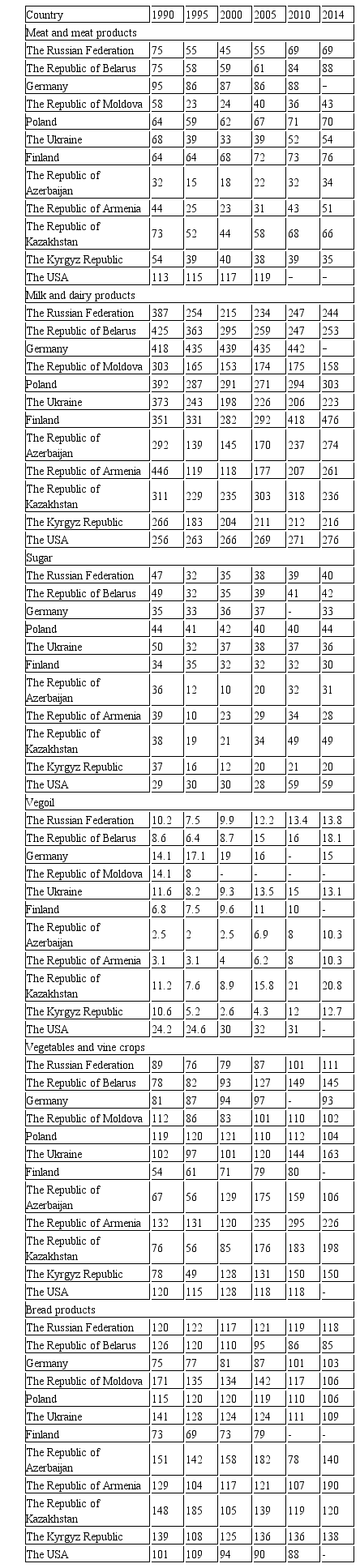
In Russia, Ukraine and Belarus, basic food consumption is approximately the same. These indicators are average compared to other countries. Russia is at the bottom of the list by only one item – vegetables and vine crops.
Above average food consumption was recorded in the European countries, such as France, Germany, the United Kingdom, Finland and Poland. In the US and Australia, food consumption is quite high compared to other countries due to a high standard of living and support for low-income population.
The reverse situation with consumption is observed in Asian countries, such as the Republic of Azerbaijan, Armenia, the Republic of Kazakhstan and the Kyrgyz Republic – many groups of products are consumed at the below average level. Despite the differences in per capita consumption levels between these countries, the overall dynamics are generally the same. This allows stating the existence of a single food market. There are multidirectional trends in the livestock and crop markets development due to the fact that products made from plant raw materials are a cheaper substitute for animal products.
A number of scientists consider the international law practice in the field of food security from the standpoint of scientific knowledge, which essence is considered in regard to all the types of state activity.
Literature analysis has shown that a number of researchers (Timiras, 2012; Sokolinskaya, 2017) adhere to an integrated approach to solving the specified problem in order to adapt regulations to new challenges and threats.
Transparency, common rules and standards should become one of the most important criteria for the international food security development. Such an opinion was expressed by foreign and domestic researchers of different countries (Kusz, 2014; Koos van, 2006; Jere and Maharaj, 2017). Thus, we have identified various approaches to solving the common problems of food security, which are a prerequisite for the national policy strategy development and provide for the management improvement in the agro-industrial sector. According to the obtained data illustrating the process of building the international food security relations, it would be reasonable to use them in a separate study devoted to the content of international regulation of the food security system transformation in the Russian Federation.
Summarizing this study, we can outline some important trends in the field of international food security regulation: World experience in food security regulation indicates that the main role remains with the state; Price policy in the domestic market grounds the national food security and accessibility for the low-income population; Processes of regulating and stimulating the agricultural producers through the various mechanisms have a significant impact on the national food self-sufficiency improvement; food safety regulation and quality control vary considerably across the countries, but the latest development trends in the food production regulations are characterized by a shift from food safety requirements to certain quality indicators; analysis of food consumption per capita in different countries reflects the concept of a global food market with general trends and patterns of development. Based on the above, let us assess the legal subsystem of the institutional food security environment. Current international food security regulation has a general trend towards the interaction rules individualization and concretization with due account for the national and geopolitical interests of different countries.
There was created an international food security regulation architecture. Since it has certain disadvantages, it requires further specification of rules, the elimination of gaps and harmonization of national regulations with the international practices with due account for the modern interests of stakeholders.
The article is prepared with the financial support of the Russian Federal Property Fund within the project No. 17-02-00327 (2017) The RF Food Security System Formation under the Extreme Factors: theoretical and methodological aspects.
Figure 1
International agencies, which performance is directly or indirectly related to food security
Basic Food Consumption per Capita per Year in the RF and Foreign Countries for 1990-2014.
