Promotion of entrepreneurship development by art and design by pedagogy
Promoción del desarrollo emprendedor por arte y diseño por pedagogía
Promotion of entrepreneurship development by art and design by pedagogy
Opción, vol. 34, no. 85-2, pp. 729-751, 2018
Universidad del Zulia
Received: 07 January 2018
Accepted: 22 March 2018
Abstract: This paper discusses how art and design pedagogy can further entrepreneurship in societal, economic and educational contexts, so that students may thrive in a world full of complexity and flux. The author touches on some of the methodologies inherent in art and design pedagogy for teaching creativity and innovation and provides a broader overview of how the values and attitudes can further the current concepts of innovation and entrepreneurship and their societal and economic contexts. The paper highlights how the values, attributes and attitudes associated with art and design pedagogy translate into the economic focus of most current entrepreneurship thinking.
Keywords: art, design, pedagogy, entrepreneurship, creativity.
Resumen: Este documento discute cómo la pedagogía del arte y el diseño puede fomentar el emprendimiento en contextos sociales, económicos y educativos, de modo que los estudiantes puedan prosperar en un mundo lleno de complejidad y flujo. El autor aborda algunas de las metodologías inherentes a la pedagogía del arte y el diseño para enseñar creatividad e innovación y ofrece una visión más amplia de cómo los valores y actitudes pueden promover los conceptos actuales de innovación y emprendimiento y sus contextos sociales y económicos. El documento destaca cómo los valores, atributos y actitudes asociados con la pedagogía del arte y el diseño se traducen en el enfoque económico de la mayoría del pensamiento empresarial actual1.
Palabras clave: arte, diseño, pedagogía, iniciativa empresarial, creatividad.
1. INTRODUCTION
Although entrepreneurship is often taught in a business school context, there is evidence to suggest that a disproportionate number of entrepreneurs has benefitted from a liberal arts education and have not followed conventional paths. When the venture capital firm Point Judith Capital looked at data on the numbers of entrepreneurs coming out of the Bowdoin liberal arts college they concluded that “liberal arts college graduates are uniquely oriented substantially over index in terms of entrepreneurial value creation and innovation as compared to other college graduates” (Bloom et al., 1956: 22). In the university, we seek to equip our students with skills and competences that were first articulated in Bloom’s taxonomy (Bloom et al., 1956) to remember, comprehend, apply, analyze, synthesize, and evaluate knowledge. While there have been many attempts to articulate learning, his approach still has a stronghold in HE pedagogy today. The construction of academic knowledge is often done through critique. Critique in itself can be erosive; by breaking down arguments, looking for the gaps and holes or evidence it can often end up being de- constructive. While these are essential elements for “good” academic argument, they may result in our students being unable to see beyond a pre-conceived construction of limitations and barriers. Students are effectively schooled in this way, to think diagnostically and causally, focusing on what they know and what is possible. This method of thinking and critiquing tends to hinder creative thinking, which is what entrepreneurs are able to do. Encouraging students to work with different methods and to understand their own potential in new and different ways can be achieved by focusing on methods that are used by expert entrepreneurs. One of the basic methods is effectuation (Sarasvathy, 2001).
The article is informed by on-going research and teaching at Aarhus University (see PACE project http://badm.au.dk/research/research-groups/icare/pace/) where entrepreneurship is defined as creating value for oneself and others through everyday practices. For many students, a university education is about getting a qualification for a job. However, more and more we are meeting students who articulate a frustration about flexibility to engage with real problems in their own lives, which maybe an explanation for the growth of areas like social and environmental entrepreneurship. The discourses that surround these ways of acting in the real world, being enterprising in your own life, have a strong appeal for students wanting more than a paper qualification for a pre- described job. We believe that we can encourage students to develop an entrepreneurial mind-set through particular ways of teaching they go on to say that there appears to be a substantial correlation between a liberal arts education and becoming a successful entrepreneur. This is not surprising, given that the liberal arts value critical, creative and lateral thinking skills that are central to innovation. Art and design education shares these values and has established educational strategies/signature pedagogies for developing these skills in students. Risk-taking and rule-breaking are considered positive attributes in art and design education, with an emphasis on inventiveness, innovation and going beyond the status quo (HMT, 2005). If we believe there is truth in the statement that without deviation from the norm, progress is not possible (attributed to Frank Zappa, undated), it makes sense that a pedagogy that encourages norm-breaking attitudes will support the development of innovative action and entrepreneurial behavior. Design thinking and creative intelligence are becoming more widely recognized as skills that are beneficial in a multidisciplinary context, but if indeed creativity, properly employed, carefully evaluated, skillfully managed and soundly implemented, is a key to future business success – and to national prosperity HMT (2005) some fundamental questions have to be asked as to the method of the application of these skills to the business environment.
In 2005 the then UK Chancellor of the Exchequer commissioned the Cox Review of Creativity in Business HMT (2005) with the objective of looking at how best to enhance UK business productivity by drawing on the UK’s creative capabilities. The Cox Review also confirmed the presence of links between creativity, innovation and design. It highlights how, through the generation of new ideas, creativity can “enable new ways of looking at existing problems and aid the identification of new opportunities, for example by exploiting emerging technologies and changes in markets” (HMT, 2005: 13). The review goes on to say that innovation is the successful exploitation of these ideas; and design is described as creativity deployed to a specific end and as the link between creativity and innovation. As such, entrepreneurship could be described as the action that grows naturally out of these attributes. From Silicon Valley to the Digital Roundabout, there is a widely acknowledged link between initially small professional circles of creative and tech-savvy people, who have the ability to create a micro-climate of economic development and growth, and the eventual regeneration of the wider community in which they are situated. Money is currently being invested by governments, industry and educational institutions to support the creation of a variety of entrepreneurial environments, because they are seen as a vital component for future economic growth and for the ability to compete in a knowledge-based economy.
With its creativity-focused educational approach, art and design pedagogy is well placed to support the creation of these localized creative communities. However, because the relevance of this pedagogy is asserted in an economic context, fundamental questions need to be asked about the aims and purpose of building these creative communities. The ways in which these communities may be created can already be found in a variety of initiatives and educational models from around the world. Examination of the variety of practices at creative educational and business hubs and initiatives – for instance, the Sharp Project (2014) in Manchester, the Scandinavian creative education company Hyper Island (2014), UTC college in Sheffield (2014), or at the international Coder-dojos (2014) run by committed volunteers – may provide useful input for planning and evaluating better relevant educational and governmental strategies to support entrepreneurship. However, the planning and creation of entrepreneurial strategies need to be part of a wider educational and societal debate if the values and futures created in these entrepreneurial bee-hives are to fulfil their potential of generating sustainable development and growth for the communities in which they are situated and for society at large. Exactly how art and design pedagogy can further this entrepreneurship also needs to be discussed, not only as a transfer of pedagogic methodologies but also as a transfer of its intrinsic values.
2. CREATIVITY AND INNOVATION
Creativity is a cognitive skill central to our development as a species; however, to understand it only in neurological terms would be reductive and not helpful when discussing its impact on personal and collective well-being. If we understand that the goal of creativity is to achieve creative insight and to generate ideas that can be acted upon, its link with innovation is at the same time transparent and mysterious. Although our society values innovation and acknowledges it as a vital component for growth, how innovation is fostered is often still not fully understood; and the central role creativity and its expression plays in the fostering of innovation is mostly ignored. If creativity is a human trait, latent in us all, we may reasonably assume that innovation would be pervasive and easy to acquire in any part of society. However, creativity can seem elusive and difficult to conjure at will and the natural creative ability young children exhibit can be entirely stunted and rendered inaccessible by adult members of the same society. Bowkett (2005) writes that creativity is as much an attitude as it is a set of mental processes. It incorporates playfulness, curiosity, sensitivity, self-awareness and independence. He then also goes on to lament that, for many people, alas, this great potential is never realized and they fall back on routine thinking skills and hide-bound views of the world.
The reason for the non-realization of this potential may possibly be found in the ambivalent attitude society displays towards creativity. Creativity is an evolutionary human trait, central to the development of culture, communication, concepts and social skills, and all of these are accepted as basic, but necessary, components for society to function. However, it is the potential of creativity to instigate creative expression that may explain society’s ambivalence and tension when it comes to explicitly developing these skills in all members of society. A common misconception is that creativity resides mostly, if not solely, in the arts and artistic communities; but making a distinction between the artistic community and the general populous is not helpful. Art and design is not just about aesthetics, and creativity is not garnish to the productivity roast, but fundamental to a highly complex, challenge-ridden and rapidly changing the Social Order (Spence, 2011).
Creativity requires play, criticality, rule breaking and the questioning of orthodox thinking. The more a society requires its citizens to adhere to the rules and unquestioning acceptance of societal norms, the more likely a society is to discourage or silo the nurture of creativity which may lead to creative expression. This can be implemented through a variety of societal tools such as education, hierarchy and law. The more totalitarian the state, the more the learned suppression of creativity becomes important for individuals in these systems, in order to meet their more basic need for safety (Maslow, 1943).
3. INNOVATION AND THE STATE
Given that creativity and its propensity for creative expression may come into conflict with our more basic human need for safety, it is not surprising that innovation cannot be conjured at will in any given societal context. The more a state relies on the creation of compliant citizens as the basis of its power, whose labour can be controlled and whose thoughts are predictable, the less likely it is that the state will benefit from the innate creative abilities of its population. This not to say that creative expression does not occur in such societies. There are many examples in history supporting the idea that oppressive systems can produce some of the most vibrant creative communities we have known. However, these communities thrive on opposition to the state and not within it; their forced and often chosen exclusion means that the system loses its main driver for potential innovation and may eventually be weakened by these subcultures.
If we consider capitalism as a system, which thrives on any form of human labour and is not bound by state lines or traditional value systems, we may observe a system that thrives by feeding off innovation and creativity, as much as it feeds off physical labour and resources. As a system, it seems to understand how human creativity can be harvested to sustain and perpetually feed its economic system and markets. The questions then are who does this system serve? – and to what purpose? It is a system that places (economic) value on innovation and offers financial rewards for those who can deliver it.
For many creative communities there has long been a tension between the ability and desire to innovate and the restricted goals to which this creative labour is applied. Due to the current economic crisis this tension has acquired a wider societal dimension, where the very values and strategies of the system within which we operate are being called into question by a larger proportion of society. The Occupy movement has been internationally active in this debate; even at governmental level there is an understanding that this discontent has implications with regard to citizens’ perceptions of the competence of their governments. When talking of the rapid deterioration of the EU’s positive image in the eyes of its citizens, the European Union Citizenship review policy states that the reason for this degradation of the EU’s image can, amongst others be found in the perception that the recipes it proposed to deal with the economic and financial crisis have not improved citizens socio- economic conditions over the past few years.
This could be considered an understatement because the cultural awakening that the capitalist deity we are feeding with all of our labour may actually be merely a giant parasite, offering protection only to its moneyed priests and none to the communities that feed it: it represents a fundamental breach of covenant. Creative communities are particularly aware of this as the confines of the freedom of their creative expression within this system have become more visibly defined. There is a renewed awareness of the possibility that, once again, we may have been no more than slaves all along, only imagining ourselves to be free. The concept of democracy is the visual interface of this deception where, as the Nobel Prize-winning economist Michael Spence commented, the premise of one person, one vote has long been superseded by one dollar, one vote (Spence, 2011). Yet it is the concept of democracy that also offers us a way out of this system, by allowing us to imagine that individual action is central to the building of a sustainable post-industrial society. However, when the EU states that Citizenship may be defined as equal membership in a political community, to which rights and duties, participatory practice, benefits and a sense of identity are attached, this definition will continue to ring hollow if there is not decisive political and legislative action convincing citizens of their empowerment and emancipation; and will increasingly call into question, as Gore Vidal anecdotally stated, the inequity of a system where most people drudge along, paying heavy taxes for which they get nothing in return.
Considering that governments have identified the potential of innovation as a propellant out of the economic crisis, it is not surprising that there are now widely pursued innovation and entrepreneurship strategies are being pursued widely at policy level: they are the focus of political declarations and debate. In its report Art of innovation 2008, NESTA writes that “they (the government) have linked this type of creativity to the type required for global competitiveness” (HEA–NESTA, 2007: 18); but, although the need for these skills is expressed, the same government may also remove art and design curricula from schools and implement severe funding cuts to all cultural sectors. The narrowing of the curriculum and cultural narratives, as recently implemented in the UK by the current coalition government, stands in direct opposition to its expressed desire to innovate the country out of recession. Technology based start-ups are benefitting from a certain amount of governmental support because they appear to offer such start-ups a more obvious link to economic growth; but no questions are being asked as to where the creative inhabiting these spaces have sprung from and what cultural climate they need in order to thrive. As Gibb (2005) stated, despite there being “evidence of collaborations at a local level the lack of support through policy inhibits development and a clearer understanding of where these are effective in developing greater graduate entrepreneurship” (Hea–Nesta, 2007:31). The neoliberal view that markets will step in to support what is ultimately necessary for their survival is an oft-argued justification for cuts in art and culture, but ultimately at the heart of this paradoxical action there is a lack of understanding of how and to what purpose creativity is nurtured, in order for innovation and entrepreneurship to thrive. It is also a misinterpretation and misunderstanding of the values that enable the creation of this economic benefit in the first place. Governmental assessment of value often seems to be based only on the immediate transparent economic gain a particular sector can generate, which may blind the government to the fact that creative values are, generally speaking, much broader than an explicit financial outlook would suggest is the case. Governments would benefit from an understanding that one may cut a rose and appreciate it, but this benefit will be short lived if one fails to water and feed the plant that bore it. This is not to say that creativity resides only in art and design; research suggests that creative do not regard creativity as synonymous with the culture of the arts. Both cultural and [other] work can be creative or formulaic. Work in other parts of the economy is not necessarily seen as being less creative (Oakley et al, 2008). The key factor is that creative sectors have established very successful strategies for the development of creative skills.
4. INNOVATION AND ART AND DESIGN PEDAGOGY
The aim of art and design pedagogy is to aid the acquisition of a wide range of creative skills. The pedagogic methods applied are varied and art and design pedagogy have been described as a pedagogy of ambiguity (Danvers, 2003). It is a discipline based on divergent rather than convergent thinking, on problem solving and innovation. It is an educational philosophy that is grounded in constructivism, underpinned by a belief in learning as fundamentally about changing one’s mind, an educational encounter that leads to some change in one’s ideas, beliefs, values, ways of being, knowing and doing (Danvers, 2003).If we agree with the idea that innovation springs out of necessity, we must consider what it is that enables us to identify necessity and how creativity can enable us to imagine something that may not yet exist by allowing conceptual leaps, lateral thinking and norm breaking. Art and design pedagogy is community based and practice led, but distinct from the broader group of practice-based subjects is a notion of divergent thinking where solutions develop through intelligent problem creation and resolution (Gibb, 2005; HEA–NESTA, 2007). As a pedagogy it is situated in, and dependent on, a studio culture where learning to be is valued above learning about and of which learning by doing is an essential component. Although this pedagogy may be easily transferable to other settings and subjects, without a holistic approach to this transfer and an appreciation of the integrity of the learning processes and values involved, it may quickly lose its ability to deliver the desired outcomes of creativity and innovation.
Knowledge-driven industries in particular have recognized the need for the creation of an enabling environment beyond the creative department. There are hard commercial reasons why the offices of companies like Google, Yahoo and eBay look like a creative’s playground. As the Cox Report HMT (2005) highlights, “creative businesses are creative throughout. As well as being a path to new products and services, creativity is also a route to greater productivity” (HMT, 2005: 14). These companies are attracting a high caliber of creative professionals whose creative motivation drives their ability to innovate. Most creative behavior and the ability to innovate is based on instilling a certain attitude; and one’s attitude is by nature closely linked to one’s values. These values may be tacit, but they are the very foundation of art and design pedagogy. It is the creation of lifelong learning habits. When talking about transformative learning, Danvers describes this process as:
An open-ended process of growth in knowledge, action and self-constitution, which has value for its own sake (enhancing the quality of living and richness of experience, increasing adaptability and responsiveness, and extending the repertoire of skills in handling ideas and materials). Because this process involves dialogue and interaction with others, it leads to collective transformations – maintaining the vitality and fluidity of cultures and society at all levels (2003: 12).
It is important that this transformative learning is viewed as having value for its own sake. Danvers (2003) also highlights the collaborative nature of this pedagogy, where a social outlook is very much part of the learning and underpinning attitude. Students have to know who is doing what in the world beyond university and positioning themselves in relation to that (Shreeve et al, 2010). They have to be able to understand a subject in many different contexts, to develop a viewpoint on it and then translate it into action by communicating, making, creating and subsequently testing this output and, possibly, starting afresh, applying what they learned. The 2013 Restarting Britain report by Danvers (2003) points out that these skills are very similar to the 21st century skillset outlined by Adapt, with “three main principles for problem-solving in the face of complexity: seek out new ideas and try new things; when trying something new, do it on a scale where failure is survivable; learn how to tell the difference between success and failure” (Danvers, 2003: 25).
5. ART AND DESIGN PEDAGOGY AND ENTREPRENEURSHIP
There is much talk of the need to bring business thinking to the art school, but in societal terms, it could be argued that it would be much more beneficial to bring art school thinking to business.
Succeeding in the pursuit of creative expression demands passion and sacrificial labour, attributes that are vital to entrepreneurial businesses in particular. However, passion and sacrificial labour are dependent on intrinsic motivation; and motivation cannot be divorced from beliefs and values. The motivations and values in creative communities are not situated in the traditional capitalist economic aims of unlimited growth for purely financial gain. Research shows that the majority [of students] believe that measurement of entrepreneurial activity needs to recognize the benefits and values created in society in addition to and sometimes as an alternative to economic value (Hea–Nesta, 2007) (table1).
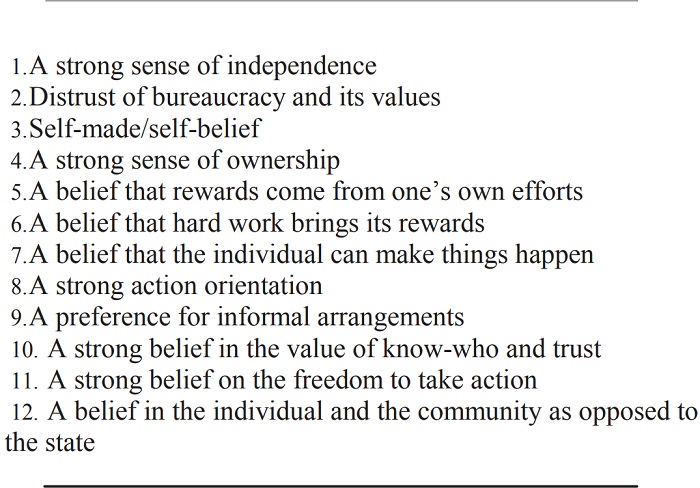
Source: after Gibb (2005).
Failing to understand such beliefs will prevent governments from engaging these communities in their economic effort, because the creative labour needed may be withheld if the motivation for its application is lacking. Entrepreneurship has been already been associated with values that parallel many of those held by the creative community: these values are listed in Table 1. The last entry in the table, belief in the individual and community as opposed to the state highlights the theme of tension between what the state is asking of these communities and what these communities may be prepared to deliver. Art and design pedagogy are about analysis, interpretation and tolerance of ambiguity and as such is perfectly situated to enable individuals to survive and thrive in a world of flux and complexity. Once the process has been mastered and owned by an individual it can be applied to any given scenario and any new context.
The Design Commission report Restarting Britain: Design Education and Growth points out that there is a consensus that in the 21st century, governments and global corporations are presiding over complex systems they are no longer confident they control Danvers (2003) and reiterates that there are different skills required for the navigation of this world than was the case in the past. Danvers (2003) makes the point that “instability and uncertainty are often seen as positive states of mind within art and design” (Danvers, 2003: 12).This pedagogy is described as encouraging people “to take risks, to deal with the fundamental instability of meanings and definition, and high levels of uncertainty in relation to knowledge and practice, require particular kinds of learning environments in which these needs are recognized and valued” (Danvers 2003: 2) and if indeed the radical power of financial interests to uproot businesses and destroy individual lives has grown in the wake of deregulation Friedman (2010) a refocusing of values is as much a business interest as a social one. Although social entrepreneurship has been traditionally associated with the voluntary sector, many of the commercial brands that have achieved sustainable growth in the last decade have at their core ethical and social concerns. If the creative community is marked out by not being singularly inspired by purely financial gain, but rather thrives on projects where the profit for purpose is the key motivating factor, then the idea that policy, focusing on entrepreneurship has developed on a national and regional level, but much of this is informed by a narrow view of what constitutes entrepreneurship HEA–NESTA (2007) needs to bead dressed. The NESTA report also discusses the finding that creative students were uncomfortable with the common stereotypes of entrepreneurship, which they associated with aggression, confrontation and poor environmental and ethical performance – characteristics as antithetical to their own practices as the focus on the commercial gain at the expense of social benefit (HEA–NESTA, 2007).The often divisive distinction between artistry and industry is not helping business to benefit from the creativity, because creative capacity is an observable and valuable component of social and economic enterprise, as McWilliam and Haukka (2008) point out; they also explore the notion of creative capital (Ibid). Furthermore, there is an understanding that centers of excellence should be established for multi-disciplinary courses combining management studies, engineering and technology and the creative arts (HMT, 2005).
If there is truth in Friedman’s (2010) argument that the economies of the United States and many parts of Europe are destroying wealth as they shift resources from productive to financial manipulation, then business as much as citizens would benefit from attitudes not entirely compliant with this system. If we as citizens have come to view ourselves as primary consumers, because we are treated as such, art and design education may offer us a way back to meaningful citizenship, applying what we have learned as consumers and engaging in the co-design of our society. Design education has the ability and the duty to contribute to the propagation of future entrepreneurship, by ensuring that pedagogies support the development of anticipatory action in students and encourage co-creation with all societal stakeholders by means of service design, design thinking and human centered technological strategies.
6. CONCLUSIONS
This paper has examined the idea that the liberal arts and art and design education, in particular, have uniquely effective pedagogical methodologies for the teaching of innovative action and entrepreneurship, and that it would be beneficial to apply these pedagogies to a much broader educational strategy. I also argue that with this application, a realization must come that the attitudes and values intrinsic in this pedagogy should also be transferred because they can make an important contribution to society as a whole. In order to reap the full benefit of the creative labour potential in these creative communities, governments must show an understanding and appreciation of these values and provide an economic setting which delivers motivational goals beyond mere financial economic growth. Financial stability rather than unlimited growth is important to these communities and thus the passion to innovate and the willingness for sacrificial labour will be fully motivated only by ethical and societal benefits. Achieving sustainable economic growth is discussed as an existential goal for post-industrial society, but to achieve it there is a dire need to refocus on what this economic growth entails.
Creative communities may appear at times to behave uneconomically and this can be viewed as naive, but the misconception of the capitalist system in believing that there is only one economic market, namely the financial one, is feeble. Considering Schumacher’s (1973) assertion that a Buddhist economy, for example, is very different from the economics of modern materialism, since the Buddhist sees the essence of civilization, not in a multiplication of wants but in the purification of human character, it is not suggested that creative communities have the same goals of purification; merely that their economy also has objectives different from the mainstream, purely financial ones. The inability to comprehend the existence of these other economies is an underlying weakness of our dominant system and may be an indication of its spiritual and social immaturity. Design Thinking is a creative process in itself. Entrepreneurship can benefit from the application of Design Thinking when moving through a creative process of problem solving, or when looking for new opportunities and challenges. With deeper insights into the dynamics and power of Design Thinking, students can benefit from the integration of entrepreneurial skills in the curricula. If art and design pedagogy can offer its students a sense of human engagement based on ethics and on care, this sense needs to be offered to the wider community when using its methodologies to further innovation and entrepreneurship. The creative and digital realm offers a magnitude of opportunities for real world benefit and, as the economic climate becomes harsher, the creativity at the center of our humanity must once again be called on to enable us to survive and adapt, and to instil in our communities the vibrancy and versatility they deserve.
REFERENCES
BLOOM, B., ENGELHART, M., FURST, E., HILL, W., and KRATHWOHL, D. 1956. Taxonomy of educational objectives: The classification of educational goals. Handbook I: Cognitive domain. New York.
BOWKETT, S. 2005.100 Ideas for Teaching Creativity, Continuum International Publishing Group. Pp. 12–13. London.
CODER-DOJOS. 2014. See: http://coderdojo.com/#zoom=3&lat=48.9225&lon=- 35.15625&layers=00B0T (accessed 10 March 2014).
DANVERS, J. 2003. Towards a radical pedagogy: provisional notes on learning and teaching in art and design.International Journal of Art&Design Education. Vol 22. No 1.pp 47– 57.London.
FRIEDMAN,K.2010.Modelsofdesign:envisioningafuture design education. Visible Language.Vol. 46. No½:132–154.London.
GIBB, A. 2005.Towards the entrepreneurial university: entrepreneurship education as the lever for change. NCGE Policy Paper No 3. NCGE. Birmingham. England.
HEA–NESTA, K. 2007. Creating Entrepreneurship: Higher Education and the Creative Industries, Higher Education Academy Art Design Media Subject Centre and National Endowment for Science, Technology and the Arts. Pp. 57–59. London.
HMT, L. 2005.The Cox Review of Creativity in Business: Building on the UK’s Strength. pp 2–3.London. http://www.hm treasury.gov.uk/coxreview_index.htm (accessed 17 April 2014). http://coderdojo.com/#zoom=3&lat=48.9225&lon=35.15625&la yers=00B0T (accessed 10 March 2014).
http://coderdojo.com/#zoom=3&lat=48.9225&lon=35.15625&layers=00B0T (accessed 10 March 2014).
Maslow, A. 1943. Atheory of human motivation. Psychological Review. Vol 50. No 4: 370–396.London.
MCWILLIAM, E., and HAUKKA, S.2008. Educating the creative workforce: new directions for twenty-first century schooling. British Educational Research Journal. Vol. 43. No 5: 651– 666.London.
OAKLEY, K., SPERRY, B., and PRATT, A. 2008.The Art of Innovation: How Fine Arts Graduates Contribute to Innovation. NESTA. London.
SARASVATHY, S. 2001. Causation and Effectuation: Toward a Theoretical Shift from Economic Inevitability to Entrepreneurial Contingency. The Academy of Management Review.Vol. 26. No2: 243–263.London.
Schumacher, E.1973. Small is Beautiful, Blond and Briggs. London.
SHREEVE, A., SIMS, E., and TROWLER, P. 2010. A kind of exchange: learning from art and design teaching. Higher Education Research and Development. Vol 29. No 2: 125– 138.London.
SPENCE, M. 2011.Quoted in: Kristof Occupy the agenda. New York. http://www.nytimes.com/2011/11/20/opinion/sunday/kristof-occupy-the-agenda.html (accessed 15 May 2013).