Assessing the functioning of Saudi Arabian government schools as learning organizations
Evaluación del funcionamiento de las escuelas gubernamentales de Arabia Saudita como organizaciones de aprendizaje
Assessing the functioning of Saudi Arabian government schools as learning organizations
Opción, vol. 37, núm. 96, pp. 130-141, 2021
Universidad del Zulia
Abstract: The purpose of this study was to examine teachers’ perceptions of school leaderships’ practices towards employing the characteristics of Learning Organizations in public education schools in Saudi Arabia. Methodology: Data were collected through learning school questionnaire (LSQ) that were adapted from Goh (2003). Main Findings: One of the most important results of the research is agreement on the importance of school leaderships in achieving Learning Organizations, and there are difficulties, including centralization, the low level of administrative support in educational departments, and the ineffectiveness of organizational education training programs, which require financial, administrative and training stimulation to develop schools.
Keywords: Learning organizations, School leaderships, Teachers, Saudi Arabia.
Resumen: El estudio examina las percepciones de los maestros sobre las prácticas de líderes escolares mediante la aplicación de las características de las organizaciones de aprendizaje en escuelas de educación pública en Arabia Saudita. Metodología: Los datos se recolectaron a través del cuestionario de escuelas de aprendizaje (LSQ) que fueron adaptados de Goh (2003). Principales Hallazgos: Principalmente se encontró que hay acuerdo sobre la importancia de los liderazgos escolares para lograr organizaciones de aprendizaje; como dificultades, se hallaron: centralización, bajo nivel de apoyo administrativo en los departamentos educativos e ineficacia de la formación educativa organizacional. Se requiere estimulo financiero - administrativo y de formación para el desarrollo de las escuelas.
Palabras clave: Organizaciones de aprendizaje, Liderazgo escolar, Profesores, Arabia Saudita.
1. Introduction
In recent years, increasing attention has been given to bringing about school improvement through the transformation of school systems into Learning Organizations.
The research that was conducted on this subject reveals that all educational organizations should be transformed into Learning Organizations to survive and cope with the great changes that have occurred in almost all fields in the 21st century. (RIINA, 2014).
Recently, there were inevitably desires for changing the administrative strategies of Saudi schools as far as their mission and vision are concerned. This change was due to the need for matching the modern trends in school management to surmount a lot of problems in several schools in the Arab countries, particularly Saudi Arabia and in the light of sustainable development to improve the students' learning, as well as the school leaderships (The High Level Political Forum for the year 2018). The school leadership are responsible for the efficient and effective functioning of the building and the occupants in it. (ALHARTHI, et al., 2018). They serve as a vital connecting link between the central office/board of education and classrooms and between teachers and parents. (KLINKER, 2006).
1.1. Research Questions
The current study seeks to answer the following questions:
First question:
To what extent are the identified Learning Organization characteristics supported by school leaderships in the views of some schools’ teachers in Saudi Arabia?
Second question:
What are the obstacles that hinder transforming Saudi schools into Learning Organizations in the views of the schools' leadership in Saudi Arabia?
Third question:
What are the suggestions that might enable schools to become Learning Organizations?
2. Research Method
A questionnaire has been developed to identify the characteristics that can be used to diagnose whether school leaderships are able to transform their school into a Learning Organization. We depended on many resources to identify characteristics that must be acquired by school leaderships to be able to create a learning school, for example GOH (2003), COPPIETERS (2005), JEREZ-GÓMEZ et al (2005).
The instrument used a five-point scale that ranged from high score happened to low score happened.The first version of the questionnaire, which consisted of (42) items, was originally pilot-tested on a group of fourteen participants for clarity. Furthermore, 10 specialist professors at Saudi universities checked the instrument as far as its content validity is concerned. On revision, the instrument was administered to a group of 247 leaderships from schools in Jazan region.
Reliability tests were conducted, and the instrument was further refined and expanded. In particular, items with low reliabilities and low factor loadings in relation to their corresponding constructs were deleted. The threshold used for factor loadings was 0.40. In its final format, the instrument consisted of (33) items. The overall reliability of the instrument was measured in terms of Coefficient alpha and was found to be 0.97. Again, only items pertaining to the earlier described Learning Organization dimensions are analyzed in this study.
Moreover, the reduced instrument from the factorial analysis was applied to the sample of the teachers in Saudi.
The sample included (221) teachers. This instrument was used to judge school leaderships ability to transform their schools into Learning Organizations.
3. Data Analysis
After the data from the school leaderships were collected, we used principal components analysis (PCA), with varimax rotation to determine (BROWN, 2009a) if the instrument was measuring the dimensions it was designed to measure and therefore empirically construct validation for the Learning Organization dimensions investigated by the study.
For this study, the criterion used in order to determine how many components to retain is that of Kaiser (only components whose eigenvalues are greater than 1 are retained). Finally, the internal homogeneity of each factor was determined by calculating the coefficient alpha. If coefficient alpha was found to be above 0.70, the factor was deemed reliable and exhibiting internal consistency at an acceptable level. After confirming the factorial validity, the instrument was applied to the subjects who were in Saudi teachers and school leadership, then the appropriate statistical techniques were used for analyzing data and answering the respective research questions
4. Results and Findings
The results of the statistical analyses are depicted in Tables 1 through 4. Principal Component Analysis (PCA). The results of the PCA as well as the Reliability of each factor are presented in Table 1. As shown, the PCA that used a varimax rotation produced a five-factor solution that accounted
For 63.5 percent of the total variance. The sample of school leaderships used for this analysis was (247) from Jazan region.
| Factor | Eigen value | Variance (%) | Cronbach’s Alpha |
| 1 | 5.672 | 15.33 | 0.87 |
| 2 | 5.440 | 14.70 | 0.91 |
| 3 | 4.475 | 12.09 | 0.92 |
| 4 | 4.401 | 11.89 | 0.90 |
| 5 | 3.481 | 9.407 | 0.89 |
As shown in the last Table, almost all factors had a reliability coefficient in the 0.87 to 0.92 range, which provides evidence of internal factor homogeneity. Alpha for all thirty-three learning school variables included in this article was measured at 0.95. The variables comprising each factor as well as the corresponding factor loadings are depicted in Table 2 as following.
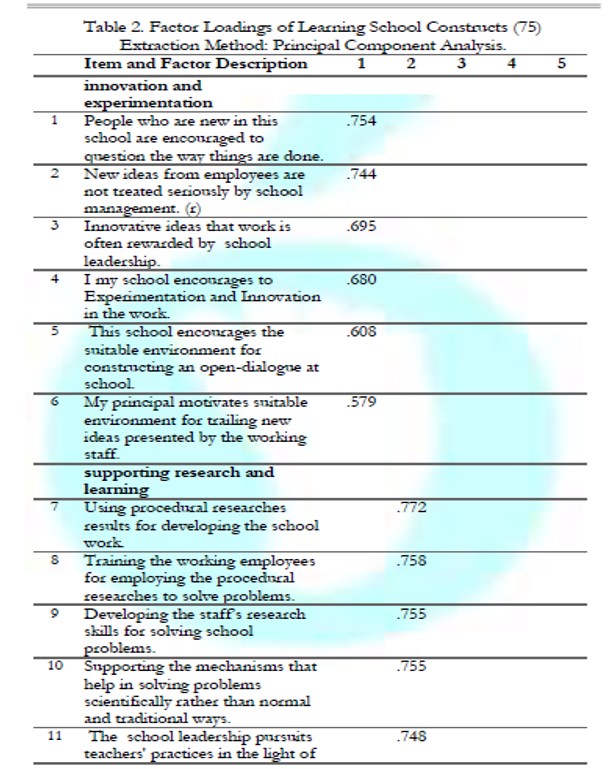


In short, the first rotated factor, which accounted for 15.33 percent of the total variance, had the highest factor loadings from five variables, which is characterized by trial of new ideas. This factor was thus named the innovation and experimentation, the second rotated factor, which accounted for 14.70 percent of the total variance, was composed of variables that collectively characterize the extent to which the organization support use of action research for problem solving in school and support for learning. This factor was thus called supporting research and learning. The third factor generated dealt with the extent to which the employees can participate in decision making in the school. This factor accounted for 12.09 percent of the total variance and was called empowerment and leadership commitment.
The fourth factor, which accounted for 11.89 percent of the total variance, pertained to the extent to which the employees have information, knowledge in order to perform their job in a professional manner. This factor was therefore labeled Knowledge Management. The fifth factor consisted of variables that describe clarity of vision and mission of school so this factor was therefore labeled vision and mission of the school.
The means, standard deviations, and correlations are among the factors summarized in Table 3.
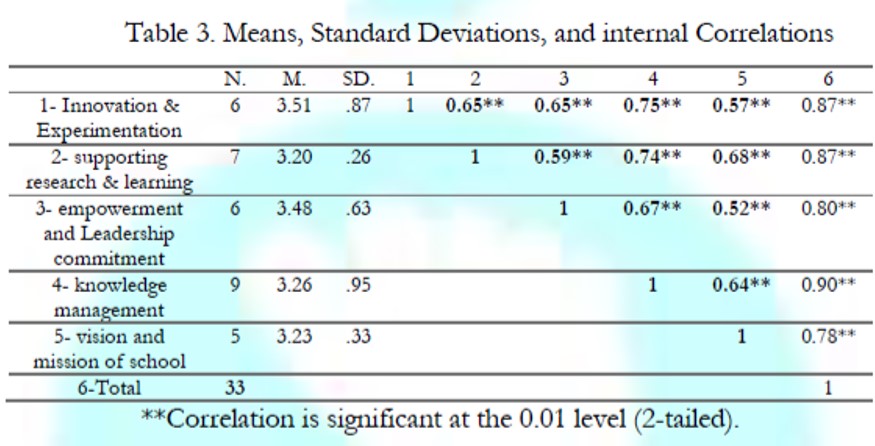
Tabla 3
As shown in the last Table, all of the correlations between dimensions of learning school are significant at 0.01 level (2-tailed), this indicates internal constancy of the instrument.
Then, the effectiveness of the current study could be demonstrated in determining the characteristics of Learning Organizations by answering the following question:
First question: To what extent are the identified Learning Organization characteristics supported by school leaderships from the views of some schools’ teachers in Saudi Arabia?
In relation to this question, the answer was worked out via identifying the minimum and maximum value of each measurement variable and arithmetic average and standard deviation. It was done by dividing the arithmetic rate of the maximum value for each variable after working out the percentage that indicates the principals' support of the characteristics of the Learning Organization in their schools. Table 4 displays the answer to the question described above.
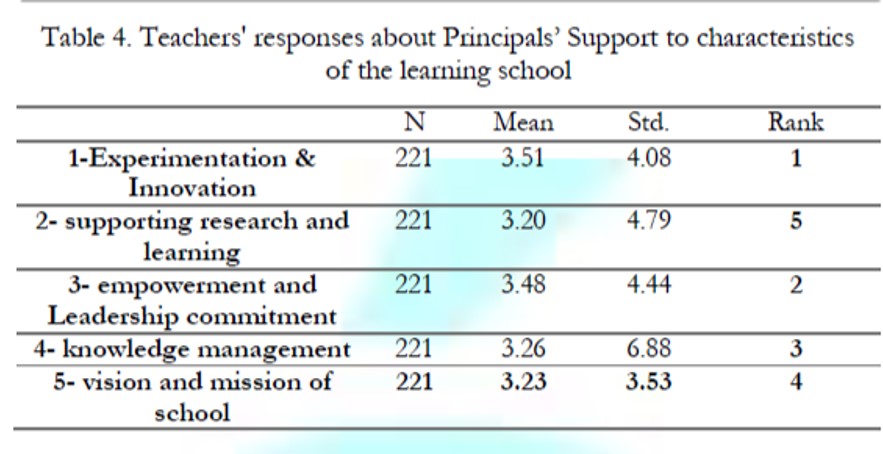
Tabla 4
Teachers' responses about Principals’ Support to characteristicsof the learning school
The previous table, according to the teachers' responses, shows that the total ratio of the school leadership' practices which support the learning school characteristics is high. but this indicates the school leaderships need to identify and support these characteristics in their schools. This result is relatively consistent with the recommendations for these two studies AGANDY & ALGEHENY (2018) and ALBLIWAI, TANASH, (2017).
The table shows that the knowledge management dimension is higher than the empowerment and Leadership commitment, but with the Experimentation & innovation dimension is lower than the supporting research and learning dimension,
These results can be explained in the light of some different cultural factors, especially, for example, the high income of a teacher and the availability of material resources is high and then made the overall ratio to the discretion of teachers to support the characteristics of a Learning Organization high in schools ,The central system of education made , the teachers are interested in implementing rules more than looking forward to develop creative students just following the regulations and laws. Although the overall percentage of the creation of schools as learning communities remains low, perhaps the reason behind this is due to the legislative factors such as the central control of the educational system in the country and some of the bureaucratic complications that reduce the freedom of schools and weaken the sense of independence and school-based management. (JACOBSON,et al.2011)
Second question: What are the obstacles that hinder transforming Saudi schools into Learning Organizations in the views of the schools' leaderships in Saudi Arabia?
In relation to the second question, the answer was worked out via the qualitative analysis of the school leaderships' responses in Saudi Arabia.
5. Conclusion
The current study has shown the important role of school leaderships in supporting the characteristics of the learning school. However, there are some likely restrictions that may hinder turning Saudi schools into Learning Organizations. There are similarities in these restrictions, as stated by the principals in Saudi schools, such as the prominent centralized administration in the educational system in spite of the fact that there are recent attempts towards decentralization. Furthermore, it is due to the low-level organizational support of the school from educational administrations and the lack of the effectiveness of the training programs for school leaderships, particularly those of organizational learning skills. Therefore. The Kingdom seeks to develop leadership side by side with modern trends to reach the learning organization. Among these are expanding the authorities given to school leaderships, enhancing continuing learning opportunities for teaching and administrative staff at schools, financial support from the side of the ministry and school districts, improving the school climate, and motivating training programs that fulfil staff's needs and desires at school.
Limitation and study forward
Selecting and examining larger samples can help in analyzing.
Acknowledgment
All thanks and appreciation for the cooperation of schoolleaderships and teachers in Jazan region.
REFERENCES
AGANDY, A. M. Z. & ALGEHENY, A. M. Z. 2018.“The degree towhich school leaders practice technical competencies in light ofdevelopment strategies Development of public education in theKingdom of Saudi Arabia”. Journal of the Faculty ofEducation, Sohag University, issue No.51:71 – 112.
ALBLIWAI. N.K & TANASH. S.Y. 2017. “Developing PerformanceAssessment Tool for Public Education Principals within TabukSchool District, KSA”. Journal Faculty of EducationalSciences, The University of Jordan, Vol. 44 (2): 211-232
ALHARTHI, S.; ALHARTHI, A. & ALHARTHI, M. 2018. “SustainableDevelopment Goals In The Kingdom Of Saudi Arabia’s 2030Vision”. WIT Transactions on Ecology and the Environment,No. 238: 455-467. Disponoble en: SC19040FU1.pdf(witpress.com) Consultado el: 19.02.2021
BROWN, J. D. 2009a. “Statistics Corner. Questions and answers aboutlanguage testing statistics: Principal components analysis andexploratory factor analysis. Definitions, differences, and choices”.Shiken: JALT Testing & Evaluation SIG Newsletter, Vol.13No.1: 26-30. Disponible en: http://jalt.org/test/bro_29.htmConsultado el: 02.05.2021
COPPIETERS, Piet. 2005. “Turning schools into LearningOrganizations”. European Journal of TeacherEducation.Vol.28, No. 2: 129-139. Disponible en:https://www.tandfonline.com/doi/full/10.1080/02619760500093131?scroll=top&needAccess=true Consultado el: 24.04.2021
GOH, S. C. 2003. “Improving organizational learning capability: lessonsfrom two case studies”. The Learning Organization.Vol.10,No.4: 216-227. Disponible en:https://www.researchgate.net/publication/242339516_Improving_organizational_learning_capability_Lessons_from_two_case_studies Consultado el: 22.03.2021
JACOBSON, S.; JOHANNSON, O. & DAY, C. 2011. Preparingschool leaders to lead Organizational learning and capacitybuilding. Stephen Jacobson, Olof Johannson& Christopher Day.Chapter No. 6: 1-42 Disponible en:https://www.researchgate.net/publication/227017669_Preparing_School_Leaders_to_Lead_Organizational_Learning_and_Capacity_Building Consultado el: 19.06.2021
JEREZ-GÓMEZ, P.; CÉSPEDES-LORENTE, J. y VALLECABRERA,R. 2005. “Organizational learning capability: aproposal of measurement”. Journal of Business Research.Vol.58: 715-725. Dicponible en:https://econpapers.repec.org/article/eeejbrese/v_3a58_3ay_3a2005_3ai_3a6_3ap_3a715-725.htm Consultado el: 10.07.2021
KLINKER, J. F. 2006. “Principalship”. In Fenwick W. (Editor),Encyclopedia of Educational Leadership andAdministration. Vol. 2. Sage Publications, Inc., California (USA).