research-article
Effects of Fear of Crime and Financial Scarcity on Wellbeing and Prison Sentences
Efectos del miedo al delito y de la escasez de recursos en el bienestar y en las penas de prisión
Effects of Fear of Crime and Financial Scarcity on Wellbeing and Prison Sentences
Anuario de Psicología Jurídica, vol. 33, no. 1, pp. 75-81, 2023
Colegio Oficial de la Psicología de Madrid
Received: 27 December 2021
Accepted: 29 July 2022
Published: 28 September 2022
ABSTRACT: In the present article we will examine whether the fear felt towards crime is related to the perception of financial scarcity when satisfying needs, thus attempting to determine whether such a fear influences considerations of whether the transgressor must serve a prison sentence. In addition, we through a correlational design, we will analyse through a correlational design, how fear of crime and perceived financial scarcity is linked to mood and wellbeing. The results from among a large sample of Spanish participants (1,474) have demonstrated that no relation exists between both concerns (fear of crime and perceived financial scarcity); that a not at all insignificant percentage (1.1%) wants the offender to serve a prison sentence; that fear does not correlate with general wellbeing and that financial scarcity does not provoke significant differences on positive mood. These findings allow us to advance in the study of the issues here analysed and thus propose solutions in order to address their consequences.
Keywords: Fear of crime, Prison sentence, Financial scarcity, Wellbeing.
RESUMEN: En la presente investigación se examina si el miedo que se siente ante el delito guarda relación con la percepción de escasez de recursos económicos que se tiene para sufragar necesidades, tratando de determinar si dicha emoción influye en la consideración de que el transgresor deba cumplir condena de cárcel. Además, a través de un diseño correlacional se analiza cómo se vincula el miedo al delito y la percepción de escasez de recursos con el estado de ánimo y el bienestar. Los resultados en una amplia muestra de participantes españoles (1,474) han constatado que no existe relación entre ambas preocupaciones (miedo al delito y percepción de recursos económicos escasos), que un porcentaje no significativo (1.1%)desea que el infractor cumpla pena de prisión, que sentir miedo no correlaciona con el bienestar general y que la escasez de recursos no muestra diferencias significativas en el estado de ánimo positivo. Estos hallazgos nos permiten avanzar en el estudio de las problemáticas analizadas y proponer soluciones para amortiguar sus consecuencias.
Palabras clave: Miedo al delito, Pena de prisión, Escasez de recursos, Bienestar.
Introduction
We can all be victims of a crime. However, fear of crime and the degree to which we perceive insecurity do not appear to be directly related to the probabilities of suffering crime. This is illustrated by the compilation undertaken by Aebi and Linde (2010) of victim surveys undertaken in 27 countries of the European Union. Within these, the percentage of victimised people (usually outside their homes) and the percentage of those who express feeling insecure when outside their homes were taken into account, among other indicators. As a result, it was determined that three types of countries exist: firstly, what could be called realistic countries (e.g., Switzerland and England), in which their citizens show a similarity between the rates of victimisation experienced (the real risk) and their perceptions of insecurity; secondly, there exists what could be termed optimistic countries (such as Sweden or the Netherlands), in which the perception of insecurity is lower than the real rates of victimisation; and thirdly, we find so-called pessimistic countries (Portugal or Spain), which, even though they have low rates of victimisation, have higher levels of perceived insecurity. Therefore, in the Iberian Peninsula beliefs do not coincide with reality, since most crimes consist of theft from cars, with very minor violent crimes.
The studies carried out in the city of Porto, Portugal (see Azevedo et al., 2021; Sani & Nunes, 2016) analyzed the perception of insecurity. Results showed, that one in five participants reported feelings of insecurity due to the presence of crime /danger. Robbery, theft, and drug traffic were perceived as the most common crimes.
In other research in Spain, after comparing crime density rate maps with those of feelings of insecurity it was found that the objective and subjective security have no clear and positive relationship. In addition, the levels of perceived insecurity in Barcelona neighborhoods are influenced by satisfaction with police services, social disorder, ethnic heterogeneity, and socio-economic status (Maldonado-Guzmán et al., 2021).
In line with what has been discussed, the European Social Survey, from 2002 until 2016, in which eastern, central, and western European countries were compared, Spain is among the countries with higher levels of perceived insecurity (European Social Survey, 2019).
According to the measures of Spains Centro de Investigaciones Sociológicas (CIS, 2021), Spaniards express that one of the issues that affects them most are crimes and social insecurity, in addition to unemployment and the financial crisis, which top the list of concerns. This phenomenon is not exclusive to our cultural context since, according to a meta-analytical review carried out by Alfaro-Beracoechea et al. (2018), fear of crime and substantial socio-economic inequalities are perceived as problematic issues in almost all of Latin America.
Causes of Fear of Crime
What do we understand by fear of crime? A largely agreed definition is that by Ferraro (1995, p. 8), who considers it an emotional reaction of fear or anxiety towards crime or those symbols that the person associates with crime. Other authors, such as Vozmediano et al. (2008) conceive fear of crime as an experience of emotional origin, provoked by the possibility of being a victim of crime. [...] this emotional experience is the result of a given way of processing information and interpreting reality from elements in our surrounding, such as news, political speeches etc., which will ultimately provoke diverse cognitive responses from citizens (p. 2-4).
These responses in the form of a sensation of nervousness, insecurity , and worry provoked by either abstract or particular crimes can be expressed emotionally, cognitively, and/or behaviourally, with either a low or high intensity or frequency. These reactions can be projected towards oneself, towards close people and even towards a surrounding or global community.
Citizens tend to link crime and financial problems together, thus producing a series of reactions that demand solutions (Swatt et al., 2013; Vidales, 2012). However, fear of crime does not always correspond to a given level of financial resources. Given this, one of the objectives of this research carried out in Spain is to offer results on the relation between these and analyse whether those who suffer more fear of crime are those who have fewer financial resources to satisfy their needs or, on the contrary, it is those who enjoy higher levels of financial resources who feel higher levels of fear of crime. Following Mani et al. (2013), we understand the concept of financial scarcity as the gap between personal needs and the resources available to satisfy them. This definition is based on the subjective perception of necessity, including people in a financial situation of prolonged poverty as well as those people who temporarily undergo periods of scarcity.
In addition, fear of crime can depend on other sociodemographic variables, such as residing in areas experiencing social degradation, which entails a stronger perception of surrounding insecurity as well as lower levels of wellbeing. According to Aebi and Linde (2012) and Alfaro-Beracoechea et al. (2018) women are the most pessimistic regarding social insecurity, particularly women who acknowledged doing domestic work, alongside those who positioned themselves politically within the extreme right, women who had a lower academic education, those who had suffered some crime in their life, and those who had had bad experiences with law enforcement. These results on the possible causes for fear of crime follow the predictors of which Collins (2016) informs after his meta-analytical review, which are: age, race, income levels, victimisation and appreciation of police.
Consequences of Fear of Crime
Fear of crime brings people to the limit of their abilities to perceive the reality in which they live. They develop a complex emotional process which translates into verbalisations, actions or omissions, either voluntarily or involuntarily, regarding their level of verification of crime and their fear of it, even though the perceived vulnerability before a criminal act does not necessarily correspond with the real risk of suffering it.
Regarding the possible solutions to the problem, once the crime has been committed, it is important to know whether the population considers the current punitive penal system adequate or not, since there is a general dissatisfaction in victims, who perceive a series of deficiencies in traditional justice, which is not restorative, attentive or caring for their needs, while offenders consider that prison teaches them nothing, resulting in a useless sentence which is sterile in its re-socialising goals, and society sees justice as an untrustworthy enemy, since it does not provide an adequate response to crime, only managing, if at all, to offer a control system and a false perception of justice and security (Miguel Barrio, 2019). In the case of the general public, according to research by Fernández Molina and Tarancón Gómez (2010), it is felt convenient to undertake educational and rehabilitating measures instead of more punitive measures, especially among young delinquents.
Moreover, this study will address the influence that fear of crime may have over mood and wellbeing, given that some studies demonstrate that this emotion does not necessarily diminish wellbeing in people. Both Gray et al. (2011) and Jackson and Gray (2010) undertook research to study the benefits of concern for and fear of crime. These authors found that people recognised that concern for crime made them take higher precautions, enabling them to feel safer without this affecting their quality of life. Therefore, fear of crime is a natural and adaptive defence system against crime.
Recent research conducted in Jalisco (Mexico) explored the relationship between direct, indirect, and vicarious victimization and fear of crime on subjective wellbeing, emotional climate, and social wellbeing. The results revealed that women and people who have been victims are more afraid of crime and that victimization and fear of crime are negatively related to subjective wellbeing through the negative emotional climate. Therefore, it is the emotional climate that has an important mediating effect, since people may be afraid of crime without it directly affecting their subjective or social wellbeing, but if the fear of crime is associated with an emotional climate in which individuals perceive a negative or hostile social environment, it is then that their social wellbeing will be affected (Beracoechea et al., 2021).
In addition, Franklin et al. (2008) consider feelings of vulnerability, which evidence fear of crime through personal risk. That is, for these authors, physical, social, and financial vulnerabilities translate into fear of crime.
Although it is not possible to specify how an individual would respond to the possibility of being a victim of a specific crime, it is clear that the individual will generate extreme responses according to their physical capabilities and their perception and comprehension of their individual and social reality, and will interpret this situation from a feeling of insecurity and thus of fear (Ávila Guerrero et al., 2015).
Generally, security and trust are feelings that people experience when they have, or feel they have, enough power and financial resources to face a given situation. On the contrary, people feel fear or concerns when they face threatening or dangerous situations with an insufficient amount of resources.
With regards to a lack of resources and affect, previous studies have explained that subjective wellbeing is not comparable to levels of wealth, since different levels of happiness can be achieved within a same level of financial resources (Diener et al., 2009). Following this line, Brockman et al. (2009) and Tang (2014) verified that, despite the high financial growth experienced by China during the last two decades, their average levels of happiness had descended. Within this cultural context it is evident that satisfaction with life has not followed the same path as financial growth.
Unfortunately, many people live in societies that generate economic inequalities and scarcity of resources and where events that produce reactions of fear, frustration, mistrust, and insecurity take place. Life among these spirals of adversity is indeed complicated and causes much suffering. The question that arises is how people in these conditions maintain their mood.
Objectives
Based on existing literature, the first objective of this study is to analyse the relation between fear of crime and the perception of financial resources with wellbeing and mood. Furthermore, it will explore whether fear of crime is stronger in the group with lower financial resources to satisfy their needs.
The second objective attempts to study whether fear of crime can determine support for prison sentences, taking into account that this forces the offender to remain for a period of the sentence within the prison under established regimes of internment.
We will also explore if individuals think, after having committed a serious crime (violent robbery), if it is necessary for the offender to go to prison (for 2 to 5 years for the crime here studied, according to the law), since the loss of freedom is considered by many as disciplining those who are dangerous individuals, who will spend a good time behind bars, thus preventing them from reincurring in criminal behaviour (Ríos et al., 2016).
Method
Participants
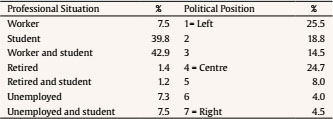
A sample of 1,474 participants from across Spain have participated in this study, with an age range between 18 and 66 (M = 28.18, SD = 11.03); 69.8% were women. In Table 1 their professional situation and political ideology (within a continuum from 1 = left-wing to 7 = right-wing) is described.
Note. % = percentage for every one of the possible answers.
As can be observed, the majority of participants are both studying and working, and have centre-left political tendencies. The sample also has a higher percentage of women than men.
Procedure
With regards to the procedure undertaken in collecting the data, Social Psychology students were asked to collaborate in the activity in exchange for academic credits. In the instructions it was made clear that they should answer themselves and ask for the help of another person of the opposite gender. In addition, they were instructed to communicate to the invited person that their participation was voluntary, and they could step back whenever they wished to. This information also appeared at the beginning of the questionnaire, in the informed consent section, which they had to sign if interested in participating. Data collection took place online, through the Qualtrics program, for which the student had to send a link to the invited person for the completion of the questionnaire.
Instruments
Fear of Crime
To evaluate this variable, participants were presented with a text describing a violent robbery towards a friend, with physical and psychological consequences for the victim (adapted from Lozano & Fernández, 2021, see Appendix). After the text, the participants had to answer the following question: Are you fearful right now when considering the possibility of suffering this crime yourself?, within an answer range of 1 (not at all) to 7 (very). The descriptive statistics were (M = 4.17, ST = 1.84, Mdn = 4). The value of Mdn allowed for the creation of a dummy variable, in which those who score between 1 and 4 are the group that feels less fear of crime (n = 765), while the other group, with scores between 5 and 7, express a higher level of fear towards the possibility of suffering the same crime (n = 709).
Perception of Financial Resources
This indicator was taken from Mani et al. (2013). The participants had to answer the following question: Regarding the wealth you and/or your family possess, is it a) more money than you and/or your family needs? b) enough to satisfy your and/or your familys needs? or c) NOT enough to satisfy your and/or your familys needs? The final answer option (c) means a higher perception of the need for financial resources than the previous two. The answer percentages in our sample were distributed as a) 8.6% (n = 127), b) 75.6% (n = 1.115), and c) 15.7% (n = 232).
Prison Sentence
The participants were asked about the possibility of offenders serving their sentence in prison, after being declared guilty: After the violent robbery crime described, do you consider that the offender must serve their sentence in prison?. As many as 98.9% (1.458) answered No against 1.1% (n = 16) that answered affirmatively.
Mood
This variable was measured with the abbreviated scale of PANAS (Positive and Negative Affect Schedule by Watson et al., 1988), formed by 10 emotional terms grouped in two dimensions: positive (e.g., determined, resolute) and negative affect (e.g., anxious). Participants were asked to indicate to what extent they had experienced these feelings and emotions during the last three months (answer range from 1 = never experienced to 7 = always). From the scores obtained three indicators were created: positive affect (M = 5.16, SD = .91, = .77), negative affect (M = 3.39, SD = 1.07, = .77) and the affect balance obtained through the difference between positive and negative affect (M = 1.77, DT = 1.52).
General Wellbeing
In order to measure general wellbeing the Pemberton Happiness Index (PHI; Hervás and Vázquez, 2013) was used. Remembered wellbeing is evaluated through 11 items (e. g., I am very satisfied with the way I am, my life is full of lessons and challenges that help me to grow). The answer range went from 1, totally disagree to 7, totally agree, (M = 5.43, SD = 0.91). The Cronbach alpha was satisfactory ( = .88).
Design
A descriptive-correlational study was undertaken. A non-probabilistic intentional sample strategy was adopted.
Data Analysis
The statistical analysis of reliability, descriptive and of correlations is presented, were analysed through SPSS 25. We used Spearmans correlation (rho) for categorical variable (see Perception of financial resources). In addition, the size of the effect (partial eta squared) was calculated for comparison of means between groups.
Results
Previous Analysis
In order to check whether gender, age, professional situation, and political ideology influenced the variables here studied variance analyses (ANOVA) were undertaken. The results showed that fear and mood did have statistically significant differences (Fs; p < .001) depending on the sociodemographic variables studied. For this reason, these four indicators will be included as covariables in the analysis to check differences between groups.
Associations between Variables
In Table 2 one can find the Spearman matrix of correlations, where one can verify the relations obtained among the indicators analysed. Firstly, we can see how fear of crime is linked to negative affect and affect balance. Secondly, we can observe that there were no associations between this emotion and the perception of financial resources, positive affect, or general wellbeing.
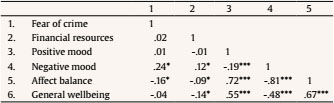
Note. N = 1,474; fear of crime with an answer range of 1 (Not at all) to 7 (Very). Financial resources with an answer range of 1 to 3, with 1 representing more money than you and/or your family need, 2 enough to satisfy your and/or your familys needs, and 3 not enough. Answer range for positive mood, affect balance and general wellbeing from 1 to 7, with higher scores indicating a better mood, affect balance, and general wellbeing. Answer range for negative mood from 1 to 7 with higher scores indicating higher levels of negative mood.
***p < .001.
The perception of financial resources to satisfy needs is associated positively with negative affect, while the negative relations are to be found regarding the affect balance and general wellbeing.
However, the relation between fear of crime and the perception of financial resources is not significant. The significant relations take place when the affect is of a different nature (positive vs. negative) from wellbeing.
Finally, it is important to consider how the affect balance is a variable significantly associated with all the variables: negatively with fear of crime, financial resources, and negative mood; and, as expected, positively with general wellbeing and positive mood.
Group Differences according to Fear of Crime
The mean and standard errors for the groups with regards to fear of crime (low vs. high) are presented in Table 3. The ANOVAs, with gender, age, professional situation, and political ideology covariables reflect statistically significant differences for the following indicators: negative mood, affect balance, and general wellbeing.
As can be observed in Table 3, the scores in negative mood are greater in the group with a stronger fear of crime, while those who feel lower fear present a better affect balance and a greater general wellbeing.
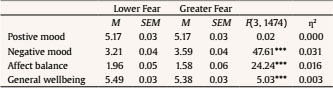
Note. The covariables appearing in the model are evaluated with the following values: gender = 1.70 (1 = men and 2 = women), age = 28.18 years-old, professional situation = 2.81 (student, worker) and political ideology = 3.01 (from 1 = left-wing to 7 = wing; SEM = standard error of the mean.
***p < .001.
Group Differences according to the Perception of Financial Resources
Notes. The covariables appearing in the model are evaluated with the following values: gender = 1.70 (1 = men and 2 = women), age = 28.18 years-old, professional situation = 2.81 (student, worker) and political ideology = 3.01 (from 1 = left-wing to 7 = right-wing); SEM = sstandard error of the mean.
*p < .05, ***p < .001
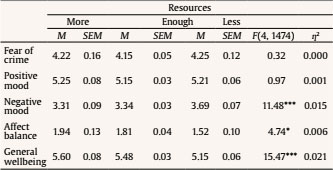
Table 4 shows the comparison of means for groups according to the perception of financial resources. The variable in this analysis presents the following answer alternatives: a) more, b) enough, and c) less than enough to cover needs.
As a whole, this comparison of means shows a specific profile for those who have a perception of fewer financial resources to cover their needs. These are characterised by a greater negative mood, worse affect balance , and lower general wellbeing.
However, there are no statistically significant differences that depend on belonging to one group or another with regards to feeling more fear of crime; and we can see that having more or less financial resources also does not have an effect on positive moods.
Group Differences according to Reparations for Harm
Finally, comparisons were made to determine whether individuals that have considered that the only solution for the reparation of the crime is prison are differentiated in some of the variables studied here from those who had answered no to the question. The only significant result was that fear of crime is stronger for those who expect offenders serve their sentence in prison F(1, 1472) = 3.75; p < .05, ƞ2 = .005, M Yes = 5.06, SD = 1.73 vs. M No = 4.16, SD = 1.84. This emotion is stronger for those who expect offenders serve their sentence in prison.
Discussion
The general objective of this study has been to analyse how fear of crime is related to financial scarcity, prison sentence, and wellbeing, constituting an empirical and exploratory work of innovative characteristics, since both precedents and consequences of fear of crime are addressed. The analysis of correlations allows to disengage of two issues that are generally associated: fear of crime does not have as a cause the perception of having more or fewer financial resources to cover needs. Collins (2016) did obtain a significative effect between both variables. A plausible explanation could be found in the majority of participants being university students with financial income. In addition, according to the classification of Mani et al. (2013), 75% of the sample perceives that they have enough money to satisfy their needs.
Fear and fewer financial resources are associated, similarly, with a negative mood and a worse affect balance. In line with previous research (see Muratori & Zubieta, 2013), these issues, fear of crime and financial scarcity, do not have an effect on positive states of mind.
A better affect balance and general wellbeing can be found among those who feel less fear of crime. These two indicators will diminish among those who perceive that they do not have enough financial resources to cover their needs, which evidently affects their quality of life. Previous studies have empathised the emotional aspects of insecurity as factors that impact on wellbeing and quality of life (Alfaro-Beracoechea et al., 2018).
In addition, we have been able to demonstrate that a low percentage of participants perceive themselves as not having enough financial resources, even though the ample majority affirm having enough to cover their needs. Perceived scarcity influences general wellbeing. These findings are based in a sample of voluntary participants in which a majority are not in a situation of poverty, which is why we would recommend replicating this study among the larger population.
As has been shown, only a non-representative percentage of those surveyed believes that offenders must serve their sentence in prison. A possible explanation could be found in blaming the victims. As described in the Appendix, the victims texted with the cell-phone as they walked, and consequently they were distracted from the environment. However, this invites further thoughts on alternative paths for reparation, such as restorative justice, since some form of solution to this situation is needed. Following Zehr (2002), this practice stems from reintegrating and holding the offender responsible, which are indispensable for a restorative process to take place, as well as the offenders realisation of the impact of their crime. We must not forget, however, that the primary purpose consists of the reparation to the victim, who has been harmed by the crime and feels fear.
The result in connection with the serving of sentences in prison contrasts with the research undertaken by Caño and Calvo (2019) with Law students, since these show severe punitive attitudes, such as reviewable life imprisonment. The authors explain that a possible explanation for the high percentages of supporters of this measure can be found in the current socio-political situation and that these are not representative of larger society. Moreover, as Caño and Calvo (2019) explain, people with strong fear of crime and/or victims of it do not necessarily believe that the offender must go to prison, that is, having suffered a crime is not directly related to preferring prison sentences, which means that attributing a punitive sentiment to victims constitutes a fallacy.
Our findings allow for the evaluation of the repercussions of fear of crime through mood and wellbeing, bringing new opportunities for the understanding of emotional and behavioural responses when facing perceived insecurity. Other studies suggest that fear of crime is related to the hedonic wellbeing experienced, as well as to corruption and social problems (see Alfaro-Beracoechea et al., 2018). The perception of (in)security has also been related with other variables such as nationality, education, criminal, and environmental factors, adequacy and satisfaction with policing, and seek for formal support (Azevedo et al., 2021).
Despite these contributions, our study is not free of limitations, since we use data collected in a given moment and based only on a violent robbery crime. To establish an understanding of fear of crime across time it would be necessary to undertake longitudinal research in which participants could consider several events that create insecurity and that have different juridical consequences according to the law. This methodology could situate precedents and consequences, as well as address the type of sentences ranging from the lowest with no imprisonment to short-term imprisonment and ending in revisable life imprisonment.
To conclude, this study evidences that fear of crime is relatively independent of the perception of financial resources, which is a phenomenon that does have an effect on affects and wellbeing. Further research should be conducted in different cultural contexts in which other socio-financial and criminal realities take place, in order to corroborate these results in a sample representing different political ideologies and job statuses. We however must not forget that wellbeing is a complex concept that does not only encompass the existence of positive and negative sentiments, but also involves the ascription of meaning to life after suffering negative and traumatic events, such as violent crime.
References
Aebi, M. F., & Linde, A. (2010). Las encuestas de victimización en Europa: evolución histórica y situación actual. Revista de Derecho Penal y Criminología, 3, 211-298. http://espacio.uned.es/fez/eserv.php?pid=bibliuned:revistaDerechoPenalyCriminologia-2010-3-5060&dsID=Documento.pdf
Aebi, M. F., & Linde, A. (2012). Conviction Statistics as an Indicator of Crime Trends in Europe from 1996 to 2006. European Journal on Criminal Policy and Research, 18(1), 103-144. https://doi.org/10.1007/s10610-011-9166-7
Alfaro-Beracoechea, L. N., Puente, A., da Costa, S., Ruvalcaba, N., & Páez, D. (2018). Effects of fear of crime on subjective wellbeing: A meta-analytic review. The European Journal of Psychology Applied to Legal Context, 10(2), 89-96. https://doi.org/10.5093/ejpalc2018a9
Alfaro-Beracoechea, L. N., Ruvalcaba, N. A., & Páez, D. (2021). Efectos de la victimización y el miedo al delito en el bienestar de habitantes de Ocotlán, Jalisco. Journal de Ciencias Sociales, 9(16), 21-42. https://doi.org/10.18682/jcs.vi16.4342
Ávila Guerrero, M. E., Martínez Ferrer, B., Vera Jiménez, J. A., Bahena Rivera, A., & Musito Ochoa, G. (2015). Victimización, miedo al delito y cambios en las rutinas cotidianas en un contexto de alta criminalidad, en función del género. Revista Española de Investigación Criminológica, 13, 122. https://doi.org/10.46381/reic.v13i0.89
Azevedo, V., Sani, A., Nunes, L. M., & Paulo, D. (2021). Do you Feel Safe in the Urban Space? From Perceptions to Associated Variables. Anuario de Psicología Jurídica, 31(1), 75-84. https://doi.org/10.5093/apj2021a12
Brockmann, H., Delhey, J., Welzel, C., & Yuan, H. (2009). The China puzzle: Falling happiness in a rising economy. Journal of Happiness Studies, 10(4), 387405. https://doi.org/10.1007/s10902-008-9095-4
Caño, M.A. & Calvo, Mª A. (2019). Percepción de la delincuencia, miedo al delito y actitudes punitivas en España. InDret, 4. https://raco.cat/index.php/InDret/article/view/364412
Centro de Investigaciones Sociológicas (CIS, 2021). Estudio número 3330. Centro de Investigaciones Sociológicas. http://www.cis.es/cis/opencms/ES/NoticiasNovedades/InfoCIS/2021/Documentacion_3330.html
Collins, R. (2016). Addressing the inconsistencies in fear of crime research: A meta-analytic review. Journal of Criminal Justice, 47, 21-31. https://doi.org/10.1016/j.jcrimjus.2016.06.004
Diener, E., Lucas, R., Schimmack, U., & Helliwell, J. (2009). Wellbeing for public policy. Oxford University Press.
European Social Survey. (2019). About the European Social Survey, European Research Infrastructure ESS ERIC. https://www.europeansocialsurvey.org/about/
Fernández Molina, E., & Tarancón Gómez, P. (2010). Conocimiento y actitud pública hacia la delincuencia juvenil. Boletín Criminológico, 16. https://doi.org/10.24310/Boletin-criminologico.2010.v16i0.8436
Ferraro, K. (1995). Fear of Crime. Interpreting Victimization Risk. State University of New York.
Franklin, T. W., Courtney, A., Franklin, A. P. & Fearn, N. F. (2008). A Multilevel analysis of the vulnerability, disorder, and social integration models of fear of crime. Social Justice Research, 21(2), 204227. https://doi.org/10.1007/s11211-008-0069-9
Gray, E., Jackson, J., & Farrall, S. (2011). Feelings and functions in the fear of crime. Applying a new approach to victimization insecurity. British Journal of Criminology, 51(1), 75-94. https://doi.org/10.1093/bjc/azq066
Hervás, G., & Vázquez, C. (2013). Construction and validation of a measure of integrative wellbeing in seven languages: The Pemberton Happiness Index. Health and Quality of Live Outcomes, 11, Article 66. https://doi.org/10.1186/1477-7525-11-66
Jackson, J., & Gray, E. (2010). Functional fear and public insecurities about crime. British Journal of Criminology, 50(1), 1-22. https://doi.org/10.1093/bjc/azp059
Lozano, F., & Fernández, I. (2021). Justicia restaurativa y su relación con la empatía y los valores sociales. [The relationships between Restorative Justice, Empathy and Social Values] Universitas Psychologica, 20, 1-14. https://doi.org/10.11144/Javeriana.upsy20.jrre
Maldonado-Guzmán, D. J., Saldaña-Taboada, P., & Miguel-Alvaro, A. (2021). Análisis espacial de la inseguridad percibida en barcelona: el papel de los barrios adyacentes y de los factores psicosociales implicados. Anuario de Psicología Jurídica, 31(1), 63-73. https://doi.org/10.5093/apj2021a7
Mani, A., Mullainathan, S., Shafir, E., & Zhao, J. (2013). Poverty impedes cognitive function. Science, 341(61489), 976-980. https://doi.org/10.1126/science.1238041
Miguel Barrio, R. (2019). Justicia restaurativa y justicia penal. Atelier.
Muratori, M., & Zubieta, E. (2013). Miedo al delito y victimización como factores influyentes en la percepción del contexto social y clima emocional, Boletín de Psicología, 109, 718. http://www.uv.es/seoane/boletin/previos/N109.htm
Ríos, J. C., Pascual, E. Segovia, J. L., Etxebarria, X., & Lozano, F (2016). Mediación penal, penitenciaria y encuentros restaurativos. Experiencias para reducir el sufrimiento en el sistema penal. Universidad Pontificia de Comillas, Madrid.
Sani, A., & Nunes, L. M. (2016). Diagnóstico de seguridad/inseguridad. Un estudio exploratorio en una comunidad urbana. Anuario de Psicología Jurídica, 26(1), 102-106. https://doi.org/10.1016/j.apj.2015.07.001
Swatt, M., Varano, S. P., Uchida, C. D., & Solomon, S. E. (2013). Fear of crime, incivilities, and collective efficacy in four Miami neighborhoods. Journal of Criminal Justice, 41(1), 1-11. https://doi.org/10.1016/j.jcrimjus.2012.09.004
Tang, Z. (2014): They are richer but are they Happier? Subjective wellbeing of Chinesse citizens across the Reform Era, Social Indicators Research, 117(1), 145-164. http://dx.doi.org/10.1007/s11205-013-0339-2
Vidales, C. (2012). Seguridad ciudadana, políticas de seguridad y estrategias policiales. Estudios Penales y Criminológicos, 32, 469-502.
Vozmediano Sanz, L., San Juan G, C., & Vergara, A. I. (2008). Problemas de medición del miedo al delito. Revista Electrónica de Ciencia Penal y Criminología, 10, 1-17
Watson, D., Clark, L. A., & Tellegen, A. (1988). Development and validation of brief measures of positive and negative affect: The PANAS Scales. Journal of Personality and Social Psychology, 54(6), 1063-1070. https://doi.org/10.1037/0022-3514.54.6.1063
Zehr, H. (2002). The little book of restorative justice. Good Books.
Appendix
Description of violent robbery, a crime with a 2 to 5-year prison sentences according to the Spanish Penal Code
A friend of yours tells you that they have been a victim of a crime. Your friend recounts what happened while they texted as they walked. They tell you that suddenly they were pushed, fell to the ground and someone leaped on their cell-phone and tried to snatch it. Your friends personal and professional relationships depended on that smartphone, which is why it could not be stolen. They tried to hang on to it. A scuffle ensued. The offender hit your friend, through them to the floor, kicked them and your friend could not take it anymore and let go of the cell-phone. The offender ran away with the cell-phone. Your friend remained on the floor, bleeding and terrified. Although the serious physical injuries have been cured, they are still deeply terrified.
Notes
Author notes
Correspondence: Ifernandez@psi.uned.es (I. Fernández).