research-article
Psychopathy, Emotional Recognition, and Moral Judgment in Female Inmates
La psicopatía, el reconocimiento emocional y el juicio moral en mujeres presas
Psychopathy, Emotional Recognition, and Moral Judgment in Female Inmates
Anuario de Psicología Jurídica, vol. 34, no. 1, pp. 67-74, 2024
Colegio Oficial de la Psicología de Madrid
Received: 26 December 2021
Accepted: 08 November 2022
Published: 24 March 2023
ABSTRACT: Despite the lower levels of psychopathy in women than in men, the scientific interest in studying psychopathy in female participants is increasing. Nevertheless, the number of studies investigating psychopathy in women and associated phenomena remains low. The influence of psychopathy in women inmates on experimental tasks of emotional recognition and moral judgment was evaluated, aiming to contribute to this field of research. Utilitarian moral judgment was predicted by psychopathy, specifically by primary and secondary psychopathy, while primary psychopathy predicted a worse performance on the emotional recognition task. There was no significant influence of general intellectual abilities on either task. Contrarily to what was expected, emotional recognition did not prove to be a significant mediator of the relationship between psychopathy and utilitarian moral judgment. These results emphasize that the tendency to utilitarian moral judgment and worse recognition of facial expressions of emotion are associated to higher psychopathy scores in female inmates (especially primary psychopathy), but more studies are necessary to address the role of the emotional component in the process of moral judgment.
Keywords: Psychopathy, Women, Female, Imprisonment, Emotional recognition, Facial expressions identification, Moral judgment, Utilitarianism.
RESUMEN: A pesar de los niveles más bajos de psicopatía en mujeres que en hombres, está aumentando el interés científico en estudiar la psicopatía en mujeres. Sin embargo, el número de estudios que investigan esta patología en mujeres y sus fenómenos asociados sigue siendo bajo. Se evaluó su influencia en reclusas en tareas experimentales de reconocimiento emocional y juicio moral, con objeto de contribuir a este campo de investigación. La psicopatía, específicamente la primaria y la secundaria, predijo el juicio moral utilitario, mientras que la primaria predijo un peor desempeño en la tarea de reconocimiento emocional. No hubo influencia significativa de las habilidades intelectuales generales para ninguna de las tareas. Contrariamente a lo que se esperaba, el reconocimiento emocional no demostró ser un mediador significativo de la relación entre la psicopatía y el juicio moral utilitario. Los resultados destacan que la tendencia al juicio moral utilitario y el peor reconocimiento de las expresiones faciales de emoción se asocian a puntuaciones más altas de psicopatía en reclusas (especialmente en psicopatía primaria), pero se necesitan otros estudios que aborden el papel del componente emocional en el proceso de juicio moral.
Palabras clave: Psicopatía, Mujeres, Sexo femenino, Encarcelamiento, Reconocimiento emocional, Identificación de expresiones faciales, Juicio moral, Utilitarismo.
Introduction
Psychopathy has been studied for decades and researchers accept that this construct consists of a range of personality traits, some of which are considered disruptive and associated to antisocial behaviour, but this definition is not consensual. The term “psychopathy” started to be frequently used with Cleckley, who described the clinical profile of psychopaths in his work The mask of sanity (1941), by identifying 16 descriptive characteristics: superficial charm and high IQ, absence of delusions and other signs of irrational thinking, absence of nervousness or neurotic manifestations, unreliability, untruthfulness and insincerity, lack of remorse or shame, antisocial behaviour without apparent compunction, poor judgment and failure to learn from experience, pathological egocentricity and incapacity to love, general poverty in major affective reactions, specific loss of insight, unresponsiveness in general interpersonal relations, fantastic and uninviting behaviour with drink and sometimes without it, suicide threats rarely carried out, impersonal, trivial, and poorly integrated sex life, and failure to follow any life plan. Considering the above, and attempting to move beyond the pathological perspective, psychopathy may be defined as a personality structure, marked by a character deviation in its most intense manifestations, which includes affective (e.g., lack of guilt and low empathy) and interpersonal traits (e.g., narcissism and superficial charm), as much as antisocial behaviours.
Evaluating psychopathy triggers a massive discussion about its nature, namely if it is categorical or dimensional, with a continuous distribution in the population. Hare (1970) discussed whether we should postulate a type (“the psychopath”) or a dimension (“the psychopathy”), concluding that both are appropriate and represent two sides of the same coin. From a categorical point of view, psychopathy would be a non-arbitrary type, whereas from a dimensional perspective it is defined based on a continuum in which every individual is placed. This last perspective, supported by various authors (e.g., Edens et al., 2006; Guay Ruscio et al., 2007; Hare & Neumann, 2008), is adopted in the present study for two reasons: firstly, as noted by Feldman (1977), there are very few individuals consistently psychopaths or non-psychopaths in every situation and towards everyone; secondly, using the term “psychopath” is always questionable and must be applied carefully, especially when it refers to institutionalized individuals, who might be negatively influenced by the label.
One of the most reported models of psychopathy is the two-factor model. Originally developed by Hare (1991), this model divides the construct in two dimensions: factor 1, closely related to the so-called primary psychopathy; and the factor 2, encompassing features of the secondary psychopathy. Primary psychopathy comprises affective and interpersonal traits, describing aggressive, hostile, extroverted, and self-confident individuals with low levels of anxiety. Secondary psychopathy includes antisocial lifestyle and impulsivity traits, characterizing irresponsible, impulsive, temperamental, socially anxious, and isolated individuals with low levels of self-esteem.
Although psychopathic traits are more evident in men, they are also present in women. Cleckley (1941) includes female individuals in his book, observing that psychopathic features are manifested in both sexes, but in women its manifestations tend to be interpreted as violations of the roles expected for the female gender. Since then, most studies focused on men, with relevant exceptions, such as Widom’s (1978) study, where he concludes that primary and secondary psychopathy types are also present in female samples. Later reviews on the area (e.g., Cale & Lilienfeld, 2002) confirm that although levels of psychopathy are lower in women, reliability and factorial structure of psychopathy measures are adequate to both sexes, validating the applicability of the construct to women (Warren et al., 2003) and supporting the previously raised hypothesis that men and women share the affective and interpersonal traits of psychopathy, but differ in the behavioural manifestations of antisocial behaviour (e.g., Hamburger et al., 1996). Patrick’s (2006) work also highlighted the unquestionable lower levels of psychopathy in women and gender differences in the behavioural manifestations of anti-sociality. Specifically, some behavioural characteristics are less visible in women, while others (e.g., emotional reactivity and anxiety) seem to be more prevalent, confirming previous results (e.g., Warren et al., 2003).
The relationship between psychopathy and moral judgment is highly reported (e.g., Bartels & Pizarro, 2011; Glenn et al., 2009; Kahane et al., 2015) and has been evaluated in many different ways. One form of moral judgment is utilitarianism, which is based on the rule that the moral action is the one that maximizes the good and minimizes the damage to the higher number of people (Bentham, 1948, cit. in Balash & Falkenbach, 2018). When the focus is on moral utilitarianism, most studies confirm the hypothesis that a higher psychopathy score is associated with a more utilitarian judgment (e.g., Bartels & Pizarro, 2011; Kahane et al., 2015), but not all studies confirm it. In a study by Marshall et al. (2017), the authors conclude that individuals scoring high on psychopathy have an intact moral comprehension but are not concerned in acting on the basis of this knowledge. This meets the findings from a previous study by Tassy et al. (2013), and a possible explanation for this null result is the fact that this type of studies recruits university samples, not disregarding other studies that point out a link between psychopathy and higher predisposition for harmful actions when there is some benefit on the line (Gao & Tang, 2013; Koenigs et al., 2012). It is thus possible that certain psychopathy features induce changes in moral judgment: although these individuals are capable of discerning “right” from “wrong”, they act regardless of it; in other words, “psychopaths know right from wrong, but don’t care” (Cima et al., 2010, p. 66).
Although scarce, gender differences are documented in a few papers, with men always scoring higher in utilitarian responses to personal dilemmas and in the use of personal harm to reach some benefits (Ritchie & Forth, 2016). However, Seara-Cardoso et al. (2013) observed that women who score higher on psychopathy also reveal higher utilitarianism in personal dilemmas that involve direct harm.
Modern perspectives on the relation between psychopathy and morality state that emotional experience is necessary to the moral process (Greene et al., 2001), and this assumption has been reinforced by various empirical studies (e.g., Balash & Falkenbach, 2018; Patil, 2015; Ritchie & Forth, 2016). For example, the Integrated Emotions System (IES) model (Blair, 2005) may explain the association between psychopathy, emotion, and moral judgment. This suggests a primary amygdala dysfunction in psychopathy. This dysfunction compromises the ability to form stimulus-reinforcement associations, which interferes with socialization mechanisms: individuals lack the ability to avoid antisocial behaviour, using it instrumentally to achieve personal goals or rewarding outcomes, regardless of the victim’s potential distress (e.g., negative emotional expressions). Additionally, the reduced amygdala activation is visible in emotional memory and aversive conditioning tasks. As proposed by Tassy et al. (2013), the affective proximity to others suffering is associated with lower utilitarianism; moral judgments from high psychopathy scorers are not affected by this, given their affective deficit regarding others. Bearing this explanation in mind, a stronger link between the factor 1 of psychopathy and a utilitarian response style would be expected.
Indeed, various studies confirm the distinct contribution of psychopathy factors for utilitarian judgments, with most reporting that such judgments are more common in individuals scoring higher in primary psychopathy (Balash & Falkenbach, 2018; Koenigs et al., 2012; Patil, 2015). For example, Seara-Cardoso et al. (2012), studying undergraduates, concluded that factor 1 was associated with a diminished empathic response, lower empathic concern, and less difficulty in making decisions in moral dilemmas. In turn, factor 2 was associated with higher empathic concern.
Taking the above findings into consideration, the affective dimension of psychopathy seems a key factor for utilitarianism, to the extent that the unpleasant effects of causing harm to others are not experienced by individuals showing deficits in their emotional responses. Still, at least one study by Gao and Tang (2013) found that the association between psychopathy and utilitarian moral judgment is more salient for the behavioural factor of psychopathy. Interestingly, most participants were women, so it is possible that female psychopathy manifests itself differently, regarding moral judgment.
Moreover, existing research presents us with conflicting data on the ability to recognize emotions in individuals with high psychopathy scores. For an efficient manipulation of others, these individuals would be expected to have a great ability to identify emotions in others, so that this information would become useful to their personal gain. However, psychopathic individuals seem to process emotional information differently (Cleckley, 1988; Lykken, 1995), and most studies suggest that psychopathy is associated with deficits in the recognition of facial expressions of emotion (Visser et al., 2010), with the amygdala dysfunction hypothesis (Blair et al., 2004) proposing that these deficits are circumscribed to the processing of sadness and fear (amygdaline emotions).
In effect, not all studies confirm significant negative effects of psychopathy on performance measures of emotional processing (e.g., Pham & Philippot, 2010). For example, there is some evidence of angry expressions being better identified by high psychopathy individuals (Igoumenou et al., 2017). Moreover, a study conducted by Hansen et al. (2008) in a male inmate sample did not find any significant results for fear (or sad) expressions. Likewise, Hastings et al. (2008) only found significant negative correlations for happy and sad expressions. A study from Eisenbarth et al. (2008) with a female inmate sample showed that psychopathy was significantly associated with a worse performance in recognizing all basic emotions, except happy expressions. The same study also collected data from participants’ ratings of arousal and valence, revealing the expected lower arousal ratings in individuals scoring higher on psychopathy, but these individuals also rated valence as more negative than controls.
Despite the inconsistencies above, existing evidence suggests that total scores of psychopathy are negatively correlated with accuracy in emotional recognition tasks (e.g., Brook & Kosson, 2013; Hastings et al., 2008), and the recognition of fear is usually the one with a higher rate of error (Blair et al., 2004). However, when we consider the distinct contribution of both psychopathy factors, results are more conflicting. Prado et al. (2015) reported that both primary and secondary psychopathy are associated with reduced accuracy in identifying facial expressions of emotion, but deficits are more pronounced for primary psychopathy and seem circumscribed to disgust, shame, and sadness. In a study by Ali et al. (2009), primary psychopathy predicted the classification of negative emotions as more positive and secondary psychopathy predicted the classification of neutral expressions as more negative. Other studies report either deficits associated with both factors, in the same or distinct emotions (e.g., Igoumenou et al., 2017; Prado et al., 2015), or associated with only one factor. Surprisingly, Brook and Kosson (2013) only found significant deficits associated with factor 2, and not factor 1, as it would be expected. No less surprising, Del Gaizo and Falkenbach (2008) observed that primary psychopathic traits were positively correlated with accuracy of perception of fearful faces, whereas secondary psychopathy was not related to emotional recognition, and point out the fact that the sample was mainly female as a possible cause for this effect. Once again, the possibility that sex may have influenced the results cannot be ruled out, since a number of studies show that men are worse in identifying emotions than women (e.g., Thayer & Johnsen, 2000), and the results above may be explained by the recruitment of community samples, namely university students.
It is worth mentioning that the relationship between psychopathy and a worse emotional recognition tends to lack significance when we control for other general cognitive abilities, seen as mediators. To this regard, recent studies (e.g., Igoumenou et al., 2017; Olderbak et al., 2018) confirm that the poor performance of high psychopathy scorers in emotional tasks reported in other studies is due to a general cognitive deficit. As such, previously identified emotional recognition deficits in psychopathy may be questioned, and it is important to consider cognitive abilities, especially in institutionalized samples, to prevent the disparity of results being a consequence of lack of control for third variables (Olderbak et al., 2018).
Summing up, considering the reviewed literature, most studies show us that psychopathy is associated with a utilitarian moral judgement and a worse performance in emotional recognition tasks, but we cannot clearly conclude whether this deficit is shared by both primary and secondary psychopathy-traits, is global or specific, nor which emotions are affected (Olderbak et al., 2018). Different sampling approaches may account for the conflicting findings and general cognitive ability may be acting as a confounding variable, particularly on the results for institutionalized samples. Furthermore, research has been mostly focused on male participants. Regardless of the raising number of studies about psychopathy in women and its relevance (e.g., Nicholls & Petrila, 2005), very little is known about their performance in emotional recognition tasks and its possible relationship with moral judgment. Therefore, the present research intends to evaluate: (a) the performance of female inmates in behavioural tasks of emotional recognition and moral judgment; (b) to what extent this performance is influenced by the psychopathy scores, rather than other variables (general abilities, years of schooling, history of drug use and psychotropic or psychoactive prescribed medication); and (c) to what extent the emotional processing mediates the predicted relationship between psychopathy and moral judgment.
Method
Participants
Fifty-one female inmates from a prison facility were randomly invited to participate in this study. After applying the exclusion criteria explained bellow, the final sample was composed of 35 women, all Portuguese native speakers, aged between 24 and 62 years old (M = 38.4, SD = 10.6), and years of education ranging from 4 to 18 (M = 9.83, SD = 3.30).
The following exclusion criteria were applied: (a) illiteracy (n = 1), (b) previous diagnosis of mental illness (n = 3), (c) scores bellow 10th percentile on Raven’s Progressive Matrices (n = 4); see Materials section bellow), and eight participants gave up before finishing, being also excluded from the present sample. Twelve participants had history of drug use and 17 were prescribed with psychotropic or psychoactive medication.
This is an observational study in which only self-report measures were collected, with no potentially identifiable harm or data, and all participants provided written informed consent. Thus, the study was approved by a scientific board only. The data that support the findings of this study are openly available in OSF, at https://osf.io/694mp?show=view&view_only=.
Materials
Raven’s Standard Progressive Matrices
Standard Progressive Matrices (SPM; Raven et al., 1998) were administered to control for the influence of intellectual ability, as it is usually lower in forensic samples (Sanders et al., 1995). The SPM is a non-verbal intelligence test that minimizes the impact of linguistic skills and cultural differences. Participants are asked to identify the missing piece in a series of figurative patterns, organized with increasing difficulty during the task. A Portuguese study from Garcia (2016) was used to determine the cut-off point for exclusion criteria (the 10th percentile in each level of education).
Emotional Recognition Task
The facial emotion identification task was prepared using a set of photographs from Radboud database (free access database from Radboud University, Nijmegen, Netherlands). Facial expressions from three female and three male models were selected, according to the highest percentage of hits (Langner et al., 2010). For each model, we used the expressions of the following emotions: anger, surprise, fear, sadness, happiness, disgust, and neutral. Using E-Prime 2.0, we designed a single block of 42 stimuli, randomly presented, with free response time and no inter-stimulus interval. In each trial, participants had to evaluate the arousal and valence of the emotional expression being portrayed, on a scale of 1 to 7, based on the Self-Assessment Manikin (SAM; Bradley & Lang, 1994). Then, they identified the emotion by choosing between the ones that were being investigated. Participants responded by pressing the key with the selected emotion tag on a keypad. Measures of arousal and valence were recorded, as well as the emotional category selected for each expression.
Moral Judgment Task
A set of moral dilemmas from the moral dilemmas database proposed by Greene et al. (2008); Portuguese version by Fernandes et al., 2018) were used to evaluate utilitarian judgments. After being presented with a dilemma and a possible solution, participants should answer “yes” or “no” (using the correspondent key on the keypad) according to whether they would agree or not with the presented solution being morally acceptable. There are 40 dilemmas, but it was used a shorter version of the task comprising only the 12 high-conflict dilemmas, as validated by Fernandes et al. (2018), to avoid an extensive protocol. The internal consistency of this version proved to be high (α = .85) and no significant differences were found in the utilitarian responses between both versions (Fernandes et al., 2018). Using E-Prime 2.0, the task was organized in 2 blocks of 6 dilemmas each, randomly presented, and allowing participants to take a pause between blocks. There was no time-limit to read and analyse the moral scenario, and participants decided when to proceed to the response. Given that the response “yes” reflected the utilitarian solution in every dilemma, the measure of utilitarianism corresponds to the number of positive responses.
Levenson Self-Report Psychopathy Scale (LSRPS)
The LSRPS (Levenson et al., 1995; Portuguese version by Barbosa et al., 2014) was administered to obtain measures of psychopathy. The LSRPS is a 26-item scale that evaluates primary and secondary psychopathy, according to factors 1 and 2 of the Hare’s Psychopathy Checklist - Revised (PCL-R; Hare, 1991). This scale has demonstrated good validity in both male and female samples (Neumann et al., 2012) and strong correlations with PCL-R (Seara-Cardoso et al., 2013), being referred as a valid and reliable measure to evaluate psychopathy in forensic settings (Moreira et al., 2014). Responses to each item vary between 1 (strongly disagree) and 4 (strongly agree) with higher scores reflecting higher levels of psychopathy. Total, primary, and secondary psychopathy scores were computed.
Procedure
Data was collected in the female ward of a prison facility, after approval from Direção Geral de Reinserção e Serviços Prisionais. All participants were individually evaluated in the prison’s library, after giving written informed consent.
The protocol was initiated with a semi-structured interview to collect sociodemographic information of interest (age, years of education, history of drug use, prescribed medication), followed by Raven’s SPM. The emotional recognition and moral judgment tasks that followed were balanced between subjects. After reading the instructions, both tasks started with an example trial. Then, participants had to complete them on their own, with no further help or feedback to their responses. At the end, participants completed the LSRPS. This scale and the SPM were administered in “paper and pencil” format, while the experimental tasks were computerized.
Statistical analyses were conducted in JASP (version 0.10.2.0). Regression models were computed to verify whether psychopathy scores (total, primary, and secondary) significantly predicted participants’ performance on the moral judgment and emotional recognition tasks. Explained variances based on the education and general intellectual levels were also computed. Normality and homogeneity assumptions were verified in every analysis. The collinearity was tested by calculating the tolerance and variance inflation factor (VIF), and the autocorrelation of residuals was examined with the Durbin-Watson’s D. All values were acceptable for every test. Extreme cases were detected by Cook’s d and standardized residuals analyses (> 2). Only one extreme case was identified and eliminated from the model that evaluated the predictive effect of psychopathy total score in the moral judgment task. After that, a mediation model was conducted to explore the influence of emotional recognition in the relationship between psychopathy and utilitarian moral judgment. As accessory analyses, we examined the differences of mean rates of arousal and valence between the present sample and the normative sample from the emotional expressions database.
Results
Descriptive Statistics
Table 1 displays the means and standard deviations regarding measures of psychopathy, moral judgment, and emotional recognition.
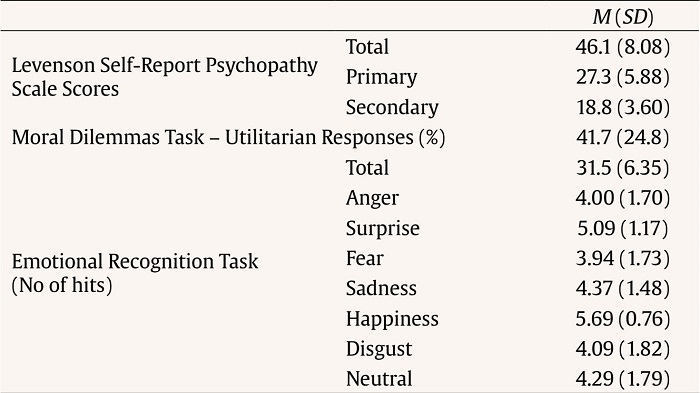
Note. The highest score possible for the emotional recognition task is 42 (100% hits), 6 for each emotion.
Hypothesis Testing
A simple linear regression was conducted in order to test whether the “level of education” and “general cognitive ability” (Raven’s matrices scores) predicted performance on the experimental tasks. Results show that the level of education and general cognitive ability do not in fact predict the results of the moral judgment task, adj. R2 = -.005, F(2, 32) = 0.91, p = .413, or the emotional recognition task, adj. R2 = - .036, F(2, 32) = 0.41, p = .664.
Independent linear regressions were conducted to examine whether performance in each experimental task is predicted by total psychopathy, primary psychopathy, and secondary psychopathy scores.
“Total psychopathy” score significantly predicted the results of the moral judgment task, R2 = .186, F(1, 32) = 7.34, p = .011. Results indicate that higher total scores of psychopathy predict a higher percentage of positive responses to moral dilemmas, b = 1.29, t(1, 32) = 2.71, p = .011, which translates as a more utilitarian judgment. To evaluate the contribution of the distinct psychopathy factors, the same analysis was repeated, using “primary” and “secondary psychopathy” scores as predictors. A significant model was obtained, adj R2 = .314, F(2, 32) = 8.78, p < .001, with both “primary psychopathy”, b = .65, t(2, 32) = 4.17, p < .001, and “secondary psychopathy”, b = - .33, t(2, 32) = 2.10, p = .043, significantly predicting a utilitarian moral judgment.
A similar procedure was repeated for the emotional recognition task. No significant results were found for “total psychopathy”, R2 = .071, F(1, 33) = 2.52, p = .122, meaning that a higher score does not predict fewer hits in the emotional recognition task, b = -0.21, t(1, 33) = 1.59, p = .122. However, the regression model with “primary” and “secondary psychopathy” scores as predictors proved to be significant, adj R2 = .131, F(2, 32) = 3.56, p = .040, with “primary psychopathy” being a significant predictor of fewer hits in the emotional recognition task, b = -.47, t(2, 32) = 2.67, p = .012.
We also ran additional regression analysis, taking the number of hits for each emotional category as the result variable in order to understand if there was a specific deficit in emotional recognition. Only “primary psychopathy” score was used, given that it was the only significant predictor from the previous analysis.
“Primary psychopathy” significantly predicted the recognition of neutral expressions, b = -0.15, t(1, 33) = -3.33, p = .014, and the recognition of anger b = -0.11, t(1, 33) = -2.27, p = .030, but results did not survive after applying corrections for multiple regressions (p values adjusted with FDR method).
Finally, a mediation analysis was conducted to test for a mediation effect of “emotional recognition” in the relationship between “psychopathy” and a utilitarian “moral judgment”. “Emotional recognition” does not have a mediation effect on the relation between “total psychopathy” and “moral judgment”, despite a significant correlation coefficient between its score and a utilitarian “moral judgment” (p = .040). For the “secondary psychopathy” model none of the coefficients were significant (all p > .139), while for “primary psychopathy”, as illustrated in Figure 1, coefficients with the utilitarian “moral judgment” (p = .002) and the “emotional recognition” (p = .025) were both statistically significant. Nevertheless, the significance in the relationship between “emotional recognition”, as mediator variable, and utilitarian “moral judgment”, under the influence of “primary psychopathy”, is not statistically significant, b = -0.30, t(32) = -0.46, p = .646. After controlling for emotional recognition, “primary psychopathy” still significantly predicts a utilitarian “moral judgment”, b = 2.05, t(32) = 2.98, p = .006, which leads us to conclude that the mediation effect is not confirmed for the present model.
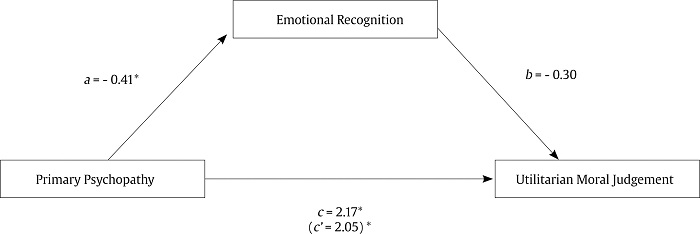
Figure 1
Standardized Regression Coefficients to the Relationship between Primary Psychopathy Scores and Utilitarian Moral Judgment, Mediated by the Ability of Emotional Recognition. The standardized regression coefficient between Primary Psychopathy and Utilitarian Moral Judgment after controlling for emotional recognition is in brackets. *p < .05.
Additional Analysis
To analyse the arousal and valence rates, we subtracted our sample’s rates for each stimulus from the mean rates for the same stimulus of the database validation study. These results allow us to analyse the degree in which our participants’ rates deviate from the mean rates considered normative, both in arousal and valence. Concerning the arousal rates, all deviations were negative, meaning that participants reported a lower arousal than the normative sample for every emotional expression. However, when it comes to valence, expressions of anger and disgust were rated more positively by the participants than the normative sample. We also tested the predictive effects of both psychopathy factors on arousal and valence rating deviations from the normative sample. “Secondary psychopathy” significantly predicted deviation on arousal rates for surprise expressions, b = .385, t(2, 32) = 2.12, p = .042, as well as deviation on valence rates for disgust expressions, b = .369, t(2, 32) = 2.03, p = .051, but none of the effects remained significant after corrections.
Discussion and Conclusions
Many studies on emotional recognition in psychopathy have been published, but most involved male participants and only few considered the influence of psychopathic traits on moral judgment. Additionally, whether psychopathic manifestations in women are identical to those of their male peers remains a matter of discussion. Even though psychopathy measures have already been validated and proved to be consistent and suitable for women, research with female samples is very scarce. The present study aimed to evaluate the moral judgment of female inmates and their performance in an emotional recognition task and examine whether results were affected by both primary and secondary psychopathy traits. We were also interested in verifying whether an eventual emotional recognition deficit would be general (affecting the recognition of all emotional categories) or specific (circumscribed to certain emotions). Finally, we explored the mediating effect of emotional recognition in the relationship between psychopathy and utilitarian moral judgment.
Since level of education and general cognitive ability were reported in previous studies as crucial to performance in emotional recognition tasks (e.g., Brook & Kosson, 2013; Igoumenou et al., 2017; Olderbak et al., 2018; Pham & Philippot, 2010), the effects of these variables were previously analysed. None of them predicted the performance in emotional recognition or moral judgments. It is worth mentioning that the mean number of years of education in our sample is relatively high in comparison to what research usually reports for forensic samples. Also, participants who scored below the 10th percentile on Raven’s Standard Progressive Matrices were excluded. These factors may have contributed to the absence of effects of education and general cognitive ability on the experimental tasks, as intended.
Mean psychopathy scores in the studied sample are not particularly high, which is not unexpected, considering the sample’s gender and the scientific evidence of lower psychopathy scores in female participants (e.g., Cale & Lilienfeld, 2002). Despite this moderate level of psychopathy, in correlational based models, more important than a big sample size with psychopathy levels beyond the traditional cut-off point is to have a reasonable variability at the results distribution, which we ensure with the standard deviations presented in Table 1.
Mean utilitarian responses to the moral dilemmas was lower than 50%. When we compare these results with the Portuguese validation study (Fernandes et al., 2018), researchers found a utilitarian responses rate of 52.5%, which shows that our sample exhibit a slightly lower rate of utilitarianism. This utilitarian rate in inmate participants may have been influenced by a higher social desirability bias than in the validation sample, but this was not controlled in either of the two studies.
In the emotion recognition task, fear was the emotional expression with fewer correct responses, followed by anger, with the mean hit-rate at 31.5, which represents 75% of all responses. This percentage is relatively higher than those reported in previous research. For instance, in a study by Prado et al. (2015) with a predominantly female sample, the mean hit-rate in a similar task was 69.8%.
Concerning moral judgment, results suggest that higher psychopathy scores predict a more utilitarian moral judgment, and both primary and secondary psychopathy traits significantly predict this effect. This is the main finding of this study as it partly differs from previous literature that tends to assume an association only between primary psychopathy and utilitarian moral judgment (e.g., Balash & Falkenbach, 2018; Koenigs et al., 2012; Ritchie & Forth, 2016; Takamatsu & Takai, 2019; Tassy et al., 2013), regardless of a small number of studies reporting the influence of secondary psychopathy (not primary) in the utilitarian moral judgment (Gao & Tang, 2013; Marshall et al., 2017). Taking into consideration the concept of utilitarianism and the lack of empathic concern that characterizes the behaviour of people with higher psychopathy traits, we can find here a possible explanation to the contribution of both psychopathy factors to utilitarian judgements: instead of being influenced by emotions in the process of moral judgment, individuals scoring high in primary psychopathy traits tend to judge and behave more rationally, applying the rule of a higher benefit to the higher number of people possible, regardless of the actions they have to execute and the harmful consequences they bring along to some.
When it comes to emotional recognition, results indicate that total scores of psychopathy do not predict worse emotional recognition, but higher primary psychopathy scores do. This finding is in line with the idea that emotional recognition deficits are specific to factor 1 of psychopathy, since interpersonal and affective deficits are the primary characteristics associated to this factor, thus having a higher impact on tasks that require emotional processing (Brook & Kosson, 2013). In any case, there are studies reporting significant effects of psychopathy traits comprised in the factor 2 (e.g., Brook & Kosson, 2013) or both factors (e.g., Igoumenou et al., 2017; Prado et al., 2015) on poor emotional recognition. Assuming that women perform generally better in recognising emotions (Thayer & Johnsen, 2000), those who have high scores of secondary psychopathy seem to be able to perform emotional recognition tasks at the same level as community samples. However, the ones with high scores of primary psychopathy cannot do such, reinforcing the thesis according to which emotional recognition deficits are more evident in individuals with higher traits of primary psychopathy, and this also applies to women.
Concerning the perspective that emotional recognition deficits in individuals with high psychopathy only affects specific types of emotions (Blair et al., 2004), some research report deficits circumscribed to certain emotional categories (e.g., Hastings et al., 2008; Igoumenou et al., 2017), but such categories vary between studies. Our results suggest that not only primary psychopathy is the single predictor of emotional recognition in female inmates, but also that only neutral expressions are affected, which diverges from previous scientific findings. Wrong attributions to neutral expressions can be interesting to analyse, as long as these expressions are included in emotional recognition tasks, as Ali et al. (2009) point out. The possibility that neutral faces do not consciously capture attention as much as the emotional ones (Devue & Grimshaw, 2017) may be enough to explain the significant effects on this category. It is important to emphasize that sadness was the emotion selected in half of the misclassified responses to neutral expressions. Neutral expressions may be associated with a higher ambiguity in the emotional categorization and individuals with higher scores of primary psychopathy have higher difficulty solving this ambiguity to its correct recognition. To this matter, we should also highlight a study by Hansen et al. (2008), which identified a significant negative correlation between factor 1 of psychopathy and the recognition of neutral expressions. It is possible that high psychopathy individuals do not consistently demonstrate deficits in concrete aspects of the tasks, but sometimes fail in judging more complex components of emotion in others (Brook & Kosson, 2013).
Although several studies emphasize the thesis that the emotional component is vital in the moral judgment process (e.g., Balash & Falkenbach, 2018; Patil, 2015; Ritchie & Forth, 2016), the mediation effect of emotional recognition in the relationship between measures of psychopathy and utilitarian moral judgment was not confirmed. One possible explanation for these null effects is that the emotional processing was only evaluated through the recognition of facial expressions of emotion. However, there are a lot of other emotion-inducing stimuli besides facial expressions of emotion. The influence of emotion in the moral judgment of individuals with high psychopathy scores may be related to other aspects of emotional processing (rather than the identification of facial expressions of emotion).
Our sample presents a tendency to report lower levels of arousal for every emotion and lower levels of valence, except for anger and disgust expressions, which deviate positively from the normative sample. A research conducted by Eisenbarth et al. (2008) concluded that subjects with higher psychopathy scores tend to attribute a lower arousal rate and a more negative valence to stimuli, which supports the present results. The fact that anger and disgust expressions were more positively classified can be partly explained by the results of another study (Ali et al., 2009), which suggested that individuals with higher primary psychopathy traits tend to classify the negative emotional expressions more positively. However, it must be emphasised that neither primary nor secondary psychopathy revealed a significant effect on the arousal or valence deviations after applying the corrections for multiple regressions. A larger sample would probably allow to obtain/maintain significant results in the expected direction and with improved statistical power.
Indeed, the sample size is the main caveat of this study. Yet, taking into consideration the restraints of investigations in prisons and with forensic samples, these results are still valuable to the overall knowledge in this field of research. In addition, Roscoe (1975) proposes the following rules of thumb for determining sample size: (a) sample sizes larger than 30 are appropriate for most research; (b) in multivariate research (including multiple regression analyses), the sample size should be preferably 10 times or more (but 5 is acceptable) as large as the number of variables in the study (Sekaran, 2003). The lack of a social desirability measure is another shortcoming of the present and similar studies, although anonymity and absence of negative consequences were emphasized in order to mitigate the tendency to falsify responses. Still, it is known that in forensic samples there is a tendency to answer according to the way that feels more favourable regarding other’s perspectives (Bartels & Pizarro, 2011), which makes us recommend the inclusion of social desirability measures in future studies. Nevertheless, some studies on the matter show less social desirability in higher psychopathy level individuals (Pechorro et al., 2016; Verschuere et al., 2014). In the same vein, a community sample of women with similar psychopathy scores would allow to conveniently control the imprisonment effect, despite the difficulty of selecting a community sample with such characteristics. Normative data allows to identify differences in the performance of the investigated sample in comparison to individuals from community, but these comparisons are always limited by the lack of data on psychopathy in the latter individuals. Finally, future research is invited to replicate this study in male samples, explore gender differences, and include emotional processing tasks other than recognition of facial expressions of emotion, to further examine the possible mediation effect of emotion processing between psychopathy and moral judgement.
To sum up, despite the previously mentioned shortcomings, this study addresses female psychopathy, which is understudied, to examine its influence on emotional recognition and moral judgment, also looking at possible mediation effects of emotions on the psychopathy-utilitarian judgment relation. Initial predictions were partly confirmed, and findings are not entirely consistent with the literature, which is far from being consistent itself, emphasizing the need for more studies. As primary conclusions, results suggest that a higher level of psychopathy predicts a more utilitarian moral judgment, and both primary and secondary traits contribute to this effect. However, only primary psychopathy significantly predicts a worse emotional recognition, with the mediation effect of this latter on the psychopathy-utilitarian moral judgment relation not being confirmed.
References
Ali, F., Amorim, I. S., & Chamorro-Premuzic, T. (2009). Empathy deficits and trait emotional intelligence in psychopathy and Machiavellianism. Personality and Individual Differences, 47(7), 758-762. https://doi.org/10.1016/j.paid.2009.06.016
Balash, J., & Falkenbach, D. M. (2018). The ends justify the meanness: An investigation of psychopathic traits and utilitarian moral endorsement. Personality and Individual Differences, 127, 127-132. https://doi.org/10.1016/j.paid.2018.02.009
Barbosa, F., Gonçalves, S., Almeida, P. R., Ferreira-Santos, F., & Marques-Teixeira, J. (2014). The Levenson Self-Report Psychopathy Scale (LSRPS): Translation and adaptation to European Portuguese. Faculdade de Psicologia e de Ciencias da Educaçao, Universidade do Porto, Portugal.
Bartels, D. M., & Pizarro, D. A. (2011). The mismeasure of morals: Antisocial personality traits predict utilitarian responses to moral dilemmas. Cognition, 121(1), 154-161. https://doi.org/10.1016/j.cognition.2011.05.010
Blair, R. J. R. (2005). Applying a cognitive neuroscience perspective to the disorder of psychopathy. Development and Psychopathology, 17(3), 865-891. https://doi.org/10.10170S0954579405050418
Blair, R. J. R., Mitchell, D. G. V., Peschardt, K. S., Colledge, E., Leonard, R. A., Shine, J. H., Murray, L. K., & Perrett, D. I. (2004). Reduced sensitivity to others’ fearful expressions in psychopathic individuals. Personality and Individual Differences, 37(6), 1111-1122. https://doi.org/10.1016/j.paid.2003.10.008
Bradley, M. M., & Lang, P. J. (1994). Measuring emotion: The self-assessment manikin and the semantic differential. Journal of Behavior Therapy and Experimental Psychiatry, 25(1), 49-59.
Brook, M., & Kosson, D. S. (2013). Impaired cognitive empathy in criminal psychopathy: Evidence from a laboratory measure of empathic accuracy. Journal of Abnormal Psychology, 122(1), 156-166. https://doi.org/10.1037/a0030261
Cale, E. M., & Lilienfeld, S. O. (2002). Sex differences in psychopathy and antisocial personality disorder: A review and integration. Clinical Psychology Review, 22(8), 1179-1207. https://doi.org/10.1016/S0272-7358(01)00125-8
Cima, M., Tonnaer, F., & Hauser, M. D. (2010). Psychopaths know right from wrong but don’t care. Social Cognitive and Affective Neuroscience, 5(1), 59-67. https://doi.org/10.1093/scan/nsp051
Cleckley, H. (1988). The mask of sanity (5th ed.). Mosby.
Del Gaizo, A. L., & Falkenbach, D. M. (2008). Primary and secondary psychopathic-traits and their relationship to perception and experience of emotion. Personality and Individual Differences, 45(3), 206-212. https://doi.org/10.1016/j.paid.2008.03.019
Devue, C., & Grimshaw, G. M. (2017) Faces are special, but facial expressions aren’t Insights from an oculomotor capture paradigm. Attention, Perception and Psychophysics, 79(5), 1438-1452. https://doi.org/10.3758/s13414-017-1313-x
Edens, J. F., Marcus, D. K., Lilienfeld, S. O., & Poythress, N. G. (2006). Psychopathic, not psychopath: Taxometric evidence for the dimensional structure of psychopathy. Journal of Abnormal Psychology, 115(1), 131-144. https://doi.org/10.1037/0021-843x.115.1.131
Eisenbarth, H., Alpers, G. W., Segrè, D., Calogero, A., & Angrilli, A. (2008). Categorization and evaluation of emotional faces in psychopathic women. Psychiatry Research, 159(1-2), 189-195. https://doi.org/10.1016/j.psychres.2007.09.001
Feldman, M. P. (1977). Criminal Behavior: A Psychological Analysis. Wiley & Sons.
Fernandes, C., Gonçalves, A. R., Pasion, R., Ferreira-Santos, F., Paiva, T. O., Melo e Castro, J. M., Barbosa, F., Martins, I. P., & Marques-Teixeira, J. (2018). European Portuguese adaptation and validation of dilemmas used to assess moral decision-making. Trends in Psychiatry and Psychotherapy, 40(1), 38-46. https://doi.org/10.1590/2237-6089-2017-0022
Garcia, I. (2016). Estudo preliminar das propriedades psicométricas e dos dados normativos da Forma Geral das Matrizes Progressivas de Raven numa amostra da comunidade. https://doi.org/10.13140/RG.2.2.13062.98881
Gao, Y., & Tang, S. (2013). Psychopathic personality and utilitarian moral judgment in college students. Journal of Criminal Justice, 41(5), 342-349. https://doi.org/10.1016/j.jcrimjus.2013.06.012
Glenn, A. L., Iyer, R., Graham, J., Koleva, S., & Haidt, J. (2009). Are all types of morality compromised in psychopathy? Journal of Personality Disorders, 23(4), 384-398. https://doi.org/10.1521/pedi.2009.23.4.384
Greene J. D., Morelli, S. A., Lowenberg, K., Nystrom, L. E., & Cohen, J. D. (2008). Cognitive load selectively interferes with utilitarian moral judgment. Cognition, 107(3), 1144-54. https://doi.org/10.1016/j.cognition.2007.11.004
Greene, J. D., Sommerville, R. B., & Nystrom, L. E. (2001). An fMRI investigation of emotional engagement in moral judgment, 293(5537), 2105-2109.
Guay, J. P., Ruscio, J., Knight, R. A., & Hare, R. D. (2007). A taxometric analysis of the latent structure of psychopathy: Evidence for dimensionality. Journal of Abnormal Psychology, 116(4), 701-716. https://doi.org/10.1037/0021-843X.116.4.701
Hamburger, M. E., Lilienfeld, S. O., & Hogben, M. (1996). Psychopathy, gender, and gender roles: Implications for antisocial and histrionic personality disorders. Journal of Personality Disorders, 10(1), 41-55. https://doi.org/10.1521/pedi.1996.10.1.41
Hansen, A. L., Johnsen, B. H., Hart, S., Waage, L., & Thayer, J. F. (2008). Brief communication: Psychopathy and recognition of facial expressions of emotion. Journal of Personality Disorders, 22(6), 639-644. https://doi.org/10.1521/pedi.2008.22.6.639
Hare, R. (1970). Psychopathy theory and research. Wiley & Sons.
Hare, R. D. (1991). The Hare Psychopathy Checklist - Revised. Multi-Heath Systems.
Hare, R., & Neumann, C. (2008). Psychopathy as a clinical and empirical construct. Annual Review of Clinical Psychology, 4(1), 217-246. https://doi.org/10.1146/annurev.clinpsy.3.022806.091452
Hastings, M. E., Tangney, J. P., & Stuewig, J. (2008). Psychopathy and identification of facial expressions of emotion. Personality and Individual Differences, 44(7), 1474-1483. https://doi.org/10.1016/j.paid.2008.01.004
Igoumenou, A., Harmer, C. J., Yang, M., Coid, J. W., & Rogers, R. D. (2017). Faces and facets: The variability of emotion recognition in psychopathy reflects its affective and antisocial features. Journal of Abnormal Psychology, 126(8), 1066-1076. https://doi.org/10.1037/abn0000293
Kahane, G., Everett, J. A. C., Earp, B. D., Farias, M., & Savulescu, J. (2015). “Utilitarian” judgments in sacrificial moral dilemmas do not reflect impartial concern for the greater good. Cognition, 134, 193-209. https://doi.org/10.1016/j.cognition.2014.10.005
Koenigs, M., Kruepke, M., Zeier, J., & Newman, J. P. (2012). Utilitarian moral judgment in psychopathy. Social Cognitive and Affective Neuroscience, 7(6), 708-714. https://doi.org/10.1093/scan/nsr048
Langner, O., Dotsch, R., Bijlstra, G., Wigboldus, D. H. J., Hawk, S. T., & van Knippenberg, A. (2010). Presentation and validation of the Radboud Faces Database. Cognition and Emotion, 24(8), 1377-1388. https://doi.org/10.1080/02699930903485076
Levenson, M. R., Kiehl, K. A., & Fitzpatrick, C. M. (1995). Assessing psychopathic attributes in a noninstitutionalized population. Journal of Personality and Social Psychology, 68(1), 151-158. https://doi.org/10.1037/0022-3514.68.1.151
Lykken, D. T. (1995). The antisocial personalities. Lawrence Erlbaum
Marshall, J., Watts, A., Frankel, E., & Lilienfeld, S. (2017). An examination of psychopathy’s relationship with two indices of moral judgment. Personality and Individual Differences, 113, 240-245. https://doi.org/10.1016/j.paid.2017.03.034
Moreira, D., Almeida, F., Pinto, M., & Fávero, M. (2014). Psychopathy: A comprehensive review of its assessment and intervention. Aggression and Violent Behavior, 19(3), 19-195. https://doi.org/10.1016/j.avb.2014.04.008
Neumann, C. S., Schmitt, D. S., Carter, R., Embley, I., & Hare, R. D. (2012). Psychopathic traits in females and males across the globe. Behavioural Sciences and the Law, 30(5), 557-574. https://doi.org/10.1002/bsl.2038
Nicholls, T. L., & Petrila, J. (2005). Gender and psychopathy: An overview of important issues and introduction to the special issue. Behavioral Sciences and the Law, 23(6), 729-741. https://doi.org/10.1002/bsl.677
Olderbak, S. G., Mokros, A., Nitschke, J., Habermeyer, E., & Wilhelm, O. (2018). Psychopathic men: Deficits in general mental ability, not emotion perception. Journal of Abnormal Psychology, 127(3), 294-304. https://doi.org/10.1037/abn0000340
Patil, I. (2015). Trait psychopathy and utilitarian moral judgement: The mediating role of action aversion. Journal of Cognitive Psychology, 27(3), 349-366. https://doi.org/10.1080/20445911.2015.1004334
Patrick, C. J. (2006). Handbook of psychopathy. The Guildford Press.
Pechorro, P., Ayala-Nunes, L., Oliveira, J. P., Nunes, C., Gonçalves, R. A. (2016). Psychometric properties of the Socially Desirable Response Set-5 among incarcerated male and female juvenile offenders. International Journal of Law and Psychiatry, 49, part A, 17-21. https://doi.org/10.1016/j.ijlp.2016.05.003
Pham, T. H., & Philippot, P. (2010). Decoding of facial expression of emotion in criminal psychopaths. Journal of Personality Disorders, 24(4), 445-459. https://doi.org/10.1521/pedi.2010.24.4.445
Prado, C. E., Treeby, M. S., & Crowe, S. F. (2015). Examining relationships between facial emotion recognition, self-control, and psychopathic traits in a non-clinical sample. Personality and Individual Differences, 80, 22-27. https://doi.org/10.1016/j.paid.2015.02.013
Raven, J., Raven, J. C., & Court, J. H. (1998). Manual for Raven’s Progressive Matrices and Vocabulary Scales. Section 3, The Standard Progressive Matrices. Oxford Psychologists Press/The Psychological Corporation.
Ritchie, M. B., & Forth, A. E. (2016). Without concern: Predicting personal-moral transgressions from psychopathy and gender. Personality and Individual Differences, 94, 247-252. https://doi.org/10.1016/j.paid.2016.01.041
Roscoe, J. T. (1975). Fundamental research statistics for the behavioural sciences (2nd ed.). Holt Rinehart and Winston.
Sanders, C. E., Lubinski, D., & Benbow, C. P. (1995). Does the Defining Issues Test measure psychological phenomena distinct from verbal ability? An examination of Lykken’s query. Journal of Personality and Social Psychology, 69(3), 498-504. https://doi.org/10.1037/0022-3514.69.3.498
Seara-Cardoso, A., Dolberg, H., Neumann, C., Roiser, J. P., & Viding, E. (2013). Empathy, morality, and psychopathic traits in women. Personality and Individual Differences, 55(3), 328-333. https://doi.org/10.1016/j.paid.2013.03.011
Seara-Cardoso, A., Neumann, C., Roiser, J., Mccrory, E., & Viding, E. (2012). Investigating associations between empathy, morality and psychopathic personality traits in the general population. Personality and Individual Differences, 52(1), 67-71. https://doi.org/10.1016/j.paid.2011.08.029
Sekaran, U. (2003) Research methods for business: A skill-building approach (4th ed.). John Wiley & Sons.
Thayer, J. F., & Johnsen, B. H. (2000). Sex differences in judgment of facial affect: A multivariate analysis of recognition errors. Scandinavian Journal of Psychology, 41(3), 243-246.
Takamatsu, R., & Takai, J. (2019). With or without empathy: Primary psychopathy and difficulty in identifying feelings predict utilitarian judgment in sacrificial dilemmas. Ethics & Behavior, 29(1), 71-85. https://doi.org/10.1080/10508422.2017.1367684
Tassy, S., Deruelle, C., Mancini, J., Leistedt, S., & Wicker, B. (2013). High levels of psychopathic traits alters moral choice but not moral judgment. Frontiers in Human Neuroscience, 7, Article 229. https://doi.org/10.3389/fnhum.2013.00229
Verschuere, B., Uzieblo, K., De Schryver, M., Douma, H., Onraedt, T., & Crombez, G. (2014). The inverse relation between psychopathy and faking good: Not response bias, but true variance in psychopathic personality. The Journal of Forensic Psychiatry & Psychology, 25(6), 705-713. https://doi.org/10.1080/14789949.2014.952767
Visser, B. A., Bay, D., Cook, G. L., & Myburgh, J. (2010). Psychopathic and antisocial, but not emotionally intelligent. Personality and Individual Differences, 48(5), 644-648. https://doi.org/10.1016/j.paid.2010.01.003
Warren, J. I., Burnette, M. L., South, S. C., Chauhan, P., Bale, R., Friend, R., & Van Patten, I. (2003). Psychopathy in women: Structural modeling and comorbidity. International Journal of Law and Psychiatry, 26(3), 223-242. https://doi.org/10.1016/S0160-2527(03)00034-7
Widom, C. S. (1978). An empirical classification of female offenders. Criminal Justice and Behavior, 5(1), 35-52.
Notes
Author notes
Correpondence: goncalvesteresa11@gmail.com (T. Pinto).
Conflict of interest declaration