research-article
Childhood Poly-victimization and Adults’ Psychoticism: A Moderated Mediation Model Testing an Affective Pathway
La polivictimización de la infancia y el psicoticismo de los adultos: un modelo de mediación moderada para probar la vía afectiva
Childhood Poly-victimization and Adults’ Psychoticism: A Moderated Mediation Model Testing an Affective Pathway
Anuario de Psicología Jurídica, vol. 34, no. 1, pp. 97-106, 2024
Colegio Oficial de la Psicología de Madrid
Received: 08 March 2022
Accepted: 20 August 2023
Published: 06 June 2023
ABSTRACT: Child poly-victimization is a risk factor for psychopathology in adulthood, such as anxiety and depression. Despite that, there is minus investment regarding psychotic symptoms and the mechanisms explaining the relationship between poly-victimization and psychoticism. The purpose of this study is to investigate these variables and explain how they might be associated. A sample of 246 adults participated in this study, aged between 18 and 68 years (M = 37.5, SD = 12.5) and mostly females (76.8%). The results revealed a significant mediating effect of anxiety and depression in the relationship between childhood victimization and psychoticism (b = .12, p = .011), but not a significant moderating effect of gender, Δχ2(5) = 3.87, p = .568. The affective pathway was supported by our findings. These results suggest the need of additional efforts on prevention of child victimization, as well as of intervention programs aiming to prevent its cumulative effect.
Keywords: Childhood poly-victimization, Psychoticism, Affective pathway, Depression and anxiety.
RESUMEN: La polivictimización infantil es un factor de riesgo de psicopatología en la edad adulta, tales como la ansiedad y la depresión. A pesar de ello hay escasa inversión en síntomas psicóticos y los mecanismos que explican la relación entre la polivictimización y el psicoticismo. El objetivo del estudio es investigar estas variables y explicar cómo pueden asociarse. En el estudio participaron 246 adultos de edades comprendidas entre los 18 y los 68 años (M = 37.5, DT = 12.5), la mayoría mujeres (76.8%). Los resultados muestran un efecto mediador significativo de la ansiedad y la depresión en la relación entre victimización infantil y el psicoticismo (b = .12, p = .011), pero no un efecto moderador significativo del género, Δχ2(5) = 3.87, p = .568. Dichos resultados avalan la via afectiva e indican la necesidad de mayores esfuerzos en prevención de la victimización infantil así como en programas de intervención que prevengan su efecto acumulado.
Palabras clave: Polivictimización infantil, Psicoticismo, Vía afectiva, Depresión y ansiedad.
Introduction
Young people’s victimization is a well-known and worldwide public health issue that affects their psychological functioning (Stoltenborgh et al., 2015). Despite the extensive literature on the impact of child victimization on mental health, less investment has been made on the cumulative effect of multiple types of maltreatment (Clemens et al., 2018; Finkelhor et al., 2007; Scott-Storey, 2011), and particularly on its adverse effects on psychoticism in adulthood (Shevlin et al., 2007). Furthermore, more research is needed on the mechanisms explaining the relationship between childhood victimization and adults’ psychoticism as well as on the role of gender in these associations. In fact, on one hand, robust evidence has been provided about gender differences on psychopathology (e.g., women show greater internalizing difficulties than men; Jalnapurkar et al., 2018; Kiely et al., 2019). On the other hand, some inconsistencies have been reported regarding gender in child maltreatment or family violence (Finkelhor & Dziuba-Leatherman, 1994; Moody et al., 2018; Rhoades, 2008; Sternberg et al., 2006; Zhu et al., 2023). Additionally, some research indicates that males are more likely than females to experience multiple types of victimization (Chan, 2013; Dong et al., 2013); however, other studies show higher levels of poly-victimization for females (Ellonen & Salmi, 2011; Mossige & Huang, 2017).
Young People’s Victimization and Mental Health in Adulthood
According to Finkelhor, Hamby, et al. (2005), child victimization experiences may include conventional crimes, child maltreatment, peer or sibling victimization, sexual victimization, and indirect victimization. Conventional crimes are the most cross-cultural prevalent domain of victimization, ranging from 20% in China (Liu et al., 2020) to over 60% in Europe (e.g., Spain, Portugal, Sweden; Aho et al., 2014; Almeida et al., 2020; Forns et al., 2013; Pereda et al., 2014) and South America (Chile, 93.9%; Pinto-Cortez et al., 2018). Also, a child who has been victim of one type of abuse is more likely to be victimized with other types of abuse in the future (Finkelhor et al., 2007; Mitchell et al., 2019; Turner et al., 2010). This suggests that distinct types of victimization do not take place alone (Dong et al., 2004; Finkelhor et al., 2007; Green et al., 2010), as they are more likely to co-occur (Finkelhor et al., 2011; Higgins & McCabe, 2000, 2001). Specifically, being victim of physical abuse increased the likelihood of being emotionally abused (7%) and neglected (4%) (Finkelhor et al., 2014).
Poly-victimization is defined as the cooccurrence of multiple types of victimization in different contexts of a child’s life (Dierkhising et al., 2019; Finkelhor, Ormrod, et al., 2005), and it is related with greater symptomatology and poor development outcomes in young people (Finkelhor, Ormrod, et al., 2005; Turner et al., 2016). Adverse childhood experiences may have a significant short and long-term impact on physical and mental health (Berzenski & Yates, 2011; Pereda & Gallardo-Pujol, 2014). Around 30% of maltreated children seem to develop psychopathology during adulthood (Green et al., 2010), namely depressive disorders (Widom et al., 2007). More than exploring the impact of merely a single type of maltreatment on mental health outcomes, additional efforts are needed to detect the effect of multiple types of victimization (Clemens et al., 2018; Scott-Storey, 2011). Evidence suggests that multiple victimizations are associated with higher psychopathology (Finkelhor et al., 2007; Finkelhor et al., 2009), such as dissociative, depressive, or anxious symptoms, as well as lower self-esteem, comparing to the experience of only one victimization type (Higgins & McCabe, 2000). This evidence is consistent with the dose-response effect (Sala et al., 2014), which suggests that as the number of abusive situations increases, the poorer an individual’s mental health will be (e.g., Berzenski & Yates, 2011; Janssen et al., 2004).
Specifically, Rapsey et al. (2019) investigated the associations between child maltreatment, such as sexual, physical, and emotional abuse, and internalizing disorders, including anxiety and depression, at three points in the participants’ lives (aged between 18 and 64 years). When compared to the class that did not encounter or suffered a low level of victimization, the likelihood of developing internalizing difficulties doubled for victims of sexual abuse and quadrupled for victims of multiple victimization experiences (poly-victims). Also, Asselmann et al. (2018) conducted a longitudinal and prospective study aiming to evaluate the relationship between eight specific adverse experiences – civil war, physical assault, violation, childhood sexual abuse, natural disasters, serious accidents, arrest, and testimony of traumatic events that occur to others – and later psychopathology. The results are consistent with previous assumptions showing the cumulative effect of adverse experience on psychopathology.
Looking at the specific mental health outcomes, although the literature has well documented the effects of child maltreatment on internalizing symptoms during adulthood (e.g., Berzenski & Yates, 2011; Higgins & McCabe, 2001), such as depressive and anxious symptoms (Kaplow & Widom, 2007), there is scarce evidence about psychoticism (Shevlin et al., 2007). Psychoticism involves schizophrenia’s primary symptoms, such as hallucinations and thought control, as well as indicators of loneliness and a schizoid lifestyle (Canavarro, 2007). These symptoms may emerge from stressful life events (Myin-Germeys & van Os, 2007), such as sexual, emotional, and physical abuse during childhood (Bonoldi et al., 2013), and could be anchored in the classic vulnerability/stress model (Ingram & Luxton, 2005). This model suggests that when there are social stressors and a lack of supporting environment together with individual vulnerabilities to psychosis, the susceptibility rises, and the development of psychotic symptoms emerge (Nuechterlein & Dawson, 1984; Taylor et al., 2019). In other words, adverse childhood experiences increase an individual’s vulnerability to stress (Wichers et al., 2009), which may be associated with higher levels of psychosis, both in adolescence and adulthood (Bebbington et al., 2004; Janssen et al., 2004). In fact, individuals with early psychosis had a high rate of exposure to adverse childhood experiences (e.g., Duhig et al., 2015; Janssen et al., 2004; Whitfield et al., 2005). Specifically, the literature suggests that child sexual victimization is positively associated with psychotic-like symptoms, particularly hallucinations and delusions (Bendall et al., 2013; Bentall et al., 2012; Freeman & Fowler, 2009). Also, child neglect (both physical and emotional) has been associated with both positive and negative psychotic symptoms (Duhig et al., 2015; van Dam et al., 2014). Finally, the dose-response effect is also highlighted in psychoticism (e.g., Bentall et al., 2012; Kelleher et al., 2013), as two or more types of maltreatment significantly increase the likelihood of these symptoms (Shevlin et al., 2007).
The Association between Young People’s Victimization and Psychoticism in Adulthood
The Affective Pathway
Research has suggested that the affective pathway (Freeman et al., 2011; Isvoranu et al., 2016; Myin-Germeys & van Os, 2007) might explain the emergence of psychoticism. The authors claim that the association between victimization and psychoticism can be explained by changes in a person’s sensitivity to daily stress, including heightened emotional reactivity (Myin-Germeys & van Os, 2007). Furthermore, according to this proposal, the relationship between child maltreatment and later psychotic symptoms might be mediated by affective symptoms, such as anxiety and depression (Alameda et al., 2020; Sideli et al., 2020). Previous research has shown that the development of a psychotic disorder can be preceded by affective symptoms, like anxiety and depression (Krabbendam et al., 2005), and individuals who have psychotic-like experiences are more likely to have a history of affective symptoms (Broome et al., 2012; Varghese et al., 2011). For instance, these authors propose that anxiety, negative mood, and biased negative cognitions will have an impact on self-esteem and individuals’ schemas about the self, which may be associated with psychotic symptoms or signs (Alameda et al., 2020). Specifically, anxiety and depression have been associated with the emergence and persistence of auditory hallucinations (Freeman et al., 2011), and anxiety symptoms are also predictors of persecutory delusions (Startup et al., 2007). Furthermore, depressive symptoms are a long-term maintaining mechanism for psychotic symptoms (Vorontsova et al., 2013).
The literature on this mechanism has been mostly focused on child sexual abuse. Marwaha and Bebbington (2014) studied the association between sexual abuse and psychoticism and the mediation role of anxiety and depressive symptoms in this relationship. When both mediating variables were included in the model, depression explained three-quarters of the mediation in the association between sexual abusive contacts and psychotic symptoms. This is consistent with other authors who found a mediating role of anxiety and depression in the relationship between child sexual abuse experiences and later psychoticism (Bebbington et al., 2011). McCarthy-Jones (2018) found a partial mediation effect of anxiety symptoms, but not depression, in the association between sexual abuse and auditory-verbal hallucinations.
In turn, a few studies explored this mechanism in the context of other abusive experiences. Isvoranu et al. (2016) found no direct associations between childhood trauma subscales and psychoticism, as this association was only significant through the mediation of psychopathology. More specifically, anxiety mediated the relationship between emotional victimization and positive psychotic symptoms, such as hallucinations and delusions. Another study also found a significant mediation through depression symptoms in the association between child victimization and the psychotic-like experiences (Metel et al., 2019). In sum, the emergence of psychotic symptoms seems to be related to affective mechanisms (Trotta et al., 2015), based on the empirical evidence of anxiety and depression symptoms as mediating the association between early adversity and psychotic-like symptoms (Fisher et al., 2013).
Gender Differences on Victimization and Psychopathology
The literature focused on gender differences regarding child victimization has provided inconsistent results (Finkelhor & Dziuba-Leatherman, 1994; Moody et al., 2018; Rhoades, 2008; Sternberg et al., 2006; Zhu et al., 2023). There is evidence suggesting gender differences regarding the level and type of victimization (Card et al., 2008). Specifically, some research suggests that males are more likely to be exposed to multiple types of abuse (Chan, 2013; Dong et al., 2013), while others found higher levels of poly-victimization in females (Ellonen & Salmi, 2011; Mossige & Huang, 2017). Regarding the types of victimization, males are more likely to be exposed to physical abuse (Benbenishty et al., 2002; Finkelhor et al., 2009; Lev-Wiesel et al., 2016) and conventional crimes (Garcia & Ochotorena, 2017; Pereda et al., 2014; Pinto-Cortez et al., 2018) than females. On the other hand, females tend to report more experiences of sexual victimization (Durand & de Calheiros Velozo, 2018; Garcia & Ochotorena, 2017; Pinto-Cortez et al., 2018) and emotional bullying (Durand & de Calheiros Velozo, 2018; Pinto-Cortez et al., 2018).
Regarding psychopathology, the literature suggests that females present a higher prevalence of affective disorders in different stages of life, such as anxiety and mood disorders (Afonso Junior et al., 2020; Boyd et al., 2015; Chyczij et al., 2020). According to the American Psychiatric Association (2014), females are twice as likely as males to suffer from affective disorders such as anxiety and depression. These differences may be explained by the interaction of biological (hormonal differences; Kuehner, 2017; Li et al., 2017) and social factors (e.g., females are more likely to experience sexual victimization and domestic violence; Oram et al., 2016). Furthermore, though females tend to show lower self-esteem and greater ruminative thoughts (Kuehner, 2017), men are more likely than women to develop psychotic disorders (Castillejos et al., 2018; Eranti et al., 2013; McGrath et al., 2004). Moreover, females tend to have a later onset of psychotic symptoms (Eranti et al., 2013; Riecher-Rössler, 2017) and report more cases of psychotic affective disorders, while males report a higher prevalence of non-affective psychotic disorders (Castillejos et al., 2018; Jääskeläinen et al., 2018).
Research Problem and Objectives
Whereas the literature on the effects of a single type of childhood victimization on adults’ mental health is extensive, the cumulative role of different types of victimization (Clemens et al., 2018; Elliott et al., 2009; Finkelhor et al., 2007; Higgins & McCabe, 2001; Scott-Storey, 2011) and its relationship with psychoticism is still scarce and need further research efforts (Shevlin et al., 2007). Nonetheless, existing evidence suggests that examining the cumulative effect of victimization experiences is important (Finkelhor, Ormrod, et al., 2005), as they co-occur, and it is difficult to identify the specific consequences of each type of maltreatment (Berzenski & Yates, 2011). Furthermore, regarding the affective pathways (anxiety and depression) in the association between young people’s victimization and psychoticism in adulthood, additional evidence is needed. As such, we aim to investigate a) the role of child poly-victimization on mental health during the adulthood, specifically, anxiety, depression and psychoticism, and b) the mediating role of anxiety and depression in the relationship between childhood victimization and adults’ psychoticism. Also, based on previous evidence on gender issues (e.g., Chan, 2013; Dong et al., 2013; Jääskeläinen et al., 2018; Riecher-Rössler, 2017), we will test a moderated mediation model by gender.
Following the evidence previously described, it is expected that: a) the cumulative effect of childhood victimization will be associated with higher levels of anxiety, depression, and psychoticism during adulthood; b) anxiety and depression will mediate the relationship between victimization and psychoticism, as more experiences of young people’s victimization will be associated with more anxiety and depression symptoms and that these symptoms, in turn, will be associated with higher levels of psychoticism; and c) gender will moderate these associations and will be stronger for female participants.
Method
Participants
The inclusion criteria to participate in this study were being 18 years old or older and understanding the Portuguese language. Only 275 of the 368 people who agreed to participate in the study completed all the questionnaires, and one participant under the age of 18 was not included. Twenty-eight participants did not report any victimization experience, and for that reason were excluded from further analysis. The final sample consisted of 246 adults (aged 18 - 68 years old; M = 37.5, SD = 12.5) and mostly females (76.8%). In terms of marital status, 50% were single, 37.8% married, 11% divorced, and 1.2% were widowed. Most of these participants completed a university degree (38.2% a bachelor, 13.8% a master’s degree, and 0.8% a PhD), followed by high school (32.1%) and middle school (8.9%). Most of them were employed (63.4%), while 19.9% were students, 8.5% unemployed, and 2.8% retired.
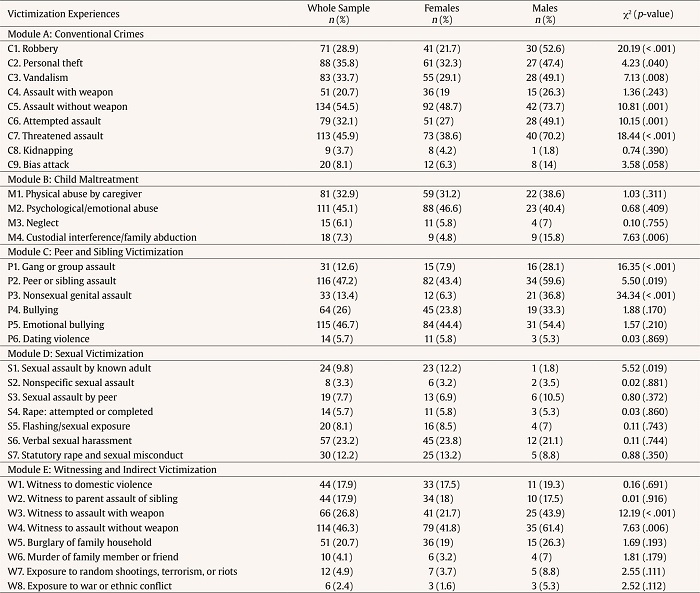
Regarding victimization experiences, conventional crimes were the most reported in this sample, particularly assault without weapon (54.5%) and threatened assault (45.9%) as the most reported. Furthermore, psychological and emotional abuse was the most reported type of child maltreatment by caregivers (45.1%), followed by physical abuse (32.9%). Regarding peer and sibling victimization, most participants reported peer or sibling assault (47.2%) and emotional bullying (46.7%). In terms of sexual victimization, 23.2% of our participants reported verbal sexual harassment, and 12.2% reported having statutory rape and sexual misconduct. Finally, witness to assault without weapon (46.3%) and with weapon (26.8%) stands out among the most frequent witnessing and indirect victimization experiences (Table 1). Sixty-three percent of our participants are poly-victims (n = 155) given that they reported 5 or more forms of victimization (Finkelhor, Ormrod, et al., 2005).
Instruments
Sociodemographic Questionnaire
This questionnaire allowed gathering participants’ sociodemographic data, such as gender, age, education level, employment status or marital status.
Brief Symptom Inventory (BSI)
The Portuguese version of BSI allows the assessment of nine dimensions of psychopathology – somatization, obsessions-compulsions, interpersonal sensitivity, depression, anxiety, hostility, phobic anxiety, paranoid ideation, and psychoticism – and three global indices – general symptom index, positive symptom index, total number of positive symptoms –, comprising a total of 53 items answered in a 5-point Likert scale ranging from never (0) to too often (4) (Canavarro, 2007). In the current study, merely three dimensions were selected to test the hypothesized model: anxiety (6 items; α = .77; e.g., “nervousness or inner tension”), depression (6 items; α = .73; e.g., “not being interested in anything”), and psychoticism (5 items; α = .62; e.g., “getting the impression that other people can control your thoughts”) (Canavarro, 2007). In the current study, greater reliability indices than the Portuguese version were found: depression (α = .88), anxiety (α = .84), and psychoticism (α = .70) (Kline, 2011).
To examine whether these dimensions were invariant across males and females, we tested measurement invariance of this measure across both groups, using AMOS v.18 (Arbuckle, 2021) with the maximum likelihood estimator. The following fit indices and criteria were used as indicative of a good model fit: comparative fit index (CFI) approaching 1, root mean square error of approximation (RMSEA), and standardized root mean residual (SRMR) lower than .08 (Hu & Bentler, 1999; Kline, 2011). First, configural invariance was tested by fitting a model with the three dimensions without any equality constraints. Results of this analysis revealed that one item of the psychoticism dimension presented a nonsignificant loading for the male group. This item was, thus, removed from the analyses. A subsequent configural invariance test of the three-dimension model without this item revealed a good model fit, χ2(198) = 413.36, p < .001, CFI = .90, RMSEA = .07, SRMR = .05, thus supporting configural invariance of the measure. Next, to test for metric invariance, factor loadings were constrained to be equal across both groups. Model fit for the constrained model was worse than that of the unconstrained model, Δχ2(16) = 30.23, p < .017, thus indicating noninvariant items across groups (Kline, 2011). A Z test of the equality of the factor loadings revealed that the factor loadings of one item from the anxiety factor and another from the depression factor were significantly different between males and females (respectively, Z = -3.34, p = .001 and Z = -2.01, p = .044). Since the item from the anxiety factor presented the largest unstandardized difference between groups, this item was released so that partial metric invariance could be tested. The χ2 difference test for this model was not statistically significant, Δχ2(15) = 20.08, p < .169, when compared to the baseline, thus supporting partial metric invariance of this measure.
Juvenile Victimization Questionnaire (JVQ-R2)
The Portuguese version (Magalhães et al., 2020) of the Juvenile Victimization Questionnaire (Screener Sum Version, adult retrospective; Finkelhor, Hamby et al., 2005) consists of 34 questions (yes or no) assessing the five dimensions of victimization: conventional crimes (e.g., “When you were a child, did anyone use force to take something away from you that you were carrying or wearing?”), child maltreatment (e.g., “Not including spanking on your bottom, when you were a child, did a grown-up in your life hit, beat, kick, or physically hurt you in any way?”), peers or siblings victimization (e.g., “Sometimes groups of kids or gangs attack people. When you were a child, did a group of kids or a gang hit, jump, or attack you?”), sexual victimization (e.g., “When you were a child, did a grown-up you know touch your private parts when they shouldn’t have or make you touch their private parts? Or did a grown-up you know force you to have sex?”), and witnessing and indirect victimization (e.g., “When you were a child, did you see a parent get pushed, slapped, hit, punched, or beat up by another parent, or their boyfriend or girlfriend?”). The global dimension of child victimization showed a very good global internal consistency value (α = .85).
Procedure
This study is part of a larger project that was approved by University Ethics Committee (Reference 08/2019). This cross-sectional study is based on data collected through the Qualtrics software and using a convenience sample. The study’s link was disseminated through digital platforms such as Facebook and LinkedIn targeting adults (> or = 18 years old) and who understand the Portuguese language. First, an informed consent was presented to the participants describing the study’s goals and conditions of participation, including the expected time to complete the questionnaires, the voluntary and anonymous nature of participation, and the guarantee of confidentiality. Then, after the participants filled the questionnaires, a debriefing was presented. No financial compensation or incentive were provided.
Data Analysis
Descriptive and correlational analyses were performed with IBM SPSS statistics (version 28.0). A multiple group analysis was performed with IBM AMOS for Windows (version 25.0), using the maximum likelihood estimator, to test the moderated mediation. Regarding the mediating effects, a bootstrap approach (95% confidence intervals generated with bias corrected bootstrapping, using 5,000 resamples) was selected to test the significance of indirect effects (Shrout & Bolger, 2002). Based on theoretical assumptions and on the results of the bivariate correlations, the error terms of the mediators were allowed to correlate. Therefore, the mediation model was fully saturated, which yields a perfect model fit (i.e., χ2 = 0, CFI = 1; Kline, 2011). The moderating role of gender was tested by comparing the unconstrained multiple group model to a model where all paths were constrained to be equivalent across both groups (i.e., men and women). Standardized regression effects will be described in the Results section.
A post hoc power analysis using G*Power 3 (Faul et al., 2009), with three predictors (i.e., childhood victimization, anxiety, and depression) indicated that our sample size is sufficient to detect medium and large effect sizes on the criterion variable. Specifically, with α = .05, and a sample size of 246, power exceeded .99 to detect a medium (f2 = .15) and a large effect (f2 = .35).
Results
Associations between Sociodemographic Variables, Poly-victimization, and Psychopathology
Chi-square tests revealed that males reported significantly more conventional crimes (robbery, personal theft, vandalism, assault without weapon, attempted assault, and threatened assault), peer and sibling victimization (gang or group assault, peer or sibling assault, and nonsexual genital assault) and witnessing and indirect victimization (witness to assault with weapon, and witness to assault without weapon). Moreover, females reported significantly more sexual victimization, specifically, sexual assault by known adult (Table 1).
Correlational analyses (Table 2) revealed that males tended to be more poly victimized. Further, older participants showed lower scores on psychoticism, and participants with a higher academic degree revealed lower scores on anxiety. Poly-victimization was positively correlated with psychoticism. Correlations between depression, anxiety, and psychoticism were all positive and significant.

Note. Gender: female (0), male (1); (poly)victimization: victimization (0), poly-victimization (1).
*p < .05, **p < .01, ***p < .001.
Mediating Effects of Depression and Anxiety
Significant and full mediating effects of the affective pathway (depression and anxiety) on the association between child victimization and psychoticism were found (β = .12, p = .011). This means that participants who reported greater childhood victimization experiences also reported more depressive and anxiety symptoms, which in turn predicted higher psychoticism (Figure 1).
Figure 1
The Mediating Role of Anxiety and Depression in the Relationship between Child Vctimization and Psychoticism.
Direct standardized effects in brackets. *p < .05, **p < .01, ***p < .001
Moderated Mediating Effects of Depression and Anxiety by Gender
The multiple group model test analyzing the moderated mediation through individual’s gender showed a non-significant chi-square difference between the unconstrained and the constrained models: Δχ2(5) = 3.87, p = .568, indicating that the model did not vary significantly between female and male participants.
Discussion
This study aimed to explore the cumulative effect of childhood poly-victimization on adults’ mental health, and specifically the mediating effect of an affective pathway as moderated by gender. Results revealed a non-significant moderating effect of gender, although significant mediation effects of anxiety and depression were found for the whole sample. Thus, these findings support the hypothesis that affective mechanisms may mediate the association between childhood victimization and adults’ psychoticism (Bebbington et al., 2011; Fisher et al., 2013; Freeman & Fowler, 2009).
The association between higher levels of exposure to multiple forms of victimization and higher levels of psychopathology during adulthood supports prior research about the dose-response effect (Steine et al., 2017). In addition, these findings are also in line with previous studies that found that early exposure to adverse experiences is associated with higher levels of adults’ psychoticism through higher levels of anxiety and depression (Bebbington et al., 2004; Janssen et al., 2004). Indeed, empirical research indicates that adversity is associated to further anxiety and depression, which increases the risk of developing psychotic-like experiences (Fisher et al., 2013). Literature in this field has specifically revealed an association between anxiety and the severity of positive symptoms, such as delusions and hallucinations (Huppert & Smith, 2005; Ramanathan, 1982; Watson et al., 2006). In the study by Delespaul et al. (2002), higher levels of anxiety were found before the onset of an auditory hallucination, indicating that an individual’s anxiety levels predict an increase in the severity of this type of psychotic symptoms. Similarly, several studies have also documented an association between depressive symptoms and the severity of early or chronic psychoticism symptoms (Drake et al., 2004; Freeman et al., 2001; Watson et al., 2006). For example, Smith et al. (2006) showed that higher levels of depression were associated to the severity of auditory hallucinations and persecutory delusions.
The present study also revealed that polyvictimization was prevalent in this sample (63%), as expected given that different types of victimization are likely to co-occur (e.g., Finkelhor et al., 2011; Higgins & McCabe, 2001). Conventional crimes were the most reported, which is in line with previous studies conducted in Europe region, reporting rates from 60% of conventional crimes (e.g., Aho et al., 2014; Almeida et al., 2020; Pereda et al., 2014). Regarding psychopathology, anxiety levels of our sample are similar from those reported for the Portuguese population (M = 0.94), while depression levels are slightly above from the one reported for the Portuguese population (M = 0.89), but much lower than the average for the clinical population (M = 1.83) (Canavarro, 2007).
Moreover, male participants reported more poly-victimization compared to female participants. These results reinforce previous studies which revealed that males have a higher rate of exposure to different forms of victimization (Chan, 2013; Dong et al., 2013). In fact, research suggests that, aside from maltreatment and childhood sexual abuse, being a man increases one’s risk of being a victim (Benbenishty et al., 2002; Ellonen & Salmi, 2011; Finkelhor, et al., 2007, 2009). Additionally, according to our findings, conventional crimes occur more frequently than other victimization types, and in this sample males tended to report more experiences of this type of victimization.
Despite inconsistent results regarding gender differences on child victimization (e.g., Moody et al., 2018; Zhu et al., 2023), our results are in line with previous studies showing that males are more likely to be exposed to conventional crimes than females (Garcia & Ochotorena, 2017; Pereda et al., 2014; Pinto-Cortez et al., 2018). As males tend to be involved in more conflicts compared to females, this may increase their likelihood of becoming victims of conventional crimes (Finkelhor et al., 2009). On the other hand, our results revealed that females reported more sexual victimization than males, which is also consistent with some previous studies (Durand & de Calheiros Velozo, 2018; Garcia & Ochotorena, 2017; Pinto-Cortez et al., 2018). For instance, a review of research from 2000 to 2015 (Fedina et al., 2016) indicated that when sexual victimization was widely defined to cover a range of forced or compelled acts of sexual contact, the victimization rates for women were roughly between 18% and 19% and for men were between 1% and 3%. Unexpectedly, our results revealed no gender differences regarding symptomatology, even though previous studies consistently show that females present higher levels of anxiety and depression than males (e.g., Boyd et al., 2015; Chyczij et al., 2020).
Despite the relevance of our findings, it is important to point out some limitations of this study. First, victimization experiences were retrospectively collected. As we know, participants may underestimate their experiences of childhood victimization in such cases (Hardt & Rutter, 2004). Nonetheless, previous research also suggests that bias from retrospective methodologies does not undermine findings validity (Hardt & Rutter, 2004). Second, this is a study based on a convenience sample, and our sample size is not large enough to test more complex models and we have an unbalanced sample on gender. Moreover, contextual variables such as nationality or the context of origin in childhood were not collected in this study, which should be addressed in the future. Additional moderating variables would be also included, such as other adverse experiences during infancy beyond victimization or even stressful life events that may strengthen those effects, in line with a cumulative approach of risk and vulnerability (Magalhães et al., 2022). Furthermore, the study’s cross-sectional (rather than longitudinal) design should be noted, as this requires special caution when analyzing mediation results. Finally, given the sample size and the fact that this study was conducted with a convenience sample, it is not possible to generalize these findings to all people with childhood victimization experiences. Therefore, in future studies, it would be important to use a representative sample of the Portuguese population, as well as to test the proposed hypotheses through longitudinal designs with a multi-informant approach.
Nevertheless, these findings allowed us to identify important implications for practice. First, the implementation of evidence-based programs is needed to prevent child victimization, its recurrence, and poly-victimization patterns. Not only must interventions target specific profiles of young people at risk of victimization, but also a set of protective factors (e.g., social support, social awareness about child victimization, young people’s skills) should be fostered to prevent poly-victimization (Finkelhor et al., 2011). Universal and selective prevention approaches are needed to prevent child victimization in different ecological systems of development (e.g., family, school, community contexts), together with a significant worldwide investment on social welfare systems to support families, young people and communities at risk. These programs should focus on building positive, respectful relationships, teaching life skills such as problem solving, conflict resolution, and healthy communication, including guidance on the recognition of risky situations (Nation et al., 2003). Social marketing campaigns are also important channels to raise awareness, create positive shifts in social norms, and promote positive behaviors (e.g., Potter 2012). Second, early intervention is needed to reduce symptoms following child victimization as well as to foster victims’ well-being. Specifically, non-specific behavioral and psychological symptoms prior to the onset of psychotic-type experiences should be intervened to prevent further development or exacerbation of psychotic symptoms (Salokangas & McGlashan, 2008; Stafford et al., 2013). Trauma informed and cognitive-behavioral therapies (CBT) are beneficial in these cases (Garety et al., 2008), as well as combined approaches of intervention (e.g., CBT and family therapy) (Bird et al., 2010; Stockings et al., 2015). Specifically for complex-trauma symptomatology, which includes post-traumatic stress symptoms along with disturbances in self-organization (Maercker et al., 2013), interventions addressing day-to-day functioning are especially important to increase emotional, psychological, and social resources in order to enhance the effectiveness of trauma-focused work (Cloitre et al., 2012). Intervention programs, such as the TARGET [Trauma Affect Regulation: Guide for Education and Therapy], and the ITCT-C [Integrative Treatment of Complex Trauma for Children]/ITCT [Integrative Treatment of Complex Trauma for Adolescents], have been showing significant reduction of anxiety and depression, as well as other psychopathological symptoms (e.g., Frisman et al., 2008; Lanktree et al., 2012). Additionally, early home visitation programs, providing support for parents and toddlers, are recognized as an effective strategy in decreasing violence (Bilukha et al., 2005). Moreover, intervention services should be organized by developmental stages (instead of violence types), considering the poli-victimization and the knowledge about the developmental patterns of violence (Hamby & Grych, 2013). Finally, a family-centered approach from the services is needed to assess properly the co-occurrence pattern of victimization and to tailor interventions to specific child needs (Berger & Font, 2015).
References
Afonso Junior, A., Portugal, A. C. A., Landeira-Ferandez, J., Bullón, F. F., Santos, E. J. R., Vilhena, J., & Anunciação, L. (2020). Depression and anxiety symptoms in a representative sample of undergraduate students in Spain, Portugal, and Brazil. Psicologia: Teoria e Pesquisa, 36, Article e36412. https://doi.org/10.1590/0102.3772e36412
Aho, N., Gren-Landell, M., & Svedin, C. G. (2014). The prevalence of potentially victimizing events, poly-victimization, and its association to sociodemographic factors: A Swedish youth survey. Journal of Interpersonal Violence, 31(4), 620-651. https://doi.org/10.1177/0886260514556105
Alameda, L., Rodriguez, V., Carr, E., Aas, M., Trotta, G., Marino, P., Vorontsova, N., Herane-Vives, A., Gadelrab, R., Spinazzola, E., Di Forti, M., Morgan, C., & Murray, R. M. (2020). A systematic review on mediators between adversity and psychosis: Potential targets for treatment. Psychological Medicine, 50(12), 1-11. https://doi.org/10.1017/s0033291720002421
Almeida, T. C., Ramos, C., Brito, J., & Cardoso, J. (2020). The juvenile victimization questionnaire: Psychometric properties and poly-victimization among Portuguese youth. Children and Youth Services Review, 113, Article 105001. https://doi.org/10.1016/j.childyouth.2020.105001
American Psychiatric Association (2014). DSM-5: Manual de diagnóstico e estatística das perturbações mentais. Climepsi Editores.
Arbuckle, J. L. (2021). Amos (Version 28.0) [Computer Program]. IBM SPSS.
Asselmann, E., Wittchen, H., Lieb, R., Perkonigg, A., & Beesdo-Baum, K. (2018). Incident mental disorders in the aftermath of traumatic events: A prospective-longitudinal community study. Journal of Affective Disorders, 227, 82-89. https://doi.org/10.1016/j.jad.2017.10.004
Bebbington, P. E., Bhugra, D., Brugha, T., Singleton, N., Farrell, M., Jenkins, R., Lewis, G., & Meltzer, H. (2004). Psychosis, victimization and childhood disadvantage: Evidence from the second British National Survey of Psychiatric Morbidity. British Journal of Psychiatry, 185(3), 220-226. https://doi.org/10.1192/bjp.185.3.220
Bebbington, P., Jonas, S., Kuipers, E., King, M., Cooper, C., Brugha, T., Meltzer, H., McManus, S., & Jenkins, R. (2011). Childhood sexual abuse and psychosis: Data from a cross-sectional national psychiatric survey in England. British Journal of Psychiatry, 199(01), 29-37. https://doi.org/10.1192/bjp.bp.110.083642
Benbenishty, R., Zeira, A., & Astor, R. A. (2002). Children’s reports of emotional, physical and sexual maltreatment by educational staff in Israel. Child Abuse & Neglect, 26(8), 763-782. https://doi.org/10.1016/s0145-2134(02)00350-2
Bendall, S., Hulbert, C. A., Alvarez-Jimenez, M., Allott, K., McGorry, P. D., & Jackson, H. J. (2013). Testing a model of the relationship between childhood sexual abuse and psychosis in a first-episode psychosis group. The Journal of Nervous and Mental Disease, 201(11), 941-947. https://doi.org/10.1097/nmd.0000000000000033
Bentall, R. P., Wickham, S., Shevlin, M., & Varese, F. (2012). Do specific early-life adversities lead to specific symptoms of psychosis? A study from the 2007 the adult psychiatric morbidity survey. Schizophrenia Bulletin, 38(4), 734-740. https://doi.org/10.1093/schbul/sbs049
Berger, L. M., & Font, S. A. (2015). The role of the family and family-centered programs and policies. The Future of Children, 25(1), 155-176. https://doi.org/10.1353/foc.2015.0007
Berzenski, S. R., & Yates, T. M. (2011). Classes and consequences of multiple maltreatment: A person-centered analysis. Child Maltreatment, 16(4), 250-261. https://doi.org/10.1177/1077559511428353
Bilukha, O., Hahn, R. A., Crosby, A., Fullilove, M. T., Liberman, A., Moscicki, E., Snyder, S., Tuma, F., Corso, P., Schofield, A., Briss, P. A., & Task Force on Community Preventive Services. (2005). The effectiveness of early childhood home visitation in preventing violence: A systematic review. American Journal of Preventive Medicine, 28(2), 11-39. https://doi.org/10.1016/j.amepre.2004.10.004
Bird, V., Premkumar, P., Kendall, T., Whittington, C., Mitchell, J., & Kuipers, E. (2010). Early intervention services, cognitive-behavioural therapy and family intervention in early psychosis: Systematic review. British Journal of Psychiatry, 197(5), 350-356. https://doi.org/10.1192/bjp.bp.109.074526
Bonoldi, I., Simeone, E., Rocchetti, M., Codjoe, L., Rossi, G., Gambi, F., Balottin, U., Caverzasi, E., Politi, P., & Fusar-Poli, P. (2013). Prevalence of self-reported childhood abuse in psychosis: A meta-analysis of retrospective studies. Psychiatry Research, 210(1), 8-15. https://doi.org/10.1016/j.psychres.2013.05.003
Boyd, A., Van de Velde, S., Vilagut, G., de Graaf, R., O´Neill, S., Florescu, S., Alonso, J., Kovess-Masfety, V., & EU-WMH Investigators. (2015). Gender differences in mental disorders and suicidality in Europe: Results from a large cross-sectional population-based study. Journal of Affective Disorders, 173, 245-254. https://doi.org/10.1016/j.jad.2014.11.002
Broome, M. R., Day, F., Valli, L., Johns, L. C., Howes, O., Garety, P., & McGuire, P. K. (2012). Delusional ideation, manic symptomatology and working memory in a cohort at clinical high-risk for psychosis: A longitudinal study. European Psychiatry, 27(4), 258-263. https://doi.org/10.1016/j.eurpsy.2010.07.008
Canavarro, M. C. (2007). Inventário de Sintomas Psicopatológicos (BSI): Uma revisão crítica dos estudos realizados em Portugal. In M. R. Simões, C. Machado, M. M. Gonçalves, & L. S. Almeida (Eds.), Avaliação psicológica: instrumentos validados para a população portuguesa (Vol. III, pp. 305-330). Quarteto Editora.
Card, N. A., Stucky, B. D., Sawalani, G. M., & Little, T. D. (2008). Direct and indirect aggression during childhood and adolescence: A meta-analytic review of gender differences, intercorrelations, and relations to maladjustment. Child Development, 79(5), 1185-1229. https://doi.org/10.1111/j.1467-8624.2008.01184.x
Castillejos, M. C., Martín-Pérez, C., & Moreno-Küstner, B. (2018). A systematic review and meta-analysis of the incidence of psychotic disorders: The distribution of rates and the influence of gender, urbanicity, immigration and socio-economic level. Psychological Medicine, 48(13), 2101-2115. https://doi.org/10.1017/S0033291718000235
Chan, K. L. (2013). Victimization and poly-victimization among school-aged Chinese adolescents: Prevalence and associations with health. Preventive Medicine, 56(3-4), 207-210. https://doi.org/10.1016/j.ypmed.2012.12.018
Chyczij, F. F., Ramos, C. L., Santos, A. L., Jesus, L. A., & Alexandre, J. M. (2020). Prevalence of depression, anxiety, and stress in patients of a family health unit in northern Portugal. Revista de Enfermagem Referência, 5(2), Article e19094. https://doi.org/10.12707/RIV19094
Clemens, V., Huber-Lang, M., Plener, P. L., Brähler, E., Brown, R. C., & Fegert, J. M. (2018). Association of child maltreatment subtypes and long-term physical health in a German representative sample. European Journal of Psychotraumatology, 9(1), Article 1510278. https://doi.org/10.1080/20008198.2018.1510278
Cloitre, M., Petkova, E., Wang, J. & Lassell, L. (2012) An examination of the influence of a sequential treatment on the course and impact of dissociation among women with PTSD related to childhood abuse. Depression and Anxiety 29(8), 709-717. https://doi.org/10.1002/da.21920
Delespaul, P., deVries, M., & van Os, J. (2002). Determinants of occurrence and recovery from hallucinations in daily life. Social Psychiatry and Psychiatric Epidemiology, 37(3), 97-104. https://doi.org/10.1007/s001270200000
Dierkhising, C. B., Ford, J. D., Branson, C., Grasso, D. J., & Lee, R. (2019). Developmental timing of polyvictimization: Continuity, change, and association with adverse outcomes in adolescence. Child Abuse & Neglect, 87, 40-50. https://doi.org/10.1016/j.chiabu.2018.07.022
Dong, M., Anda, R. F., Felitti, V., Dube, S. R., Williamson, D. F., Thompson, T. J., Loo, C. M., & Giles, W. H. (2004). The interrelatedness of multiple forms of childhood abuse, neglect, and household dysfunction. Child Abuse & Neglect, 28(7), 771-784. https://doi.org/10.1016/j.chiabu.2004.01.00
Dong, F., Cao, F., Cheng, P., Cui, N., & Li, Y. (2013). Prevalence and associated factors of poly-victimization in Chinese adolescents. Scandinavian Journal of Psychology, 54(5), 415-422. https://doi.org/10.1111/sjop.12059
Drake, R. J., Pickles, A., Bentall, R. P., Kinderman, P., Haddock, G., Tarrier, N., & Lewis, S. W. (2004). The evolution of insight, paranoia and depression during early schizophrenia. Psychological Medicine, 34(2), 285-292. https://doi.org/10.1017/s0033291703008821
Duhig, M., Patterson, S., Connell, M., Foley, S., Capra, C., Dark, F., Gordon, A., Singh, S., Hide, L., McGrath, J. J., & Scott, J. (2015). The prevalence and correlates of childhood trauma in patients with early psychosis. Australian & New Zealand Journal of Psychiatry, 49(7), 1-9. https://doi.org/10.1177/000486741557537
Durand, G., & de Calheiros Velozo, J. (2018). The interplay of gender, parental behaviors, and child maltreatment in relation to psychopathic traits. Child Abuse & Neglect, 83, 120-128. https://doi.org/10.1016/j.chiabu.2018.07.013
Elliott, A. N., Alexander, A. A., Pierce, T. W., Aspelmeier, J. E., & Richmond, J. M. (2009). Childhood victimization, poly-victimization, and adjustment to college in women. Child Maltreatment, 14(4), 330-343. https://doi.org/10.1177/1077559509332262
Ellonen, N., & Salmi, V. (2011). Poly-victimization as a life condition: Correlates of poly-victimization among Finnish children. Journal of Scandinavian Studies in Criminology and Crime Prevention, 12(1), 20-44. https://doi.org/10.1080/14043858.2011.561621
Eranti, S. V., MacCabe, J. H., Bundy, H., & Murray, R. M. (2013). Gender-differences in age at onset of schizophrenia: A meta-analysis. Psychological Medicine, 43(1), 155-167. https://doi.org/10.1017/S003329171200089X
Faul, F., Erdfelder, E., Buchner, A., & Lang, A.-G. (2009). Statistical power analyses using G*Power 3.1: Tests for correlation and regression analyses. Behavior Research Methods, 41(4), 1149-1160. https://doi.org/10.3758/brm.41.4.1149
Fedina, L., Holmes, J. L., & Backes, B. L. (2016). Campus sexual assault: A systematic review of prevalence research from 2000 to 2015. Trauma, Violence, & Abuse, 19(1), 76-93. https://doi.org/10.1177/1524838016631129
Finkelhor, D., & Dzuiba-Leatherman, J. (1994). Victimization of children. American Psychologist, 49(3), 173-183. https://doi.org/10.1037//0003-066X.49.3.173
Finkelhor, D., Hamby, S., Ormrod, R., & Turner, H. (2005). The Juvenile Victimization Questionnaire: Reliability, validity and national norms. Child Abuse & Neglect, 29(4), 383-412. https://doi.org/10.1016/j.chiabu.2004.11.001
Finkelhor, D., Ormrod, R. K., & Turner, H. A. (2007). Poly-victimization: A neglected component in child victimization. Child Abuse & Neglect, 31(1), 7-26. https://doi.org/10.1016/j.chiabu.2006.06.008
Finkelhor, D., Ormrod, R. K., & Turner, H. A. (2009). The developmental epidemiology of childhood victimization. Journal of Interpersonal Violence, 24(5), 711-731. https://doi.org/10.1177/0886260508317185
Finkelhor, D., Ormrod, R. K., Turner, H. A., & Hamby, S. L. (2005). Measuring poly-victimization using the Juvenile Victimization Questionnaire. Child Abuse & Neglect, 29(11), 1297-1312. https://doi.org/10.1016/j.chiabu.2005.06.005
Finkelhor, D., Turner, H. A., Hamby, S., & Ormrod, R. K. (2011). Polyvictimization: Children’s exposure to multiple types of violence, crime, and abuse. National Survey of Children’s Exposure to Violence. https://www.ncjrs.gov/pdffiles1/ojjdp/235504.pdf
Finkelhor, D., Vanderminden, J., Turner, H., Hamby, S., & Shattuck, A. (2014). Child maltreatment rates assessed in a national household survey of caregivers and youth. Child Abuse & Neglect, 38(9), 1421-1435. https://doi.org/10.1016/j.chiabu.2014.05.005
Fisher, H. L., Schreier, A., Zammit, S., Maughan, B., Munafo, M. R., Lewis, G., & Wolke, D. (2013). Pathways between childhood victimization and psychosis-like symptoms in the ALSPAC birth cohort. Schizophrenia Bulletin, 39(5), 1045-1055. https://doi.org/10.1093/schbul/sbs088
Forns, M., Kirchner, T., Soler, L., & Paretilla, C. (2013). Spanish/Catalan version of the Juvenile Victimization Questionnaire (JVQ): Psychometric properties. Anuario de Psicologia, 43(2), 171-188.
Freeman, D., & Fowler, D. (2009). Routes to psychotic symptoms: Trauma, anxiety and psychosis-like experiences. Psychiatry Research, 169(2), 107-112. https://doi.org/10.1016/j.psychres.2008.07.009
Freeman, D., Garety, P. A., & Kuipers, E. (2001). Persecutory delusions: Developing the understanding of belief maintenance and emotional distress. Psychological Medicine, 31(7), 1293-1306. https://doi.org/10.1017/s003329170100455x
Freeman, D., Stahl, D., McManus, S., Meltzer, H., Brugha, T., Wiles, N., & Bebbington, P. (2011). Insomnia, worry, anxiety and depression as predictors of the occurrence and persistence of paranoid thinking. Social Psychiatry and Psychiatric Epidemiology, 47(8), 1195-1203. https://doi.org/10.1007/s00127-011-0433-1
Frisman, L. K., Ford, J. D., Lin, H., Mallon, S., & Chang, R. (2008). Outcomes of trauma treatment using the TARGET model. Journal of Groups in Addiction and Recovery, 3(3-4), 285-303. https://doi.org/10.1080/15560350802424910
Garcia, S. I., & Ochotorena, J. P. (2017). Lifetime victimization among Spanish adolescents. Psicothema, 29(3), 378-383. https://doi.org/10.7334/psicothema2016.34
Garety, P. A., Fowler, D. G., Freeman, D., Bebbington, P., Dunn, G., & Kuipers, E. (2008). Cognitive-behavioural therapy and family intervention for relapse prevention and symptom reduction in psychosis: Randomized controlled trial. British Journal of Psychiatry, 192(6), 412-423. https://doi.org/10.1192/bjp.bp.107.043570
Green, J. G., McLaughlin, K. A., Berglund, P. A., Gruber, M. J., Sampson, N. A., Zaslavsky, A. M., & Kessler, R. C. (2010). Childhood adversities and adult psychiatric disorders in the national comorbidity survey replication I: Associations with first onset of DSM-IV disorders. Archives of General Psychiatry, 67(2), 113-123. https://doi.org/10.1001/archgenpsychiatry.2009.186
Hamby, S., & Grych, J. (2013). The web of violence: Exploring connections among different forms of interpersonal violence and abuse. Springer Science/Business Media. https://doi.org/10.1007/978-94-007-5596-3
Hardt, J., & Rutter, M. (2004). Validity of adult retrospective reports of adverse childhood experiences: Review of the evidence. Journal of Child Psychology and Psychiatry, 45(2), 260-273. https://doi.org/10.1111/j.1469-7610.2004.00218.x
Higgins, D. J., & McCabe, M. P. (2000). Multi-type maltreatment and the long-term adjustment of adults. Child Abuse Review, 9(1), 6-18. https://doi.org/10.1002/(sici)1099-0852(200001/02)9:1<6::aid-car579>3.0.co;2-w
Higgins, D. J., & McCabe, M. P. (2001). Multiple forms of child abuse and neglect: Adult retrospective reports. Aggression and Violent Behavior, 6(6), 547-578. https://doi.org/10.1016/s1359-1789(00)00030-6
Hu, L.T., & Bentler, P. M. (1999). Cutoff criteria for fit indexes in covariance structure analysis: Conventional criteria versus new alternatives. Structural Equation Modeling, 6(1), 1-55. https://doi.org/10.1080/10705519909540118
Huppert, J. D., & Smith, T. E. (2005). Anxiety and schizophrenia: The interaction of subtypes of anxiety and psychotic symptoms. CNS Spectrums, 10(9), 721-731. https://doi.org/10.1017/s1092852900019714
Ingram, R. E., & Luxton, D. D. (2005). Vulnerability-stress models. In B. L. Hankin & J. R. Z. Abela (Eds.), Development of psychopathology: A vulnerability-stress perspective (32-46). Sage.
Isvoranu, A. M., van Borkulo, C. D., Boyette, L. L., Wigman, J. T. W., Vinkers, C. H., & Borsboom, D. (2016). A network approach to psychosis: Pathways between childhood trauma and psychotic symptoms. Schizophrenia Bulletin, 43(1), 187-196. https://doi.org/10.1093/schbul/sbw055
Jääskeläinen, E., Juola, T., Korpela, H., Lehtiniemi, H., Nietola, M., Korkeila, J., & Miettunen, J. (2018). Epidemiology of psychotic depression: Systematic review and meta-analysis. Psychological Medicine, 48(6), 905-918. https://doi.org/10.1017/S0033291717002501
Jalnapurkar, I., Allen, M., & Pigott, T. (2018). Sex differences in anxiety disorders: A review. Journal of Psychiatry, Depression & Anxiety, 4, Article 012. https://doi.org/10.24966/PDA-0150/100012
Janssen, I., Krabbendam, L., Bark, M., Hassen, M., Vollebergh, W., de Graaf, R., & van Os, J. (2004). Childhood abuse as a risk factor for psychotic experiences. Acta Psychiatrica Scandinavica, 109(1), 38-45. https://doi.org/10.1046/j.0001-690x.2003.00217.x
Kaplow, J. B., & Widom, C. S. (2007). Age of onset of child maltreatment predicts long-term mental health outcomes. Journal of Abnormal Psychology, 116(1), 176-187. https://doi.org/10.1037/0021-843x.116.1.176
Kelleher, I., Keeley, H., Corcoran, P., Ramsay, H., Wasserman, C., Carli, V., Sarchiapone, M., Hoven, C., Wasserman, D., & Cannon, M. (2013). Childhood trauma and psychosis in a prospective cohort study: Cause, effect, and directionality. American Journal of Psychiatry, 170(7), 734-741. https://doi.org/10.1176/appi.ajp.2012.1209116
Kiely, K. M., Brady, B., & Byles, J. (2019). Gender, mental health and ageing. Maturitas, 129, 76-84. https://doi.org/10.1016/j.maturitas.2019.09.004
Kline, R. B. (2011). Principles and practice of structural equation modeling (3rd ed.). Guilford Press.
Krabbendam, L., Myin-Germeys, I., Hanssen, M., Graaf, R., Vollebergh, W., Bak, M., & Os, J. (2005). Development of depressed mood predicts onset of psychotic disorder in individuals who report hallucinatory experiences. British Journal of Clinical Psychology, 44(1), 113-125. https://doi.org/10.1348/014466504x19767
Kuehner, C. (2017). Why is depression more common among women than among men? The Lancet Psychiatry, 4(2), 146-158. https://doi.org/10.1016/S2215-0366(16)30263-2
Lanktree, C. B., Briere, J., Godbout, N., Hodges, M., Chen, K., Trimm, L., Adams, B., Maida, C. A., & Freed, W. (2012). Treating multi-traumatized, socially- marginalized children: Results of a naturalistic treatment outcome study. Journal of Aggression, Maltreatment & Trauma, 21(8), 813-828. https://doi.org/10.1080/10926771.2012.722588
Lev-Wiesel, R., Eisikovits, Z., First, M., Gottfried, R., & Mehlhausen, D. (2016). Prevalence of child maltreatment in Israel: A national epidemiological study. Journal of Child & Adolescent Trauma, 11(2), 141-150. https://doi.org/10.1007/s40653-016-0118-8
Li, S. H., Bronwyn, M., & Graham, B. (2017). Why are women so vulnerable to anxiety, trauma-related and stress-related disorders? The potential role of sex hormones. The Lancet Psychiatry, 4(1), 73-82. https://doi.org/10.1016/S2215-0366(16)30358-3
Liu, T., O’Brien, J. E., Li, W., & Zhu, Y. (2020). Child victimization in China: Prevalence and links to family contextual characteristics using a representative sample. Children and Youth Services Review, 112, Article 104919. https://doi.org/10.1016/j.childyouth.2020.104919
Maercker, A., Brewin, C. R., Bryant, R. A., Cloitre, M., Reed, G. M., van Ommeren, M., Humayun, A., Jones, L. M., Kagee, A., Llosa, A. E., Rousseau, C., Somasundaram, D. J., Souza, R., Suzuki, Y., Weissbecker, I., Wessely, S. C., First, M. B., & Saxena, S. (2013). Proposals for mental disorders specifically associated with stress in the International Classification of Diseases-11. The Lancet, 381(9878), 1683-1685. https://doi.org/10.1016/S0140-6736(12)62191-6
Magalhães, E., Camilo, C., Costa, P., D’Eça, L. & David, B. (2020). Juvenile Victimization Questionnaire (Adult Retrospective). Manuscript sent for publication.
Magalhães, E., Ferreira, C., Antunes, C., Jongenelen, I., & Castro, E. (2022). Stressful events during last year, violence and anxiety and depression: a moderated mediation model by sex. Violence and victims, 37(5), 610-624. https://doi.org/10.1891/VV-2021-0156
Marwaha, S., & Bebbington, P. (2014). Mood as a mediator of the link between child sexual abuse and psychosis. Social Psychiatry and Psychiatric Epidemiology, 50(4), 661-663. https://doi.org/10.1007/s00127-014-0966-1
McCarthy-Jones, S. (2018). Post-traumatic symptomatology and compulsions as potential mediators of the relation between child sexual abuse and auditory verbal hallucinations. Behavioural and Cognitive Psychotherapy, 46(03), 318-331. https://doi.org/10.1017/S1352465817000686
McGrath, J., Saha, S., Welham, J., El Saadi, O., McCauly, C., & Chant, D. (2004). A systematic review of the incidence of schizophrenia: The distribution of rates and the influence of sex, urbanicity, migrant status and methodology. BMC Medicine, 2, Article 13. https://doi.org/10.1186/1741-7015-2-13
Metel, D., Arciszewska, A., Daren, A., Pionke, R., Cechnicki, A., Frydecka, D., & Gawda, Ł. (2019). Mediating role of cognitive biases, resilience and depressive symptoms in the relationship between childhood trauma and psychotic-like experiences in young adults. Early Intervention in Psychiatry, 14(1), 87-96. https://doi.org/10.1111/eip.12829
Mitchell, K., Moschella, E., Hamby, S., & Banyard, V. (2019). Developmental stage of onset, poly-victimization, and persistence of childhood victimization: Impact on adult well-being in a rural community-based study. Child Maltreatment, 25(1), 20-31. https://doi.org/10.1177/1077559519859080
Moody, G., Cannings-John, R., Hood, K., Kemp, A, & Robling, M. (2018). Establishing the international prevalence of self-reported child maltreatment: A systematic review by maltreatment type and gender. BMC Public Health, 18, Article 1164. https://doi.org/10.1186/s12889-018-6044-y
Mossige, S., & Huang, L. (2017). Poly-victimization in a Norwegian adolescent population: Prevalence, social and psychological profile, and detrimental effects. PLoS One, 12(12), 1-14. https://doi.org/10.1371/journal.pone.0189637
Myin-Germeys, I., & van Os, J. (2007). Stress-reactivity in psychosis: Evidence for an affective pathway to psychosis. Clinical Psychology Review, 27(4), 409-424. https://doi.org/10.1016/j.cpr.2006.09.005
Nation, M., Crusto, C., Wandersman, A., Kumpfer, K. L., Seybolt, D., Morrissey-Kane, E., & Davino, K. (2003). What works in prevention: Principles of effective prevention programs. American Psychologist, 58(6/7), 449-456. https://doi.org/10.1037/0003-066X.58.6-7.449
Nuechterlein, K. H., & Dawson, M. E. (1984). A heuristic vulnerability/stress model of schizophrenic episodes. Schizophrenia Bulletin, 10(2), 300-312. https://doi.org/10.1093/schbul/10.2.300
Oram, S., Khalifeh, H., & Howard, L. (2016). Violence against women and mental health. The Lancet Psychiatry, 4(2), 159-170. https://doi.org/10.1016/S2215-0366(16)30261-9
Pereda, N., & Gallardo-Pujol, D. (2014). One hit makes the difference: The role of polyvictimization in childhood in lifetime revictimization on a southern European sample. Violence and Victims, 29(2), 217-231. https://doi.org/10.1891/0886-6708.VV-D-12-00061R1
Pereda, N., Guilera, G., & Abad, J. (2014). Victimization and polyvictimization of Spanish children and youth: Results from a community sample. Child Abuse & Neglect, 38(4), 640-649. https://doi.org/10.1016/j.chiabu.2014.01.019
Pinto-Cortez, C., Gutiérrez-Echegoyen, P., & Henríquez, D. (2018). Child victimization and polyvictimization among young adults in northern Chile. Journal of Interpersonal Violence, 36(5-6), 2008-2030. https://doi. org/10.1177/0886260518759058
Potter, S. (2012). Using a multi-media social marketing campaign to increase active bystanders on the college campus. Journal of American College Health, 60(4), 282-295. https://doi.org/10.1080/07448481.2011.599350
Ramanathan, A. (1982). Reality of auditory hallucinations in schizophrenia. Indian Journal of Psychiatry, 24(1), 55 -60.
Rapsey, C. M., Scott, K. M., & Patterson, T. (2019). Childhood sexual abuse, poly-victimization and internalizing disorders across adulthood and older age: Findings from a 25-year longitudinal study. Journal of Affective Disorders, 244, 171-179. https://doi.org/10.1016/j.jad.2018.10.095
Rhoades, K. A. (2008). Children’s responses to interparental conflict: A meta-analysis of their associations with adjustment. Child Development, 79(6), 1942-1956. https://doi.org/10.1111/j.1467-8624.2008.01235.x
Riecher-Rössler, A. (2017). Oestrogens, prolactin, hypothalamic-pituitary-gonadal axis, and schizophrenic psychoses. The Lancet Psychiatry, 4(1), 63-72. https://doi.org/10.1016/S2215-0366(16)30379-0
Sala, R., Goldstein, B. I., Wang, S., & Blanco, C. (2014). Childhood maltreatment and the course of bipolar disorders among adults: Epidemiologic evidence of dose-response effects. Journal of Affective Disorders, 165, 74-80. https://doi.org/10.1016/j.jad.2014.04.035
Salokangas, R. K. R., & McGlashan, T. H. (2008). Early detection and intervention of psychosis: A review. Nordic Journal of Psychiatry, 62(2), 92-105. https://doi.org/10.1080/08039480801984008
Scott-Storey, K. (2011). Cumulative abuse: Do things add up? An evaluation of the conceptualization, operationalization, and methodological approaches in the study of the phenomenon of cumulative abuse. Trauma, Violence, & Abuse, 12(3), 135-150. https://doi.org/10.1177/1524838011404253
Shevlin, M., Houston, J. E., Dorahy, M. J., & Adamson, G. (2007). Cumulative traumas and psychosis: An analysis of the National Comorbidity Survey and the British Psychiatric Morbidity Survey. Schizophrenia Bulletin, 34(1), 193-199. https://doi.org/10.1093/schbul/sbm069
Shrout, P. E., & Bolger, N. (2002). Mediation in experimental and nonexperimental studies. New procedures and recommendations. Psychological Methods, 7(4), 422-445. https://doi.org/10.1037/1082-989X.7.4.422
Sideli, L., Murray, R. M., Schimmenti, A., Corso, M., la Barbera, D., Trotta, A., & Fisher, H. L. (2020). Childhood adversity and psychosis: A systematic review of bio-psychosocial mediators and moderators. Psychological Medicine, 50(11), 1761-1782. https://doi.org/10.1017/S0033291720002172
Smith, B., Fowler, D. G., Freeman, D., Bebbington, P., Bashforth, H., Garety, P., Dunn, G., & Kuipers, E. (2006). Emotion and psychosis: Links between depression, self-esteem, negative schematic beliefs and delusions and hallucinations. Schizophrenia Research, 86(1-3), 181-188. https://doi.org/ 10.1016/j.schres.2006.06.018
Stafford, M. R., Jackson, H., Mayo-Wilson, E., Morrison, A. P., & Kendall, T. (2013). Early interventions to prevent psychosis: Systematic review and meta-analysis. BMJ, 346, 1-13. https://doi.org/10.1136/bmj.f185
Startup, H., Freeman, D., & Garety, P. A. (2007). Persecutory delusions and catastrophic worry in psychosis: Developing the understanding of delusion distress and persistence. Behaviour Research and Therapy, 45(3), 523-537. https://doi.org/10.1016/j.brat.2006.04.006
Steine, I., Winje, D., Krystal, J., Bjorvatn, B., Milde, A., Grønli, J., Nordhus, I., & Pallesen, S. (2017). Cumulative childhood maltreatment and its dose-response relation with adult symptomatology: Findings in a sample of adult survivors of sexual abuse. Child Abuse & Neglect, 65, 99-111. https://doi.org/10.1016/j.chiabu.2017.01.008
Sternberg, K., Baradaran, L., Abbott, C., Lamb, M., & Guterman, E. (2006). Type of violence, age, and gender differences in the effects of family violence on children’s behavior problems: A mega-analysis. Developmental Review, 26(1), 89-112. https://doi.org/10.1016/j.dr.2005.12.001
Stockings, E. A., Degenhardt, L., Dobbins, T., Lee, Y. Y., Erskine, H. E., Whiteford, H. A., & Patton, G. (2015). Preventing depression and anxiety in young people: A review of the joint efficacy of universal, selective and indicated prevention. Psychological Medicine, 46(01), 11-26. https://doi.org/10.1017/s0033291715001725
Stoltenborgh, M., Bakermans-Kranenburg, M. J., Alink, L. R. A., & van IJzendoorn, M. H. (2015). The prevalence of child maltreatment across the globe: Review of a series of meta-analyses. Child Abuse Review, 24(1), 37-50. https://doi.org/10.1002/car.2353
Taylor, S. F., Grove, T. B., Ellingrod, V. L., & Tso, I. F. (2019). The fragile brain: Stress vulnerability, negative affect and GABAergic neurocircuits in psychosis. Schizophrenia Bulletin, 45(6), 1170-1183. https://doi.org/10.1093/schbul/sbz046
Trotta, A., Murray, R. M., & Fisher, H. L. (2015). The impact of childhood adversity on the persistence of psychotic symptoms: A systematic review and meta-analysis. Psychological Medicine, 45(12), 2481-2498. https://doi.org/10.1017/s0033291715000574
Turner, H. A., Finkelhor, D., & Ormrod, R. (2010). Poly-victimization in a national sample of children and youth. American Journal of Preventive Medicine, 38(3), 323-30. https://doi.org/10.1016/j.amepre.2009.11.012
Turner, H. A., Shattuck, A., Finkelhor, D., & Hamby, S. (2016). Polyvictimization and youth violence exposure across contexts. Journal of Adolescent Health, 58(2), 208-214. https://doi.org/10.1016/j.jadohealth.2015.09.021
van Dam, D. S., van Nierop, M., Viechtbauer, W., Velthorst, E., van Winkel, R., Bruggeman, R., Cahn, W., Haan, L., Meijer, C. J., Myin-Germeys, I., van Os, J., & Wiersma, D. (2014). Childhood abuse and neglect in relation to the presence and persistence of psychotic and depressive symptomatology. Psychological Medicine, 45(07), 1363-1377. https://doi.org/10.1017/s0033291714001561
Varghese, D., Scott, J., Welham, J., Bor, W., Najman, J., O’Callaghan, M., Williams, G., & McGrath, J. (2011). Psychotic-like experiences in major depression and anxiety disorders: A population-based survey in young adults. Schizophrenia Bulletin, 37(2), 389-393. https://doi.org/10.1093/schbul/sbp083
Vorontsova, N., Garety, P., & Freeman, D. (2013). Cognitive factors maintaining persecutory delusions in psychosis: The contribution of depression. Journal of Abnormal Psychology, 122(4), 1121-1131. https://doi.org/10.1037/a0034952
Watson, P. W. B., Garety, P. A., Weinman, J., Dunn, G., Bebbington, P. E., Fowler, D., Freeman, D., & Kuipers, E. (2006). Emotional dysfunction in schizophrenia spectrum psychosis: The role of illness perceptions. Psychological Medicine, 36(06), 761-770. https://doi.org/10.1017/s0033291706007458
Whitfield, C. L., Dube, S. R., Felitti, V. J., & Anda, R. F. (2005). Adverse childhood experiences and hallucinations. Child Abuse & Neglect, 29(7), 797-810. https://doi.org/10.1016/j.chiabu.2005.01.004
Wichers, M., Schrijvers, D., Geschwind, N., Jacobs, N., Myin-Germeys, I., Thiery, E., Derom, C., Sabbe, B., Peeters, F., Delespaul, P., & van Os, J. (2009). Mechanisms of gene-environment interactions in depression: Evidence that genes potentiate multiple sources of adversity. Psychological Medicine, 39(07), 1077-1086. https://doi.org/10.1017/s0033291708004388
Widom, C. S., DuMont, K., & Czaja, S. J. (2007). A prospective investigation of major depressive disorder and comorbidity in abused and neglected children grown up. Archives of General Psychiatry, 64(1), 49-56. https://doi.org/10.1001/archpsyc.64.1.49
Zhu, Y., Xiao, C., & Zhu, B. (2023). Gender differences in child sexual abuse in China: Do one-child status and repeated victimization matter? Children and Youth Services Review, 144, Article 106743. https://doi.org/10.1016/j.childyouth.2022.106743
Notes
Author notes
Correspondence: eunice_magalhaes@iscte-iul.pt (E. Magalhães)
Conflict of interest declaration