Papers
Overlapping Areas Used for Artisanal Fishing and Populations of Franciscana Dolphin (Pontoporia blainvillei) in the Southwest Atlantic Ocean
 Camilah Antunes Zappes camilah.zappes@ufes.br
Samanta Chisté de Araujo samy.samca@gmail.com
Ana Paula Madeira Di Beneditto anadibeneditto@gmail.com
Carlos Eduardo Novo Gatts gatts@uenf.br
Sérgio Carvalho Moreira sergiocmoreira@gmail.com
Camila Domit cadomit@gmail.com
Renata Montalvão Gama renatamgama@gmail.com
Camilah Antunes Zappes camilah.zappes@ufes.br
Samanta Chisté de Araujo samy.samca@gmail.com
Ana Paula Madeira Di Beneditto anadibeneditto@gmail.com
Carlos Eduardo Novo Gatts gatts@uenf.br
Sérgio Carvalho Moreira sergiocmoreira@gmail.com
Camila Domit cadomit@gmail.com
Renata Montalvão Gama renatamgama@gmail.com
Overlapping Areas Used for Artisanal Fishing and Populations of Franciscana Dolphin (Pontoporia blainvillei) in the Southwest Atlantic Ocean
Sociedade & Natureza, vol. 36, no. 1, e72021, 2024
Editora da Universidade Federal de Uberlândia - EDUFU
Received: 09 January 2024
Accepted: 15 April 2024
Published: 02 July 2024
Funding
Funding source: Project ‘ProToninhas’ from Fundação O Boticário de Proteção a Natureza
Contract number: number process 0894-20111
Funding
Funding source: Coordenação de Aperfeiçoamento de Pessoal de Nível Superior (CAPES)
Contract number: Financing code 001
Funding
Funding source: Conselho Nacional de Desenvolvimento Científico e Tecnológico
Contract number: CNPq - 302.598/2021-9
Contract number: 304.179/2022-1
Funding
Funding source: Fundação Carlos Chagas Filho de Amparo a Pesquisa do Estado do Rio de Janeiro
Contract number: FAPERJ - process E-26/200.797/2021
Funding
Contract number: Yaqu Pacha - Society for the Protection of Aquatic Mammals Species of Latin America
Funding statement: Project ‘ProToninhas’ from Fundação O Boticário de Proteção a Natureza (number process 0894-20111); Coordenação de Aperfeiçoamento de Pessoal de Nível Superior (CAPES) - Financing code 001; Conselho Nacional de Desenvolvimento Científico e Tecnológico (CNPq - 302.598/2021-9 and 304.179/2022-1); Fundação Carlos Chagas Filho de Amparo a Pesquisa do Estado do Rio de Janeiro (FAPERJ - process E-26/200.797/2021); Yaqu Pacha - Society for the Protection of Aquatic Mammals Species of Latin America
Abstract: This study identified the overlap between artisanal fishing areas and the Franciscana dolphin (Pontoporia blainvillei) in the Southwest Atlantic Ocean (SWAO), Brazil, to identify areas where the species was incidentally captured from the perception of artisanal fishers. Using a semistructured questionnaire, ethnographic interviews (n = 330) were carried out from 2012 to 2018 with fishers from ten communities in southeastern (ES and RJ) and southern (PR) Brazil. After the interviews, the fishers presented their fishing routes, locations and areas of incidental capture and occurrence of the Franciscana dolphin. Ninety-five fishers (29%) identified the species: 23 in northern ES, 1 in southern ES, 20 in northern RJ, and 51 in the PR. Among the 235 fishers who could not identify the species, approximately half worked in the distribution gaps. The areas of occurrence noted by the fishers coincided with those described in the “National Action Plan for the Conservation of the Toninha,” an official document from the Brazilian Government and scientific literature. The results indicate that the information provided by fishers is useful for understanding the distribution of the Franciscana dolphin and can be used in the development of management strategies to mitigate the incidental capture of the species.
Keywords: Local ecological knowledge, Dolphin, Incidental capture, Brazil.
INTRODUCTION
Bycatch of dolphins in fisheries artifacts is an unintentional entanglement being considered an accident. The incidental capture of dolphins in gillnets is the main negative interaction between fishing practices and dolphin species worldwide (Jefferson et al., 2015). In Brazil, the species that is most impacted by this interaction is the Franciscana dolphin (Pontoporia blainvillei, Gervais; D'orbigny 1844) (Amaral et al., 2018; PAN/ICMBio, 2018; Prado et al., 2021; Secchi et al., 2003). The Franciscana dolphin is a small coastal cetacean that occurs at depths of up to 50 m between the north of the state of Espírito Santo (ES) (18°25’S-39°42’W) in southeastern Brazil and the San Matías Gulf (43°18’S-65°06’W) in Argentina (Crespo et al., 2010; Siciliano, 1994). In Brazil, there are stretches of coast along the species distribution area where there are no records of occurrence; these stretches are called distribution gaps (Cunha et al., 2014). These gaps occur between the mouth of the Piraquê-Açu River (19°57’S-40°08’W) and Barra de Itabapoana (21°18’S-40°54’W) and encompass the coastal zone between Armação dos Búzios (22°44’S-41°53’W) and Piraquara de Dentro (22°59’S-44°26’W) (Amaral et al., 2018). The Franciscana dolphin is classified by the IUCN Red List as a “vulnerable” species (Zerbini et al., 2017) and by the Livro Vermelho da Fauna Brasileira Ameaçada de Extinção (Red Book of Endangered Brazilian Fauna) as “critically endangered” (PAN/ICMBio, 2018).
Artisanal fishing in Brazilian waters is defined as an activity practiced by professional fishers independently or in a family economy regime without formal employment (Federal Law no. 11.959 of June 29, 2009; Brasil, 2009). By practicing the activity every day, fishers maintain regular contact with the environment and develop knowledge about the marine fauna in the area. This knowledge is described as local ecological knowledge (LEK), elaborated over several years and increasing with each generation, passed on orally from the oldest to the youngest (Zappes; Gama; Domit, Gatts; Di Beneditto, 2016). Studies involving the LEK of artisanal fishers on dolphins have been carried out on the Brazilian coast, as this local knowledge can be an important tool for the conservation of these animals (Araujo et al., 2023; Souza; Begossi, 2007; Zappes et al., 2014; Zappes; Gama; Domit; Gatts; Di Beneditto, 2016).
The LEK of artisanal fishers can be transcribed in the form of images using cartography through ethnomapping, called ethnocartography. Unlike conventional cartography, ethnocartography highlights the importance of traditional knowledge of nature, valuing local ecological knowledge for the proper management of natural resources (Sletto, 2009). A graphic representation of the distribution of species in ethnomaps can provide information on population dynamics and the degree of disturbance in a given area, which allows the establishment of priorities for conservation and management. Additionally, ethnocartography can contribute to processes of valorization and retrieval of local culture and to the elaboration of guidelines for public policies (Miranda et al., 2007).
The combination of LEK with scientific knowledge allows for greater participation of traditional communities in the development of management strategies aimed at conservation, which facilitates decision-making processes (Abreu et al., 2017). Thus, the objective of the present study was to identify the overlap between areas of artisanal fishing and the occurrence of Franciscana dolphin from the perspective of artisanal fishers as a way of identifying the areas with the greatest anthropic impact on the species in the Southwest Atlantic Ocean, between 18°35'S and 25°28'S.
MATERIALS AND METHODS
Study area
This study was carried out in ten fishing communities distributed in the Southwest Atlantic Ocean (SWAO) in the southeast of Brazil (states of Espírito Santo (ES) and Rio de Janeiro (RJ) and the south of Brazil (state of Paraná (PR) (Figure 1, Table 1). The following six communities whose fishing zones included known Franciscana dolphin were selected: Conceição da Barra, Regência and Barra do Riacho (ES), Atafona (RJ), and Peças Island and Superagui Island (PR). In addition, four communities were located within the distribution gaps (Piúma and Anchieta in ES and Arraial do Cabo and Cabo Frio in RJ).

Source: The authors (2024).
In Espírito Santo state (the northern region) are located the municipalities of Conceição da Barra; Regência district of Linhares and Barra do Riacho district of Aracruz. In 2015, this region was impacted by a dam that released millions of iron mining waste into the Atlantic Ocean and this disaster can be considered a threat to fishing maintenance and franciscana dolphin (Pinheiro et al., 2019; Oliveira et al., 2020). In the southern region of Espírito Santo state are the municipalities of Anchieta and Piúma where occur intensive trawling fisheries (Musiello-Fernandes et al., 2020).
In Rio de Janeiro state (the northern region) is located the district of Atafona, municipality of São João da Barra. This municipality is the most important gillnet and trawling fishing port (Di Beneditto et al., 2001; Zappes; Oliveira; Di Beneditto; 2016). In the east coast of this state are placed on the Arraial do Cabo and Cabo Frio municipalities, being two important fishery ports of longline, handline and octopus traps (Silva et al., 2014).
In the Complexo Estuarino de Paranaguá (Paranaguá Estuarine Complex - PEC), in Paraná state are located Ilha do Superagui (Superagui Island) and Ilha das Peças (Peças Island) in the area surrounding Parque Nacional do Superagui (Superagui National Park), a conservation unit. These fishing communities are based on subsistence harvesting, but products from fishers are also marketed on a small scale in urban centers. All the fisheries practices occur mainly on the coasts of islands and inside the PEC (Zappes; Gama; Domit, Gatts; Di Beneditto, 2016).
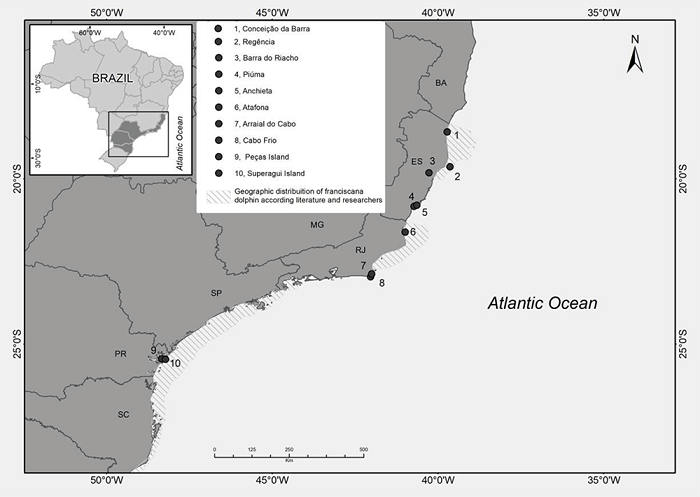
Figure 1
Location of the fishing communities studied in the Southwest Atlantic Ocean (SWAO) and the occurrence areas (hatched) and distribution gaps (not hatched) of the Franciscana dolphin Pontoporia blainvillei.
Source: The authors (2024).
Methods
Between March 2012 and November 2018, 330 ethnographic interviews were conducted with artisanal fishers living in the communities under study. The present study had an appropriate sample size for obtaining data from interviews, as the ideal sample size in ethnological research varies between 30 and 60 interviews (Mason, 2010). In this way, between 30 and 50 interviews were carried out per community. Initially, exploratory research was carried out through participant observation to follow the daily fishing activities in each community (Malinowski, 1978). Sampling in the gap areas was performed to confirm the absence of the species from the fishers’s reports. The selection of sampling sites followed the guidance contained in the National Action Plan (NAP) for the species, which indicates the priority areas for their conservation on the Brazilian coast (PAN/ICMBio, 2018).
For the interviews, a standard semistructured questionnaire consisting of open (n = 56) and closed (n = 12) questions was used. The interviews were conducted through dialogs, facilitating interaction and establishing trust between the interviewer and interviewee (Schensul et al., 1999; Opdenakker, 2006). The questionnaire was separated into categories for analysis of the results: a) profile of the fishers (sex, age, period of experience with fishing, and education); b) fishing characteristics (types of vessel, fishing schedule, artifacts used, target species and fishing zone close to the coast); area used by the Franciscana dolphin; and area of incidental capture of the species.
All the fishers were interviewed individually to avoid possible interference between informants. The first fisher was selected with aid from a local guide, and from the second interview, the snowball method and random meetings with fishers in the communities were employed (Naderifar et al., 2017). The snowball method involves the indication of a possible interviewer by fishermen who have already been interviewed (Bailey, 1982). The criteria used to select the fishers to be interviewed were (1) to be artisanal fishers, (2) for fishing to be their main economic activity, and (3) to practice fishing in any of the communities included in the study.
An illustrative board with photos of four species of small coastal cetaceans that occur in Brazil was presented to each fisher, among which was a photo of a Franciscana dolphin. The other photos were of the Guiana dolphin (Sotalia guianensis, Van Bénéden, 1864), the common bottlenose dolphin (Tursiops truncatus, Montagu, 1821) and the Clymene dolphin (Stenella clymene, Gray, 1846). Visual stimulation assisted in the analysis of the reports (Miranda et al., 2007) and was used to confirm that the interviewed fishers knew how to correctly identify the species. At the end of the interview, each fisher was presented with a map of the region to indicate their fishing route, the locations where they placed their fishing artifacts, and the areas of occurrence and incidental capture of the Franciscana dolphin. The maps helped in the identification of the areas of overlap between fishing and the occurrence of the Franciscana dolphin.
This study was submitted to Plataforma Brasil (a unified Brazilian base for research records involving human beings) and to the Sistema Nacional de Gestão do Patrimônio Genético (SISGEN - National System for the Management of Genetic Heritage and Associated Traditional Knowledge-) and was approved by the Ethics Committee of the Universidade Federal do Espírito Santo (Federal University of Espírito Santo) (CAAE 07863218.7.0000.5542). The legal representatives of the interviewed fishers were asked to give prior consent for the study, according to the Brazilian legislation that deals with the collection of data of this nature (Federal Law no. 13.123 of May 20 - Brasil, 2015). Each fisher was informed about the objectives of the study and asked if they agreed to participate, ensuring their anonymity. The name of the vessel on which each respondent worked was noted to avoid interviewing fishers who operated on the same vessel.
Discourse analysis was used to analyze the reports organized into categories related to the questionnaire questions (Ryan; Bernard, 2000), which allowed the information to be grouped by topic and facilitated the interpretation of the interviews. The triangulation method was used to compare the reports and to cross and filter the information collected following the study methods (participant observation, interviews-questionnaires, and boards). Thus, the same questionnaire was administered to different fishers at different times (with repeated information in synchronic situations technique), allowing us to obtain the maximum veracity in the reports and to establish links between the information contained in the fishers’s statements (Schensul et al., 1999).
The responses of the participants included body size between 100 and 170 cm; body color as light brown, shades of pink, light red, light yellow, and light gray; and areas of occurrence on the northern coast of the ES, the mouth of the Doce River, the coasts of Regência and Barra do Riacho, the northern coast of RJ, the coasts of Atafona and Farol de São Thomé, the countryside of the Paranaguá Estuarine Complex, and the coasts of Superagui and Pontal do Paraná. These responses were determined by Boolean logic as those that could recognize the Franciscana dolphin as belonging to the species P. blainvillei (Table 2). Boolean logic transformed linguistic variables with values of 0 (zero) for responses similar to the literature and 1 (one) for responses different from the literature. Fishers who indicated three or more characteristics of the species similar to those described in the literature, including visual recognition on the illustrative board, were classified as those who could recognize the Franciscana dolphin.

Source: The authors (2024).
To identify the degree of overlap between the areas used for fishing and the areas where the Franciscana dolphin occurred, records of the occurrence of the species described in the “Plano de Ação Nacional para a Conservação da Toninha (National Action Plan for the Conservation of the Toninha)/Instituto Chico Mendes de Conservação da Biodiversidade”, institute responsible for the creation and management of conservation areas (PAN/ICMBio 2018), Amaral et al. (2018) and the accounts of the fishers who identified the Franciscana dolphin according to Boolean logic were compared. The records were geo-referenced by QuantumGis 3.0.1 software, together with information on fishing routes, positioning of fishing artifacts, and areas of occurrence and incidental capture of the species described by the fishers.
To analyze the areas of overlap between fishing and the Franciscana dolphin, the communities studied were grouped into five regions: north of the state of Espírito Santo - North ES (Conceição da Barra, Regência and Barra do Riacho), south of the state of Espírito Santo - South ES (Anchieta and Piúma), north of the state of Rio de Janeiro - North RJ (Atafona), central coast of the state of Rio de Janeiro - Central RJ (Cabo Frio and Arraial do Cabo), and state of Paraná - PR (Superagui Island and Peças Island).
RESULTS
Profile of the interviewed fishers and characteristics of artisanal fishing
Among the fishers who were interviewed (n = 330), 329 were male, with only one woman working in Regência, North ES. The ages of the fishers ranged between 15 and 78 years, and the lengths of their fishing experience ranged from 4 to 73 years. Their education levels were low; most had attended incomplete elementary school only, with a history of at most four years (64.2%; n = 212). Regarding the characteristics of artisanal fishing, the boats were made of wood and/or aluminum, with decks and cockpits. The preferred fishing period was during the day (59.7%; n = 197), and the fishers went out to sea at dawn or in the morning (4:00 am to 9:00 am) and returned between mid-afternoon and early evening (3:00 pm to 7:00 pm). Among the fishing devices used, the fishers described the types of nets (trawl nets, gillnets, cast nets, drive-in nets, bottom-trawl nets, surrounding nets), lines (longlines, multiple-hook lines, trolling lines and jigging lines), traps (pots for octopus), and hooked rods (tuna fishing) that were employed. The preferred targets included bony and cartilaginous fish, crustaceans and shellfish, which varied according to the artifacts used. The preferred targets families are Aethridae, Ariidae, Balistidae, Carangidae, Centropomidae, Dasyatidae, Gerreidae, Haemulidae, Leucosiidae, Lobotidae, Lysmatidae, Mugilidae, Ostreidae, Paralichthyidae, Penaeidae, Pomadasyidae, Portunidae, Potamotrygonidae, Scianidae, Scombridae, Sparidae, Tetraodontidae.
Areas of artisanal fishing versus areas of occurrence of the Franciscana dolphin in the Southwest Atlantic Ocean, between 18°35’S and 25°28’S
Among all the fishers who were interviewed, only 95 (29%) identified the Franciscana dolphin as belonging to the species P. blainvillei: 24.2% (n = 23) in North ES; 1.1% (n = 1) in South ES (Anchieta); 21% (n = 20) in North RJ; and 53.7% (n = 51) in the state of PR. Among the 120 fishers interviewed in communities located within the species distribution gaps, only one fisher from South ES identified the species from sightings near the mouth of the Doce River, where he sometimes fished in North ES (Araujo et al., 2023). The analysis of the results was based on the reports of 95 fishers who recognized the Franciscana dolphin, among which 87.4% (n = 83) described the incidental capture of the species in gillnets.
The fishers described the area of occurrence of the Franciscana dolphin from their daily experience with fishing (Figure 2). Four fishers (North ES (n = 3) and North RJ (n = 1)) did not know how to specify the area of occurrence, and seven (North ES (n = 5) and North RJ (n = 2)) did not know how to identify the areas where incidental captures occurred.
The fishers indicated areas close to the coast as those used by the Franciscana dolphin. In North ES (Figure 2A), specifically in Regência, there was a concentration of sightings of this species at the mouth of the Doce River, an area impacted by the release of ore tailings by SAMARCO Mineração S.A. (BHP Billiton Brasil LTDA) in an environmental disaster beginning in November 2015 (Magris et al., 2019). It is important to emphasize that the effects of this disaster on the coastal environment are still occurring, as rains in the Doce River basin carry ore tailings to the mouth of the river.
In North RJ, fishers reported sightings of the Franciscana dolphin up to 50 m into the sea (Figure 2B). Fishers in this region emphasized that dolphins also occurred in areas dominated by large port enterprises, which were areas closed for fishing. In the PR, the area where the Franciscana dolphin was seen by fishers was within the PEC and the coast of Superagui Island, up to 10 m into the water (Figure 2C). In all fishing communities whose fishing grounds were located in the area where the species occurred, there were reports of incidental captures. This shows that the overlap between fishing and Franciscana dolphin has led to a negative interaction between the two. The information on the area of occurrence of the species provided by the fishers coincided with the official data of the Brazilian Government (PAN/ICMBio, 2018) and with the results found by Amaral et al. (2018) (see description in data analysis).
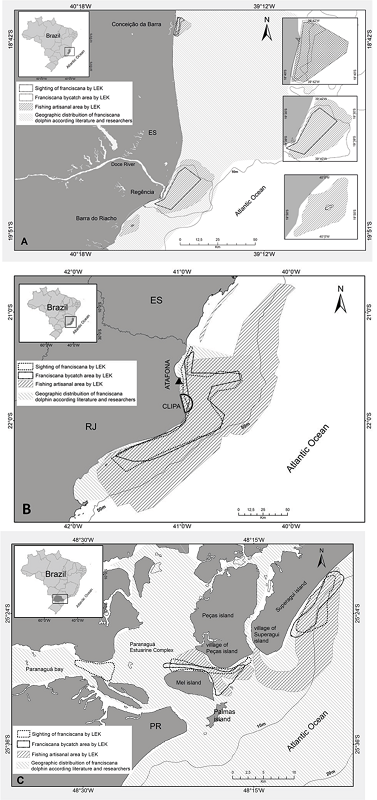
Figure 2
Areas of fishing, species occurrence and incidental capture of the Franciscana dolphin described by fishers through local ecological knowledge (LEK) and areas of occurrence of the species indicated in the literature: A) north of the state of Espírito Santo; B) north of the state of Rio de Janeiro; and C) state of Paraná, South Brazil. CLIPA - Complexo Logístico Industrial Portuário do Açu.
Source: The authors (2024).
DISCUSSION
Profile of the interviewed fishers and characteristics of artisanal fishing
In the areas under study, artisanal fishing is practiced mainly by men; women are generally responsible for household activities and fish processing (Oliveira et al., 2016). Usually, in these communities, the women are responsible for activities involving continental or coastal fishing as crustaceans and mollusks extraction, fish cleaning and commercialization, domestic activities and family care, which indicates work overload. So, they perform important functions in fishing communities but rarely are identified as ‘fishers’ (Abreu et al., 2020; Musiello-Fernandes et al., 2020).
Fishers were found to have low education levels, which interferes with access to new job opportunities and makes it difficult for them to move into other economic sectors (Oliveira et al., 2016). In fisheries communities, young people are encouraged to work in fishing activities to contribute to family income, but the instable routine of profession can difficult the frequency at the school (Silva et al., 2014). Furthermore, this incentive for young people to work in fishing is related to the local culture in which the profession is passed from father to son (Zappes, Oliveira; Di Benedito, 2016).
The diversity of artifacts described by the fishers is a characteristic of artisanal fishing in Brazil and can be explained by the high diversity of environments exploited, target species and production derived from activity (Lima et al., 2018; Musiello-Fernandes et al., 2020). However, fishing areas close to the coast were chosen mainly because of easy access, as their fishing vessels had little autonomy (Oliveira et al., 2016; Zappes, Oliveira; Di Benedito, 2016).
Areas of artisanal fishing versus areas of occurrence of the Franciscana dolphin in the Southwest Atlantic Ocean, between 18°35’S and 25°28’S
The identification of Franciscana dolphin by fishers from North ES, North RJ and the PR was related to their preferred fishing area, which coincided with areas where the species are known to occur in part of the Southwest Atlantic Ocean (Amaral et al., 2018; Bertozzi; Zerbini, 2002). The fact that fishers who worked in southern ES and central RJ could not identify the species was justified by the fact that they did not share their fishing area with the species, as the fishing grounds were located on distribution gaps. Additionally, the physical and behavioral characteristics of the species, combined with the characteristics of the fishing grounds throughout its distribution, may make it difficult for fishers who work in the other areas under study to see the dolphin (Araujo et al., 2023).
Gillnets were described by fishers as the main artifacts responsible for the incidental capture of the Franciscana dolphin, coinciding with the information in the literature (Bertozzi; Zerbini, 2002; Di Beneditto et al., 2001; PAN/ICMBio, 2018; Prado et al., 2021). Incidental captures occurred due to the overlap between gillnet fishing areas and the areas where the species occurred (Di Beneditto et al., 2001). Other anthropic factors that may interfere with the maintenance of populations of the species include the fact that their distribution coincides with areas dominated by large port enterprises, as observed in North RJ (Oliveira et al., 2016) and in the PR (Paranaguá Port) (Santos et al., 2009), and the occurrence of environmental disasters that affect the coastal marine environment, such as those that occurred in North ES in 2015 (Pinheiro et al., 2019).
Because the Franciscana dolphin has coastal habits associated mainly with river mouths and estuaries, fishers who work in the northern regions of ES, North RJ, and the state of PR are more likely to report sights and incidental captures of the species, as these areas are located around the mouths of the Doce and Paraíba do Sul Rivers and the Paranaguá Estuarine Complex (PEC), respectively (Di Beneditto et al., 2001; Moreno et al., 2003; Rosas et al., 2002).
The fact that fishers identified that the areas used for fishing were the same as where incidental captures of the species occurred demonstrates an important point to be developed in fishing management. Generally, management actions use data obtained only from researchers (Bordino et al., 2002; Prajith et al., 2014), disregarding information obtained through the LEK of artisanal fishers (Andrew et al., 2007). This unidirectional management excludes local actors, thus not allowing the fishers to act in decision-making processes in their own territories. To preserve social identity and maintain the quality of life of traditional communities, comanagement of fisheries involving all stakeholders, such as local actors, governments, legislators and researchers, must be prioritized (Abreu et al., 2017). The joint management or comanagement developed and applied together with fishing communities has made actions aimed at the conservation of the Franciscana dolphin more effective and ensured the preservation of social identity (Araujo et al., 2023).
This study demonstrated the importance of superimposing information on the area of occurrence of Franciscana dolphin provided by the fishers’s LEK and by the literature to complement the available information about the species. Understanding and valuing the LEK of fishers regarding the habits of cetaceans strengthens conservation actions throughout the species’ distribution areas (Zappes et al., 2013). In the case of the Franciscana dolphin, this study contributes to the fulfillment of the goals of the Brazilian Government aimed at the conservation of the species.
FINAL CONSIDERATIONS
The LEK of fishers regarding the Franciscana dolphin is influenced mainly by the presence of the dolphin in their fishing zones. The identification of the species by the fishers was not in complete agreement with the literature but was rather based on the recognition of areas of occurrence and of incidental capture. Although few fishers recognized the Franciscana dolphin, recognizing these areas and capture occurrences indicates that LEK is a tool for complementing data on species populations in the areas. Through ethnomapping, it was possible to visualize the overlap of areas used for artisanal fishing and of the occurrence of the Franciscana dolphin, which is important for future management proposals. Understanding local ecological knowledge facilitates the approach of researchers to communities and can assist in the comanagement of fisheries aimed at species conservation.
ACKNOWLEDGEMENTS
We thank the presidents of the Fishers’ Colonies and the fishers for their cooperation. This work was supported by the Project ‘ProToninhas’ by Fundação O Boticário de Proteção a Natureza (grant number 0894-20111), Coordenação de Aperfeiçoamento de Pessoal de Nível Superior (CAPES) - Financing code 001; Conselho Nacional de Desenvolvimento Científico e Tecnológico (CNPq - grant numbers 304.179/2022-1; 302.598/2021-9); Fundação Carlos Chagas Filho de Amparo a Pesquisa do Estado do Rio de Janeiro (FAPERJ - grant numbers E-26/200.797/2021) and the Yaqu Pacha - Society for the Protection of Aquatic Mammals Species of Latin America. We thank Hilário Antônio de Araujo, Maristela Chisté, David Rodrigues, Silvana R. Gomes, Laura Helena de O. Côrtes, Andrielli Medeiros, Renato P. Siqueira for support during the fieldwork.
REFERENCES
ABREU, J. S.; DI BENEDITTO, A. P. M.; SILVA, A. M.; ZAPPES, C. A. Artisanal fishing in the municipality of Guarapari, state of Espírito Santo, Brazil: An approach to the perception of fishermen working in small-scale fishing. Sociedade & Natureza, v. 32, p. 56-1, 2020. Doi: 10.14393/SN-v32-2020-46923
ABREU, J. S.; DOMIT, C.; ZAPPES, C. A. Is there dialogue between researchers and traditional community members? The importance of integration between traditional knowledge and scientific knowledge to coastal management. Ocean & Coastal Management, v.141, p. 10-19, 2017. Doi: 10.1016/j.ocecoaman.2017.03.003
AMARAL, K. B.; DANILEWICZ, D.; ZERBINI, A.; DI BENEDITTO, A. P. M.; ANDRIOLO, A.; ALVARES, D. J.; SECCHI, E.; FERREIRA, E.; SUCUNZA, F.; BORGES-MARTINS, M.; SANTOS, M. C. O.; CREMER, M.; DENUNCIO, P.; OTT, P. H.; MORENO, I. B. Reassessment of the franciscana Pontoporia blainvillei (Gervais and d'Orbigny, 1844) distribution and niche characteristics in Brazil. Journal of Experimental Marine Biology and Ecology, v. 508, p. 1-12, 2018. Doi: 10.1016/j.jembe.2018.07.010
ANDREW, N. L.; BÉNÉ, C.; HALL, S. J.; ALLISON, E. H.; HECK, S.; RATNER, B. D. Diagnosis and management of small-scale fisheries in developing countries. Fish and Fisheries, v. 8, n. 3, p. 227-240, 2007. Doi: 10.1111/j.1467-2679.2007.00252.x
ARAUJO, S. C.; DI BENEDITTO, A. P. M.; GATTS, C. E. N.; MOREIRA, S. C.; DOMIT, C.; GAMA, R. M.; MARTINS, A. S.; ZAPPES, C. A. Local ecological knowledge of fishers from southern and southeastern Brazil about the franciscana dolphin Pontoporia blainvillei: Strategies for conservation. Anais da Academia Brasileira de Ciências, v. 95, n. 1, p. e20201111, 2023. Doi: 10.1590/0001-3765202320201111
BAILEY, K. D. Methods of Social Research. New York: McMillan Publishers. The Free Press, 1982. 2 ed.
BERTOZZI, C. P.; ZERBINI, A. N. Incidental mortality of the franciscana, Pontoporia blainvillei, in the artisanal fishery of Praia Grande, São Paulo State, Brazil. Latin American Journal of Aquatic Mammals, v. 1 n. 1, p. 153-160. 2002. Doi: 10.5597/lajam00019
BORDINO, P.; KRAUS, S.; ALBAREDA, D.; FAZIO, A.; PALMERIO, A.; MENDEZ, M.; BOTTA, S. Reducing incidental mortality of franciscana dolphin Pontoporia blainvillei with acoustic warning devices attached to fishing nets. Marine Mammal Science, v. 18, n. 4, p. 833-842, 2002. Doi: 10.1111/j.1748-7692.2002.tb01076.x
BRASIL. Decreto n. 11.959, de 29 de junho de 2009. Dispõe sobre a Política Nacional de Desenvolvimento Sustentável da Aquicultura e da Pesca, regula as atividades pesqueiras, revoga a Lei n 7.679, de 23 de novembro de 1988, e dispositivos do Decreto-Lei n 221, de 28 de fevereiro de 1967, e dá outras providências. Brasília, DF: Presidência da República, Diário Oficial da União de 30/06/2009, seção 1, ano 146, n. 122, p. 1. Available: https://www.planalto.gov.br/ccivil_03/_ato2007-2010/2009/lei/l11959.htm. Accessed on: Mar. 2, 2014.
BRASIL. Lei Federal n 13.123, de 20 de maio de 2015. Dispõe sobre o acesso ao patrimônio genético, sobre a proteção e o acesso ao conhecimento tradicional associado e sobre a repartição de benefícios para conservação e uso sustentável da biodiversidade. Brasília, DF: Presidência da República , Diário Oficial da União de 21/05/2015, seção 1, ano 152, n. 95, p. 1. Available: https://www.planalto.gov.br/ccivil_03/_ato2015-2018/2015/lei/l13123.htm. Accessed on: Jul. 2, 2015.
CRESPO, E. A.; PEDRAZA, S. N.; GRANDI, M. F.; DANS, S. L.; GARAFFO, G. V. Abundance and distribution of endangered Franciscana dolphins (Pontoporia blainvillei) in Argentine waters and conservation implications. Marine Mammal Science , v. 26, n. 1, p. 17 - 35, 2010. Doi: 10.1111/j.1748-7692.2009.00313.x
CUNHA, H. A.; MEDEIROS, B. V.; BARBOSA, L. A.; CREMER, M. J.; MARIGO, J.; LAILSON-BRITO, J.; AZEVEDO, A. F.; SOLÉ-CAVA, A. M. Population structure of the endangered franciscana dolphin (Pontoporia blainvillei): reassessing management units. Plos One, v. 9, n. 1, p. 85633, 2014. Doi: 10.1371/journal.pone.0085633
DI BENEDITTO, A. P. M.; RAMOS, R. Biology and conservation of the franciscana (Pontoporia blainvillei) in the north of Rio de Janeiro State, Brazil. Journal Cetacean Research Manager, v. 3 n. 2, p. 185 - 192, 2001. Doi: 10.47536/jcrm.v3i2.889
DI BENEDITTO, A. P.; RAMOS, R. M. A.; LIMA, N. R. W. Sightings of Pontoporia blainvillei (Gervais and D´Orbigny, 1844) and Sotalia fluviatilis (Gervais, 1853) (Cetacea) in South-eastern Brazil. Brazilian Archives of Biology and Technology, v. 44, n. 3, p. 291-296, 2001. Doi: 10.1590/S1516-89132001000300011
JEFFERSON, T. A.; WEBBER, M. A.; PITMAN, R. L. Marine mammals of the World: a comprehensive guide to their identification. San Diego: Academic Press, 2015. 2 v.
LIMA, J. S.; ZAPPES, C. A.; DI BENEDITTO, A. P. M.; ZALMON, I. R . Artisanal fisheries and artificial reefs on the southeast coast of Brazil: Contributions to research and management. Ocean & Coastal Management , v. 163, p. 372-382, 2018. Doi: 10.1016/j.ocecoaman.2018.07.018
MAGRIS, R. A.; MARTA-ALMEIDA, M.; MONTEIRO, J. A. F.; BAN, N. C. A modelling approach to assess the impact of land mining on marine biodiversity: Assessment in coastal catchments experiencing catastrophic events (SWBrazil). Science of the Total Environment v. 659, p. 828-840, 2019. Doi: 10.1016/j.scitotenv.2018.12.238
MALINOWSKI, B. K. Os pensadores: Argonautas do Pacífico Ocidental: Um relato do empreendimento e da aventura dos nativos nos Arquipélagos da Nova Guiné Melanésia. São Paulo: Abril Cultural, 1978. 2 v.
MASON, M. Sample size and saturation in PhD studies using qualitative interviews. Forum Qualitative Social Research, v. 11, n. 3, 2010. Doi: 10.17169/fqs-11.3.1428
MIRANDA, T. M.; DE MELLO AMOROZO, M. C.; GOVONE, J. S.; MIRANDA, D. M. The Influence of visual stimuli in ethnobotanical data collection using the listing task method. Field Methods, v. 19, n. 1, p. 76-86, 2007. Doi: 10.1177/1525822X06295987
MORENO, I. B.; MARTINS, C. C.; ANDRIOLO, A.; ENGEL, M. H. Sightings of franciscana dolphins (Pontoporia blainvillei) off Espírito Santo, Brazil. Latin American Journal of Aquatic Mammals , v. 2, n. 2, p. 131-132, 2003. Doi: 10.5597/lajam00043
MOURA, J. F.; RODRIGUES, E. S.; SHOLL, T. G. C.; SICILIANO, S. Franciscana dolphin (Pontoporia blainvillei) on the north-east coast of Rio de Janeiro State, Brazil, recorded during a long term monitoring programme. Marine Biodiversity Records, v. 2, n. e-66, 2009. Doi: 10.1017/S1755267209000803
MUSIELLO-FERNANDES, J.; OLIVEIRA, P. C.; ARAÚJO, S. C.; ABREU, J. S.; DI BENEDITTO, A. P. M.; BRAGA, A. A.; HOSTIM-SILVA, M.; ZAPPES, C. A. Artisanal fishing on the coast of Espírito Santo State, Southeastern Brazil: An approach to Socioenvironmental Oceanography. Boletim do Instituto de Pesca, v. 46, n. 4, e610, 2020. Doi: 10.20950/1678-2305.2020.46.4.610
NADERIFAR, M.; GOLI, H.; GHALJAIE, F. Snowball sampling: A purposeful method of sampling in qualitative research. Strides in Development of Medical Education, v. 14, n. 3, e67670, 2017. Doi: 10.5812/sdme.67670
OLIVEIRA, P. C.; DI BENEDITTO, A. P. M.; BULHÕES, E. M. R.; ZAPPES, C. A. Artisanal fishery versus port activity in southern Brazil. Ocean & Coastal Management , v. 129, p. 49-57, 2016. Doi: 10.1016/j.ocecoaman.2016.05.005
OLIVEIRA, P. C.; DI BENEDITTO, A. P. M.; QUARESMA, V. S.; BASTOS, A. C.; ZAPPES, C. A. Traditional knowledge of Fishers versus an environmental disaster from mining waste in Central Brazil. Marine Policy, v. 120, p. 104129, 2020. Doi: 10.1016/j.marpol.2020.104129
OPDENAKKER, R. Advantages and disadvantages of four interview techniques in qualitative research. Forum Qualitative Social Research, v. 7, n. 4, 2006. http://nbn-resolving.de/urn:nbn:de:0114-fqs0604118
PAN/ICMBio - Instituto Chico Mendes de Conservação da Biodiversidade. Plano de ação nacional para a conservação da Toninha: Pontoporia blainvillei. 2018. Available: https://www.gov.br/icmbio/pt-br/assuntos/biodiversidade/pan/pan-toninha. Accessed on: Oct. 21, 2022.
PINHEIRO, F. C. F.; PINHEIRO, H. T.; TEIXEIRA, J. B.; MARTINS, A. S.; CREMER, M. J. Opportunistic Development and Environmental Disaster Threat Franciscana Dolphins in the Southeast of Brazil. Tropical Conservation Science, v. 12, 2019. Doi: 10.1177%2F1940082919847886
PRADO, J. H. F.; KINAS, P. G.; PENNINO, M. G.; SEYBOTH, E.; SILVEIRA, F. R. G.; FERREIRA, E. C.; SECCHI, E. R. Definition of no fishing zones and fishing effort limits to reduce franciscana bycatch to sustainable levels in southern Brazil. Animal Conservation, v. 24, n.5, 2021. Doi: 10.1111/acv.12679
PRAJITH, K. K.; DHIJU DAS, P. H.; EDWIN, L. Dolphin Wall Net (DWN) e an innovative management measure devised by ring seine fishermen of Kerala-India to reducing or eliminating marine mammal-fishery interactions. Ocean & Coastal Management, v. 102, p. 1-6. 2014. Doi: 10.1016/j.ocecoaman.2014.08.012
ROSAS, F. C. W.; MONTEIRO-FILHO, E. L. A. Reproductive parameters of Pontoporia blainvillei (Cetacea, Pontoporiidae), on the coast of São Paulo and Paraná States, Brazil. Mammalia, v. 66, n. 2, p. 231-245, 2002. Doi: 10.1515/mamm.2002.66.2.231
ROSAS, F. C. W.; MONTEIRO-FILHO, E. L. A.; OLIVEIRA, M. D. Incidental catches of franciscana (Pontoporia blainvillei) on the southern coast of São Paulo state and the coast of Paraná state, Brazil. Latin American Journal of Aquatic Mammals , v. 1, n. 1, p. 161-167, 2002. Doi: 10.5597/lajam00020
RYAN, G.; BERNARD, H. R. Data management and analysis methods. In: DENZIN, N. K.; LINCOLN, Y. S. (Eds.) Handbook of Qualitative Research. London: Sage, 2000. p. 769-802.
SANTOS, M. C. D. O.; OSHIMA, J. E. D. F.; SILVA, E. D. Sightings of franciscana dolphins (Pontoporia blainvillei): The Discovery of a population in the Paranaguá Estuarine Complex, Southern Brazil. Brazilian Journal of Oceanography, v. 57, n. 1, p. 57-63, 2009. Doi: 10.1590/S1679-87592009000100006
SCHENSUL, S. L.; SCHENSUL, J. J.; LECOMPTE, M. D. Essential Ethnographic Methods: Observations, Interviews, and Questionnaires. In: SCHENSUL, J. J.; LECOMPTE, M. D. (Eds.) Ethnographer's Toolkit. 2 ed. Walnut Creek: Altamira Press, 1999. p. 69-89.
SECCHI, E. R.; DANILEWICZ, D.; OTT, P. H. Applying the phylogeographic concept to identify franciscana dolphin stocks: implications to meet management objectives. Journal of Cetacean Research and Management, v. 5, n. 1, p. 61-68, 2003. Doi: 10.47536/jcrm.v5i1.827
SICILIANO, S. Review of small cetaceans and fishery interactions in coastal waters of Brazil. Report International Whaling Commission, v. 15, p. 241-250, 1994.
SILVA, C.; MOREIRA, S. C.; ZAPPES, C. A.; DI BENEDITTO, A. P. M. Pesca artesanal e cetáceos que ocorrem no litoral leste do Rio de Janeiro: Uma abordagem etnoecológica para verificar a existência de manejo tradicional. Boletim do Instituto de Pesca , v. 40, n. 4, p. 521-539, 2014.
SLETTO, B. I. “We Drew What We Imagined”: Participatory Mapping, Performance, and the Arts of Landscape Making. Current Anthropology, v. 50, n. 4, p. 443-476, 2009. Doi: 10.1086/593704
SOUZA, S. P.; BEGOSSI, A. Whales, dolphins or fishes?: The Ethnotaxonomy of Cetaceans in São Sebastião, Brazil. Journal of Ethnobiology and Ethnomedicine, v. 3, n. 9, p. 1-15, 2007. Doi: 10.1186/1746-4269-3-9
TRIMBLE, M.; PRADERI, R. What is the colour of the franciscana (Pontoporia blainvillei)?: A review and a proposed assessment method. Latin American Journal of Aquatic Mammals , v. 5, n. 1, p. 55-63, 2006. Doi: 10.5597/lajam00092
ZAPPES, C. A.; ALVES, L. C. P. S.; SILVA, C. V.; AZEVEDO, A. F.; DI BENEDITTO, A. P. M.; ANDRIOLO, A. Accidents between artisanal fisheries and cetaceans on the Brazilian coast and Central Amazon: Proposals for integrated management. Ocean & Coastal Management , v. 85, p. 46-57, 2013. Doi: 10.1016/j.ocecoaman.2013.09.004
ZAPPES, C. A.; GAMA, R. M.; DOMIT, C.; GATTS, C. E. N.; DI BENEDITTO, A. P. M. Artisanal fishing and the franciscana (Pontoporia blainvillei) in Southern Brazil: ethnoecology from the fishing practice. Journal of the Marine Biological Association of the United Kingdom, n. 4, p. 1-11, 2016. Doi: 10.1017/S0025315416001788
ZAPPES, C. A.; OLIVEIRA, P. C.; DI BENEDITTO, A. P. M. Percepção de pescadores do norte fluminense sobre a viabilidade da pesca artesanal com a implantação de megaempreendimento portuário. Boletim do Instituto de Pesca , v. 42, n. 1, p. 73-88, 2016. Doi: 10.5007/1678-2305.2016v42n1p73
ZAPPES, C. A.; GATTS, C. E. N.; LODI, L. F.; SIMÕES-LOPES, P. C.; LAPORTA, P.; ANDRIOLO, A.; DI BENEDITTO, A. P. M. Comparison of local knowledge about the bottlenose dolphin (Tursiops truncatus Montagu, 1821) in the Southwest Atlantic Ocean: New research needed to develop conservation management strategies. Ocean & Coastal Management , v. 98, p. 120-129, 2014. Doi: 10.1016/j.ocecoaman.2014.06.014
ZERBINI, A. N.; SECCHI, E.; CRESPO, E.; DANILEWICZ, D.; REEVES, R. Pontoporia blainvillei. The IUCN Red List of Threatened Species. 2017. Doi: 10.2305/IUCN.UK.2017-3.RLTS.T17978A50371075.en
Notes