Papers
Unraveling Environmental Impact Assessment Practitioners in Brazil: Profile, Education and Perception of EIA Practice among CBAI Participants
 Maria Rita Raimundo Almeida mrralmeida@unifei.edu.br
Fernanda Aparecida Veronez fveronez@ifes.edu.br
Anne Caroline Malvestio anne.malvestio@ufu.br
Maria Rita Raimundo Almeida mrralmeida@unifei.edu.br
Fernanda Aparecida Veronez fveronez@ifes.edu.br
Anne Caroline Malvestio anne.malvestio@ufu.br
Unraveling Environmental Impact Assessment Practitioners in Brazil: Profile, Education and Perception of EIA Practice among CBAI Participants
Sociedade & Natureza, vol. 36, no. 1, e71552x, 2024
Editora da Universidade Federal de Uberlândia - EDUFU
Received: 23 November 2023
Accepted: 01 February 2024
Published: 15 March 2024
Resumo: Environmental Impact Assessment (EIA) practice demands interactions between different actors, and its effectiveness depends on how they respond to their own expectations, as well as the expectations of other actors and legal standards. Thus, EIA practitioners play an important role in improving this process. This study examines the profile of Brazilian EIA practitioners who participated in at least one edition of the Congresso Brasileiro de Avaliação de Impacto (CBAI - Brazilian Congress on Impact Assessment in English), as well as their perception of EIA practice within the country. It is a quantitative and qualitative research based on the premise that EIA practitioners would have participated in at least one of the first five congresses (CBAI) promoted by the Associação Brasileira de Avaliação de Impacto (ABAI - Brazilian Association for Impact Assessment in English). Data collection involved distributing an online questionnaire, available between September 26th and November 1st, 2022, to all 794 contacts registered at ABAI. A total of 217 responses were obtained, with participants comprising 48% men and 52% women, with the majority falling between 25 and 45 years of age. All respondents had studied EIA (through undergraduate or postgraduate courses, or in other contexts). Most participants had more than 10 years of experience working with EIA, primarily in consultancy and academia. Perceptions regarding the quality, problems, strengths and opportunities of Brazilian EIA practice generally aligned with the literature. Respondents tended to disagree with streamlining EIA and Environmental Licensing procedures and to agree with the necessity of implementing Strategic Environmental Assessment in Brazil. The results are important to understand who Brazilian EIA practitioners are and what this portion of EIA practitioners think.
Palavras-chave: Stakeholders, Professional profile, Training.
INTRODUCTION
The interaction among the actors involved in Environmental Impact Assessment (EIA) contributes to various learning processes associated with its practice, which are essential for promoting its effectiveness (Kågström; Faith-Ell; Longueville, 2023; Khan et al., 2018). Research has been dedicated to exploring EIA as an ongoing learning process involving stakeholders with diverse roles, expertise, and expectations (Blicharska et al., 2011; Cruz et al., 2018; Enríquez-De-Salamanca, 2019; Khan et al., 2018). These stakeholders - project proponents (public or private), consultants, environmental agency analysts, academics, among others - referred to as practitioners, play a fundamental role in improving EIA practice. The actions of each practitioner, their responses to their own expectations and those of others, and the relationships among all involved influence the practice of EIA and its continuous improvement. Therefore, the practice of EIA is a comprehensive process that is influenced by and influences the perceptions of the group with which a practitioner interacts (Ravn Boess, 2023).
Thus, EIA professionals shape their practice (Kågström; Richardson, 2015), and improving practice requires practitioners to adopt new ways of perceiving and executing their role in their “practice spaces” (Ravn Boess, 2023). Khan et al. (2018) highlight the role of consultants, emphasizing that they are the ones responsible for conducting environmental studies and interacting with several other actors. In this interaction, dialogue among practitioners, using collaborative spaces, can improve EIA learning and practice (Kågström; Faith-Ell; Longueville, 2023). Furthermore, there is an opportunity for academics to play the role of “intermediaries” of EIA knowledge and influence its practice over time (Pope; Morrison-Saunders, 2022). Collaborative activities can also serve as a model for exchanging knowledge between academia and practice in the field of EIA (Bond; Fischer, 2022).
Therefore, it is desired that practitioners act as active actors in improving EIA, reacting to a predetermined practice (Ravn Boess, 2023). According to Pope and Morrison-Saunders (2022), the most important factor in collaboration among practitioners is the strength of the relationships between them, which requires that the actors in each group are aware of each other's work and that there is mutual respect and trust. Thus, first and foremost, it is important to understand who the EIA practitioners are within a practice context.
Considering the necessity for research addressing the perceptions of practitioners and their role in relation to the effectiveness of EIA (Duarte et al., 2017; Kågström, 2016) and recognizing the importance of research in EIA for its future (Fonseca, 2022), this article aimed to answer the following questions: (i) who are the EIA practitioners in Brazil?; (ii) what is their academic background and area of activity?; and (iii) what are the practitioners' perspectives on the practice of EIA? These questions were answered from a survey conducted among participants of the CBAI.
METHODOLOGY
This research involved the application of a questionnaire and qualitative and quantitative analysis of its results. For the sample selection, a database was sought that could provide contacts of professionals involved with EIA. This was found with the ABAI, through the list of participants in the CBAI. ABAI is a nationwide and multidisciplinary civil association that brings together public and private organizations, civil society entities, individuals, professionals and students who develop activities related to impact assessment (ABAI, 2021). Therefore, all individuals who participated in at least one of the five CBAI carried out until 2022 were invited to respond to the survey, with a population of 794 contacts. Therefore, the research is based on a group of professionals who work with EIA and who have participated in at least one of the first five CBAI. It is understood that this methodological choice can bring biases, which will be discussed in the results; however, it is justified due to the difficulty in identifying EIA practitioners, which is linked to the plurality of forms of acting in this field. Bond and Fischer (2022), who chose to only interview individuals whom the authors knew were researching EIA in the UK, based on their knowledge as journal reviewers, reported a similar difficulty.
The questionnaire was approved by the Comitê de Ética em Pesquisa (Research Ethics Committee in English) (Process 59346822.5.0000.5072) and included open and closed questions, addressing the respondents’ personal and professional profile, training, professional experience, perception of EIA practice in Brazil and agreement regarding four statements on the topic. It was applied via “Google Form”, being sent to the emails provided by ABAI (794 contacts). The form was sent four times to each contact, being available between September 26th and November 1st, 2022. A total of 217 responses were obtained (27.3% of total contacts). It is worth noting that in this qualitative research, there was no intention to seek a statistically representative sample of EIA practitioners in Brazil, thus characterizing it as intentional and exploratory sampling (Patton, 2002).
The analysis of the responses was carried out differently for each type of question. For closed questions, descriptive statistics were applied and graphs were created when relevant.
For open questions, content analysis was used, initially reading all responses and identifying categories into which they could be grouped, then defining the analysis categories (Bardin, 2016).
For the open questions related to the training of practitioners, the answers were categorized according to the course profile for technical training and undergraduate programs. For postgraduate courses, given the diversity and difficulty of categorization, a word cloud was produced. For the open question related to the perception regarding EIA practice in Brazil, four categories and their subcategories were defined based on the analysis of the responses’ content (Table 1). All responses were fully analyzed, allowing the identification and extraction of information about one or more categories and subcategories.
Finally, to analyze the participants' level of agreement regarding the statements about EIA, the distribution of responses was analyzed using descriptive statistics, both for the total set of responses and for the groups of practitioners, in order to verify whether there were differences among the groups.
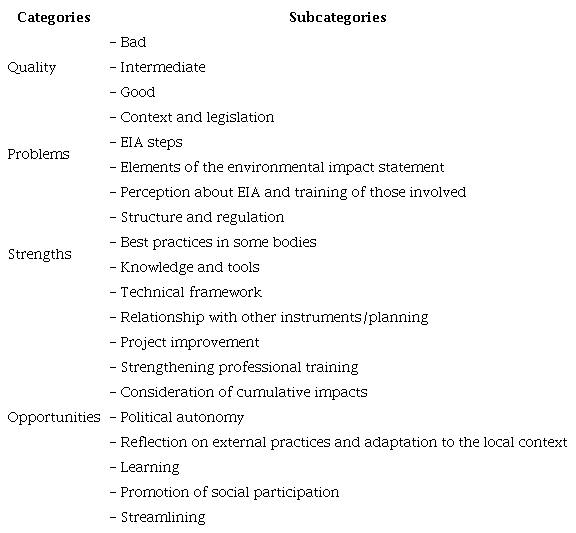
Source: The authors (2024).
RESULTS AND DISCUSSION
A total of 217 responses to the questionnaire were received. Assessing the representativeness of the sample in terms of the roles of EIA professionals is challenging due to the lack of an overview of the “EIA professional community” (Runhaar et al., 2019). Furthermore, a professional may work in different areas, which was common in participants’ responses.
Eight respondents chose not to answer the question regarding the areas in which they work or indicated that they did not work with EIA, while another six indicated they were students. In other words, among the 217 participants, 203 reported working professionally with EIA. Specifically, 83 (38%) working in academia (teaching and/or research), 74 (34%) in environmental consultancy, 70 (32%) in an environmental agency, 39 (18%) in the business areas (private or public), 11 (5%) in Non-Governmental Organizations (NGO), 5 (2%) in other public agency, and one in a Multilateral Development Agency. The Venn diagram presents the five main areas of activity indicated in the responses and their overlaps (Figure 1), demonstrating that it is common for professionals to work across multiple EIA areas. The most prevalent overlap is between academia and consultancy, suggesting a rapprochement between academia and EIA practice. Additionally, it was noted that none of the respondents exclusively worked in an NGO; instead, their work in this area always overlapped with one or more other areas.
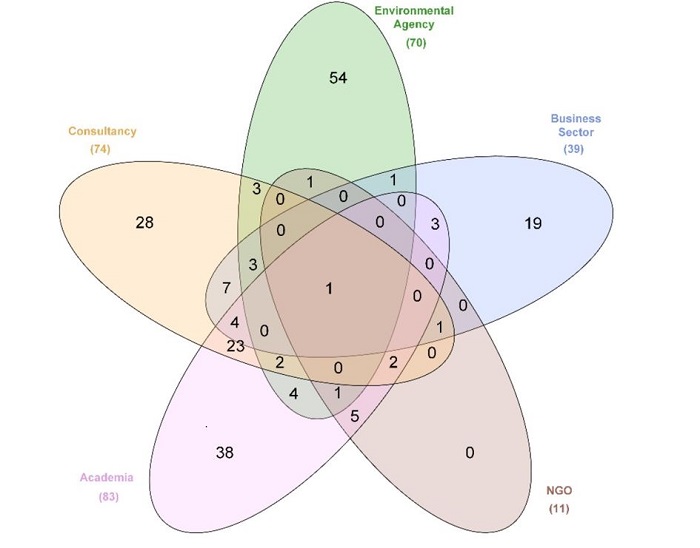
Figure 1
Areas of professional activity in EIA of research participants
Source: The authors (2024).
Regarding the location of professional activity, 82 (38%) stated that they performed their duties in more than one Brazilian state, with all states identified as the area of activity declared by the survey respondents (Figure 2). The least and most cited states were, respectively, Acre (five practitioners) and São Paulo (66 practitioners). A greater presence in the southeast region was already expected since it hosted four of the five editions of the CBAI, which took place in São Paulo (two editions), Minas Gerais and Espírito Santo (the latter was initially organized to be in person but was held online because of Covid-19 pandemic).
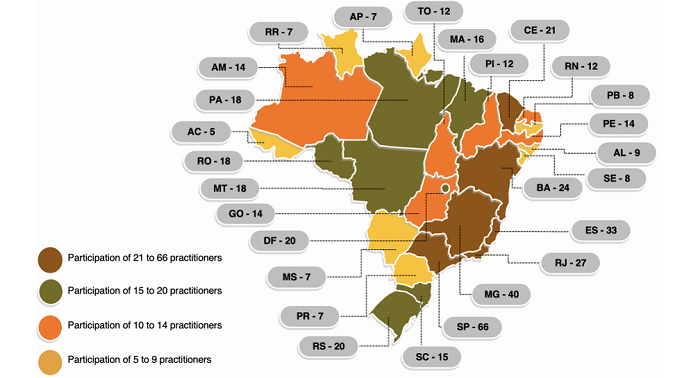
Figure 2
Number of practitioners participating in the research who stated to work in each Brazilian state
Source: The authors (2024).
The results encompass the perceptions of a diverse range of practitioners, both in terms of areas and locations of professional activity. This helps mitigate the biases from the methodological choice of approaching EIA practitioners solely from CBAI participants. Moreover, this diversity indicates a collective interest among actors from various areas in engaging in these forums for debate and training. A similar situation can be observed in events organized by the International Impact Assessment Association (IAIA, 2023).
The age profile of the research participants was well-distributed (Figure 3). Practitioners aged between 35 and 45 years old constitute the largest group (38%), followed by those aged between 25 and 35 years old (24%). This suggests a predominantly young professional profile, with the majority being under 45 years old, contrasting with the findings of Ma et al. (2018), which indicated a majority of participants were over 50 years old.
Regarding gender, the results were also balanced, with 52% female participation and 48% male participation. Morrison-Saunders and Bailey (2009) also presented this balanced result, however, with a male majority (57%) in their study. The female group is younger when compared to the male group: the most prevalent age group among females is between 35 and 45 years old, whereas among males, it is over 55 years old (Figure 3).
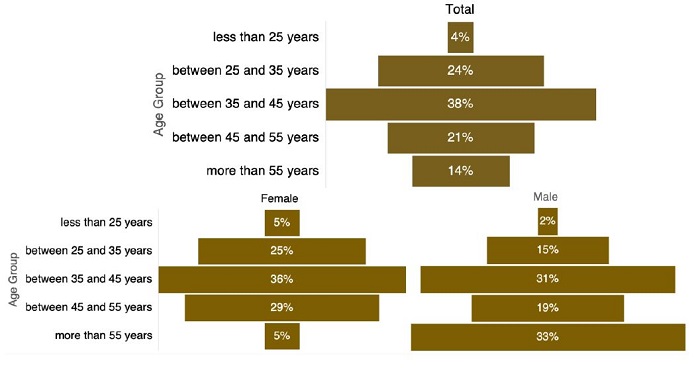
Figure 3
Age pyramid of research participants
Source: The authors (2024).
Regarding academic training, 36 out of 217 participants stated that they had completed some form of technical course, with 7 being specific to the environmental area (environmental technician, environmental management or environmental control). In terms of undergraduate education, 210 reported being graduates (with some individuals holding multiple degrees). The undergraduate programs mostly mentioned were highlighted, and those with fewer than five citations were grouped and categorized as "other courses" (Figure 4). This category includes programs in agronomy, agricultural sciences, administration, biomedicine, communication, graphic design, law, economics, nursing, philosophy, history, letters, veterinary medicine, pedagogy, data processing, chemistry and tourism. The diverse array of programs shown in Figure 4 reaffirms the interdisciplinary nature of CBAI participants, involving practitioners from various areas of knowledge.
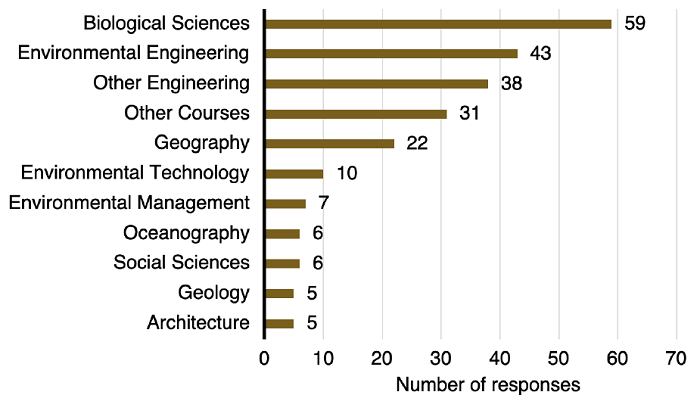
Figure 4
Undergraduate programs of research participants
Source: The authors (2024).
Regarding postgraduate education, 148 practitioners (68% of participants) reported holding a master's degree, while 68 (31% of participants) indicated having a doctorate. These findings mirror those of the study conducted by Ma et al. (2018), where the majority of participants held either a master's or doctorate degree. Postgraduate programs were diverse, with higher frequency observed in programs related to Environmental Engineering Sciences (Figure 5). This result could have been influenced by a potentially greater participation of researchers affiliated with universities that hosted the first three in-person editions of the CBAI: University of São Paulo - USP (2 editions) and Federal University of Ouro Preto - UFOP (1 edition). Nevertheless, the variety of programs presented in Figure 5 reflects the inherent nature of EIA, which demands the engagement of professionals from a broad spectrum of disciplinary and professional experiences (Morgan et al., 2012).
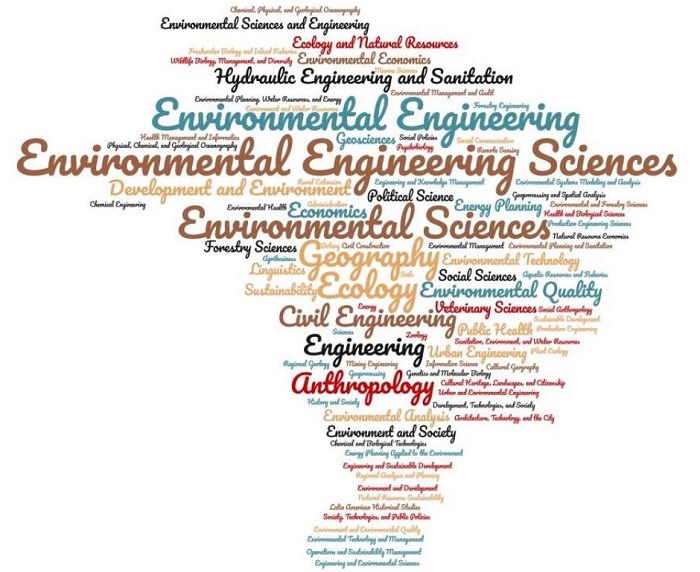
Figure 5
Distribution of postgraduate programs of research participants
Source: The authors (2024).
Training and teaching are fundamental to the effectiveness of EIA practice (Kågström et al., 2023), which demands practitioners equipped with adequate education and training, in addition to professional experience (Enríquez-De-Salamanca, 2019; Sánchez; Mitchell, 2017). Half of the participants reported studying EIA subjects during their undergraduate studies; while 53% did so at the postgraduate level (25 did not hold a postgraduate degree). Moreover, 78% indicated having studied EIA in other context (short course, specialization, etc.) and all participants had received some form of training in EIA (undergraduate, postgraduate or other context). Despite these positive findings, it remains imperative to assess the quality of this training, considering the weaknesses of EIA teaching in Brazil highlighted by Almeida, Malvestio e Veronez (2022) e Almeida, Veronez e Malvestio (2022).
Regarding the question “How do you evaluate the practice of EIA in Brazil?” (Table 2), nine participants (4%) did not provide a response. Among the received responses, 132 were related to the quality of practice, with 63% bearing a negative connotation, 33% intermediate and 4% positive. The most frequently used adjectives associated with negative connotations were “incipient”, “deficient”, “precarious” and “limited”. Intermediate responses showed an ongoing process, such as “needs to improve/improving” and “needs to move forward/advancing”. Among the six responses with a positive connotation, four qualified the EIA practice as “good”.
Duarte et al. (2017) obtained similar findings when surveying the perception of EIA practitioners regarding the Brazilian system, showing positive perceptions about some certain aspects but with a notable prevalence of negative evaluations regarding both the quality of the EIA process and the quality of the Environmental Impact Study (EIS). Nita et al. (2022) also highlighted a negative perception among researchers from various countries, where over half of the respondents (50.4%) considered EIA ineffective, indicating a range of flaws and questioning its objectivity and compliance with legal requirements. This negative perception of EIA practice in Brazil is further supported by studies assessing its effectiveness (Almeida; Montaño, 2017; MPF, 2004; Ruaro et al. 2021; Veronez; Montaño, 2017).

Source: The authors (2024).
Regarding the problems, 41 issues were identified (out of 123 responses), which were grouped into four subcategories:
-
Context and legislation: political and economic influence; streamlining; discrepancies among regions/states; lack of information; absence of Strategic Environmental Assessment (SEA); reduction of EIA practice to Environmental Licensing (EL) and environmental impact statement (EIS); confusion regarding the role of the EL and the Environmental Impact Assessment (EIA); lack of professional recognition; neglect of ecosystem services; discouragement among EIA professionals; inadequate investment/technical resources; limited normative instruments; delayed EIA process; ineffectiveness of public policies; issuance of certificates and technical opinions by city halls that do not address local socio-environmental vulnerabilities; limited influence on decision-making; lack of adaptation to the context; and drafting of the Projeto de Lei (PL - Bill in English) regarding EL,
-
EIA steps: lack or limitation of participation; inadequate supervision or monitoring; limited access to information; low quality of terms of reference or generalization of the scoping; lack of focus on significant impacts; limited effectiveness; and application restricted to large enterprises.
-
Elements of the environmental impact statement: poor or incomplete study; absence of study of alternatives; lack of criteria for defining the area of influence; failure to conduct feasibility analysis; insufficient analysis of cumulative impacts; lack of significance analysis; absence of new methods and processes; and fragmented and poorly integrated analyzes.
-
Perception about EIA and training of those involved: lack of knowledge/training; application solely due to legal requirement/enactment; perceived as an obstacle to development; bureaucratic; restricted to professionals in the area; gap between teaching and practice; lack of integration among participants; and costly.
These problems are commonly addressed in the literature. Nita et al. (2022) pointed out that problems hindering the adequate implementation of EIA are prevalent, such as specific EIA regulations, the low quality of environmental studies, insufficient equipment and trained personnel, an inadequate institutional framework, a lack of participation and low level of cooperation among interested parties. In Pakistan, Khan et al. (2020) also identified: limited capabilities of the environmental agency, consultants and proponents; lack of political will; political interference; and outdated regulations.
Regarding the confusion between instruments and studies as pointed out by research participants, it is crucial to clarify that the EL is a regulatory instrument of public authorities (represented by the competent environmental agency), over activities utilizing natural resources and that cause pollution or environmental degradation (CONAMA, 1997). On the other hand, EIA is “the process of identifying, predicting, evaluating and mitigating the relevant effects - biophysical, social and others - of development proposals before fundamental decisions are made and commitments are made” (IAIA; IEA 1999). As a process, EIA comprises a series of steps (IAIA; IEA 1999), including the preparation of environmental studies.
In Brazil, EIA is commonly integrated into EL process for activities with the potential to cause significant environmental degradation, aiming to assess the environmental viability of the project (CONAMA, 1997). In this context, the most crucial study involved in EIA is the EIS, which adheres the general guidelines and conducts the minimum technical activities outlined in Conama Resolution No. 1/1986 (CONAMA, 1986). Therefore, EIA constitutes the process and EIS is one of the elements within this process.
The problems most frequently mentioned by participants (with over 20 citations) were: lack or limitation of participation, absence of SEA and insufficient knowledge or training. These differ from those pointed out by Duarte et al. (2017), where the most significant shortcomings in Brazilian practices were the consideration of cumulative impacts and the determination of impact significance. However, the problems perceived by the participants are consistent with findings in the literature on Brazilian practice. Deficiencies in participation were noticed by Almeida and Montaño (2017), Santos et al. (2022) and Zhouri and Oliveira (2012). The limited implementation and absence of a legal requirement for the SEA application in Brazil were reported by Malvestio and Montaño (2019), Montaño et al. (2021) and Sánchez (2017). Weaknesses in EIA teaching were raised by Almeida, Malvestio e Veronez (2022) and Almeida, Veronez e Malvestio (2022), suggesting that practice and teaching mutually influence each other and that deficiencies in EIA teaching may negatively influence its practice, and vice versa.
Although only 10 participants pointed out positive aspects, the responses were diverse and grouped into four subcategories: (i) structure and regulation (presence of EIA in all project phases, implementation of EIA by all federative entities, and good structuring and regulation enabling the effective development of EL supported by EIA); (ii) best practices in some environmental agencies (highlighting the state of São Paulo and federal environmental agency - Instituto Brasileiro do Meio Ambiente e dos Recursos Naturais Renováveis - Ibama, Brazilian Institute of the Environment and Renewable Natural Resources in English); (iii) knowledge and tools (acquisition of practical knowledge across different administrative levels where EIA is conduce and the use of cartographic tools to support decision-making); and (iv) technical staff (recognition of skilled technicians and employees within environmental agencies who execute high-quality work). In Duarte et al. (2017), the most positive opinions regarding the quality of the EIA process were attributed to the screening and review conducted by environmental agencies. In Nita et al. (2022), researchers who deemed the EIA procedure effective highlighted its positive contribution to sustainable development and its potential to halt projects with significant negative environmental impact.
Opportunities were highlighted in 23 varied responses, related to: relationship with other instruments and planning, particularly the connection with SEA; improvement of projects based on environmental feasibility analysis; enhancement of professional training; consideration of cumulative impacts; political autonomy; reflection on external practices and adaptation to the local context; learning from mistakes and successes; and encouragement of social participation. The issue of streamlining was also mentioned, with some participants recognizing its necessity and others considering it as a flexibility. Notably, while the absence of SEA was the primary problem highlighted, its application was also mentioned as an opportunity. These identified opportunities align with those identified by Duarte et al. (2017) for the Brazilian context.
Lastly, research participants were confronted with four statements related to the context of EIA practice in Brazil and asked to indicate their level of agreement on a scale from “completely agree” to “completely disagree” (Figure 6). Surveying professionals' perceptions can elucidate the most controversial points as well as areas of consensus and can support legal reform initiatives and signal topics requiring more attention in public debates or research endeavors (Morgan et al., 2012).
In response to statement 1, “EIA in Brazil needs to be streamlined”, the answers exhibited some variation, but the most frequent were “Disagree” (35%) and “Strongly disagree” (34%), while two practitioners were unable to respond. Regarding statement 2, “EL process in Brazil needs to be streamlined”, and statement 3, “EIA of projects can evaluate cumulative impacts”, the responses were divided. For statement 2, the most cited responses were “Disagree” (31.3%) and “Agree” (28.6%), with five people unable to respond. For statement 3, the most prevalent responses were “Agree” (32.3%) and “Disagree” (29.5%), with five people unable to respond. Finally, in response to statement 4, "EIA of policies, plans, and programs should be practiced in Brazil", the majority of respondents indicated “Totally agree” (64.1%) and “Agree” (30.4%), with two people unable to respond.
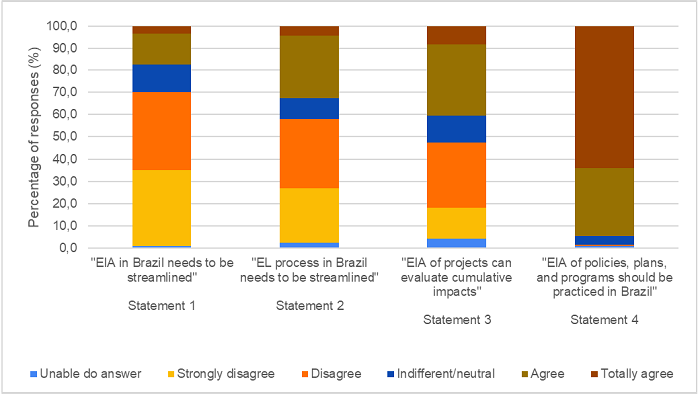
Figure 6
Agreement levels among EIA practitioners on survey statements
Source: The authors (2024).
The issue of streamlining EIA is widely discussed and contentious globally (Fonseca; Gibson, 2020; Morgan, 2012). In the Brazilian context, the debate over streamlining both EIA and EL gained prominence due to the legal changes that have occurred, especially at the state level (Fonseca; Rodrigues, 2017) and in light of the General Law Proposal for EL, PL No. 3,729/2004 (Fonseca et al. 2017), approved in the Chamber of Deputies and currently under discussion in the Senate as PL No. 2,159/2021. One of the main criticisms revolves around the proposed simplification’s focus solely on process efficiency, without offering adequate solutions to the main problems of the current EIA and EL system (Fonseca et al., 2017). The emphasis on procedural efficiency is a recurring concern (Enríquez-De-Salamanca, 2021; Fischer et al., 2023; Fonseca; Gibson, 2020), as streamlining should ensure an adequate EIA rather than just shortening deadlines (Enríquez-De-Salamanca, 2021). In essence, streamlining should enhance the instruments, being considered a good practice when it is properly adapted to the context (Noble, 2009; Sadler, 1996) and results from experiential learning (Cruz et al., 2018).
Thus, the statements regarding EIA streamlining and EL streamlining may have been interpreted differently by the respondents. Some might have considered the streamlining as a consequence of experiential learning (positive perspective), while others might have perceived it in the context of ongoing Brazilian legislative changes (positive or negative perspective). Although responses disagreeing with streamlining predominate in both statements (“I completely disagree” and “I disagree”), a significant percentage of participants also agreed with the streamlining of EL (32.7% “Totally agree” or “Agree”), reflecting the varied interpretations for the term.
Regarding the assessment of cumulative impacts integrated into the EIA of projects, the hypothesis is raised that the divergence of responses may have been influenced by the “theory versus practice” dichotomy of EIA. While this integration of cumulative impacts is deemed feasible and desirable in theory (Sánchez, 2023), it has not been widely practiced in Brazil (Duarte et al., 2017).
The majority of practitioners agreed (64.1% “Totally agreed” and 30.4% “Agreed”) that “EIA of policies, plans and programs should be practiced in Brazil”, highlighting the significance of SEA in the eyes of EIA practitioners participating in the research. These results are in line with what was verified in the question regarding the EIA practice in Brazil, where the absence of SEA was mentioned as a problem and its use as an opportunity. The importance of assessing environmental impacts in the strategic level has been reiterated in international literature across various contexts (Fischer; González, 2021), including for Brazil (Montãno et al., 2021).
Finally, it is noteworthy that there were no significant differences in responses when analyzed separately by the practitioners’ areas of activity (including five areas of activity: academia, environmental consultancy, environmental agency, and business area). Predominantly, practitioners tended to disagree with the streamlining of EIA and EL, while recognizing SEA as an instrument that should be practiced in Brazil. The literature confirms that practitioners hold varying understandings of the central aspects of practice, which are evident at the individual level and among different professionals groups and stakeholders (Morrison-Saunders; Bailey, 2003; Wegner et al., 2005). Additionally, professional cultures shape perceptions of impact assessment among professionals (Morgan et al., 2012). However, in the case of the participants in this research, different understandings about the central aspects of EIA appear to be more closely linked to individual perceptions, as there is no pattern within each area of professional activity.
FINAL CONSIDERATIONS
From the results of this research, it is possible to observe a heterogeneous profile of the respondents, covering various actors from different areas and locations of activity, reflecting the multidisciplinary nature of professionals engaged in EIA practice in Brazil. The majority of the respondents fall within the 25 to 45 age range (mainly women), and hold postgraduate degrees. Notably, all respondents had received some form of EIA training, whether through undergraduate or postgraduate programs or other contexts, highlighting the need for future studies to assess the quality of this training.
Analysis of respondents' perception of EIA practice in Brazil revealed a spectrum of issues, such as problems, strengths, and opportunities, alongside assessments of its quality. Over 60% of participants expressed a negative perception regarding the quality of practice, with the most frequently mentioned problems being: limited participation, absence of SEA and insufficient knowledge or training. Conversely, positive aspects and opportunities were diverse.
There was consensus in the evaluation of statements such as “EIA in Brazil needs to be streamlined” (predominantly disagreement) and “EIA of policies, plans and programs should be practiced in Brazil” (predominantly agreement). A trend of disagreement also emerged regarding the streamlining of the EIA and EL instruments, though this issue was more contentious in the context of EL. The most significant divergences concern the assessment of cumulative impacts by EIA of projects, possibly influenced by participants' varying practical or theoretical perspectives.
Despite the challenges in identifying EIA practitioners in Brazil, it is recommended to consult additional databases beyond CBAI participants to supplement the findings of this research. Such efforts are crucial for understanding the identities and perspectives of EIA practitioners in Brazil.
ACKNOWLEDGMENT
The authors would like to thank all participants who responded to the research questionnaire and UNIFEI for the financial support for translating the work.
REFERENCES
ALMEIDA, M. R. R.; MONTAÑO, M. The effectiveness of Environmental Impact Assessment systems in São Paulo and Minas Gerais states. Ambiente & Sociedade, v. 20, p. 77-104, 2017. https://doi.org/10.1590/1809-4422ASOC235R2V2022017
ALMEIDA, M. R. R.; MALVESTIO, A. C.; VERONEZ, F. A. Teaching impact assessment: applying indicators of best practice principles to Brazil. Impact Assessment and Project Appraisal, v. 40, n. 1, p. 27-37, 2022. https://doi.org/10.1080/14615517.2021.1968263
ALMEIDA, M. R. R.; VERONEZ, F. A.; MALVESTIO, A. C. O Ensino da Avaliação de Impacto Ambiental no Brasil: será só um ‘Faz de Conta’? Ambiente & Sociedade, v. 25, 2022. https://doi.org/10.1590/1809-4422asoc20210020r1vu2022L2AO
ABAI - Associação Brasileira de Avaliação de Impacto. Estatuto Social. 2021. Disponível em: https://avaliacaodeimpacto.org.br/wp-content/uploads/2022/10/Estatuto-ABAI-atualizado11-2.pdf. Acesso: 20 nov. 2023.
BARDIN, L. Análise de Conteúdo. São Paulo: Edições 70, 2016.
BLICHARSKA, M.; ISAKSSON, K.; RICHARDSON, T.; WU, C. Context dependency and stakeholder involvement in EIA: the decisive role of practitioners. Journal of Environmental Planning and Management, v. 54, n. 3, p. 337-354, 2011. https://doi.org/10.1080/09640568.2010.506077
BOND, A. J.; FISCHER, T. B. Characterising the collaboration between academia and practice in UK environmental assessment. Environmental Impact Assessment Review, v. 97, p. 106899, 2022. https://doi.org/10.1016/j.eiar.2022.106899
CONAMA - Conselho Nacional do Meio Ambiente. Resolução n° 1, de 23 de janeiro de 1986. Conselho Nacional do Meio Ambiente. Brasília, 1986.
CONAMA - Conselho Nacional do Meio Ambiente . Resolução n° 237, de 19 de dezembro de 1997. Conselho Nacional do Meio Ambiente. Brasília, 1997.
CRUZ, F. B.; VERONEZ, F. A.; MONTAÑO, M. Evidence of learning processes in EIA systems. Impact Assessment and Project Appraisal, v. 36, n. 3, p. 242-252, 2018. https://doi.org/10.1080/14615517.2018.1445177
DUARTE, C. G.; DIBO, A. P. A.; SIQUEIRA-GAY, J.; SÁNCHEZ, L. E. Practitioners’ perceptions of the Brazilian environmental impact assessment system: results from a survey. Impact Assessment and Project Appraisal, v. 35, n. 4, p. 293-309, 2017. https://doi.org/10.1080/14615517.2017.1322813
ENRÍQUEZ-DE-SALAMANCA, A. Environmental assessment: a third division subject at the university. Impact Assessment and Project Appraisal, v. 37, n. 5, p. 452-454, 2019. https://doi.org/10.1080/14615517.2019.1589773
ENRÍQUEZ-DE-SALAMANCA, A. Simplified environmental impact assessment processes: review and implementation proposals. Environmental Impact Assessment Review, v. 90, p. 106640, 2021. https://doi.org/10.1016/j.eiar.2021.106640
FISCHER, T. B.; GONZÁLEZ, A. (Ed.). Handbook on Strategic Environmental Assessment. Edward Elgar Publishing, 2021. https://doi.org/10.4337/9781789909937.00009
FISCHER, T. B.; FONSECA, A.; GEIßLER, G.; JHA-THAKUR, U.; RETIEF, F.; ALBERTS, R.; JIRICKA-PÜRRER, A. Simplification of environmental and other impact assessments-results from an international online survey. Impact Assessment and Project Appraisal , v. 41, n. 3, p. 181-189, 2023. https://doi.org/10.1080/14615517.2023.2198839
FONSECA, A.; GIBSON, R. B. Testing an ex-ante framework for the evaluation of impact assessment laws: Lessons from Canada and Brazil. Environmental Impact Assessment Review, v. 81, p. 106355, 2020. https://doi.org/10.1016/j.eiar.2019.106355
FONSECA, A.; RODRIGUES, S. E. The attractive concept of simplicity in environmental impact assessment: Perceptions of outcomes in southeastern Brazil. Environmental Impact Assessment Review, v. 67, p. 101-108, 2017. https://doi.org/10.1016/j.eiar.2017.09.001
FONSECA, A.; SÁNCHEZ, L. E.; RIBEIRO, J. C. J. Reforming EIA systems: A critical review of proposals in Brazil. Environmental Impact Assessment Review , v. 62, p. 90-97, 2017. https://doi.org/10.1016/j.eiar.2016.10.002
FONSECA, A. Epilogue (The future of impact prediction: what to expect from EIA in the next 50 years?). In: FONSECA, A. Handbook of Environmental Impact Assessment. 2022. p. 471.
IAIA; IEA - International Association for Impact Assessment; Institute of Environmental Assessment. Princípios da melhor prática em avaliação do impacto ambiental. 1999. Disponível em: https://www.iaia.org/uploads/pdf/IAIA_Principios_pt.pdf. Acesso: 24 jan. 2024.
IAIA - International Association for Impact Assessment. ABOUT IAIA. 2023. Disponível em: https://www.iaia.org/more-about-iaia.php. Acesso: 20 nov. 2023.
KÅGSTRÖM, M.; RICHARDSON, T. Space for action: How practitioners influence environmental assessment. Environmental Impact Assessment Review, v. 54, p. 110-118, 2015. https://doi.org/10.1016/j.eiar.2015.06.003
KÅGSTRÖM, M. Between ‘best’ and ‘good enough’: How consultants guide quality in environmental assessment. Environmental Impact Assessment Review, v. 60, p. 169-175, 2016. https://doi.org/10.1016/j.eiar.2016.05.003
KÅGSTRÖM, M.; FAITH-ELL, C.; LONGUEVILLE, A. Exploring researcher’ roles in collaborative spaces supporting learning in environmental assessment in Sweden. Environmental Impact Assessment Review, v. 99, p. 106990, 2023. https://doi.org/10.1016/j.eiar.2022.106990
KHAN, M. et al. Challenges to EIA consultants whilst dealing with stakeholders in Punjab, Pakistan. Environmental Impact Assessment Review, v. 73, p. 201-209, 2018. https://doi.org/10.1016/j.eiar.2018.09.001
KHAN, M.; CHAUDHRY, M. N.; AHMAD, S. R.; SAIF, S.; MEHMOOD, A. Performance of EIA authority and effectiveness of EIA system in Pakistan. Environmental Impact Assessment Review, v. 81, p. 106357, 2020. https://doi.org/10.1016/j.eiar.2019.106357
MA, J.; DUINKER, P. N.; WALKER, T. R. Scholar and practitioner views on science in environmental assessment. Impact Assessment and Project Appraisal, v. 36, n. 6, p. 516-528, 2018. https://doi.org/10.1080/14615517.2018.1519978
MALVESTIO, A. C.; MONTAÑO, M. From medicine to poison: how flexible strategic environmental assessment may be? Lessons from a non-regulated SEA system. Impact Assessment and Project Appraisal, v. 37, n. 5, p. 437-451, 2019. https://doi.org/10.1080/14615517.2019.1574390
MONTAÑO, M.; TSHIBANGU, G. M.; MALVESTIO, A. C. Strategic environmental assessment in Brazil: an endangered species? In: FISCHER, T. B.; GONZÁLEZ, A. (Ed.). Handbook on Strategic Environmental Assessment. Edward Elgar Publishing, 2021. p. 363-373. https://doi.org/10.4337/9781789909937.00037
MORGAN, R. K. Environmental impact assessment: the state of the art. Impact Assessment and Project Appraisal, v. 30, p. 5-14, 2012. https://doi.org/10.1080/14615517.2012.661557
MORGAN, R. K.; HART, A.; FREEMAN, C.; COUTTS, B.; COLWILL, D.; HUGHES, A. Practitioners, professional cultures, and perceptions of impact assessment. Environmental Impact Assessment Review, v. 32, n. 1, p. 11-24, 2012. https://doi.org/10.1016/j.eiar.2011.02.002
MORRISON-SAUNDERS, A.; BAILEY, J. Practitioner perspectives on the role of science in environmental impact assessment. Environmental Management, v. 31, p. 683-695, 2003. https://doi.org/10.1007/s00267-003-2709-z
MORRISON-SAUNDERS, A.; BAILEY, M. Appraising the role of relationships between regulators and consultants for effective EIA. Environmental Impact Assessment Review, v. 29, n. 5, p. 284-294, 2009. https://doi.org/10.1016/j.eiar.2009.01.006
MPF - Ministério Público Federal. Deficiências em Estudos de Impacto Ambiental: síntese de uma experiência. Brasília: 4ª Câmara de Coordenação e Revisão, Escola Superior do Ministério Público da União, 2004.
NITA, A.; FINERAN, S.; ROZYLOWICZ, L. Researchers' perspective on the main strengths and weaknesses of Environmental Impact Assessment (EIA) procedures. Environmental Impact Assessment Review, v. 92, p. 106690, 2022. https://doi.org/10.1016/j.eiar.2021.106690
NOBLE, B. F. Promise and dismay: The state of strategic environmental assessment systems and practices in Canada. Environmental Impact Assessment Review, v. 29, n. 1, p. 66-75, 2009. https://doi.org/10.1016/j.eiar.2008.05.004
PATTON, M. Q. Qualitative Research and Evaluation Methods. London: Sage, 2002.
POPE, J.; MORRISON-SAUNDERS, A. Collaboration between academic and non-academic actors in EIA: Reflections from Western Australia. Environmental Impact Assessment Review, v. 97, p. 106910, 2022. https://doi.org/10.1016/j.eiar.2022.106910
RAVN BOESS, E. Practitioners’ pursuit of change: A theoretical framework. Environmental Impact Assessment Review, v. 98, p. 106928, 2023. https://doi.org/10.1016/j.eiar.2022.106928
RUNHAAR, H.; GOMMERS, A.; VERHAEGEN, K.; COOMAN, K.; CORENS, P. The effectiveness of environmental assessment in Flanders: An analysis of practitioner perspectives. Environmental Impact Assessment Review, v. 76, p. 113-119, 2019. https://doi.org/10.1016/j.eiar.2019.02.006
RUARO, R.; FERRANTE, L.; FEARNSIDE, P. M. Brazil's doomed environmental licensing. Science, v. 372, n. 6546, p. 1049-1050, 2021. https://doi.org/10.1126/science.abj4924
SADLER, B. International study of the effectiveness of environmental assessment. Final Report. Canadian Environmental Assessment Agency and the International Association for Impact Assessment, 1996.
SÁNCHEZ, L. E. Por que não avança a avaliação ambiental estratégica no Brasil? Estudos avançados, v. 31, n. 89, p. 167-183, 2017. https://doi.org/10.1590/s0103-40142017.31890015
SÁNCHEZ, L. E.; MITCHELL, R. Conceptualizing impact assessment as a learning process. Environmental Impact Assessment Review, v. 62, p. 195-204, 2017. https://doi.org/10.1016/j.eiar.2016.06.001
SÁNCHEZ, L. E. Avaliação de impactos cumulativos. Oficina de textos, 2023.
SANTOS, L. S.; ALMEIDA, M. R. R.; VERONEZ, F. A. Participação na Avaliação de Impactos Ambientais no estado de Minas Gerais: um levantamento sobre as audiências públicas. Revista Brasileira de Geografia Física, v. 15, n. 03, p. 1196-1212, 2022. https://doi.org/10.26848/rbgf.v15.3.p1196-1212
VERONEZ, F.; MONTAÑO, M. Análise da qualidade dos estudos de impacto ambiental no estado do Espírito Santo (2007-2013). Desenvolvimento e Meio Ambiente, v. 43, p. 6-21, 2017. http://dx.doi.org/10.5380/dma.v43i0.54180
WEGNER, A.; MOORE, S. A.; BAILEY, J. Consideration of biodiversity in environmental impact assessment in Western Australia: practitioner perceptions. Environmental Impact Assessment Review, v. 25, n. 2, p. 143-162, 2005. https://doi.org/10.1016/j.eiar.2004.03.003
ZHOURI, A.; OLIVEIRA, R. Development and environmental conflicts in Brazil: challenges for anthropology and anthropologists. Vibrant: Virtual Brazilian Anthropology, v. 9, p. 181-208, 2012. https://doi.org/10.1590/S1809-43412012000100007
Author notes