Serviço Social, Trabalho e Formação
Undergraduate and graduate studies programs in Social Work in Brazil
Graduação e pós-graduação em Serviço Social no Brasil
Undergraduate and graduate studies programs in Social Work in Brazil
Textos & Contextos (Porto Alegre), vol. 17, no. 2, pp. 247-261, 2018
Pontifícia Universidade Católica do Rio Grande do Sul, Programa de Pós-Graduaçao em Serviço Social
Received: 15 March 2018
Accepted: 15 September 2018
ABSTRACT: This article examines the expansion of undergraduate and graduate programs in Brazil, characterizing the convergences and divergences between the two educational levels in the last 15 years. This is a document study based on data available on the websites of the Ministry of Education and the Coordination for the Improvement of Higher Education Personnel (CAPES). Undergraduate studies in social work are currently offered by 575 institutions, distributed among Brazil's five geographical regions, particularly in the Southeast and South. These institutions are for the most part private and provide both classroom-based and distance learning formats. Graduate studies programs continue to expand at a different pace. They are primarily linked to public institutions, with classroom- based teaching and a higher number of PhD holders among their professors.
Keywords: Undergraduate, Graduate, Social work.
RESUMO: Este artigo analisa a expansão da graduação e da pós-graduação em Serviço Social no Brasil, caracterizando as convergências e divergências entre os dois níveis de formação nos últimos 15 anos. Trata-se de pesquisa documental com base em dados disponíveis nos sites do Ministério da Educação e da Coordenação de Aperfeiçoamento de Pessoal de Nível Superior. A graduação em Serviço Social é ofertada, atualmente, por 575 Instituições, distribuídas pelas cinco regiões brasileiras, com concentração no Sudeste e no Sul. Essas Instituições são, em sua maioria, privadas e disponibilizam tanto a modalidade presencial quanto a modalidade a distância. A pós- graduação segue um fluxo de expansão diferente. É vinculada sobretudo às instituições públicas, com oferta de ensino presencial e maior quantitativo de doutores entre seus docentes.
Palavras-chave: Graduação, Pós-graduação, Serviço social.
This article examines the expansion process for the training of human resources in the field of social work in Brazil, at the undergraduate and graduate levels, in an effort to characterize the convergences and divergences that this process has assumed over the last 15 years. The historical background of the evolution of the profession is examined and, especially, the new formats in the contemporary context (expansion of undergraduate studies in social work through distance learning and traditional graduate studies programs).
Understanding this expansion process in professional training requires setting the profession within the historical evolution of society. Therefore, it is necessary to extend beyond an analysis of social work as a profession and field of knowledge, and place it within a context of the broader relationships corresponding to a capitalist society, particularly in the sphere of responses that society and the State build in relation to the social question and its manifestations, in its multiple dimensions. This society is the product of contradictory social relationships which cross the entire spectrum of social life and permeate social policies and the State itself.
The reproduction process of all the social relationships in a society is a complex process, which carries with it the possibility of newness, variety, contradiction and change. It involves a totality in permanent re-elaboration, in which the movement itself that generates the conditions for reproduction of a class-based society creates and recreates the conflicts resulting from these relationships and the possibilities of overcoming them (YAZBEK, 2014).
Social work emerged and was institutionalized in the 1930s, a time when the capitalist state, in dealing with the manifestations of the social question, contracted Social Agents to defend its bourgeois project. Therefore, the profession arose linked to the interests of the bourgeoisie, in a State whose objective was, above all, to serve the needs of capital.
The 1930s were marked by the tension of conflicting interests: on one hand, the Church, through social actions, intervened to keep the working class away from subversive influences; on the other, workers demonstrated for rights and social protection, since they did not only want benefits. In this context, the Church undertook a specialized technical training for social action, and there were also demands from state institutions by professionals in this field (MARTINELLI, 1991; CASTRO, 1989).
The first undergraduate courses in social work were created in the 1930s1. In Latin America, Chile created its first course in 1925; Brazil, in 1936; Uruguay, in 1937; and Argentina, in 1940 (CASTRO, 1989). In Brazil's case, the creation of this school was not the result of an exclusive initiative of the Catholic Movement, but was also associated with demand from the State (IAMAMOTO, 2011). “It was in relationship with the Catholic Church that Brazilian social work would ground the formulation of its first political-social objectives, being guided by a humanistic, conservative approaches […]”(YAZBEK, 2009, p.131).
The Brazilian State, in the 1940s, was stretched to incorporate part of the demands of workers and recognize the legitimacy of their claims, henceforth considered a political issue and not a matter for the police. As a result, state welfare institutions emerged to regulate the reproduction process of the social relationships that ensured meeting the social needs of the subaltern classes and enabled the process of capitalist accumulation of wealth.
On June 13, 1953, Law No. 1889 was enacted, providing the first set of regulations for social work as a profession. It outlined the teaching objectives and established that one of its competences was the production of scientific knowledge about social reality. Four years later, new laws to regulate the profession were passed (Law No. 3252, of August 27, 1957), which granted a monopoly over the profession to holders of degrees in the field; and more recently, Law No. 8662, of June 7, 1993) (PEREIRA, 2007).
In 1972, nineteen years after the initial set of regulations, the first graduate studies courses were implemented, at the master's level, in the Pontifical Catholic Universities of São Paulo and Rio de Janeiro (IAMAMOTO, 2014). In the following years, graduate studies programs expanded, particularly among federal universities and, more recently, among state universities.
The momentum for graduate studies programs was strengthened by two facts in particular: (i) approval, in 1979, in Natal, of the curricular review sent by the Brazilian Association for Teaching and Research in Social Work (ABEPSS), from a critical perspective, which required professional advanced training (IAMAMOTO, 2014); (ii) integration of many confessional social work courses into the federal higher education system in the 1960s and 1970s, assigning greater importance to more systematic production of knowledge and, consequently, to graduate studies.
According to Predes (2014), based on Netto, this process for the profession was not only a “mere formal and legal event”, and had impacts on the professional training process.
The conditions imposed by the dictatorship on the Brazilian educational panorama facilitated the consolidation of a technocratic and aseptic bias in the social disciplines incorporated by Social Work […] The State encouraged improvement of the technical training of new professionals so that they could embrace the developmental direction of Brazilian social policies (PREDES, 2014, p.28-29).
In the 1960s and 1970s, there were a number of important milestones related to the expansion of the National Graduate Studies System (SNPG) (SANTOS; AZEVEDO, 2009), particularly: (a) in 1965, elaboration of the Sucupira Opinion (Opinion No. 977/65) – the graduate studies framework in Brazil; (b) in 1970, implementation of the Intensive Graduate Studies Program (Decree No. 67348/70); (c) in 1973, creation of a working group commissioned to propose preliminary measures for defining the graduate studies policy; (d) in 1974, implementation of the National Graduate Studies Council, a collegial interministerial body whose responsibilities were focused on formulating the graduate studies policy and carrying it out; (e) for the period 1975-1977, formulation of the 1st National Graduate Studies Plan (PNGP), which sought, among its objectives, to institutionalize the National Graduate Studies System, raise the performance standards of the programs, streamline the use of resources and plan its expansion.
Graduate studies programs in social work in Brazil were only implemented in the last four decades, starting in the 1970s. The South region was the pioneer in master's degree courses in social work (PUC-Rio and PUC-SP, in 1972; and UFRJ, in 1976). During this period, master's degree programs also expanded to the South region (PUC-RS, in 1977) and North region (UFPB-JP, in 1978; and UFPE, in 1979) (CAPES, 2016).
In 19762, CAPES included Social Work as a field of knowledge (belonging to the larger area of Social Professions3) (GARCIA, 2016). More than just a bureaucratic-administrative procedure, this inclusion was the recognition of an intense struggle in the sense of attributing academic status to a profession that was legitimized through its interventional dimension in the sociotechnical division of labor. “Recognition of research in social work […] in CAPES as a knowledge production field was and, to a certain extent, still is (in terms of status and funding for research) the result of numerous struggles” (SPOSATI, 2007, p.4).
It important to recognize the continuous and systematic role of ABEPSS, graduate studies programs, researchers and all the coordinators of the field of social work in CAPES in strengthening and legitimizing the knowledge produced by the field, demonstrating the necessary ethical and political maturity in different levels of discussion, i.e., in the internal coordination of the professional category (with other fields of knowledge) and institutional coordination (with different national and international bodies that promote research and graduate studies).
The present study used document sources, via the database of the e-MEC Registry of Higher Learning Institutions and Courses of the Federal Education System, in reference to social work in 2014, as well as the MEC/CAPES database. The following variables were examined in these databases: regional distribution of graduate studies course in social work by administrative category and academic organization; number of graduate studies courses by teaching format; and spatial distribution of undergraduate and graduate studies courses in social work. Descriptive statistical analysis and measures of central tendency were used for the data analysis.
Undergraduate and graduate studies programs in social work in Brazil - evolution from 1930 to 2016
Between 1936 and 1945, 14 Schools of Social Work were created in Brazil. Another 20 new courses emerged between 1946 and 1963, with a strong influence of the Catholic Church – 70% of these schools were independently and directly created by the Church, and were only incorporated into university structures in the following decade (Pereira, 2007).
During the period of military rule (1964-1985), the presence of the private sector was intensified in relation to the public. In other words, in regard to the Social Work courses created between 1964 and 1985, there was a predominance of private institutions of higher education (19 linked to the private sector and five with a religious affiliation) (Table 1).
| Category | Number | % |
|---|---|---|
| Business Sector | 19 | 61.3 |
| State | 7 | 22.6 |
| Church | 5 | 16.1 |
| Total | 31 | 100 |
The development of a business sector dates back to the era of the military dictatorship (OLIVEIRA, 2009). Durham (2003, p.2) adds:
[…] apart from the denominational institutions and nonprofit schools of higher education created by local elites, another type of establishment proliferated in the 1960s: not religiously affiliated non-university and organized as companies, their main objective was to generate profit - they were, in essence, businesses.
There was a period of restructuring of the internal organization of the universities, based on business logic, i.e., there was a need to tailor the educational system to the accelerated process of the modernization of capitalism. The crisis of accumulation of capital led to the abandonment of Fordism- Taylorism, as well as the ideology of development and the welfare state. On the other hand, liberalism was relaunched (LIMA, 2005). The international situation, post 1970s, pointed to a new crisis for capital where neoliberalism gained ground around the world, affecting social rights. The neoliberal way of thinking was based on the commercialization of all spheres of social life and, as the concept of modern citizenship was narrowed, education as a social right was also attacked (PEREIRA, 2007).
MEC […], in 1965, pointed toward the effort to privatize higher education, based on the North American model - as well as its reconfiguration to make it more efficient and streamlined, in the form of a “university-company”: this would be the meaning of “modernization” of higher education, i.e., universities conforming to the constant needs of the capitalist mode of production, revolutionizing production forces, including science and technology, in the historical context of monopolistic capitalism (PEREIRA, 2007, p.161).
The expansion of graduate studies courses in social work is directly related to the expansion that took place in higher education between 1980 and 1990 in Brazil, particularly through the distance education format, which was intensified in the 1990s (PEREIRA, 2010). In the context of the entrenchment of neoliberalism throughout this decade, education ceased being a right and became a commodity, i.e., profit was the overriding motive for the provision of this “service” by business groups that exploited this new market niche. In other words, the Reform of the Brazilian State, particularly in relation to higher education, made it clear that it was no longer solely responsible for providing it. This meant that:
[…] education was no longer conceived as a right and became a service; that education stopped being considered a public service and started being viewed as a service that could be public or private […] The Reform of the State defined universities as social organizations and not as social institutions (CHAUI, 2003, p. 6).
Also with respect to the commercialization of education4, it is important to mention the constant and growing pressure of businessmen in the sector to eliminate barriers to market expansion, i.e., education should be treated as any other market, regulated by “neutral” market rules and “free trade” (SIQUEIRA, 2007).
This means the incorporation of various sectors traditionally maintained and regulated by the State as part of the social and subjective rights of citizens, and the fruit of years of struggle and victories (education, health, environment and sanitation, etc.) within the sphere of the General Agreement on Trade in Services (GATS), and its organization based on the rationale of profit, supply and competition, characteristics of liberal thought of the “free” market (SIQUEIRA, 2007, p.148).
This context reflected the process of the Brazilian State casting off its responsibility toward education and the striking presence of the privatization of higher education, which became almost hegemonic over the next few decades, as can be seen below in data from the Higher Education Census (Table 2).
| Year | Total | % variation | Public | Private | ||
|---|---|---|---|---|---|---|
| Total | % variation | Total | % variation | |||
| 2002 | 1,637 | – | 195 | – | 1,142 | – |
| 2003 | 1,859 | 13.6 | 207 | 6.2 | 1,652 | 14.6 |
| 2004 | 2,013 | 8.3 | 224 | 8.2 | 1,789 | 8.3 |
| 2005 | 2,165 | 7.6 | 231 | 3.1 | 1,934 | 8.1 |
| 2006 | 2,270 | 4.8 | 248 | 7.4 | 2,022 | 4.6 |
| 2007 | 2,281 | 0.5 | 249 | 0.4 | 2,032 | 0.5 |
| 2008 | 2,252 | -1.3 | 236 | -5.2 | 2,016 | -0.8 |
The dissimilar growth between public and private IHEs, as shown in Table 2, accentuates the existing asymmetry between the two. In 2003, the number of spots offered by private IHEs corresponded to 70.8% of the total number of spots offered. By 2011, this percentage grew to 73.7% (TANEGUTI, 2012). This predominance of private IEHs continued from 2009 to 2012 (Table 3). According to the 2013 Higher Education Census (BRAZIL, 2014), distance education courses accounted for more than 15% of the enrollments in higher education. The country currently offers more than 1,200 options in this format – 86.6% in private IHEs.
| Year | Total | Administrative Category | |||
|---|---|---|---|---|---|
| Federal | State | Municipal | Private | ||
| 2009 | 2,314 | 94 | 84 | 67 | 2,069 |
| 2010 | 2,378 | 99 | 108 | 71 | 2,100 |
| 2011 | 2,365 | 103 | 110 | 71 | 2,081 |
| 2012 | 2,416 | 103 | 116 | 85 | 2,112 |
In Brazilian higher education, the hegemony of private institutions is reflected in the stats (87.4% in 2012, according to Table 3). It is necessary to link this figure to the expansion in distance education courses.
In social work courses, a substantially larger number of spots were offered in the distance education format than the classroom-based format, between 2010 and 2013. In all these years, the number of spots offered, as well as student enrollments, via distance education courses, exceeded the number of classroom-based courses. The incidence of private educational institutions is significant in both formats. However, distance education still prevails in terms of number of spots offered (TRINDADE, 2015).
[…] is clearly related to privatization, since 80% of enrollments, in both classroom- based and distance education courses, are private in nature. Therefore, the overwhelming expansion of the privatization of professional training in social work at the undergraduate level in Brazil, since the 1970s, has been boosted by private distance education course (TRINDADE, 2015, p. 253).
This predominance noted by Trindade is reflected in the analysis of the type of administrative organization of the IHEs that offer undergraduate courses in social work: they are mostly private (91.65%) and located in the Southeast (34%) and Northeast (27%) regions of Brazil.
The predominance of private institutions consolidates the expansion of higher education through the private sector. As seen, the Brazilian government, since the enactment of the National Education Guidelines and Bases Law5 (LDB) (Law No. 9394/96), has opened the doors for expansion of higher education via distance education, which occurs primarily in the private sector (LIMA, 2004; OLIVEIRA, 2009; PEREIRA, 2012).
The predominance of universities in the offer of undergraduate courses in social work, with a prevalence of private institutions, does not correspond to a large number of spots offered or actual enrollments6, i.e., a college or university center can offer more spots than the total number offered in universities, which does not necessarily mean a corresponding enrollment of students.
A little over half of the social work courses offered by IHEs are linked to university centers and colleges (55.1%). They are institutions that do not ensure the disassociation of teaching, research and extension, and they are characterized by the transmission of knowledge. The preponderance of courses in colleges stands out in the Southeast region (41.2%), unlike the other regions where universities prevail. However, almost 100% of the university centers are private (Table 4).
| Academic Organization | North | Northeast | C-West | Southeast | South | Brazil | ||||||
|---|---|---|---|---|---|---|---|---|---|---|---|---|
| No. | % | No. | % | No. | % | No. | % | No. | % | No. | % | |
| Public University | 5 | 6.5 | 13 | 8.4 | 3 | 5.1 | 13 | 6.7 | 10 | 11.1 | 44 | 7.7 |
| Private University | 33 | 42.8 | 61 | 39.3 | 29 | 49.2 | 58 | 29.9 | 36 | 40.0 | 217 | 37.7 |
| Public University Center | 0 | 0.0 | 0 | 0.0 | 0 | 0.0 | 1 | 0.5 | 0 | 0.0 | 1 | 0.2 |
| Private University Center | 19 | 24.7 | 20 | 12.9 | 17 | 28.8 | 42 | 21.7 | 13 | 14.4 | 111 | 19.3 |
| Public College | 0 | 0.0 | 0 | 0.0 | 0 | 0.0 | 1 | 0.5 | 2 | 2.2 | 3 | 0.5 |
| Private College | 20 | 26 | 61 | 39.4 | 10 | 16.9 | 79 | 40.7 | 29 | 32.3 | 199 | 34.6 |
| Total | 77 | 100 | 155 | 100 | 59 | 100 | 194 | 100 | 90 | 100 | 575 | 100 |
The highest number of social work courses is concentrated in private universities (37.7%), particularly in the Center-West region (49.2%), followed by the North region, with 42.85%. As to the course format, 67.2% were classroom-based (Table 5).
| Academic Organization | North | Northeast | Center-West | Southeast | South | Brazil | ||||||
|---|---|---|---|---|---|---|---|---|---|---|---|---|
| No. | % | No. | % | No. | % | No. | % | No. | % | No. | % | |
| Classroom | 59 | 56.8 | 133 | 67.5 | 36 | 46.8 | 175 | 78.1 | 74 | 71.8 | 476 | 67.2 |
| Distance | 45 | 43.2 | 64 | 32.5 | 41 | 53.2 | 49 | 21.9 | 29 | 28.2 | 232 | 32.8 |
| Total | 104 | 100 | 197 | 100 | 77 | 100 | 224 | 100 | 103 | 100 | 708 | 100 |
In 2014, most of the courses offered were classroom-based (67.23% of the total), whereas distance education courses corresponded to 32.76% of the total. It can be seen that the Center-West region has the highest percentage in relative numbers (53.24%) of distance education courses, followed by the North region (43.26%). In contrast, classroom-based courses predominate, in relative numbers, in the Southeast region (78.12%), followed by the South region (71.84%).
Only 10.26% of the IHEs that offered social work courses are found in the Center-West region, but the number of distance education courses, in relative numbers, is significant (53.24%). In this regard, the Federal District is worth noting, which offered 68.75% of the social work courses in this format. In the other states from this region, with the exception of Minas Gerais, the number of courses offered in this format is hegemonic.
The Southeast region accounts for 33.73% of the IHEs that offer social work courses, but it only offers 21.87% in the distance education format. The North region accounts for 13.39% of the IHEs with courses in social work and offers 43.26% in distance education format. The Northeast region corresponds to 26.9% of the national total and offers 32.48% in this format.
A predominant distance education trend can be noted in the Center-West region, whereas in the North region this format is similar in percentage to the classroom-based format. In the Northeast, South and Southeast regions, although there are also a considerable number of distance education courses, classroom-based teaching still predominates.
It is important to emphasize that only the number of distance education courses is highlighted. No other variables are taken into account, such as number of spots offered, candidates enrolled, and number of admissions and graduates in social work courses, which provides another perspective on the reconfiguration of this course based on the distance education format. Trindade (2015) pointed out that the offer of social work spots in this format is higher than the amounts filled, i.e., there are excess spots.
The expansion of social work courses in the realm of higher education should also be examined from the point of view of the Program for Support of Restructuring and Expansion Plans of Federal Universities (Reuni), created by the federal government in 2007. The Brazilian Ministry of Education (MEC) instituted this program as “one of the actions within the Education Development Plan, aimed at the academic and pedagogical growth and physical expansion of public higher education and the federal higher education system (PREDES, 2012, p. 6).
The expansion of courses (classroom-based and distance) was backed by public funding for the private sector (Financing for Higher Education Students [Fies]) and extensive tax exemptions given to the private sector for classroom-based education through the University for All program (Prouni). There was also a clear incentive for expansion of distance education (PEREIRA, 2012).
Although there is, at present, growing social demand (especially in the area of education), the Constitutional Amendment Proposal 55 (PEC 55, formerly PEC 241) was passed, which freezes public spending for 20 years, except for adjustments for inflation in the first half of the previous year.
From a macroeconomic point of view, this 20-year financial freeze hinders economic growth and countercyclical action by the State. From a social point of view, it not only promotes the destruction of social rights, constitutionally guaranteed by the Federal Constitution of 1988, but also undermines education and health policies. And, no less important, from a political perspective, it takes away the possibility from Congress and society to shape the public budget, thus imposing a new social pact in relation to a minimal state (FÓRUM et. al., 2016).
With serious consequences for educational policies, the freeze on public spending causes expansion of higher education to contract, thereby jeopardizing its maintenance and existence (as evidenced by the crisis experienced by federal and state public universities).
If the expansion of undergraduate spots has been primarily ensured by private IHEs, what direction will graduate studies programs in social work take?
Graduate studies in social work in Brazil and their role in the Latin American and international context
Analyzing graduate studies in social work in Brazil and their current status requires inserting them within the expansion process of graduate studies programs, as well as IHEs, in Brazil.
In the 1960s, there were 38 graduate studies courses in the country, with none in social work (Area 32). In 2014, there were 3,806 programs, and only 0.87% of them were in this field (GARCIA, 2016).
There are currently 34 graduate studies programs in social work, distributed as follows: 12 in the Southeast region (35.3%), 11 in the Northeast region (32.3%), 6 in the South region (17.6%), 3 in the Center- West region (8.8%) and 2 in the North region (6%). In comparing this data with general data from the National Graduate Studies System, it was found that, in percentage terms, the field of social work has a higher number of programs in the Northeast region (Table 6).
| Geographic Region | No. GSP/NGSS | % | No. GSP/SS | % |
|---|---|---|---|---|
| Southeast | 1,747 | 45.9 | 12 | 35.3 |
| South | 795 | 20.9 | 6 | 17.6 |
| Northeast | 754 | 19.8 | 11 | 32.3 |
| Center-West | 311 | 8.2 | 3 | 8.8 |
| North | 199 | 5.2 | 2 | 6.0 |
| Total | 3,806 | 100 | 34 | 100 |
In relation to graduate studies programs in social work, public universities prevailed (78.8%), followed by community institutions of higher education (15.2) and a low representation of private institutions (6%) - the opposite trend to the one for undergraduate programs.
In regard to administrative category, the distribution of graduate studies programs in social work is as follows: 20 (58.8%) in federal universities; 8 (23.5%) in state universities; and 6 (17.7%) in private universities. Particularly noteworthy is the expansion of these programs in state universities (from 3, in 2010, to 8, in 2015 - a growth of 266%); the small reduction of these programs in private universities (from 8, in 2010, to 6, in 2017); the change of area of the Social Policy Program of the Catholic University of Salvados (UCSAL); and shutdown of the course at Cruzeiro do Sul University (UNICSUL) (CAPES, 2017). This distribution differs from the national IHE figures (predominance of private IHEs), as pointed out in the previous section.
Among public IHEs, state ones prevailed, followed by federal ones. However, in the profile of Graduate Studies Programs in social work, federal IHEs predominated (Table 7).
| Administrative Category | No. | % |
|---|---|---|
| Federal | 106 | 35.1 |
| State | 119 | 39.5 |
| Municipal | 76 | 25.4 |
| Total | 301 | 100 |

In an historical analysis, it can be seen that graduate studies programs in private IHEs grew slightly over 300% between 1998 and 2011. Among public IHEs, growth was 100%. However, graduate studies programs are, for the most part, linked to public IHEs. In 2015, private IHEs accounted for 7.6% of the PhD courses, 8.9% of the professional master's degrees and 21.4% of the graduate studies programs with master's and PhD degrees. The public IHEs accounted for 99.8% of the students enrolled in 2015 (58.6% in federal institutions, 29.5% in state institutions and 11.7% in municipal institutions) (CAPES, 2016).
In 2017, Area 32 (Social Work) has 19 graduate studies programs that offer PhD courses (PUC/RS, PUC/SP, PUC/Rio, UFMA, UFRJ, UFPE, UnB, UNESP, UERJ, UFPE, UFF, FUFPI, UFES, UFV, UEL, UFSC, UCPel, UFPA, UFRN and UFAL) and 34 that offer traditional master's degree courses. The basic areas of these 34 graduate studies programs are broken down as follows: 24 in Social Work (69.7%); 5 in Political Science (15.2%); 3 in Public Policies (9%) and 2 in Home Economics (6.1%) (CAPES, 2016).
The expansion of graduate studies programs in social work (Area 32) started to occur in 2000 (Graph 1). Up until 1999, there were only 12 graduate studies programs, but in the last three-year period, this number rose to 31, representing growth of over 150%.
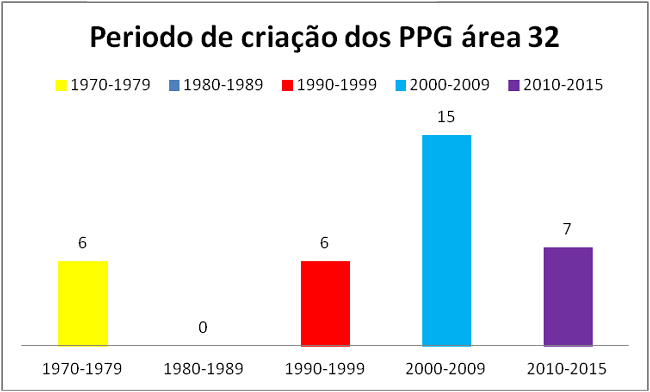
Graph 1
Period of creation of graduate studies programs in Area 32 of CAPES
Source: CAPES (2016)
Expansion has been continuous. In 2014, the number of graduate studies programs in social work rose to 33; 16 of them were PhD programs (Graph 2).
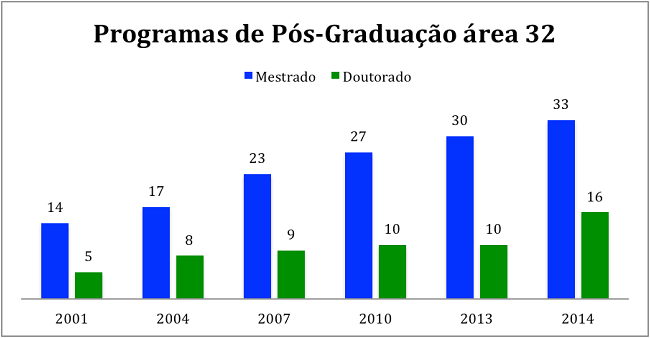
Graph 2
Evolution of graduate studies programs in social work in Brazil
Source: CAPES (2016)
In 2015, master's degrees in social work and social policy were approved in UFRGS and Unifesp. In 2016, PhDs from UFPA and UFRN were approved; that same year, a PhD creation proposal was submitted in UFAL, and the UNICSUL program ended its activities (CAPES, 2016).
The creation of 28 new programs, starting in the 1990s (Graph 1), exemplifies the widespread process of critical academic and professional renewal that has occurred in Brazilian social work in the last few decades, and breaks with its conservative and confessional frameworks of origin.
Graduates studies play an essential role in the scientific support of this renewal. In this process, social work focuses on the analysis of the social question and its most vigorous manifestations, within the framework of the relations between the State and civil society, as expressed in the daily life of different segments of the subaltern classes, in their relationships with the faction in power and the collective initiatives for obtaining, putting into effect and expanding social rights.
The results of the most recent data consolidated by CAPES, in 2013, reveals that Area 32 has: 1 program with a score of 7 (PUC-SP); 6 with a score of 6; 2 with a score of 5; 11 with a score of 4; and 13 with a score of 3. Of the 13 programs with a score of 3, only one was created in 1978. The rest are characterized as new courses: five were created between 2006 and 2010; and seven in 2011 and 2014. Of these, four will undergo the first assessment cycle in this quadrennial period.
| Grades | No. GSP NGSS | % | No. GSP SW | % |
|---|---|---|---|---|
| 3 | 1,466 | 38.5 | 13 | 39.4 |
| 4 | 1,315 | 34.6 | 11 | 33.3 |
| 5 | 610 | 16.0 | 2 | 6.1 |
| 6 | 270 | 7.1 | 6 | 18.3 |
| 7 | 145 | 3.8 | 1 | 3 |
Master's degree and PhD courses hold a privileged place in knowledge production due to the core role they play in scientific research. Knowledge production focuses on topics such as the social question and social policies in the modern world, as well as the theoretical-methodological advance of social work. It is also worth mentioning the contribution that production in social work has been making to the social sciences in general, in its selection of highly relevant current topics, such as: work, production restructuring, social protection, social security, assessment and analysis of social policies and programs, aging, third sector, volunteer work, and children and adolescents, among others. This production also illustrates the growing concern with Brazilian social problems resulting from high indices of social inequality and poverty, reinforcing the importance of contemporary social work in dealing with national, regional and local issues.
The formal employment rate for holders of master's degrees in social work was 78.3% in 2009 and 79% in 2014. For PhD graduates, the employment rate was 79% in 2014 (CGEE, 2016). Therefore, the expansion of graduate studies programs underway in the National Graduate Studies System (and in social work) has been responding to the demand created by the expansion of federal universities under the auspices of the Program for Support of Restructuring and Expansion Plans of Federal Universities (Reuni).
Despite all this expansion, the 2010 census (IBGE, 2016) showed that 7.46% of the Brazilian population had higher education; 0.32, master's degrees; and 0.12% PhDs (IBGE, 2016). Since the 1st National Graduate Studies Plan (PNPG) implemented in the 1970s until the 5th PNPG, released by MEC at the end of 2004, the goal has been the same - expansion of the system, which raises new issues, such as: quality of the education offered in graduate studies programs, scholarship coverage, limits of this expansion, and parameters used in the process to assess the system, etc. Inserted within this context, the field of social work has been called on to generate reflections on this process.
Conclusion
The expansion process of undergraduate and graduate courses in the field of social work has followed a general trend observed in the direction adopted by educational policies in the country. In other words, these are not isolated phenomena. There is a national policy and international guidelines directing the modus operandi of education in Brazil, reflected, mainly, by the commercialization of higher education and the “imperative” need to rapidly expand this education, under the auspices of a narrative of democratization of access, without, however, the proper correspondence of the necessary conditions for permanence in higher education.
On the other hand, it is necessary to expand the educational level of the population, ensuring conditions of access and permanence of students, whether in undergraduate or graduate studies. Therefore, in view of the financial cuts underway, keeping students in university is a challenge, but not the only one. Institutions of higher education are currently facing financial difficulties to maintain themselves.
It was noted, through this study, that the expansion of undergraduate programs has occurred through private institutions, with hourly-based work contracts and no commitment to research and extension. It is not possible to implement graduate studies programs in institutions with these characteristics, since this process requires hiring a teaching staff with PhDs and, such professionals are considered expensive for many IHEs. For this reason, unlike the expansion of undergraduate courses, the expansion of graduate studies programs has occurred primarily in public IHEs (around 80%), since they incorporate new PhD graduates or encourage professors to obtain degrees at this level. In 2014, for example, 41.7% of professors with PhDs were in federal public administration institutions, 22.7% in state public administration and 3.3% in municipal public administration (68% of the total professors with PhDs).
Data on the expansion of undergraduate and graduate studies programs indicates an important aspect: regional asymmetries, which are not specific, however, in the field of social work.
There is an asymmetry in graduate studies programs in social work which reflects the trend found in the National Graduate Studies System. However, it differs from almost all courses in this system because it does not have a professional master's degree (a situation only observed in the fields of social work and archeology).
At the graduate studies level, asymmetry is manifested in the trend of diversified expansion between classroom-based and distance education courses. In the Southeast region, which offers the most courses in social work, classroom-based education predominates (almost 80%), whereas in the Center- West region, more than 50% of the courses are distance education. There has been a significant increase in the distance education format for social work, which currently offers more than 30% of the courses in the area.
The graduate studies programs that received the best assessments are concentrated in the South and Southeast regions. The courses that obtained scores of 3 and 4 are relatively recent, created mainly in 2006 and after.
Undergraduate courses are evaluated every three years. The results of the most recent assessment, in 2013, indicated that, of the 222 courses evaluated, only seven (3.15%) obtained the maximum score (5.0) in the National Performance Exam (Enade). Of this total, 42.85% are courses from the North and Northeast regions, and 57.14% from the South and Southeast regions. No course in the Center-West region obtained the maximum score. Sixty-one courses (27.47%) achieved a score of 4.0. Of these, 59% were from the Southeast; 18% from the South; 18% from the North; and 4.91% from the Central-West (BRAZIL, 2014).
There were differences and similarities between the undergraduate and graduate levels. For this reason, it is necessary to constantly reflect on the reality encountered, in a way that leads to a deeper involvement and commitment to building other paths for social work, aimed at quality and genuinely transformative education.
References
BRASIL. Instituto Nacional de Estudos e Pesquisas Educacionais Anísio Teixeira (INEP). Censo da Educação Superior 2007: Resumo Técnico. Brasília, Inep. 2008. Disponível em: <http://www.inep.gov.br>. Acesso em: mar. 2016.
BRASIL. Instituto Nacional de Estudos e Pesquisas Educacionais Anísio Teixeira (INEP). Censo da Educação Superior 2013: Resumo Técnico. Brasília, Inep, 2008. Disponível em: <http://www.inep.gov.br>. Acesso em: mar. 2016.
BRASIL. Ministério da Educação. Lei de Diretrizes e Bases da Educação Nacional. 1996. Disponível em:<http://portal.mec.gov.br/arquivos/pdf/ldb.pdf>. Acesso em: mar.2016.
BRASIL. Instituto Nacional de Estudos e Pesquisas Educacionais Anísio Teixeira. Portaria nº 599, de 17 de dezembro de 2014. Diário Oficial da União, n. 245, quinta-feira, 18 de dezembro de 2014. p.22-57.
BRASIL. Ministério da Educação (MEC). Censo da Educação Superior 2013. Brasília/DF, 2014.
CAPES - COORDENAÇÃO DE APERFEIÇOAMENTO DE PESSOAL DE NÍVEL SUPERIOR. Documento de Área do Serviço Social 2016 [no prelo].
CASTRO, M.M. História do serviço social na América Latina. São Paulo: Cortez, 1989.
CENTRO DE GESTÃO E ESTUDOS ESTRATÉGICOS - CGEE. Mestres e doutores 2015: estudos da demografia de base técnico-científica brasileira. Brasília/DF: CGEEE, 2016.
CHAUÍ, Marilena. A universidade pública sob nova perspectiva. Revista Brasileira de Educação, n. 24, set./out./nov./dez. 2003.
FONSECA, Cláudia. Avaliação dos programas de pós-graduação: do ponto de vista de um nativo. Horizontes Antropológicos, Porto Alegre, ano 7, n. 16, p.261-275, dez. 2001.
FÓRUM 21 et al. Austeridade e retrocesso - finanças públicas e política fiscal no Brasil. São Paulo: Fórum, 21; Fundação Friedrich EbertStiftung (FES); GT de Macro da Sociedade Brasileira de Economia Política (SEP); e Plataforma Política Social. 2016. Disponível em: <http://brasildebate.com.br/wp-content/uploads/Austeridade-e-Retrocesso.pdf>. Acesso em: jun. 2017.
GARCIA, M. L. T. A pós-graduação em serviço social no Brasil. Brasília/DF, 2016 [no prelo].
GARCIA, M. L. T.; NOGUEIRA, V.M.R. Reflexões sobre a pós-graduação em serviço social no Brasil através do perfil dos docentes. Katálysis, Florianópolis, v. 20, n. 2, p.145-154, maio/ago. 2017. Disponível em: <file:///Users/marialuciagarcia/Downloads/47627-172052-1-PB.pdf>.
IAMAMOTO, Marilda Villela. A formação acadêmico-profissional no serviço social brasileiro. Serv. Soc. Soc., São Paulo, n. 120, p. 608-639, dez. 2014. Disponível em: <http://www.scielo.br/scielo.php?script=sci_arttext&pid=S0101-66282014000400002&lng=en&nrm=iso>. http://dx.doi.org/10.1590/0101-6628.001.
IAMAMOTO, Marilda Villela.; CARVALHO, Raul. Relações sociais e serviço social no Brasil - esboço de uma interpretação histórico-metodológica. São Paulo: Cortez/Celats, 2011.
INSTITUTO BRASILEIRO DE GEOGRAFIA E ESTATÍSTICA - IBGE. Censo 2010. Brasília/DF, 2016. Disponível em: <http://censo2010.ibge.gov.br>.
LIMA, Kátia Regina Souza. Reforma da educação superior do governo Lula e educação a distância: democratização do acesso ou subordinação das instituições de ensino superior à ordem do capital? 2ᵃ Reunião Anual da ANPED. 2004. Disponível em: <http://www.anped.org.br/biblioteca/item/reforma-da-educacao-superior-do-governo-lula-e-educacao-distancia-democratizacao-ou>. Acesso em: jul. 2016.
MARTINELLI, Maria Lúcia. Serviço social: identidade e alienação. 11.ed. São Paulo: Cortez, 1991.
NICOLATO, M.A. CAPES. Estrutura e funcionamento do sistema da avaliação da pós-graduação stricto sensu. 2000. Mimeo.
OLIVEIRA, R. P. A transformação da educação em mercadoria no Brasil. Educ. Soc., Campinas, v. 30, n. 108, p.739-760, out. 2009.
PEREIRA, L.D. Política educacional brasileira e serviço social: do confessionalismo ao empresariamento da formação profissional. Tese (Doutorado em Serviço Social) - RJ, UFRJ, 2007.
PEREIRA, L.D. Mercantilização do ensino superior, educação a distância e serviço social. Katálysis. Florianópolis, v.12, n.2, p.268-277, jul./dez.2009.
PEREIRA, L.D. A expansão dos cursos de serviço social em tempos de contrarreforma do ensino superior brasileiro: impactos na formação profissional em serviço social. Revista de Políticas Públicas, número especial, p.323-331, 2010.
PEREIRA, L.D. Expansão dos cursos de serviço social na modalidade de EAD: direito à educação ou discriminação educacional? Ser Social (UnB), v. 14, p.28-47, 2012.
PREDES, R. O serviço social no Brasil. In: FERRIZ, A.F.P.; PATRIOTA, L.M; SILVEIRA, A.S. (Org.). O curso de serviço social da UEPB: elementos para uma análise histórica e teórico-metodológica. Campina Grande, EDUEPB, 2014, p.21-42.
PRESTES, E.M. da T.;SCOCUGLIA, A.C.; JENIZE, E. Democratização do ensino superior brasileiro: o caso da Universidade Federal da Paraíba. Revista Lusófona de Educação, n. 21, p.199-218, 2012.
SANTOS, Cássio M. dos. Tradições e contradições da pós-graduação no Brasil. Educ. Soc. Campinas, v.24, n.83, p.627-641, ago.2003.
SANTOS, Ana Lúcia Felix dos; AZEVEDO, Janete Maria Lins de. A pós-graduação no Brasil, a pesquisa em educação e os estudos sobre a política educacional: os contornos da constituição de um campo acadêmico. Revista Brasileira de Educação, v. 14, n. 42, p. 534-550, set./dez. 2009. https://doi.ore/10.1590/S1413-24782009000300010.
SPOSATI, Aldaíza. Pesquisa e produção de conhecimento no campo do serviço social. Katálysis, Florianópolis, v. 10, número especial, p. 15-25, 2007. Disponível em: <http://www.scielo.br/scielo.php?script=sci_arttext&pid=S1414-49802007000300002&lng=en&nrm=iso>. http://dx.doi.org/10.1590/S1414-49802007000300002.
STUART, P. H. Social work profession: history. In: STUART, P. H. Encyclopedia of social work. Disponível em: http://socialwork.oxfordre.com/view/10.1093/acrefore/9780199975839.001.0001/acrefore-9780199975839-e-623?print=pdf
TANEGUTI, L. Y. Relatório técnico contendo estudo sobre a atual relação oferta/demanda de cursos de Graduação no Brasil, como subsídio ao Conselho Nacional de Educação para a formulação de políticas públicas que possibilitem a melhor distribuição da oferta de vagas no ensino superior de graduação. Brasília/DF, 2013. Disponível em: <http://portal.mec.gov.br/index.php?option=com_docman&view=download&alias=13948-produto-2-oferta-demanda-educ-superior-pdf-pdf&Itemid=30192>. Acesso em: set. 2016.
TRINDADE, R.L. et al. Ensino superior no Brasil e a expansão dos cursos de serviço social nos anos 2010 e 2013. O Social em Questão, ano XVIII, n. 34, p. 245-258, 2015.
YAZBEK, M.C. Fundamentos históricos e teórico-metodológicos do serviço social. In: CFESS ABEPSS - Conselho Federal de Serviço Social e Associação Brasileira de Ensino e Pesquisa em Serviço Social. Serviço social: direitos sociais e competências profissionais. Brasília: CFESS/ABEPSS, 2014.
YAZBEK, M.C. Changes in capitalism and challenges to social work: a view from Brazil. Critical and Radical Social Work, v. 2, n. 3, p. 275-285, nov. 2014. Disponível em: <www.ingentaconnect.com/content/tpp/crsw;jsessionid=acso471d009ig.alice>.
Notes