Notas
First record of Macrocheles subbadius (Berlese) (Acari: Macrochelidae) in Argentina, associated with the cactophilic fly Drosophila koepferae Fontdevila & Wasserman (Diptera: Drosophilidae)
Primer registro de Macrocheles subbadius (Berlese) (Acari: Macrochelidae) en Argentina, asociado a la mosca cactófila Drosophila koepferae Fontdevila & Wasserman (Diptera: Drosophilidae)
First record of Macrocheles subbadius (Berlese) (Acari: Macrochelidae) in Argentina, associated with the cactophilic fly Drosophila koepferae Fontdevila & Wasserman (Diptera: Drosophilidae)
Revista de la Sociedad Entomológica Argentina, vol. 79, no. 4, pp. 47-50, 2020
Sociedad Entomológica Argentina
Received: 16 July 2020
Accepted: 24 September 2020
Published: 28 December 2020
Abstract: The mite Macrocheles subbadius (Berlese) (Acari: Macrochelidae) is recorded by the first time in Argentina, associated to the cactophilic fly Drosophila koepferae Fontdevila & Wasserman (Diptera: Drosophilidae) from San Agustín de Valle Fértil, province of San Juan.
Keywords: Mesostigmata, Mite, Phoresy, Valle Fértil.
Resumen: Se registra al ácaro Macrocheles subbadius (Berlese) (Acari: Macrochelidae) por primera vez en Argentina, asociado a la mosca cactófila Drosophila koepferae Fontdevila & Wasserman (Diptera: Drosophilidae), en la localidad de San Agustín de Valle Fértil, provincia de San Juan.
Palabras clave: Ácaro, Foresia, Mesostigmata, Valle Fértil.
The family Macrochelidae Vitzthum (Mesostigmata) includes nearly 500 species in 23 genera (Gerson et al., 2003; Emberson, 2010; Beaulieu et al., 2011; Azevedo et al., 2015) of which Macrocheles Latreille is the most diverse with around 325 described species (Emberson, 2010; Azevedo et al., 2015; Kamaruzaman et al., 2018). Most Macrocheles species are predators feeding on small invertebrates, influencing their population growth and, thereby, may have effects on the advancement and composition of ephemeral micro-ecosystems (Geden et al., 1988; Perotti, 1999, 2001; Kamaruzaman et al., 2018). Because of their occurrence in patchy habitats, phoresy of macrochelids over other organisms is a very common processs (Krantz, 1998) that has evolved, in some species, in true parasitism (Krantz, 1967; Azevedo et al., 2015). Some macrochelid species have been proposed as agents for biological control (Gerson et al., 2003; Azevedo et al., 2015) and have importance in forensic acarology (Perotti & Braig, 2009; Perotti et al., 2010; Kamaruzaman et al., 2018).
San Agustín de Valle Fértil (30° 38’ S, 67° 27’ W), in San Juan, Argentina, is a small village settled in the margin of Valle Fértil river. It is located in the vicinity of the Multipurpose Reserve of Valle Fértil; an 8,000 km2 area declared as Natural Park in 1971 to protect a large segment of xeric environments, typical of the Monte phytogeographic province, exclusive of Argentina (Arana et al., 2017). Valle Fértil’s conditions are exceptional due to the moisture gradient present, making it an exciting environment to discover locally restricted floral and faunal endemism. The environment (Fig. 1A) consists of a xeric steppe with characteristic flora, including some Cactaceae: Echinopsis terscheckii (Parm.) Friedrich & G.D. Rowley; Opuntia sulphurea Gillies ex Salm-Dyck and, in lower abundance, Cereus aethiops Haw., and Echinopsis strigosus (Salm-Dyck) Britton & Rose. Two species of sympatric cactophilic Drosophila Fallén have been collected in this locality: Drosophila koepferae Fontdevila & Wasserman and Drosophila buzzatii Patterson & Wheeler. While D. buzzatii prefers and breeds primarily on the decaying cladodes of several species of the genus Opuntia and secondarily on columnar cacti of the genera Cereus and Echinopsis the reverse is true for D. koepferae (Hasson et al., 1992; Soto et al., 2012). Intensive research was previously performed in this locality, using these flies as models for testing an ecological and evolutionary hypothesis (Soto, 2012; Soto et al., 2012, 2018; Stefanini et al., 2018). In the course of an ongoing study of the arthropod fauna associated with these cactophilicflies, several mites were collected doing phoresis.
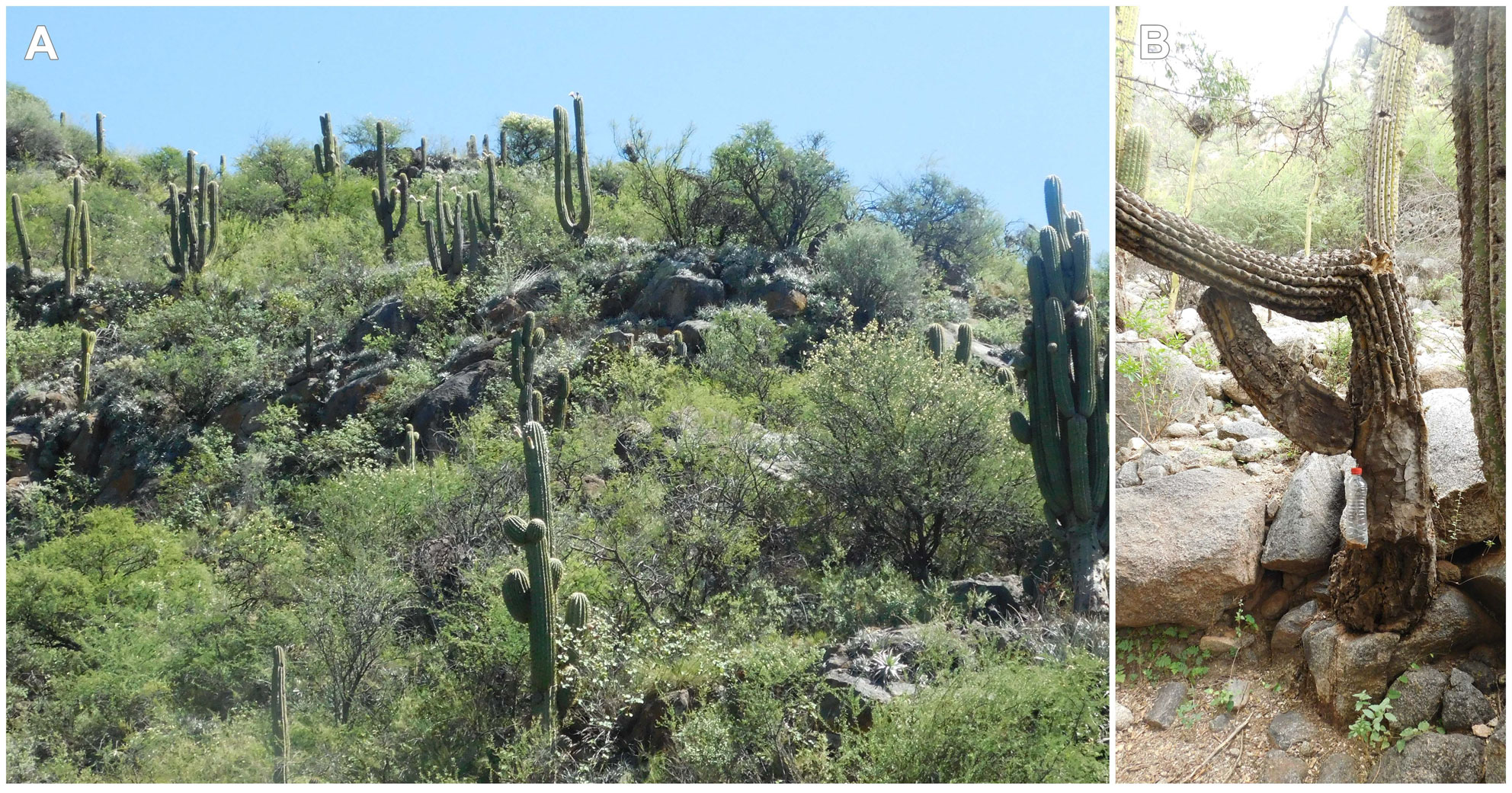
Fig. 1. Collecting environment in San Agustín de Valle Fértil, San Juan, Argentina. A. columnar cacti belonging to the species Echinopsis terscheckii. B. Banana bait pending on an E. terscheckii.
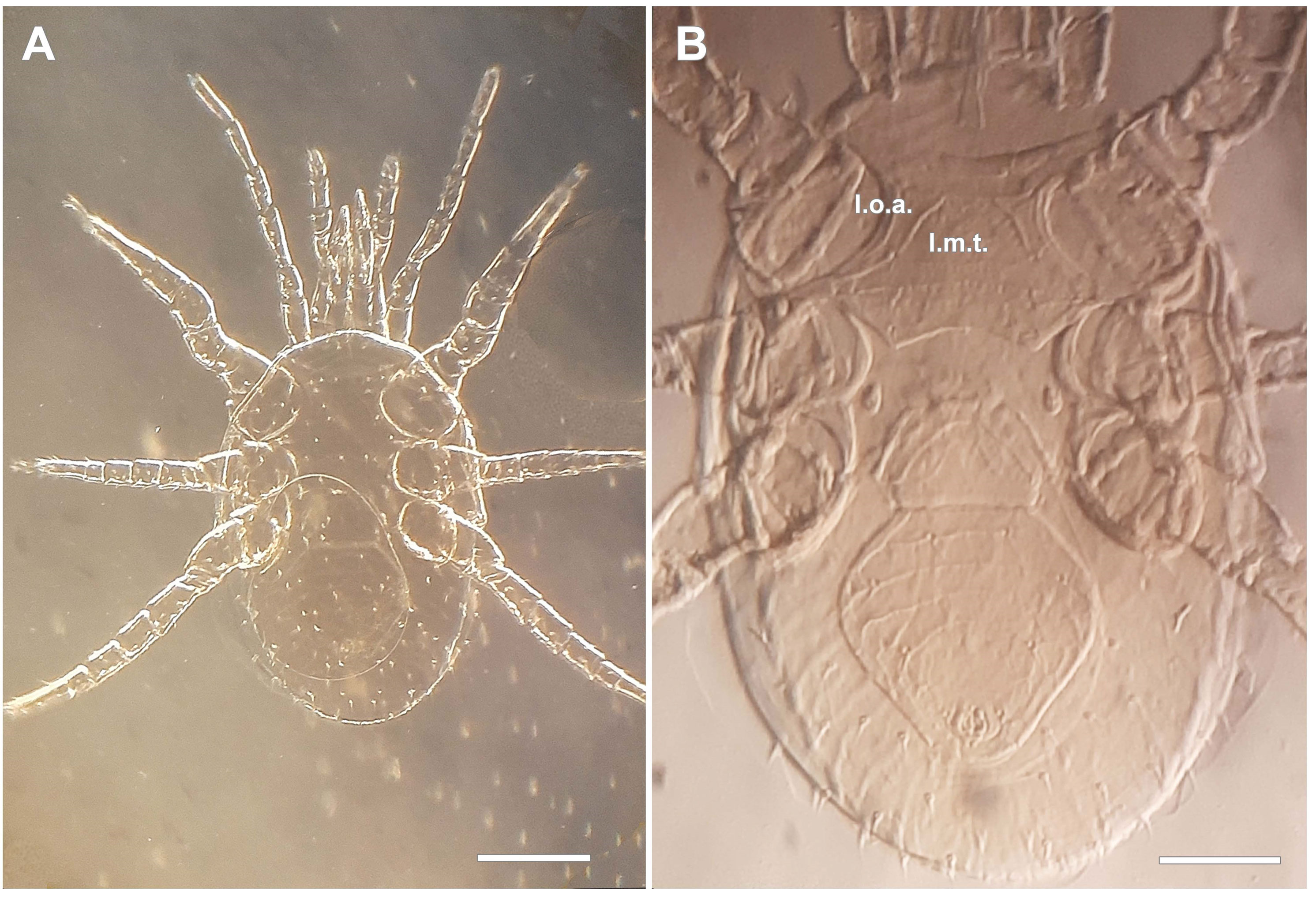
Fig. 2. Macrocheles subbadius (Berlese), female (MACN-Ar 41784). A. dorsal view, dark field. B. ventral idiosomal view, phase contrast.
Scale bars. A = 200 µm; B = 100 µm.
Flies were collected by net sweeping over fermented banana baits (Markow & O’Grady, 2006, Soto et al., 2014) (Fig. 1B) and preserved in 96% ethanol. Associated mites were separated under a stereomicroscope, slide-mounted on Hoyer’s medium, and identified using an M11 Wild microscope with phase contrast. Vouchers are deposited in the Arachnological Collection of the Museo Argentino de Ciencias Naturales, “Bernardino Rivadavia” (MACN-Ar).
Between several mite taxa belonging to the orders Trombidiformes, Sarcoptiformes, and Mesostigmata, three females (MACN-Ar 41784 to 41786) of Macrocheles subbadius (Berlese) (Mesostigmata: Macrochelidae) were identified. This species belongs to the M. subbadius group proposed by Filipponi & Pegazzano (1963), based on the characteristic ornamentation of the sternal shield of the females (i.e., an arch-shaped linea obliqua anterior -l.o.a.- connected by a series of more or less parallel punctate lines). Walter (1988) divided this group into two species complexes based on the size of the punctuations on the sternal shield: the subbadius complex, with coarse punctae (Fig. 2B), and the merdarius complex, in which the punctae are fine to obsolete. Into the subbadius complex of species, M. subbadius is characterized by having the Genu IV with seven setae, the sternal shield with the linea media transversa (l.m.t.) straight between st2; with l.o.a. joined by four or five transverse lines, the most posterior of which is the l.m.t (Fig. 2B); the dorsal setae of normal length and aciculate (Fig. 2A), the seta j1 short and in the male, the presence of a distal spur on tarsus II, a sclerotized band around the genital opening, and three pairs of protuberances on the dorsal shield (Walter, 1988; Azevedo et al., 2017).
Macrocheles subbadius is associated with dung and dung-inhabiting insects and was recorded from various countries in Europe, Asia, Oceania, and America; in the latter, it was recorded in the USA, Mexico, and Brazil (Azevedo et al., 2017). This new record constitutes the first record of this species in Argentina. This mite was also found carried by many other fly species belonging to the genera Musca L., Meroplius Rondani, Drosophila, Odontoloxozus Enderlein, Phaenicia Robineau-Desvoidy, and Haematobia Le Peletier & Serville (Niogret et al., 2006). The macrochelids have been mentioned as potential biological control agents of organisms, including different cattle pest fly species (Krantz, 1983; Azevedo et al., 2015). The presence of this species in natural environments in Argentina constitutes a valuable addition to the potential agent’s species for biological control programs in the region.
ACKNOWLEDGMENTS
We wish to acknowledge the logistic support of the Environmental Agency of San Juan province (Secretary of Environment and Sustainable Development, SAyDS) for fieldwork and the technical assistance provided by the Guards staff in the Reserve. This work was supported by a grant from the Research Committee of the British Cactus and Succulent Society and local funding from ANPCyT (PICT 2017-0220) and University of Buenos Aires grants (UBACyT 2018) granted to IMS. Finally, we are grateful to three anonymous reviewers and Dr. Matias D. Maggi (UNMDP), whose suggestions greatly improved the paper.
REFERENCES
Arana, M., Martínez, G., Oggero, A., Natale, E., & Morrone, J. (2017) Map and shapefile of the biogeographic provinces of Argentina. Zootaxa, 4341, 420-422.
Azevedo, L.H., Emberson, R.M., Esteca, F.C.N., & Moraes, G.J. (2015) Macrochelid mites (Mesostigmata: Macrochelidae) as biological control agents. Prospects for biological control of plant feeding mites and other harmful organisms (ed. Carrilo, D., Moraes, G.J., & Peña, J.), pp. 103-132. Springer International Publishing, Cham.
Azevedo, L.H., Castilho, R.C., Berto, M.M., & Moraes, G.J. (2017) Macrochelid mites (Mesostigmata: Macrochelidae) from São Paulo state, Brazil, with description of a new species of Macrocheles. Zootaxa, 4269, 413-426.
Beaulieu, F., Dowling, A.P.G., Klompen, H., Moraes, G.J., & Walter, D.E. (2011) Superorder Parasitiformes Reuter, 1909. Zootaxa, 3148, 123-128.
Emberson, R.M. (2010) A reappraisal of some basal lineages of the family Macrochelidae, with the description of a new genus (Acarina: Mesostigmata). Zootaxa, 2501, 37-53.
Filipponi, A., & Pegazzano, F. (1963) Specie italiane del gruppo-subbadius (Acarina, Mesostigmata, Macrochelidae). Redia, 48, 69-91.
Geden, C.J., Stinner, R.E., & Axtell, R.C. (1988) Predation by predators of the house-fly in poultry manure: effects of predator density, feeding history, interspecific interference, and field conditions. Environmental Entomology, 17, 320-329.
Gerson, U., Smiley, R.L., & Ochoa, R. (2003) Mites (Acari) for Pest Control. Blackwell Science Ltd, London.
Hasson, E., Naveira, H., & Fontdevila, A. (1992) The breeding sites of the Argentinian species of the Drosophila mulleri complex (subgenus Drosophila repleta group). Revista Chilena de Historia Natural, 65, 319-326.
Kamaruzaman, N.A., Mašán, P., Velásquez, Y., González-Medina, A., Lindström, A., Braig, H.R., & Perotti, M.A. (2018) Macrocheles species (Acari: Macrochelidae) associated with human corpses in Europe. Experimental and Applied Acarology, 76, 453-471.
Krantz, G.W. (1967) A review of the genus Holocelaeno Berlese, 1910 (Acarina: Macrochelidae). Acarologia Supplement, 9, 1-89.
Krantz, G.W. (1983) Mites as biological control agents of dung-breeding flies, with special reference to the Macrochelidae. Biological control of pests by mites (ed. Hoy, M.A., Cunningham, G.L., & Knutson, L.), pp.91-98. University of California, Berkeley, Special publication.
Krantz, G.W. (1998) Reflections on the biology, morphology and ecology of the Macrochelidae. Ecology and Evolution of the Acari. Series Entomologica, vol. 55 (ed. Bruin, J., van der Geest, L.P.S., & Sabelis, M.W.), pp. 291-301. Springer, Dordrecht.
Markow, T., & O’Grady, P. (2006) Drosophila. A guide to species identification and use. Academic Press, San Diego.
Niogret, J., Lumaret, J.P., & Bertrand, M. (2006) Review of the phoretic association between coprophilous insects and macrochelid mites (Acari: Mesostigmata) in France. Elytron,20, 99-121.
Perotti, M.A. (1999) Localization of distant preys by Glyptholaspis confusa Foa (Acari: Macrochelidae). Revista de la Sociedad Entomológica Argentina, 58, 106-108.
Perotti, M.A. (2001) Prey location and predation rates of predatory mites (Acari: Macrochelidae) on immature stages of pest flies (Diptera: Muscidae). Systematic and Applied Acarology, 6, 27-34.
Perotti, M.A., & Braig, H.R. (2009) Phoretic mites associated with animal and human decomposition. Experimental and Applied Acarology, 49, 85-124.
Perotti, M.A., Braig, H.R., & Goff, M.L. (2010) Phoretic mites and carcasses. Current concepts in forensic entomology: novel arthropods, environments and geographical regions (ed. Amendt, J., Campobasso, C.P., Grassberger, M., & Goff, M.L.), pp. 69-91. Springer, Dordrecht.
Soto, I.M. (2012) Aedeagal divergence in sympatric populations of two sibling species of cactophilic Drosophila (Diptera, Drosophilidae): Evidence of character displacement? Neotropical Entomology,41, 207-213.
Soto, E.M., Goenaga, J., Hurtado, J.P., & Hasson, E. (2012) Oviposition and performance in natural hosts in cactophilic Drosophila. Evolutionary Ecology,26, 975-990.
Soto, I.M., Carreira, V.P., Corio, C., Padró, J., Soto, E.M., & Hasson, E. (2014) Differences in Tolerance to Host Cactus Alkaloids in Drosophila koepferae and D. buzzatii. PLoS ONE, 9, e88370.
Soto, E.M., Padró, J., Milla Carmona, P., Tuero, D.T., Carreira, V.P., & Soto, I.M. (2018) Pupal emergence pattern in cactophilic Drosophila and the effect of host plants. Insect Science, 25, 1108-1118.
Stefaninni, M.I., Milla Carmona, P., Iglesias, P., Soto, E.M., & Soto, I.M. (2018) Differential rates of genital evolution in sibling Drosophila species. Evolutionary Biology, 45, 211-222.
Walter, D.E. (1988) Macrocheles schaeferi (Acari: Mesostigmata: Macrochelidae), a new species in the subbadius group from grassland soils in the Central United States. Annals of the Entomological Society of America, 81, 386-394.
Author notes
hugporta@yahoo.com.ar