Notas
First record of Heteropsylla tenuata from Argentina (Hemiptera: Psyllidae), and additional notes on other psyllid species
Primer registro de Heteropsylla tenuata en Argentina (Hemiptera: Psyllidae), y notas adicionales de otras especies de psílidos
First record of Heteropsylla tenuata from Argentina (Hemiptera: Psyllidae), and additional notes on other psyllid species
Revista de la Sociedad Entomológica Argentina, vol. 80, núm. 4, 2021
Sociedad Entomológica Argentina
Recepción: 16 Junio 2021
Aprobación: 24 Septiembre 2021
Publicación: 30 Diciembre 2021
Abstract: The Psyllidae family is the most diverse within Psylloidea, with more than 1,300 species worldwide. Some psyllid species are important pests mainly of fruit trees, forest and ornamental plants. Despite being an economically relevant group, there are few studies on its biology, geographic distribution, natural enemies or host plant associations for many Argentinean psyllid species. This work records one species from Argentina for the first time, extends the distribution of another two psyllid species and provides information on host plants.
Keywords: Fabaceae, Pests, Platycorypha, Psylloidea.
Resumen: La familia Psyllidae es la más diversa dentro de Psylloidea, con más de 1.300 especies de distribución cosmopolita. Muchas especies de psílidos son importantes plagas, principalmente de arboles frutales, forestales y plantas ornamentales. A pesar de ser un grupo económicamente relevante, existen pocos estudios sobre su biología, distribución geográfica, enemigos naturales o asociaciones de plantas huésped para muchas especies de psílidos argentinos. En este trabajo registramos por primera vez una especie en Argentina, ampliamos la distribución de otras dos especies de psílidos, y brindamos información sobre plantas huésped.
Palabras clave: Fabaceae, Plagas, Platycorypha, Psylloidea.
Jumping plant-lice or psyllids (Psylloidea) are hemipterous phloem feeders and generally host specific. Psylloidea includes approximately 4,000 described species worldwide and at least as many undescribed species (Burckhardt & Queiroz, 2020; Burckhardt et al., 2021). The family Psyllidae is the most diverse within Psylloidea, with more than 1,300 species worldwide, many of which develop on Fabaceae (Burckhardt, 2008; Serbina & Burckhardt, 2017; Ouvrard, 2021). At present, 17 genera and 56 species of this family are recorded from Argentina (Baliotte et al., 2021).
Psyllids can be major or sporadic pests in subtropical and temperate regions, mainly of fruit trees, forest and ornamental plants (Burckhardt, 1994). In Argentina, many species are occasional pests on ornamental plants, such as Platycorypha erythrinae (Lizer) associated with “ceibo” Erythrina cristagalli L. (Burckhardt, 2008). About 40 Old World species of Cacopsylla are associated with pear trees, many considered pests, such as Cacopsylla bidens (Ŝulc), which was introduced in South America (Valle et al., 2017). Diaphorina citri Kuwayama is the vector of bacteria Candidatus Liberibacter spp. which cause the Huanglongbing disease (HLB) considered to be the most destructive citrus disease in the world (SINAVIMO, 2021).
Despite being a relevant group for agriculture and forestry (Queiroz et al., 2017), there are few studies on biology, geographic distribution, natural enemies or host plant associations for many Argentinean psyllid species. According to Burckhardt (2008), the knowledge on psyllids is fragmentary in Argentina. This work records one species from Argentina for the first time, extends the distribution of another two psyllid species and provides additional information on host plants.
The studied material was collected from the province of Entre Ríos, Argentina. Specimens were collected by using an insect aspirator and were preserved in 70% ethanol. Once in the laboratory, part of the material was critical point dried and point mounted. Some specimens, or parts, such as forewings, head and terminalia were slide-mounted following Queiroz et al. (2017) and labelled for taxonomic study. Specimens were identified following the keys and descriptions by Burckhardt (1987), Muddiman et al. (1992), Hodkinson & Muddiman (1993), Santana et al. (2006), Burckhardt (2008), Rung et al. (2009) and Queiroz et al. (2010). Images were taken with a Leica DFC 295 camera attached to a Leica S8APO stereoscopic microscope and to a Biotraza XSZ146AT microscope. All examined specimens were deposited in the collection of the División Entomología of the Museo de La Plata, Buenos Aires, Argentina. The plant names and distributions follow the Catálogo de plantas vasculares (IBODA, 2021).
Subfamily Ciriacreminae
Heteropsylla tenuata Muddiman, Hodkinson & Hollis (Fig. 1)
Distribution. Brazil (Muddiman et al., 1992). Argentina (First record): Entre Ríos.
Material examined. Argentina: Entre Ríos, Concordia, 10-IV-2019, J.P. Bouvet & D.A. Aquino cols., on Enterolobium contortisiliquum (Vell.) Morong; 6♂, 7♀, 5 immatures.
Host plant. Enterolobium contortisiliquum (Vell.) Morong (Fabaceae) (Muddiman et al., 1992).
Remarks. Heteropsylla tenuata can be distinguished from other species of the genus by the genae produced into moderately long processes; forewings not maculated, with pterostigma petiolate; male proctiger cylindrical and expanded basally; parameres bifid with the inner lobe long tapering towards apex and the outer lobe long and narrow; female proctiger with dorsomedial bulge and setae not arranged in transverse row (Muddiman et al., 1992). The host-plant record E. contortisiliquum is dubious according to Muddiman et al. (1992); however, specimens were found in this plant species confirming the record of the host plant.
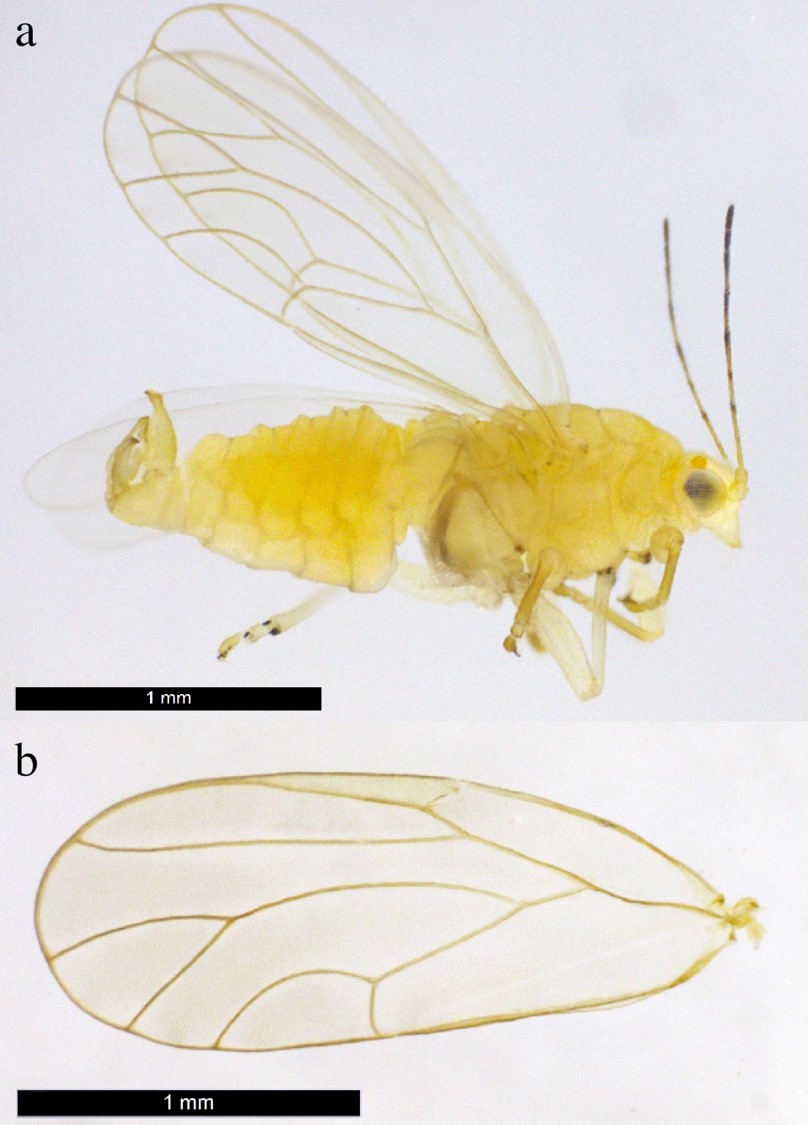
Fig. 1. Heteropsylla tenuata. a. lateral view of the male. b. forewing.
Additional notes on two species of the Subfamily Platycoryphinae
Platycorypha erythrinae (Lizer)
Distribution. Costa Rica, Panama, Peru, Brazil, Paraguay, Uruguay and Argentina (Ouvrard, 2021): Buenos Aires (Baliotte et al., 2021) and Entre Ríos (new record).
Material examined. Argentina: Entre Ríos, Concordia, 23-V-2008, J.P. Bouvet col., on Erythrina cristagalli L.; 1♂, 1♀, 7 immatures.
Host plant. Erythrina cristagalli L. (Fabaceae) (Ouvrard, 2021)
Remarks. According to Burckhardt (1987) and Queiroz et al. (2010), this species is easily recognized by the features in forewings and male terminalia, among others.
Platycorypha nigrivirga Burckhardt
Distribution. Bolivia, Brazil, Uruguay and Argentina (Ouvrard, 2021): Buenos Aires, Chaco, Mendoza, Salta, Tucumán (Baliotte et al., 2021) and Entre Ríos (new record). Introduced species in Spain, Portugal, South Africa, and USA (Ouvrard, 2021; Burckhardt, pers. comm.).
Material examined. Argentina: Entre Ríos, Concordia, 11-IV-2019, J.P. Bouvet & D.A. Aquino cols., on Tipuana tipu (Benth.) Kuntze; 2♂, 2♀, 7 immatures.
Host plant. Tipuana tipu (Benth.) Kuntze. (Fabaceae) (Ouvrard, 2021)
Remarks. Adults of this species have a dark transverse stripe on the head which is a diagnostic character for their identification (Rung et al., 2009). Platycorypha nigrivirga produces depigmentation and premature leaf death on T. tipu, causing serious damage to the plant. Immatures and adults produce sugar drops or honeydew in large amounts, hindering photosynthesis and respiration of the plants. At high population levels, the species can become a nuisance by soiling sidewalks, streets and cars with honeydew (Santana et al., 2006; Rung et al., 2009; SINAVIMO, 2021).
Among the economically important hemipterans in Argentina, psyllids gain relevance because many of their species behave as pests of fruit, forest and ornamental plants, and knowledge of the Argentinean species is fragmentary and scarce (Burckhardt, 2008; SINAVIMO, 2021). The three species studied in this work were collected from host plants belonging to the group of legumes or Fabaceae, which are affected to a greater or lesser extent. The economic and social importance of legumes lies in that they are used as food, forage, forestry, medicine and, ornaments, among other uses (Cantero et al., 2019). Therefore, it is necessary to carry out more exhaustive studies of these and other species of psyllids, in order to know the diversity of species present in Argentina, the host plants that they can affect, their biology, and natural enemies.
Currently, with the results of this work, 17 genera and 57 species of the family Psyllidae are recorded from Argentina.
REFERENCES
Baliotte, C., Dellapé, G., Bouvet, J.P.R., & Aquino, D.A. (2021) Psylloidea (Hemiptera: Sternorrhyncha) species from Argentina and Uruguay [June 2021] Available at: https://biodar.unlp.edu.ar/psylloidea/
Burckhardt, D. (1987) Jumping plant lice (Homoptera: Psylloidea) of the temperate neotropical region. Part 2: Psyllidae (subfamilies Diaphorininae, Acizziinae, Ciriacreminae and Psyllinae). Zoological Journal of the Linnean Society, 90, 145-205.
Burckhardt, D. (1994) Psylloid pests of temperate and subtropical crop and ornamental plants (Hemiptera, Psylloidea): a review. Trends in Agricultural Sciences, Entomology, 2, 173-186.
Burckhardt, D. (2008) Psylloidea. Biodiversidad de Artrópodos Argentinos. Vol. 2 (ed. Claps, L.E., Debandi, G., & Roig-Juñent, S.), pp. 189-200. Sociedad Entomológica Argentina.
Burckhardt, D., & Queiroz, D.L. (2020) Neotropical jumping plant-lice (Hemiptera, Psylloidea) associated with plants of the tribe Detarieae (Leguminosae, Detarioideae). Zootaxa, 4733, 1-73.
Burckhardt, D., Ouvrard, D., & Percy, D.M. (2021) An updated classification of the jumping plant-lice (Hemiptera: Psylloidea) integrating molecular and morphological evidence. European Journal of Taxonomy, 736, 137-182.
Cantero, J.J., Núñez, C.O., Bernardello, G., Amuchástegui, A., Mulko, J., Brandolin, P., Palchetti, M.V., Iparraguirre, J., Virginil, N., & Ariza Espinar, L. (2019) Las plantas de importancia económica en Argentina. UniRío, Río Cuarto, Argentina.
Hodkinson, I.D., & Muddiman, S.B. (1993) A new species of Heteropsylla Crawford from Ecuador with new host-plant and distribution records for the genus (Homoptera, Psylloidea). Beiträge zur Entomologie, 43, 441-443.
IBODA (2021) Catálogo de las Plantas Vasculares. Instituto de Botánica “Darwinion”, Buenos Aires, Argentina [June 2021] Available at: http://www.darwin.edu.ar/
Muddiman, S.B., Hodkinson, I.D., & Hollis, D. (1992) Legume-feeding psyllids of the genus Heteropsylla (Homoptera: Psylloidea). Bulletin of Entomological Research, 82, 73-117.
Ouvrard, D. (2021) Psyl'list - The World Psylloidea Database [June 2021] Available at: http://www.hemiptera-databases.com/psyllist. doi:10.5519/0029634
Queiroz, D.L., Burckhardt, D., Rezende, M.Q., de Queiroz, E.C., Fernández, J.I.R., & De Andrade, D.P. (2010) Notes on the jumping plant-louse Platycorypha erythrinae (Hemiptera: Psylloidea) in Brazil. Mitteilungen der Schweizerischen Entomologischen Gesellschaft, 83, 241-248.
Queiroz, D.L., Burckhardt, D., & Garrastazu, M.C. (2017) Protocolo de coleta e montagem de psilídeos. Embrapa Florestas-Comunicado Técnico 393.
Rung, A., Arakelian, G., Gill, R., & Nisson, N. (2009) Platycorypha nigrivirga Burckhardt (Hemiptera: Sternorrhyncha: Psylloidea), tipu psyllid, new to North America. Insecta Mundi, 97, 1-5.
Santana, D.L., Burckhardt, D., & Aguiar, A.M. (2006) Primeiro Registro de Platycorypha nigrivirga Burckhardt (Hemiptera: Psylloidea), em Tipuana tipu (Benth.), no Brasil. Neotropical Entomology, 35, 861-863.
Serbina, L., & Burckhardt, D. (2017) Systematics, biogeography and host-plant relationships of the Neotropical jumping plant-louse genus Russelliana (Hemiptera: Psylloidea). Zootaxa,4266, 1-114.
SINAVIMO (2021) Sistema Nacional de Vigilancia y Monitoreo de plagas. Argentina [June 2021] Available at: https://www.sinavimo.gob.ar/
Valle, D., Burckhardt, D., Mujca, V., Zoppolo, R., & Morelli, E. (2017) The occurrence of the Pear Psyllid, Cacopsylla bidens (Šulc, 1907) (Insecta: Hemiptera: Psyllidae), in Uruguay. Check List,13, 1-4.
Notas de autor
cbaliotte@fcnym.unlp.edu.ar