New records and distributional data of Sarcophaginae (Diptera: Sarcophagidae) from Colombia
Nuevos registros y datos de distribución de Sarcophaginae (Diptera: Sarcophagidae) de Colombia
New records and distributional data of Sarcophaginae (Diptera: Sarcophagidae) from Colombia
Revista de la Sociedad Entomológica Argentina, vol. 81, núm. 2, 2022
Sociedad Entomológica Argentina
Recepción: 29 Septiembre 2021
Aprobación: 15 Marzo 2022
Abstract: Sarcophagidae is one of the largest families of Oestroidea. The family is classified into three subfamilies, Miltogramminae, Paramacronychiinae, and Sarcophaginae. The number of species of Sarcophaginae occurring in Colombia, as well as their geographical distributions, are still poorly documented. Here, six species are recorded for the first time in the country: Argoravinia catiae Carvalho Filho & Esposito, Oxysarcodexia adunca Lopes, Oxysarcodexia carvalhoi Lopes, Oxysarcodexia eberti Lopes & Tibana, Peckia .Euboettcheria. epimelia (Lopes), and Peckia .Sarcodexia. chirotheca (Hall). The occurrence of 16 species previously registered in Colombia is expanded to the Departments of Amazonas, Antioquia, Chocó, Magdalena, and Meta. As a result, the number of known Sarcophaginae species for Colombia is updated to 109.
Keywords: Calyptrate, Flesh flies, Geographic distribution, Neotropics, Sarcophagids.
Resumen: Sarcophagidae es una de las familias más grandes de Oestroidea. La familia se clasifica en tres subfamilias, Miltogramminae, Paramacronychiinae, y Sarcophaginae. El número de especies de Sarcophaginae reportadas para Colombia, así como su distribución geográfica, aún están pobremente documentadas. Aquí se registran seis especies por primera vez para el país: Argoravinia catiae Carvalho Filho & Esposito, Oxysarcodexia adunca Lopes, Oxysarcodexia carvalhoi Lopes, Oxysarcodexia eberti Lopes & Tibana, Peckia .Euboettcheria. epimelia (Lopes), and Peckia .Sarcodexia. chirotheca (Hall). Se amplía la ocurrencia de 16 especies previamente registradas en Colombia para los Departamentos de Amazonas, Antioquia, Chocó, Magdalena y Meta. Como resultado, el número de especies conocidas de Sarcophaginae para Colombia se actualiza a 109.
Palabras clave: Calyptratae, Distribución geográfica, Moscas de la carne, Neotrópico, Sarcofágidos.
Sarcophagidae is a worldwide distributed flesh-fly family that encompasses about 3000 named species (Pape et al., 2011), being the second most species-rich family within the superfamily Oestroidea, and is usually classified into three subfamilies: Miltogramminae, Paramacronychiinae, and Sarcophaginae (Pape, 1996; Pape et al., 2011). The latter subfamily, with about 2300 species in 46 genera (Buenaventura & Pape, 2018), has its highest richness in the Neotropical Region and is generally more diverse in life habits and morphology of the male terminalia than the other two subfamilies (Buenaventura et al., 2018).
The study of the sarcophagid fauna in Colombia has been focused on flies collected near the main cities attracted with carrion (Wolff et al., 2001; Pérez et al., 2005; Martinez et al., 2007; Buenaventura et al., 2009; Barrios & Wolff, 2011; Ramírez-Mora et al., 2012; Amat et al., 2013; Yepes-Gaurisas et al., 2013; Ramos-Pastrana et al., 2014; Valverde Castro et al., 2017). To date, there are 109 recorded Sarcophagidae species for Colombia (Pape, 1996; Pape et al., 2004; Ramírez-Mora et al., 2012; Buenaventura & Pape, 2013; Yepes-Gaurisas et al., 2013; Mello-Patiu, 2016; Souza & Buenaventura, 2016; Valverde-Castro et al., 2017, Souza et al., 2020), of which 103 belong to the subfamily Sarcophaginae. In this study, we aimed to contribute to the knowledge of the Sarcophaginae species recorded for the first time in localities from Colombia and to extend the geographical distribution of previously known species.
A total of 485 male specimens were examined from 31 localities (Fig. 1), collection data are summarized in Table I.
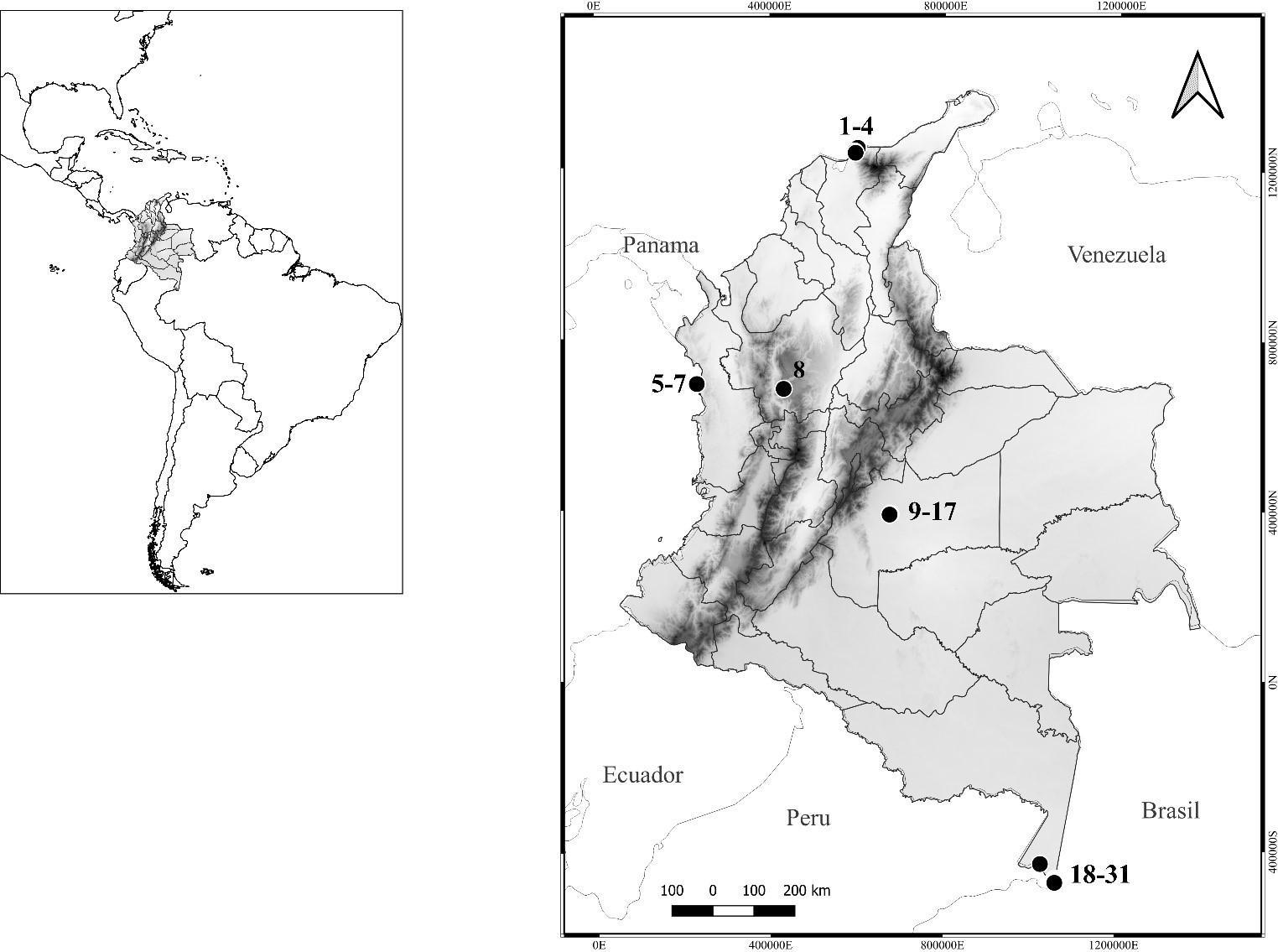
Fig. 1.
Map with collection localities in Colombia. The numbers correspond to those in the column “Site number” in Table I.
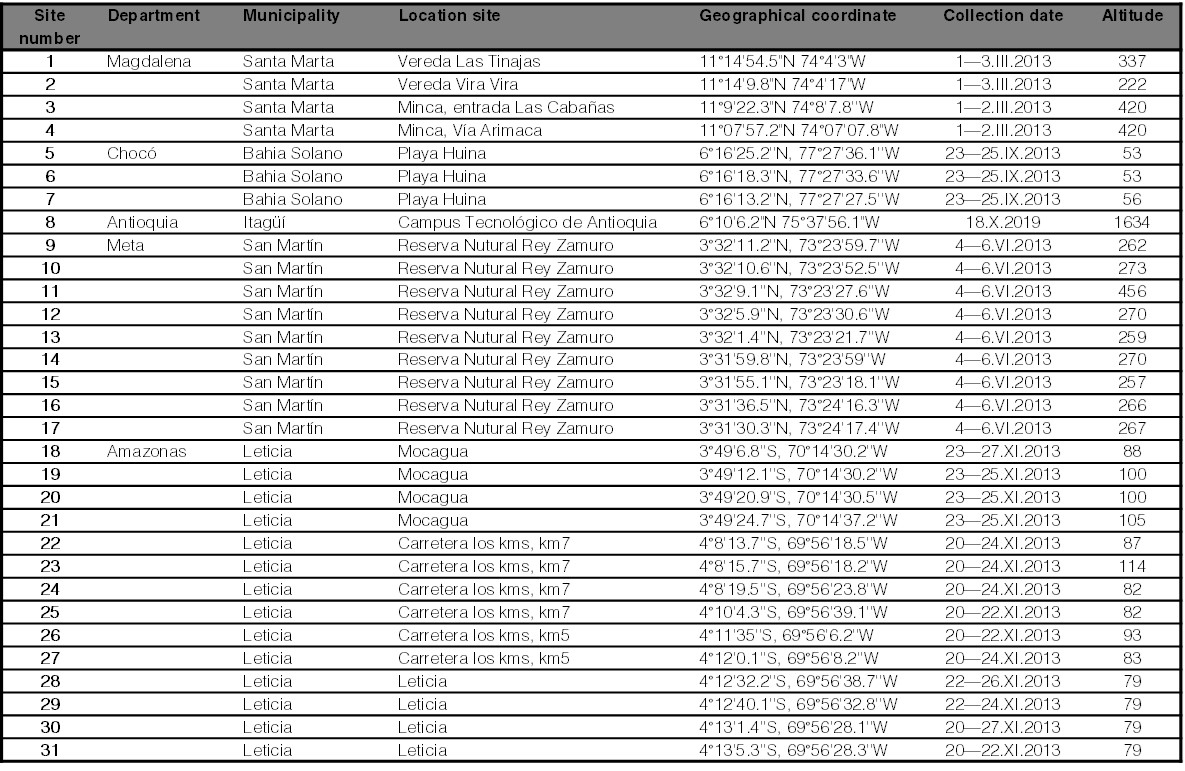
Table I.
Collection localities in Colombia.
The material is deposited at the Colección Entomológica Tecnológico de Antioquia (CETdeA, number 204 in the Colombian National Record). Specimens were attracted using Van Someren Rydon traps baited with decomposing fish and chicken, traps were left in the field between 12-24 hrs. Male specimens were examined and identified using the reference collection previously identified by Dr. Eliana Buenaventura hosted at CETdeA, and the following taxonomic keys, descriptions, and redescriptions: Guimarães (2004), Pape & Mello-Patiu (2006), Carvalho & Mello-Patiu (2008), Vairo et al. (2011), Carvalho Filho & Esposito (2012), Buenaventura & Pape (2013), Vairo et al. (2014), Souza et al. (2020). Previous distributional records at country level for the Neotropical Region were obtained from Pape et al. (2004), Ramírez-Mora et al. (2012), Mello-Patiu (2016), Valverde-Castro et al. (2017), Dufek et al. (2020), and the references used for the taxonomic identification.
As a result, 22 species of Sarcophaginae were identified, six of which are recorded for the first time for Colombia: Argoravinia catiae Carvalho Filho & Esposito, 2012, Oxysarcodexia adunca Lopes, 1975, Oxysarcodexia carvalhoi Lopes, 1946, Oxysarcodexia eberti Lopes & Tibana, 1987, Peckia .Euboettcheria. epimelia (Lopes, 1938), and Peckia (Sarcodexia) chirotheca (Hall, 1933). The distribution of 16 species already known from Colombia is also updated, with new records for the departments of Amazonas, Antioquia, Chocó, Magdalena, and Meta (Table II).
Subfamily Sarcophaginae
Argoravinia catiae Carvalho Filho & Esposito, 2012
Material examined: 4 males, sites 11, 12 (Table I).
Distribution. Neotropical: Brazil, Colombia (Table II).
Engelimyia inops Walker, 1849
Material examined: 2 males, site 17 (Table I).
Distribution. Neotropical: Bolivia, Brazil, Colombia (Table II), Ecuador, Guyana, Peru, Trinidad & Tobago.
Oxysarcodexia adunca Lopes, 1975
Material examined: 4 males, site 18 (Table I).
Distribution. Neotropical: Brazil, Colombia (Table II), Ecuador.
Oxysarcodexia amorosa (Schiner, 1868)
Material examined: 45 males, sites 18, 20, 22-24, 27-31 (Table I).
Distribution. Neotropical: Brazil, Colombia (Table II), Costa Rica, Ecuador, Guyana, Mexico, Panama, Peru.
Oxysarcodexia angrensis Lopes, 1933
Material examined: 1 male, site 25 (Table I).
Distribution. Neotropical: Brazil, Colombia (Table II), Costa Rica, Ecuador, Guyana, Panama, Peru, Trinidad & Tobago, Venezuela.
Oxysarcodexia avuncula Lopes, 1933
Material examined: 2 males, sites 1, 2 (Table I).
Distribution. Neotropical: Argentina, Bolivia, Brazil, Colombia (Table II), Ecuador, Mexico, Paraguay, Peru, Trinidad & Tobago.
Oxysarcodexia carvalhoi Lopes, 1946
Material examined: 7 males, sites 5, 11, 15 (Table I).
Distribution. Neotropical: Brazil, Colombia (Table II), Ecuador, Guyana.
Oxysarcodexia conclausa Walker, 1861
Material examined: 92 males, sites 9, 11, 12, 14—16, 26, 28—31 (Table I).
Distribution. Nearctic: Canada, USA; Neotropical: Chile, Colombia (Table II), Costa Rica, Ecuador, El Salvador, Guatemala, Honduras, Mexico, Panama, Peru, Trinidad & Tobago, Venezuela.
Oxysarcodexia eberti Lopes & Tibana, 1987
Material examined: 10 males, site 8 (Table I).
Distribution. Neotropical: Brazil, Colombia (Table II).
Oxysarcodexia fluminensis Lopes, 1946
Material examined: 40 males, sites 28, 30 (Table I).
Distribution.Neotropical: Argentina, Brazil, Colombia (Table II).
Oxysarcodexia fringidea Curran & Walley, 1934
Material examined: 246 males, sites 9, 11, 14-16 (Table I).
Distribution. Neotropical: Bolivia, Brazil, Colombia (Table II), Guyana, Peru, Venezuela.
Oxysarcodexia sarcinata Lopes, 1953
Material examined: 1 male, site 7 (Table I).
Distribution. Neotropical: Colombia (Table II), Costa Rica, Mexico, Panama, Trinidad & Tobago.
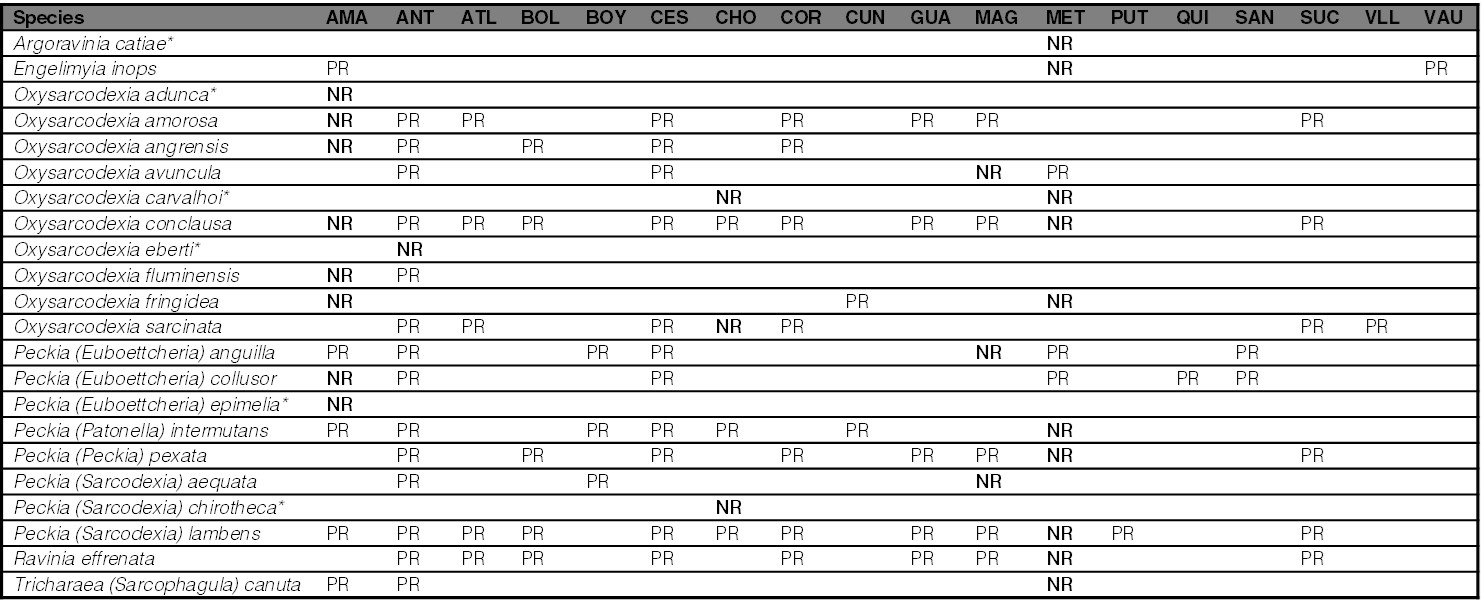
Table II.
List of Sarcophagidae species with new records for Colombia and departments in the country, and their known distribution.
Colombian departments are abbreviated as follow: AMA: Amazonas; ANT: Antioquia; ATL: Atlántico; BOL: Bolívar; BOY: Boyacá; CAL: Caldas; CES: Cesar; CHO: Chocó; COR: Córdoba; CUN: Cundinamarca; GUA: La Guajira; MAG: Magdalena; MET: Meta; PUT: Putumayo; QUI: Quindío; SAN: Santander; SUC: Sucre; TOL: Tolima; VLL: Valle del Cauca; VAU: Vaupés. References = * species recorded for the first time for Colombia; NR: new records; PR: previous record.
Peckia (Euboettcheria) Anguilla (Curran & Walley, 1934)
Material examined: 1 male, site 3 (Table I).
Distribution. Neotropical: Argentina, Bolivia, Brazil, Colombia (Table II), Costa Rica, Guyana, Mexico, Nicaragua, Panama, Peru, Trinidad & Tobago.
Peckia (Euboettcheria) collusor (Curran & Walley, 1934)
Material examined: 8 males, sites 22-24, 26, 28, 30 (Table I).
Distribution. Neotropical: Argentina, Bolivia, Brazil, Colombia (Table II), Costa Rica, Ecuador, Guyana, Panama, Peru, Trinidad & Tobago, Venezuela.
Peckia (Euboettcheria) epimelia (Lopes, 1938)
Material examined: 1 male, site 21 (Table I).
Distribution. Neotropical: Brazil, Colombia (Table II), Ecuador.
Peckia (Patonella) intermutans (Walker, 1861)
Material examined: 4 males, sites 13, 15, 16 (Table I).
Distribution. Neotropical: Argentina, Belize, Brazil, Colombia (Table II), Costa Rica, Ecuador, Guatemala, Guyana, Honduras, Mexico, Nicaragua, Panama, Paraguay, Peru, St. Lucia, Trinidad & Tobago, Venezuela.
Peckia (Peckia) pexata (Wulp, 1895)
Material examined: 7 males, sites 10, 12 (Table I).
Distribution. Nearctic: USA; Neotropical: Argentina, Barbados, Brazil, Colombia (Table II), Costa Rica, Ecuador, El Salvador, Guatemala, Mexico, Nicaragua, St. Lucia, St. Vincent and the Grenadines, Trinidad & Tobago, Venezuela.
Peckia (Sarcodexia) aequata (Wulp, 1895)
Material examined: 1 male, site 4 (Table I).
Distribution. Neotropical: Bolivia, Brazil, Colombia (Table II), Ecuador, Mexico, Panama, Peru, Venezuela.
Peckia (Sarcodexia) chirotheca (Hall, 1933)
Material examined: 1 male, site 6 (Table I).
Distribution. Neotropical: Belize, Colombia (Table II), Costa Rica, Panama, Venezuela.
Peckia (Sarcodexia) lambens (Wiedemann, 1830)
Material examined: 3 males, sites 9, 11, 12 (Table I).
Distribution. Nearctic: USA; Neotropical: Argentina, Bahamas, Bolivia, Brazil, Cayman Is., Chile, Colombia (Table II), Costa Rica, Cuba, Ecuador, El Salvador, Guadeloupe, Guyana, Haiti, Honduras, Jamaica, Mexico, Panama, Paraguay, Peru, Puerto Rico, St. Vincent and the Grenadines, Trinidad & Tobago, Venezuela; Australasian/Oceanian: Cook Is., French Polynesia.
Ravinia effrenata (Walker, 1861)
Material examined: 1 male, site 10 (Table I).
Distribution. Nearctic: USA; Neotropical: Bahamas, Colombia (Table II), Costa Rica, Cuba, Dominica, El Salvador, Guatemala, Jamaica, Panama, Peru.
Tricharaea (Sarcophagula) canuta (Wulp, 1896)
Material examined: 4 males, sites 10, 11, 14 (Table I).
Distribution. Nearctic: USA; Neotropical: Brazil, Colombia (Table II), Costa Rica, Cuba, Dominica, Ecuador, El Salvador, Guatemala, Honduras, Jamaica, Mexico, Paraguay.
This study provides 22 new geographic records of Sarcophaginae in Colombia, South America, including species recorded for the first time for the country, and advances towards the knowledge of flesh fly diversity from Colombia. In particular, it increases the knowledge of the sarcophagid fauna in unexplored regions far from large urban centers such as Chocó and Meta departments. As a result, the number of known species of Colombian Sarcophaginae increased to 109. The most diverse genera registered in the country were Oxysarcodexia (31 species) and Peckia (27 species). These genera are common in the Neotropical Region and are represented by a large number of species.
Colombia is a country having various geographical regions and climates with diverse environments. Therefore, the actual number of sarcophagid species should be substantially higher than the one mentioned here.
Acknowledgments
We thank members of the Bioforense research group that performed field collections. The authors also wish to thank Dr. Pablo Mulieri for his valuable comments that significantly improved the manuscript. We acknowledge financial support provided by the Comité para el Desarrollo de la Investigación -CODEI- belonging to the Tecnológico de Antioquia.
REFERENCES
Amat, E., Ramírez-Mora, M.A., Buenaventura, E., & Gómez-Piñerez, L. (2013) Variación temporal de la abundancia en familias de moscas carroñeras (Diptera, Calyptratae) en un valle andino antropizado de Colombia. Acta Zoológica Mexicana (nueva serie), 29, 463-472.
Barrios, M.,& Wolff, M. (2011) Initial study of arthropods succession and pig carrion decomposition in two freshwater ecosystems in the Colombian Andes. Forensic Science International, 212, 164-172.
Buenaventura, E., Camacho, G., García, A., & Wolff, M. (2009) Sarcophagidae (Diptera) de importancia forense en Colombia: claves taxonómicas, notas sobre su biología y distribución. Revista Colombiana de Entomología, 35, 189-196.
Buenaventura, E., & Pape, T. (2013) Revision of the New World genus Peckia Robineau-Desvoidy (Diptera: Sarcophagidae). Zootaxa ,3622, 1-87.
Buenaventura, E., & Pape, T. (2018) Phylogeny, evolution and male terminalia functionality of Sarcophaginae (Diptera: Sarcophagidae). Zoological Journal of the Linnean Society, 183, 808-906.
Buenaventura, E., Valverde-Castro, C., Wolff, M., Triana-Chavez, O., & Gómez-Palacio, A. (2018) DNA barcoding for identifying synanthropic flesh flies (Diptera, Sarcophagidae) of Colombia. Acta Tropica, 182, 291-297.
Carvalho, C.J., & Mello-Patiu, C.A. (2008) Key to the adults of the most common forensic species of Diptera in South America. Revista Brasileira de Entomologia, 52, 390-406.
Carvalho Filho, F., & Esposito, M.C. (2012) Revision of Argoravinia Townsend (Diptera: Sarcophagidae) of Brazil with the description of two new species. Zootaxa, 3256, 1-26.
Dufek, M., Mello-Patiu, C.A., & Mulieri, P.R. (2020) Inventory of Sarcophaginae (Diptera: Sarcophagidae) for the Humid Chaco, a poorly surveyed ecoregion of South America.Journal of Natural History, 54, 367-403.
Guimarães, H. (2004) Redescrição dos machos de dez espécies neotropicais de Ravinia Robineau-Desvoidy, 1863 (Diptera, Sarcophagidae). Arquivos do Museu Nacional, 62, 45-66.
Martinez, E., Duque, P., & Wolff, M. (2007) Succession pattern of carrion-feeding insects in Paramo, Colombia. Forensic Science International, 166, 182-189.
Mello-Patiu, C.A. (2016) Family Sarcophagidae. Zootaxa, 4122, 884-903.
Pape, T. (1996) Catalogue of the Sarcophagidae of the world (Insecta: Diptera). Memoirs on Entomology, International, ., 1-558.
Pape, T., Blagoderov, V., & Mostovski, M.B. (2011) Order Diptera Linnaeus, 1758. In: Zhang, Z.-Q. (Ed.), Animal biodiversity: An outline of higher-level classification and survey of taxonomic richness. Zootaxa, 3148, 222-229.
Pape, T., & Mello-Patiu, C.A. (2006) Revision of Engelimyia Lopes, 1975 (Diptera: Sarcophagidae). Zootaxa, 1256, 21-47.
Pape, T., Wolff, M., & Amat, E. (2004) Los califóridos, éstridos, rinofóridos y sarcofágidos (Diptera: Calliphoridae, Oestridae, Rhinophoridae, Sarcophagidae) de Colombia. Biota Colombiana, ., 201-208.
Pérez, S., Duque, P., & Wolff, M. (2005) Successional behavior and occurrence matrix of carrion-associated arthropods in the urban area of Medellín, Colombia. Journal of Forensic Science, 50, 1-7.
Ramírez-Mora, M.A., Buenaventura, E., Gómez-Piñerez, L., & Amat, E. (2012) Updated checklist and new records of Calyptratae carrion flies (Diptera, Schizophora) from Valle de Aburrá and other localities in Colombia. Entomotropica, 27, 27-35.
Ramos-Pastrana, Y., Velasquez-Valencia, A., & Wolff, M. (2014) Preliminary study of insects associated to indoor body decay in Colombia. Revista Brasileira de Entomologia, 58, 326-332.
Souza, C.M., & Buenaventura, E. (2016) Three new species of Oxysarcodexia Townsend (Diptera: Sarcophagidae) from the Colombian Andes. Zootaxa, 4084, 115-124.
Souza, C.M., Pape, T., & Thyssen, P.J. (2020) Oxysarcodexia Townsend, 1917 (Diptera: Sarcopagidae)-a centennial conspectus. Zootaxa, 4841, 1-126.
Vairo, K.P., Mello-Patiu, C.A., & Carvalho, C.J. (2011) Pictorial identification key for species of Sarcophagidae (Diptera) of potential forensic importance in southern Brazil. Revista Brasileira de Entomologia, 55, 333-347.
Vairo, K.P., Ururahy-Rodrigues, A., Osvaldo, M., & Mello-Patiu, C.A. (2014) Sarcophagidae (Diptera) with forensic potential in Amazonas: a pictorial key. Tropical Zoology, 27, 140-152.
Valverde-Castro, C., Buenaventura, E., Sánchez-Rodríguez, J.D., & Wolff, M. (2017) Flesh flies (Diptera: Sarcophagidae: Sarcophaginae) from the Colombian Guajira biogeographic province, an approach to their ecology and distribution. Zoologia, 34, e12277.
Wolff, M., Uribe, A., Ortiz, A., & Duque, A. (2001) A preliminary study of forensic entomology in Medellín, Colombia. Forensic Science International, 120, 53-59.
Yepes-Gaurisas, D., Sánchez-Rodríguez, J.D., Mello-Patiu, C.A., & Wolff, M. (2013) Synanthropy of Sarcophagidae (Diptera) in La Pintada, Antioquia-Colombia. Revista de Biología Tropical,61, 1275-1287.