Notas
An unusual worker morph of Diacamma ceylonense Emery, 1897 (Hymenoptera: Formicidae)
Una forma inusual de obrera de Diacamma ceylonense Emery, 1897 (Hymenoptera: Formicidae)
 Shahid A. AKBAR kingakbarali@gmail.com
Himender BHARTI himenderbharti@gmail.com
Shahid A. AKBAR kingakbarali@gmail.com
Himender BHARTI himenderbharti@gmail.com
An unusual worker morph of Diacamma ceylonense Emery, 1897 (Hymenoptera: Formicidae)
Revista de la Sociedad Entomológica Argentina, vol. 81, núm. 3, 2022
Sociedad Entomológica Argentina
Recepción: 02 Junio 2022
Aprobación: 24 Junio 2022
Resumen: Se reporta una forma inusual de obrera de Diacamma ceylonense Emery, 1897, procedente de los Ghats occidentales de la India. La literatura mirmecológica abunda en este tipo de anomalías; sin embargo, este es el primer registro de este tipo para este género. Se informa y discute aquí una anormalidad teratológica asimétrica que se manifiesta en la antena derecha como una forma aberrante.
Palabras clave: Anomalía teratológica, Hormigas, India, Ponerinae.
Abstract: An intriguing worker morph of Diacamma ceylonense Emery, 1897 is reported here from the Western Ghats of India. Myrmecological literature abounds in such anomalies; however, this is a first such report for this genus. An asymmetrical teratological abnormality manifested in the right antennae as an atrocious form is reported and discussed here.
Keywords: Ants, India, Ponerinae, Teratological abnormality.
The queenless, ponerine ant genus Diacamma Mayr, 1862, sometimes called the “Asian bullet ant”, is a medium sized genus (Zettel et al., 2016; Annagiri, 2021), occurring from India to Australia (Laciny et al., 2015), globally represented by 44 valid species (AntWeb, 2022) and by 13 species in India (Bharti et al., 2016). The workers of this genus are unique in having a pair of novel thoracic appendages called gemmae (Peeters & Billen, 1991). A single gamergate (mated worker, a functional or reproductive queen) per colony, retains these ‘gemmae’ while mutilating (pulling off) those of other workers, soon after the workers eclose from cocoons (Peeters & Higashi, 1989). The origin and evolution of mutilation, its physiological, behavioral and adaptive significance are still not completely been ascertained(Tsuji, 2021). Because of its monomorphic colony, with no alate queens, the species has limited dispersal, restricted geographical range and specialized habitat requirements, resulting in a high degree of endemism (Doums et al., 2002).
Anomalies in ants are of common occurrence, be it genetic, manifested as novel mosaic castes or intersexes (Yang & Abouheif, 2011; Molet et al., 2012), teratological morphological abnormalities or even aberrant freaks (Creighton, 1928). Ants being social have close association among individuals, which can promote frequent parasitisation or rapid spread of infected cases, but are far less affected by abnormalities in an embryological or developmental sense (López & Ortuño 1992). With frequent foraging needs, ants are susceptible to injuries and other traumatic deformities (Gilad et al., 2021). At times, it becomes difficult to properly determine and categorise the cause of aberrant malformations among individuals.
Traumatic teratology in ants is usually manifested as monstrous asymmetrical deformations (often symmetrical in case of parasitogenic origin) among individuals (Czechowski et al., 2008), and has always attracted a lot of attention (Balazuc, 1958). Being so frequent in historical empirical data, it is probable that such occurrences do not occur by chance (López & Ortuño, 1992). Selective pressure on disfavoured anomalous individuals is reduced because of high brood care, increasing their survival and occurrence. Additionally, mandibular traumatism, frequent shifting of workers, and large sampling numbers, may favour frequent anomaly mentions in ants compared with non social insects (López & Ortuño, 1992).
Among ants, most of the anomalies have been reported in the subfamily Myrmicinae (Czechowski et al., 2008). Review on ant injuries, also suggested myrmicines to be more prone to these, compared with other ants (Gilad et al., 2021). Only few injuries and anomalies among ponerines have been reported so far (AntWeb, 2022). Here, we report a case of a curious morphological anomaly in a ponerine ant genus Diacamma. This is perhaps the first such mention of the structural traumatic anomaly for the genus. We discuss possible reasons for such anomaly in light of the available literature.
Various localities in the Western Ghats of India were surveyed between the years 2010 and 2013, which resulted in more than 173 species of ants belonging to 65 genera being captured (Dad et al., 2019). Among these, three species belonging to the genus Diacamma were also identified, D. assamense Emery, 1897, D. ceylonense Emery, 1897 and D. scalpratum (Smith, F., 1858). The teratological specimen of D. ceylonense Emery, 1897 was collected from India, Kerala, Silent Valley National park near Badriya Juma Masjid, Mukkali (11.0618N, 76.5390E), 700 m.a.s.l., 25.ix.2011. After revisiting the place and studying the collected samples with relative detail, no other abnormal specimen was found. Taxonomic analysis was conducted using a Nikon SMZ 1500 stereo zoom microscope installed with a digital camera (MP evolution). Digital stacked images were processed using Auto-Montage (Syncroscopy, Division of Synoptics, Ltd.) software and Adobe Photoshop CS6. Terminology for measurements follow Zettel et al. (2016) and include:
TL. Total outstretched length of a specimen, from mandibular apex to gastral apex.
HL. Maximum length of head capsule from anterior clypeal margin to mid-point of posterior head margin in full-face view.
HW. Maximum width of head in full-face view.
EL. Maximum length of eye as measured in oblique view of the head to show full surface of eye.
WL. Weber’s length of mesosoma, measured in lateral view from the anterior surface of the pronotum (excluding the collar) to the posterior margin of the propodeal lobes.
PL. Maximum length of petiole from anterior process to posterior-most point of tergite, where it articulates with helcium.
Diacamma ceylonense Emery, 1897
The Sri Lankan queenless ant Diacamma ceylonense is a widespread species of Indomalaya region (so far reported from India and Sri Lanka only), collected frequently from average elevations of about 540 meters (Bharti et al., 2016; Dias et al., 2020; AntWeb, 2022). This is a moderately large, slender species (TL 12.2–13.5 mm), characterized among congeners by the vertical striation of the metapleura (vs. horizontal or oblique striation in others) in addition to petiolar process posteriorly with reduced tooth and gaster tergites 1 and 2 with fine and dense longitudinal striation (Zettel et al., 2016). The teratological specimen of D. ceylonense complies well with the general description, but is smaller (TL 10 mm, HL 2.61, HW 1.80, EL 0.53, WL 3.70, PL 1.10), and the body striations are less pronounced. The scape of the right antennae is extremely reduced, unusual, with deformed joint, between the scape and the rest of the antennal segments (Fig. 1 a-e).
The gena on the same side, close to the eye, has an indentation or wound; a similar but somewhat smaller scar is also present along the dorsal side near the thorax ‘gemmae’; all these marks or indentations suggest some sort of injury, presumably incurred during development. However, it cannot be ruled out that the reported anomaly may have a possible genetic background, but with only a single available specimen, this unfortunately cannot be ascertained. This unusual form was not observed while collecting the specimen and consequently, no field notes were made impeding any attempt to look for possible causes of the injury, which could have occurred during an intent of mutilation between con-specifics. This assumption comes from nest observations of nest-mate recognition behaviours during the same survey but from another location, which was not formally recorded (Fig. 1 f-g).
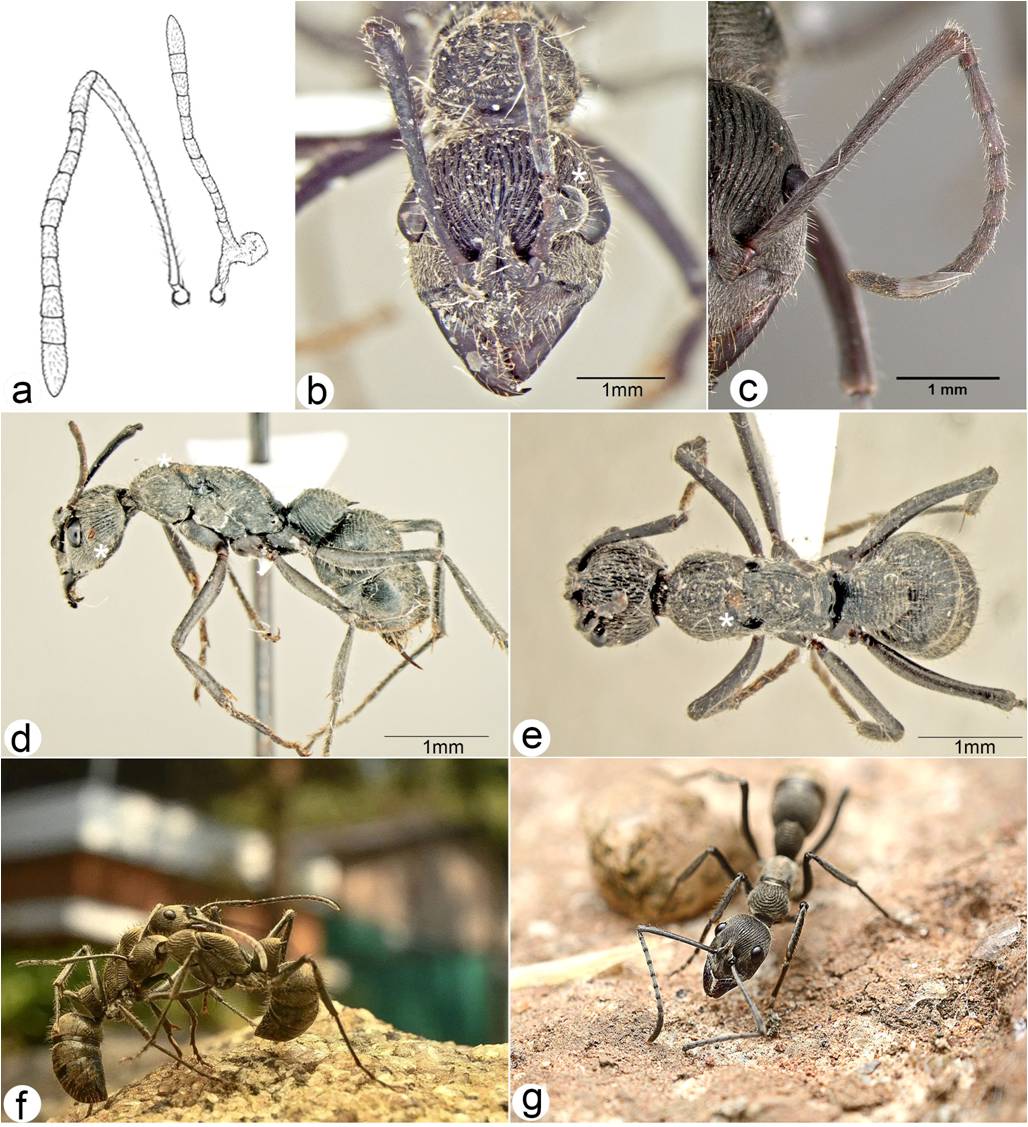
Fig. 1.
Diacamma ceylonense Emery, 1897. Worker (a) normal and deformed antennae, line diagram; (b) head, frontal view in teratological specimen; (c) antennae in normal AntWeb specimen, CASENT0003158 (Photograph courtesy of April Nobile); (d) habitus, lateral view in teratological specimen (e) habitus, dorsal view in teratological specimen; (f–g) antennae usage in nest-mate recognition and foraging. White asterisk marks deformation. Images (f–g) courtesy of Mr. Manoj Vembayam..
Agradecimientos
The first author would like to thank various forest officials of Western Ghats division for their great help during the field surveys. We are grateful to the team of AntWeb and Manoj Vembayam, Kerala, India, for allowing the use of their images. We thank Sumana Annagiri (Department of Biological Sciences, IISER Kolkata) for sharing the relevant literature. We also thank our anonymous reviewers for helpful comments and suggestions.
REFERENCES
Annagiri, S. (2021). Diacamma. Encyclopedia of Social Insects. (ed. Starr, C.K.), pp. 325–330. Springer, Cham. https://doi.org/10.1007/978-3-030-28102-1_35
AntWeb (2022). Version 8.72.4. California Academy of Science, online at https://www.antweb.org. Accessed 9 March 2022.
Balazuc, J. (1958) La teratologie des Hymenopteroides. Annales Societe Entomologique France, 127, 167–203.
Bharti, H., Guénard, B., Bharti, M., & Ecomono, E.P. (2016) An updated checklist of the ants of India with their specific distributions in Indian states (Hymenoptera: Formicidae). ZooKeys, 551, 1–83. https://doi.org/10.3897/zookeys.551.6767
Creighton, W.S. (1928) Notes on three abnormal ants. Psyche, 35, 51–55.
Czechowski, W., Radchenko, A. & Slipinski, P. (2008) An unusual worker morph of Myrmica rugulosa Nyl. (Hymenoptera: Formicidae). North-Western Journal of Zoology, 4, 42–49.
Dad, J.M., Akbar, S.A., Bharti, H. & Wachkoo, A.A. (2019) Community structure and ant species diversity across select sites of Western Ghats, India. Acta Ecologica Sinica, 39, 219–228. https://doi.org/10.1016/j.chnaes.2018.12.008
Dias, R.K.S., Guénard, B., Akbar, S.A., Economo, E.P., Udayakantha, W.S. & Wachkoo, A.A. (2020) The Ants (Hymenoptera, Formicidae) of Sri Lanka: a taxonomic research summary and updated checklist. ZooKeys, 967, 1–142. https://doi.org/10.3897/zookeys.967.54432
Doums, C., Cabrera, H. & Peeters, C. (2002) Population genetic structure and male-biased dispersal in the queenless ant Diacamma cyaneiventre. Molecular Ecology, 11, 2251–2264. https://doi.org/10.1046/j.1365-294X.2002.01619.x
Gilad, T., Dorfman, A., Subach, A. & Scharf, I. (2021) Leg or antenna injury in Cataglyphisants impairs survival but does not hinder searching for food. Current Zoology, 68, 1–18. https://doi.org/10.1093/cz/zoab027
Laciny, A., Pal, A. & Zettel, H. (2015) Taxonomic notes on the ant genus Diacamma Mayr, 1862 (Hymenoptera: Formicidae), part 1. Zeitschrift der Arbeitsgemeinschaft Österreichischer Entomologen, 67, 83–136.
López, F. & Ortuño, V.M. (1992) Five teratological cases in Tetramorium Mayr and Leptothorax Mayr, and some comments on the incidence of teratologies in ants. Entomologist,111, 123–133.
Molet, M., Wheeler, D.E. & Peeters, C. (2012) Evolution of novel mosaic castes in ants: modularity, phenotypic plasticity, and colonial buffering. American Naturalist, 180, 328–341. https://doi.org/10.1086/667368.
Peeters, C. & Billen, J. (1991) A novel exocrine gland inside the thoracic appendages (‘gemmae’) of the queenless ant Diacamma australe. Experientia, 47, 229–231.
Peeters, C. & Higashi, S. (1989) Reproductive dominance controlled by mutilation in the queenless ant Diacamma australe. Naturwissenschaften,76, 177–180.
Tsuji, K. (2021) Reproductive differentiation and conflicts in Diacamma: A model system for integrative sociobiology. Asian Myrmecology, 13, e013007. https://doi.org/10.20362/am.013007
Yang, A.S. & Abouheif, E. (2011) Gynandromorphs as indicators of modularity and evolvability in ants. Journal of Experimental Zoology Part B: Molecular and Developmental Evolution, 316, 313–318. https://doi.org/10.1002/jez.b.21407
Zettel, H., Pal, A. & Laciny, A. (2016). Taxonomic notes on the ant genus Diacamma Mayr, 1862 (Hymenoptera: Formicidae), part 2. Zeitschrift der Arbeitsgemeinschaft Österreichischer Entomologen, 68, 129–168.
Notas de autor
aijaz_shoorida@yahoo.co.in